Natural selection · 自然选择
| English | 中文 | Pinyin · 拼音 |
|---|---|---|
| adapted/əˈdæptɪd/ | 适应 | shì yìng |
| peppered moth/ˈpepəd mɒθ/ | 桦尺蛾 | huà chǐ é |
| stabilising/ˈsteɪbəlaɪzɪŋ/ | 稳定选择 | wěn dìng xuǎn zé |
| directional/daɪˈrekʃənl/ | 定向 | dìng xiàng |
| disruptive/dɪsˈrʌptɪv/ | 分裂 | fēn liè |
| antibiotic resistance/ˌæntɪbaɪˈɒtɪk rɪˈzɪstəns/ | 抗生素抗性 | kàng shēng sù kàng xìng |
Survival of the fittest
- A population makes far more offspring than can survive.
- So they compete — and the best adapted 适应 win.
- Over generations, the helpful alleles spread.
适者生存
- 一个群体产生远 多于 能存活的 后代。
- 所以它们 竞争——而最好地 适应 的获胜。
- 经过许多代,有帮助的等位基因传播开。
Natural selection acts on the variation that already exists in a population. · 自然选择作用于一个群体中已经存在的变异。
It cannot create variation; it selects from what is already there (mutation creates the new variation). · 它不能创造变异;它从已经存在的东西中选择(突变创造新的变异)。
The process
- More offspring are born than can survive, so they compete for food and space — the "struggle for existence".
- The best-adapted individuals are most likely to survive, reproduce, and pass on their alleles.
- Over many generations, the helpful alleles become more common.
- The peppered moth 桦尺蛾 shows this: the form that is best camouflaged on the bark is eaten less, so it becomes more common.
这个过程
- 出生的后代比能存活的多,所以它们为食物和空间竞争——“生存斗争”。
- 最好地 适应 的个体最可能 存活、繁殖 并传递它们的等位基因。
- 经过许多代,有帮助的等位基因变得 更常见。
- 桦尺蛾(peppered moth) 展示了这一点:在树皮上伪装得最好的形态被吃得更少,所以它变得更常见。
Natural selection · 自然选择
Step through Darwin's idea: variation + a selection pressure means the best-adapted survive and pass on their alleles. · 一步步走过达尔文的想法:变异 + 一个选择压力意味着最好地适应的存活并传递它们的等位基因。
In natural selection, which individuals are most likely to pass on their alleles? · 在自然选择中,哪些个体最可能传递它们的等位基因?
The best-adapted individuals survive, reproduce, and pass on their helpful alleles, which spread over generations. · 最好地适应的个体存活、繁殖并传递它们有帮助的等位基因,这些等位基因经过许多代传播。
The peppered moth shows natural selection because: · 桦尺蛾展示自然选择,因为:
Birds eat the moth that stands out; the better-camouflaged form survives and increases in frequency. · 鸟吃显眼的蛾;伪装更好的形态存活并在频率上增加。
Put natural selection in order. · 把自然选择按顺序排列。
Variation → pressure → differential survival → reproduction → the allele frequency changes. · 变异 → 压力 → 差别存活 → 繁殖 → 等位基因频率改变。
Three types of selection
- stabilising 稳定选择 — favours the average, removes the extremes (population stays the same).
- directional 定向 — favours one extreme, so the mean shifts that way.
- disruptive 分裂 — favours both extremes, removes the average.
三种选择类型
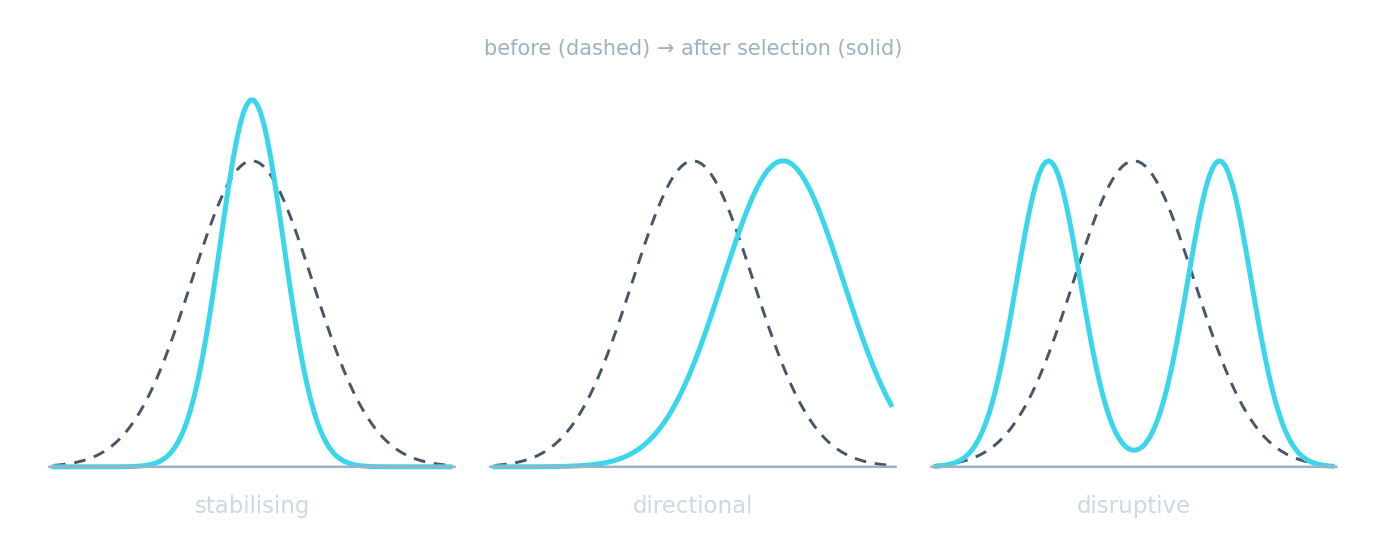
- 稳定选择(stabilising)——偏好平均,移除极端(群体保持不变)。
- 定向选择(directional)——偏好一个极端,所以平均值朝那个方向移动。
- 分裂选择(disruptive)——偏好两个极端,移除平均。
Directional selection: · 定向选择:
Directional selection favours one extreme, shifting the population mean in that direction. · 定向选择偏好一个极端,把群体平均值朝那个方向移动。
Match each type of selection to what it does to the distribution. · 把每种选择类型与它对分布做的事配对。
Directional shifts the mean, stabilising narrows it, disruptive splits it — all by selecting from existing variation. · 定向移动平均值,稳定收窄它,分裂把它分开——都通过从现有的变异中选择。
Disruptive selection: · 分裂选择:
Disruptive selection favours both extremes, splitting the distribution into two peaks. · 分裂选择偏好两个极端,把分布分成两个峰。
Selection we can watch
- Antibiotic resistance 抗生素抗性 is natural selection happening fast enough to observe.
Worked example. Antibiotics kill non-resistant bacteria; the few resistant ones survive and multiply. Within days a resistant population dominates — selection in real time.
The peppered moth: birds eat the form that stands out, so camouflage is selected for.
我们能观察到的选择
- 抗生素抗性 是发生得快到足以观察的自然选择。
例题。 抗生素杀死没有抗性的细菌;少数有抗性的存活并繁殖。几天之内一个有抗性的群体占主导——实时的选择。

桦尺蛾:鸟吃显眼的形态,所以伪装被选择。
You've got it
- overproduction → competition → the best-adapted survive and reproduce → helpful alleles spread
- the peppered moth: better camouflage = eaten less = more common
- stabilising (favours average), directional (shifts mean), disruptive (favours both extremes)
你掌握了
- 过度繁殖 → 竞争 → 最好地 适应 的存活并繁殖 → 有帮助的等位基因传播
- 桦尺蛾:更好的伪装 = 被吃得更少 = 更常见
- 稳定(偏好平均)、定向(移动平均值)、分裂(偏好两个极端)