IGCSE Toán học (0580) bao gồm số học, đại số và đồ thị, hình học tọa độ, hình học, tính toán hình học, hàm lượng giác, phép biến đổi và vector, xác suất và thống kê.
Việc đăng ký chia thành Nền tảng (Core) và Nâng cao (Extended), và chương trình Nâng cao mở rộng đáng kể hơn về đại số và hàm lượng giác — hãy xác định cấp độ của bạn trước khi chọn nội dung để luyện tập.
Điểm phương pháp được trao cho phần trình bày lời giải. Một đáp số sai có thể vẫn đạt được nhiều điểm nếu quá trình giải rõ ràng, và một đáp số đúng nhưng không có quá trình giải có thể đạt được ít điểm hơn. Viết từng dòng không phải là sự gọn gàng — đó là điểm số.
This handout covers Topic 1, Number. Cambridge Maths has two levels: Core and Extended. Parts marked (Extended) are only tested on the Extended papers; everything else is for both levels.
Tiếng Việt
Tài liệu này bao gồm Chủ đề 1, Số. Cambridge Maths có hai mức độ: Core (Cốt lõi) và Extended (Nâng cao). Các phần được đánh dấu (Extended) chỉ kiểm tra trong đề nâng cao; mọi phần còn lại áp dụng cho cả hai mức độ.
1.1
Types of number · Các loại số
Syllabus · Chương trình
English
Subject content
Notes and examples
Identify and use: • natural numbers • integers (positive, zero and negative) • prime numbers • square numbers • cube numbers • common factors • common multiples • rational and irrational numbers • reciprocals.
Example tasks include: • convert between numbers and words, e.g. six billion is 6000000000 10007 is ten thousand and seven • express 72 as a product of its prime factors • find the highest common factor (HCF) of two numbers • find the lowest common multiple (LCM) of two numbers.
Tiếng Việt
Nội dung môn học
Ghi chú và ví dụ
Nhận diện và sử dụng: • số tự nhiên • số nguyên (dương, không và âm) • số nguyên tố • số chính phương • số lập phương • ước chung • bội chung • số hữu tỷ và vô tỷ • số nghịch đảo.
Các nhiệm vụ ví dụ bao gồm: • chuyển đổi giữa số và chữ, ví dụ sáu tỷ là 6000000000; 10007 là mười nghìn lẻ bảy • biểu diễn 72 dưới dạng tích các thừa số nguyên tố • tìm Ước chung lớn nhất (UCLN) của hai số • tìm Bội chung nhỏ nhất (BCNN) của hai số.
Source: Cambridge International syllabus · Nguồn: Chương trình Cambridge International
English
You must know the words for the different kinds of number. Examiners give marks for using them correctly.
A factor 因数 of a number divides into it exactly, leaving no remainder 余数. The factors of $18$ are $1, 2, 3, 6, 9, 18$.
A multiple 倍数 of a number is that number times an integer. Multiples of $6$ are $6, 12, 18, 24, \dots$
A common factor 公因数 of two numbers is a factor of both.
A common multiple 公倍数 of two numbers is a multiple of both.
Prime, square and cube numbers
A prime number 质数 has exactly two factors: $1$ and itself. The first primes are $2, 3, 5, 7, 11, 13, \dots$ Note that $1$ is not prime.
A square number 平方数 is a whole number times itself: $1, 4, 9, 16, 25, \dots$
A cube number 立方数 uses a whole number three times: $1, 8, 27, 64, \dots$
Rational, irrational and reciprocal
A rational number 有理数 can be written as a fraction 分数$\frac{a}{b}$ of two integers. Examples: $\frac{3}{4}$, $5$, $0.7$.
An irrational number 无理数 cannot be written this way. Examples: $\pi$ and $\sqrt{2}$.
The reciprocal 倒数 of a number is $1$ divided by that number. The reciprocal of $4$ is $\frac{1}{4}$; the reciprocal of $0.25$ is $4$; the reciprocal of $\frac{2}{3}$ is $\frac{3}{2}$.
Prime factors, HCF and LCM
Every integer above $1$ is prime, or can be written as a product 乘积 of prime numbers. To write a number as a product of its prime factors 质因数, keep dividing by the smallest prime that fits.
Worked example. Write $72$ as a product of its prime factors.
The highest common factor (HCF) 最大公因数 of two numbers is the largest factor they share. The lowest common multiple (LCM) 最小公倍数 is the smallest multiple they share. Prime factors give a quick method.
Worked example. Find the HCF and LCM of $72$ and $120$.
HCF: take the lowest power of each prime that appears in both: $2^{3} \times 3 = 24$.
LCM: take the highest power of every prime that appears: $2^{3} \times 3^{2} \times 5 = 360$.
Tiếng Việt
Bạn phải biết tên gọi của các loại số khác nhau. Giám khảo chấm điểm nếu bạn sử dụng chúng chính xác.
Mỗi tập hợp nằm bên trong tập hợp tiếp theo: mọi số tự nhiên đều là số nguyên, mọi số nguyên đều là số hữu tỷ, mọi số hữu tỷ đều là số thực. Số vô tỷ là số thực nhưng không phải số hữu tỷ.
Số đếm và số nguyên
natural numbers (số tự nhiên) — các số đếm $1, 2, 3, 4, \dots$
integers (số nguyên) — số nguyên dương, âm hoặc không: $\dots, -2, -1, 0, 1, 2, \dots$
Ước và bội
Một factor (ước) của một số chia hết vào nó mà không để lại remainder (dư số). Các ước của $18$ là $1, 2, 3, 6, 9, 18$.
Một multiple (bội) của một số là số đó nhân với một số nguyên. Các bội của $6$ là $6, 12, 18, 24, \dots$
Một common factor (Ước chung) của hai số là ước của cả hai số đó.
Một common multiple (Bội chung) của hai số là bội của cả hai số đó.
Số nguyên tố, số chính phương và số lập phương
Một prime number (số nguyên tố) có đúng hai ước: $1$ và chính nó. Các số nguyên tố đầu tiên là $2, 3, 5, 7, 11, 13, \dots$ Lưu ý rằng $1$không phải là số nguyên tố.
Một square number (số chính phương) là số nguyên nhân với chính nó: $1, 4, 9, 16, 25, \dots$
Một cube number (số lập phương) sử dụng một số nguyên ba lần: $1, 8, 27, 64, \dots$
Số hữu tỷ, số vô tỷ và nghịch đảo
Một số hữu tỷ có thể được viết dưới dạng phân số$\frac{a}{b}$ của hai số nguyên. Ví dụ: $\frac{3}{4}$, $5$, $0.7$.
Một irrational number (số vô tỷ) không thể được viết theo cách này. Ví dụ: $\pi$ và $\sqrt{2}$.
Reciprocal (nghịch đảo) của một số là $1$ chia cho số đó. Nghịch đảo của $4$ là $\frac{1}{4}$; nghịch đảo của $0.25$ là $4$; nghịch đảo của $\frac{2}{3}$ là $\frac{3}{2}$.
Ước nguyên tố, Ước chung lớn nhất và Bội chung nhỏ nhất
Mọi số nguyên lớn hơn $1$ đều là số nguyên tố, hoặc có thể được viết dưới dạng product (tích) của các số nguyên tố. Để viết một số dưới dạng tích các prime factors (ước nguyên tố), hãy liên tục chia cho số nguyên tố nhỏ nhất phù hợp.
Ví dụ minh họa. Viết $72$ dưới dạng tích các thừa số nguyên tố.
Tiếp tục phân tách cho đến khi mỗi nhánh kết thúc ở một số nguyên tố (được khoanh tròn); việc thu thập chúng sẽ tạo ra $72 = 2^{3} \times 3^{2}$.
Highest common factor (HCF) (Ước chung lớn nhất) của hai số là ước lớn nhất mà chúng cùng chia hết. Lowest common multiple (LCM) (Bội chung nhỏ nhất) là bội nhỏ nhất mà chúng cùng chia hết. Ước nguyên tố cung cấp phương pháp nhanh chóng.
Worked example. Tìm HCF và LCM của $72$ và $120$.
Đầu tiên viết mỗi số dưới dạng tích các số nguyên tố:
HCF: lấy lowest (lũy thừa thấp nhất) của mỗi số nguyên tố xuất hiện trong cả hai: $2^{3} \times 3 = 24$.
LCM: lấy highest (lũy thừa cao nhất) của mọi số nguyên tố xuất hiện: $2^{3} \times 3^{2} \times 5 = 360$.
Explore · Khám phá
Sets of numbers · Các tập hợp số
Every counting number is also an integer, every integer a rational — see how the number sets nest, and how union and intersection combine them. · Mỗi số đếm đều là số nguyên, mỗi số nguyên đều là số hữu tỉ — hãy xem các tập hợp số lồng vào nhau như thế nào, và cách hợp và giao gộp chúng.
Understand and use set language, notation and Venn diagrams to describe sets.
Venn diagrams are limited to two sets. The following set notation will be used: • $n(A)$ Number of elements in set $A$ • $A'$ Complement of set $A$ • $\mathscr{E}$ Universal set • $A \cup B$ Union of $A$ and $B$ • $A \cap B$ Intersection of $A$ and $B$. Example definition of sets: $A = \{x : x \text{ is a natural number}\}$$B = \{a, b, c, \dots\}$$C = \{x : a \leqslant x \leqslant b\}$.
Tiếng Việt
Nội dung môn học
Ghi chú và ví dụ
Hiểu và sử dụng ngôn ngữ tập hợp, ký hiệu và sơ đồ Venn để mô tả các tập hợp.
Sơ đồ Venn bị giới hạn ở hai tập hợp. Các ký hiệu tập hợp sau đây sẽ được sử dụng: • $n(A)$ Số phần tử trong tập hợp $A$ • $A'$ Bùu của tập hợp $A$ • $\mathscr{E}$ Tập hợp toàn phần • $A \cup B$ Hợp của $A$ và $B$ • $A \cap B$ Giao của $A$ và $B$. Ví dụ về định nghĩa tập hợp: $A = \{x : x \text{ is a natural number}\}$$B = \{a, b, c, \dots\}$$C = \{x : a \leqslant x \leqslant b\}$.
English
Subject content
Notes and examples
Understand and use set language, notation and Venn diagrams to describe sets and represent relationships between sets.
Venn diagrams are limited to two or three sets. The following set notation will be used: • $n(A)$ Number of elements in set $A$ • $\in$ "... is an element of ..." • $\notin$ "... is not an element of ..." • $A'$ Complement of set $A$ • $\varnothing$ The empty set • $\mathscr{E}$ Universal set • $A \subseteq B$$A$ is a subset of $B$ • $A \nsubseteq B$$A$ is not a subset of $B$ • $A \cup B$ Union of $A$ and $B$ • $A \cap B$ Intersection of $A$ and $B$. Example definition of sets: $A = \{x : x \text{ is a natural number}\}$$B = \{(x, y) : y = mx + c\}$$C = \{x : a \leqslant x \leqslant b\}$$D = \{a, b, c, \dots\}$.
Tiếng Việt
Nội dung môn học
Ghi chú và ví dụ
Hiểu và sử dụng ngôn ngữ tập hợp, ký hiệu và sơ đồ Venn để mô tả các tập hợp và biểu diễn mối quan hệ giữa các tập hợp.
Sơ đồ Venn chỉ giới hạn ở hai hoặc ba tập hợp. Các ký hiệu tập hợp sau đây sẽ được sử dụng: • $n(A)$ Số lượng phần tử trong tập hợp $A$ • $\in$ "... là một phần tử của ..." • $\notin$ "... không phải là một phần tử của ..." • $A'$ Bù của tập hợp $A$ • $\varnothing$ Tập rỗng • $\mathscr{E}$ Tập vũ trụ • $A \subseteq B$$A$ là tập con của $B$ • $A \nsubseteq B$$A$ không phải là tập con của $B$ • $A \cup B$ Hợp của $A$ và $B$ • $A \cap B$ Giao của $A$ và $B$. Ví dụ định nghĩa về tập hợp: $A = \{x : x \text{ is a natural number}\}$$B = \{(x, y) : y = mx + c\}$$C = \{x : a \leqslant x \leqslant b\}$$D = \{a, b, c, \dots\}$.
Source: Cambridge International syllabus · Nguồn: Chương trình Cambridge International
English
A set 集合 is a collection of objects. Each object in the set is an element 元素 of the set. You should know this notation:
Symbol
Meaning
$n(A)$
the number of elements in set $A$
$x \in A$
$x$ is an element of $A$
$x \notin A$
$x$ is not an element of $A$
$\mathscr{E}$
the universal set 全集 — everything being talked about
$A'$
the complement 补集 of $A$ — everything not in $A$
$\varnothing$
the empty set 空集 — a set with no elements
$A \subseteq B$
$A$ is a subset 子集 of $B$ — every element of $A$ is also in $B$
$A \cup B$
the union 并集 — elements in $A$ or $B$ or both
$A \cap B$
the intersection 交集 — elements in both $A$ and $B$
A Venn diagram 维恩图 draws each set as a circle inside a rectangle (the universal set). Core uses two sets; Extended may use three.
Worked example.$\mathscr{E} = \{1,2,3,4,5,6,7,8,9,10\}$, $A = \{\text{even numbers}\}$, $B = \{\text{multiples of } 3\}$.
$A = \{2,4,6,8,10\}$ and $B = \{3,6,9\}$.
$A \cap B = \{6\}$ — the only number in both.
$A \cup B = \{2,3,4,6,8,9,10\}$ — the numbers in either set.
$n(A \cup B) = 7$.
You may also see a set written as a rule, e.g. $C = \{x : 1 \leqslant x \leqslant 5\}$ means "all values $x$ such that $1 \leqslant x \leqslant 5$".
Tiếng Việt
Một set (tập hợp) là một bộ sưu tập các đối tượng. Mỗi đối tượng trong tập hợp là một element (phần tử) của tập hợp. Bạn nên biết ký hiệu này:
Ký hiệu
Ý nghĩa
$n(A)$
số lượng phần tử trong tập hợp $A$
$x \in A$
$x$ là một phần tử của $A$
$x \notin A$
$x$ không phải là phần tử của $A$
$\mathscr{E}$
universal set (tập hợp vũ trụ) — tất cả những gì đang được bàn đến
$A'$
complement (bù) của $A$ — tất cả những gì không nằm trong $A$
$\varnothing$
empty set (tập rỗng) — một tập hợp không có phần tử nào
$A \subseteq B$
$A$ là một subset (tập con) của $B$ — mọi phần tử của $A$ cũng nằm trong $B$
$A \cup B$
union (hợp) — các phần tử nằm trong $A$ hoặc $B$ hoặc cả hai
$A \cap B$
intersection (giao) — các phần tử nằm trong cả $A$ và $B$
Một Venn diagram (sơ đồ Venn) vẽ mỗi tập hợp bằng hình tròn bên trong hình chữ nhật (tập hợp vũ trụ). Mức Cốt lõi sử dụng hai tập hợp; Mức Nâng cao có thể sử dụng ba.
Ví dụ có lời giải.$\mathscr{E} = \{1,2,3,4,5,6,7,8,9,10\}$, $A = \{\text{even numbers}\}$, $B = \{\text{multiples of } 3\}$.
$A = \{2,4,6,8,10\}$ và $B = \{3,6,9\}$.
$A \cap B = \{6\}$ — số duy nhất xuất hiện trong cả hai tập hợp.
$A \cup B = \{2,3,4,6,8,9,10\}$ — các số thuộc một trong hai tập hợp.
$n(A \cup B) = 7$.
$A \cap B = \{6\}$ là số duy nhất nằm trong cả hai vòng tròn; $A \cup B$ bao gồm tất cả những gì nằm bên trong bất kỳ vòng tròn nào.
Bạn cũng có thể thấy một tập hợp được viết dưới dạng quy tắc, ví dụ: $C = \{x : 1 \leqslant x \leqslant 5\}$ có nghĩa là "tất cả các giá trị $x$ sao cho $1 \leqslant x \leqslant 5$".
Explore · Khám phá
Venn diagrams · Sơ đồ Venn
Tap the regions to see union, intersection and complement — the language of sets. · Nhấn vào các vùng để thấy hợp, giao và phần bù — ngôn ngữ của tập hợp.
Calculate with the following: • squares • square roots • cubes • cube roots • other powers and roots of numbers.
Includes recall of squares and their corresponding roots from 1 to 15, and recall of cubes and their corresponding roots of 1, 2, 3, 4, 5 and 10, e.g.: • Write down the value of $\sqrt{169}$ . • Work out $5^2 \times \sqrt[3]{8}$ .
Tiếng Việt
Nội dung môn học
Ghi chú và ví dụ
Tính toán với các số sau: • bình phương • căn bậc hai • lập phương • căn bậc ba • các lũy thừa và căn khác của số.
Bao gồm việc ghi nhớ bình phương và căn bậc hai tương ứng từ 1 đến 15, và ghi nhớ lập phương cùng căn bậc ba tương ứng của 1, 2, 3, 4, 5 và 10, ví dụ: • Viết giá trị của $\sqrt{169}$ . • Tính $5^2 \times \sqrt[3]{8}$ .
English
Subject content
Notes and examples
Calculate with the following: • squares • square roots • cubes • cube roots • other powers and roots of numbers.
Includes recall of squares and their corresponding roots from 1 to 15, and recall of cubes and their corresponding roots of 1, 2, 3, 4, 5 and 10, e.g.: • Write down the value of $\sqrt{169}$. • Work out $5^2 \times \sqrt[3]{8}$.
Tiếng Việt
Nội dung môn học
Ghi chú và ví dụ
Tính toán với các phép sau: • bình phương • căn bậc hai • lập phương • căn bậc ba • các lũy thừa và căn thức khác của số.
Bao gồm việc ghi nhớ bình phương và căn bậc hai tương ứng từ 1 đến 15, và ghi nhớ lập phương cùng căn bậc ba tương ứng của 1, 2, 3, 4, 5 và 10, ví dụ: • Viết giá trị của $\sqrt{169}$. • Tính $5^2 \times \sqrt[3]{8}$.
Source: Cambridge International syllabus · Nguồn: Chương trình Cambridge International
English
A power 幂 (also called an index 指数, plural indices) shows how many times to multiply a number by itself: $2^{5} = 2 \times 2 \times 2 \times 2 \times 2 = 32$.
A square root 平方根 of a number gives that number when squared: $\sqrt{169} = 13$ because $13^{2} = 169$.
A cube root 立方根 works the same way for cubes: $\sqrt[3]{8} = 2$ because $2^{3} = 8$.
You should be able to recall the squares from $1^2$ to $15^2$ (and their roots), and the cubes of $1, 2, 3, 4, 5$ and $10$.
Worked example. Work out $5^{2} \times \sqrt[3]{8}$.
$$5^{2} \times \sqrt[3]{8} = 25 \times 2 = 50.$$
Tiếng Việt
Một lũy thừa (còn gọi là số mũ, số nhiều số mũ) chỉ ra số lần nhân một số với chính nó: $2^{5} = 2 \times 2 \times 2 \times 2 \times 2 = 32$.
Căn bậc hai của một số khi bình phương sẽ trả lại số đó: $\sqrt{169} = 13$ vì $13^{2} = 169$.
Căn bậc ba hoạt động tương tự đối với lập phương: $\sqrt[3]{8} = 2$ vì $2^{3} = 8$.
Bạn nên nhớ được các bình phương từ $1^2$ đến $15^2$ (và các căn bậc hai của chúng), cũng như các lập phương của $1, 2, 3, 4, 5$ và $10$.
Ví dụ có lời giải. Tính $5^{2} \times \sqrt[3]{8}$.
$$5^{2} \times \sqrt[3]{8} = 25 \times 2 = 50.$$
Explore · Khám phá
Powers and roots lab · Phòng thí nghiệm lũy thừa và căn bậc
square = x^2 · bình phương = x^2
Change the base and see powers grow while roots undo powers. · Thay đổi cơ số và thấy lũy thừa tăng lên trong khi căn bậc undo lũy thừa.
1.7
The laws of indices · Các định luật về số mũ
Syllabus · Chương trình
English
Subject content
Notes and examples
1 Understand and use indices (positive, zero and negative integers).
e.g. find the value of $7^{-2}$.
2 Understand and use the rules of indices.
e.g. find the value of $2^{-3} \times 2^4$, $(2^3)^2$, $2^3 \div 2^4$.
Tiếng Việt
Nội dung môn học
Ghi chú và ví dụ
1 Hiểu và sử dụng chỉ số (số nguyên dương, bằng 0 và âm).
Ví dụ: tìm giá trị của $7^{-2}$.
2 Hiểu và sử dụng các quy tắc về chỉ số.
Ví dụ: tìm giá trị của $2^{-3} \times 2^4$, $(2^3)^2$, $2^3 \div 2^4$.
English
Subject content
Notes and examples
1 Understand and use indices (positive, zero, negative, and fractional).
Examples include: • $6^{\frac{1}{2}} = \sqrt{6}$ • $16^{\frac{1}{4}} = \sqrt[4]{16}$ • find the value of $7^{-2}$, $81^{\frac{1}{2}}$, $8^{-\frac{2}{3}}$.
2 Understand and use the rules of indices.
e.g. find the value of $2^{-3} \times 2^4$, $(2^3)^2$, $2^3 \div 2^4$.
Tiếng Việt
Nội dung môn học
Ghi chú và ví dụ
1 Hiểu và sử dụng lũy thừa (dương, không, âm và phân số).
Ví dụ bao gồm: • $6^{\frac{1}{2}} = \sqrt{6}$ • $16^{\frac{1}{4}} = \sqrt[4]{16}$ • tìm giá trị của $7^{-2}$, $81^{\frac{1}{2}}$, $8^{-\frac{2}{3}}$.
2 Hiểu và sử dụng các quy tắc về chỉ số.
Ví dụ: tìm giá trị của $2^{-3} \times 2^4$, $(2^3)^2$, $2^3 \div 2^4$.
Source: Cambridge International syllabus · Nguồn: Chương trình Cambridge International
English
When you multiply or divide powers of the same base 底数, use these rules:
Ba định luật về số mũ: nhân thì cộng số mũ, chia thì trừ số mũ, lũy thừa của lũy thừa thì nhân số mũ
1.8
Standard form · Số khoa học
Syllabus · Chương trình
English
Subject content
Notes and examples
1 Use the standard form $A \times 10^n$ where $n$ is a positive or negative integer and $1 \leqslant A < 10$.
2 Convert numbers into and out of standard form.
3 Calculate with values in standard form.
Core candidates are expected to calculate with standard form only on Paper 3.
Tiếng Việt
Nội dung môn học
Ghi chú và ví dụ
1 Sử dụng dạng chuẩn $A \times 10^n$ trong đó $n$ là số nguyên dương hoặc âm và $1 \leqslant A < 10$.
2 Chuyển đổi số sang và từ dạng chuẩn.
3 Tính toán với các giá trị ở dạng chuẩn.
Các thí sinh cốt lõi được yêu cầu tính toán với dạng chuẩn chỉ trên Bài thi 3.
English
Subject content
Notes and examples
1 Use the standard form $A \times 10^n$ where $n$ is a positive or negative integer and $1 \leqslant A < 10$.
2 Convert numbers into and out of standard form.
3 Calculate with values in standard form.
Tiếng Việt
Nội dung môn học
Ghi chú và ví dụ
1 Sử dụng dạng chuẩn $A \times 10^n$ trong đó $n$ là số nguyên dương hoặc âm và $1 \leqslant A < 10$.
2 Chuyển đổi số sang và từ dạng chuẩn.
3 Tính toán với các giá trị ở dạng chuẩn.
Source: Cambridge International syllabus · Nguồn: Chương trình Cambridge International
English
Standard form 科学记数法 writes a number as $A \times 10^{n}$, where $1 \leqslant A < 10$ and $n$ is an integer. It is used for very large or very small numbers.
To convert, count how many places the decimal point moves:
$4\,500\,000 = 4.5 \times 10^{6}$ — the point moves $6$ places left, so the power is positive.
$0.00072 = 7.2 \times 10^{-4}$ — the point moves $4$ places right, so the power is negative.
Worked example. Work out $(3 \times 10^{5}) \times (2 \times 10^{-2})$.
Multiply the front numbers and add the powers:
$$3 \times 2 = 6, \qquad 10^{5} \times 10^{-2} = 10^{3}, \qquad \text{so the answer is } 6 \times 10^{3}.$$
Tiếng Việt
Một thiên hà: khoảng cách cực lớn được viết gọn gàng dưới dạng số khoa học.
Số khoa học viết một số dưới dạng $A \times 10^{n}$, trong đó $1 \leqslant A < 10$ và $n$ là một số nguyên. Nó được dùng cho các số rất lớn hoặc rất nhỏ.
Để chuyển đổi, đếm xem dấu phẩy di chuyển bao nhiêu vị trí:
$4\,500\,000 = 4.5 \times 10^{6}$ — dấu phẩy di chuyển $6$ vị trí sang trái, nên số mũ mang dấu dương.
$0.00072 = 7.2 \times 10^{-4}$ — dấu phẩy di chuyển $4$ vị trí sang phải, nên số mũ mang dấu âm.
Ví dụ có lời giải. Tính $(3 \times 10^{5}) \times (2 \times 10^{-2})$.
Nhân các hệ số phía trước và cộng các số mũ:
$$3 \times 2 = 6, \qquad 10^{5} \times 10^{-2} = 10^{3}, \qquad \text{so the answer is } 6 \times 10^{3}.$$
Số khoa học: một số được viết dưới dạng a × 10^n với 1 ≤ a < 10
Explore · Khám phá
Standard form route · Con đường đến dạng chuẩn
Follow a large or small number into a x 10^n form. · Chuyển một số lớn hoặc nhỏ sang dạng a x 10^n.
To rationalise the denominator 分母有理化 means to remove a surd from the bottom of a fraction (the denominator 分母). Multiply the top and bottom by a value that clears the surd.
Worked example. Rationalise $\dfrac{10}{\sqrt{5}}$ and $\dfrac{1}{-1+\sqrt{3}}$.
Rút gọn radical: đưa thừa số vuông lớn nhất ra ngoài
Đào rationalisation (trừ radical) ở mẫu số có nghĩa là loại bỏ radical khỏi phần dưới của phân số (mẫu số). Nhân cả tử và mẫu với một giá trị để triệt tiêu radical.
Ví dụ có lời giải. Rationalise $\dfrac{10}{\sqrt{5}}$ và $\dfrac{1}{-1+\sqrt{3}}$.
rationalise the denominator/ˈræʃənəlaɪz ðə dɪˈnɒmɪneɪtə/
trừ căn ở mẫu
denominator/dɪˈnɒmɪneɪtə/
mẫu số
numerator/ˈnjuːməreɪtə/
tử số
proper fraction/ˈprɒpə ˈfrækʃn/
phân số đơn giản
improper fraction/ɪmˈprɒpə ˈfrækʃn/
phân số giả
mixed number/mɪkst ˈnʌmbə/
hỗn số
1.4
Fractions, decimals and percentages · Phân số, thập phân và phần trăm
Syllabus · Chương trình
English
Subject content
Notes and examples
1 Use the language and notation of the following in appropriate contexts: • proper fractions • improper fractions • mixed numbers • decimals • percentages.
Candidates are expected to be able to write fractions in their simplest form. Candidates are not expected to use recurring decimal notation.
2 Recognise equivalence and convert between these forms.
Candidates are not expected to demonstrate the conversion of a recurring decimal to a fraction and vice versa.
Tiếng Việt
Nội dung môn học
Ghi chú và ví dụ
1 Sử dụng ngôn ngữ và ký hiệu của các dạng sau trong ngữ cảnh thích hợp: • phân số thực • phân số giả • số hỗn hợp • thập phân • phần trăm.
Thí sinh cần có khả năng viết phân số ở dạng tối giản. Thí sinh không yêu cầu sử dụng ký hiệu thập phân vô hạn tuần hoàn.
2 Nhận biết sự tương đương và chuyển đổi giữa các dạng này.
Thí sinh không yêu cầu thể hiện việc chuyển đổi thập phân vô hạn tuần hoàn sang phân số và ngược lại.
English
Subject content
Notes and examples
1 Use the language and notation of the following in appropriate contexts: • proper fractions • improper fractions • mixed numbers • decimals • percentages.
Candidates are expected to be able to write fractions in their simplest form. Recurring decimal notation is required, e.g. • $0.1\dot{7} = 0.1777...$ • $0.1\dot{2}\dot{3} = 0.1232323...$ • $0.\dot{1}2\dot{3} = 0.123123...$
2 Recognise equivalence and convert between these forms.
Includes converting between recurring decimals and fractions and vice versa, e.g. write $0.1\dot{7}$ as a fraction.
Tiếng Việt
Nội dung môn học
Ghi chú và ví dụ
1 Sử dụng ngôn ngữ và ký hiệu của các đối tượng sau trong các ngữ cảnh thích hợp: • phân số thực • phân số giả • số hỗn hợp • thập phân • phần trăm.
Thí sinh cần có khả năng viết phân số ở dạng tối giản. Cần sử dụng ký hiệu thập phân vô hạn tuần hoàn, ví dụ: • $0.1\dot{7} = 0.1777...$ • $0.1\dot{2}\dot{3} = 0.1232323...$ • $0.\dot{1}2\dot{3} = 0.123123...$
2 Nhận biết sự tương đương và chuyển đổi giữa các dạng này.
Bao gồm chuyển đổi giữa số thập phân vô hạn tuần hoàn và phân số và ngược lại, ví dụ: viết $0.1\dot{7}$ dưới dạng phân số.
Source: Cambridge International syllabus · Nguồn: Chương trình Cambridge International
English
A fraction has a numerator 分子 (the top) and a denominator (the bottom).
proper fraction 真分数: numerator smaller than denominator, e.g. $\frac{3}{4}$.
improper fraction 假分数: numerator the same or larger, e.g. $\frac{7}{4}$.
mixed number 带分数: a whole number plus a fraction, e.g. $1\frac{3}{4}$.
Change between improper and mixed: $\frac{7}{4} = 1\frac{3}{4}$ because $7 \div 4 = 1$ remainder $3$.
A decimal 小数 uses place value after a point. A percentage 百分比 means "out of $100$", so $37\% = \frac{37}{100} = 0.37$.
Converting between forms
To change
Method
Example
fraction → decimal
divide top by bottom
$\frac{3}{8} = 3 \div 8 = 0.375$
decimal → percentage
multiply by $100$
$0.07 = 7\%$
percentage → fraction
put over $100$, then simplify
$7\% = \frac{7}{100}$
percentage → decimal
divide by $100$
$34\% = 0.34$
Write a fraction in its simplest form 最简形式 by dividing the top and bottom by their HCF: $\frac{18}{24} = \frac{3}{4}$ (both divided by $6$).
Recurring decimals (Extended)
A recurring decimal 循环小数 repeats the same digits forever. Dots mark the repeating part: $0.1\dot{7} = 0.1777\ldots$ and $0.\dot{1}2\dot{3} = 0.123123\ldots$
To turn a recurring decimal into a fraction, multiply so the repeating parts line up, then subtract.
Worked example. Write $0.1\dot{7}$ as a fraction.
Let $x = 0.1777\ldots$ Only the $7$ repeats, so use $10x$ and $100x$:
Một phân số có tử số (phần trên) và mẫu số (phần dưới).
Một giá trị ba cách: một phân số, một thập phân và một phần trăm
phân số thực: tử số nhỏ hơn mẫu số, ví dụ: $\frac{3}{4}$.
phân số giả: tử số bằng hoặc lớn hơn, ví dụ: $\frac{7}{4}$.
hỗn số: một số nguyên cộng với một phân số, ví dụ: $1\frac{3}{4}$.
Chuyển đổi giữa phân số giả và hỗn số: $\frac{7}{4} = 1\frac{3}{4}$ vì $7 \div 4 = 1$ dư $3$.
Một thập phân sử dụng giá trị vị trí sau dấu chấm. Một phần trăm có nghĩa là "trong số $100$", do đó $37\% = \frac{37}{100} = 0.37$.
Chuyển đổi giữa các dạng
Để chuyển đổi
Phương pháp
Ví dụ
phân số → thập phân
chia tử cho mẫu
$\frac{3}{8} = 3 \div 8 = 0.375$
thập phân → phần trăm
nhân với $100$
$0.07 = 7\%$
phần trăm → phân số
đặt trên $100$, sau đó rút gọn
$7\% = \frac{7}{100}$
phần trăm → số thập phân
chia cho $100$
$34\% = 0.34$
Viết một phân số ở dạng tối giản bằng cách chia cả tử và mẫu cho ƯCLN của chúng: $\frac{18}{24} = \frac{3}{4}$ (cả hai đều chia cho $6$).
Thập phân tuần hoàn (Nâng cao)
Một thập phân tuần hoàn lặp lại cùng một dãy số vô hạn. Các chấm đánh dấu phần lặp lại: $0.1\dot{7} = 0.1777\ldots$ và $0.\dot{1}2\dot{3} = 0.123123\ldots$
Để biến thập phân tuần hoàn thành phân số, hãy nhân để các phần lặp lại trùng khớp, rồi trừ đi.
Ví dụ có lời giải. Viết $0.1\dot{7}$ dưới dạng phân số.
Đặt $x = 0.1777\ldots$ Chỉ có $7$ lặp lại, nên sử dụng $10x$ và $100x$:
Use the four operations for calculations with integers, fractions and decimals, including correct ordering of operations and use of brackets.
Includes: • negative numbers • improper fractions • mixed numbers • practical situations, e.g. temperature changes.
Tiếng Việt
Nội dung môn học
Ghi chú và ví dụ
Sử dụng bốn phép tính để tính toán với số nguyên, phân số và thập phân, bao gồm thứ tự đúng của các phép toán và sử dụng ngoặc.
Bao gồm: • số âm • phân số giả • số hỗn hợp • tình huống thực tế, ví dụ: thay đổi nhiệt độ.
Source: Cambridge International syllabus · Nguồn: Chương trình Cambridge International
English
Order of operations
Work in this order — the order of operations 运算顺序: brackets first, then indices (powers and roots), then multiply and divide (left to right), then add and subtract (left to right).
Worked example. Work out $-6 \times -3 + 7 \times 2$.
Do the multiplications first: $-6 \times -3 = 18$ and $7 \times 2 = 14$. Then add: $18 + 14 = 32$.
Negative numbers
Adding a negative: $5 + (-3) = 5 - 3 = 2$.
Subtracting a negative: $5 - (-3) = 5 + 3 = 8$.
Multiplying or dividing: same signs give a positive; different signs give a negative. So $-6 \times -3 = 18$ but $-12 \div 4 = -3$.
A change in temperature from $-5\,{}^{\circ}\text{C}$ to $3\,{}^{\circ}\text{C}$ is a rise of $8\,{}^{\circ}\text{C}$.
Calculating with fractions
Multiply: multiply the tops, multiply the bottoms: $\frac{2}{3} \times \frac{4}{5} = \frac{8}{15}$.
Divide: multiply by the reciprocal of the second fraction: $\frac{2}{3} \div \frac{4}{5} = \frac{2}{3} \times \frac{5}{4} = \frac{10}{12} = \frac{5}{6}$.
Add or subtract: use a common denominator (the LCM of the bottoms).
Worked example. Work out $1\frac{7}{15} - \frac{4}{5}$, giving the answer in its simplest form.
Change the mixed number to an improper fraction, then use denominator $15$:
Thực hiện theo thứ tự này — thứ tự thực hiện phép tính: ngoặc trước, sau đó là số mũ (lũy thừa và căn), tiếp theo là nhân và chia (từ trái sang phải), cuối cùng là cộng và trừ (từ trái sang phải).
Ví dụ có lời giải. Tính $-6 \times -3 + 7 \times 2$.
Thực hiện phép nhân trước: $-6 \times -3 = 18$ và $7 \times 2 = 14$. Sau đó cộng: $18 + 14 = 32$.
Thứ tự thực hiện phép tính, áp dụng vào ví dụ có lời giải
Số âm
Cộng một số âm: $5 + (-3) = 5 - 3 = 2$.
Trừ một số âm: $5 - (-3) = 5 + 3 = 8$.
Nhân hoặc chia: cùng dấu cho kết quả dương; khác dấu cho kết quả âm. Vậy $-6 \times -3 = 18$ nhưng $-12 \div 4 = -3$.
Sự thay đổi nhiệt độ từ $-5\,{}^{\circ}\text{C}$ đến $3\,{}^{\circ}\text{C}$ là sự gia tăng $8\,{}^{\circ}\text{C}$.
Tính toán với phân số
Nhân: nhân tử với nhau, nhân mẫu với nhau: $\frac{2}{3} \times \frac{4}{5} = \frac{8}{15}$.
Chia: nhân với nghịch đảo của phân số thứ hai: $\frac{2}{3} \div \frac{4}{5} = \frac{2}{3} \times \frac{5}{4} = \frac{10}{12} = \frac{5}{6}$.
Cộng hoặc trừ: sử dụng mẫu số chung (BCNN của các mẫu số).
Ví dụ minh họa. Tính $1\frac{7}{15} - \frac{4}{5}$, đưa kết quả về dạng tối giản.
Chuyển số hỗn hợp thành phân số không đúng, sau đó dùng mẫu số $15$:
Order quantities by magnitude and demonstrate familiarity with the symbols $=, \ne, >, <, \geqslant$ and $\leqslant$.
Tiếng Việt
Nội dung môn học
Ghi chú và ví dụ
Sắp xếp các đại lượng theo độ lớn và thể hiện sự quen thuộc với các ký hiệu $=, \ne, >, <, \geqslant$ và $\leqslant$.
English
Subject content
Notes and examples
Order quantities by magnitude and demonstrate familiarity with the symbols $=, \neq, >, <, \geqslant$ and $\leqslant$.
Tiếng Việt
Nội dung môn học
Ghi chú và ví dụ
Sắp xếp các đại lượng theo độ lớn và thể hiện sự quen thuộc với các ký hiệu $=, \neq, >, <, \geqslant$ và $\leqslant$.
Source: Cambridge International syllabus · Nguồn: Chương trình Cambridge International
English
Use these symbols to compare numbers by magnitude 大小 (size):
Symbol
Meaning
$=$
is equal to
$\neq$
is not equal to
$>$
is greater than
$<$
is less than
$\geqslant$
is greater than or equal to
$\leqslant$
is less than or equal to
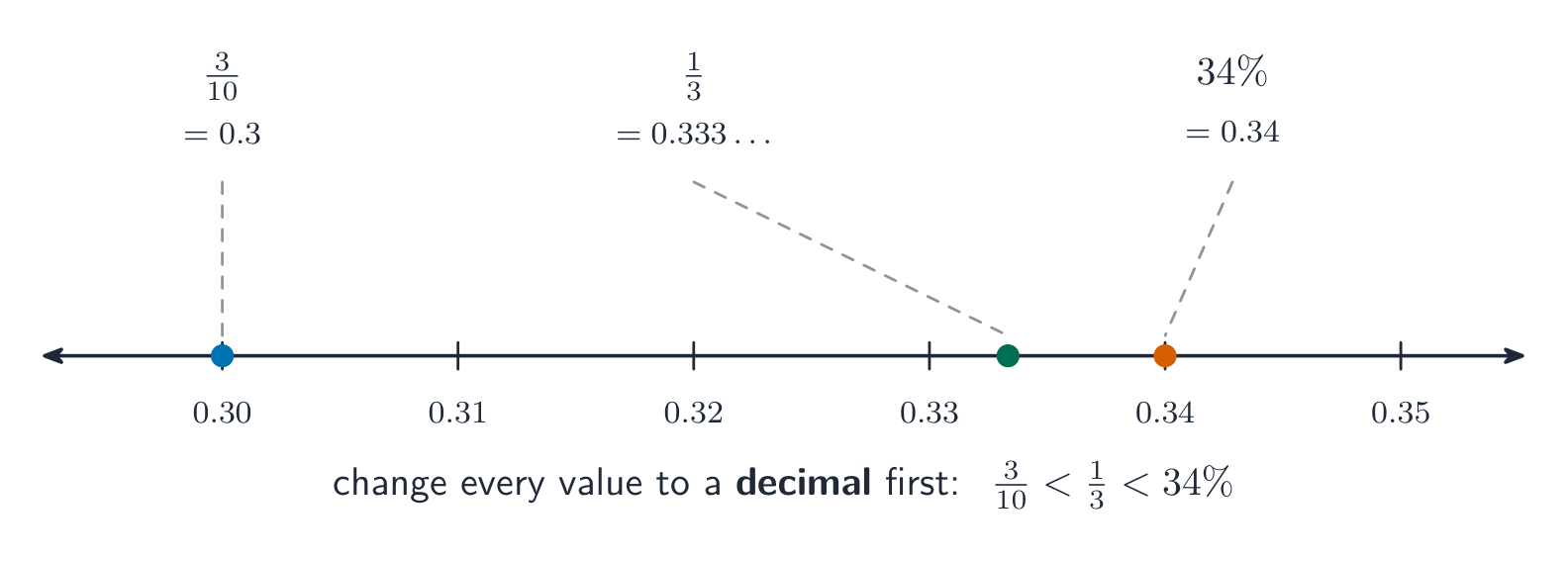
To put a mixed list in order, change every value to a decimal first.
Worked example. Put $34\%$, $\frac{1}{3}$ and $\frac{3}{10}$ in order, smallest first.
As decimals: $34\% = 0.34$, $\frac{1}{3} = 0.333\ldots$, $\frac{3}{10} = 0.3$. So the order is
$$\frac{3}{10} < \frac{1}{3} < 34\%.$$
Tiếng Việt
Sử dụng các ký hiệu này để so sánh số theo độ lớn (kích thước):
Ký hiệu
Ý nghĩa
$=$
bằng
$\neq$
không bằng
$>$
lớn hơn
$<$
nhỏ hơn
$\geqslant$
lớn hơn hoặc bằng
$\leqslant$
nhỏ hơn hoặc bằng
Để sắp xếp một danh sách gồm nhiều loại giá trị, trước hết chuyển tất cả về dạng thập phân.
Ví dụ minh họa. Sắp xếp $34\%$, $\frac{1}{3}$ và $\frac{3}{10}$ theo thứ tự tăng dần.
Dưới dạng thập phân: $34\% = 0.34$, $\frac{1}{3} = 0.333\ldots$, $\frac{3}{10} = 0.3$. Vậy thứ tự là
$$\frac{3}{10} < \frac{1}{3} < 34\%.$$
Chuyển mọi giá trị sang thập phân, sau đó đặt chúng lên trục số
1.13
Percentages · Phần trăm
Syllabus · Chương trình
English
Subject content
Notes and examples
1 Calculate a given percentage of a quantity.
2 Express one quantity as a percentage of another.
3 Calculate percentage increase or decrease.
4 Calculate with simple and compound interest.
Formulas are not given. Percentage calculations may include: • deposit • discount • profit and loss (as an amount or a percentage) • earnings • percentages over 100%.
Tiếng Việt
Nội dung môn học
Ghi chú và ví dụ
1 Tính phần trăm cho trước của một lượng.
2 Biểu diễn một lượng dưới dạng phần trăm của lượng khác.
3 Tính phần trăm tăng hoặc giảm.
4 Tính toán với lãi suất đơn và lãi suất kép.
Công thức không được cung cấp. Các phép tính phần trăm có thể bao gồm: • tiền gửi • giảm giá • lợi nhuận và lỗ loss (với tư cách là số tiền hoặc phần trăm) • thu nhập • phần trăm vượt quá 100%.
English
Subject content
Notes and examples
1 Calculate a given percentage of a quantity.
2 Express one quantity as a percentage of another.
3 Calculate percentage increase or decrease.
4 Calculate with simple and compound interest.
Problems may include repeated percentage change. Formulas are not given.
5 Calculate using reverse percentages.
e.g. find the cost price given the selling price and the percentage profit. Percentage calculations may include: • deposit • discount • profit and loss (as an amount or a percentage) • earnings • percentages over 100%.
Tiếng Việt
Nội dung môn học
Ghi chú và ví dụ
1 Tính phần trăm cho trước của một lượng.
2 Biểu diễn một lượng dưới dạng phần trăm của lượng khác.
3 Tính phần trăm tăng hoặc giảm.
4 Tính toán với lãi suất đơn và lãi suất kép.
Các bài toán có thể bao gồm sự thay đổi phần trăm lặp lại. Không cung cấp công thức.
5 Tính toán bằng cách sử dụng phần trăm ngược.
Ví dụ: tìm giá vốn khi biết giá bán và tỷ lệ lợi nhuận. Các phép tính phần trăm có thể bao gồm: • tiền đặt cọc • giảm giá • lợi nhuận và lỗ (dưới dạng số tiền hoặc phần trăm) • thu nhập • các phần trăm lớn hơn 100%.
Source: Cambridge International syllabus · Nguồn: Chương trình Cambridge International
English
Find a percentage of an amount.$15\%$ of $\$80 = 0.15 \times 80 = \$12$.
Write one amount as a percentage of another. A score of $18$ out of $25$ is $\frac{18}{25} \times 100\% = 72\%$.
A reverse percentage 逆百分比 problem gives the amount after a change and asks for the original. To solve it, divide by the multiplier — do not just take the percentage off.
Worked example. A coat costs $\$60$ after a $20\%$ increase. Find the original price.
$\$60$ is $120\%$ of the original, so the original price is $60 \div 1.2 = \$50$.
Tiếng Việt
Các cửa hàng sử dụng phần trăm cho giảm giá, thuế bán hàng và biên lợi nhuận.
Tìm phần trăm của một số.$15\%$ của $\$80 = 0.15 \times 80 = \$12$.
Viết một số lượng dưới dạng phần trăm của số lượng khác. Điểm số $18$ trên tổng điểm $25$ tương đương với $\frac{18}{25} \times 100\% = 72\%$.
Exponential growth and decay (Extended) · Tăng trưởng và suy thoái lũy thừa (Nâng cao)
Syllabus · Chương trình
English
Subject content
Notes and examples
Use exponential growth and decay.
e.g. depreciation, population change. Knowledge of e is not required.
Tiếng Việt
Nội dung môn học
Ghi chú và ví dụ
Sử dụng sự tăng trưởng và suy giảm lũy thừa.
Ví dụ: khấu hao, biến đổi dân số. Không yêu cầu kiến thức về e.
Source: Cambridge International syllabus · Nguồn: Chương trình Cambridge International
English
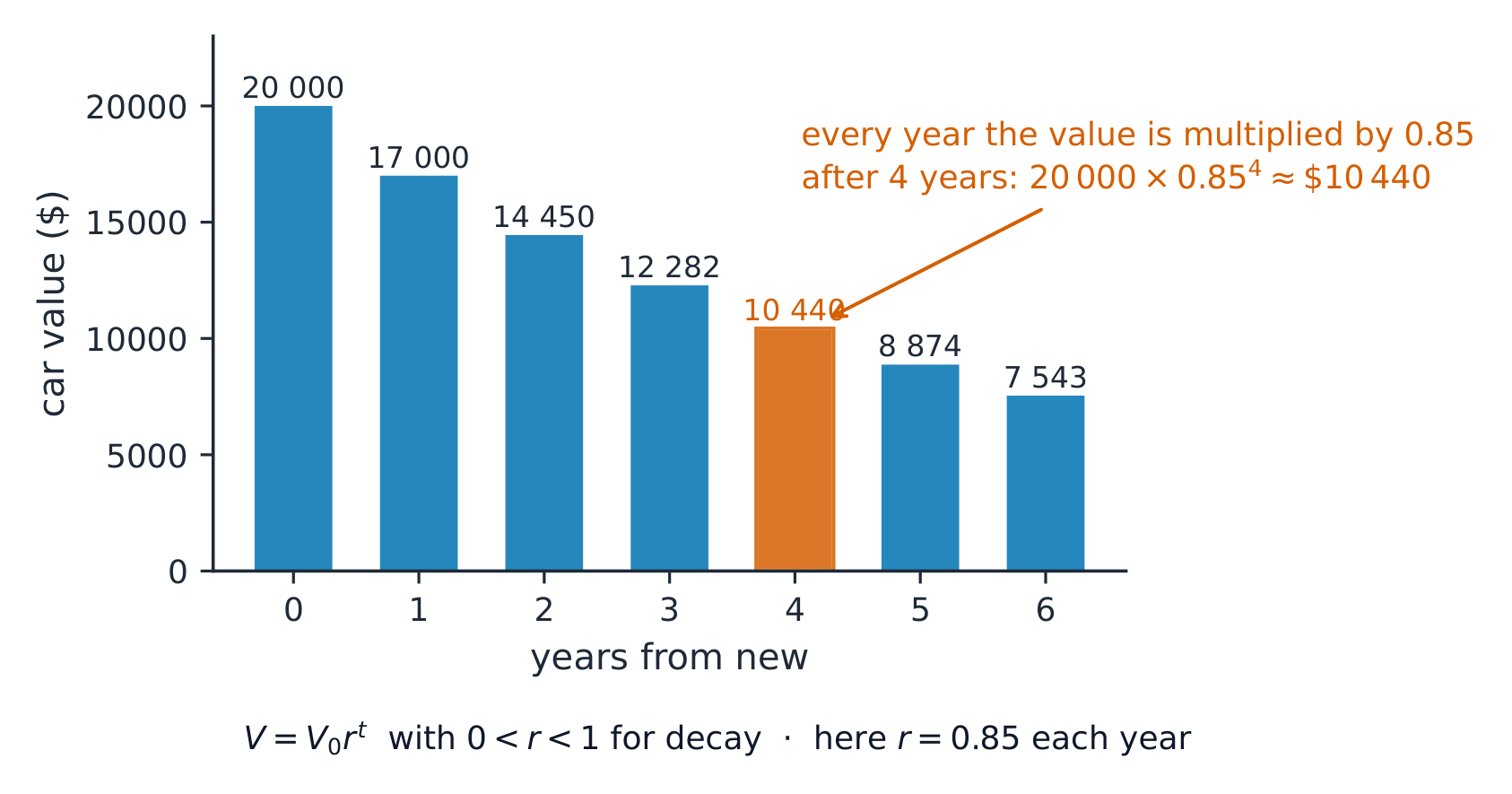
When a quantity changes by the same percentage in each time period, it shows exponential growth 指数增长 (it gets bigger) or exponential decay 指数衰减 (it gets smaller). Use the compound formula. Depreciation 折旧, where something like a car loses value each year, is decay.
Worked example. A car worth $\$20\,000$ loses $15\%$ of its value each year. Find its value after $4$ years.
Khi một lượng thay đổi cùng một tỷ lệ phần trăm trong mỗi khoảng thời gian, nó thể hiện tăng trưởng lũy thừa (nó trở nên lớn hơn) hoặc suy thoái lũy thừa (nó trở nên nhỏ hơn). Sử dụng công thức lũy kế. Suy hao, nơi một vật như ô tô mất giá trị mỗi năm, là sự suy thoái.
Ví dụ minh họa. Một chiếc ô tô có giá trị $\$20\,000$ loses $15\%$ of its value each year. Find its value after $4$ năm.
Suy thoái lũy thừa: xe mất 15 phần trăm giá trị hiện tại mỗi năm
Explore · Khám phá
Compound interest · Lãi suất kép
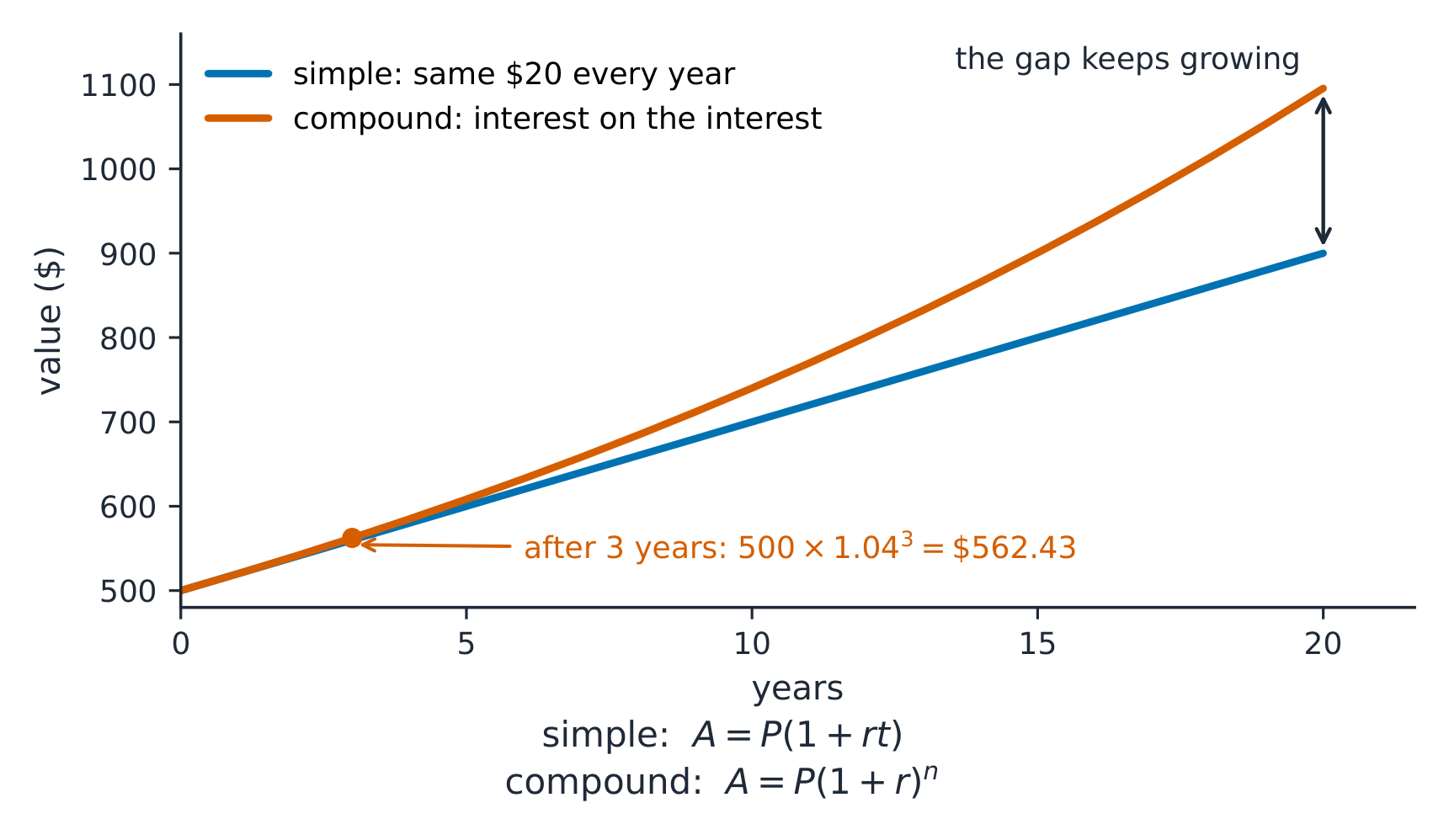
Money grows by (1 + r) every year, so compound interest curves above simple interest. Drag the rate and the number of years. · Tiền tăng theo (1 + r) mỗi năm, nên đường cong lãi suất kép nằm trên lãi suất đơn. Kéo tỷ lệ và số năm.
Change the base b: b > 1 grows, 0 < b < 1 decays — useful for interest and populations. · Thay đổi cơ số b: b > 1 tăng, 0 < b < 1 giảm — hữu ích cho lãi suất và dân số.
• use proportional reasoning and ratios in context.
e.g. adapt recipes; use map scales; determine best value.
Tiếng Việt
Nội dung môn học
Ghi chú và ví dụ
Hiểu và sử dụng tỉ lệ và tỉ lệ thức để:
• viết tỉ lệ ở dạng tối giản
ví dụ: 20:30:40 ở dạng tối giản là 2:3:4.
• chia một lượng theo tỉ lệ cho trước
• sử dụng tư duy tỉ lệ thức và tỉ lệ trong ngữ cảnh.
ví dụ: điều chỉnh công thức nấu ăn; sử dụng tỷ lệ bản đồ; xác định giá trị tốt nhất.
Source: Cambridge International syllabus · Nguồn: Chương trình Cambridge International
English
A ratio 比 compares quantities, written like $a:b$. Simplify it like a fraction by dividing by the HCF: $20:30:40 = 2:3:4$.
Dividing in a ratio. Share $\$48$ in the ratio $3:5$.
The total number of parts is $3 + 5 = 8$. One part is $48 \div 8 = \$6$. So the shares are $3 \times 6 = \$18$ and $5 \times 6 = \$30$.
Proportion 比例 means two ratios are equal. Use it for recipes, map scales 比例尺 and finding best value.
Worked example.$3$ pens cost $\$1.80$. Find the cost of $7$ pens.
One pen costs $1.80 \div 3 = \$0.60$. So $7$ pens cost $7 \times 0.60 = \$4.20$.
Tiếng Việt
Một tỉ lệ so sánh các lượng, viết như $a:b$. Rút gọn nó giống như phân số bằng cách chia cho ƯCLN: $20:30:40 = 2:3:4$.
Chia theo tỉ lệ. Chia $\$48$ in the ratio $3:5$.
Tổng số phần là $3 + 5 = 8$. Một phần là $48 \div 8 = \$6$. So the shares are $3 \times 6 = \$18$ và $5 \times 6 = \$30$.
Mô hình thanh để chia 48 đô la theo tỉ lệ 3 đến 5
Tỉ lệ thức nghĩa là hai tỉ lệ bằng nhau. Sử dụng nó cho công thức nấu ăn, tỷ lệ bản đồ và tìm giá trị tốt nhất.
Ví dụ minh họa.$3$ bút có giá $\$1.80$. Find the cost of $7$ bút.
Một cây bút có giá $1.80 \div 3 = \$0.60$. So $7$ pens cost $7 \times 0.60 = \$4.20$.
Explore · Khám phá
Direct proportion · Tỉ lệ thuận
y = ax
Direct proportion is a straight line through the origin — double x and you double y. · Tỉ lệ thuận là một đường thẳng đi qua gốc tọa độ — gấp đôi x thì cũng gấp đôi y.
1.12
Rates and average speed · Tốc độ và vận tốc trung bình
Syllabus · Chương trình
English
Subject content
Notes and examples
1 Use common measures of rate.
e.g. calculate with: • hourly rates of pay • exchange rates between currencies • flow rates • fuel consumption.
2 Apply other measures of rate.
e.g. calculate with: • pressure • density • population density. Required formulas will be given in the question.
3 Solve problems involving average speed.
Knowledge of speed/distance/time formula is required. e.g. A cyclist travels 45 km in 3 hours 45 minutes. What is their average speed? Notation used will be, e.g. m/s (metres per second), $\text{g/cm}^3$ (grams per cubic centimetre).
Tiếng Việt
Nội dung môn học
Ghi chú và ví dụ
1 Sử dụng các đơn vị đo tốc độ phổ biến.
ví dụ: tính toán với: • mức lương theo giờ • tỷ giá hối đoái giữa các đồng tiền • tốc độ dòng chảy • tiêu thụ nhiên liệu.
2 Áp dụng các đơn vị đo tốc độ khác.
ví dụ: tính toán với: • áp suất • mật độ • mật độ dân số. Công thức yêu cầu sẽ được cung cấp trong câu hỏi.
3 Giải quyết các vấn đề liên quan đến vận tốc trung bình.
Cần nắm vững công thức vận tốc/quãng đường/thời gian. Ví dụ: Một người đi xe đạp di chuyển 45 km trong 3 giờ 45 phút. Vận tốc trung bình của họ là bao nhiêu? Ký hiệu sử dụng sẽ là, ví dụ m/s (mét trên giây), $\text{g/cm}^3$ (gram trên cm³).
English
Subject content
Notes and examples
1 Use common measures of rate.
e.g. calculate with: • hourly rates of pay • exchange rates between currencies • flow rates • fuel consumption.
2 Apply other measures of rate.
e.g. calculate with: • pressure • density • population density. Required formulas will be given in the question.
3 Solve problems involving average speed.
Knowledge of speed/distance/time formula is required. e.g. A cyclist travels 45 km in 3 hours 45 minutes. What is their average speed? Notation used will be, e.g. m/s (metres per second), g/cm$^{3}$ (grams per cubic centimetre).
Tiếng Việt
Nội dung môn học
Ghi chú và ví dụ
1 Sử dụng các đơn vị đo tốc độ phổ biến.
ví dụ: tính toán với: • mức lương theo giờ • tỷ giá hối đoái giữa các đồng tiền • tốc độ dòng chảy • tiêu thụ nhiên liệu.
2 Áp dụng các đơn vị đo tốc độ khác.
ví dụ: tính toán với: • áp suất • mật độ • mật độ dân số. Công thức yêu cầu sẽ được cung cấp trong câu hỏi.
3 Giải các bài toán liên quan đến vận tốc trung bình.
Cần có kiến thức về công thức vận tốc/quãng đường/thời gian. Ví dụ: Một người đi xe đạp di chuyển 45 km trong 3 giờ 45 phút. Vận tốc trung bình của họ là bao nhiêu? Các ký hiệu sử dụng sẽ là, ví dụ: m/s (mét trên giây), g/cm$^{3}$ (gam trên centimet khối).
Source: Cambridge International syllabus · Nguồn: Chương trình Cambridge International
English
A rate 比率 compares two quantities measured in different units, such as price per kilogram, or distance per hour.
Other examples are flow rate, fuel consumption and population density 人口密度. If a rate needs a special formula (such as pressure 压强), the question will give it to you.
Tiếng Việt
Một tốc độ so sánh hai lượng đo bằng các đơn vị khác nhau, chẳng hạn như giá per kilogram, hoặc quãng đường per giờ.
số chữ số thập phân (d.p.): các chữ số tính sau dấu phẩy. $3.14159$ làm tròn đến $2$ d.p. là $3.14$.
chữ số có ý nghĩa (s.f.): các chữ số tính từ chữ số khác 0 đầu tiên. $5764$ làm tròn đến $1$ s.f. là $6000$; $0.004067$ làm tròn đến $2$ s.f. là $0.0041$.
Quy tắc: nhìn vào chữ số tiếp theo. Nếu nó là $5$ hoặc lớn hơn, làm tròn lên; nếu nhỏ hơn, làm tròn xuống.
Ước lượng
Để ước lượng một đáp án, làm tròn mọi số về $1$ s.f., sau đó tính toán.
Ví dụ minh họa. Ước lượng $\dfrac{41.3}{9.79 \times 0.765}$.
Rounding and bounds lab · Phòng thí nghiệm làm tròn và cận
Classify numbers by the decision needed for accuracy. · Phân loại các số dựa trên quyết định cần thiết cho độ chính xác.
1.10
Limits of accuracy · Giới hạn độ chính xác
Syllabus · Chương trình
English
Subject content
Notes and examples
Give upper and lower bounds for data rounded to a specified accuracy.
e.g. write down the upper bound of a length measured correct to the nearest metre. Candidates are not expected to find the bounds of the results of calculations which have used data rounded to a specified accuracy.
Tiếng Việt
Nội dung môn học
Ghi chú và ví dụ
Đưa ra giới hạn trên và giới hạn dưới cho dữ liệu được làm tròn đến độ chính xác quy định.
Ví dụ: ghi giới hạn trên của chiều dài đo lường chính xác đến mét gần nhất. thí sinh không cần tìm giới hạn của kết quả tính toán đã sử dụng dữ liệu làm tròn đến độ chính xác quy định.
English
Subject content
Notes and examples
1 Give upper and lower bounds for data rounded to a specified accuracy.
e.g. write down the upper bound of a length measured correct to the nearest metre.
2 Find upper and lower bounds of the results of calculations which have used data rounded to a specified accuracy.
Example calculations include: • calculate the upper bound of the perimeter or the area of a rectangle given dimensions measured to the nearest centimetre • find the lower bound of the speed given rounded values of distance and time.
Tiếng Việt
Nội dung môn học
Ghi chú và ví dụ
1 Đưa ra cận trên và cận dưới cho dữ liệu được làm tròn đến độ chính xác quy định.
Ví dụ: viết cận trên của một độ dài đo đúng đến mét gần nhất.
2 Tìm cận trên và cận dưới của kết quả các phép tính đã sử dụng dữ liệu được làm tròn đến độ chính xác quy định.
Các phép tính ví dụ bao gồm: • tính cận trên của chu vi hoặc diện tích của hình chữ nhật nếu kích thước đo đúng đến cm • tìm cận dưới của tốc độ nếu có các giá trị làm tròn của quãng đường và thời gian.
Source: Cambridge International syllabus · Nguồn: Chương trình Cambridge International
English
A rounded value could really be anything that rounds to it. The smallest possible value is the lower bound 下界; the largest is the upper bound 上界. For a value rounded to the nearest unit, the bounds lie half a unit on each side.
Worked example. A height $h$ is $635\text{ m}$, correct to the nearest metre. Give the bounds.
$$634.5 \leqslant h < 635.5.$$
So the lower bound is $634.5\text{ m}$ and the upper bound is $635.5\text{ m}$.
Bounds in calculations (Extended)
Combine the bounds to get the bound you want.
Worked example. A rectangle is $8\text{ cm}$ by $5\text{ cm}$, each side to the nearest cm. Find the largest possible area 面积.
Use the upper bounds of both sides: $8.5 \times 5.5 = 46.75\text{ cm}^{2}$. (The smallest area uses the lower bounds: $7.5 \times 4.5 = 33.75\text{ cm}^{2}$.)
For a divided quantity such as $\text{speed} = \dfrac{\text{distance}}{\text{time}}$, the largest speed comes from the largest distance divided by the smallest time.
Tiếng Việt
Một giá trị làm tròn thực tế có thể là bất kỳ giá trị nào làm tròn thành nó. Giá trị nhỏ nhất có thể là giới hạn dưới; giá trị lớn nhất là giới hạn trên. Đối với một giá trị làm tròn đến đơn vị gần nhất, các giới hạn nằm cách nhau nửa đơn vị ở mỗi bên.
Ví dụ đã giải. Chiều cao $h$ là $635\text{ m}$, đúng đến mét gần nhất. Hãy đưa ra các giới hạn.
$$634.5 \leqslant h < 635.5.$$
Mọi thứ trong dải đều làm tròn về 635: giới hạn dưới được bao gồm, giới hạn trên thì không
Vì vậy giới hạn dưới là $634.5\text{ m}$ và giới hạn trên là $635.5\text{ m}$.
Giới hạn trong tính toán (Nâng cao)
Kết hợp các giới hạn để thu được giới hạn bạn muốn.
Ví dụ đã giải. Một hình chữ nhật có kích thước $8\text{ cm}$ x $5\text{ cm}$, mỗi cạnh đúng đến cm gần nhất. Tìm diện tích lớn nhất có thể.
Sử dụng giới hạn trên của cả hai cạnh: $8.5 \times 5.5 = 46.75\text{ cm}^{2}$. (Diện tích nhỏ nhất sử dụng giới hạn dưới: $7.5 \times 4.5 = 33.75\text{ cm}^{2}$.)
Đối với một đại lượng chia như $\text{speed} = \dfrac{\text{distance}}{\text{time}}$, tốc độlớn nhất đến từ quãng đườnglớn nhất chia cho thời giannhỏ nhất.
1.15
Time · Thời gian
Syllabus · Chương trình
English
Subject content
Notes and examples
1 Calculate with time: seconds (s), minutes (min), hours (h), days, weeks, months, years, including the relationship between units.
1 year = 365 days.
2 Calculate times in terms of the 24-hour and 12-hour clock.
In the 24-hour clock, for example, 3.15 a.m. will be denoted by 03 15 and 3.15 p.m. by 15 15.
3 Read clocks and timetables.
Includes problems involving time zones, local times and time differences.
Tiếng Việt
Nội dung môn học
Ghi chú và ví dụ
1 Tính toán với thời gian: giây (s), phút (min), giờ (h), ngày, tuần, tháng, năm, bao gồm mối quan hệ giữa các đơn vị.
1 năm = 365 ngày.
2 Tính toán thời gian theo đồng hồ 24 giờ và 12 giờ.
Trong đồng hồ 24 giờ, ví dụ, 3.15 sáng sẽ được ký hiệu là 03 15 và 3.15 chiều là 15 15.
3 Đọc đồng hồ và bảng giờ.
Bao gồm các vấn đề liên quan đến khung giờ, giờ địa phương và chênh lệch giờ.
English
Subject content
Notes and examples
1 Calculate with time: seconds (s), minutes (min), hours (h), days, weeks, months, years, including the relationship between units.
1 year = 365 days.
2 Calculate times in terms of the 24-hour and 12-hour clock.
In the 24-hour clock, for example, 3.15 a.m. will be denoted by 0315 and 3.15 p.m. by 1515.
3 Read clocks and timetables.
Includes problems involving time zones, local times and time differences.
Tiếng Việt
Nội dung môn học
Ghi chú và ví dụ
1 Tính toán với thời gian: giây (s), phút (min), giờ (h), ngày, tuần, tháng, năm, bao gồm mối quan hệ giữa các đơn vị.
1 năm = 365 ngày.
2 Tính toán thời gian theo hệ thống đồng hồ 24 giờ và 12 giờ.
Trong hệ thống đồng hồ 24 giờ, ví dụ, 3.15 sáng sẽ được ký hiệu là 0315 và 3.15 chiều là 1515.
3 Đọc đồng hồ và bảng giờ.
Bao gồm các vấn đề liên quan đến khung giờ, giờ địa phương và chênh lệch giờ.
Source: Cambridge International syllabus · Nguồn: Chương trình Cambridge International
e.g. know not to round values within a calculation and to only round the final answer.
2 Enter values appropriately on a calculator.
e.g. enter 2 hours 30 minutes as 2.5 hours or 2° 30’ 0’’.
3 Interpret the calculator display appropriately.
e.g. in money 4.8 means $4.80; in time 3.25 means 3 hours 15 minutes.
Tiếng Việt
Nội dung môn học
Ghi chú và ví dụ
1 Sử dụng máy tính bỏ túi một cách hiệu quả.
ví dụ: biết rằng không nên làm tròn các giá trị bên trong quá trình tính toán và chỉ làm tròn đáp án cuối cùng.
2 Nhập giá trị phù hợp vào máy tính bỏ túi.
ví dụ: nhập 2 giờ 30 phút thành 2.5 giờ hoặc 2° 30’ 0’’.
3 Diễn giải màn hình máy tính bỏ túi một cách phù hợp.
ví dụ: trong tiền tệ, 4.8 có nghĩa là $4.80; trong thời gian, 3.25 có nghĩa là 3 giờ 15 phút.
English
Subject content
Notes and examples
1 Use a calculator efficiently.
e.g. know not to round values within a calculation and to only round the final answer.
2 Enter values appropriately on a calculator.
e.g. enter 2 hours 30 minutes as 2.5 hours or 2° 30' 0''.
3 Interpret the calculator display appropriately.
e.g. in money 4.8 means $4.80; in time 3.25 means 3 hours 15 minutes.
Tiếng Việt
Nội dung môn học
Ghi chú và ví dụ
1 Sử dụng máy tính bỏ túi một cách hiệu quả.
ví dụ: biết rằng không nên làm tròn các giá trị bên trong quá trình tính toán và chỉ làm tròn đáp án cuối cùng.
2 Nhập các giá trị phù hợp vào máy tính bỏ túi.
Ví dụ: nhập 2 giờ 30 phút thành 2.5 giờ hoặc 2° 30' 0''.
3 Diễn giải màn hình máy tính bỏ túi một cách phù hợp.
ví dụ: trong tiền tệ, 4.8 có nghĩa là $4.80; trong thời gian, 3.25 có nghĩa là 3 giờ 15 phút.
Source: Cambridge International syllabus · Nguồn: Chương trình Cambridge International
English
Do not round part-way through a calculation. Keep the full value and round only the final answer.
Enter time as a decimal of an hour: $2$ hours $30$ minutes is $2.5$ hours, not $2.30$.
Read the display in context: in money, $4.8$ means $\$4.80$; in time, $3.25$ hours means $3$ hours $15$ minutes.
Tiếng Việt
Không làm tròn phần giữa quá trình tính toán. Giữ nguyên giá trị đầy đủ và chỉ làm tròn đáp án cuối cùng.
Nhập thời gian dưới dạng số thập phân của một giờ: $2$ giờ $30$ phút là $2.5$ giờ, không phải $2.30$.
Đọc màn hình theo ngữ cảnh: đối với tiền tệ, $4.8$ có nghĩa là $\$4.80$; in time, $3.25$ hours means $3$ hours $15$ phút.
1.14
Exam tips · Mẹo làm bài thi
English
Follow BIDMAS (brackets, indices, division/multiplication, addition/subtraction) in order, and remember a negative times a negative is positive.
In standard form the number in front is between 1 and 10; a small number (like $0.0004$) has a negative power of 10.
A percentage change is worked out on the original amount. For a reverse percentage, divide by the multiplier (e.g. $\div 1.2$ undoes a $20\%$ rise).
Do not round part-way through — keep the full value and round only at the end, to the accuracy the question asks for (decimal places or significant figures).
For limits of accuracy, a value rounded to the nearest whole number can be up to $0.5$ either side (so $8$ means $7.5 \le x < 8.5$).
Tiếng Việt
Tuân thủ BIDMAS ( ngoặc, lũy thừa, chia/nhân, cộng/trừ) theo thứ tự, và nhớ rằng âm nhân âm là dương.
Trong dạng chuẩn (số học), số ở phía trước nằm giữa 1 và 10; một số nhỏ (như $0.0004$) có luỹ thừa âm của 10.
Một biến đổi phần trăm được tính dựa trên số ban đầu. Đối với phần trăm ngược, hãy chia cho thừa số (ví dụ: $\div 1.2$ undo một mức tăng $20\%$).
Không làm tròn phần giữa — giữ nguyên giá trị đầy đủ và chỉ làm tròn ở cuối, đến độ chính xác mà câu hỏi yêu cầu (chữ số thập phân hoặc chữ số có ý nghĩa).
Đối với giới hạn độ chính xác, một giá trị làm tròn đến số nguyên gần nhất có thể lên đến $0.5$ ở mỗi bên (ví dụ: $8$ có nghĩa là $7.5 \le x < 8.5$).
This handout covers Topic 2, Algebra and graphs. Parts marked (Extended) are only tested on the Extended papers; everything else is for both levels.
2.1
Working with algebra
Syllabus · Chương trình
English
Subject content
Notes and examples
1 Know that letters can be used to represent generalised numbers.
2 Substitute numbers into expressions and formulas.
Tiếng Việt
Nội dung môn học
Ghi chú và ví dụ
1 Biết rằng các chữ cái có thể được sử dụng để biểu diễn các số tổng quát.
2 Thay số vào biểu thức và công thức.
Source: Cambridge International syllabus · Nguồn: Chương trình Cambridge International
In algebra 代数 we use letters to stand for numbers. A letter whose value can change is a variable 变量. To substitute 代入 means to put a number in place of a letter.
Worked example. Find the value of $3x^{2} - 2y$ when $x = 4$ and $y = 5$.
5 Complete the square for expressions in the form $ax^2 + bx + c$.
Tiếng Việt
Nội dung môn học
Ghi chú và ví dụ
1 Rút gọn biểu thức bằng cách gom các số hạng đồng dạng.
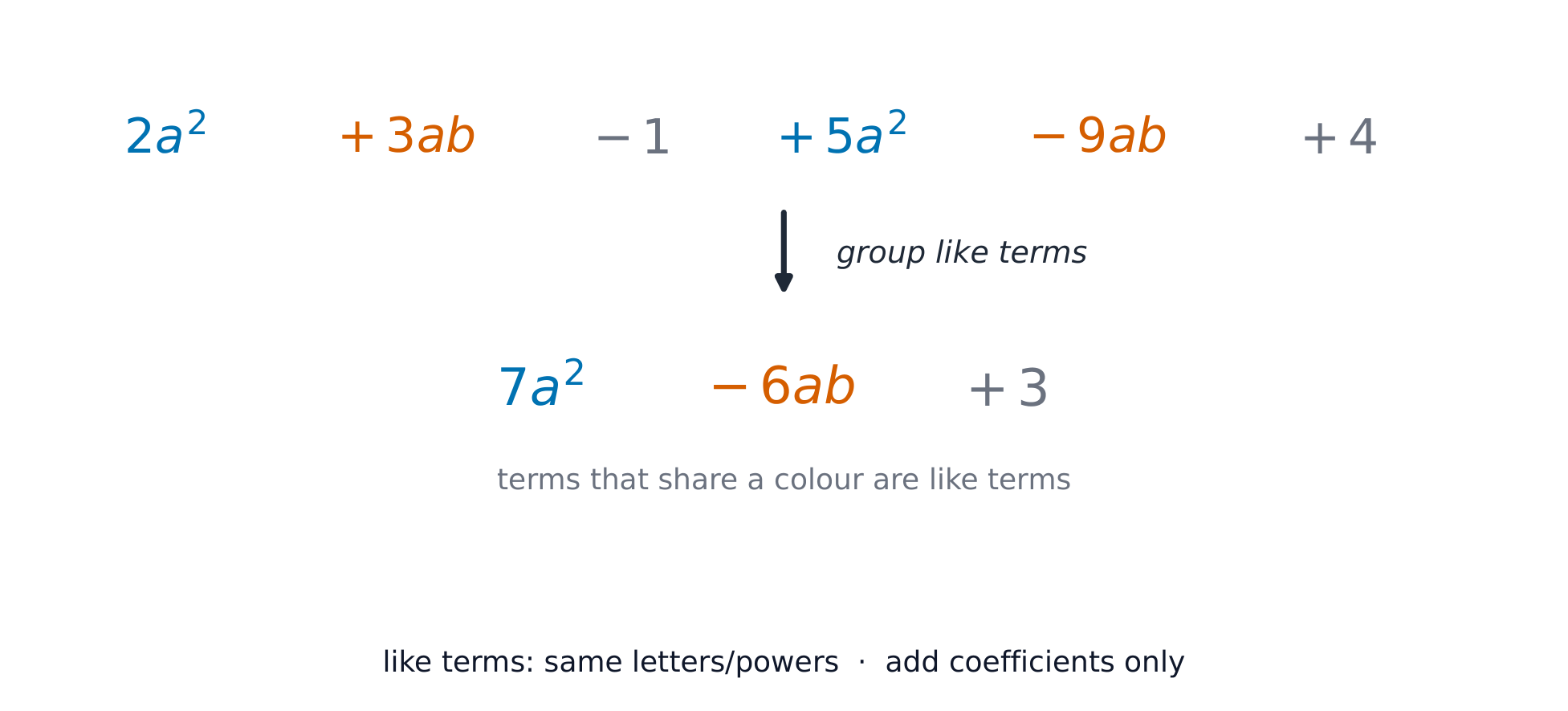
Rút gọn có nghĩa là đưa đáp án về dạng tối giản, ví dụ: $2a^2 + 3ab - 1 + 5a^2 - 9ab + 4 = 7a^2 - 6ab + 3$.
2 Khai triển tích các biểu thức đại số.
Vd. khai triển $3x(2x - 4y)$, $(3x + y)(x - 4y)$. Bao gồm tích của nhiều hơn hai ngoặc, v.d. khai triển $(x - 2)(x + 3)(2x + 1)$.
3 Phân tích đa thức thành nhân tử bằng cách提取公因式.
Phân tích có nghĩa là phân tích hoàn toàn, ví dụ: $9x^2 + 15xy = 3x(3x + 5y)$.
4 Phân tích đa thức thành nhân tử các biểu thức dạng: • $ax + bx + kay + kby$ • $a^2x^2 - b^2y^2$ • $a^2 + 2ab + b^2$ • $ax^2 + bx + c$ • $ax^3 + bx^2 + cx$.
5 Lập phương complete cho các biểu thức dạng $ax^2 + bx + c$.
Source: Cambridge International syllabus · Nguồn: Chương trình Cambridge International
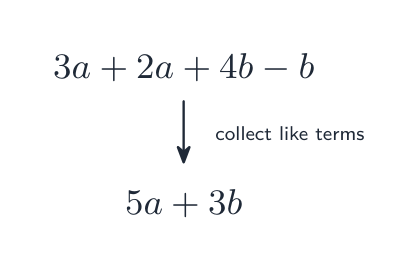
A term 项 is a single part of an expression 表达式, such as $5a$ or $-9b$. Like terms 同类项 have exactly the same letters; you may add or subtract them. The number in front of the letter is the coefficient 系数.
Expanding a bracket with an area modelCollecting like terms: add terms with the same letter
Collect like terms: $2a^{2} + 5a^{2} = 7a^{2}$, $3ab - 9ab = -6ab$, $-1 + 4 = 3$. So the answer is
$$7a^{2} - 6ab + 3.$$
To expand 展开 means to multiply out brackets 括号. Multiply every term inside by the term outside; for two brackets, multiply every term in the first by every term in the second.
Source: Cambridge International syllabus · Nguồn: Chương trình Cambridge International
An algebraic fraction 分式 has algebra on the top or bottom. Add and subtract using a common denominator; multiply and divide as with ordinary fractions.
1 Understand and use indices (positive, zero and negative).
e.g. $2^x = 32$. Find the value of $x$.
2 Understand and use the rules of indices.
e.g. simplify: • $(5x^3)^2$ • $12a^5 \div 3a^{-2}$ • $6x^7y^4 \times 5x^{-5}y$. Knowledge of logarithms is not required.
Tiếng Việt
Nội dung môn học
Ghi chú và ví dụ
1 Hiểu và sử dụng chỉ số (số nguyên dương, bằng 0 và âm).
Ví dụ: $2^x = 32$. Tìm giá trị của $x$.
2 Hiểu và sử dụng các quy tắc về chỉ số.
Ví dụ: rút gọn: • $(5x^3)^2$ • $12a^5 \div 3a^{-2}$ • $6x^7y^4 \times 5x^{-5}y$. Không yêu cầu kiến thức về logarit.
English
Subject content
Notes and examples
1 Understand and use indices (positive, zero, negative and fractional).
e.g. solve: • $32^x = 2$ • $5^{x+1} = 25^x$.
2 Understand and use the rules of indices.
e.g. simplify: • $3x^{-4} \times \frac{2}{3}x^{\frac{1}{2}}$ • $\frac{2}{5}x^{\frac{1}{2}} \div 2x^{-2}$ • $\left(\frac{2x^5}{3}\right)^3$. Knowledge of logarithms is not required.
Tiếng Việt
Nội dung môn học
Ghi chú và ví dụ
1 Hiểu và sử dụng lũy thừa (lũy thừa dương, không, âm và phân số).
Vd. giải: • $32^x = 2$ • $5^{x+1} = 25^x$.
2 Hiểu và sử dụng các quy tắc về chỉ số.
Ví dụ: rút gọn: • $3x^{-4} \times \frac{2}{3}x^{\frac{1}{2}}$ • $\frac{2}{5}x^{\frac{1}{2}} \div 2x^{-2}$ • $\left(\frac{2x^5}{3}\right)^3$. Không yêu cầu kiến thức về logarit.
Source: Cambridge International syllabus · Nguồn: Chương trình Cambridge International
The laws of indices 指数 work with letters too: $a^{m} \times a^{n} = a^{m+n}$, $a^{m} \div a^{n} = a^{m-n}$, and $(a^{m})^{n} = a^{mn}$.
4 Solve simultaneous linear equations in two unknowns.
5 Solve simultaneous equations, involving one linear and one non-linear.
With powers no higher than two.
6 Solve quadratic equations by factorisation, completing the square and by use of the quadratic formula.
Includes writing a quadratic expression in completed square form. Candidates may be expected to give solutions in surd form. The quadratic formula is given in the List of formulas.
7 Change the subject of formulas.
e.g. change the subject of a formula where: • the subject appears twice • there is a power or root of the subject.
Tiếng Việt
Nội dung môn học
Ghi chú và ví dụ
1 Lập biểu thức, phương trình và công thức.
Vd. viết một biểu thức cho tích của hai số chẵn liên tiếp. Bao gồm việc lập hệ phương trình đồng thời.
5 Giải hệ phương trình, bao gồm một phương trình bậc nhất và một phương trình phi tuyến tính.
Với lũy thừa không cao hơn hai.
6 Giải phương trình bậc hai bằng cách phân tích thành nhân tử, hoàn thành bình phương và sử dụng công thức nghiệm.
Bao gồm việc viết biểu thức bậc hai ở dạng hoàn thành bình phương. Thí sinh có thể được yêu cầu đưa ra lời giải dưới dạng căn thức. Công thức nghiệm được cung cấp trong Danh sách công thức.
7 Đổi chủ đề của công thức.
Vd. đổi chủ đề của một công thức mà: • chủ đề xuất hiện hai lần • có lũy thừa hoặc căn của chủ đề.
Source: Cambridge International syllabus · Nguồn: Chương trình Cambridge International
Simultaneous equations: where the lines cross
An equation 方程 says two expressions are equal. To solve a linear 一次 equation, do the same operation to both sides until the unknown 未知数 is alone.
Represent and interpret inequalities, including on a number line.
When representing and interpreting inequalities on a number line: • open circles should be used to represent strict inequalities (<, >) • closed circles should be used to represent inclusive inequalities ($\leqslant$, $\geqslant$) e.g. $-3 \leqslant x < 1$
Tiếng Việt
Nội dung môn học
Ghi chú và ví dụ
Biểu diễn và giải thích bất đẳng thức, bao gồm trên trục số.
Khi biểu diễn và giải thích bất đẳng thức trên trục số: • vòng tròn mở nên được dùng để biểu diễn bất đẳng thức nghiêm ngặt (<, >) • vòng tròn đóng nên được dùng để biểu diễn bất đẳng thức bao gồm ($\leqslant$, $\geqslant$) Ví dụ: $-3 \leqslant x < 1$
English
Subject content
Notes and examples
1 Represent and interpret inequalities, including on a number line.
When representing and interpreting inequalities on a number line: • open circles should be used to represent strict inequalities (<, >) • closed circles should be used to represent inclusive inequalities ($\leqslant$, $\geqslant$). e.g. $-3 \leqslant x < 1$
2 Construct, solve and interpret linear inequalities.
3 Represent and interpret linear inequalities in two variables graphically.
The following conventions should be used: • broken lines should be used to represent strict inequalities (<, >) • solid lines should be used to represent inclusive inequalities ($\leqslant$, $\geqslant$) • shading should be used to represent unwanted regions (unless otherwise directed in the question). e.g. graphs of $x < 1$ and $y \geqslant 1$
4 List inequalities that define a given region.
Linear programming problems are not included.
Tiếng Việt
Nội dung môn học
Ghi chú và ví dụ
1 Biểu diễn và diễn giải bất đẳng thức, bao gồm trên trục số.
Khi biểu diễn và diễn giải bất đẳng thức trên trục số: • dùng vòng tròn mở để biểu diễn bất đẳng thức nghiêm ngặt (<, >) • dùng vòng tròn đóng để biểu diễn bất đẳng thức bao gồm ($\leqslant$, $\geqslant$). Vd. $-3 \leqslant x < 1$
2 Lập, giải và diễn giải bất đẳng thức tuyến tính.
3 Biểu diễn và diễn giải bất đẳng thức tuyến tính hai biến bằng đồ thị.
Các quy ước sau đây nên được sử dụng: • dùng đường nét đứt để biểu diễn bất đẳng thức nghiêm ngặt (<, >) • dùng đường nét liền để biểu diễn bất đẳng thức bao gồm ($\leqslant$, $\geqslant$) • dùng tô màu để biểu diễn vùng không mong muốn (trừ khi câu hỏi chỉ dẫn khác). Vd. đồ thị của $x < 1$ và $y \geqslant 1$
4 Liệt kê các bất đẳng thức xác định một miền cho trước.
Không bao gồm bài toán quy hoạch tuyến tính.
Source: Cambridge International syllabus · Nguồn: Chương trình Cambridge International
An inequality 不等式 uses $<$, $>$, $\leqslant$ or $\geqslant$. Solve it like an equation, but reverse the sign if you multiply or divide by a negative number.
On a number line 数轴, use an open circle for $<$ or $>$ (value not included) and a closed circle for $\leqslant$ or $\geqslant$ (value included).
$-\tfrac{1}{3} \leqslant x < 3$: a closed circle includes the end value, an open circle excludes it.
Regions (Extended)
An inequality in two letters describes a region 区域 of the graph. Draw the boundary line (broken for $<$ or $>$, solid for $\leqslant$ or $\geqslant$) and shade the unwanted side. You may also be asked to list the inequalities that define a given region.
Explore · Khám phá
Inequalities · Bất đẳng thức
y = ax + b
An inequality asks where the line is above or below a value. · Một bất đẳng thức yêu cầu xác định vị trí đường thẳng nằm trên hay dưới một giá trị cụ thể.
e.g. write the next two terms in this sequence: 1, 3, 6, 10, 15, ... , ...
2 Recognise patterns in sequences, including the term-to-term rule, and relationships between different sequences.
3 Find and use the $n$th term of the following sequences: (a) linear (b) simple quadratic (c) simple cubic.
e.g. find the $n$th term of 2, 5, 10, 17
Tiếng Việt
Nội dung môn học
Ghi chú và ví dụ
1 Tiếp tục một dãy số hoặc quy luật đã cho.
Ví dụ: viết hai số hạng tiếp theo trong dãy số này: 1, 3, 6, 10, 15, ... , ...
2 Nhận biết quy luật trong dãy số, bao gồm quy tắc từ số hạng này sang số hạng kia, và mối quan hệ giữa các dãy số khác nhau.
3 Tìm và sử dụng số hạng thứ $n$ của các dãy số sau: (a) tuyến tính (b) bậc hai đơn giản (c) bậc ba đơn giản.
Ví dụ: tìm số hạng thứ $n$ của 2, 5, 10, 17
English
Subject content
Notes and examples
1 Continue a given number sequence or pattern.
Subscript notation may be used, e.g. $T_n$ is the $n$th term of sequence $T$.
2 Recognise patterns in sequences, including the term-to-term rule, and relationships between different sequences.
Includes linear, quadratic, cubic and exponential sequences and simple combinations of these.
3 Find and use the $n$th term of sequences.
Tiếng Việt
Nội dung môn học
Ghi chú và ví dụ
1 Tiếp tục một dãy số hoặc quy luật đã cho.
Có thể sử dụng ký hiệu chỉ số dưới, v.d. $T_n$ là số hạng thứ $n$ của dãy $T$.
2 Nhận diện quy luật trong dãy số, bao gồm quy tắc từ số hạng này sang số hạng khác, và mối quan hệ giữa các dãy số khác nhau.
Bao gồm dãy số tuyến tính, bậc hai, bậc ba và lũy thừa cùng các tổ hợp đơn giản của chúng.
3 Tìm và sử dụng số hạng $n$ của các dãy số.
Source: Cambridge International syllabus · Nguồn: Chương trình Cambridge International
Romanesco broccoli: self-similar spirals form a natural number pattern.
A sequence 数列 is a list of numbers that follow a rule. The term-to-term rule 递推规则 tells you how to get the next term from the one before.
To find the rule for the term in position $n$ (the $n$th term), look at how the terms change.
Linear sequence (the terms go up by the same amount each time). The difference is the multiple of $n$.
Worked example. Find the $n$th term of $2, 5, 8, 11, \dots$
The terms go up by $3$, so start with $3n$. Since $3 \times 1 = 3$ but the first term is $2$, subtract $1$: the $n$th term is $3n - 1$.
Quadratic sequence (the differences themselves change by the same amount). The second difference equals $2 \times$ the coefficient of $n^{2}$.
Worked example. Find the $n$th term of $2, 5, 10, 17, \dots$
First differences are $3, 5, 7$; the second difference is $2$, so the $n^{2}$ part is $1n^{2}$. Subtracting $n^{2}$ ($1, 4, 9, 16$) from the sequence leaves $1, 1, 1, 1$. So the $n$th term is $n^{2} + 1$.
A cubic 三次 sequence such as $1, 8, 27, 64, \dots$ has $n$th term $n^{3}$. An exponential sequence 指数数列 such as $2, 6, 18, 54, \dots$ multiplies by a fixed number each time; here the $n$th term is $2 \times 3^{\,n-1}$.
Explore · Khám phá
Number sequences · Dãy số
Build an arithmetic (add d) or geometric (times r) sequence term by term. · Xây dựng từng số hạng của dãy cộng (cộng d) hoặc dãy nhân (nhân r).
Express direct and inverse proportion in algebraic terms and use this form of expression to find unknown quantities.
Includes linear, square, square root, cube and cube root proportion. Knowledge of proportional symbol ($\propto$) is required.
Tiếng Việt
Nội dung môn học
Ghi chú và ví dụ
Biểu diễn tỉ lệ thuận và tỉ lệ nghịch bằng thuật ngữ đại số và sử dụng dạng biểu diễn này để tìm đại lượng chưa biết.
Bao gồm tỉ lệ thuận tuyến tính, bình phương, căn bậc hai, lập phương và căn bậc ba. Cần nắm được ký hiệu tỉ lệ ($\propto$).
Source: Cambridge International syllabus · Nguồn: Chương trình Cambridge International
Two quantities are in direct proportion 正比例 if one is always a fixed multiple of the other: $y \propto x$ means $y = kx$, where $k$ is a constant 常数. They are in inverse proportion 反比例 if one rises as the other falls: $y \propto \dfrac{1}{x}$ means $y = \dfrac{k}{x}$. The symbol $\propto$ is read "is proportional to". You can also have proportion to a square, square root, cube or cube root.
Worked example.$y$ is in direct proportion to $x$, and $y = 12$ when $x = 3$. Find $y$ when $x = 7$.
First find $k$: $12 = k \times 3$, so $k = 4$ and $y = 4x$. Then $y = 4 \times 7 = 28$.
Explore · Khám phá
Inverse proportion · Tỷ lệ nghịch
y = a/x
Inverse proportion: as x doubles, y halves — a reciprocal curve with two asymptotes. · Tỷ lệ nghịch: khi x gấp đôi, y giảm đi một nửa — là một đường cong nghịch đảo với hai đường tiệm cận.
1 Use and interpret graphs in practical situations including travel graphs and conversion graphs.
e.g. interpret the gradient of a straight-line graph as a rate of change.
2 Draw graphs from given data.
e.g. draw a distance–time graph to represent a journey.
Tiếng Việt
Nội dung môn học
Ghi chú và ví dụ
1 Sử dụng và giải thích đồ thị trong tình huống thực tế bao gồm đồ thị chuyển động và đồ thị chuyển đổi.
Ví dụ: giải thích độ dốc của đồ thị đường thẳng như một tốc độ thay đổi.
2 Vẽ đồ thị từ dữ liệu đã cho.
Ví dụ: vẽ đồ thị khoảng thời gian - quãng đường để biểu diễn một hành trình.
English
Subject content
Notes and examples
1 Use and interpret graphs in practical situations including travel graphs and conversion graphs.
Includes estimation and interpretation of the gradient of a tangent at a point.
2 Draw graphs from given data.
3 Apply the idea of rate of change to simple kinematics involving distance–time and speed–time graphs, acceleration and deceleration.
4 Calculate distance travelled as area under a speed–time graph.
Areas will involve linear sections of the graph only.
Tiếng Việt
Nội dung môn học
Ghi chú và ví dụ
1 Sử dụng và diễn giải đồ thị trong tình huống thực tế bao gồm đồ thị chuyển động và đồ thị đổi đơn vị.
Bao gồm ước lượng và diễn giải hệ số góc của tiếp tuyến tại một điểm.
2 Vẽ đồ thị từ dữ liệu đã cho.
3 Áp dụng khái niệm tốc độ thay đổi vào động học đơn giản liên quan đến đồ thị quãng đường - thời gian và đồ thị vận tốc - thời gian, gia tốc và giảm tốc.
4 Tính quãng đường di chuyển như là diện tích dưới đồ thị vận tốc - thời gian.
Diện tích sẽ chỉ liên quan đến các đoạn thẳng của đồ thị.
Source: Cambridge International syllabus · Nguồn: Chương trình Cambridge International
Speed-time graphs: gradient and area
The gradient 斜率 (steepness) of a graph shows a rate of change 变化率.
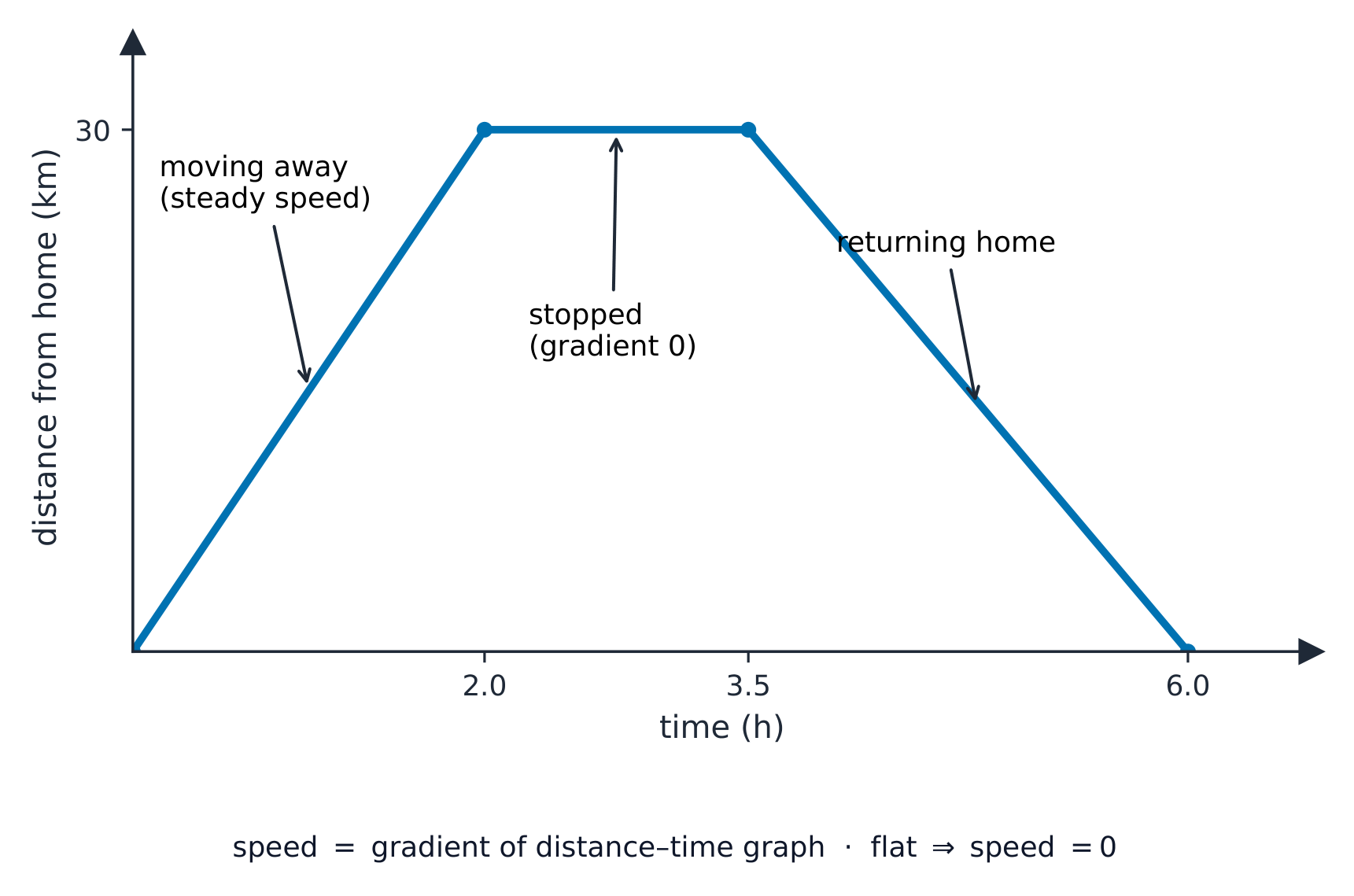
A travel graph 行程图 (distance–time graph) has gradient equal to speed; a flat part means the object is not moving.
A conversion graph 换算图 is a straight line used to change between two units (for example, miles and kilometres).
On a distance–time graph the gradient is the speed; a flat section means the object has stopped.
Speed–time graphs (Extended)
On a speed–time graph the gradient is the acceleration 加速度 (or deceleration 减速度 if the speed falls), and the area 面积 under the graph is the distance 距离 travelled.
Worked example. A car speeds up from rest to $20\text{ m/s}$ in $8\text{ s}$, then stays at $20\text{ m/s}$ for $12\text{ s}$. Find the acceleration and the total distance.
Acceleration $= \dfrac{20}{8} = 2.5\text{ m/s}^{2}$. The distance is the area: a triangle plus a rectangle,
On a speed–time graph the gradient is the acceleration and the area underneath is the distance travelled.
Explore · Khám phá
Real-life graphs · Đồ thị thực tế
y = ax + b
A distance–time or cost graph is read from its gradient and its intercept. · Một đồ thị khoảng thời gian hoặc chi phí được đọc dựa trên hệ số góc và giao điểm của nó.
1 Construct tables of values, and draw, recognise and interpret graphs for functions of the following forms: • $ax + b$ • $\pm x^2 + ax + b$ • $\frac{a}{x} \ (x \neq 0)$ where $a$ and $b$ are integer constants.
2 Solve associated equations graphically, including finding and interpreting roots by graphical methods.
e.g. find the intersection of a line and a curve.
Tiếng Việt
Nội dung môn học
Ghi chú và ví dụ
1 Lập bảng giá trị, vẽ, nhận diện và giải thích đồ thị cho các hàm có dạng sau: • $ax + b$ • $\pm x^2 + ax + b$ • $\frac{a}{x} \ (x \neq 0)$ trong đó $a$ và $b$ là hằng số nguyên.
2 Giải các phương trình liên quan bằng phương pháp đồ thị, bao gồm tìm và giải thích nghiệm bằng phương pháp đồ thị.
Ví dụ: tìm giao điểm của đường thẳng và đường cong.
Subject content
Notes and examples
1 Construct tables of values, and draw, recognise and interpret graphs for functions of the following forms: • $a x^n$ (includes sums of no more than three of these) • $a b^x + c$ where $n = -2, -1, -\frac{1}{2}, 0, \frac{1}{2}, 1, 2, 3$; $a$ and $c$ are rational numbers; and $b$ is a positive integer.
2 Solve associated equations graphically, including finding and interpreting roots by graphical methods.
e.g. finding the intersection of a line and a curve.
3 Draw and interpret graphs representing exponential growth and decay problems.
Source: Cambridge International syllabus · Nguồn: Chương trình Cambridge International
To draw a graph, make a table of values 数值表: choose values of $x$, work out $y$, then plot the coordinates 坐标 and join them with a smooth curve.
The points where a graph crosses the $x$-axis (the horizontal axis 坐标轴) are the roots 根 — the solutions of $y = 0$.
You can solve an equation by reading a graph. The intersection point 交点 of a line and a curve gives the solution of the two equations together.
For exponential growth 指数增长 and exponential decay 指数衰减, the graph of $y = a\,b^{x} + c$ rises (or falls) faster and faster and flattens towards a horizontal line.
Explore · Khám phá
Graphing a quadratic · Vẽ đồ thị hàm bậc hai
y = ax² + bx + c
Drag a, b and c and watch the parabola move — its turning point and where it crosses the axes. · Kéo a, b và c và xem parabol di chuyển — điểm cực trị và nơi nó cắt các trục tọa độ.
Recognise, sketch and interpret graphs of the following functions: (a) linear (b) quadratic.
Knowledge of symmetry and roots is required. Knowledge of turning points is not required.
Tiếng Việt
Nội dung môn học
Ghi chú và ví dụ
Nhận diện, phác thảo và giải thích đồ thị của các hàm sau: (a) tuyến tính (b) bậc hai.
Yêu cầu kiến thức về tính đối xứng và nghiệm. Không yêu cầu kiến thức về điểm cực trị.
English
Subject content
Notes and examples
Recognise, sketch and interpret graphs of the following functions: (a) linear (b) quadratic (c) cubic (d) reciprocal (e) exponential.
Functions will be equivalent to: • $ax + by = c$ • $y = ax^2 + bx + c$ • $y = ax^3 + b$ • $y = ax^3 + bx^2 + cx$ • $y = \frac{a}{x} + b$ • $y = ar^x + b$ where $a$, $b$ and $c$ are rational numbers and $r$ is a rational, positive number. Knowledge of turning points, roots and symmetry is required. Knowledge of vertical and horizontal asymptotes is required. Finding turning points of quadratics by completing the square is required.
Tiếng Việt
Nội dung môn học
Ghi chú và ví dụ
Nhận biết, phác thảo và diễn giải đồ thị của các hàm sau: (a) tuyến tính (b) bậc hai (c) bậc ba (d) nghịch đảo (e) mũ.
Các hàm sẽ tương đương với: • $ax + by = c$ • $y = ax^2 + bx + c$ • $y = ax^3 + b$ • $y = ax^3 + bx^2 + cx$ • $y = \frac{a}{x} + b$ • $y = ar^x + b$ trong đó $a$, $b$ và $c$ là số hữu tỷ và $r$ là số hữu tỷ, dương. Cần nắm được điểm cực trị, nghiệm và tính đối xứng. Cần nắm được tiệm cận đứng và tiệm cận ngang. Cần biết cách tìm điểm cực trị của tam thức bậc hai bằng phương pháp lập phương complete.
Source: Cambridge International syllabus · Nguồn: Chương trình Cambridge International
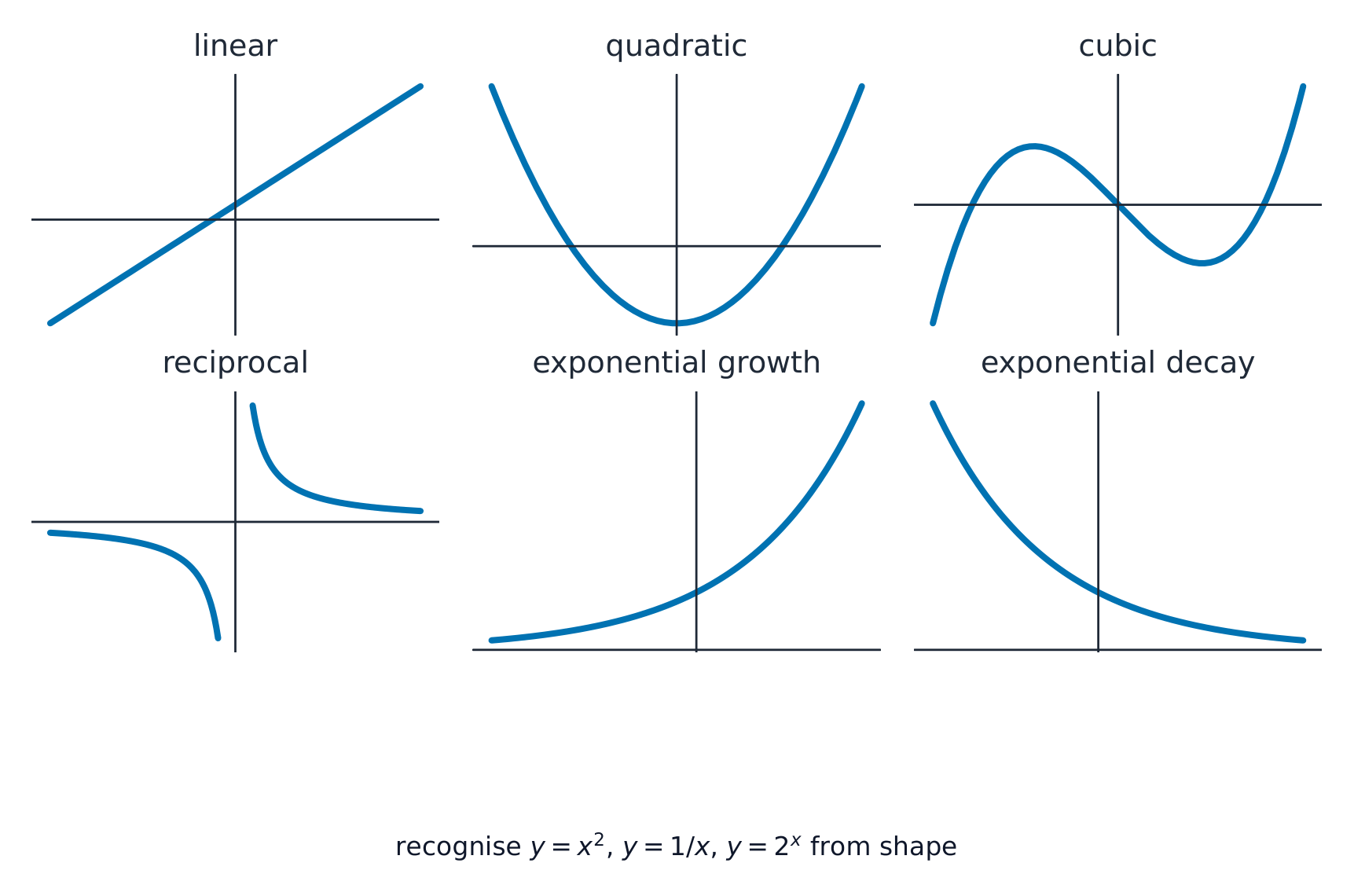
A quick sketch should show the right shape and the key features: where it crosses the axes, any symmetry 对称, and any line the curve gets close to.
Function
Shape
linear, $y = mx + c$
straight line; gradient $m$, $y$-intercept 截距$c$
quadratic, $y = ax^{2} + bx + c$
a parabola 抛物线 (U-shape if $a>0$, $\cap$-shape if $a<0$)
cubic, $y = ax^{3} + bx + c$
an S-shaped curve
reciprocal, $y = \dfrac{a}{x} + b$
two separate curves
exponential, $y = a\,r^{x} + b$
fast growth or decay
The basic graph shapes; knowing each shape lets you sketch quickly from the equation.
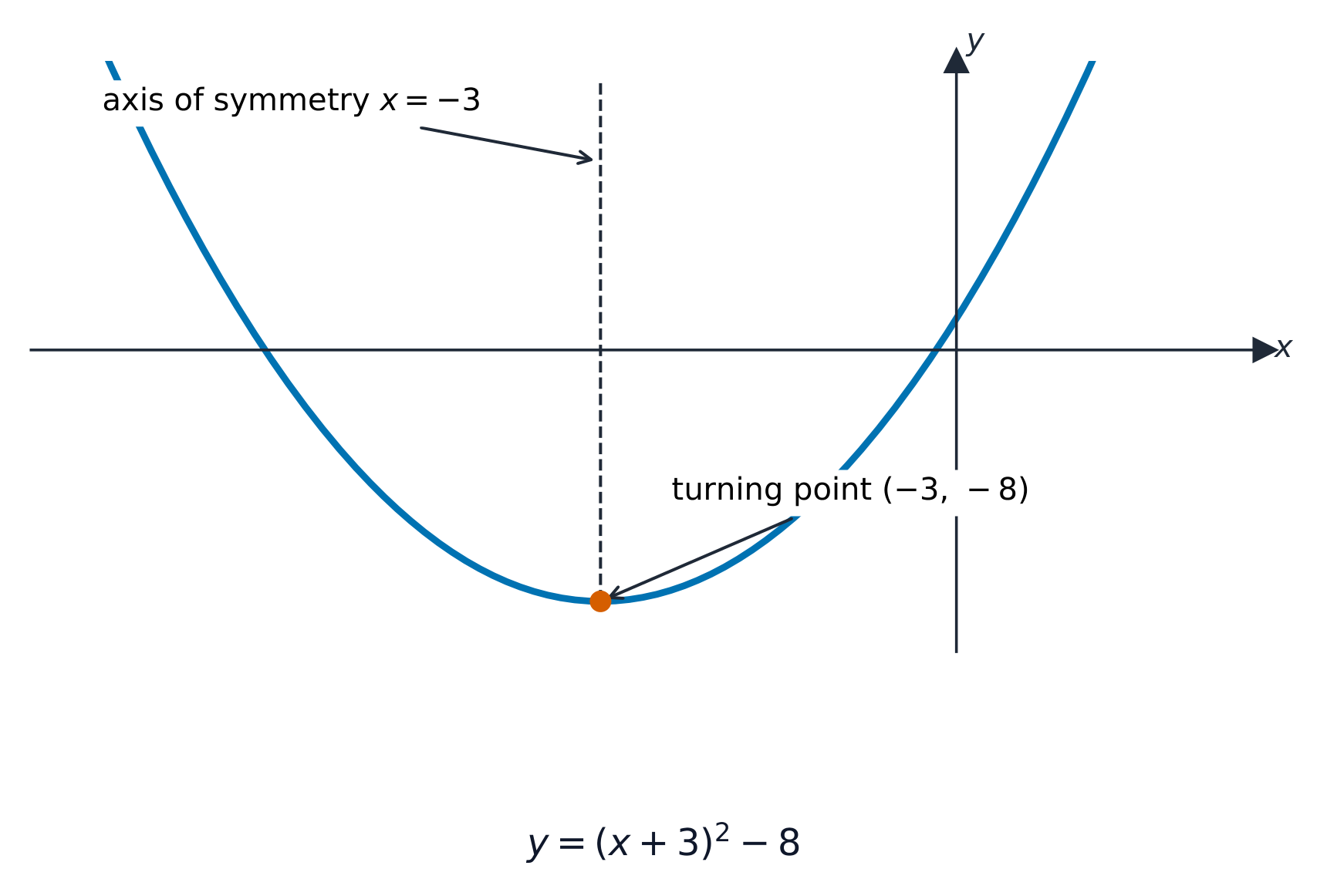
For a parabola, completing the square gives the turning point 转折点 (the lowest or highest point). For example $y = (x + 3)^{2} - 8$ has its turning point at $(-3, -8)$.
Completing the square, $y=(x+3)^2-8$, shows the turning point $(-3,-8)$ and the line of symmetry $x=-3$.
An asymptote 渐近线 is a line that the curve gets closer and closer to but never touches — for example, the $x$-axis for $y = \dfrac{a}{x}$, or the line $y = b$ for $y = a\,r^{x} + b$.
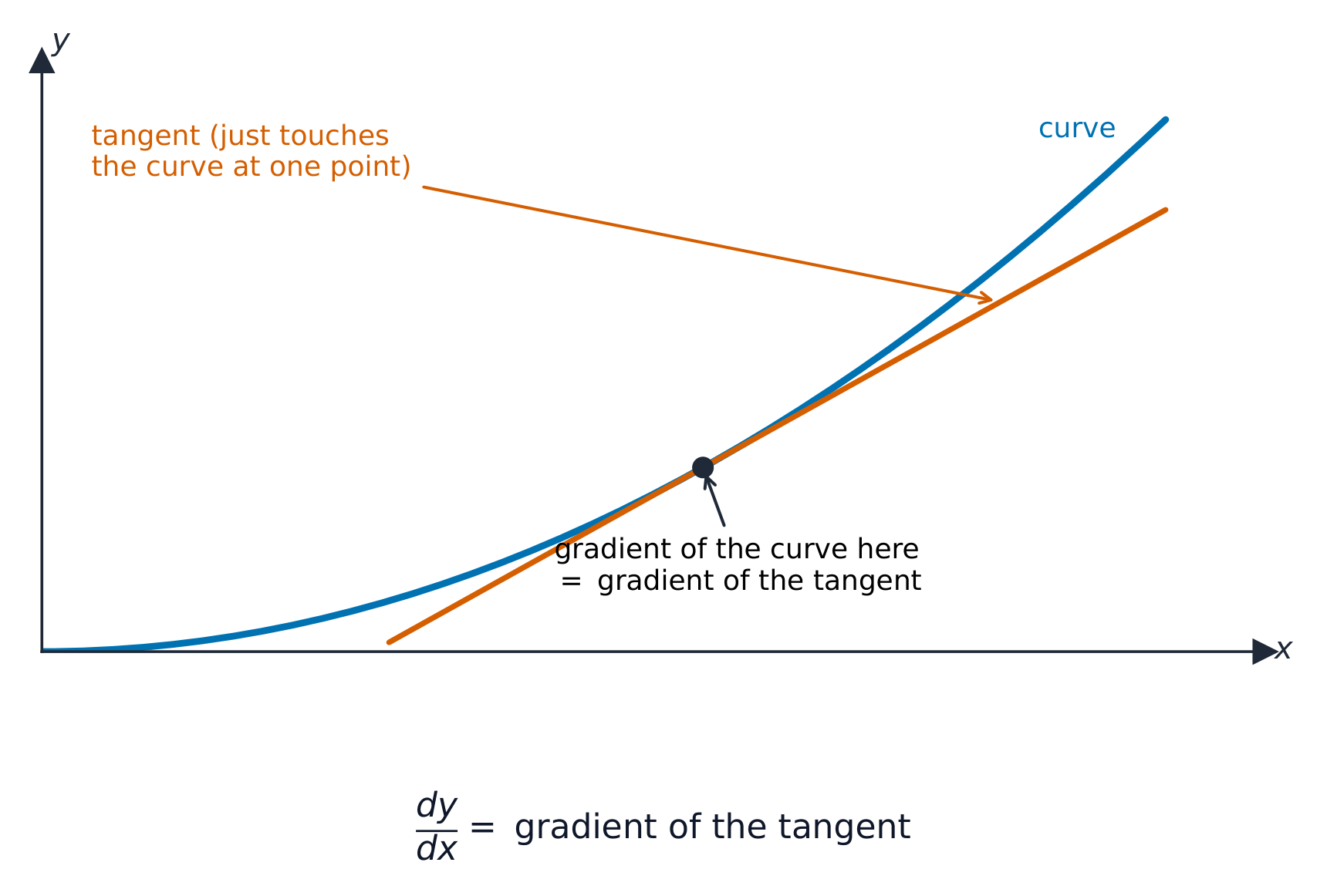
1 Estimate gradients of curves by drawing tangents.
2 Use the derivatives of functions of the form $ax^n$, where $a$ is a rational constant and $n$ is a positive integer or zero, and simple sums of not more than three of these.
$\frac{\mathrm{d}y}{\mathrm{d}x}$ notation will be expected.
3 Apply differentiation to gradients and stationary points (turning points).
4 Discriminate between maxima and minima by any method.
Maximum and minimum points may be identified by: • an accurate sketch • use of the second differential • inspecting the gradient either side of a turning point. Candidates are not expected to identify points of inflection.
Tiếng Việt
Nội dung môn học
Ghi chú và ví dụ
1 Ước lượng độ dốc của đường cong bằng cách vẽ tiếp tuyến.
2 Sử dụng đạo hàm của các hàm có dạng $ax^n$, trong đó $a$ là hằng số hữu tỉ và $n$ là số nguyên dương hoặc không, và các tổng đơn giản không quá ba hàm như vậy.
Ký hiệu $\frac{\mathrm{d}y}{\mathrm{d}x}$ sẽ được yêu cầu.
3 Áp dụng đạo hàm cho độ dốc và các điểm dừng (điểm cực trị).
4 Phân biệt giữa điểm cực đại và cực tiểu bằng bất kỳ phương pháp nào.
Điểm cực đại và cực tiểu có thể được xác định bởi: • một bản phác thảo chính xác • sử dụng đạo hàm bậc hai • kiểm tra độ dốc ở hai bên của điểm cực trị. Thí sinh không cần xác định điểm uốn.
Source: Cambridge International syllabus · Nguồn: Chương trình Cambridge International
Differentiation 微分 finds the gradient of a curve at any point. You can estimate it by drawing a tangent 切线 (a line that just touches the curve) and measuring its gradient.
The gradient of a curve at a point equals the gradient of the tangent there — what differentiation finds.
The exact rule: if $y = ax^{n}$, then the derivative 导数 is
The turning point is $(3, -4)$. To decide whether a turning point is a maximum 最大值 or a minimum 最小值, check the sign of the gradient on each side, or use the second derivative (positive means a minimum).
Explore · Khám phá
Gradient of a curve · Hệ số góc của đường cong
y = ax³ + bx² + cx + d
Move the point: the tangent shows the gradient there, which is what differentiation finds. · Di chuyển điểm: tiếp tuyến hiển thị hệ số góc tại đó, điều mà đạo hàm tìm kiếm.
2 Understand and find inverse functions $f^{-1}(x)$.
3 Form composite functions as defined by $gf(x) = g(f(x))$.
e.g. $f(x) = \frac{3}{x + 2}$ and $g(x) = (3x + 5)^2$. Find $fg(x)$. Give your answer as a fraction in its simplest form. Candidates are not expected to find the domains and ranges of composite functions. This topic may include mapping diagrams.
Tiếng Việt
Nội dung môn học
Ghi chú và ví dụ
1 Hiểu về hàm số, tập xác định và tập giá trị và sử dụng ký hiệu hàm số.
3 Lập hàm hợp theo định nghĩa bởi $gf(x) = g(f(x))$.
Vd. $f(x) = \frac{3}{x + 2}$ và $g(x) = (3x + 5)^2$. Tìm $fg(x)$. Trình bày đáp án dưới dạng phân số tối giản. Thí sinh không cần tìm tập xác định và tập giá trị của hàm hợp. Chủ đề này có thể bao gồm sơ đồ ánh xạ.
Source: Cambridge International syllabus · Nguồn: Chương trình Cambridge International
A function 函数 turns each input into one output. We write $f(x)$, for example $f(x) = 3x - 5$, so $f(2) = 1$. The set of allowed inputs is the domain 定义域; the set of possible outputs is the range 值域.
The inverse function 反函数$f^{-1}(x)$ undoes the function. To find it, write $y = f(x)$, swap the roles, and make $x$ the subject.
Worked example. Find the inverse of $f(x) = 3x - 5$.
This handout covers Topic 3, Coordinate geometry. Parts marked (Extended) are only tested on the Extended papers; everything else is for both levels.
Tiếng Việt
Tài liệu này bao gồm Chủ đề 3, Hình học tọa độ. Các phần được đánh dấu (Nâng cao) chỉ được kiểm tra trong các bài thi Nâng cao; tất cả những phần khác dành cho cả hai mức độ.
3.1
Coordinates · Tọa độ
Syllabus · Chương trình
English
Subject content
Notes and examples
Use and interpret Cartesian coordinates in two dimensions.
Tiếng Việt
Nội dung môn học
Ghi chú và ví dụ
Sử dụng và giải thích tọa độ Descartes trong hai chiều.
Source: Cambridge International syllabus · Nguồn: Chương trình Cambridge International
English
A point on a graph is described by its coordinates 坐标, sometimes called Cartesian coordinates, written $(x, y)$. The first number is the across value and the second is the up value.
The two number lines are the axes 坐标轴: the horizontal 水平$x$-axis and the vertical 竖直$y$-axis.
They cross at the origin 原点, the point $(0, 0)$.
The axes split the grid into four quadrants 象限.
So the point $(3, -2)$ is found by going $3$ to the right and $2$ down.
Tiếng Việt
Lưới đường phố thành phố: mọi nơi đều được cố định bởi tọa độ của nó.
Một điểm trên đồ thị được mô tả bởi tọa độ của nó, đôi khi được gọi là tọa độ Descartes, viết là $(x, y)$. Số đầu tiên là giá trị ngang và số thứ hai là giá trị dọc.
Hai đường số là trục tọa độ: trục ngang$x$-trục và trục dọc$y$-trục.
Chúng cắt nhau tại gốc tọa độ, điểm $(0, 0)$.
Các trục chia lưới thành bốn quadrants.
Vì vậy, điểm $(3, -2)$ được tìm thấy bằng cách di chuyển $3$ sang phải và $2$ xuống dưới.
Các trục giao nhau tại gốc tọa độ $O$ và chia mặt phẳng thành bốn quadrant; $(3,-2)$ có nghĩa là 3 đơn vị sang phải rồi 2 đơn vị xuống dưới.
Explore · Khám phá
The coordinate plane · Mặt phẳng tọa độ
y = mx + c
Every point has an (x, y) coordinate. A straight line is the set of points where y depends on x in a fixed way. · Mỗi điểm đều có tọa độ (x, y). Đường thẳng là tập hợp các điểm mà y phụ thuộc vào x theo một cách cố định.
The equation of a straight line · Phương trình đường thẳng
Syllabus · Chương trình
English
Subject content
Notes and examples
Interpret and obtain the equation of a straight-line graph in the form $y = mx + c$.
Questions may: • use and request lines in the forms $y = mx + c$, $x = k$ • involve finding the equation when the graph is given • ask for the gradient or $y$-intercept of a graph from an equation, e.g. find the gradient and $y$-intercept of the graph with the equation $y = 6x + 3$. Candidates are expected to give equations of a line in a fully simplified form.
Tiếng Việt
Nội dung môn học
Ghi chú và ví dụ
Giải thích và tìm phương trình của đồ thị đường thẳng ở dạng $y = mx + c$.
Câu hỏi có thể: • sử dụng và yêu cầu các đường thẳng ở dạng $y = mx + c$, $x = k$ • liên quan đến việc tìm phương trình khi đồ thị đã cho • yêu cầu tìm hệ số góc hoặc $y$-trục tung của đồ thị từ phương trình, ví dụ: tìm hệ số góc và $y$-trục tung của đồ thị có phương trình $y = 6x + 3$. Thí sinh cần đưa ra phương trình đường thẳng ở dạng rút gọn hoàn toàn.
English
Subject content
Notes and examples
Interpret and obtain the equation of a straight-line graph.
Questions may: • use and request lines in different forms, e.g. $ax + by = c$, $y = mx + c$, $x = k$ • involve finding the equation when the graph is given • ask for the gradient or $y$-intercept of a graph from an equation, e.g. find the gradient and $y$-intercept of the graph with equation $5x + 4y = 8$. Candidates are expected to give equations of a line in a fully simplified form.
Tiếng Việt
Nội dung môn học
Ghi chú và ví dụ
Diễn giải và thu được phương trình của đồ thị đường thẳng.
Câu hỏi có thể: • sử dụng và yêu cầu các đường thẳng ở các dạng khác nhau, v.d. $ax + by = c$, $y = mx + c$, $x = k$ • liên quan đến việc tìm phương trình khi đồ thị đã được cho • yêu cầu tìm hệ số góc hoặc $y$-trục tung của đồ thị từ một phương trình, v.d. tìm hệ số góc và $y$-trục tung của đồ thị có phương trình $5x + 4y = 8$. Thí sinh được kỳ vọng đưa ra phương trình đường thẳng ở dạng rút gọn hoàn toàn.
Source: Cambridge International syllabus · Nguồn: Chương trình Cambridge International
English
Most straight lines can be written as
$$y = mx + c,$$
where $m$ is the gradient 斜率 (steepness) and $c$ is the intercept 截距 — the $y$-value where the line crosses the $y$-axis.
A line like $x = k$ (for example $x = 3$) is vertical.
A line like $y = k$ (for example $y = 3$) is horizontal.
A line may also be given as $ax + by = c$. Rearrange it into $y = mx + c$ to read off the gradient and intercept.
Worked example. Find the gradient and $y$-intercept of $5x + 4y = 8$.
Vậy gradient là $-\tfrac{5}{4}$ và $y$-intercept là $2$.
Explore · Khám phá
y = mx + c
y = ax + b
Drag the gradient and the intercept. a is the gradient (steepness) and b is where the line crosses the y-axis. · Kéo hệ số góc và tung độ gốc. a là hệ số góc (độ dốc) và b là nơi đường thẳng cắt trục y.
Source: Cambridge International syllabus · Nguồn: Chương trình Cambridge International
English
To draw $y = mx + c$, the quickest way is:
Mark the intercept $c$ on the $y$-axis.
Use the gradient to step to more points (for $m = 3$, go $1$ right and $3$ up).
Join the points with a straight line.
You can also make a small table of values 数值表: choose two or three $x$-values, work out $y$, and plot the points.
Tiếng Việt
Để vẽ $y = mx + c$, cách nhanh nhất là:
Đánh dấu intercept $c$ trên trục $y$.
Sử dụng gradient để bước đến các điểm khác (đối với $m = 3$, đi $1$ sang phải và $3$ lên trên).
Nối các điểm lại bằng một đường thẳng.
Bạn cũng có thể lập một bảng giá trị nhỏ: chọn hai hoặc ba giá trị $x$, tính $y$, và biểu diễn các điểm.
Vẽ đường thẳng nhanh: đánh dấu intercept, sau đó dùng gradient để bước đến các điểm mới
3.5
Finding the equation of a line · Tìm phương trình của đường thẳng
Syllabus · Chương trình
English
Subject content
Notes and examples
Interpret and obtain the equation of a straight-line graph in the form $y = mx + c$.
Questions may: • use and request lines in the forms $y = mx + c$, $x = k$ • involve finding the equation when the graph is given • ask for the gradient or $y$-intercept of a graph from an equation, e.g. find the gradient and $y$-intercept of the graph with the equation $y = 6x + 3$. Candidates are expected to give equations of a line in a fully simplified form.
Tiếng Việt
Nội dung môn học
Ghi chú và ví dụ
Giải thích và tìm phương trình của đồ thị đường thẳng ở dạng $y = mx + c$.
Câu hỏi có thể: • sử dụng và yêu cầu các đường thẳng ở dạng $y = mx + c$, $x = k$ • liên quan đến việc tìm phương trình khi đồ thị đã cho • yêu cầu tìm hệ số góc hoặc $y$-trục tung của đồ thị từ phương trình, ví dụ: tìm hệ số góc và $y$-trục tung của đồ thị có phương trình $y = 6x + 3$. Thí sinh cần đưa ra phương trình đường thẳng ở dạng rút gọn hoàn toàn.
English
Subject content
Notes and examples
Interpret and obtain the equation of a straight-line graph.
Questions may: • use and request lines in different forms, e.g. $ax + by = c$, $y = mx + c$, $x = k$ • involve finding the equation when the graph is given • ask for the gradient or $y$-intercept of a graph from an equation, e.g. find the gradient and $y$-intercept of the graph with equation $5x + 4y = 8$. Candidates are expected to give equations of a line in a fully simplified form.
Tiếng Việt
Nội dung môn học
Ghi chú và ví dụ
Diễn giải và thu được phương trình của đồ thị đường thẳng.
Câu hỏi có thể: • sử dụng và yêu cầu các đường thẳng ở các dạng khác nhau, v.d. $ax + by = c$, $y = mx + c$, $x = k$ • liên quan đến việc tìm phương trình khi đồ thị đã được cho • yêu cầu tìm hệ số góc hoặc $y$-trục tung của đồ thị từ một phương trình, v.d. tìm hệ số góc và $y$-trục tung của đồ thị có phương trình $5x + 4y = 8$. Thí sinh được kỳ vọng đưa ra phương trình đường thẳng ở dạng rút gọn hoàn toàn.
Source: Cambridge International syllabus · Nguồn: Chương trình Cambridge International
English
If you know the gradient $m$ and one point on the line, put the point into $y = mx + c$ to find $c$.
Worked example. A line has gradient $3$ and passes through $(1, 2)$. Find its equation.
Khoảng trống ngang (3) và khoảng trống dọc (4) tạo thành tam giác vuông, nên độ dài là $\sqrt{3^2+4^2}=5$; điểm chính giữa là trung bình cộng của các tọa độ.
Explore · Khám phá
Length and midpoint lab · Thí nghiệm chiều dài và trung điểm
midpoint is halfway between endpoints · trung điểm nằm ở giữa hai đầu mút
Move along a line segment and see midpoint as halfway. · Di chuyển dọc theo đoạn thẳng và xem trung điểm là điểm chính giữa.
Find the gradient and equation of a straight line parallel to a given line.
e.g. find the equation of the line parallel to $y = 4x - 1$ that passes through $(1, -3)$.
Tiếng Việt
Nội dung môn học
Ghi chú và ví dụ
Tìm độ dốc và phương trình của một đường thẳng song song với một đường thẳng đã cho.
Ví dụ: tìm phương trình của đường thẳng song song với $y = 4x - 1$ đi qua điểm $(1, -3)$.
Source: Cambridge International syllabus · Nguồn: Chương trình Cambridge International
English
Parallel 平行 lines never meet, so they have the same gradient.
Worked example. Find the equation of the line parallel to $y = 4x - 1$ that passes through $(1, -3)$.
The gradient is also $4$. Put the point in:
$$-3 = 4(1) + c \;\Rightarrow\; c = -7,$$
so the line is $y = 4x - 7$.
Tiếng Việt
Các đường parallel (song song) không bao giờ gặp nhau, vì vậy chúng có cùng gradient.
Worked example. Tìm phương trình của đường thẳng song song với $y = 4x - 1$ đi qua $(1, -3)$.
Gradient cũng là $4$. Thay điểm vào:
$$-3 = 4(1) + c \;\Rightarrow\; c = -7,$$
vậy đường thẳng là $y = 4x - 7$.
Đường thẳng song song: cùng gradient, khác intercept
Explore · Khám phá
Parallel & perpendicular · Song song & vuông góc
y = ax + b
Parallel lines share a gradient; perpendicular gradients multiply to −1. · Song song: các đường thẳng có cùng hệ số góc; Vuông góc: tích các hệ số góc bằng −1.
Find the gradient and equation of a straight line perpendicular to a given line.
Examples include: • find the gradient of a line perpendicular to $2y = 3x + 1$ • find the equation of the perpendicular bisector of the line joining the points $(-3, 8)$ and $(9, -2)$.
Tiếng Việt
Nội dung môn học
Ghi chú và ví dụ
Tìm hệ số góc và phương trình của một đường thẳng vuông góc với một đường thẳng cho trước.
Ví dụ bao gồm: • tìm hệ số góc của đường thẳng vuông góc với $2y = 3x + 1$ • tìm phương trình đường trung trực của đoạn thẳng nối hai điểm $(-3, 8)$ và $(9, -2)$.
Source: Cambridge International syllabus · Nguồn: Chương trình Cambridge International
English
Two lines are perpendicular 垂直 if they meet at a right angle 直角. Their gradients multiply to $-1$:
Worked example. Find the gradient of a line perpendicular to $2y = 3x + 1$.
Rearrange: $y = \tfrac{3}{2}x + \tfrac{1}{2}$, so the gradient is $\tfrac{3}{2}$. The perpendicular gradient is $-\tfrac{2}{3}$.
Perpendicular bisector
The perpendicular bisector 垂直平分线 of a segment cuts it in half at a right angle. To find its equation: get the midpoint, then use the perpendicular gradient through that midpoint.
Worked example. Find the perpendicular bisector of the segment joining $(-3, 8)$ and $(9, -2)$.
Worked example. Tìm gradient của đường thẳng vuông góc với $2y = 3x + 1$.
Biến đổi: $y = \tfrac{3}{2}x + \tfrac{1}{2}$, do đó hệ số góc là $\tfrac{3}{2}$. Hệ số góc vuông góc với nó là $-\tfrac{2}{3}$.
Đường thẳng song song có cùng gradient; các gradient vuông góc nhân với nhau ra $-1$.
Đường trung trực
Perpendicular bisector (đường trung trực) của một đoạn thẳng cắt đôi nó ở góc vuông. Để tìm phương trình của nó: lấy điểm chính giữa, sau đó sử dụng gradient vuông góc đi qua điểm chính giữa đó.
Worked example. Tìm đường trung trực của đoạn thẳng nối $(-3, 8)$ và $(9, -2)$.
This handout covers Topic 4, Geometry. Parts marked (Extended) are only tested on the Extended papers; everything else is for both levels. In the exam you must give reasons using the correct names below, not just the numbers.
Tiếng Việt
Tài liệu này bao gồm Chủ đề 4, Hình học. Các phần được đánh dấu (Nâng cao) chỉ được kiểm tra trong các bài thi Nâng cao; tất cả các phần còn lại áp dụng cho cả hai mức độ. Trong kỳ thi, bạn phải trình bày lý do sử dụng đúng tên gọi bên dưới, không chỉ ghi con số.
4.1
Lines and angles · Đường thẳng và góc
Syllabus · Chương trình
English
Subject content
Notes and examples
1 Use and interpret the following geometrical terms: • point • vertex • line • parallel • perpendicular • bearing • right angle • acute, obtuse and reflex angles • interior and exterior angles • similar • congruent • scale factor.
Candidates are not expected to show that two shapes are congruent.
2 Use and interpret the vocabulary of: • triangles • special quadrilaterals • polygons • nets • simple solids.
Includes the following terms: Triangles: • equilateral • isosceles • scalene • right-angled. Quadrilaterals: • square • rectangle • kite • rhombus • parallelogram • trapezium. Polygons: • regular and irregular polygons • pentagon • hexagon • octagon • decagon.
Includes the following terms: • centre • radius (plural radii) • diameter • circumference • semicircle • chord • tangent • arc • sector • segment.
Tiếng Việt
Nội dung môn học
Ghi chú và ví dụ
1 Sử dụng và diễn giải các thuật ngữ hình học sau: • điểm • đỉnh • đường thẳng • song song • vuông góc • phương vị • góc vuông • góc nhọn, góc tù và góc reflex • góc trong và góc ngoài • tương tự • bằng nhau • hệ số tỷ lệ.
Thí sinh không cần chứng minh hai hình bằng nhau.
2 Sử dụng và diễn giải từ vựng về: • tam giác • tứ giác đặc biệt • đa giác • mặt phẳng khai triển • khối đơn giản.
Bao gồm các thuật ngữ sau: Tam giác: • đều • cân • thường • vuông. Tứ giác: • hình vuông • hình chữ nhật • hình diều • hình thoi • hình bình hành • hình thang. Đa giác: • đa giác đều và không đều • ngũ giác • lục giác • bát giác • thập giác.
Khối đơn giản: • khối lập phương • khối hộp chữ nhật • lăng trụ • trụ tròn • chóp • nón • cầu (không yêu cầu thuật ngữ 'nửa cầu') • mặt • bề mặt • cạnh.
3 Sử dụng và diễn giải từ vựng về hình tròn.
Bao gồm các thuật ngữ sau: • tâm • bán kính (số nhiều là radii) • đường kính • chu vi • nửa đường tròn • dây cung • tiếp tuyến • cung • hình quạt • hình viên phân.
English
Subject content
Notes and examples
1 Use and interpret the following geometrical terms: • point • vertex • line • plane • parallel • perpendicular • perpendicular bisector • bearing • right angle • acute, obtuse and reflex angles • interior and exterior angles • similar • congruent • scale factor.
Candidates are not expected to show that two shapes are congruent.
2 Use and interpret the vocabulary of: • triangles • special quadrilaterals • polygons • nets • solids.
Includes the following terms. Triangles: • equilateral • isosceles • scalene • right-angled. Quadrilaterals: • square • rectangle • kite • rhombus • parallelogram • trapezium.
Includes the following terms: • centre • radius (plural radii) • diameter • circumference • semicircle • chord • tangent • major and minor arc • sector • segment.
Tiếng Việt
Nội dung môn học
Ghi chú và ví dụ
1 Sử dụng và diễn giải các thuật ngữ hình học sau: • điểm • đỉnh • đường thẳng • mặt phẳng • song song • vuông góc • đường trung trực • phương vị • góc vuông • góc nhọn, góc tù và góc reflex • góc trong và góc ngoài • đồng dạng • bằng nhau • hệ số tỉ lệ.
Thí sinh không yêu cầu chứng minh hai hình bằng nhau.
2 Sử dụng và giải thích từ vựng về: • tam giác • tứ giác đặc biệt • đa giác • mặt khai triển • khối.
Bao gồm các thuật ngữ sau. Tam giác: • đều • cân • thường • vuông. Tứ giác: • hình vuông • hình chữ nhật • hình diều • hình thoi • hình bình hành • hình thang.
Đa giác: • đa giác đều và không đều • ngũ giác • lục giác • bát giác • thập giác. Khối: • lập phương • hộp chữ nhật • lăng trụ • trụ tròn • chóp • nón • cầu • bán cầu • khối cụt • mặt • bề mặt • cạnh.
3 Sử dụng và giải thích từ vựng về đường tròn.
Bao gồm các thuật ngữ sau: • tâm • bán kính (số nhiều là radii) • đường kính • chu vi • bán nguyệt • dây cung • tiếp tuyến • cung lớn và cung nhỏ • hình quạt • hình phần.
Source: Cambridge International syllabus · Nguồn: Chương trình Cambridge International
English
A corner where two lines meet is a vertex 顶点. Two lines are parallel 平行 if they never meet, and perpendicular 垂直 if they meet at a right angle. Angles are named by their size:
Name
Size
acute angle 锐角
less than $90^{\circ}$
right angle 直角
exactly $90^{\circ}$
obtuse angle 钝角
between $90^{\circ}$ and $180^{\circ}$
reflex angle 优角
between $180^{\circ}$ and $360^{\circ}$
We name an angle with three letters, e.g. angle $ABC$ is the angle at $B$.
Tiếng Việt
Giao điểm của hai đường thẳng là một đỉnh. Hai đường thẳng song song nếu chúng không bao giờ cắt nhau, và vuông góc nếu chúng cắt nhau tại một góc vuông. Góc được đặt tên theo độ lớn:
Tên
Kích thước
góc nhọn
nhỏ hơn $90^{\circ}$
góc vuông
đúng bằng $90^{\circ}$
góc tù
giữa $90^{\circ}$ và $180^{\circ}$
góc bẹt
giữa $180^{\circ}$ và $360^{\circ}$
Phân loại góc theo độ lớn: góc nhọn (dưới $90^\circ$), góc vuông ($90^\circ$, ký hiệu bằng hình vuông), góc tù ($90^\circ$–$180^\circ$) và góc reflex ($180^\circ$–$360^\circ$).
Chúng ta đặt tên cho một góc bằng ba chữ cái, ví dụ: góc $ABC$ chính là góc tại $B$.
Explore · Khám phá
Shape and angle lab · Phòng thí nghiệm hình học và góc
Classify angle facts by the diagram feature that creates them. · Phân loại các quy luật góc dựa trên đặc điểm hình học tạo ra chúng.
4.6
Angle facts · Kiến thức về góc
Syllabus · Chương trình
English
Subject content
Notes and examples
1 Calculate unknown angles and give simple explanations using the following geometrical properties: • sum of angles at a point = 360° • sum of angles at a point on a straight line = 180° • vertically opposite angles are equal • angle sum of a triangle = 180° and angle sum of a quadrilateral = 360°.
Knowledge of three-letter notation for angles is required, e.g. angle $ABC$. Candidates are expected to use the correct geometrical terminology when giving reasons for answers.
2 Calculate unknown angles and give geometric explanations for angles formed within parallel lines: • corresponding angles are equal • alternate angles are equal • co-interior angles sum to 180° (supplementary).
3 Know and use angle properties of regular polygons.
Includes exterior and interior angles, and angle sum.
Tiếng Việt
Nội dung môn học
Ghi chú và ví dụ
1 Tính các góc chưa biết và đưa ra lời giải thích đơn giản bằng các tính chất hình học sau: • tổng các góc tại một điểm = 360° • tổng các góc tại một điểm trên một đường thẳng = 180° • hai góc đối đỉnh bằng nhau • tổng các góc của tam giác = 180° và tổng các góc của tứ giác = 360°.
Cần nắm rõ ký hiệu ba chữ cái cho góc, ví dụ: góc $ABC$. Thí sinh cần sử dụng đúng thuật ngữ hình học khi đưa ra lý do cho câu trả lời.
2 Tính các góc chưa biết và đưa ra lời giải thích hình học cho các góc tạo thành giữa các đường thẳng song song: • góc đồng vị bằng nhau • góc so le trong bằng nhau • góc trong cùng phía cộng lại bằng 180° (bù nhau).
3 Biết và sử dụng các tính chất góc của đa giác đều.
Bao gồm góc ngoài, góc trong và tổng các góc.
Subject content
Notes and examples
1 Calculate unknown angles and give simple explanations using the following geometrical properties: • sum of angles at a point = 360° • sum of angles at a point on a straight line = 180° • vertically opposite angles are equal • angle sum of a triangle = 180° and angle sum of a quadrilateral = 360°.
Knowledge of 3-letter notation for angles is required, e.g. angle $ABC$. Candidates are expected to use the correct geometrical terminology when giving reasons for answers.
2 Calculate unknown angles and give geometric explanations for angles formed within parallel lines: • corresponding angles are equal • alternate angles are equal • co-interior angles sum to 180° (supplementary).
3 Know and use angle properties of regular and irregular polygons.
Includes exterior and interior angles, and angle sum.
Source: Cambridge International syllabus · Nguồn: Chương trình Cambridge International
English
Learn these basic facts. Each one is a valid reason in the exam.
Angles at a point add up to $360^{\circ}$.
Angles on a straight line add up to $180^{\circ}$.
Vertically opposite angles 对顶角 (made by two crossing lines) are equal.
Worked example. Three angles on a straight line are $x$, $50^{\circ}$ and $70^{\circ}$. Find $x$.
Parallel line and polygon lab · Phòng thí nghiệm đường thẳng song song và đa giác
Pick the angle rule that unlocks each diagram. · Chọn quy tắc góc giải mã mỗi sơ đồ.
4.6
Angles in parallel lines · Góc trong đường thẳng song song
Syllabus · Chương trình
English
Subject content
Notes and examples
1 Calculate unknown angles and give simple explanations using the following geometrical properties: • sum of angles at a point = 360° • sum of angles at a point on a straight line = 180° • vertically opposite angles are equal • angle sum of a triangle = 180° and angle sum of a quadrilateral = 360°.
Knowledge of three-letter notation for angles is required, e.g. angle $ABC$. Candidates are expected to use the correct geometrical terminology when giving reasons for answers.
2 Calculate unknown angles and give geometric explanations for angles formed within parallel lines: • corresponding angles are equal • alternate angles are equal • co-interior angles sum to 180° (supplementary).
3 Know and use angle properties of regular polygons.
Includes exterior and interior angles, and angle sum.
Tiếng Việt
Nội dung môn học
Ghi chú và ví dụ
1 Tính các góc chưa biết và đưa ra lời giải thích đơn giản bằng các tính chất hình học sau: • tổng các góc tại một điểm = 360° • tổng các góc tại một điểm trên một đường thẳng = 180° • hai góc đối đỉnh bằng nhau • tổng các góc của tam giác = 180° và tổng các góc của tứ giác = 360°.
Cần nắm rõ ký hiệu ba chữ cái cho góc, ví dụ: góc $ABC$. Thí sinh cần sử dụng đúng thuật ngữ hình học khi đưa ra lý do cho câu trả lời.
2 Tính các góc chưa biết và đưa ra lời giải thích hình học cho các góc tạo thành giữa các đường thẳng song song: • góc đồng vị bằng nhau • góc so le trong bằng nhau • góc trong cùng phía cộng lại bằng 180° (bù nhau).
3 Biết và sử dụng các tính chất góc của đa giác đều.
Bao gồm góc ngoài, góc trong và tổng các góc.
Subject content
Notes and examples
1 Calculate unknown angles and give simple explanations using the following geometrical properties: • sum of angles at a point = 360° • sum of angles at a point on a straight line = 180° • vertically opposite angles are equal • angle sum of a triangle = 180° and angle sum of a quadrilateral = 360°.
Knowledge of 3-letter notation for angles is required, e.g. angle $ABC$. Candidates are expected to use the correct geometrical terminology when giving reasons for answers.
2 Calculate unknown angles and give geometric explanations for angles formed within parallel lines: • corresponding angles are equal • alternate angles are equal • co-interior angles sum to 180° (supplementary).
3 Know and use angle properties of regular and irregular polygons.
Includes exterior and interior angles, and angle sum.
Source: Cambridge International syllabus · Nguồn: Chương trình Cambridge International
English
When a line crosses two parallel lines:
Corresponding angles 同位角 (in matching positions, an "F" shape) are equal.
Alternate angles 内错角 (opposite sides of the crossing line, a "Z" shape) are equal.
Co-interior angles 同旁内角 (a "C" shape) add up to $180^{\circ}$; we say they are supplementary 互补.
Worked example. A straight line crosses two parallel lines. One angle is $110^{\circ}$. The co-interior angle $y$ satisfies $110 + y = 180$, so $y = 70^{\circ}$.
Tiếng Việt
Khi một đường thẳng cắt hai đường thẳng song song:
Góc đồng vị (nằm ở vị trí tương ứng, dạng "F") thì bằng nhau.
Góc so le (nằm ở hai phía khác nhau của đường cắt, dạng "Z") thì bằng nhau.
Góc trong cùng phía (dạng "C") cộng lại bằng $180^{\circ}$; ta gọi chúng là bù nhau.
Ví dụ minh họa. Một đường thẳng cắt hai đường thẳng song song. Một góc bằng $110^{\circ}$. Góc đồng vị (cùng phía trong) $y$ thỏa mãn $110 + y = 180$, nên $y = 70^{\circ}$.
Góc đồng vị (F) và góc so le (Z) thì bằng nhau; góc trong cùng phía (C) cộng lại bằng $180^\circ$.
1 Use and interpret the following geometrical terms: • point • vertex • line • parallel • perpendicular • bearing • right angle • acute, obtuse and reflex angles • interior and exterior angles • similar • congruent • scale factor.
Candidates are not expected to show that two shapes are congruent.
2 Use and interpret the vocabulary of: • triangles • special quadrilaterals • polygons • nets • simple solids.
Includes the following terms: Triangles: • equilateral • isosceles • scalene • right-angled. Quadrilaterals: • square • rectangle • kite • rhombus • parallelogram • trapezium. Polygons: • regular and irregular polygons • pentagon • hexagon • octagon • decagon.
Includes the following terms: • centre • radius (plural radii) • diameter • circumference • semicircle • chord • tangent • arc • sector • segment.
Tiếng Việt
Nội dung môn học
Ghi chú và ví dụ
1 Sử dụng và diễn giải các thuật ngữ hình học sau: • điểm • đỉnh • đường thẳng • song song • vuông góc • phương vị • góc vuông • góc nhọn, góc tù và góc reflex • góc trong và góc ngoài • tương tự • bằng nhau • hệ số tỷ lệ.
Thí sinh không cần chứng minh hai hình bằng nhau.
2 Sử dụng và diễn giải từ vựng về: • tam giác • tứ giác đặc biệt • đa giác • mặt phẳng khai triển • khối đơn giản.
Bao gồm các thuật ngữ sau: Tam giác: • đều • cân • thường • vuông. Tứ giác: • hình vuông • hình chữ nhật • hình diều • hình thoi • hình bình hành • hình thang. Đa giác: • đa giác đều và không đều • ngũ giác • lục giác • bát giác • thập giác.
Khối đơn giản: • khối lập phương • khối hộp chữ nhật • lăng trụ • trụ tròn • chóp • nón • cầu (không yêu cầu thuật ngữ 'nửa cầu') • mặt • bề mặt • cạnh.
3 Sử dụng và diễn giải từ vựng về hình tròn.
Bao gồm các thuật ngữ sau: • tâm • bán kính (số nhiều là radii) • đường kính • chu vi • nửa đường tròn • dây cung • tiếp tuyến • cung • hình quạt • hình viên phân.
English
Subject content
Notes and examples
1 Use and interpret the following geometrical terms: • point • vertex • line • plane • parallel • perpendicular • perpendicular bisector • bearing • right angle • acute, obtuse and reflex angles • interior and exterior angles • similar • congruent • scale factor.
Candidates are not expected to show that two shapes are congruent.
2 Use and interpret the vocabulary of: • triangles • special quadrilaterals • polygons • nets • solids.
Includes the following terms. Triangles: • equilateral • isosceles • scalene • right-angled. Quadrilaterals: • square • rectangle • kite • rhombus • parallelogram • trapezium.
Includes the following terms: • centre • radius (plural radii) • diameter • circumference • semicircle • chord • tangent • major and minor arc • sector • segment.
Tiếng Việt
Nội dung môn học
Ghi chú và ví dụ
1 Sử dụng và diễn giải các thuật ngữ hình học sau: • điểm • đỉnh • đường thẳng • mặt phẳng • song song • vuông góc • đường trung trực • phương vị • góc vuông • góc nhọn, góc tù và góc reflex • góc trong và góc ngoài • đồng dạng • bằng nhau • hệ số tỉ lệ.
Thí sinh không yêu cầu chứng minh hai hình bằng nhau.
2 Sử dụng và giải thích từ vựng về: • tam giác • tứ giác đặc biệt • đa giác • mặt khai triển • khối.
Bao gồm các thuật ngữ sau. Tam giác: • đều • cân • thường • vuông. Tứ giác: • hình vuông • hình chữ nhật • hình diều • hình thoi • hình bình hành • hình thang.
Đa giác: • đa giác đều và không đều • ngũ giác • lục giác • bát giác • thập giác. Khối: • lập phương • hộp chữ nhật • lăng trụ • trụ tròn • chóp • nón • cầu • bán cầu • khối cụt • mặt • bề mặt • cạnh.
3 Sử dụng và giải thích từ vựng về đường tròn.
Bao gồm các thuật ngữ sau: • tâm • bán kính (số nhiều là radii) • đường kính • chu vi • bán nguyệt • dây cung • tiếp tuyến • cung lớn và cung nhỏ • hình quạt • hình phần.
Source: Cambridge International syllabus · Nguồn: Chương trình Cambridge International
English
A triangle 三角形 has three sides and angles that add up to $180^{\circ}$.
Type
Property
equilateral 等边
all sides equal, all angles $60^{\circ}$
isosceles 等腰
two sides equal, two angles equal
scalene 不等边
all sides and angles different
right-angled
has one right angle
Worked example. A triangle has angles $x$, $2x$ and $90^{\circ}$. Find $x$.
1 Use and interpret the following geometrical terms: • point • vertex • line • parallel • perpendicular • bearing • right angle • acute, obtuse and reflex angles • interior and exterior angles • similar • congruent • scale factor.
Candidates are not expected to show that two shapes are congruent.
2 Use and interpret the vocabulary of: • triangles • special quadrilaterals • polygons • nets • simple solids.
Includes the following terms: Triangles: • equilateral • isosceles • scalene • right-angled. Quadrilaterals: • square • rectangle • kite • rhombus • parallelogram • trapezium. Polygons: • regular and irregular polygons • pentagon • hexagon • octagon • decagon.
Includes the following terms: • centre • radius (plural radii) • diameter • circumference • semicircle • chord • tangent • arc • sector • segment.
Tiếng Việt
Nội dung môn học
Ghi chú và ví dụ
1 Sử dụng và diễn giải các thuật ngữ hình học sau: • điểm • đỉnh • đường thẳng • song song • vuông góc • phương vị • góc vuông • góc nhọn, góc tù và góc reflex • góc trong và góc ngoài • tương tự • bằng nhau • hệ số tỷ lệ.
Thí sinh không cần chứng minh hai hình bằng nhau.
2 Sử dụng và diễn giải từ vựng về: • tam giác • tứ giác đặc biệt • đa giác • mặt phẳng khai triển • khối đơn giản.
Bao gồm các thuật ngữ sau: Tam giác: • đều • cân • thường • vuông. Tứ giác: • hình vuông • hình chữ nhật • hình diều • hình thoi • hình bình hành • hình thang. Đa giác: • đa giác đều và không đều • ngũ giác • lục giác • bát giác • thập giác.
Khối đơn giản: • khối lập phương • khối hộp chữ nhật • lăng trụ • trụ tròn • chóp • nón • cầu (không yêu cầu thuật ngữ 'nửa cầu') • mặt • bề mặt • cạnh.
3 Sử dụng và diễn giải từ vựng về hình tròn.
Bao gồm các thuật ngữ sau: • tâm • bán kính (số nhiều là radii) • đường kính • chu vi • nửa đường tròn • dây cung • tiếp tuyến • cung • hình quạt • hình viên phân.
English
Subject content
Notes and examples
1 Use and interpret the following geometrical terms: • point • vertex • line • plane • parallel • perpendicular • perpendicular bisector • bearing • right angle • acute, obtuse and reflex angles • interior and exterior angles • similar • congruent • scale factor.
Candidates are not expected to show that two shapes are congruent.
2 Use and interpret the vocabulary of: • triangles • special quadrilaterals • polygons • nets • solids.
Includes the following terms. Triangles: • equilateral • isosceles • scalene • right-angled. Quadrilaterals: • square • rectangle • kite • rhombus • parallelogram • trapezium.
Includes the following terms: • centre • radius (plural radii) • diameter • circumference • semicircle • chord • tangent • major and minor arc • sector • segment.
Tiếng Việt
Nội dung môn học
Ghi chú và ví dụ
1 Sử dụng và diễn giải các thuật ngữ hình học sau: • điểm • đỉnh • đường thẳng • mặt phẳng • song song • vuông góc • đường trung trực • phương vị • góc vuông • góc nhọn, góc tù và góc reflex • góc trong và góc ngoài • đồng dạng • bằng nhau • hệ số tỉ lệ.
Thí sinh không yêu cầu chứng minh hai hình bằng nhau.
2 Sử dụng và giải thích từ vựng về: • tam giác • tứ giác đặc biệt • đa giác • mặt khai triển • khối.
Bao gồm các thuật ngữ sau. Tam giác: • đều • cân • thường • vuông. Tứ giác: • hình vuông • hình chữ nhật • hình diều • hình thoi • hình bình hành • hình thang.
Đa giác: • đa giác đều và không đều • ngũ giác • lục giác • bát giác • thập giác. Khối: • lập phương • hộp chữ nhật • lăng trụ • trụ tròn • chóp • nón • cầu • bán cầu • khối cụt • mặt • bề mặt • cạnh.
3 Sử dụng và giải thích từ vựng về đường tròn.
Bao gồm các thuật ngữ sau: • tâm • bán kính (số nhiều là radii) • đường kính • chu vi • bán nguyệt • dây cung • tiếp tuyến • cung lớn và cung nhỏ • hình quạt • hình phần.
Source: Cambridge International syllabus · Nguồn: Chương trình Cambridge International
English
A quadrilateral 四边形 has four sides and angles that add up to $360^{\circ}$.
Shape
Property
square 正方形
four equal sides, four right angles
rectangle 矩形
opposite sides equal, four right angles
parallelogram 平行四边形
opposite sides parallel and equal
rhombus 菱形
four equal sides, opposite sides parallel
kite 鸢形
two pairs of equal sides next to each other
trapezium 梯形
one pair of parallel sides
Tiếng Việt
Một tứ giác có bốn cạnh và tổng bốn góc bằng $360^{\circ}$.
Hình
Tính chất
hình vuông
bốn cạnh bằng nhau, bốn góc vuông
hình chữ nhật
hai cạnh đối bằng nhau, bốn góc vuông
hình bình hành
hai cạnh đối song song và bằng nhau
hình thoi
bốn cạnh bằng nhau, hai cạnh đối song song
hình diều
hai cặp cạnh bằng nhau nằm kề nhau
hình thang
có một cặp cạnh song song
4.6
Polygons · Đa giác
Syllabus · Chương trình
English
Subject content
Notes and examples
1 Calculate unknown angles and give simple explanations using the following geometrical properties: • sum of angles at a point = 360° • sum of angles at a point on a straight line = 180° • vertically opposite angles are equal • angle sum of a triangle = 180° and angle sum of a quadrilateral = 360°.
Knowledge of three-letter notation for angles is required, e.g. angle $ABC$. Candidates are expected to use the correct geometrical terminology when giving reasons for answers.
2 Calculate unknown angles and give geometric explanations for angles formed within parallel lines: • corresponding angles are equal • alternate angles are equal • co-interior angles sum to 180° (supplementary).
3 Know and use angle properties of regular polygons.
Includes exterior and interior angles, and angle sum.
Tiếng Việt
Nội dung môn học
Ghi chú và ví dụ
1 Tính các góc chưa biết và đưa ra lời giải thích đơn giản bằng các tính chất hình học sau: • tổng các góc tại một điểm = 360° • tổng các góc tại một điểm trên một đường thẳng = 180° • hai góc đối đỉnh bằng nhau • tổng các góc của tam giác = 180° và tổng các góc của tứ giác = 360°.
Cần nắm rõ ký hiệu ba chữ cái cho góc, ví dụ: góc $ABC$. Thí sinh cần sử dụng đúng thuật ngữ hình học khi đưa ra lý do cho câu trả lời.
2 Tính các góc chưa biết và đưa ra lời giải thích hình học cho các góc tạo thành giữa các đường thẳng song song: • góc đồng vị bằng nhau • góc so le trong bằng nhau • góc trong cùng phía cộng lại bằng 180° (bù nhau).
3 Biết và sử dụng các tính chất góc của đa giác đều.
Bao gồm góc ngoài, góc trong và tổng các góc.
Subject content
Notes and examples
1 Calculate unknown angles and give simple explanations using the following geometrical properties: • sum of angles at a point = 360° • sum of angles at a point on a straight line = 180° • vertically opposite angles are equal • angle sum of a triangle = 180° and angle sum of a quadrilateral = 360°.
Knowledge of 3-letter notation for angles is required, e.g. angle $ABC$. Candidates are expected to use the correct geometrical terminology when giving reasons for answers.
2 Calculate unknown angles and give geometric explanations for angles formed within parallel lines: • corresponding angles are equal • alternate angles are equal • co-interior angles sum to 180° (supplementary).
3 Know and use angle properties of regular and irregular polygons.
Includes exterior and interior angles, and angle sum.
Source: Cambridge International syllabus · Nguồn: Chương trình Cambridge International
English
A polygon 多边形 is a shape with straight sides. A regular polygon 正多边形 has all sides and all angles equal.
Sides
Name
5
pentagon 五边形
6
hexagon 六边形
8
octagon 八边形
10
decagon 十边形
For a polygon with $n$ sides:
$$\text{sum of interior angles} = (n - 2) \times 180^{\circ}, \qquad \text{sum of exterior angles} = 360^{\circ}.$$
The interior angle 内角 and the exterior angle 外角 at each corner add up to $180^{\circ}$.
Worked example. Find each interior angle of a regular hexagon.
The exterior angle is $\dfrac{360^{\circ}}{6} = 60^{\circ}$, so each interior angle is $180^{\circ} - 60^{\circ} = 120^{\circ}$.
Tiếng Việt
Mạng tessellation tổ ong phủ kín mặt phẳng bằng các lục giác đều.
Một đa giác là hình có các cạnh là đoạn thẳng. Một đa giác đều có tất cả các cạnh và tất cả các góc bằng nhau.
Số cạnh
Tên gọi
5
ngũ giác
6
lục giác
8
bát giác
10
thập giác
Đối với đa giác có $n$ cạnh:
$$\text{sum of interior angles} = (n - 2) \times 180^{\circ}, \qquad \text{sum of exterior angles} = 360^{\circ}.$$
Tổng góc trong và góc ngoài tại mỗi đỉnh bằng $180^{\circ}$.
Ví dụ minh họa. Tìm mỗi góc trong của một lục giác đều.
Góc ngoài là $\dfrac{360^{\circ}}{6} = 60^{\circ}$, nên mỗi góc trong là $180^{\circ} - 60^{\circ} = 120^{\circ}$.
Tại mỗi đỉnh, góc trong và góc ngoài cộng lại bằng $180^\circ$; một lục giác đều có $60^\circ$ góc ngoài và $120^\circ$ góc trong.
Recognise line symmetry and order of rotational symmetry in two dimensions.
Includes properties of triangles, quadrilaterals and polygons directly related to their symmetries.
Tiếng Việt
Nội dung môn học
Ghi chú và ví dụ
Nhận biết đối xứng trục và bậc đối xứng quay trong hai chiều.
Bao gồm các tính chất của tam giác, tứ giác và đa giác liên quan trực tiếp đến sự đối xứng của chúng.
English
Subject content
Notes and examples
1 Recognise line symmetry and order of rotational symmetry in two dimensions.
Includes properties of triangles, quadrilaterals and polygons directly related to their symmetries.
2 Recognise symmetry properties of prisms, cylinders, pyramids and cones.
e.g. identify planes and axes of symmetry.
Tiếng Việt
Nội dung môn học
Ghi chú và ví dụ
1 Nhận biết đối xứng trục và bậc đối xứng quay trong hai chiều.
Bao gồm các tính chất của tam giác, tứ giác và đa giác có liên quan trực tiếp đến đối xứng của chúng.
2 Nhận biết các tính chất đối xứng của lăng trụ, trụ tròn, chóp và nón.
Ví dụ: xác định các mặt phẳng và trục đối xứng.
Source: Cambridge International syllabus · Nguồn: Chương trình Cambridge International
English
A shape has line symmetry 轴对称 if a mirror line splits it into two matching halves.
A shape has rotational symmetry 旋转对称 if it fits onto itself as you turn it. The order is how many times it fits in one full turn.
For solids (Extended), a flat slice that splits the solid into mirror halves is a plane of symmetry 对称面, and a line you can spin it around is an axis of symmetry 对称轴.
Tiếng Việt
Tháp Taj Mahal có một đường đối xứng rõ ràng dọc theo trục trung tâm.
Một hình có đối xứng trục nếu một đường gương chia nó thành hai nửa giống hệt nhau.
Một hình có đối xứng quay nếu nó trùng khít lên chính mình khi xoay. Bậc đối xứng là số lần nó trùng khít trong một vòng quay hoàn toàn.
Đối với khối lập thể (Nâng cao), một mặt phẳng cắt ngang chia khối lập thể thành hai nửa đối xứng là mặt phẳng đối xứng, và một đường mà bạn có thể xoay nó quanh đó là trục đối xứng.
Explore · Khám phá
Symmetry as a reflection · Đối xứng qua phản xạ
A shape has line symmetry if reflecting it leaves it unchanged. Reflect the shape and watch what is preserved. · Một hình có đối xứng trục nếu khi phản xạ nó vẫn giữ nguyên hình dạng. Hãy phản xạ hình và quan sát những gì được bảo toàn.
4.1
Circles: the parts · Đường tròn: các bộ phận
Syllabus · Chương trình
English
Subject content
Notes and examples
1 Use and interpret the following geometrical terms: • point • vertex • line • parallel • perpendicular • bearing • right angle • acute, obtuse and reflex angles • interior and exterior angles • similar • congruent • scale factor.
Candidates are not expected to show that two shapes are congruent.
2 Use and interpret the vocabulary of: • triangles • special quadrilaterals • polygons • nets • simple solids.
Includes the following terms: Triangles: • equilateral • isosceles • scalene • right-angled. Quadrilaterals: • square • rectangle • kite • rhombus • parallelogram • trapezium. Polygons: • regular and irregular polygons • pentagon • hexagon • octagon • decagon.
Includes the following terms: • centre • radius (plural radii) • diameter • circumference • semicircle • chord • tangent • arc • sector • segment.
Tiếng Việt
Nội dung môn học
Ghi chú và ví dụ
1 Sử dụng và diễn giải các thuật ngữ hình học sau: • điểm • đỉnh • đường thẳng • song song • vuông góc • phương vị • góc vuông • góc nhọn, góc tù và góc reflex • góc trong và góc ngoài • tương tự • bằng nhau • hệ số tỷ lệ.
Thí sinh không cần chứng minh hai hình bằng nhau.
2 Sử dụng và diễn giải từ vựng về: • tam giác • tứ giác đặc biệt • đa giác • mặt phẳng khai triển • khối đơn giản.
Bao gồm các thuật ngữ sau: Tam giác: • đều • cân • thường • vuông. Tứ giác: • hình vuông • hình chữ nhật • hình diều • hình thoi • hình bình hành • hình thang. Đa giác: • đa giác đều và không đều • ngũ giác • lục giác • bát giác • thập giác.
Khối đơn giản: • khối lập phương • khối hộp chữ nhật • lăng trụ • trụ tròn • chóp • nón • cầu (không yêu cầu thuật ngữ 'nửa cầu') • mặt • bề mặt • cạnh.
3 Sử dụng và diễn giải từ vựng về hình tròn.
Bao gồm các thuật ngữ sau: • tâm • bán kính (số nhiều là radii) • đường kính • chu vi • nửa đường tròn • dây cung • tiếp tuyến • cung • hình quạt • hình viên phân.
English
Subject content
Notes and examples
1 Use and interpret the following geometrical terms: • point • vertex • line • plane • parallel • perpendicular • perpendicular bisector • bearing • right angle • acute, obtuse and reflex angles • interior and exterior angles • similar • congruent • scale factor.
Candidates are not expected to show that two shapes are congruent.
2 Use and interpret the vocabulary of: • triangles • special quadrilaterals • polygons • nets • solids.
Includes the following terms. Triangles: • equilateral • isosceles • scalene • right-angled. Quadrilaterals: • square • rectangle • kite • rhombus • parallelogram • trapezium.
Includes the following terms: • centre • radius (plural radii) • diameter • circumference • semicircle • chord • tangent • major and minor arc • sector • segment.
Tiếng Việt
Nội dung môn học
Ghi chú và ví dụ
1 Sử dụng và diễn giải các thuật ngữ hình học sau: • điểm • đỉnh • đường thẳng • mặt phẳng • song song • vuông góc • đường trung trực • phương vị • góc vuông • góc nhọn, góc tù và góc reflex • góc trong và góc ngoài • đồng dạng • bằng nhau • hệ số tỉ lệ.
Thí sinh không yêu cầu chứng minh hai hình bằng nhau.
2 Sử dụng và giải thích từ vựng về: • tam giác • tứ giác đặc biệt • đa giác • mặt khai triển • khối.
Bao gồm các thuật ngữ sau. Tam giác: • đều • cân • thường • vuông. Tứ giác: • hình vuông • hình chữ nhật • hình diều • hình thoi • hình bình hành • hình thang.
Đa giác: • đa giác đều và không đều • ngũ giác • lục giác • bát giác • thập giác. Khối: • lập phương • hộp chữ nhật • lăng trụ • trụ tròn • chóp • nón • cầu • bán cầu • khối cụt • mặt • bề mặt • cạnh.
3 Sử dụng và giải thích từ vựng về đường tròn.
Bao gồm các thuật ngữ sau: • tâm • bán kính (số nhiều là radii) • đường kính • chu vi • bán nguyệt • dây cung • tiếp tuyến • cung lớn và cung nhỏ • hình quạt • hình phần.
Source: Cambridge International syllabus · Nguồn: Chương trình Cambridge International
English
Term
Meaning
circle 圆
all points the same distance from a centre
centre 圆心
the middle point
radius 半径
centre to edge (plural radii)
diameter 直径
right across through the centre ($= 2 \times$ radius)
circumference 圆周
the distance all the way round
chord 弦
a straight line joining two points on the circle
arc 弧
part of the circumference
sector 扇形
a "pizza slice" between two radii
segment 弓形
the region cut off by a chord
semicircle 半圆
half a circle
tangent 切线
a line that touches the circle at one point
Tiếng Việt
Thuật ngữ
Ý nghĩa
đường tròn
tập hợp các điểm cách đều một tâm
tâm
điểm ở giữa
bán kính
từ tâm đến biên (số nhiều bán kính)
đường kính
đi ngang qua tâm ($= 2 \times$ bán kính)
chu vi
khoảng cách chạy trọn vẹn quanh mép
đây cung
đoạn thẳng nối hai điểm trên đường tròn
cung tròn
một phần của chu vi
tuyếtflake (quạt tròn)
một "miếng pizza" nằm giữa hai bán kính
đoạn tròn
vùng bị cắt ra bởi một dây cung
nửa đường tròn
một nửa của đường tròn
tiếp tuyến
một đường thẳng chạm vào đường tròn tại đúng một điểm
Các phần chính của đường tròn: dây cung nối hai điểm, trong khi tiếp tuyến chỉ chạm vào tại một điểm.Hình quạt là một mảnh giữa hai bán kính, hình thoi bị cắt bởi một dây cung, cung là một phần của chu vi, và nửa đường tròn là một nửa của đường tròn.
Explore · Khám phá
Arc and sector · Cung tròn và hình quạt
Drag the angle and radius to see the arc (part of the circumference) and the sector (pie slice) it cuts off. · Kéo thả góc và bán kính để xem cung (phần của chu vi) và hình quạt (mảnh bánh pie) mà nó tạo ra.
Calculate unknown angles and give explanations using the following geometrical properties of circles: • angle in a semicircle = 90° • angle between tangent and radius = 90°.
Candidates will be expected to use the geometrical properties listed in the syllabus when giving reasons for answers.
Tiếng Việt
Nội dung môn học
Ghi chú và ví dụ
Tính các góc chưa biết và đưa ra lời giải thích bằng các tính chất hình học sau của đường tròn: • góc nội tiếp trong nửa đường tròn = 90° • góc giữa tiếp tuyến và bán kính = 90°.
Thí sinh sẽ được yêu cầu sử dụng các tính chất hình học được liệt kê trong chương trình khi đưa ra lý do cho câu trả lời.
English
Subject content
Notes and examples
Calculate unknown angles and give explanations using the following geometrical properties of circles: • angle in a semicircle = 90° • angle between tangent and radius = 90° • angle at the centre is twice the angle at the circumference • angles in the same segment are equal • opposite angles of a cyclic quadrilateral sum to 180° (supplementary) • alternate segment theorem.
Candidates are expected to use the geometrical properties listed in the syllabus when giving reasons for answers.
Tiếng Việt
Nội dung môn học
Ghi chú và ví dụ
Tính các góc chưa biết và đưa ra các lời giải thích bằng cách sử dụng các tính chất hình học của đường tròn sau: • góc nội tiếp trong bán nguyệt = 90° • góc giữa tiếp tuyến và bán kính = 90° • góc ở tâm gấp đôi góc ở circumference (chu vi) • các góc cùng nằm trong một cung bằng nhau • tổng hai góc đối diện của tứ giác nội tiếp bằng 180° (bù nhau) • định lý cung thay thế.
要求在考生使用教学大纲中列出的几何性质给出答案的理由。
English
Subject content
Notes and examples
Use the following symmetry properties of circles: • equal chords are equidistant from the centre • the perpendicular bisector of a chord passes through the centre • tangents from an external point are equal in length.
Candidates are expected to use the geometrical properties listed in the syllabus when giving reasons for answers.
Tiếng Việt
Nội dung môn học
Ghi chú và ví dụ
Sử dụng các tính chất đối xứng sau của đường tròn: • hai dây cung bằng nhau cách đều tâm • đường trung trực của một dây cung đi qua tâm • hai tiếp tuyến kẻ từ một điểm bên ngoài có độ dài bằng nhau.
要求在考生使用教学大纲中列出的几何性质给出答案的理由。
Source: Cambridge International syllabus · Nguồn: Chương trình Cambridge International
English
Angle in a semicircle: always 90 degreesAngle at the centre: always double
Use these to find unknown angles, always giving the reason.
For both levels:
The angle in a semicircle is $90^{\circ}$.
The angle between a tangent and a radius is $90^{\circ}$.
Extended (theorems I):
The angle at the centre is twice the angle at the circumference (standing on the same arc).
Angles in the same segment are equal.
Opposite angles of a cyclic quadrilateral 圆内接四边形 add up to $180^{\circ}$.
The alternate segment theorem 弦切角定理: the angle between a tangent and a chord equals the angle in the other segment.
Extended (theorems II): equal chords are the same distance from the centre; the perpendicular bisector of a chord passes through the centre; two tangents from the same outside point are equal in length.
Worked example. A, B, C are on a circle. The angle at the circumference $ABC$ is $40^{\circ}$. Find the angle $AOC$ at the centre $O$.
The angle at the centre is twice the angle at the circumference: $2 \times 40^{\circ} = 80^{\circ}$.
Tiếng Việt
Góc nội tiếp trong nửa đường tròn: luôn là 90 độGóc ở tâm: luôn gấp đôi
Sử dụng những định lý này để tìm các góc chưa biết, luôn nêu rõ lý do.
Dành cho cả hai mức:
Góc nội tiếp trong nửa đường tròn là $90^{\circ}$.
Góc giữa tiếp tuyến và bán kính là $90^{\circ}$.
Hai định lý áp dụng cho cả hai cấp độ: góc nội tiếp trong nửa đường tròn là $90^\circ$, và tiếp tuyến gặp bán kính tại $90^\circ$.
Nâng cao (định lý I):
Góc ở tâm bằng hai lần góc nội tiếp (cùng chắn một cung).
Các góc nội tiếp trong cùng một hình thoi bằng nhau.
Hai góc đối của ** tứ giác nội tiếp** cộng lại bằng $180^{\circ}$.
Định lý hình thoi đối diện: góc giữa tiếp tuyến và dây cung bằng góc nội tiếp trong hình thoi kia.
Nâng cao (định lý II): hai dây cung bằng nhau cách đều tâm; đường trung trực của một dây cung đi qua tâm; hai tiếp tuyến từ cùng một điểm ngoài thì bằng nhau.
Ví dụ đã giải. A, B, C nằm trên đường tròn. Góc nội tiếp $ABC$ là $40^{\circ}$. Tìm góc $AOC$ ở tâm $O$.
Góc ở tâm bằng hai lần góc nội tiếp: $2 \times 40^{\circ} = 80^{\circ}$.
Góc ở tâm ($80^\circ$) bằng hai lần góc nội tiếp ($40^\circ$) cùng chắn một cung.
2 Use the relationships between lengths and areas of similar shapes and lengths, surface areas and volumes of similar solids.
Includes use of scale factor, e.g.
$$\frac{\text{Volume of } A}{\text{Volume of } B} = \frac{(\text{Length of } A)^3}{(\text{Length of } B)^3}$$
3 Solve problems and give simple explanations involving similarity.
Includes showing that two triangles are similar using geometric reasons.
Tiếng Việt
Nội dung môn học
Ghi chú và ví dụ
1 Tính độ dài của các hình tương tự.
2 Sử dụng mối quan hệ giữa độ dài và diện tích của các hình tương tự, cũng như độ dài, diện tích bề mặt và thể tích của các khối tương tự.
Bao gồm sử dụng hệ số tỷ lệ, ví dụ:
$$\frac{\text{Volume of } A}{\text{Volume of } B} = \frac{(\text{Length of } A)^3}{(\text{Length of } B)^3}$$
3 Giải quyết các bài toán và đưa ra các lời giải thích đơn giản liên quan đến sự tương tự.
Bao gồm việc chứng minh hai tam giác tương tự bằng các lý do hình học.
Source: Cambridge International syllabus · Nguồn: Chương trình Cambridge International
English
Two shapes are similar 相似 if one is an enlargement of the other: same angles, and all sides multiplied by the same scale factor 比例因子$k$. (Shapes that are exactly the same size and shape are congruent 全等.)
For similar shapes and solids:
$$\frac{\text{area of } A}{\text{area of } B} = k^{2}, \qquad \frac{\text{volume of } A}{\text{volume of } B} = k^{3}.$$
Worked example. Two similar solids have lengths in the ratio $2 : 3$. The smaller has volume $40\text{ cm}^{3}$. Find the volume of the larger.
The volume ratio is $2^{3} : 3^{3} = 8 : 27$. So the larger volume is $40 \times \dfrac{27}{8} = 135\text{ cm}^{3}$.
Tiếng Việt
Hai hình đồng dạng nếu một hình là sự phóng to của hình kia: có cùng các góc, và tất cả các cạnh nhân với cùng một tỷ số phóng đại$k$. (Các hình giống hệt nhau cả về kích thước lẫn hình dáng gọi là bằng nhau.)
Búp bê nesting là các hình đồng dạng: mỗi cái có cùng hình dạng với các cái khác, chỉ được nhân lên theo tỷ số phóng đại
Đối với các hình và khối đồng dạng:
$$\frac{\text{area of } A}{\text{area of } B} = k^{2}, \qquad \frac{\text{volume of } A}{\text{volume of } B} = k^{3}.$$
Ví dụ đã giải. Hai khối đồng dạng có tỷ lệ chiều dài là $2 : 3$. Khối nhỏ hơn có thể tích $40\text{ cm}^{3}$. Tìm thể tích của khối lớn hơn.
Tỷ lệ thể tích là $2^{3} : 3^{3} = 8 : 27$. Vậy thể tích khối lớn là $40 \times \dfrac{27}{8} = 135\text{ cm}^{3}$.
Explore · Khám phá
Similar shapes — enlargement · Hình tương tự — Phóng đại
Similar shapes are the same shape but a different size. An enlargement scales every length by the same factor; angles stay the same. · Các hình tương tự có cùng hình dạng nhưng kích thước khác nhau. Phóng đại tỷ lệ mọi độ dài theo cùng một hệ số; các góc giữ nguyên.
1 Calculate unknown angles and give simple explanations using the following geometrical properties: • sum of angles at a point = 360° • sum of angles at a point on a straight line = 180° • vertically opposite angles are equal • angle sum of a triangle = 180° and angle sum of a quadrilateral = 360°.
Knowledge of three-letter notation for angles is required, e.g. angle $ABC$. Candidates are expected to use the correct geometrical terminology when giving reasons for answers.
2 Calculate unknown angles and give geometric explanations for angles formed within parallel lines: • corresponding angles are equal • alternate angles are equal • co-interior angles sum to 180° (supplementary).
3 Know and use angle properties of regular polygons.
Includes exterior and interior angles, and angle sum.
Tiếng Việt
Nội dung môn học
Ghi chú và ví dụ
1 Tính các góc chưa biết và đưa ra lời giải thích đơn giản bằng các tính chất hình học sau: • tổng các góc tại một điểm = 360° • tổng các góc tại một điểm trên một đường thẳng = 180° • hai góc đối đỉnh bằng nhau • tổng các góc của tam giác = 180° và tổng các góc của tứ giác = 360°.
Cần nắm rõ ký hiệu ba chữ cái cho góc, ví dụ: góc $ABC$. Thí sinh cần sử dụng đúng thuật ngữ hình học khi đưa ra lý do cho câu trả lời.
2 Tính các góc chưa biết và đưa ra lời giải thích hình học cho các góc tạo thành giữa các đường thẳng song song: • góc đồng vị bằng nhau • góc so le trong bằng nhau • góc trong cùng phía cộng lại bằng 180° (bù nhau).
3 Biết và sử dụng các tính chất góc của đa giác đều.
Bao gồm góc ngoài, góc trong và tổng các góc.
Subject content
Notes and examples
1 Calculate unknown angles and give simple explanations using the following geometrical properties: • sum of angles at a point = 360° • sum of angles at a point on a straight line = 180° • vertically opposite angles are equal • angle sum of a triangle = 180° and angle sum of a quadrilateral = 360°.
Knowledge of 3-letter notation for angles is required, e.g. angle $ABC$. Candidates are expected to use the correct geometrical terminology when giving reasons for answers.
2 Calculate unknown angles and give geometric explanations for angles formed within parallel lines: • corresponding angles are equal • alternate angles are equal • co-interior angles sum to 180° (supplementary).
3 Know and use angle properties of regular and irregular polygons.
Includes exterior and interior angles, and angle sum.
Source: Cambridge International syllabus · Nguồn: Chương trình Cambridge International
English
A bearing 方位角 gives a direction as a three-figure angle, measured clockwise 顺时针 from north, from $000^{\circ}$ to $360^{\circ}$. So due east is $090^{\circ}$ and due south is $180^{\circ}$.
Worked example. The bearing of $B$ from $A$ is $025^{\circ}$. Find the bearing of $A$ from $B$.
The return (back) bearing differs by $180^{\circ}$: $025^{\circ} + 180^{\circ} = 205^{\circ}$.
Tiếng Việt
Phương vị chỉ một hướng dưới dạng góc ba chữ số, đo theo chiều kim đồng hồ từ hướng Bắc, từ $000^{\circ}$ đến $360^{\circ}$. Vì vậy, hướng Đông đúng là $090^{\circ}$ và hướng Nam đúng là $180^{\circ}$.
Ví dụ đã giải. Phương vị của $B$ so với $A$ là $025^{\circ}$. Tìm phương vị của $A$ so với $B$.
Phương vị ngược (phương vị quay lại) chênh lệch $180^{\circ}$: $025^{\circ} + 180^{\circ} = 205^{\circ}$.
Phương vị được đo theo chiều kim đồng hồ từ hướng Bắc dưới dạng ba chữ số; phương vị ngược chênh lệch $180^\circ$.
Explore · Khám phá
Bearings route · Tuyến đường phương hướng
Follow how to measure a bearing correctly from north. · Làm theo cách đo phương hướng chính xác từ hướng Bắc.
Constructions, nets and solids · Vẽ hình, mặt phẳng khai triển và khối đa diện
Syllabus · Chương trình
English
Subject content
Notes and examples
1 Measure and draw lines and angles.
A ruler should be used for all straight edges. Constructions of perpendicular bisectors and angle bisectors are not required.
2 Construct a triangle, given the lengths of all sides, using a ruler and pair of compasses only.
e.g. construct a rhombus by drawing two triangles. Construction arcs must be shown.
3 Draw, use and interpret nets.
Examples include: • draw nets of cubes, cuboids, prisms and pyramids • use measurements from nets to calculate volumes and surface areas.
Tiếng Việt
Nội dung môn học
Ghi chú và ví dụ
1 Đo vẽ các đoạn thẳng và góc.
Thước kẻ phải được sử dụng cho tất cả các cạnh thẳng. Không yêu cầu dựng đường trung trực và đường phân giác.
2 Dựng tam giác, biết độ dài ba cạnh, chỉ dùng thước kẻ và com pa.
Ví dụ: dựng hình thoi bằng cách vẽ hai tam giác. Các cung dựng hình phải được hiển thị.
3 Vẽ, sử dụng và diễn giải mặt phẳng khai triển.
Ví dụ bao gồm: • vẽ mặt phẳng khai triển của khối lập phương, khối hộp chữ nhật, lăng trụ và chóp • sử dụng kích thước từ mặt phẳng khai triển để tính thể tích và diện tích bề mặt.
English
Subject content
Notes and examples
1 Draw and interpret scale drawings.
A ruler must be used for all straight edges.
2 Use and interpret three-figure bearings.
Bearings are measured clockwise from north (000° to 360°). e.g. find the bearing of A from B if the bearing of B from A is 025°.
Includes an understanding of the terms north, east, south and west. e.g. point D is due east of point C.
Tiếng Việt
Nội dung môn học
Ghi chú và ví dụ
1 Vẽ và diễn giải bản vẽ tỉ lệ.
Thước kẻ phải được sử dụng cho tất cả các cạnh thẳng.
2 Sử dụng và diễn giải phương vị ba chữ số.
Phương vị được đo theo chiều kim đồng hồ từ hướng Bắc (000° đến 360°). Ví dụ: tìm phương vị của A từ B nếu phương vị của B từ A là 025°.
Bao gồm hiểu biết về các thuật ngữ bắc, đông, nam và tây. Ví dụ: điểm D nằm chính xác về phía đông của điểm C.
Subject content
Notes and examples
1 Draw and interpret scale drawings.
A ruler must be used for all straight edges.
2 Use and interpret three-figure bearings.
Bearings are measured clockwise from north ($000^{\circ}$ to $360^{\circ}$). e.g. find the bearing of $A$ from $B$ if the bearing of $B$ from $A$ is $025^{\circ}$. Includes an understanding of the terms north, east, south and west. e.g. point $D$ is due east of point $C$.
Source: Cambridge International syllabus · Nguồn: Chương trình Cambridge International
English
To construct 作图 a triangle from three given sides, draw the base with a ruler, then use a pair of compasses 圆规 to mark each other side as an arc. Leave the construction arcs showing.
A net 展开图 is a flat shape that folds up into a solid. You can use a net to work out surface areas.
A scale drawing 比例图 shows a real object smaller (or larger) by a fixed scale, such as $1\text{ cm}$ to $5\text{ m}$.
Common solids 几何体 and their parts:
Solid
Note
cube 立方体 / cuboid 长方体
box shapes
prism 棱柱
the same shape all along its length
cylinder 圆柱
a circular prism
pyramid 棱锥 / cone 圆锥
come to a point
sphere 球 / hemisphere 半球
a ball / half a ball
frustum 平截头体
a cone or pyramid with the top cut off
A flat side of a solid is a face 面, two faces meet at an edge 棱, and the whole outside is its surface 表面.
Tiếng Việt
Để vẽ hình tam giác từ ba cạnh cho trước, vẽ cạnh đáy bằng thước kẻ, sau đó dùng compa để đánh dấu cạnh còn lại dưới dạng cung tròn. Giữ nguyên các cung vẽ hình.
Mặt phẳng khai triển là một hình phẳng được gập lại thành một khối. Bạn có thể dùng mặt phẳng khai triển để tính diện tích bề mặt.
Bản vẽ tỷ lệ thể hiện một vật thật nhỏ hơn (hoặc lớn hơn) theo một tỷ lệ cố định, chẳng hạn như $1\text{ cm}$ đến $5\text{ m}$.
Mở rộng một khối ra sẽ thu được mặt phẳng khai triển. Cộng diện tích các mảnh lại để có diện tích bề mặt: hình trụ là $2\pi r^{2} + 2\pi r h$.
Các khối đa diện phổ biến và các bộ phận của chúng:
Khối đa diện
Ghi chú
hình lập phương / hình hộp chữ nhật
các hình dạng như hộp
lăng trụ
cùng một hình dạng dọc theo chiều dài
hình trụ
lăng trụ hình tròn
chóp / nón
hội tụ về một đỉnh
hình cầu / nửa cầu
quả bóng / nửa quả bóng
mảnh chóp cụt
một nón hoặc chóp có phần đỉnh bị cắt bỏ
Một mặt phẳng của khối đa diện là một mặt, hai mặt giao nhau tại một cạnh, và toàn bộ phần bên ngoài là bề mặt của nó.
Explore · Khám phá
Construction and solid lab · Phòng thí nghiệm xây dựng và khối
Classify geometry tasks by the tool or representation needed. · Phân loại các bài toán hình học theo công cụ hoặc biểu diễn cần thiết.
Angles on a straight line add to $180°$, around a point to $360°$, and in a triangle to $180°$. Give a reason for every step of an angle question.
Learn the circle theorems: the angle at the centre is twice the angle at the circumference; the angle in a semicircle is $90°$; angles in the same segment are equal; opposite angles of a cyclic quadrilateral add to $180°$.
The exterior angles of any polygon add to $360°$, and each interior angle + its exterior angle = $180°$.
Bearings are measured clockwise from north and always written with three figures (e.g. $072°$).
Tiếng Việt
Các góc trên một đường thẳng có tổng là $180°$, quanh một điểm là $360°$, và trong một tam giác là $180°$. Hãy đưa ra lý do cho từng bước của câu hỏi về góc.
Học thuộc các định lý về đường tròn: góc ở tâm gấp đôi góc nội tiếp; góc nội tiếp trong nửa đường tròn là $90°$; các góc nội tiếp trong cùng một hình thoi bằng nhau; hai góc đối của tứ giác nội tiếp tròn cộng lại bằng $180°$.
Tổng các góc ngoài của bất kỳ đa giác nào bằng $360°$, và mỗi góc trong + góc ngoài tương ứng = $180°$.
Phương vị được đo theo chiều kim đồng hồ từ hướng Bắc và luôn được viết với ba chữ số (ví dụ: $072°$).
This handout covers Topic 5, Mensuration (measuring length, area and volume). The Core and Extended content here is almost the same. In the exam, some formulas are given in the List of formulas, but you should still learn them all.
Tiếng Việt
Tài liệu này bao gồm Chủ đề 5, Đo lường (đo độ dài, diện tích và thể tích). Nội dung Cơ bản và Nâng cao ở đây gần như giống nhau. Trong bài thi, một số công thức được đưa trong Danh sách công thức, nhưng bạn vẫn nên học thuộc tất cả chúng.
5.1
Units of measure · Đơn vị đo
Syllabus · Chương trình
English
Subject content
Notes and examples
Use metric units of mass, length, area, volume and capacity in practical situations and convert quantities into larger or smaller units.
Units include: • mm, cm, m, km • $\text{mm}^2$, $\text{cm}^2$, $\text{m}^2$, $\text{km}^2$ • $\text{mm}^3$, $\text{cm}^3$, $\text{m}^3$ • ml, l • g, kg. Conversion between units includes: • between different units of area, e.g. $\text{cm}^2 \leftrightarrow \text{m}^2$ • between units of volume and capacity, e.g. $\text{m}^3 \leftrightarrow \text{litres}$.
Tiếng Việt
Nội dung môn học
Ghi chú và ví dụ
Sử dụng các đơn vị metric của khối lượng, chiều dài, diện tích, thể tích và dung tích trong các tình huống thực tế và chuyển đổi các đại lượng sang đơn vị lớn hơn hoặc nhỏ hơn.
Các đơn vị bao gồm: • mm, cm, m, km • $\text{mm}^2$, $\text{cm}^2$, $\text{m}^2$, $\text{km}^2$ • $\text{mm}^3$, $\text{cm}^3$, $\text{m}^3$ • ml, l • g, kg. Chuyển đổi giữa các đơn vị bao gồm: • giữa các đơn vị diện tích khác nhau, ví dụ: $\text{cm}^2 \leftrightarrow \text{m}^2$ • giữa các đơn vị thể tích và dung tích, ví dụ: $\text{m}^3 \leftrightarrow \text{litres}$.
Source: Cambridge International syllabus · Nguồn: Chương trình Cambridge International
English
We use metric 公制 units for mass 质量 (g, kg), length 长度 (mm, cm, m, km), area 面积, volume 体积 and capacity 容量 (ml, litres — the space inside a container).
To change units, be careful with squares and cubes:
Worked example. Convert $3\text{ m}^{2}$ to $\text{cm}^{2}$.
$$3 \times 10\,000 = 30\,000\text{ cm}^{2}.$$
Tiếng Việt
Chúng ta sử dụng đơn vị mét cho khối lượng (g, kg), chiều dài (mm, cm, m, km), diện tích, thể tích và dung tích (ml, lít — không gian bên trong một vật chứa).*
Thay đổi đơn vị độ dài: nhân khi đi xuống, chia khi đi lên
Để đổi đơn vị, hãy cẩn thận với bình phương và lập phương:
Độ dài: $1\text{ m} = 100\text{ cm}$.
Diện tích: $1\text{ m}^{2} = 100^{2} = 10\,000\text{ cm}^{2}$.
Thể tích: $1\text{ m}^{3} = 100^{3} = 1\,000\,000\text{ cm}^{3}$.
Ví dụ minh họa. Chuyển $3\text{ m}^{2}$ sang $\text{cm}^{2}$.
$$3 \times 10\,000 = 30\,000\text{ cm}^{2}.$$
Explore · Khám phá
Unit choice lab · Phòng thí nghiệm chọn đơn vị
Choose the unit that matches the measurement scale. · Chọn đơn vị phù hợp với thang đo.
5.2
Perimeter and area of basic shapes · Chu vi và diện tích các hình cơ bản
Syllabus · Chương trình
English
Subject content
Notes and examples
Carry out calculations involving the perimeter and area of a rectangle, triangle, parallelogram and trapezium.
Except for area of a triangle, formulas are not given.
Tiếng Việt
Nội dung môn học
Ghi chú và ví dụ
Thực hiện các phép tính liên quan đến chu vi và diện tích của hình chữ nhật, tam giác, hình bình hành và hình thang.
Ngoại trừ diện tích tam giác, các công thức không được cho trước.
English
Subject content
Notes and examples
Carry out calculations involving the perimeter and area of a rectangle, triangle, parallelogram and trapezium.
Except for the area of a triangle, formulas are not given.
Tiếng Việt
Nội dung môn học
Ghi chú và ví dụ
Thực hiện các phép tính liên quan đến chu vi và diện tích của hình chữ nhật, tam giác, hình bình hành và hình thang.
Ngoại trừ diện tích tam giác, các công thức không được cung cấp.
Source: Cambridge International syllabus · Nguồn: Chương trình Cambridge International
English
The perimeter 周长 is the distance all the way round a shape. The area is the amount of flat space inside it. Here $b$ is the base 底 and $h$ is the perpendicular height 高.
Shape
Area
rectangle 矩形
$\text{length} \times \text{width}$
triangle 三角形
$\tfrac{1}{2} \times b \times h$
parallelogram 平行四边形
$b \times h$
trapezium 梯形
$\tfrac{1}{2}(a + b)h$, where $a$ and $b$ are the two parallel sides
Worked example. A trapezium has parallel sides $6\text{ cm}$ and $10\text{ cm}$, and height $4\text{ cm}$. Find its area.
1 Carry out calculations involving the circumference and area of a circle.
Answers may be asked for in terms of $\pi$.
2 Carry out calculations involving arc length and sector area as fractions of the circumference and area of a circle, where the sector angle is a factor of $360^\circ$.
Formulas are given in the List of formulas.
Tiếng Việt
Nội dung môn học
Ghi chú và ví dụ
1 Thực hiện các phép tính liên quan đến chu vi và diện tích của đường tròn.
Đáp án có thể yêu cầu theo dạng $\pi$.
2 Thực hiện các phép tính liên quan đến độ dài cung và diện tích hình quạt như một phân số của chu vi và diện tích đường tròn, trong đó góc của hình quạt là ước số của $360^\circ$.
Công thức được cung cấp trong Danh sách công thức.
English
Subject content
Notes and examples
1 Carry out calculations involving the circumference and area of a circle.
Answers may be asked for in terms of $\pi$. Formulas are given in the List of formulas.
2 Carry out calculations involving arc length and sector area as fractions of the circumference and area of a circle.
Includes minor and major sectors.
Tiếng Việt
Nội dung môn học
Ghi chú và ví dụ
1 Thực hiện các phép tính liên quan đến chu vi và diện tích của đường tròn.
Answers may be asked for in terms of $\pi$. Formulas are given in the List of formulas.
2 Thực hiện các phép tính liên quan đến độ dài cung và diện tích hình quạt dưới dạng phân số của chu vi và diện tích đường tròn.
Bao gồm hình quạt nhỏ và hình quạt lớn.
Source: Cambridge International syllabus · Nguồn: Chương trình Cambridge International
English
For a circle 圆 with radius 半径$r$ (and diameter 直径$d = 2r$):
1 Carry out calculations involving the circumference and area of a circle.
Answers may be asked for in terms of $\pi$.
2 Carry out calculations involving arc length and sector area as fractions of the circumference and area of a circle, where the sector angle is a factor of $360^\circ$.
Formulas are given in the List of formulas.
Tiếng Việt
Nội dung môn học
Ghi chú và ví dụ
1 Thực hiện các phép tính liên quan đến chu vi và diện tích của đường tròn.
Đáp án có thể yêu cầu theo dạng $\pi$.
2 Thực hiện các phép tính liên quan đến độ dài cung và diện tích hình quạt như một phân số của chu vi và diện tích đường tròn, trong đó góc của hình quạt là ước số của $360^\circ$.
Công thức được cung cấp trong Danh sách công thức.
English
Subject content
Notes and examples
1 Carry out calculations involving the circumference and area of a circle.
Answers may be asked for in terms of $\pi$. Formulas are given in the List of formulas.
2 Carry out calculations involving arc length and sector area as fractions of the circumference and area of a circle.
Includes minor and major sectors.
Tiếng Việt
Nội dung môn học
Ghi chú và ví dụ
1 Thực hiện các phép tính liên quan đến chu vi và diện tích của đường tròn.
Answers may be asked for in terms of $\pi$. Formulas are given in the List of formulas.
2 Thực hiện các phép tính liên quan đến độ dài cung và diện tích hình quạt dưới dạng phân số của chu vi và diện tích đường tròn.
Bao gồm hình quạt nhỏ và hình quạt lớn.
Source: Cambridge International syllabus · Nguồn: Chương trình Cambridge International
English
An arc 弧 is part of the circumference. A sector 扇形 is a "pizza slice" between two radii. If the sector angle is $\theta$, the arc and sector are that fraction $\dfrac{\theta}{360}$ of the whole circle:
Một cung là một phần của chu vi. Một hình quạt là một "miếng pizza" nằm giữa hai bán kính. Nếu góc của hình quạt là $\theta$, thì cung và hình quạt chính là phân số $\dfrac{\theta}{360}$ của toàn bộ đường tròn:
A bigger angle or radius means a longer arc and larger sector area. · Góc lớn hơn hoặc bán kính lớn hơn nghĩa là cung dài hơn và diện tích hình quạt lớn hơn.
Explore · Khám phá
Arc length and sector area · Chiều dài cung và diện tích hình quạt
Change the angle and radius and read off the arc length and sector area — a fraction of the whole circle. · Thay đổi góc và bán kính và đọc chiều dài cung và diện tích hình quạt — tỷ lệ của cả đường tròn.
Surface area and volume of solids · Diện tích bề mặt và thể tích khối
Syllabus · Chương trình
English
Subject content
Notes and examples
Carry out calculations and solve problems involving the surface area and volume of a: • cuboid • prism • cylinder • sphere • pyramid • cone.
Answers may be asked for in terms of $\pi$. The following formulas are given in the List of formulas: • curved surface area of a cylinder • curved surface area of a cone • surface area of a sphere • volume of a prism • volume of a pyramid • volume of a cylinder • volume of a cone • volume of a sphere. The term prism refers to any solid with a uniform cross-section, e.g. a cylindrical sector.
Tiếng Việt
Nội dung môn học
Ghi chú và ví dụ
Thực hiện các phép tính và giải quyết các bài toán liên quan đến diện tích bề mặt và thể tích của: • hình hộp chữ nhật • lăng trụ • trụ tròn
Đáp án có thể yêu cầu theo $\pi$. Các công thức sau được cung cấp trong Danh sách công thức: • diện tích xung quanh của trụ tròn • diện tích xung quanh của hình nón • diện tích bề mặt của quả cầu • thể tích của lăng trụ • thể tích của chóp • thể tích của trụ tròn • thể tích của hình nón • thể tích của quả cầu. Thuật ngữ lăng trụ chỉ bất kỳ khối đa diện nào có tiết diện đều, ví dụ như một phân mảnh trụ tròn.
Source: Cambridge International syllabus · Nguồn: Chương trình Cambridge International
English
The surface area 表面积 is the total area of all the outside faces. The volume is the space inside. For these solids ($r$ = radius, $h$ = height):
Một vải vụn (hay hình chóp cụt/hình nón cụt) là một hình nón hoặc hình chóp bị cắt bỏ phần đỉnh; tìm thể tích của nó bằng cách trừ đi hình nón nhỏ phía trên khỏi hình nón nguyên bản.
Ví dụ minh họa. Tìm diện tích của một hình gồm hình chữ nhật $8\text{ cm} \times 5\text{ cm}$ có một nửa đường tròn có đường kính $5\text{ cm}$ gắn vào một đầu.
Chia một hình phức hợp thành các phần bạn đã biết — ở đây là hình chữ nhật cộng với nửa đường tròn — sau đó cộng diện tích lại.
This handout covers Topic 6, Trigonometry. Parts marked (Extended) are only tested on the Extended papers; everything else is for both levels. Give angle answers to one decimal place.
6.1
Pythagoras' theorem
Syllabus · Chương trình
English
Subject content
Notes and examples
Know and use Pythagoras’ theorem.
Tiếng Việt
Nội dung môn học
Ghi chú và ví dụ
Biết và áp dụng định lý Pythagoras.
Source: Cambridge International syllabus · Nguồn: Chương trình Cambridge International
Pythagoras: the rearrangement proof
Pythagoras' theorem 勾股定理 links the three sides of a right-angled triangle 直角三角形 (a triangle 三角形 with one $90^{\circ}$ angle). If the longest side (the hypotenuse 斜边, opposite the right angle) is $c$, then
$$a^{2} + b^{2} = c^{2}.$$
Use it to find a missing side.
Pythagoras as areas: the squares on the two shorter sides ($9+16$) add up to the square on the hypotenuse ($25$).
Worked example. A right-angled triangle has a hypotenuse of $13\text{ cm}$ and one short side of $5\text{ cm}$. Find the other short side.
Change the two short sides and see $a^2 + b^2 = c^2$ — the squares on the sides really do add up. · Thay đổi hai cạnh ngắn và xem $a^2 + b^2 = c^2$ — bình phương trên các cạnh thực sự cộng lại.
1 Know and use the sine, cosine and tangent ratios for acute angles in calculations involving sides and angles of a right-angled triangle.
Angles will be given in degrees and answers should be written in degrees, with decimals correct to one decimal place.
2 Solve problems in two dimensions using Pythagoras’ theorem and trigonometry.
Knowledge of bearings may be required.
Tiếng Việt
Nội dung môn học
Ghi chú và ví dụ
1 Nắm vững và sử dụng các tỷ số sin, cosin và tangent cho góc nhọn trong các phép tính liên quan đến cạnh và góc của tam giác vuông.
Góc sẽ được cho bằng độ và đáp án phải viết bằng độ, làm tròn chính xác đến một chữ số thập phân.
2 Giải quyết các bài toán trong hai chiều sử dụng định lý Pythagoras và lượng giác.
Có thể cần kiến thức về phương hướng (bearing).
English
Subject content
Notes and examples
1 Know and use the sine, cosine and tangent ratios for acute angles in calculations involving sides and angles of a right-angled triangle.
Angles will be given in degrees and answers should be written in degrees, with decimals correct to one decimal place.
2 Solve problems in two dimensions using Pythagoras’ theorem and trigonometry.
Knowledge of bearings may be required.
3 Know that the perpendicular distance from a point to a line is the shortest distance to the line.
4 Carry out calculations involving angles of elevation and depression.
Tiếng Việt
Nội dung môn học
Ghi chú và ví dụ
1 Nắm vững và sử dụng các tỷ số sin, cosin và tangent cho góc nhọn trong các phép tính liên quan đến cạnh và góc của tam giác vuông.
Góc sẽ được cho bằng độ và đáp án phải viết bằng độ, làm tròn chính xác đến một chữ số thập phân.
2 Giải quyết các bài toán trong hai chiều sử dụng định lý Pythagoras và lượng giác.
Có thể cần kiến thức về phương hướng (bearing).
3 Biết rằng khoảng cách vuông góc từ một điểm đến một đường thẳng là khoảng cách ngắn nhất đến đường thẳng đó.
4 Thực hiện các phép tính liên quan đến góc nâng cao và góc hạ xuống.
Source: Cambridge International syllabus · Nguồn: Chương trình Cambridge International
SOH CAH TOA: the ratio belongs to the angle
Label the sides from the angle you are using: the opposite 对边 (across from the angle), the adjacent 邻边 (next to the angle), and the hypotenuse. The three ratios are the sine 正弦, cosine 余弦 and tangent ratio 正切 (sin, cos, tan):
Remember them as SOH-CAH-TOA. To find an angle, use the inverse ($\sin^{-1}$, $\cos^{-1}$, $\tan^{-1}$).
Name the sides from the angle $\theta$: the opposite is across from it, the adjacent next to it, and the hypotenuse opposite the right angle (SOH-CAH-TOA).
Worked example (find a side). In a right-angled triangle the hypotenuse is $10\text{ cm}$ and the angle is $30^{\circ}$. Find the opposite side.
1 Know and use the sine, cosine and tangent ratios for acute angles in calculations involving sides and angles of a right-angled triangle.
Angles will be given in degrees and answers should be written in degrees, with decimals correct to one decimal place.
2 Solve problems in two dimensions using Pythagoras’ theorem and trigonometry.
Knowledge of bearings may be required.
3 Know that the perpendicular distance from a point to a line is the shortest distance to the line.
4 Carry out calculations involving angles of elevation and depression.
Tiếng Việt
Nội dung môn học
Ghi chú và ví dụ
1 Nắm vững và sử dụng các tỷ số sin, cosin và tangent cho góc nhọn trong các phép tính liên quan đến cạnh và góc của tam giác vuông.
Góc sẽ được cho bằng độ và đáp án phải viết bằng độ, làm tròn chính xác đến một chữ số thập phân.
2 Giải quyết các bài toán trong hai chiều sử dụng định lý Pythagoras và lượng giác.
Có thể cần kiến thức về phương hướng (bearing).
3 Biết rằng khoảng cách vuông góc từ một điểm đến một đường thẳng là khoảng cách ngắn nhất đến đường thẳng đó.
4 Thực hiện các phép tính liên quan đến góc nâng cao và góc hạ xuống.
Source: Cambridge International syllabus · Nguồn: Chương trình Cambridge International
Looking up at a tower involves an angle of elevation.
The angle of elevation 仰角 is the angle up from the horizontal to an object above you. The angle of depression 俯角 is the angle down from the horizontal to an object below you. The shortest distance from a point to a line is the perpendicular 垂直 distance.
The angle of elevation looks up from the horizontal; the angle of depression looks down.
Worked example. From a point $50\text{ m}$ from the foot of a tower, the angle of elevation to the top is $40^{\circ}$. Find the height of the tower.
Know the exact values of: 1 $\sin x$ and $\cos x$ for $x = 0^\circ, 30^\circ, 45^\circ, 60^\circ$ and $90^\circ$. 2 $\tan x$ for $x = 0^\circ, 30^\circ, 45^\circ$ and $60^\circ$.
Tiếng Việt
Nội dung môn học
Ghi chú và ví dụ
Biết các giá trị chính xác của: 1 $\sin x$ và $\cos x$ cho $x = 0^\circ, 30^\circ, 45^\circ, 60^\circ$ và $90^\circ$. 2 $\tan x$ cho $x = 0^\circ, 30^\circ, 45^\circ$ và $60^\circ$.
Source: Cambridge International syllabus · Nguồn: Chương trình Cambridge International
You must know these exact values without a calculator.
$x$
$0^{\circ}$
$30^{\circ}$
$45^{\circ}$
$60^{\circ}$
$90^{\circ}$
$\sin x$
$0$
$\tfrac{1}{2}$
$\tfrac{\sqrt{2}}{2}$
$\tfrac{\sqrt{3}}{2}$
$1$
$\cos x$
$1$
$\tfrac{\sqrt{3}}{2}$
$\tfrac{\sqrt{2}}{2}$
$\tfrac{1}{2}$
$0$
$\tan x$
$0$
$\tfrac{1}{\sqrt{3}}$
$1$
$\sqrt{3}$
—
These two special triangles are where the exact values come from — worth memorising.
6.4
Graphs and trigonometric equations (Extended)
Syllabus · Chương trình
English
Subject content
Notes and examples
1 Recognise, sketch and interpret the following graphs for $0^\circ \leqslant x \leqslant 360^\circ$: • $y = \sin x$ • $y = \cos x$ • $y = \tan x$.
2 Solve trigonometric equations involving $\sin x$, $\cos x$ or $\tan x$, for $0^\circ \leqslant x \leqslant 360^\circ$.
e.g. solve: • $\sin x = \frac{\sqrt{3}}{2}$ for $0^\circ \leqslant x \leqslant 360^\circ$ • $2 \cos x + 1 = 0$ for $0^\circ \leqslant x \leqslant 360^\circ$.
Tiếng Việt
Nội dung môn học
Ghi chú và ví dụ
1 Nhận biết, vẽ sơ đồ và giải thích các đồ thị sau đây cho $0^\circ \leqslant x \leqslant 360^\circ$: • $y = \sin x$ • $y = \cos x$ • $y = \tan x$.
2 Giải phương trình lượng giác liên quan đến $\sin x$, $\cos x$ hoặc $\tan x$, với $0^\circ \leqslant x \leqslant 360^\circ$.
Ví dụ: giải: • $\sin x = \frac{\sqrt{3}}{2}$ với $0^\circ \leqslant x \leqslant 360^\circ$ • $2 \cos x + 1 = 0$ với $0^\circ \leqslant x \leqslant 360^\circ$.
Source: Cambridge International syllabus · Nguồn: Chương trình Cambridge International
A Ferris wheel: a point on the rim traces a sine curve as it turns.
For $0^{\circ} \leqslant x \leqslant 360^{\circ}$:
$y = \sin x$ is a wave starting at $0$, peaking at $90^{\circ}$, back to $0$ at $180^{\circ}$, down to $-1$ at $270^{\circ}$.
$y = \cos x$ is the same wave but starting at $1$.
$y = \tan x$ rises steeply and repeats every $180^{\circ}$.
$y=\sin x$ and $y=\cos x$ are smooth waves between $-1$ and $1$; cosine is sine shifted left by $90^\circ$.
A trigonometric equation 三角方程 often has more than one answer in this range. Use the graph (or the symmetry of the wave) to find them all.
Worked example. Solve $\sin x = \tfrac{\sqrt{3}}{2}$ for $0^{\circ} \leqslant x \leqslant 360^{\circ}$.
One answer is $x = 60^{\circ}$. The sine wave is also $\tfrac{\sqrt{3}}{2}$ at $180^{\circ} - 60^{\circ} = 120^{\circ}$. So $x = 60^{\circ}$ or $120^{\circ}$.
Worked example. Solve $2\cos x + 1 = 0$ for $0^{\circ} \leqslant x \leqslant 360^{\circ}$.
$$\cos x = -\tfrac{1}{2} \;\Rightarrow\; x = 120^{\circ} \text{ or } 240^{\circ}.$$
Explore · Khám phá
Trig graphs & equations · Đồ thị & phương trình lượng giác
(cos θ, sin θ)
As θ turns, sin and cos trace their waves — and repeat every 360°. · Khi θ quay, sin và cos vẽ ra sóng của chúng — và lặp lại sau mỗi 360°.
In any triangle, sides $a$, $b$, $c$ lie opposite the angles $A$, $B$, $C$ of the same letter.
Use the sine rule 正弦定理 when you have a side and its opposite angle. Use the cosine rule 余弦定理 when you have two sides and the angle between them, or all three sides. With the sine rule, watch for the ambiguous case 两解情况, where an angle could be acute or obtuse.
The area of any triangle is
$$\text{area} = \tfrac{1}{2}ab\sin C.$$
Worked example. A triangle has $b = 7\text{ cm}$, $c = 8\text{ cm}$ and the angle between them $A = 40^{\circ}$. Find side $a$.
Two sides and the angle between them fix the triangle: the cosine rule finds the third side, the sine rule the other angles. · Hai cạnh và góc xen giữa cố định tam giác: định lý cos tìm cạnh thứ ba, định lý sin tìm các góc khác.
Explore · Khám phá
What sin and cos mean · Ý nghĩa của sin và cos
Spin the angle on the unit circle: the horizontal leg is cos θ and the vertical leg is sin θ — the same ratios the sine and cosine rules use. · Xoay góc trên đường tròn đơn vị: cạnh nằm ngang là cos θ và cạnh nằm dọc là sin θ — cùng tỷ lệ mà định lý sin và cos sử dụng.
Carry out calculations and solve problems in three dimensions using Pythagoras' theorem and trigonometry, including calculating the angle between a line and a plane.
Tiếng Việt
Nội dung môn học
Ghi chú và ví dụ
Thực hiện phép tính và giải bài toán trong không gian ba chiều bằng định lý Pythagoras và lượng giác, bao gồm tính góc giữa một đường thẳng và một mặt phẳng.
Source: Cambridge International syllabus · Nguồn: Chương trình Cambridge International
In three dimensions, find a right-angled triangle inside the solid, then use Pythagoras or trigonometry on it. A common task is the angle between a line and a flat surface (a plane 平面).
Worked example. A box has a base $6\text{ cm}$ by $8\text{ cm}$ and height $5\text{ cm}$. Find the angle between a space diagonal and the base.
First the base diagonal: $\sqrt{6^{2} + 8^{2}} = \sqrt{100} = 10\text{ cm}$. This diagonal and the height form a right-angled triangle, so the angle $\theta$ with the base is
In a right-angled triangle a² + b² = c². The same idea, applied twice, gives lengths inside 3-D solids. · Trong tam giác vuông a² + b² = c². Ý tưởng tương tự, áp dụng hai lần, sẽ cho độ dài bên trong khối đa diện 3 chiều.
This handout covers Topic 7, Transformations and vectors. Parts marked (Extended) are only tested on the Extended papers; everything else is for both levels. Vectors as a whole topic are Extended.
7.1
Transformations
Syllabus · Chương trình
English
Subject content
Notes and examples
Recognise, describe and draw the following transformations:
Questions will not involve combinations of transformations. A ruler must be used for all straight edges.
1 Reflection of a shape in a vertical or horizontal line.
2 Rotation of a shape about the origin, vertices or midpoints of edges of the shape, through multiples of 90°.
3 Enlargement of a shape from a centre by a scale factor.
Positive and fractional scale factors only.
4 Translation of a shape by a vector $\begin{pmatrix} x \\ y \end{pmatrix}$.
Tiếng Việt
Nội dung môn học
Ghi chú và ví dụ
Nhận biết, mô tả và vẽ các phép biến hình sau:
Câu hỏi sẽ không bao gồm tổ hợp các phép biến hình. Must use a ruler for all straight edges.
1 Phản xạ một hình qua đường thẳng đứng hoặc ngang.
2 Xoay một hình quanh gốc tọa độ, các đỉnh hoặc trung điểm cạnh của hình, qua các bội số của 90°.
3 Phép vị tự (nở rộng) của hình từ tâm với hệ số tỉ lệ.
Chỉ hệ số tỉ lệ dương và phân số.
4 Dịch chuyển một hình theo vectơ $\begin{pmatrix} x \\ y \end{pmatrix}$.
English
Transformations
Notes and examples
Recognise, describe and draw the following transformations:
Questions may involve combinations of transformations. A ruler must be used for all straight edges.
1 Reflection of a shape in a straight line.
2 Rotation of a shape about a centre through multiples of 90°.
3 Enlargement of a shape from a centre by a scale factor.
Positive, fractional and negative scale factors may be used.
4 Translation of a shape by a vector $\begin{pmatrix} x \\ y \end{pmatrix}$.
Tiếng Việt
Phép biến hình
Ghi chú và ví dụ
Nhận biết, mô tả và vẽ các phép biến hình sau:
Các câu hỏi có thể liên quan đến tổ hợp các phép biến hình. Phải dùng thước kẻ cho tất cả các cạnh thẳng.
1 Phản xạ (đối xứng) của một hình qua một đường thẳng.
2 Xoay một hình quanh tâm theo các bội số của 90°.
3 Phóng đại (nâng tỷ lệ) một hình từ một tâm với hệ số phóng đại.
Có thể sử dụng hệ số phóng đại dương, phân số và âm.
4 Dịch chuyển một hình theo vectơ $\begin{pmatrix} x \\ y \end{pmatrix}$.
Source: Cambridge International syllabus · Nguồn: Chương trình Cambridge International
Translate, reflect, rotate, enlargeGeometric tiles are built by reflecting, rotating and translating shapes.
A transformation 变换 changes the position or size of a shape. The original is the object and the result is the image. There are four types. When asked to describe one, you must name the type and give all the details below.
Reflection
A reflection 反射 flips the shape over a mirror line 对称轴. Each image point is the same distance from the line as the object point, on the other side.
To describe it, give the equation of the mirror line (for Core, a horizontal or vertical line; Extended allows any line such as $y = x$).
Worked example. Reflect the point $(3, 2)$ in the $y$-axis. Only the sign of $x$ changes: the image is $(-3, 2)$. (In the $x$-axis it would be $(3, -2)$.)
A reflection flips the shape over a mirror line (here the $y$-axis); each point and its image are the same distance from the line.
Rotation
A rotation 旋转 turns the shape about a fixed point, the centre 中心 of rotation, through multiples of $90^{\circ}$.
To describe it, give the centre, the angle, and the direction (clockwise or anticlockwise).
Worked example. Rotate $(3, 1)$ by $90^{\circ}$ anticlockwise about the origin. The rule is $(x, y) \to (-y, x)$, so the image is $(-1, 3)$.
A rotation turns the shape about a fixed centre — here $90^\circ$ anticlockwise about the origin.
Enlargement
An enlargement 放大 changes the size by a scale factor 比例因子$k$, measured from a fixed centre. Each distance from the centre is multiplied by $k$.
To describe it, give the centre and the scale factor. A fractional scale factor (between 0 and 1) makes the shape smaller. For Extended, $k$ may also be negative (the image appears on the other side of the centre).
Worked example. Enlarge $(1, 2)$ from the origin by scale factor $2$. Multiply both coordinates: the image is $(2, 4)$.
An enlargement multiplies every distance from the centre by the scale factor (here $2$).
Translation
A translation 平移 slides the shape with no turning, by a vector 向量 written as a column vector 列向量$\begin{pmatrix} x \\ y \end{pmatrix}$ ($x$ across, $y$ up).
Worked example. Translate $(5, 3)$ by $\begin{pmatrix} -2 \\ 4 \end{pmatrix}$: move $2$ left and $4$ up to get $(3, 7)$.
A translation slides every point by the same column vector, with no turning.
(Extended: a question may ask you to combine two transformations and describe the single transformation that has the same effect.)
Explore · Khám phá
Transforming a shape · Biến dạng hình học
Translate, reflect, rotate or enlarge the shape and watch where it lands. · 产业的发展, phản xạ, quay hoặc phóng to hình và xem nơi nó rơi xuống.
Calculate the magnitude of a vector $\begin{pmatrix} x \\ y \end{pmatrix}$ as $\sqrt{x^2 + y^2}$.
The magnitudes of vectors will be denoted by modulus signs, e.g. • $|\mathbf{a}|$ is the magnitude of $\mathbf{a}$ • $|\overrightarrow{AB}|$ is the magnitude of $\overrightarrow{AB}$.
Tiếng Việt
Độ lớn của vectơ
Ghi chú và ví dụ
Tính độ lớn của vectơ $\begin{pmatrix} x \\ y \end{pmatrix}$ là $\sqrt{x^2 + y^2}$.
Độ lớn của các vectơ được ký hiệu bằng dấu模数 (modulus), ví dụ: • $|\mathbf{a}|$ là độ lớn của $\mathbf{a}$ • $|\overrightarrow{AB}|$ là độ lớn của $\overrightarrow{AB}$.
Source: Cambridge International syllabus · Nguồn: Chương trình Cambridge International
The magnitude 模 (length) of a vector is found with Pythagoras. For $\begin{pmatrix} x \\ y \end{pmatrix}$,
$$\left| \begin{pmatrix} x \\ y \end{pmatrix} \right| = \sqrt{x^{2} + y^{2}}.$$
Worked example. The magnitude of $\begin{pmatrix} 3 \\ 4 \end{pmatrix}$ is $\sqrt{3^{2} + 4^{2}} = \sqrt{25} = 5$.
The magnitude of $\begin{pmatrix}3\\4\end{pmatrix}$ comes from Pythagoras on its horizontal and vertical parts.
where $\mathbf{a}$ and $\mathbf{b}$ are the position vectors of $A$ and $B$.
To go from $A$ to $B$, travel back along $\mathbf{a}$ to $O$ then forward along $\mathbf{b}$: so $\overrightarrow{AB} = \mathbf{b} - \mathbf{a}$.
Two vectors are parallel 平行 if one is a scalar multiple of the other (for example $\overrightarrow{AB} = 2\,\overrightarrow{CD}$). Three points are collinear 共线 (in a straight line) if the vectors between them are parallel and share a point. You can express any vector in terms of two coplanar 共面 vectors.
Worked example.$O$ is the origin, with $\overrightarrow{OA} = \mathbf{a}$ and $\overrightarrow{OB} = \mathbf{b}$. $M$ is the midpoint of $AB$. Find $\overrightarrow{OM}$ in terms of $\mathbf{a}$ and $\mathbf{b}$.
Combine vectors to reach a point — the resultant is the direct route. · Kết hợp các véc-tơ để đến một điểm — véc-tơ tổng hợp chính là đường đi trực tiếp.
Fully describe each transformation: a translation (a vector), a reflection (the mirror line), a rotation (centre, angle and direction), an enlargement (centre and scale factor).
A negative scale factor turns the image upside down through the centre; a fractional one (between 0 and 1) makes it smaller.
Add vectors tip-to-tail — add the top numbers, then the bottom numbers. The magnitude of a vector comes from Pythagoras on its components.
$\overrightarrow{AB} = \mathbf{b} - \mathbf{a}$ (end minus start). Two vectors are parallel if one is a scalar multiple of the other.
This handout covers Topic 8, Probability. Parts marked (Extended) are only tested on the Extended papers; everything else is for both levels.
Tiếng Việt
Tài liệu này bao gồm Chủ đề 8, Xác suất. Các phần được đánh dấu (Extended) chỉ kiểm tra trong đề thi Extended; tất cả các nội dung khác dành cho cả hai mức độ.
8.1
The probability scale · Thang đo xác suất
Syllabus · Chương trình
English
Subject content
Notes and examples
1 Understand and use the probability scale from 0 to 1.
Probability notation is not required. Probabilities should be given as a fraction, decimal or percentage. Problems may require using information from tables, graphs or Venn diagrams (limited to two sets).
2 Calculate the probability of a single event.
3 Understand that the probability of an event not occurring = 1 – the probability of the event occurring.
e.g. The probability that a counter is blue is 0.8. What is the probability that it is not blue?
Tiếng Việt
Nội dung môn học
Ghi chú và ví dụ
1 Hiểu và sử dụng thang đo xác suất từ 0 đến 1.
Ký hiệu xác suất không yêu cầu. Xác suất nên được cho dưới dạng phân số, số thập phân hoặc phần trăm. Bài toán có thể yêu cầu sử dụng thông tin từ bảng, biểu đồ hoặc sơ đồ Venn (giới hạn ở hai tập hợp).
2 Tính xác suất của một biến cố đơn lẻ.
3 Hiểu rằng xác suất của một biến cố không xảy ra = 1 – xác suất của biến cố đó xảy ra.
Ví dụ: Xác suất để một quân cờ màu xanh là 0.8. Xác suất để nó không màu xanh là bao nhiêu?
English
Subject content
Notes and examples
1 Understand and use the probability scale from 0 to 1.
$\text{P}(A)$ is the probability of $A$
2 Understand and use probability notation.
$\text{P}(A')$ is the probability of not $A$
3 Calculate the probability of a single event.
Probabilities should be given as a fraction, decimal or percentage. Problems may require using information from tables, graphs or Venn diagrams.
4 Understand that the probability of an event not occurring = 1 – the probability of the event occurring.
e.g. $\text{P}(B) = 0.8$, find $\text{P}(B')$
Tiếng Việt
Nội dung môn học
Ghi chú và ví dụ
1 Hiểu và sử dụng thang đo xác suất từ 0 đến 1.
$\text{P}(A)$ là xác suất của $A$
2 Hiểu và sử dụng ký hiệu xác suất.
$\text{P}(A')$ là xác suất của không xảy ra $A$
3 Tính xác suất của một biến cố đơn lẻ.
Xác suất nên được biểu diễn dưới dạng phân số, thập phân hoặc phần trăm. Các bài toán có thể yêu cầu sử dụng thông tin từ bảng, đồ thị hoặc sơ đồ Venn.
4 Hiểu rằng xác suất của một biến cố không xảy ra = 1 – xác suất của biến cố đó xảy ra.
Ví dụ: $\text{P}(B) = 0.8$, tìm $\text{P}(B')$
Source: Cambridge International syllabus · Nguồn: Chương trình Cambridge International
English
Probability 概率 measures how likely an event 事件 is. It runs on a scale from $0$ (impossible) to $1$ (certain), and can be written as a fraction, decimal or percentage. We write $\text{P}(A)$ for the probability of event $A$.
For equally likely outcomes 结果,
$$\text{P}(\text{event}) = \frac{\text{number of favourable outcomes}}{\text{total number of outcomes}}.$$
The probability that an event does not happen is
$$\text{P}(A') = 1 - \text{P}(A).$$
Worked example. A bag has $3$ red and $5$ blue counters. Find the probability of not drawing red.
Xúc xắc: thang đo xác suất chạy từ không thể xảy ra (0) đến chắc chắn (1).
Xác suất đo lường mức độ xảy ra của một kiện. Nó chạy trên thang đo từ $0$ (không thể) đến $1$ (chắc chắn), và có thể được viết dưới dạng phân số, thập phân hoặc phần trăm. Chúng ta viết $\text{P}(A)$ cho xác suất của kiện $A$.
Xác suất chạy từ $0$ (không thể xảy ra) đến $1$ (chắc chắn), với $\tfrac12$ là cơ hội ngang bằng.
Đối với các kết quả có khả năng như nhau,
$$\text{P}(\text{event}) = \frac{\text{number of favourable outcomes}}{\text{total number of outcomes}}.$$
Bánh xe roulette: vì mỗi ngăn đều có cùng kích thước, các kết quả có khả năng như nhau và xác suất chỉ là một phép đếm
Xác suất để một sự kiện không xảy ra là
$$\text{P}(A') = 1 - \text{P}(A).$$
Ví dụ đã giải. Một túi chứa $3$ quân đỏ và $5$ quân xanh dương. Tìm xác suất không rút được quân đỏ.
Slide the marker from 0 (impossible) to 1 (certain) to place an event on the probability scale. · Trượt đánh dấu từ 0 (không thể xảy ra) đến 1 (chắc chắn) để đặt sự kiện lên thang đo xác suất.
Relative frequency and expected frequency · Tần suất tương đối và tần suất kỳ vọng
Syllabus · Chương trình
English
Subject content
Notes and examples
1 Understand relative frequency as an estimate of probability.
e.g. use results of experiments with a spinner to estimate the probability of a given outcome.
2 Calculate expected frequencies.
e.g. use probability to estimate an expected value from a population. Includes understanding what is meant by fair, bias and random.
Tiếng Việt
Nội dung môn học
Ghi chú và ví dụ
1 Hiểu tần suất tương đối như một ước lượng của xác suất.
Ví dụ: sử dụng kết quả thực nghiệm với con quay để ước lượng xác suất của một kết quả cụ thể.
2 Tính tần suất dự kiến.
Ví dụ: sử dụng xác suất để ước lượng giá trị dự kiến từ một quần thể. Bao gồm hiểu ý nghĩa của công bằng, thiên lệch và ngẫu nhiên.
English
Subject content
Notes and examples
1 Understand relative frequency as an estimate of probability.
e.g. use results of experiments with a spinner to estimate the probability of a given outcome.
2 Calculate expected frequencies.
e.g. use probability to estimate an expected value from a population.
Includes understanding what is meant by fair, bias and random.
Tiếng Việt
Nội dung môn học
Ghi chú và ví dụ
1 Hiểu tần suất tương đối như một ước lượng của xác suất.
Ví dụ: sử dụng kết quả thực nghiệm với con quay để ước lượng xác suất của một kết quả cụ thể.
2 Tính tần suất kỳ vọng.
Ví dụ: sử dụng xác suất để ước lượng giá trị kỳ vọng từ một quần thể.
Bao gồm hiểu ý nghĩa của công bằng, thiên lệch và ngẫu nhiên.
Source: Cambridge International syllabus · Nguồn: Chương trình Cambridge International
English
When outcomes are not equally likely, do an experiment. The relative frequency 相对频率 estimates the probability:
$$\text{relative frequency} = \frac{\text{number of times it happened}}{\text{total number of trials}}.$$
The more trials you do, the better the estimate. A fair 公平 object gives equal chances; one with bias 偏倚 does not; random 随机 means each outcome happens by chance.
The expected frequency 期望频数 is how many times you expect an event in $n$ trials:
Worked example. The probability of rolling a six is $\tfrac{1}{6}$. How many sixes are expected in $300$ rolls?
$$\frac{1}{6} \times 300 = 50.$$
Tiếng Việt
Khi các kết quả không có khả năng như nhau, hãy thực hiện một thí nghiệm. Tần suất tương đối ước lượng xác suất:
$$\text{relative frequency} = \frac{\text{number of times it happened}}{\text{total number of trials}}.$$
Càng nhiều lần thử thì ước lượng càng tốt. Một vật công bằng mang lại cơ hội ngang bằng; một vật có thiên lệch thì không; ngẫu nhiên nghĩa là mỗi kết quả xảy ra do may mắn.
Tần suất kỳ vọng là số lần bạn mong đợi một sự kiện xảy ra trong $n$ lần thử:
Ví dụ đã giải. Xác suất lăn ra mặt sáu là $\tfrac{1}{6}$. Có bao nhiêu mặt sáu được kỳ vọng trong $300$ lần lăn?
$$\frac{1}{6} \times 300 = 50.$$
Explore · Khám phá
Two-dice probability · Xác suất hai con xúc xắc
Roll the two dice many times: the bars start jumpy but settle into the theoretical triangle peaking at 7 — experimental probability closing in on theory. · Lăn hai con xúc xắc nhiều lần: các thanh bắt đầu dao động nhưng sau đó ổn định thành tam giác lý thuyết đỉnh tại 7 — xác suất thực nghiệm hội tụ về lý thuyết.
Calculate the probability of combined events using, where appropriate: • sample space diagrams • Venn diagrams • tree diagrams.
Combined events will only be with replacement.
Venn diagrams will be limited to two sets.
In tree diagrams, outcomes will be written at the end of the branches and probabilities by the side of the branches.
Tiếng Việt
Nội dung môn học
Ghi chú và ví dụ
Tính xác suất của các biến cố kết hợp sử dụng, khi thích hợp: • sơ đồ không gian mẫu • sơ đồ Venn • sơ đồ cây.
Các biến cố kết hợp chỉ áp dụng với việc thay thế lại.
Sơ đồ Venn sẽ giới hạn ở hai tập hợp.
Trong sơ đồ cây, các kết quả sẽ được viết ở cuối các nhánh và xác suất bên cạnh các nhánh.
English
Subject content
Notes and examples
Calculate the probability of combined events using, where appropriate: • sample space diagrams • Venn diagrams
Combined events could be with or without replacement.
The notation $\text{P}(A \cap B)$ and $\text{P}(A \cup B)$ may be used in the context of Venn diagrams.
• tree diagrams.
On tree diagrams outcomes will be written at the end of branches and probabilities by the side of the branches.
Tiếng Việt
Nội dung môn học
Ghi chú và ví dụ
Tính xác suất của các biến cố kết hợp bằng cách sử dụng, khi phù hợp: • sơ đồ không gian mẫu • sơ đồ Venn
Biến cố kết hợp có thể có hoàn lại hoặc không hoàn lại.
Ký hiệu $\text{P}(A \cap B)$ và $\text{P}(A \cup B)$ có thể được sử dụng trong ngữ cảnh của sơ đồ Venn.
• sơ đồ cây.
Trên sơ đồ cây, các kết quả sẽ được viết ở cuối các nhánh và xác suất bên cạnh các nhánh.
Source: Cambridge International syllabus · Nguồn: Chương trình Cambridge International
English
For two or more events together (combined events 组合事件), two rules help:
AND (both happen): multiply the probabilities — when the events are independent 独立事件 (one does not affect the other).
OR (either happens): add the probabilities — when the events are mutually exclusive 互斥 (they cannot both happen).
Three pictures help you organise the work.
Sample space diagrams
A sample space diagram 样本空间图 is a table or grid listing every possible outcome — useful for two dice or two spinners. Count the outcomes you want out of the total.
Venn diagrams
A Venn diagram 维恩图 sorts outcomes into overlapping sets. From it you can read $\text{P}(A \cap B)$ (in both) and $\text{P}(A \cup B)$ (in either).
Tree diagrams
A tree diagram 树状图 shows each stage as a set of branches. Write the probability on each branch and the outcome at the end. Multiply along the branches, then add the paths you want.
Worked example (with replacement). From the bag ($3$ red, $5$ blue), a counter is drawn, replaced, then a second is drawn. This is with replacement 有放回, so the chances do not change. Find the probability of two reds.
Worked example (without replacement, Extended). Now the first counter is not replaced — drawing without replacement 无放回. After one red is taken, $2$ reds remain out of $7$:
Quay công bằng: tám khu vực giống hệt nhau, nên mỗi số là một kết quả có khả năng như nhau.
Đối với hai hoặc nhiều sự kiện cùng lúc (sự kiện kết hợp), hai quy tắc giúp ích:
VÀ (cả hai xảy ra): nhân các xác suất — khi các sự kiện là độc lập (một sự kiện không ảnh hưởng đến sự kiện kia).
HOẶC (một trong hai xảy ra): cộng các xác suất — khi các sự kiện là tương phản (không thể cả hai cùng xảy ra).
Ba hình ảnh giúp bạn tổ chức bài làm.
Sơ đồ không gian mẫu
Một sơ đồ không gian mẫu là bảng hoặc lưới liệt kê mọi kết quả có thể xảy ra — hữu ích cho hai xúc xắc hoặc hai quay. Đếm số kết quả bạn muốn trên tổng số kết quả.
Sơ đồ không gian mẫu liệt kê mọi kết quả; đối với tổng của hai xúc xắc có $36$ ô có khả năng như nhau.
Sơ đồ Venn
Một sơ đồ Venn phân loại các kết quả vào các tập hợp giao nhau. Từ đó bạn có thể đọc $\text{P}(A \cap B)$ (ở cả hai) và $\text{P}(A \cup B)$ (ở một trong hai).
Phần giao nhau là $\text{P}(A\cap B)=0.2$; tất cả những gì nằm bên trong bất kỳ vòng tròn nào là $\text{P}(A\cup B)=0.6$; ngoài cả hai là $0.4$.
Sơ đồ cây
Một sơ đồ cây hiển thị mỗi giai đoạn dưới dạng một bộ nhánh. Viết xác suất lên mỗi nhánh và kết quả ở đầu cuối. Nhân dọc theo các nhánh, sau đó cộng các đường đi bạn muốn.
Ví dụ đã giải (có hoàn trả). Từ túi ($3$ đỏ, $5$ xanh dương), rút một quân, hoàn trả, rồi rút quân thứ hai. Đây là có hoàn trả, nên cơ hội không thay đổi. Tìm xác suất để có hai quân đỏ.
Trên sơ đồ cây, nhân các xác suất dọc theo các nhánh; tổng các xác suất của bốn kết quả bằng $1$.
Ví dụ đã giải (không hoàn trả, Nâng cao). Bây giờ quân đầu tiên không được hoàn trả — rút không hoàn trả. Sau khi lấy đi một quân đỏ, còn lại $2$ quân đỏ trong tổng số $7$:
Multiply the probabilities along each branch; the four outcomes always add up to 1. · Nhân các xác suất dọc theo mỗi nhánh; bốn kết quả luôn cộng lại bằng 1.
Explore · Khám phá
Combined events · Sự kiện kết hợp
P(A ∩ B) = P(A)·P(B|A)
Combine two events: the area model shows AND (overlap) versus OR (union). · Kết hợp hai sự kiện: mô hình diện tích hiển thị AND (giao) so với OR (hợp).
Conditional probability (Extended) · Xác suất điều kiện (Nâng cao)
Syllabus · Chương trình
English
Subject content
Notes and examples
Calculate conditional probability using Venn diagrams, tree diagrams and tables.
Knowledge of notation, $\text{P}(A|B)$, and formulas relating to conditional probability is not required.
Tiếng Việt
Nội dung môn học
Ghi chú và ví dụ
Tính xác suất có điều kiện bằng sơ đồ Venn, sơ đồ cây và bảng.
Không yêu cầu kiến thức về ký hiệu, $\text{P}(A|B)$, và các công thức liên quan đến xác suất có điều kiện.
Source: Cambridge International syllabus · Nguồn: Chương trình Cambridge International
English
Conditional probability 条件概率 is the probability of one event given that another has already happened. Read it from a Venn diagram, two-way table or tree diagram by looking only at the part that matches the condition.
Worked example. In a class of $30$, $18$ study French and, of those, $7$ also study German. A French student is picked. Find the probability they also study German.
Xác suất điều kiện là xác suất của một sự kiện biết rằng một sự kiện khác đã xảy ra. Đọc nó từ sơ đồ Venn, bảng hai chiều hoặc sơ đồ cây bằng cách chỉ xem xét phần phù hợp với điều kiện.
Ví dụ đã giải. Trong một lớp học có $30$ người, $18$ học tiếng Pháp và, trong số đó, $7$ cũng học tiếng Đức. Chọn ngẫu nhiên một học sinh học tiếng Pháp. Tìm xác suất họ cũng học tiếng Đức.
Change the branch probabilities and read combined and conditional probabilities off the tree. · Thay đổi xác suất các nhánh và đọc xác suất kết hợp và có điều kiện từ cây.
8.4
Exam tips · Mẹo làm bài thi
English
Every probability lies between $0$ and $1$, and the probabilities of all the outcomes add to $1$.
For "and" (both events) multiply the probabilities; for "or" (either event) add them. On a tree diagram, multiply along the branches.
Watch for without replacement: the second probability changes because one item has already been removed.
Expected frequency = probability × number of trials.
Tiếng Việt
Mọi xác suất nằm giữa $0$ và $1$, và tổng các xác suất của tất cả các kết quả bằng $1$.
Đối với "và" (cả hai sự kiện) nhân các xác suất; đối với "hoặc" (một trong hai sự kiện) cộng chúng. Trên sơ đồ cây, nhân dọc theo các nhánh.
Chú ý đến không hoàn trả: xác suất lần thứ hai sẽ thay đổi vì một vật phẩm đã bị lấy ra.
This handout covers Topic 9, Statistics. Parts marked (Extended) are only tested on the Extended papers; everything else is for both levels.
Tiếng Việt
Tài liệu này bao gồm Chủ đề 9, Thống kê. Các phần được đánh dấu (Nâng cao) chỉ được kiểm tra trong các bài thi Nâng cao; mọi phần khác dành cho cả hai mức độ.
9.1 9.2
Collecting and showing data · Thu thập và trình bày dữ liệu
Syllabus · Chương trình
English
Subject content
Notes and examples
Classify and tabulate statistical data.
e.g. tally tables, two-way tables.
Tiếng Việt
Nội dung môn học
Ghi chú và ví dụ
Phân loại và lập bảng dữ liệu thống kê.
Ví dụ: bảng đánh dấu, bảng hai chiều.
English
Subject content
Notes and examples
1 Read, interpret and draw inferences from tables and statistical diagrams.
2 Compare sets of data using tables, graphs and statistical measures.
e.g. compare averages and ranges between two data sets.
3 Appreciate restrictions on drawing conclusions from given data.
Tiếng Việt
Nội dung môn học
Ghi chú và ví dụ
1 Đọc, diễn giải và rút ra kết luận từ bảng biểu và sơ đồ thống kê.
2 So sánh các bộ dữ liệu sử dụng bảng, biểu đồ và các số liệu thống kê.
Ví dụ: so sánh giá trị trung bình và khoảng biến thiên giữa hai bộ dữ liệu.
3 Nhận thức được những hạn chế trong việc rút ra kết luận từ dữ liệu đã cho.
English
Subject content
Notes and examples
1 Read, interpret and draw inferences from tables and statistical diagrams.
2 Compare sets of data using tables, graphs and statistical measures.
e.g. compare averages and measures of spread between two data sets.
3 Appreciate restrictions on drawing conclusions from given data.
Tiếng Việt
Nội dung môn học
Ghi chú và ví dụ
1 Đọc, diễn giải và rút ra kết luận từ bảng biểu và sơ đồ thống kê.
2 So sánh các tập dữ liệu bằng bảng, đồ thị và các số liệu thống kê.
Ví dụ: so sánh trung bình và độ phân tán giữa hai tập dữ liệu.
3 Nhận thức được những hạn chế trong việc rút ra kết luận từ dữ liệu đã cho.
Source: Cambridge International syllabus · Nguồn: Chương trình Cambridge International
English
To organise statistical 统计data 数据, use:
a tally table 计数表 — make a mark for each value, then count.
a two-way table 双向表 — sorts data by two features at once (for example, boys/girls against walk/bus).
When you read a diagram, only draw conclusions the data really supports.
Tiếng Việt
Dữ liệu được thu thập từ con người — một mẫu được抽取 từ một quần thể.
Để tổ chức dữ liệu thống kê, hãy sử dụng:
bảng đếm — đánh dấu cho mỗi giá trị, sau đó đếm số lượng.
bảng hai chiều — phân loại dữ liệu theo hai đặc điểm cùng lúc (ví dụ: nam/nữ so với đi bộ/xe buýt).
Khi đọc biểu đồ, chỉ đưa ra kết luận mà dữ liệu thực sự hỗ trợ.
Explore · Khám phá
Data handling cycle · Chu kỳ xử lý dữ liệu
Follow a statistical question from collection to display. · Theo dõi một câu hỏi thống kê từ quá trình thu thập đến khi trình bày.
Averages and range · Giá trị trung bình và khoảng biến thiên
Syllabus · Chương trình
English
Subject content
Notes and examples
Calculate the mean, median, mode and range for individual data and distinguish between the purposes for which these are used.
Data may be in a list or frequency table, but will not be grouped.
Tiếng Việt
Nội dung môn học
Ghi chú và ví dụ
Tính trung bình cộng, trung vị, mốt và khoảng biến thiên cho dữ liệu riêng lẻ và phân biệt giữa các mục đích sử dụng khác nhau của chúng.
Dữ liệu có thể ở dạng danh sách hoặc bảng tần số, nhưng sẽ không được nhóm.
English
Subject content
Notes and examples
1 Calculate the mean, median, mode, quartiles, range and interquartile range for individual data and distinguish between the purposes for which these are used.
2 Calculate an estimate of the mean for grouped discrete or grouped continuous data.
3 Identify the modal class from a grouped frequency distribution.
Tiếng Việt
Nội dung môn học
Ghi chú và ví dụ
1 Tính trung bình cộng, trung vị, mốt, tứ phân vị, khoảng biến thiên và khoảng tứ phân vị cho dữ liệu rời rạc riêng lẻ và phân biệt mục đích sử dụng của chúng.
2 Tính ước lượng trung bình cộng cho dữ liệu phân nhóm rời rạc hoặc dữ liệu phân nhóm liên tục.
3 Xác định lớp mốt từ bảng tần số phân nhóm.
Source: Cambridge International syllabus · Nguồn: Chương trình Cambridge International
English
Three averages describe a typical value of the data, and the range shows how spread out it is. Each is used for a different purpose:
mean 平均数$= \dfrac{\text{sum of all values}}{\text{how many values}}$.
median 中位数$=$ the middle value when the data is put in order.
mode 众数$=$ the value that appears most often.
range 极差$=$ largest value $-$ smallest value (it shows how spread out the data is).
Worked example. Find the mean, median, mode and range of $4, 7, 7, 2, 5$.
Ba loại giá trị trung bình mô tả một giá trị điển hình của dữ liệu, và khoảng biến thiên cho thấy mức độ phân tán của nó. Mỗi loại được sử dụng cho một mục đích khác nhau:
Trung bình, trung vị, mốt và khoảng biến thiên của một tập dữ liệu nhỏ
trung bình cộng$= \dfrac{\text{sum of all values}}{\text{how many values}}$.
trung vị$=$ giá trị ở giữa khi dữ liệu được sắp xếp theo thứ tự.
mốt$=$ giá trị xuất hiện nhiều nhất.
khoảng biến thiên$=$ giá trị lớn nhất $-$ giá trị nhỏ nhất (nó cho thấy dữ liệu phân tán thế nào).
Ví dụ đã giải. Tìm trung bình cộng, trung vị, mốt và khoảng biến thiên của $4, 7, 7, 2, 5$.
Averages from a frequency table · Giá trị trung bình từ bảng tần số
Syllabus · Chương trình
English
Subject content
Notes and examples
Calculate the mean, median, mode and range for individual data and distinguish between the purposes for which these are used.
Data may be in a list or frequency table, but will not be grouped.
Tiếng Việt
Nội dung môn học
Ghi chú và ví dụ
Tính trung bình cộng, trung vị, mốt và khoảng biến thiên cho dữ liệu riêng lẻ và phân biệt giữa các mục đích sử dụng khác nhau của chúng.
Dữ liệu có thể ở dạng danh sách hoặc bảng tần số, nhưng sẽ không được nhóm.
English
Subject content
Notes and examples
1 Calculate the mean, median, mode, quartiles, range and interquartile range for individual data and distinguish between the purposes for which these are used.
2 Calculate an estimate of the mean for grouped discrete or grouped continuous data.
3 Identify the modal class from a grouped frequency distribution.
Tiếng Việt
Nội dung môn học
Ghi chú và ví dụ
1 Tính trung bình cộng, trung vị, mốt, tứ phân vị, khoảng biến thiên và khoảng tứ phân vị cho dữ liệu rời rạc riêng lẻ và phân biệt mục đích sử dụng của chúng.
2 Tính ước lượng trung bình cộng cho dữ liệu phân nhóm rời rạc hoặc dữ liệu phân nhóm liên tục.
3 Xác định lớp mốt từ bảng tần số phân nhóm.
Source: Cambridge International syllabus · Nguồn: Chương trình Cambridge International
English
When data is listed with its frequency 频数 (how many times each value occurs), the mean is
For grouped data 分组数据, you cannot find the exact mean, so estimate it using the midpoint of each group as the value. The modal class 众数组 is simply the group with the highest frequency.
Tiếng Việt
Khi dữ liệu được liệt kê kèm tần số (số lần mỗi giá trị xuất hiện), trung bình cộng là
Đối với dữ liệu phân nhóm, bạn không thể tìm được giá trị trung bình chính xác, nên hãy ước lượng nó bằng cách sử dụng trung điểm của mỗi nhóm làm giá trị. Nhóm mode đơn giản là nhóm có tần số cao nhất.
Measures of spread (Extended) · Các Measures of spread (Extended)
Syllabus · Chương trình
English
Subject content
Notes and examples
1 Calculate the mean, median, mode, quartiles, range and interquartile range for individual data and distinguish between the purposes for which these are used.
2 Calculate an estimate of the mean for grouped discrete or grouped continuous data.
3 Identify the modal class from a grouped frequency distribution.
Tiếng Việt
Nội dung môn học
Ghi chú và ví dụ
1 Tính trung bình cộng, trung vị, mốt, tứ phân vị, khoảng biến thiên và khoảng tứ phân vị cho dữ liệu rời rạc riêng lẻ và phân biệt mục đích sử dụng của chúng.
2 Tính ước lượng trung bình cộng cho dữ liệu phân nhóm rời rạc hoặc dữ liệu phân nhóm liên tục.
3 Xác định lớp mốt từ bảng tần số phân nhóm.
Source: Cambridge International syllabus · Nguồn: Chương trình Cambridge International
English
When data is in order, the quartiles 四分位数 cut it into four equal parts. The lower quartile (LQ) is one quarter of the way up; the upper quartile (UQ) is three quarters of the way up. The interquartile range 四分位距 measures the spread of the middle half:
The interquartile range is useful because, unlike the range, it ignores extreme values.
Tiếng Việt
Khi dữ liệu đã được sắp xếp, các phân vị tứ phân chia nó thành bốn phần bằng nhau. Phân vị dưới (LQ) nằm ở một phần tư chiều cao; phân vị trên (UQ) nằm ở ba phần tư chiều cao. Phạm vi tứ phân đo sự phân tán của nửa giữa:
Phạm vi tứ phân hữu ích vì, khác với phạm vi, nó bỏ qua các giá trị cực đoan.
A box-and-whisker plot shows the five-number summary; the box length is the interquartile range.
Explore · Khám phá
Box-and-whisker plot · Biểu tượng hộp và râu
Build a box plot from the five-number summary: the box is the middle 50% (the interquartile range) and the median's position shows the skew. · Xây dựng biểu tượng hộp từ tóm tắt năm số: phần hộp chứa 50% ở giữa (độ lệch tứ phân vị) và vị trí của số trung vị cho thấy độ lệch hướng.
A Galton board shows how data piles up into a distribution.Biểu tượng pictogram sử dụng một ký hiệu để đại diện cho một số lượng vật phẩmBiểu đồ cột thể hiện tần số của mỗi nhóm
Chart
What it shows
bar chart
a bar for each category; height is the frequency
pie chart
a circle split into slices, each a fraction of $360^{\circ}$
pictogram
uses a symbol to stand for a number of items
stem-and-leaf diagram
keeps the digits of ordered data, with a key
frequency distribution
a table of values and their frequencies
Worked example (pie chart). Out of $120$ people, $30$ chose tea. Find the angle of the tea slice.
Mỗi lát cắt là phân số của $360^\circ$; trà chiếm $\tfrac{30}{120}\times360^\circ=90^\circ$.
Explore · Khám phá
Pie-chart angles · Góc của biểu đồ tròn
Each slice's angle is its share of the whole turned into degrees — frequency ÷ total × 360 — and the slices always add to 360°. · Góc của mỗi lát cắt chính là tỷ lệ phần trăm của toàn bộ được chuyển sang độ — tần số ÷ tổng × 360 — và tổng các lát cắt luôn cộng lại bằng 360°.
frequency distribution/ˈfriːkwənsi ˌdɪstrɪˈbjuːʃn/
phân bố tần suất
9.5
Scatter diagrams and correlation
Syllabus · Chương trình
English
Subject content
Notes and examples
1 Draw and interpret scatter diagrams.
Plotted points should be clearly marked, for example as small crosses (×).
2 Understand what is meant by positive, negative and zero correlation.
3 Draw by eye, interpret and use a straight line of best fit.
A line of best fit: • should be a single ruled line drawn by inspection • should extend across the full data set • does not need to coincide exactly with any of the points but there should be a roughly even distribution of points either side of the line over its entire length.
Tiếng Việt
Nội dung môn học
Ghi chú và ví dụ
1 Vẽ và giải thích sơ đồ scatter.
Các điểm được vẽ nên được đánh dấu rõ ràng, ví dụ như dấu chéo nhỏ (×).
2 Hiểu ý nghĩa của tương quan dương, âm và bằng không.
3 Vẽ bằng mắt, giải thích và sử dụng đường hồi quy tuyến tính.
Đường hồi quy: • nên là một đường kẻ duy nhất được vẽ bằng mắt • nên kéo dài qua toàn bộ tập dữ liệu • không cần đi qua chính xác bất kỳ điểm nào nhưng phải có sự phân bố khoảng đều của các điểm ở cả hai phía của đường trên toàn bộ chiều dài của nó.
English
Subject content
Notes and examples
1 Draw and interpret scatter diagrams.
Plotted points should be clearly marked, for example as small crosses (x).
2 Understand what is meant by positive, negative and zero correlation.
3 Draw by eye, interpret and use a straight line of best fit.
A line of best fit: • should be a single ruled line drawn by inspection • should extend across the full data set • does not need to coincide exactly with any of the points but there should be a roughly even distribution of points either side of the line over its entire length.
Tiếng Việt
Nội dung môn học
Ghi chú và ví dụ
1 Vẽ và giải thích sơ đồ phân tán.
Các điểm biểu diễn phải được đánh dấu rõ ràng, ví dụ như dấu chéo nhỏ (x).
2 Hiểu ý nghĩa của tương quan dương, âm và bằng không.
3 Vẽ bằng mắt, giải thích và sử dụng đường hồi quy tuyến tính.
Đường hồi quy: • nên là một đường kẻ duy nhất được vẽ bằng mắt • nên kéo dài qua toàn bộ tập dữ liệu • không cần đi qua chính xác bất kỳ điểm nào nhưng phải có sự phân bố khoảng đều của các điểm ở cả hai phía của đường trên toàn bộ chiều dài của nó.
Source: Cambridge International syllabus · Nguồn: Chương trình Cambridge International
English
A scatter diagram 散点图 plots pairs of values as points to show whether two things are linked. The link is the correlation 相关性:
positive correlation 正相关 — as one goes up, the other goes up.
negative correlation 负相关 — as one goes up, the other goes down.
zero correlation 零相关 — no clear link.
If there is correlation, draw a line of best fit 最佳拟合线: one straight ruled line through the middle of the points, with about the same number of points on each side. Use it to predict values.
Tiếng Việt
Một scatter diagram biểu diễn các cặp giá trị dưới dạng điểm để cho thấy hai thứ có liên quan hay không. Mối liên hệ đó là correlation:
positive correlation — khi cái này tăng, cái kia cũng tăng.
negative correlation — khi cái này tăng, cái kia giảm.
zero correlation — không có mối liên hệ rõ ràng.
Positive correlation rises together; negative falls as the other rises; zero shows no clear link.
Nếu có correlation, hãy vẽ một line of best fit: một đường thẳng kẻ qua giữa các điểm, sao cho khoảng cách đều hoặc số lượng điểm xấp xỉ bằng nhau ở cả hai bên. Sử dụng nó để dự đoán các giá trị.
A line of best fit is one straight ruled line through the middle of the points; use it to predict.
Explore · Khám phá
Scatter and correlation · Biểu đồ phân tán và tương quan
Change the strength of the relationship and add a line of best fit to spot the trend. · Thay đổi độ mạnh của mối quan hệ và thêm đường hồi quy để nhận biết xu hướng.
1 Draw and interpret cumulative frequency tables and diagrams.
Plotted points on a cumulative frequency diagram should be clearly marked, for example as small crosses (x), and be joined with a smooth curve.
2 Estimate and interpret the median, percentiles, quartiles and interquartile range from cumulative frequency diagrams.
Tiếng Việt
Nội dung môn học
Ghi chú và ví dụ
1 Vẽ và giải thích bảng và sơ đồ tần số lũyaccumulated.
Các điểm biểu diễn trên sơ đồ tần số lũyaccumulated phải được đánh dấu rõ ràng, ví dụ như dấu chéo nhỏ (x), và nối với nhau bằng đường cong trơn.
2 Ước lượng và giải thích trung vị, percentiles, tứ phân vị và khoảng tứ phân vị từ sơ đồ tần số lũyaccumulated.
Source: Cambridge International syllabus · Nguồn: Chương trình Cambridge International
English
The cumulative frequency 累积频数 is a running total of the frequencies. Plot it against the upper end of each class and join the points with a smooth curve.
From the curve you can read the median (at half the total), the quartiles (at one quarter and three quarters), and any percentile 百分位数 (for example, the $90$th percentile is at $90\%$ of the total).
Tiếng Việt
Cumulative frequency là tổng lũy kế của các tần số. Vẽ nó lên trục tung theo cuối mỗi class và nối các điểm bằng một đường cong mượt mà.
Từ đường cong, bạn có thể đọc được median (ở một nửa tổng số), các quartiles (ở một phần tư và ba phần tư), và bất kỳ percentile nào (ví dụ, percentile thứ $90$ nằm ở $90\%$ của tổng số).
Read the median at half the total, and the quartiles at one quarter and three quarters: across to the curve, then down.
Explore · Khám phá
Cumulative frequency route · Lộ trình tần số lũyaccumulated
Follow raw data into a cumulative frequency curve and percentile reading. · Theo dõi dữ liệu thô vào đường cong tần số lũyaccumulated và đọc phần trăm vị trí.
On histograms, the vertical axis is labelled 'Frequency density'.
2 Calculate with frequency density.
Frequency density is defined as $\text{frequency density} = \text{frequency} \div \text{class width}$.
Tiếng Việt
Nội dung môn học
Ghi chú và ví dụ
1 Vẽ và giải thích histogram.
Trên histogram, trục dọc được ghi nhãn 'Mật độ tần số'.
2 Tính toán với mật độ tần số.
Mật độ tần số được định nghĩa là $\text{frequency density} = \text{frequency} \div \text{class width}$.
Source: Cambridge International syllabus · Nguồn: Chương trình Cambridge International
English
A histogram 直方图 looks like a bar chart, but the bars can have different widths and the area of each bar (not its height) shows the frequency. The vertical axis is the frequency density 频数密度:
Một histogram trông giống như bar chart, nhưng các thanh có thể có độ rộng khác nhau và diện tích của mỗi thanh (không phải chiều cao) biểu thị tần số. Trục dọc là frequency density:
Frequency-density histogram · Histogram mật độ tần số
With unequal class widths the bar height is frequency density, so the area (not the height) represents the frequency. · Với chiều rộng lớp không bằng nhau, chiều cao cột là mật độ tần số, do đó diện tích (không phải chiều cao) đại diện cho tần số.
Know the three averages: mean (add up ÷ how many), median (the middle value when in order), mode (the most common). The range is highest − lowest.
From a frequency table the mean is $\frac{\sum fx}{\sum f}$ — divide by the total frequency, not the number of rows.
On a scatter diagram, describe the correlation as positive, negative or none, and draw the line of best fit through the mean point.
For a histogram with unequal class widths, the height is the frequency density (frequency ÷ class width), not the frequency.
Tiếng Việt
Know the three averages: mean (tổng số lượng), median (giá trị giữa khi đã sắp xếp), mode (phổ biến nhất). Range là giá trị lớn nhất − giá trị nhỏ nhất.
From a frequency table the mean is $\frac{\sum fx}{\sum f}$ — divide by the total frequency, not the number of rows.
On a scatter diagram, describe the correlation as positive, negative or none, and draw the line of best fit through the mean point.
For a histogram with unequal class widths, the height is the frequency density (frequency ÷ class width), not the frequency.
Pick one and the site follows you — notes, papers, videos and practice all open on it. · Chọn một môn và trang sẽ điều hướng theo — ghi chú, tài liệu, video và bài tập đều mở ở đó.
Type to search notes, lessons, code, vocabulary and past-paper questions across every subject. · Nhập để tìm ghi chú, bài học, mã, từ vựng và câu hỏi đề thi cũ trên mọi môn học.