Skip to content · ⁨Bỏ qua nội dung⁩

Acids, bases and salts · ⁨Axit, bazơ và muối⁩

IGCSE Chemistry · ⁨Hóa học IGCSE⁩ · Topic 7 · ⁨Chủ đề 7⁩

Video lesson for this topic · ⁨Bài học video cho chủ đề này⁩ Open the video page · ⁨Mở trang video⁩
13:06

Axit, Base & Muối

Nước chanh, giấm, và axit trong dạ dày của bạn — axit có ở khắp nơi. Và ngược lại của chúng cũng vậy: kiềm, như xà phòng và chất tẩy rửa lò nướng. trộn axit và một base…

English narration · English + 中文 subtitles burned in · ⁨Giọng đọc tiếng Anh · phụ đề tiếng Anh + 中文 được ghi trực tiếp⁩

7.1

Acids · ⁨Axit⁩

Syllabus · ⁨Chương trình⁩
English
Core Supplement
1 Describe the characteristic properties of acids in terms of their reactions with: (a) metals (b) bases (c) carbonates
2 Describe acids in terms of their effect on: (a) litmus (b) thymolphthalein (c) methyl orange
3 State that bases are oxides or hydroxides of metals and that alkalis are soluble bases
4 Describe the characteristic properties of bases in terms of their reactions with: (a) acids (b) ammonium salts
5 Describe alkalis in terms of their effect on: (a) litmus (b) thymolphthalein (c) methyl orange
6 State that aqueous solutions of acids contain $\text{H}^+$ ions and aqueous solutions of alkalis contain $\text{OH}^-$ ions 9 Define acids as proton donors and bases as proton acceptors
10 Define a strong acid as an acid that is completely dissociated in aqueous solution and a weak acid as an acid that is partially dissociated in aqueous solution
11 State that hydrochloric acid is a strong acid, as shown by the symbol equation, $\text{HCl}(\text{aq}) \rightarrow \text{H}^+(\text{aq}) + \text{Cl}^-(\text{aq})$
12 State that ethanoic acid is a weak acid, as shown by the symbol equation, $\text{CH}_3\text{COOH}(\text{aq}) \rightleftharpoons \text{H}^+(\text{aq}) + \text{CH}_3\text{COO}^-(\text{aq})$
7 Describe how to compare hydrogen ion concentration, neutrality, relative acidity and relative alkalinity in terms of colour and pH using universal indicator paper
8 Describe the neutralisation reaction between an acid and an alkali to produce water, $\text{H}^+(\text{aq}) + \text{OH}^-(\text{aq}) \rightarrow \text{H}_2\text{O}(l)$
Tiếng Việt
Cốt lõi Bổ sung
1 Mô tả các tính chất đặc trưng của axit theo các phản ứng của chúng với: (a) kim loại (b) bazơ (c) cacbonat
2 Mô tả axit theo ảnh hưởng của chúng lên: (a) giấy quỳ tím (b) thymolphthalein (c) metyl cam
3 Nêu rằng bazơ là oxit hoặc hiđroxit của kim loại và kiềm là các bazơ tan trong nước
4 Mô tả các tính chất đặc trưng của bazơ theo các phản ứng của chúng với: (a) axit (b) muối amoni
5 Mô tả kiềm theo ảnh hưởng của chúng lên: (a) giấy quỳ tím (b) thymolphthalein (c) metyl cam
6 Nêu rằng dung dịch nước của axit chứa $\text{H}^+$ ion và dung dịch nước của kiềm chứa $\text{OH}^-$ ion 9 Định nghĩa axit là chất cho proton và bazơ là chất nhận proton
10 Định nghĩa axit mạnh là axit phân li hoàn toàn trong dung dịch nước và axit yếu là axit phân li một phần trong dung dịch nước
11 Nêu rằng axit clohiđric là axit mạnh, như được minh họa bởi phương trình ký hiệu, $\text{HCl}(\text{aq}) \rightarrow \text{H}^+(\text{aq}) + \text{Cl}^-(\text{aq})$
12 Nêu rằng axit etanoic là axit yếu, như được thể hiện bởi phương trình ion thu gọn, $\text{CH}_3\text{COOH}(\text{aq}) \rightleftharpoons \text{H}^+(\text{aq}) + \text{CH}_3\text{COO}^-(\text{aq})$
7 Mô tả cách so sánh nồng độ ion hydro, tính trung hòa, độ axit tương đối và độ bazơ tương đối dựa trên màu sắc và chỉ số pH sử dụng giấy quỳ tím
8 Mô tả phản ứng trung hòa giữa axit và bazơ tạo ra nước, $\text{H}^+(\text{aq}) + \text{OH}^-(\text{aq}) \rightarrow \text{H}_2\text{O}(l)$

Source: Cambridge International syllabus · ⁨Nguồn: Chương trình Cambridge International⁩

English

An acid 酸 is a substance that forms hydrogen ions ($\text{H}^{+}$) when dissolved in water. Acids have three typical reactions:

  • with metals 金属: acid + metal → a salt 盐 + hydrogen 氢气
  • with bases: acid + base 碱 → a salt + water (this is neutralisation 中和)
  • with carbonates 碳酸盐: acid + carbonate → a salt + water + carbon dioxide 二氧化碳

Describing what you see

Naming the products is only half of what the exam wants. "State the observations" asks what you would see with your eyes, and it carries its own marks - so learn the words:

You see Say
bubbles of gas coming off effervescence 泡腾 (also accepted: fizzing, bubbling)
the solid getting smaller and vanishing the solid dissolves / disappears
the colour of the solution changing name the colour, e.g. turns blue (copper salts)
bubbling that stops no more effervescence - the acid is used up

So for magnesium added to hydrochloric acid, a full answer is: effervescence, and the solid dissolves (and the tube gets warm). For copper(II) oxide added to warm sulfuric acid: the black solid dissolves and the solution turns blue.

Two rules save most of the lost marks. Never write "hydrogen is given off" as an observation - you cannot see hydrogen, you can only see the bubbles, so write effervescence. And do not write a name you cannot see: "a salt forms" is a conclusion, not an observation.

Indicators

An indicator 指示剂 is a dye that changes colour to show whether a solution is acidic or alkaline.

Indicator In acid In alkali
litmus 石蕊 red blue
thymolphthalein 百里酚酞 colourless blue
methyl orange 甲基橙 red yellow

Aqueous solutions of acids contain hydrogen ions 离子 ($\text{H}^{+}$). Aqueous solutions of alkalis contain hydroxide ions ($\text{OH}^{-}$).

Tiếng Việt

Một axit là chất tạo ra ion hydro ($\text{H}^{+}$) khi tan trong nước. Axit có ba loại phản ứng điển hình:

Axit phản ứng với kim loại, bazơ và cacbonat để tạo ra các sản phẩm khác nhau
Axit phản ứng với kim loại, bases và cacbonat để tạo ra các sản phẩm khác nhau
  • với kim loại: axit + kim loại → một muối + hydrogen
  • với bazơ: axit + bazơ → muối + nước (đây là trung hòa)
  • với cacbonat: axit + cacbonat → muối + nước + carbon dioxide

Mô tả những gì bạn thấy

Việc đặt tên sản phẩm chỉ là một nửa yêu cầu của bài thi. "Nêu các quan sát" hỏi những gì bạn sẽ thấy bằng mắt thường, và phần này có điểm riêng - vì vậy hãy học các thuật ngữ:

Bạn thấy Nói
bọt khí nổi lên sủi bọt (cũng chấp nhận: sủi khí, nổi bọt)
chất rắn变小 và biến mất chất rắn tan / biến mất
màu dung dịch thay đổi nêu màu sắc, ví dụ: chuyển sang xanh dương (muối đồng)
bubbles stop không còn sủi bọt nữa - axit đã hết

Vì vậy, đối với magie thêm vào axit hydrocloric, câu trả lời đầy đủ là: sủi bọt, và chất rắn tan (và ống nghiệm trở nên ấm). Đối với đồng(II) oxit thêm vào axit sunfuric nóng: chất rắn màu đen tan và dung dịch chuyển sang xanh dương.

Hai quy tắc giúp bạn tránh mất điểm. Không bao giờ viết "hydrogen được giải phóng" như một quan sát - bạn không thể thấy hydrogen, bạn chỉ có thể thấy các bong bóng, vì vậy hãy viết sủi bọt. Và không viết tên chất mà bạn không thể nhìn thấy: "một muối hình thành" là một kết luận, không phải là một quan sát.

Chất chỉ thị

Một chất chỉ thị là một thuốc nhuộm thay đổi màu sắc để cho biết dung dịch đó có tính axit hay tính kiềm.

Chất chỉ thị Trong axit Trong kiềm
quỳ tím đỏ xanh lam
thymolphthalein không màu xanh lam
methyl orange đỏ vàng

Dung dịch axit chứa các ion hydro ($\text{H}^{+}$). Dung dịch bazơ chứa ion hydroxide ($\text{OH}^{-}$).

Giấy quỳ tím màu xanh và tập giấy quỳ tím màu đỏ trên nền trắng
Giấy quỳ: giấy quỳ tím màu xanh chuyển sang đỏ trong axit, và giấy quỳ tím màu đỏ chuyển sang xanh trong kiềm
Vocabulary · ⁨Từ vựng⁩ Train · ⁨Luyện tập⁩
English Tiếng Việt
acid/ˈæsɪd/ axit
metals/ˈmetlz/ kim loại
hydrogen/ˈhaɪdrədʒn/ hiđro
base/beɪs/ cơ số
neutralisation/ˌnjuːtrəlaɪˈzeɪʃn/ trung hòa
carbonates/ˈkɑːbəneɪts/ cacbonat
carbon dioxide/ˈkɑːbən daɪˈɒksaɪd/ carbon dioxide
indicator/ˈɪndɪkeɪtə/ chất chỉ thị
litmus/ˈlɪtməs/ quỳ tím
thymolphthalein/ˈθaɪməlfθæliːn/ thymolphthalein
methyl orange/ˈmiːθaɪl ˈɒrɪndʒ/ methyl orange
ions/ˈaɪɒnz/ ions
7.1

Bases and alkalis · ⁨Bazơ và kiềm⁩

English

Bases are oxides 氧化物 or hydroxides 氢氧化物 of metals. An alkali 可溶性碱 is a base that dissolves in water (a soluble base).

Bases have two typical reactions:

  • with acids: base + acid → a salt + water (neutralisation again)
  • with ammonium salts 铵盐: this releases ammonia gas.
Tiếng Việt

Bazơ là các oxit hoặc hiđroxit của kim loại. Một kiềm là một bazơ tan trong nước (bazơ tan).

Bazơ có hai phản ứng đặc trưng:

  • với axit: bazơ + axit → muối + nước (trung hòa lần nữa)
  • với muối amoni: quá trình này giải phóng khí amoniac.
Dải pH: kiềm làm chỉ thị đa năng chuyển sang màu tím hoặc xanh lam (pH > 7)
Explore · ⁨Khám phá⁩

Watch the pH during neutralisation · ⁨Quan sát pH trong quá trình trung hòa⁩

Adding alkali to acid raises the pH. Near the end point the pH leaps up sharply — that steep jump is where the acid has just been neutralised. · ⁨Thêm kiềm vào axit làm tăng pH. Gần điểm kết thúc, pH nhảy vọt lên mạnh — sự tăng dốc đó chính là nơi axit vừa được trung hòa hoàn toàn.⁩

7.1

Strong and weak acids · ⁨Axit mạnh và yếu⁩

English

An acid is a proton 质子 donor — it gives away $\text{H}^{+}$ ions (a hydrogen ion is just a proton). A base is a proton acceptor.

How strong an acid is depends on how much of it splits into ions in water:

  • A strong acid 强酸 is completely dissociated 电离 (fully split into ions) in water. Hydrochloric acid 盐酸 is strong:
$$\text{HCl}(aq) \rightarrow \text{H}^{+}(aq) + \text{Cl}^{-}(aq)$$
  • A weak acid 弱酸 is only partly dissociated. Ethanoic acid 乙酸 is weak, so the equation uses the reversible arrow:
$$\text{CH}_3\text{COOH}(aq) \rightleftharpoons \text{H}^{+}(aq) + \text{CH}_3\text{COO}^{-}(aq)$$

Note: 'strong' and 'weak' are about dissociation, not about being dilute or concentrated.

Tiếng Việt

Axit là một chất cho proton — nó nhường đi $\text{H}^{+}$ ion (ion hydro chỉ là một proton). Bazơ là chất nhận proton.

Độ mạnh của axit phụ thuộc vào lượng axit bị phân ly thành ion trong nước:

  • Một axit mạnh bị phân ly hoàn toàn (tách hoàn toàn thành ion) trong nước. Axit clohydric là axit mạnh:
$$\text{HCl}(aq) \rightarrow \text{H}^{+}(aq) + \text{Cl}^{-}(aq)$$
  • Một axit yếu chỉ bị phân ly một phần. Axit etanoic là axit yếu, vì vậy phương trình sử dụng mũi tên thuận nghịch:
$$\text{CH}_3\text{COOH}(aq) \rightleftharpoons \text{H}^{+}(aq) + \text{CH}_3\text{COO}^{-}(aq)$$

Lưu ý: 'mạnh' và 'yếu' nói về sự phân ly, không nói về việc loãng hay đặc.

Hai cốc thủy tinh: một cái chứa axit mạnh đầy ắp các ion dương và âm riêng lẻ, và một cái chứa axit yếu chủ yếu là các phân tử nguyên vẹn với chỉ một vài ion
Axit mạnh bị tách hoàn toàn thành ion; axit yếu chủ yếu vẫn ở dạng phân tử (chỉ bị phân ly một phần)
Vocabulary · ⁨Từ vựng⁩ Train · ⁨Luyện tập⁩
English Tiếng Việt
proton/ˈprəʊtɒn/ proton
strong acid/strɒŋ ˈæsɪd/ axit mạnh
dissociated/dɪˈsəʊsɪeɪtɪd/ phân ly
hydrochloric acid/ˌhaɪdrəˈklɔːrɪk ˈæsɪd/ axit clohydric
weak acid/wiːk ˈæsɪd/ axit yếu
ethanoic acid/ˌeθəˈnəʊɪk ˈæsɪd/ axit etanoic
universal indicator/ˌjuːnɪˈvɜːsl ˈɪndɪkeɪtə/ chỉ thị universal
acidic/əˈsɪdɪk/ axit
neutral/ˈnjuːtrəl/ trung tính
alkaline/ˈælkəlaɪn/ kiềm
amphoteric/ˌæmfəʊˈterɪk/ lưỡng tính
soluble/ˈsɒljuːbl/ tan được
insoluble/ɪnˈsɒljuːbl/ không tan
nitrates/ˈnaɪtreɪts/ nitrat
chlorides/ˈklɔːraɪdz/ clorua
sulfates/ˈsʌlfeɪts/ sunfat
titration/taɪˈtreɪʃn/ bách phân
excess/ekˈses/ dư
filter/ˈfɪltə/ filter
evaporate/ɪˈvæpəreɪt/ bay hơi
crystallise/ˈkrɪstəlaɪz/ kết tinh
7.1

The pH scale · ⁨Thang đo pH⁩

English

The pH scale runs from 0 to 14 and tells you how acidic or alkaline a solution is. A higher hydrogen ion concentration means a lower pH.

You can find pH using universal indicator 通用指示剂, which turns different colours:

pH Type Colour of universal indicator
below 7 acidic 酸性 red / orange / yellow
exactly 7 neutral 中性 green
above 7 alkaline 碱性 blue / purple

When an acid and an alkali react, the $\text{H}^{+}$ and $\text{OH}^{-}$ ions join to make water:

$$\text{H}^{+}(aq) + \text{OH}^{-}(aq) \rightarrow \text{H}_2\text{O}(l)$$
Tiếng Việt

Thang đo pH chạy từ 0 đến 14 và cho bạn biết độ axit hoặc độ kiềm của dung dịch. Nồng độ ion hydro cao hơn có nghĩa là pH thấp hơn.

Bạn có thể tìm pH bằng cách sử dụng chỉ thị đa năng, chất này chuyển sang nhiều màu sắc khác nhau:

pH Loại Màu của chỉ thị đa năng
dưới 7 tính axit đỏ / cam / vàng
đúng bằng 7 trung tính xanh lá
trên 7 tính kiềm xanh lam / tím
Thang đo pH từ 0 đến 14 được tô màu như chất chỉ thị đa năng: đỏ ở đầu axit, xanh lá ở trung tính, tím ở đầu kiềm
Chỉ thị đa năng chuyển sang màu đỏ trong axit mạnh, màu xanh lá ở trạng thái trung tính (pH 7), và màu tím trong kiềm mạnh

Khi axit và kiềm phản ứng, các ion $\text{H}^{+}$ và $\text{OH}^{-}$ kết hợp để tạo thành nước:

$$\text{H}^{+}(aq) + \text{OH}^{-}(aq) \rightarrow \text{H}_2\text{O}(l)$$
Explore · ⁨Khám phá⁩

The pH scale · ⁨Thang đo pH⁩

Slide the pH or tap a substance — lemon, water, soap, bleach. The indicator goes red→green→purple, and each step down in pH is ten times more H⁺ ions. · ⁨Trượt thanh pH hoặc chọn một chất — chanh, nước, xà phòng, nước tẩy. Chỉ thị chuyển từ đỏ→xanh lá→tím, và mỗi bước giảm xuống của pH tương đương với gấp mười lần lượng ion H⁺.⁩

Explore · ⁨Khám phá⁩

A titration curve · ⁨Đường cong chuẩn độ⁩

Add alkali to acid and watch the pH rise. The steep jump is where the acid is just neutralised. · ⁨Thêm kiềm vào axit và quan sát pH tăng. Bước nhảy dốc là nơi axit vừa được trung hòa.⁩

7.2

Oxides · ⁨Oxit⁩

Syllabus · ⁨Chương trình⁩
English
Core Supplement
1 Classify oxides as acidic, including $\text{SO}_2$ and $\text{CO}_2$, or basic, including $\text{CuO}$ and $\text{CaO}$, related to metallic and non-metallic character 2 Describe amphoteric oxides as oxides that react with acids and with bases to produce a salt and water
3 Classify $\text{Al}_2\text{O}_3$ and $\text{ZnO}$ as amphoteric oxides
Tiếng Việt
Cốt lõi Bổ sung
1 Phân loại các oxit thành oxit axit, bao gồm $\text{SO}_2$ và $\text{CO}_2$, hoặc oxit bazơ, bao gồm $\text{CuO}$ và $\text{CaO}$, liên quan đến tính chất kim loại và phi kim 2 Mô tả các oxit lưỡng tính là những oxit phản ứng với cả axit và bazơ để tạo ra muối và nước
3 Phân loại $\text{Al}_2\text{O}_3$ và $\text{ZnO}$ là các oxit lưỡng tính

Source: Cambridge International syllabus · ⁨Nguồn: Chương trình Cambridge International⁩

English

Oxides can be sorted by how they behave:

  • Acidic oxides are oxides of non-metals, such as $\text{SO}_2$ and $\text{CO}_2$.
  • Basic oxides are oxides of metals, such as $\text{CuO}$ and $\text{CaO}$.
  • Amphoteric 两性 oxides react with both acids and bases to make a salt and water. $\text{Al}_2\text{O}_3$ and $\text{ZnO}$ are amphoteric.

So metal oxides tend to be basic and non-metal oxides tend to be acidic.

Tiếng Việt

Oxit có thể được phân loại dựa trên hành vi của chúng:

  • Oxit axit là oxit của phi kim, chẳng hạn như $\text{SO}_2$ và $\text{CO}_2$.
  • Oxit bazơ là oxit của kim loại, chẳng hạn như $\text{CuO}$ và $\text{CaO}$.
  • Oxít lưỡng tính phản ứng với cả axit và bazơ để tạo thành muối và nước. $\text{Al}_2\text{O}_3$ và $\text{ZnO}$ là oxít lưỡng tính.

Vì vậy, oxit kim loại thường mang tính bazơ và oxit phi kim thường mang tính axit.

Đá vôi chủ yếu là canxi cacbonat — một muối cacbonat của kim loại đóng vai trò là bazơ và trung hòa axit
Vôi vôi chủ yếu là canxi cacbonat — một cacbonat kim loại hoạt động như một bazơ và trung hòa axit
Explore · ⁨Khám phá⁩

Oxide type lab · ⁨Thí nghiệm loại oxit⁩

Classify oxides by how they behave with acids and bases. · ⁨Phân loại oxit dựa trên cách chúng phản ứng với axit và bazơ.⁩

Vocabulary · ⁨Từ vựng⁩ Train · ⁨Luyện tập⁩
English Tiếng Việt
oxides/ˈɒksaɪdz/ oxit
hydroxides/haɪˈdrɒksaɪdz/ hydroxide
alkali/ˈælkəlaɪ/ kiềm
ammonium salts/æˈməʊnɪəm sɒlts/ muối amoni
7.3

Preparing salts · ⁨Điều chế muối⁩

Syllabus · ⁨Chương trình⁩
English
Core Supplement
1 Describe the preparation, separation and purification of soluble salts by reaction of an acid with: (a) an alkali by titration (b) excess metal (c) excess insoluble base (d) excess insoluble carbonate 4 Describe the preparation of insoluble salts by precipitation
2 Describe the general solubility rules for salts: (a) sodium, potassium and ammonium salts are soluble (b) nitrates are soluble (c) chlorides are soluble, except lead and silver (d) sulfates are soluble, except barium, calcium and lead (e) carbonates are insoluble, except sodium, potassium and ammonium (f) hydroxides are insoluble, except sodium, potassium, ammonium and calcium (partially)
3 Define a hydrated substance as a substance that is chemically combined with water and an anhydrous substance as a substance containing no water 5 Define the term water of crystallisation as the water molecules present in hydrated crystals, including $\text{CuSO}_4\bullet5\text{H}_2\text{O}$ and $\text{CoCl}_2\bullet6\text{H}_2\text{O}$
Tiếng Việt
Cốt lõi Bổ sung
1 Mô tả quá trình điều chế, tách chiết và tinh chế các muối tan bằng phản ứng của axit với: (a) bazơ qua phép chuẩn độ (b) kim loại dư (c) bazơ không tan dư (d) cacbonat không tan dư 4 Mô tả sự điều chế muối không tan bằng phương pháp kết tủa
2 Mô tả các quy tắc hòa tan chung của muối: (a) muối natri, kali và amoni đều tan (b) nitrat đều tan (c) clorua đều tan, trừ chì và bạc (d) sunfat đều tan, trừ barium, canxi và chì (e) cacbonat không tan, trừ natri, kali và amoni (f) hiđroxit không tan, trừ natri, kali, amoni và canxi (tan một phần)
3 Định nghĩa chất có nước kết hợp là chất hóa học kết hợp với nước và chất không nước là chất không chứa nước 5 Định nghĩa thuật ngữ nước trong tinh thể là các phân tử nước tồn tại trong tinh thể có nước kết hợp, bao gồm $\text{CuSO}_4\bullet5\text{H}_2\text{O}$ và $\text{CoCl}_2\bullet6\text{H}_2\text{O}$

Source: Cambridge International syllabus · ⁨Nguồn: Chương trình Cambridge International⁩

English

Whether a salt can be made by a certain method depends on whether it is soluble 可溶 (dissolves) or insoluble 不溶 (does not dissolve).

Solubility rules

Salt type Rule
sodium, potassium, ammonium salts all soluble
nitrates 硝酸盐 all soluble
chlorides 氯化物 soluble, except lead and silver
sulfates 硫酸盐 soluble, except barium, calcium and lead
carbonates insoluble, except sodium, potassium and ammonium
hydroxides insoluble, except sodium, potassium, ammonium and (partly) calcium

Making a soluble salt

You react an acid with one of these:

  • an alkali, using titration 滴定 (since both are solutions, you must measure the exact volumes);
  • an excess 过量 of a metal, an insoluble base, or an insoluble carbonate.

When you use an excess of a solid, you then filter 过滤 to remove the leftover solid. Finally you evaporate 蒸发 some water and let the solution crystallise 结晶 to get the salt.

Worked example. Which method would you use to prepare (a) copper(II) sulfate and (b) barium sulfate? Check the solubility rules first. (a) Copper(II) sulfate is soluble (only barium, calcium and lead sulfates are not), so make it from an insoluble solid and an acid: add excess copper(II) oxide to warm dilute sulfuric acid, filter off the leftover solid, then evaporate some water and crystallise. (b) Barium sulfate is insoluble, so make it by precipitation: mix two solutions that each carry one of the needed ions, then filter, wash and dry the solid. The solubility of the salt you want is what decides the method - consult the rules before you choose.

Making an insoluble salt

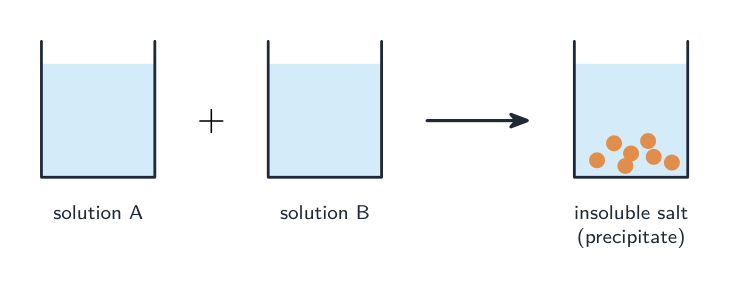
An insoluble salt is made by precipitation 沉淀: mix two solutions that each contain one of the needed ions, and the insoluble salt forms as a solid. You then filter, wash and dry it.

Water in salts

  • A hydrated 水合 substance is chemically joined with water.
  • An anhydrous 无水 substance contains no water.

The water molecules inside hydrated crystals are called the water of crystallisation 结晶水. For example, $\text{CuSO}_4 \bullet 5\text{H}_2\text{O}$ has five water molecules for each formula unit.

Tiếng Việt

Việc một muối có thể được tạo thành bằng phương pháp nhất định hay không phụ thuộc vào việc nó có tan (tan) hay không tan (không tan).

Quy tắc độ tan

Loại muối Quy tắc
muối natri, kali, amoni tất cả đều tan
nitrat tất cả đều tan
clorua tan, trừ chì và bạc
sunfat tan, trừ barium, canxi và chì
cacbonat không tan, trừ natri, kali và amoni
hiđroxit không tan, trừ natri, kali, amoni và (một phần) canxi

Tạo muối tan

Bạn phản ứng axit với một trong những chất sau:

  • một kiềm, sử dụng thử nghiệm chuẩn độ (vì cả hai đều là dung dịch, bạn phải đo chính xác thể tích);
  • một lượng dư kim loại, bazơ không tan hoặc cacbonat không tan.

Khi bạn sử dụng lượng dư của chất rắn, sau đó bạn lọc để loại bỏ phần chất rắn còn lại. Cuối cùng bạn bay hơi một phần nước và để dung dịch kết tinh để thu được muối.

Sơ đồ luồng gồm bốn bước: thêm quá lượng chất rắn vào axit, lọc, bay hơi bớt nước, sau đó để kết tinh
Tạo muối tan từ chất rắn không tan: phản ứng với lượng dư, lọc bỏ phần dư, bay hơi, sau đó kết tinh
Tinh thể hình học màu xanh lam sáng của đồng(II) sunfat trên nền trắng
Để dung dịch kết tinh chậm sẽ tạo ra tinh thể có hình dáng đẹp — ở đây, các tinh thể màu xanh của đồng(II) sunfat

Ví dụ có lời giải. Bạn sẽ sử dụng phương pháp nào để điều chế (a) đồng(II) sunfat và (b) barium sunfat? Hãy kiểm tra quy tắc tan trước. (a) Đồng(II) sunfat là tan (chỉ có barium, canxi và chì sunfat không tan), nên tạo nó từ một chất rắn không tan và axit: thêm dư đồng(II) oxide vào dung dịch axit sulfuric loãng ấm, lọc bỏ phần chất rắn thừa, sau đó bay hơi một phần nước và kết tinh. (b) Barium sunfat là không tan, nên tạo nó bằng cách kết tủa: trộn hai dung dịch, mỗi dung dịch chứa một trong các ion cần thiết, sau đó lọc, rửa và sấy khô chất rắn. Độ tan của muối mong muốn sẽ quyết định phương pháp - hãy tham khảo các quy tắc trước khi lựa chọn.

Tạo muối không tan

Muối không tan được tạo ra bằng cách kết tủa: trộn hai dung dịch, mỗi dung dịch chứa một trong các ion cần thiết, và muối không tan sẽ tạo thành dưới dạng chất rắn. Sau đó bạn lọc, rửa và sấy khô nó.

Hai dung dịch trong suốt được đổ vào nhau tạo cốc có chất rắn lắng ở đáy
Trộn hai dung dịch, mỗi dung dịch chứa một trong các ion cần thiết, sẽ làm cho muối không tan xuất hiện dưới dạng kết tủa rắn, mà sau đó bạn lọc bỏ

Nước trong muối

  • Một chất ngậm nước là chất được liên kết hóa học với nước.
  • Một chất anhydrous (không ngậm nước) chứa hoàn toàn không có nước.

Các phân tử nước bên trong tinh thể ngậm nước gọi là nước kết tinh. Ví dụ, $\text{CuSO}_4 \bullet 5\text{H}_2\text{O}$ có năm phân tử nước cho mỗi đơn vị công thức.

Explore · ⁨Khám phá⁩

Preparing a soluble salt · ⁨Chuẩn bị một loại muối tan⁩

Step through the method. React an acid with excess insoluble base, filter off what's left over, then evaporate and crystallise to get pure salt crystals. · ⁨Thực hiện từng bước quy trình. Cho axit phản ứng với bazơ không tan dư thừa, lọc bỏ phần còn lại, sau đó bay hơi và kết tinh để thu được tinh thể muối tinh khiết.⁩

Vocabulary · ⁨Từ vựng⁩ Train · ⁨Luyện tập⁩
English Tiếng Việt
salt/sɒlt/ muối
precipitation/prɪˌsɪpɪˈteɪʃn/ precipitation
hydrated/haɪˈdreɪtɪd/ có hydrat
anhydrous/ænˈhaɪdrəs/ không có nước
water of crystallisation/ˈwɔːtə ɒv ˌkrɪstəlaɪˈzeɪʃn/ nước tinh thể
effervescence/ˌefəˈvesəns/ sủi bọt
7.3

Exam tips · ⁨Mẹo làm bài thi⁩

English
  • Learn the three acid reactions: acid + metal → salt + hydrogen; acid + base → salt + water (neutralisation); acid + carbonate → salt + water + carbon dioxide.
  • Strong and weak describe how much the acid splits into ions (dissociation), not how concentrated it is. A strong acid is fully dissociated; a weak acid only partly.
  • A lower pH means a higher hydrogen-ion concentration. pH 7 is neutral, below 7 is acidic, above 7 is alkaline.
  • Choose the salt method by solubility: a soluble salt is made from an acid + excess solid (then filter, evaporate, crystallise), or by titration with an alkali; an insoluble salt is made by precipitation (mix two solutions, then filter).
  • Learn the solubility rules — all sodium, potassium, ammonium and nitrate salts are soluble.
Tiếng Việt
  • Học ba phản ứng của axit: axit + kim loại → muối + hydro; axit + bazơ → muối + nước (trung hòa); axit + carbonat → muối + nước + carbon dioxide.
  • Mạnh và yếu mô tả mức độ phân li của axit thành ion (sự phân ly), không phải độ đặc của nó. Axit mạnh phân ly hoàn toàn; axit yếu chỉ phân ly một phần.
  • Giá trị pH càng thấp thì nồng độ ion hydro càng cao. pH 7 là trung tính, dưới 7 là axit, trên 7 là kiềm.
  • Chọn phương pháp tạo muối dựa trên độ tan: muối tan được tạo từ axit + dư chất rắn (sau đó lọc, bay hơi, kết tinh), hoặc bằng phương pháp chuẩn độ với dung dịch kiềm; muối không tan được tạo bằng cách kết tủa (trộn hai dung dịch, sau đó lọc).
  • Học các quy tắc tan — tất cả các muối natri, kali, amoni và nitrat đều tan.

Interactive lessons on this topic · ⁨Bài học tương tác về chủ đề này⁩

Work through it step by step, with instant-check exercises. · ⁨Làm theo từng bước, kèm theo bài tập kiểm tra ngay lập tức.⁩

Past Papers · ⁨Đề thi cũ⁩

More topics in IGCSE Chemistry · ⁨Hóa học IGCSE⁩ · ⁨Nhiều chủ đề hơn trong IGCSE Chemistry · ⁨Hóa học IGCSE⁩⁩

Log in or create account · ⁨Đăng nhập hoặc tạo tài khoản⁩

IGCSE, A-Level & AP