Insoluble salts and water of crystallisation
Introduced| English | Meaning |
|---|---|
| precipitation/prɪˌsɪpɪˈteɪʃn/ | Formation of an insoluble solid from substances in a solution. |
| precipitate/prɪˈsɪpɪteɪt/ | An insoluble solid formed when substances in solution react. |
| water of crystallisation/ˈwɔːtə ɒv ˌkrɪstəlaɪˈzeɪʃn/ | Water molecules present in a fixed proportion within a compound's crystal structure. |
| hydrated/haɪˈdreɪtɪd/ | Containing water molecules within a compound's crystal structure. |
| anhydrous/ænˈhaɪdrəs/ | Containing no water, especially no water of crystallisation. |
Salts that won't dissolve
- Some salts don't dissolve in water. They're made a different way — by precipitation 沉淀.
- And some crystals trap water inside them.
An insoluble salt is made by:
Difficulty 1/5 · 100 coins + a small bonus on first completion today
Precipitation forms an insoluble solid.
The insoluble solid that forms when two solutions are mixed is called a:
Difficulty 1/5 · 100 coins + a small bonus on first completion today
An insoluble solid formed this way is a precipitate.
Making insoluble salts
- Mix two soluble salt solutions that contain the right ions.
- The insoluble salt forms as a solid precipitate 沉淀, which is filtered off.
Worked example. To make insoluble silver chloride, mix silver nitrate solution with sodium chloride solution. Silver chloride forms as a white precipitate, which you filter, wash and dry.
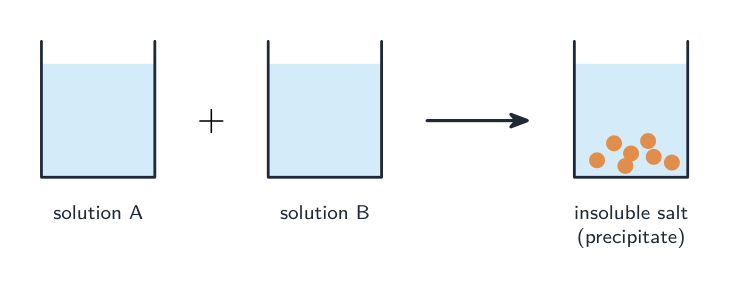
Mixing two solutions that each carry one of the needed ions makes the insoluble salt appear as a solid precipitate

A strong acid is fully split into ions; a weak acid stays mostly as molecules
Making an insoluble salt by precipitation
Step through precipitation. Mix two solutions whose ions swap partners to make an insoluble salt, then filter, wash and dry the solid.
A salt that contains water of crystallisation is described as:
Difficulty 1/5 · 100 coins + a small bonus on first completion today
Hydrated salts contain locked-in water.
Water locked into the structure of a crystal is called water of ______.
Difficulty 1/5 · 100 coins + a small bonus on first completion today
Such salts are hydrated.
Water of crystallisation 结晶水
- Some salt crystals contain water locked into their structure — water of crystallisation.
- These are hydrated 水合 salts (e.g. blue copper sulfate, CuSO₄·5H₂O).
Heating hydrated copper sulfate (blue) drives off water, leaving white anhydrous salt.
Difficulty 1/5 · 100 coins + a small bonus on first completion today
Removing the water of crystallisation turns it white.
Hydrated and anhydrous 无水
- Heating a hydrated salt drives off the water, leaving the anhydrous salt.
- Blue hydrated copper sulfate turns white when the water is removed.
Precipitation is for insoluble salts; the excess-acid method is for soluble ones. Choose the method by the salt's solubility: insoluble → mix two solutions; soluble → react acid with excess base.
You've got it
- insoluble salts are made by precipitation (mix two solutions, filter the solid)
- water of crystallisation is water locked in crystals → a hydrated salt
- heating removes it, leaving the anhydrous salt (blue → white copper sulfate)