Bases, alkalis and the pH scale
Introduced| English | Meaning |
|---|---|
| base/beɪs/ | A substance that accepts protons in the Bronsted-Lowry model, or donates an electron pair in the Lewis model. |
| alkali/ˈælkəlaɪ/ | A base that dissolves in water. |
| pH scale/piː eɪtʃ skeɪl/ | pH scale |
| hydroxide ions/haɪˈdrɒksaɪd ˈaɪɒnz/ | hydroxide ions |
| neutral/ˈnjuːtrəl/ | Neither acidic nor alkaline when describing a solution, or having no net electric charge when describing a particle or object. |
| neutralisation/ˌnjuːtrəlaɪˈzeɪʃn/ | A reaction between an acid and a base that forms a salt, usually with water. |
The opposite of acids
- If acids are one extreme, bases 碱 and alkalis 可溶性碱 are the other.
- The pH scale pH值 measures where a substance sits between them.
An alkali is a base that:
Difficulty 1/5 · 100 coins + a small bonus on first completion today
An alkali is a soluble base, giving OH⁻ ions.
Alkalis form ______ ions (OH⁻) in water.
Difficulty 1/5 · 100 coins + a small bonus on first completion today
OH⁻ is the hydroxide ion.
Bases and alkalis
- A base neutralises an acid; an alkali is a base that dissolves in water.
- Alkalis form hydroxide ions 氢氧根离子 (OH⁻) in water (e.g. sodium hydroxide).

Acids react with metals, bases and carbonates to give different products
A solution with pH 2 is:
Difficulty 1/5 · 100 coins + a small bonus on first completion today
pH below 7 is acidic.
What is the pH of a neutral solution?
Difficulty 2/5 · 140 coins + a small bonus on first completion today
pH 7 is neutral.
The pH scale
- The pH scale runs from 0 to 14: below 7 is acidic, 7 is neutral 中性, above 7 is alkaline.
- The lower the pH, the more acidic; the higher, the more alkaline.
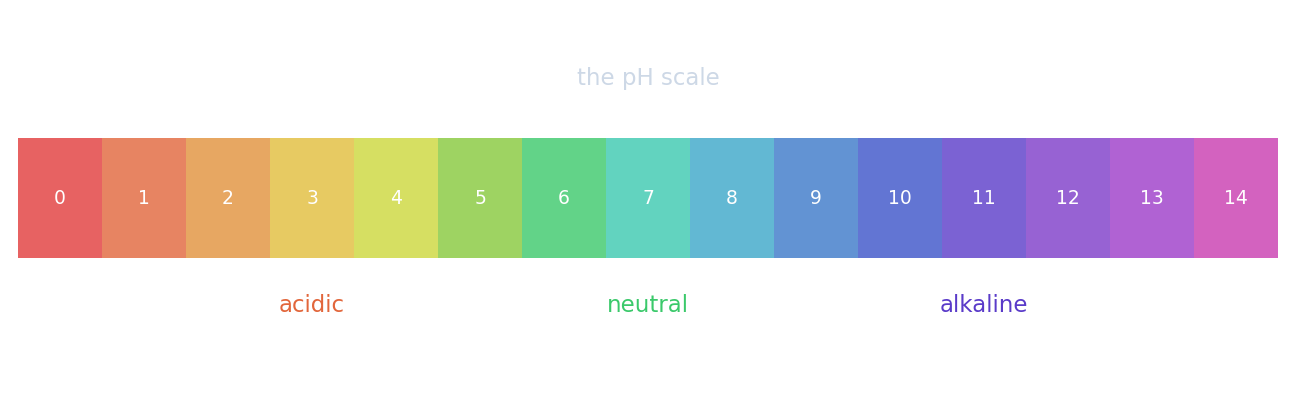
pH below 7 is acidic, 7 is neutral, and above 7 is alkaline.
Acid + alkali produces a salt and:
Difficulty 1/5 · 100 coins + a small bonus on first completion today
Neutralisation: acid + alkali → salt + water.
Neutralisation 中和
- Acid + alkali → salt + water — this is neutralisation.
- The H⁺ from the acid and OH⁻ from the alkali combine to make water.
A base and an alkali are not quite the same. All alkalis are bases, but only soluble bases are alkalis. An insoluble base (like copper oxide) still neutralises acid but isn't called an alkali.
Watch the pH during neutralisation
Adding alkali to acid raises the pH. Near the end point the pH leaps up sharply — that steep jump is where the acid has just been neutralised.
You've got it
- a base neutralises acid; an alkali is a soluble base (gives OH⁻ ions)
- the pH scale (0–14): <7 acidic, 7 neutral, >7 alkaline
- neutralisation: acid + alkali → salt + water