Một đinh thép thả vào nước sẽ chìm thẳng xuống đáy. Bây giờ hãy nhìn con tàu này. Nó được chế tạo từ cùng một loại thép, hàng chục nghìn tấn thép, và nó…
English narration · English + 中文 subtitles burned in · Giọng đọc tiếng Anh · phụ đề tiếng Anh + 中文 được ghi trực tiếp
8.1
Internal Structure and Density · Cấu trúc bên trong và Mật độ
Syllabus · Chương trình
English
Learning Objective 8.1.A: Describe the properties of a fluid.
8.1.A.1 Distinguishing properties of solids, liquids, and gases stem from the varying interactions between atoms and molecules.
8.1.A.2 A fluid is a substance that has no fixed shape.
8.1.A.3 Fluids can be characterized by their density. Density is defined as a ratio of mass to volume.
Equation:$\rho = \dfrac{m}{V}$
8.1.A.4 An ideal fluid is incompressible and has no viscosity.
Tiếng Việt
Mục tiêu học tập 8.1.A: Mô tả các tính chất của chất lưu.
8.1.A.1 Các tính chất phân biệt của chất rắn, chất lỏng và chất khí xuất phát từ sự tương tác khác nhau giữa các nguyên tử và phân tử.
8.1.A.2 Chất lưu là một chất không có hình dạng cố định.
8.1.A.3 Chất lưu có thể được đặc trưng bởi mật độ của chúng. Mật độ được định nghĩa là tỷ số giữa khối lượng và thể tích.
Phương trình:$\rho = \dfrac{m}{V}$
8.1.A.4 Một chất lưu lý tưởng là chất không nén được và không có độ nhớt.
Source: College Board AP Course and Exam Description · Nguồn: Mô tả Khóa học và Bài thi College Board AP
English
The differences between solids, liquids, and gases come from how strongly their particles interact. A fluid 流体 (liquid or gas) has no fixed shape – it flows because its particles move past one another. Density 密度 is mass per unit volume:
$$\rho=\frac{m}{V}.$$
It depends on the substance and its state. An object sinks or floats depending on how its density compares with the surrounding fluid's – less dense floats, more dense sinks. An ideal fluid 理想流体 is incompressible 不可压缩 (constant density, whatever the pressure) and has no viscosity 黏度 (internal friction) – the model AP uses throughout.
Tiếng Việt
Sự khác biệt giữa chất rắn, chất lỏng và chất khí đến từ mức độ tương tác mạnh yếu giữa các hạt của chúng. Một chất lưu (chất lỏng hoặc khí) không có hình dạng cố định – nó chảy vì các hạt của nó trượt qua nhau. Mật độ là khối lượng trên một đơn vị thể tích:
$$\rho=\frac{m}{V}.$$
Nó phụ thuộc vào bản chất vật liệu và trạng thái của nó. Một vật chìm hay nổi tùy thuộc vào mật độ của nó so với chất lưu xung quanh – ít密度 hơn thì nổi, nhiều density hơn thì chìm. Một chất lưu lý tưởng là không nén được (mật độ không đổi, bất kể áp suất) và không có sức nhớt (ma sát nội) – mô hình AP sử dụng throughout.
Explore · Khám phá
Float or sink by density · Nổi hay chìm dựa theo mật độ
An object floats if it is less dense than the fluid. Change the density and watch it ride higher or sink, displacing its own weight of fluid. · Một vật nổi nếu nó ít đặc hơn chất lỏng. Thay đổi mật độ và quan sát nó nổi cao hơn hoặc chìm xuống, đẩy một lượng chất lỏng có trọng lượng bằng chính nó.
Learning Objective 8.2.A: Describe the pressure exerted on a surface by a given force.
8.2.A.1 Pressure is defined as the magnitude of the perpendicular force component exerted per unit area over a given surface area, as described by the equation
Equation:$P = \dfrac{F_\perp}{A}$
8.2.A.2 Pressure is a scalar quantity.
8.2.A.3 The volume and density of a given amount of an incompressible fluid is constant regardless of the pressure exerted on that fluid.
Learning Objective 8.2.B: Describe the pressure exerted by a fluid.
8.2.B.1 The pressure exerted by a fluid is the result of the entirety of the interactions between the fluid's constituent particles and the surface with which those particles interact.
8.2.B.2 The absolute pressure of a fluid at a given point is equal to the sum of a reference pressure $P_0$, such as the atmospheric pressure $P_{\text{atm}}$, and the gauge pressure $P_{\text{gauge}}$.
Equation:$P = P_0 + \rho g h$
8.2.B.3 The gauge pressure of a vertical column of fluid is described by the equation
Equation:$P_{\text{gauge}} = \rho g h$
Tiếng Việt
Mục tiêu học tập 8.2.A: Mô tả áp suất tác dụng lên một bề mặt bởi một lực xác định.
8.2.A.1 Áp suất được định nghĩa là độ lớn của thành phần lực vuông góc tác dụng trên một đơn vị diện tích của một bề mặt nhất định, như được mô tả bởi phương trình
Phương trình:$P = \dfrac{F_\perp}{A}$
8.2.A.2 Áp suất là một đại lượng vô hướng.
8.2.A.3 Thể tích và mật độ của một lượng chất lưu không nén được là hằng số bất kể áp suất nào tác dụng lên chất lưu đó.
Mục tiêu học tập 8.2.B: Mô tả áp suất tác dụng bởi chất lưu.
8.2.B.1 Áp suất tác dụng bởi chất lưu là kết quả của toàn bộ các tương tác giữa các hạt cấu thành chất lưu và bề mặt mà các hạt này tương tác.
8.2.B.2 Áp suất tuyệt đối của chất lưu tại một điểm cho trước bằng tổng của một áp suất tham chiếu $P_0$, chẳng hạn như áp suất khí quyển $P_{\text{atm}}$, và áp suất kế (áp suất dư) $P_{\text{gauge}}$.
Phương trình:$P = P_0 + \rho g h$
8.2.B.3 Áp suất kế của một cột chất lưu thẳng đứng được mô tả bởi phương trình
Phương trình:$P_{\text{gauge}} = \rho g h$
Source: College Board AP Course and Exam Description · Nguồn: Mô tả Khóa học và Bài thi College Board AP
English
Pressure 压强 is the perpendicular force per unit area, a scalar 标量 measured in pascals (Pa):
$$P=\frac{F_\perp}{A}.$$
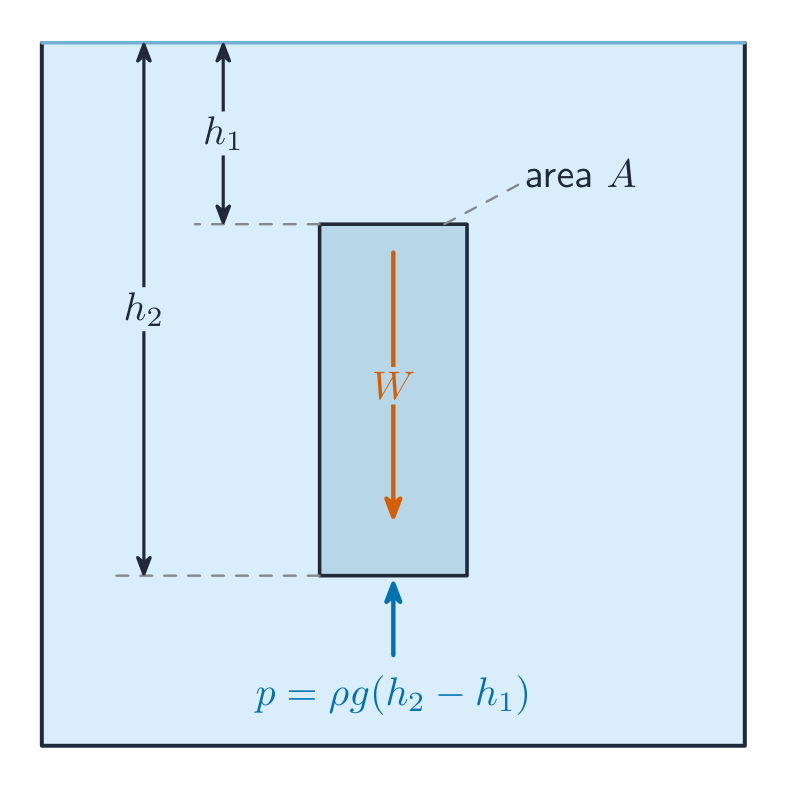
In a fluid at rest, pressure increases with depth 深度 because of the weight of fluid above:
$$P=P_0+\rho g h,$$
where $P_0$ is the pressure at the surface and $h$ is the depth. Pressure acts equally in all directions at a point and pushes perpendicular to any surface.
Distinguish the two pressures AP asks about: the gauge pressure 表压 is the extra pressure the fluid column adds, $P_{\text{gauge}}=\rho g h$, while the absolute pressure 绝对压强 is the total, $P=P_0+P_{\text{gauge}}$ (with $P_0$ usually atmospheric). A tyre gauge reading "$200\ \text{kPa}$" is gauge pressure; the air inside is really at about $300\ \text{kPa}$ absolute.
Worked example. Find the total pressure on a diver $10\ \text{m}$ below the surface of water ($\rho=1000\ \text{kg/m}^3$, surface pressure $P_0=1.0\times10^{5}\ \text{Pa}$):
$$P=P_0+\rho g h=1.0\times10^{5}+1000\times9.8\times10=1.98\times10^{5}\ \text{Pa}.$$
Every $10\ \text{m}$ of water adds roughly one extra atmosphere of pressure. Notice the pressure does not depend on the shape or width of the container, only on the depth.
Tiếng Việt
Áp suất là lực vuông góc trên một đơn vị diện tích, là đại lượng vô hướng đo bằng pascal (Pa):
$$P=\frac{F_\perp}{A}.$$
Trong chất lưu đứng yên, áp suất tăng theo độ sâu do trọng lượng của lớp chất lưu phía trên:
$$P=P_0+\rho g h,$$
trong đó $P_0$ là áp suất tại bề mặt và $h$ là độ sâu. Áp suất tác dụng đều theo mọi hướng tại một điểm và đẩy vuông góc với bất kỳ bề mặt nào.
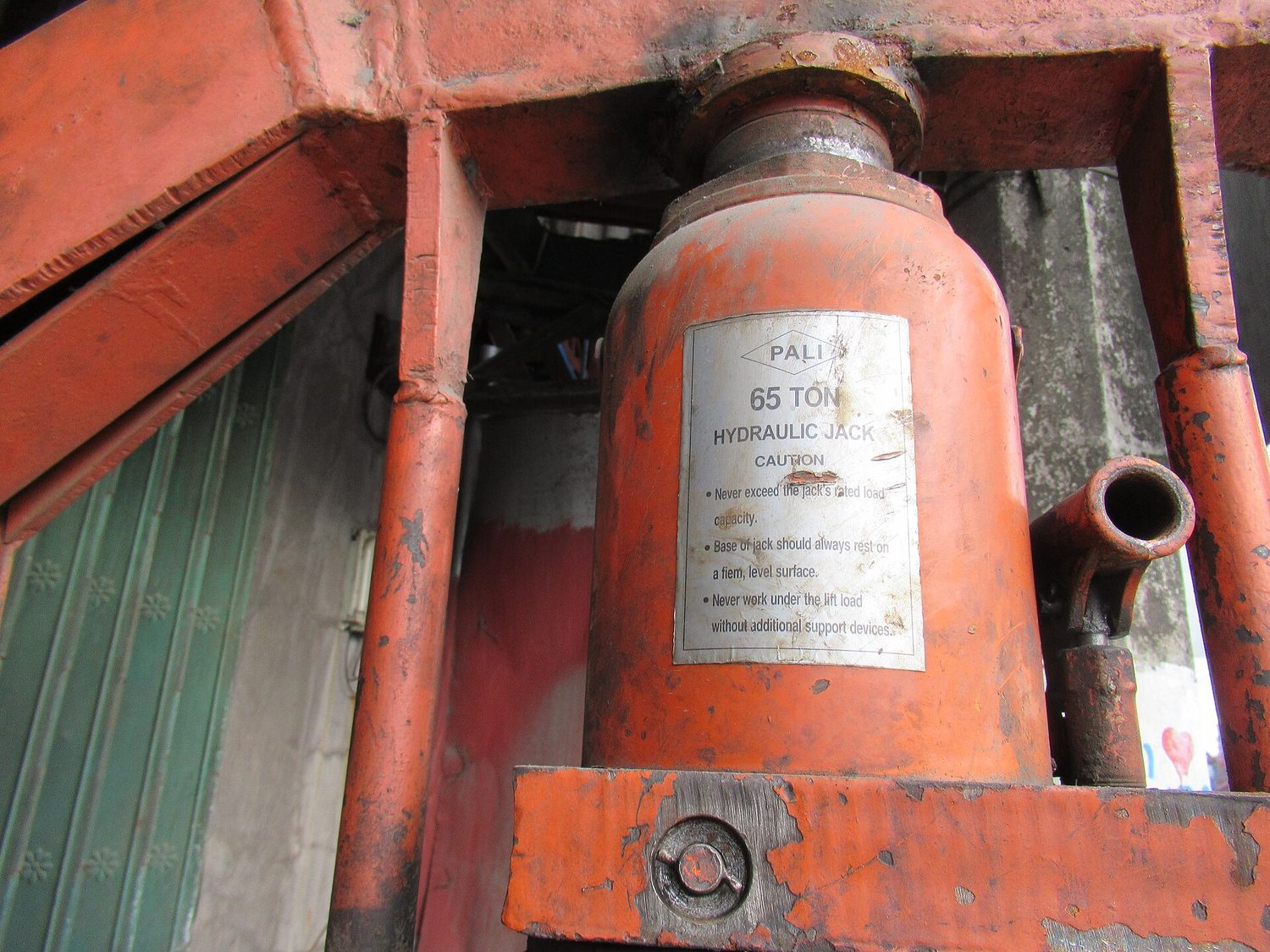
Xi lanh thủy lực: áp suất tác dụng lên piston nhỏ được truyền nguyên vẹn qua chất lưu đến piston lớn, nên một lực nhỏ có thể nâng xe ô tô
Phân biệt hai loại áp suất mà đề thi AP yêu cầu: áp suất tương đối là áp suất bổ sung do cột chất lỏng tạo thêm, $P_{\text{gauge}}=\rho g h$, trong khi áp suất tuyệt đối là tổng giá trị, $P=P_0+P_{\text{gauge}}$ (với $P_0$ thường là áp suất khí quyển). Thiết bị đo áp suất lốp đọc "$200\ \text{kPa}$" là áp suất tương đối; thực tế không khí bên trong ở mức áp suất tuyệt đối khoảng $300\ \text{kPa}$.
Trọng lượng của cột chất lỏng thiết lập áp suất bổ sung tại độ sâu
Ví dụ minh họa. Tính tổng áp suất tác dụng lên một thợ lặn $10\ \text{m}$ bên dưới mặt nước ($\rho=1000\ \text{kg/m}^3$, áp suất mặt nước $P_0=1.0\times10^{5}\ \text{Pa}$):
$$P=P_0+\rho g h=1.0\times10^{5}+1000\times9.8\times10=1.98\times10^{5}\ \text{Pa}.$$
Mỗi $10\ \text{m}$ nước sẽ tăng thêm khoảng một atm áp suất. Lưu ý rằng áp suất không phụ thuộc vào hình dạng hay độ rộng của bình chứa, mà chỉ phụ thuộc vào độ sâu.
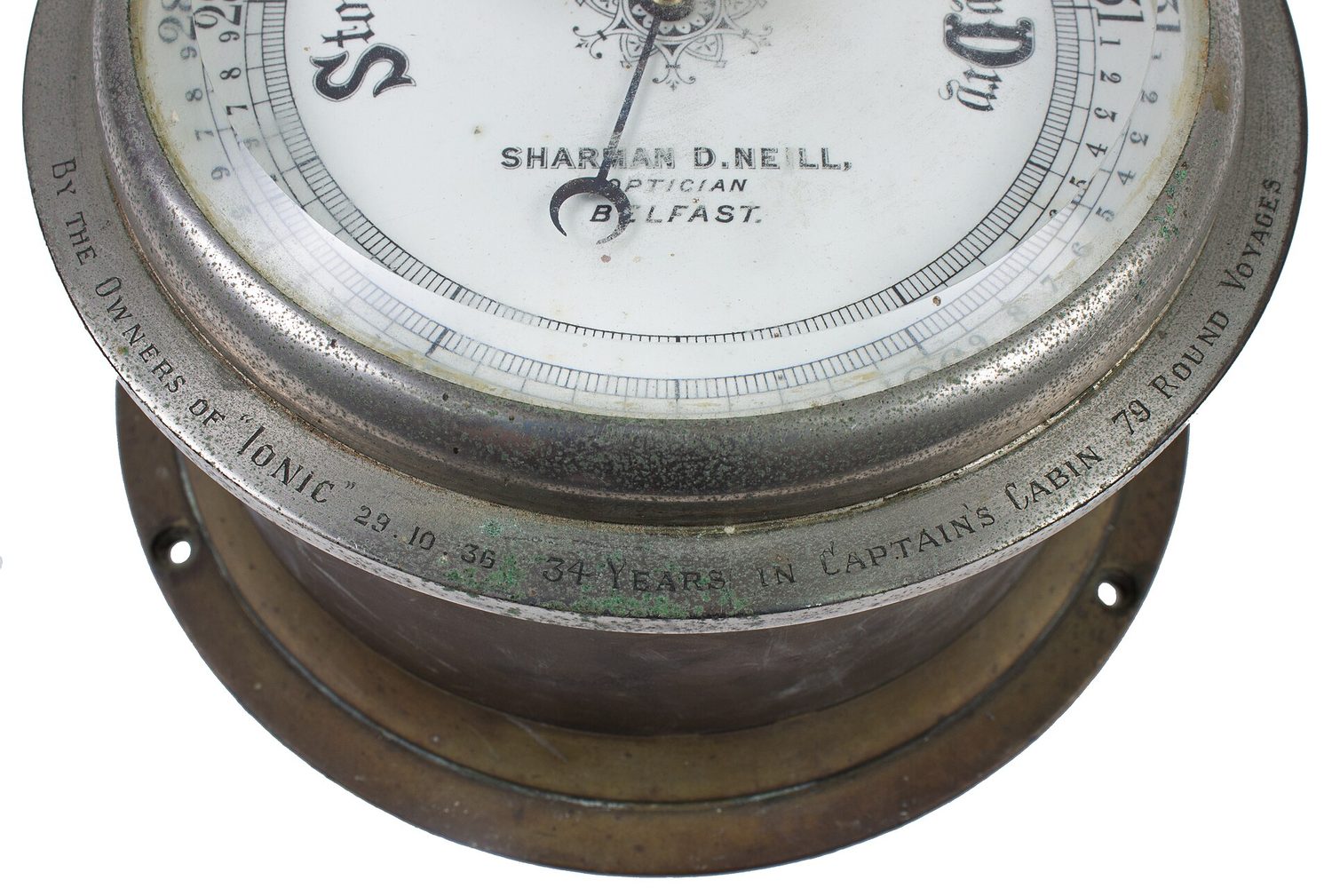
Máy đo áp suất khí aneroid đo áp suất không khí bằng một hộp kim loại kín có thể biến dạng khi áp suất bên ngoài thay đổi
Fluids and Newton's Laws · Chất lưu và Định luật Newton
Syllabus · Chương trình
English
Learning Objective 8.3.A: Describe the conditions under which a fluid's velocity changes.
8.3.A.1 Newton's laws can be used to describe the motion of particles within a fluid.
8.3.A.2 The macroscopic behavior of a fluid is a result of the internal interactions between the fluid's constituent particles and external forces exerted on the fluid.
Learning Objective 8.3.B: Describe the buoyant force exerted on an object interacting with a fluid.
8.3.B.1 The buoyant force is a net upward force exerted on an object by a fluid.
8.3.B.2 The buoyant force exerted on an object by a fluid is a result of the collective forces exerted on the object by the particles making up the fluid.
8.3.B.3 The magnitude of the buoyant force exerted on an object by a fluid is equivalent to the weight of the fluid displaced by the object.
Equation:$F_b = \rho V g$
Tiếng Việt
Mục tiêu học tập 8.3.A: Mô tả các điều kiện để vận tốc của chất lưu thay đổi.
8.3.A.1 Các định luật Newton có thể được sử dụng để mô tả chuyển động của các hạt bên trong chất lưu.
8.3.A.2 Hành vi vĩ mô của chất lưu là kết quả của các tương tác nội bộ giữa các hạt cấu thành chất lưu và các ngoại lực tác dụng lên chất lưu.
Mục tiêu học tập 8.3.B: Mô tả lực đẩy Archimedes tác dụng lên một vật tương tác với chất lưu.
8.3.B.1 Lực đẩy Archimedes là lực tổng hợp theo phương thẳng đứng hướng lên tác dụng lên một vật bởi chất lưu.
8.3.B.2 Lực đẩy Archimedes tác dụng lên một vật bởi chất lưu là kết quả của các lực tổng hợp tác dụng lên vật bởi các hạt cấu thành chất lưu.
8.3.B.3 Độ lớn của lực đẩy Archimedes tác dụng lên một vật bởi chất lưu bằng trọng lượng của phần chất lưu bị vật chiếm chỗ.
Phương trình:$F_b = \rho V g$
Source: College Board AP Course and Exam Description · Nguồn: Mô tả Khóa học và Bài thi College Board AP
English
Buoyancy: float or sink
An object in a fluid feels an upward buoyant force 浮力 equal to the weight of the fluid it displaces – Archimedes' principle 阿基米德原理:
Combine this with Newton's laws: the object floats when buoyancy balances weight, sinks when weight wins, and rises when buoyancy wins. A floating object displaces exactly its own weight of fluid.
Worked example. A block of density $600\ \text{kg/m}^3$ floats in water ($1000\ \text{kg/m}^3$). What fraction is under the surface? For floating, the buoyant force equals the weight, so $\rho_{\text{fluid}}\,g\,V_{\text{sub}}=\rho_{\text{object}}\,g\,V$:
Kết hợp với các định luật Newton: vật nổi khi lực đẩy cân bằng trọng lượng, chìm khi trọng lượng thắng thế, và trồi lên khi lực đẩy thắng thế. Một vật nổi sẽ đẩy ra đúng lượng chất lưu có trọng lượng bằng chính nó.
Ví dụ minh họa. Một khối vật có mật độ $600\ \text{kg/m}^3$ nổi trong nước ($1000\ \text{kg/m}^3$). Phần nào nằm dưới mặt nước? Đối với vật nổi, lực đẩy bằng trọng lượng, nên $\rho_{\text{fluid}}\,g\,V_{\text{sub}}=\rho_{\text{object}}\,g\,V$:
Fluids and Conservation Laws · Chất lưu và Các Định luật Bảo toàn
Syllabus · Chương trình
English
Learning Objective 8.4.A: Describe the flow of an incompressible fluid through a cross-sectional area by using mass conservation.
8.4.A.1 A difference in pressure between two locations causes a fluid to flow.
8.4.A.1.i The rate at which matter enters a fluid-filled tube open at both ends must equal the rate at which matter exits the tube.
8.4.A.1.ii The rate at which matter flows into a location is proportional to the cross-sectional area of the flow and the speed at which the fluid flows.
Derived equation:$\dfrac{V}{t} = A v$
8.4.A.2 The continuity equation for fluid flow describes conservation of mass flow rate in incompressible fluids.
Equation:$A_1 v_1 = A_2 v_2$
Tiếng Việt
Mục tiêu học tập 8.4.A: Mô tả dòng chảy của chất lưu không nén được qua một tiết diện ngang bằng cách sử dụng bảo toàn khối lượng.
8.4.A.1 Sự chênh lệch áp suất giữa hai vị trí gây ra dòng chảy của chất lưu.
8.4.A.1.i Tốc độ vật chất đi vào ống dẫn chứa chất lưu mở ở cả hai đầu phải bằng tốc độ vật chất đi ra khỏi ống.
8.4.A.1.ii Tốc độ vật chất chảy vào một vị trí tỉ lệ thuận với diện tích tiết diện ngang của dòng chảy và tốc độ dòng chảy của chất lưu.
Phương trình suy ra:$\dfrac{V}{t} = A v$
8.4.A.2 Phương trình liên tục cho dòng chảy chất lưu mô tả sự bảo toàn tốc độ dòng khối lượng trong chất lưu không nén được.
Phương trình:$A_1 v_1 = A_2 v_2$
Source: College Board AP Course and Exam Description · Nguồn: Mô tả Khóa học và Bài thi College Board AP
English
For an ideal fluid flowing steadily, two conservation ideas apply:
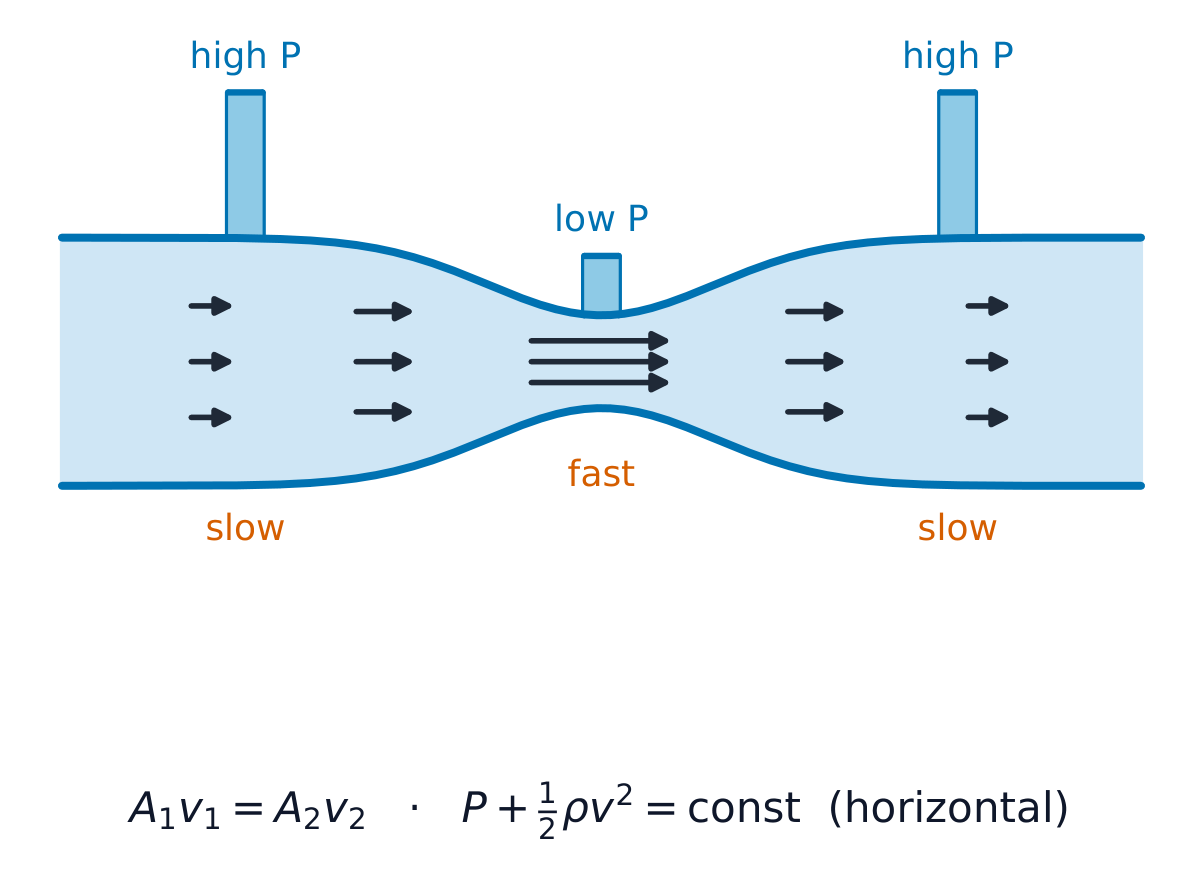
Continuity 连续性 (conservation of mass): the volume flow rate is constant, so $A_1 v_1 = A_2 v_2$. A narrower pipe forces faster flow.
Bernoulli's equation 伯努利方程 (conservation of energy per volume): along a streamline,
$$P+\tfrac{1}{2}\rho v^2+\rho g y = \text{constant}.$$
Together they explain why fluid speeds up and its pressure drops where a pipe narrows or where flow is fastest.
Worked example. Water flows at $2.0\ \text{m/s}$ through a pipe of cross-section $0.010\ \text{m}^2$, then enters a narrower section of $0.0040\ \text{m}^2$. By continuity the speed there is
By Bernoulli's equation this faster stream is at lower pressure – the effect that lifts an aeroplane wing and pulls two passing ships together.
Exam skill. Choose the right law by what changes. If the pipe changes width, start with continuity ($A_1v_1=A_2v_2$) to get the speeds; if you then need a pressure, feed those speeds into Bernoulli. Watch the height term $\rho g y$ only when the pipe also changes level.
Tiếng Việt
Đối với chất lưu lý tưởng chảy ổn định, hai nguyên lý bảo toàn sau đây được áp dụng:
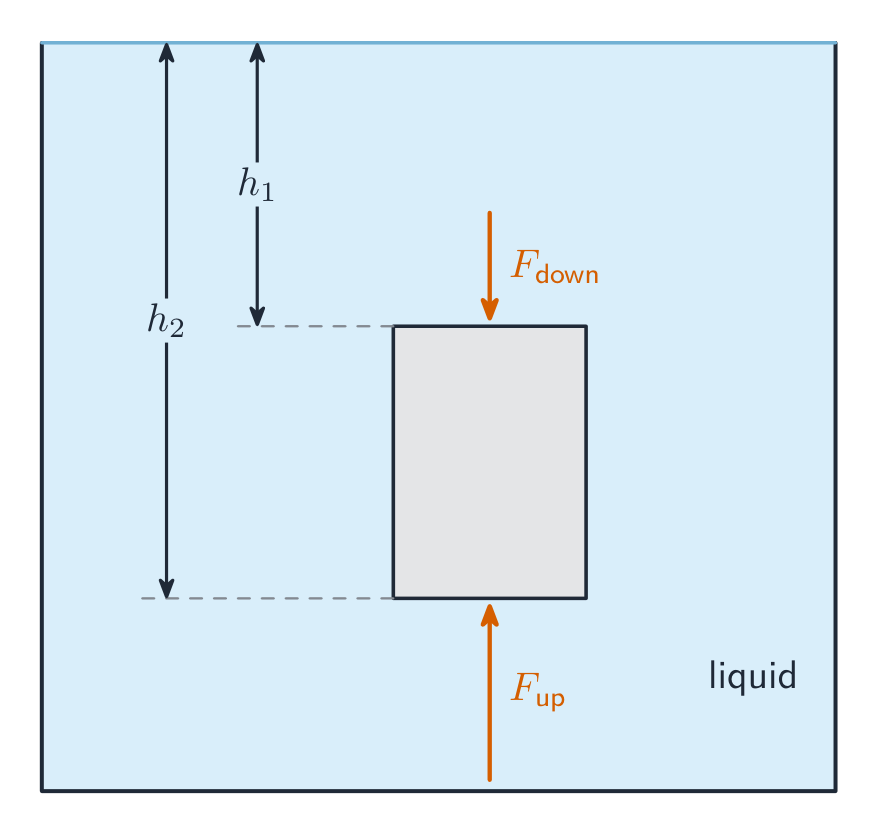
Lực nâng sinh ra vì áp suất ở mặt dưới của vật lớn hơn áp suất ở mặt trên
Phương trình liên tục (bảo toàn khối lượng): lưu lượng thể tích không đổi, do đó $A_1 v_1 = A_2 v_2$. Ống hẹp hơn buộc dòng chảy nhanh hơn.
Phương trình Bernoulli (bảo toàn năng lượng theo đơn vị thể tích): dọc theo đường streamline,
$$P+\tfrac{1}{2}\rho v^2+\rho g y = \text{constant}.$$
Cùng nhau chúng giải thích tại sao tốc độ chất lưu tăng và áp suất giảm nơi ống thu hẹp hoặc nơi dòng chảy nhanh nhất.
Nơi ống thu hẹp, chất lưu chảy nhanh hơn (liên tục) và áp suất giảm (Bernoulli)
Ví dụ minh họa. Nước chảy với tốc độ $2.0\ \text{m/s}$ qua một ống có tiết diện $0.010\ \text{m}^2$, sau đó đi vào một đoạn ống hẹp hơn có tiết diện $0.0040\ \text{m}^2$. Theo phương trình liên tục, tốc độ tại đó là
Theo phương trình Bernoulli, dòng chảy nhanh hơn này có áp suất thấp hơn – hiệu ứng này tạo lực nâng cho cánh máy bay và kéo hai con tàu đang đi ngang qua lại gần nhau.
Kỹ năng làm bài thi. Chọn định luật phù hợp dựa vào đại lượng thay đổi. Nếu ống thay đổi chiều rộng, hãy bắt đầu với phương trình liên tục ($A_1v_1=A_2v_2$) để tìm tốc độ; nếu bạn cần tìm áp suất, hãy đưa các tốc độ đó vào phương trình Bernoulli. Chỉ chú ý đến số hạng chiều cao $\rho g y$ khi ống cũng thay đổi độ cao.
8.4
Exam tips · Mẹo làm bài thi
English
Pressure with depth is $P=P_0+\rho g h$ — it depends on depth only, not the container's shape or width.
Buoyant force = weight of fluid displaced ($\rho_{\text{fluid}}\,gV_{\text{disp}}$); a floating object displaces its own weight, so the fraction submerged is $\rho_{\text{object}}/\rho_{\text{fluid}}$.
Compare densities to predict floating vs sinking; a floating object is in equilibrium (buoyancy = weight), not weightless.
Use continuity$A_1v_1=A_2v_2$: a narrower pipe means faster flow.
Bernoulli: where a fluid flows faster its pressure is lower (wing lift, spray).
Tiếng Việt
Áp suất theo độ sâu là $P=P_0+\rho g h$ — nó chỉ phụ thuộc vào độ sâu, không phụ thuộc vào hình dạng hay độ rộng của bình chứa.
Lực đẩy = trọng lượng chất lưu bị đẩy ra ($\rho_{\text{fluid}}\,gV_{\text{disp}}$); một vật nổi đẩy ra đúng trọng lượng của chính nó, nên tỷ lệ phần submerged là $\rho_{\text{object}}/\rho_{\text{fluid}}$.
So sánh mật độ để dự đoán nổi hay chìm; một vật nổi处于 cân bằng (lực đẩy = trọng lượng), không phải mất trọng lượng.
Sử dụng phương trình liên tục$A_1v_1=A_2v_2$: ống hẹp hơn nghĩa là dòng chảy nhanh hơn.
Bernoulli: nơi chất lưu chảy nhanh hơn thì áp suất thấp hơn (lực nâng cánh, phun sương).
Interactive lessons on this topic · Bài học tương tác về chủ đề này
Work through it step by step, with instant-check exercises. · Làm theo từng bước, kèm theo bài tập kiểm tra ngay lập tức.
Pick one and the site follows you — notes, papers, videos and practice all open on it. · Chọn một môn và trang sẽ điều hướng theo — ghi chú, tài liệu, video và bài tập đều mở ở đó.
Type to search notes, lessons, code, vocabulary and past-paper questions across every subject. · Nhập để tìm ghi chú, bài học, mã, từ vựng và câu hỏi đề thi cũ trên mọi môn học.