| Learning Objective | Essential Knowledge |
|---|---|
6.1.A |
|
Energy and Momentum of Rotating Systems
AP Physics 1 · Topic 6
 7:54
7:54
Energy and Momentum of Rotating Systems
Watch a skater spinning with her arms stretched out. She pulls them in — and suddenly she spins much faster. Nobody pushed her. No motor started. So where did…
English narration · English + 中文 subtitles burned in
6.1
Rotational Kinetic Energy
Syllabus
Source: College Board AP Course and Exam Description
A spinning object has rotational kinetic energy 转动动能, the rotational twin of $\tfrac12 mv^2$:
$$K_{\text{rot}}=\tfrac{1}{2}I\omega^2.$$
An object that both moves and spins (like a rolling ball) has both translational and rotational kinetic energy, and its total is $K=\tfrac12 mv^2+\tfrac12 I\omega^2$.
Vocabulary
Train
| English |
|---|
| rotational kinetic energy/rəʊˈteɪʃənl kɪˈnetɪk ˈenədʒi/ |
6.2
Torque and Work
Syllabus
| Learning Objective | Essential Knowledge |
|---|---|
6.2.A |
|
Source: College Board AP Course and Exam Description
A torque acting through an angular displacement does work, changing rotational kinetic energy:
$$W=\tau\,\Delta\theta,\qquad P=\tau\omega.$$
This is the rotational form of $W=Fd$ and $P=Fv$, and it extends the work–energy theorem to rotation.
Worked example. A motor applies a steady torque of $8.0\ \text{N m}$ to a flywheel while it turns through $10\ \text{rad}$. The work done is $W=\tau\,\Delta\theta=8.0\times10=80\ \text{J}$, and if the flywheel started from rest this all becomes rotational kinetic energy.
Explore
Balance torques on a seesaw
Torque is force times perpendicular distance, $\tau = Fd$. The beam balances when the torques on each side are equal — move the forces and distances to find the balance point.
6.3
Angular Momentum and Angular Impulse
Syllabus
| Learning Objective | Essential Knowledge |
|---|---|
6.3.A |
|
6.3.B |
|
6.3.C |
Boundary statement: While AP Physics 1 expects that students can mathematically manipulate the magnitude of angular momentum using one-dimensional vector conventions, the direction of angular momentum and angular impulse is beyond the scope of the course. |
Source: College Board AP Course and Exam Description
Angular momentum 角动量 is the rotational version of linear momentum:
$$L=I\omega.$$
A net torque acting over time delivers an angular impulse 角冲量 that changes it: $\tau\,\Delta t=\Delta L$ – the rotational impulse–momentum theorem.
Vocabulary
Train
| English |
|---|
| Angular momentum/ˈæŋɡjʊlə məʊˈmentəm/ |
| angular impulse/ˈæŋɡjʊlə ˈɪmpʌls/ |
6.4
Conservation of Angular Momentum
Syllabus
| Learning Objective | Essential Knowledge |
|---|---|
6.4.A |
|
6.4.B |
|
Source: College Board AP Course and Exam Description
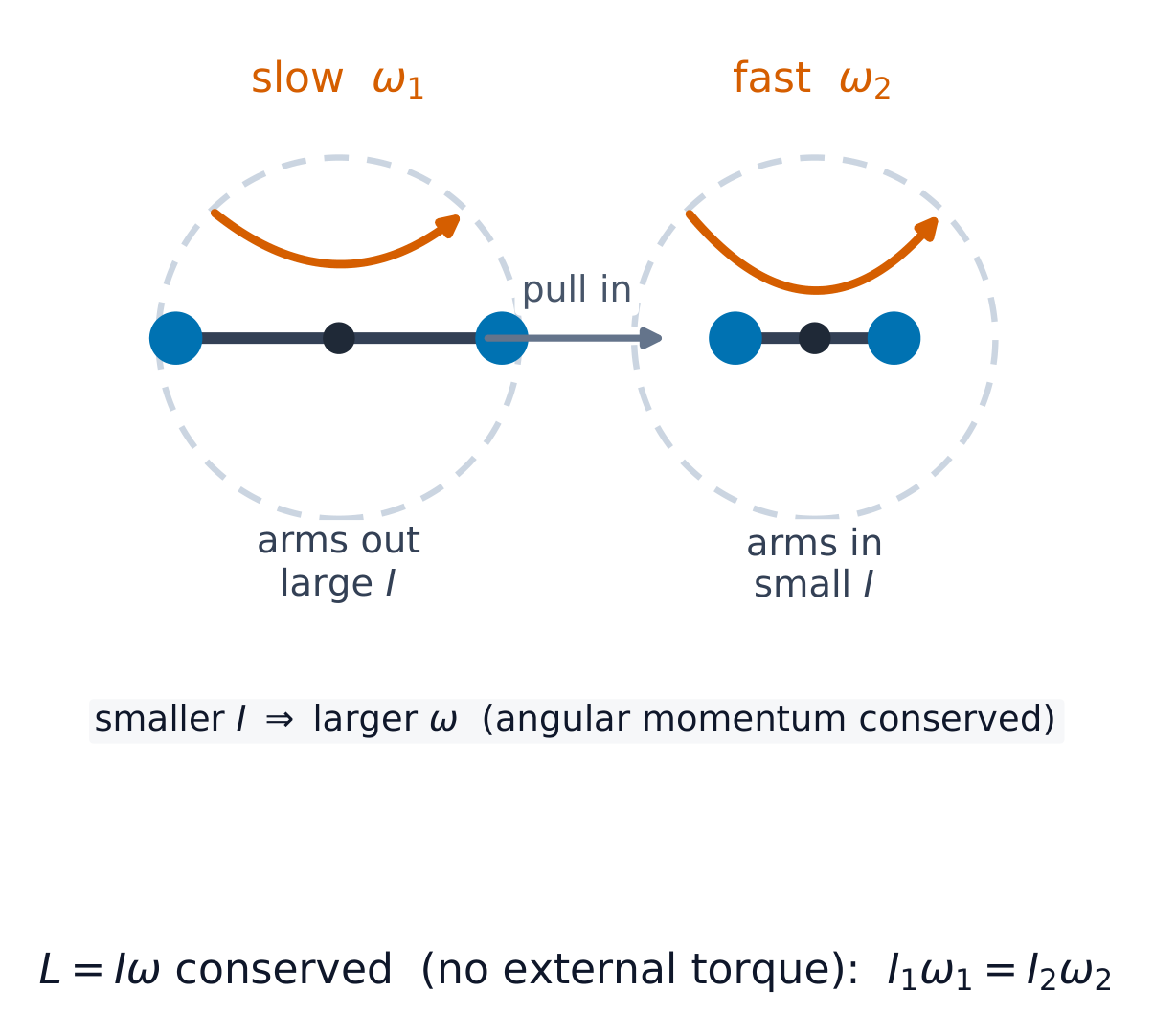
If the net external torque on a system is zero, its total angular momentum is conserved 守恒:
$$I_1\omega_1=I_2\omega_2.$$
So if $I$ decreases, $\omega$ increases to keep $L$ constant – this is why a spinning skater speeds up when pulling their arms in. It applies to collisions and explosions of rotating systems too.
Worked example. A skater spins at $2.0\ \text{rev/s}$ with rotational inertia $I_1=4.0\ \text{kg m}^2$. She pulls her arms in, dropping her rotational inertia to $I_2=1.6\ \text{kg m}^2$. With no external torque, angular momentum is conserved:
$$\omega_2=\frac{I_1}{I_2}\,\omega_1=\frac{4.0}{1.6}\times2.0=5.0\ \text{rev/s}.$$
Her kinetic energy actually rises – the extra energy comes from the work her muscles do pulling her arms in against the outward pull.
Vocabulary
Train
| English |
|---|
| conserved/kənˈsɜːvd/ |
6.5
Rolling
Syllabus
| Learning Objective | Essential Knowledge |
|---|---|
6.5.A |
|
6.5.B |
|
6.5.C |
Boundary statement: Rolling friction is beyond the scope of AP Physics 1. Boundary statement: The precise mathematical relationships between linear and angular quantities while a rigid body is rolling while slipping are beyond the scope of AP Physics 1 and 2, and students will not be expected to model those relationships quantitatively. However, students are expected to qualitatively explain the changes to linear and angular quantities while a rigid body is rolling while slipping. |
Source: College Board AP Course and Exam Description
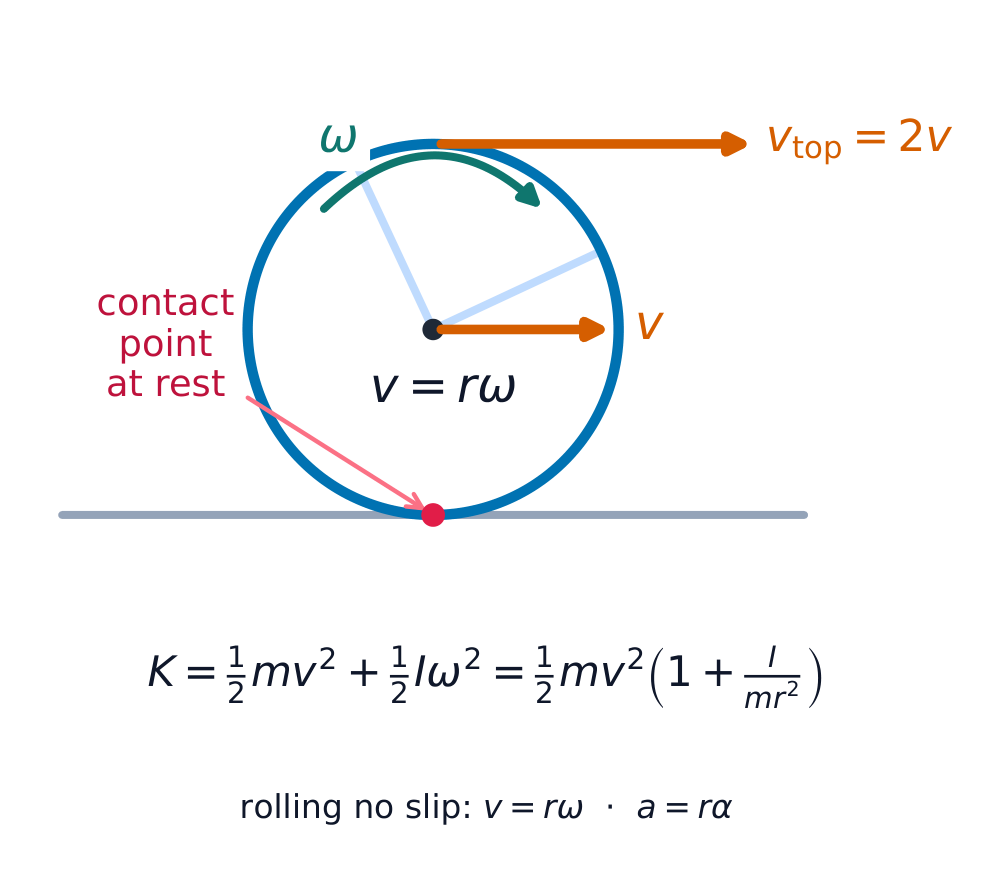
Rolling without slipping 纯滚动 links the translational and rotational motions: the contact point is momentarily at rest, so
$$v=r\omega \qquad\text{and}\qquad a=r\alpha.$$
A rolling object's energy splits between translation and rotation, so on an incline it accelerates more slowly than a frictionless sliding object – some energy goes into spin.
Worked example. For a solid disk ($I=\tfrac12 mR^2$) that rolls without slipping, what fraction of its kinetic energy is rotational? Using $v=R\omega$, the rotational part is $\tfrac12 I\omega^2=\tfrac12(\tfrac12 mR^2)\omega^2=\tfrac14 mv^2$, while the translational part is $\tfrac12 mv^2$. So the total is $\tfrac34 mv^2$ and the rotational share is $\tfrac{1/4}{3/4}=\tfrac13$. A hoop, with its mass farther out, stores half its energy in spin and rolls down a ramp even more slowly.
Vocabulary
Train
| English |
|---|
| Rolling without slipping/ˈrəʊlɪŋ wɪˈðaʊt ˈslɪpɪŋ/ |
6.6
Motion of Orbiting Satellites
Syllabus
| Learning Objective | Essential Knowledge |
|---|---|
6.6.A |
|
Source: College Board AP Course and Exam Description
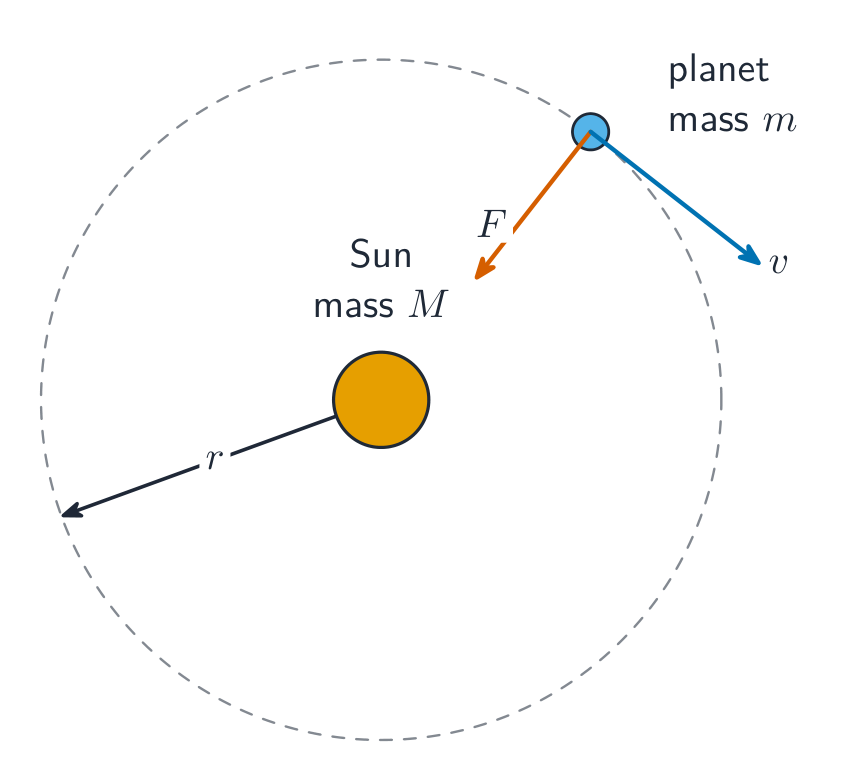
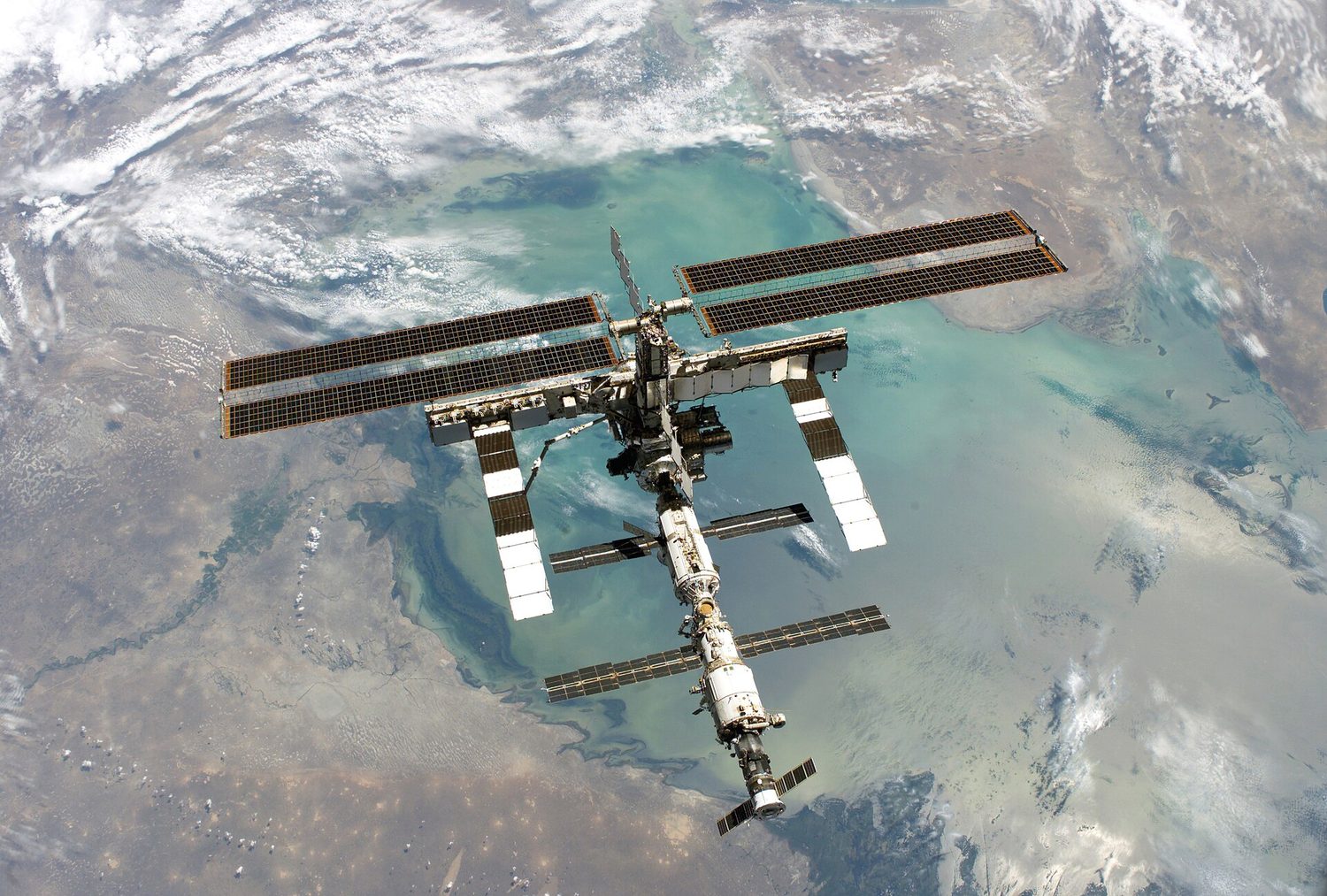
A satellite 卫星 in orbit is in free fall: gravity provides the exact centripetal force needed to curve its path into an orbit. Setting gravity equal to the centripetal requirement,
$$\frac{GMm}{r^2}=\frac{mv^2}{r}\ \Rightarrow\ v=\sqrt{\frac{GM}{r}}.$$
So a larger orbit means a slower speed. For a circular orbit, angular momentum and mechanical energy are both constant; for an elliptical orbit, angular momentum is conserved (no torque about the planet) while speed varies – fastest when closest.
Worked example. Find the speed of a satellite in a low orbit just above the Earth, radius $r=6.4\times10^{6}\ \text{m}$, with $GM=4.0\times10^{14}\ \text{m}^3/\text{s}^2$:
$$v=\sqrt{\frac{GM}{r}}=\sqrt{\frac{4.0\times10^{14}}{6.4\times10^{6}}}=\sqrt{6.25\times10^{7}}\approx 7.9\times10^{3}\ \text{m/s},$$
about $7.9\ \text{km/s}$ – and notice that the satellite's mass cancels, so all low orbits share this speed.
Escape velocity 逃逸速度 is the launch speed that just lets an object leave for good: its total mechanical energy is exactly zero, so it slows to zero speed only at infinite distance. Setting $\tfrac12 mv^2 - \dfrac{GMm}{r}=0$ (using the general gravitational PE $U_g=-GMm/r$) and solving for $v$,
$$v_{\text{esc}}=\sqrt{\frac{2GM}{r}}.$$
It is $\sqrt2$ times the circular-orbit speed at the same radius, and (like orbital speed) does not depend on the escaping object's mass.
Explore
Compare orbits at different radii
A satellite is in free fall, its gravity supplying the centripetal force. A larger orbit means a slower speed and a longer period — Kepler's third law.
Vocabulary
Train
| English |
|---|
| satellite/ˈsætəlaɪt/ |
| Escape velocity/eˈskeɪp vəˈlɒsɪti/ |
6.6
Exam tips
- Conserve angular momentum $L=I\omega$ when no external torque acts: a smaller $I$ (arms pulled in) gives a larger $\omega$.
- A rolling object splits its energy between $\tfrac12 mv^2$ and $\tfrac12 I\omega^2$, linked by $v=r\omega$ — so it accelerates down a ramp more slowly than a sliding one.
- For a circular orbit set gravity equal to the centripetal requirement: $v=\sqrt{GM/r}$, so a larger orbit is slower and the satellite's mass cancels.
- Pulling in raises the spin and the kinetic energy — the extra energy comes from the work done pulling inward; $L$ is unchanged.
- Watch which rotational quantity is conserved: $L$ (no torque) versus energy (no friction) are different conditions.
Interactive lessons on this topic
Work through it step by step, with instant-check exercises.