| Learning Objective | Essential Knowledge |
|---|---|
5.1.A |
Boundary statement: Descriptions of the directions of rotation for a point or object are limited to clockwise and counterclockwise with respect to a given axis of rotation. |
Torque and Rotational Dynamics
AP Physics 1 · Topic 5
 7:41
7:41
Torque and Rotational Dynamics
Push a heavy door right next to its hinge, as hard as you can. It barely moves. Now push with the same force, out at the handle — and it swings wide open. Same…
English narration · English + 中文 subtitles burned in
5.1
Rotational Kinematics
Syllabus
Source: College Board AP Course and Exam Description
Rotation is described by angular quantities that mirror the linear ones:
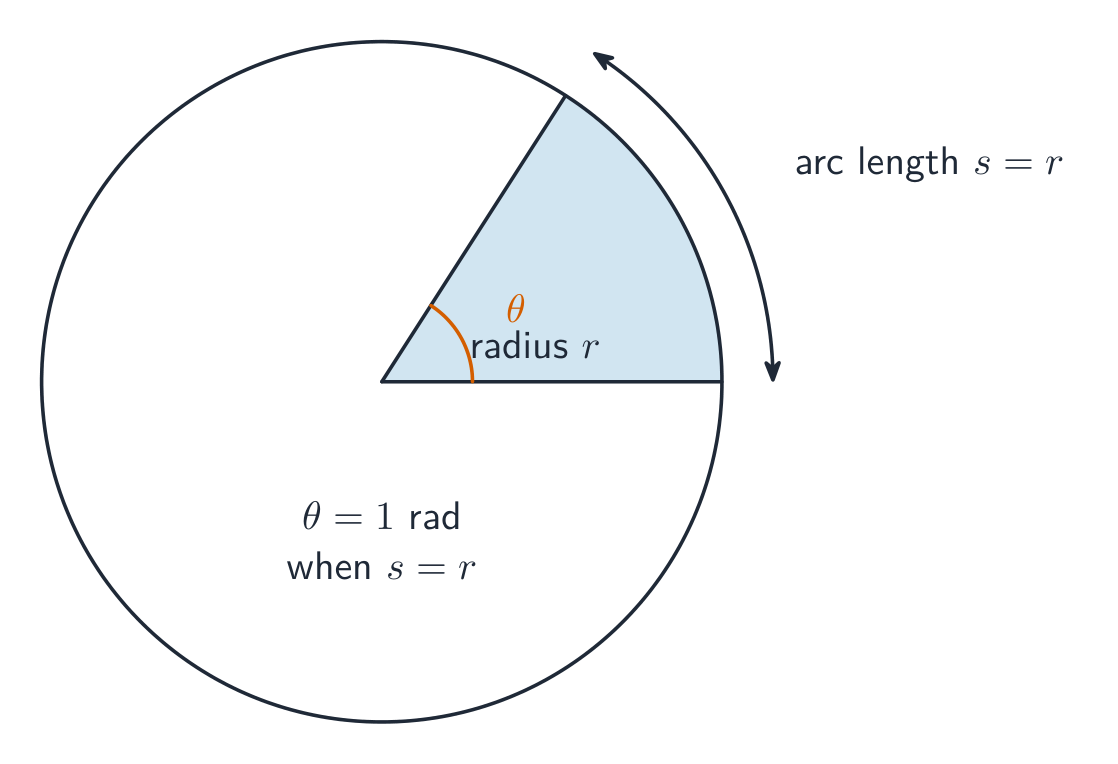
- angular displacement 角位移 $\theta$ (in radians 弧度),
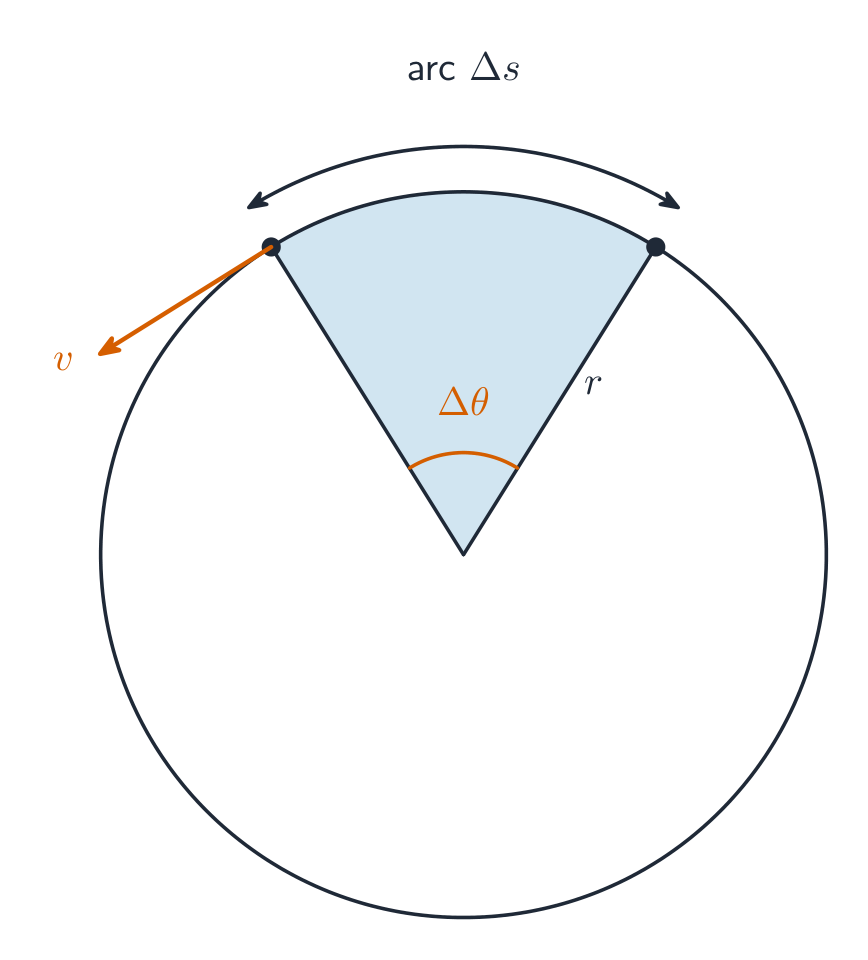
- angular velocity 角速度 $\omega=\dfrac{\Delta\theta}{\Delta t}$,
- angular acceleration 角加速度 $\alpha=\dfrac{\Delta\omega}{\Delta t}$.
For constant $\alpha$, the rotational kinematic equations have the same form as the linear ones, with $\theta,\omega,\alpha$ replacing $x,v,a$: $\omega=\omega_0+\alpha t$, $\theta=\omega_0 t+\tfrac12\alpha t^2$, and $\omega^2=\omega_0^2+2\alpha\theta$.
Worked example. A wheel starts from rest and speeds up uniformly to $30\ \text{rad/s}$ in $6.0\ \text{s}$. Find its angular acceleration and the total angle turned:
$$\alpha=\frac{\Delta\omega}{\Delta t}=\frac{30}{6.0}=5.0\ \text{rad/s}^2,\qquad \theta=\tfrac12\alpha t^2=\tfrac12\times5.0\times6.0^2=90\ \text{rad}.$$
Vocabulary
Train
| English |
|---|
| angular displacement/ˈæŋɡjʊlə dɪˈspleɪsmənt/ |
| radians/ˈreɪdɪənz/ |
| angular velocity/ˈæŋɡjʊlə vəˈlɒsɪti/ |
| angular acceleration/ˈæŋɡjʊlə əkˌseləˈreɪʃn/ |
5.2
Connecting Linear and Rotational Motion
Syllabus
| Learning Objective | Essential Knowledge |
|---|---|
5.2.A |
Boundary statement: Descriptions of the directions of rotation for a point or object are limited to clockwise and counterclockwise with respect to a given axis of rotation. |
Source: College Board AP Course and Exam Description
A point at radius $r$ from the axis has linear quantities tied to the angular ones:
$$s=r\theta,\qquad v=r\omega,\qquad a_t=r\alpha.$$
Points farther from the axis move faster. This link lets you switch between "how fast the wheel spins" and "how fast a point on its rim moves."
Worked example. A bicycle wheel of radius $0.35\ \text{m}$ spins at $12\ \text{rad/s}$. A point on the rim (and so the bike) moves at $v=r\omega=0.35\times12=4.2\ \text{m/s}$. A point halfway to the axis moves at half that speed.
5.3
Torque
Syllabus
| Learning Objective | Essential Knowledge |
|---|---|
5.3.A |
|
5.3.B |
Boundary statement: While AP Physics 1 expects students to mathematically manipulate the magnitude of torque using vector conventions, the direction of torque is beyond the scope of the course. |
Source: College Board AP Course and Exam Description
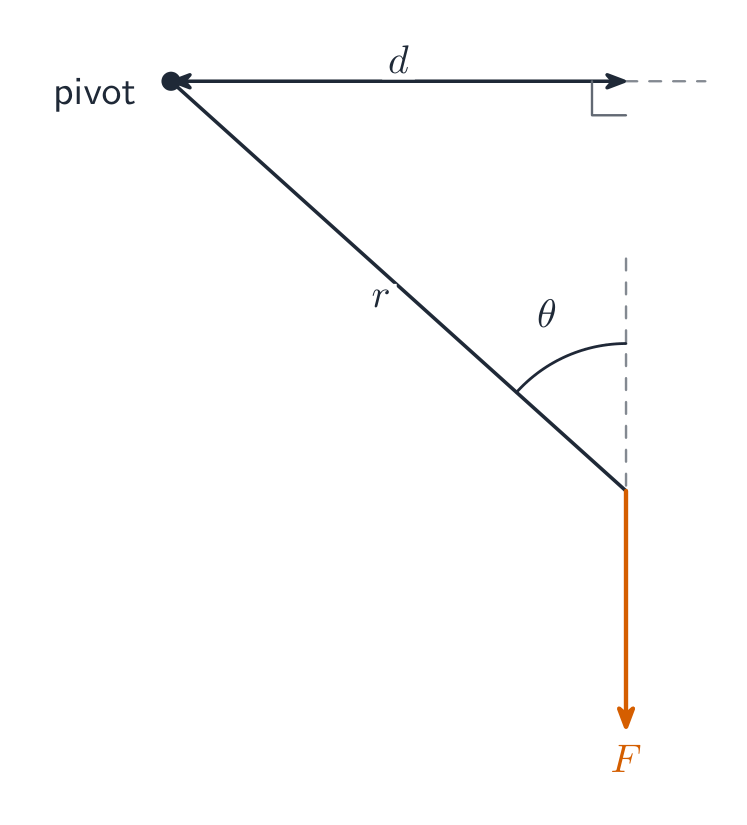
Torque 力矩 is the rotational effect of a force – how effectively it turns an object about an axis:
$$\tau=r F\sin\theta = F\cdot r_\perp,$$
where $r_\perp$ is the moment arm 力臂 (the perpendicular distance from the axis to the force's line of action). A force applied farther out, or more perpendicular, produces more torque. Torque has a sign (clockwise vs counterclockwise).
Worked example. You push with $20\ \text{N}$ at the end of a $0.30\ \text{m}$ wrench. Perpendicular to the wrench the torque is $\tau=rF=0.30\times20=6.0\ \text{N m}$. If you push at $60^{\circ}$ to the wrench instead, only the perpendicular part counts: $\tau=rF\sin 60^{\circ}=0.30\times20\times0.87=5.2\ \text{N m}$ – which is why you push at a right angle for the most turning effect.
Explore
Balance torques on a beam
Torque is force times perpendicular distance, $\tau=Fd$. The beam is in rotational equilibrium when the torques on each side are equal.
Vocabulary
Train
| English |
|---|
| Torque/tɔːk/ |
| moment arm/ˈməʊmənt ɑːm/ |
5.4
Rotational Inertia
Syllabus
| Learning Objective | Essential Knowledge |
|---|---|
5.4.A |
|
5.4.B |
Boundary statement: AP Physics 1 only expects students to calculate the rotational inertia for systems of five or fewer objects arranged in a two-dimensional configuration. Boundary statement: Students do not need to know the rotational inertia of extended rigid systems, as these will be provided within the exam. Students should have a qualitative understanding of the factors that affect rotational inertia; for example, how rotational inertia is greater when mass is farther from the axis of rotation, which is why a hoop has more rotational inertia than a solid disk of the same mass and radius. |
Source: College Board AP Course and Exam Description
Rotational inertia 转动惯量 (moment of inertia) $I$ measures how hard it is to change an object's rotation – the rotational version of mass. It depends on both the mass and how far that mass sits from the axis: mass spread farther out gives a larger $I$. For a point mass, $I=mr^2$; for extended bodies, standard formulas are provided (a hoop is $mR^2$, a solid disk $\tfrac12 mR^2$). This is why a figure skater spins faster when she pulls her arms in – she reduces $I$.
Vocabulary
Train
| English |
|---|
| Rotational inertia/rəʊˈteɪʃənl ɪˈnɜːʃə/ |
5.5
Rotational Equilibrium
Syllabus
| Learning Objective | Essential Knowledge |
|---|---|
5.5.A |
Boundary statement: AP Physics 1 does not expect students to simultaneously analyze rotation in multiple planes. |
Source: College Board AP Course and Exam Description
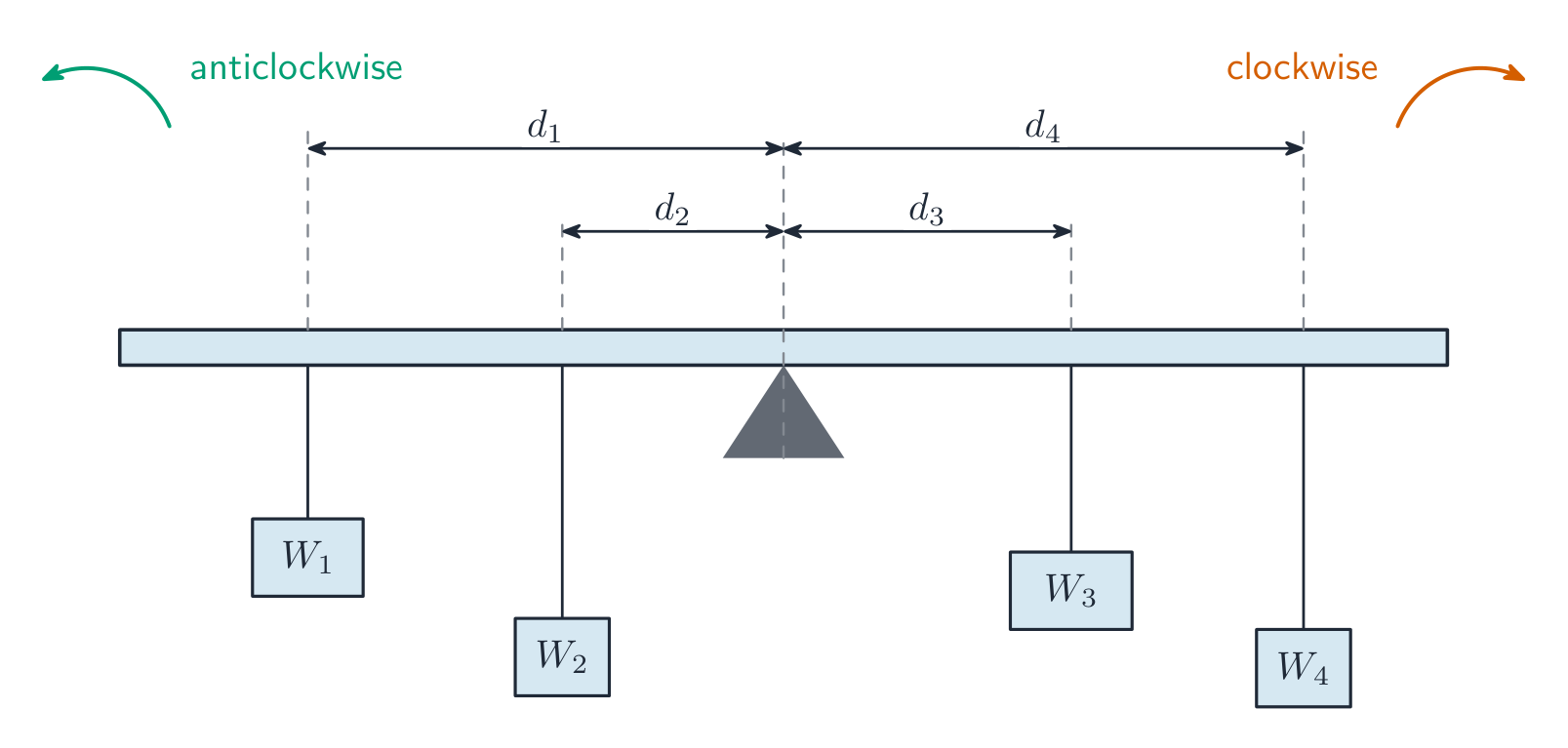
An object is in rotational equilibrium 转动平衡 when the net torque is zero, so its angular velocity stays constant. For a balanced (static) object, both the net force and the net torque are zero. Choosing the axis at an unknown force's location removes it from the torque equation – a useful trick for beam and ladder problems.
Worked example. A $30\ \text{kg}$ child sits $2.0\ \text{m}$ from the pivot of a seesaw. Where must a $40\ \text{kg}$ child sit on the other side to balance it? Set the clockwise torque equal to the anticlockwise torque (the $g$'s cancel):
$$30\times2.0=40\times d\;\Rightarrow\;d=\frac{60}{40}=1.5\ \text{m}.$$
The heavier child sits closer to the pivot – less distance, same torque.
Explore
Find the balance point
For rotational equilibrium the total clockwise torque equals the total anticlockwise torque. Move the forces and distances until the beam balances.
Vocabulary
Train
| English |
|---|
| rotational equilibrium/rəʊˈteɪʃənl ˌiːkwɪˈlɪbrɪəm/ |
5.6
Newton's Second Law in Rotational Form
Syllabus
| Learning Objective | Essential Knowledge |
|---|---|
5.6.A |
|
Source: College Board AP Course and Exam Description
Net torque produces angular acceleration, in direct analogy with $F=ma$:
$$\sum\tau = I\alpha.$$
So a larger net torque, or a smaller rotational inertia, gives a larger angular acceleration. Solve rotation problems just like translation problems, with $\tau\leftrightarrow F$, $I\leftrightarrow m$, and $\alpha\leftrightarrow a$.
Worked example. A net torque of $12\ \text{N m}$ acts on a wheel with rotational inertia $I=3.0\ \text{kg m}^2$. Its angular acceleration is $\alpha=\tau/I=12/3.0=4.0\ \text{rad/s}^2$ – the exact rotational twin of $a=F/m$.
5.6
Exam tips
- Torque $\tau=Fr_\perp$ uses the perpendicular distance from the pivot; a force through the pivot gives zero torque.
- For balance, set clockwise torque = anticlockwise torque; choosing the pivot at an unknown force removes it from the equation.
- Use the rotational analogues: $\tau\leftrightarrow F$, $I\leftrightarrow m$, $\alpha\leftrightarrow a$, so $\sum\tau=I\alpha$ mirrors $\sum F=ma$.
- Rotational inertia depends on how far the mass sits from the axis, not just its amount — a hoop resists spinning more than a disc of equal mass.
- Convert angles to radians and link linear to angular with $v=r\omega$, $a_t=r\alpha$.
Interactive lessons on this topic
Work through it step by step, with instant-check exercises.