| Learning Objective | Essential Knowledge |
|---|---|
4.1.A |
Boundary statement: Unless otherwise stated, the general term "momentum" will refer specifically to linear momentum. |
Linear Momentum
AP Physics 1 · Topic 4
 7:49
7:49
Linear Momentum
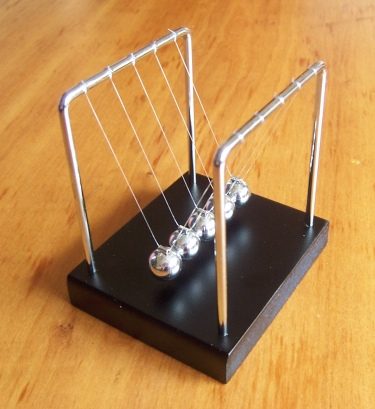
Five steel balls hang in a row, just touching. Lift one, let it go, and one ball flies off the far end. Only one. Lift two, and exactly two fly off. Something…
English narration · English + 中文 subtitles burned in
4.1
Linear Momentum
Syllabus
Source: College Board AP Course and Exam Description
Linear momentum 动量 is mass times velocity – a vector pointing the same way as the velocity:
$$\vec{p}=m\vec{v}.$$
It measures "how hard it is to stop" a moving object. A heavy slow truck and a light fast ball can have the same momentum. Its unit is $\text{kg m/s}$, the same as $\text{N s}$.
Vocabulary
Train
| English |
|---|
| Linear momentum/ˈlɪnɪə məʊˈmentəm/ |
4.2
Change in Momentum and Impulse
Syllabus
| Learning Objective | Essential Knowledge |
|---|---|
4.2.A |
|
4.2.B |
Boundary statement: AP Physics 1 does not require students to quantitatively analyze systems in which the mass of the system changes with respect to time. |
Source: College Board AP Course and Exam Description
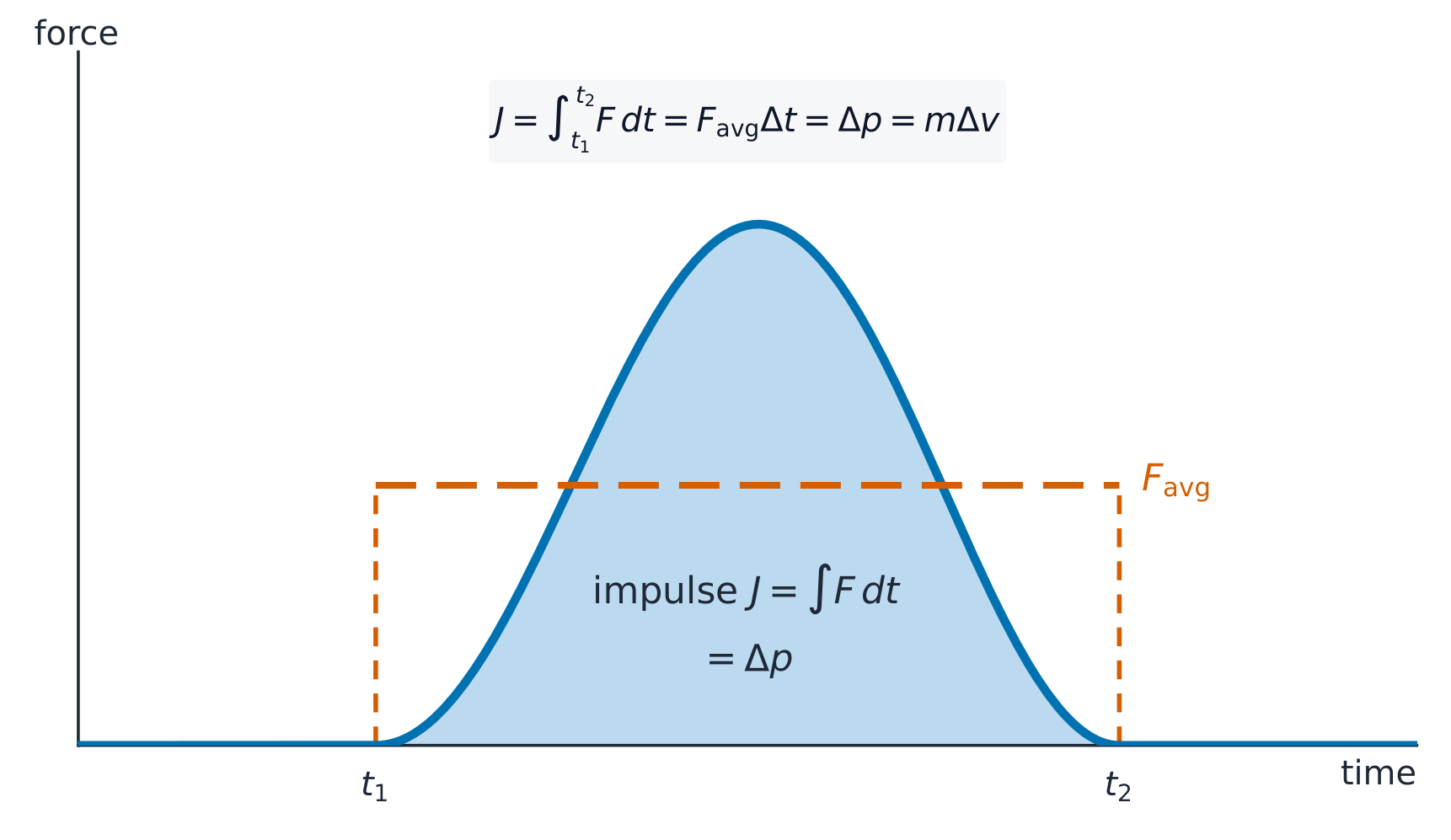
A net force acting over time changes momentum. The impulse 冲量 delivered is
$$\vec{J}=\vec{F}\,\Delta t=\Delta\vec{p}.$$
This is the impulse–momentum theorem: impulse equals the change in momentum. On a force–time graph, impulse is the area under the curve. It explains why airbags and follow-through help – spreading the same momentum change over a longer time reduces the force.
Worked example. A $0.15\ \text{kg}$ ball hits a wall at $20\ \text{m/s}$ and bounces straight back at $15\ \text{m/s}$. The contact lasts $0.020\ \text{s}$. Find the average force on the ball. Take the rebound direction as positive, so $u=-20\ \text{m/s}$ and $v=+15\ \text{m/s}$:
$$\Delta p=m(v-u)=0.15\big(15-(-20)\big)=5.25\ \text{kg m/s},\qquad F=\frac{\Delta p}{\Delta t}=\frac{5.25}{0.020}=260\ \text{N}.$$
The sign work matters: forgetting that the velocity reverses is the most common mistake here.
Vocabulary
Train
| English |
|---|
| impulse/ˈɪmpʌls/ |
4.3
Conservation of Linear Momentum
Syllabus
| Learning Objective | Essential Knowledge |
|---|---|
4.3.A |
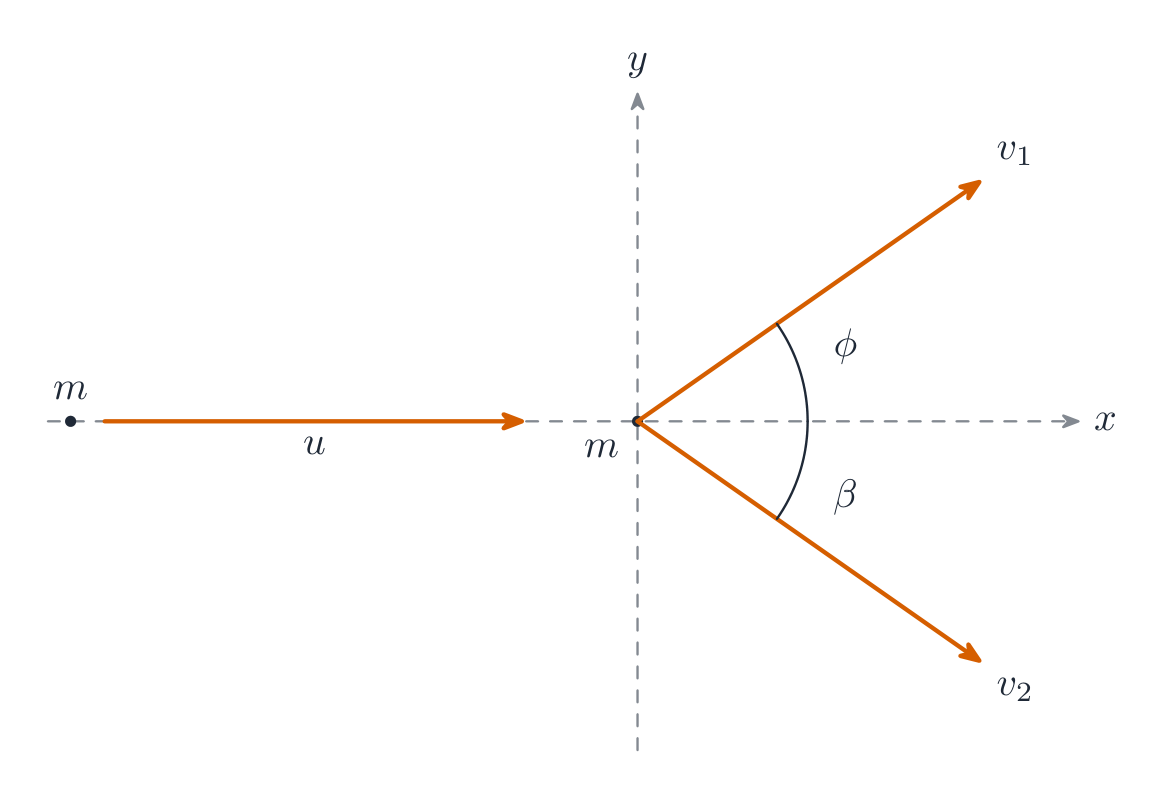
Boundary statement: AP Physics 1 includes a quantitative and qualitative treatment of conservation of momentum in one dimension and a semiquantitative treatment of conservation of momentum in two dimensions. Exam questions involving solution of simultaneous equations are not included in AP Physics 1, but the AP Physics 1 Exam may include questions that assess whether students can set up the equations properly and reason about how changing a given mass, speed, or angle would affect other quantities. AP Physics 2 includes a full treatment of conservation of momentum in two dimensions for problems that include one unknown final velocity. |
4.3.B |
|
Source: College Board AP Course and Exam Description
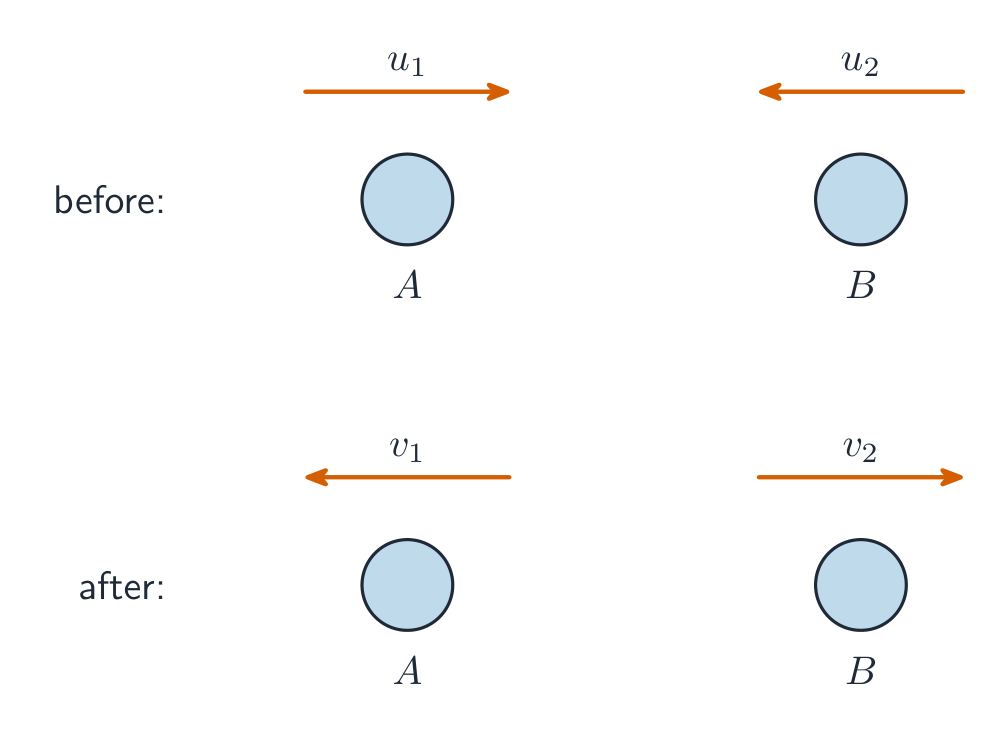
If the net external force on a system is zero, its total momentum is conserved 守恒:
$$\sum \vec{p}_{\text{before}}=\sum \vec{p}_{\text{after}}.$$
Internal forces (like the push between two colliding carts) come in third-law pairs and cancel, so they cannot change the total momentum. This is the key tool for collisions 碰撞 and explosions – apply it separately in the $x$ and $y$ directions.
Worked example (recoil 反冲). A $60\ \text{kg}$ skater, initially at rest on frictionless ice, throws a $2.0\ \text{kg}$ ball at $8.0\ \text{m/s}$. Find her recoil speed. The total momentum starts at zero and stays zero:
$$0=(60)v+(2.0)(8.0)\;\Rightarrow\;v=-\frac{16}{60}=-0.27\ \text{m/s},$$
so she moves at $0.27\ \text{m/s}$ in the opposite direction to the ball – the principle behind rockets and guns.
A whole collection of objects can be described by a single center-of-mass velocity 质心速度:
$$\vec{v}_{\text{cm}}=\frac{\sum m_i\vec{v}_i}{\sum m_i}=\frac{\vec{p}_{\text{total}}}{M_{\text{total}}}.$$
Since total momentum is conserved when no net external force acts, $\vec{v}_{\text{cm}}$ then stays constant – a $v_{\text{cm}}$-versus-time graph is flat unless an outside force acts. An internal collision or explosion never changes it, however violently the parts fly apart.
Explore
Collide two carts and conserve momentum
In any collision the total momentum $\sum mv$ before equals the total after. Set the masses and speeds and check the momentum bookkeeping.
Vocabulary
Train
| English |
|---|
| conserved/kənˈsɜːvd/ |
| collisions/kəˈlɪʒnz/ |
| center-of-mass velocity/ˈsentə ɒv mæs vəˈlɒsɪti/ |
| recoil/rɪˈkɔɪl/ |
4.4
Elastic and Inelastic Collisions
Syllabus
| Learning Objective | Essential Knowledge |
|---|---|
4.4.A |
|
Source: College Board AP Course and Exam Description
Momentum is conserved in every collision (with no external force). Kinetic energy is not:
- In an elastic collision 弹性碰撞, kinetic energy is also conserved (objects bounce apart cleanly).
- In an inelastic collision 非弹性碰撞, some kinetic energy becomes heat or deformation. In a perfectly inelastic collision the objects stick together and move with one common velocity afterward.
Strategy: always write momentum conservation; add energy conservation only if the collision is stated to be elastic. One elastic fact worth memorising: in a 1D elastic collision between equal masses, the two objects simply swap velocities (a moving ball striking an identical stationary one stops dead, and the target flies off at the incoming speed).
Worked example. A $1000\ \text{kg}$ car moving at $20\ \text{m/s}$ runs into a stationary $1500\ \text{kg}$ car and they lock together. Find their common speed, and the kinetic energy lost. Momentum conservation gives
$$1000\times20=(1000+1500)\,v\;\Rightarrow\;v=\frac{20000}{2500}=8.0\ \text{m/s}.$$
Kinetic energy before is $\tfrac12(1000)(20^2)=2.0\times10^{5}\ \text{J}$; after is $\tfrac12(2500)(8.0^2)=8.0\times10^{4}\ \text{J}$. So $1.2\times10^{5}\ \text{J}$ (about $60\%$) is lost to crumpling and heat – momentum is still conserved, but kinetic energy is not.
Explore
Compare elastic and inelastic collisions
Momentum is always conserved, but kinetic energy is only conserved in an elastic collision. In an inelastic one the carts stick and some energy becomes heat.
Vocabulary
Train
| English |
|---|
| elastic collision/ɪˈlæstɪk kəˈlɪʒn/ |
| inelastic collision/ɪnɪˈlæstɪk kəˈlɪʒn/ |
4.4
Exam tips
- Momentum is a vector — assign $+$/$-$ signs before adding; a ball that rebounds reverses its velocity, giving a large $\Delta p$.
- Momentum is conserved in every collision (no external force); kinetic energy is conserved only if the collision is stated to be elastic.
- In a perfectly inelastic collision the objects stick and move with one common velocity.
- Impulse $=F\,\Delta t=\Delta p$ = the area under a force–time graph; spreading a collision over a longer time reduces the force (airbags, bending knees).
- For recoil/explosions, set the total momentum equal before and after (often zero before).
Interactive lessons on this topic
Work through it step by step, with instant-check exercises.