| Learning Objective | Essential Knowledge |
|---|---|
3.1.A |
|
Work, Energy, and Power
AP Physics 1 · Topic 3
 8:07
8:07
Work, Energy, and Power
Look up at the first hill of a roller coaster. A chain drags the train to the top, then lets go. There is no engine on the train — nothing pushes it again for…
English narration · English + 中文 subtitles burned in
3.1
Translational Kinetic Energy
Syllabus
Source: College Board AP Course and Exam Description
Energy 能量 is the capacity to do work, measured in joules 焦耳 (J). A moving object has kinetic energy 动能:
$$K=\tfrac{1}{2}mv^2.$$
It depends on the square of the speed, so doubling the speed quadruples the kinetic energy. Kinetic energy is a scalar and is never negative.
Worked example. A $1500\ \text{kg}$ car travels at $20\ \text{m/s}$. Its kinetic energy is $K=\tfrac12\times1500\times20^2=3.0\times10^{5}\ \text{J}=300\ \text{kJ}$. If it speeds up to $40\ \text{m/s}$ (double), the kinetic energy becomes $4\times$ larger, $1200\ \text{kJ}$ – which is why stopping distance grows so fast with speed.
Vocabulary
Train
| English |
|---|
| Energy/ˈenədʒi/ |
| joules/dʒuːlz/ |
| kinetic energy/kɪˈnetɪk ˈenədʒi/ |
3.2
Work
Syllabus
| Learning Objective | Essential Knowledge |
|---|---|
3.2.A |
Boundary statement: AP Physics 1 only expects students to analyze the transfer of mechanical energy (as defined in Unit 3, Topic 4: Conservation of Energy), although students should be aware that mechanical energy may be dissipated in the form of thermal energy or sound. In AP Physics 2, students will also study how thermal energy can be transferred between systems through heating or cooling. |
Source: College Board AP Course and Exam Description
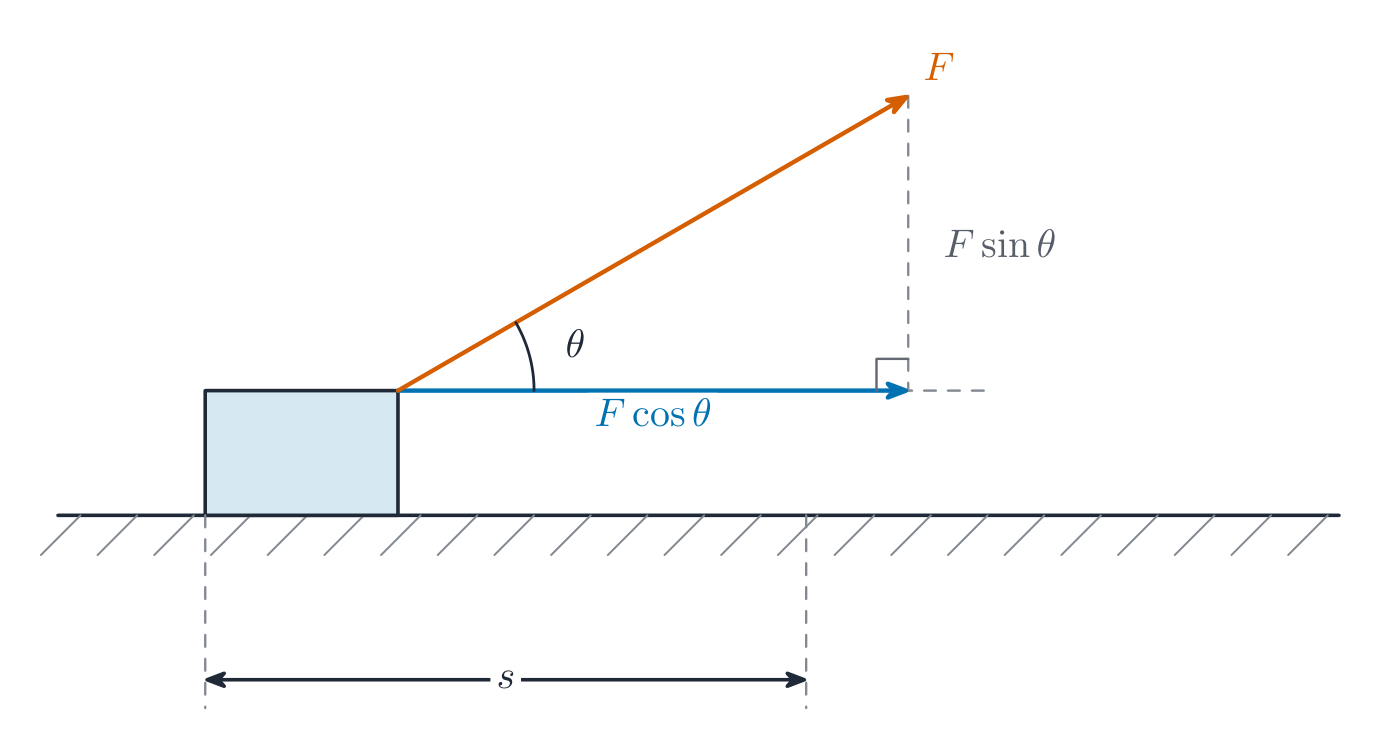
Work 功 is energy transferred by a force acting over a displacement:
$$W=F\,d\cos\theta,$$
where $\theta$ is the angle between the force and the displacement. Work is positive when the force has a component along the motion (adds energy), negative when it opposes the motion (removes energy), and zero when the force is perpendicular. On a force–position graph, work is the area under the curve. The work–energy theorem 动能定理 states that the net work equals the change in kinetic energy: $W_{\text{net}}=\Delta K$.
Worked example. A $2.0\ \text{kg}$ block moving at $3.0\ \text{m/s}$ on a frictionless floor is pushed by a $5.0\ \text{N}$ force over $4.0\ \text{m}$ in the direction of motion. Find its final speed. The net work is $W=Fd=5.0\times4.0=20\ \text{J}$, and by the work–energy theorem $W=\tfrac12 m(v^2-v_0^2)$:
$$20=\tfrac12\times2.0\times(v^2-3.0^2)\;\Rightarrow\;v^2=29\;\Rightarrow\;v=5.4\ \text{m/s}.$$
Vocabulary
Train
| English |
|---|
| Work/wɜːk/ |
| work–energy theorem/wɜːk ˈenədʒi ˈθɪərəm/ |
3.3
Potential Energy
Syllabus
| Learning Objective | Essential Knowledge |
|---|---|
3.3.A |
|
Source: College Board AP Course and Exam Description
Potential energy 势能 is stored energy that depends on position or configuration:
- Gravitational potential energy 重力势能 near the surface: $U_g=mgh$ (height $h$ above a reference level).
- Elastic potential energy 弹性势能 in a spring: $U_s=\tfrac{1}{2}kx^2$.
Potential energy is defined only for conservative forces 保守力 (gravity, springs), for which the stored energy depends on position, not path. Only changes in potential energy matter, so you may put the zero level wherever is convenient.
The $U_g=mgh$ form only holds near a surface where $g$ is roughly constant. The general form, for two spherical masses a distance $r$ apart, is
$$U_g=-\frac{G m_1 m_2}{r}.$$
It is negative and defined to be zero at infinite separation, so gravitational PE rises toward zero as the masses move apart. $mgh$ is simply its near-surface approximation. (This is the form you need for satellites and escape speed.)
Explore
Store elastic potential energy in a spring
Stretching a spring stores elastic potential energy $\tfrac12 kx^2$ — the area under the force-extension line. Release it and that energy becomes kinetic.
Vocabulary
Train
| English |
|---|
| Potential energy/pəˈtenʃl ˈenədʒi/ |
| Gravitational potential energy/ˌɡrævɪˈteɪʃənl pəˈtenʃl ˈenədʒi/ |
| Elastic potential energy/ɪˈlæstɪk pəˈtenʃl ˈenədʒi/ |
| conservative forces/kənˈsɜːvətɪv ˈfɔːsɪz/ |
3.4
Conservation of Energy
Syllabus
| Learning Objective | Essential Knowledge |
|---|---|
3.4.A |
|
3.4.B |
|
3.4.C |
Boundary statement: AP Physics 1 expects students to know that mechanical energy can be dissipated as thermal energy or sound by nonconservative forces. |
Source: College Board AP Course and Exam Description
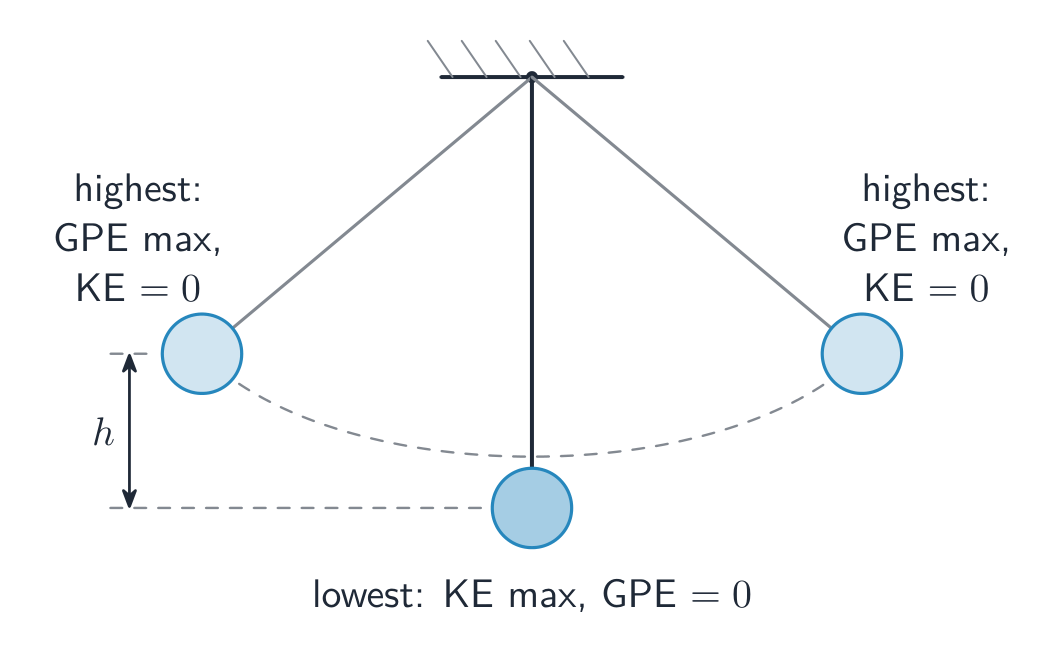
The total mechanical energy 机械能 is $E=K+U$. When only conservative forces do work, mechanical energy is conserved 守恒:
$$K_1+U_1=K_2+U_2.$$
When friction or other non-conservative forces act, they transfer mechanical energy to thermal energy 热能; then the general statement is that total energy (including thermal) is conserved. Energy bar charts are a good way to track where the energy goes.
Worked example. A ball is released from rest at the top of a frictionless ramp $5.0\ \text{m}$ high. Find its speed at the bottom. All the gravitational potential energy becomes kinetic energy:
$$mgh=\tfrac12 mv^2\;\Rightarrow\;v=\sqrt{2gh}=\sqrt{2\times9.8\times5.0}=9.9\ \text{m/s}.$$
The mass cancels, so every object reaches the same speed – exactly the free-fall result, now got from energy. If instead $30\ \text{J}$ were lost to friction, you would subtract it: $mgh-30=\tfrac12 mv^2$.
Explore
Watch energy convert as an object falls
With no friction, mechanical energy is conserved: as an object falls, gravitational potential energy turns into kinetic energy while the total stays fixed.
Vocabulary
Train
| English |
|---|
| total mechanical energy/ˈtəʊtl mɪˈkænɪkl ˈenədʒi/ |
| conserved/kənˈsɜːvd/ |
| thermal energy/ˈθɜːml ˈenədʒi/ |
3.5
Power
Syllabus
| Learning Objective | Essential Knowledge |
|---|---|
3.5.A |
|
Source: College Board AP Course and Exam Description
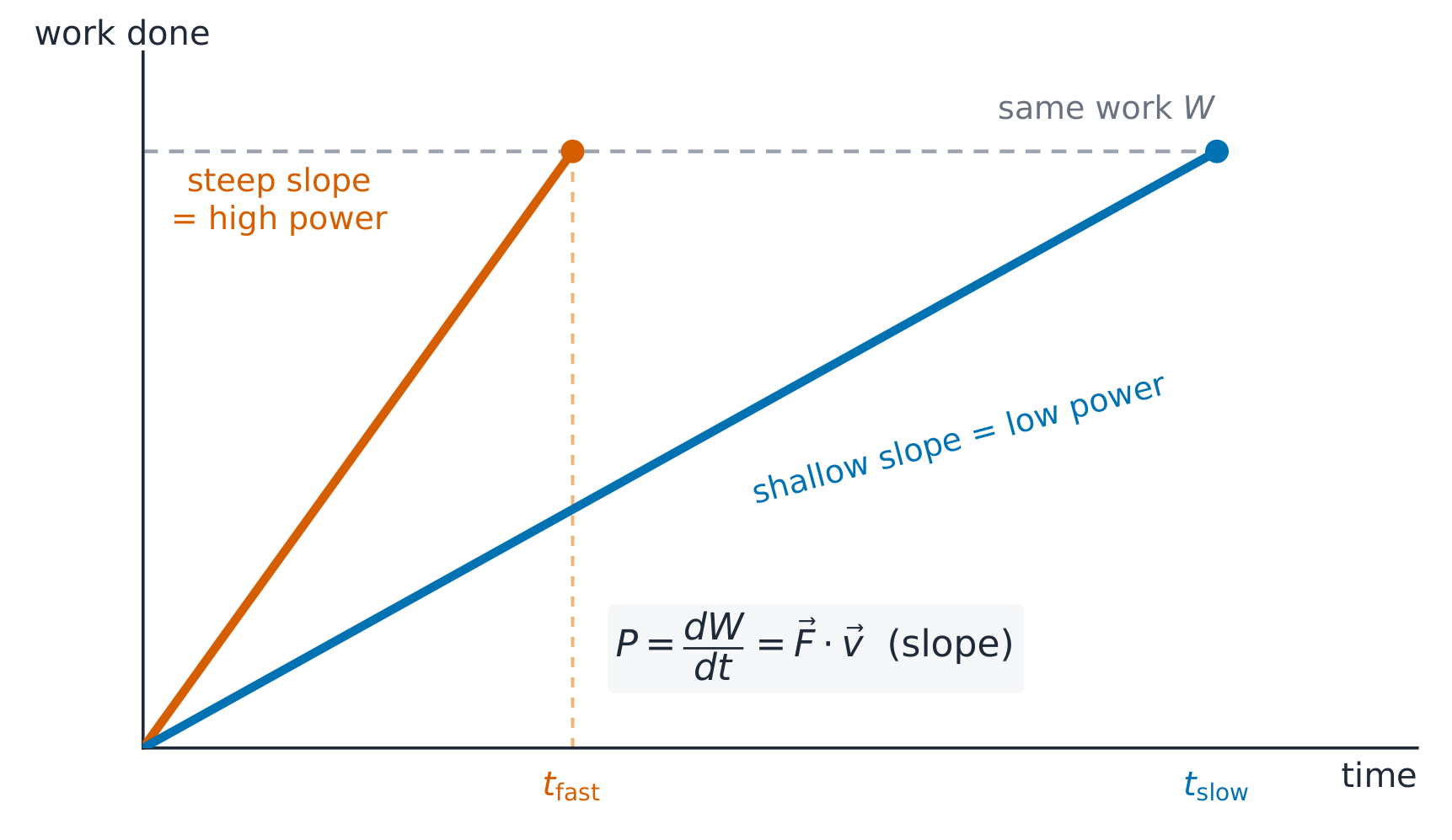
Power 功率 is the rate of doing work or transferring energy, measured in watts 瓦特 (W):
$$P=\frac{W}{\Delta t}=\frac{\Delta E}{\Delta t},\qquad\text{and instantaneously}\qquad P=Fv.$$
So the same job done faster requires more power. On an energy–time graph, power is the slope.
Worked example. A motor lifts a $50\ \text{kg}$ load at a steady $2.0\ \text{m/s}$. Because it moves at constant speed, the lifting force equals the weight, so
$$P=Fv=mgv=50\times9.8\times2.0=980\ \text{W}.$$
Real machines waste some energy, so we quote efficiency 效率 – useful output power divided by total input power. If this motor draws $1400\ \text{W}$ of electrical power to deliver $980\ \text{W}$ of useful lifting, its efficiency is $980/1400=0.70$, or $70\%$; the other $30\%$ becomes heat and sound.
Vocabulary
Train
| English |
|---|
| Power/ˈpaʊə/ |
| watts/wɒts/ |
| efficiency/ɪˈfɪʃənsi/ |
3.5
Exam tips
- Use $W=Fd\cos\theta$: work is zero when the force is perpendicular to the motion, and negative when it opposes it.
- Reach for the work–energy theorem ($W_{\text{net}}=\Delta K$) or energy conservation ($K_1+U_1=K_2+U_2$) instead of forces whenever the path is complicated.
- When friction acts, mechanical energy is not conserved — subtract the energy lost to heat.
- Remember $K\propto v^2$: doubling the speed quadruples the kinetic energy (and the stopping distance).
- Use $P=Fv$ for power at a steady speed; at constant velocity the net force is zero but the power is not.
Interactive lessons on this topic
Work through it step by step, with instant-check exercises.