Skip to content

Force and Translational Dynamics

AP Physics 1 · Topic 2

Train
2.1

Systems and Center of Mass

Syllabus
Learning ObjectiveEssential Knowledge

2.1.A
Describe the properties and interactions of a system.

  • 2.1.A.1 System properties are determined by the interactions between objects within the system.
  • 2.1.A.2 If the properties or interactions of the constituent objects within a system are not important in modeling the behavior of the macroscopic system, the system can itself be treated as a single object.
  • 2.1.A.3 Systems may allow interactions between constituent parts of the system and the environment, which may result in the transfer of energy or mass.
  • 2.1.A.4 Individual objects within a chosen system may behave differently from each other as well as from the system as a whole.
  • 2.1.A.5 The internal structure of a system affects the analysis of that system.
  • 2.1.A.6 As variables external to a system are changed, the system's substructure may change.

2.1.B
Describe the location of a system's center of mass with respect to the system's constituent parts.

  • 2.1.B.1 For systems with symmetrical mass distributions, the center of mass is located on lines of symmetry.
  • 2.1.B.2 The location of a system's center of mass along a given axis can be calculated using the equation
    • Equation: $\vec{x}_{cm} = \dfrac{\sum m_i \vec{x}_i}{\sum m_i}$
  • 2.1.B.3 A system can be modeled as a singular object that is located at the system's center of mass.

Boundary statement: AP Physics 1 only expects students to calculate the center of mass for systems of five or fewer particles arranged in a two-dimensional configuration or for systems that are highly symmetrical.

Source: College Board AP Course and Exam Description

A system 系统 is the object or group of objects you choose to analyze. A system can be treated as a single point at its center of mass 质心 – the average position of its mass. External forces change the motion of the center of mass; internal forces (between parts of the system) do not.

This is why a wrench spinning across a table still has its center of mass move in a straight line: the spinning is internal, and only the (near-zero) external force matters for the center of mass. For two masses $m_1,m_2$ on a line at positions $x_1,x_2$, the center of mass sits at $x_{\text{cm}}=\dfrac{m_1x_1+m_2x_2}{m_1+m_2}$ – always closer to the heavier mass.

Vocabulary Train
English Chinese Pinyin
system 系统 xì tǒng
center of mass 质心 zhì xīn
2.2

Forces and Free-Body Diagrams

Syllabus
Learning ObjectiveEssential Knowledge

2.2.A
Describe a force as an interaction between two objects or systems.

  • 2.2.A.1 Forces are vector quantities that describe the interactions between objects or systems.
    • 2.2.A.1.i A force exerted on an object or system is always due to the interaction of that object with another object or system.
    • 2.2.A.1.ii An object or system cannot exert a net force on itself.
  • 2.2.A.2 Contact forces describe the interaction of an object or system touching another object or system and are macroscopic effects of interatomic electric forces.

2.2.B
Describe the forces exerted on an object or system using a free-body diagram.

  • 2.2.B.1 Free-body diagrams are useful tools for visualizing forces being exerted on a single object or system and for determining the equations that represent a physical situation.
  • 2.2.B.2 The free-body diagram of an object or system shows each of the forces exerted on the object by the environment.
  • 2.2.B.3 Forces exerted on an object or system are represented as vectors originating from the representation of the center of mass, such as a dot. A system is treated as though all of its mass is located at the center of mass.
  • 2.2.B.4 A coordinate system with one axis parallel to the direction of acceleration of the object or system simplifies the translation from free-body diagram to algebraic representation. For example, in a free-body diagram of an object on an inclined plane, it is useful to set one axis parallel to the surface of the incline.

Boundary statement: AP Physics 1 only expects students to depict the forces exerted on objects, not the force components on free-body diagrams. On the AP Physics exams, individual forces represented on a free-body diagram must be drawn as individual straight arrows, originating on the dot and pointing in the direction of the force. Individual forces that are in the same direction must be drawn side by side, not overlapping.

Source: College Board AP Course and Exam Description

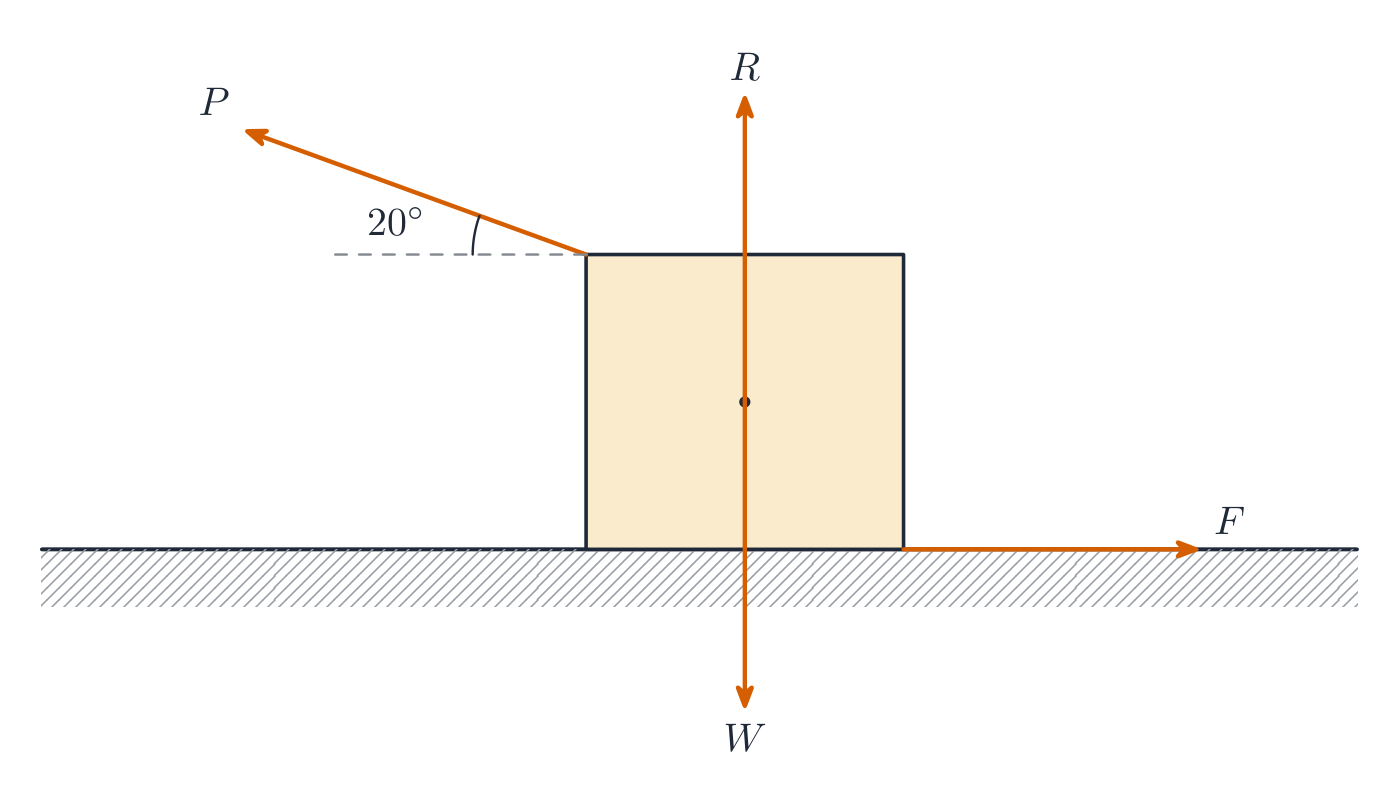
A force is a push or pull – a vector, measured in newtons (N). A free-body diagram 受力图 shows one object as a dot with arrows for every force acting on it (weight 重力, normal, tension 张力, friction, applied), each labelled and pointing the right way. Draw it before any dynamics problem; it is where most marks are won or lost.
A free-body diagram shows every force acting on one object A free-body diagram shows every force acting on one object

Two rules keep free-body diagrams honest: draw only forces acting on the chosen object (not forces it exerts on other things), and draw only real, physical forces (a rope, a surface, gravity, a hand) – never an "$ma$" arrow, which is the result of the forces, not a force itself.

Explore

Balance the forces on a free-body diagram

A free-body diagram shows every force on one object as an arrow. The object accelerates only if the forces don't cancel — the net force sets $a=F/m$.

Vocabulary Train
English Chinese Pinyin
force
free-body diagram 受力图 shòu lì tú
weight 重力 zhòng lì
tension 张力 zhāng lì
2.3

Newton's Third Law

Syllabus
Learning ObjectiveEssential Knowledge

2.3.A
Describe the interaction of two objects using Newton's third law and a representation of paired forces exerted on each object.

  • 2.3.A.1 Newton's third law describes the interaction of two objects in terms of the paired forces that each exerts on the other.
    • Equation: $\vec{F}_{\text{A on B}} = -\vec{F}_{\text{B on A}}$
  • 2.3.A.2 Interactions between objects within a system (internal forces) do not influence the motion of a system's center of mass.
  • 2.3.A.3 Tension is the macroscopic net result of forces that segments of a string, cable, chain, or similar system exert on each other in response to an external force.
    • 2.3.A.3.i An ideal string has negligible mass and does not stretch when under tension.
    • 2.3.A.3.ii The tension in an ideal string is the same at all points within the string.
    • 2.3.A.3.iii In a string with nonnegligible mass, tension may not be the same at all points within the string.
    • 2.3.A.3.iv An ideal pulley is a pulley that has negligible mass and rotates about an axle through its center of mass with negligible friction.

Boundary statement: AP Physics 1 only expects students to describe tension qualitatively in a string, cable, chain, or similar system with mass. For example, students might note that the tension in a hanging chain is greater toward the top of the chain.

Boundary statement: The interaction between objects or systems at a distance is limited to gravitational forces in AP Physics 1. In AP Physics 2, gravitational, electric, and magnetic forces may be considered.

Source: College Board AP Course and Exam Description

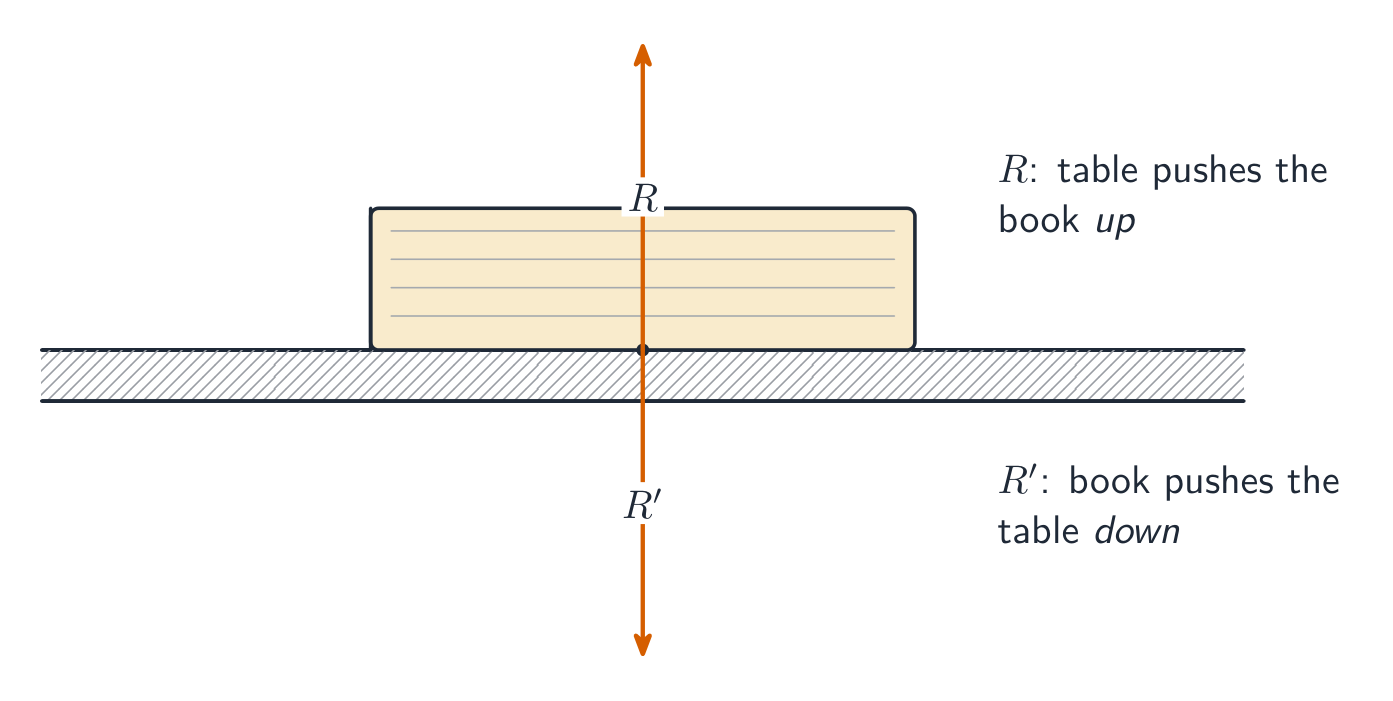
Newton's third law 牛顿第三定律: if object A pushes on object B, then B pushes back on A with a force equal in size and opposite in direction. These two forces act on different objects, so they never cancel each other. Identify third-law pairs by the "A on B / B on A" wording.

A Newton's third-law pair: equal and opposite forces on two different objects A Newton's third-law pair: equal and opposite forces on two different objects

A classic trap: the weight of a book and the normal force from the table are not a third-law pair – they act on the same object (the book). The partner of the book's weight is the pull the book exerts on the Earth; the partner of the table's push is the push the book makes on the table.

Vocabulary Train
English Chinese Pinyin
Newton's third law 牛顿第三定律 niú dùn dì sān dìng lǜ
2.4

Newton's First Law

Syllabus
Learning ObjectiveEssential Knowledge

2.4.A
Describe the conditions under which a system's velocity remains constant.

  • 2.4.A.1 The net force on a system is the vector sum of all forces exerted on the system.
  • 2.4.A.2 Translational equilibrium is a configuration of forces such that the net force exerted on a system is zero.
    • Derived equation: $\sum_i \vec{F}_i = 0$
  • 2.4.A.3 Newton's first law states that if the net force exerted on a system is zero, the velocity of that system will remain constant.
  • 2.4.A.4 Forces may be balanced in one dimension but unbalanced in another. The system's velocity will change only in the direction of the unbalanced force.
  • 2.4.A.5 An inertial reference frame is one from which an observer would verify Newton's first law of motion.

Source: College Board AP Course and Exam Description

Newton's first law 牛顿第一定律 (the law of inertia 惯性): an object's velocity stays constant unless a net force 合力 acts on it. So zero net force means constant velocity (including rest) – the object is in translational equilibrium 平衡. Inertia is the tendency to resist changes in motion, measured by mass.

Worked example. A $1200\ \text{kg}$ car cruises at a steady $25\ \text{m/s}$ on a level road. What is the net force on it? Because the velocity is constant, the acceleration is zero, so by the first law the net force is zero – the forward drive force exactly balances drag and friction. "Steady speed" always means balanced forces.

Vocabulary Train
English Chinese Pinyin
Newton's first law 牛顿第一定律 niú dùn dì yí dìng lǜ
inertia 惯性 guàn xìng
net force 合力 hé lì
translational equilibrium 平衡 píng héng
2.5

Newton's Second Law

Syllabus
Learning ObjectiveEssential Knowledge

2.5.A
Describe the conditions under which a system's velocity changes.

  • 2.5.A.1 Unbalanced forces are a configuration of forces such that the net force exerted on a system is not equal to zero.
  • 2.5.A.2 Newton's second law of motion states that the acceleration of a system's center of mass has a magnitude proportional to the magnitude of the net force exerted on the system and is in the same direction as that net force.
    • Equation: $\vec{a}_{\text{sys}} = \dfrac{\sum \vec{F}}{m_{\text{sys}}} = \dfrac{\vec{F}_{\text{net}}}{m_{\text{sys}}}$
  • 2.5.A.3 The velocity of a system's center of mass will only change if a nonzero net external force is exerted on that system.

Source: College Board AP Course and Exam Description

Newton's second law 牛顿第二定律 relates net force to acceleration:

$$\vec{a}=\frac{\sum \vec{F}}{m},\qquad\text{i.e.}\qquad \sum\vec{F}=m\vec{a}.$$
Apply it one axis at a time: add the force components along each axis and set the sum equal to $ma$ for that axis. Acceleration points the same way as the net force.

Worked example. A $4.0\ \text{kg}$ box is pulled along the floor by a horizontal force of $18\ \text{N}$. Friction on the box is $6.0\ \text{N}$. Find its acceleration. Along the direction of motion the net force is $18-6.0=12\ \text{N}$, so

$$a=\frac{\sum F}{m}=\frac{12}{4.0}=3.0\ \text{m/s}^2.$$

Worked example (incline 斜面). A block of mass $m$ slides down a frictionless ramp tilted at angle $\theta$. Find its acceleration. Resolve gravity into components along and perpendicular to the ramp; only the along-ramp part, $mg\sin\theta$, drives the motion, so

$$a=\frac{mg\sin\theta}{m}=g\sin\theta.$$
The steeper the ramp, the larger $\sin\theta$ and the faster it accelerates; at $\theta=90^{\circ}$ it is free fall.

Vocabulary Train
English Chinese Pinyin
Newton's second law 牛顿第二定律 niú dùn dì èr dìng lǜ
incline 斜面 xié miàn
2.6

Gravitational Force

Syllabus
Learning ObjectiveEssential Knowledge

2.6.A
Describe the gravitational interaction between two objects or systems with mass.

  • 2.6.A.1 Newton's law of universal gravitation describes the gravitational force between two objects or systems as directly proportional to each of their masses and inversely proportional to the square of the distance between the systems' centers of mass.
    • Equation: $\left|\vec{F}_g\right| = G\dfrac{m_1 m_2}{r^2}$
    • 2.6.A.1.i The gravitational force is attractive.
    • 2.6.A.1.ii The gravitational force is always exerted along the line connecting the centers of mass of the two interacting systems.
    • 2.6.A.1.iii The gravitational force on a system can be considered to be exerted on the system's center of mass.
  • 2.6.A.2 A field models the effects of a noncontact force exerted on an object at various positions in space.
    • 2.6.A.2.i The magnitude of the gravitational field created by a system of mass $M$ at a point in space is equal to the ratio of the gravitational force exerted by the system on a test object of mass $m$ to the mass of the test object.
      • Equation: $\left|\vec{g}\right| = \dfrac{\left|\vec{F}_g\right|}{m} = G\dfrac{M}{r^2}$
    • 2.6.A.2.ii If the gravitational force is the only force exerted on an object, the observed acceleration of the object (in m/s$^2$) is numerically equal to the magnitude of the gravitational field strength (in N/kg) at that location.
  • 2.6.A.3 The gravitational force exerted by an astronomical body on a relatively small nearby object is called weight.
    • Equation: $\text{Weight} = F_g = mg$

2.6.B
Describe situations in which the gravitational force can be considered constant.

  • 2.6.B.1 If the gravitational force between two systems' centers of mass has a negligible change as the relative position of the two systems changes, the gravitational force can be considered constant at all points between the initial and final positions of the systems.
  • 2.6.B.2 Near the surface of Earth, the strength of the gravitational field is $g \approx 10 \text{ N/kg}$

2.6.C
Describe the conditions under which the magnitude of a system's apparent weight is different from the magnitude of the gravitational force exerted on that system.

  • 2.6.C.1 The magnitude of the apparent weight of a system is the magnitude of the normal force exerted on the system.
  • 2.6.C.2 If the system is accelerating, the apparent weight of the system is not equal to the magnitude of the gravitational force exerted on the system.
  • 2.6.C.3 A system appears weightless when there are no forces exerted on the system or when the force of gravity is the only force exerted on the system.
  • 2.6.C.4 The equivalence principle states that an observer in a noninertial reference frame is unable to distinguish between an object's apparent weight and the gravitational force exerted on the object by a gravitational field.

2.6.D
Describe inertial and gravitational mass.

  • 2.6.D.1 Objects have inertial mass, or inertia, a property that determines how much an object's motion resists changes when interacting with another object.
  • 2.6.D.2 Gravitational mass is related to the force of attraction between two systems with mass.
  • 2.6.D.3 Inertial mass and gravitational mass have been experimentally verified to be equivalent.

Source: College Board AP Course and Exam Description

Orbital motion (Kepler's 2nd law)

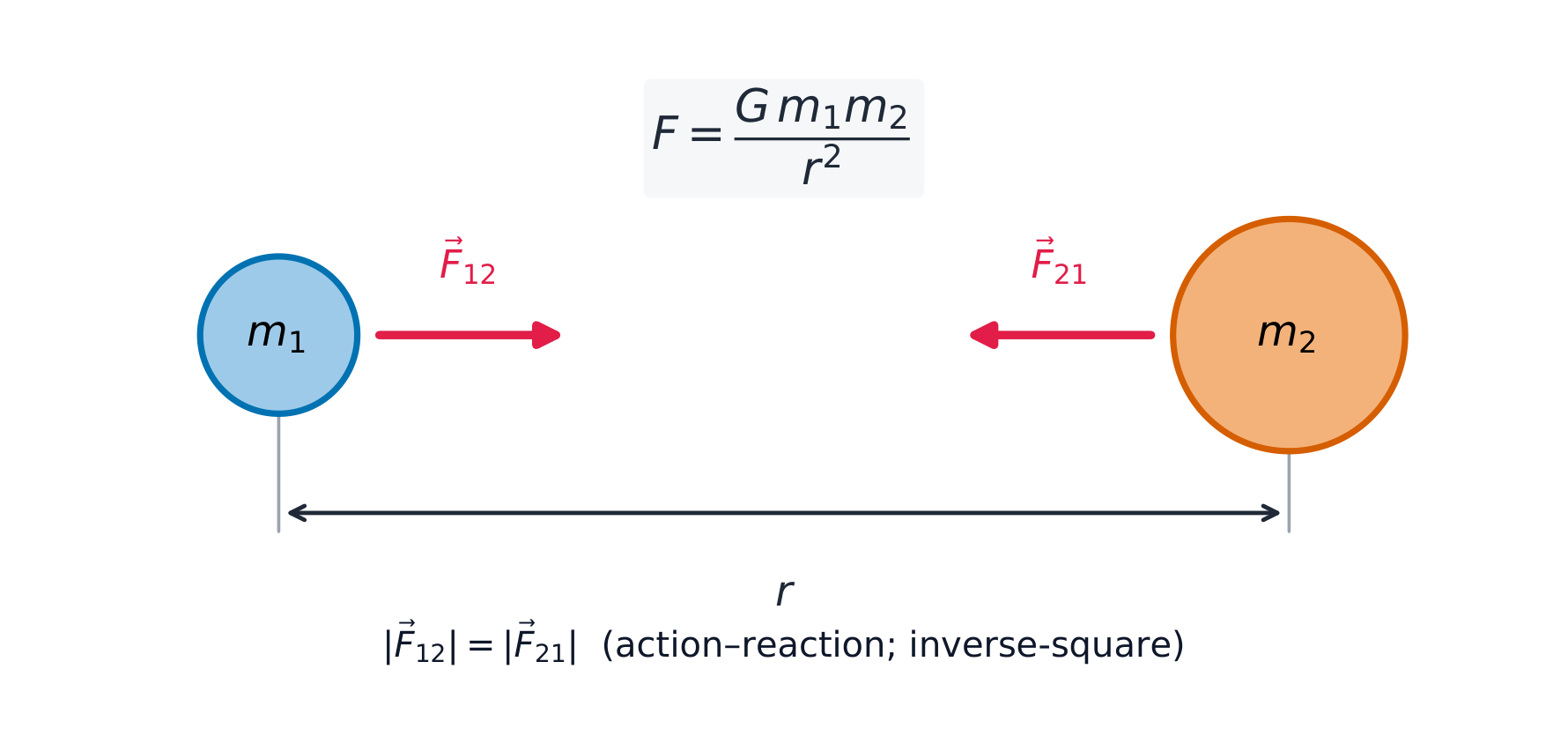
Near a planet's surface, the gravitational force (weight) is $F_g=mg$, directed down, where $g$ is the gravitational field strength 重力场强度. More generally, Newton's law of gravitation 万有引力定律 gives the attraction between any two masses:

$$F_g=\frac{G m_1 m_2}{r^2},$$
directed along the line joining them, weaker as the distance $r$ grows (an inverse-square law). Doubling the separation quarters the force.

Two masses attract each other with equal, opposite, inverse-square forces along the line joining them Two masses attract each other with equal, opposite, inverse-square forces along the line joining them

Worked example. A $2.0\ \text{kg}$ object weighs $19.6\ \text{N}$ on Earth ($g=9.8\ \text{m/s}^2$). On the Moon $g_{\text{Moon}}=1.6\ \text{m/s}^2$. Its mass is unchanged ($2.0\ \text{kg}$), but its weight becomes $F_g=mg=2.0\times1.6=3.2\ \text{N}$. Mass measures inertia; weight is a force that depends on where you are.

Mass actually plays two distinct roles. Inertial mass 惯性质量 sets how strongly an object resists acceleration ($F=ma$); gravitational mass 引力质量 sets how strongly it attracts other masses ($F=Gm_1m_2/r^2$). Experiments confirm the two are equal – which is exactly why every object, heavy or light, falls with the same $g$.

Vocabulary Train
English Chinese Pinyin
gravitational field strength 重力场强度 zhòng lì chǎng qiáng dù
Newton's law of gravitation 万有引力定律 wàn yǒu yǐn lì dìng lǜ
Inertial mass 惯性质量 guàn xìng zhì liàng
gravitational mass 引力质量 yǐn lì zhì liàng
Exercise sheet
2.7

Kinetic and Static Friction

Syllabus
Learning ObjectiveEssential Knowledge

2.7.A
Describe kinetic friction between two surfaces

  • 2.7.A.1 Kinetic friction occurs when two surfaces in contact move relative to each other.
    • 2.7.A.1.i The kinetic friction force is exerted in a direction opposite to the motion of each surface relative to the other surface.
    • 2.7.A.1.ii The force of friction between two surfaces does not depend on the size of the surface area of contact.
  • 2.7.A.2 The magnitude of the kinetic friction force exerted on an object is the product of the normal force the surface exerts on the object and the coefficient of kinetic friction.
    • Equation: $\left|\vec{F}_{f,k}\right| = \left|\mu_k \vec{F}_n\right|$
    • 2.7.A.2.i The coefficient of kinetic friction depends on the material properties of the surfaces that are in contact.
    • 2.7.A.2.ii Normal force is the perpendicular component of the force exerted on an object by the surface with which it is in contact; it is directed away from the surface.

2.7.B
Describe static friction between two surfaces.

  • 2.7.B.1 Static friction may occur between the contacting surfaces of two objects that are not moving relative to each other.
  • 2.7.B.2 Static friction adopts the value and direction required to prevent an object from slipping or sliding on a surface.
    • Equation: $\left|\vec{F}_{f,s}\right| \leq \left|\mu_s \vec{F}_n\right|$
    • 2.7.B.2.i Slipping and sliding refer to situations in which two surfaces are moving relative to each other.
    • 2.7.B.2.ii There exists a maximum value for which static friction will prevent an object from slipping on a given surface.
      • Equation: $F_{f,s,\max} = \mu_s F_n$
  • 2.7.B.3 The coefficient of static friction is typically greater than the coefficient of kinetic friction for a given pair of surfaces.

Source: College Board AP Course and Exam Description

Friction 摩擦力 acts along a surface, opposing relative sliding (or the tendency to slide):

  • Kinetic friction 动摩擦 (while sliding): $f_k=\mu_k N$.
  • Static friction 静摩擦 (while not yet sliding): $f_s\le \mu_s N$ – it adjusts up to a maximum to prevent motion.

Here $N$ is the normal force 法向力 (surface push, perpendicular to the surface) and $\mu$ is the coefficient of friction 摩擦系数.

Worked example. A $5.0\ \text{kg}$ crate sits on a level floor with $\mu_s=0.40$. Will a horizontal push of $15\ \text{N}$ move it? On a level floor $N=mg=5.0\times9.8=49\ \text{N}$, so the largest static friction is $f_{s,\max}=\mu_s N=0.40\times49=19.6\ \text{N}$. The $15\ \text{N}$ push is smaller than $19.6\ \text{N}$, so friction rises to match it and the crate stays still.

Explore

Slide a block down a slope with friction

Friction opposes motion up to a maximum $\mu N$. Tilt the slope until gravity's pull along it beats static friction and the block starts to slide.

Vocabulary Train
English Chinese Pinyin
Friction 摩擦力 mó cā lì
Kinetic friction 动摩擦 dòng mó cā
Static friction 静摩擦 jìng mó cā
normal force 法向力 fǎ xiàng lì
coefficient of friction 摩擦系数 mó cā xì shù
2.8

Spring Forces

Syllabus
Learning ObjectiveEssential Knowledge

2.8.A
Describe the force exerted on an object by an ideal spring

  • 2.8.A.1 An ideal spring has negligible mass and exerts a force that is proportional to the change in its length as measured from its relaxed length.
  • 2.8.A.2 The magnitude of the force exerted by an ideal spring on an object is given by Hooke's law:
    • Equation: $\vec{F}_s = -k\Delta\vec{x}$
  • 2.8.A.3 The force exerted on an object by a spring is always directed toward the equilibrium position of the object–spring system.

Source: College Board AP Course and Exam Description

Hooke's law & the elastic limit

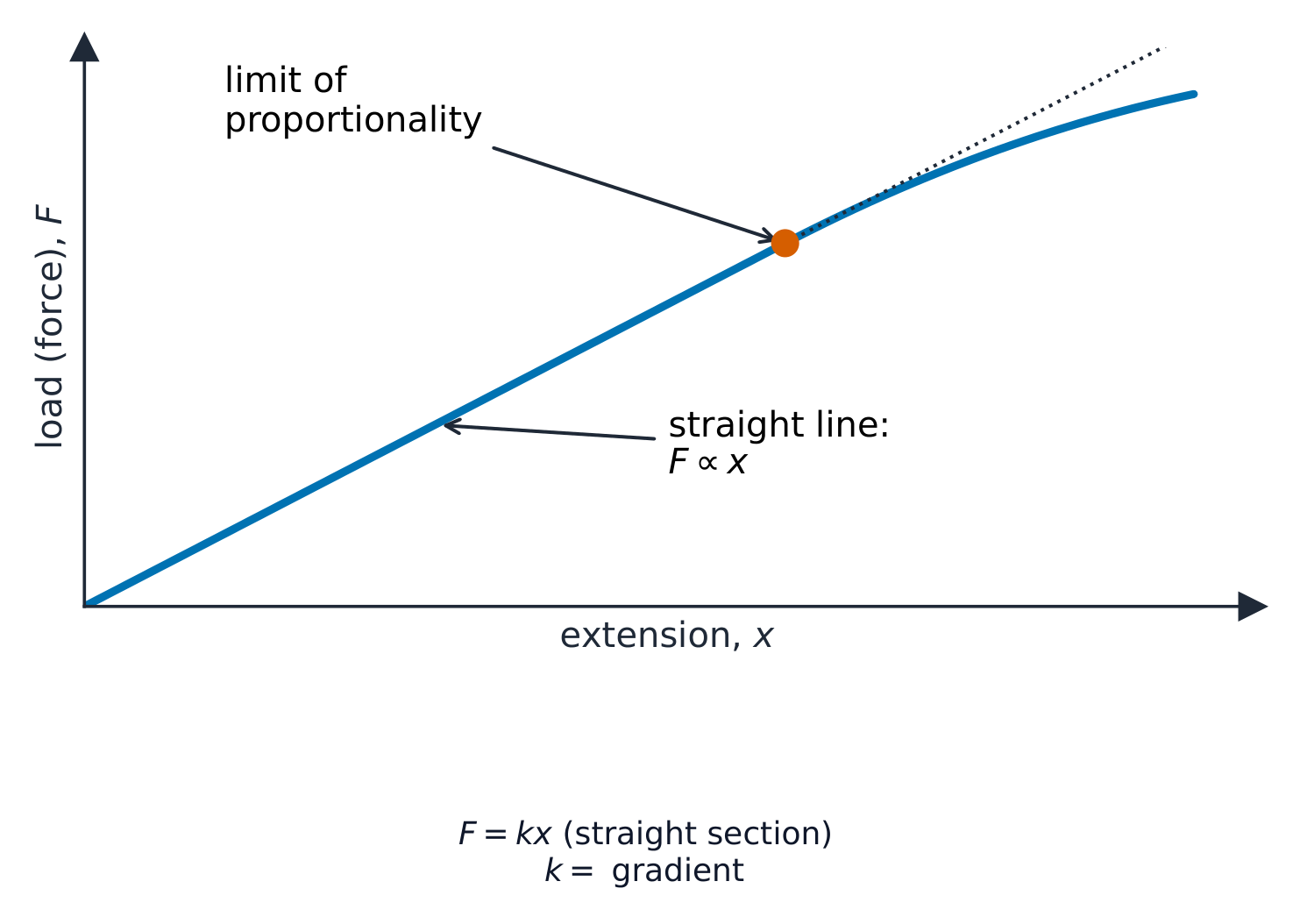
An ideal spring exerts a restoring force 回复力 proportional to its stretch or compression – Hooke's law 胡克定律:

$$F_s=-kx,$$
where $k$ is the spring constant 弹簧常数 (stiffness) and $x$ is the displacement from the spring's natural length. The minus sign means the force points back toward equilibrium.

Hooke's law: extension is proportional to load up to the limit of proportionality Hooke's law: extension is proportional to load up to the limit of proportionality

Worked example. A spring with $k=200\ \text{N/m}$ hangs vertically and a $0.50\ \text{kg}$ mass is hung on it. How far does it stretch at rest? At rest the spring force balances the weight, $kx=mg$, so

$$x=\frac{mg}{k}=\frac{0.50\times9.8}{200}=0.025\ \text{m}=2.5\ \text{cm}.$$

Explore

Stretch a spring (Hooke's law)

A spring's force is proportional to its extension, $F=kx$ (Hooke's law). Pull harder and the extension grows in step — until the spring's limit.

Vocabulary Train
English Chinese Pinyin
restoring force 回复力 huí fù lì
Hooke's law 胡克定律 hú kè dìng lǜ
spring constant 弹簧常数 tán huáng cháng shù
Exercise sheet
2.9

Circular Motion

Syllabus
Learning ObjectiveEssential Knowledge

2.9.A
Describe the motion of an object traveling in a circular path.

  • 2.9.A.1 Centripetal acceleration is the component of an object's acceleration directed toward the center of the object's circular path.
    • 2.9.A.1.i The magnitude of centripetal acceleration for an object moving in a circular path is the ratio of the object's tangential speed squared to the radius of the circular path.
      • Equation: $a_c = \dfrac{v^2}{r}$
    • 2.9.A.1.ii Centripetal acceleration is directed toward the center of an object's circular path.
  • 2.9.A.2 Centripetal acceleration can result from a single force, more than one force, or components of forces exerted on an object in circular motion.
    • 2.9.A.2.i At the top of a vertical, circular loop, an object requires a minimum speed to maintain circular motion. At this point, and with this minimum speed, the gravitational force is the only force that causes the centripetal acceleration.
      • Equation: $v = \sqrt{gr}$
    • 2.9.A.2.ii Components of the static friction force and the normal force can contribute to the net force producing centripetal acceleration of an object traveling in a circle on a banked surface.
    • 2.9.A.2.iii A component of tension contributes to the net force producing centripetal acceleration experienced by a conical pendulum.
  • 2.9.A.3 Tangential acceleration is the rate at which an object's speed changes and is directed tangent to the object's circular path.
  • 2.9.A.4 The net acceleration of an object moving in a circle is the vector sum of the centripetal acceleration and tangential acceleration.
  • 2.9.A.5 The revolution of an object traveling in a circular path at a constant speed (uniform circular motion) can be described using period and frequency.
    • 2.9.A.5.i The time to complete one full circular path, one full rotation, or a full cycle of oscillatory motion is defined as period, $T$.
    • 2.9.A.5.ii The rate at which an object is completing revolutions is defined as frequency, $f$.
      • Equation: $T = \dfrac{1}{f}$
    • 2.9.A.5.iii For an object traveling at a constant speed in a circular path, the period is given by the derived equation
      • Equation: $T = \dfrac{2\pi r}{v}$

2.9.B
Describe circular orbits using Kepler's third law.

  • 2.9.B.1 For a satellite in circular orbit around a central body, the satellite's centripetal acceleration is caused only by gravitational attraction. The period and radius of the circular orbit are related to the mass of the central body.
    • Equation: $T^2 = \dfrac{4\pi^2}{GM} R^3$

Boundary statement: AP Physics 1 only expects students to quantitatively analyze banked curves in which no friction is required to maintain uniform circular motion. Analysis of situations in which friction is required on a banked curve is limited to qualitative descriptions.

Boundary statement: AP Physics 1 does not expect students to know Kepler's first or second laws of planetary motion.

Source: College Board AP Course and Exam Description

Uniform circular motion

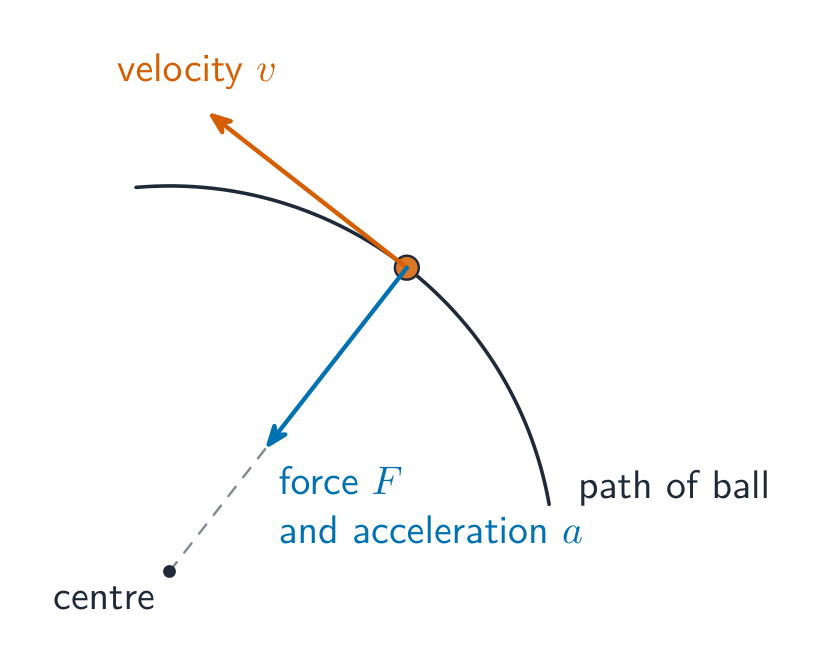
An object moving in a circle at constant speed still accelerates, because its velocity direction keeps changing. This centripetal acceleration 向心加速度 points toward the center:

$$a_c=\frac{v^2}{r}.$$
It is produced by a net inward (centripetal) force 向心力 $F_c=\dfrac{mv^2}{r}$ – supplied by whatever real force points inward (tension, gravity, friction, normal). The time for one full revolution is the period 周期 $T$, and the number of revolutions per second is the frequency 频率 $f$; they are reciprocals, $f = 1/T$, and the same definitions describe any rotation or oscillation.There is no separate outward force; "centrifugal" is only an apparent effect.

The velocity points along the tangent; the centripetal force and acceleration point to the centre The velocity points along the tangent; the centripetal force and acceleration point to the centre

Worked example. A $0.30\ \text{kg}$ ball on a string is whirled in a horizontal circle of radius $0.80\ \text{m}$ at $4.0\ \text{m/s}$. Find the tension in the string. The tension supplies the whole centripetal force:

$$T=\frac{mv^2}{r}=\frac{0.30\times4.0^2}{0.80}=6.0\ \text{N}.$$
If the string can take at most $6.0\ \text{N}$, this is the fastest the ball can go at that radius – spin any faster and the string breaks.

Vocabulary Train
English Chinese Pinyin
centripetal acceleration 向心加速度 xiàng xīn jiā sù dù
net inward (centripetal) force 向心力 xiàng xīn lì
period 周期 zhōu qī
frequency 频率 pín lǜ
2.9

Exam tips

  • Always draw a free-body diagram first: only real forces on the chosen object (weight, normal, tension, friction, applied) — never an "$ma$" arrow.
  • Apply $\sum F = ma$ one axis at a time; on an incline resolve gravity into $mg\sin\theta$ (along) and $mg\cos\theta$ (perpendicular).
  • A Newton's third-law pair acts on two different objects — a book's weight and the table's normal force are not a pair (both act on the book).
  • Static friction adjusts up to $\mu_s N$ (use it to test whether motion starts); once sliding, use kinetic friction $f_k=\mu_k N$.
  • Circular motion needs a net inward (centripetal) force $mv^2/r$ supplied by a real force — there is no outward "centrifugal" force.

Log in or create account

IGCSE & A-Level