| Learning Objective | Essential Knowledge |
|---|---|
1.1.A |
|
1.1.B |
|
Kinematics
AP Physics 1 · Topic 1
 9:04
9:04
Kinematics
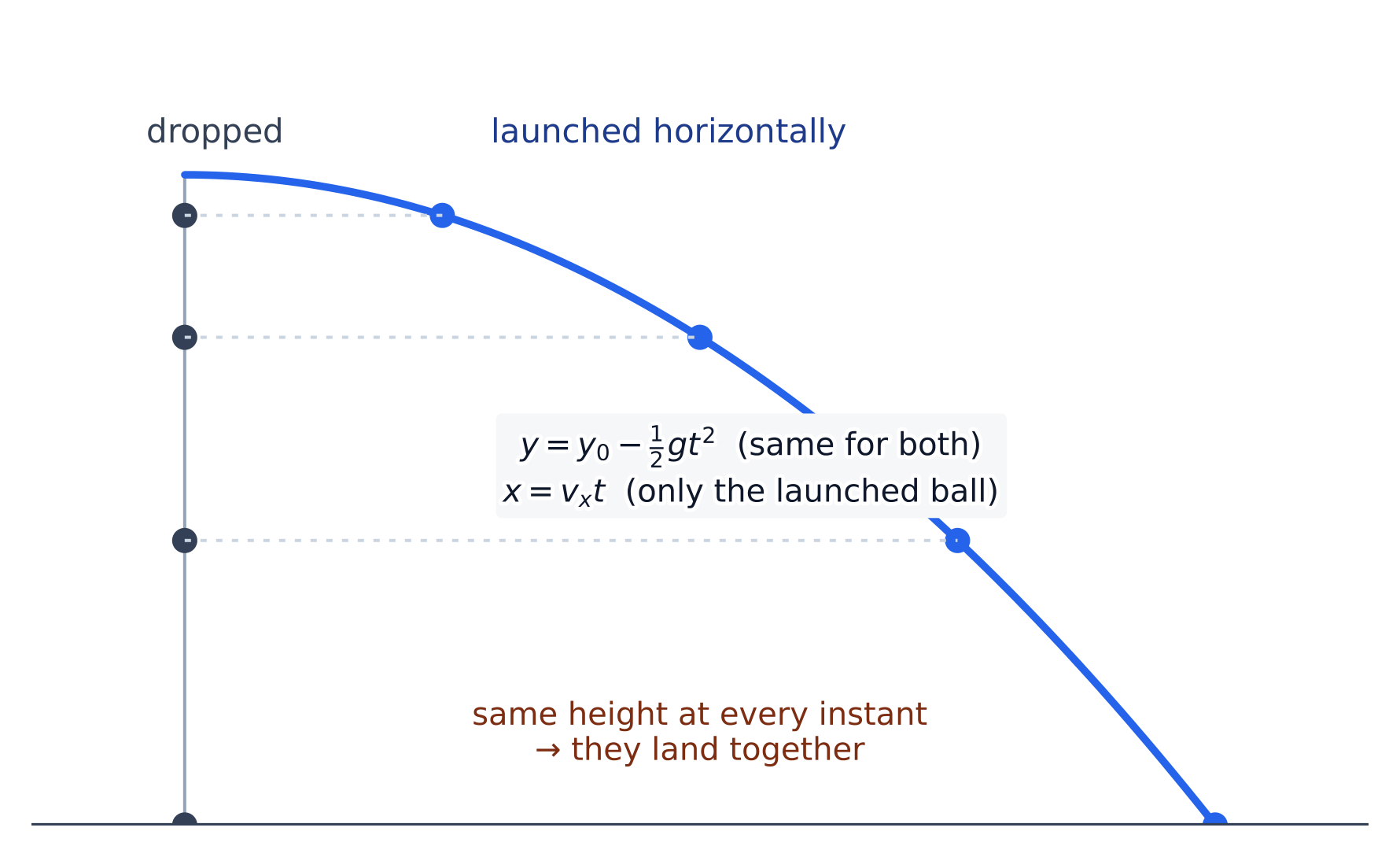
Two balls leave a table at the same moment. One is simply dropped. The other is fired sideways, hard. Which one hits the floor first? <slow>They land…
English narration · English + 中文 subtitles burned in
1.1
Scalars and Vectors in One Dimension
Syllabus
Source: College Board AP Course and Exam Description
Kinematics 运动学 describes how objects move, without asking why. First, two kinds of quantity:
- A scalar 标量 has only size (magnitude 大小): distance 距离, speed, time, mass.
- A vector 矢量 has magnitude and direction: displacement, velocity, acceleration, force.
The difference matters. Distance is the total path length travelled – a scalar that only grows. Displacement is the straight-line change in position, with a direction. Walk $3\ \text{m}$ east then $1\ \text{m}$ back west: the distance is $4\ \text{m}$, but the displacement is only $2\ \text{m}$ east.
In one dimension, direction is just a sign (+ or −) along a chosen axis. Choosing the positive direction first is essential – every vector's sign depends on it. A velocity of $-5\ \text{m/s}$ does not mean "slow"; it means $5\ \text{m/s}$ in the negative direction.
Vocabulary
Train
| English |
|---|
| Kinematics/ˌkɪnɪˈmætɪks/ |
| scalar/ˈskeɪlə/ |
| magnitude/ˈmæɡnɪtjuːd/ |
| vector/ˈvektə/ |
| distance/ˈdɪstəns/ |
1.2
Displacement, Velocity, and Acceleration
Syllabus
| Learning Objective | Essential Knowledge |
|---|---|
1.2.A |
|
1.2.B |
|
1.2.B |
|
Source: College Board AP Course and Exam Description
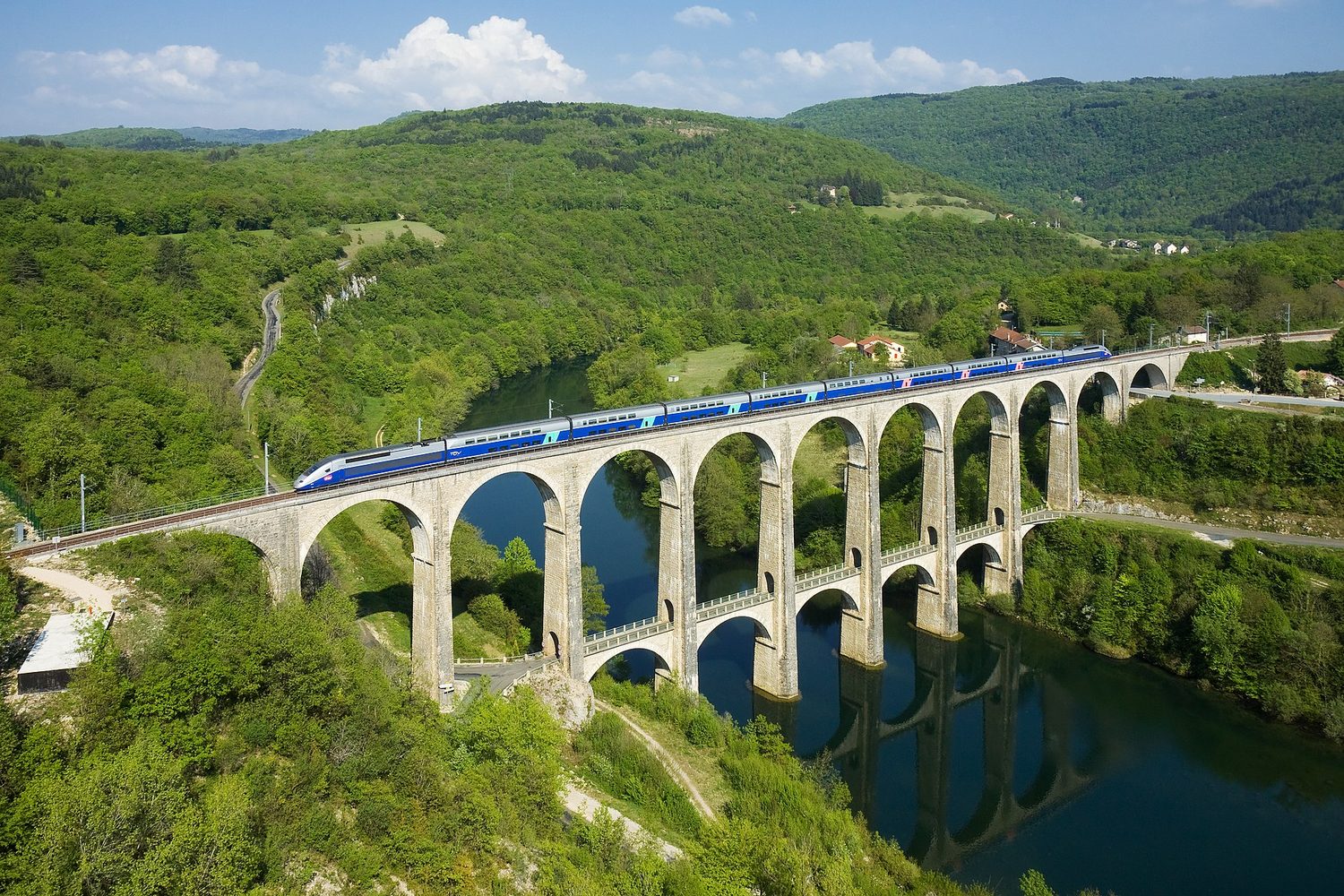
Three linked vectors describe motion along a line:
- Displacement 位移 $\Delta x$ is the change in position – a vector from start to end (not the total path length, which is distance).
- Velocity 速度 is the rate of change of position, $v=\dfrac{\Delta x}{\Delta t}$. Its sign gives direction; its magnitude is speed 速率.
- Acceleration 加速度 is the rate of change of velocity, $a=\dfrac{\Delta v}{\Delta t}$.
Be careful to separate average velocity 平均速度 (total displacement over total time) from instantaneous velocity 瞬时速度 (the velocity at one instant, the slope of the position–time graph at that point). They are equal only when the velocity is constant.
An object speeds up when $v$ and $a$ have the same sign, and slows down (deceleration 减速) when they have opposite signs. Note that a negative acceleration does not always mean slowing down – a ball falling faster and faster has negative velocity and negative acceleration.
For constant acceleration, the four kinematic equations (often called SUVAT) apply:
$$v=v_0+at,\qquad \Delta x=v_0 t+\tfrac{1}{2}at^2,\qquad v^2=v_0^2+2a\,\Delta x,\qquad \Delta x=\tfrac{1}{2}(v_0+v)\,t.$$
Pick the equation that contains the three quantities you know plus the one you want, so only one unknown is left. They apply only while $a$ is constant.
Worked example. A car starts from rest and accelerates uniformly at $2.0\ \text{m/s}^2$ for $6.0\ \text{s}$. Find its final velocity and the distance it travels.
List what you know: $v_0=0$, $a=2.0\ \text{m/s}^2$, $t=6.0\ \text{s}$.
$$v=v_0+at=0+2.0\times 6.0=12\ \text{m/s},$$
$$\Delta x=v_0 t+\tfrac12 at^2=0+\tfrac12\times 2.0\times 6.0^2=36\ \text{m}.$$
Worked example (free fall). A ball is thrown straight up at $15\ \text{m/s}$. Taking $g=9.8\ \text{m/s}^2$ and up as positive, how high does it rise, and how long is it in the air before returning to the thrower's hand?
At the highest point the velocity is momentarily zero, and $a=-g=-9.8\ \text{m/s}^2$ throughout (this is free fall 自由落体, ignoring air resistance 空气阻力):
$$v^2=v_0^2+2a\,\Delta x \;\Rightarrow\; 0=15^2+2(-9.8)\Delta x \;\Rightarrow\; \Delta x=\frac{225}{19.6}=11.5\ \text{m}.$$
Time to the top: $0=15-9.8\,t \Rightarrow t=1.53\ \text{s}$. By symmetry the fall takes the same time, so the total is $3.1\ \text{s}$.
Vocabulary
Train
| English |
|---|
| Displacement/dɪˈspleɪsmənt/ |
| Velocity/vəˈlɒsɪti/ |
| speed/spiːd/ |
| Acceleration/əkˌseləˈreɪʃn/ |
| average velocity/ˈævrɪdʒ vəˈlɒsɪti/ |
| instantaneous velocity/ˌɪnstənˈteɪnɪəs vəˈlɒsɪti/ |
| deceleration/dɪˌseləˈreɪʃn/ |
| free fall/friː fɔːl/ |
| air resistance/eə rɪˈzɪstəns/ |
1.3
Representing Motion
Syllabus
| Learning Objective | Essential Knowledge |
|---|---|
1.3.A |
Boundary statement: AP Physics 1 does not expect students to quantitatively analyze nonuniform acceleration. However, students will be expected to be able to qualitatively analyze, sketch appropriate graphs of, and discuss situations in which acceleration is nonuniform. Boundary statement: For all situations in which a numerical quantity is required for $g$, the value $g \approx 10 \ m/s^2$ will be used. However, students will not be penalized for correctly using the more precise commonly accepted values of $g = 9.81 \ \text{m/s}^2$ or $g = 9.8 \ \text{m/s}^2$. |
Source: College Board AP Course and Exam Description
The same motion appears as a description, a graph, a table, or an equation, and you should move between them:
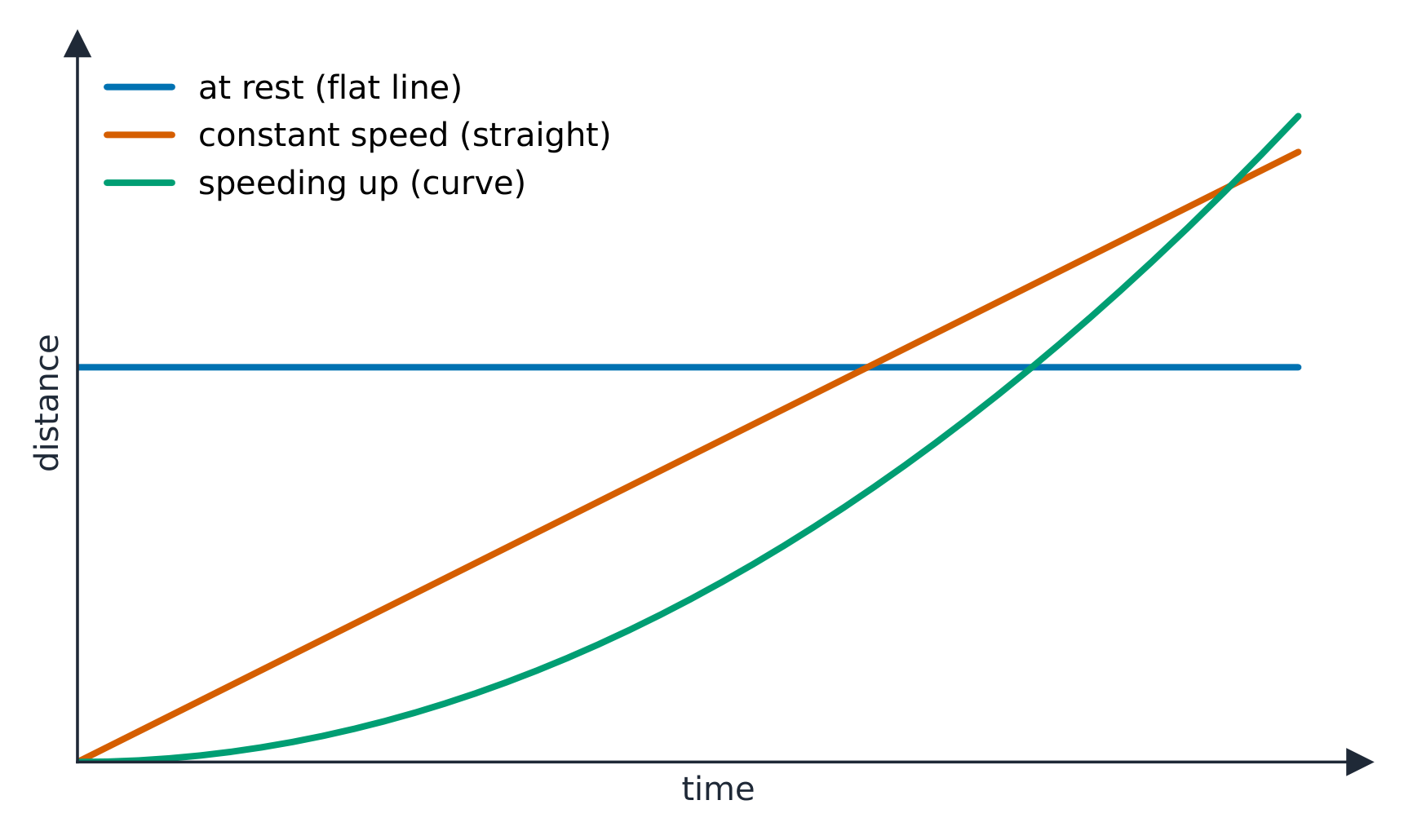
- On a position–time graph, the slope is velocity (steeper = faster; a curve = changing velocity).
- On a velocity–time graph, the slope is acceleration, and the area under the line is displacement.
Reading slopes and areas off graphs is a core exam skill. To get displacement from a velocity–time graph, split the area into triangles and rectangles and add them up; area below the time axis counts as negative displacement (motion the other way).
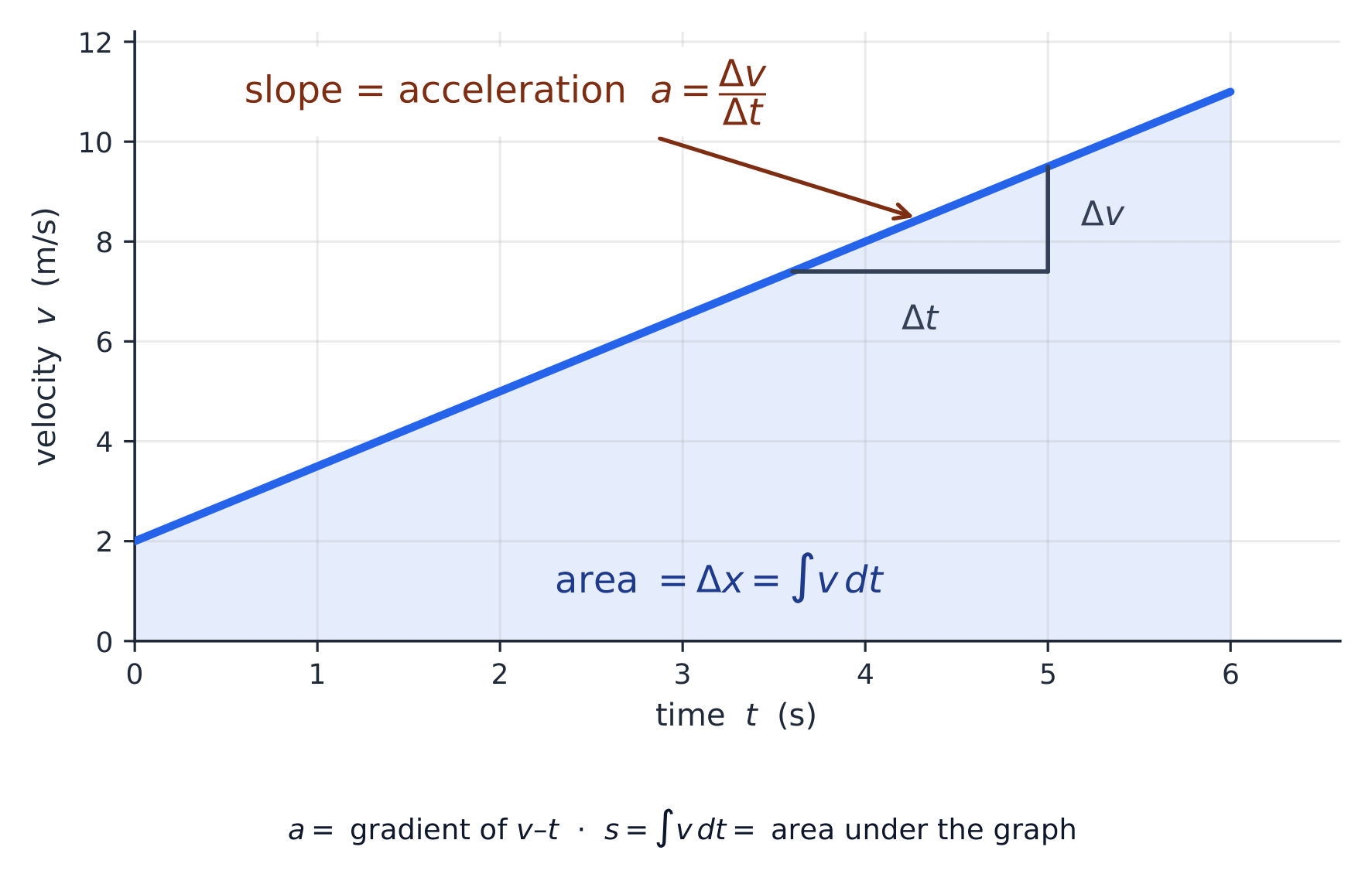
Worked example. A cyclist speeds up uniformly from rest to $8.0\ \text{m/s}$ in $4.0\ \text{s}$, then holds $8.0\ \text{m/s}$ for $6.0\ \text{s}$. Find the total distance from the velocity–time graph.
The area is a triangle followed by a rectangle:
$$\Delta x=\underbrace{\tfrac12\times 4.0\times 8.0}_{\text{triangle}}+\underbrace{6.0\times 8.0}_{\text{rectangle}}=16+48=64\ \text{m}.$$
Explore
Explore the velocity–time graph
Change the start velocity $u$ and the acceleration $a$. The gradient (slope) of the line is the acceleration; the area between the line and the time axis is the displacement.
1.4
Reference Frames and Relative Motion
Syllabus
| Learning Objective | Essential Knowledge |
|---|---|
1.4.A |
|
1.4.B |
Boundary statement: Unless otherwise stated, the frame of reference of any problem may be assumed to be inertial. Boundary statement: Adding or subtracting vectors to find relative velocities is restricted to motion along one dimension for AP Physics 1. |
Source: College Board AP Course and Exam Description
All motion is measured against a reference frame 参考系. Velocities measured in different frames differ, and you combine them by vector addition. The velocity of A relative to C is
$$\vec{v}_{A/C}=\vec{v}_{A/B}+\vec{v}_{B/C}.$$
A person walking on a moving train has one velocity relative to the train and another relative to the ground – this is relative motion 相对运动. A useful shortcut: the velocity of A relative to B is $\vec{v}_{A/B}=\vec{v}_A-\vec{v}_B$ (subtract B's velocity).
A frame that is not accelerating is an inertial reference frame 惯性参考系: one in which a free object (no net force) obeys Newton's first law, staying at rest or moving at constant velocity. A frame that accelerates – a braking car – is non-inertial, where objects seem to speed up with no force acting on them.
Worked example. A boat points straight across a river and moves at $3.0\ \text{m/s}$ relative to the water. The current flows at $4.0\ \text{m/s}$ along the river. Find the boat's speed and direction relative to the bank.
The two velocities are perpendicular, so add them as a right triangle:
$$v=\sqrt{3.0^2+4.0^2}=5.0\ \text{m/s},\qquad \theta=\tan^{-1}\!\frac{4.0}{3.0}=53^{\circ}\ \text{downstream from straight across.}$$
Vocabulary
Train
| English |
|---|
| reference frame/ˈrefrəns freɪm/ |
| relative motion/ˈrelətɪv ˈməʊʃn/ |
| inertial reference frame/ɪˈnɜːʃl ˈrefrəns freɪm/ |
1.5
Vectors and Motion in Two Dimensions
Syllabus
| Learning Objective | Essential Knowledge |
|---|---|
1.5.A |
|
1.5.B |
|
Source: College Board AP Course and Exam Description
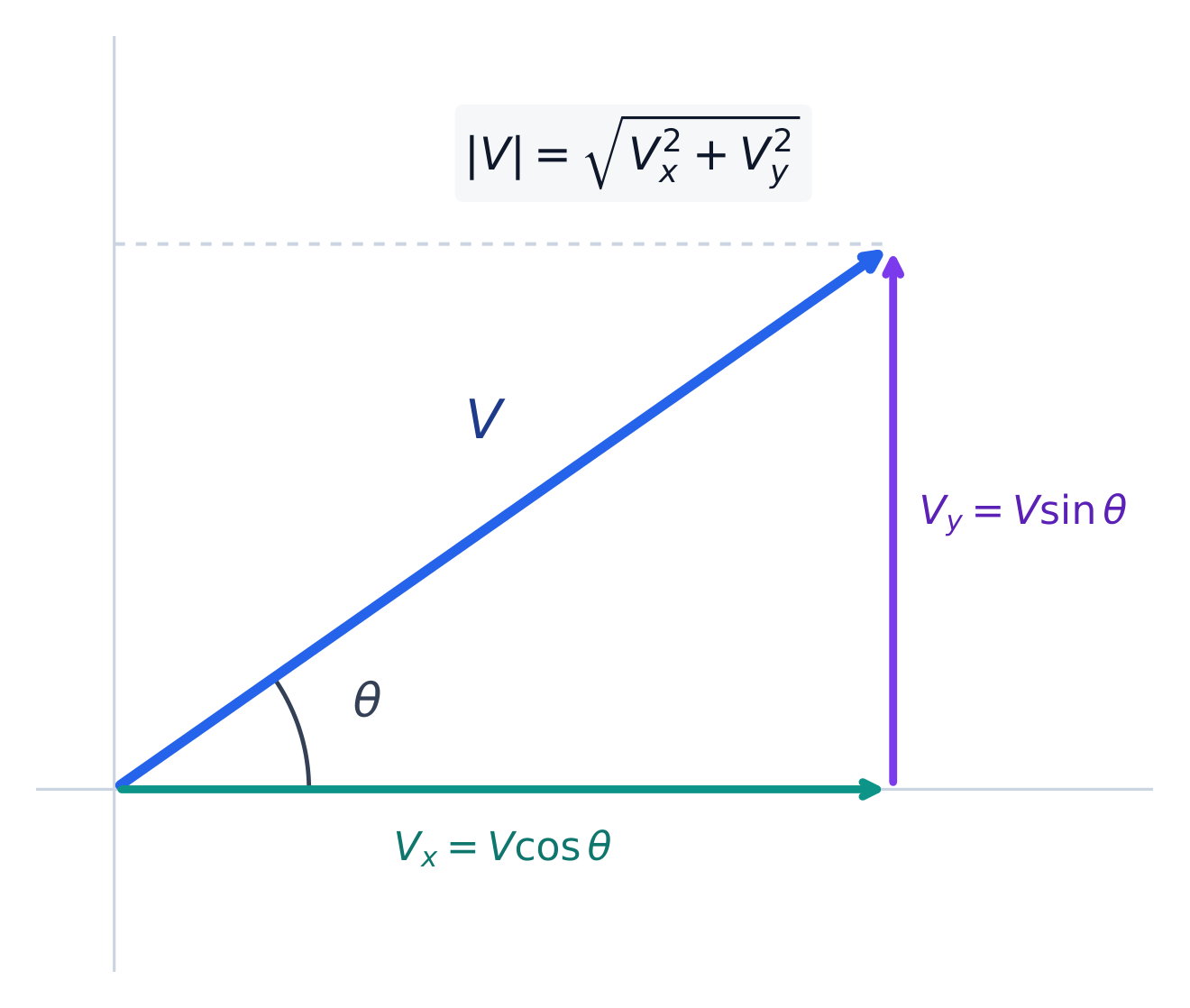
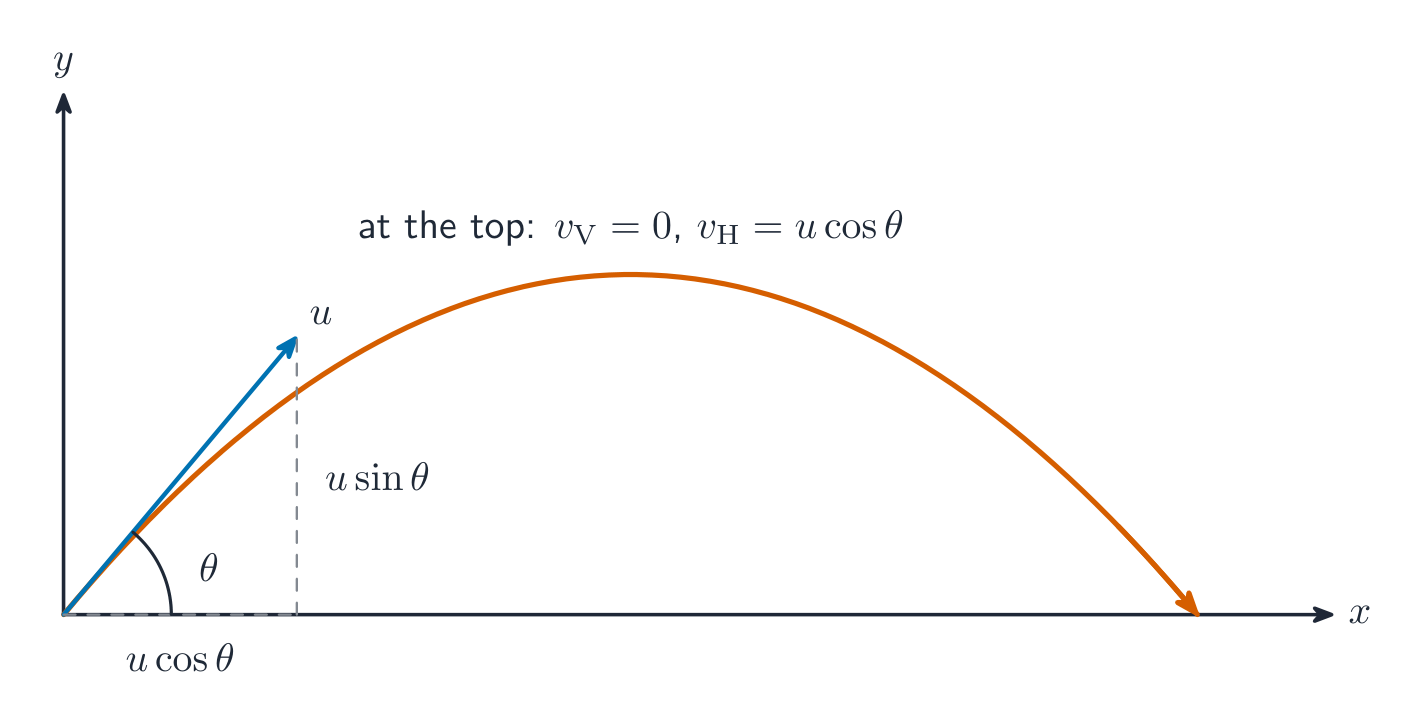
In two dimensions, resolve each vector into components 分量 along perpendicular axes ($x$ and $y$), handle each axis separately, then recombine. A velocity $v$ at angle $\theta$ to the horizontal has components $v_x=v\cos\theta$ and $v_y=v\sin\theta$.
For projectile motion 抛体运动 (an object moving under gravity alone): the horizontal and vertical motions are independent. Horizontally, velocity is constant ($a_x=0$); vertically, acceleration is $-g$ (down). The two motions share only the time. So a projectile's path (its trajectory 轨迹) is a parabola, and you solve it as two one-dimensional problems joined by $t$.
Worked example. A ball is kicked at $20\ \text{m/s}$, $30^{\circ}$ above the horizontal. Taking $g=9.8\ \text{m/s}^2$, find the time of flight, the maximum height, and the horizontal range 射程 (assume it lands at launch height).
Split the launch velocity into components:
$$v_{0x}=20\cos 30^{\circ}=17.3\ \text{m/s},\qquad v_{0y}=20\sin 30^{\circ}=10\ \text{m/s}.$$
Vertical motion sets the time. At the top $v_y=0$, so $0=10-9.8\,t \Rightarrow t_{\text{up}}=1.02\ \text{s}$, and the total flight is $2t_{\text{up}}=2.0\ \text{s}$. The maximum height is
$$\Delta y=\frac{v_{0y}^2}{2g}=\frac{10^2}{19.6}=5.1\ \text{m}.$$
Horizontal motion runs at constant $v_{0x}$ for the whole flight, so the range is
$$R=v_{0x}\times t_{\text{flight}}=17.3\times 2.0=35\ \text{m}.$$
A common trap: at the top of the flight the vertical velocity is zero, but the ball is not at rest – its horizontal velocity $v_{0x}$ never changes. The speed at the top equals $v_{0x}=17.3\ \text{m/s}$.
Explore
Explore projectile motion
Fire the ball, then change the angle and speed. The horizontal motion stays steady while gravity pulls it down — together they trace a parabola. Find the launch angle that gives the longest range, and try the Moon.
Explore
Explore vectors and their components
Drag the vectors to change their $x$- and $y$-components. See how a single vector is built from independent horizontal and vertical parts, and how two vectors add tip-to-tail into a resultant.
Vocabulary
Train
| English |
|---|
| components/kəmˈpəʊnənts/ |
| projectile motion/prəˈdʒektaɪl ˈməʊʃn/ |
| trajectory/trəˈdʒektəri/ |
| range/reɪndʒ/ |
1.5
Exam tips
- Choose the right kinematic equation by listing the three quantities you know plus the one you want, so only one unknown remains; the SUVAT equations apply only while acceleration is constant.
- Fix a positive direction first — every displacement, velocity, and acceleration then carries a sign; a negative velocity means "moving the other way", not "slow".
- Treat a projectile as two independent 1-D problems sharing only the time $t$: constant velocity horizontally, $a=-g$ vertically. At the top $v_y=0$ but $v_x$ is unchanged.
- On a velocity–time graph the gradient is the acceleration and the area is the displacement (area below the axis is negative).
- Distinguish distance (scalar, total path) from displacement (vector, start-to-end), and speed from velocity.
Interactive lessons on this topic
Work through it step by step, with instant-check exercises.