| Learning Objective | Essential Knowledge |
|---|---|
7.1.A |
|
Oscillations
AP Physics 1 · Topic 7
 7:48
7:48
Oscillations
Two identical springs, two identical masses. Pull one of them far down. Pull the other only a little. Let go of both at the same moment. Which one gets back…
English narration · English + 中文 subtitles burned in
7.1
Defining Simple Harmonic Motion
Syllabus
Source: College Board AP Course and Exam Description
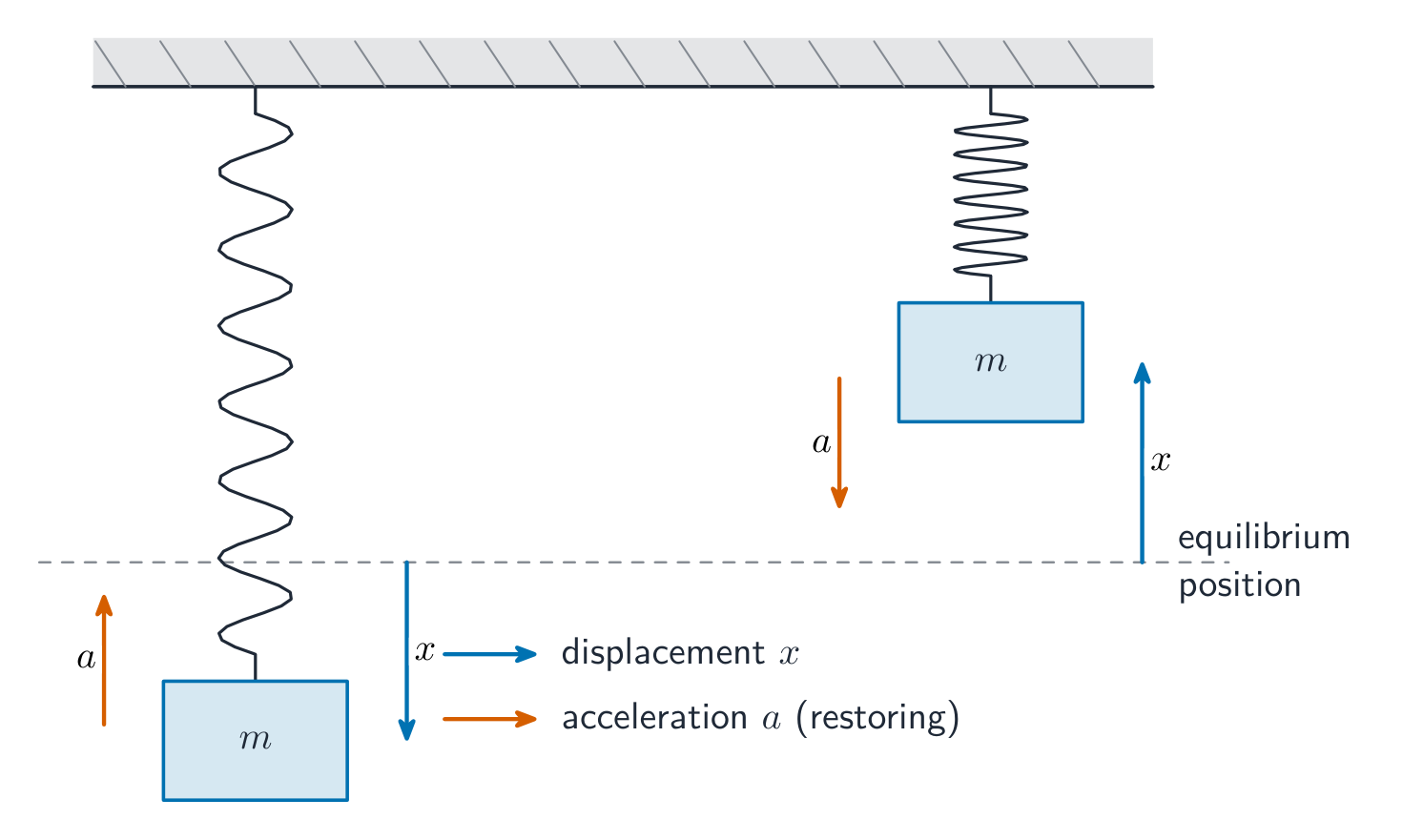
Simple harmonic motion 简谐运动 (SHM) is a back-and-forth oscillation 振动 caused by a restoring force 回复力 that is proportional to the displacement from equilibrium and always points back toward it: $F=-kx$. A mass on a spring and (for small angles) a pendulum are the standard examples. Because the force grows with displacement, the motion is smooth and repeating, tracing a sine curve in time.
The test for SHM is exactly this: acceleration proportional to displacement and opposite in direction, $a=-\dfrac{k}{m}x$. A pendulum only obeys it for small swings, where $\sin\theta\approx\theta$; large swings are not quite SHM.
Vocabulary
Train
| English |
|---|
| Simple harmonic motion/ˈsɪmpl hɑːˈmɒnɪk ˈməʊʃn/ |
| oscillation/ˌɒsɪˈleɪʃn/ |
| restoring force/rɪˈstɔːrɪŋ fɔːs/ |
7.2
Frequency and Period of SHM
Syllabus
| Learning Objective | Essential Knowledge |
|---|---|
7.2.A |
|
Source: College Board AP Course and Exam Description
- The period 周期 $T$ is the time for one full cycle.
- The frequency 频率 $f=\dfrac{1}{T}$ is cycles per second (hertz).
For SHM these depend only on the system, not on the amplitude:
$$T_{\text{spring}}=2\pi\sqrt{\frac{m}{k}},\qquad T_{\text{pendulum}}=2\pi\sqrt{\frac{L}{g}}.$$
So a stiffer spring or smaller mass oscillates faster; a longer pendulum swings slower.
Worked example. A $0.25\ \text{kg}$ mass hangs on a spring of stiffness $k=100\ \text{N/m}$. Its period is
$$T=2\pi\sqrt{\frac{m}{k}}=2\pi\sqrt{\frac{0.25}{100}}=0.31\ \text{s},\qquad f=\frac{1}{T}=3.2\ \text{Hz}.$$
Worked example. A pendulum clock ticks with a period of exactly $2.0\ \text{s}$. How long is it? Rearranging $T=2\pi\sqrt{L/g}$,
$$L=g\left(\frac{T}{2\pi}\right)^2=9.8\times\left(\frac{2.0}{2\pi}\right)^2=0.99\ \text{m}.$$
Notice the amplitude never entered – a wide or narrow swing keeps the same time, which is what makes pendulums good clocks.
Explore
Time a pendulum's swing
A pendulum's period depends on its length and gravity, not its mass or (small) amplitude: $T=2\pi\sqrt{L/g}$. Lengthen it and each swing takes longer.
Vocabulary
Train
| English |
|---|
| period/ˈpɪərɪəd/ |
| frequency/ˈfriːkwənsi/ |
7.3
Representing and Analyzing SHM
Syllabus
| Learning Objective | Essential Knowledge |
|---|---|
7.3.A |
|
Source: College Board AP Course and Exam Description
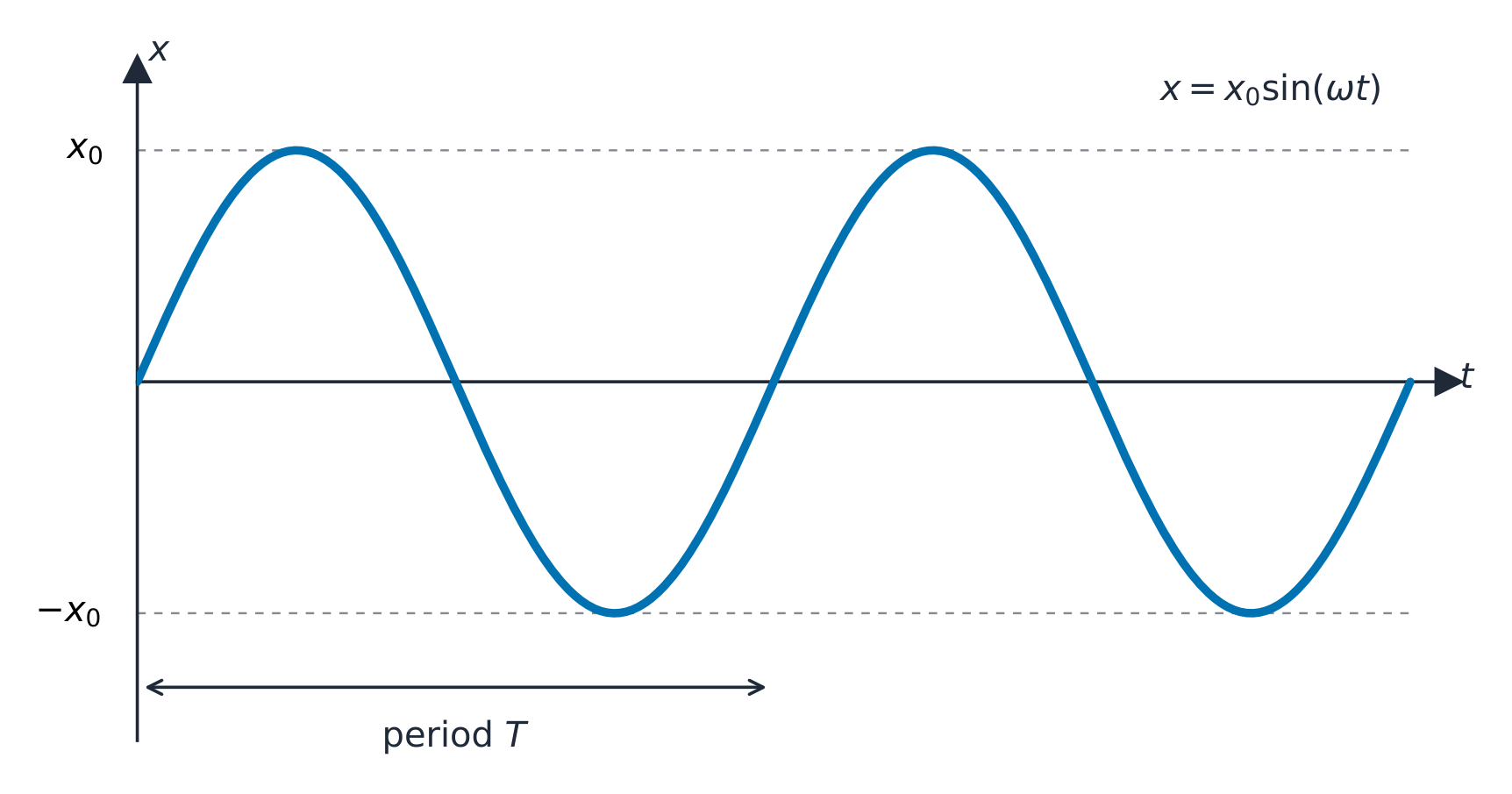
The displacement varies sinusoidally: $x(t)=A\cos(\omega t)$ (or sine), where $A$ is the amplitude 振幅 (maximum displacement) and $\omega=2\pi f$ is the angular frequency 角频率. Reading the motion:
- At the extremes ($x=\pm A$): displacement and restoring force are maximum, so acceleration is maximum, but velocity is zero.
- At equilibrium 平衡 ($x=0$): force and acceleration are zero, but speed is maximum.
Velocity and acceleration are also sinusoidal, shifted in phase 相位 from the displacement – velocity leads displacement by a quarter cycle, and acceleration is exactly opposite to displacement.
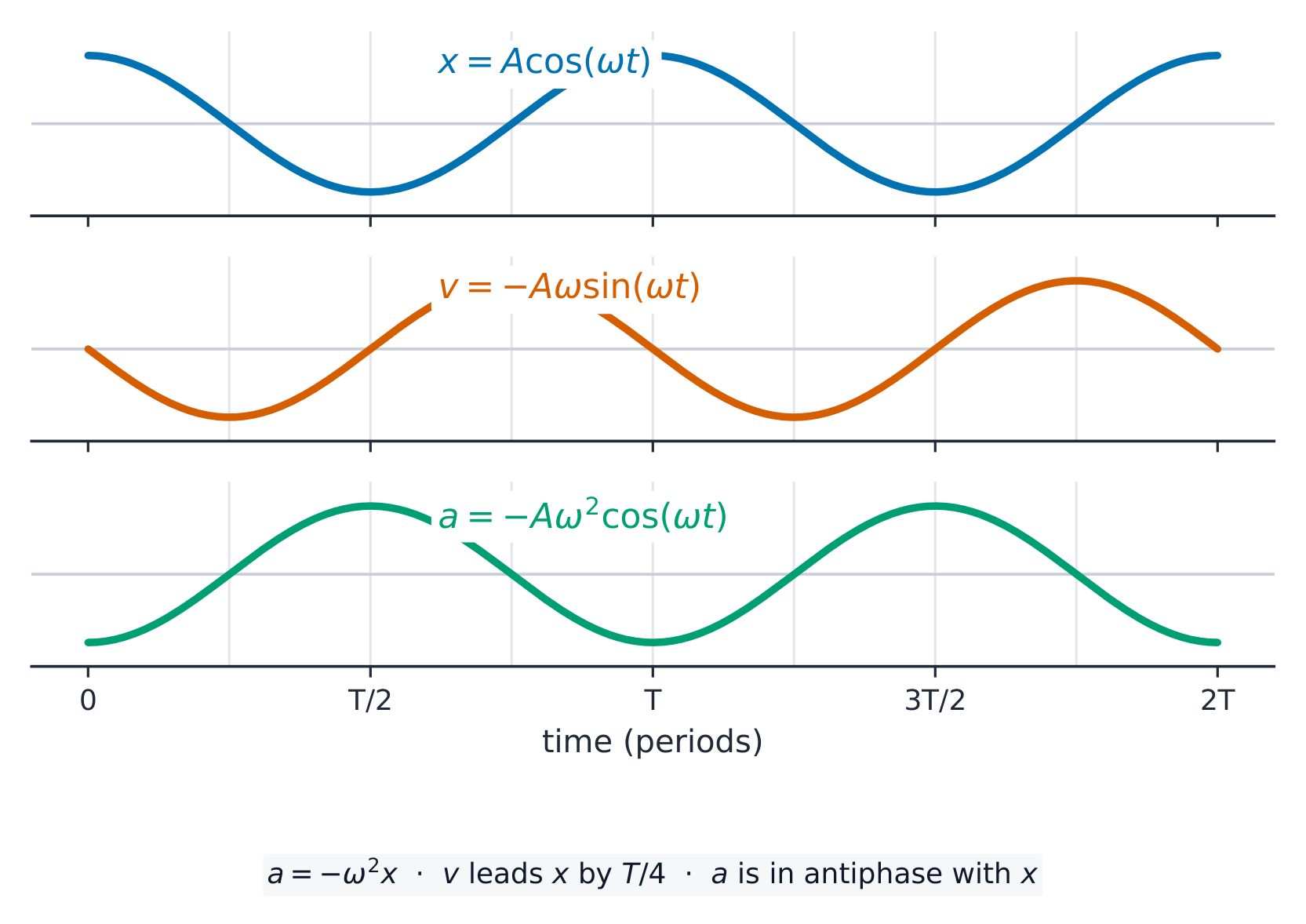
Read the figure as a story: where $x$ is largest (the turning point), $v$ has just fallen to zero and $a$ is at its most negative, hauling the mass back; a quarter-cycle later the mass races through the middle at top speed with zero acceleration.
Vocabulary
Train
| English |
|---|
| amplitude/ˈæmplɪtjuːd/ |
| angular frequency/ˈæŋɡjʊlə ˈfriːkwənsi/ |
| phase/feɪz/ |
| equilibrium/ˌiːkwɪˈlɪbrɪəm/ |
7.4
Energy of Simple Harmonic Oscillators
Syllabus
| Learning Objective | Essential Knowledge |
|---|---|
7.4.A |
|
Source: College Board AP Course and Exam Description
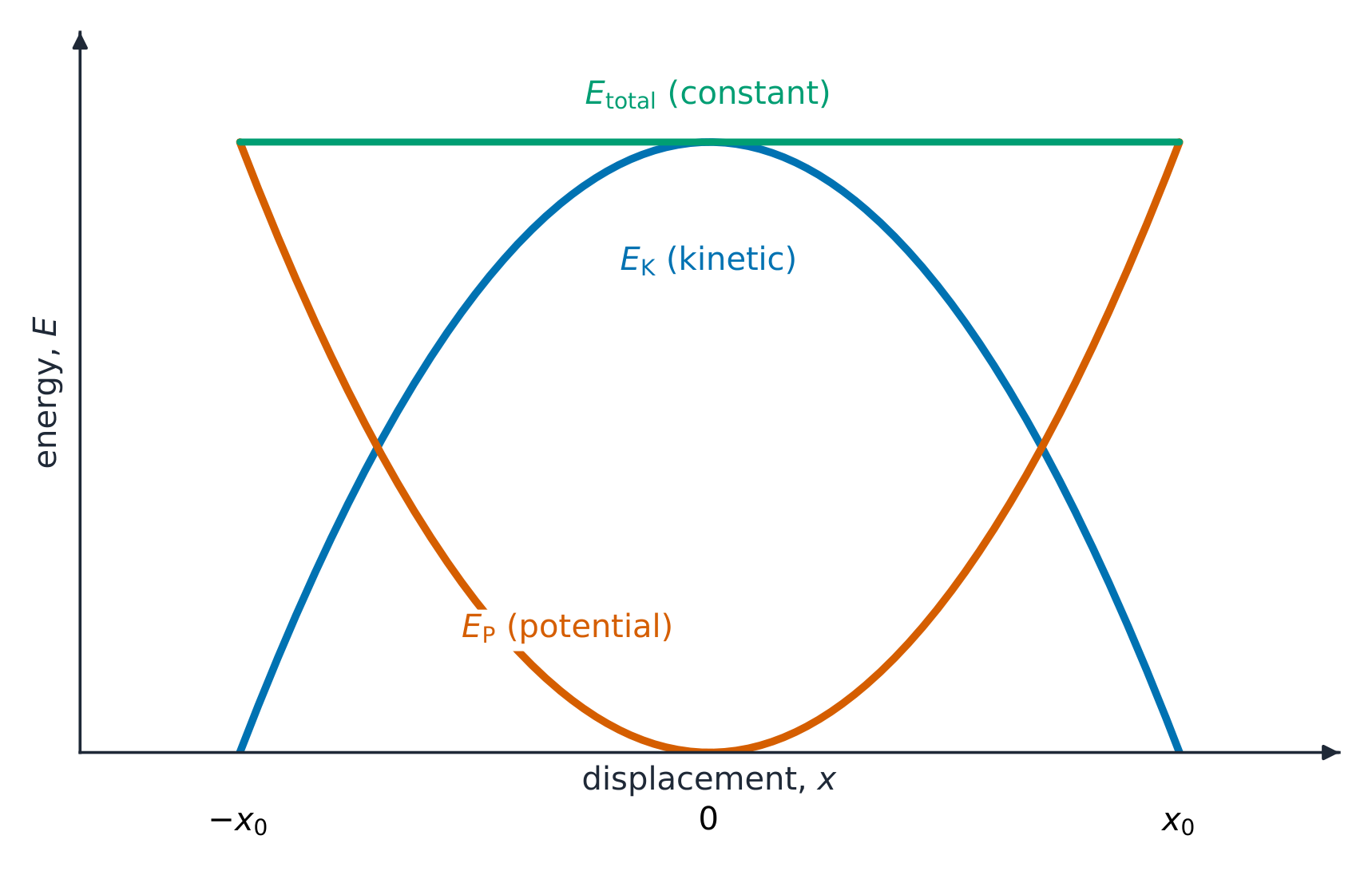
Energy sloshes between kinetic and potential while the total stays constant (no friction):
$$E=\tfrac{1}{2}kA^2 = \tfrac{1}{2}kx^2+\tfrac{1}{2}mv^2.$$
At the extremes it is all potential; at equilibrium it is all kinetic (maximum speed). Because $E\propto A^2$, doubling the amplitude quadruples the energy.
Worked example. A $0.50\ \text{kg}$ mass on a spring of stiffness $k=200\ \text{N/m}$ oscillates with amplitude $A=0.10\ \text{m}$. Find its maximum speed. All the energy is kinetic at the equilibrium point, so $\tfrac12 kA^2=\tfrac12 mv_{\max}^2$:
$$v_{\max}=A\sqrt{\frac{k}{m}}=0.10\times\sqrt{\frac{200}{0.50}}=0.10\times20=2.0\ \text{m/s}.$$
The energy method is faster than tracking the sine functions when you only need the greatest speed.
Explore
Trade kinetic and potential energy in SHM
In simple harmonic motion, energy sloshes between kinetic (fastest at the centre) and potential (greatest at the extremes) while the total stays constant.
7.4
Exam tips
- Test for SHM: the acceleration must be proportional to the displacement and directed back toward the middle ($a=-\tfrac{k}{m}x$).
- The period does not depend on amplitude — use $T=2\pi\sqrt{m/k}$ (spring) or $T=2\pi\sqrt{L/g}$ (pendulum, small angles).
- Speed is maximum at the middle (all kinetic) and zero at the extremes (all potential); acceleration is largest at the extremes.
- Use energy ($\tfrac12 kA^2 = \tfrac12 kx^2 + \tfrac12 mv^2$) to find the maximum speed quickly: $v_{\max}=A\sqrt{k/m}$.
- Total energy $\propto A^2$, so doubling the amplitude quadruples the energy.
Interactive lessons on this topic
Work through it step by step, with instant-check exercises.