| Learning Objective | Essential Knowledge |
|---|---|
8.1.A |
|
Fluids
AP Physics 1 · Topic 8
 8:06
8:06
Fluids
A steel nail dropped into water goes straight to the bottom. Now look at this ship. It is built from the same steel, tens of thousands of tonnes of it, and it…
English narration · English + 中文 subtitles burned in
8.1
Internal Structure and Density
Syllabus
Source: College Board AP Course and Exam Description
The differences between solids, liquids, and gases come from how strongly their particles interact. A fluid 流体 (liquid or gas) has no fixed shape – it flows because its particles move past one another. Density 密度 is mass per unit volume:
$$\rho=\frac{m}{V}.$$
It depends on the substance and its state. An object sinks or floats depending on how its density compares with the surrounding fluid's – less dense floats, more dense sinks. An ideal fluid 理想流体 is incompressible 不可压缩 (constant density, whatever the pressure) and has no viscosity 黏度 (internal friction) – the model AP uses throughout.
Explore
Float or sink by density
An object floats if it is less dense than the fluid. Change the density and watch it ride higher or sink, displacing its own weight of fluid.
Vocabulary
Train
| English |
|---|
| fluid/ˈfluːɪd/ |
| Density/ˈdensɪti/ |
| ideal fluid/aɪˈdɪəl ˈfluːɪd/ |
| incompressible/ˌɪnkəmˈpresəbl/ |
| viscosity/vɪˈskɒsɪti/ |
8.2
Pressure
Syllabus
| Learning Objective | Essential Knowledge |
|---|---|
8.2.A |
|
8.2.B |
|
Source: College Board AP Course and Exam Description
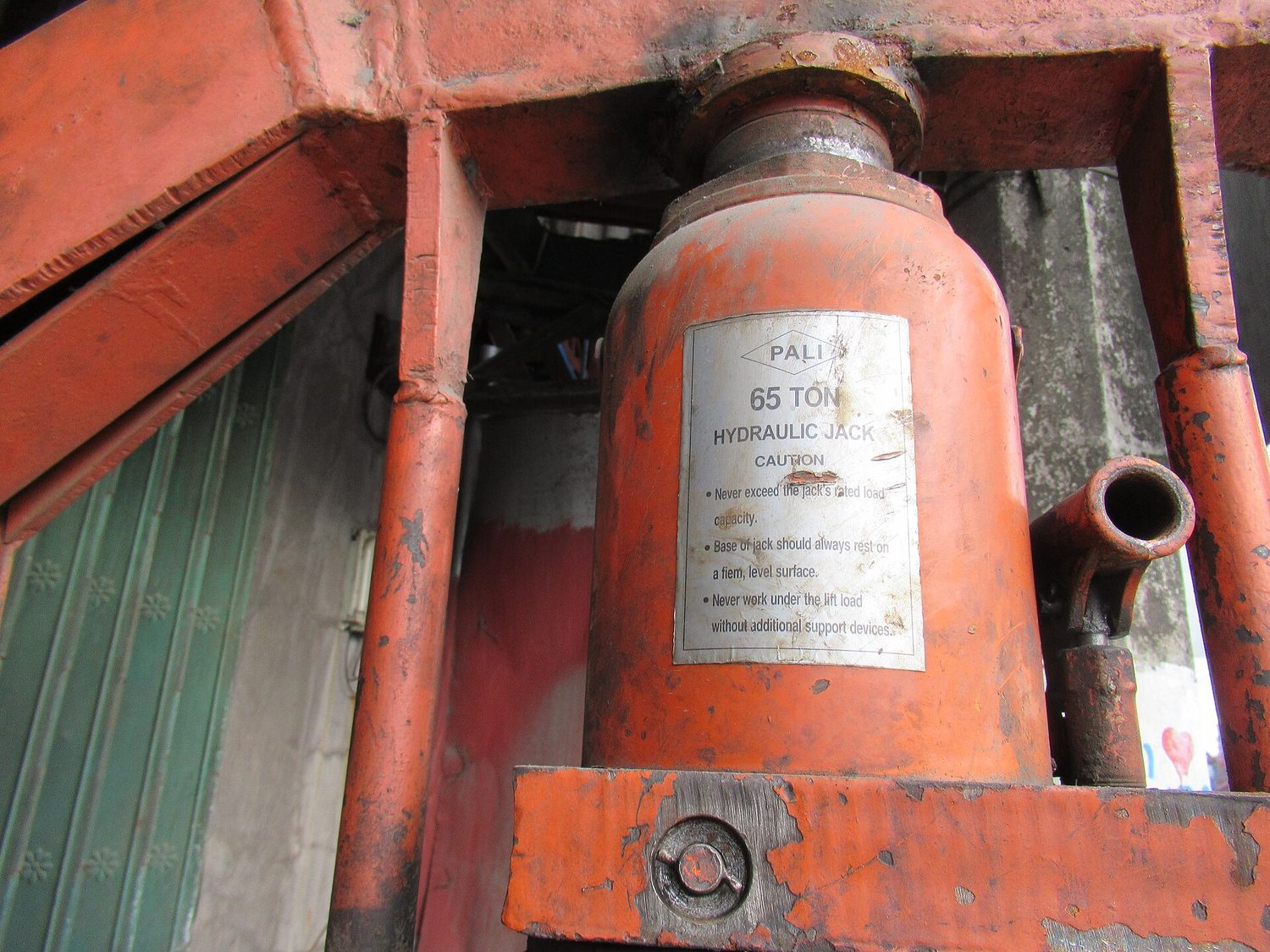
Pressure 压强 is the perpendicular force per unit area, a scalar 标量 measured in pascals (Pa):
$$P=\frac{F_\perp}{A}.$$
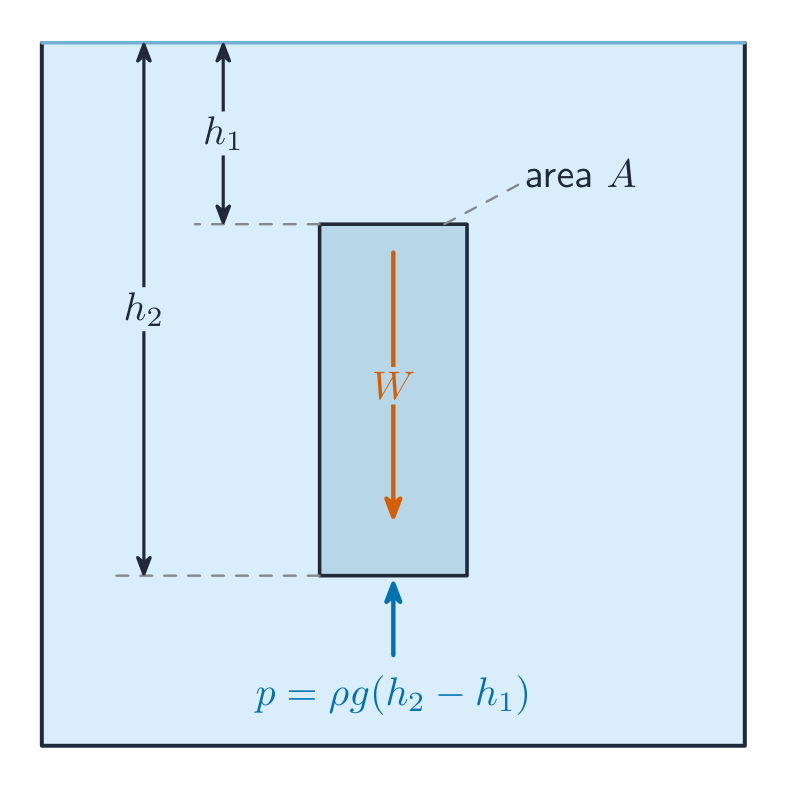
In a fluid at rest, pressure increases with depth 深度 because of the weight of fluid above:
$$P=P_0+\rho g h,$$
where $P_0$ is the pressure at the surface and $h$ is the depth. Pressure acts equally in all directions at a point and pushes perpendicular to any surface.
Distinguish the two pressures AP asks about: the gauge pressure 表压 is the extra pressure the fluid column adds, $P_{\text{gauge}}=\rho g h$, while the absolute pressure 绝对压强 is the total, $P=P_0+P_{\text{gauge}}$ (with $P_0$ usually atmospheric). A tyre gauge reading "$200\ \text{kPa}$" is gauge pressure; the air inside is really at about $300\ \text{kPa}$ absolute.
Worked example. Find the total pressure on a diver $10\ \text{m}$ below the surface of water ($\rho=1000\ \text{kg/m}^3$, surface pressure $P_0=1.0\times10^{5}\ \text{Pa}$):
$$P=P_0+\rho g h=1.0\times10^{5}+1000\times9.8\times10=1.98\times10^{5}\ \text{Pa}.$$
Every $10\ \text{m}$ of water adds roughly one extra atmosphere of pressure. Notice the pressure does not depend on the shape or width of the container, only on the depth.
Vocabulary
Train
| English |
|---|
| Pressure/ˈpreʃə/ |
| scalar/ˈskeɪlə/ |
| depth/depθ/ |
| gauge pressure/ɡeɪdʒ ˈpreʃə/ |
| absolute pressure/ˈæbsəluːt ˈpreʃə/ |
8.3
Fluids and Newton's Laws
Syllabus
| Learning Objective | Essential Knowledge |
|---|---|
8.3.A |
|
8.3.B |
|
Source: College Board AP Course and Exam Description
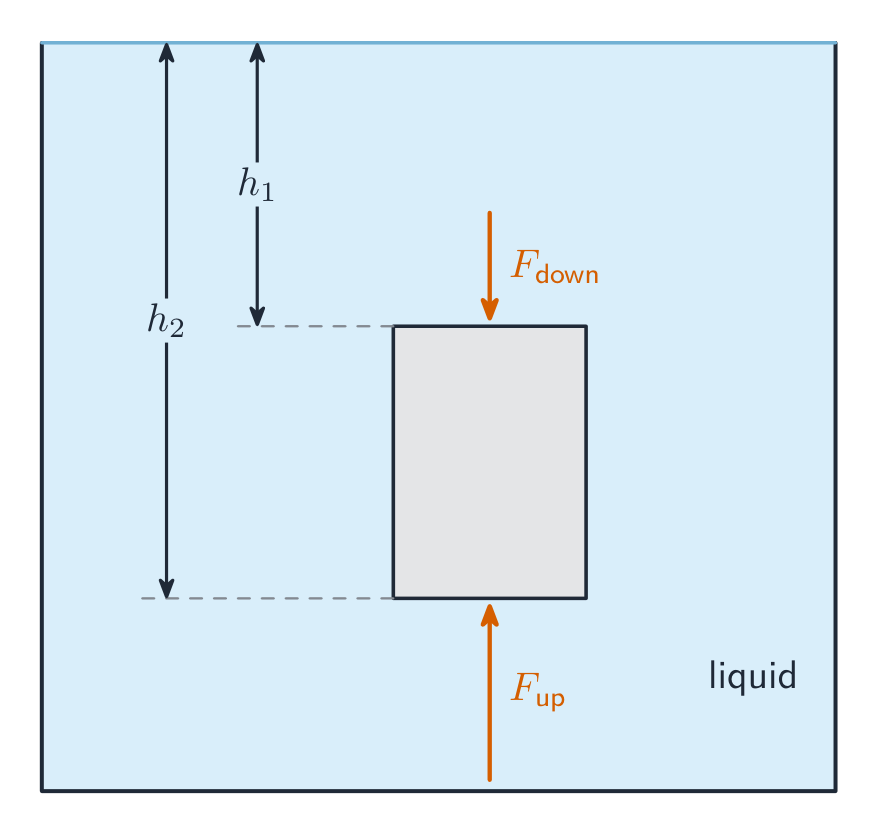
An object in a fluid feels an upward buoyant force 浮力 equal to the weight of the fluid it displaces – Archimedes' principle 阿基米德原理:
$$F_b=\rho_{\text{fluid}}\,g\,V_{\text{displaced}}.$$
Combine this with Newton's laws: the object floats when buoyancy balances weight, sinks when weight wins, and rises when buoyancy wins. A floating object displaces exactly its own weight of fluid.
Worked example. A block of density $600\ \text{kg/m}^3$ floats in water ($1000\ \text{kg/m}^3$). What fraction is under the surface? For floating, the buoyant force equals the weight, so $\rho_{\text{fluid}}\,g\,V_{\text{sub}}=\rho_{\text{object}}\,g\,V$:
$$\frac{V_{\text{sub}}}{V}=\frac{\rho_{\text{object}}}{\rho_{\text{fluid}}}=\frac{600}{1000}=0.60.$$
So $60\%$ sits below the water – the same reason most of an iceberg (density $\approx 900$) hides underwater.
Vocabulary
Train
| English |
|---|
| buoyant force/ˈbɔɪənt fɔːs/ |
| Archimedes' principle/ˌɑːkɪˈmiːdiːz ˈprɪnsɪpl/ |
8.4
Fluids and Conservation Laws
Syllabus
| Learning Objective | Essential Knowledge |
|---|---|
8.4.A |
|
Source: College Board AP Course and Exam Description
For an ideal fluid flowing steadily, two conservation ideas apply:
- Continuity 连续性 (conservation of mass): the volume flow rate is constant, so $A_1 v_1 = A_2 v_2$. A narrower pipe forces faster flow.
- Bernoulli's equation 伯努利方程 (conservation of energy per volume): along a streamline,
$$P+\tfrac{1}{2}\rho v^2+\rho g y = \text{constant}.$$
Together they explain why fluid speeds up and its pressure drops where a pipe narrows or where flow is fastest.
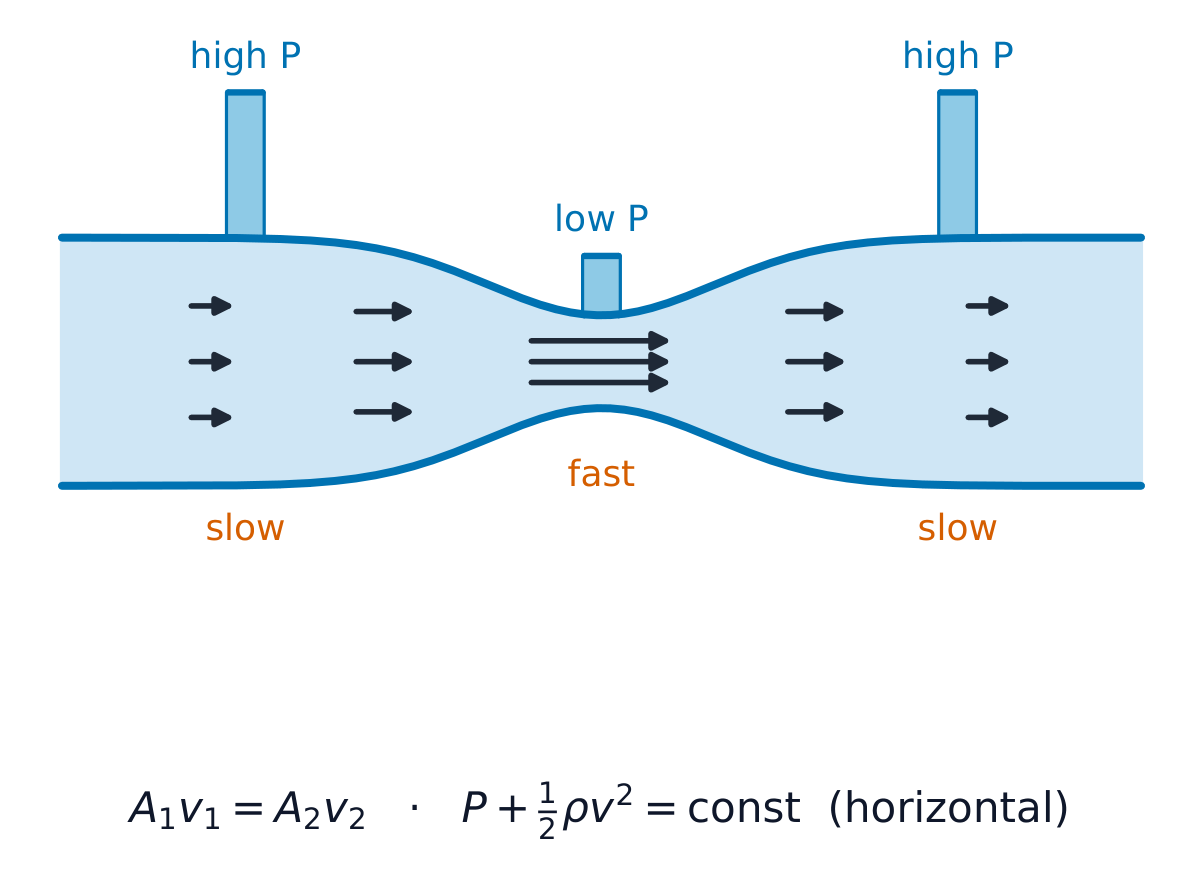
Worked example. Water flows at $2.0\ \text{m/s}$ through a pipe of cross-section $0.010\ \text{m}^2$, then enters a narrower section of $0.0040\ \text{m}^2$. By continuity the speed there is
$$v_2=\frac{A_1 v_1}{A_2}=\frac{0.010\times2.0}{0.0040}=5.0\ \text{m/s}.$$
By Bernoulli's equation this faster stream is at lower pressure – the effect that lifts an aeroplane wing and pulls two passing ships together.
Exam skill. Choose the right law by what changes. If the pipe changes width, start with continuity ($A_1v_1=A_2v_2$) to get the speeds; if you then need a pressure, feed those speeds into Bernoulli. Watch the height term $\rho g y$ only when the pipe also changes level.
Vocabulary
Train
| English |
|---|
| Continuity/kɒntɪˈnjuːɪti/ |
| Bernoulli's equation/ˈbɜːnaʊliz ɪˈkweɪʒn/ |
8.4
Exam tips
- Pressure with depth is $P=P_0+\rho g h$ — it depends on depth only, not the container's shape or width.
- Buoyant force = weight of fluid displaced ($\rho_{\text{fluid}}\,gV_{\text{disp}}$); a floating object displaces its own weight, so the fraction submerged is $\rho_{\text{object}}/\rho_{\text{fluid}}$.
- Compare densities to predict floating vs sinking; a floating object is in equilibrium (buoyancy = weight), not weightless.
- Use continuity $A_1v_1=A_2v_2$: a narrower pipe means faster flow.
- Bernoulli: where a fluid flows faster its pressure is lower (wing lift, spray).
Interactive lessons on this topic
Work through it step by step, with instant-check exercises.