Fluids and Newton's Laws
Introduced| English |
|---|
| buoyant force/ˈbɔɪənt fɔːs/ |
A steel ship floats, but a steel nail sinks
- Drop a steel nail in water and it sinks at once. Yet a ship made of thousands of tonnes of steel floats.
- The ship wins by pushing aside a huge volume of water — enough to hold its weight up.
- The upward push from a fluid is the buoyant force 浮力.
- It obeys a beautifully simple rule discovered by Archimedes.
Archimedes' principle
- The buoyant force equals the weight of the fluid displaced: $F_b = \rho_{\text{fluid}} V g$.
- It comes from pressure being larger at the bottom of an object than the top.
- $V$ is the submerged volume, and $\rho_{\text{fluid}}$ the fluid's density.
- Push aside more fluid, or a denser fluid, and you get a bigger upward force.
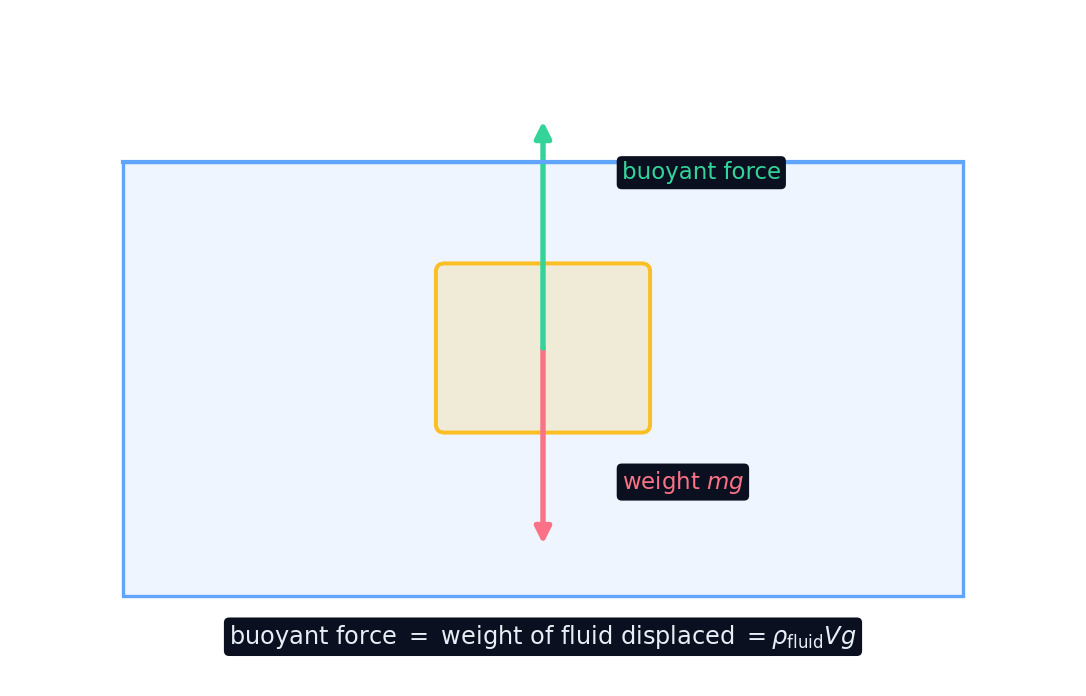
A block of volume $0.002\ \text{m}^3$ is submerged in water ($\rho = 1000\ \tfrac{\text{kg}}{\text{m}^3}$, $g = 10\ \tfrac{\text{m}}{\text{s}^2}$). What is the buoyant force, in $\text{N}$?
$F_b = \rho V g = 1000 \times 0.002 \times 10 = 20\ \text{N}$.
Archimedes' principle says the buoyant force equals:
$F_b = \rho_{\text{fluid}} V g$ — the weight of the fluid the object pushes aside.
Float or sink? Compare the forces
- Compare the buoyant force (up) with the object's weight (down) — a Newton's-law balance.
- If buoyancy can equal the weight, the object floats; if not, it sinks.
- Equivalently, compare densities: less dense than the fluid ⇒ floats; denser ⇒ sinks.
- A ship floats because its overall (average) density, hull plus air, is low.
Will it float?
Compare an object's density with the fluid's and see how buoyancy decides float or sink.
An object floats in a fluid when the object is:
Less dense than the fluid ⇒ buoyancy can support its weight ⇒ it floats.
A steel ship floats because its overall average density (steel plus air) is less than water's.
The hollow hull traps air, lowering the ship's average density below that of water.
Select all things that increase the buoyant force on a fully submerged object.
$F_b = \rho_{\text{fluid}} V g$ grows with volume, fluid density and $g$. Colour is irrelevant.
Why it feels lighter underwater
- Lift a rock underwater and it feels lighter — the buoyant force helps you.
- Its apparent weight is the real weight minus the buoyant force.
- Fully submerged, a denser-than-water object still sinks, but with reduced apparent weight.
- Buoyancy is just Newton's laws applied to the pressure of the surrounding fluid.
The apparent weight of a submerged object is its real weight minus the ____ force.
Apparent weight $=$ real weight $-$ buoyant force, so things feel lighter underwater.
Buoyancy depends on the volume of fluid displaced and the fluid's density — not on the object's own density or weight directly. Floating vs sinking is decided by comparing the buoyant force to the weight (or the object's density to the fluid's).
A block of volume $0.002\ \text{m}^3$ is fully submerged in water ($\rho = 1000\ \tfrac{\text{kg}}{\text{m}^3}$, $g = 10\ \tfrac{\text{m}}{\text{s}^2}$).
- $F_b = \rho V g = 1000 \times 0.002 \times 10 = 20\ \text{N}$.
If the block weighs more than $20\ \text{N}$ it sinks; less, and it rises and floats.
The buoyant force equals the weight of the fluid displaced: $F_b = \rho_{\text{fluid}} V g$ (Archimedes' principle). An object floats if this can balance its weight — equivalently, if it is less dense than the fluid — and sinks if not. Underwater objects have a reduced apparent weight.