Internal Structure and Density
Introduced| English |
|---|
| density/ˈdensɪti/ |
| fluid/ˈfluːɪd/ |
A marble outweighs a beach ball
- A tiny steel marble can be heavier than a huge beach ball. How?
- The marble packs a lot of mass into a small space; the ball spreads a little mass over a big one.
- What matters is mass per unit volume — the density 密度.
- Density explains what floats, what sinks, and how fluids behave.
Defining density
- Density is mass divided by volume: $\rho = \dfrac{m}{V}$.
- Its units are $\tfrac{\text{kg}}{\text{m}^3}$ (or $\tfrac{\text{g}}{\text{cm}^3}$).
- It measures how tightly matter is packed, not how much there is in total.
- Water is about $1000\ \tfrac{\text{kg}}{\text{m}^3}$; lead is over $11\,000$; air is only about $1.2$.
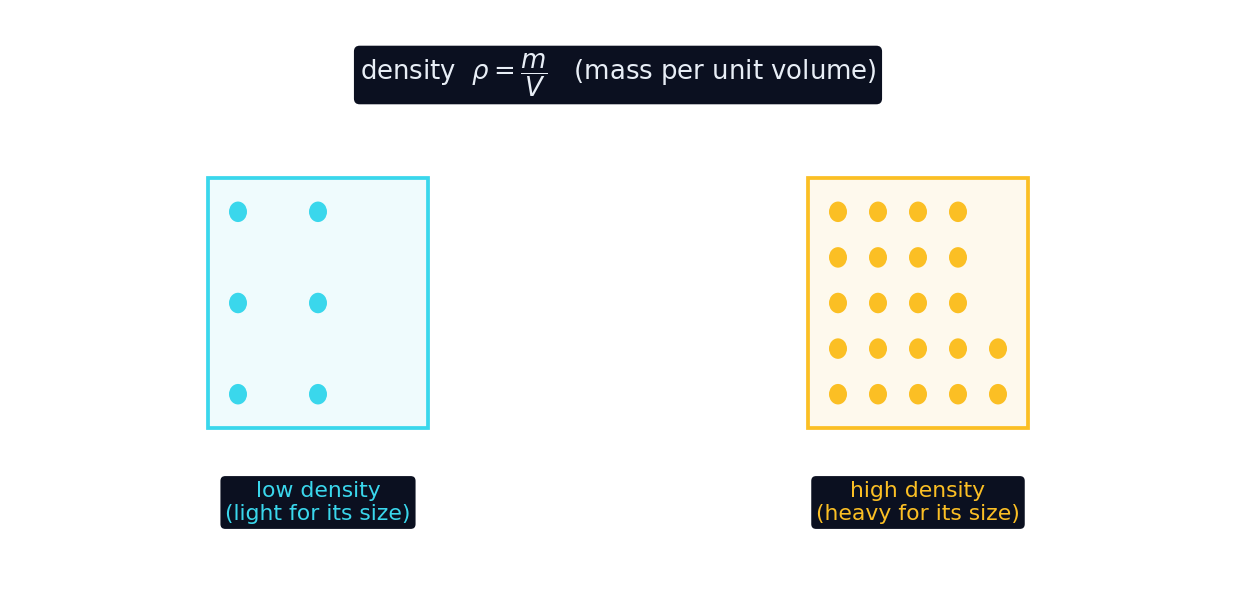
Dense sinks, light floats
Change an object's density and the liquid, and see whether it floats or sinks.
A block has mass $600\ \text{g}$ and volume $200\ \text{cm}^3$. What is its density, in $\tfrac{\text{g}}{\text{cm}^3}$?
$\rho = m/V = 600/200 = 3\ \tfrac{\text{g}}{\text{cm}^3}$.
Density is defined as:
$\rho = m/V$ — mass per unit volume.
Solids, liquids, and gases
- In a solid, particles are packed tightly and fixed, so solids are usually dense.
- In a liquid, particles touch but can slide, so liquids are dense but flow.
- In a gas, particles are far apart, so gases have very low density.
- A fluid 流体 is anything that flows — both liquids and gases.
To find mass from density and volume, use $m = \rho \times \_\_$.
Rearranging $\rho = m/V$ gives $m = \rho V$.
Water has density $1\ \tfrac{\text{g}}{\text{cm}^3}$. What is the mass of $250\ \text{cm}^3$ of water, in grams?
$m = \rho V = 1 \times 250 = 250\ \text{g}$.
Select all true statements about density and states of matter.
Gases are low-density, both liquids and gases flow (fluids), solids are packed. Density is per volume, not total mass.
Using density
- Rearrange to find any one quantity: $m = \rho V$ or $V = \dfrac{m}{\rho}$.
- Density lets you find a mass without weighing, if you know the material and volume.
- Comparing densities tells you instantly which object will float in which fluid.
- It is the starting point for pressure, buoyancy and fluid flow.
A large, heavy object always has a high density.
Density is mass per volume. A large object can be low-density if its mass is spread over a big volume.
Density is not the same as mass or weight. A huge object can be low-density (a beach ball); a small one can be high-density (a marble). Always divide mass by volume — a big heavy object is not automatically "dense".
A block has a mass of $600\ \text{g}$ and a volume of $200\ \text{cm}^3$. Find its density.
- $\rho = \dfrac{m}{V} = \dfrac{600}{200} = 3\ \tfrac{\text{g}}{\text{cm}^3}$.
That is three times denser than water ($1\ \tfrac{\text{g}}{\text{cm}^3}$), so it will sink in water.
Density is mass per unit volume, $\rho = \dfrac{m}{V}$ (in $\tfrac{\text{kg}}{\text{m}^3}$). It measures how tightly matter is packed, not the total amount. Solids and liquids are dense; gases are not. A fluid is anything that flows.