Skip to content · ⁨Bỏ qua nội dung⁩

Torque and Rotational Dynamics · ⁨Mô-men lực và động học quay⁩

AP Physics 1 · ⁨AP Vật lý 1⁩ · Topic 5 · ⁨Chủ đề 5⁩

Video lesson for this topic · ⁨Bài học video cho chủ đề này⁩ Open the video page · ⁨Mở trang video⁩
7:41

Mô-men lực và động học quay

Đẩy một cánh cửa nặng ngay sát bản lề, thật mạnh. Nó hầu như không di chuyển. Bây giờ đẩy với cùng một lực, ra xa ở tay nắm — và nó mở toang ra. Cùng một…

English narration · English + 中文 subtitles burned in · ⁨Giọng đọc tiếng Anh · phụ đề tiếng Anh + 中文 được ghi trực tiếp⁩

5.1

Rotational Kinematics · ⁨Động học Quay⁩

Syllabus · ⁨Chương trình⁩
English

Learning Objective 5.1.A: Describe the rotation of a system with respect to time using angular displacement, angular velocity, and angular acceleration.

  • 5.1.A.1 Angular displacement is the measurement of the angle, in radians, through which a point on a rigid system rotates about a specified axis.
    • Equation: $\Delta\theta = \theta - \theta_0$
    • 5.1.A.1.i A rigid system is one that holds its shape but in which different points on the system move in different directions during rotation. A rigid system cannot be modeled as an object.
    • 5.1.A.1.ii One direction of angular displacement about an axis of rotation—clockwise or counterclockwise—is typically indicated as mathematically positive, with the other direction becoming mathematically negative.
    • 5.1.A.1.iii If the rotation of a system about an axis may be well described using the motion of the system's center of mass, the system may be treated as a single object. For example, the rotation of Earth about its axis may be considered negligible when considering the revolution of Earth about the center of mass of the Earth–Sun system.
  • 5.1.A.2 Average angular velocity is the average rate at which angular position changes with respect to time.
    • Equation: $\omega_{\text{avg}} = \dfrac{\Delta\theta}{\Delta t}$
  • 5.1.A.3 Average angular acceleration is the average rate at which the angular velocity changes with respect to time.
    • Equation: $\alpha_{\text{avg}} = \dfrac{\Delta\omega}{\Delta t}$
  • 5.1.A.4 Angular displacement, angular velocity, and angular acceleration around one axis are analogous to linear displacement, velocity, and acceleration in one dimension and demonstrate the same mathematical relationships.
    • 5.1.A.4.i For constant angular acceleration, the mathematical relationships between angular displacement, angular velocity, and angular acceleration can be described with the following equations:
      • Equation: $\omega = \omega_0 + \alpha t$
      • Equation: $\theta = \theta_0 + \omega_0 t + \dfrac{1}{2}\alpha t^2$
      • Equation: $\omega^2 = \omega_0^2 + 2\alpha(\theta - \theta_0)$
    • 5.1.A.4.ii Graphs of angular displacement, angular velocity, and angular acceleration as functions of time can be used to find the relationships between those quantities.

Boundary statement: Descriptions of the directions of rotation for a point or object are limited to clockwise and counterclockwise with respect to a given axis of rotation.

Tiếng Việt

Mục tiêu học tập 5.1.A: Mô tả chuyển động quay của hệ theo thời gian bằng cách sử dụng độ dịch chuyển góc, vận tốc góc và gia tốc góc.

  • 5.1.A.1 Độ dịch chuyển góc là phép đo góc (tính bằng radian) mà một điểm trên hệ cứng quay quanh một trục xác định.
    • Phương trình: $\Delta\theta = \theta - \theta_0$
    • 5.1.A.1.i Hệ cứng là hệ giữ nguyên hình dạng nhưng các điểm khác nhau trên hệ chuyển động theo các hướng khác nhau trong quá trình quay. Một hệ cứng không thể được mô hình hóa như một vật thể.
    • 5.1.A.1.ii Một chiều của độ dịch chuyển góc quanh trục quay—theo chiều kim đồng hồ hoặc ngược chiều kim đồng hồ—thường được quy ước là dương trong toán học, còn chiều kia trở thành âm.
    • 5.1.A.1.iii Nếu chuyển động quay của hệ quanh một trục có thể được mô tả tốt bằng chuyển động của tâm khối lượng của hệ, thì hệ có thể được xem xét như một vật thể duy nhất. Ví dụ, khi xét chuyển động quỹ đạo của Trái Đất quanh tâm khối lượng của hệ Trái Đất - Mặt Trời, sự quay của Trái Đất quanh trục của chính nó có thể coi là không đáng kể.
  • 5.1.A.2 Vận tốc góc trung bình là tốc độ thay đổi trung bình của vị trí góc theo thời gian.
    • Phương trình: $\omega_{\text{avg}} = \dfrac{\Delta\theta}{\Delta t}$
  • 5.1.A.3 Gia tốc góc trung bình là tốc độ thay đổi trung bình của vận tốc góc theo thời gian.
    • Phương trình: $\alpha_{\text{avg}} = \dfrac{\Delta\omega}{\Delta t}$
  • 5.1.A.4 Độ dịch chuyển góc, vận tốc góc và gia tốc góc quanh một trục tương tự như độ dịch chuyển, vận tốc và gia tốc tuyến tính theo một chiều và thể hiện các mối quan hệ toán học giống nhau.
    • 5.1.A.4.i Đối với gia tốc góc không đổi, các mối quan hệ toán học giữa độ dịch chuyển góc, vận tốc góc và gia tốc góc có thể được mô tả bằng các phương trình sau:
      • Phương trình: $\omega = \omega_0 + \alpha t$
      • Phương trình: $\theta = \theta_0 + \omega_0 t + \dfrac{1}{2}\alpha t^2$
      • Phương trình: $\omega^2 = \omega_0^2 + 2\alpha(\theta - \theta_0)$
    • 5.1.A.4.ii Đồ thị biểu diễn độ dịch chuyển góc, vận tốc góc và gia tốc góc theo thời gian có thể được sử dụng để tìm các mối quan hệ giữa các đại lượng đó.

Tuyên bố giới hạn: Các mô tả về chiều quay của một điểm hoặc vật chỉ giới hạn ở chiều kim đồng hồ và ngược chiều kim đồng hồ so với một trục quay xác định.
Source: College Board AP Course and Exam Description · ⁨Nguồn: Mô tả Khóa học và Bài thi College Board AP⁩

English

Rotation is described by angular quantities that mirror the linear ones:

  • angular displacement 角位移 $\theta$ (in radians 弧度),
  • angular velocity 角速度 $\omega=\dfrac{\Delta\theta}{\Delta t}$,
  • angular acceleration 角加速度 $\alpha=\dfrac{\Delta\omega}{\Delta t}$.

For constant $\alpha$, the rotational kinematic equations have the same form as the linear ones, with $\theta,\omega,\alpha$ replacing $x,v,a$: $\omega=\omega_0+\alpha t$, $\theta=\omega_0 t+\tfrac12\alpha t^2$, and $\omega^2=\omega_0^2+2\alpha\theta$.

Worked example. A wheel starts from rest and speeds up uniformly to $30\ \text{rad/s}$ in $6.0\ \text{s}$. Find its angular acceleration and the total angle turned:

$$\alpha=\frac{\Delta\omega}{\Delta t}=\frac{30}{6.0}=5.0\ \text{rad/s}^2,\qquad \theta=\tfrac12\alpha t^2=\tfrac12\times5.0\times6.0^2=90\ \text{rad}.$$

Tiếng Việt
A crash-test collision: large forces and torques produce rapid changes in linear and angular motion
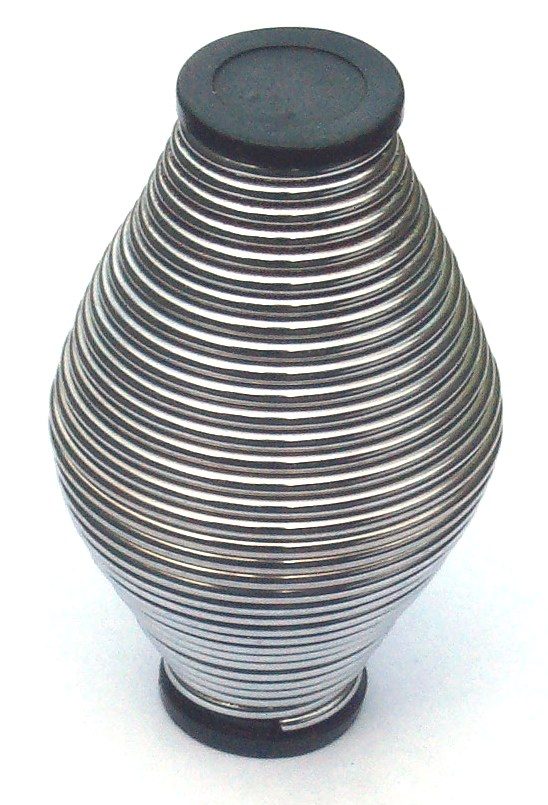
A spring under load: Hooke's law links force and extension — useful context for energy in rotating systems

Chuyển động quay được mô tả bởi các đại lượng góc tương tự như các đại lượng tuyến tính:

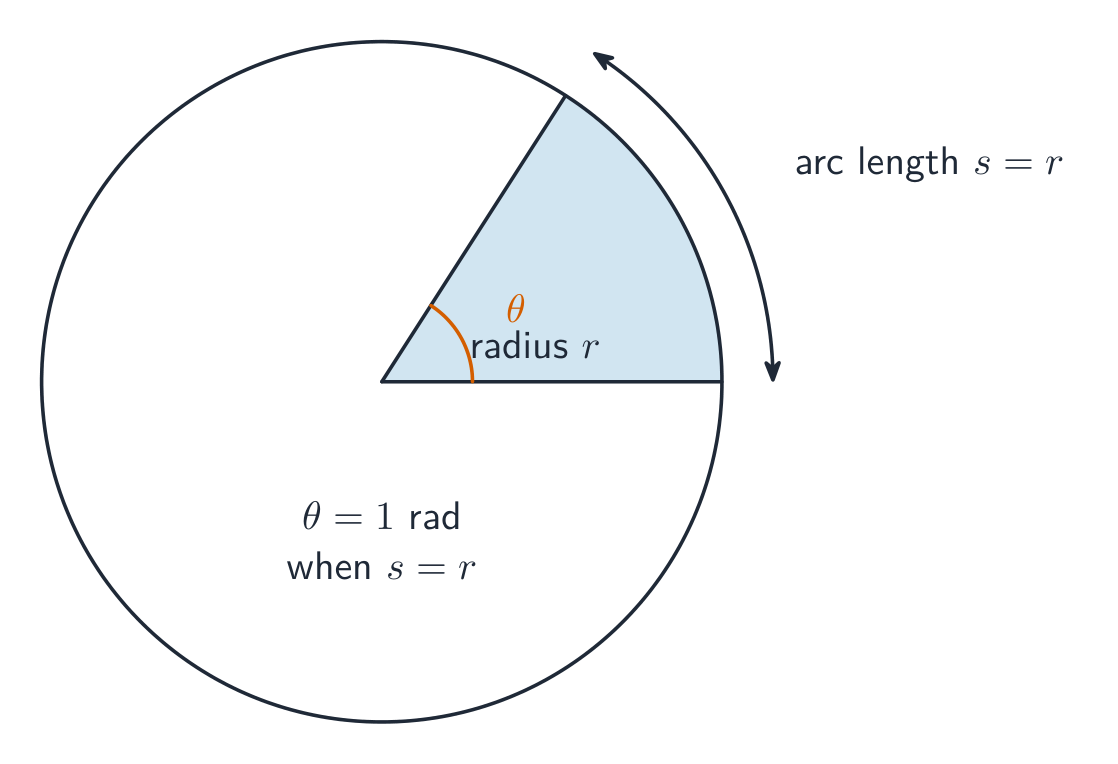
Một radian là góc có chiều dài cung bằng bán kính
  • dịch chuyển góc $\theta$ (tính bằng radian),
  • vận tốc góc $\omega=\dfrac{\Delta\theta}{\Delta t}$,
  • gia tốc góc $\alpha=\dfrac{\Delta\omega}{\Delta t}$.

Với gia tốc góc không đổi $\alpha$, các phương trình động học quay có cùng dạng với các phương trình tuyến tính, với $\theta,\omega,\alpha$ thay thế cho $x,v,a$: $\omega=\omega_0+\alpha t$, $\theta=\omega_0 t+\tfrac12\alpha t^2$, và $\omega^2=\omega_0^2+2\alpha\theta$.

Ví dụ có lời giải. Một bánh xe bắt đầu từ trạng thái nghỉ và tăng tốc đều lên $30\ \text{rad/s}$ trong thời gian $6.0\ \text{s}$. Tìm gia tốc góc của nó và tổng góc quay:

$$\alpha=\frac{\Delta\omega}{\Delta t}=\frac{30}{6.0}=5.0\ \text{rad/s}^2,\qquad \theta=\tfrac12\alpha t^2=\tfrac12\times5.0\times6.0^2=90\ \text{rad}.$$

Vocabulary · ⁨Từ vựng⁩ Train · ⁨Luyện tập⁩
English Tiếng Việt
angular displacement/ˈæŋɡjʊlə dɪˈspleɪsmənt/ góc quay
radians/ˈreɪdɪənz/ radian
angular velocity/ˈæŋɡjʊlə vəˈlɒsɪti/ vận tốc góc
angular acceleration/ˈæŋɡjʊlə əkˌseləˈreɪʃn/ gia tốc góc
Torque/tɔːk/ Mô-men lực
moment arm/ˈməʊmənt ɑːm/ Cánh tay lực
Rotational inertia/rəʊˈteɪʃənl ɪˈnɜːʃə/ Momen quán tính quay
rotational equilibrium/rəʊˈteɪʃənl ˌiːkwɪˈlɪbrɪəm/ cân bằng quay
5.2

Connecting Linear and Rotational Motion · ⁨Liên hệ Chuyển động Tuyến tính và Quay⁩

Syllabus · ⁨Chương trình⁩
English

Learning Objective 5.2.A: Describe the linear motion of a point on a rotating rigid system that corresponds to the rotational motion of that point, and vice versa.

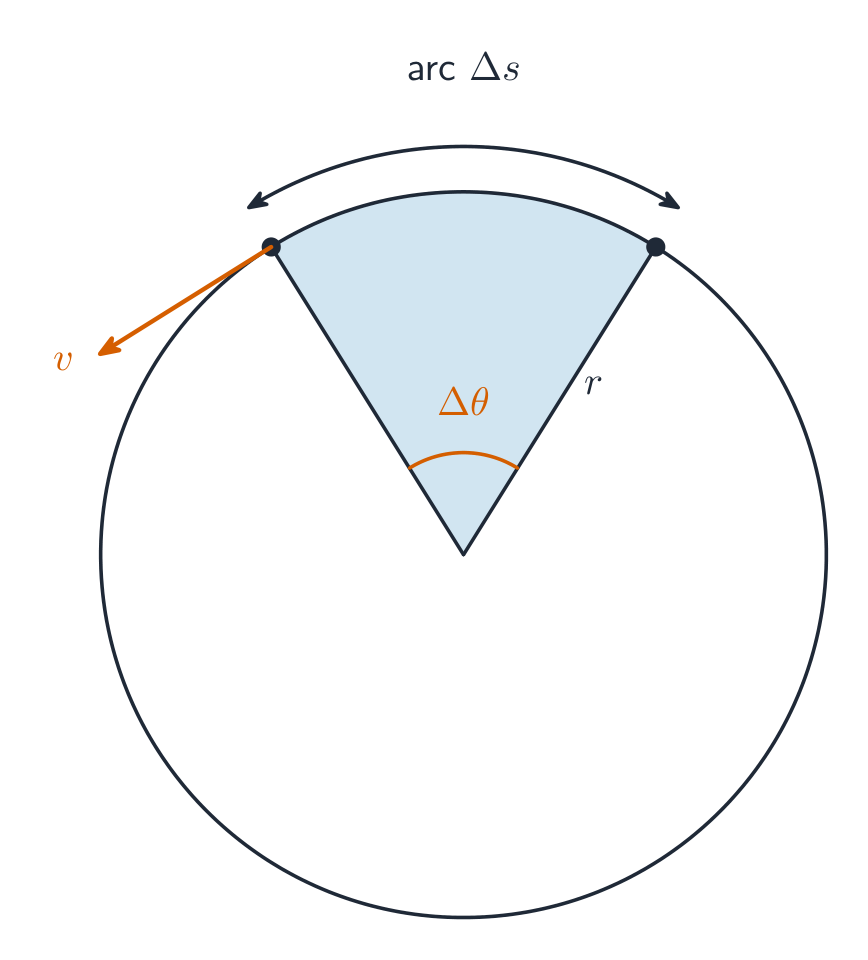
  • 5.2.A.1 For a point at a distance $r$ from a fixed axis of rotation, the linear distance $s$ traveled by the point as the system rotates through an angle $\Delta\theta$ is given by the equation $\Delta s = r\Delta\theta$.
  • 5.2.A.2 Derived relationships of linear velocity and of the tangential component of acceleration to their respective angular quantities are given by the following equations:
    • Equation: $s = r\theta$
    • Equation: $v = r\omega$
    • Equation: $a_T = r\alpha$
  • 5.2.A.3 For a rigid system, all points within that system have the same angular velocity and angular acceleration.

Boundary statement: Descriptions of the directions of rotation for a point or object are limited to clockwise and counterclockwise with respect to a given axis of rotation.

Tiếng Việt

Mục tiêu học tập 5.2.A: Mô tả chuyển động tuyến tính của một điểm trên hệ cứng đang quay tương ứng với chuyển động quay của điểm đó, và ngược lại.

  • 5.2.A.1 Đối với một điểm ở khoảng cách $r$ từ trục quay cố định, quãng đường tuyến tính $s$ mà điểm đó di chuyển khi hệ quay qua một góc $\Delta\theta$ được cho bởi phương trình $\Delta s = r\Delta\theta$.
  • 5.2.A.2 Các mối quan hệ suy ra từ vận tốc tuyến tính và thành phần tiếp tuyến của gia tốc so với các đại lượng góc tương ứng của chúng được cho bởi các phương trình sau:
    • Phương trình: $s = r\theta$
    • Phương trình: $v = r\omega$
    • Phương trình: $a_T = r\alpha$
  • 5.2.A.3 Đối với hệ cứng, tất cả các điểm bên trong hệ đó đều có cùng vận tốc góc và gia tốc góc.

Tuyên bố giới hạn: Các mô tả về chiều quay của một điểm hoặc vật chỉ giới hạn ở chiều kim đồng hồ và ngược chiều kim đồng hồ so với một trục quay xác định.
Source: College Board AP Course and Exam Description · ⁨Nguồn: Mô tả Khóa học và Bài thi College Board AP⁩

English

A point at radius $r$ from the axis has linear quantities tied to the angular ones:

$$s=r\theta,\qquad v=r\omega,\qquad a_t=r\alpha.$$
Points farther from the axis move faster. This link lets you switch between "how fast the wheel spins" and "how fast a point on its rim moves."

Worked example. A bicycle wheel of radius $0.35\ \text{m}$ spins at $12\ \text{rad/s}$. A point on the rim (and so the bike) moves at $v=r\omega=0.35\times12=4.2\ \text{m/s}$. A point halfway to the axis moves at half that speed.

Tiếng Việt

Một điểm nằm ở bán kính $r$ từ trục quay có các đại lượng tuyến tính liên hệ với các đại lượng góc:

$$s=r\theta,\qquad v=r\omega,\qquad a_t=r\alpha.$$
Các điểm càng xa trục quay sẽ di chuyển nhanh hơn. Mối liên hệ này cho phép bạn chuyển đổi giữa "bánh xe quay nhanh bao nhiêu" và "một điểm trên vành bánh xe di chuyển nhanh bao nhiêu".

As the radius turns through an angle, a point moves along an arc at speed v

Ví dụ có lời giải. Một bánh xe đạp có bán kính $0.35\ \text{m}$ quay với tốc độ $12\ \text{rad/s}$. Một điểm trên vành (và do đó cả chiếc xe) di chuyển với tốc độ $v=r\omega=0.35\times12=4.2\ \text{m/s}$. Một điểm ở halfway về phía trục di chuyển với một nửa tốc độ đó.

5.3

Torque · ⁨Mô-men Lực (Lực đẩy)⁩

Syllabus · ⁨Chương trình⁩
English

Learning Objective 5.3.A: Identify the torques exerted on a rigid system.

  • 5.3.A.1 Torque results only from the force component perpendicular to the position vector from the axis of rotation to the point of application of the force.
  • 5.3.A.2 The lever arm is the perpendicular distance from the axis of rotation to the line of action of the exerted force.

Learning Objective 5.3.B: Describe the torques exerted on a rigid system.

  • 5.3.B.1 Torques can be described using force diagrams.
    • 5.3.B.1.i Force diagrams are similar to free-body diagrams and are used to analyze the torques exerted on a rigid system.
    • 5.3.B.1.ii Similar to free-body diagrams, force diagrams represent the relative magnitude and direction of the forces exerted on a rigid system. Force diagrams also depict the location at which those forces are exerted relative to the axis of rotation.
  • 5.3.B.2 The magnitude of the torque exerted on a rigid system by a force is described by the following equation, where $\theta$ is the angle between the force vector and the position vector from the axis of rotation to the point of application of the force.
    • Equation: $\tau = rF_{\perp} = rF\sin\theta$

Boundary statement: While AP Physics 1 expects students to mathematically manipulate the magnitude of torque using vector conventions, the direction of torque is beyond the scope of the course.

Tiếng Việt

Mục tiêu học tập 5.3.A: Xác định các momen lực tác dụng lên hệ cứng.

  • 5.3.A.1 Momen lực chỉ phát sinh từ thành phần lực vuông góc với vectơ vị trí từ trục quay đến điểm đặt lực.
  • 5.3.A.2 Cánh tay đòn là khoảng cách vuông góc từ trục quay đến đường tác dụng của lực.

Mục tiêu học tập 5.3.B: Mô tả các mô-men tác dụng lên một hệ vật cứng.

  • 5.3.B.1 Mô-men có thể được mô tả bằng sơ đồ lực.
    • 5.3.B.1.i Sơ đồ lực tương tự như sơ đồ vật tự do và được sử dụng để phân tích các mô-men tác dụng lên một hệ vật cứng.
    • 5.3.B.1.ii Tương tự như sơ đồ vật tự do, sơ đồ lực biểu diễn độ lớn tương đối và hướng của các lực tác dụng lên một hệ vật cứng. Sơ đồ lực cũng chỉ ra vị trí mà các lực đó tác dụng so với trục quay.
  • 5.3.B.2 Độ lớn của mô-men tác dụng lên một hệ vật cứng bởi một lực được mô tả bởi phương trình sau, trong đó $\theta$ là góc giữa vectơ lực và vectơ vị trí từ trục quay đến điểm đặt lực.
    • Phương trình: $\tau = rF_{\perp} = rF\sin\theta$

Tuyên bố biên: Mặc dù AP Physics 1 yêu cầu học sinh thao tác toán học với độ lớn mô-men xoắn theo quy ước vectơ, nhưng hướng của mô-men xoắn nằm ngoài phạm vi của khóa học.

Source: College Board AP Course and Exam Description · ⁨Nguồn: Mô tả Khóa học và Bài thi College Board AP⁩

English
The principle of moments (torque)

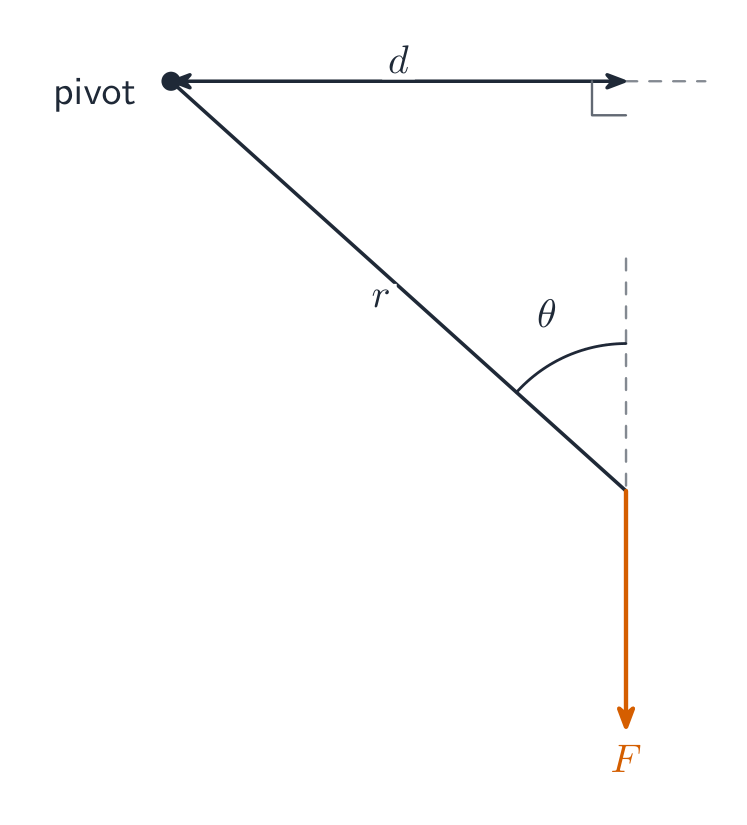
Torque 力矩 is the rotational effect of a force – how effectively it turns an object about an axis:

$$\tau=r F\sin\theta = F\cdot r_\perp,$$
where $r_\perp$ is the moment arm 力臂 (the perpendicular distance from the axis to the force's line of action). A force applied farther out, or more perpendicular, produces more torque. Torque has a sign (clockwise vs counterclockwise).

Worked example. You push with $20\ \text{N}$ at the end of a $0.30\ \text{m}$ wrench. Perpendicular to the wrench the torque is $\tau=rF=0.30\times20=6.0\ \text{N m}$. If you push at $60^{\circ}$ to the wrench instead, only the perpendicular part counts: $\tau=rF\sin 60^{\circ}=0.30\times20\times0.87=5.2\ \text{N m}$ – which is why you push at a right angle for the most turning effect.

Tiếng Việt
The principle of moments (torque)

Mô-men lực (Torque) là hiệu ứng quay của một lực – mức độ hiệu quả mà nó làm quay một vật thể quanh trục:

$$\tau=r F\sin\theta = F\cdot r_\perp,$$
trong đó $r_\perp$ là cánh tay đòn (khoảng cách vuông góc từ trục đến đường tác dụng của lực). Một lực tác dụng xa hơn hoặc vuông góc hơn sẽ tạo ra mô-men lực lớn hơn. Mô-men lực mang dấu (chiều kim đồng hồ so với chiều ngược lại).

The moment of a force depends on the perpendicular distance from the pivot

Ví dụ có lời giải. Bạn đẩy với lực $20\ \text{N}$ tại đầu của một cái cờ lê dài $0.30\ \text{m}$. Vuông góc với cái cờ lê, mô-men lực là $\tau=rF=0.30\times20=6.0\ \text{N m}$. Nếu bạn pushing ở góc $60^{\circ}$ so với cái cờ lê, chỉ phần vuông góc mới được tính: $\tau=rF\sin 60^{\circ}=0.30\times20\times0.87=5.2\ \text{N m}$ – đó là lý do tại sao bạn nên push vuông góc để có hiệu quả quay tối đa.

Explore · ⁨Khám phá⁩

Balance torques on a beam · ⁨Cân bằng mô-men trên thanh dầm⁩

Torque is force times perpendicular distance, $\tau=Fd$. The beam is in rotational equilibrium when the torques on each side are equal. · ⁨Mô-men là lực nhân với khoảng cách vuông góc, $\tau=Fd$. Thanh dầm ở trạng thái cân bằng quay khi mô-men ở mỗi bên bằng nhau.⁩

5.4

Rotational Inertia · ⁨Quán tính Quay⁩

Syllabus · ⁨Chương trình⁩
English

Learning Objective 5.4.A: Describe the rotational inertia of a rigid system relative to a given axis of rotation.

  • 5.4.A.1 Rotational inertia measures a rigid system's resistance to changes in rotation and is related to the mass of the system and the distribution of that mass relative to the axis of rotation.
  • 5.4.A.2 The rotational inertia of an object rotating a perpendicular distance $r$ from an axis is described by the equation
    • Equation: $I = mr^2$
  • 5.4.A.3 The total rotational inertia of a collection of objects about an axis is the sum of the rotational inertias of each object about that axis:
    • Equation: $I_{\text{tot}} = \sum I_i = \sum m_i r_i^2$

Learning Objective 5.4.B: Describe the rotational inertia of a rigid system rotating about an axis that does not pass through the system's center of mass.

  • 5.4.B.1 A rigid system's rotational inertia in a given plane is at a minimum when the rotational axis passes through the system's center of mass.
  • 5.4.B.2 The parallel axis theorem uses the following equation to relate the rotational inertia of a rigid system about any axis that is parallel to an axis through its center of mass:
    • Equation: $I' = I_{\text{cm}} + Md^2$

Boundary statement: AP Physics 1 only expects students to calculate the rotational inertia for systems of five or fewer objects arranged in a two-dimensional configuration.

Boundary statement: Students do not need to know the rotational inertia of extended rigid systems, as these will be provided within the exam. Students should have a qualitative understanding of the factors that affect rotational inertia; for example, how rotational inertia is greater when mass is farther from the axis of rotation, which is why a hoop has more rotational inertia than a solid disk of the same mass and radius.

Tiếng Việt

Mục tiêu học tập 5.4.A: Mô tả quán tính quay của một hệ vật cứng so với một trục quay cho trước.

  • 5.4.A.1 Quán tính quay đo lường sự kháng cự của một hệ vật cứng đối với sự thay đổi chuyển động quay và liên quan đến khối lượng của hệ thống và sự phân bố khối lượng đó so với trục quay.
  • 5.4.A.2 Quán tính quay của một vật quay ở khoảng cách vuông góc $r$ từ một trục được mô tả bởi phương trình
    • Phương trình: $I = mr^2$
  • 5.4.A.3 Tổng quán tính quay của một nhóm các vật quanh một trục là tổng các quán tính quay của từng vật quanh trục đó:
    • Phương trình: $I_{\text{tot}} = \sum I_i = \sum m_i r_i^2$

Mục tiêu học tập 5.4.B: Mô tả quán tính quay của một hệ vật cứng quay quanh một trục không đi qua trọng tâm của hệ.

  • 5.4.B.1 Quán tính quay của một hệ vật cứng trong một mặt phẳng cho trước đạt giá trị nhỏ nhất khi trục quay đi qua trọng tâm của hệ.
  • 5.4.B.2 Định lý trục song song sử dụng phương trình sau để liên hệ quán tính quay của một hệ vật cứng quanh bất kỳ trục nào song song với trục đi qua trọng tâm của nó:
    • Phương trình: $I' = I_{\text{cm}} + Md^2$

Tuyên bố biên: AP Physics 1 chỉ yêu cầu học sinh tính quán tính quay cho các hệ gồm năm hoặc ít hơn các vật được sắp xếp theo cấu hình hai chiều.

Tuyên bố biên: Học sinh không cần biết quán tính quay của các hệ cứng mở rộng, vì những đại lượng này sẽ được cung cấp trong đề thi. Học sinh nên có hiểu biết định tính về các yếu tố ảnh hưởng đến quán tính quay; ví dụ, quán tính quay lớn hơn khi khối lượng ở xa trục quay hơn, đó là lý do tại sao một vòng tròn có quán tính quay lớn hơn một đĩa đặc cùng khối lượng và bán kính.

Source: College Board AP Course and Exam Description · ⁨Nguồn: Mô tả Khóa học và Bài thi College Board AP⁩

English

Rotational inertia 转动惯量 (moment of inertia) $I$ measures how hard it is to change an object's rotation – the rotational version of mass. It depends on both the mass and how far that mass sits from the axis: mass spread farther out gives a larger $I$. For a point mass, $I=mr^2$; for extended bodies, standard formulas are provided (a hoop is $mR^2$, a solid disk $\tfrac12 mR^2$). This is why a figure skater spins faster when she pulls her arms in – she reduces $I$.

Tiếng Việt

Quán tính quay (mô-men quán tính) $I$ đo lường mức độ khó khăn trong việc thay đổi chuyển động quay của một vật – phiên bản quay của khối lượng. Nó phụ thuộc vào cả khối lượng và khoảng cách mà khối lượng đó nằm từ trục: khối lượng phân bố càng xa sẽ tạo ra $I$ lớn hơn. Đối với chất điểm, $I=mr^2$; đối với vật thể mở rộng, các công thức tiêu chuẩn được cung cấp (một vòng tròn rỗng là $mR^2$, một đĩa đặc là $\tfrac12 mR^2$). Đây là lý do tại sao một vận động viên trượt băng quay nhanh hơn khi thu tay lại – cô ấy giảm $I$.

5.5

Rotational Equilibrium · ⁨Cân Bằng Quay⁩

Syllabus · ⁨Chương trình⁩
English

Learning Objective 5.5.A: Describe the conditions under which a system's angular velocity remains constant.

  • 5.5.A.1 A system may exhibit rotational equilibrium (constant angular velocity) without being in translational equilibrium, and vice versa.
    • 5.5.A.1.i Free-body and force diagrams describe the nature of the forces and torques exerted on an object or rigid system.
    • 5.5.A.1.ii Rotational equilibrium is a configuration of torques such that the net torque exerted on the system is zero.
      • Equation: $\sum \tau_i = 0$
    • 5.5.A.1.iii The rotational analog of Newton's first law is that a system will have a constant angular velocity only if the net torque exerted on the system is zero.
  • 5.5.A.2 A rotational corollary to Newton's second law states that if the torques exerted on a rigid system are not balanced, the system's angular velocity must be changing.

Boundary statement: AP Physics 1 does not expect students to simultaneously analyze rotation in multiple planes.

Tiếng Việt

Mục tiêu học tập 5.5.A: Mô tả các điều kiện để vận tốc góc của một hệ duy trì không đổi.

  • 5.5.A.1 Một hệ có thể thể hiện trạng thái cân bằng quay (vận tốc góc không đổi) mà không cần ở trạng thái cân bằng tịnh tiến, và ngược lại.
    • 5.5.A.1.i Sơ đồ vật tự do và sơ đồ lực mô tả bản chất của các lực và mô-men tác dụng lên một vật hay hệ vật cứng.
    • 5.5.A.1.ii Cân bằng quay là trạng thái của các mô-men sao cho tổng mô-men tác dụng lên hệ bằng không.
      • Phương trình: $\sum \tau_i = 0$
    • 5.5.A.1.iii Phiên bản quay của định luật Newton thứ nhất là: một hệ sẽ có vận tốc góc không đổi chỉ khi tổng mô-men tác dụng lên hệ bằng không.
  • 5.5.A.2 Hệ quả quay của định luật Newton thứ hai phát biểu rằng nếu các mô-men tác dụng lên một hệ vật cứng không cân bằng, thì vận tốc góc của hệ phải đang thay đổi.

Phát biểu giới hạn: AP Physics 1 không yêu cầu học sinh đồng thời phân tích chuyển động quay trong nhiều mặt phẳng.

Source: College Board AP Course and Exam Description · ⁨Nguồn: Mô tả Khóa học và Bài thi College Board AP⁩

English

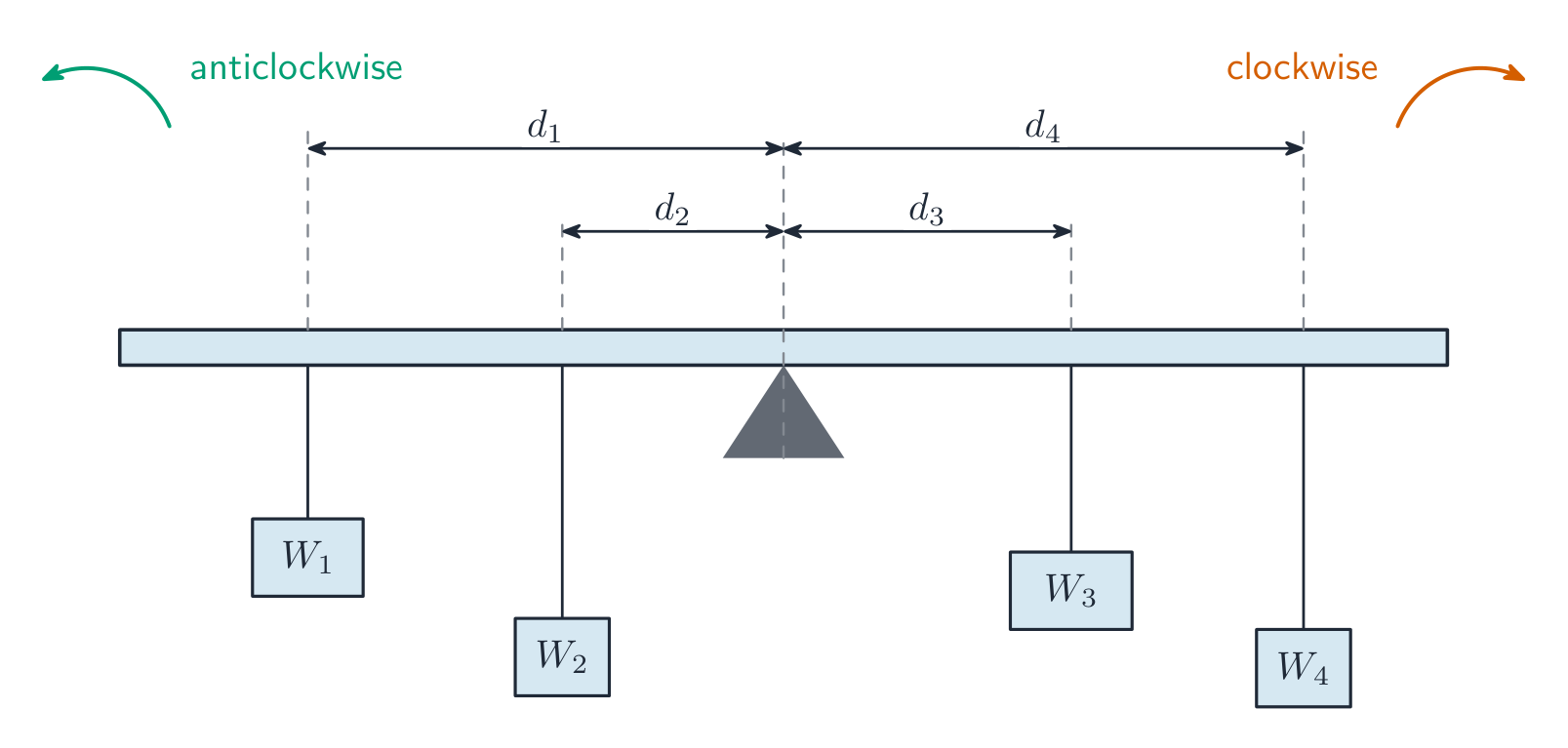
An object is in rotational equilibrium 转动平衡 when the net torque is zero, so its angular velocity stays constant. For a balanced (static) object, both the net force and the net torque are zero. Choosing the axis at an unknown force's location removes it from the torque equation – a useful trick for beam and ladder problems.

Worked example. A $30\ \text{kg}$ child sits $2.0\ \text{m}$ from the pivot of a seesaw. Where must a $40\ \text{kg}$ child sit on the other side to balance it? Set the clockwise torque equal to the anticlockwise torque (the $g$'s cancel):

$$30\times2.0=40\times d\;\Rightarrow\;d=\frac{60}{40}=1.5\ \text{m}.$$
The heavier child sits closer to the pivot – less distance, same torque.

Tiếng Việt

Một vật处于 cân bằng quay khi tổng mô-men lực bằng không, do đó vận tốc góc của nó giữ nguyên. Đối với một vật cân bằng (tĩnh), cả tổng lực và tổng mô-men lực đều bằng không. Việc chọn trục tại vị trí của một lực chưa biết sẽ loại bỏ lực đó khỏi phương trình mô-men lực – một mẹo hữu ích cho các bài toán dầm và thang.

At balance the clockwise and anticlockwise moments about the pivot are equal

Ví dụ có lời giải. Một đứa trẻ nặng $30\ \text{kg}$ ngồi cách trục quay $2.0\ \text{m}$. Đứa trẻ nặng $40\ \text{kg}$ phải ngồi ở đâu bên kia để cân bằng? Đặt mô-men lực chiều kim đồng hồ bằng mô-men lực ngược chiều kim đồng hồ (các $g$ triệt tiêu nhau):

$$30\times2.0=40\times d\;\Rightarrow\;d=\frac{60}{40}=1.5\ \text{m}.$$
Đứa trẻ nặng hơn ngồi gần trục quay hơn – ít khoảng cách hơn, nhưng cùng mô-men lực.

Explore · ⁨Khám phá⁩

Find the balance point · ⁨Tìm điểm cân bằng⁩

For rotational equilibrium the total clockwise torque equals the total anticlockwise torque. Move the forces and distances until the beam balances. · ⁨Để đạt cân bằng quay, tổng mô-men chiều kim đồng hồ phải bằng tổng mô-men ngược chiều kim đồng hồ. Di chuyển lực và khoảng cách cho đến khi thanh cân bằng.⁩

5.6

Newton's Second Law in Rotational Form · ⁨Định Luật Second Của Newton Dạng Quay⁩

Syllabus · ⁨Chương trình⁩
English

Learning Objective 5.6.A: Describe the conditions under which a system's angular velocity changes.

  • 5.6.A.1 Angular velocity changes when the net torque exerted on the object or system is not equal to zero.
  • 5.6.A.2 The rate at which the angular velocity of a rigid system changes is directly proportional to the net torque exerted on the rigid system and is in the same direction. The angular acceleration of the rigid system is inversely proportional to the rotational inertia of the rigid system.
    • Equation: $\alpha_{\text{sys}} = \dfrac{\sum \tau}{I_{\text{sys}}} = \dfrac{\tau_{\text{net}}}{I_{\text{sys}}}$
  • 5.6.A.3 To fully describe a rotating rigid system, linear and rotational analyses may need to be performed independently.
Tiếng Việt

Mục tiêu học tập 5.6.A: Mô tả các điều kiện để vận tốc góc của một hệ thay đổi.

  • 5.6.A.1 Vận tốc góc thay đổi khi tổng mô-men tác dụng lên vật hay hệ không bằng không.
  • 5.6.A.2 Tốc độ thay đổi vận tốc góc của một hệ vật cứng tỷ lệ thuận với tổng mô-men tác dụng lên hệ vật cứng và cùng hướng. Gia tốc góc của hệ vật cứng tỷ lệ nghịch với quán tính quay của hệ vật cứng.
    • Phương trình: $\alpha_{\text{sys}} = \dfrac{\sum \tau}{I_{\text{sys}}} = \dfrac{\tau_{\text{net}}}{I_{\text{sys}}}$
  • 5.6.A.3 Để mô tả đầy đủ một hệ vật cứng đang quay, có thể cần phải thực hiện các phân tích tịnh tiến và quay độc lập.

Source: College Board AP Course and Exam Description · ⁨Nguồn: Mô tả Khóa học và Bài thi College Board AP⁩

English

Net torque produces angular acceleration, in direct analogy with $F=ma$:

$$\sum\tau = I\alpha.$$
So a larger net torque, or a smaller rotational inertia, gives a larger angular acceleration. Solve rotation problems just like translation problems, with $\tau\leftrightarrow F$, $I\leftrightarrow m$, and $\alpha\leftrightarrow a$.

Worked example. A net torque of $12\ \text{N m}$ acts on a wheel with rotational inertia $I=3.0\ \text{kg m}^2$. Its angular acceleration is $\alpha=\tau/I=12/3.0=4.0\ \text{rad/s}^2$ – the exact rotational twin of $a=F/m$.

Tiếng Việt

Tổng mô-men lực gây ra gia tốc góc, tương tự trực tiếp với $F=ma$:

$$\sum\tau = I\alpha.$$
Vậy một tổng mô-men lực lớn hơn, hoặc quán tính quay nhỏ hơn, sẽ tạo ra gia tốc góc lớn hơn. Giải các bài toán quay giống hệt như giải các bài toán dịch chuyển, với $\tau\leftrightarrow F$, $I\leftrightarrow m$, và $\alpha\leftrightarrow a$.

Ví dụ có lời giải. Một tổng mô-men lực $12\ \text{N m}$ tác dụng lên một bánh xe có quán tính quay $I=3.0\ \text{kg m}^2$. Gia tốc góc của nó là $\alpha=\tau/I=12/3.0=4.0\ \text{rad/s}^2$ – chính xác là bản sao quay của $a=F/m$.

5.6

Exam tips · ⁨Mẹo làm bài thi⁩

English
  • Torque $\tau=Fr_\perp$ uses the perpendicular distance from the pivot; a force through the pivot gives zero torque.
  • For balance, set clockwise torque = anticlockwise torque; choosing the pivot at an unknown force removes it from the equation.
  • Use the rotational analogues: $\tau\leftrightarrow F$, $I\leftrightarrow m$, $\alpha\leftrightarrow a$, so $\sum\tau=I\alpha$ mirrors $\sum F=ma$.
  • Rotational inertia depends on how far the mass sits from the axis, not just its amount — a hoop resists spinning more than a disc of equal mass.
  • Convert angles to radians and link linear to angular with $v=r\omega$, $a_t=r\alpha$.
Tiếng Việt
  • Mô-men lực $\tau=Fr_\perp$ sử dụng khoảng cách vuông góc từ trục quay; một lực đi qua trục quay sẽ tạo ra mô-men lực bằng không.
  • Để cân bằng, đặt mô-men đồng hồ = mô-men ngược chiều kim đồng hồ; chọn điểm tựa tại một lực chưa biết sẽ loại bỏ lực này khỏi phương trình.
  • Sử dụng các tương ứng quay: $\tau\leftrightarrow F$, $I\leftrightarrow m$, $\alpha\leftrightarrow a$, do đó $\sum\tau=I\alpha$ phản chiếu $\sum F=ma$.
  • Mô-men quán tính phụ thuộc vào khoảng cách của khối lượng đến trục quay, không chỉ vào lượng khối lượng — một vòng tròn chống lại sự quay mạnh hơn một đĩa có cùng khối lượng.
  • Chuyển đổi góc sang radian và liên hệ chuyển động tuyến tính với chuyển động quay qua $v=r\omega$, $a_t=r\alpha$.

Interactive lessons on this topic · ⁨Bài học tương tác về chủ đề này⁩

Work through it step by step, with instant-check exercises. · ⁨Làm theo từng bước, kèm theo bài tập kiểm tra ngay lập tức.⁩

Past Papers · ⁨Đề thi cũ⁩

More topics in AP Physics 1 · ⁨AP Vật lý 1⁩ · ⁨Nhiều chủ đề hơn trong AP Physics 1 · ⁨AP Vật lý 1⁩⁩

Log in or create account · ⁨Đăng nhập hoặc tạo tài khoản⁩

IGCSE, A-Level & AP