Newton's Second Law in Rotational Form
IntroducedTwist harder to spin faster — but big wheels resist
- Give a bike wheel a hard flick and it spins up quickly; a heavy flywheel barely responds to the same twist.
- More torque spins things up faster; more rotational inertia fights the change.
- There is one equation that ties torque, inertia and angular acceleration together.
- It is Newton's second law — dressed for rotation.
The rotational second law
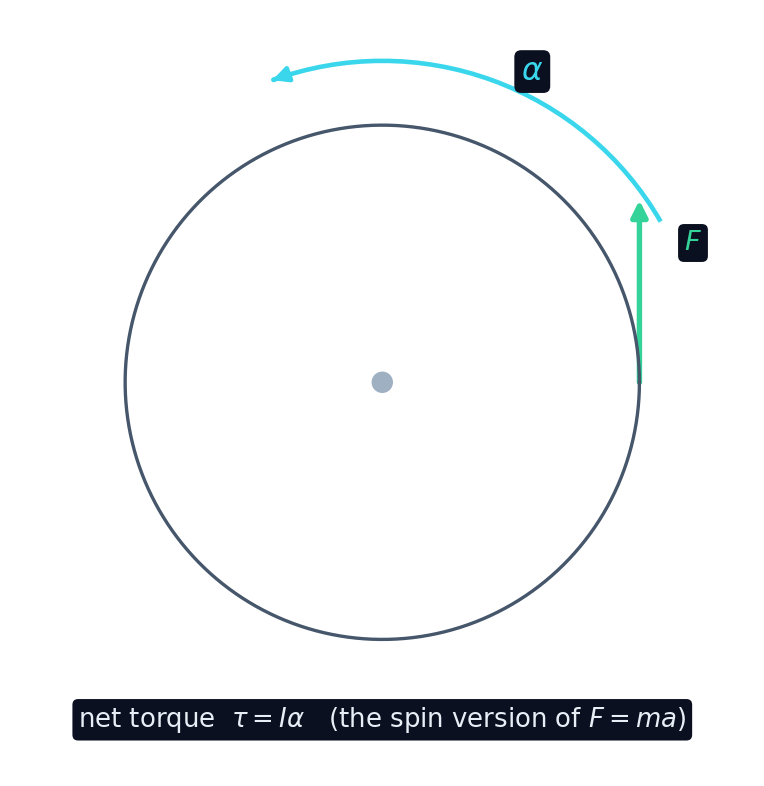
- Net torque equals rotational inertia times angular acceleration: $\sum \tau = I\alpha$.
- Rearranged: $\alpha = \dfrac{\sum \tau}{I}$ — the spin-up a torque produces.
- Bigger torque ⇒ bigger $\alpha$; bigger $I$ ⇒ smaller $\alpha$.
- It is the exact twin of $\vec F = m\vec a$, with rotational quantities swapped in.
A net torque of $12\ \text{N·m}$ acts on a wheel with $I = 3\ \text{kg}\cdot\text{m}^2$. What is the angular acceleration, in $\tfrac{\text{rad}}{\text{s}^2}$?
$\alpha = \sum\tau / I = 12/3 = 4\ \tfrac{\text{rad}}{\text{s}^2}$.
What net torque gives a wheel of $I = 2\ \text{kg}\cdot\text{m}^2$ an angular acceleration of $5\ \tfrac{\text{rad}}{\text{s}^2}$? Answer in $\text{N·m}$.
$\tau = I\alpha = 2 \times 5 = 10\ \text{N·m}$.
The rotational second law is net torque $= I\_\_$ (fill in the angular quantity).
$\sum\tau = I\alpha$ — inertia times angular acceleration.
The full analogy
- Force $\to$ torque $\tau$; mass $\to$ rotational inertia $I$; acceleration $\to$ angular acceleration $\alpha$.
- Every straight-line law has a rotational partner obtained by this swap.
- $F = ma$ becomes $\tau = I\alpha$; momentum $mv$ becomes angular momentum $I\omega$.
- Learn one column and you get the other for free.
In the rotational second law $\tau = I\alpha$, which quantity plays the role of mass?
Rotational inertia $I$ is the rotational analog of mass — the resistance to angular acceleration.
Match each rotational quantity to its linear analog.
$\tau \leftrightarrow F$, $I \leftrightarrow m$, $\alpha \leftrightarrow a$ turns $F = ma$ into $\tau = I\alpha$.
Why heavy wheels are sluggish
- A large $I$ (mass far from the axis) means a given torque produces only a small $\alpha$.
- Flywheels use this on purpose — they resist changes in spin, smoothing an engine's rotation.
- To spin up a heavy wheel quickly you need a large torque.
- Same torque, larger inertia ⇒ slower to get going, and slower to stop.
Newton's second law for rotation
A torque produces angular acceleration in proportion to rotational inertia: torque = I times alpha.
For the same net torque, a larger rotational inertia gives a smaller angular acceleration.
$\alpha = \tau / I$: a larger $I$ in the denominator means a smaller $\alpha$.
The rotational second law uses net torque, not force, and rotational inertia, not mass. Do not plug plain mass into $\tau = I\alpha$ — you must use $I = \sum mr^2$, which depends on how the mass is arranged.
A net torque of $12\ \text{N}\cdot\text{m}$ acts on a wheel of rotational inertia $I = 3\ \text{kg}\cdot\text{m}^2$.
- $\alpha = \dfrac{\sum \tau}{I} = \dfrac{12}{3} = 4\ \tfrac{\text{rad}}{\text{s}^2}$.
Double the rotational inertia and the same torque gives only $2\ \tfrac{\text{rad}}{\text{s}^2}$.
Newton's second law for rotation: $\sum \tau = I\alpha$, so $\alpha = \sum\tau / I$. It mirrors $F = ma$ with torque for force, rotational inertia for mass, and angular acceleration for acceleration. A large $I$ makes an object sluggish to spin up or slow down.