Rotational Equilibrium and Newton's First Law in Rotational Form
Introduced| English |
|---|
| rotational equilibrium/rəʊˈteɪʃənl ˌiːkwɪˈlɪbrɪəm/ |
A seesaw balances — but not where you'd guess
- A heavy adult and a light child can balance a seesaw perfectly.
- The trick: the light child sits farther from the pivot.
- Balance is not about equal forces — it is about equal torques.
- This is Newton's first law, rewritten for rotation.
The condition for rotational equilibrium
- An object is in rotational equilibrium 转动平衡 when the net torque is zero: $\sum \tau = 0$.
- The total anticlockwise torque equals the total clockwise torque.
- Combined with $\sum F = 0$ (no linear acceleration), the object is in full equilibrium.
- Nothing starts to spin and nothing starts to move.
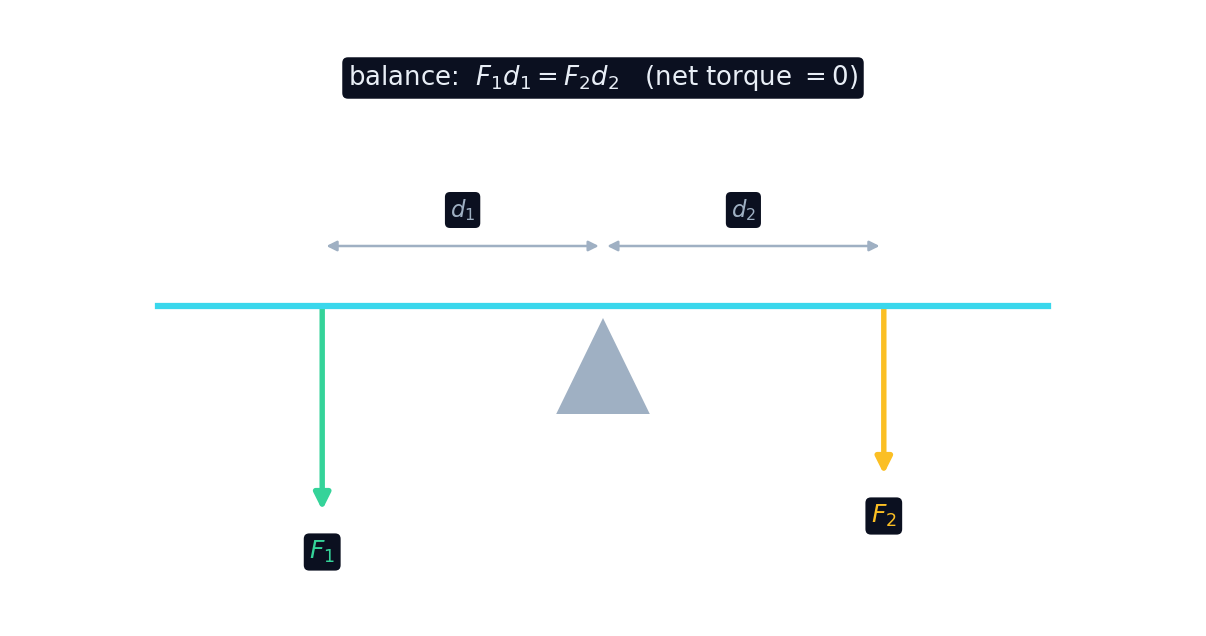
Balance the torques
Adjust the forces and distances until the clockwise and anticlockwise torques cancel.
What is the condition for rotational equilibrium?
Rotational equilibrium means $\sum \tau = 0$ — the turning effects balance.
In rotational equilibrium, the total clockwise torque equals the total ____ torque.
The clockwise and anticlockwise torques must be equal for $\sum\tau = 0$.
Rotational equilibrium is the rotational form of which of Newton's laws?
Zero net torque ⇒ no change in rotation — the first law (inertia) written for rotation.
Trading force for distance
- Because torque is force times distance, a small force far out can balance a large force close in.
- $F_1 d_1 = F_2 d_2$ is the balance condition for a simple beam.
- A light child at the end balances a heavy adult near the middle.
- This is the whole principle of levers, cranes and balance scales.
A $300\ \text{N}$ child sits $2\ \text{m}$ from a seesaw pivot. How far from the pivot must a $400\ \text{N}$ child sit to balance it, in metres?
$300 \times 2 = 400 \times d_2 \Rightarrow d_2 = 600/400 = 1.5\ \text{m}$.
For an object to be in full equilibrium, select all that must be true.
Full equilibrium needs $\sum F = 0$ and $\sum \tau = 0$, so neither linear nor angular acceleration. Shape is irrelevant.
Why it keeps structures standing
- Bridges, shelves and cranes must be in rotational equilibrium, or they would rotate and fall.
- Engineers add up every torque about a chosen pivot and set the sum to zero.
- A clever pivot choice makes an unknown force vanish from the equation.
- Getting the torques to balance is what keeps a loaded structure still.
Rotational equilibrium needs the torques to balance, not the forces. Two equal forces can still spin an object if they act at different distances or in the same turning sense. Always compare $\sum \tau$, using each force's lever arm.
Two equal forces acting at different distances from a pivot always keep an object balanced.
Balance needs equal torques, not equal forces. Different lever arms give different torques.
A child of weight $300\ \text{N}$ sits $2\ \text{m}$ from a seesaw's pivot. Where must a $400\ \text{N}$ child sit to balance it?
- Balance: $F_1 d_1 = F_2 d_2 \Rightarrow 300 \times 2 = 400 \times d_2$.
- $d_2 = \dfrac{600}{400} = 1.5\ \text{m}$ from the pivot, on the other side.
Rotational equilibrium means zero net torque: $\sum \tau = 0$, so the clockwise and anticlockwise torques balance ($F_1 d_1 = F_2 d_2$ for a beam). It is Newton's first law for rotation, and — with $\sum F = 0$ — keeps seesaws, bridges and cranes still.