Skip to content · ⁨Bỏ qua nội dung⁩

Acids and Bases · ⁨Axít và Bazơ⁩

AP Chemistry · ⁨AP Hóa học⁩ · Topic 8 · ⁨Chủ đề 8⁩

Video lesson for this topic · ⁨Bài học video cho chủ đề này⁩ Open the video page · ⁨Mở trang video⁩
8:24

Axít và Bazơ

Hai mảnh giấy — một màu đỏ, một màu xanh dương. Nhúng chúng vào chất lỏng và màu sắc thay đổi; màu sắc đó cho bạn biết liệu chất lỏng là axit hay bazơ.…

English narration · English + 中文 subtitles burned in · ⁨Giọng đọc tiếng Anh · phụ đề tiếng Anh + 中文 được ghi trực tiếp⁩

8.1

Introduction to Acids and Bases · ⁨Giới thiệu về Axit và Bazơ⁩

Syllabus · ⁨Chương trình⁩
English

Learning Objective 8.1.A: Calculate the values of $\mathrm{pH}$ and $\mathrm{pOH}$, based on $K_w$ and the concentration of all species present in a neutral solution of water.

  • 8.1.A.1 The concentrations of hydronium ion and hydroxide ion are often reported as $\mathrm{pH}$ and $\mathrm{pOH}$, respectively.
    • Equation: $\mathrm{pH} = -\log[\mathrm{H_3O^+}]$
    • Equation: $\mathrm{pOH} = -\log[\mathrm{OH^-}]$
    • The terms "hydrogen ion" and "hydronium ion" and the symbols $\mathrm{H^+}(aq)$ and $\mathrm{H_3O^+}(aq)$ are often used interchangeably for the aqueous ion of hydrogen. Hydronium ion and $\mathrm{H_3O^+}(aq)$ are preferred, but $\mathrm{H^+}(aq)$ is also accepted on the AP Exam.
  • 8.1.A.2 Water autoionizes with an equilibrium constant $K_w$.
    • Equation: $K_w = [\mathrm{H_3O^+}][\mathrm{OH^-}] = 1.0 \times 10^{-14}$ at 25°C
  • 8.1.A.3 In pure water, $\mathrm{pH} = \mathrm{pOH}$ is called a neutral solution. At 25°C, $\mathrm{p}K_w = 14.0$ and thus $\mathrm{pH} = \mathrm{pOH} = 7.0$.
    • Equation: $\mathrm{p}K_w = 14 = \mathrm{pH} + \mathrm{pOH}$ at 25°C
  • 8.1.A.4 The value of $K_w$ is temperature dependent, so the pH of pure, neutral water will deviate from 7.0 at temperatures other than 25°C.
Tiếng Việt

Mục tiêu học tập 8.1.A: Tính toán các giá trị $\mathrm{pH}$ và $\mathrm{pOH}$, dựa vào $K_w$ và nồng độ của tất cả các loài hiện diện trong dung dịch nước trung hòa.

  • 8.1.A.1 Nồng độ của ion hydroni và ion hydroxide thường được báo cáo là $\mathrm{pH}$ và $\mathrm{pOH}$, tương ứng.
    • Phương trình: $\mathrm{pH} = -\log[\mathrm{H_3O^+}]$
    • Phương trình: $\mathrm{pOH} = -\log[\mathrm{OH^-}]$
    • Các thuật ngữ "ion hiđro" và "ion hydroni" cùng các ký hiệu $\mathrm{H^+}(aq)$ và $\mathrm{H_3O^+}(aq)$ thường được dùng hoán đổi cho nhau để chỉ ion hiđro trong dung dịch. Ion hydroni và $\mathrm{H_3O^+}(aq)$ được ưu tiên hơn, nhưng $\mathrm{H^+}(aq)$ cũng được chấp nhận trong kỳ thi AP.
  • 8.1.A.2 Nước tự điện li với hằng số cân bằng $K_w$.
    • Phương trình: $K_w = [\mathrm{H_3O^+}][\mathrm{OH^-}] = 1.0 \times 10^{-14}$ ở 25°C
  • 8.1.A.3 Trong nước tinh khiết, $\mathrm{pH} = \mathrm{pOH}$ được gọi là dung dịch trung hòa. Ở 25°C, $\mathrm{p}K_w = 14.0$ và do đó $\mathrm{pH} = \mathrm{pOH} = 7.0$.
    • Phương trình: $\mathrm{p}K_w = 14 = \mathrm{pH} + \mathrm{pOH}$ ở 25°C
  • 8.1.A.4 Giá trị của $K_w$ phụ thuộc vào nhiệt độ, vì vậy pH của nước tinh khiết trung hòa sẽ lệch khỏi 7.0 ở các nhiệt độ khác 25°C.
Source: College Board AP Course and Exam Description · ⁨Nguồn: Mô tả Khóa học và Bài thi College Board AP⁩

English

By the Brønsted–Lowry definition, an acid 酸 is a proton ($\text{H}^+$) donor and a base 碱 is a proton acceptor. When an acid donates a proton it becomes its conjugate base 共轭碱; a base gaining a proton becomes its conjugate acid 共轭酸. Water is amphoteric – it can act as either.

Tiếng Việt
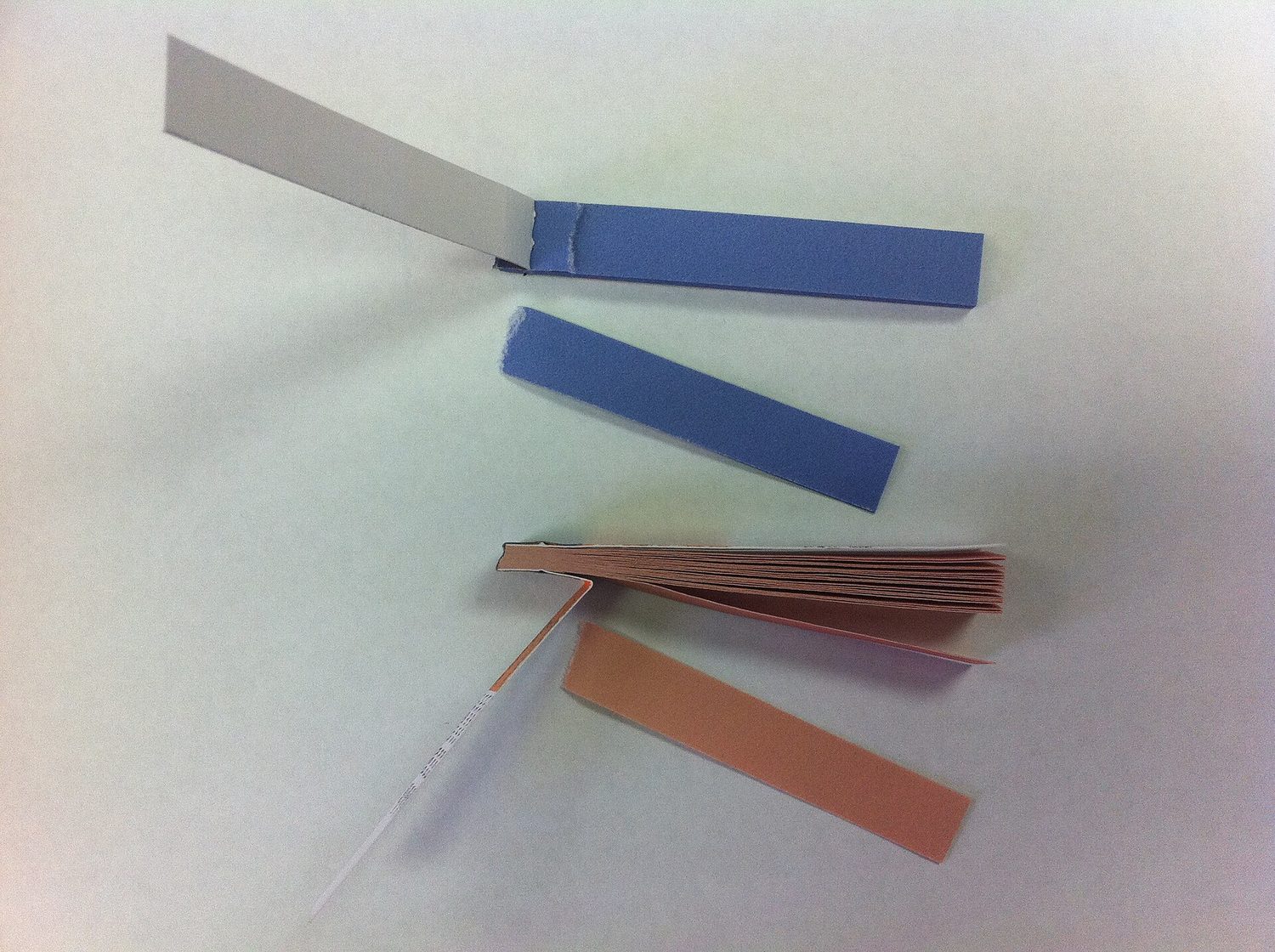
Giấy quỳ tím: chỉ thị axit–bazơ thay đổi màu sắc theo nồng độ H⁺ (pH)

Theo định nghĩa Brønsted–Lowry, một axit là chất nhờ proton ($\text{H}^+$) và một bazơ là chất nhận proton. Khi một axit nhường proton, nó trở thành bazơ liên hợp; một bazơ nhận proton trở thành axit liên hợp. Nước có tính lưỡng tính – có thể đóng vai trò là cả hai.

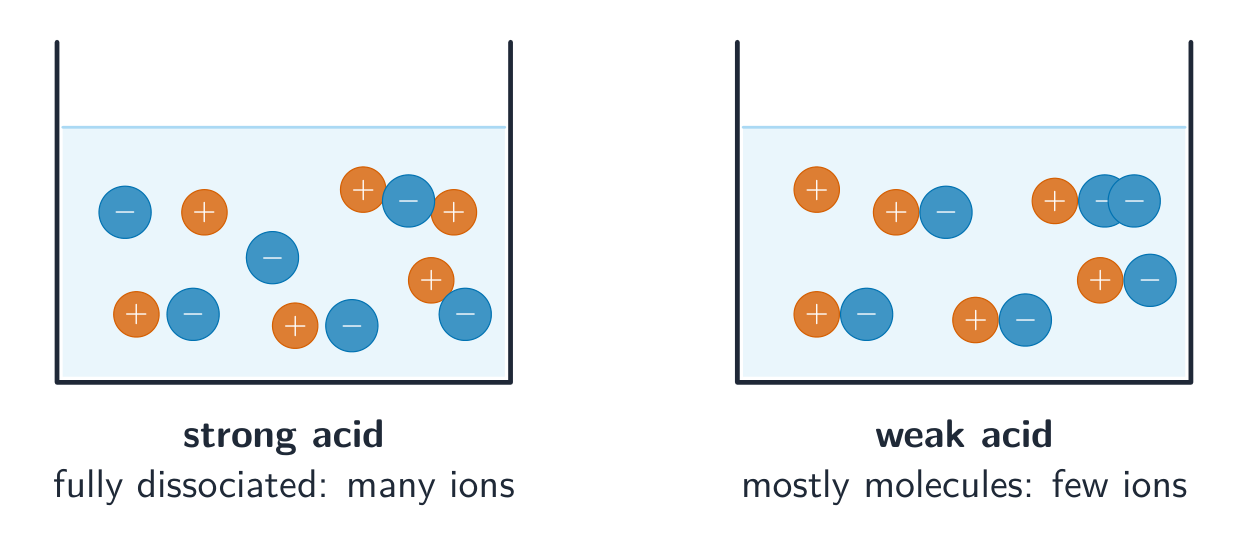
Một axit mạnh phân ly hoàn toàn; một axit yếu chỉ phân ly từng phần
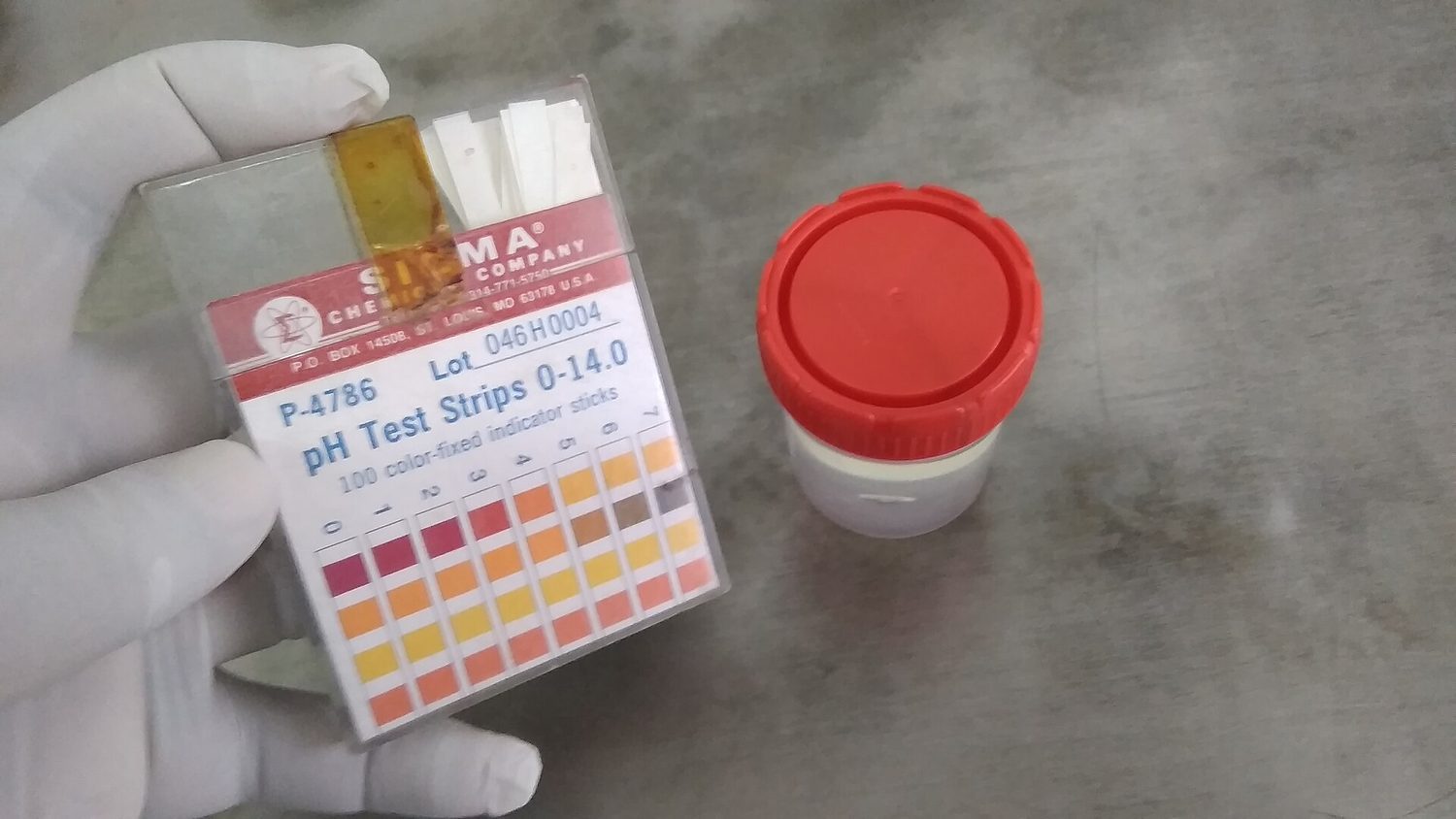
Giấy thử pH: độ mạnh axit-bazơ và nồng độ xác định giá trị pH bạn đo được
纸试纸:酸碱强度和浓度决定测得的pH值
Vocabulary · ⁨Từ vựng⁩ Train · ⁨Luyện tập⁩
English Tiếng Việt
acid/ˈæsɪd/ axit
base/beɪs/ cơ số
conjugate base/ˈkɒndʒuːɡeɪt beɪs/ bazơ liên hợp
conjugate acid/ˈkɒndʒuːɡeɪt ˈæsɪd/ axit liên hợp
autoionization/ˌɔːtəʊˌaɪənaɪˈzeɪʃn/ tự ion hóa
hydronium ion/haɪˈdrəʊnɪəm ˈaɪɒn/ ion hydronium
ion-product constant of water/ˈaɪɒn ˈprɒdʌkt ˈkɒnstənt ɒv ˈwɔːtə/ hằng số tích ion của nước
neutral/ˈnjuːtrəl/ trung tính
pH/piː eɪtʃ/ pH
strong acid/strɒŋ ˈæsɪd/ axit mạnh
strong base/strɒŋ beɪs/ bazơ mạnh
weak acid/wiːk ˈæsɪd/ axit yếu
8.1

The Autoionization of Water · ⁨Tự điện ly của Nước⁩

Syllabus · ⁨Chương trình⁩
English

Learning Objective 8.1.A: Calculate the values of $\mathrm{pH}$ and $\mathrm{pOH}$, based on $K_w$ and the concentration of all species present in a neutral solution of water.

  • 8.1.A.1 The concentrations of hydronium ion and hydroxide ion are often reported as $\mathrm{pH}$ and $\mathrm{pOH}$, respectively.
    • Equation: $\mathrm{pH} = -\log[\mathrm{H_3O^+}]$
    • Equation: $\mathrm{pOH} = -\log[\mathrm{OH^-}]$
    • The terms "hydrogen ion" and "hydronium ion" and the symbols $\mathrm{H^+}(aq)$ and $\mathrm{H_3O^+}(aq)$ are often used interchangeably for the aqueous ion of hydrogen. Hydronium ion and $\mathrm{H_3O^+}(aq)$ are preferred, but $\mathrm{H^+}(aq)$ is also accepted on the AP Exam.
  • 8.1.A.2 Water autoionizes with an equilibrium constant $K_w$.
    • Equation: $K_w = [\mathrm{H_3O^+}][\mathrm{OH^-}] = 1.0 \times 10^{-14}$ at 25°C
  • 8.1.A.3 In pure water, $\mathrm{pH} = \mathrm{pOH}$ is called a neutral solution. At 25°C, $\mathrm{p}K_w = 14.0$ and thus $\mathrm{pH} = \mathrm{pOH} = 7.0$.
    • Equation: $\mathrm{p}K_w = 14 = \mathrm{pH} + \mathrm{pOH}$ at 25°C
  • 8.1.A.4 The value of $K_w$ is temperature dependent, so the pH of pure, neutral water will deviate from 7.0 at temperatures other than 25°C.
Tiếng Việt

Mục tiêu học tập 8.1.A: Tính toán các giá trị $\mathrm{pH}$ và $\mathrm{pOH}$, dựa vào $K_w$ và nồng độ của tất cả các loài hiện diện trong dung dịch nước trung hòa.

  • 8.1.A.1 Nồng độ của ion hydroni và ion hydroxide thường được báo cáo là $\mathrm{pH}$ và $\mathrm{pOH}$, tương ứng.
    • Phương trình: $\mathrm{pH} = -\log[\mathrm{H_3O^+}]$
    • Phương trình: $\mathrm{pOH} = -\log[\mathrm{OH^-}]$
    • Các thuật ngữ "ion hiđro" và "ion hydroni" cùng các ký hiệu $\mathrm{H^+}(aq)$ và $\mathrm{H_3O^+}(aq)$ thường được dùng hoán đổi cho nhau để chỉ ion hiđro trong dung dịch. Ion hydroni và $\mathrm{H_3O^+}(aq)$ được ưu tiên hơn, nhưng $\mathrm{H^+}(aq)$ cũng được chấp nhận trong kỳ thi AP.
  • 8.1.A.2 Nước tự điện li với hằng số cân bằng $K_w$.
    • Phương trình: $K_w = [\mathrm{H_3O^+}][\mathrm{OH^-}] = 1.0 \times 10^{-14}$ ở 25°C
  • 8.1.A.3 Trong nước tinh khiết, $\mathrm{pH} = \mathrm{pOH}$ được gọi là dung dịch trung hòa. Ở 25°C, $\mathrm{p}K_w = 14.0$ và do đó $\mathrm{pH} = \mathrm{pOH} = 7.0$.
    • Phương trình: $\mathrm{p}K_w = 14 = \mathrm{pH} + \mathrm{pOH}$ ở 25°C
  • 8.1.A.4 Giá trị của $K_w$ phụ thuộc vào nhiệt độ, vì vậy pH của nước tinh khiết trung hòa sẽ lệch khỏi 7.0 ở các nhiệt độ khác 25°C.
Source: College Board AP Course and Exam Description · ⁨Nguồn: Mô tả Khóa học và Bài thi College Board AP⁩

English

Even pure water conducts a tiny current, because water molecules react with each other in a reaction called autoionization 自偶电离:

$$2\text{H}_2\text{O} \rightleftharpoons \text{H}_3\text{O}^+ + \text{OH}^-.$$
One water molecule passes a proton to another, making a hydronium ion 水合氢离子 ($\text{H}_3\text{O}^+$, the ion we loosely write as $\text{H}^+$) and a hydroxide ion. This equilibrium has its own constant, the ion-product constant of water 水的离子积:
$$K_w = [\text{H}_3\text{O}^+][\text{OH}^-] = 1.0\times10^{-14}$$
at 25 °C. Defining $\text{pOH}=-\log[\text{OH}^-]$ and taking $-\log$ of the $K_w$ expression gives the rule the rest of this topic leans on:
$$\text{pH} + \text{pOH} = \text{p}K_w = 14.0$$
(again at 25 °C). Know one of pH or pOH and you get the other by subtracting from 14.

In pure water the two ions form in equal numbers, so $[\text{H}_3\text{O}^+]=[\text{OH}^-]$ and $\text{pH}=\text{pOH}=7.0$. This is what neutral 中性 means. Acidic means $[\text{H}_3\text{O}^+]>[\text{OH}^-]$ (pH below 7); basic is the reverse.

Worked example. A solution has $[\text{H}_3\text{O}^+]=2.0\times10^{-3}\ \text{M}$. Find $[\text{OH}^-]$. Because $K_w$ always holds in water,

$$[\text{OH}^-]=\frac{K_w}{[\text{H}_3\text{O}^+]}=\frac{1.0\times10^{-14}}{2.0\times10^{-3}}=5.0\times10^{-12}\ \text{M}.$$
The hydroxide concentration is far smaller than the hydronium, confirming the solution is acidic.

$K_w$ is temperature dependent: autoionization is endothermic, so heating water shifts it forward and raises $K_w$. At 50 °C, $K_w>1.0\times10^{-14}$, so neutral water has $\text{pH}=\text{pOH}<7.0$. It is still neutral, because the ion concentrations are still equal – neutral means equal ions, not a pH of exactly 7.

Tiếng Việt

Ngay cả nước tinh khiết cũng dẫn điện nhẹ, vì các phân tử nước tương tác với nhau qua một phản ứng gọi là tự điện ly:

$$2\text{H}_2\text{O} \rightleftharpoons \text{H}_3\text{O}^+ + \text{OH}^-.$$
Một phân tử nước chuyển giao một proton cho phân tử khác, tạo ra ion hydroni ($\text{H}_3\text{O}^+$, ion mà chúng ta thường viết gọn là $\text{H}^+$) và ion hydroxide. Cân bằng này có hằng số riêng, gọi là hằng số tích ion của nước:
$$K_w = [\text{H}_3\text{O}^+][\text{OH}^-] = 1.0\times10^{-14}$$
ở 25 °C. Định nghĩa $\text{pOH}=-\log[\text{OH}^-]$ và lấy $-\log$ của $K_w$ biểu thức đưa ra quy tắc mà phần còn lại của chủ đề này dựa vào:
$$\text{pH} + \text{pOH} = \text{p}K_w = 14.0$$
(lại ở 25 °C). Biết một trong hai giá trị pH hoặc pOH, bạn sẽ tìm được cái kia bằng cách lấy 14 trừ đi.

Trong nước tinh khiết, hai ion hình thành với số lượng bằng nhau, nên $[\text{H}_3\text{O}^+]=[\text{OH}^-]$ và $\text{pH}=\text{pOH}=7.0$. Đây chính là ý nghĩa của trung tính. Axit có nghĩa là $[\text{H}_3\text{O}^+]>[\text{OH}^-]$ (pH dưới 7); bazơ là điều ngược lại.

Ví dụ minh họa. Một dung dịch có $[\text{H}_3\text{O}^+]=2.0\times10^{-3}\ \text{M}$. Tìm $[\text{OH}^-]$. Vì $K_w$ luôn đúng trong nước,

$$[\text{OH}^-]=\frac{K_w}{[\text{H}_3\text{O}^+]}=\frac{1.0\times10^{-14}}{2.0\times10^{-3}}=5.0\times10^{-12}\ \text{M}.$$
Nồng độ hydroxide nhỏ hơn nhiều so với hydroni, xác nhận dung dịch có tính axit.

$K_w$ phụ thuộc vào nhiệt độ: tự điện ly là phản ứng thu nhiệt, nên đun nóng nước sẽ đẩy cân bằng về phía trước và làm tăng $K_w$. Ở 50 °C, $K_w>1.0\times10^{-14}$, nên nước trung tính có $\text{pH}=\text{pOH}<7.0$. Nó vẫn trung tính, vì nồng độ ion vẫn bằng nhau – trung tính có nghĩa là ion bằng nhau, không phải pH đúng bằng 7.

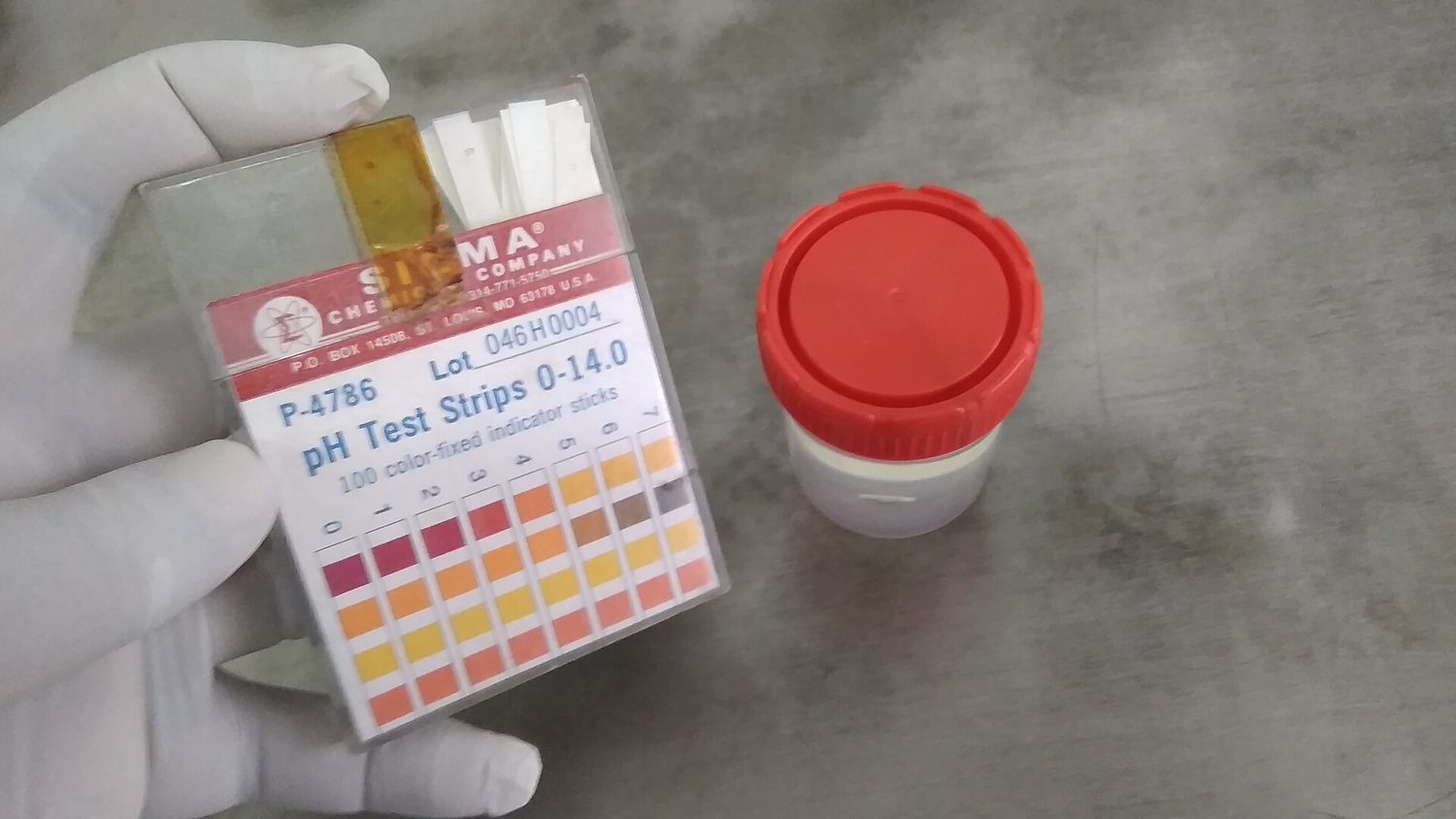
Giấy thử pH: nước tự ion hóa nên nước tinh khiết có pH 7; axit và bazơ làm dịch chuyển H+ và OH-
pH试纸:水自电离所以纯水是pH 7;酸和碱移动H+和OH-
8.2

pH and pOH of Strong Acids and Bases · ⁨pH và pOH của Axit và Bazơ MẠNH⁩

Syllabus · ⁨Chương trình⁩
English

Learning Objective 8.2.A: Calculate $\mathrm{pH}$ and $\mathrm{pOH}$ based on concentrations of all species in a solution of a strong acid or a strong base.

  • 8.2.A.1 Molecules of a strong acid (e.g., $\mathrm{HCl}$, $\mathrm{HBr}$, $\mathrm{HI}$, $\mathrm{HClO_4}$, $\mathrm{H_2SO_4}$, and $\mathrm{HNO_3}$) will completely ionize in aqueous solution to produce hydronium ions and the conjugate base of the acid. As such, the concentration of $\mathrm{H_3O^+}$ in a strong acid solution is equal to the initial concentration of the strong acid, and thus the $\mathrm{pH}$ of the strong acid solution is easily calculated.
  • 8.2.A.2 When dissolved in solution, strong bases (e.g., group I and II hydroxides) completely dissociate to produce hydroxide ions. As such, the concentration of $\mathrm{OH^-}$ in a strong base solution is equal to the initial concentration of a group I hydroxide and double the initial concentration of a group II hydroxide, and thus the $\mathrm{pOH}$ (and $\mathrm{pH}$) of the strong base solution is easily calculated.
Tiếng Việt

Mục tiêu học tập 8.2.A: Tính toán $\mathrm{pH}$ và $\mathrm{pOH}$ dựa trên nồng độ của tất cả các loài trong dung dịch axit mạnh hoặc bazơ mạnh.

  • 8.2.A.1 Phân tử của axit mạnh (ví dụ: $\mathrm{HCl}$, $\mathrm{HBr}$, $\mathrm{HI}$, $\mathrm{HClO_4}$, $\mathrm{H_2SO_4}$, và $\mathrm{HNO_3}$) sẽ điện li hoàn toàn trong dung dịch nước để tạo ra ion hydroni và bazơ liên hợp của axit. Do đó, nồng độ $\mathrm{H_3O^+}$ trong dung dịch axit mạnh bằng với nồng độ ban đầu của axit mạnh, và vì vậy $\mathrm{pH}$ của dung dịch axit mạnh dễ dàng được tính toán.
  • 8.2.A.2 Khi hòa tan trong dung dịch, bazơ mạnh (ví dụ: hydroxide nhóm I và II) phân ly hoàn toàn để tạo ra ion hydroxide. Do đó, nồng độ $\mathrm{OH^-}$ trong dung dịch bazơ mạnh bằng với nồng độ ban đầu của hydroxide nhóm I và gấp đôi nồng độ ban đầu của hydroxide nhóm II, và vì vậy $\mathrm{pOH}$ (và $\mathrm{pH}$) của dung dịch bazơ mạnh dễ dàng được tính toán.

Source: College Board AP Course and Exam Description · ⁨Nguồn: Mô tả Khóa học và Bài thi College Board AP⁩

English

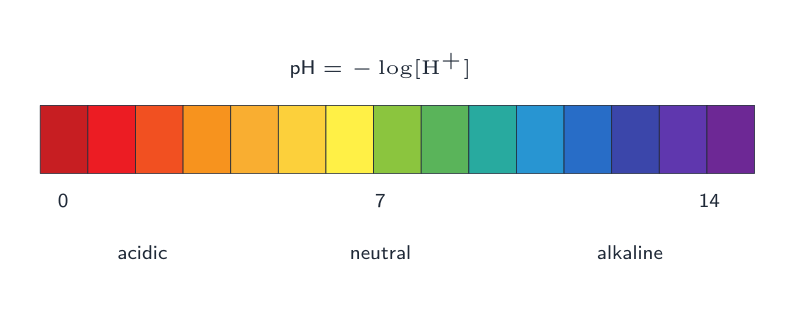
The pH pH值 scale measures acidity: $\text{pH}=-\log[\text{H}^+]$, with $\text{pH}+\text{pOH}=14$ at 25 °C. A strong acid 强酸 or strong base 强碱 dissociates completely, so its ion concentration equals its concentration – read pH directly. Lower pH means more acidic.

Worked example. Find the pH of $0.010\ \text{M}$ HCl. Because HCl is a strong acid it is fully dissociated, so $[\text{H}^+]=0.010\ \text{M}$ and

$$\text{pH}=-\log(0.010)=2.0.$$
For a strong base like $0.010\ \text{M}$ NaOH, $\text{pOH}=2.0$, so $\text{pH}=14-2.0=12.0$.

Tiếng Việt

Thang đo pH đo độ axit: $\text{pH}=-\log[\text{H}^+]$, với $\text{pH}+\text{pOH}=14$ ở 25 °C. Một axit mạnh hoặc bazơ mạnh phân ly hoàn toàn, nên nồng độ ion bằng với nồng độ dung dịch – đọc trực tiếp pH. pH càng thấp thì tính axit càng mạnh.

Thang đo pH: pH là logarit âm của nồng độ ion hydro
The pH scale: pH is the negative log of the hydrogen-ion concentration

Ví dụ minh họa. Tìm pH của $0.010\ \text{M}$ HCl. Vì HCl là axit mạnh nên phân ly hoàn toàn, do đó $[\text{H}^+]=0.010\ \text{M}$ và

$$\text{pH}=-\log(0.010)=2.0.$$
Đối với một bazơ mạnh như $0.010\ \text{M}$ NaOH, $\text{pOH}=2.0$, nên $\text{pH}=14-2.0=12.0$.

Explore · ⁨Khám phá⁩

Move along the pH scale · ⁨Di chuyển dọc theo thang pH⁩

pH measures hydrogen-ion concentration on a log scale: each unit is a tenfold change. Strong acids sit low, strong bases high, 7 is neutral. · ⁨pH đo nồng độ ion hydro theo thang logarit: mỗi đơn vị là sự thay đổi mười lần. Axit mạnh nằm thấp, base mạnh nằm cao, 7 là trung tính.⁩

8.3

Weak Acid and Base Equilibria · ⁨Cân bằng Axit yếu và Bazơ yếu⁩

Syllabus · ⁨Chương trình⁩
Learning ObjectiveEssential Knowledge

8.3.A
Explain the relationship among $\mathrm{pH}$, $\mathrm{pOH}$, and concentrations of all species in a solution of a monoprotic weak acid or weak base.

  • 8.3.A.1 Weak acids react with water to produce hydronium ions. However, only a small percentage of molecules of a weak acid will ionize in this way. Thus, the concentration of $\mathrm{H_3O^+}$ is much less than the initial concentration of the molecular acid, and the vast majority of the acid molecules remain un-ionized.
  • 8.3.A.2 A solution of a weak acid involves equilibrium between an un-ionized acid and its conjugate base. The equilibrium constant for this reaction is $K_a$, often reported as $\mathrm{p}K_a$. The pH of a weak acid solution can be determined from the initial acid concentration and the $\mathrm{p}K_a$.
    • Equation: $K_a = \dfrac{[\mathrm{H_3O^+}][\mathrm{A^-}]}{[\mathrm{HA}]}$
    • Equation: $\mathrm{p}K_a = -\log K_a$
  • 8.3.A.3 Weak bases react with water to produce hydroxide ions in solution. However, ordinarily just a small percentage of the molecules of a weak base in solution will ionize in this way. Thus, the concentration of $\mathrm{OH^-}$ in the solution does not equal the initial concentration of the base, and the vast majority of the base molecules remain un-ionized.
  • 8.3.A.4 A solution of a weak base involves equilibrium between an un-ionized base and its conjugate acid. The equilibrium constant for this reaction is $K_b$, often reported as $\mathrm{p}K_b$. The $\mathrm{pH}$ of a weak base solution can be determined from the initial base concentration and the $\mathrm{p}K_b$.
    • Equation: $K_b = \dfrac{[\mathrm{OH^-}][\mathrm{HB^+}]}{[\mathrm{B}]}$
    • Equation: $\mathrm{p}K_b = -\log K_b$
  • 8.3.A.5 The percent ionization of a weak acid (or base) can be calculated from its $\mathrm{p}K_a$ ($\mathrm{p}K_b$) and the initial concentration of the acid (base). The percent ionization can also be calculated from the initial concentration of the acid (base) and the equilibrium concentration of any of the species in the equilibrium expression.
  • 8.3.A.6 For any conjugate acid-base pair, the acid ionization constant and base ionization constant are related by $K_w$:
    • Equation: $K_w = K_a \times K_b$
    • Equation: $\mathrm{p}K_w = \mathrm{p}K_a + \mathrm{p}K_b$

Source: College Board AP Course and Exam Description · ⁨Nguồn: Mô tả Khóa học và Bài thi College Board AP⁩

English

A weak acid 弱酸 only partly dissociates, described by an equilibrium constant $K_a$ (larger $K_a$ = stronger weak acid); a weak base has $K_b$. For any conjugate acid–base pair the two are linked through water, $K_a\times K_b = K_w$, so $\text{p}K_a+\text{p}K_b=14$ – a stronger acid always has a weaker conjugate base. Because dissociation is small, find $[\text{H}^+]$ with an ICE table and the $K_a$ expression, often using the small-$x$ approximation.

Worked example. Find the pH of $0.10\ \text{M}$ acetic acid, $K_a=1.8\times10^{-5}$. Let $x=[\text{H}^+]$ at equilibrium; the ICE table gives $K_a=\dfrac{x^2}{0.10-x}\approx\dfrac{x^2}{0.10}$ (small-$x$ approximation), so

$$x=\sqrt{K_a\times0.10}=\sqrt{1.8\times10^{-6}}=1.3\times10^{-3}\ \text{M}\;\Rightarrow\;\text{pH}=-\log(1.3\times10^{-3})=2.9.$$
The weak acid is far less acidic than a strong acid of the same concentration (which would be pH $1.0$).

Tiếng Việt

Một axit yếu chỉ phân ly một phần, được mô tả bởi hằng số cân bằng $K_a$ ($K_a$ lớn hơn = axit yếu mạnh hơn); một bazơ yếu có $K_b$. Đối với bất kỳ cặp axit-bazơ liên hợp nào, hai chất liên kết thông qua nước, $K_a\times K_b = K_w$, nên $\text{p}K_a+\text{p}K_b=14$ – axit càng mạnh thì bazơ liên hợp càng yếu. Vì sự phân ly nhỏ, tìm $[\text{H}^+]$ bằng bảng ICE và biểu thức $K_a$, thường sử dụng xấp xỉ nhỏ-$x$.

Ví dụ minh họa. Tìm pH của $0.10\ \text{M}$ axit axetic, $K_a=1.8\times10^{-5}$. Đặt $x=[\text{H}^+]$ tại cân bằng; bảng ICE cho biết $K_a=\dfrac{x^2}{0.10-x}\approx\dfrac{x^2}{0.10}$ (xấp xỉ nhỏ-$x$), nên

$$x=\sqrt{K_a\times0.10}=\sqrt{1.8\times10^{-6}}=1.3\times10^{-3}\ \text{M}\;\Rightarrow\;\text{pH}=-\log(1.3\times10^{-3})=2.9.$$
Axit yếu có tính axit yếu hơn nhiều so với axit mạnh cùng nồng độ (điều đó sẽ có pH $1.0$).

8.4

Acid-Base Reactions and Buffers · ⁨Phản ứng Axit-Bazơ và Dung dịch Đệm⁩

Syllabus · ⁨Chương trình⁩
English

Learning Objective 8.4.A: Explain the relationship among the concentrations of major species in a mixture of weak and strong acids and bases.

  • 8.4.A.1 When a strong acid and a strong base are mixed, they react quantitatively in a reaction represented by the equation: $\mathrm{H^+}(aq) + \mathrm{OH^-}(aq) \rightarrow \mathrm{H_2O}(l)$. The pH of the resulting solution may be determined from the concentration of excess reagent.
  • 8.4.A.2 When a weak acid and a strong base are mixed, they react quantitatively in a reaction represented by the equation: $\mathrm{HA}(aq) + \mathrm{OH^-}(aq) \rightleftarrows \mathrm{A^-}(aq)\ \mathrm{H_2O}(l)$. If the weak acid is in excess, then a buffer solution is formed, and the $\mathrm{pH}$ can be determined from the Henderson-Hasselbalch (H–H) equation (see 8.9.A.1). If the strong base is in excess, then the $\mathrm{pH}$ can be determined from the moles of excess hydroxide ion and the total volume of solution. If they are equimolar, then the (slightly basic) $\mathrm{pH}$ can be determined from the equilibrium represented by the equation: $\mathrm{A^-}(aq) + \mathrm{H_2O}(l) \rightleftarrows \mathrm{HA}(aq) + \mathrm{OH^-}(aq)$.
  • 8.4.A.3 When a weak base and a strong acid are mixed, they will react quantitatively in a reaction represented by the equation: $\mathrm{B}(aq) + \mathrm{H_3O^+}(aq) \rightleftarrows \mathrm{HB^+}(aq) + \mathrm{H_2O}(l)$. If the weak base is in excess, then a buffer solution is formed, and the $\mathrm{pH}$ can be determined from the H–H equation. If the strong acid is in excess, then the $\mathrm{pH}$ can be determined from the moles of excess hydronium ion and the total volume of solution. If they are equimolar, then the (slightly acidic) $\mathrm{pH}$ can be determined from the equilibrium represented by the equation: $\mathrm{HB^+}(aq) + \mathrm{H_2O}(l) \rightleftarrows \mathrm{B}(aq) + \mathrm{H_3O^+}(aq)$.
  • 8.4.A.4 When a weak acid and a weak base are mixed, they will react to an equilibrium state whose reaction may be represented by the equation: $\mathrm{HA}(aq) + \mathrm{B}(aq) \rightleftarrows \mathrm{A^-}(aq) + \mathrm{HB^+}(aq)$.
Tiếng Việt

Mục tiêu học tập 8.4.A: Giải thích mối quan hệ giữa nồng độ các thành phần chính trong hỗn hợp axit và bazơ yếu và mạnh.

  • 8.4.A.1 Khi axit mạnh và bazơ mạnh được trộn lẫn, chúng phản ứng hoàn toàn theo phương trình: $\mathrm{H^+}(aq) + \mathrm{OH^-}(aq) \rightarrow \mathrm{H_2O}(l)$. pH của dung dịch thu được có thể được xác định từ nồng độ chất phản ứng dư thừa.
  • 8.4.A.2 Khi axit yếu và bazơ mạnh được trộn lẫn, chúng phản ứng hoàn toàn theo phương trình: $\mathrm{HA}(aq) + \mathrm{OH^-}(aq) \rightleftarrows \mathrm{A^-}(aq)\ \mathrm{H_2O}(l)$. Nếu axit yếu dư thừa, dung dịch đệm sẽ hình thành, và $\mathrm{pH}$ có thể được xác định từ phương trình Henderson-Hasselbalch (H–H) (xem 8.9.A.1). Nếu bazơ mạnh dư thừa, thì $\mathrm{pH}$ có thể được xác định từ số mol hydroxide dư thừa và tổng thể tích dung dịch. Nếu chúng đồng mol, thì (độ pH hơi kiềm) $\mathrm{pH}$ có thể được xác định từ cân bằng đại diện bởi phương trình: $\mathrm{A^-}(aq) + \mathrm{H_2O}(l) \rightleftarrows \mathrm{HA}(aq) + \mathrm{OH^-}(aq)$.
  • 8.4.A.3 Khi bazơ yếu và axit mạnh được trộn lẫn, chúng sẽ phản ứng hoàn toàn theo phương trình: $\mathrm{B}(aq) + \mathrm{H_3O^+}(aq) \rightleftarrows \mathrm{HB^+}(aq) + \mathrm{H_2O}(l)$. Nếu bazơ yếu dư thừa, dung dịch đệm sẽ hình thành, và $\mathrm{pH}$ có thể được xác định từ phương trình H–H. Nếu axit mạnh dư thừa, thì $\mathrm{pH}$ có thể được xác định từ số mol hydronium dư thừa và tổng thể tích dung dịch. Nếu chúng đồng mol, thì (độ pH hơi axit) $\mathrm{pH}$ có thể được xác định từ cân bằng đại diện bởi phương trình: $\mathrm{HB^+}(aq) + \mathrm{H_2O}(l) \rightleftarrows \mathrm{B}(aq) + \mathrm{H_3O^+}(aq)$.
  • 8.4.A.4 Khi axit yếu và bazơ yếu được trộn lẫn, chúng sẽ phản ứng đạt trạng thái cân bằng mà phản ứng có thể được đại diện bởi phương trình: $\mathrm{HA}(aq) + \mathrm{B}(aq) \rightleftarrows \mathrm{A^-}(aq) + \mathrm{HB^+}(aq)$.

Source: College Board AP Course and Exam Description · ⁨Nguồn: Mô tả Khóa học và Bài thi College Board AP⁩

English

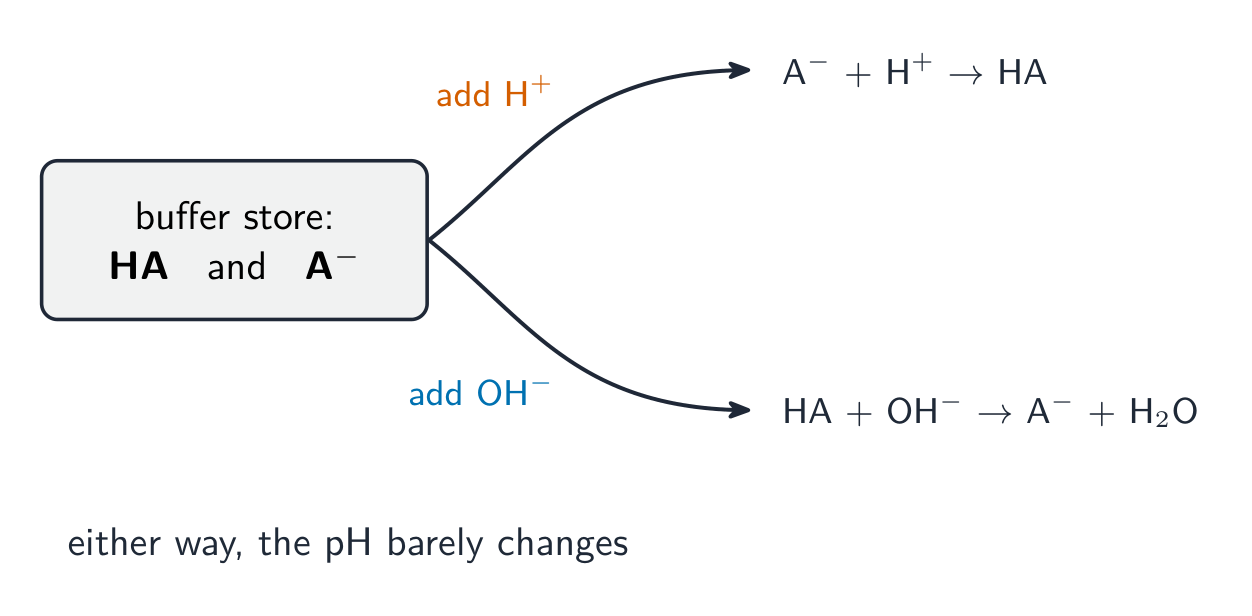
A buffer 缓冲溶液 resists pH change. It contains a weak acid and its conjugate base (or a weak base and its conjugate acid) in comparable amounts. Added acid is neutralized by the conjugate base, and added base by the weak acid, so pH barely moves.

Tiếng Việt

Dung dịch đệm chống lại sự thay đổi pH. Nó chứa một axit yếu và bazơ liên hợp của nó (hoặc bazơ yếu và axit liên hợp) với lượng tương đương. Axit thêm vào sẽ bị bazơ liên hợp trung hòa, và bazơ thêm vào sẽ bị axit yếu trung hòa, nên pH hầu như không di chuyển.

8.5

Acid-Base Titrations · ⁨Chuẩn độ Axit-Bazơ⁩

Syllabus · ⁨Chương trình⁩
English

Learning Objective 8.5.A: Explain results from the titration of a mono- or polyprotic acid or base solution, in relation to the properties of the solution and its components.

  • 8.5.A.1 An acid-base reaction can be carried out under controlled conditions in a titration. A titration curve, plotting $\mathrm{pH}$ against the volume of titrant added, is useful for summarizing results from a titration.
  • 8.5.A.2 At the equivalence point for titrations of monoprotic acids or bases, the number of moles of titrant added is equal to the number of moles of analyte originally present. This relationship can be used to obtain the concentration of the analyte. This is the case for titrations of strong acids/bases and weak acids/bases.
  • 8.5.A.3 For titrations of weak acids/bases, it is useful to consider the point halfway to the equivalence point, that is, the half-equivalence point. At this point, there are equal concentrations of each species in the conjugate acid-base pair, for example, for a weak acid $[\mathrm{HA}] = [\mathrm{A^-}]$. Because $\mathrm{pH} = \mathrm{p}K_a$ when the conjugate acid and base have equal concentrations, the $\mathrm{p}K_a$ can be determined from the $\mathrm{pH}$ at the half-equivalence point in a titration.
  • 8.5.A.4 At the equivalence point, pH is determined by the major species in solution. Strong acid and strong base titrations result in neutral pH at the equivalence point. However, in titrations of weak acids (weak bases), the conjugate base of the weak acid (conjugate acid of the weak base) is present at the equivalence point and can undergo proton-transfer reactions with the surrounding water, producing basic (acidic) solutions.
  • 8.5.A.5 For polyprotic acids, titration curves can be used to determine the number of acidic protons. In doing so, the major species present at any point along the curve can be identified, along with the $\mathrm{p}K_a$ associated with each proton in a weak polyprotic acid.
    • Exclusion statement: Computation of the concentration of each species present in the titration curve for polyprotic acids will not be assessed on the AP Exam. Such computations for titration of monoprotic acids are within the scope of the course (see 8.4.A.2 and 8.4.A.3), as is qualitative reasoning regarding what species are present in large versus small concentrations at any point in a titration of a polyprotic acid.
Tiếng Việt

Mục tiêu học tập 8.5.A: Giải thích kết quả từ phép chuẩn độ dung dịch axit hoặc bazơ đơn protic hay đa protic, liên quan đến tính chất của dung dịch và các thành phần của nó.

  • 8.5.A.1 Một phản ứng axit-bazơ có thể được thực hiện trong điều kiện kiểm soát thông qua phép chuẩn độ. Đường chuẩn độ, biểu diễn $\mathrm{pH}$ theo thể tích chất chuẩn độ thêm vào, hữu ích để tóm tắt kết quả từ phép chuẩn độ.
  • 8.5.A.2 Tại điểm tương đương đối với phép chuẩn độ axit hoặc bazơ đơn protic, số mol chất chuẩn độ thêm vào bằng với số mol analyte ban đầu có mặt. Mối quan hệ này có thể được sử dụng để tìm nồng độ analyte. Điều này đúng cho cả phép chuẩn độ axit/bazơ mạnh và axit/bazơ yếu.
  • 8.5.A.3 Đối với phép chuẩn độ axit/bazơ yếu, việc xem xét điểm halfway đến điểm tương đương, tức là điểm nửa tương đương, là hữu ích. Tại điểm này, có nồng độ bằng nhau của mỗi loài trong cặp axit-bazơ liên hợp, ví dụ, đối với axit yếu $[\mathrm{HA}] = [\mathrm{A^-}]$. Vì $\mathrm{pH} = \mathrm{p}K_a$ khi axit liên hợp và bazơ liên hợp có nồng độ bằng nhau, nên $\mathrm{p}K_a$ có thể được xác định từ $\mathrm{pH}$ tại điểm nửa tương đương trong phép chuẩn độ.
  • 8.5.A.4 Tại điểm tương đương, pH được xác định bởi các thành phần chính trong dung dịch. Phép chuẩn độ axit mạnh và bazơ mạnh dẫn đến pH trung tính tại điểm tương đương. Tuy nhiên, trong phép chuẩn độ axit yếu (bazơ yếu), bazơ liên hợp của axit yếu (axit liên hợp của bazơ yếu) có mặt tại điểm tương đương và có thể tham gia phản ứng chuyển giao proton với nước xung quanh, tạo ra dung dịch kiềm (axit).
  • 8.5.A.5 Đối với axit đa protic, đường chuẩn độ có thể được sử dụng để xác định số lượng proton axit. Trong quá trình này, các thành phần chính có mặt tại bất kỳ điểm nào trên đường cong có thể được xác định, cùng với $\mathrm{p}K_a$ liên quan đến từng proton trong một axit đa protic yếu.
    • Tuyên bố loại trừ: Việc tính toán nồng độ của mỗi loài xuất hiện trên đường chuẩn độ đối với axit đa protic sẽ không được đánh giá trong Kỳ thi AP. Các phép tính như vậy cho phép chuẩn độ axit đơn protic nằm trong phạm vi khóa học (xem 8.4.A.2 và 8.4.A.3), cũng như suy luận định tính về những loài nào có mặt với nồng độ lớn so với nhỏ tại bất kỳ điểm nào trong phép chuẩn độ axit đa protic.

Source: College Board AP Course and Exam Description · ⁨Nguồn: Mô tả Khóa học và Bài thi College Board AP⁩

English
An acid–base titration curve

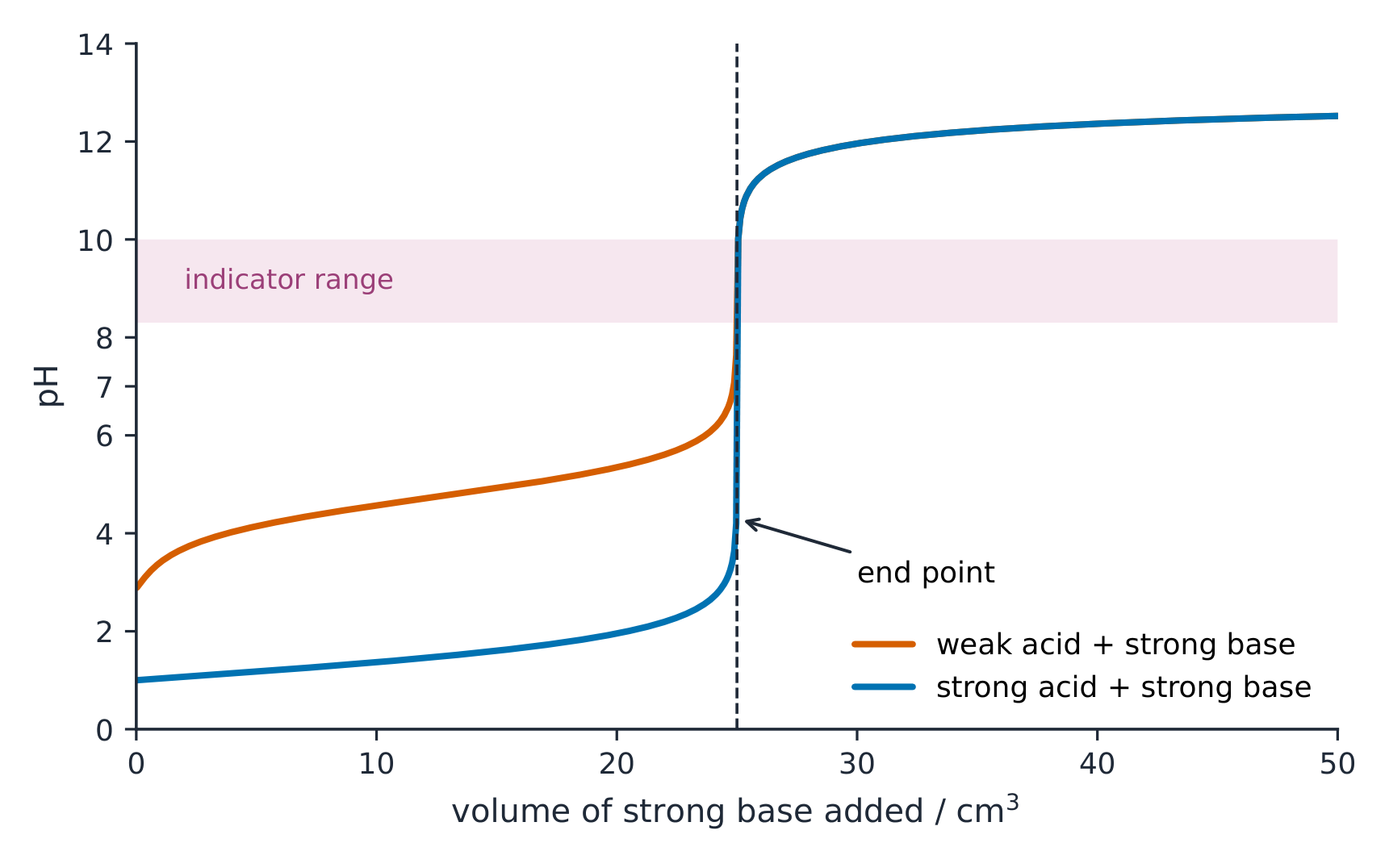
A titration curve 滴定曲线 plots pH as base (or acid) is added. Key points: the equivalence point 等当点 (moles of acid = moles of base – a steep jump), and the half-equivalence point, where $\text{pH}=\text{p}K_a$ (half the weak acid is converted, so a buffer is at its center).

An acid-base indicator 酸碱指示剂 is itself a weak acid whose protonated and deprotonated forms have different colours, so its colour responds to pH. You pick an indicator whose colour change happens near the titration's equivalence-point pH, so the colour flips just as the reaction completes.

Tiếng Việt
Đường cong chìtitrat axit-bazơ

Đường chuẩn độ biểu diễn pH khi thêm bazơ (hoặc axit). Các điểm quan trọng: điểm tương đương (mol axit = mol bazơ – một bước nhảy dốc), và điểm nửa tương đương, nơi $\text{pH}=\text{p}K_a$ (nửa axit yếu đã chuyển hóa, nên dung dịch đệm nằm ở trung tâm).

Một chỉ thị axit-bazơ bản thân nó là một axit yếu, trong đó dạng proton hóa và dạng khử proton có màu sắc khác nhau, nên màu sắc của nó phản ứng với pH. Bạn chọn một chỉ thị mà sự đổi màu xảy ra gần điểm tương đương của đường chuẩn độ, nên màu sắc đảo ngay khi phản ứng hoàn tất.

Đường cong chuẩn độ có bước nhảy dốc gần điểm tương đương
A titration curve has a steep jump near the equivalence point
Explore · ⁨Khám phá⁩

Titrate to the equivalence point · ⁨Chuẩn độ đến điểm tương đương⁩

A titration curve rises gently, then sharply at the equivalence point where moles of acid and base match. The steep jump pinpoints that volume. · ⁨Một đồ thị chuẩn độ tăng nhẹ, sau đó tăng mạnh tại điểm tương đương nơi mol axit và base khớp nhau. Sự nhảy vọt dốc đứng xác định chính xác thể tích đó.⁩

Vocabulary · ⁨Từ vựng⁩ Train · ⁨Luyện tập⁩
English Tiếng Việt
titration curve/taɪˈtreɪʃn kɜːv/ đường cong chuẩn độ
equivalence point/ɪˈkwɪvələns pɔɪnt/ điểm tương đương
acid-base indicator/ˈæsɪd beɪs ˈɪndɪkeɪtə/ chất chỉ thị axít-bazơ
Buffer capacity/ˈbʌfə kəˈpæsɪti/ Dung lượng đệm
8.6

Molecular Structure of Acids and Bases · ⁨Cấu trúc phân tử của Axit và Bazơ⁩

Syllabus · ⁨Chương trình⁩
English

Learning Objective 8.6.A: Explain the relationship between the strength of an acid or base and the structure of the molecule or ion.

  • 8.6.A.1 The protons on a molecule that will participate in acid-base reactions, and the relative strength of these protons, can be inferred from the molecular structure.
    • i. Strong acids (such as $\mathrm{HCl}$, $\mathrm{HBr}$, $\mathrm{HI}$, $\mathrm{HClO_4}$, $\mathrm{H_2SO_4}$, and $\mathrm{HNO_3}$) have very weak conjugate bases that are stabilized by electronegativity, inductive effects, resonance, or some combination thereof.
    • ii. Carboxylic acids are one common class of weak acid.
    • iii. Strong bases (such as group I and II hydroxides) have very weak conjugate acids.
    • iv. Common weak bases include nitrogenous bases such as ammonia as well as carboxylate ions.
    • v. Electronegative elements tend to stabilize the conjugate base relative to the conjugate acid, and so increase acid strength.
Tiếng Việt

Mục tiêu học tập 8.6.A: Giải thích mối quan hệ giữa độ mạnh của axit hoặc bazơ và cấu trúc của phân tử hoặc ion.

  • 8.6.A.1 Các proton trên một phân tử sẽ tham gia phản ứng axit-bazơ, và độ mạnh tương đối của các proton này, có thể được suy luận từ cấu trúc phân tử.
    • i. Axit mạnh (như $\mathrm{HCl}$, $\mathrm{HBr}$, $\mathrm{HI}$, $\mathrm{HClO_4}$, $\mathrm{H_2SO_4}$, và $\mathrm{HNO_3}$) có bazơ liên hợp rất yếu được ổn định bởi độ âm điện, hiệu ứng cảm ứng, cộng hưởng, hoặc sự kết hợp của các yếu tố trên.
    • ii. Axit cacboxylic là một lớp axit yếu phổ biến.
    • iii. Bazơ mạnh (như hydroxide nhóm I và II) có axit liên hợp rất yếu.
    • iv. Các bazơ yếu phổ biến bao gồm bazơ chứa nitơ như ammonia cũng như các ion cacboxylat.
    • v. Các nguyên tố có độ âm điện cao có xu hướng ổn định hóa base liên hợp so với acid liên hợp, do đó làm tăng độ mạnh của acid.

Source: College Board AP Course and Exam Description · ⁨Nguồn: Mô tả Khóa học và Bài thi College Board AP⁩

English

Strength has structural roots. An acid is stronger when its conjugate base is more stable – for example, more electronegative atoms or resonance spreading the negative charge stabilize it. For oxoacids, more oxygen atoms on the central atom means a stronger acid.

Tiếng Việt

Độ mạnh có nguồn gốc từ cấu trúc. Một axit mạnh hơn khi cơ bản liên hợp ổn định hơn – ví dụ, các nguyên tố có độ âm điện cao hơn hoặc cộng hưởng lan tỏa điện tích âm giúp ổn định nó. Đối với axit oxo, nhiều nguyên tử oxy trên nguyên tử trung tâm nghĩa là axit mạnh hơn.

8.7

pH and pKa · ⁨pH và pKa⁩

Syllabus · ⁨Chương trình⁩
English

Learning Objective 8.7.A: Explain the relationship between the predominant form of a weak acid or base in solution at a given $\mathrm{pH}$ and the $\mathrm{p}K_a$ of the conjugate acid or the $\mathrm{p}K_b$ of the conjugate base.

  • 8.7.A.1 The protonation state of an acid or base (i.e., the relative concentrations of $\mathrm{HA}$ and $\mathrm{A^-}$) can be predicted by comparing the $\mathrm{pH}$ of a solution to the $\mathrm{p}K_a$ of the acid in that solution. When solution $\mathrm{pH} < \mathrm{acid}\ \mathrm{p}K_a$, the acid form has a higher concentration than the base form. When solution $\mathrm{pH} > \mathrm{acid}\ \mathrm{p}K_a$, the base form has a higher concentration than the acid form.
  • 8.7.A.2 Acid-base indicators are substances that exhibit different properties (such as color) in their protonated versus deprotonated state, making that property respond to the $\mathrm{pH}$ of a solution.
  • 8.7.A.3 To ensure accurate results in a titration experiment, acid-base indicators should be selected that have a $\mathrm{p}K_a$ close to the $\mathrm{pH}$ at the equivalence point.
Tiếng Việt

Mục tiêu học tập 8.7.A: Giải thích mối quan hệ giữa dạng chủ yếu của một acid yếu hoặc base yếu trong dung dịch ở một $\mathrm{pH}$ nhất định và $\mathrm{p}K_a$ của acid liên hợp hoặc $\mathrm{p}K_b$ của base liên hợp.

  • 8.7.A.1 Trạng thái proton hóa của một acid hay base (tức là tỷ lệ tương đối giữa $\mathrm{HA}$ và $\mathrm{A^-}$) có thể được dự đoán bằng cách so sánh $\mathrm{pH}$ của dung dịch với $\mathrm{p}K_a$ của acid trong dung dịch đó. Khi dung dịch $\mathrm{pH} < \mathrm{acid}\ \mathrm{p}K_a$, nồng độ dạng acid cao hơn dạng base. Khi dung dịch $\mathrm{pH} > \mathrm{acid}\ \mathrm{p}K_a$, nồng độ dạng base cao hơn dạng acid.
  • 8.7.A.2 Chỉ báo acid-base là các chất có tính chất khác nhau (như màu sắc) ở trạng thái proton hóa so với không proton hóa, khiến cho tính chất đó phản ứng với $\mathrm{pH}$ của dung dịch.
  • 8.7.A.3 Để đảm bảo kết quả chính xác trong thí nghiệm chuẩn độ, nên chọn chỉ báo acid-base có $\mathrm{p}K_a$ gần với $\mathrm{pH}$ tại điểm tương đương.

Source: College Board AP Course and Exam Description · ⁨Nguồn: Mô tả Khóa học và Bài thi College Board AP⁩

English

$\text{p}K_a=-\log K_a$: a smaller $\text{p}K_a$ means a stronger acid. Comparing pH to $\text{p}K_a$ tells you the dominant form: below $\text{p}K_a$ the acid form dominates; above it, the conjugate base form dominates.

Tiếng Việt

$\text{p}K_a=-\log K_a$: một $\text{p}K_a$ nhỏ hơn có nghĩa là axit mạnh hơn. So sánh pH với $\text{p}K_a$ cho biết dạng chủ đạo: dưới $\text{p}K_a$ thì dạng axit chiếm ưu thế; trên nó, dạng cơ bản liên hợp chiếm ưu thế.

8.8

Properties of Buffers · ⁨Tính chất của Dung dịch Đệm⁩

Syllabus · ⁨Chương trình⁩
English

Learning Objective 8.8.A: Explain the relationship between the ability of a buffer to stabilize $\mathrm{pH}$ and the reactions that occur when an acid or a base is added to a buffered solution.

  • 8.8.A.1 A buffer solution contains a large concentration of both members in a conjugate acid-base pair. The conjugate acid reacts with added base and the conjugate base reacts with added acid. These reactions are responsible for the ability of a buffer to stabilize $\mathrm{pH}$.
Tiếng Việt

Mục tiêu học tập 8.8.A: Giải thích mối quan hệ giữa khả năng ổn định $\mathrm{pH}$ của dung dịch đệm và các phản ứng xảy ra khi thêm acid hoặc base vào dung dịch đã được đệm.

  • 8.8.A.1 Dung dịch đệm chứa nồng độ lớn của cả hai thành phần trong cặp acid-base liên hợp. Acid liên hợp phản ứng với base được thêm vào và base liên hợp phản ứng với acid được thêm vào. Các phản ứng này là nguyên nhân giúp dung dịch đệm có khả năng ổn định $\mathrm{pH}$.

Source: College Board AP Course and Exam Description · ⁨Nguồn: Mô tả Khóa học và Bài thi College Board AP⁩

English
How a buffer resists pH change

A buffer works best when the weak acid and conjugate base concentrations are similar (pH near $\text{p}K_a$). Choose a buffer whose $\text{p}K_a$ is close to the target pH. Diluting a buffer barely changes its pH, because the acid-to-base ratio stays the same.

Tiếng Việt
Cách dung dịch đệm chống lại sự thay đổi pH

Dung dịch đệm hoạt động tốt nhất khi nồng độ axit yếu và cơ bản liên hợp gần giống nhau (pH gần $\text{p}K_a$). Chọn dung dịch đệm có $\text{p}K_a$ gần với pH mục tiêu. Phá loãng dung dịch đệm hầu như không làm thay đổi pH, vì tỷ lệ axit và bazơ vẫn giữ nguyên.

Dung dịch đệm chống lại sự thay đổi pH bằng cách hấp thụ axit hoặc bazơ thêm vào
Dung dịch đệm chống lại sự thay đổi pH bằng cách hấp thụ axit hoặc bazơ được thêm vào
Vocabulary · ⁨Từ vựng⁩ Train · ⁨Luyện tập⁩
English Tiếng Việt
buffer/ˈbʌfə/ dung dịch đệm
8.9

The Henderson-Hasselbalch Equation · ⁨Phương trình Henderson-Hasselbalch⁩

Syllabus · ⁨Chương trình⁩
English

Learning Objective 8.9.A: Identify the $\mathrm{pH}$ of a buffer solution based on the identity and concentrations of the conjugate acid-base pair used to create the buffer.

  • 8.9.A.1 The $\mathrm{pH}$ of the buffer is related to the $\mathrm{p}K_a$ of the acid and the concentration ratio of the conjugate acid-base pair. This relation is a consequence of the equilibrium expression associated with the dissociation of a weak acid, and is described by the Henderson-Hasselbalch equation. Adding small amounts of acid or base to a buffered solution does not significantly change the ratio of $[\mathrm{A^-}]/[\mathrm{HA}]$ and thus does not significantly change the solution $\mathrm{pH}$. The change in $\mathrm{pH}$ on addition of acid or base to a buffered solution is therefore much less than it would have been in the absence of the buffer.
    • Equation: $\mathrm{pH} = \mathrm{p}K_a + \log\dfrac{[\mathrm{A^-}]}{[\mathrm{HA}]}$
    • Exclusion statement: Computation of the change in pH resulting from the addition of an acid or a base to a buffer will not be assessed on the AP Exam.
    • Exclusion statement: Derivation of the Henderson-Hasselbalch equation will not be assessed on the AP Exam.
Tiếng Việt

Mục tiêu học tập 8.9.A: Xác định $\mathrm{pH}$ của dung dịch đệm dựa trên danh tính và nồng độ của cặp acid-base liên hợp được sử dụng để tạo ra dung dịch đệm.

  • 8.9.A.1 $\mathrm{pH}$ của dung dịch đệm liên quan đến $\mathrm{p}K_a$ của acid và tỷ số nồng độ của cặp acid-base liên hợp. Mối quan hệ này là hệ quả của biểu thức cân bằng đi kèm với sự phân ly của acid yếu, và được mô tả bởi phương trình Henderson-Hasselbalch. Việc thêm lượng nhỏ acid hoặc base vào dung dịch đệm không làm thay đổi đáng kể tỷ số $[\mathrm{A^-}]/[\mathrm{HA}]$ và do đó không làm thay đổi đáng kể $\mathrm{pH}$ của dung dịch. Sự thay đổi $\mathrm{pH}$ khi thêm acid hoặc base vào dung dịch đệm vì thế nhỏ hơn nhiều so với trường hợp không có dung dịch đệm.
    • Phương trình: $\mathrm{pH} = \mathrm{p}K_a + \log\dfrac{[\mathrm{A^-}]}{[\mathrm{HA}]}$
    • Lưu ý loại trừ: Việc tính toán sự thay đổi pH do thêm acid hoặc base vào dung dịch đệm sẽ không được kiểm tra trong kỳ thi AP.
    • Lưu ý loại trừ: Việc suy diễn phương trình Henderson-Hasselbalch sẽ không được kiểm tra trong kỳ thi AP.

Source: College Board AP Course and Exam Description · ⁨Nguồn: Mô tả Khóa học và Bài thi College Board AP⁩

English

For a buffer, the pH follows from the acid-to-base ratio:

$$\text{pH}=\text{p}K_a+\log\frac{[\text{A}^-]}{[\text{HA}]}.$$
When the concentrations are equal, the log is zero and $\text{pH}=\text{p}K_a$. Use it to design a buffer or find its pH quickly.

Worked example. A buffer holds $0.20\ \text{M}$ acetic acid ($\text{p}K_a=4.74$) and $0.30\ \text{M}$ acetate. Its pH is

$$\text{pH}=4.74+\log\frac{0.30}{0.20}=4.74+\log(1.5)=4.74+0.18=4.92.$$
A little more conjugate base than acid pushes the pH just above $\text{p}K_a$, as the equation predicts.

Tiếng Việt

Đối với dung dịch đệm, pH suy ra từ tỷ lệ axit và bazơ:

$$\text{pH}=\text{p}K_a+\log\frac{[\text{A}^-]}{[\text{HA}]}.$$
Khi nồng độ bằng nhau, logarit bằng 0 nên $\text{pH}=\text{p}K_a$. Sử dụng nó để thiết kế dung dịch đệm hoặc tìm nhanh pH của nó.

Ví dụ minh họa. Một dung dịch đệm chứa $0.20\ \text{M}$ axit axetic ($\text{p}K_a=4.74$) và $0.30\ \text{M}$ acetat. Giá trị pH của nó là

$$\text{pH}=4.74+\log\frac{0.30}{0.20}=4.74+\log(1.5)=4.74+0.18=4.92.$$
Một chút cơ bản liên hợp nhiều hơn axit sẽ đẩy pH lên ngay trên $\text{p}K_a$, đúng như phương trình dự đoán.

8.10

Buffer Capacity · ⁨Khả năng đệm⁩

Syllabus · ⁨Chương trình⁩
English

Learning Objective 8.10.A: Explain the relationship between the buffer capacity of a solution and the relative concentrations of the conjugate acid and conjugate base components of the solution.

  • 8.10.A.1 Increasing the concentration of the buffer components (while keeping the ratio of these concentrations constant) keeps the $\mathrm{pH}$ of the buffer the same but increases the capacity of the buffer to neutralize added acid or base.
  • 8.10.A.2 When a buffer has more conjugate acid than base, it has a greater buffer capacity for addition of added base than acid. When a buffer has more conjugate base than acid, it has a greater buffer capacity for addition of added acid than base.
Tiếng Việt

Mục tiêu học tập 8.10.A: Giải thích mối quan hệ giữa dung lượng đệm của dung dịch và nồng độ tương đối của các thành phần axit liên hợp và bazơ liên hợp trong dung dịch.

  • 8.10.A.1 Tăng nồng độ các thành phần đệm (trong khi giữ nguyên tỷ lệ giữa các nồng độ này) làm cho $\mathrm{pH}$ của đệm không đổi nhưng tăng dung lượng đệm trong việc trung hòa axit hoặc bazơ được thêm vào.
  • 8.10.A.2 Khi một dung dịch đệm có nhiều axit liên hợp hơn bazơ, nó có dung lượng đệm lớn hơn đối với việc thêm bazơ so với axit. Ngược lại, khi dung dịch đệm có nhiều bazơ liên hợp hơn axit, nó có dung lượng đệm lớn hơn đối với việc thêm axit so với bazơ.

Source: College Board AP Course and Exam Description · ⁨Nguồn: Mô tả Khóa học và Bài thi College Board AP⁩

English

Buffer capacity 缓冲容量 is how much acid or base a buffer can absorb before its pH changes sharply. It is greatest when the components are concentrated and in roughly equal amounts. Once one component is used up, the buffer fails.

Tiếng Việt

Khả năng đệm là lượng axit hoặc bazơ mà dung dịch đệm có thể hấp thụ trước khi pH thay đổi đột ngột. Nó lớn nhất khi các thành phần có nồng độ cao và ở mức xấp xỉ bằng nhau. Khi một thành phần bị tiêu hao hết, dung dịch đệm mất tác dụng.

8.11

pH and Solubility · ⁨pH và Độ tan⁩

Syllabus · ⁨Chương trình⁩
English

Learning Objective 8.11.A: Identify the qualitative effect of changes in pH on the solubility of a salt.

  • 8.11.A.1 The solubility of a salt is pH sensitive when one of the constituent ions is a weak acid, a weak base, or the hydroxide ion. These effects can be understood qualitatively using Le Châtelier's principle.
    • Exclusion statement: Computations of solubility as a function of pH will not be assessed on the AP Exam.
Tiếng Việt

Mục tiêu học tập 8.11.A: Xác định ảnh hưởng định tính của những thay đổi pH lên độ tan của một muối.

  • 8.11.A.1 Độ tan của một muối nhạy cảm với pH khi một trong các ion cấu thành là axit yếu, bazơ yếu, hoặc ion hydroxide. Những ảnh hưởng này có thể được hiểu theo tính chất định tính bằng cách áp dụng nguyên tắc Le Châtelier.
    • Lời tuyên bố loại trừ: Việc tính toán độ tan theo hàm số của pH sẽ không được đánh giá trong kỳ thi AP.

Source: College Board AP Course and Exam Description · ⁨Nguồn: Mô tả Khóa học và Bài thi College Board AP⁩

English

The solubility of a salt with a basic anion rises in acidic solution: the added $\text{H}^+$ reacts with the anion, removing it from the solubility equilibrium and pulling more solid to dissolve (Le Chatelier applied to $K_{sp}$). So pH can control whether an ionic solid dissolves.

Tiếng Việt

Độ tan của muối có anion bazơ tăng trong dung dịch axit: $\text{H}^+$ được thêm vào phản ứng với anion, loại bỏ nó khỏi cân bằng độ tan và kéo thêm chất rắn tan ra (áp dụng Le Chatelier cho $K_{sp}$). Do đó, pH có thể kiểm soát việc một chất rắn ion tan hay không.

8.11

Exam tips · ⁨Mẹo làm bài thi⁩

English
  • Neutral means equal ions, not pH 7. In pure water $[\text{H}_3\text{O}^+]=[\text{OH}^-]$; since $K_w$ rises with temperature, neutral pH drifts below 7 above 25 °C. Use $K_w=[\text{H}_3\text{O}^+][\text{OH}^-]=1.0\times10^{-14}$ (25 °C) to convert between $[\text{OH}^-]$ and $[\text{H}_3\text{O}^+]$.
  • $\text{pH}=-\log[\text{H}^+]$ is logarithmic — each unit is a ten-fold change in $[\text{H}^+]$.
  • A strong acid/base dissociates completely (so $[\text{H}^+]$ = concentration); a weak one only partly, needing $K_a$.
  • A buffer contains a weak acid and its conjugate base together; it resists pH change by mopping up added acid or base.
  • On a titration curve the equivalence point is the steep jump; the half-equivalence point has $\text{pH}=\text{p}K_a$.
  • A smaller $\text{p}K_a$ means a stronger acid.
Tiếng Việt
  • Trung tính có nghĩa là nồng độ ion bằng nhau, không phải pH = 7. Trong nước tinh khiết $[\text{H}_3\text{O}^+]=[\text{OH}^-]$; vì $K_w$ tăng theo nhiệt độ, pH trung tính sẽ giảm xuống dưới 7 ở trên 25 °C. Sử dụng $K_w=[\text{H}_3\text{O}^+][\text{OH}^-]=1.0\times10^{-14}$ (25 °C) để chuyển đổi giữa $[\text{OH}^-]$ và $[\text{H}_3\text{O}^+]$.
  • $\text{pH}=-\log[\text{H}^+]$ mang tính logarit — mỗi đơn vị tương ứng với sự thay đổi gấp mười lần $[\text{H}^+]$.
  • Một axit/bazơ mạnh phân ly hoàn toàn (nên $[\text{H}^+]$ = nồng độ); một axit/bazơ yếu chỉ phân ly một phần, cần $K_a$.
  • Một dung dịch đệm chứa cả axit yếu và cơ bản liên hợp của nó; nó chống lại sự thay đổi pH bằng cách hấp thụ axit hoặc bazơ được thêm vào.
  • Trên đường cong chuẩn độ, điểm tương đương là bước nhảy dốc; điểm nửa tương đương có $\text{pH}=\text{p}K_a$.
  • Một $\text{p}K_a$ nhỏ hơn có nghĩa là axit mạnh hơn.

Interactive lessons on this topic · ⁨Bài học tương tác về chủ đề này⁩

Work through it step by step, with instant-check exercises. · ⁨Làm theo từng bước, kèm theo bài tập kiểm tra ngay lập tức.⁩

Past Papers · ⁨Đề thi cũ⁩

More topics in AP Chemistry · ⁨AP Hóa học⁩ · ⁨Nhiều chủ đề hơn trong AP Chemistry · ⁨AP Hóa học⁩⁩

Log in or create account · ⁨Đăng nhập hoặc tạo tài khoản⁩

IGCSE, A-Level & AP