English
Learning Objective 1.1.A: Calculate quantities of a substance or its relative number of particles using dimensional analysis and the mole concept.
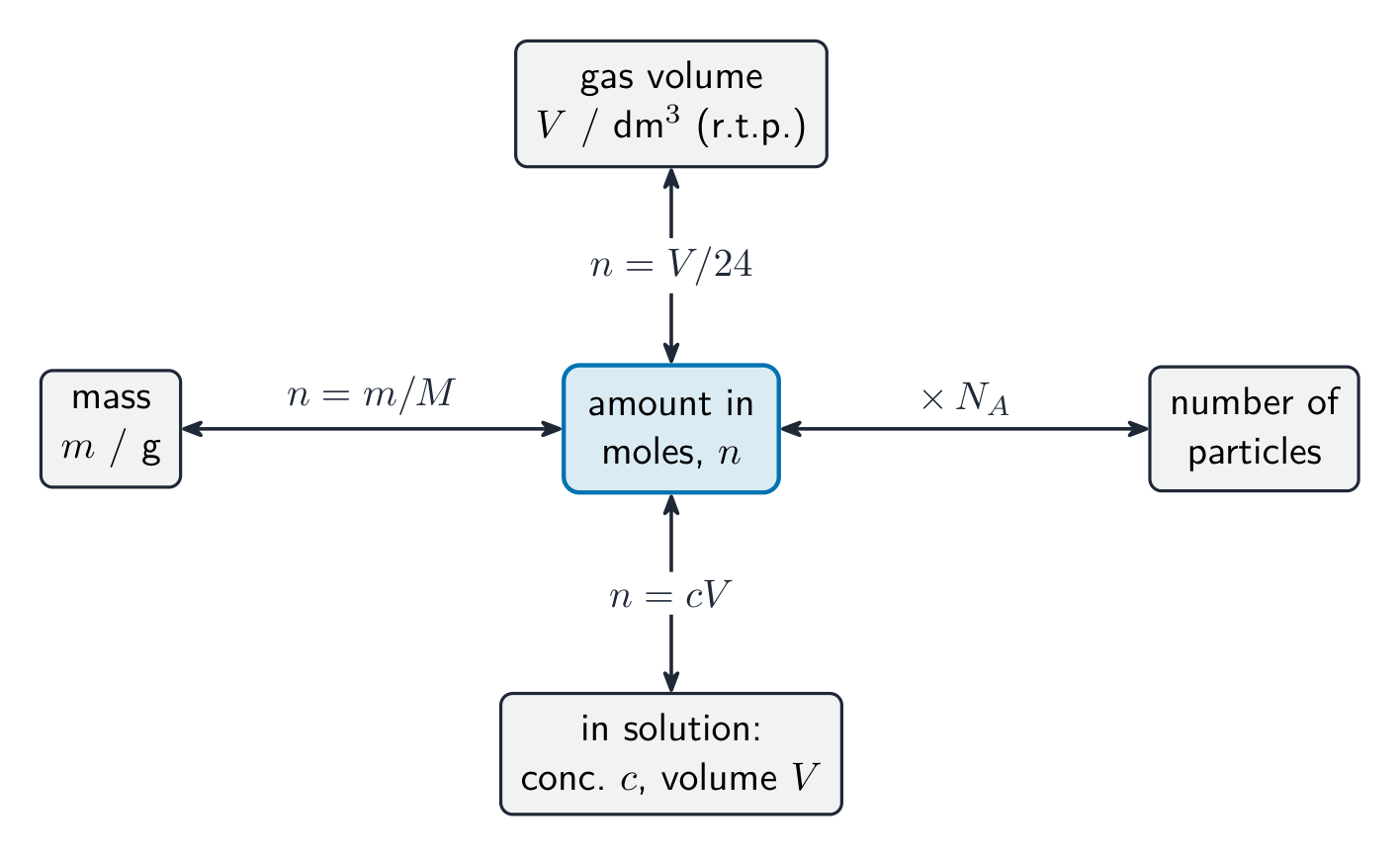
- 1.1.A.1 One cannot count particles directly while performing laboratory work. Thus, there must be a connection between the masses of substances reacting and the actual number of particles undergoing chemical changes.
- 1.1.A.2 Avogadro's number ($N_{\mathrm{A}} = 6.022 \times 10^{23}\ \mathrm{mol}^{-1}$) provides the connection between the number of moles in a pure sample of a substance and the number of constituent particles (or formula units) of that substance.
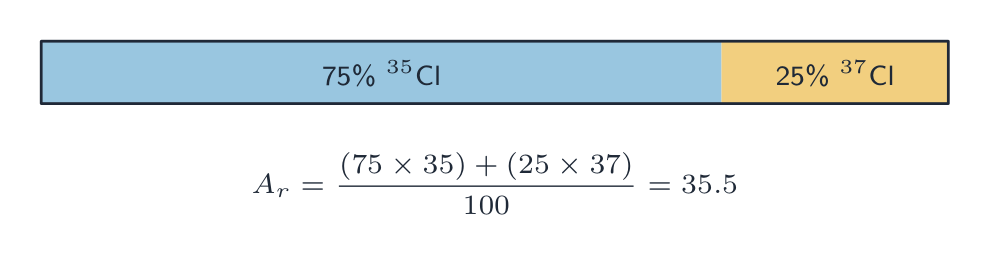
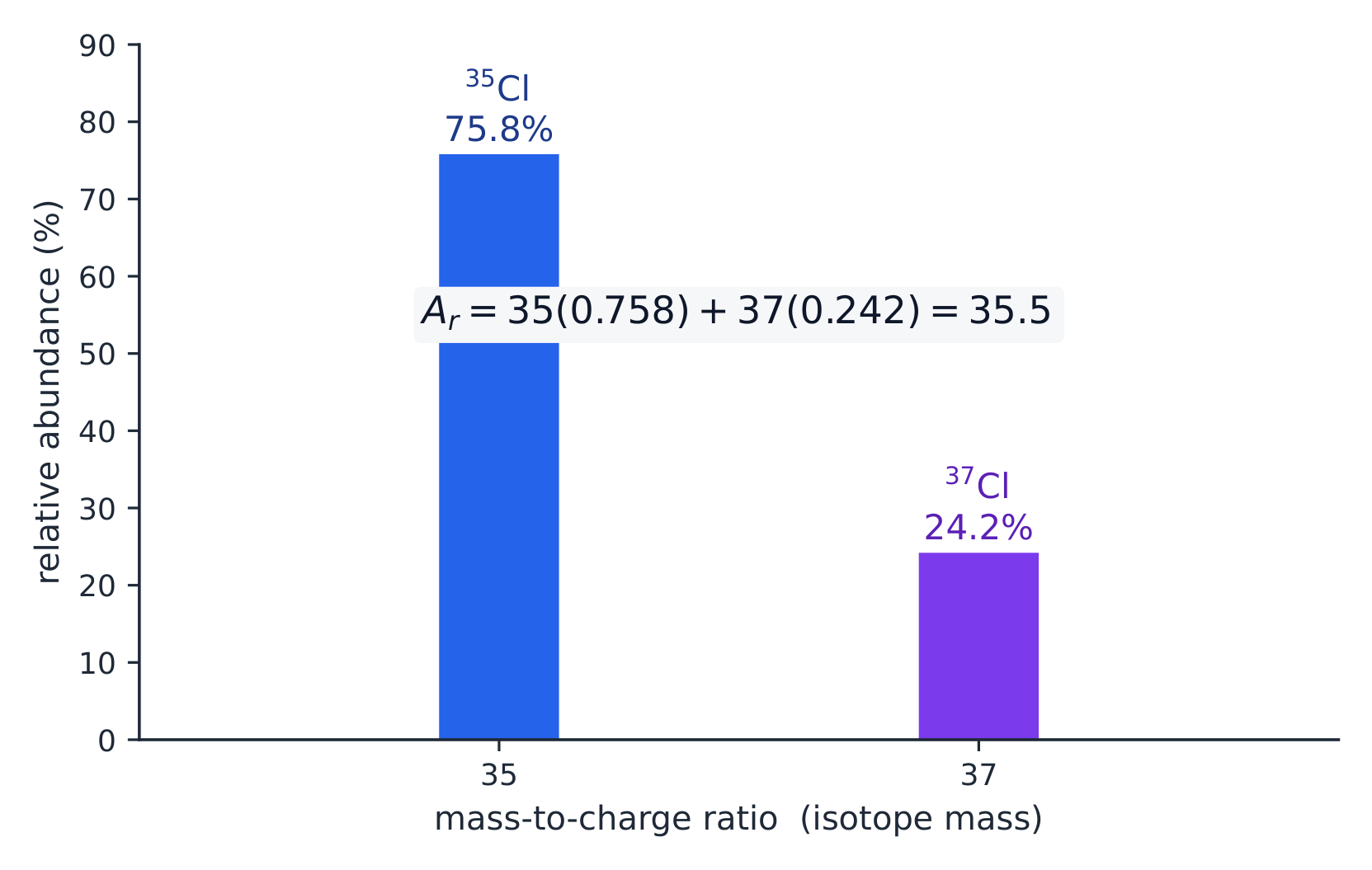
- 1.1.A.3 Expressing the mass of an individual atom or molecule in atomic mass units (amu) is useful because the average mass in amu of one particle (atom or molecule) or formula unit of a substance will always be numerically equal to the molar mass of that substance in grams. Thus, there is a quantitative connection between the mass of a substance and the number of particles that the substance contains.
- Equation: $n = m/M$
Tiếng Việt
Mục tiêu học tập 1.1.A: Tính toán lượng chất hoặc số hạt tương đối của chất đó bằng phương pháp phân tích kích thước (dimensional analysis) và khái niệm mol.
- 1.1.A.1 Không thể đếm trực tiếp các hạt khi thực hiện thí nghiệm trong phòng lab. Do đó, phải có mối liên hệ giữa khối lượng của các chất tham gia phản ứng và số lượng hạt thực tế đang trải qua biến đổi hóa học.
- 1.1.A.2 Số Avogadro ($N_{\mathrm{A}} = 6.022 \times 10^{23}\ \mathrm{mol}^{-1}$) thiết lập mối liên hệ giữa số mol trong một mẫu chất tinh khiết và số hạt cấu thành (hoặc đơn vị công thức) của chất đó.
- 1.1.A.3 Việc biểu thị khối lượng của một nguyên tử hay phân tử riêng lẻ theo đơn vị khối lượng nguyên tử (amu) là hữu ích vì khối lượng trung bình (tính bằng amu) của một hạt (nguyên tử hoặc phân tử) hay đơn vị công thức của một chất luôn có giá trị số học bằng với khối lượng mol của chất đó tính bằng gam. Như vậy, tồn tại mối liên hệ định lượng giữa khối lượng của một chất và số hạt mà chất đó chứa đựng.
- Phương trình: $n = m/M$