English
- describe the relationship between the structure of chloroplasts, as shown in diagrams and electron micrographs, and their function
- explain that energy transferred as ATP and reduced NADP from the light-dependent stage is used during the light-independent stage (Calvin cycle) of photosynthesis to produce complex organic molecules
- state that within a chloroplast, the thylakoids (thylakoid membranes and thylakoid spaces), which occur in stacks called grana, are the site of the light-dependent stage and the stroma is the site of the light-independent stage
- describe the role of chloroplast pigments (chlorophyll a, chlorophyll b, carotene and xanthophyll) in light absorption in thylakoids
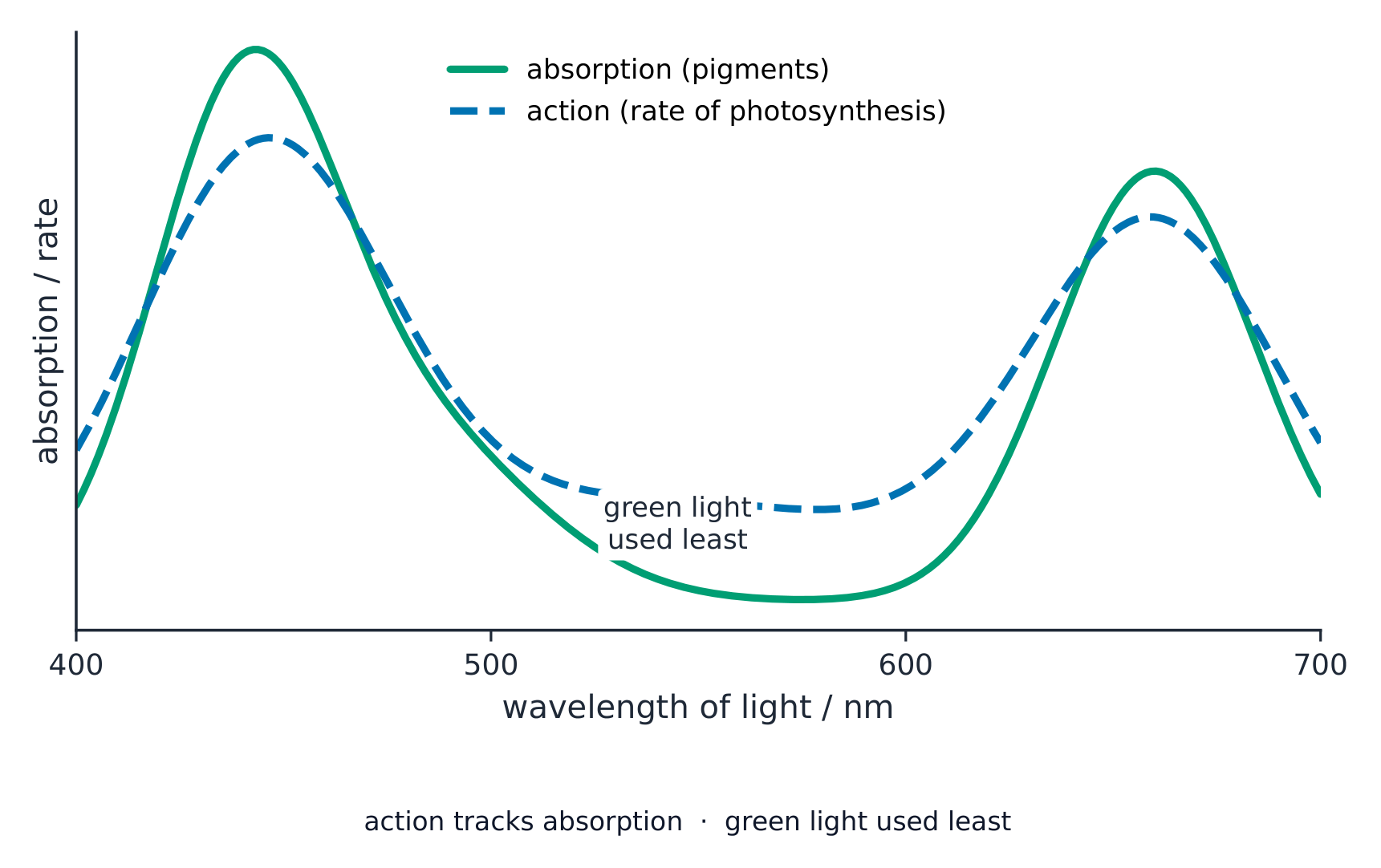
- interpret absorption spectra of chloroplast pigments and action spectra for photosynthesis
- describe and use chromatography to separate and identify chloroplast pigments (reference should be made to $R_f$ values in identification of chloroplast pigments)
- state that cyclic photophosphorylation and non-cyclic photophosphorylation occur during the light-dependent stage of photosynthesis
- explain that in cyclic photophosphorylation: • only photosystem I (PSI) is involved • photoactivation of chlorophyll occurs • ATP is synthesised
- explain that in non-cyclic photophosphorylation: • photosystem I (PSI) and photosystem II (PSII) are both involved • photoactivation of chlorophyll occurs • the oxygen-evolving complex catalyses the photolysis of water • ATP and reduced NADP are synthesised
- explain that during photophosphorylation: • energetic electrons release energy as they pass through the electron transport chain (details of carriers are not expected) • the released energy is used to transfer protons across the thylakoid membrane • protons return to the stroma from the thylakoid space by facilitated diffusion through ATP synthase, providing energy for ATP synthesis (details of ATP synthase are not expected)
- outline the three main stages of the Calvin cycle: • rubisco catalyses the fixation of carbon dioxide by combination with a molecule of ribulose bisphosphate (RuBP), a 5C compound, to yield two molecules of glycerate 3-phosphate (GP), a 3C compound • GP is reduced to triose phosphate (TP) in reactions involving reduced NADP and ATP • RuBP is regenerated from TP in reactions that use ATP
- state that Calvin cycle intermediates are used to produce other molecules, limited to GP to produce some amino acids and TP to produce carbohydrates, lipids and amino acids
Tiếng Việt
- mô tả mối quan hệ giữa cấu trúc của lạp lục, như được thể hiện trong sơ đồ và ảnh kính hiển vi điện tử, với chức năng của chúng
- giải thích rằng năng lượng được chuyển giao dưới dạng ATP và NADP khử từ giai đoạn phụ thuộc ánh sáng được sử dụng trong giai đoạn không phụ thuộc ánh sáng (chu trình Calvin) của quang hợp để sản xuất các phân tử hữu cơ phức tạp
- nêu rằng bên trong lạp lục, các thylakoid (màng thylakoid và không gian thylakoid), vốn xuất hiện theo từng bó gọi là grana, là nơi diễn ra giai đoạn phụ thuộc ánh sáng và stroma là nơi diễn ra giai đoạn không phụ thuộc ánh sáng
- mô tả vai trò của sắc tố lạp lục (chlorophyll a, chlorophyll b, carotene và xanthophyll) trong việc hấp thụ ánh sáng tại thylakoid
- diễn giải qu phổ hấp thụ của sắc tố lạp lục và qu phổ hoạt động cho quá trình quang hợp
- mô tả và sử dụng phân tích sắc tố (chromatography) để tách và xác định sắc tố lạp lục (cần tham khảo $R_f$ giá trị trong việc xác định sắc tố lạp lục)
- nêu rằng phosphoryl hóa quang hợp tuần hoàn và phosphoryl hóa quang hợp phi tuần hoàn xảy ra trong giai đoạn phụ thuộc ánh sáng của quang hợp
- giải thích rằng trong phosphoryl hóa quang hợp tuần hoàn: • chỉ có photosystem I (PSI) tham gia • quang kích hoạt chlorophyll xảy ra • ATP được tổng hợp
- giải thích rằng trong phosphoryl hóa quang hợp phi tuần hoàn: • photosystem I (PSI) và photosystem II (PSII) đều tham gia • quang kích hoạt chlorophyll xảy ra • hệ thống giải phóng oxy xúc tác quang ly nước • ATP và NADP khử được tổng hợp
- giải thích rằng trong quá trình phosphoryl hóa quang hợp: • electron năng lượng cao giải phóng năng lượng khi đi qua chuỗi truyền electron (chi tiết về các chất mang không yêu cầu) • năng lượng được giải phóng sử dụng để vận chuyển proton xuyên qua màng thylakoid • proton quay trở lại stroma từ không gian thylakoid thông qua khuếch tán có协助 thông qua ATP synthase, cung cấp năng lượng cho tổng hợp ATP (chi tiết về ATP synthase không yêu cầu)
- nêu khung ba giai đoạn chính của chu trình Calvin: • rubisco xúc tác cố định carbon dioxide bằng cách kết hợp với một phân tử ribulose bisphosphate (RuBP), một hợp chất 5C, để tạo ra hai phân tử glycerate 3-phosphate (GP), một hợp chất 3C • GP bị khử thành triose phosphate (TP) trong các phản ứng liên quan đến NADP khử và ATP • RuBP được tái tạo từ TP trong các phản ứng sử dụng ATP
- nêu rằng các trung gian của chu trình Calvin được sử dụng để sản xuất các phân tử khác, giới hạn ở GP để sản xuất một số axit amin và TP để sản xuất carbohydrate, lipid và axit amin