The chloroplast and pigments
Introduced| English | Meaning |
|---|---|
| photosynthesis/ˌfəʊtəʊˈsɪnθəsɪs/ | The process by which plants and other organisms use light energy to make organic substances from carbon dioxide and water. |
| chloroplast/ˈklɔːrəʊplæst/ | An organelle in plants and algae that contains photosynthetic pigments and carries out photosynthesis. |
| pigment/ˈpɪɡmənt/ | A substance that absorbs some wavelengths of light more than others and gives a material or structure its colour. |
| thylakoid/ˈθaɪləkɔɪd/ | A flattened membrane compartment in a chloroplast whose membrane carries the light-dependent photosynthetic reactions. |
| granum/ˈɡrænəm/ | granum |
| stroma/ˈstrəʊmə/ | The fluid region inside a chloroplast surrounding its thylakoids, where the Calvin cycle takes place. |
| chlorophyll/ˌklɔːrəʊˈfɪl/ | A green pigment that absorbs light energy for photosynthesis. |
| Calvin cycle/ˈkælvɪn ˈsaɪkl/ | The cycle of reactions that uses ATP and reduced NADP to incorporate carbon dioxide into organic molecules. |
| absorption spectrum/əbˈsɔːpʃn ˈspektrəm/ | The pattern of wavelengths absorbed by a substance, often seen as missing bands or lines in transmitted light. |
| action spectrum/ˈækʃn ˈspektrəm/ | A graph showing how the effectiveness of a process varies with the wavelength of light. |
Photosynthesis 光合作用 and the chloroplast 叶绿体
- Photosynthesis happens inside the chloroplast.
- Its structure has two parts for the two stages of the reaction.
- Coloured pigments 色素 trap the light that powers it all.
Inside a chloroplast
- Flat sacs called thylakoids 类囊体 stack into a granum 基粒 (plural grana) — the thylakoid membranes hold the pigments and run the first stage.
- The fluid around them is the stroma 基质 — where the second stage happens.

A chloroplast: stacks of thylakoids form grana, surrounded by the fluid stroma

Leaves are green because their chloroplasts are full of chlorophyll 叶绿素.
Explore the chloroplast
Tap each part. The light-dependent stage runs on the thylakoid membranes (grana); the Calvin cycle runs in the stroma around them.
In a chloroplast, the stacks of thylakoids (grana) are where:
Difficulty 1/5 · 100 coins + a small bonus on first completion today
The thylakoid membranes hold the pigments and carry out the light-dependent stage; the stroma runs the Calvin cycle.
Match each chloroplast part to its job.
Difficulty 2/5 · 140 coins + a small bonus on first completion today
Light reactions happen on the thylakoid membranes; the Calvin cycle in the stroma; chlorophyll captures the light.
The two stages
- light-dependent stage (in the thylakoids): uses light energy to make ATP and reduced NADP.
- light-independent stage / Calvin cycle 卡尔文循环 (in the stroma): uses that ATP and reduced NADP to build organic molecules from carbon dioxide.

The light-dependent stage makes ATP and reduced NADP, which power the light-independent Calvin cycle

Chloroplasts (small green discs) inside the cells of an Elodea leaf.
The light-dependent stage produces:
Difficulty 1/5 · 100 coins + a small bonus on first completion today
It uses light to make ATP and reduced NADP, which power the Calvin cycle.
The light-dependent stage happens in the thylakoid membranes, and the Calvin cycle in the stroma.
Difficulty 1/5 · 100 coins + a small bonus on first completion today
Light reactions need the membranes (pigments); the Calvin cycle uses the enzymes dissolved in the stroma.
Pigments and their spectra
- Pigments: chlorophyll a and b (absorb red and blue), plus carotene and xanthophyll (absorb other colours).
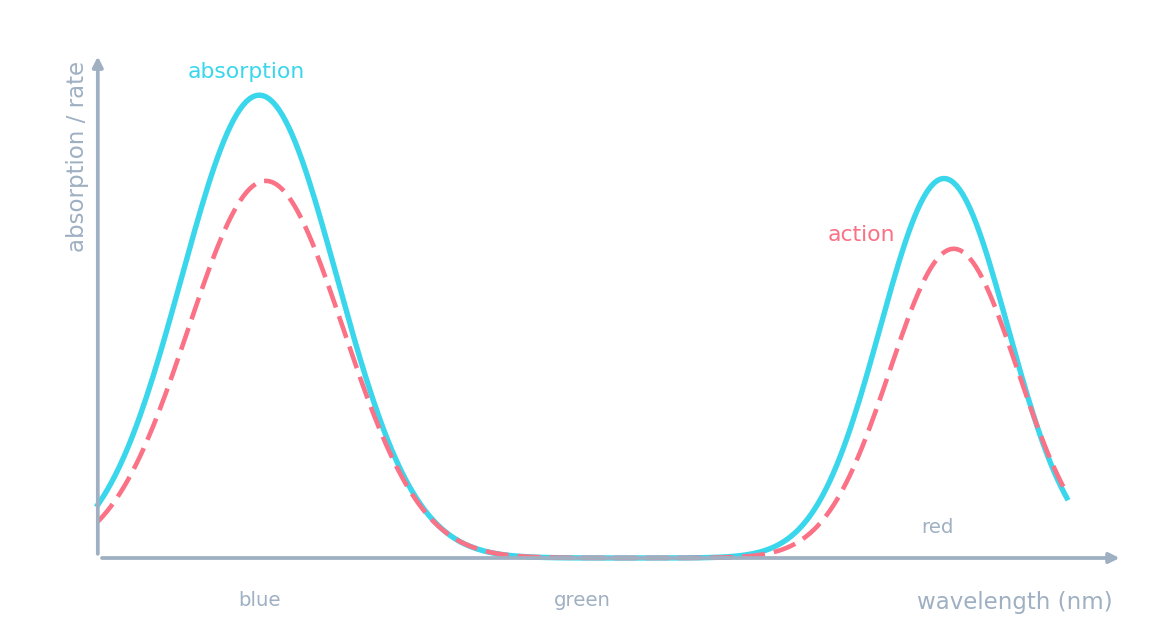
- An absorption spectrum 吸收光谱 shows how much light each pigment absorbs; an action spectrum 作用光谱 shows how fast photosynthesis goes. They match — proof the pigments drive it.
- Chromatography separates pigments; each has an Rf value = distance pigment moved ÷ distance solvent moved.

Chromatography spreads the leaf pigments into spots; each pigment's Rf is its distance over the solvent's
The absorption spectrum and action spectrum match closely. This shows that:
Difficulty 1/5 · 100 coins + a small bonus on first completion today
Where pigments absorb most (blue/red), photosynthesis is fastest — so those pigments drive the reaction.
In chromatography a pigment moves 4 cm while the solvent front moves 8 cm. What is its Rf value?
Difficulty 2/5 · 140 coins + a small bonus on first completion today
Rf = distance moved by the pigment ÷ distance moved by the solvent = 4 ÷ 8 = 0.5.
You've got it
- thylakoids stack into grana (light-dependent stage); the stroma runs the Calvin cycle
- light-dependent → ATP + reduced NADP; light-independent → builds molecules from CO₂
- pigments: chlorophyll a/b + carotene/xanthophyll; absorption & action spectra match
- chromatography + Rf value (pigment distance ÷ solvent distance) identify pigments