English narration · English + 中文 subtitles burned in · การบรรยายภาษาอังกฤษ · คำบรรยายภาษาอังกฤษ + 中文 ลอยตัวบนภาพ
English
This handout covers Topic 1, Number. Cambridge Maths has two levels: Core and Extended. Parts marked (Extended) are only tested on the Extended papers; everything else is for both levels.
Identify and use: • natural numbers • integers (positive, zero and negative) • prime numbers • square numbers • cube numbers • common factors • common multiples • rational and irrational numbers • reciprocals.
Example tasks include: • convert between numbers and words, e.g. six billion is 6000000000 10007 is ten thousand and seven • express 72 as a product of its prime factors • find the highest common factor (HCF) of two numbers • find the lowest common multiple (LCM) of two numbers.
A factor 因数 of a number divides into it exactly, leaving no remainder 余数. The factors of $18$ are $1, 2, 3, 6, 9, 18$.
A multiple 倍数 of a number is that number times an integer. Multiples of $6$ are $6, 12, 18, 24, \dots$
A common factor 公因数 of two numbers is a factor of both.
A common multiple 公倍数 of two numbers is a multiple of both.
Prime, square and cube numbers
A prime number 质数 has exactly two factors: $1$ and itself. The first primes are $2, 3, 5, 7, 11, 13, \dots$ Note that $1$ is not prime.
A square number 平方数 is a whole number times itself: $1, 4, 9, 16, 25, \dots$
A cube number 立方数 uses a whole number three times: $1, 8, 27, 64, \dots$
Rational, irrational and reciprocal
A rational number 有理数 can be written as a fraction 分数$\frac{a}{b}$ of two integers. Examples: $\frac{3}{4}$, $5$, $0.7$.
An irrational number 无理数 cannot be written this way. Examples: $\pi$ and $\sqrt{2}$.
The reciprocal 倒数 of a number is $1$ divided by that number. The reciprocal of $4$ is $\frac{1}{4}$; the reciprocal of $0.25$ is $4$; the reciprocal of $\frac{2}{3}$ is $\frac{3}{2}$.
Prime factors, HCF and LCM
Every integer above $1$ is prime, or can be written as a product 乘积 of prime numbers. To write a number as a product of its prime factors 质因数, keep dividing by the smallest prime that fits.
Worked example. Write $72$ as a product of its prime factors.
The highest common factor (HCF) 最大公因数 of two numbers is the largest factor they share. The lowest common multiple (LCM) 最小公倍数 is the smallest multiple they share. Prime factors give a quick method.
Worked example. Find the HCF and LCM of $72$ and $120$.
factor ตัวประกอบของตัวเลขคือตัวเลขที่หารเข้ากันได้พอดี ไม่มี remainder余数 The factors of $18$ are $1, 2, 3, 6, 9, 18$.
multiple พหุคูณของตัวเลขคือตัวเลขนั้นคูณด้วยจำนวนเต็ม Multiples of $6$ are $6, 12, 18, 24, \dots$
common factor ตัวประกอบร่วมของตัวเลขสองจำนวนคือตัวประกอบของทั้งสอง
common multiple พหุคูณร่วมของตัวเลขสองจำนวนคือพหุคูณของทั้งสอง
จำนวน prime square และ cube
prime number จำนวนเฉพาะมีตัวประกอบเพียงสองตัว: $1$ และตัวมันเอง Prime numbers แรกๆ คือ $2, 3, 5, 7, 11, 13, \dots$ หมายเหตุว่า $1$not ไม่ใช่ prime number
square number จำนวนกำลังสองคือจำนวนเต็มคูณกับตัวเอง: $1, 4, 9, 16, 25, \dots$
cube number จำนวนกำลังสามคือการนำจำนวนเต็มมาคูณกันสามครั้ง: $1, 8, 27, 64, \dots$
irrational number จำนวนอตรรกยะไม่สามารถเขียนแบบนี้ได้ ตัวอย่าง: $\pi$ และ $\sqrt{2}$
reciprocal ส่วนกลับของตัวเลขคือ $1$ หารด้วยตัวเลขนั้น The reciprocal of $4$ is $\frac{1}{4}$; The reciprocal of $0.25$ is $4$; The reciprocal of $\frac{2}{3}$ is $\frac{3}{2}$
ตัวประกอบเฉพาะ HCF และ LCM
จำนวนเต็มทุกจำนวนมากกว่า $1$ เป็น prime number หรือสามารถเขียนเป็น product ผลคูณของจำนวนเฉพาะได้ ในการเขียนตัวเลขเป็นผลคูณของ prime factors ให้หารด้วยจำนวนเฉพาะที่เล็กที่สุดที่ยังหารลงตัวเรื่อยๆ
Worked example. เขียน $72$ เป็นผลคูณของ prime factors
แยกย่อยต่อไปจนทุกกิ่งจบด้วย prime number (วงกลม); การรวบรวม将它们 gives $72 = 2^{3} \times 3^{2}$
HCF Highest Common Factor ตัวประกอบร่วมสูงสุดของตัวเลขสองจำนวนคือตัวประกอบที่ใหญ่ที่สุดที่พวกเขาร่วมกันมี LCM Lowest Common Multiple พหุคูณร่วมต่ำสุดคือพหุคูณที่น้อยที่สุดที่พวกเขาร่วมกันมี Prime factors ให้วิธีการคำนวณที่รวดเร็ว
HCF: เลือก lowest power ของแต่ละ prime number ที่ปรากฏใน both: $2^{3} \times 3 = 24$
LCM: เลือก highest power ของ every prime number ที่ปรากฏ: $2^{3} \times 3^{2} \times 5 = 360$
Explore · สำรวจ
Sets of numbers · เซตของตัวเลข
Every counting number is also an integer, every integer a rational — see how the number sets nest, and how union and intersection combine them. · ทุกจำนวนนับเป็นจำนวนเต็ม, ทุกจำนวนเต็มเป็นจำนวนตรรกยะ — ดูว่าเซตของตัวเลขซ้อนกันอย่างไร และ how union and intersection รวมพวกมันเข้าด้วยกัน
Understand and use set language, notation and Venn diagrams to describe sets.
Venn diagrams are limited to two sets. The following set notation will be used: • $n(A)$ Number of elements in set $A$ • $A'$ Complement of set $A$ • $\mathscr{E}$ Universal set • $A \cup B$ Union of $A$ and $B$ • $A \cap B$ Intersection of $A$ and $B$. Example definition of sets: $A = \{x : x \text{ is a natural number}\}$$B = \{a, b, c, \dots\}$$C = \{x : a \leqslant x \leqslant b\}$.
แผนภาพเวนน์จำกัดอยู่แค่สองเซ็ตProgramming set notation will be used: • $n(A)$ จำนวนองค์ประกอบในเซ็ต $A$ • $A'$ คอมพลีเมนต์ของเซ็ต $A$ • $\mathscr{E}$ เซ็ตเอกภพ • $A \cup B$ ยูเนียนของ $A$ และ $B$ • $A \cap B$ อินเตอร์เซคชันของ $A$ และ $B$. ตัวอย่างนิยามของเซ็ต: $A = \{x : x \text{ is a natural number}\}$$B = \{a, b, c, \dots\}$$C = \{x : a \leqslant x \leqslant b\}$.
English
Subject content
Notes and examples
Understand and use set language, notation and Venn diagrams to describe sets and represent relationships between sets.
Venn diagrams are limited to two or three sets. The following set notation will be used: • $n(A)$ Number of elements in set $A$ • $\in$ "... is an element of ..." • $\notin$ "... is not an element of ..." • $A'$ Complement of set $A$ • $\varnothing$ The empty set • $\mathscr{E}$ Universal set • $A \subseteq B$$A$ is a subset of $B$ • $A \nsubseteq B$$A$ is not a subset of $B$ • $A \cup B$ Union of $A$ and $B$ • $A \cap B$ Intersection of $A$ and $B$. Example definition of sets: $A = \{x : x \text{ is a natural number}\}$$B = \{(x, y) : y = mx + c\}$$C = \{x : a \leqslant x \leqslant b\}$$D = \{a, b, c, \dots\}$.
Tap the regions to see union, intersection and complement — the language of sets. · แตะพื้นที่เพื่อดู ** UNION, INTERSECTION** และส่วนเสริม — ภาษาของเซต
Calculate with the following: • squares • square roots • cubes • cube roots • other powers and roots of numbers.
Includes recall of squares and their corresponding roots from 1 to 15, and recall of cubes and their corresponding roots of 1, 2, 3, 4, 5 and 10, e.g.: • Write down the value of $\sqrt{169}$ . • Work out $5^2 \times \sqrt[3]{8}$ .
Calculate with the following: • squares • square roots • cubes • cube roots • other powers and roots of numbers.
Includes recall of squares and their corresponding roots from 1 to 15, and recall of cubes and their corresponding roots of 1, 2, 3, 4, 5 and 10, e.g.: • Write down the value of $\sqrt{169}$. • Work out $5^2 \times \sqrt[3]{8}$.
Source: Cambridge International syllabus · แหล่งที่มา: หลักสูตร Cambridge International
English
A power 幂 (also called an index 指数, plural indices) shows how many times to multiply a number by itself: $2^{5} = 2 \times 2 \times 2 \times 2 \times 2 = 32$.
A square root 平方根 of a number gives that number when squared: $\sqrt{169} = 13$ because $13^{2} = 169$.
A cube root 立方根 works the same way for cubes: $\sqrt[3]{8} = 2$ because $2^{3} = 8$.
You should be able to recall the squares from $1^2$ to $15^2$ (and their roots), and the cubes of $1, 2, 3, 4, 5$ and $10$.
Worked example. Work out $5^{2} \times \sqrt[3]{8}$.
Source: Cambridge International syllabus · แหล่งที่มา: หลักสูตร Cambridge International
English
Standard form 科学记数法 writes a number as $A \times 10^{n}$, where $1 \leqslant A < 10$ and $n$ is an integer. It is used for very large or very small numbers.
To convert, count how many places the decimal point moves:
$4\,500\,000 = 4.5 \times 10^{6}$ — the point moves $6$ places left, so the power is positive.
$0.00072 = 7.2 \times 10^{-4}$ — the point moves $4$ places right, so the power is negative.
Worked example. Work out $(3 \times 10^{5}) \times (2 \times 10^{-2})$.
Multiply the front numbers and add the powers:
$$3 \times 2 = 6, \qquad 10^{5} \times 10^{-2} = 10^{3}, \qquad \text{so the answer is } 6 \times 10^{3}.$$
To rationalise the denominator 分母有理化 means to remove a surd from the bottom of a fraction (the denominator 分母). Multiply the top and bottom by a value that clears the surd.
Worked example. Rationalise $\dfrac{10}{\sqrt{5}}$ and $\dfrac{1}{-1+\sqrt{3}}$.
rationalise the denominator/ˈræʃənəlaɪz ðə dɪˈnɒmɪneɪtə/
ทำให้ส่วนเป็นจำนวนเต็ม
denominator/dɪˈnɒmɪneɪtə/
ตัวส่วน
numerator/ˈnjuːməreɪtə/
ตัวเศษ
proper fraction/ˈprɒpə ˈfrækʃn/
เศษส่วนแท้
improper fraction/ɪmˈprɒpə ˈfrækʃn/
เศษเกิน
mixed number/mɪkst ˈnʌmbə/
เลขคละ
1.4
Fractions, decimals and percentages · เศษส่วน ทศนิยม และเปอร์เซ็นต์
Syllabus · หลักสูตร
English
Subject content
Notes and examples
1 Use the language and notation of the following in appropriate contexts: • proper fractions • improper fractions • mixed numbers • decimals • percentages.
Candidates are expected to be able to write fractions in their simplest form. Candidates are not expected to use recurring decimal notation.
2 Recognise equivalence and convert between these forms.
Candidates are not expected to demonstrate the conversion of a recurring decimal to a fraction and vice versa.
1 Use the language and notation of the following in appropriate contexts: • proper fractions • improper fractions • mixed numbers • decimals • percentages.
Candidates are expected to be able to write fractions in their simplest form. Recurring decimal notation is required, e.g. • $0.1\dot{7} = 0.1777...$ • $0.1\dot{2}\dot{3} = 0.1232323...$ • $0.\dot{1}2\dot{3} = 0.123123...$
2 Recognise equivalence and convert between these forms.
Includes converting between recurring decimals and fractions and vice versa, e.g. write $0.1\dot{7}$ as a fraction.
Source: Cambridge International syllabus · แหล่งที่มา: หลักสูตร Cambridge International
English
A fraction has a numerator 分子 (the top) and a denominator (the bottom).
proper fraction 真分数: numerator smaller than denominator, e.g. $\frac{3}{4}$.
improper fraction 假分数: numerator the same or larger, e.g. $\frac{7}{4}$.
mixed number 带分数: a whole number plus a fraction, e.g. $1\frac{3}{4}$.
Change between improper and mixed: $\frac{7}{4} = 1\frac{3}{4}$ because $7 \div 4 = 1$ remainder $3$.
A decimal 小数 uses place value after a point. A percentage 百分比 means "out of $100$", so $37\% = \frac{37}{100} = 0.37$.
Converting between forms
To change
Method
Example
fraction → decimal
divide top by bottom
$\frac{3}{8} = 3 \div 8 = 0.375$
decimal → percentage
multiply by $100$
$0.07 = 7\%$
percentage → fraction
put over $100$, then simplify
$7\% = \frac{7}{100}$
percentage → decimal
divide by $100$
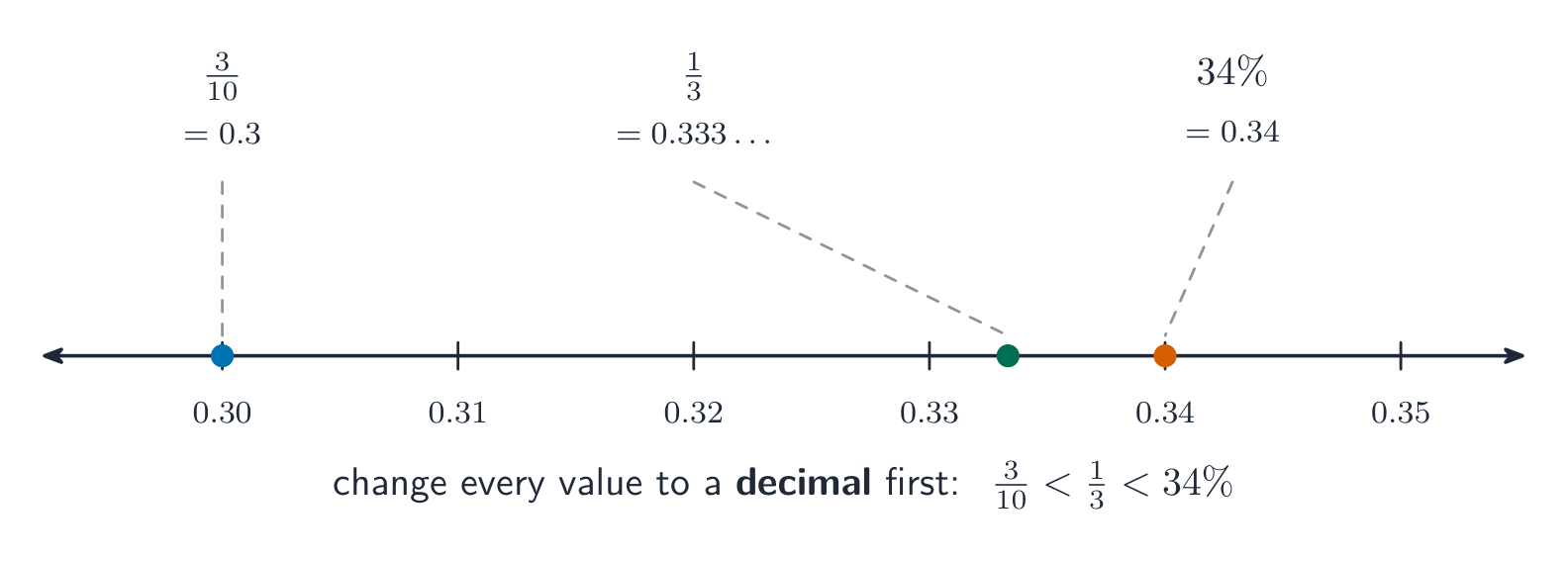
$34\% = 0.34$
Write a fraction in its simplest form 最简形式 by dividing the top and bottom by their HCF: $\frac{18}{24} = \frac{3}{4}$ (both divided by $6$).
Recurring decimals (Extended)
A recurring decimal 循环小数 repeats the same digits forever. Dots mark the repeating part: $0.1\dot{7} = 0.1777\ldots$ and $0.\dot{1}2\dot{3} = 0.123123\ldots$
To turn a recurring decimal into a fraction, multiply so the repeating parts line up, then subtract.
Worked example. Write $0.1\dot{7}$ as a fraction.
Let $x = 0.1777\ldots$ Only the $7$ repeats, so use $10x$ and $100x$:
Source: Cambridge International syllabus · แหล่งที่มา: หลักสูตร Cambridge International
English
Order of operations
Work in this order — the order of operations 运算顺序: brackets first, then indices (powers and roots), then multiply and divide (left to right), then add and subtract (left to right).
Worked example. Work out $-6 \times -3 + 7 \times 2$.
Do the multiplications first: $-6 \times -3 = 18$ and $7 \times 2 = 14$. Then add: $18 + 14 = 32$.
Negative numbers
Adding a negative: $5 + (-3) = 5 - 3 = 2$.
Subtracting a negative: $5 - (-3) = 5 + 3 = 8$.
Multiplying or dividing: same signs give a positive; different signs give a negative. So $-6 \times -3 = 18$ but $-12 \div 4 = -3$.
A change in temperature from $-5\,{}^{\circ}\text{C}$ to $3\,{}^{\circ}\text{C}$ is a rise of $8\,{}^{\circ}\text{C}$.
Calculating with fractions
Multiply: multiply the tops, multiply the bottoms: $\frac{2}{3} \times \frac{4}{5} = \frac{8}{15}$.
Divide: multiply by the reciprocal of the second fraction: $\frac{2}{3} \div \frac{4}{5} = \frac{2}{3} \times \frac{5}{4} = \frac{10}{12} = \frac{5}{6}$.
Add or subtract: use a common denominator (the LCM of the bottoms).
Worked example. Work out $1\frac{7}{15} - \frac{4}{5}$, giving the answer in its simplest form.
Change the mixed number to an improper fraction, then use denominator $15$:
2 Express one quantity as a percentage of another.
3 Calculate percentage increase or decrease.
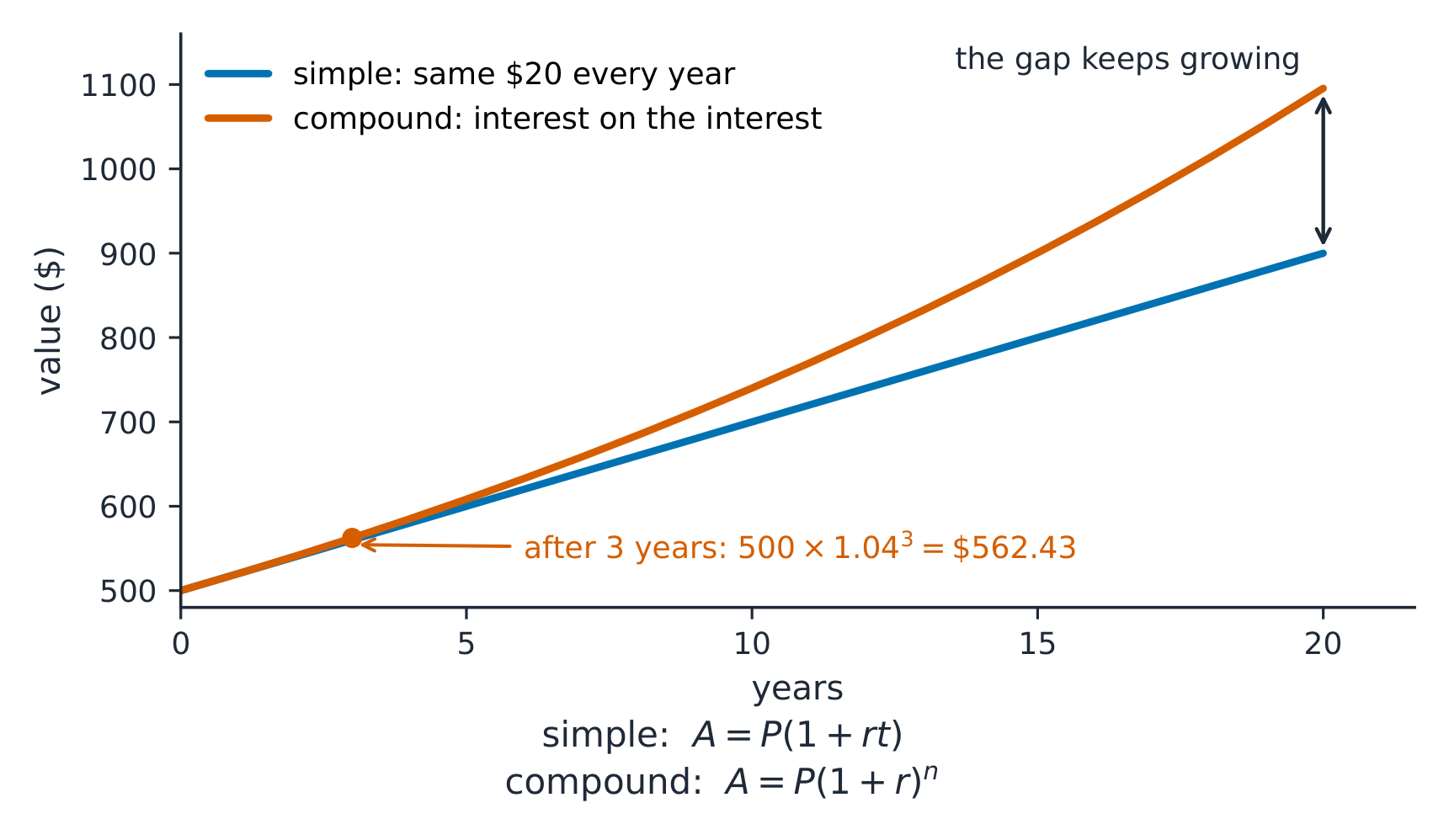
4 Calculate with simple and compound interest.
Formulas are not given. Percentage calculations may include: • deposit • discount • profit and loss (as an amount or a percentage) • earnings • percentages over 100%.
2 Express one quantity as a percentage of another.
3 Calculate percentage increase or decrease.
4 Calculate with simple and compound interest.
Problems may include repeated percentage change. Formulas are not given.
5 Calculate using reverse percentages.
e.g. find the cost price given the selling price and the percentage profit. Percentage calculations may include: • deposit • discount • profit and loss (as an amount or a percentage) • earnings • percentages over 100%.
A reverse percentage 逆百分比 problem gives the amount after a change and asks for the original. To solve it, divide by the multiplier — do not just take the percentage off.
Worked example. A coat costs $\$60$ after a $20\%$ increase. Find the original price.
$\$60$ is $120\%$ of the original, so the original price is $60 \div 1.2 = \$50$.
Exponential growth and decay (Extended) · การเติบโตและการลดลงแบบเอ็กซ์โพเนนเชียล (ส่วนขยาย)
Syllabus · หลักสูตร
English
Subject content
Notes and examples
Use exponential growth and decay.
e.g. depreciation, population change. Knowledge of e is not required.
ไทย
เนื้อหารายวิชา
หมายเหตุและตัวอย่าง
ใช้การเติบโตและการลดลงแบบเอ็กซ์โพเนนเชียล
เช่น การเสื่อมมูลค่า, การเปลี่ยนแปลงของประชากร ไม่จำเป็นต้องมีความรู้เรื่อง e
Source: Cambridge International syllabus · แหล่งที่มา: หลักสูตร Cambridge International
English
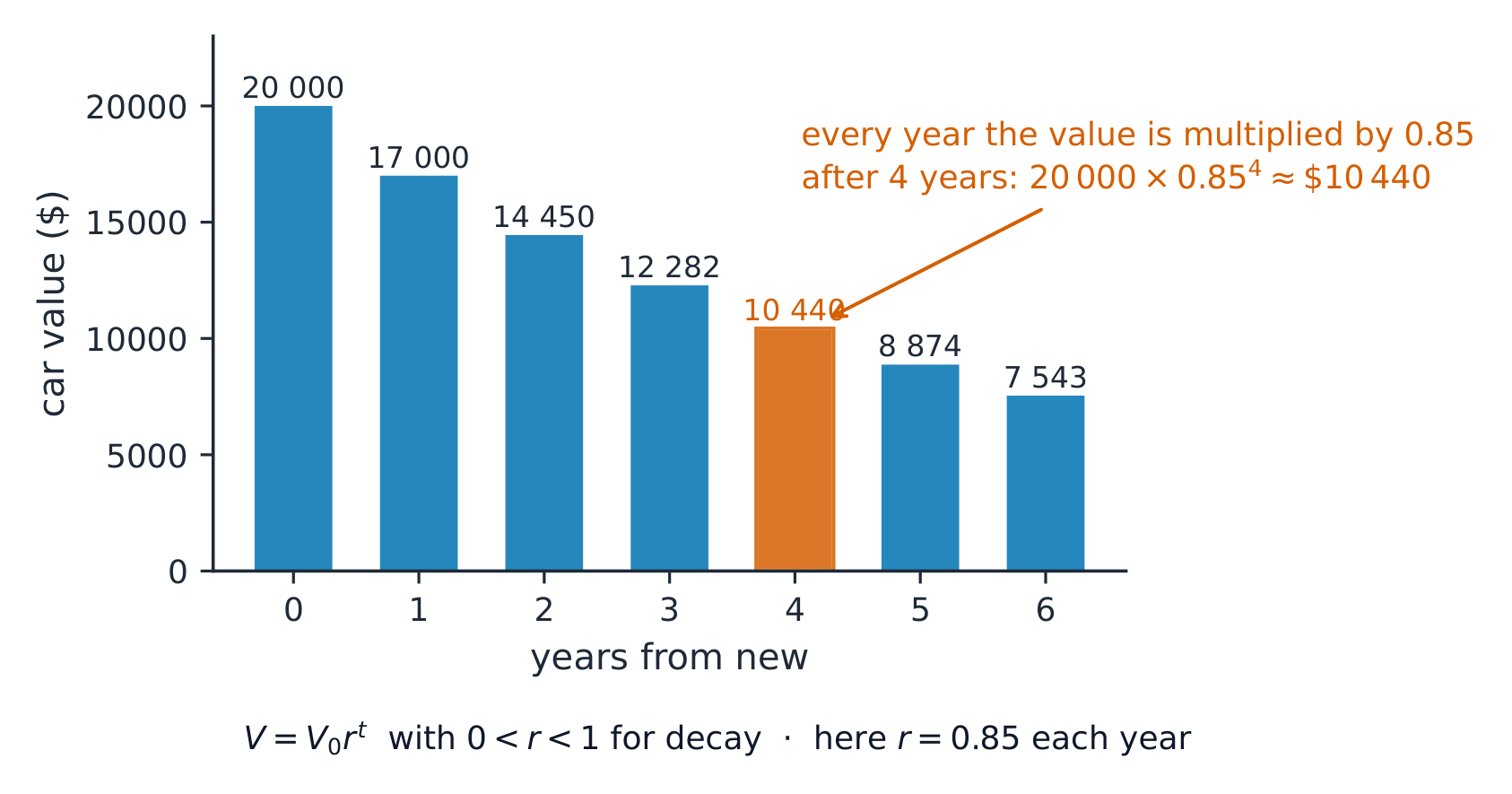
When a quantity changes by the same percentage in each time period, it shows exponential growth 指数增长 (it gets bigger) or exponential decay 指数衰减 (it gets smaller). Use the compound formula. Depreciation 折旧, where something like a car loses value each year, is decay.
Worked example. A car worth $\$20\,000$ loses $15\%$ of its value each year. Find its value after $4$ years.
Money grows by (1 + r) every year, so compound interest curves above simple interest. Drag the rate and the number of years. · เงินโตขึ้นด้วย (1 + r) ทุกปี ทำให้กราฟดอกเบี้ยทบต้นอยู่เหนือดอกเบี้ยธรรมดา ลากอัตราและจำนวนปี
Change the base b: b > 1 grows, 0 < b < 1 decays — useful for interest and populations. · เปลี่ยน ฐาน b: b > 1 เติบโต, 0 < b < 1 ลดลง — ใช้ได้กับการดอกเบี้ยและประชากร
Direct proportion is a straight line through the origin — double x and you double y. · ความสัมพันธ์แปรผันตรงคือ เส้นตรงผ่านจุดกำเนิด — เมื่อ x เป็นสองเท่า y ก็เป็นสองเท่า
1.12
Rates and average speed · อัตราและความเร็วเฉลี่ย
Syllabus · หลักสูตร
English
Subject content
Notes and examples
1 Use common measures of rate.
e.g. calculate with: • hourly rates of pay • exchange rates between currencies • flow rates • fuel consumption.
2 Apply other measures of rate.
e.g. calculate with: • pressure • density • population density. Required formulas will be given in the question.
3 Solve problems involving average speed.
Knowledge of speed/distance/time formula is required. e.g. A cyclist travels 45 km in 3 hours 45 minutes. What is their average speed? Notation used will be, e.g. m/s (metres per second), $\text{g/cm}^3$ (grams per cubic centimetre).
ต้องมีความรู้เกี่ยวกับสูตรความเร็ว/ระยะทาง/เวลา เช่น. นักปั่นจักรยานเดินทาง 45 กม. ใน 3 ชั่วโมง 45 นาที ความเร็วเฉลี่ยของเขา是多少?符号将使用, e.g. m/s (เมตรต่อวินาที), $\text{g/cm}^3$ (กรัมต่อลูกบาศก์เซนติเมตร).
English
Subject content
Notes and examples
1 Use common measures of rate.
e.g. calculate with: • hourly rates of pay • exchange rates between currencies • flow rates • fuel consumption.
2 Apply other measures of rate.
e.g. calculate with: • pressure • density • population density. Required formulas will be given in the question.
3 Solve problems involving average speed.
Knowledge of speed/distance/time formula is required. e.g. A cyclist travels 45 km in 3 hours 45 minutes. What is their average speed? Notation used will be, e.g. m/s (metres per second), g/cm$^{3}$ (grams per cubic centimetre).
Other examples are flow rate, fuel consumption and population density 人口密度. If a rate needs a special formula (such as pressure 压强), the question will give it to you.
Rounding and bounds lab · ห้องปฏิบัติการการปัดเศษและขอบเขต
Classify numbers by the decision needed for accuracy. · จำแนกตัวเลขตามการตัดสินใจที่ต้องใช้เพื่อความแม่นยำ
1.10
Limits of accuracy · ขอบเขตของความแม่นยำ
Syllabus · หลักสูตร
English
Subject content
Notes and examples
Give upper and lower bounds for data rounded to a specified accuracy.
e.g. write down the upper bound of a length measured correct to the nearest metre. Candidates are not expected to find the bounds of the results of calculations which have used data rounded to a specified accuracy.
1 Give upper and lower bounds for data rounded to a specified accuracy.
e.g. write down the upper bound of a length measured correct to the nearest metre.
2 Find upper and lower bounds of the results of calculations which have used data rounded to a specified accuracy.
Example calculations include: • calculate the upper bound of the perimeter or the area of a rectangle given dimensions measured to the nearest centimetre • find the lower bound of the speed given rounded values of distance and time.
Source: Cambridge International syllabus · แหล่งที่มา: หลักสูตร Cambridge International
English
A rounded value could really be anything that rounds to it. The smallest possible value is the lower bound 下界; the largest is the upper bound 上界. For a value rounded to the nearest unit, the bounds lie half a unit on each side.
Worked example. A height $h$ is $635\text{ m}$, correct to the nearest metre. Give the bounds.
$$634.5 \leqslant h < 635.5.$$
So the lower bound is $634.5\text{ m}$ and the upper bound is $635.5\text{ m}$.
Bounds in calculations (Extended)
Combine the bounds to get the bound you want.
Worked example. A rectangle is $8\text{ cm}$ by $5\text{ cm}$, each side to the nearest cm. Find the largest possible area 面积.
Use the upper bounds of both sides: $8.5 \times 5.5 = 46.75\text{ cm}^{2}$. (The smallest area uses the lower bounds: $7.5 \times 4.5 = 33.75\text{ cm}^{2}$.)
For a divided quantity such as $\text{speed} = \dfrac{\text{distance}}{\text{time}}$, the largest speed comes from the largest distance divided by the smallest time.
อ่านหน้าจอตามบริบท: ในกรณีของเงิน $4.8$ หมายถึง $\$4.80$; in time, $3.25$ hours means $3$ hours $15$ นาที
1.14
Exam tips · ข้อแนะนำสำหรับการสอบ
English
Follow BIDMAS (brackets, indices, division/multiplication, addition/subtraction) in order, and remember a negative times a negative is positive.
In standard form the number in front is between 1 and 10; a small number (like $0.0004$) has a negative power of 10.
A percentage change is worked out on the original amount. For a reverse percentage, divide by the multiplier (e.g. $\div 1.2$ undoes a $20\%$ rise).
Do not round part-way through — keep the full value and round only at the end, to the accuracy the question asks for (decimal places or significant figures).
For limits of accuracy, a value rounded to the nearest whole number can be up to $0.5$ either side (so $8$ means $7.5 \le x < 8.5$).
Pick one and the site follows you — notes, papers, videos and practice all open on it. · เลือกหนึ่งตัว และเว็บจะติดตามคุณ — หมายเหตุ, ใบงาน, วิดีโอ และการฝึกฝนจะเปิดอยู่ที่นั้น
Type to search notes, lessons, code, vocabulary and past-paper questions across every subject. · พิมพ์เพื่อค้นหาบันทึก, บทเรียน, โค้ด, คำศัพท์ และคำถามข้อสอบเก่าในทุกวิชา