Rounding, estimation and limits of accuracy
Introduced| English | Meaning |
|---|---|
| decimal places/ˈdesɪml ˈpleɪsɪz/ | decimal places |
| significant figures/sɪɡˈnɪfɪkənt ˈfɪɡəz/ | The meaningful digits in a measured or rounded number, beginning with its first non-zero digit. |
| estimation/ˌestɪˈmeɪʃn/ | estimation |
| limits of accuracy/ˈlɪmɪts ɒv ˈækjʊrəsi/ | limits of accuracy |
Close enough?
- A builder needs 3.47 m of wood but the shop only measures to the nearest 0.1 m. They'll buy 3.5 m.
- An engineer needs 3.470 m measured to the millimetre. Precision matters — and knowing how much precision you need is a mathematical skill.
Rounding and bounds lab
Classify numbers by the decision needed for accuracy.
Rounding to decimal places 小数位
- Count digits after the decimal point.
- $3.14159$ to 2 d.p. $= 3.14$ (look at the third digit: $1 < 5$, round down).
- $3.146$ to 2 d.p. $= 3.15$ (look at the third digit: $6 \geq 5$, round up).
Round 3.146 to 2 decimal places. Give the answer as a decimal.
Difficulty 2/5 · 140 coins + a small bonus on first completion today
The third decimal place is 6 ≥ 5, so round up: 3.15.
Rounding to significant figures 有效数字
- Count from the first non-zero digit (left to right).
- $5764$ to 1 s.f. $= 6000$ (the first s.f. is $5$; the next digit $7 \geq 5$, round up).
- $0.003\,47$ to 2 s.f. $= 0.0035$ (the first two s.f. are $3$ and $4$; the next digit $7 \geq 5$, round up).
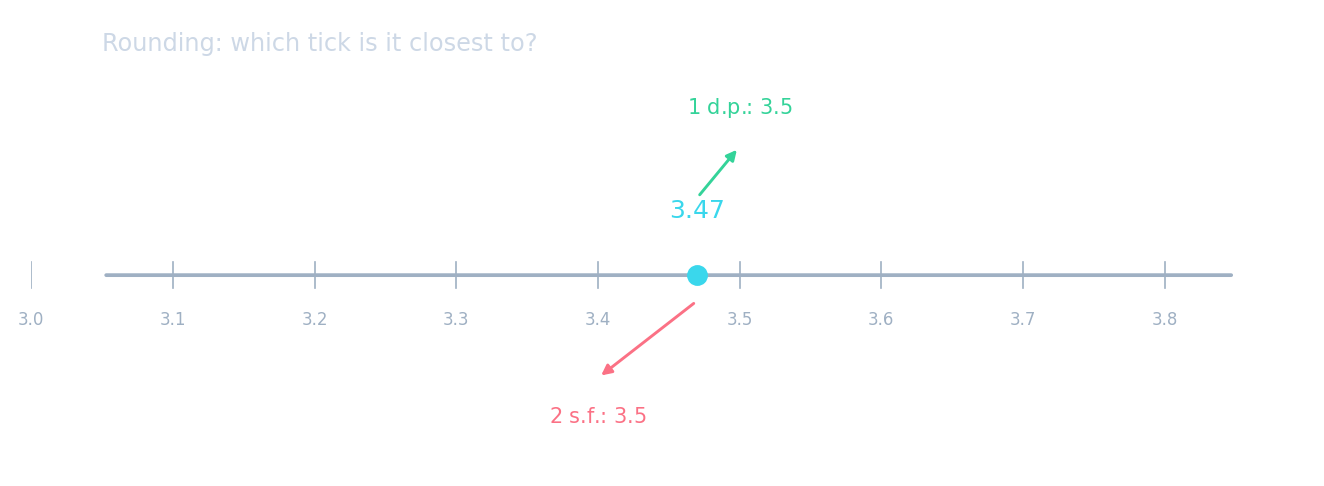
Rounding is about finding the nearest tick — which value is $3.47$ closest to?
Leading zeros don't count. In $0.00347$, the first significant figure is $3$ (not $0$). The zeros before $3$ are just placeholders.
What is 5764 rounded to 1 significant figure?
Difficulty 1/5 · 100 coins + a small bonus on first completion today
The first significant figure is 5; the next digit 7 ≥ 5, so round up to 6000.
In the number 0.00347, the first significant figure is 0.
Difficulty 1/5 · 100 coins + a small bonus on first completion today
Leading zeros are not significant. The first significant figure is 3.
Estimation 估算
- Round every number in the calculation to 1 significant figure, then calculate.
- $\dfrac{41.3}{9.79 \times 0.765} \approx \dfrac{40}{10 \times 0.8} = \dfrac{40}{8} = 5$.
- Estimation is a quick sanity check — if your calculator says $500$, something went wrong.
Quick check. $49 \times 21 \approx 50 \times 20 = 1000$. The actual answer is $1029$ — close enough to confirm the calculation is in the right ballpark.
Estimate 41.3 / (9.79 × 0.765) by rounding each to 1 s.f.
Difficulty 2/5 · 140 coins + a small bonus on first completion today
≈ 40 / (10 × 0.8) = 40 / 8 = 5.
Limits of accuracy 精度范围 (Core and Extended)
- A rounded measurement has a range of possible true values.
- $635$ m to the nearest metre: $634.5 \leq h < 635.5$.
- Extended: for combined measurements, make the result as big (or small) as possible. For a product (area = length × width): max = UB × UB, min = LB × LB. For a quotient (speed = distance ÷ time): max = UB distance ÷ LB time, min = LB distance ÷ UB time — biggest top over smallest bottom.
A height is 635 m to the nearest metre. What is the lower bound (m)?
Difficulty 2/5 · 140 coins + a small bonus on first completion today
The bounds are half a metre each side: 634.5 ≤ h < 635.5.
A length is 8.4 cm to 1 decimal place. What is the upper bound?
Difficulty 2/5 · 140 coins + a small bonus on first completion today
Bounds are half of 0.1 either side: 8.35 ≤ L < 8.45. Upper bound = 8.45.
Measurement bounds are also Core
- A reading of 8.6 cm to nearest 0.1 cm has half-step 0.05 cm: $8.55\le l<8.65$. Include the lower boundary; the upper boundary rounds to 8.7.
- Extended calculated bounds: for positive $d\in[99.5,100.5)$ km and $t\in[1.95,2.05)$ h, speed has lower bound $99.5/2.05\approx48.5366$ and upper bound $100.5/1.95\approx51.5385\text{ km/h}$. Core stops at bounds of the measured inputs.
A length is 8.6 cm to nearest 0.1 cm. Find its lower bound in cm.
Difficulty 2/5 · 140 coins + a small bonus on first completion today
Half the step is 0.05 cm; 8.6 − 0.05 = 8.55 cm.
You've got it
- d.p. = count after the decimal point; s.f. = count from the first non-zero digit
- round up if the next digit $\geq 5$; round down otherwise
- estimate by rounding each number to 1 s.f. before calculating
- bounds: nearest unit → $\pm\,0.5$ ($635 \to 634.5 \leq h < 635.5$)