Fractions, decimals, percentages and operations
Introduced| English | Meaning |
|---|---|
| fraction/ˈfrækʃn/ | A number written as one integer divided by another nonzero integer; it can be less than, equal to or greater than 1. |
| decimal/ˈdesɪml/ | A number written using place value with a decimal point, such as 0.375. |
| percentage/pəˈsentɪdʒ/ | A proportion expressed as a number of parts per hundred. |
| reciprocal/rɪˈsɪprəkl/ | The value obtained by dividing one by a non-zero number. |
| common denominator/ˈkɒmən dɪˈnɒmɪneɪtə/ | common denominator |
| order of operations/ˈɔːdə ɒv ˌɒpəˈreɪʃnz/ | The rules determining the order in which the parts of an expression are evaluated. |
Half a pizza, 50% of a pizza, 0.5 of a pizza
- They are the same thing — just three ways of writing the same number.
- Fractions 分数, decimals 小数, and percentages 百分比 are interchangeable. The skill is picking the right form and converting quickly.
Number form lab
Classify equivalent number forms and operations.
Fractions to decimals and back
- Fraction → decimal: divide the top by the bottom. $\dfrac{3}{8} = 3 \div 8 = 0.375$.
- Decimal → fraction: write the decimal over the appropriate power of 10, then simplify.
- $0.6 = \dfrac{6}{10} = \dfrac{3}{5}$.
Memorise the common ones. $\dfrac{1}{4} = 0.25 = 25\%$; $\dfrac{1}{3} = 0.\dot{3} = 33.\dot{3}\%$; $\dfrac{1}{5} = 0.2 = 20\%$; $\dfrac{3}{4} = 0.75 = 75\%$.

Shops use percentages for discounts, sales tax and profit margins
Write 3/8 as a decimal.
Difficulty 2/5 · 140 coins + a small bonus on first completion today
3 ÷ 8 = 0.375.
Decimals to percentages
- Decimal → percentage: multiply by 100. $0.375 \times 100 = 37.5\%$.
- Percentage → decimal: divide by 100. $45\% = 0.45$.

One value three ways: a fraction, a decimal and a percentage
Convert 45% to a decimal.
Difficulty 2/5 · 140 coins + a small bonus on first completion today
45% = 45 ÷ 100 = 0.45.
Multiplying and dividing fractions
- Multiply: tops × tops, bottoms × bottoms. $\dfrac{2}{3} \times \dfrac{4}{5} = \dfrac{8}{15}$.
- Divide: multiply by the reciprocal 倒数 of the second fraction. $\dfrac{2}{3} \div \dfrac{4}{5} = \dfrac{2}{3} \times \dfrac{5}{4} = \dfrac{10}{12} = \dfrac{5}{6}$.
- Add/subtract: find a common denominator 公分母 first.
Never add tops to tops. $\dfrac{1}{3} + \dfrac{1}{4} \neq \dfrac{2}{7}$. Find a common denominator: $\dfrac{4}{12} + \dfrac{3}{12} = \dfrac{7}{12}$.
What is 2/3 × 4/5?
Difficulty 1/5 · 100 coins + a small bonus on first completion today
Multiply tops and bottoms: (2×4)/(3×5) = 8/15.
1/3 + 1/4 = 2/7.
Difficulty 1/5 · 100 coins + a small bonus on first completion today
1/3 + 1/4 = 4/12 + 3/12 = 7/12, not 2/7. You must find a common denominator before adding.
Order of operations 运算顺序 (BIDMAS)
- Brackets → Indices → Division/Multiplication (left to right) → Addition/Subtraction (left to right).
- $-6 \times -3 + 7 \times 2 = 18 + 14 = 32$ (multiply before adding).
Using the order of operations, work out −6 × −3 + 7 × 2.
Difficulty 2/5 · 140 coins + a small bonus on first completion today
Multiply first: −6×−3 = 18 and 7×2 = 14; then 18 + 14 = 32.
Ordering mixed numbers
- To order a list mixing fractions, decimals, and percentages: convert everything to decimals first, then compare.
- $\dfrac{2}{3}=0.666\ldots$, $65\%=0.65$, and $0.6\dot6=0.666\ldots$. The two recurring forms are equal; 0.667 is only an approximation (recurring notation is Extended).
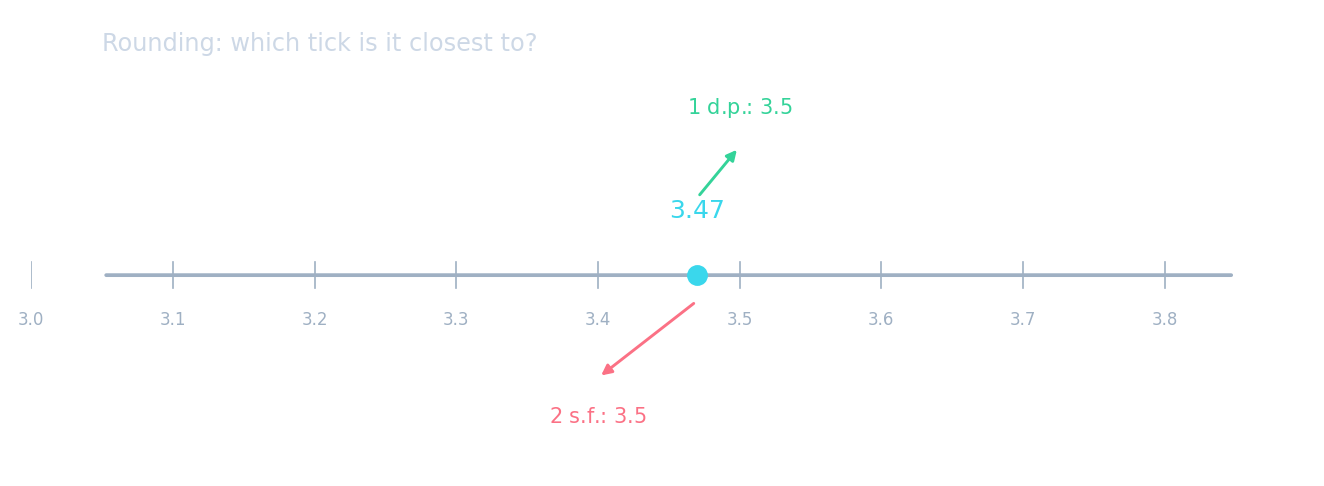
Number lines make comparisons obvious — plot each value as a decimal and read left to right.
Put these in order from smallest to largest: 2/3, 65%, 0.7, 7/10.
Difficulty 3/5 · 200 coins + a small bonus on first completion today
2/3 ≈ 0.667, 65% = 0.65, 0.7 = 0.7, 7/10 = 0.7. Order: 0.65, 0.667, 0.7, 0.7.
Mixed numbers and negative comparisons
- Convert a mixed number before arithmetic: $2\frac13=(2\times3+1)/3=7/3$. Then $2\frac13-\frac56=14/6-5/6=9/6=1\frac12$.
- Convert unlike forms to compare: $-1\frac14=-1.25<-1.2$. On a number line the more negative number is further left; $\le$ includes the endpoint while $<$ excludes it.
Calculate 2⅓ − ⅚ as a decimal.
Difficulty 2/5 · 140 coins + a small bonus on first completion today
Convert to sixths: 14/6 − 5/6 = 9/6 = 1.5.
You've got it
- fraction → decimal: divide top by bottom ($\dfrac{3}{8} = 0.375$)
- decimal → percentage: ×100; percentage → decimal: ÷100
- multiply fractions: tops × tops, bottoms × bottoms; divide: × the reciprocal
- order of operations: BIDMAS (brackets, indices, ÷×, +−)
Write from the decimal 0.625
- Write 5/8 as a decimal.
- 5 divided by 8.
Write 5/8 as a decimal.
8 goes into 50 six times, with 2 left, then 5.
What is 5/8 as a decimal?
Difficulty 1/5 · 100 coins + a small bonus on first completion today
Five divided by eight is 0.625.