Skip to content · ⁨ข้ามไปยังเนื้อหา⁩

Listening skills · ⁨ทักษะการฟัง⁩

IGCSE English · ⁨English IGCSE⁩ · Topic 9 · ⁨หัวข้อ 9⁩

Video lesson for this topic · ⁨บทเรียนวิดีโอสำหรับหัวข้อนี้⁩ Open the video page · ⁨เปิดหน้าวิดีโอ⁩
7:00

ทักษะการฟัง

นี่คือสิ่งที่ทำให้การฟังต่างจากกระดาษอื่นๆ ทั้งหมด ในการอ่าน ข้อความนิ่งรอให้คุณ ในการฟัง <slow>บันทึกเสียงไม่…

English narration · English + 中文 subtitles burned in · ⁨การบรรยายภาษาอังกฤษ · คำบรรยายภาษาอังกฤษ + 中文 ลอยตัวบนภาพ⁩

9.1

Listening for facts · ⁨Lắng nghe để nắm bắt thông tin⁩

Syllabus · ⁨หลักสูตร⁩
English
  1. listen for specific facts and details: places, names, times, dates and directions
  2. predict what kind of information you will hear before you listen
  3. select the correct multiple-choice option based on what the speaker says
ไทย
  1. ฟังหาข้อเท็จจริงและรายละเอียดเฉพาะ: สถานที่ ชื่อ เวลา วันที่ และทิศทาง
  2. คาดเดาประเภทของข้อมูลที่คุณจะได้ยินก่อนการฟัง
  3. เลือกตัวเลือกคำตอบที่ถูกต้องจากสิ่งที่ผู้พูดกล่าว

Source: Cambridge International syllabus · ⁨แหล่งที่มา: หลักสูตร Cambridge International⁩

English

In the listening exam you hear each recording 录音 twice. Use both chances well.

Predict before you listen

  • Read the question before the recording starts.
  • Predict 预测 what kind of answer you need: a place, a name, a number, a time?

Catch the detail

  • Listen for specific 具体的 facts: places, names, dates, times and directions 方向.
  • The answers usually come in the same order as the questions.

Use both playings

  • On the first listening, choose your answer.
  • On the second, check it. Do not change a right answer without a good reason.
ไทย

Trong bài thi nghe, bạn nghe mỗi bản ghi âm (recording) hai lần. Hãy tận dụng tốt cả hai cơ hội.

Dự đoán trước khi nghe

  • อ่านคำถามก่อนเริ่มบันทึกเสียง
  • Dự đoán (predict) loại câu trả lời bạn cần: một địa điểm, một tên, một con số, một thời gian?

Bắt kịp chi tiết

  • Lắng nghe để tìm thông tin cụ thể (specific facts): địa điểm, tên, ngày tháng, giờ và hướng đi (directions).
  • คำตอบมักมาตามลำดับเดียวกับคำถาม

Sử dụng cả hai lần phát

  • Lần nghe đầu tiên, chọn câu trả lời của bạn.
  • Lần thứ hai, kiểm tra lại. Đừng thay đổi một câu trả lời đúng mà không có lý do chính đáng.
Một timeline: trước bản ghi âm đọc câu hỏi và dự đoán loại câu trả lời, lần phát đầu tiên chọn đáp án, lần phát thứ hai kiểm tra và điền khoảng trống; câu trả lời thường xuất hiện theo thứ tự câu hỏi
ใช้การฟังทั้งสองครั้งต่างกัน: ตอบก่อน แล้วค่อยตรวจสอบ
Một phòng thu radio: bài thi nghe yêu cầu bạn bắt kịp thông tin, thái độ và ý nghĩa hàm ẩn qua hai lần phát
Nghe cẩn thận: bắt kịp thông tin, thái độ, và những gì chỉ được ngụ ý
Vocabulary · ⁨คำศัพท์⁩ Train · ⁨ฝึกฝน⁩
English ไทย
recording/rɪˈkɔːdɪŋ/ การบันทึกเสียง
predict/prɪˈdɪkt/ คาดการณ์
specific/spəˈsɪfɪk/ เฉพาะเจาะจง
directions/daɪˈrekʃnz/ คำแนะนำ
9.2

Hearing opinions and attitudes · ⁨Nghe ý kiến và thái độ⁩

Syllabus · ⁨หลักสูตร⁩
English
  1. understand speakers' ideas, opinions, feelings and attitudes
  2. follow how ideas connect across a longer talk or conversation
  3. notice the language that speakers use to express how they feel
ไทย
  1. เข้าใจความคิด ความเห็น อารมณ์ และทัศนคติของผู้พูด
  2. ติดตามวิธีการเชื่อมโยงความคิดตลอดการพูดหรือสนทนาที่ยาวนานขึ้น
  3. สังเกตภาษาที่ผู้พูดใช้เพื่อแสดงความรู้สึก

Source: Cambridge International syllabus · ⁨แหล่งที่มา: หลักสูตร Cambridge International⁩

English

Some questions ask how a speaker thinks or feels, not just what they say.

Opinions and feelings

  • Listen for the speaker's opinion 观点 and feelings 感受.
  • Notice the words they choose. Strong words show strong feelings.

Follow the connections

  • In a longer talk, ideas connect 连接. Follow how one point leads to the next.
  • Words like "but", "because" and "so" show how ideas link.
ไทย

Một số câu hỏi hỏi cách người nói nghĩ hoặc cảm nhận, không chỉ những gì họ nói.

Ý kiến và cảm xúc

  • Lắng nghe ý kiến (opinion) và cảm xúc (feelings) của người nói.
  • Chú ý đến từ ngữ họ lựa chọn. Từ mạnh mẽ cho thấy cảm xúc mạnh mẽ.

Theo dõi các liên kết

  • Trong một bài nói dài, các ý tưởng liên kết (connect). Theo dõi cách một điểm dẫn đến điểm tiếp theo.
  • Các từ như "nhưng", "vì" và "nên" cho thấy cách các ý tưởng liên kết.
Vocabulary · ⁨คำศัพท์⁩ Train · ⁨ฝึกฝน⁩
English ไทย
opinion/əˈpɪnɪən/ ความคิดเห็น
feelings/ˈfiːlɪŋz/ ความรู้สึก
connect/kəˈnekt/ เชื่อมโยง
9.3

Listening between the lines · ⁨Nghe giữa các dòng⁩

Syllabus · ⁨หลักสูตร⁩
English
  1. understand what is implied but not directly stated
  2. work out a speaker's overall intention or attitude
  3. deduce the meaning of an unfamiliar word from the words around it
ไทย
  1. เข้าใจสิ่งที่สื่อโดยนัยแต่ไม่ได้ระบุไว้โดยตรง
  2. พิจารณาเจตนาหรือทัศนภาพโดยรวมของผู้พูด
  3. สรุปความหมายของคำที่ไม่คุ้นเคยจากรายละเอียดโดยรอบ

Source: Cambridge International syllabus · ⁨แหล่งที่มา: หลักสูตร Cambridge International⁩

English

Not every answer is said directly.

Implied meaning

  • Sometimes a speaker suggests 暗示 something without saying it openly.
  • Think about what they really mean, not only the exact words.

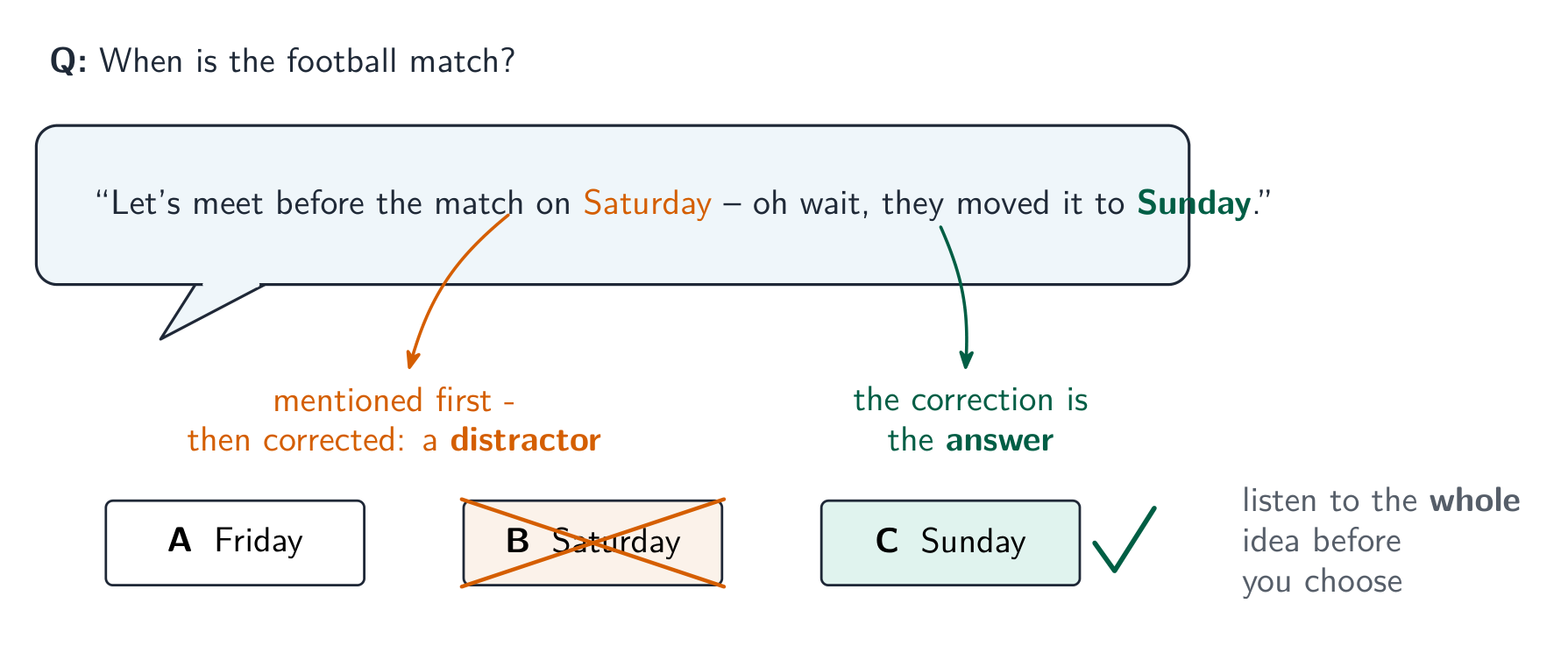
Watch the distractors

  • In multiple-choice 选择题 questions, the wrong options are called distractors 干扰项.
  • A speaker may mention an option, then change their mind. Listen to the whole idea before you choose.

Words that signal the answer

Trained ears listen for small words that point to the answer.

  • A correction is coming: actually… / sorry, I mean… / on second thought… — the words after these usually hold the real answer, not the ones before.
  • The key point: the main thing is… / what matters is… / above all…
  • A feeling or attitude 态度: to be honest… / the trouble is… / I'm delighted that…
  • Order of steps: first… next… finally… — these help you follow a sequence.

Catching one signal word can win you a mark. Note them down as you hear them.

ไทย

Không phải câu trả lời nào cũng được nói trực tiếp.

ความหมายที่สื่อโดยนัย

  • Đôi khi người nói ngụ ý (suggests) điều gì đó mà không nói thẳng.
  • Hãy nghĩ về những gì họ thực sự muốn nói, không chỉ những từ chính xác.

Cẩn trọng với các yếu tố gây nhiễu

  • Trong câu hỏi trắc nghiệm (multiple-choice), các phương án sai được gọi là yếu tố gây nhiễu (distractors).
  • Người nói có thể đề cập đến một phương án, sau đó thay đổi suy nghĩ. Hãy lắng nghe toàn bộ ý tưởng trước khi chọn.
Người nói nói trận đấu vào thứ Bảy, sau đó sửa thành Chủ nhật; thứ Bảy là yếu tố gây nhiễu và bị gạch bỏ, ngày đã được sửa là Chủ nhật là đáp án
Một yếu tố gây nhiễu được đề cập trước, sau đó bị sửa - phần sửa là đáp án

Những từ báo hiệu đáp án

tai được huấn luyện lắng nghe những từ nhỏ chỉ ra đáp án.

  • การแก้ไขข้อความกำลังมา: ในความเป็นจริง… / ขออภัย, ฉันหมายถึง… / เมื่อคิดดีๆ แล้ว… — คำที่ อยู่หลังจาก คำเหล่านี้มักจะเป็นคำตอบที่แท้จริง ไม่ใช่คำที่อยู่ก่อนหน้า
  • ประเด็นสำคัญ: สิ่งที่สำคัญที่สุดคือ… / สิ่งที่มีนัยสำคัญคือ… / เป็นพิเศษอย่างยิ่ง…
  • ความรู้สึกหรือทัศนคติ: พูดกันตรงๆ… / ปัญหาอยู่ที่ว่า… / ฉันยินดีมากที่…
  • ลำดับขั้นตอน: ก่อนอื่น… จากนั้น… สุดท้ายแล้ว… — คำเหล่านี้ช่วยให้คุณติดตามลำดับเหตุการณ์ได้ง่ายขึ้น

การจับคำสัญญาณได้เพียงคำเดียวก็ทำให้คุณได้รับคะแนนแล้ว จดจำคำเหล่านี้ไว้ขณะฟัง

Vocabulary · ⁨คำศัพท์⁩ Train · ⁨ฝึกฝน⁩
English ไทย
suggests/səˈdʒests/ เสนอแนะ
multiple-choice/ˈmʌltɪpl tʃɔɪs/ แบบเลือกตอบ
distractors/dɪˈstræktəz/ ตัวเลือกลวง
attitude/ˈætɪtjuːd/ ทัศนคติ
9.3

Exam tips · ⁨ข้อแนะนำสำหรับการสอบ⁩

English
  • Read the questions before the audio starts and underline the key words in each one.
  • You hear everything twice: answer what you can in round one, check and fill gaps in round two.
  • Speakers often correct themselves with numbers, days and spellings. The last version is the answer.
  • Missed one? Let it go and follow the next question; return to the gap in the second play.
  • Write something for every question. There is no penalty for a wrong guess.
ไทย
  • อ่านคำถามก่อนเริ่มฟังและขีดเส้นใต้คำสำคัญในแต่ละข้อ
  • คุณจะได้ยินทุกสิ่งสองรอบ: ตอบสิ่งที่ทำได้ในรอบแรก และตรวจสอบพร้อมเติมช่องว่างในรอบที่สอง
  • ผู้พูดมักแก้ไขตัวเองด้วยตัวเลข วัน และการสะกดคำ รูปแบบสุดท้ายคือคำตอบ
  • หากพลาดไป? ทิ้งไว้และมุ่งไปที่ข้อถัดไป กลับไปเติมช่องว่างนั้นในรอบที่สอง
  • เขียนคำตอบสำหรับทุกข้อ ไม่มีการหักคะแนนสำหรับการทายผิด

Interactive lessons on this topic · ⁨บทเรียนเชิงโต้ตอบสำหรับหัวข้อนี้⁩

Work through it step by step, with instant-check exercises. · ⁨ทำทีละขั้นตอน พร้อมแบบฝึกหัดตรวจสอบผลทันที⁩

Past Papers · ⁨ข้อสอบย้อนหลัง⁩

More topics in IGCSE English · ⁨English IGCSE⁩ · ⁨หัวข้อเพิ่มเติมใน IGCSE English · ⁨English IGCSE⁩⁩

Log in or create account · ⁨เข้าสู่ระบบหรือสร้างบัญชี⁩

IGCSE, A-Level & AP