- take part in a conversation or interview, giving factual information and opinions
- respond to questions and develop your answers with reasons and examples
- use interactive skills: starting, responding, asking for clarification and taking turns
Speaking skills
IGCSE English · Topic 10
 7:16
7:16
Speaking skills
Ten minutes. Two people. One conversation, in English. That is the whole speaking test — no essay, no grammar paper. You just talk. So why do so many good…
English narration · English + 中文 subtitles burned in
10.1
Talking with the examiner
Syllabus
Source: Cambridge International syllabus
The speaking test is a friendly conversation 对话, not a test you fail by being nervous.
Take part fully
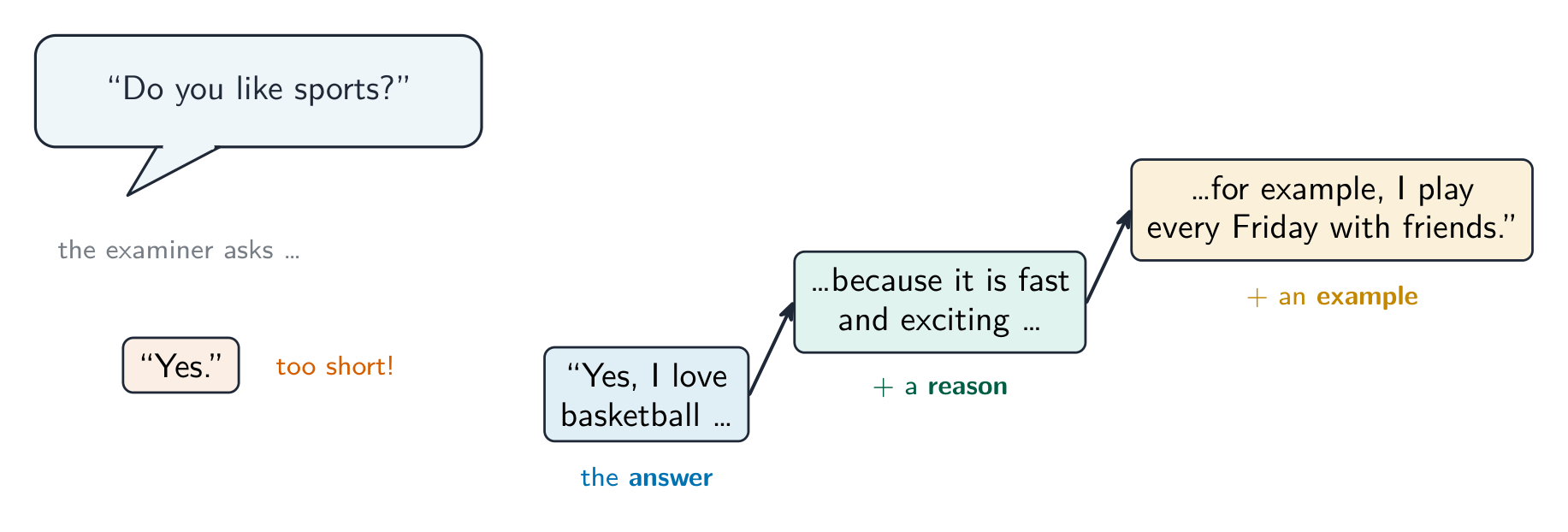
- Answer the question, then add more. A one-word answer is too short.
- Give reasons and examples. Show what you can do with English.
Interact well
- Listen to the examiner and respond 回应 to what they say.
- If you do not understand, it is fine to ask: "Sorry, could you repeat that?"
- Take turns 轮流 naturally, as in a real conversation.

Vocabulary
Train
| English |
|---|
| conversation/kɒnvəˈseɪʃn/ |
| respond/rɪˈspɒnd/ |
| turns/tɜːnz/ |
10.2
Giving a short talk

Syllabus
- give a short talk that describes an event or explains and justifies an opinion
- expand your answers by giving examples, justifying, comparing and speculating
- speak with control of vocabulary, grammar, pronunciation and intonation
Source: Cambridge International syllabus
You may be asked to talk about a topic for a short time.
Develop your ideas
- Do not just list points. Develop 展开 each one with a reason or an example.
- Use phrases like "for example", "that is why" and "I suppose" to extend your answers.
Speak clearly
- Speak with good pronunciation 发音 and natural intonation 语调.
- Do not rush. It is better to speak clearly than quickly.
- If you forget a word, say it another way. This is called paraphrasing 释义.
Useful language
Memorise a few phrases 短语 for each move. They keep you talking when your mind goes blank.
- To give an opinion: In my opinion… / I'd say… / For me,…
- To add detail: for example… / that's why… / what I mean is…
- To buy thinking time: That's a good question… / Well, let me think… / I suppose…
- To agree or disagree politely 礼貌: That's true, but… / I see what you mean, though…
A short pause with "Let me think…" sounds far better than silence. It shows control, not panic.
A model turn
See how one student turns a plain question into a full, natural answer.
Examiner: Do you enjoy studying at home?
Student: In my opinion, home is better for some subjects. For example, I revise 复习 maths well at home because it is quiet and nobody interrupts 打断 me. But I suppose group work is easier at school, where I can ask my friends straight away. So really, it depends on the task.
The student gives an opinion, backs it with an example, admits the other side, and finishes with a neat conclusion. That is a top-mark turn — and anyone can build it with these phrases.
Vocabulary
Train
| English |
|---|
| develop/dɪˈveləp/ |
| pronunciation/prəˌnʌnsɪˈeɪʃn/ |
| intonation/ˌɪntəˈneɪʃn/ |
| paraphrasing/ˈpærəfreɪzɪŋ/ |
| phrases/ˈfreɪzɪz/ |
| politely/pəˈlaɪtli/ |
| revise/rɪˈvaɪz/ |
| interrupts/ˈɪntərʌpts/ |
10.2
Exam tips
- The warm-up chat is not marked. Use it to relax and start talking, not to recite prepared lines.
- Never say memorised speeches. The examiner stops them, and real conversation earns more.
- Grow every answer: point, reason, example. "I like… because… for example…" fills a minute well.
- If you miss a question, ask: "Could you say that again, please?" That is good English, not a fault.
- Take each prompt on the card in order; every prompt can become a small topic of its own.
Interactive lessons on this topic
Work through it step by step, with instant-check exercises.