Skip to content · ⁨ข้ามไปยังเนื้อหา⁩

Acids, bases and salts · ⁨กรด ด่าง และเกลือ⁩

IGCSE Chemistry · ⁨Chemistry IGCSE⁩ · Topic 7 · ⁨หัวข้อ 7⁩

Video lesson for this topic · ⁨บทเรียนวิดีโอสำหรับหัวข้อนี้⁩ Open the video page · ⁨เปิดหน้าวิดีโอ⁩
13:06

กรด เบส และเกลือ

น้ำมะนาว น้ำส้มสายชู และกรดในกระเพาะอาหารของคุณ — กรดมีอยู่ทั่วไป 반กลับกันคือเบส เช่น สบู่และน้ำยาทำความสะอาดเตาอบ ผสมกรดและเบส…

English narration · English + 中文 subtitles burned in · ⁨การบรรยายภาษาอังกฤษ · คำบรรยายภาษาอังกฤษ + 中文 ลอยตัวบนภาพ⁩

7.1

Acids · ⁨กรด⁩

Syllabus · ⁨หลักสูตร⁩
English
Core Supplement
1 Describe the characteristic properties of acids in terms of their reactions with: (a) metals (b) bases (c) carbonates
2 Describe acids in terms of their effect on: (a) litmus (b) thymolphthalein (c) methyl orange
3 State that bases are oxides or hydroxides of metals and that alkalis are soluble bases
4 Describe the characteristic properties of bases in terms of their reactions with: (a) acids (b) ammonium salts
5 Describe alkalis in terms of their effect on: (a) litmus (b) thymolphthalein (c) methyl orange
6 State that aqueous solutions of acids contain $\text{H}^+$ ions and aqueous solutions of alkalis contain $\text{OH}^-$ ions 9 Define acids as proton donors and bases as proton acceptors
10 Define a strong acid as an acid that is completely dissociated in aqueous solution and a weak acid as an acid that is partially dissociated in aqueous solution
11 State that hydrochloric acid is a strong acid, as shown by the symbol equation, $\text{HCl}(\text{aq}) \rightarrow \text{H}^+(\text{aq}) + \text{Cl}^-(\text{aq})$
12 State that ethanoic acid is a weak acid, as shown by the symbol equation, $\text{CH}_3\text{COOH}(\text{aq}) \rightleftharpoons \text{H}^+(\text{aq}) + \text{CH}_3\text{COO}^-(\text{aq})$
7 Describe how to compare hydrogen ion concentration, neutrality, relative acidity and relative alkalinity in terms of colour and pH using universal indicator paper
8 Describe the neutralisation reaction between an acid and an alkali to produce water, $\text{H}^+(\text{aq}) + \text{OH}^-(\text{aq}) \rightarrow \text{H}_2\text{O}(l)$
ไทย
แก่น เพิ่มเติม
1 อธิบายคุณสมบัติเฉพาะตัวของกรดในแง่ของปฏิกิริยากับ: (ก) โลหะ (ข) เบส (ค) คาร์บอเนต
2 อธิบายกรดในแง่ของผล其对: (ก) ลิทมัส (ข) ไทมอลฟثالีน (ค) เมทิลออเรนจ์
3 ระบุว่าเบสคือออกไซด์หรือไฮดรอกไซด์ของโลหะและว่าอัลคาไลคือเบสที่ละลายได้
4 อธิบายคุณสมบัติเฉพาะตัวของเบสในแง่ของปฏิกิริยากับ: (ก) กรด (ข) แอมโมเนียมเกลือ
5 อธิบายอัลคาไลในแง่ของผล其对: (ก) ลิทมัส (ข) ไทมอลฟثالีน (ค) เมทิลออเรนจ์
6 ระบุว่าสารละลายกรดในน้ำมี $\text{H}^+$ ไอออน และสารละลายเบสในน้ำมี $\text{OH}^-$ ไอออน 9 นิยามกรดว่าเป็นผู้ให้โปรตอนและเบสเป็นผู้รับโปรตอน
10 นิยามกรดแรงว่าเป็นกรดที่แตกตัวสมบูรณ์ในสารละลายน้ำและกรดอ่อนว่าเป็นกรดที่แตกตัวบางส่วนในสารละลายน้ำ
11 ระบุว่ากรดไฮโดรคลอริกเป็นกรดแรง ตามที่แสดงโดยสมการสัญลักษณ์, $\text{HCl}(\text{aq}) \rightarrow \text{H}^+(\text{aq}) + \text{Cl}^-(\text{aq})$
12 ระบุ rằngกรดเอทานอยิกเป็นกรดอ่อน ตามที่แสดงโดยสมการสัญลักษณ์ $\text{CH}_3\text{COOH}(\text{aq}) \rightleftharpoons \text{H}^+(\text{aq}) + \text{CH}_3\text{COO}^-(\text{aq})$
7 อธิบายวิธีการเปรียบเทียบความเข้มข้นของไอออนไฮโดรเจน ความเป็นกลาง ความเป็นกรดและความเป็นด่างสัมพัทธ์ โดยใช้กระดาษบอกรสสีน้ำเงินและค่า pH
8 อธิปฏิกิริยาระหว่างกรดกับเบสเพื่อผลิตน้ำ $\text{H}^+(\text{aq}) + \text{OH}^-(\text{aq}) \rightarrow \text{H}_2\text{O}(l)$

Source: Cambridge International syllabus · ⁨แหล่งที่มา: หลักสูตร Cambridge International⁩

English

An acid 酸 is a substance that forms hydrogen ions ($\text{H}^{+}$) when dissolved in water. Acids have three typical reactions:

  • with metals 金属: acid + metal → a salt 盐 + hydrogen 氢气
  • with bases: acid + base 碱 → a salt + water (this is neutralisation 中和)
  • with carbonates 碳酸盐: acid + carbonate → a salt + water + carbon dioxide 二氧化碳

Describing what you see

Naming the products is only half of what the exam wants. "State the observations" asks what you would see with your eyes, and it carries its own marks - so learn the words:

You see Say
bubbles of gas coming off effervescence 泡腾 (also accepted: fizzing, bubbling)
the solid getting smaller and vanishing the solid dissolves / disappears
the colour of the solution changing name the colour, e.g. turns blue (copper salts)
bubbling that stops no more effervescence - the acid is used up

So for magnesium added to hydrochloric acid, a full answer is: effervescence, and the solid dissolves (and the tube gets warm). For copper(II) oxide added to warm sulfuric acid: the black solid dissolves and the solution turns blue.

Two rules save most of the lost marks. Never write "hydrogen is given off" as an observation - you cannot see hydrogen, you can only see the bubbles, so write effervescence. And do not write a name you cannot see: "a salt forms" is a conclusion, not an observation.

Indicators

An indicator 指示剂 is a dye that changes colour to show whether a solution is acidic or alkaline.

Indicator In acid In alkali
litmus 石蕊 red blue
thymolphthalein 百里酚酞 colourless blue
methyl orange 甲基橙 red yellow

Aqueous solutions of acids contain hydrogen ions 离子 ($\text{H}^{+}$). Aqueous solutions of alkalis contain hydroxide ions ($\text{OH}^{-}$).

ไทย

กรด เป็นสารที่เกิดไอออนไฮโดรเจน ($\text{H}^{+}$) เมื่อละลายในน้ำ กรดมีปฏิกิริยามาตรฐานสามชนิด:

กรดทำปฏิกิริยากับโลหะ เบส และคาร์บอเนตให้เกิดผลิตภัณฑ์ต่างกัน
Acids react with metals, bases and carbonates to give different products
  • กับ โลหะ: กรด + โลหะ → เกลือ + **ไฮโดรเจน
  • กับเบส: กรด + เบส → เกลือ + น้ำ (นี่คือ การทำให้เป็นกลาง)
  • กับ คาร์บอเนต: กรด + คาร์บอเนต → เกลือ + น้ำ + คาร์บอนไดออกไซด์

การบรรยายสิ่งที่เห็น

การระบุชื่อผลิตภัณฑ์เป็นเพียงครึ่งหนึ่งของสิ่งที่ข้อสอบต้องการ “บอกการสังเกต” ถามว่าคุณจะ เห็นอะไรด้วยตาเปล่า และ它有คะแนนของตัวเอง - ดังนั้นควรจดจำคำศัพท์:

คุณเห็น บอกว่า
ฟองแก๊สลอยขึ้นมา การเกิดฟอง (ยอมรับได้: ฟองฟู่, มีฟอง bubbly)
ของแข็งเล็กลงและหายไป ของแข็ง ละลาย / หายไป
สีของสารละลายเปลี่ยนไป บอกสี เช่น เปลี่ยนเป็น สีน้ำเงิน (เกลือทองแดง)
ฟองหยุด bubbling ไม่มีฟองอีกต่อไป - กรดถูกใช้หมดแล้ว

ดังนั้น สำหรับแมกนีเซียมที่เติมลงในกรดไฮโดรคลอริก คำตอบที่สมบูรณ์คือ: มีฟองอากาศ และ ของแข็งละลาย (และหลอดทดลองจะอุ่นขึ้น) สำหรับทองแดง(II)ออกไซด์ที่เติมลงในกรดซัลฟิวริกอุ่น: ของแข็งสีดำ ละลาย และสารละลาย เปลี่ยนเป็นสีน้ำเงิน

กฎสองข้อช่วยรักษาคะแนนที่หายไปส่วนใหญ่ได้ ห้ามเขียนว่า "ถูกปล่อยไฮโดรเจน" เป็นคำตอบการสังเกต — คุณไม่สามารถมองเห็นไฮโดรเจนได้ คุณเห็นเพียงฟองอากาศเท่านั้น ดังนั้นให้เขียนว่า มีการฟองอากาศ และ อย่าเขียนชื่อสารที่คุณมองไม่เห็น: การเขียนว่า "เกิดเกลือ" เป็นการสรุปผล ไม่ใช่การสังเกต

ตัวบ่งชี้ทางเคมี

ตัวบ่งชี้ทางเคมี คือสีย้อมที่เปลี่ยนสีเพื่อแสดงว่าสารละลายเป็นกรดหรือด่าง

ตัวบ่งชี้ ในกรด ในด่าง
ลิทมัส แดง น้ำเงิน
ไทโมฟثالเลน ไม่มีสี น้ำเงิน
เมทิลออเรนจ์ แดง เหลือง

สารละลายกรดในน้ำมี ไอออน $\text{H}^{+}$ (ไฮโดรเจนไอออน) สารละลายด่างในน้ำมีไอออนไฮดรอกไซด์ ($\text{OH}^{-}$)

แถบกระดาษลิทมัสสีฟ้าและสมุดเล่มเล็กของกระดาษลิทมัสสีแดงบนพื้นหลังสีขาว
กระดาษลิทมัส: กระดาษลิทมัสสีฟ้าเปลี่ยนเป็นสีแดงในกรด และกระดาษลิทมัสสีแดงเปลี่ยนเป็นสีฟ้าในด่าง
Vocabulary · ⁨คำศัพท์⁩ Train · ⁨ฝึกฝน⁩
English ไทย
acid/ˈæsɪd/ กรด (acid)
metals/ˈmetlz/ โลหะ
base/beɪs/ ฐาน
neutralisation/ˌnjuːtrəlaɪˈzeɪʃn/ การเป็นกลาง
carbonates/ˈkɑːbəneɪts/ คาร์บอเนต
carbon dioxide/ˈkɑːbən daɪˈɒksaɪd/ คาร์บอนไดออกไซด์
indicator/ˈɪndɪkeɪtə/ อินดิเคเตอร์
litmus/ˈlɪtməs/ ลิทมัส
thymolphthalein/ˈθaɪməlfθæliːn/ ไทมโฟลทาลีน
methyl orange/ˈmiːθaɪl ˈɒrɪndʒ/ เมทิลออเรนจ์
ions/ˈaɪɒnz/ ไอออน
7.1

Bases and alkalis · ⁨ฐานและด่าง⁩

English

Bases are oxides 氧化物 or hydroxides 氢氧化物 of metals. An alkali 可溶性碱 is a base that dissolves in water (a soluble base).

Bases have two typical reactions:

  • with acids: base + acid → a salt + water (neutralisation again)
  • with ammonium salts 铵盐: this releases ammonia gas.
ไทย

ฐานคือ ออกไซด์ หรือ ไฮดรอกไซด์ ของโลหะ ด่าง คือฐานที่ละลายน้ำได้ (ฐานที่ละลายน้ำ)

ฐานมีปฏิกิริยาแบบปกติสองชนิด:

  • กับกรด: ฐาน + กรด → เกลือ + น้ำ (การเกิดปฏิกิริยาลบล้างฤทธิ์อีกครั้ง)
  • กับ เกลือแอมโมเนียม: จะเกิดแก๊สแอมโมเนียออกมา
แถบ pH: ด่างทำให้ยูนิเวอร์ซัลอินดิเคเตอร์เปลี่ยนเป็นสีม่วงหรือน้ำเงิน (pH > 7)
Explore · ⁨สำรวจ⁩

Watch the pH during neutralisation · ⁨สังเกตค่า pH ระหว่างการทำให้เป็นกลาง⁩

Adding alkali to acid raises the pH. Near the end point the pH leaps up sharply — that steep jump is where the acid has just been neutralised. · ⁨การเพิ่มอัลคาไลเข้าไปในกรดจะทำให้ค่า pH สูงขึ้นNear the end point ค่า pH จะพุ่งสูงขึ้นอย่างฉับพลัน — จุดที่เพิ่มขึ้น陡峭นี้คือจุดที่กรดเพิ่งถูกทำให้เป็นกลาง⁩

7.1

Strong and weak acids · ⁨กรดแรงและกรดอ่อน⁩

English

An acid is a proton 质子 donor — it gives away $\text{H}^{+}$ ions (a hydrogen ion is just a proton). A base is a proton acceptor.

How strong an acid is depends on how much of it splits into ions in water:

  • A strong acid 强酸 is completely dissociated 电离 (fully split into ions) in water. Hydrochloric acid 盐酸 is strong:
$$\text{HCl}(aq) \rightarrow \text{H}^{+}(aq) + \text{Cl}^{-}(aq)$$
  • A weak acid 弱酸 is only partly dissociated. Ethanoic acid 乙酸 is weak, so the equation uses the reversible arrow:
$$\text{CH}_3\text{COOH}(aq) \rightleftharpoons \text{H}^{+}(aq) + \text{CH}_3\text{COO}^{-}(aq)$$

Note: 'strong' and 'weak' are about dissociation, not about being dilute or concentrated.

ไทย

กรดคือ ผู้ให้โปรตอน — มันมอบ $\text{H}^{+}$ ไอออน (ไฮโดรเจนไอออนคือโปรตอน) ฐานคือผู้รับโปรตอน

ความแรงของกรดขึ้นอยู่กับปริมาณที่มันแตกตัวเป็นไอออนในน้ำ:

  • กรดแรง แตกตัว สมบูรณ์ (แยกออกเป็นไอออนทั้งหมด) ในน้ำ กรดไฮโดรคลอริก เป็นกรดแรง:
$$\text{HCl}(aq) \rightarrow \text{H}^{+}(aq) + \text{Cl}^{-}(aq)$$
  • กรดอ่อน แตกตัวไม่สมบูรณ์ กรดเอทานอยิก เป็นกรดอ่อน ดังนั้นสมการจึงใช้ลูกศรย้อนกลับ:
$$\text{CH}_3\text{COOH}(aq) \rightleftharpoons \text{H}^{+}(aq) + \text{CH}_3\text{COO}^{-}(aq)$$

หมายเหตุ: คำว่า 'แรง' และ 'อ่อน'说的是关于แตกตัว ไม่ใช่เรื่องความเจือจางหรือความเข้มข้น

ถ้วยทดลองสองใบ: กรดแรงที่มีไอออนบวกและลบแยกกันอยู่ และกรดอ่อนที่มีโมเลกุลเดิมส่วนใหญ่และมีเพียงไอออนเล็กน้อย
กรดแรงแตกตัวเป็นไอออนอย่างสมบูรณ์; กรดอ่อนยังคงเป็นโมเลกุลส่วนใหญ่ (แตกตัวไม่สมบูรณ์)
Vocabulary · ⁨คำศัพท์⁩ Train · ⁨ฝึกฝน⁩
English ไทย
weak acid/wiːk ˈæsɪd/ กรดอ่อน
ethanoic acid/ˌeθəˈnəʊɪk ˈæsɪd/ เอทานอยแอซิด
universal indicator/ˌjuːnɪˈvɜːsl ˈɪndɪkeɪtə/ อินดิเคเตอร์สากล
acidic/əˈsɪdɪk/ เป็นกรด
neutral/ˈnjuːtrəl/ เป็นกลาง
alkaline/ˈælkəlaɪn/ อัลคาไล
amphoteric/ˌæmfəʊˈterɪk/ แอมฟอเทอริก
soluble/ˈsɒljuːbl/ ละลายได้
insoluble/ɪnˈsɒljuːbl/ ไม่ละลาย
nitrates/ˈnaɪtreɪts/ ไนเตรต
chlorides/ˈklɔːraɪdz/ คลอไรด์
sulfates/ˈsʌlfeɪts/ ซัลเฟต
titration/taɪˈtreɪʃn/ การไทเทรต
excess/ekˈses/ เกินพอ
filter/ˈfɪltə/ filter
evaporate/ɪˈvæpəreɪt/ ระเหย
crystallise/ˈkrɪstəlaɪz/ ผลึก
7.1

The pH scale · ⁨สเกลค่า pH⁩

English

The pH scale runs from 0 to 14 and tells you how acidic or alkaline a solution is. A higher hydrogen ion concentration means a lower pH.

You can find pH using universal indicator 通用指示剂, which turns different colours:

pH Type Colour of universal indicator
below 7 acidic 酸性 red / orange / yellow
exactly 7 neutral 中性 green
above 7 alkaline 碱性 blue / purple

When an acid and an alkali react, the $\text{H}^{+}$ and $\text{OH}^{-}$ ions join to make water:

$$\text{H}^{+}(aq) + \text{OH}^{-}(aq) \rightarrow \text{H}_2\text{O}(l)$$
ไทย

สเกลค่า pH มีตั้งแต่ 0 ถึง 14 บอกความกรด-ด่างของสารละลาย ยิ่งมีความเข้มข้นของไฮโดรเจนไอออนสูง ค่า pH ยิ่งต่ำ

คุณสามารถหาค่า pH ได้โดยใช้ ยูนิเวอร์ซัลอินดิเคเตอร์ ซึ่งเปลี่ยนสีต่างกัน:

ค่า pH ประเภท สีของยูนิเวอร์ซัลอินดิเคเตอร์
ต่ำกว่า 7 เป็นกรด แดง / ส้ม / เหลือง
พอดี 7 เป็นกลาง เขียว
สูงกว่า 7 เป็นด่าง น้ำเงิน / ม่วง
สเกลค่า pH จาก 0 ถึง 14 ที่ทำสีเหมือนยูนิเวอร์ซัลอินดิเคเตอร์: สีแดงที่ด้านกรด, สีเขียวที่จุดเป็นกลาง, สีม่วงที่ด้านด่าง
ยูนิเวอร์ซัลอินดิเคเตอร์เปลี่ยนเป็นสีแดงในกรดแรง, สีเขียวที่จุดเป็นกลาง (pH 7), และสีม่วงในด่างแรง

เมื่อกรดและด่างทำปฏิกิริยากัน $\text{H}^{+}$ และ $\text{OH}^{-}$ ไอออนจะรวมกันเพื่อสร้างน้ำ:

$$\text{H}^{+}(aq) + \text{OH}^{-}(aq) \rightarrow \text{H}_2\text{O}(l)$$
Explore · ⁨สำรวจ⁩

The pH scale · ⁨มาตราส่วน pH⁩

Slide the pH or tap a substance — lemon, water, soap, bleach. The indicator goes red→green→purple, and each step down in pH is ten times more H⁺ ions. · ⁨เลื่อนค่า pH หรือทดสอบสาร เช่น มะนาว น้ำ สบู่ น้ำฟอกขาว อินดิเคเตอร์จะเปลี่ยนสีแดง→เขียว→ม่วง และทุกขั้นตอนที่ค่า pH ลดลงคือมีไอออน H⁺ มากขึ้นสิบเท่า⁩

Explore · ⁨สำรวจ⁩

A titration curve · ⁨กราฟการ titration⁩

Add alkali to acid and watch the pH rise. The steep jump is where the acid is just neutralised. · ⁨เพิ่มเบสลงกรดและดูค่า pH เพิ่มขึ้น จุดที่พุ่งสูงขึ้นอย่างรวดเร็วคือจุดที่กรดถูก กลางneutralize tepat⁩

7.2

Oxides · ⁨ออกไซด์⁩

Syllabus · ⁨หลักสูตร⁩
English
Core Supplement
1 Classify oxides as acidic, including $\text{SO}_2$ and $\text{CO}_2$, or basic, including $\text{CuO}$ and $\text{CaO}$, related to metallic and non-metallic character 2 Describe amphoteric oxides as oxides that react with acids and with bases to produce a salt and water
3 Classify $\text{Al}_2\text{O}_3$ and $\text{ZnO}$ as amphoteric oxides
ไทย
แก่น เพิ่มเติม
1 จำแนกออกไซด์เป็นกรด รวมถึง $\text{SO}_2$ และ $\text{CO}_2$ หรือเป็นเบส รวมถึง $\text{CuO}$ และ $\text{CaO}$ ที่เกี่ยวข้องกับลักษณะโลหะและไม่โลหะ 2 อธิบายออกไซด์แอมฟอเทริกว่าเป็นออกไซด์ที่ทำปฏิกิริยากับกรดและเบสเพื่อผลิตเกลือและน้ำ
3 จำแนก $\text{Al}_2\text{O}_3$ และ $\text{ZnO}$ เป็นออกไซด์แอมฟอเทริก

Source: Cambridge International syllabus · ⁨แหล่งที่มา: หลักสูตร Cambridge International⁩

English

Oxides can be sorted by how they behave:

  • Acidic oxides are oxides of non-metals, such as $\text{SO}_2$ and $\text{CO}_2$.
  • Basic oxides are oxides of metals, such as $\text{CuO}$ and $\text{CaO}$.
  • Amphoteric 两性 oxides react with both acids and bases to make a salt and water. $\text{Al}_2\text{O}_3$ and $\text{ZnO}$ are amphoteric.

So metal oxides tend to be basic and non-metal oxides tend to be acidic.

ไทย

ออกไซด์สามารถจำแนกตามพฤติกรรมได้:

  • ออกไซด์ที่เป็นกรด คือออกไซด์ของธาตุไม่โลหะ เช่น $\text{SO}_2$ และ $\text{CO}_2$
  • ออกไซด์ที่เป็นเบส คือออกไซด์ของโลหะ เช่น $\text{CuO}$ และ $\text{CaO}$
  • ออกไซด์แอมฟอเทอริก ทำปฏิกิริยากับทั้งกรดและฐานเพื่อผลิตเกลือและน้ำ $\text{Al}_2\text{O}_3$ และ $\text{ZnO}$ เป็นแอมฟอเทอริก

ดังนั้น ออกไซด์ของโลหะมักจะเป็นเบส และออกไซด์ของธาตุไม่โลหะมักจะเป็นกรด

หินปูนประกอบด้วยแคลเซียมคาร์บอเนตเป็นหลัก — คาร์บอเนตของโลหะที่ทำหน้าที่เป็นฐานและลบล้างฤทธิ์กรด
Explore · ⁨สำรวจ⁩

Oxide type lab · ⁨การทดลองประเภทออกไซด์⁩

Classify oxides by how they behave with acids and bases. · ⁨จำแนกออกไซด์ตามพฤติกรรมกับกรดและเบส⁩

Vocabulary · ⁨คำศัพท์⁩ Train · ⁨ฝึกฝน⁩
English ไทย
oxides/ˈɒksaɪdz/ ออกไซด์
hydroxides/haɪˈdrɒksaɪdz/ ไฮดรอกไซด์
alkali/ˈælkəlaɪ/ เบส
ammonium salts/æˈməʊnɪəm sɒlts/ เกลือแอมโมเนียม
proton/ˈprəʊtɒn/ โปรตอน
strong acid/strɒŋ ˈæsɪd/ กรดแก่
dissociated/dɪˈsəʊsɪeɪtɪd/ แตกตัว
hydrochloric acid/ˌhaɪdrəˈklɔːrɪk ˈæsɪd/ กรดไฮโดรคลอรีก
7.3

Preparing salts · ⁨การเตรียมเกลือ⁩

Syllabus · ⁨หลักสูตร⁩
English
Core Supplement
1 Describe the preparation, separation and purification of soluble salts by reaction of an acid with: (a) an alkali by titration (b) excess metal (c) excess insoluble base (d) excess insoluble carbonate 4 Describe the preparation of insoluble salts by precipitation
2 Describe the general solubility rules for salts: (a) sodium, potassium and ammonium salts are soluble (b) nitrates are soluble (c) chlorides are soluble, except lead and silver (d) sulfates are soluble, except barium, calcium and lead (e) carbonates are insoluble, except sodium, potassium and ammonium (f) hydroxides are insoluble, except sodium, potassium, ammonium and calcium (partially)
3 Define a hydrated substance as a substance that is chemically combined with water and an anhydrous substance as a substance containing no water 5 Define the term water of crystallisation as the water molecules present in hydrated crystals, including $\text{CuSO}_4\bullet5\text{H}_2\text{O}$ and $\text{CoCl}_2\bullet6\text{H}_2\text{O}$
ไทย
แก่น เพิ่มเติม
1 อธิบายการเตรียม แยก และทำบริสุทธิ์เกลือที่ละลายน้ำได้ bằngปฏิกิริยาของกรดกับ: (ก) เบสโดยการไทเทรต (ข) โลหะเกิน (ค) เบสไม่ละลายน้ำเกิน (ง) คาร์บอเนตไม่ละลายน้ำเกิน 4 อธิบายการเตรียมเกลือที่ไม่ละลายน้ำด้วยการตกตะกอน
2 อธิบายกฎความละลายน้ำทั่วไปสำหรับเกลือ: (ก) เกลือโซเดียม โพแทสเซียม และแอมโมเนียมละลายน้ำได้ (ข) ไนเตรตละลายน้ำได้ (ค) คลอไรด์ละลายน้ำได้ ยกเว้นตะกั่วและเงิน (ง) ซัลเฟตละลายน้ำได้ ยกเว้นแบเรียม แคลเซียม และตะกั่ว (จ) คาร์บอเนตไม่ละลายน้ำได้ ยกเว้นโซเดียม โพแทสเซียม และแอมโมเนียม (ฉ) ไฮดรอกไซด์ไม่ละลายน้ำได้ ยกเว้นโซเดียม โพแทสเซียม แอมโมเนียม และแคลเซียม (บางส่วน)
3 นิยามสารที่มีน้ำเป็นสารที่มีน้ำรวมตัวกันทางเคมีและสารไร้水是สารที่ไม่มีน้ำ 5 นิยามพจน์น้ำในผลึกว่าเป็นโมเลกุลของน้ำที่มีอยู่ในผลึกที่มีน้ำ รวมถึง $\text{CuSO}_4\bullet5\text{H}_2\text{O}$ และ $\text{CoCl}_2\bullet6\text{H}_2\text{O}$

Source: Cambridge International syllabus · ⁨แหล่งที่มา: หลักสูตร Cambridge International⁩

English

Whether a salt can be made by a certain method depends on whether it is soluble 可溶 (dissolves) or insoluble 不溶 (does not dissolve).

Solubility rules

Salt type Rule
sodium, potassium, ammonium salts all soluble
nitrates 硝酸盐 all soluble
chlorides 氯化物 soluble, except lead and silver
sulfates 硫酸盐 soluble, except barium, calcium and lead
carbonates insoluble, except sodium, potassium and ammonium
hydroxides insoluble, except sodium, potassium, ammonium and (partly) calcium

Making a soluble salt

You react an acid with one of these:

  • an alkali, using titration 滴定 (since both are solutions, you must measure the exact volumes);
  • an excess 过量 of a metal, an insoluble base, or an insoluble carbonate.

When you use an excess of a solid, you then filter 过滤 to remove the leftover solid. Finally you evaporate 蒸发 some water and let the solution crystallise 结晶 to get the salt.

Worked example. Which method would you use to prepare (a) copper(II) sulfate and (b) barium sulfate? Check the solubility rules first. (a) Copper(II) sulfate is soluble (only barium, calcium and lead sulfates are not), so make it from an insoluble solid and an acid: add excess copper(II) oxide to warm dilute sulfuric acid, filter off the leftover solid, then evaporate some water and crystallise. (b) Barium sulfate is insoluble, so make it by precipitation: mix two solutions that each carry one of the needed ions, then filter, wash and dry the solid. The solubility of the salt you want is what decides the method - consult the rules before you choose.

Making an insoluble salt

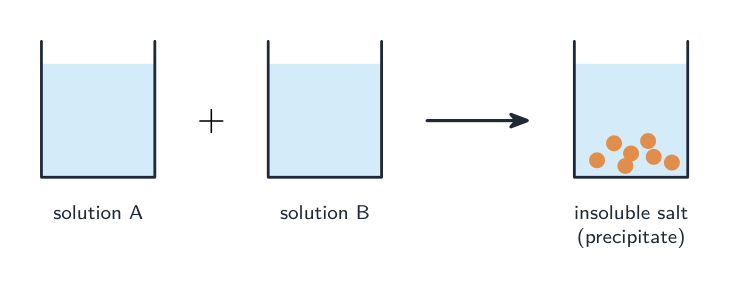
An insoluble salt is made by precipitation 沉淀: mix two solutions that each contain one of the needed ions, and the insoluble salt forms as a solid. You then filter, wash and dry it.

Water in salts

  • A hydrated 水合 substance is chemically joined with water.
  • An anhydrous 无水 substance contains no water.

The water molecules inside hydrated crystals are called the water of crystallisation 结晶水. For example, $\text{CuSO}_4 \bullet 5\text{H}_2\text{O}$ has five water molecules for each formula unit.

ไทย

ความสามารถในการผลิตเกลือด้วยวิธีใดวิธีหนึ่งขึ้นอยู่กับว่าเป็น ละลายน้ำได้ (ละลาย) หรือ ไม่ละลายน้ำ (ไม่ละลาย)

กฎความละลายน้ำ

ประเภทเกลือ กฎ
เกลือโซเดียม, โพแทสเซียม, แอมโมเนียม ละลายน้ำได้ทั้งหมด
ไนเตรต ละลายน้ำได้ทั้งหมด
คลอไรด์ ละลายน้ำได้ ยกเว้น เลดและเงิน
ซัลเฟต ละลายน้ำได้ ยกเว้น บารียม, แคลเซียม และ_TypeInfo
คาร์บอเนต ไม่ละลายน้ำ ยกเว้น โซเดียม, โพแทสเซียม และแอมโมเนียม
ไฮดรอกไซด์ ไม่ละลายน้ำ ยกเว้น โซเดียม, โพแทสเซียม, แอมโมเนียม และ (บางส่วน) แคลเซียม

การผลิตเกลือที่ละลายน้ำได้

คุณทำปฏิกิริยากับกรดกับสิ่งใดสิ่งหนึ่งต่อไปนี้:

  • ด่าง, ใช้ การไทเทรต (เนื่องจากทั้งสองเป็นสารละลาย คุณต้องวัดปริมาตรที่แน่นอน);
  • ส่วนเกิน ของโลหะ, ฐานที่ไม่ละลายน้ำ, หรือคาร์บอเนตที่ไม่ละลายน้ำ

เมื่อใช้ของแข็งส่วนเกิน แล้วคุณต้อง กรอง เพื่อเอาของแข็งที่เหลือออก สุดท้ายคุณ ระเหย น้ำบางส่วนออกและปล่อยให้สารละลาย ตกผลึก เพื่อได้เกลือ

แผนภาพขั้นตอนสี่ขั้นตอน: เพิ่มของแข็งส่วนเกินลงในกรด, กรอง, ระเหยน้ำบางส่วน, แล้วทิ้งไว้ให้ตกผลึก
การผลิตเกลือที่ละลายน้ำได้จากของแข็งที่ไม่ละลายน้ำ: ทำปฏิกิริยากับส่วนเกิน, กรองส่วนเกินออก, ระเหย, แล้วตกผลึก
ผลึกเรขาคณิตสีฟ้าสดใสของทองแดง(II) ซัลเฟตบนพื้นหลังสีขาว
การปล่อยให้สารละลายตกผลึกช้าๆ จะได้ผลึกที่มีรูปร่างดี — ที่นี่คือผลึกสีฟ้าของทองแดง(II) ซัลเฟต

ตัวอย่างที่แสดงวิธีทำ คุณจะใช้วิธีใดในการเตรียม (a) คอปเปอร์(II)ซัลเฟต และ (b) บารียมซัลเฟต? ตรวจสอบกฎความละลายก่อน (a) คอปเปอร์(II)ซัลเฟตเป็น สารละลายได้ (มีเพียงบารียม แคลเซียม และตะกั่วซัลเฟตเท่านั้นที่ไม่ละลาย) ดังนั้นให้ทำจากของแข็งไม่ละลายและกรด: เติม คอปเปอร์(II)ออกไซด์เกินพอ ลงในกรดซัลฟิวริกเจือจางอุ่น แล้ว กรอง นำของแข็งที่เหลือออก จากนั้นระเหยน้ำบางส่วนและทำให้ผลึกตกผลึก (b) บารียมซัลเฟตเป็น สารละลายไม่ได้ ดังนั้นให้ทำโดย การตกตะกอน: ผสมสารละลายสองชนิดที่มีไอออนที่ต้องการอย่างละหนึ่งชนิด แล้วกรอง ล้าง และอบให้แห้ง ความสามารถในการละลายของเกลือที่คุณต้องการคือสิ่งที่กำหนดวิธีการ - ตรวจสอบกฎก่อนเลือกใช้

การทำเกลือที่ไม่ละลายได้

เกลือที่ไม่ละลายได้ทำโดย การตกตะกอน: ผสมสารละลายสองชนิดที่มีไอออนที่ต้องการอย่างละหนึ่งชนิด และเกลือที่ไม่ละลายได้จะเกิดเป็นของแข็ง จากนั้นคุณก็จะกรอง ล้าง และอบให้แห้ง

สารละลายใสสองชนิดเทรวมกันให้แก้ววัดที่มีของแข็งเกิดขึ้นที่ด้านล่าง
การผสมสารละลายสองชนิดที่มีไอออนที่ต้องการอย่างละหนึ่งชนิดจะทำให้เกลือที่ไม่ละลายได้ปรากฏเป็นของแข็งตกตะกอน ซึ่งคุณสามารถกรองออกมาได้

น้ำในเกลือ

  • สารไฮเดรต คือสารที่มีน้ำผูกติดกันทางเคมี
  • สารอะนไฮดรัส คือสารที่ไม่มีน้ำ

โมเลกุลน้ำภายในผลึกไฮเดรตเรียกว่า น้ำแห่งผลึก ตัวอย่างเช่น $\text{CuSO}_4 \bullet 5\text{H}_2\text{O}$ มีโมเลกุลน้ำห้าตัวสำหรับแต่ละหน่วยสูตร

Explore · ⁨สำรวจ⁩

Preparing a soluble salt · ⁨การเตรียมเกลือที่ละลายน้ำได้⁩

Step through the method. React an acid with excess insoluble base, filter off what's left over, then evaporate and crystallise to get pure salt crystals. · ⁨ทำตามขั้นตอนวิธี: ทำปฏิกิริยากับกรดด้วยเบสที่ไม่ละลายน้ำส่วนเกิน กรองเอาส่วนที่เหลือออก แล้วระเหยและผลึกเพื่อให้ได้ผลึกเกลือบริสุทธิ์⁩

Vocabulary · ⁨คำศัพท์⁩ Train · ⁨ฝึกฝน⁩
English ไทย
salt/sɒlt/ เกลือ
hydrogen/ˈhaɪdrədʒn/ ไฮโดรเจน
precipitation/prɪˌsɪpɪˈteɪʃn/ การตกตะกอน
hydrated/haɪˈdreɪtɪd/ ไฮเดรต
anhydrous/ænˈhaɪdrəs/ แอนไฮดรัส (ไร้สารละลาย)
water of crystallisation/ˈwɔːtə ɒv ˌkrɪstəlaɪˈzeɪʃn/ น้ำในผลึก
effervescence/ˌefəˈvesəns/ ฟองแก๊ส
7.3

Exam tips · ⁨ข้อแนะนำสำหรับการสอบ⁩

English
  • Learn the three acid reactions: acid + metal → salt + hydrogen; acid + base → salt + water (neutralisation); acid + carbonate → salt + water + carbon dioxide.
  • Strong and weak describe how much the acid splits into ions (dissociation), not how concentrated it is. A strong acid is fully dissociated; a weak acid only partly.
  • A lower pH means a higher hydrogen-ion concentration. pH 7 is neutral, below 7 is acidic, above 7 is alkaline.
  • Choose the salt method by solubility: a soluble salt is made from an acid + excess solid (then filter, evaporate, crystallise), or by titration with an alkali; an insoluble salt is made by precipitation (mix two solutions, then filter).
  • Learn the solubility rules — all sodium, potassium, ammonium and nitrate salts are soluble.
ไทย
  • จำปฏิกิริยาของกรดสามชนิด: กรด + โลหะ → เกลือ + ไฮโดรเจน; กรด + เบส → เกลือ + น้ำ (การทำให้เป็นกลาง); กรด + คาร์บอเนต → เกลือ + น้ำ + คาร์บอนไดออกไซด์
  • แรง และ อ่อน อธิบายถึงปริมาณที่กรดแยกตัวเป็นไอออน (dissociation), ไม่ใช่ ความเข้มข้น กรดแรงมีการแยกตัวสมบูรณ์; กรดอ่อนมีการแยกตัวบางส่วนเท่านั้น
  • ค่า pH ที่ต่ำลงหมายถึงความเข้มข้นของไอออนไฮโดรเจนที่สูงขึ้น pH 7 เป็นกลาง, ต่ำกว่า 7 เป็นกรด, สูงกว่า 7 เป็นเบส
  • เลือกวิธีการทำเกลือตามความละลาย: เกลือละลายได้ ทำได้จากกรด + ของแข็งเกินพอ (แล้วกรอง, ระเหย, ทำให้ผลึกตกผลึก), หรือโดยการไทเทรตกับอัลคาไล; เกลือไม่ละลายได้ ทำด้วยการตกตะกอน (ผสมสารละลายสองชนิด แล้วกรอง)
  • จำกฎความละลาย — เกลือของโซเดียม โพแทสเซียม แอมโมเนียม และไนเตรตทั้งหมดละลายได้

Interactive lessons on this topic · ⁨บทเรียนเชิงโต้ตอบสำหรับหัวข้อนี้⁩

Work through it step by step, with instant-check exercises. · ⁨ทำทีละขั้นตอน พร้อมแบบฝึกหัดตรวจสอบผลทันที⁩

Past Papers · ⁨ข้อสอบย้อนหลัง⁩

More topics in IGCSE Chemistry · ⁨Chemistry IGCSE⁩ · ⁨หัวข้อเพิ่มเติมใน IGCSE Chemistry · ⁨Chemistry IGCSE⁩⁩

Log in or create account · ⁨เข้าสู่ระบบหรือสร้างบัญชี⁩

IGCSE, A-Level & AP