English
| Core | Supplement |
|---|---|
| 1 Describe the differences between elements, compounds and mixtures |
ไทย
| แก่น | เพิ่มเติม |
|---|---|
| 1 อธิบายความแตกต่างระหว่าง ธาตุ, สารประกอบ และ สารผสม |
IGCSE Chemistry · Chemistry IGCSE · Topic 2 · หัวข้อ 2
 16:46
16:46
อะตอมและพันธะเคมี
มองสองสิ่งนี้ ดIAMOND — วัสดุที่แข็งที่สุดที่คุณซื้อได้ และดินสอสีเทาอ่อนนุ่ม它们在完全不同。Yet both are…
English narration · English + 中文 subtitles burned in · การบรรยายภาษาอังกฤษ · คำบรรยายภาษาอังกฤษ + 中文 ลอยตัวบนภาพ

| Core | Supplement |
|---|---|
| 1 Describe the differences between elements, compounds and mixtures |
| แก่น | เพิ่มเติม |
|---|---|
| 1 อธิบายความแตกต่างระหว่าง ธาตุ, สารประกอบ และ สารผสม |
Source: Cambridge International syllabus · แหล่งที่มา: หลักสูตร Cambridge International
All substances are made from about 100 simple building blocks. Knowing how they are joined lets you sort every substance into one of three groups.
The key difference: in a compound the elements are bonded and can only be separated by chemical reactions; in a mixture they are not bonded and are easy to separate.
สารทั้งหมดประกอบด้วยองค์ประกอบพื้นฐานประมาณ 100 อย่าง การรู้วิธีการเชื่อมต่อกันช่วยให้คุณสามารถจัดกลุ่มสารทุกชนิดออกเป็นสามกลุ่มได้
ความแตกต่างที่สำคัญ: ในสารประกอบ ธาตุจะถูก พันธะ กันและสามารถแยกออกได้เฉพาะโดยปฏิกิริยาเคมี; ในส่วนผสม ониไม่ถูกพันธะกันและแยกออกได้ง่าย

Classify everyday particle examples by composition. · จำแนกตัวอย่างอนุภาคในชีวิตประจำวันตามองค์ประกอบ ⟦⟧.
| English | ไทย |
|---|---|
| element/ˈelɪmənt/ | ธาตุ |
| compound/ˈkɒmpaʊnd/ | สารประกอบ |
| mixture/ˈmɪkstʃə/ | ส่วนผสม |
| nucleus/ˈnjuːklɪəs/ | นิวเคลียส |

| Core | Supplement |
|---|---|
| 1 Describe the structure of the atom as a central nucleus containing neutrons and protons surrounded by electrons in shells | |
| 2 State the relative charges and relative masses of a proton, a neutron and an electron | |
| 3 Define proton number/atomic number as the number of protons in the nucleus of an atom | |
| 4 Define mass number/nucleon number as the total number of protons and neutrons in the nucleus of an atom | |
| 5 Determine the electronic configuration of elements and their ions with proton number 1 to 20, e.g. 2,8,3 | |
| 6 State that: (a) Group VIII noble gases have a full outer electron shell (b) the number of outer shell electrons is equal to the group number in Groups I to VII (c) the number of occupied electron shells is equal to the period number |
| แก่น | เพิ่มเติม |
|---|---|
| 1 อธิบายโครงสร้างของอะตอมโดยมี นิวเคลียส เป็นศูนย์กลางซึ่งประกอบด้วย นิวตรอน และ โปรตอน ล้อมรอบด้วย อิเล็กตรอน ใน ชั้นพลังงาน | |
| 2 บอกรูปแบบ ประจุสัมพัทธ์ และ มวลสัมพัทธ์ ของโปรตอน นิวตรอน และอิเล็กตรอน | |
| 3 นิยาม เลขอะตอม/เลขโปรตอน ว่าคือจำนวนโปรตอนในนิวเคลียสของอะตอม | |
| 4 นิยาม เลขมวล/เลขนิวคลีออน ว่าคือผลรวมของจำนวนโปรตอนและนิวตรอนในนิวเคลียสของอะตอม | |
| 5 หา การกระจายตัวของอิเล็กตรอน ของธาตุและไอออนของธาตุนั้นๆ ที่มีเลขอะตอมตั้งแต่ 1 ถึง 20 เช่น 2,8,3 | |
| 6 ระบุว่า: (ก) กลุ่ม VIII แก๊สนoble มีชั้นอิเล็กตรอนชั้นนอกที่เต็มแล้ว (ข) จำนวนอิเล็กตรอนในชั้นนอกเท่ากับ กลุ่มเลข ในกลุ่ม I ถึง VII (ค) จำนวนชั้นอิเล็กตรอนที่ถูกใช้เท่ากับ ช่วงเลข |
Source: Cambridge International syllabus · แหล่งที่มา: หลักสูตร Cambridge International
Every atom has a small, dense centre called the nucleus 原子核. Around it, electrons 电子 move in shells 电子层 (energy levels). The nucleus contains two kinds of particle: protons 质子 and neutrons 中子.
Each particle has a relative mass and a relative charge 电荷. You must learn these values:
| Particle | Relative mass | Relative charge |
|---|---|---|
| proton | 1 | $+1$ |
| neutron | 1 | $0$ |
| electron | $\frac{1}{1840}$ (almost 0) | $-1$ |
An atom has no overall charge because it has equal numbers of protons ($+1$ each) and electrons ($-1$ each).
Two numbers describe an atom:
So the number of neutrons $=$ mass number $-$ proton number.
The electrons fill the shells from the inside out. The first shell holds up to 2 electrons; the next shells hold up to 8 each (for the first 20 elements). The electronic configuration 电子排布 lists how many electrons are in each shell, starting from the inside.
For example, an atom with 13 electrons has the configuration $2,8,3$. Sodium (proton number 11) is $2,8,1$. Calcium (proton number 20) is $2,8,8,2$.
The configuration links to the Periodic Table 周期表:
อะตอมทุกตัวมีศูนย์กลางขนาดเล็กและหนาแน่นที่เรียกว่า นิวเคลียส รอบๆ นิวเคลียส อิเล็กตรอน จะเคลื่อนที่อยู่ใน ชั้นพลังงาน (energy levels) นิวเคลียสประกอบด้วยอนุภาคสองชนิดคือ โปรตอน และ นิวตรอน
แต่ละอนุภาคมี มวลสัมพัทธ์ และ ประจุสัมพัทธ์ คุณต้องจำค่าเหล่านี้ให้ได้:
| อนุภาค | มวลสัมพัทธ์ | ประจุสัมพัทธ์ |
|---|---|---|
| โปรตอน | 1 | $+1$ |
| นิวตรอน | 1 | $0$ |
| อิเล็กตรอน | $\frac{1}{1840}$ (เกือบเป็น 0) | $-1$ |
อะตอมไม่มีประจุรวมเนื่องจากมีจำนวนโปรตอน ($+1$ ต่อตัว) เท่ากับจำนวนอิเล็กตรอน ($-1$ ต่อตัว)
ตัวเลขสองตัวใช้บรรยายอะตอม:
ดังนั้น จำนวนนิวตรอน = $=$ - $-$
อิเล็กตรอนจะเติมลงในชั้นพลังงานจากด้านในออกไปด้านนอก ชั้นแรกรองรับอิเล็กตรอนได้สูงสุด 2 ตัว; ชั้นถัดไปรองรับได้สูงสุด 8 ตัวต่อชั้น (สำหรับ 20 ธาตุแรก) การเรียงตัวอิเล็กตรอน แสดงจำนวนอิเล็กตรอนในแต่ละชั้น โดยเริ่มนับจากด้านในสุด
ตัวอย่างเช่น อะตอมที่มี 13 อิเล็กตรอน มีการเรียงตัว $2,8,3$ โซเดียม (เลขอะตอม 11) มีการเรียงตัว $2,8,1$ แคลเซียม (เลขอะตอม 20) มีการเรียงตัว $2,8,8,2$
การเรียงตัวเชื่อมโยงกับ ตารางธาตุ:

Change the atomic number and watch the shells fill (2, 8, 8) — the electron arrangement of the first 20 elements. · เปลี่ยนเลขอะตอมและดูชั้นเติมเต็ม (2, 8, 8) — การจัดเรียงอิเล็กตรอนของ 20 ธาตุแรก
| English | ไทย |
|---|---|
| atom/ˈætəm/ | อะตอม |
| shells/ʃelz/ | ชั้น |
| protons/ˈprəʊtɒnz/ | โปรตอน |
| neutrons/ˈnjuːtrɒnz/ | นิวตรอน |
| Group/ɡruːp/ | กลุ่ม |
| Period/ˈpɪərɪəd/ | ช่วงเวลา |
| noble gases/ˈnəʊbl ˈɡæsɪz/ | แก๊สนoble |
| isotopes/ˈaɪsətəʊps/ | ไอโซโทป |

| Core | Supplement |
|---|---|
| 1 Define isotopes as different atoms of the same element that have the same number of protons but different numbers of neutrons | 3 State that isotopes of the same element have the same chemical properties because they have the same number of electrons and therefore the same electronic configuration |
| 2 Interpret and use symbols for atoms, e.g. $^{12}_{6}\text{C}$, and ions, e.g. $^{35}_{17}\text{Cl}^-$ | 4 Calculate the relative atomic mass of an element from the relative masses and abundances of its isotopes |
| แก่น | เพิ่มเติม |
|---|---|
| 1 นิยาม ไอโซโทป ว่าคืออะตอม的不同ของธาตุเดียวกันที่มีจำนวนโปรตอนเท่ากันแต่มีจำนวนนิวตรอนต่างกัน | 3 ระบุว่าไอโซโทปของธาตุเดียวกันจะมี คุณสมบัติทางเคมี เหมือนกันเพราะมีจำนวนอิเล็กตรอนเท่ากันและดังนั้นจึงมี การจัดเรียงอิเล็กตรอน เหมือนกัน |
| 2 ตีความและใช้ สัญลักษณ์ สำหรับอะตอม เช่น $^{12}_{6}\text{C}$, และไอออน เช่น $^{35}_{17}\text{Cl}^-$ | 4 คำนวณ มวลอะตอมสัมพัทธ์ ของธาตุจากมวลสัมพัทธ์และ ความอุดมสมบูรณ์ ของไอโซโทปต่างๆ ของธาตุนั้น |
Source: Cambridge International syllabus · แหล่งที่มา: หลักสูตร Cambridge International
Isotopes 同位素 are atoms of the same element that have the same number of protons but different numbers of neutrons. Because the proton number is the same, they are the same element. Because the neutron number is different, they have different mass numbers.
You write an atom with its mass number on top and proton number below, like $^{12}_{6}\text{C}$. For an ion you add the charge, like $^{35}_{17}\text{Cl}^{-}$.
Isotopes of an element have the same chemical properties. This is because chemical reactions only involve electrons, and isotopes have the same number of electrons and the same electronic configuration. (The extra neutrons change only the mass.)
The relative atomic mass 相对原子质量 ($A_r$) of an element is the average mass of its atoms, taking into account how common each isotope is. The abundance 丰度 is the percentage of each isotope.
For example, chlorine is 75% $^{35}\text{Cl}$ and 25% $^{37}\text{Cl}$:
Worked example. Boron has two isotopes, $^{10}\text{B}$ and $^{11}\text{B}$, and its $A_r$ is 10.8. Find the percentage of each. Let the abundance of $^{11}\text{B}$ be $x$, so the abundance of $^{10}\text{B}$ is $(100 - x)$. Then
so $11x + 1000 - 10x = 1080$, giving $x = 80$. Boron is 80% $^{11}\text{B}$ and 20% $^{10}\text{B}$. Check it against common sense: 10.8 lies closer to 11, so the heavier isotope must be the more common one. If your answer gives the majority to the isotope further from $A_r$, you have them the wrong way round.
ไอโซโทป คืออะตอมของธาตุเดียวกันที่มีจำนวนโปรตอนเท่ากันแต่มีจำนวนนิวตรอนต่างกัน เนื่องจากเลขอะตอมเท่ากันจึงเป็นธาตุเดียวกัน แต่เนื่องจากจำนวนนิวตรอนต่างกันจึงมีเลขมวลต่างกัน
เราเขียนสัญลักษณ์อะตอมโดยใส่เลขมวลด้านบนและเลขอะตอมด้านล่าง เช่น $^{12}_{6}\text{C}$ สำหรับไอออน เราจะเพิ่มประจุเข้าไป เช่น $^{35}_{17}\text{Cl}^{-}$
ไอโซโทปของธาตุหนึ่งจะมี คุณสมบัติทางเคมีเหมือนกัน เนื่องจากปฏิกิริยาเคมีเกี่ยวข้องกับอิเล็กตรอนเท่านั้น และไอโซโทปมีจำนวนอิเล็กตรอนและการเรียงตัวอิเล็กตรอนเหมือนกัน (นิวตรอนที่เพิ่มขึ้นเปลี่ยนเพียงมวลเท่านั้น)
มวลอะตอมสัมพัทธ์ ($A_r$) ของธาตุคือมวลเฉลี่ยของอะตอมต่างๆ โดยพิจารณาจากความอุดมสมบูรณ์ของแต่ละไอโซโทป ความอุดมสมบูรณ์ (abundance) คือเปอร์เซ็นต์ของแต่ละไอโซโทป
ตัวอย่างเช่น คลอรีนมี 75% เป็น $^{35}\text{Cl}$ และ 25% เป็น $^{37}\text{Cl}$:
ตัวอย่างวิธีทำ. บอโรนมีไอโซโทปสองชนิดคือ $^{10}\text{B}$ และ $^{11}\text{B}$, และมี $A_r$ เท่ากับ 10.8. จงหาเปอร์เซ็นต์ของแต่ละชนิด. ให้ปริมาณสัมพัทธ์ของ $^{11}\text{B}$ คือ $x$, ดังนั้นปริมาณสัมพัทธ์ของ $^{10}\text{B}$ คือ $(100 - x)$. แล้วได้สมการดังนี้
ดังนั้น $11x + 1000 - 10x = 1080$ ซึ่งทำให้ $x = 80$ บอโรมี $^{11}\text{B}$ เป็น 80% และ $^{10}\text{B}$ เป็น 20% ตรวจสอบด้วยเหตุผลทั่วไป: 10.8 อยู่ใกล้กับ 11 มากกว่า ดังนั้นไอโซโทปที่มีมวลมากกว่าต้องมีความอุดมสมบูรณ์มากกว่า หากคำตอบของคุณให้สัดส่วนส่วนใหญ่เป็นไอโซโทปที่อยู่ห่างจาก $A_r$ มากกว่า คุณอาจสลับตำแหน่งกันแล้ว
Change the neutrons to make isotopes (same element, different mass number); change the electrons to make ions. · เปลี่ยนนิวตรอนเพื่อสร้างไอโซโทป (ธาตุเดียวกัน แต่เลขมวลต่างกัน); เปลี่ยนอิเล็กตรอนเพื่อสร้างไอออน
Classify isotope facts by proton, neutron and mass number. · จำแนกข้อเท็จจริงเกี่ยวกับไอโซโทปตามโปรตอน นิวตรอน และเลขมวล
| English | ไทย |
|---|---|
| relative atomic mass/ˈrelətɪv əˈtɒmɪk mæs/ | มวลอะตอมสัมพัทธ์ |
| abundance/əˈbʌndəns/ | ความอุดมสมบูรณ์สัมพัทธ์ |

| Core | Supplement |
|---|---|
| 1 Describe the formation of positive ions, known as cations, and negative ions, known as anions | 5 Describe the giant lattice structure of ionic compounds as a regular arrangement of alternating positive and negative ions |
| 2 State that an ionic bond is a strong electrostatic attraction between oppositely charged ions | 6 Describe the formation of ionic bonds between ions of metallic and non-metallic elements, including the use of dot-and-cross diagrams |
| 3 Describe the formation of ionic bonds between elements from Group I and Group VII, including the use of dot-and-cross diagrams | 7 Explain in terms of structure and bonding the properties of ionic compounds: (a) high melting points and boiling points (b) good electrical conductivity when aqueous or molten and poor when solid |
| 4 Describe the properties of ionic compounds: (a) high melting points and boiling points (b) good electrical conductivity when aqueous or molten and poor when solid |
| แก่น | เพิ่มเติม |
|---|---|
| 1 อธิบายการสร้างไอออนบวกที่เรียกว่า แคทไอออน และไอออนลบที่เรียกว่า แอนไอออน | 5 อธิบายโครงสร้างแลตทิซขนาดใหญ่ของสารไอออนิกว่าเป็นการจัดเรียงที่เป็นระเบียบของไอออนบวกและลบสลับกัน |
| 2 ระบุว่าพันธะไอออนิกคือการดึงดูดทางไฟฟ้าสถิตที่แข็งแรงระหว่างไอออนที่มีประจุตรงข้ามกัน | 6 อธิบายการสร้างพันธะไอออนิกระหว่างไอออนของธาตุโลหะและไม่โลหะ รวมถึงการใช้แผนภาพจุดและกากบาท |
| 3 อธิบายการสร้างพันธะไอออนิกระหว่างธาตุในกลุ่ม I และกลุ่ม VII รวมถึงการใช้แผนภาพจุดและกากบาท | 7 อธิบายในเชิงโครงสร้างและพันธะถึงคุณสมบัติของสารไอออนิก: (ก) จุดหลอมเหลวและจุดเดือดสูง (ข) นำไฟฟ้าได้ดีเมื่อละลายน้ำหรือเป็นของเหลวไหล และนำไฟฟ้าได้ไม่ดีเมื่อเป็นของแข็ง |
| 4 อธิบายคุณสมบัติของสารไอออนิก: (ก) จุดหลอมเหลวและจุดเดือดสูง (ข) นำไฟฟ้าได้ดีเมื่อละลายน้ำหรือเป็นของเหลวไหล และนำไฟฟ้าได้ไม่ดีเมื่อเป็นของแข็ง |
Source: Cambridge International syllabus · แหล่งที่มา: หลักสูตร Cambridge International
An ion 离子 is an atom (or group of atoms) that has lost or gained electrons, so it has an electric charge.
Atoms do this to get a full outer shell, like a noble gas.
An ionic bond 离子键 is a strong electrostatic attraction 静电引力 between oppositely charged ions (a $+$ ion and a $-$ ion pull together).
Ionic bonds form between a metal 金属 and a non-metal 非金属. Take sodium chloride, $\text{NaCl}$. Sodium ($2,8,1$) gives its one outer electron to chlorine ($2,8,7$). Now sodium is $\text{Na}^{+}$ ($2,8$) and chlorine is $\text{Cl}^{-}$ ($2,8,8$). Both have full outer shells, and the opposite charges attract.
You can show this with a dot-and-cross diagram: draw each atom's outer-shell electrons as dots for one element and crosses for the other, then show the electron moving from the metal to the non-metal.
An ionic compound 离子化合物 is not made of separate molecules 分子. The ions pack together into a giant lattice 晶格 — a regular pattern of huge numbers of alternating 交替 positive and negative ions.
This structure explains the properties:
| Property | Reason |
|---|---|
| high melting point 熔点 and boiling point 沸点 | the strong electrostatic attraction between ions needs a lot of energy to break |
| poor electrical conductivity 导电性 when solid | the ions are fixed in place and cannot move |
| good conductor when molten 熔融 or aqueous 水溶液 | the ions are now free to move and carry charge |
*การเกิดพันธะไอออน: การถ่ายโอนอิเล็กตรอน
ไอออน คืออะตอม (หรือกลุ่มของอะตอม) ที่สูญเสียหรือได้รับอิเล็กตรอน sehingga它有电charge
อะตอมทำเช่นนี้เพื่อให้ได้ชั้นนอกสุดที่เต็มเหมือนแก๊สนoble
พันธะไอออนิก คือแรง ดึงดูดไฟฟ้าสถิต ที่แข็งแรงระหว่างไอออนที่มีประจุตรงข้ามกัน (ไอออน $+$ และไอออน $-$ ดึงดูดเข้าหากัน)
พันธะไอออนิกเกิดขึ้นระหว่าง โลหะ และ อโลหะ ตัวอย่างเช่น โซเดียมคลอไรด์, $\text{NaCl}$. โซเดียม ($2,8,1$) ส่งอิเล็กตรอนวงนอกหนึ่งตัวให้คลอรีน ($2,8,7$). ตอนนี้โซเดียมเป็น $\text{Na}^{+}$ ($2,8$) และคลอรีนเป็น $\text{Cl}^{-}$ ($2,8,8$). ทั้งสองมีวงอิเล็กตรอนวงนอกเต็มแล้ว และประจุที่ตรงข้ามจะดึงดูดกัน
คุณสามารถแสดงสิ่งนี้ได้ด้วย แผนภาพจุดและเครื่องหมายไขว้: วาดอิเล็กตรอนวงนอกของแต่ละอะตอมโดยใช้จุดสำหรับธาตุหนึ่งและเครื่องหมายไขว้สำหรับอีกธาตุหนึ่ง จากนั้นแสดงการเคลื่อนย้ายของอิเล็กตรอนจากโลหะไปยังอโลหะ
สารประกอบไอออนิก ไม่ประกอบด้วย โมเลกุล แยกต่างหาก ไอออนจะจัดเรียงตัวเข้าด้วยกันเป็น โครงข่ายผลึกขนาดใหญ่ — ซึ่งเป็นรูปแบบที่เป็นระเบียบของ ไอออนบวกและลบสลับกัน จำนวนมหาศาล


โครงสร้างนี้อธิบายคุณสมบัติเหล่านี้:
| คุณสมบัติ | เหตุผล |
|---|---|
| จุดหลอมเหลว และ จุดเดือดสูง | การดึงดูดทางไฟฟ้าสถิตที่แข็งแกร่งระหว่างไอออนต้องใช้พลังงานมากในการทำลาย |
| นำไฟฟ้าได้ไม่ดี เมื่อเป็นของแข็ง | ไอออนถูกยึดไว้กับที่และไม่สามารถเคลื่อนที่ได้ |
| นำไฟฟ้าได้ดีเมื่อ ละลาย หรือ ละลายน้ำ | ปัจจุบันไอออนอิสระในการเคลื่อนที่และพกพาประจุ |
Step through it. A metal hands its outer electron to a non-metal; the oppositely charged ions then attract and pack into a giant lattice. · ดูขั้นตอน: โลหะส่งอิเล็กตรอนชั้นนอกให้กับไม่โลหะ; ไอออนที่มีประจุตรงข้ามกันจะดึงดูดและจัดเรียงเป็นตาข่ายผลึกขนาดใหญ่
Step through it: the metal hands its outer electron(s) to the non-metal, both reach full shells, and the resulting + and − ions attract — an ionic bond. · ดูขั้นตอน: โลหะส่งอิเล็กตรอนชั้นนอกให้กับไม่โลหะ ทั้งคู่ได้ชั้นเต็ม และไอออน + และ − ที่เกิดขึ้นจะดึงดูดกัน — นี่คือพันธะไอออนิก
| English | ไทย |
|---|---|
| charge/tʃɑːdʒ/ | ประจุไฟฟ้า |
| proton number/ˈprəʊtɒn ˈnʌmbə/ | เลขอะตอม |
| atomic number/əˈtɒmɪk ˈnʌmbə/ | เลขอะตอม |
| mass number/mæs ˈnʌmbə/ | เลขมวล |
| nucleon number/ˈnjuːklɪən ˈnʌmbə/ | เลขนิวคลีออน |
| electronic configuration/ɪlekˈtrɒnɪk kənˌfɪɡjəˈreɪʃn/ | การจัดเรียงอิเล็กตรอน |
| Periodic Table/ˌpɪərɪˈɒdɪk ˈteɪbl/ | ตารางธาตุ |
| ion/ˈaɪɒn/ | ไอออน |
| cation/ˈkætaɪən/ | แคทไอออน |
| anion/ˈænaɪən/ | แอนไอออน |
| ionic bond/aɪˈɒnɪk bɒnd/ | พันธะไอออนิก |
| electrostatic attraction/ɪˌlektrəʊˈstætɪk əˈtrækʃn/ | electrostatic attraction |
| lattice/ˈlætɪs/ | ผลึก (lattice) |
| alternating/ˈɔːltəneɪtɪŋ/ | สลับขั้ว |
| melting point/ˈmeltɪŋ pɔɪnt/ | จุดหลอมเหลว |
| boiling point/ˈbɔɪlɪŋ pɔɪnt/ | จุดเดือด |
| electrical conductivity/ɪˈlektrɪkl kɒndəkˈtɪvɪti/ | การนำไฟฟ้า |
| molten/ˈməʊltn/ | หลอมเหลว |
| aqueous/ˈeɪkwɪəs/ | สารละลายในน้ำ |

| Core | Supplement |
|---|---|
| 1 State that a covalent bond is formed when a pair of electrons is shared between two atoms leading to noble gas electronic configurations | |
| 2 Describe the formation of covalent bonds in simple molecules, including $\text{H}_2$, $\text{Cl}_2$, $\text{H}_2\text{O}$, $\text{CH}_4$, $\text{NH}_3$ and $\text{HCl}$. Use dot-and-cross diagrams to show the electronic configurations in these and similar molecules | 4 Describe the formation of covalent bonds in simple molecules, including $\text{CH}_3\text{OH}$, $\text{C}_2\text{H}_4$, $\text{O}_2$, $\text{CO}_2$ and $\text{N}_2$. Use dot-and-cross diagrams to show the electronic configurations in these and similar molecules |
| 3 Describe in terms of structure and bonding the properties of simple molecular compounds: (a) low melting points and boiling points (b) poor electrical conductivity | 5 Explain in terms of structure and bonding the properties of simple molecular compounds: (a) low melting points and boiling points in terms of weak intermolecular forces (specific types of intermolecular forces are not required) (b) poor electrical conductivity |
| แก่น | เพิ่มเติม |
|---|---|
| 1 ระบุว่าพันธะโคเวเลนต์เกิดขึ้นเมื่อคู่อิเล็กตรอนถูกแบ่งปันกันระหว่างสองอะตอมจนเกิดการกระจายตัวของอิเล็กตรอนแบบแก๊สนoble | |
| 2 อธิบายการสร้างพันธะโคเวเลนต์ในโมเลกุล đơn รวมถึง $\text{H}_2$, $\text{Cl}_2$, $\text{H}_2\text{O}$, $\text{CH}_4$, $\text{NH}_3$ และ $\text{HCl}$ ใช้แผนภาพจุดและกากบาทเพื่อแสดงการกระจายตัวของอิเล็กตรอนในโมเลกุลเหล่านี้และโมเลกุลที่คล้ายกัน | 4 อธิบายการสร้างพันธะโคเวเลนต์ในโมเลกุล đơn รวมถึง $\text{CH}_3\text{OH}$, $\text{C}_2\text{H}_4$, $\text{O}_2$, $\text{CO}_2$ และ $\text{N}_2$ ใช้แผนภาพจุดและกากบาทเพื่อแสดงการกระจายตัวของอิเล็กตรอนในโมเลกุลเหล่านี้และโมเลกุลที่คล้ายกัน |
| 3 อธิบายในเชิงโครงสร้างและพันธะถึงคุณสมบัติของสารโมเลกุล đơn: (ก) จุดหลอมเหลวและจุดเดือดต่ำ (ข) นำไฟฟ้าได้ไม่ดี | 5 อธิบายในเชิงโครงสร้างและพันธะถึงคุณสมบัติของสารโมเลกุล đơn: (ก) จุดหลอมเหลวและจุดเดือดต่ำเนื่องจากแรงระหว่างโมเลกุลอ่อน (ไม่จำเป็นต้องระบุประเภทเฉพาะของแรงระหว่างโมเลกุล) (ข) นำไฟฟ้าได้ไม่ดี |
Source: Cambridge International syllabus · แหล่งที่มา: หลักสูตร Cambridge International
A covalent bond 共价键 forms when two atoms share a pair of electrons. By sharing, each atom gets a full outer shell (a noble gas configuration). Covalent bonds form between non-metal atoms.
Some molecules to know:
In a dot-and-cross diagram for a molecule, you draw the outer electrons of each atom and show which pairs are shared in the overlap between the atoms.
These substances are made of small, separate molecules.
พันธะโคเวเลนต์ เกิดขึ้นเมื่อสองอะตอม แบ่งปัน อิเล็กตรอนคู่หนึ่ง通过将 By sharing, each atom gets a full outer shell (a noble gas configuration). Covalent bonds form between non-metal atoms.
โมเลกุลบางชนิดที่ต้องรู้จัก:
ในแผนภาพจุดและเครื่องหมายไขว้ของโมเลกุล คุณวาดอิเล็กตรอนวงนอกของแต่ละอะตอมและแสดงว่าคู่ใดบ้างที่ถูกแบ่งปันในพื้นที่ทับซ้อนระหว่างอะตอม

สารเหล่านี้ประกอบด้วยโมเลกุลเล็กแยกต่างหาก
Shared electron pairs repel one another and spread out as far apart as they can. Four bonding pairs and no lone pairs gives a tetrahedral shape, like methane (CH4). · คู่电子ที่แบ่งปันกันจะผลักกันและกระจายตัวออกให้ห่างที่สุด สี่คู่ bonding และไม่มี lone pair จะให้รูปทรงสี่หน้า (tetrahedral) เช่น เมทาน (CH4)
Step through it: two non-metal atoms overlap and share a pair of electrons — counting for both — so each reaches a full outer shell. That shared pair is the covalent bond; O₂ shares two pairs (a double bond). · ขั้นตอนการทำงาน: อะตอมของธาตุอโลหะสองชนิดซ้อนทับกันและแบ่งปันคู่ electron หนึ่งคู่ — นับรวมสำหรับทั้งสองข้าง — ทำให้แต่ละอะตอมมีชั้น outer ที่เต็มแล้ว คู่ที่แบ่งปันนี้คือพันธะโคเวเลนต์; O₂ แบ่งปันสองคู่ (เป็นพันธะคู่)
| English | ไทย |
|---|---|
| metal/ˈmetl/ | โลหะ |
| non-metal/nɒn ˈmetl/ | โลหะมีloid |
| ionic compound/aɪˈɒnɪk ˈkɒmpaʊnd/ | สารประกอบไอออนิก |
| molecules/ˈmɒlɪkjuːlz/ | โมเลกุล |
| covalent bond/ˈkəʊvələnt bɒnd/ | พันธะโคเวเลนต์ |
| intermolecular forces/ˌɪntəməˈlekjʊlə ˈfɔːsɪz/ | แรงระหว่างโมเลกุล |
| giant covalent structure/ˈdʒaɪənt ˈkəʊvələnt ˈstrʌktʃə/ | โครงสร้างโคเวเลนต์ขนาดใหญ่ |

| Core | Supplement |
|---|---|
| 1 Describe the giant covalent structures of graphite and diamond | 3 Describe the giant covalent structure of silicon(IV) oxide, $\text{SiO}_2$ |
| 2 Relate the structures and bonding of graphite and diamond to their uses, limited to: (a) graphite as a lubricant and as an electrode (b) diamond in cutting tools | 4 Describe the similarity in properties between diamond and silicon(IV) oxide, related to their structures |
| แก่น | เพิ่มเติม |
|---|---|
| 1 อธิบายโครงสร้างโคเวเลนต์ขนาดใหญ่ของกราไฟต์และเพชร | 3 อธิบายโครงสร้างโคเวเลนต์ขนาดใหญ่ของซิลิคอน(IV)ออกไซด์, $\text{SiO}_2$ |
| 2 เชื่อมโยงโครงสร้างและพันธะของกราไฟต์และเพชรกับการใช้งาน ซึ่งจำกัดไว้เพียง: (ก) กราไฟต์ใช้เป็นสารหล่อลื่นและเป็นขั้วไฟฟ้า (ข) เพชรใช้ในเครื่องมือตัด | 4 อธิบายความคล้ายคลึงกันในคุณสมบัติระหว่างเพชรและซิลิคอน(IV)ออกไซด์ ซึ่งสัมพันธ์กับโครงสร้างของทั้งสอง |
Source: Cambridge International syllabus · แหล่งที่มา: หลักสูตร Cambridge International
Some covalent substances are not small molecules. Instead, millions of atoms are joined by covalent bonds into one giant covalent structure 巨型共价结构. The two you must know are both forms of carbon.
Diamond 金刚石: each carbon atom is bonded to four other carbon atoms. This makes a very strong, rigid 3-D network. Diamond is extremely hard, so it is used in cutting tools 切割工具.
Graphite 石墨: each carbon atom is bonded to only three others, forming flat layers 层. There are weak forces between the layers, so the layers can slide over each other — this makes graphite a good lubricant 润滑剂. The fourth outer electron of each carbon is free; these delocalised electrons 离域电子 can move, so graphite conducts electricity and is used as an electrode 电极.
Silicon(IV) oxide 二氧化硅 ($\text{SiO}_2$) has a giant covalent structure like diamond, so it is also very hard and has a very high melting point.
สารโคเวเลนต์บางชนิดไม่ใช่โมเลกุลเล็ก แทนที่จะเป็นเช่นนั้น อะตอมหลายล้านตัวเชื่อมต่อกันด้วยพันธะโคเวเลนต์เป็น โครงสร้างโคเวเลนต์ขนาดใหญ่เดียว สองชนิดที่คุณต้องรู้คือรูป allotrope ของคาร์บอนทั้งสอง
เพชร: อะตอมคาร์บอนแต่ละตัวเชื่อมต่อกับอะตอมคาร์บอนอีกสี่ตัว ทำให้เกิดโครงสร้างเครือข่าย 3-D ที่แข็งแรงและแข็งทื่อมาก เพชรมีความแข็งสูงมากจึงถูกนำไปใช้ใน เครื่องมือตัด
กราไฟต์: คาร์บอนแต่ละตัวเชื่อมต่อกับอีกสามตัวเท่านั้น สร้างเป็น ชั้นแบนราบ มีแรงอ่อนๆ ระหว่างชั้น ทำให้ชั้นสามารถลื่นไถลผ่านกันได้ — สิ่งนี้ทำให้กราไฟต์เป็น น้ำมันหล่อลื่น ที่ดี อิเล็กตรอนวงนอกตัวที่สี่ของคาร์บอนแต่ละตัวเป็นอิสระ; อิเล็กตรอนที่ไม่Localization เหล่านี้สามารถเคลื่อนที่ได้ ดังนั้นกราไฟต์จึงนำไฟฟ้าได้และใช้เป็น ขั้วไฟฟ้า

ซิลิกอน(IV)ออกไซด์ ($\text{SiO}_2$) มีโครงสร้างโคเวเลนต์ขนาดใหญ่เหมือนเพชร ดังนั้นจึงมีความแข็งมากและมีจุดหลอมเหลวสูงมาก
Compare giant covalent structures by bonding and properties. · เปรียบเทียบโครงสร้างโคเวเลนต์ขนาดใหญ่โดยพิจารณาจากพันธะและคุณสมบัติ
| English | ไทย |
|---|---|
| diamond/ˈdaɪəmənd/ | เพชร |
| cutting tools/ˈkʌtɪŋ tuːlz/ | เครื่องมือตัด |
| graphite/ˈɡræfaɪt/ | กราไฟต์ |
| layers/ˈleɪəz/ | เลเยอร์ |
| lubricant/ˈluːbrɪkənt/ | สารหล่อลื่น |
| Core | Supplement |
|---|---|
| 1 Describe metallic bonding as the electrostatic attraction between the positive ions in a giant metallic lattice and a ‘sea’ of delocalised electrons | |
| 2 Explain in terms of structure and bonding the properties of metals: (a) good electrical conductivity (b) malleability and ductility |
| แก่น | เพิ่มเติม |
|---|---|
| 1 อธิบายพันธะโลหะว่าเป็นการดึงดูดทางไฟฟ้าสถิตระหว่างไอออนบวกในแลตทิซโลหะขนาดใหญ่และ "ทะเล" ของอิเล็กตรอนที่เคลื่อนที่อิสระ | |
| 2 อธิบายในเชิงโครงสร้างและพันธะถึงคุณสมบัติของโลหะ: (ก) นำไฟฟ้าได้ดี (ข) ทนต่อการตีขึ้นรูปและดัดดึง |
Source: Cambridge International syllabus · แหล่งที่มา: หลักสูตร Cambridge International
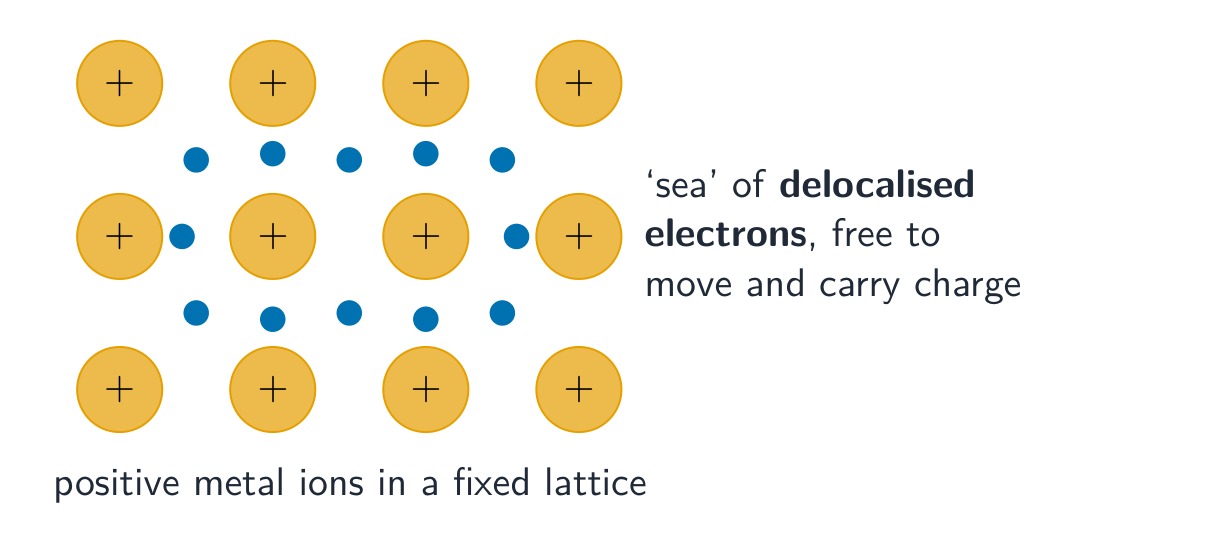
A metal is a giant structure of positive ions surrounded by a 'sea' of delocalised electrons that are free to move through the whole metal. Metallic bonding 金属键 is the strong electrostatic attraction between these positive ions and the sea of electrons.
This explains two key properties of metals:
โลหะเป็นโครงสร้างขนาดใหญ่ของไอออนบวกที่ล้อมรอบด้วย "ทะเล" ของ อิเล็กตรอนที่ไม่Localization ที่อิสระในการเคลื่อนที่ผ่านโลหะทั้งหมด พันธะโลหะ คือการดึงดูดทางไฟฟ้าสถิตที่แข็งแกร่งระหว่างไอออนบวกเหล่านี้กับทะเลของอิเล็กตรอน
สิ่งนี้อธิบายคุณสมบัติสำคัญสองประการของโลหะ:
Step through it. Positive ions sit in a shared sea of delocalised electrons — that one picture explains conduction and why metals bend instead of snapping. · ขั้นตอนการทำงาน: ไอออนบวกนั่งอยู่ในทะเลของอิเล็กตรอนดีโลคาไลซ์ — ภาพเดียวอธิบายการนำไฟฟ้าและทำไมโลหะถึงงอแทนที่จะแตกหัก
| English | ไทย |
|---|---|
| metallic bonding/məˈtælɪk ˈbɒndɪŋ/ | การพันธะโลหะ |
| malleability/ˌmæləˈbɪlɪti/ | ความยืดหยุ่น |
| ductility/dʌkˈtɪlɪti/ | ความยืดหยุ่น |
| English | ไทย |
|---|---|
| electrons/ɪˈlektrɒnz/ | อิเล็กตรอน |
| delocalised electrons/dɪˈlɒkəlaɪzd ɪˈlektrɒnz/ | อิเล็กตรอนที่กระจายตัว |
| electrode/ɪˈlektrəʊd/ | อิเล็กโทรด |
| silicon(IV) oxide/ˈsɪlɪkən ˈɒksaɪd/ | ซิลิคอน(IV) ออกไซด์ |
Work through it step by step, with instant-check exercises. · ทำทีละขั้นตอน พร้อมแบบฝึกหัดตรวจสอบผลทันที
Past Papers · ข้อสอบย้อนหลัง
Loading subjects… · กำลังโหลดวิชา…