Metallic bonding
Introduced| English | Meaning |
|---|---|
| metallic bonding/məˈtælɪk ˈbɒndɪŋ/ | Positive metal ions in a sea of delocalised electrons. |
| delocalised/dɪˈlɒkəlaɪzd/ | Describing electrons that are spread over several atoms rather than confined to one bond or atom. |
| conductors/kənˈdʌktəz/ | A material through which electric charge or thermal energy can pass readily. |
| malleable/ˈmæləbl/ | Able to be hammered or rolled into a different shape without breaking. |
A sea of electrons
- Metals conduct electricity, bend without breaking, and feel solid. Why?
- The answer is a special kind of bonding: metallic bonding 金属键.
Metallic bonding consists of:
Difficulty 1/5 · 100 coins + a small bonus on first completion today
Delocalised electrons surround positive metal ions.
The outer electrons in a metal are delocalised, meaning free to move.
Difficulty 1/5 · 100 coins + a small bonus on first completion today
Delocalised electrons explain conduction and malleability.
In a metal, positive ions sit in a ______ of delocalised electrons.
Difficulty 1/5 · 100 coins + a small bonus on first completion today
The electron sea holds the metal together.
What metallic bonding is
- In a metal, atoms lose their outer electrons, which become delocalised 离域的 (free to move).
- This creates a lattice of positive metal ions in a sea of free electrons.
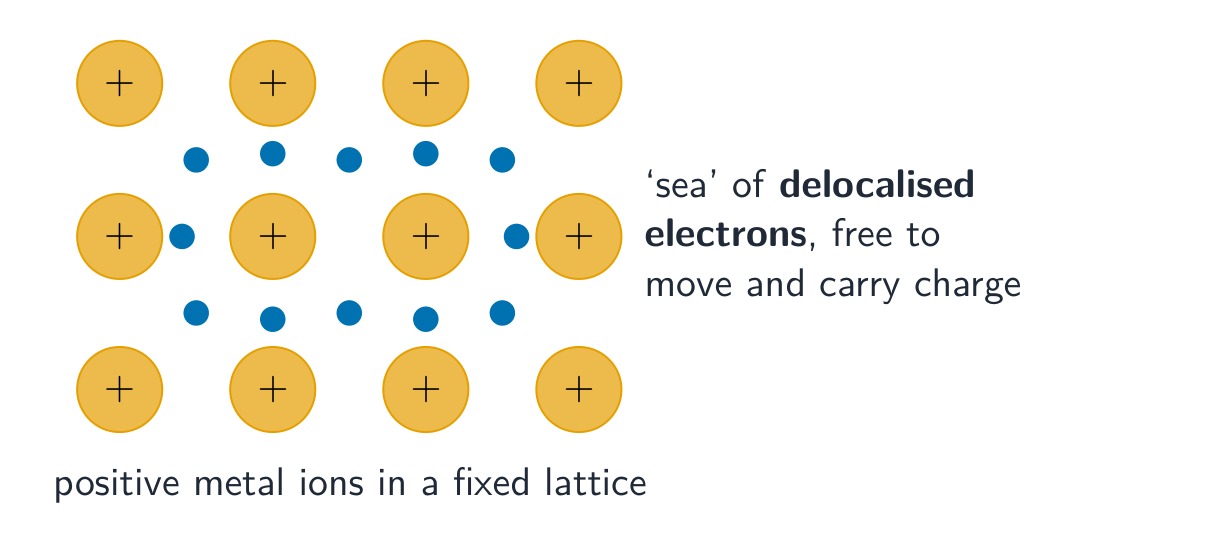
A metal is positive ions in a sea of delocalised electrons that are free to move
Inside a metal — and why it behaves that way
Step through it. Positive ions sit in a shared sea of delocalised electrons — that one picture explains conduction and why metals bend instead of snapping.
Metals conduct electricity because they have:
Difficulty 1/5 · 100 coins + a small bonus on first completion today
Mobile electrons carry the current.
Conducting electricity and heat
- The free electrons can move through the metal, carrying electric current and heat.
- This is why metals are good conductors 导体.
Metals can be bent and shaped (are malleable) because:
Difficulty 1/5 · 100 coins + a small bonus on first completion today
Sliding layers keep the metallic bond intact.
Strong and bendy
- The strong attraction between the ions and the electron sea makes metals strong with high melting points.
- Layers of ions can slide over each other without breaking the bond, so metals are malleable 可延展的 (can be bent and shaped).
Worked example. Copper is used for wires because its delocalised electrons carry current easily, and it can be drawn into thin wires because its ion layers slide — both explained by metallic bonding.
You've got it
- metallic bonding: positive metal ions in a sea of delocalised electrons
- free electrons make metals good conductors of electricity and heat
- sliding ion layers make metals malleable; strong attraction gives high melting points
Write from delocalised electrons that conduct
- A metal wire is connected in a circuit.
- The positive ions stay in the lattice.
What carries the current?
Moving electrons, not moving ions, carry charge in a metal.
What carries charge through the metal?
Difficulty 1/5 · 100 coins + a small bonus on first completion today
The electron sea is mobile.