Atomic structure
Introduced| English | Meaning |
|---|---|
| nucleus/ˈnjuːklɪəs/ | The small, dense central part of an atom, containing protons and usually neutrons. |
| electrons/ɪˈlektrɒnz/ | Negatively charged subatomic particles found outside atomic nuclei. |
| protons/ˈprəʊtɒnz/ | Positively charged subatomic particles found in atomic nuclei. |
| neutrons/ˈnjuːtrɒnz/ | Electrically neutral subatomic particles found in most atomic nuclei. |
| shells/ʃelz/ | The main electron energy levels around an atomic nucleus. |
| neutral/ˈnjuːtrəl/ | Neither acidic nor alkaline when describing a solution, or having no net electric charge when describing a particle or object. |
| mass number/mæs ˈnʌmbə/ | The total number of protons and neutrons in an atomic nucleus. |
| atomic number/əˈtɒmɪk ˈnʌmbə/ | The number of protons in the nucleus of an atom. |
Inside the atom
- Atoms are the tiny building blocks of everything — but they have an even smaller inner structure.
- An atom has a central nucleus 原子核 surrounded by electrons 电子.
Which subatomic particle has a positive charge?
Difficulty 1/5 · 100 coins + a small bonus on first completion today
Protons are positive; neutrons neutral; electrons negative.
The three subatomic particles
- Protons 质子: positive charge, in the nucleus.
- Neutrons 中子: no charge, in the nucleus.
- Electrons: negative charge, orbiting in shells 电子层.
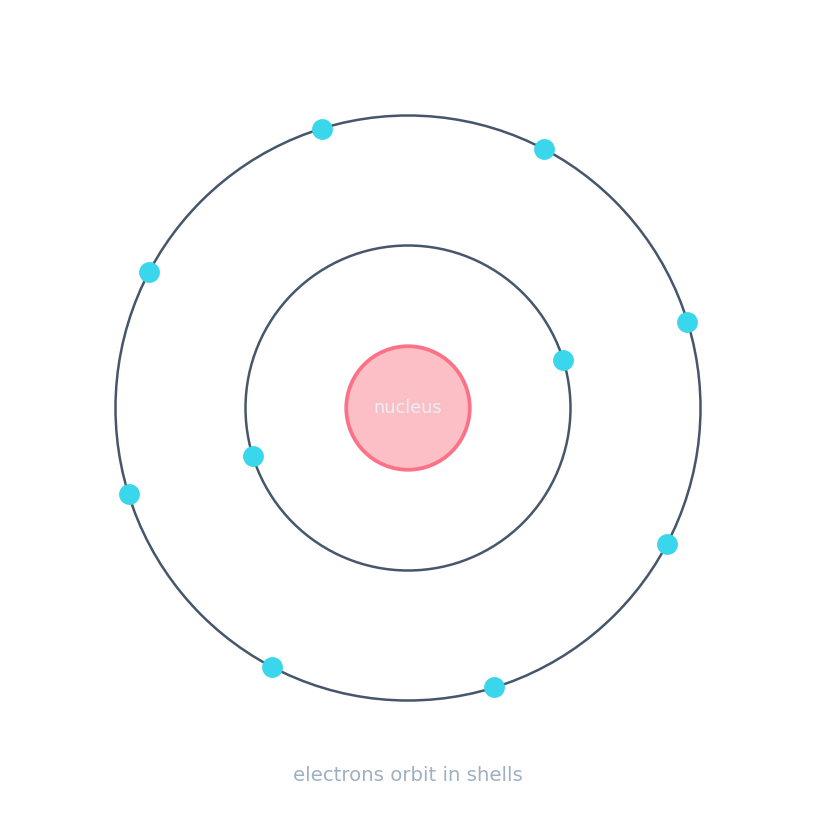
Protons and neutrons sit in the nucleus; electrons orbit in shells.
An atom has no overall charge because it has equal numbers of:
Difficulty 1/5 · 100 coins + a small bonus on first completion today
Equal protons and electrons make an atom neutral.
Mass and charge
- Protons and neutrons each have a mass of 1; electrons have almost no mass.
- An atom is neutral 中性 because it has equal numbers of protons and electrons.
Build the atom, shell by shell
Protons and neutrons sit in the tiny nucleus; electrons fill shells around it — 2 in the first, then up to 8. Change the element to see how its particles are arranged.
An atom has atomic number 6 and mass number 14. How many neutrons does it have?
Difficulty 2/5 · 140 coins + a small bonus on first completion today
Neutrons = mass number − atomic number = 14 − 6 = 8.
The atomic number of an element is the number of:
Difficulty 1/5 · 100 coins + a small bonus on first completion today
Atomic number = number of protons.
The mass number equals the number of protons plus ______.
Difficulty 1/5 · 100 coins + a small bonus on first completion today
Mass number = protons + neutrons.
Atomic and mass number 质量数
- Atomic (proton) number = the number of protons (this defines the element).
- Mass number = protons + neutrons. So neutrons = mass number − atomic number 原子序数.
Worked example. A sodium atom has atomic number 11 and mass number 23. It has 11 protons, 11 electrons (neutral), and 23 − 11 = 12 neutrons.
You've got it
- protons (+, nucleus), neutrons (0, nucleus), electrons (−, shells)
- atoms are neutral: protons = electrons; proton and neutron mass = 1, electron ≈ 0
- atomic number = protons; mass number = protons + neutrons