Skip to content · ⁨ข้ามไปยังเนื้อหา⁩
Subjects · ⁨รายวิชา⁩

IGCSE Chemistry · ⁨Chemistry IGCSE⁩

Tips · ⁨เคล็ดลับ⁩

เคมี IGCSE (0620) ครอบคลุมตั้งแต่ สถานะของสสาร และ โครงสร้างอะตอม ผ่านถึง สโตichiometry, อิเล็กโทรเคมี, พลังงาน, อัตราปฏิกิริยา, กรดและเบส, ตารางธาตุ, โลหะ, เคมีสิ่งแวดล้อม และ เคมีอินทรีย์ ลงท้ายด้วยเทคนิคและการวิเคราะห์การทดลอง

สโตchiometry กำหนดเกรด It appears in its own questions and again inside electrochemistry, energetics and rates, so time spent on moles pays back several times over.

The other reliable loss is equations: unbalanced, missing state symbols, or an ionic equation written out in full. Papers exist for six components, split between Core and Extended — confirm which you are sitting before you revise.

  • 1

    States of matter · ⁨สถานะของสาร⁩

    Watch lesson · ⁨ดูบทเรียน⁩
    1.1

    The three states of matter · ⁨สภาวะของสสารทั้งสาม⁩

    Syllabus · ⁨หลักสูตร⁩
    English
    Core Supplement
    1 State the distinguishing properties of solids, liquids and gases
    2 Describe the structures of solids, liquids and gases in terms of particle separation, arrangement and motion
    3 Describe changes of state in terms of melting, boiling, evaporating, freezing and condensing 5 Explain changes of state in terms of kinetic particle theory, including the interpretation of heating and cooling curves
    4 Describe the effects of temperature and pressure on the volume of a gas 6 Explain, in terms of kinetic particle theory, the effects of temperature and pressure on the volume of a gas
    ไทย
    แก่น เพิ่มเติม
    1 ระบุคุณสมบัติเฉพาะของ ของแข็ง, ของเหลว และ แก๊ส
    2 อธิบายโครงสร้างของของแข็ง, ของเหลว และแก๊ส ในแง่ของ ระยะห่างระหว่างอนุภาค, การจัดเรียง และ การเคลื่อนที่
    3 อธิบาย การเปลี่ยนสถานะ ในแง่ของ การหลอมเหลว, การเดือด, การระเหย, การแข็งตัว และ การควบแน่น 5 อธิบายการเปลี่ยนสถานะในแง่ของ ทฤษฎีอนุภาคจลน์, รวมถึงการตีความ กราฟความร้อนและความเย็น
    4 อธิบายผลของ อุณหภูมิ และ ความดัน ต่อ ปริมาตรของแก๊ส 6 อธิบายในแง่ของ ทฤษฎีอนุภาคจลน์ ว่าอุณหภูมิและความดันมีผลต่อปริมาตรของแก๊สอย่างไร

    Source: Cambridge International syllabus · ⁨แหล่งที่มา: หลักสูตร Cambridge International⁩

    English
    Solid, liquid, gas: particle motion

    Everything around you is made of tiny particles 粒子 — these can be atoms 原子, molecules 分子, or ions 离子. The kinetic particle theory 粒子动理论 says these particles are always moving. How close the particles are, how they are arranged, and how they move decides whether matter is a solid 固体, a liquid 液体, or a gas 气体.

    Properties you can observe

    You do not need a microscope to tell the three states apart. They behave in different ways:

    • A solid has a fixed shape and a fixed volume 体积. It does not flow and you cannot compress 压缩 it (squeeze it smaller).
    • A liquid has a fixed volume but no fixed shape. It flows and takes the shape of its container. It is almost impossible to compress.
    • A gas has no fixed shape and no fixed volume. It flows and spreads out to fill the whole container. A gas is easy to compress.

    The table below sums up these properties. Density 密度 means how much mass 质量 is packed into a given volume.

    Property Solid Liquid Gas
    Shape fixed takes the shape of the container fills the whole container
    Volume fixed fixed fills the whole container
    Can it be compressed? no almost none yes, easily
    Does it flow? no yes yes
    Density high high low

    The particle picture

    The kinetic particle theory explains these properties by looking at three things: the separation 间距 of the particles (how far apart they are), their arrangement 排列 (the pattern), and their motion 运动 (how they move).

    Solid Liquid Gas
    Separation touching, very close close together far apart
    Arrangement regular 规则 pattern random, no pattern random, no pattern
    Motion vibrate 振动 about fixed positions move and slide past each other move quickly in all directions

    Strong forces of attraction 引力 hold the particles together. In a solid these forces are strong enough to hold every particle in place, so a solid keeps its shape. In a liquid the forces are weaker, so particles can move around. In a gas the particles move so fast that the forces hardly act at all, so the gas spreads out.

    ไทย
    ของแข็ง, ของเหลว, ก๊าซ: การเคลื่อนที่ของอนุภาค

    ทุกสิ่งรอบตัวคุณทำจาก อนุภาค เล็กมาก — ซึ่งอาจเป็น อะตอม, โมเลกุล, หรือ ไอออน ทฤษฎีอนุภาคจลน์ระบุว่าอนุภาคเหล่านี้มีการเคลื่อนไหวตลอดเวลา ความใกล้ชิดของอนุภาค รูปแบบการจัดเรียง และการเคลื่อนที่ของอนุภาคเป็นตัวกำหนดว่าสสารนั้นจะเป็น ของแข็ง, ของเหลว, หรือ ก๊าซ

    คุณสมบัติที่คุณสังเกตได้

    คุณไม่จำเป็นต้องใช้กล้องจุลทรรศน์เพื่อแยกแยะสภาวะทั้งสาม ออกจากกัน—they behaves differently:

    • ของแข็งมีรูปร่างตายตัวและมี ปริมาตร ที่แน่นอน มันไม่ไหลและไม่สามารถ บีบอัด ได้ (บีบให้เล็กลง)
    • ของเหลวมีปริมาตรที่แน่นอนแต่ไม่มีรูปร่างตายตัว มันไหลและ conform กับรูปร่างของภาชนะ几乎 impossible to compress.
    • ก๊าซไม่มีรูปร่างตายตัวและไม่มีปริมาตรที่แน่นอน มันไหลและกระจายตัวเต็มภาชนะ ก๊าซบีบอัดได้ง่าย

    ตารางด้านล่างสรุปคุณสมบัติเหล่านี้ ความหนาแน่น หมายถึงปริมาณ มวล ที่อัดอยู่ในปริมาตรที่กำหนด

    คุณสมบัติ ของแข็ง ของเหลว ก๊าซ
    รูปร่าง ตายตัว conform กับรูปร่างภาชนะ เติมเต็มภาชนะทั้งหมด
    ปริมาตร ตายตัว ตายตัว เติมเต็มภาชนะทั้งหมด
    บีบอัดได้หรือไม่? ไม่ เกือบไม่ได้ ได้, ง่าย
    ไหลได้หรือไม่? ไม่ ได้ ได้
    ความหนาแน่น สูง สูง ต่ำ

    ภาพของอนุภาค

    ทฤษฎีอนุภาคจลน์อธิบายคุณสมบัติเหล่านี้โดยพิจารณาสามอย่าง: ระยะห่าง ของอนุภาค (ว่าอยู่ห่างกันเท่าไร), การจัดเรียง (รูปแบบ), และ การเคลื่อนที่ (วิธีการเคลื่อนที่)

    ของแข็ง ของเหลว ก๊าซ
    การแยกตัว สัมผัสกัน, ใกล้กันมาก อยู่ชิดกัน แยกห่างกัน
    การจัดเรียง รูปแบบที่เป็นระเบียบ สุ่ม, ไม่มีรูปแบบ สุ่ม, ไม่มีรูปแบบ
    การเคลื่อนที่ สั่น ในตำแหน่งคงที่ เคลื่อนที่และเลื่อนผ่านกัน เคลื่อนที่เร็วในทุกทิศทาง

    แรงดึงดูด ที่แข็งแรงยึดอนุภาคไว้ด้วยกัน ในของแข็งแรงเหล่านี้มีมากพอที่จะยึดอนุภาคแต่ละตัวไว้ที่ตำแหน่ง ทำให้ของแข็งรักษารูปร่างไว้ ในของเหลวแรงอ่อนกว่า ดังนั้นอนุภาคจึงเคลื่อนที่ได้อิสระ ในก๊าซอนุภาคเคลื่อนที่เร็วมากจนแรงแทบจะไม่ทำงานเลย ทำให้ก๊าซกระจายตัว

    แผนภาพอนุภาคของของแข็ง ของเหลว และก๊าซ: ของแข็งเป็นตารางจัดเรียงแบบเป็นระเบียบ, ของเหลวอยู่ใกล้กันแต่สุ่ม, ก๊าซกระจายตัว thưaๆ
    อนุภาคจัดเรียงแน่นและเป็นระเบียบในของแข็ง หนาแน่นและไม่เป็นระเบียบในของเหลว และห่างกันมากในแก๊ส
    Explore · ⁨สำรวจ⁩

    States of matter · ⁨สถานะของสาร⁩

    Heat the box and watch the particles break free: a vibrating solid melts to a flowing liquid, then spreads out as a gas. Same particles — just more energy. · ⁨ให้ความร้อนกับกล่องแล้วดูอนุภาคหลุดออก: ของแข็งที่สั่นสะเทือนจะหลอมเหลวกลายเป็นของเหลวไหล ไหลกระจายตัวเป็นแก๊ส อนุภาคเดิม — เพียงแต่มีพลังงานมากขึ้น ⟦⟧.⁩

    Vocabulary · ⁨คำศัพท์⁩ Train · ⁨ฝึกฝน⁩
    English ไทย
    particles/ˈpɑːtɪklz/ อนุภาค
    atoms/ˈætəmz/ อะตอม
    molecules/ˈmɒlɪkjuːlz/ โมเลกุล
    ions/ˈaɪɒnz/ ไอออน
    kinetic particle theory/kɪˈnetɪk ˈpɑːtɪkl ˈθɪəri/ ทฤษฎีอนุภาคจลน์
    compress/kəmˈpres/ อัด
    density/ˈdensɪti/ ความหนาแน่น
    mass/mæs/ มวล
    separation/ˌsepəˈreɪʃn/ การแยกสาร
    arrangement/əˈreɪndʒmənt/ การจัดวาง
    motion/ˈməʊʃn/ การเคลื่อนที่
    regular/ˈreɡjʊlə/ สม่ำเสมอ
    vibrate/vaɪˈbreɪt/ สั่นสะเทือน
    forces of attraction/ˈfɔːsɪz ɒv əˈtrækʃn/ แรงดึงดูด
    melting/ˈmeltɪŋ/ การหลอมละลาย
    freezing/ˈfriːzɪŋ/ การแช่แข็ง
    evaporating/ɪˈvæpəreɪtɪŋ/ การระเหย
    boiling/ˈbɔɪlɪŋ/ จุดเดือด
    condensing/kənˈdensɪŋ/ การควบแน่น
    melting point/ˈmeltɪŋ pɔɪnt/ จุดหลอมเหลว
    boiling point/ˈbɔɪlɪŋ pɔɪnt/ จุดเดือด
    1.1

    Changes of state · ⁨การเปลี่ยนสถานะ⁩

    English

    When you heat or cool a substance, it can change from one state to another. You must know the name of each change.

    Change What happens Name
    solid → liquid melting 熔化 melting
    liquid → solid freezing 凝固 freezing
    liquid → gas (at the surface, below the boiling point) evaporating 蒸发 evaporation
    liquid → gas (all through the liquid) boiling 沸腾 boiling
    gas → liquid condensing 凝结 condensation

    A pure solid melts at one fixed temperature, the melting point 熔点. A pure liquid boils at one fixed temperature, the boiling point 沸点. The same substance freezes at its melting point and condenses at its boiling point.

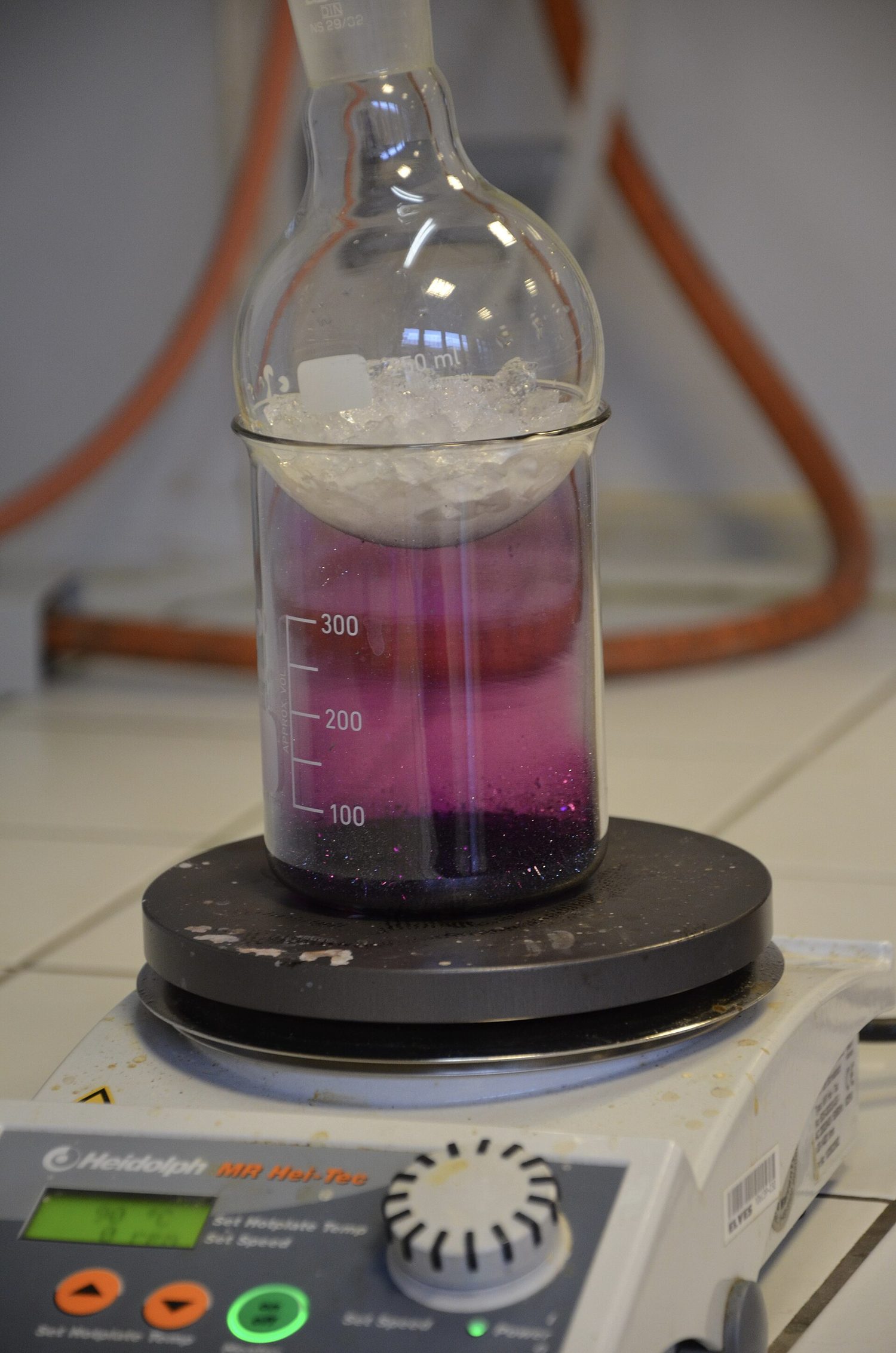
    A few substances change straight from solid to gas without melting first. This is called sublimation 升华. In the photo below, warmed solid iodine in a beaker turns directly into a purple gas; the gas then cools on the round flask of ice above and turns back into a solid.

    Explaining changes of state with the particle theory

    Each change of state is really a change in the energy 能量 of the particles.

    • When you heat a solid, the particles gain energy and vibrate faster. At the melting point the particles have enough energy to break away from their fixed places and slide around — the solid melts.
    • When you heat a liquid, the particles move faster. At the boiling point they have enough energy to fully escape the forces of attraction and become a gas.
    • Cooling does the opposite. The particles lose energy, move more slowly, and the forces of attraction pull them back together.

    During a change of state the energy goes into breaking the forces of attraction, not into making the particles move faster. This is why the temperature stays the same while a substance is melting or boiling.

    Heating and cooling curves

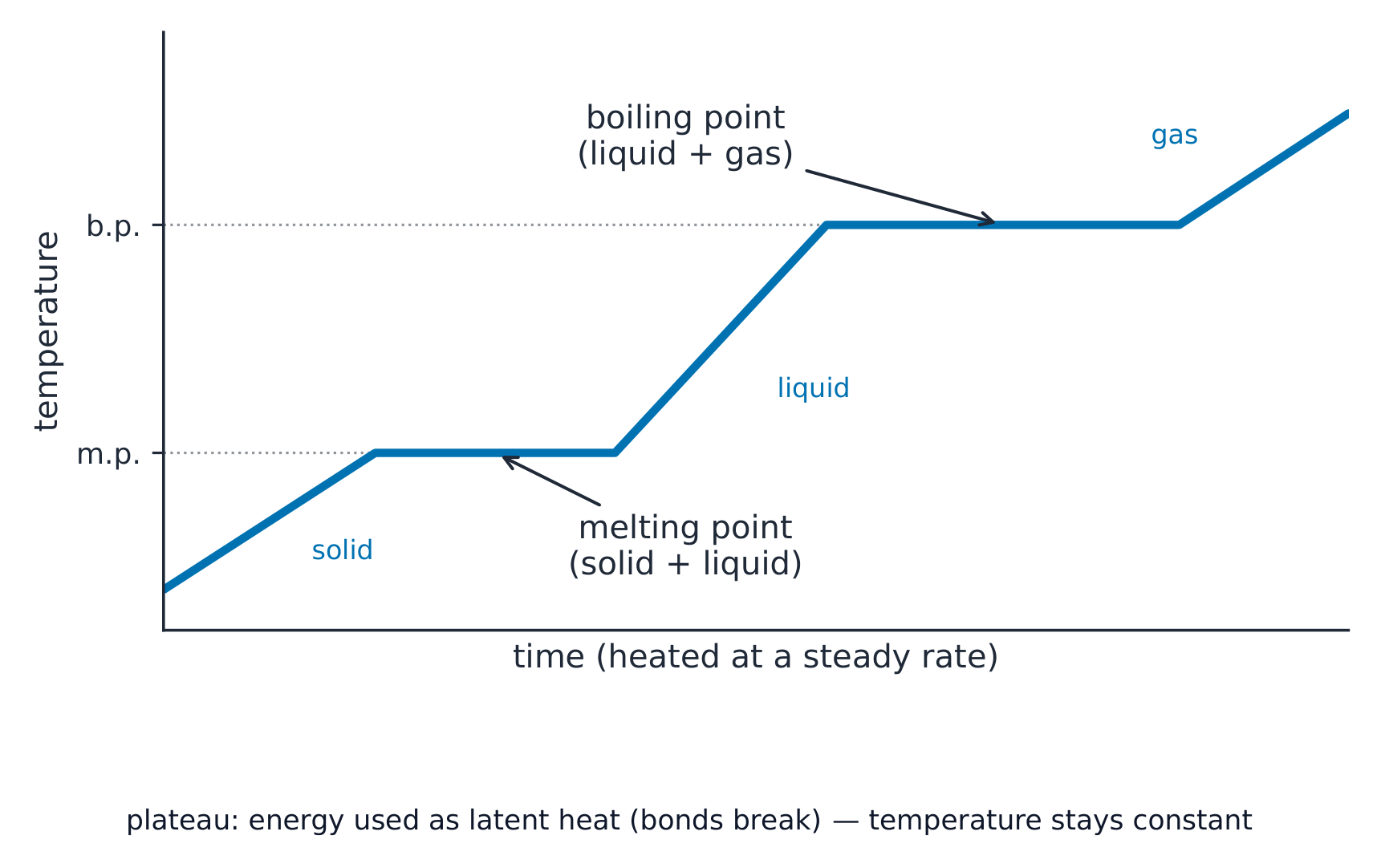
    A heating curve 加热曲线 is a graph of temperature against time as you heat a substance steadily. A cooling curve 冷却曲线 is the same graph as the substance cools.

    On a heating curve there are two flat (level) parts:

    • The first flat part is at the melting point. Here solid and liquid are both present. The heat energy breaks the forces holding the solid together, so the temperature does not rise.
    • The second flat part is at the boiling point. Here liquid and gas are both present, and the temperature again stays constant.

    A cooling curve is the reverse. It has a flat part at the boiling point (the gas condenses) and a flat part at the melting point (the liquid freezes). As the particles slow down, thermal energy 热能 is released to the surroundings.

    ไทย
    ลูกน้ำแข็งละลายในแก้ว
    น้ำแข็งละลายเป็นน้ำ: การเปลี่ยนสถานะเมื่อของแข็งถูกทำให้ร้อน

    เมื่อคุณให้ความร้อนหรือทำให้เย็นสารหนึ่ง มันสามารถเปลี่ยนจากสภาวะหนึ่งไปยังอีกสภาวะหนึ่ง คุณต้องรู้ชื่อของการเปลี่ยนแปลงแต่ละชนิด

    การเปลี่ยนแปลง เกิดอะไรขึ้น ชื่อ
    ของแข็ง → ของเหลว ละลาย การละลาย
    ของเหลว → ของแข็ง แข็งตัว การแข็งตัว
    ของเหลว → ก๊าซ (ที่พื้นผิว, ต่ำกว่าจุดเดือด) ระเหย การระเหย
    ของเหลว → ก๊าซ (ทั่วทั้งของเหลว) เดือด การเดือด
    ก๊าซ → ของเหลว ควบแน่น การควบแน่น

    ของบริสุทธิ์จะละลายที่อุณหภูมิตายตัวหนึ่ง ซึ่งเรียกว่า จุดหลอมเหลว ของบริสุทธิ์จะเดือดที่อุณหภูมิตายตัวหนึ่ง ซึ่งเรียกว่า จุดเดือด สารเดียวกันจะแข็งตัวที่จุดหลอมเหลวและควบแน่นที่จุดเดือด

    ของแข็ง, ของเหลว และก๊าซ เชื่อมต่อกันด้วยลูกศร: การละลายและการเดือดไปทางหนึ่ง, การแข็งตัวและการควบแน่นย้อนกลับ
    การให้ความร้อน: ของแข็ง → ของเหลว → ก๊าซ; การทำให้เย็นจะย้อนกลับทุกการเปลี่ยนแปลง

    สารบางชนิดเปลี่ยนตรงจากของแข็งเป็นก๊าซโดยไม่ละลายก่อน นี่คือ การระเหยด ในภาพด้านล่าง แร่ไอโอดีนแข็งที่ถูกทำให้ร้อนใน beker เปลี่ยนเป็นก๊าซสีม่วงโดยตรง; จากนั้นก๊าซจะเย็นลงบนขวดกลมที่มีน้ำแข็งด้านบนและกลับกลายเป็นของแข็งอีกครั้ง

    beker ของแร่ไอโอดีนแข็งบนเตาความร้อนเต็มไปด้วยก๊าซไอโอดีนสีม่วงสดใส, พร้อมขวดที่มีน้ำแข็งวางอยู่บน頂 where the gas turns back to a solid
    ไอโอดีนของแข็งที่อุ่นขึ้นเปลี่ยนเป็นแก๊สสีม่วงโดยตรง (การระเหิด)
    ก้อนน้ำแข็งแห้งปล่อยควันขาวหนาเมื่อเปลี่ยนเป็นก๊าซโดยตรง
    ตัวอย่างในชีวิตประจำวัน: น้ำแข็งแห้งคือคาร์บอนไดออกไซด์แข็ง และมันก็ระเหยดเช่นกัน — มันไม่เคยทิ้งแอ่งน้ำ

    อธิบายการเปลี่ยนสถานะด้วยทฤษฎีอนุภาค

    การเปลี่ยนสถานะแต่ละชนิดแท้จริงแล้วเป็นการเปลี่ยนแปลงใน พลังงาน ของอนุภาค

    • เมื่อคุณให้ความร้อนของแข็ง อนุภาคจะได้รับพลังงานและ สั่น เร็วขึ้น ที่จุดหลอมเหลว อนุภาคจะมีพลังงานเพียงพอที่จะหลุดออกจากตำแหน่งเดิมและเลื่อนรอบๆ — ของแข็งละลาย
    • เมื่อคุณให้ความร้อนของเหลว อนุภาคเคลื่อนที่เร็วขึ้น ที่จุดเดือด они имеют достаточно энергии чтобы逃脱 attractive forces иกลายเป็นก๊าซ
    • การทำให้เย็นทำในทางตรงกันข้าม อนุภาคสูญเสียพลังงาน เคลื่อนที่ช้าลง และแรงดึงดูดดึงพวกเขากลับมา together again

    ระหว่างการเปลี่ยนสถานะ พลังงานจะถูกนำไป用於การ overcome attractive forces, ไม่ใช่用于ทำให้อนุภาคเคลื่อนที่เร็วขึ้น นี่คือเหตุผลที่อุณหภูมิคงที่ขณะสารกำลังละลายหรือเดือด

    กราฟการให้ความร้อนและการทำให้เย็น

    กราฟการให้ความร้อน คือกราฟของอุณหภูมิเทียบกับเวลา當你 steadily heat a substance. กราฟการทำให้เย็น คือกราฟเดียวกันเมื่อสารเย็นลง

    บนกราฟการให้ความร้อนจะมีสองส่วนราบ (ระดับ):

    • ส่วนราบแรกอยู่ที่ จุดหลอมเหลว此处ของแข็งและของเหลวอยู่ร่วมกัน พลังงานความร้อนทำลายแรงยึดเหนี่ยวระหว่างอนุภาค ทำให้อุณหภูมิไม่เพิ่มขึ้น
    • ส่วนราบที่สองอยู่ที่ จุดเดือด此处ของเหลวและแก๊สอยู่ร่วมกัน และอุณหภูมิต่อให้คงที่

    กราฟความเย็นเป็นภาพกลับด้าน มีส่วนราบที่จุดเดือด (แก๊สควบแน่น) และส่วนราบที่จุดหลอมเหลว (ของเหลวแข็งตัว) เมื่ออนุภาคเคลื่อนที่ช้าลง พลังงานความร้อนจะถูกปล่อยออกสู่สิ่งแวดล้อม

    กราฟการให้ความร้อนของอุณหภูมิเทียบกับเวลา, สูงขึ้นแล้วราบที่จุดหลอมเหลว, สูงขึ้นแล้วราบที่จุดเดือด, จากนั้นสูงขึ้นอีกครั้ง
    อุณหภูมิคงที่ที่จุดหลอมเหลวและจุดเดือดขณะแรงดึงดูดถูกทำลาย
    Explore · ⁨สำรวจ⁩

    Heating a substance through its states · ⁨การให้ความร้อนแก่สารผ่านสถานะต่างๆ⁩

    Step up the temperature. Adding heat gives the particles more energy until they break free — and the temperature pauses at each change of state while the energy does that work. · ⁨เพิ่มอุณหภูมิขึ้น การเพิ่มความร้อนให้พลังงานแก่อนุภาคจนพวกเขาหลุดออก — และอุณหภูมิจะหยุดนิ่งในช่วงการเปลี่ยนสถานะแต่ละครั้งขณะที่พลังงานทำงานนั้น ⟦⟧.⁩

    Vocabulary · ⁨คำศัพท์⁩ Train · ⁨ฝึกฝน⁩
    English ไทย
    solid/ˈsɒlɪd/ ของแข็ง
    liquid/ˈlɪkwɪd/ ของเหลว
    gas/ɡæs/ แก๊ส
    sublimation/ˌsʌblɪˈmeɪʃn/ การแปลงสภาพ (Sublimation)
    energy/ˈenədʒi/ พลังงาน
    heating curve/ˈhiːtɪŋ kɜːv/ กราฟความร้อน
    cooling curve/ˈkuːlɪŋ kɜːv/ กราฟความเย็น
    thermal energy/ˈθɜːml ˈenədʒi/ 热能
    1.1

    Gases: temperature, pressure and volume · ⁨แก๊ส: อุณหภูมิ ความดัน และปริมาตร⁩

    English

    A gas pushes on the walls of its container. This push, spread over the area of the wall, is the pressure 压强 of the gas. Pressure comes from the gas particles hitting the walls.

    Effect of temperature

    If you heat a fixed mass of gas while keeping the pressure the same, its volume increases.

    Using the particle theory: heating gives the particles more kinetic energy 动能, so they move faster. They hit the walls harder and more often. To keep the pressure the same, the gas must take up more space, so the volume gets bigger.

    If instead the volume is fixed (a sealed, rigid container), heating the gas makes the pressure rise, because the faster particles collide 碰撞 with the walls harder and more often.

    Effect of pressure

    If you increase the pressure on a fixed mass of gas while keeping the temperature the same, its volume decreases. Squeezing the gas into a smaller space means the particles hit the walls more often, which is what a higher pressure means.

    ไทย

    แก๊สผลักผนังภาชนะ แรงผลักนี้กระจายบนพื้นที่ของผนังคือ ความดัน ของแก๊ส ซึ่งเกิดจากอนุภาคแก๊สชนกับผนัง

    ผลของอุณหภูมิ

    หากคุณให้ความร้อนแก๊สที่มีมวลคงที่โดยรักษาความดันไว้เท่าเดิม ปริมาตรจะเพิ่มขึ้น

    แก๊สที่ถูกทำให้ร้อน: อนุภาคเคลื่อนที่เร็วขึ้นใช้พื้นที่มากขึ้นที่ความดันคงที่
    แก๊สที่ถูกความร้อน: อนุภาคเคลื่อนที่เร็วขึ้นกระจายตัวและใช้พื้นที่มากขึ้น

    โดยใช้ทฤษฎีอนุภาค: การให้ความร้อนเพิ่ม พลังงานจลน์ ให้แก่อนุภาค ทำให้เคลื่อนที่เร็วขึ้น ชนผนังแรงขึ้นและบ่อยขึ้น เพื่อรักษาความดันให้คงที่ แก๊สต้องใช้พื้นที่มากขึ้น ดังนั้นปริมาตรจึงใหญ่ขึ้น

    หากในทางกลับกันปริมาตรคงที่ (ภาชนะปิดทึบแข็ง), การให้ความร้อนแก๊สจะทำให้ความดันเพิ่มขึ้น เพราะอนุภาคที่เคลื่อนที่เร็วขึ้น ชน กับผนังแรงขึ้นและบ่อยขึ้น

    ผลของความดัน

    หากคุณเพิ่มความดันต่อแก๊สที่มีมวลคงที่โดยรักษาอุณหภูมิไว้เท่าเดิม ปริมาตรจะลดลง การบีบแก๊สให้อยู่ในพื้นที่เล็กกว่าหมายความว่าอนุภาคชนกับผนังบ่อยขึ้น ซึ่งเป็นความหมายของความดันที่สูงขึ้น

    ที่อุณหภูมิเดียวกัน การบีบแก๊สให้อยู่ในปริมาตรเล็กกว่าทำให้อนุภาคอยู่ใกล้กันมากขึ้นจนชนกับผนังบ่อยขึ้น ซึ่งคือความดันที่สูงขึ้น
    การบีบแก๊สให้อยู่ในปริมาตรเล็กกว่าทำให้อนุภาคชนกับผนังบ่อยขึ้น จึงทำให้ความดันเพิ่มขึ้น
    Explore · ⁨สำรวจ⁩

    Gases, pressure & volume · ⁨แก๊ส ความดัน & ปริมาตร⁩

    p = k / V

    Squeeze the volume and the pressure rises (Boyle's law). · ⁨บีบ ปริมาตร แล้ว ความดัน จะเพิ่มขึ้น (กฎของโบয়েล) ⟦⟧.⁩

    Vocabulary · ⁨คำศัพท์⁩ Train · ⁨ฝึกฝน⁩
    English ไทย
    volume/ˈvɒljuːm/ ปริมาตร
    pressure/ˈpreʃə/ ความดัน
    kinetic energy/kɪˈnetɪk ˈenədʒi/ พลังงานจลน์
    collide/kəˈlaɪd/ ชนกัน
    1.2

    Diffusion · ⁨การแพร่ (Diffusion)⁩

    Syllabus · ⁨หลักสูตร⁩
    English
    Core Supplement
    1 Describe and explain diffusion in terms of kinetic particle theory 2 Describe and explain the effect of relative molecular mass on the rate of diffusion of gases
    ไทย
    แก่น เพิ่มเติม
    1 อธิบายและอธิบาย การแพร่กระจาย ในแง่ของ ทฤษฎีอนุภาคจลน์ 2 อธิบายและอธิบายผลของ มวลโมเลกุลสัมพัทธ์ ต่อ อัตราการแพร่กระจาย ของแก๊ส

    Source: Cambridge International syllabus · ⁨แหล่งที่มา: หลักสูตร Cambridge International⁩

    English
    Diffusion: random motion, one-way flow

    Diffusion 扩散 is the spreading of particles from a region where they are crowded to a region where they are spread out — that is, from high concentration 浓度 to low concentration. It happens because particles are always moving in random directions.

    Diffusion explains why you can smell food from across a room: the smell particles move and mix with the air until they reach your nose. Diffusion happens in gases and in liquids, but not in solids, because solid particles cannot move from place to place.

    Rate of diffusion and molecular mass

    Lighter gas particles move faster than heavier ones at the same temperature. So a gas with a smaller relative molecular mass 相对分子质量 (a smaller mass for each molecule) has a faster rate 速率 of diffusion.

    A classic experiment shows this. Cotton wool soaked in ammonia 氨气 ($\text{NH}_3$) is put at one end of a long glass tube. Cotton wool soaked in hydrogen chloride 氯化氢 ($\text{HCl}$) is put at the other end. Both gases diffuse along the tube and meet to form a white ring of ammonium chloride 氯化铵 ($\text{NH}_4\text{Cl}$).

    $$\text{NH}_3 + \text{HCl} \rightarrow \text{NH}_4\text{Cl}$$

    Ammonia has $M_r = 17$ and hydrogen chloride has $M_r = 36.5$. Ammonia is lighter, so it diffuses faster and travels further along the tube. The white ring forms nearer the hydrogen chloride end.

    Worked example. Bromine ($M_r = 160$) and ammonia ($M_r = 17$) are released at the same moment from opposite ends of a long tube. Which travels further before they meet? Compare the relative molecular masses. Ammonia's $M_r$ is far smaller, so its molecules move faster at the same temperature and it diffuses more quickly. Ammonia therefore travels the greater distance, and the two gases meet nearer the bromine end. The rule is always "lighter means faster" - argue from $M_r$, never from how big the formula looks on paper.

    ไทย
    การแพร่กระจาย: การเคลื่อนที่แบบสุ่ม, กระแสการไหลทางเดียว

    การแพร่คือการกระจายตัวของอนุภาคจากบริเวณที่หนาแน่นไปยังบริเวณที่บาง—that คือ จาก ความเข้มข้นสูงไปต่ำ เกิดขึ้นเนื่องจากอนุภาคเคลื่อนที่ไปในทิศทางสุ่มตลอดเวลา

    อนุภาคที่หนาแน่นด้านหนึ่งของกล่องกระจายออกไปตามเวลาจนเติมเต็มกล่องอย่างสม่ำเสมอ เคลื่อนที่จากความเข้มข้นสูงไปต่ำ
    อนุภาคแพร่จากความเข้มข้นสูงไปต่ำจนกระจายตัวอย่างสม่ำเสมอ

    การแพร่อธิบายได้ว่าทำไมคุณจึงสามารถดมกลิ่นอาหารได้จากระยะไกลในห้อง: อนุภาคกลิ่นเคลื่อนที่และผสมกับอากาศจนถึงจมูกของคุณ การแพร่เกิดขึ้นในแก๊สและของเหลว แต่ไม่เกิดขึ้นในของแข็ง เนื่องจากอนุภาคของแข็งไม่สามารถเคลื่อนที่เปลี่ยนตำแหน่งได้

    อัตราการแพร่และมวลโมเลกุล

    อนุภาคแก๊สที่มีน้ำหนักเบากว่าเคลื่อนที่เร็วกว่าอนุภาคหนักกว่าที่อุณหภูมิเดียวกัน ดังนั้นแก๊สที่มี มวลโมเลกุลสัมพัทธ์ น้อยกว่า (มวลของแต่ละโมเลกุลน้อยกว่า) จะมี อัตราการแพร่ ที่เร็วขึ้น

    การทดลองคลาสสิกแสดงให้เห็นสิ่งนี้ สำลีชุบ แอมโมเนีย ($\text{NH}_3$) วางที่ปลายหนึ่งของหลอดแก้วยาว สำลีชุบ ไฮโดรเจนคลอไรด์ ($\text{HCl}$) วางที่อีกปลายทั้งสองแก๊สแพร่ไปตามหลอดและพบกันเพื่อสร้างวงแหวนสีขาวของ แอมโมเนียมคลอไรด์ ($\text{NH}_4\text{Cl}$)

    $$\text{NH}_3 + \text{HCl} \rightarrow \text{NH}_4\text{Cl}$$

    แอมโมเนียมี $M_r = 17$ และไฮโดรเจนคลอไรด์มี $M_r = 36.5$ แอมโมเนียมีน้ำหนักเบากว่าดังนั้นจึงแพร่เร็วขึ้นและเดินทางไกลกว่าตามหลอด วงแหวนสีขาวจึงเกิดขึ้นใกล้ปลายไฮโดรเจนคลอไรด์มากขึ้น

    หลอดแก้วยาวที่มีแอมโมเนียแพร่เข้ามาทางซ้ายและไฮโดรเจนคลอไรด์ทางขวา; พวกเขาพบกันเพื่อสร้างวงแหวนสีขาวใกล้ปลายไฮโดรเจนคลอไรด์มากขึ้น
    แอมโมเนีย ($M_r=17$) มีน้ำหนักเบากว่าดังนั้นจึงแพร่เร็วและไกลกว่า; วงแหวนสีขาวเกิดขึ้นใกล้ปลาย HCl มากขึ้น

    ตัวอย่างคำนวณ. บรอมีน ($M_r = 160$) และแอมโมเนีย ($M_r = 17$) ปล่อยออกมาพร้อมกันจากปลายตรงข้ามของหลอดยาว哪一种เดินทางไกลกว่าก่อนจะพบกัน? เปรียบเทียบมวลโมเลกุลสัมพัทธ์ มวลโมเลกุลของแอมโมเนีย $M_r$ น้อยกว่ามาก ดังนั้นโมเลกุลของมันจึงเคลื่อนที่เร็วขึ้นที่อุณหภูมิเดียวกันและแพร่เร็วขึ้น ดังนั้นแอมโมเนียจึงเดินทางระยะทางมากกว่า และการพบกันของแก๊สทั้งสองจะอยู่ใกล้ปลาย บรอมีน มากกว่า กฎคือ "เบา意味著เร็ว" - อธิบายจาก $M_r$ ไม่ใช่จากขนาดของสูตรบนกระดาษ

    Explore · ⁨สำรวจ⁩

    Diffusion · ⁨การแพร่กระจาย (Diffusion)⁩

    Release the cloud and the particles spread on their own from the crowded corner until they fill the box evenly — diffusion, sped up by heat. · ⁨ปล่อยเมฆและอนุภาคจะกระจายตัวเองจากมุมที่หนาแน่นไปจนเติมเต็มกล่องอย่างสม่ำเสมอ — การแพร่ ซึ่งเร่งความเร็วด้วยความร้อน ⟦⟧.⁩

    Explore · ⁨สำรวจ⁩

    Diffusion · ⁨การแพร่กระจาย (Diffusion)⁩

    Set the concentration on each side. Particles spread from high to low concentration until evenly mixed. · ⁨ตั้งความเข้มข้นในแต่ละด้าน อนุภาคกระจายจาก สูงไปต่ำ จนผสมกันสม่ำเสมอ⁩

    Vocabulary · ⁨คำศัพท์⁩ Train · ⁨ฝึกฝน⁩
    English ไทย
    diffusion/dɪˈfjuːʒn/ การแพร่
    concentration/ˌkɒnsənˈtreɪʃn/ ความเข้มข้น
    relative molecular mass/ˈrelətɪv məˈlekjʊlə mæs/ มวลโมเลกุลสัมพัทธ์
    rate/reɪt/ อัตราส่วน
    ammonia/æˈməʊnɪə/ แอมโมเนีย
    hydrogen chloride/ˈhaɪdrədʒn ˈklɔːraɪd/ ไฮโดรเจนคลอไรด์
    ammonium chloride/æˈməʊnɪəm ˈklɔːraɪd/ แอมโมเนียมคลอไรด์
    Watch lesson · ⁨ดูบทเรียน⁩
    1.2

    Exam tips · ⁨ข้อแนะนำสำหรับการสอบ⁩

    English
    • During melting and boiling the temperature stays constant (the flat parts of a heating curve), because the energy breaks the forces between particles instead of making them move faster.
    • Evaporation happens only at the surface and at any temperature; boiling happens throughout the liquid at one fixed temperature.
    • Explain gas behaviour with the particle theory: heating a gas at fixed volume raises the pressure because the particles hit the walls harder and more often — the particles themselves do not get bigger.
    • Diffusion is faster for lighter particles (smaller $M_r$) and cannot happen in solids. In the ammonia/hydrogen chloride tube the lighter ammonia travels further, so the white ring forms nearer the HCl end.
    ไทย
    • ระหว่าง การหลอมเหลว และ การเดือด อุณหภูมิคงที่ (ส่วนราบของกราฟ升温) เนื่องจากพลังงานทำลายแรงระหว่างอนุภาคแทนที่จะทำให้เคลื่อนที่เร็วขึ้น
    • การระเหย เกิดขึ้นเฉพาะที่พื้นผิวและที่อุณหภูมิใดๆ; การเดือด เกิดขึ้นทั่วทั้งของเหลวที่อุณหภูมิคงที่หนึ่ง
    • อธิบายพฤติกรรมของแก๊สด้วยทฤษฎีอนุภาค: การให้ความร้อนแก๊สที่ปริมาตรคงที่ทำให้ความดันเพิ่มขึ้นเพราะอนุภาคชนกับผนังแรงขึ้นและบ่อยขึ้น—not because the particles themselves get bigger.
    • การแพร่ เร็วขึ้นสำหรับอนุภาคที่มีน้ำหนักเบากว่า (มวล $M_r$ น้อยกว่า) และไม่เกิดขึ้นในของแข็ง ในหลอดแอมโมเนีย/ไฮโดรเจนคลอไรด์ แอมโมเนียที่มีน้ำหนักเบากว่าเดินทางไกลกว่า ดังนั้นวงแหวนสีขาวจึงเกิดขึ้นใกล้ปลาย HCl มากขึ้น
  • 2

    Atoms, elements and compounds · ⁨อะตอม ธาตุ และสารประกอบ⁩

    Watch lesson · ⁨ดูบทเรียน⁩
    2.1

    Elements, compounds and mixtures · ⁨ธาตุ สารประกอบ และสารผสม⁩

    Syllabus · ⁨หลักสูตร⁩
    English
    Core Supplement
    1 Describe the differences between elements, compounds and mixtures
    ไทย
    แก่น เพิ่มเติม
    1 อธิบายความแตกต่างระหว่าง ธาตุ, สารประกอบ และ สารผสม

    Source: Cambridge International syllabus · ⁨แหล่งที่มา: หลักสูตร Cambridge International⁩

    English

    All substances are made from about 100 simple building blocks. Knowing how they are joined lets you sort every substance into one of three groups.

    • An element 元素 is a substance made of only one type of atom 原子. You cannot break it into anything simpler by a chemical reaction. Examples: copper, oxygen, carbon.
    • A compound 化合物 is two or more elements chemically joined (bonded) together. The atoms are joined in a fixed ratio. Examples: water, carbon dioxide. A compound has different properties from the elements in it.
    • A mixture 混合物 is two or more substances that are just mixed, not chemically joined. The parts keep their own properties and can be separated by physical methods. Example: air.

    The key difference: in a compound the elements are bonded and can only be separated by chemical reactions; in a mixture they are not bonded and are easy to separate.

    ไทย
    แท่งและลูกบาศก์ผลึกวานาเดียมบริสุทธิ์
    ธาตุบริสุทธิ์ (วานาเดียม): ธาตุคือสารที่ง่ายที่สุด

    สารทั้งหมดประกอบด้วยองค์ประกอบพื้นฐานประมาณ 100 อย่าง การรู้วิธีการเชื่อมต่อกันช่วยให้คุณสามารถจัดกลุ่มสารทุกชนิดออกเป็นสามกลุ่มได้

    • ธาตุ คือสารที่ประกอบด้วยอะตอมชนิดเดียวเท่านั้น คุณไม่สามารถแยกมันออกเป็นส่วนที่ซับซ้อนน้อยกว่าได้ด้วยปฏิกิริยาเคมี ตัวอย่าง: ทองแดง, ออกซิเจน, คาร์บอน
    • สารประกอบ คือธาตุสองชนิดขึ้นไปที่เชื่อมต่อกันด้วยพันธะเคมี อะตอมจะเชื่อมต่อกันในอัตราส่วนที่กำหนดไว้เสมอ ตัวอย่าง: น้ำ, คาร์บอนไดออกไซด์ สารประกอบจะมีคุณสมบัติต่างจากธาตุองค์ประกอบภายในมัน
    • ส่วนผสม คือสารสองชนิดขึ้นไปที่ถูกผสมกันเพียงอย่างเดียวโดยไม่มีการเชื่อมต่อกันด้วยพันธะเคมี ส่วนประกอบ的各ส่วนยังคงคุณสมบัติของตัวเองไว้และสามารถแยกออกจากกันได้ด้วยวิธีทางกายภาพ ตัวอย่าง: อากาศ

    ความแตกต่างที่สำคัญ: ในสารประกอบ ธาตุจะถูก พันธะ กันและสามารถแยกออกได้เฉพาะโดยปฏิกิริยาเคมี; ในส่วนผสม ониไม่ถูกพันธะกันและแยกออกได้ง่าย

    สามกล่องอนุภาค: ธาตุที่มีอะตอมชนิดเดียว, สารประกอบที่มีอะตอมสองชนิดที่พันธะกันในอัตราส่วนคงที่, และส่วนผสมของอะตอมที่ไม่พันธะกัน
    ธาตุมีอะตอมชนิดเดียว; สารประกอบมีอะตอมต่างชนิดกันเชื่อมต่อกันในอัตราส่วนคงที่; ส่วนผสมไม่มีการเชื่อมต่อ
    Explore · ⁨สำรวจ⁩

    Elements, compounds and mixtures lab · ⁨ห้องปฏิบัติการเรื่อง ธาตุ สารประกอบ และส่วนผสม⁩

    Classify everyday particle examples by composition. · ⁨จำแนกตัวอย่างอนุภาคในชีวิตประจำวันตามองค์ประกอบ ⟦⟧.⁩

    Vocabulary · ⁨คำศัพท์⁩ Train · ⁨ฝึกฝน⁩
    English ไทย
    element/ˈelɪmənt/ ธาตุ
    compound/ˈkɒmpaʊnd/ สารประกอบ
    mixture/ˈmɪkstʃə/ ส่วนผสม
    nucleus/ˈnjuːklɪəs/ นิวเคลียส
    2.2

    Atomic structure · ⁨โครงสร้างอะตอม⁩

    Syllabus · ⁨หลักสูตร⁩
    English
    Core Supplement
    1 Describe the structure of the atom as a central nucleus containing neutrons and protons surrounded by electrons in shells
    2 State the relative charges and relative masses of a proton, a neutron and an electron
    3 Define proton number/atomic number as the number of protons in the nucleus of an atom
    4 Define mass number/nucleon number as the total number of protons and neutrons in the nucleus of an atom
    5 Determine the electronic configuration of elements and their ions with proton number 1 to 20, e.g. 2,8,3
    6 State that: (a) Group VIII noble gases have a full outer electron shell (b) the number of outer shell electrons is equal to the group number in Groups I to VII (c) the number of occupied electron shells is equal to the period number
    ไทย
    แก่น เพิ่มเติม
    1 อธิบายโครงสร้างของอะตอมโดยมี นิวเคลียส เป็นศูนย์กลางซึ่งประกอบด้วย นิวตรอน และ โปรตอน ล้อมรอบด้วย อิเล็กตรอน ใน ชั้นพลังงาน
    2 บอกรูปแบบ ประจุสัมพัทธ์ และ มวลสัมพัทธ์ ของโปรตอน นิวตรอน และอิเล็กตรอน
    3 นิยาม เลขอะตอม/เลขโปรตอน ว่าคือจำนวนโปรตอนในนิวเคลียสของอะตอม
    4 นิยาม เลขมวล/เลขนิวคลีออน ว่าคือผลรวมของจำนวนโปรตอนและนิวตรอนในนิวเคลียสของอะตอม
    5 หา การกระจายตัวของอิเล็กตรอน ของธาตุและไอออนของธาตุนั้นๆ ที่มีเลขอะตอมตั้งแต่ 1 ถึง 20 เช่น 2,8,3
    6 ระบุว่า: (ก) กลุ่ม VIII แก๊สนoble มีชั้นอิเล็กตรอนชั้นนอกที่เต็มแล้ว (ข) จำนวนอิเล็กตรอนในชั้นนอกเท่ากับ กลุ่มเลข ในกลุ่ม I ถึง VII (ค) จำนวนชั้นอิเล็กตรอนที่ถูกใช้เท่ากับ ช่วงเลข

    Source: Cambridge International syllabus · ⁨แหล่งที่มา: หลักสูตร Cambridge International⁩

    English

    Inside the atom

    Every atom has a small, dense centre called the nucleus 原子核. Around it, electrons 电子 move in shells 电子层 (energy levels). The nucleus contains two kinds of particle: protons 质子 and neutrons 中子.

    Each particle has a relative mass and a relative charge 电荷. You must learn these values:

    Particle Relative mass Relative charge
    proton 1 $+1$
    neutron 1 $0$
    electron $\frac{1}{1840}$ (almost 0) $-1$

    An atom has no overall charge because it has equal numbers of protons ($+1$ each) and electrons ($-1$ each).

    Proton number and mass number

    Two numbers describe an atom:

    • The proton number 质子数 (also called the atomic number 原子序数) is the number of protons in the nucleus. It tells you which element the atom is.
    • The mass number 质量数 (also called the nucleon number 核子数) is the total number of protons and neutrons in the nucleus.

    So the number of neutrons $=$ mass number $-$ proton number.

    Electronic configuration

    The electrons fill the shells from the inside out. The first shell holds up to 2 electrons; the next shells hold up to 8 each (for the first 20 elements). The electronic configuration 电子排布 lists how many electrons are in each shell, starting from the inside.

    For example, an atom with 13 electrons has the configuration $2,8,3$. Sodium (proton number 11) is $2,8,1$. Calcium (proton number 20) is $2,8,8,2$.

    The configuration links to the Periodic Table 周期表:

    • A Group 族 number (Groups I to VII) equals the number of electrons in the outer shell. So $2,8,1$ is in Group I.
    • A Period 周期 number equals the number of shells that hold electrons. So $2,8,1$ has three shells, so it is in Period 3.
    • The noble gases 稀有气体 in Group VIII (or 0) have a full outer shell, which makes them very unreactive.
    ไทย

    ภายในอะตอม

    อะตอมทุกตัวมีศูนย์กลางขนาดเล็กและหนาแน่นที่เรียกว่า นิวเคลียส รอบๆ นิวเคลียส อิเล็กตรอน จะเคลื่อนที่อยู่ใน ชั้นพลังงาน (energy levels) นิวเคลียสประกอบด้วยอนุภาคสองชนิดคือ โปรตอน และ นิวตรอน

    อะตอมลิเธียม: นิวเคลียสสีส้มของโปรตอนและนิวตรอน พร้อมชั้นอิเล็กตรอนสองชั้นที่รองรับ 2 แล้วตามด้วย 1 อิเล็กตรอน
    อะตอมมีนิวเคลียสขนาดเล็กประกอบด้วยโปรตอนและนิวตรอน และมีอิเล็กตรอนอยู่ในชั้นรอบๆ

    แต่ละอนุภาคมี มวลสัมพัทธ์ และ ประจุสัมพัทธ์ คุณต้องจำค่าเหล่านี้ให้ได้:

    อนุภาค มวลสัมพัทธ์ ประจุสัมพัทธ์
    โปรตอน 1 $+1$
    นิวตรอน 1 $0$
    อิเล็กตรอน $\frac{1}{1840}$ (เกือบเป็น 0) $-1$

    อะตอมไม่มีประจุรวมเนื่องจากมีจำนวนโปรตอน ($+1$ ต่อตัว) เท่ากับจำนวนอิเล็กตรอน ($-1$ ต่อตัว)

    เลขอะตอมและเลขมวล

    ตัวเลขสองตัวใช้บรรยายอะตอม:

    • เลขอะตอม (หรือเรียกอีกอย่างว่าเลขอะตอม) คือจำนวนโปรตอนในนิวเคลียส มันบอกคุณได้ว่าอะตอมนั้นคือธาตุอะไร
    • เลขมวล (หรือเรียกอีกอย่างว่าเลขนิวคลีออน) คือผลรวมของจำนวนโปรตอนและนิวตรอนในนิวเคลียส

    ดังนั้น จำนวนนิวตรอน = $=$ - $-$

    การจัดเรียงอิเล็กตรอน

    อิเล็กตรอนจะเติมลงในชั้นพลังงานจากด้านในออกไปด้านนอก ชั้นแรกรองรับอิเล็กตรอนได้สูงสุด 2 ตัว; ชั้นถัดไปรองรับได้สูงสุด 8 ตัวต่อชั้น (สำหรับ 20 ธาตุแรก) การเรียงตัวอิเล็กตรอน แสดงจำนวนอิเล็กตรอนในแต่ละชั้น โดยเริ่มนับจากด้านในสุด

    ตัวอย่างเช่น อะตอมที่มี 13 อิเล็กตรอน มีการเรียงตัว $2,8,3$ โซเดียม (เลขอะตอม 11) มีการเรียงตัว $2,8,1$ แคลเซียม (เลขอะตอม 20) มีการเรียงตัว $2,8,8,2$

    การเรียงตัวเชื่อมโยงกับ ตารางธาตุ:

    • เลขกลุ่ม (Groups I ถึง VII) มีค่าเท่ากับจำนวนอิเล็กตรอนในชั้นนอกสุด ดังนั้น $2,8,1$ จึงอยู่ในกลุ่ม I
    • เลขคาบ (Period) มีค่าเท่ากับจำนวนชั้นที่มีอิเล็กตรอนอยู่ ดังนั้น $2,8,1$ จึงมีสามชั้น จึงอยู่ในคาบที่ 3
    • แก๊สนoble ในกลุ่ม VIII (หรือ 0) มีชั้นนอกสุดที่เต็ม ทำให้他们有非常不reactive
    อะตอมโซเดียมที่วาดอิเล็กตรอนไว้สามชั้นเป็น 2, 8, 1; อิเล็กตรอนชั้นนอกสุดหนึ่งตัวหมายถึงกลุ่ม I และสามชั้นที่ใช้หมายถึงคาบที่ 3
    การเรียงตัวของโซเดียม 2,8,1 เชื่อมโยงกับตารางธาตุ: อิเล็กตรอนชั้นนอกสุดหนึ่งตัวหมายถึงกลุ่ม I, สามชั้นหมายถึงคาบที่ 3
    Explore · ⁨สำรวจ⁩

    Electron shells · ⁨ชั้นอิเล็กตรอน⁩

    Change the atomic number and watch the shells fill (2, 8, 8) — the electron arrangement of the first 20 elements. · ⁨เปลี่ยนเลขอะตอมและดูชั้นเติมเต็ม (2, 8, 8) — การจัดเรียงอิเล็กตรอนของ 20 ธาตุแรก⁩

    Vocabulary · ⁨คำศัพท์⁩ Train · ⁨ฝึกฝน⁩
    English ไทย
    atom/ˈætəm/ อะตอม
    shells/ʃelz/ ชั้น
    protons/ˈprəʊtɒnz/ โปรตอน
    neutrons/ˈnjuːtrɒnz/ นิวตรอน
    Group/ɡruːp/ กลุ่ม
    Period/ˈpɪərɪəd/ ช่วงเวลา
    noble gases/ˈnəʊbl ˈɡæsɪz/ แก๊สนoble
    isotopes/ˈaɪsətəʊps/ ไอโซโทป
    Watch lesson · ⁨ดูบทเรียน⁩
    2.3

    Isotopes · ⁨ไอโซโทป⁩

    Syllabus · ⁨หลักสูตร⁩
    English
    Core Supplement
    1 Define isotopes as different atoms of the same element that have the same number of protons but different numbers of neutrons 3 State that isotopes of the same element have the same chemical properties because they have the same number of electrons and therefore the same electronic configuration
    2 Interpret and use symbols for atoms, e.g. $^{12}_{6}\text{C}$, and ions, e.g. $^{35}_{17}\text{Cl}^-$ 4 Calculate the relative atomic mass of an element from the relative masses and abundances of its isotopes
    ไทย
    แก่น เพิ่มเติม
    1 นิยาม ไอโซโทป ว่าคืออะตอม的不同ของธาตุเดียวกันที่มีจำนวนโปรตอนเท่ากันแต่มีจำนวนนิวตรอนต่างกัน 3 ระบุว่าไอโซโทปของธาตุเดียวกันจะมี คุณสมบัติทางเคมี เหมือนกันเพราะมีจำนวนอิเล็กตรอนเท่ากันและดังนั้นจึงมี การจัดเรียงอิเล็กตรอน เหมือนกัน
    2 ตีความและใช้ สัญลักษณ์ สำหรับอะตอม เช่น $^{12}_{6}\text{C}$, และไอออน เช่น $^{35}_{17}\text{Cl}^-$ 4 คำนวณ มวลอะตอมสัมพัทธ์ ของธาตุจากมวลสัมพัทธ์และ ความอุดมสมบูรณ์ ของไอโซโทปต่างๆ ของธาตุนั้น

    Source: Cambridge International syllabus · ⁨แหล่งที่มา: หลักสูตร Cambridge International⁩

    English

    Isotopes 同位素 are atoms of the same element that have the same number of protons but different numbers of neutrons. Because the proton number is the same, they are the same element. Because the neutron number is different, they have different mass numbers.

    You write an atom with its mass number on top and proton number below, like $^{12}_{6}\text{C}$. For an ion you add the charge, like $^{35}_{17}\text{Cl}^{-}$.

    Isotopes of an element have the same chemical properties. This is because chemical reactions only involve electrons, and isotopes have the same number of electrons and the same electronic configuration. (The extra neutrons change only the mass.)

    Calculating relative atomic mass

    The relative atomic mass 相对原子质量 ($A_r$) of an element is the average mass of its atoms, taking into account how common each isotope is. The abundance 丰度 is the percentage of each isotope.

    $$A_r = \frac{\sum (\text{isotope mass} \times \text{abundance})}{100}$$

    For example, chlorine is 75% $^{35}\text{Cl}$ and 25% $^{37}\text{Cl}$:

    $$A_r = \frac{(35 \times 75) + (37 \times 25)}{100} = 35.5$$

    Worked example. Boron has two isotopes, $^{10}\text{B}$ and $^{11}\text{B}$, and its $A_r$ is 10.8. Find the percentage of each. Let the abundance of $^{11}\text{B}$ be $x$, so the abundance of $^{10}\text{B}$ is $(100 - x)$. Then

    $$\frac{11x + 10(100 - x)}{100} = 10.8$$

    so $11x + 1000 - 10x = 1080$, giving $x = 80$. Boron is 80% $^{11}\text{B}$ and 20% $^{10}\text{B}$. Check it against common sense: 10.8 lies closer to 11, so the heavier isotope must be the more common one. If your answer gives the majority to the isotope further from $A_r$, you have them the wrong way round.

    ไทย

    ไอโซโทป คืออะตอมของธาตุเดียวกันที่มีจำนวนโปรตอนเท่ากันแต่มีจำนวนนิวตรอนต่างกัน เนื่องจากเลขอะตอมเท่ากันจึงเป็นธาตุเดียวกัน แต่เนื่องจากจำนวนนิวตรอนต่างกันจึงมีเลขมวลต่างกัน

    เราเขียนสัญลักษณ์อะตอมโดยใส่เลขมวลด้านบนและเลขอะตอมด้านล่าง เช่น $^{12}_{6}\text{C}$ สำหรับไอออน เราจะเพิ่มประจุเข้าไป เช่น $^{35}_{17}\text{Cl}^{-}$

    ไอโซโทปของธาตุหนึ่งจะมี คุณสมบัติทางเคมีเหมือนกัน เนื่องจากปฏิกิริยาเคมีเกี่ยวข้องกับอิเล็กตรอนเท่านั้น และไอโซโทปมีจำนวนอิเล็กตรอนและการเรียงตัวอิเล็กตรอนเหมือนกัน (นิวตรอนที่เพิ่มขึ้นเปลี่ยนเพียงมวลเท่านั้น)

    การคำนวณมวลอะตอมสัมพัทธ์

    มวลอะตอมสัมพัทธ์ ($A_r$) ของธาตุคือมวลเฉลี่ยของอะตอมต่างๆ โดยพิจารณาจากความอุดมสมบูรณ์ของแต่ละไอโซโทป ความอุดมสมบูรณ์ (abundance) คือเปอร์เซ็นต์ของแต่ละไอโซโทป

    $$A_r = \frac{\sum (\text{isotope mass} \times \text{abundance})}{100}$$

    ตัวอย่างเช่น คลอรีนมี 75% เป็น $^{35}\text{Cl}$ และ 25% เป็น $^{37}\text{Cl}$:

    $$A_r = \frac{(35 \times 75) + (37 \times 25)}{100} = 35.5$$
    ไอโซโทปสองชนิดของคลอรีนวาดเป็นวงกลมขนาดตามความอุดมสมบูรณ์ 75% เป็น Cl-35 และ 25% เป็น Cl-37 ดังนั้นค่ามวลอะตอมสัมพัทธ์เฉลี่ยถ่วงน้ำหนัก 35.5 จึงอยู่ใกล้กับ 35 มากขึ้น
    มวลอะตอมสัมพัทธ์คือค่าเฉลี่ยถ่วงน้ำหนัก: คลอรีนมี 75% เป็น Cl-35 และ 25% เป็น Cl-37 ดังนั้น A_r จึงเท่ากับ 35.5

    ตัวอย่างวิธีทำ. บอโรนมีไอโซโทปสองชนิดคือ $^{10}\text{B}$ และ $^{11}\text{B}$, และมี $A_r$ เท่ากับ 10.8. จงหาเปอร์เซ็นต์ของแต่ละชนิด. ให้ปริมาณสัมพัทธ์ของ $^{11}\text{B}$ คือ $x$, ดังนั้นปริมาณสัมพัทธ์ของ $^{10}\text{B}$ คือ $(100 - x)$. แล้วได้สมการดังนี้

    $$\frac{11x + 10(100 - x)}{100} = 10.8$$

    ดังนั้น $11x + 1000 - 10x = 1080$ ซึ่งทำให้ $x = 80$ บอโรมี $^{11}\text{B}$ เป็น 80% และ $^{10}\text{B}$ เป็น 20% ตรวจสอบด้วยเหตุผลทั่วไป: 10.8 อยู่ใกล้กับ 11 มากกว่า ดังนั้นไอโซโทปที่มีมวลมากกว่าต้องมีความอุดมสมบูรณ์มากกว่า หากคำตอบของคุณให้สัดส่วนส่วนใหญ่เป็นไอโซโทปที่อยู่ห่างจาก $A_r$ มากกว่า คุณอาจสลับตำแหน่งกันแล้ว

    Explore · ⁨สำรวจ⁩

    Protons, neutrons & isotopes · ⁨โปรตอน, นิวตรอน & ไอโซโทป⁩

    Change the neutrons to make isotopes (same element, different mass number); change the electrons to make ions. · ⁨เปลี่ยนนิวตรอนเพื่อสร้างไอโซโทป (ธาตุเดียวกัน แต่เลขมวลต่างกัน); เปลี่ยนอิเล็กตรอนเพื่อสร้างไอออน⁩

    Explore · ⁨สำรวจ⁩

    Isotope lab · ⁨ห้องปฏิบัติการไอโซโทป⁩

    Classify isotope facts by proton, neutron and mass number. · ⁨จำแนกข้อเท็จจริงเกี่ยวกับไอโซโทปตามโปรตอน นิวตรอน และเลขมวล⁩

    Vocabulary · ⁨คำศัพท์⁩ Train · ⁨ฝึกฝน⁩
    English ไทย
    relative atomic mass/ˈrelətɪv əˈtɒmɪk mæs/ มวลอะตอมสัมพัทธ์
    abundance/əˈbʌndəns/ ความอุดมสมบูรณ์สัมพัทธ์
    Watch lesson · ⁨ดูบทเรียน⁩
    2.4

    Ions and ionic bonds · ⁨ไอออนและพันธะไอออนิก⁩

    Syllabus · ⁨หลักสูตร⁩
    English
    Core Supplement
    1 Describe the formation of positive ions, known as cations, and negative ions, known as anions 5 Describe the giant lattice structure of ionic compounds as a regular arrangement of alternating positive and negative ions
    2 State that an ionic bond is a strong electrostatic attraction between oppositely charged ions 6 Describe the formation of ionic bonds between ions of metallic and non-metallic elements, including the use of dot-and-cross diagrams
    3 Describe the formation of ionic bonds between elements from Group I and Group VII, including the use of dot-and-cross diagrams 7 Explain in terms of structure and bonding the properties of ionic compounds: (a) high melting points and boiling points (b) good electrical conductivity when aqueous or molten and poor when solid
    4 Describe the properties of ionic compounds: (a) high melting points and boiling points (b) good electrical conductivity when aqueous or molten and poor when solid
    ไทย
    แก่น เพิ่มเติม
    1 อธิบายการสร้างไอออนบวกที่เรียกว่า แคทไอออน และไอออนลบที่เรียกว่า แอนไอออน 5 อธิบายโครงสร้างแลตทิซขนาดใหญ่ของสารไอออนิกว่าเป็นการจัดเรียงที่เป็นระเบียบของไอออนบวกและลบสลับกัน
    2 ระบุว่าพันธะไอออนิกคือการดึงดูดทางไฟฟ้าสถิตที่แข็งแรงระหว่างไอออนที่มีประจุตรงข้ามกัน 6 อธิบายการสร้างพันธะไอออนิกระหว่างไอออนของธาตุโลหะและไม่โลหะ รวมถึงการใช้แผนภาพจุดและกากบาท
    3 อธิบายการสร้างพันธะไอออนิกระหว่างธาตุในกลุ่ม I และกลุ่ม VII รวมถึงการใช้แผนภาพจุดและกากบาท 7 อธิบายในเชิงโครงสร้างและพันธะถึงคุณสมบัติของสารไอออนิก: (ก) จุดหลอมเหลวและจุดเดือดสูง (ข) นำไฟฟ้าได้ดีเมื่อละลายน้ำหรือเป็นของเหลวไหล และนำไฟฟ้าได้ไม่ดีเมื่อเป็นของแข็ง
    4 อธิบายคุณสมบัติของสารไอออนิก: (ก) จุดหลอมเหลวและจุดเดือดสูง (ข) นำไฟฟ้าได้ดีเมื่อละลายน้ำหรือเป็นของเหลวไหล และนำไฟฟ้าได้ไม่ดีเมื่อเป็นของแข็ง

    Source: Cambridge International syllabus · ⁨แหล่งที่มา: หลักสูตร Cambridge International⁩

    English
    Ionic bonding: electron transfer

    An ion 离子 is an atom (or group of atoms) that has lost or gained electrons, so it has an electric charge.

    • A metal atom loses electrons to form a positive ion, called a cation 阳离子.
    • A non-metal atom gains electrons to form a negative ion, called an anion 阴离子.

    Atoms do this to get a full outer shell, like a noble gas.

    How an ionic bond forms

    An ionic bond 离子键 is a strong electrostatic attraction 静电引力 between oppositely charged ions (a $+$ ion and a $-$ ion pull together).

    Ionic bonds form between a metal 金属 and a non-metal 非金属. Take sodium chloride, $\text{NaCl}$. Sodium ($2,8,1$) gives its one outer electron to chlorine ($2,8,7$). Now sodium is $\text{Na}^{+}$ ($2,8$) and chlorine is $\text{Cl}^{-}$ ($2,8,8$). Both have full outer shells, and the opposite charges attract.

    You can show this with a dot-and-cross diagram: draw each atom's outer-shell electrons as dots for one element and crosses for the other, then show the electron moving from the metal to the non-metal.

    The structure and properties of ionic compounds

    An ionic compound 离子化合物 is not made of separate molecules 分子. The ions pack together into a giant lattice 晶格 — a regular pattern of huge numbers of alternating 交替 positive and negative ions.

    This structure explains the properties:

    Property Reason
    high melting point 熔点 and boiling point 沸点 the strong electrostatic attraction between ions needs a lot of energy to break
    poor electrical conductivity 导电性 when solid the ions are fixed in place and cannot move
    good conductor when molten 熔融 or aqueous 水溶液 the ions are now free to move and carry charge
    ไทย

    *การเกิดพันธะไอออน: การถ่ายโอนอิเล็กตรอน

    ไอออน คืออะตอม (หรือกลุ่มของอะตอม) ที่สูญเสียหรือได้รับอิเล็กตรอน sehingga它有电charge

    • อะตอมโลหะ สูญเสีย อิเล็กตรอนเพื่อสร้างไอออนบวก ซึ่งเรียกว่า แคทไอออน
    • อะตอมอโลหะ ได้รับ อิเล็กตรอนเพื่อสร้างไอออนลบ ซึ่งเรียกว่า แอนไอออน

    อะตอมทำเช่นนี้เพื่อให้ได้ชั้นนอกสุดที่เต็มเหมือนแก๊สนoble

    การเกิดพันธะไอออนิก

    พันธะไอออนิก คือแรง ดึงดูดไฟฟ้าสถิต ที่แข็งแรงระหว่างไอออนที่มีประจุตรงข้ามกัน (ไอออน $+$ และไอออน $-$ ดึงดูดเข้าหากัน)

    พันธะไอออนิกเกิดขึ้นระหว่าง โลหะ และ อโลหะ ตัวอย่างเช่น โซเดียมคลอไรด์, $\text{NaCl}$. โซเดียม ($2,8,1$) ส่งอิเล็กตรอนวงนอกหนึ่งตัวให้คลอรีน ($2,8,7$). ตอนนี้โซเดียมเป็น $\text{Na}^{+}$ ($2,8$) และคลอรีนเป็น $\text{Cl}^{-}$ ($2,8,8$). ทั้งสองมีวงอิเล็กตรอนวงนอกเต็มแล้ว และประจุที่ตรงข้ามจะดึงดูดกัน

    คุณสามารถแสดงสิ่งนี้ได้ด้วย แผนภาพจุดและเครื่องหมายไขว้: วาดอิเล็กตรอนวงนอกของแต่ละอะตอมโดยใช้จุดสำหรับธาตุหนึ่งและเครื่องหมายไขว้สำหรับอีกธาตุหนึ่ง จากนั้นแสดงการเคลื่อนย้ายของอิเล็กตรอนจากโลหะไปยังอโลหะ

    อิเล็กตรอนวงนอกเพียงตัวของโซเดียมถ่ายโอนไปยังคลอรีน; โซเดียมกลายเป็น Na+ (2,8) และคลอรีนกลายเป็น Cl- (2,8,8)
    โซเดียมส่งอิเล็กตรอนวงนอกให้คลอรีน; ทั้งสองมีวงอิเล็กตรอนวงนอกเต็มและประจุตรงข้ามดึงดูดกัน (อิเล็กตรอนสีฟ้ามาจากโซเดียม)

    โครงสร้างและคุณสมบัติของสารประกอบไอออนิก

    สารประกอบไอออนิก ไม่ประกอบด้วย โมเลกุล แยกต่างหาก ไอออนจะจัดเรียงตัวเข้าด้วยกันเป็น โครงข่ายผลึกขนาดใหญ่ — ซึ่งเป็นรูปแบบที่เป็นระเบียบของ ไอออนบวกและลบสลับกัน จำนวนมหาศาล

    ตารางของไอออน Na+ สีฟ้าขนาดเล็กและไอออน Cl- สีส้มขนาดใหญ่ที่สลับกันซ้ำในรูปแบบที่เป็นระเบียบ
    ไอออนจัดเรียงตัวเป็นโครงข่ายผลึกขนาดใหญ่: รูปแบบที่เป็นระเบียบและซ้ำซ้อนของไอออนบวกและลบสลับกัน
    คริสตัลเกลือหินที่แตกออกเป็นลูกบาศก์หน้าเรียบมุมเหลี่ยม
    คริสตัลเกลือหิน: รูปร่างทรงลูกบาศก์ของโซเดียมคลอไรด์คือโครงข่ายผลึกไอออนิกภายในมัน ที่ขยายใหญ่พอให้เห็นได้

    โครงสร้างนี้อธิบายคุณสมบัติเหล่านี้:

    คุณสมบัติ เหตุผล
    จุดหลอมเหลว และ จุดเดือดสูง การดึงดูดทางไฟฟ้าสถิตที่แข็งแกร่งระหว่างไอออนต้องใช้พลังงานมากในการทำลาย
    นำไฟฟ้าได้ไม่ดี เมื่อเป็นของแข็ง ไอออนถูกยึดไว้กับที่และไม่สามารถเคลื่อนที่ได้
    นำไฟฟ้าได้ดีเมื่อ ละลาย หรือ ละลายน้ำ ปัจจุบันไอออนอิสระในการเคลื่อนที่และพกพาประจุ
    Explore · ⁨สำรวจ⁩

    Forming an ionic bond (NaCl) · ⁨การสร้างพันธะไอออนิก (NaCl)⁩

    Step through it. A metal hands its outer electron to a non-metal; the oppositely charged ions then attract and pack into a giant lattice. · ⁨ดูขั้นตอน: โลหะส่งอิเล็กตรอนชั้นนอกให้กับไม่โลหะ; ไอออนที่มีประจุตรงข้ามกันจะดึงดูดและจัดเรียงเป็นตาข่ายผลึกขนาดใหญ่⁩

    Explore · ⁨สำรวจ⁩

    Ionic bonding (electron transfer) · ⁨พันธะไอออนิก (การถ่ายโอนอิเล็กตรอน)⁩

    Step through it: the metal hands its outer electron(s) to the non-metal, both reach full shells, and the resulting + and − ions attract — an ionic bond. · ⁨ดูขั้นตอน: โลหะส่งอิเล็กตรอนชั้นนอกให้กับไม่โลหะ ทั้งคู่ได้ชั้นเต็ม และไอออน + และ − ที่เกิดขึ้นจะดึงดูดกัน — นี่คือพันธะไอออนิก⁩

    Vocabulary · ⁨คำศัพท์⁩ Train · ⁨ฝึกฝน⁩
    English ไทย
    charge/tʃɑːdʒ/ ประจุไฟฟ้า
    proton number/ˈprəʊtɒn ˈnʌmbə/ เลขอะตอม
    atomic number/əˈtɒmɪk ˈnʌmbə/ เลขอะตอม
    mass number/mæs ˈnʌmbə/ เลขมวล
    nucleon number/ˈnjuːklɪən ˈnʌmbə/ เลขนิวคลีออน
    electronic configuration/ɪlekˈtrɒnɪk kənˌfɪɡjəˈreɪʃn/ การจัดเรียงอิเล็กตรอน
    Periodic Table/ˌpɪərɪˈɒdɪk ˈteɪbl/ ตารางธาตุ
    ion/ˈaɪɒn/ ไอออน
    cation/ˈkætaɪən/ แคทไอออน
    anion/ˈænaɪən/ แอนไอออน
    ionic bond/aɪˈɒnɪk bɒnd/ พันธะไอออนิก
    electrostatic attraction/ɪˌlektrəʊˈstætɪk əˈtrækʃn/ electrostatic attraction
    lattice/ˈlætɪs/ ผลึก (lattice)
    alternating/ˈɔːltəneɪtɪŋ/ สลับขั้ว
    melting point/ˈmeltɪŋ pɔɪnt/ จุดหลอมเหลว
    boiling point/ˈbɔɪlɪŋ pɔɪnt/ จุดเดือด
    electrical conductivity/ɪˈlektrɪkl kɒndəkˈtɪvɪti/ การนำไฟฟ้า
    molten/ˈməʊltn/ หลอมเหลว
    aqueous/ˈeɪkwɪəs/ สารละลายในน้ำ
    Watch lesson · ⁨ดูบทเรียน⁩
    2.5

    Simple molecules and covalent bonds · ⁨โมเลกุลเล็กและพันธะโคเวเลนต์⁩

    Syllabus · ⁨หลักสูตร⁩
    English
    Core Supplement
    1 State that a covalent bond is formed when a pair of electrons is shared between two atoms leading to noble gas electronic configurations
    2 Describe the formation of covalent bonds in simple molecules, including $\text{H}_2$, $\text{Cl}_2$, $\text{H}_2\text{O}$, $\text{CH}_4$, $\text{NH}_3$ and $\text{HCl}$. Use dot-and-cross diagrams to show the electronic configurations in these and similar molecules 4 Describe the formation of covalent bonds in simple molecules, including $\text{CH}_3\text{OH}$, $\text{C}_2\text{H}_4$, $\text{O}_2$, $\text{CO}_2$ and $\text{N}_2$. Use dot-and-cross diagrams to show the electronic configurations in these and similar molecules
    3 Describe in terms of structure and bonding the properties of simple molecular compounds: (a) low melting points and boiling points (b) poor electrical conductivity 5 Explain in terms of structure and bonding the properties of simple molecular compounds: (a) low melting points and boiling points in terms of weak intermolecular forces (specific types of intermolecular forces are not required) (b) poor electrical conductivity
    ไทย
    แก่น เพิ่มเติม
    1 ระบุว่าพันธะโคเวเลนต์เกิดขึ้นเมื่อคู่อิเล็กตรอนถูกแบ่งปันกันระหว่างสองอะตอมจนเกิดการกระจายตัวของอิเล็กตรอนแบบแก๊สนoble
    2 อธิบายการสร้างพันธะโคเวเลนต์ในโมเลกุล đơn รวมถึง $\text{H}_2$, $\text{Cl}_2$, $\text{H}_2\text{O}$, $\text{CH}_4$, $\text{NH}_3$ และ $\text{HCl}$ ใช้แผนภาพจุดและกากบาทเพื่อแสดงการกระจายตัวของอิเล็กตรอนในโมเลกุลเหล่านี้และโมเลกุลที่คล้ายกัน 4 อธิบายการสร้างพันธะโคเวเลนต์ในโมเลกุล đơn รวมถึง $\text{CH}_3\text{OH}$, $\text{C}_2\text{H}_4$, $\text{O}_2$, $\text{CO}_2$ และ $\text{N}_2$ ใช้แผนภาพจุดและกากบาทเพื่อแสดงการกระจายตัวของอิเล็กตรอนในโมเลกุลเหล่านี้และโมเลกุลที่คล้ายกัน
    3 อธิบายในเชิงโครงสร้างและพันธะถึงคุณสมบัติของสารโมเลกุล đơn: (ก) จุดหลอมเหลวและจุดเดือดต่ำ (ข) นำไฟฟ้าได้ไม่ดี 5 อธิบายในเชิงโครงสร้างและพันธะถึงคุณสมบัติของสารโมเลกุล đơn: (ก) จุดหลอมเหลวและจุดเดือดต่ำเนื่องจากแรงระหว่างโมเลกุลอ่อน (ไม่จำเป็นต้องระบุประเภทเฉพาะของแรงระหว่างโมเลกุล) (ข) นำไฟฟ้าได้ไม่ดี

    Source: Cambridge International syllabus · ⁨แหล่งที่มา: หลักสูตร Cambridge International⁩

    English
    Covalent bonding: a shared pair

    A covalent bond 共价键 forms when two atoms share a pair of electrons. By sharing, each atom gets a full outer shell (a noble gas configuration). Covalent bonds form between non-metal atoms.

    Some molecules to know:

    • $\text{H}_2$ — two hydrogen atoms share one pair of electrons (a single bond).
    • $\text{Cl}_2$, $\text{HCl}$ — one shared pair each.
    • $\text{H}_2\text{O}$ — oxygen shares one pair with each of two hydrogen atoms.
    • $\text{NH}_3$ — nitrogen shares a pair with each of three hydrogen atoms.
    • $\text{CH}_4$ — carbon shares a pair with each of four hydrogen atoms.
    • $\text{O}_2$ and $\text{CO}_2$ have double bonds (two shared pairs); $\text{N}_2$ has a triple bond (three shared pairs); $\text{C}_2\text{H}_4$ and $\text{CH}_3\text{OH}$ also use shared pairs.

    In a dot-and-cross diagram for a molecule, you draw the outer electrons of each atom and show which pairs are shared in the overlap between the atoms.

    Properties of simple molecular compounds

    These substances are made of small, separate molecules.

    • They have low melting points and boiling points. The covalent bonds inside each molecule are strong, but the intermolecular forces 分子间作用力 (the forces between one molecule and the next) are weak, so little energy is needed to separate the molecules.
    • They are poor conductors of electricity, because the molecules have no overall charge and no free electrons or ions to carry charge.
    ไทย
    พันธะโคเวเลนต์: คู่อิเล็กตรอนที่แบ่งปันกัน
    โมเดลลูกบอลและแท่งของโมเลกุลน้ำ
    โมเดลโมเลกุลน้ำ: อะตอมแบ่งปันอิเล็กตรอนในพันธะโคเวเลนต์.

    พันธะโคเวเลนต์ เกิดขึ้นเมื่อสองอะตอม แบ่งปัน อิเล็กตรอนคู่หนึ่ง通过将 By sharing, each atom gets a full outer shell (a noble gas configuration). Covalent bonds form between non-metal atoms.

    โมเลกุลบางชนิดที่ต้องรู้จัก:

    • $\text{H}_2$ — อะตอมไฮโดรเจนสองตัวแบ่งปันอิเล็กตรอนคู่หนึ่ง (พันธะเดี่ยว).
    • $\text{Cl}_2$, $\text{HCl}$ — แต่ละตัวแบ่งปันอิเล็กตรอนคู่ละหนึ่ง.
    • $\text{H}_2\text{O}$ — ออกซิเจนแบ่งปันอิเล็กตรอนคู่หนึ่งกับไฮโดรเจนแต่ละตัวจำนวนสองอะตอม.
    • $\text{NH}_3$ — ไนโตรเจนแบ่งปันอิเล็กตรอนคู่หนึ่งกับไฮโดรเจนแต่ละตัวจำนวนสามอะตอม.
    • $\text{CH}_4$ — คาร์บอนแบ่งปันอิเล็กตรอนคู่หนึ่งกับไฮโดรเจนแต่ละตัวจำนวนสี่อะตอม.
    • $\text{O}_2$ และ $\text{CO}_2$ มีพันธะคู่ (แบ่งปันอิเล็กตรอนคู่ละสอง); $\text{N}_2$ มีพันธะสาม (แบ่งปันอิเล็กตรอนคู่ละสาม); $\text{C}_2\text{H}_4$ และ $\text{CH}_3\text{OH}$ ก็ใช้การแบ่งปันอิเล็กตรอนเช่นกัน

    ในแผนภาพจุดและเครื่องหมายไขว้ของโมเลกุล คุณวาดอิเล็กตรอนวงนอกของแต่ละอะตอมและแสดงว่าคู่ใดบ้างที่ถูกแบ่งปันในพื้นที่ทับซ้อนระหว่างอะตอม

    แผนภาพจุดและเครื่องหมายไขว้สำหรับไฮโดรเจน (แบ่งปันอิเล็กตรอนคู่ละหนึ่ง), น้ำ (แบ่งปันอิเล็กตรอนคู่ละสองและมีคู่อิเล็กตรอนโดดเดี่ยว) และเมเทน (แบ่งปันอิเล็กตรอนคู่ละสี่)
    ในพันธะโคเวเลนต์ อะตอมแบ่งปันอิเล็กตรอนคู่เพื่อให้แต่ละอะตอมมีวงอิเล็กตรอนวงนอกเต็ม

    คุณสมบัติของสารประกอบโมเลกุลเล็ก

    สารเหล่านี้ประกอบด้วยโมเลกุลเล็กแยกต่างหาก

    • มี จุดหลอมเหลว และ จุดเดือด ต่ำ พันธะโคเวเลนต์ภายในแต่ละโมเลกุลมีความแข็งแรง แต่ แรงระหว่างโมเลกุล (แรงระหว่างโมเลกุลหนึ่งกับอีกโมเลกุลหนึ่ง) อ่อนแอ จึงใช้พลังงานน้อยในการแยกโมเลกุลออกจากกัน
    • เป็น ตัวนำไฟฟ้าที่ไม่ดี เนื่องจากโมเลกุลไม่มีประจุสุทธิ และไม่มีการเคลื่อนตัวของอิเล็กตรอนอิสระหรือไอออนที่จะพาประจุไฟฟ้า
    Explore · ⁨สำรวจ⁩

    Why a molecule has its shape · ⁨เหตุผลที่โมเลกุลมีรูปร่างเฉพาะ⁩

    Shared electron pairs repel one another and spread out as far apart as they can. Four bonding pairs and no lone pairs gives a tetrahedral shape, like methane (CH4). · ⁨คู่电子ที่แบ่งปันกันจะผลักกันและกระจายตัวออกให้ห่างที่สุด สี่คู่ bonding และไม่มี lone pair จะให้รูปทรงสี่หน้า (tetrahedral) เช่น เมทาน (CH4)⁩

    Explore · ⁨สำรวจ⁩

    Covalent bonding (sharing) · ⁨พันธะโคเวเลนต์ (การแบ่งปัน)⁩

    Step through it: two non-metal atoms overlap and share a pair of electrons — counting for both — so each reaches a full outer shell. That shared pair is the covalent bond; O₂ shares two pairs (a double bond). · ⁨ขั้นตอนการทำงาน: อะตอมของธาตุอโลหะสองชนิดซ้อนทับกันและแบ่งปันคู่ electron หนึ่งคู่ — นับรวมสำหรับทั้งสองข้าง — ทำให้แต่ละอะตอมมีชั้น outer ที่เต็มแล้ว คู่ที่แบ่งปันนี้คือพันธะโคเวเลนต์; O₂ แบ่งปันสองคู่ (เป็นพันธะคู่)⁩

    Vocabulary · ⁨คำศัพท์⁩ Train · ⁨ฝึกฝน⁩
    English ไทย
    metal/ˈmetl/ โลหะ
    non-metal/nɒn ˈmetl/ โลหะมีloid
    ionic compound/aɪˈɒnɪk ˈkɒmpaʊnd/ สารประกอบไอออนิก
    molecules/ˈmɒlɪkjuːlz/ โมเลกุล
    covalent bond/ˈkəʊvələnt bɒnd/ พันธะโคเวเลนต์
    intermolecular forces/ˌɪntəməˈlekjʊlə ˈfɔːsɪz/ แรงระหว่างโมเลกุล
    giant covalent structure/ˈdʒaɪənt ˈkəʊvələnt ˈstrʌktʃə/ โครงสร้างโคเวเลนต์ขนาดใหญ่
    Watch lesson · ⁨ดูบทเรียน⁩
    2.6

    Giant covalent structures · ⁨โครงสร้างโคเวเลนต์ขนาดใหญ่⁩

    Syllabus · ⁨หลักสูตร⁩
    English
    Core Supplement
    1 Describe the giant covalent structures of graphite and diamond 3 Describe the giant covalent structure of silicon(IV) oxide, $\text{SiO}_2$
    2 Relate the structures and bonding of graphite and diamond to their uses, limited to: (a) graphite as a lubricant and as an electrode (b) diamond in cutting tools 4 Describe the similarity in properties between diamond and silicon(IV) oxide, related to their structures
    ไทย
    แก่น เพิ่มเติม
    1 อธิบายโครงสร้างโคเวเลนต์ขนาดใหญ่ของกราไฟต์และเพชร 3 อธิบายโครงสร้างโคเวเลนต์ขนาดใหญ่ของซิลิคอน(IV)ออกไซด์, $\text{SiO}_2$
    2 เชื่อมโยงโครงสร้างและพันธะของกราไฟต์และเพชรกับการใช้งาน ซึ่งจำกัดไว้เพียง: (ก) กราไฟต์ใช้เป็นสารหล่อลื่นและเป็นขั้วไฟฟ้า (ข) เพชรใช้ในเครื่องมือตัด 4 อธิบายความคล้ายคลึงกันในคุณสมบัติระหว่างเพชรและซิลิคอน(IV)ออกไซด์ ซึ่งสัมพันธ์กับโครงสร้างของทั้งสอง

    Source: Cambridge International syllabus · ⁨แหล่งที่มา: หลักสูตร Cambridge International⁩

    English

    Some covalent substances are not small molecules. Instead, millions of atoms are joined by covalent bonds into one giant covalent structure 巨型共价结构. The two you must know are both forms of carbon.

    Diamond 金刚石: each carbon atom is bonded to four other carbon atoms. This makes a very strong, rigid 3-D network. Diamond is extremely hard, so it is used in cutting tools 切割工具.

    Graphite 石墨: each carbon atom is bonded to only three others, forming flat layers 层. There are weak forces between the layers, so the layers can slide over each other — this makes graphite a good lubricant 润滑剂. The fourth outer electron of each carbon is free; these delocalised electrons 离域电子 can move, so graphite conducts electricity and is used as an electrode 电极.

    Silicon(IV) oxide 二氧化硅 ($\text{SiO}_2$) has a giant covalent structure like diamond, so it is also very hard and has a very high melting point.

    ไทย

    สารโคเวเลนต์บางชนิดไม่ใช่โมเลกุลเล็ก แทนที่จะเป็นเช่นนั้น อะตอมหลายล้านตัวเชื่อมต่อกันด้วยพันธะโคเวเลนต์เป็น โครงสร้างโคเวเลนต์ขนาดใหญ่เดียว สองชนิดที่คุณต้องรู้คือรูป allotrope ของคาร์บอนทั้งสอง

    เพชร: อะตอมคาร์บอนแต่ละตัวเชื่อมต่อกับอะตอมคาร์บอนอีกสี่ตัว ทำให้เกิดโครงสร้างเครือข่าย 3-D ที่แข็งแรงและแข็งทื่อมาก เพชรมีความแข็งสูงมากจึงถูกนำไปใช้ใน เครื่องมือตัด

    กราไฟต์: คาร์บอนแต่ละตัวเชื่อมต่อกับอีกสามตัวเท่านั้น สร้างเป็น ชั้นแบนราบ มีแรงอ่อนๆ ระหว่างชั้น ทำให้ชั้นสามารถลื่นไถลผ่านกันได้ — สิ่งนี้ทำให้กราไฟต์เป็น น้ำมันหล่อลื่น ที่ดี อิเล็กตรอนวงนอกตัวที่สี่ของคาร์บอนแต่ละตัวเป็นอิสระ; อิเล็กตรอนที่ไม่Localization เหล่านี้สามารถเคลื่อนที่ได้ ดังนั้นกราไฟต์จึงนำไฟฟ้าได้และใช้เป็น ขั้วไฟฟ้า

    เพชรที่คาร์บอนแต่ละตัวเชื่อมต่อกับสี่ตัวอื่นในเครือข่าย ข้างเคียงกับชั้นหกเหลี่ยมแบนราบของกราไฟต์ที่จับกันด้วยแรงอ่อน
    เพชรเชื่อมคาร์บอนแต่ละตัวเข้ากับสี่ตัวอื่น (แข็ง); กราไฟต์สร้างชั้นแบนราบที่มีแรงอ่อนๆ ระหว่างชั้น (ลื่น)
    ตัวอย่างกราไฟต์ธรรมชาติ: แร่สีเทาเข้ม-black ที่แตกเป็นแผ่นบาง
    กราไฟต์ธรรมชาติ: แรงอ่อนๆ ระหว่างชั้นเหล่านั้นคือเหตุผลที่ตัวอย่างแตกเป็นแผ่น และทำไมมันถึงทิ้งรอยบนกระดาษ

    ซิลิกอน(IV)ออกไซด์ ($\text{SiO}_2$) มีโครงสร้างโคเวเลนต์ขนาดใหญ่เหมือนเพชร ดังนั้นจึงมีความแข็งมากและมีจุดหลอมเหลวสูงมาก

    Explore · ⁨สำรวจ⁩

    Giant covalent lab · ⁨ห้องปฏิบัติการโครงสร้างโคเวเลนต์ขนาดใหญ่⁩

    Compare giant covalent structures by bonding and properties. · ⁨เปรียบเทียบโครงสร้างโคเวเลนต์ขนาดใหญ่โดยพิจารณาจากพันธะและคุณสมบัติ⁩

    Vocabulary · ⁨คำศัพท์⁩ Train · ⁨ฝึกฝน⁩
    English ไทย
    diamond/ˈdaɪəmənd/ เพชร
    cutting tools/ˈkʌtɪŋ tuːlz/ เครื่องมือตัด
    graphite/ˈɡræfaɪt/ กราไฟต์
    layers/ˈleɪəz/ เลเยอร์
    lubricant/ˈluːbrɪkənt/ สารหล่อลื่น
    2.7

    Metallic bonding · ⁨พันธะโลหะ⁩

    Syllabus · ⁨หลักสูตร⁩
    English
    Core Supplement
    1 Describe metallic bonding as the electrostatic attraction between the positive ions in a giant metallic lattice and a ‘sea’ of delocalised electrons
    2 Explain in terms of structure and bonding the properties of metals: (a) good electrical conductivity (b) malleability and ductility
    ไทย
    แก่น เพิ่มเติม
    1 อธิบายพันธะโลหะว่าเป็นการดึงดูดทางไฟฟ้าสถิตระหว่างไอออนบวกในแลตทิซโลหะขนาดใหญ่และ "ทะเล" ของอิเล็กตรอนที่เคลื่อนที่อิสระ
    2 อธิบายในเชิงโครงสร้างและพันธะถึงคุณสมบัติของโลหะ: (ก) นำไฟฟ้าได้ดี (ข) ทนต่อการตีขึ้นรูปและดัดดึง

    Source: Cambridge International syllabus · ⁨แหล่งที่มา: หลักสูตร Cambridge International⁩

    English

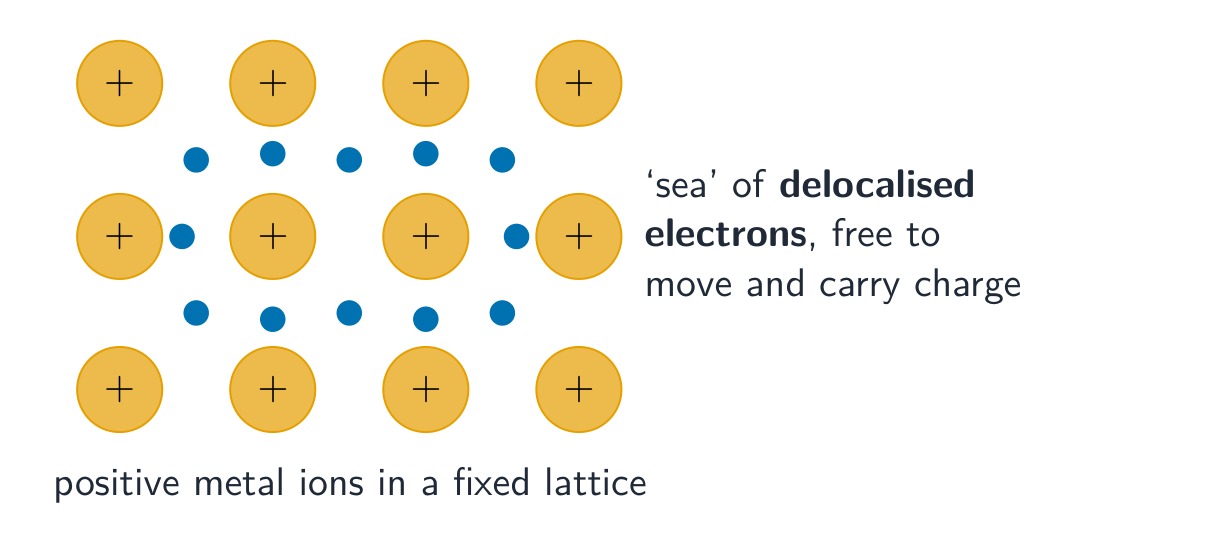
    A metal is a giant structure of positive ions surrounded by a 'sea' of delocalised electrons that are free to move through the whole metal. Metallic bonding 金属键 is the strong electrostatic attraction between these positive ions and the sea of electrons.

    This explains two key properties of metals:

    • Good electrical conductivity: the delocalised electrons are free to move and carry charge through the metal.
    • Malleability 展性 (can be hammered into sheets) and ductility 延性 (can be pulled into wires): the layers of positive ions can slide over each other without breaking the metallic bond, so the metal changes shape instead of shattering.
    ไทย

    โลหะเป็นโครงสร้างขนาดใหญ่ของไอออนบวกที่ล้อมรอบด้วย "ทะเล" ของ อิเล็กตรอนที่ไม่Localization ที่อิสระในการเคลื่อนที่ผ่านโลหะทั้งหมด พันธะโลหะ คือการดึงดูดทางไฟฟ้าสถิตที่แข็งแกร่งระหว่างไอออนบวกเหล่านี้กับทะเลของอิเล็กตรอน

    โครงข่ายผลึกที่เป็นระเบียบของไอออนโลหะบวกที่มีอิเล็กตรอนอิสระกระจายอยู่ในช่องว่างระหว่าง них
    โลหะคือไอออนบวกใน "ทะเล" ของอิเล็กตรอนที่ไม่Localization ที่อิสระในการเคลื่อนที่และพกพาประจุ

    สิ่งนี้อธิบายคุณสมบัติสำคัญสองประการของโลหะ:

    • นำไฟฟ้าได้ดี: อิเล็กตรอนที่ไม่Localization อิสระในการเคลื่อนที่และพกพาประจุผ่านโลหะ
    • ความเหนียว (Malleability) (สามารถตีเป็นแผ่นบาง) และ ความดักติล (Ductility) (สามารถดึงเป็นเส้นลวด): ชั้นของไอออนบวกสามารถเลื่อนทับกันได้โดยไม่ทำให้พันธะโลหะแตกหัก ทำให้โลหะเปลี่ยนรูปแทนที่จะแตกสลาย
    Explore · ⁨สำรวจ⁩

    Inside a metal — and why it behaves that way · ⁨ภายในโลหะ — และเหตุผลที่มันมีพฤติกรรมเช่นนั้น⁩

    Step through it. Positive ions sit in a shared sea of delocalised electrons — that one picture explains conduction and why metals bend instead of snapping. · ⁨ขั้นตอนการทำงาน: ไอออนบวกนั่งอยู่ในทะเลของอิเล็กตรอนดีโลคาไลซ์ — ภาพเดียวอธิบายการนำไฟฟ้าและทำไมโลหะถึงงอแทนที่จะแตกหัก⁩

    Vocabulary · ⁨คำศัพท์⁩ Train · ⁨ฝึกฝน⁩
    English ไทย
    metallic bonding/məˈtælɪk ˈbɒndɪŋ/ การพันธะโลหะ
    malleability/ˌmæləˈbɪlɪti/ ความยืดหยุ่น
    ductility/dʌkˈtɪlɪti/ ความยืดหยุ่น
    Watch lesson · ⁨ดูบทเรียน⁩
    2.7

    Exam tips · ⁨ข้อแนะนำสำหรับการสอบ⁩

    English
    • Number of neutrons = mass number − proton number. The proton number is what decides which element an atom is.
    • Isotopes have the same chemical properties because reactions involve only electrons, and isotopes share the same electron configuration; only the mass differs.
    • Match structure to properties: ionic = giant lattice (high melting point; conducts only when molten or aqueous); simple molecular = weak forces between molecules (low melting point; no conduction); giant covalent = very hard, very high melting point.
    • Graphite conducts and is slippery (one free electron per carbon; layers slide); diamond does neither (all four electrons bonded, so hard and non-conducting). Metals conduct and bend thanks to the sea of delocalised electrons.
    • For relative atomic mass, take the weighted average: $A_r = \dfrac{\sum(\text{isotope mass} \times \text{abundance})}{100}$.
    ไทย
    • จำนวนนิวตรอน = เลขมวล − เลขอะตอม เลขอะตอมคือสิ่งที่กำหนดว่าอะตอมนั้นเป็นธาตุใด
    • ไอโซโทปมีคุณสมบัติทางเคมีเหมือนกันเนื่องจากปฏิกิริยาเกี่ยวข้องกับอิเล็กตรอนเท่านั้น และไอโซโทปมีการจัดเรียงอิเล็กตรอนเดียวกัน มีเพียงมวลที่แตกต่างกันเท่านั้น
    • จับคู่โครงสร้างกับคุณสมบัติ: ไอออนิก = contender ขนาดใหญ่ (จุดหลอมเหลวสูง; นำไฟฟ้าได้เฉพาะเมื่อหลอมเหลวหรือละลายน้ำ); โมเลกุลเล็ก = แรงอ่อน ระหว่าง โมเลกุล (จุดหลอมเหลวต่ำ; ไม่นำไฟฟ้า); โคเวเลนต์ขนาดใหญ่ = แข็งมาก จุดหลอมเหลวสูงมาก
    • กราไฟต์นำไฟฟ้าและลื่น (อิเล็กตรอนอิสระหนึ่งตัวต่อคาร์บอน; ชั้นเลื่อนกัน); เพชรไม่ทำทั้งสองอย่างนี้ (อิเล็กตรอนทั้งสี่จับตัวกันทั้งหมด จึงแข็งและไม่นำไฟฟ้า) โลหะนำไฟฟ้าและโค้งงอได้เพราะทะเลของ อิเล็กตรอนที่เคลื่อนที่ได้อิสระ (delocalised electrons)
    • สำหรับมวลอะตอมสัมพัทธ์ ให้ใช้ค่าเฉลี่ยถ่วงน้ำหนัก: $A_r = \dfrac{\sum(\text{isotope mass} \times \text{abundance})}{100}$
    Vocabulary · ⁨คำศัพท์⁩ Train · ⁨ฝึกฝน⁩
    English ไทย
    electrons/ɪˈlektrɒnz/ อิเล็กตรอน
    delocalised electrons/dɪˈlɒkəlaɪzd ɪˈlektrɒnz/ อิเล็กตรอนที่กระจายตัว
    electrode/ɪˈlektrəʊd/ อิเล็กโทรด
    silicon(IV) oxide/ˈsɪlɪkən ˈɒksaɪd/ ซิลิคอน(IV) ออกไซด์
  • 3

    Stoichiometry · ⁨สโตइโอเมทรี⁩

    Watch lesson · ⁨ดูบทเรียน⁩
    English

    Stoichiometry 化学计量 is the study of the amounts of substances in a reaction — how much reacts and how much is made. This topic is mostly about counting atoms and doing calculations.

    ไทย

    สโตกิโอเมทรี (Stoichiometry) คือการศึกษาปริมาณสารในปฏิกิริยา — ว่าเกิดปฏิกิริยากี่มาก และผลิตได้กี่มาก หัวข้อนี้อาจเน้นเรื่องนับจำนวนอะตอมและการคำนวณ

    3.1

    Chemical formulae · ⁨สูตรเคมี⁩

    Syllabus · ⁨หลักสูตร⁩
    English
    Core Supplement
    1 State the formulae of the elements and compounds named in the subject content
    2 Define the molecular formula of a compound as the number and type of different atoms in one molecule 5 Define the empirical formula of a compound as the simplest whole number ratio of the different atoms or ions in a compound
    3 Deduce the formula of a simple compound from the relative numbers of atoms present in a model or a diagrammatic representation 6 Deduce the formula of an ionic compound from the relative numbers of the ions present in a model or a diagrammatic representation or from the charges on the ions
    4 Construct word equations and symbol equations to show how reactants form products, including state symbols 7 Construct symbol equations with state symbols, including ionic equations
    8 Deduce the symbol equation with state symbols for a chemical reaction, given relevant information
    ไทย
    แก่น เพิ่มเติม
    1 ระบุสูตรเคมีของธาตุและสารประกอบที่ระบุไว้ในเนื้อหาหลักสูตร
    2 นิยาม สูตรโมเลกุล ของสารประกอบว่าคือจำนวนและชนิดของอะตอมที่แตกต่างกันในหนึ่งโมเลกุล 5 นิยาม สูตรอย่างง่าย ของสารประกอบว่าคืออัตราส่วนจำนวนwhole number ที่ง่ายที่สุดของอะตอมหรือไอออนที่แตกต่างกันในสารประกอบ
    3 สรุปสูตรของสารประกอบอย่างง่ายจากจำนวนสัมพัทธ์ของอะตอมที่มีอยู่ในแบบจำลองหรือภาพวาด 6 สรุปสูตรของสารประกอบไอออนิกจากจำนวนสัมพัทธ์ของไอออนที่มีอยู่ในแบบจำลองหรือภาพวาดหรือจากประจุของไอออน
    4 สร้างสมการคำและสมการสัญลักษณ์เพื่อแสดงว่าสารตั้งต้นสร้างผลิตภัณฑ์อย่างไร, รวมถึงสัญลักษณ์สถานะ 7 สร้างสมการสัญลักษณ์พร้อมสัญลักษณ์สถานะ, รวมถึงสมการไอออนิก
    8 สรุปสมการสัญลักษณ์พร้อมสัญลักษณ์สถานะสำหรับปฏิกิริยาเคมี, เมื่อได้รับข้อมูลที่เกี่ยวข้อง

    Source: Cambridge International syllabus · ⁨แหล่งที่มา: หลักสูตร Cambridge International⁩

    English

    A formula 化学式 shows which atoms 原子 are in a substance, and how many of each. There are two kinds of formula you must know.

    • The molecular formula 分子式 is the actual number of each atom in one molecule 分子. For glucose it is $\text{C}_6\text{H}_{12}\text{O}_6$.
    • The empirical formula 实验式 is the simplest whole-number ratio 比例 of the atoms or ions 离子 in a compound 化合物. For glucose it is $\text{CH}_2\text{O}$.

    Working out a formula

    If you are given a model or diagram, just count the atoms of each element and write them as a formula.

    For an ionic compound 离子化合物 you can work out the formula from the charges on the ions. The total positive charge must balance the total negative charge, because the compound has no overall charge. Some common ions:

    Positive ions Negative ions
    $\text{Na}^{+}$, $\text{K}^{+}$, $\text{H}^{+}$ $\text{Cl}^{-}$, $\text{OH}^{-}$, $\text{NO}_3^{-}$
    $\text{Mg}^{2+}$, $\text{Ca}^{2+}$, $\text{Cu}^{2+}$ $\text{O}^{2-}$, $\text{SO}_4^{2-}$, $\text{CO}_3^{2-}$
    $\text{Al}^{3+}$ $\text{N}^{3-}$

    For example, $\text{Na}^{+}$ and $\text{O}^{2-}$: you need two $\text{Na}^{+}$ to balance one $\text{O}^{2-}$, so the formula is $\text{Na}_2\text{O}$.

    ไทย

    สูตรแสดงว่าในสารมี อะตอมชนิดไหน และจำนวนของแต่ละชนิดเท่าไร มีสูตร 2 แบบที่ต้องรู้

    • สูตรโมเลกุลคือจำนวนจริงของแต่ละอะตอมในหนึ่ง โมเลกุล สำหรับกลูโคสคือ $\text{C}_6\text{H}_{12}\text{O}_6$
    • สูตรเชิงประจักษ์คือ อัตราส่วนจำนวนเต็มอย่างง่ายที่สุดของ อะตอมหรือ ไอออนใน สารประกอบ สำหรับกลูโคสคือ $\text{CH}_2\text{O}$

    การหาสูตร

    หากคุณได้รับแบบจำลองหรือแผนภาพ เพียงนับจำนวนอะตอมของแต่ละธาตุแล้วเขียนเป็นสูตร

    สำหรับ สารประกอบไอออนิก คุณสามารถหาสูตรได้จากประจุของไอออน รวมประจุบวกต้องเท่ากับรวมประจุลบ เนื่องจากสารประกอบไม่มีประจุสุทธิ ไอออนทั่วไป:

    ไอออนบวก ไอออนลบ
    $\text{Na}^{+}$, $\text{K}^{+}$, $\text{H}^{+}$ $\text{Cl}^{-}$, $\text{OH}^{-}$, $\text{NO}_3^{-}$
    $\text{Mg}^{2+}$, $\text{Ca}^{2+}$, $\text{Cu}^{2+}$ $\text{O}^{2-}$, $\text{SO}_4^{2-}$, $\text{CO}_3^{2-}$
    $\text{Al}^{3+}$ $\text{N}^{3-}$

    เช่น $\text{Na}^{+}$ และ $\text{O}^{2-}$: คุณต้องใช้ $\text{Na}^{+}$ สองตัวเพื่อปรับสมดุลกับ $\text{O}^{2-}$ ตัวเดียว ดังนั้นสูตรคือ $\text{Na}_2\text{O}$

    ไอออนอลูมิเนียม 3+ และออกซิเจน 2- พร้อมตัวเลขประจุที่ข้ามไปกลายเป็นตัวชี้ย่อยใน Al2O3
    สำหรับสารประกอบไอออนิก ประจุของไอออนจะข้ามกันเพื่อให้ได้สูตร (ในที่นี้ $\text{Al}_2\text{O}_3$)
    Explore · ⁨สำรวจ⁩

    Formula writing route · ⁨วิธีเขียนสูตร⁩

    Follow charges or valencies to a neutral chemical formula. · ⁨ติดตามประจุหรือ valency ไปสู่สูตรเคมีที่เป็นกลาง⁩

    Vocabulary · ⁨คำศัพท์⁩ Train · ⁨ฝึกฝน⁩
    English ไทย
    stoichiometry/ˌstəʊɪkɪˈɒmətri/ สโตichiometry
    formula/ˈfɔːmjʊlə/ สูตร
    atoms/ˈætəmz/ อะตอม
    molecular formula/məˈlekjʊlə ˈfɔːmjʊlə/ สูตรโมเลกุล
    molecule/ˈmɒlɪkjuːl/ โมเลกุล
    empirical formula/emˈpɪrɪkl ˈfɔːmjʊlə/ สูตรอย่างง่าย
    Watch lesson · ⁨ดูบทเรียน⁩
    3.1

    Writing equations · ⁨การเขียนสมการ⁩

    English

    An equation shows how reactants 反应物 (the starting substances) change into products 生成物 (the substances made).

    • A word equation 文字方程式 uses names: magnesium + oxygen → magnesium oxide.
    • A symbol equation 化学方程式 uses formulae and must be balanced 配平 — the same number of each atom on both sides.
    $$2\text{Mg} + \text{O}_2 \rightarrow 2\text{MgO}$$

    You add state symbols 状态符号 in brackets to show the physical state: $(s)$ solid, $(l)$ liquid, $(g)$ gas, and $(aq)$ for aqueous 水溶液 (dissolved in water).

    $$\text{Zn}(s) + 2\text{HCl}(aq) \rightarrow \text{ZnCl}_2(aq) + \text{H}_2(g)$$

    Ionic equations

    An ionic equation 离子方程式 shows only the ions that actually change. Ions that are the same on both sides are spectator ions 旁观离子 and are left out. For example, when an acid reacts with an alkali:

    $$\text{H}^{+}(aq) + \text{OH}^{-}(aq) \rightarrow \text{H}_2\text{O}(l)$$
    ไทย

    สมการแสดงว่า สารตั้งต้น (สารเริ่มต้น) เปลี่ยนแปลงไปเป็น ผลิตภัณฑ์ (สารที่ได้) อย่างไร

    • สมการคำใช้ชื่อ: แมกนีเซียม + ออกซิเจน → แมกนีเซียมออกไซด์
    • สมการสัญลักษณ์ใช้สูตรและต้อง ปรับให้สมดุล — จำนวนอะตอมแต่ละชนิดเท่ากันทั้งสองข้าง
    $$2\text{Mg} + \text{O}_2 \rightarrow 2\text{MgO}$$
    อะตอมแมกนีเซียมสองตัวบวกกับโมเลกุลออกซิเจนทำปฏิกิริยากันเกิดเป็นหน่วยแมกนีเซียมออกไซด์สองหน่วย โดยมี Mg สองตัวและ O สองตัวในแต่ละฝั่ง
    สมการสัญลักษณ์ที่สมดุลจะมีจำนวนอะตอมเท่ากันในแต่ละชนิดทั้งสองข้าง

    คุณเพิ่ม สัญลักษณ์สถานะในวงเล็บเพื่อแสดงสถานะทางกายภาพ: $(s)$ ของแข็ง, $(l)$ ของเหลว, $(g)$ ก๊าซ, และ $(aq)$ สำหรับ สารละลาย (aqueous) (ละลายในน้ำ)

    $$\text{Zn}(s) + 2\text{HCl}(aq) \rightarrow \text{ZnCl}_2(aq) + \text{H}_2(g)$$

    สมการไอออน

    สมการไอออนแสดงเฉพาะไอออนที่เปลี่ยนแปลงจริง ไอออนที่มีอยู่เท่ากันทั้งสองข้างเรียกว่า ไอออนผู้สังเกตการณ์ (spectator ions) และถูกตัดออก ตัวอย่างเช่น เมื่อกรดทำปฏิกิริยากับเบส:

    $$\text{H}^{+}(aq) + \text{OH}^{-}(aq) \rightarrow \text{H}_2\text{O}(l)$$
    Explore · ⁨สำรวจ⁩

    Balance the equation · ⁨ทำให้สมการสมดุล⁩

    Step the coefficients until every element has the same number of atoms on both sides. · ⁨ปรับสัมประสิทธิ์จนแต่ละธาตุมีจำนวนอะตอมเท่ากันทั้งสองข้าง⁩

    Vocabulary · ⁨คำศัพท์⁩ Train · ⁨ฝึกฝน⁩
    English ไทย
    ions/ˈaɪɒnz/ ไอออน
    compound/ˈkɒmpaʊnd/ สารประกอบ
    ionic compound/aɪˈɒnɪk ˈkɒmpaʊnd/ สารประกอบไอออนิก
    reactants/rɪˈæktənts/ สารตั้งต้น
    products/ˈprɒdʌkts/ ผลิตภัณฑ์
    word equation/wɜːd ɪˈkweɪʒn/ สมการคำ
    symbol equation/ˈsɪmbl ɪˈkweɪʒn/ สมการสัญลักษณ์
    balanced/ˈbælənst/ balanced
    state symbols/steɪt ˈsɪmblz/ สัญลักษณ์สถานะ
    aqueous/ˈeɪkwɪəs/ สารละลายในน้ำ
    ionic equation/aɪˈɒnɪk ɪˈkweɪʒn/ สมการไอออนิก
    spectator ions/spekˈteɪtə ˈaɪɒnz/ ไอออนผู้ชม
    relative atomic mass/ˈrelətɪv əˈtɒmɪk mæs/ มวลอะตอมสัมพัทธ์
    3.2

    Relative masses · ⁨มวลสัมพัทธ์⁩

    Syllabus · ⁨หลักสูตร⁩
    English
    Core Supplement
    1 Describe relative atomic mass, $A_r$, as the average mass of the isotopes of an element compared to 1/12th of the mass of an atom of $^{12}\text{C}$
    2 Define relative molecular mass, $M_r$, as the sum of the relative atomic masses. Relative formula mass, $M_r$, will be used for ionic compounds
    3 Calculate reacting masses in simple proportions. Calculations will not involve the mole concept
    ไทย
    แก่น เพิ่มเติม
    1 อธิบายมวลอะตอมสัมพัทธ์, $A_r$, ว่าคือมวลเฉลี่ยของไอโซโทปของธาตุหนึ่งเมื่อเทียบกับ 1/12 ของมวลของอะตอมของ $^{12}\text{C}$
    2 นิยามมวลโมเลกุลสัมพัทธ์, $M_r$, ว่าเป็นผลรวมของมวลอะตอมสัมพัทธ์ มวลสูตรสัมพัทธ์, $M_r$, จะใช้กับสารประกอบไอออนิก
    3 คำนวณมวลของสารที่เข้าทำปฏิกิริยาในอัตราส่วนอย่างง่าย การคำนวณจะไม่เกี่ยวข้องกับแนวคิดโมล

    Source: Cambridge International syllabus · ⁨แหล่งที่มา: หลักสูตร Cambridge International⁩

    English

    The relative atomic mass 相对原子质量 ($A_r$) of an element 元素 is the average mass 质量 of its atoms compared to $\tfrac{1}{12}$ of the mass of one $^{12}\text{C}$ atom.

    The relative molecular mass 相对分子质量 ($M_r$) is the sum of the relative atomic masses of all the atoms in the molecule. For ionic compounds we use the relative formula mass 相对式量, found the same way from the formula.

    $$M_r(\text{H}_2\text{O}) = (2 \times 1) + 16 = 18$$

    Reacting masses by simple proportion

    You can sometimes find a reacting mass without the mole. If 24 g of magnesium makes 40 g of magnesium oxide, then 12 g of magnesium (half as much) makes 20 g of magnesium oxide.

    ไทย
    เครื่องชั่งวิเคราะห์ในห้องปฏิบัติการ
    เครื่องชั่งในห้องปฏิบัติการใช้วัดมวล — ซึ่งเป็นพื้นฐานของการคำนวณโมล

    มวลอะตอมสัมพัทธ์ ($A_r$) ของ ธาตุคือ มวลเฉลี่ยของอะตอมเมื่อเทียบกับ $\tfrac{1}{12}$ ของมวลของหนึ่ง $^{12}\text{C}$ อะตอม

    มวลโมเลกุลสัมพัทธ์ ($M_r$) คือผลรวมของมวลอะตอมสัมพัทธ์ของอะตอมทั้งหมดในโมเลกุล สำหรับสารประกอบไอออนิกเราใช้ มวลสูตรสัมพัทธ์ ซึ่งหาได้โดยวิธีเดียวกันจากสูตร

    $$M_r(\text{H}_2\text{O}) = (2 \times 1) + 16 = 18$$

    มวลที่參與ปฏิกิริยาด้วยอัตราส่วนอย่างง่าย

    บางครั้งคุณสามารถหามวลที่参与ปฏิกิริยาโดยไม่ต้องใช้โมล ถ้าแมกนีเซียม 24 กรัม ให้แมกนีเซียมออกไซด์ 40 กรัม แล้วแมกนีเซียม 12 กรัม (ครึ่งหนึ่ง) จะให้แมกนีเซียมออกไซด์ 20 กรัม

    Explore · ⁨สำรวจ⁩

    Formula mass lab · ⁨ห้องปฏิบัติการหามวลสูตร⁩

    mass = moles x Mr · ⁨มวล = โมล × Mr⁩

    Change number of formula units and see total mass scale. · ⁨เปลี่ยนจำนวนหน่วยสูตรเพื่อดูสเกลมวลรวม⁩

    Watch lesson · ⁨ดูบทเรียน⁩
    3.3

    The mole · ⁨โมล⁩

    Syllabus · ⁨หลักสูตร⁩
    English
    Core Supplement
    2 State that the mole, mol, is the unit of amount of substance and that one mole contains $6.02 \times 10^{23}$ particles, e.g. atoms, ions, molecules; this number is the Avogadro constant
    3 Use the relationship $\text{amount of substance (mol)} = \frac{\text{mass (g)}}{\text{molar mass (g/mol)}}$ to calculate: (a) amount of substance (b) mass (c) molar mass (d) relative atomic mass or relative molecular/formula mass (e) number of particles, using the value of the Avogadro constant
    4 Use the molar gas volume, taken as $24\text{ dm}^3$ at room temperature and pressure, r.t.p., in calculations involving gases
    1 State that concentration can be measured in $\text{g/dm}^3$ or $\text{mol/dm}^3$ 5 Calculate stoichiometric reacting masses, limiting reactants, volumes of gases at r.t.p., volumes of solutions and concentrations of solutions expressed in $\text{g/dm}^3$ and $\text{mol/dm}^3$, including conversion between $\text{cm}^3$ and $\text{dm}^3$
    6 Use experimental data from a titration to calculate the moles of solute, or the concentration or volume of a solution
    7 Calculate empirical formulae and molecular formulae, given appropriate data
    8 Calculate percentage yield, percentage composition by mass and percentage purity, given appropriate data
    ไทย
    แก่น เพิ่มเติม
    2 ระบุว่าโมล, mol, เป็นหน่วยของปริมาณสารและ rằngหนึ่งโมลประกอบด้วย $6.02 \times 10^{23}$อนุภาค, เช่น อะตอม, ไอออน, โมเลกุล; จำนวนนี้คือค่าคงที่อาโวกาโด
    3 ใช้ความสัมพันธ์ $\text{amount of substance (mol)} = \frac{\text{mass (g)}}{\text{molar mass (g/mol)}}$ ในการคำนวณ: (ก) ปริมาณสาร (ข) มวล (ค) มวลโมลาร์ (ง) มวลอะตอมสัมพัทธ์หรือมวลโมเลกุล/สูตรสัมพัทธ์ (จ) จำนวนอนุภาค, โดยใช้ค่าคงที่อาโวกาโด
    4 ใช้ปริมาตรโมลาร์ของแก๊ส, ซึ่งกำหนดไว้ที่ $24\text{ dm}^3$ ที่อุณหภูมิห้องและความดันห้อง, r.t.p., ในการคำนวณเกี่ยวกับแก๊ส
    1 ระบุว่าความเข้มข้นสามารถวัดได้ใน $\text{g/dm}^3$ หรือ $\text{mol/dm}^3$ 5 คำนวณมวลสารที่ทำปฏิกิริยาตามstoreschiometric, สารทำปฏิกิริยาที่จำกัด, ปริมาตรของแก๊สที่ r.t.p., ปริมาตรของสารละลายและความเข้มข้นของสารละลายที่แสดงใน $\text{g/dm}^3$ และ $\text{mol/dm}^3$, รวมถึงการแปลงระหว่าง $\text{cm}^3$ และ $\text{dm}^3$
    6 ใช้ข้อมูลการทดลองจากการทำ titration เพื่อคำนวณโมลของตัวละลาย, หรือความเข้มข้นหรือปริมาตรของสารละลาย
    7 คำนวณสูตรเชิงประจักษ์และสูตรโมเลกุล, เมื่อได้รับข้อมูลที่เหมาะสม
    8 คำนวณผลผลิตเป็นเปอร์เซ็นต์ ส่วนประกอบของมวลเป็นเปอร์เซ็นต์ และความบริสุทธิ์เป็นเปอร์เซ็นต์ โดยให้ข้อมูลที่เกี่ยวข้อง

    Source: Cambridge International syllabus · ⁨แหล่งที่มา: หลักสูตร Cambridge International⁩

    English

    The mole 摩尔 (symbol mol) is the unit for the amount of substance 物质的量. One mole of any substance contains $6.02 \times 10^{23}$ particles 粒子 (atoms, ions or molecules). This number is the Avogadro constant 阿伏伽德罗常数.

    The molar mass 摩尔质量 is the mass of one mole, in grams per mole (g/mol). Its number is the same as the $A_r$ or $M_r$. The key relationship is:

    $$\text{amount (mol)} = \frac{\text{mass (g)}}{\text{molar mass (g/mol)}}$$

    Worked example. How many moles are in 36 g of water? Molar mass of water $= 18$ g/mol.

    $$n = \frac{36}{18} = 2 \text{ mol}$$

    To find the number of particles, multiply the moles by the Avogadro constant.

    Volumes of gases

    At room temperature and pressure (r.t.p.), one mole of any gas takes up the same volume 体积. This molar gas volume 摩尔气体体积 is $24 \text{ dm}^3$.

    $$\text{volume of gas (dm}^3) = \text{amount (mol)} \times 24$$

    Worked example. What volume does $0.25$ mol of carbon dioxide occupy at r.t.p.?

    $$\text{volume} = 0.25 \times 24 = 6 \text{ dm}^3$$

    Concentration of solutions

    The concentration 浓度 of a solution 溶液 can be given in $\text{g/dm}^3$ or in $\text{mol/dm}^3$.

    $$\text{concentration (mol/dm}^3) = \frac{\text{amount of solute (mol)}}{\text{volume (dm}^3)}$$

    Remember to convert volume: $1 \text{ dm}^3 = 1000 \text{ cm}^3$, so divide a volume in $\text{cm}^3$ by 1000.

    ไทย

    โมล (สัญลักษณ์ mol) เป็นหน่วยสำหรับ ปริมาณสาร หนึ่งโมลของสารใดๆ ประกอบด้วย $6.02 \times 10^{23}$ อนุภาค (อะตอม ไอออน หรือโมเลกุล)这个数字称为阿伏伽德罗常数

    มวลโมลาร์คือมวลของหนึ่งโมล ในหน่วยกรัมต่อโมล (g/mol) ตัวเลขของมันเท่ากับ $A_r$ หรือ $M_r$ ความสัมพันธ์สำคัญคือ:

    $$\text{amount (mol)} = \frac{\text{mass (g)}}{\text{molar mass (g/mol)}}$$

    ตัวอย่างทำโจทย์ มีน้ำ 36 กรัม若干モル? น้ำมีมวลโมลาร์ $= 18$ g/mol

    $$n = \frac{36}{18} = 2 \text{ mol}$$

    ในการหาจำนวนอนุภาค ให้คูณจำนวนโมลด้วยค่าคงที่อาโวคาโด

    ปริมาตรของแก๊ส

    ที่อุณหภูมิและความดันห้อง (r.t.p.) หนึ่งโมลของก๊าซใดๆ ใช้พื้นที่ ปริมาตร เท่ากัน ปริมาตรโมลาร์ของก๊าซ นี้คือ $24 \text{ dm}^3$

    ลูกโป่งสามลูกขนาดเท่ากันบรรจุหนึ่งโมลของไฮโดรเจน ออกซิเจน และคาร์บอนไดออกไซด์: มวลต่างกันแต่มีปริมาตรเท่ากันที่ 24 ลูกบาศก์เดซิมิเตอร์
    หนึ่งโมลของก๊าซใดๆ เติมเต็ม 24 ลูกบาศก์เดซิมิเตอร์ที่อุณหภูมิและความดันห้อง
    $$\text{volume of gas (dm}^3) = \text{amount (mol)} \times 24$$

    ตัวอย่างทำโจทย์ $0.25$ mol ของคาร์บอนไดออกไซด์ใช้ปริมาตรเท่าไหร่ที่ r.t.p.?

    $$\text{volume} = 0.25 \times 24 = 6 \text{ dm}^3$$

    ความเข้มข้นของสารละลาย

    ความเข้มข้นของ สารละลายสามารถระบุได้ใน $\text{g/dm}^3$ หรือใน $\text{mol/dm}^3$

    $$\text{concentration (mol/dm}^3) = \frac{\text{amount of solute (mol)}}{\text{volume (dm}^3)}$$

    จำไว้ว่าต้องแปลงหน่วยปริมาตร: $1 \text{ dm}^3 = 1000 \text{ cm}^3$, ดังนั้นหารปริมาตรใน $\text{cm}^3$ ด้วย 1000

    แผนภาพโมลที่มีโมลอยู่ตรงกลาง เชื่อมต่อกับมวล ปริมาตรแก๊ส ความเข้มข้น และจำนวนอนุภาค ด้วยตัวแปลงหน่วยของพวกมัน
    โมลอยู่ตรงกลาง: คูณเมื่อขยายออก, หารเมื่อย้อนกลับ (ความเข้มข้นคือ โมล ÷ ปริมาตร)
    Explore · ⁨สำรวจ⁩

    Mole particle lab · ⁨ห้องปฏิบัติการอนุภาคโมล⁩

    particles = n x Avogadro constant · ⁨จำนวนอนุภาค = n x ค่าคงที่อาวอกาดโร⁩

    Change moles and see particle number scale with Avogadro constant. · ⁨เปลี่ยนจำนวนโมลเพื่อดูสเกลจำนวนอนุภาคพร้อมค่าคงที่อาโวกาโดร⁩

    Vocabulary · ⁨คำศัพท์⁩ Train · ⁨ฝึกฝน⁩
    English ไทย
    ratio/ˈreɪʃɪəʊ/ อัตราส่วน
    mass/mæs/ มวล
    relative molecular mass/ˈrelətɪv məˈlekjʊlə mæs/ มวลโมเลกุลสัมพัทธ์
    relative formula mass/ˈrelətɪv ˈfɔːmjʊlə mæs/ มวลสูตรสัมพัทธ์
    mole/məʊl/ โมล
    amount of substance/əˈmaʊnt ɒv ˈsʌbstəns/ ปริมาณสาร
    particles/ˈpɑːtɪklz/ อนุภาค
    Avogadro constant/ˌævəˈɡædrəʊ ˈkɒnstənt/ ค่าคงที่อาโวกาโดร
    molar mass/ˈməʊlə mæs/ มวลโมลาร์
    volume/ˈvɒljuːm/ ปริมาตร
    molar gas volume/ˈməʊlə ɡæs ˈvɒljuːm/ ปริมาตรแก๊สมอลาร์
    concentration/ˌkɒnsənˈtreɪʃn/ ความเข้มข้น
    solution/səˈluːʃn/ สารละลาย
    solute/ˈsɒljuːt/ ตัวละลาย
    percentage yield/pəˈsentɪdʒ jiːld/ เปอร์เซ็นต์ผลผลิต
    percentage composition by mass/pəˈsentɪdʒ ˌkɒmpəˈzɪʃn baɪ mæs/ องค์ประกอบเปอร์เซ็นต์โดยมวล
    percentage purity/pəˈsentɪdʒ ˈpjʊərɪti/ ความบริสุทธิ์เปอร์เซ็นต์
    3.3

    Doing reaction calculations · ⁨การคำนวณปฏิกิริยาเคมี⁩

    English

    Most calculations follow the same steps: change the known amount into moles, use the balanced equation to find the moles of what you want, then change back into mass, volume or concentration.

    Worked example. What mass of magnesium oxide forms when 12 g of magnesium burns completely? $2\text{Mg} + \text{O}_2 \rightarrow 2\text{MgO}$. ($A_r$: Mg $= 24$, O $= 16$.)

    Moles of Mg $= 12 / 24 = 0.5$ mol. The ratio Mg : MgO is $1 : 1$, so $0.5$ mol of MgO forms. Its molar mass is $24 + 16 = 40$ g/mol, so the mass is $0.5 \times 40 = 20$ g — the same answer as the simple-proportion method above.

    Limiting reactant

    When two reactants are mixed, often one runs out first. This is the limiting reactant 限量反应物. It decides how much product can form; any other reactant is in excess (left over).

    Worked example. 8 g of hydrogen reacts with 8 g of oxygen: $2\text{H}_2 + \text{O}_2 \rightarrow 2\text{H}_2\text{O}$. Which is the limiting reactant, and what mass of water forms? ($A_r$: H $= 1$, O $= 16$.)

    Moles of $\text{H}_2 = 8 / 2 = 4$ mol; moles of $\text{O}_2 = 8 / 32 = 0.25$ mol. The equation needs $2\text{H}_2$ for every one $\text{O}_2$, so $0.25$ mol of $\text{O}_2$ reacts with only $0.5$ mol of $\text{H}_2$. There is far more hydrogen than that, so oxygen is the limiting reactant and the hydrogen is in excess. The oxygen makes $2 \times 0.25 = 0.5$ mol of water, so the mass is $0.5 \times 18 = 9$ g. Always work in moles, not masses — the reactant with the smaller mass is not always the one that runs out.

    Titration calculation

    In a titration 滴定 you measure the volume of one solution that reacts with another. From the volume and concentration you find the moles of one solute 溶质, then use the equation ratio to find the moles, concentration or volume of the other.

    Worked example. $25.0 \text{ cm}^3$ of sodium hydroxide solution is exactly neutralised by $20.0 \text{ cm}^3$ of $0.10 \text{ mol/dm}^3$ hydrochloric acid. $\text{NaOH} + \text{HCl} \rightarrow \text{NaCl} + \text{H}_2\text{O}$. Find the concentration of the sodium hydroxide.

    Moles of HCl $= 0.10 \times \dfrac{20.0}{1000} = 0.0020$ mol. The ratio is $1 : 1$, so there are $0.0020$ mol of NaOH in $25.0 \text{ cm}^3$:

    $$\text{concentration} = \frac{0.0020}{25.0 / 1000} = 0.08 \text{ mol/dm}^3$$

    Empirical and molecular formulae from data

    To find an empirical formula from masses or percentages:

    1. Divide each element's mass (or %) by its $A_r$.
    2. Divide all the answers by the smallest one to get the simplest ratio.

    To find the molecular formula, compare the empirical formula mass with the real $M_r$ and multiply up.

    Worked example. A compound contains $40\%$ calcium, $12\%$ carbon and $48\%$ oxygen by mass. Find its empirical formula. ($A_r$: Ca $= 40$, C $= 12$, O $= 16$.)

    Divide each percentage by its $A_r$: Ca $= 40/40 = 1$, C $= 12/12 = 1$, O $= 48/16 = 3$. The ratio is $1 : 1 : 3$, so the empirical formula is $\text{CaCO}_3$.

    Percentages

    • Percentage yield 产率 compares how much product you actually got with the most you could get: $\dfrac{\text{actual}}{\text{theoretical}} \times 100$.
    • Percentage composition by mass 质量分数 of an element $= \dfrac{\text{mass of the element}}{M_r} \times 100$.
    • Percentage purity 纯度 $= \dfrac{\text{mass of pure substance}}{\text{mass of impure sample}} \times 100$.

    Worked example. Find the percentage by mass of nitrogen in ammonium nitrate, $\text{NH}_4\text{NO}_3$. ($A_r$: N $= 14$, H $= 1$, O $= 16$.)

    $M_r = (2 \times 14) + (4 \times 1) + (3 \times 16) = 80$. The mass of nitrogen is $2 \times 14 = 28$, so

    $$\% \text{ nitrogen} = \frac{28}{80} \times 100 = 35\%$$

    Worked example. A reaction could make at most 5.0 g of product, but only 4.0 g is actually collected. Find the percentage yield.

    $$\% \text{ yield} = \frac{4.0}{5.0} \times 100 = 80\%$$

    Some product is always lost — left behind in the apparatus, or used up in side reactions — so the yield is almost never $100\%$.

    Worked example. A 50 g sample of impure calcium carbonate contains 45 g of pure calcium carbonate. Find its percentage purity.

    $$\% \text{ purity} = \frac{45}{50} \times 100 = 90\%$$
    ไทย
    การทำบิรติทเรชันในห้องปฏิบัติการ
    การบิรติทเรชันวัดปริมาณกรดที่ทำปฏิกิริยากับเบสได้อย่างแม่นยำ

    การคำนวณส่วนใหญ่ทำตามขั้นตอนเดียวกัน: เปลี่ยนปริมาณที่ทราบเป็นโมล, ใช้สมการที่สมดุลเพื่อหามวลโมลของสิ่งที่ต้องการ, แล้วเปลี่ยนกลับเป็นมวล, ปริมาตร หรือความเข้มข้น

    ตัวอย่างวิธีทำ. มวลของแมกนีเซียมออกไซด์ที่เกิดขึ้นเมื่อแมกนีเซียม 12 กรัมเผาไหม้สมบูรณ์คือเท่าไร? $2\text{Mg} + \text{O}_2 \rightarrow 2\text{MgO}$. ($A_r$: Mg $= 24$, O $= 16$.)

    โมลของ Mg $= 12 / 24 = 0.5$ mol. อัตราส่วน Mg : MgO คือ $1 : 1$, ดังนั้น $0.5$ mol ของ MgO จึงเกิดขึ้น. มวลโมลของ它有 $24 + 16 = 40$ g/mol, ดังนั้นมวลคือ $0.5 \times 40 = 20$ g — ซึ่งเป็นคำตอบเดียวกับวิธีอัตราส่วนอย่างง่ายข้างต้น.

    สารตั้งต้นจำกัด

    เมื่อผสมสารตั้งต้นสองชนิดเข้าด้วยกัน มักจะมีหนึ่งชนิดหมดก่อน นี่คือ สารตั้งต้นจำกัด มันกำหนดปริมาณผลิตภัณฑ์ที่จะเกิดขึ้น; สารตั้งต้นอื่นจะเหลือเกิน (เหลือค้างไว้)

    อนุภาค A สี่ตัวและอนุภาค B สองตัวทำปฏิกิริยากันเกิดผลิตภัณฑ์สองตัว เหลืออนุภาค A ที่ไม่ทำปฏิกิริยาสองตัว
    B หมดก่อน ดังนั้นจึงเป็นสารตั้งต้นจำกัดและกำหนดปริมาณผลิตภัณฑ์; ส่วนเกินของ A จะเหลือค้างไว้

    ตัวอย่างวิธีทำ. ไฮโดรเจน 8 กรัมทำปฏิกิริยากับออกซิเจน 8 กรัม: $2\text{H}_2 + \text{O}_2 \rightarrow 2\text{H}_2\text{O}$. สารใดเป็นสารตั้งต้นจำกัด, และมวลของน้ำที่เกิดขึ้นคือเท่าไร? ($A_r$: H $= 1$, O $= 16$.)

    โมลของ $\text{H}_2 = 8 / 2 = 4$ mol; โมลของ $\text{O}_2 = 8 / 32 = 0.25$ mol. สมการต้องใช้ $2\text{H}_2$ สำหรับทุก ๆ $\text{O}_2$ หนึ่งตัว, ดังนั้น $0.25$ mol ของ $\text{O}_2$ ทำปฏิกิริยากับ $0.5$ mol ของ $\text{H}_2$ เท่านั้น. มีไฮโดรเจนมากกว่านี้มาก ดังนั้น ออกซิเจนเป็นสารตั้งต้นจำกัด และไฮโดรเจนมีปริมาณเกิน. ออกซิเจนสร้าง $2 \times 0.25 = 0.5$ mol ของน้ำ, ดังนั้นมวลคือ $0.5 \times 18 = 9$ g. ต้องคำนวณเป็นโมลเสมอ ไม่ใช่มวล — สารที่มีมวลน้อยกว่าไม่จำเป็นต้องหมดก่อนเสมอไป

    การคำนวณด้วยวิธีไทเทรชัน

    ในการ บิรติทเรชัน คุณวัดปริมาตรของสารละลายชนิดหนึ่งที่ทำปฏิกิริยากับอีกชนิดหนึ่ง จากปริมาตรและความเข้มข้นคุณหาโมลของ สารละลาย หนึ่งชนิดได้, จากนั้นใช้สัดส่วนจากสมการเพื่อหาโมล, ความเข้มข้น หรือปริมาตรของอีกชนิดหนึ่ง

    ตัวอย่างวิธีทำ. $25.0 \text{ cm}^3$ ของสารละลายโซเดียมไฮดรอกไซด์ถูกทำให้เป็นกลางโดย $20.0 \text{ cm}^3$ ของ $0.10 \text{ mol/dm}^3$ กรดไฮโดรคลอริก $\text{NaOH} + \text{HCl} \rightarrow \text{NaCl} + \text{H}_2\text{O}$. หาความเข้มข้นของโซเดียมไฮดรอกไซด์

    โมลของ HCl $= 0.10 \times \dfrac{20.0}{1000} = 0.0020$ mol. สัดส่วนคือ $1 : 1$, ดังนั้นมี $0.0020$ mol ของ NaOH ใน $25.0 \text{ cm}^3$:

    $$\text{concentration} = \frac{0.0020}{25.0 / 1000} = 0.08 \text{ mol/dm}^3$$
    การคำนวณบิรติทเรชันในรูปแบบผัง: กรดที่ทราบให้โมล, สัดส่วน 1 ต่อ 1 จากสมการให้โมลของโซเดียมไฮดรอกไซด์, และการหารด้วยปริมาตรของมันให้ความเข้มข้น
    การคำนวณบิรติทเรชัน: จากสารละลายที่ทราบเป็นโมล, สัดส่วน, แล้วหาความเข้มข้นที่ไม่ทราบค่า

    สูตรเชิงประจักษ์และสูตรโมเลกุลจากข้อมูล

    ในการหาสูตรเชิงประจักษ์จากมวลหรือเปอร์เซ็นต์:

    1. หารมวลของแต่ละธาตุ (หรือ %) ด้วย $A_r$ ของธาตุนั้น
    2. หารผลลัพธ์ทั้งหมดด้วยค่าที่น้อยที่สุดเพื่อให้ได้สัดส่วนที่ง่ายที่สุด

    ในการหาสูตรโมเลกุล ให้เปรียบเทียบมวลของสูตรเชิงประจักษ์กับ $M_r$ จริง แล้วคูณเพิ่ม

    ตัวอย่างวิธีทำ. สารประกอบหนึ่งประกอบด้วยแคลเซียม $40\%$, คาร์บอน $12\%$ และออกซิเจน $48\%$ ตามมวล. หาสูตรเชิงประจักษ์ของมัน ($A_r$: Ca $= 40$, C $= 12$, O $= 16$.)

    หารแต่ละเปอร์เซ็นต์ด้วย $A_r$ ของมัน: Ca $= 40/40 = 1$, C $= 12/12 = 1$, O $= 48/16 = 3$. สัดส่วนคือ $1 : 1 : 3$, ดังนั้นสูตรเชิงประจักษ์คือ $\text{CaCO}_3$

    เปอร์เซ็นต์

    • -percent yield เปรียบเทียบปริมาณผลิตภัณฑ์ที่คุณได้รับจริงกับปริมาณสูงสุดที่สามารถทำได้: $\dfrac{\text{actual}}{\text{theoretical}} \times 100$
    • percent composition by mass ของธาตุ $= \dfrac{\text{mass of the element}}{M_r} \times 100$
    • percent purity $= \dfrac{\text{mass of pure substance}}{\text{mass of impure sample}} \times 100$

    ตัวอย่างวิธีทำ. หาเปอร์เซ็นต์ตามมวลของไนโตรเจนในแอมโมเนียมไนเตรต, $\text{NH}_4\text{NO}_3$. ($A_r$: N $= 14$, H $= 1$, O $= 16$.)

    $M_r = (2 \times 14) + (4 \times 1) + (3 \times 16) = 80$. มวลของไนโตรเจนคือ $2 \times 14 = 28$, ดังนั้น

    $$\% \text{ nitrogen} = \frac{28}{80} \times 100 = 35\%$$

    ตัวอย่างวิธีทำ. ปฏิกิริยาหนึ่งสามารถสร้างผลิตภัณฑ์ได้สูงสุด 5.0 กรัม แต่เก็บได้จริงเพียง 4.0 กรัม. หา percent yield

    $$\% \text{ yield} = \frac{4.0}{5.0} \times 100 = 80\%$$

    ผลิตภัณฑ์บางส่วนจะถูกสูญเสียเสมอ — ทิ้งไว้ในอุปกรณ์ หรือใช้ในปฏิกิริยาร่วมด้านข้าง — ดังนั้น percent yield แทบจะไม่ pernah $100\%$

    ตัวอย่างวิธีทำ. ตัวอย่าง 50 กรัมของแคลเซียมคาร์บอเนตที่ไม่บริสุทธิ์มีแคลเซียมคาร์บอเนตบริสุทธิ์ 45 กรัม. หา percent purity ของมัน

    $$\% \text{ purity} = \frac{45}{50} \times 100 = 90\%$$
    Explore · ⁨สำรวจ⁩

    Reaction calculation route · ⁨เส้นทางในการคำนวณปฏิกิริยา⁩

    Follow a known mass through a balanced equation to the answer. · ⁨ตามมวลที่ทราบผ่านสมการที่สมดุลไปจนถึงคำตอบ⁩

    Vocabulary · ⁨คำศัพท์⁩ Train · ⁨ฝึกฝน⁩
    English ไทย
    element/ˈelɪmənt/ ธาตุ
    limiting reactant/ˈlɪmɪtɪŋ rɪˈæktənt/ สารตั้งต้นจำกัดปริมาณ
    titration/taɪˈtreɪʃn/ การไทเทรต
    3.3

    Exam tips · ⁨ข้อแนะนำสำหรับการสอบ⁩

    English
    • Always turn masses, gas volumes and concentrations into moles first, use the balanced equation's ratio, then convert back. Never compare masses directly across an equation.
    • Key formulas: $n = \dfrac{\text{mass}}{M_r}$, gas volume $= n \times 24\ \text{dm}^3$ at r.t.p., and concentration $= \dfrac{n}{\text{volume in dm}^3}$. Change cm³ to dm³ by dividing by 1000.
    • To balance a symbol equation you may only change the big numbers in front of a formula, never the small subscripts inside it.
    • The limiting reactant is the one that runs out (fewest moles once you allow for the ratio); it sets how much product forms. The other reactant is in excess.
    • Percentage yield = actual ÷ theoretical × 100; percentage purity = mass of pure substance ÷ mass of sample × 100. Both are always 100% or less.
    ไทย
    • ต้องเปลี่ยนมวล, ปริมาตรแก๊ส และความเข้มข้นให้เป็น โมล ก่อน, ใช้สัดส่วนจากสมการที่สมดุล, แล้วแปลงกลับ. ห้ามเปรียบเทียบมวลโดยตรงข้ามสมการ
    • สูตรสำคัญ: $n = \dfrac{\text{mass}}{M_r}$, ปริมาตรแก๊ส $= n \times 24\ \text{dm}^3$ ที่ r.t.p., และความเข้มข้น $= \dfrac{n}{\text{volume in dm}^3}$. เปลี่ยน cm³ เป็น dm³ โดยการหารด้วย 1000
    • ในการจัดรูปสมการสัญลักษณ์ คุณอาจเปลี่ยนเฉพาะตัวเลขใหญ่ ด้านหน้า ของสูตรเท่านั้น ไม่สามารถเปลี่ยนเลขชี้กำลังเล็กภายในได้
    • สารตั้งต้นจำกัด คือสารที่หมดก่อน (มีโมลน้อยที่สุดเมื่อพิจารณาสัดส่วนแล้ว); มันกำหนดปริมาณผลิตภัณฑ์ที่เกิดขึ้น. สารตั้งต้นที่เหลือจะเป็นสารเหลือเกิน
    • percent yield = ผลลัพธ์จริง ÷ ผลลัพธ์ทฤษฎี × 100; percent purity = มวลของสารบริสุทธิ์ ÷ มวลของตัวอย่าง × 100. ทั้งสองมีค่าไม่เกิน 100% เสมอ
  • 4

    Electrochemistry · ⁨อิเล็กโทรเคมี⁩

    Watch lesson · ⁨ดูบทเรียน⁩
    4.1

    Electrolysis · ⁨การอิเล็กโทรไลซิส⁩

    Syllabus · ⁨หลักสูตร⁩
    English
    Core Supplement
    1 Define electrolysis as the decomposition of an ionic compound, when molten or in aqueous solution, by the passage of an electric current 8 Describe the transfer of charge during electrolysis to include: (a) the movement of electrons in the external circuit (b) the loss or gain of electrons at the electrodes (c) the movement of ions in the electrolyte
    2 Identify in simple electrolytic cells: (a) the anode as the positive electrode (b) the cathode as the negative electrode (c) the electrolyte as the molten or aqueous substance that undergoes electrolysis
    3 Identify the products formed at the electrodes and describe the observations made during the electrolysis of: (a) molten lead(II) bromide (b) concentrated aqueous sodium chloride (c) dilute sulfuric acid using inert electrodes made of platinum or carbon/graphite 9 Identify the products formed at the electrodes and describe the observations made during the electrolysis of aqueous copper(II) sulfate using inert carbon/graphite electrodes and when using copper electrodes
    4 State that metals or hydrogen are formed at the cathode and that non-metals (other than hydrogen) are formed at the anode
    5 Predict the identity of the products at each electrode for the electrolysis of a binary compound in the molten state 10 Predict the identity of the products at each electrode for the electrolysis of a halide compound in dilute or concentrated aqueous solution
    11 Construct ionic half-equations for reactions at the anode (to show oxidation) and at the cathode (to show reduction)
    6 State that metal objects are electroplated to improve their appearance and resistance to corrosion
    7 Describe how metals are electroplated
    ไทย
    แก่น เพิ่มเติม
    1 นิยามการอิเล็กโทรไลซิสว่า เป็นการสลายตัวของสารประกอบไอออนิก เมื่ออยู่ในสถานะหลอมเหลวหรือในสารละลายน้ำ โดยการไหลผ่านกระแสไฟฟ้า 8 อธิบายการถ่ายโอนประจุระหว่างกระบวนการอิเล็กโทรไลซิส ได้แก่: (ก) การเคลื่อนที่ของอิเล็กตรอนในวงจรภายนอก (ข) การสูญเสียหรือรับอิเล็กตรอนที่ขั้วไฟฟ้า (ค) การเคลื่อนที่ของไอออนในสารละลายอิเล็กโทรไลต์
    2 ระบุส่วนประกอบในเซลล์อิเล็กโทรไลซิสอย่างง่าย: (ก) แอนอดคือขั้วบวก (ข) แคทอดคือขั้วลบ (ค) สารละลายอิเล็กโทรไลต์คือสารหลอมเหลวหรือสารละลายน้ำที่ undergoes กระบวนการอิเล็กโทรไลซิส
    3 ระบุผลิตภัณฑ์ที่เกิดขึ้นที่ขั้วไฟฟ้าและอธิบายปรากฏการณ์ที่ได้จากการอิเล็กโทรไลซิสของ: (ก) เลด(II) บรอมไอด์หลอมเหลว (ข) โซเดียมคลอไรด์ในสารละลายเข้มข้น (ค) กรดซัลฟิวริกเจือจาง โดยใช้ขั้วไฟฟ้าที่ไม่ทำปฏิกิริยาจากแพลทินัมหรือคาร์บอน/กราไฟท์ 9 ระบุผลิตภัณฑ์ที่เกิดขึ้นที่ขั้วไฟฟ้าและอธิบายปรากฏการณ์ที่ได้จากการอิเล็กโทรไลซิสของ铜(II) ซัลเฟตในสารละลาย โดยใช้ขั้วไฟฟ้าคาร์บอน/กราไฟท์ที่ไม่ทำปฏิกิริยาและเมื่อใช้ขั้วทองแดง
    4 ระบุว่าโลหะหรือไฮโดรเจนจะเกิดขึ้นที่แคทอด และ非金属 (ยกเว้นไฮโดรเจน) จะเกิดขึ้นที่แอนอด
    5 ทำนายชนิดของผลิตภัณฑ์ที่เกิดขึ้นที่ขั้วไฟฟ้าแต่ละขั้วสำหรับการอิเล็กโทรไลซิสของสารประกอบไบนารีในสถานะหลอมเหลว 10 ทำนายชนิดของผลิตภัณฑ์ที่เกิดขึ้นที่ขั้วไฟฟ้าแต่ละขั้วสำหรับการอิเล็กโทรไลซิสของสารประกอบฮาโลเจนในสารละลายน้ำแบบเจือจางหรือเข้มข้น
    11 เขียนสมการครึ่งปฏิกิริยาไอออนสำหรับปฏิกิริยาที่แอโนด (เพื่อแสดงการออกซิเดชัน) และที่แคโทด (เพื่อแสดงการรีดักชัน)
    6 ระบุว่าวัตถุโลหะถูกชุบไฟฟ้าเพื่อปรับปรุงรูปลักษณ์และความต้านทานต่อการกัดกร่อน
    7 อธิบายวิธีการชุบไฟฟ้าของโลหะ

    Source: Cambridge International syllabus · ⁨แหล่งที่มา: หลักสูตร Cambridge International⁩

    English
    Electrolysis: ions discharge at the electrodes

    Electrolysis 电解 is the breaking down (decomposition 分解) of an ionic compound 离子化合物 — when it is molten 熔融 or in aqueous 水溶液 solution — by passing an electric current 电流 through it.

    It only works when the substance is molten or dissolved, because then the ions 离子 are free to move and carry the charge. A solid ionic compound cannot be electrolysed because its ions are locked in place.

    The electrolytic cell

    The set-up is called an electrolytic cell 电解池. Two electrodes 电极 (solid conductors) dip into the electrolyte 电解质 — the molten or aqueous substance being broken down.

    • The anode 阳极 is the positive ($+$) electrode.
    • The cathode 阴极 is the negative ($-$) electrode.

    The electrodes are often inert 惰性 (they do not react), such as platinum 铂 or carbon/graphite 石墨.

    What is formed at each electrode

    There is a simple rule:

    • Metals 金属 or hydrogen 氢气 are formed at the cathode.
    • Non-metals 非金属 (other than hydrogen) are formed at the anode.

    For aqueous solutions, the product can depend on whether the solution is dilute 稀 or concentrated 浓. Here are the three Core examples:

    Electrolyte At the cathode ($-$) At the anode ($+$)
    molten lead(II) bromide, $\text{PbBr}_2$ lead 铅 (silvery liquid) bromine 溴 (red-brown vapour)
    concentrated aqueous sodium chloride hydrogen (bubbles of gas) chlorine 氯气 (pale green gas)
    dilute sulfuric acid 硫酸 hydrogen (bubbles of gas) oxygen 氧气 (bubbles of gas)

    Worked example. Predict the products of electrolysing molten zinc chloride, $\text{ZnCl}_2$. Because it is molten, only zinc ions and chloride ions are present - there is no water to complicate things. Zinc is a metal, so it forms at the cathode: $\text{Zn}^{2+}$ ions gain electrons and silvery zinc appears. Chlorine is a non-metal, so it forms at the anode: pale green chlorine gas bubbles off. Always check the state first. A molten compound simply gives you its own two elements, while an aqueous one brings water into the competition - which is why concentrated sodium chloride solution gives hydrogen at the cathode rather than sodium.

    How the charge moves

    During electrolysis:

    • Electrons 电子 move through the wires (the external circuit 外电路) from the power supply.
    • At the cathode, positive ions gain electrons. Gaining electrons is reduction 还原.
    • At the anode, negative ions lose electrons. Losing electrons is oxidation 氧化.
    • Inside the electrolyte, the ions move: positive ions go to the cathode and negative ions go to the anode.

    You can write a half-equation 半反应式 for each electrode. For molten lead(II) bromide:

    $$\text{Pb}^{2+} + 2e^{-} \rightarrow \text{Pb} \quad (\text{cathode, reduction})$$
    $$2\text{Br}^{-} \rightarrow \text{Br}_2 + 2e^{-} \quad (\text{anode, oxidation})$$

    Electrolysis of copper(II) sulfate

    The product at the anode depends on the electrode:

    • With inert carbon electrodes: copper 铜 forms at the cathode and oxygen forms at the anode. The blue colour of the solution slowly fades as copper is removed.
    • With copper electrodes: copper forms at the cathode, while the anode itself dissolves into the solution. The blue colour stays the same. This is used to purify copper.

    Electroplating

    Electroplating 电镀 means covering a metal object with a thin layer of another metal. This improves its appearance and its resistance to corrosion 腐蚀 (rusting and wearing away).

    To electroplate an object:

    • the object to be coated is made the cathode;
    • the plating metal is made the anode;
    • the electrolyte is a solution containing ions of the plating metal.
    ไทย
    การอิเล็กโทรไลซิส: ไอออนปล่อยประจุที่ขั้วไฟฟ้า

    Electrolysis คือการสลาย (decomposition) ของ สารประกอบไอออนิก — เมื่อมันอยู่ในสถานะ หลอมเหลว หรือใน สารละลาย — โดยการใช้ กระแสไฟฟ้า ไหลผ่านมัน

    ชุดแยกน้ำด้วยกระแสไฟฟ้า
    เซลล์ electrolysis แยกสารประกอบโดยใช้กระแสไฟฟ้า

    มันทำงานได้ก็ต่อเมื่อสารนั้นเป็นหลอมเหลวหรือละลาย, เพราะตอนนั้น ไอออน จะเคลื่อนที่ได้อิสระและนำพาประจุ. สารประกอบไอออนิกในสถานะแข็งไม่สามารถ electrolyze ได้เนื่องจากไอออนถูกล็อคอยู่กับที่

    การสาธิตการแยกสารด้วยกระแสไฟฟ้าขนาดเล็ก: หลอดวัดขนาดสองหลอดคว่ำอยู่ในแก้วตวงน้ำ เชื่อมต่อกับแบตเตอรี่ 9 โวลต์ โดยมีการเก็บก๊าซอยู่ด้านบนของแต่ละหลอด และมีปริมาณก๊าซในหลอดหนึ่งมากกว่าอีกหลอดประมาณสองเท่า
    การแยกสารน้ำด้วยกระแสไฟฟ้า: ก๊าซฟุ้งออกมาที่ขั้วแต่ละขั้วและถูกเก็บไว้ในหลอดด้านบน โดยมีปริมาณไฮโดรเจนประมาณสองเท่าของออกซิเจน

    เซลล์อิเล็กโทรไลต์

    ชุดอุปกรณ์นี้เรียกว่า เซลล์อิเล็กโทรไลต์ ขั้ว อิเล็กโทรด (ตัวนำแข็ง) สองขั้วจุ่มอยู่ใน อิเล็กโทรไลต์ — ซึ่งเป็นสารหลอมเหลวหรือสารละลายที่กำลังถูกแยกสลาย

    • แอโนด คือขั้วบวก ($+$)
    • แคโทด คือขั้วลบ ($-$)

    ขั้วอิเล็กโทรดมักจะเป็น ไม่ทำปฏิกิริยา (ไม่เกิดปฏิกิริยา) เช่น แพลตินัม หรือคาร์บอน/ กราไฟต์

    สิ่งที่เกิดขึ้นที่ขั้วแต่ละขั้ว

    มีกฎง่ายๆ ดังนี้:

    โลหะ/ไฮโดรเจนเกิดขึ้นที่แคโทด; พลังงานไม่โลหะเกิดขึ้นที่แอโนด
    Metals and hydrogen form at the cathode; non-metals at the anode
    • โลหะ หรือ ไฮโดรเจน เกิดขึ้นที่แคโทด
    • พลังงานไม่โลหะ (ยกเว้นไฮโดรเจน) เกิดขึ้นที่แอโนด

    สำหรับสารละลาย น้ำผลผลิตอาจขึ้นอยู่กับว่าสารละลายนั้นเป็น เจือจาง หรือ เข้มข้น นี่คือตัวอย่างหลักสามข้อ:

    อิเล็กโทรไลต์ ที่แคโทด ($-$) ที่แอโนด ($+$)
    เลด(II) บรอมাইด์หลอมเหลว, $\text{PbBr}_2$ เลด (ของเหลวสีเงิน) บรอมีน (ไอสีแดงน้ำตาล)
    โซเดียมคลอไรด์ในน้ำเข้มข้น ไฮโดรเจน (ฟองก๊าซ) คลอรีน (ก๊าซสีเขียวอ่อน)
    กรดซัลฟิวริกเจือจาง ไฮโดรเจน (ฟองก๊าซ) ออกซิเจน (ฟองก๊าซ)

    ตัวอย่างแบบฝึกหัด. ทำนายผลิตภัณฑ์จากการแยกสาร โซเดียมคลอไรด์หลอมเหลว, $\text{ZnCl}_2$ เนื่องจากเป็นสารหลอมเหลว จึงมีเพียงไอออนสังกะสีและไอออนคลอไรด์เท่านั้น ไม่มีน้ำมาทำให้ซับซ้อน สังกะสีเป็นโลหะดังนั้นจึงเกิดขึ้นที่ แคโทด: $\text{Zn}^{2+}$ ไอออนรับอิเล็กตรอนและสังกะสีสีเงินปรากฏขึ้น คลอรีนเป็นพลังงานไม่โลหะดังนั้นจึงเกิดขึ้นที่ แอโนด: ก๊าซคลอรีนสีเขียวอ่อนฟุ้งออกมา ตรวจสอบสถานะเสมอ สาร หลอมเหลว จะให้bidden elements ทั้งสองชนิดของตัวเองโดยตรง ในขณะที่สาร ในน้ำ จะนำน้ำเข้ามาแข่งขัน - นั่นคือเหตุผลว่าทำไมสารละลายโซเดียมคลอไรด์เข้มข้นจึงให้ไฮโดรเจนที่แคโทดแทนที่จะเป็นโซเดียม

    การเคลื่อนที่ของประจุ

    ระหว่างการแยกสารด้วยกระแสไฟฟ้า:

    • อิเล็กตรอน เคลื่อนที่ผ่านสายไฟ (วงจรภายนอก) จากแหล่งจ่ายไฟ
    • ที่แคโทด ไอออนบวกรับอิเล็กตรอน การรับอิเล็กตรอนคือ การลดค่า
    • ที่แอโนด ไอออนลบเสียอิเล็กตรอน การเสียอิเล็กตรอนคือ การออกซิเดชัน
    • ภายในอิเล็กโทรไลต์ ไอออนเคลื่อนที่: ไอออนบวก去向แคโทด และไอออนลบ去向แอโนด

    คุณสามารถเขียน สมการครึ่ง สำหรับแต่ละขั้วได้ สำหรับสารหลอมเหลวเลด(II) บรอมাইด์:

    $$\text{Pb}^{2+} + 2e^{-} \rightarrow \text{Pb} \quad (\text{cathode, reduction})$$
    $$2\text{Br}^{-} \rightarrow \text{Br}_2 + 2e^{-} \quad (\text{anode, oxidation})$$
    เซลล์การแยกสารสำหรับสารหลอมเหลวเลดบรอมাইด์: แหล่งจ่ายไฟตรงเชื่อมต่อกับแคโทดและแอโนดที่จุ่มอยู่ในสารหลอมเหลว โดยมีไอออนเลดเคลื่อนที่ไปทางแคโทดและไอออนบรอมाइด์เคลื่อนที่ไปทางแอโนด
    ในสารหลอมเหลวเลด(II) บรอมাইด์, $\text{Pb}^{2+}$ เคลื่อนที่ไปยังแคโทด และ $\text{Br}^-$ ไปยังแอโนด ซึ่งแต่ละอย่างจะถูกปลดปล่อย

    การแยกสารทองแดง(II) ซัลเฟต

    ผลิตภัณฑ์ที่แอโนดขึ้นอยู่กับขั้วอิเล็กโทรด:

    • ด้วยขั้วคาร์บอนที่ไม่ทำปฏิกิริยา: ทองแดง เกิดขึ้นที่แคโทด และออกซิเจนเกิดขึ้นที่แอโนด สีน้ำเงินของสารละลายค่อยๆ จางลงเมื่อทองแดงถูกกำจัดออก
    • ด้วยขั้วทองแดง: ทองแดงเกิดขึ้นที่แคโทด ในขณะที่แอโนดละลายเข้าสู่สารละลายเอง สีน้ำเงินคงเดิม ใช้ในการฟอกทองแดง

    การชุบไฟฟ้า

    การชุบไฟฟ้า หมายถึงการหุ้มวัตถุโลหะด้วยชั้นบางๆ ของโลหะอื่น เพื่อปรับปรุงรูปลักษณ์และความต้านทานต่อ การกัดกร่อน (สนิมและการสึกหรอ)

    เพื่อทำการชุบไฟฟ้า:

    • วัตถุที่ต้องการเคลือบจะถูกกำหนดให้เป็น แคโทด;
    • โลหะที่ใช้ชุบจะถูกกำหนดให้เป็น แอโนด;
    • อิเล็กโทรไลต์คือสารละลายที่มีไอออนของโลหะที่ใช้ชุบ
    เซลล์ชุบไฟฟ้าที่มีวัตถุเป็นแคโทดและแท่งทองแดงบริสุทธิ์เป็นแอโนดในสารละลายทองแดง(II) ซัลเฟต
    ในการชุบไฟฟ้า ให้จัดให้วัตถุเป็นขั้วลบ และโลหะที่ใช้ชุบเป็นขั้วบวก ในสารละลายที่มีไอออนของโลหะที่ใช้ชุบ
    Explore · ⁨สำรวจ⁩

    Inside an electrolysis cell · ⁨电解池内部⁩

    Pick an electrolyte and watch ions move: positive ions to the cathode, negative ions to the anode. · ⁨เลือกอิเล็กโทรไลต์และดูไอออนเคลื่อนที่: ไอออนบวกไป แคโทด ไอออนลบไป แอโนด⁩

    Vocabulary · ⁨คำศัพท์⁩ Train · ⁨ฝึกฝน⁩
    English ไทย
    electrolysis/ɪlekˈtrɒləsɪs/ electrolysis
    decomposition/ˌdiːkɒmpəˈzɪʃn/ การสลายตัว
    ionic compound/aɪˈɒnɪk ˈkɒmpaʊnd/ สารประกอบไอออนิก
    molten/ˈməʊltn/ หลอมเหลว
    aqueous/ˈeɪkwɪəs/ สารละลายในน้ำ
    electric current/ɪˈlektrɪk ˈkʌrənt/ กระแสไฟฟ้า
    ions/ˈaɪɒnz/ ไอออน
    electrolytic cell/ɪˌlektrəˈlɪtɪk sel/ เซลล์อิเล็กโทรไลต์
    electrodes/ɪˈlektrəʊdz/ ขั้วไฟฟ้า
    electrolyte/ɪˈlektrəlaɪt/ สารอิเล็กโทรไลต์
    anode/ˈænəʊd/ แอนโอด
    cathode/ˈkæθəʊd/ แคโทด
    inert/ɪˈnɜːt/ เฉื่อย
    platinum/ˈplætɪnəm/ แพลตินัม
    graphite/ˈɡræfaɪt/ กราไฟต์
    metals/ˈmetlz/ โลหะ
    hydrogen/ˈhaɪdrədʒn/ ไฮโดรเจน
    non-metals/nɒn ˈmetlz/ ไม่metal
    dilute/daɪˈluːt/ เจือจาง
    concentrated/ˈkɒnsəntreɪtɪd/ เข้มข้น
    lead/liːd/ นำ / Lead
    bromine/ˈbrəʊmaɪn/ บรอมีน
    chlorine/ˈklɔːriːn/ คลอรีน
    sulfuric acid/sʌlˈfjʊərɪk ˈæsɪd/ กรดซัลฟิวริก
    oxygen/ˈɒksɪdʒn/ ออกซิเจน
    electrons/ɪˈlektrɒnz/ อิเล็กตรอน
    external circuit/ekˈstɜːnl ˈsɜːkɪt/ วงจรภายนอก
    reduction/rɪˈdʌkʃn/ การลดรูป (reduction)
    oxidation/ˌɒksɪˈdeɪʃn/ การออกซิเดชัน
    half-equation/hɑːf ɪˈkweɪʒn/ สมการครึ่งหนึ่ง
    copper/ˈkɒpə/ ทองแดง
    electroplating/ɪˌlektrəʊˈpleɪtɪŋ/ การชุบไฟฟ้า
    corrosion/kəˈrəʊʒn/ การกัดกร่อน
    4.2

    Hydrogen–oxygen fuel cells · ⁨เซลล์เชื้อเพลิงไฮโดรเจน-ออกซิเจน⁩

    Syllabus · ⁨หลักสูตร⁩
    English
    Core Supplement
    1 State that a hydrogen–oxygen fuel cell uses hydrogen and oxygen to produce electricity with water as the only chemical product 2 Describe the advantages and disadvantages of using hydrogen–oxygen fuel cells in comparison with gasoline/petrol engines in vehicles
    ไทย
    แก่น เพิ่มเติม
    1 ระบุว่าเซลล์เชื้อเพลิงไฮโดรเจน-ออกซิเจน ใช้ไฮโดรเจนและออกซิเจนในการผลิตไฟฟ้า โดยมีน้ำเป็นผลิตภัณฑ์ทางเคมีเพียงอย่างเดียว 2 อธิบายข้อดีและข้อเสียของการใช้เซลล์เชื้อเพลิงไฮโดรเจน-ออกซิเจน เมื่อเทียบกับเครื่องยนต์เบนซิน/น้ำมันในยานพาหนะ

    Source: Cambridge International syllabus · ⁨แหล่งที่มา: หลักสูตร Cambridge International⁩

    English

    A fuel cell 燃料电池 uses hydrogen and oxygen to make electricity directly. The only chemical product is water.

    $$2\text{H}_2 + \text{O}_2 \rightarrow 2\text{H}_2\text{O}$$

    It is useful to compare a fuel cell with a normal petrol (gasoline) engine in a vehicle.

    Hydrogen–oxygen fuel cell Petrol engine
    Main product water only carbon dioxide and pollutants 污染物
    Effect on air clean adds to air pollution
    Fuel storage hydrogen is hard and dangerous to store (flammable, needs high pressure) petrol is easy to store
    Source hydrogen may be made using fossil fuels made from crude oil

    Advantages of the fuel cell: the only product is water, so it does not pollute the air, and it changes chemical energy into electricity efficiently. Disadvantages: hydrogen is hard to store and transport safely, and producing the hydrogen can still use energy from fossil fuels.

    ไทย

    เซลล์เชื้อเพลิง ใช้ไฮโดรเจนและออกซิเจนเพื่อผลิตไฟฟ้าโดยตรง ผลิตภัณฑ์ทางเคมีเดียวคือน้ำ

    $$2\text{H}_2 + \text{O}_2 \rightarrow 2\text{H}_2\text{O}$$

    เซลล์เชื้อเพลิงไฮโดรเจน-ออกซิเจนที่มีไฮโดรเจนและออกซิเจนป้อนเข้าหาขั้วทั้งสอง วงจรภายนอกขับเคลื่อนมอเตอร์ และมีน้ำเป็นผลิตภัณฑ์เดียวที่ออก *เซลล์เชื้อเพลิงไฮโดรเจน–ออกซิเจนแปลงพลังงานเคมีเป็นไฟฟ้าโดยตรง โดยมีน้ำเป็นผลิตภัณฑ์เดียว

    มีประโยชน์ในการเปรียบเทียบเซลล์เชื้อเพลิงกับเครื่องยนต์เบนซินทั่วไปในยานพาหนะ

    เซลล์เชื้อเพลิงไฮโดรเจน–ออกซิเจน เครื่องยนต์เบนซิน
    ผลิตภัณฑ์หลัก น้ำเท่านั้น คาร์บอนไดออกไซด์และ มลพิษ
    ผลกระทบต่ออากาศ สะอาด เพิ่มมลพิษทางอากาศ
    การจัดเก็บเชื้อเพลิง ไฮโดรเจนจัดเก็บยากและเป็นอันตราย (ติดไฟ ต้องใช้ความดันสูง) เบนซินจัดเก็บง่าย
    แหล่งที่มา ไฮโดรเจนอาจผลิตโดยใช้เชื้อเพลิงฟอสซิล ผลิตจากน้ำมันดิบ

    ข้อดี ของเซลล์เชื้อเพลิง: ผลิตภัณฑ์เดียวคือน้ำ ดังนั้นไม่ก่อมลพิษทางอากาศ และแปลงพลังงานเคมีเป็นไฟฟ้าได้อย่างมีประสิทธิภาพ ข้อเสีย: ไฮโดรเจนจัดเก็บและขนส่งได้ยากอย่างปลอดภัย และการผลิตไฮโดรเจนยังคงใช้พลังงานจากเชื้อเพลิงฟอสซิล

    Explore · ⁨สำรวจ⁩

    Inside a hydrogen–oxygen fuel cell · ⁨ภายในเซลล์เชื้อเพลิงไฮโดรเจน-ออกซิเจน⁩

    Step through a fuel cell. Hydrogen and oxygen combine to make water, and the energy of that reaction is released as electricity — with no carbon dioxide. · ⁨อธิบายการทำงานของเซลล์เชื้อเพลิง ไฮโดรเจนและออกซิเจนรวมตัวกันเกิดเป็นน้ำ และพลังงานจากปฏิกิริยานี้จะถูกปล่อยออกมาในรูปของไฟฟ้า — โดยไม่มีการปล่อยคาร์บอนไดออกไซด์⁩

    Vocabulary · ⁨คำศัพท์⁩ Train · ⁨ฝึกฝน⁩
    English ไทย
    fuel cell/ˈfjuːəl sel/ เซลล์เชื้อเพลิง (fuel cell)
    pollutants/pəˈluːtənts/ มลพิษ
    4.2

    Exam tips · ⁨ข้อแนะนำสำหรับการสอบ⁩

    English
    • At the cathode (negative) you get a metal or hydrogen; at the anode (positive) you get a non-metal. Positive ions move to the cathode, negative ions to the anode.
    • A molten compound just gives its two elements. An aqueous solution can give something different (concentrated sodium chloride gives hydrogen and chlorine, not sodium).
    • Reduction is gain of electrons (at the cathode); oxidation is loss of electrons (at the anode). Remember OIL RIG.
    • In a half-equation the atoms and the charges must balance, with the electrons on the correct side: $\text{Pb}^{2+} + 2e^- \rightarrow \text{Pb}$ (cathode).
    • To electroplate an object, make it the cathode, make the plating metal the anode, and use a solution containing ions of the plating metal.
    ไทย
    • ที่ แคโทด (ขั้วลบ) คุณจะได้โลหะหรือไฮโดรเจน; ที่ แอโนด (ขั้วบวก) คุณจะได้พลังงานไม่โลหะ ไอออนบวกเคลื่อนที่ไปทางแคโทด ไอออนลบเคลื่อนที่ไปทางแอโนด
    • สารประกอบหลอมเหลว จะให้ธาตุทั้งสองออกมาเท่านั้น แต่ สารละลายน้ำ อาจให้ผลิตภัณฑ์ที่แตกต่างกัน (เช่น โซเดียมคลอไรด์เข้มข้น ให้ไฮโดรเจนและคลอรีน ไม่ใช่โซเดียม)
    • การลด คือ การได้รับ อิเล็กตรอน (ที่ขั้วแคโทด); การออกซิเดชัน คือ การสูญเสีย อิเล็กตรอน (ที่ขั้วอะโนด) จำคำศัพท์ OIL RIG ได้
    • ใน สมการครึ่งหนึ่ง จำนวนอะตอมและประจุไฟฟ้าต้องสมดุลกัน โดยให้อิเล็กตรอนอยู่ด้านที่ถูกต้อง: $\text{Pb}^{2+} + 2e^- \rightarrow \text{Pb}$ (แคโทด)
    • เพื่อ ชุบไฟฟ้า วัตถุที่ต้องการชุบให้ทำหน้าที่เป็นแคโทด โลหะที่ใช้ชุบให้เป็นอะโนด และใช้สารละลายที่มีไอออนของโลหะที่จะชุบ
  • 5

    Chemical energetics · ⁨อุณหพลศาสตร์เคมี (Chemical Energetics)⁩

    Watch lesson · ⁨ดูบทเรียน⁩
    5.1

    Exothermic and endothermic reactions · ⁨ปฏิกิริยาคายความร้อนและปฏิกิริยาดูดความร้อน⁩

    Syllabus · ⁨หลักสูตร⁩
    English
    Core Supplement
    1 State that an exothermic reaction transfers thermal energy to the surroundings leading to an increase in the temperature of the surroundings 4 State that the transfer of thermal energy during a reaction is called the enthalpy change, $\Delta H$, of the reaction. $\Delta H$ is negative for exothermic reactions and positive for endothermic reactions
    2 State that an endothermic reaction takes in thermal energy from the surroundings leading to a decrease in the temperature of the surroundings
    5 Define activation energy, $E_a$, as the minimum energy that colliding particles must have to react
    3 Interpret reaction pathway diagrams showing exothermic and endothermic reactions 6 Draw and label reaction pathway diagrams for exothermic and endothermic reactions using information provided, to include: (a) reactants (b) products (c) enthalpy change of the reaction, $\Delta H$ (d) activation energy, $E_a$
    7 State that bond breaking is an endothermic process and bond making is an exothermic process and explain the enthalpy change of a reaction in terms of bond breaking and bond making
    8 Calculate the enthalpy change of a reaction using bond energies
    ไทย
    แก่น เพิ่มเติม
    1 ระบุว่าปฏิกิริยาคอเทอร์มิก (Exothermic reaction) ถ่ายโอนพลังงานความร้อนไปยังสิ่งแวดล้อม ส่งผลให้อุณหภูมิของสิ่งแวดล้อมเพิ่มขึ้น 4 ระบุว่า การถ่ายโอนพลังงานความร้อนระหว่างปฏิกิริยานั้นเรียกว่า การเปลี่ยนแปลงเอนทาลปี, $\Delta H$, ของปฏิกิริยา. $\Delta H$ เป็นค่าลบสำหรับปฏิกิริยาคอเทอร์มิกและเป็นค่าบวกสำหรับปฏิกิริยาเอ็นโดเทอร์มิก (Endothermic reaction)
    2 ระบุว่าปฏิกิริยาดูดความร้อนจะดูดซับพลังงานความร้อนจากสิ่งแวดล้อม ทำให้เกิดอุณหภูมิของสิ่งแวดล้อมลดลง
    5 นิยามพลังงานกระตุ้น, $E_a$, ว่าคือพลังงานขั้นต่ำที่อนุภาคที่ชนกันต้องมีเพื่อให้เกิดปฏิกิริยา
    3 interpret แผนภูมิเส้นทางการเกิดปฏิกิริยาที่แสดงปฏิกิริยาคอเทอร์มิกและเอ็นโดเทอร์มิก 6 วาดและติดฉลากแผนภูมิเส้นทางการเกิดปฏิกิริยาสำหรับปฏิกิริยาคอเทอร์มิกและเอ็นโดเทอร์มิกโดยใช้ข้อมูลที่กำหนดให้ ซึ่งประกอบด้วย: (ก) สารตั้งต้น (ข) ผลิตภัณฑ์ (ค) การเปลี่ยนแปลงเอนทาลปีของปฏิกิริยา, $\Delta H$ (ง) พลังงานกระตุ้น, $E_a$
    7 ระบุว่าการทำลายพันธะเป็นกระบวนการเอ็นโดเทอร์มิกและการสร้างพันธะเป็นปฏิกิริยาคอเทอร์มิก และอธิบายการเปลี่ยนแปลงเอนทาลปีของปฏิกิริยาในแง่ของการทำลายพันธะและการสร้างพันธะ
    8 คำนวณการเปลี่ยนแปลงเอนทาลปีของปฏิกิริยาโดยใช้พลังงานพันธะ

    Source: Cambridge International syllabus · ⁨แหล่งที่มา: หลักสูตร Cambridge International⁩

    English
    Reaction profile: exothermic energy change

    In every chemical reaction, energy is transferred. The reaction is either exothermic or endothermic, depending on which way the energy moves.

    • An exothermic reaction 放热反应 gives out thermal energy 热能 to the surroundings 环境. So the temperature of the surroundings goes up.
    • An endothermic reaction 吸热反应 takes in thermal energy from the surroundings. So the temperature of the surroundings goes down.

    Examples of exothermic reactions are combustion 燃烧 (burning a fuel) and neutralisation 中和 (an acid reacting with an alkali). An example of an endothermic reaction is the thermal decomposition 分解 of a compound (breaking it down using heat).

    ไทย
    กราฟโปรไฟล์ปฏิกิริยา: การเปลี่ยนแปลงพลังงานแบบคายความร้อน
    กองไฟกำลังเผาไม้
    การเผาไหม้ไม้เป็นปฏิกิริยาคายความร้อน ซึ่งปล่อยความร้อนออกไปยังสิ่งแวดล้อม

    ในทุกปฏิกิริยาเคมีจะมีพลังงานถูกถ่ายโอน ปฏิกิริยานั้นจะเป็นแบบคายความร้อนหรือดูดความร้อน ขึ้นอยู่กับทิศทางของการเคลื่อนย้ายพลังงาน

    • ปฏิกิริยาคายความร้อน จะปล่อย พลังงานความร้อน ออกไปสู่ สิ่งแวดล้อม ดังนั้นอุณหภูมิของสิ่งแวดล้อมจึงจะ สูงขึ้น
    • ปฏิกิริยาดูดความร้อน จะดูดกลืนพลังงานความร้อนจากสิ่งแวดล้อม ดังนั้นอุณหภูมิของสิ่งแวดล้อมจึงจะ ลดลง

    ตัวอย่างของปฏิกิริยาคายความร้อนได้แก่ การเผาไหม้ (การเผาเชื้อเพลิง) และ การเกิดกรด-เบส (ปฏิกิริยาระหว่างกรดกับเบส) ส่วนตัวอย่างของปฏิกิริยาดูดความร้อนคือการ สลายตัวด้วยความร้อน ของสารประกอบ (การแตกตัวโดยใช้ความร้อน)

    เทอร์โมมิเตอร์สองอัน: ในปฏิกิริยาคายความร้อนค่าจะเพิ่มขึ้น ในปฏิกิริยาดูดความร้อนค่าจะลดลง
    ปฏิกิริยาคายความร้อนทำให้สิ่งแวดล้อมอุ่นขึ้น; ปฏิกิริยาดูดความร้อนทำให้สิ่งแวดล้อมเย็นลง
    Explore · ⁨สำรวจ⁩

    Exothermic & endothermic · ⁨คายความร้อน & ดูดความร้อน⁩

    ΔH = products − reactants · ⁨ΔH = พลังงานของผลิตภัณฑ์ − พลังงานของสารตั้งต้น⁩

    Exothermic drops to lower-energy products (releases heat); endothermic climbs to higher. · ⁨ปฏิกิริยาคายความร้อน ลดลงสู่ผลิตภัณฑ์ที่มีพลังงานต่ำกว่า (ปล่อยความร้อน); ปฏิกิริยาดูดความร้อน เพิ่มขึ้นสู่ผลิตภัณฑ์ที่มีพลังงานสูงกว่า⁩

    Vocabulary · ⁨คำศัพท์⁩ Train · ⁨ฝึกฝน⁩
    English ไทย
    exothermic reaction/eɡzəˈðɜːmɪk rɪˈækʃn/ ปฏิกิริยาคายความร้อน
    thermal energy/ˈθɜːml ˈenədʒi/ 热能
    surroundings/səˈraʊndɪŋz/ สิ่งแวดล้อม
    endothermic reaction/ˌendəʊˈθɜːmɪk rɪˈækʃn/ ปฏิกิริยาดูดความร้อน
    combustion/kəmˈbʌstʃn/ การเผาไหม้
    neutralisation/ˌnjuːtrəlaɪˈzeɪʃn/ การเป็นกลาง
    decomposition/ˌdiːkɒmpəˈzɪʃn/ การสลายตัว
    enthalpy change/enˈθælpi tʃeɪndʒ/ การเปลี่ยนแปลงเอนثالปี
    activation energy/ˌæktɪˈveɪʃn ˈenədʒi/ พลังงานก่อกวน (activation energy)
    colliding/kəˈlaɪdɪŋ/ การชนกัน
    particles/ˈpɑːtɪklz/ อนุภาค
    reaction pathway diagram/rɪˈækʃn ˈpæθweɪ ˈdaɪəɡræm/ แผนภาพเส้นทางปฏิกิริยาเคมี
    reactants/rɪˈæktənts/ สารตั้งต้น
    products/ˈprɒdʌkts/ ผลิตภัณฑ์
    bond breaking/bɒnd ˈbreɪkɪŋ/ การแตกตัวของพันธะ
    bond making/bɒnd ˈmeɪkɪŋ/ การสร้างพันธะ
    5.1

    Enthalpy change, ΔH · ⁨การเปลี่ยนแปลงเอนثالปี, ΔH⁩

    English

    The amount of thermal energy transferred in a reaction is called the enthalpy change 焓变. It is written as $\Delta H$ and has these signs:

    • $\Delta H$ is negative for an exothermic reaction, because energy leaves the chemicals.
    • $\Delta H$ is positive for an endothermic reaction, because energy is taken in.
    ไทย

    ปริมาณพลังงานความร้อนที่ถูกถ่ายโอนในปฏิกิริยาเรียกว่า การเปลี่ยนแปลงเอนทาลปี เขียนแทนด้วย $\Delta H$ และมีเครื่องหมายดังนี้:

    • $\Delta H$ เป็น ลบ สำหรับปฏิกิริยาคายความร้อน เนื่องจากพลังงานออกจากสารเคมี
    • $\Delta H$ เป็น บวก สำหรับปฏิกิริยาดูดความร้อน เนื่องจากพลังงานถูกดูดเข้า
    เปลวไฟบันเซนจ่ายพลังงาน: การเปลี่ยนแปลงเอนทาลปี ΔH คือความร้อนที่ถ่ายโอนที่ความดันคงที่
    เปลวไฟบันเซนจ่ายพลังงาน: การเปลี่ยนแปลงเอนทาลปี ΔH คือความร้อนที่ถ่ายโอนที่ความดันคงที่
    5.1

    Activation energy · ⁨พลังงานก่อกวน⁩

    English

    Particles do not react every time they meet. The activation energy 活化能 ($E_a$) is the smallest amount of energy that colliding 碰撞 particles 粒子 must have before they can react. It is like a hill the particles must get over before the reaction can happen.

    ไทย

    อนุภาคไม่ได้ทำปฏิกิริยากันทุกครั้งที่ชนกัน พลังงานก่อกวน ($E_a$) คือปริมาณพลังงานขั้นต่ำที่สุดที่ อนุภาคที่ชนกัน ต้องมีก่อนจะเกิดปฏิกิริยาได้ เปรียบเสมือนภูเขาที่อนุภาคต้องปีนผ่านก่อนที่ปฏิกิริยาจะเกิดขึ้น

    Explore · ⁨สำรวจ⁩

    Activation energy · ⁨พลังงานกระตุ้น (Activation energy)⁩

    Ea = the energy barrier · ⁨Ea = กำแพงพลังงาน⁩

    Every reaction must climb the activation-energy barrier before products can form. · ⁨ทุกปฏิกิริยาต้องข้ามกำแพง พลังงานกัมมันต์ ก่อนที่ผลิตภัณฑ์จะเกิดขึ้น⁩

    5.1

    Reaction pathway diagrams · ⁨แผนภูมิเส้นทางปฏิกิริยา⁩

    English

    A reaction pathway diagram 反应进程图 shows how the energy changes as a reaction happens. Energy is on the vertical axis, and the progress of the reaction is on the horizontal axis.

    • The line starts at the energy level of the reactants 反应物.
    • It rises over a 'hill' — the height of this hill is the activation energy $E_a$.
    • It then falls or rises to the energy level of the products 生成物.
    • The gap between the reactant level and the product level is the enthalpy change $\Delta H$.

    For an exothermic reaction, the products are lower than the reactants, so energy is given out and $\Delta H$ is negative.

    For an endothermic reaction, the products are higher than the reactants, so energy is taken in and $\Delta H$ is positive.

    ไทย

    แผนภูมิเส้นทางปฏิกิริยา แสดงถึงการเปลี่ยนแปลงของพลังงานขณะเกิดปฏิกิริยา โดยพลังงานจะอยู่ในแกนตั้ง และการดำเนินไปของปฏิกิริยาจะอยู่บนแกนนอน

    • เส้นเริ่มต้นที่ระดับพลังงานของ สารตั้งต้น
    • เส้นจะพุ่งขึ้นเหนือ 'ภูเขา' — ความสูงของภูเขานี้คือพลังงานก่อกวน $E_a$
    • จากนั้นเส้นจะลดลงหรือเพิ่มขึ้นไปที่ระดับพลังงานของ ผลิตภัณฑ์
    • ระยะห่างระหว่างระดับของสารตั้งต้นและผลิตภัณฑ์คือ การเปลี่ยนแปลงเอนทาลปี $\Delta H$

    สำหรับ ปฏิกิริยาคายความร้อน ผลิตภัณฑ์จะอยู่ ต่ำกว่า สารตั้งต้น จึงมีการปล่อยพลังงานออกมา และ $\Delta H$ จะมีค่าเป็นลบ

    สำหรับ ปฏิกิริยาดูดความร้อน ผลิตภัณฑ์จะอยู่ สูงกว่า สารตั้งต้น จึงมีการดูดพลังงานเข้ามา และ $\Delta H$ จะมีค่าเป็นบวก

    แผนภูมิเส้นทางปฏิกิริยาสองแบบ: แบบคายความร้อนที่มีผลิตภัณฑ์อยู่ใต้สารตั้งต้น และแบบดูดความร้อนที่มีผลิตภัณฑ์อยู่เหนือสารตั้งต้น
    ปฏิกิริยาคายความร้อนจบลงที่จุดต่ำกว่าจุดเริ่มต้น ($\Delta H<0$); ปฏิกิริยาดูดความร้อนจบลงที่จุดสูงกว่า ($\Delta H>0$)
    Explore · ⁨สำรวจ⁩

    Reaction pathway diagrams · ⁨แผนภาพเส้นทางปฏิกิริยา⁩

    Drag ΔH and the activation energy. Exothermic releases energy; endothermic takes it in; the hump is the energy barrier. · ⁨ลาก ΔH และพลังงานกระตุ้น คายความร้อน ปล่อยพลังงาน; ดูดความร้อน ดูดซับพลังงาน; ปุ่มยอดคือกำแพงพลังงาน⁩

    5.1

    Bonds and energy · ⁨พันธเคมีและพลังงาน⁩

    English

    A reaction involves breaking the bonds in the reactants and making new bonds in the products.

    • Bond breaking 断键 takes in energy, so it is an endothermic step.
    • Bond making 成键 gives out energy, so it is an exothermic step.

    The bond energy 键能 is the energy needed to break one mole of a particular bond. You can use bond energies to find the enthalpy change:

    $$\Delta H = (\text{energy to break all bonds}) - (\text{energy released making all bonds})$$

    If more energy is given out making bonds than is taken in breaking bonds, the reaction is exothermic ($\Delta H$ negative). If less energy is given out, it is endothermic ($\Delta H$ positive).

    Worked example

    For the reaction $\text{H}_2 + \text{Cl}_2 \rightarrow 2\text{HCl}$, use these bond energies (in kJ/mol): H–H $= 436$, Cl–Cl $= 242$, H–Cl $= 431$.

    Bonds broken: one H–H and one Cl–Cl $= 436 + 242 = 678$.

    Bonds made: two H–Cl $= 2 \times 431 = 862$.

    $$\Delta H = 678 - 862 = -184 \text{ kJ/mol}$$

    The answer is negative, so this reaction is exothermic.

    ไทย
    เตาเผาบันเซนที่มีเปลวสีฟ้า
    การแตกและการสร้างพันธเคมีเป็นการถ่ายโอนพลังงาน —在这里เปลวไฟเป็นแหล่งจ่ายพลังงาน

    ปฏิกิริยาเกี่ยวข้องกับการแตกพันธเคมีในสารตั้งต้นและการสร้างพันธเคมีใหม่ในผลิตภัณฑ์

    • การแตกพันธเคมี ต้องดูดกลืนพลังงาน จึงเป็นขั้นตอนแบบดูดความร้อน
    • การสร้างพันธเคมี จะปล่อยพลังงานออกมา จึงเป็นขั้นตอนแบบคายความร้อน

    พลังงานพันธเคมี คือพลังงานที่ใช้ในการแตกพันธเคมีจำนวน 1 โมล สามารถใช้พลังงานพันธเคมีเพื่อหาการเปลี่ยนแปลงเอนทาลปีได้:

    $$\Delta H = (\text{energy to break all bonds}) - (\text{energy released making all bonds})$$

    หากมีพลังงานที่ถูกปล่อยออกมาจากการสร้างพันธเคมียิ่งมากเมื่อเทียบกับการดูดกลืนพลังงานจากการแตกพันธเคมี ปฏิกิริยานั้นจะเป็นแบบคายความร้อน ($\Delta H$ เป็นลบ) หากปล่อยออกมาน้อยกว่า จะเป็นแบบดูดความร้อน ($\Delta H$ เป็นบวก)

    ตัวอย่างวิธีทำ

    สำหรับปฏิกิริยา $\text{H}_2 + \text{Cl}_2 \rightarrow 2\text{HCl}$ ให้ใช้ค่าพลังงานพันธเหล่านี้ (หน่วย kJ/mol): H–H $= 436$, Cl–Cl $= 242$, H–Cl $= 431$

    พันธที่แตก: H–H หนึ่งตัว และ Cl–Cl หนึ่งตัว $= 436 + 242 = 678$

    พันธที่สร้าง: H–Cl สองตัว $= 2 \times 431 = 862$

    $$\Delta H = 678 - 862 = -184 \text{ kJ/mol}$$

    คำตอบเป็นลบ ดังนั้นปฏิกิริยานี้จึงเป็นแบบคายความร้อน

    แผนภูมิระดับพลังงานสำหรับไฮโดรเจนบวกคลอรีนเกิดเป็นไฮโดรเจนคลอไรด์: พุ่งขึ้นเพื่อแตกพันธ แล้วตกลงมาอย่างหนักเพื่อสร้างพันธ จบลงต่ำกว่าจุดเริ่มต้น
    การแตกพันธต้องดูดพลังงานเข้า ($+678$); การสร้างพันธปล่อยออกมากกว่า ($-862$); ดังนั้น $\Delta H = -184$ kJ/mol
    Vocabulary · ⁨คำศัพท์⁩ Train · ⁨ฝึกฝน⁩
    English ไทย
    bond energy/bɒnd ˈenədʒi/ พลังงานพันธะ
    5.1

    Exam tips · ⁨ข้อแนะนำสำหรับการสอบ⁩

    English
    • Exothermic gives out heat, so the surroundings warm up and $\Delta H$ is negative; endothermic takes in heat, so the surroundings cool and $\Delta H$ is positive.
    • Bond breaking takes energy in (endothermic); bond making gives energy out (exothermic). Use $\Delta H = (\text{energy to break bonds}) - (\text{energy released making bonds})$.
    • If more energy is released making bonds than is used breaking them, the reaction is exothermic. Always check the sign of your final answer.
    • On a reaction pathway diagram, an exothermic reaction ends lower than it starts; an endothermic one ends higher. The height of the hill is the activation energy.
    ไทย
    • ปฏิกิริยาคายความร้อน ปล่อยความร้อน ทำให้สิ่งแวดล้อมอุ่นขึ้น และ $\Delta H$ มีค่าเป็น ลบ; ปฏิกิริยาดูดความร้อน ดูดความร้อน ทำให้สิ่งแวดล้อมเย็นลง และ $\Delta H$ มีค่าเป็น บวก
    • การแตกพันธ ดูดพลังงานเข้า (ดูดความร้อน); การสร้างพันธ ปล่อยพลังงานออก (คายความร้อน) ใช้ $\Delta H = (\text{energy to break bonds}) - (\text{energy released making bonds})$
    • หากมีพลังงานที่ถูกปล่อยออกมาจากการสร้างพันธมากกว่าที่ใช้ในการแตกพันธ ปฏิกิริยานั้นจะเป็นแบบคายความร้อน ตรวจสอบเครื่องหมายของคำตอบสุดท้ายเสมอ
    • ใน แผนภูมิเส้นทางปฏิกิริยา ปฏิกิริยาคายความร้อนจะจบลง ต่ำกว่า จุดเริ่มต้น ส่วนปฏิกิริยาดูดความร้อนจะจบลง สูงกว่า ความสูงของภูเขาคือ พลังงานก่อกวน
  • 6

    Chemical reactions · ⁨ปฏิกิริยาเคมี⁩

    Watch lesson · ⁨ดูบทเรียน⁩
    6.1

    Physical and chemical changes · ⁨การเปลี่ยนแปลงทางกายภาพและทางเคมี⁩

    Syllabus · ⁨หลักสูตร⁩
    English
    Core Supplement
    1 Identify physical and chemical changes, and describe the differences between them
    ไทย
    แก่น เพิ่มเติม
    1 ระบุการเปลี่ยนแปลงทางกายภาพและการเปลี่ยนแปลงทางเคมี และอธิบายความแตกต่างระหว่างทั้งสอง

    Source: Cambridge International syllabus · ⁨แหล่งที่มา: หลักสูตร Cambridge International⁩

    English

    A physical change 物理变化 does not make a new substance. The substance only changes its state or shape, and the change can usually be reversed. Melting ice and dissolving sugar are physical changes.

    A chemical change 化学变化 (a chemical reaction) makes one or more new substances and is usually hard to reverse. Signs of a chemical change include a colour change, a gas being given off, an energy change, or a precipitate 沉淀 (a solid) forming.

    Physical change Chemical change
    no new substance made new substance(s) made
    easy to reverse usually hard to reverse
    e.g. melting, boiling, dissolving e.g. burning, rusting
    ไทย
    สนิมบนพื้นผิวเหล็ก
    การเป็นสนิมของเหล็กเป็นการเปลี่ยนแปลงทางเคมี — เกิดสารใหม่

    การเปลี่ยนแปลงทางกายภาพ ไม่ทำให้เกิดสารใหม่ สารนั้นเพียงเปลี่ยนสถานะหรือรูปร่าง และการเปลี่ยนแปลงนี้มักสามารถย้อนกลับได้ การละลายน้ำแข็งและการละลายน้ำตาลเป็นการเปลี่ยนแปลงทางกายภาพ

    การเปลี่ยนแปลงทางเคมี (ปฏิกิริยาเคมี) ทำให้เกิดสารใหม่หนึ่งหรือหลายชนิด และมักจะยากที่จะย้อนกลับได้ สัญญาณของการเปลี่ยนแปลงทางเคมี ได้แก่ การเปลี่ยนสี การปล่อยแก๊ส การเปลี่ยนแปลงพลังงาน หรือการเกิด ตะกอน (ของแข็ง)

    การเปลี่ยนแปลงทางกายภาพ การเปลี่ยนแปลงทางเคมี
    ไม่เกิดสารใหม่ เกิดสารใหม่(s)
    ย้อนกลับได้ง่าย มักจะยากที่จะย้อนกลับ
    เช่น การละลาย, การเดือด, การละลาย เช่น การเผาไหม้, การเป็นสนิม
    Explore · ⁨สำรวจ⁩

    Physical change vs chemical change · ⁨การเปลี่ยนแปลงทางกายภาพ vs การเปลี่ยนแปลงทางเคมี⁩

    Step through the difference. A physical change makes no new substance and is usually easy to reverse; a chemical change makes a new substance and is hard to undo. · ⁨ขั้นตอนความแตกต่าง: การเปลี่ยนแปลงทางกายภาพไม่เกิดสารใหม่และมักแก้ไขได้ง่าย; การเปลี่ยนแปลงทางเคมีเกิดสารใหม่และยากที่จะย้อนกลับ⁩

    6.2

    Rate of reaction · ⁨อัตราการเกิดปฏิกิริยา⁩

    Syllabus · ⁨หลักสูตร⁩
    English
    Core Supplement
    5 Describe collision theory in terms of: (a) number of particles per unit volume (b) frequency of collisions between particles (c) kinetic energy of particles (d) activation energy, $E_a$
    1 Describe the effect on the rate of reaction of: (a) changing the concentration of solutions (b) changing the pressure of gases (c) changing the surface area of solids (d) changing the temperature (e) adding or removing a catalyst, including enzymes 6 Describe and explain the effect on the rate of reaction of: (a) changing the concentration of solutions (b) changing the pressure of gases (c) changing the surface area of solids (d) changing the temperature (e) adding or removing a catalyst, including enzymes using collision theory
    2 State that a catalyst increases the rate of a reaction and is unchanged at the end of a reaction 7 State that a catalyst decreases the activation energy, $E_a$, of a reaction
    3 Describe practical methods for investigating the rate of a reaction including change in mass of a reactant or a product and the formation of a gas 8 Evaluate practical methods for investigating the rate of a reaction including change in mass of a reactant or a product and the formation of a gas
    4 Interpret data, including graphs, from rate of reaction experiments
    ไทย
    แก่น เพิ่มเติม
    5 อธิบายทฤษฎีการชนในแง่ของ: (ก) จำนวนอนุภาคต่อหน่วยปริมาตร (ข) ความถี่ของการชนระหว่างอนุภาค (ค) พลังงานจลน์ของอนุภาค (ง) พลังงานกระตุ้น, $E_a$
    1 อธิบายผลกระทบต่อการเกิดปฏิกิริยาของ: (ก) การเปลี่ยนความเข้มข้นของสารละลาย (ข) การเปลี่ยนความดันของแก๊ส (ค) การเปลี่ยนพื้นที่ผิวของของแข็ง (ง) การเปลี่ยนอุณหภูมิ (จ) การเพิ่มหรือลดตัวเร่งปฏิกิริยา รวมถึงเอนไซม์ 6 อธิบายและอธิบายผลกระทบต่อการเกิดปฏิกิริยาของ: (ก) การเปลี่ยนความเข้มข้นของสารละลาย (ข) การเปลี่ยนความดันของแก๊ส (ค) การเปลี่ยนพื้นที่ผิวของของแข็ง (ง) การเปลี่ยนอุณหภูมิ (จ) การเพิ่มหรือลดตัวเร่งปฏิกิริยา รวมถึงเอนไซม์ โดยใช้ทฤษฎีการชน
    2 ระบุว่าตัวเร่งปฏิกิริยาช่วยเพิ่มอัตราการเกิดปฏิกิริยาและไม่เปลี่ยนแปลงเมื่อปฏิกิริยาดำเนินไปจนสิ้นสุด 7 ระบุว่าตัวเร่งปฏิกิริยาลดพลังงานกระตุ้น, $E_a$, ของปฏิกิริยา
    3 อธิบายวิธีการทางปฏิบัติในการศึกษาอัตราการเกิดปฏิกิริยา รวมถึงการเปลี่ยนแปลงมวลของสารตั้งต้นหรือผลิตภัณฑ์ และการเกิดแก๊ส 8 ประเมินวิธีการทางปฏิบัติในการศึกษาอัตราการเกิดปฏิกิริยา รวมถึงการเปลี่ยนแปลงมวลของสารตั้งต้นหรือผลิตภัณฑ์ และการเกิดแก๊ส
    4 ตีความข้อมูล รวมถึงกราฟ, จากผลการทดลองอัตราการเกิดปฏิกิริยา

    Source: Cambridge International syllabus · ⁨แหล่งที่มา: หลักสูตร Cambridge International⁩

    English
    Collision theory: energy and orientation

    The rate of reaction 反应速率 tells you how fast the reactants 反应物 change into products 生成物.

    Collision theory

    Collision theory 碰撞理论 explains what controls the rate. For a reaction to happen, the particles 粒子 must collide 碰撞, and they must collide with enough energy. The least energy they need is the activation energy 活化能 ($E_a$). A faster rate happens when the particles have successful collisions more often.

    What changes the rate

    Change Effect Reason (collision theory)
    increase concentration 浓度 of a solution faster more particles in the same volume, so collisions happen more often
    increase pressure 压强 of gases faster particles are pushed closer, so collisions happen more often
    increase surface area 表面积 of a solid faster more particles are exposed, so collisions happen more often
    increase temperature faster particles gain kinetic energy 动能 and move faster, so collisions are more frequent and more of them have enough energy
    add a catalyst 催化剂 faster the catalyst lowers the activation energy, so more collisions are successful

    Catalysts

    A catalyst speeds up a reaction but is not used up — it is unchanged at the end. It works by lowering the activation energy. Enzymes 酶 are biological catalysts (catalysts that work in living things).

    Measuring the rate

    You can follow a reaction over time in these ways:

    • Change in mass: stand the flask on a balance. If a gas escapes, the mass falls. Record the mass at regular times.
    • Volume of gas: collect the gas in a gas syringe 注射器 and read its volume at regular times.
    • Formation of a precipitate: in a reaction that turns cloudy, time how long it takes for a mark under the flask to disappear.

    On a graph of product against time, the line is steepest at the start (fastest rate), becomes less steep as reactants are used up, and goes flat when the reaction has finished.

    ไทย
    ทฤษฎีการชน: พลังงานและการจัดวางตำแหน่ง

    อัตราการเกิดปฏิกิริยา บอกให้คุณทราบว่า สารตั้งต้น เปลี่ยนไปเป็น ผลิตภัณฑ์ ได้เร็วเพียงใด

    ทฤษฎีการชนกัน

    ทฤษฎีการชนกัน อธิบายถึงปัจจัยที่ควบคุมอัตราการเกิดปฏิกิริยา เพื่อให้ปฏิกิริยาเกิดขึ้น อนุภาค ต้อง ชนกัน และต้องชนกันด้วยพลังงานที่เพียงพอ พลังงานขั้นต่ำที่จำเป็นคือ พลังงานกัมมันตภาพ ($E_a$) อัตราการเกิดปฏิกิริยาจะเร็วขึ้นเมื่ออนุภาคมีการชนกันอย่างมีผลสำเร็จบ่อยครั้งขึ้น

    ปัจจัยที่เปลี่ยนอัตราการเกิดปฏิกิริยา

    การเปลี่ยนแปลง ผลกระทบ เหตุผล (ตามทฤษฎีการชนกัน)
    เพิ่ม ความเข้มข้น ของสารละลาย เร็วขึ้น มีอนุภาคมากขึ้นในปริมาตรเท่าเดิม ดังนั้นการชนกันจึงเกิดบ่อยขึ้น
    เพิ่ม ความดัน ของแก๊ส เร็วขึ้น อนุภาคถูกอัดเข้าใกล้กันมากขึ้น จึงเกิดการชนกันบ่อยขึ้น
    เพิ่ม พื้นที่ผิว ของของแข็ง เร็วขึ้น มีอนุภาคที่ถูกเปิดเผยออกมามากขึ้น จึงเกิดการชนกันบ่อยขึ้น
    เพิ่มอุณหภูมิ เร็วขึ้น อนุภาคได้รับ พลังงานจลน์ และเคลื่อนที่เร็วขึ้น จึงเกิดการชนกันบ่อยขึ้น และมีจำนวนที่พอมีพลังงานเพียงพอมากขึ้น
    เพิ่ม ตัวเร่งปฏิกิริยา เร็วขึ้น ตัวเร่งปฏิกิริยาลดพลังงานกัมมันตภาพลง จึงทำให้การชนกันประสบความสำเร็จมากขึ้น
    กล่องอนุภาคสองกล่อง: กล่องที่มีความเข้มข้นสูงกว่ามีอนุภาคมากกว่า ทำให้เกิดการชนกันบ่อยครั้ง
    มีอนุภาคมากขึ้นในปริมาตรเท่าเดิม จึงชนกันบ่อยขึ้น อัตราการเกิดปฏิกิริยาจึงเร็วขึ้น
    ก้อนของแข็งขนาดใหญ่ที่ถูกกรดสัมผัสเฉพาะด้านนอก ถัดจากของแข็งชนิดเดียวกันที่เป็นผงที่กรดสามารถสัมผัสได้ทั่วทั้งพื้นผิว
    การบดของแข็งให้เป็นผงจะทำให้เปิดพื้นที่ผิวมากขึน อัตราการเกิดปฏิกิริยาจึงเร็วขึ้น

    ตัวเร่งปฏิกิริยา

    ตัวเร่งปฏิกิริยาช่วยให้ปฏิกิริยาเร็วขึ้นแต่ไม่ถูกใช้ไป - มันไม่เปลี่ยนแปลงเมื่อสิ้นสุดปฏิกิริยา มันทำงานโดยการลดพลังงานกัมมันตภาพ เอนไซม์ เป็นตัวเร่งปฏิกิริยาชีวภาพ (ตัวเร่งปฏิกิริยาที่ทำงานในสิ่งมีชีวิต)

    เส้นทางการเกิดปฏิกิริยาที่มีเนินสูงโดยไม่ใช้ตัวเร่งปฏิกิริยา และเนินต่ำเมื่อใช้ตัวเร่งปฏิกิริยา โดยทั้งสองจบที่ผลิตภัณฑ์เดียวกัน
    ตัวเร่งปฏิกิริยาให้พลังงานกัมมันตภาพที่ต่ำกว่าทำให้การชนกันประสบความสำเร็จมากขึ้น; $\Delta H$ ไม่เปลี่ยนแปลง

    การวัดอัตราการเกิดปฏิกิริยา

    คุณสามารถติดตามปฏิกิริยาตามเวลาได้ด้วยวิธีเหล่านี้:

    • การเปลี่ยนแปลงของมวล: วางกระบอกปฏิกิริยาบนตาชั่ง หากมีแก๊สหลุดออก มวลจะลดลง บันทึกมวลเป็นเวลาอย่างสม่ำเสมอ
    • ปริมาตรของแก๊ส: เก็บแก๊สใน กระบอกฉีดยาเก็บแก๊ส แล้วอ่านค่าปริมาตรเป็นเวลาอย่างสม่ำเสมอ
    • การเกิดตะกอน: ในปฏิกิริยาที่ทำให้สารขุ่น ให้นับเวลาว่าต้องใช้เวลานานเท่าใดจนเครื่องหมายใต้กระบอกปฏิกิริยาหายไป
    กระบอกปฏิกิริยารูปกรวยเชื่อมต่อกับกระบอกฉีดยาเก็บแก๊สโดยท่อส่งเพื่อเก็บแก๊สที่ liberated出来
    กระบอกฉีดยาเก็บแก๊สเก็บแก๊สที่ liberation出来; อ่านค่าปริมาตรเป็นเวลาอย่างสม่ำเสมอเพื่อติดตามอัตราการเกิดปฏิกิริยา

    บนกราฟของผลิตภัณฑ์เทียบกับเวลา เส้นจะ ชันที่สุดที่จุดเริ่มต้น (อัตราเร็วที่สุด), จะค่อยๆ ค่อนข้างลงเมื่อสารตั้งต้นถูกใช้ไป, และจะ ราบ เมื่อปฏิกิริยาสิ้นสุด

    กราฟปริมาตรของแก๊สเทียบกับเวลา: ชันในตอนแรกแล้วค่อยๆ ราบลง โดยมีเส้นโค้งที่เร็วและช้าซึ่งไปถึงปริมาณสุดท้ายเท่ากัน *อัตราการเกิดปฏิกิริยาเร็วที่สุดที่จุดเริ่มต้น (ชันที่สุด) และเส้นจะราบลงเมื่อปฏิกิริยาสิ้นสุด

    Explore · ⁨สำรวจ⁩

    Rate from a gas-volume graph · ⁨อัตราจากกราฟปริมาตรแก๊ส⁩

    The gradient of the volume–time curve is the rate; it is steepest at the start and flattens as reactants run out. · ⁨ความชันของเส้นโค้งปริมาตร–เวลาคืออัตรา; จะชันที่สุดตอนต้นและแบนลงเมื่อสารตั้งต้นหมดไป⁩

    Explore · ⁨สำรวจ⁩

    Rate of reaction · ⁨อัตราการเกิดปฏิกิริยา⁩

    conc = c₀·bᵗ

    Concentration falls over time — fast at first, then slower. · ⁨ความเข้มข้น ลดลง ตามเวลา — เร็วในตอนแรก แล้วช้าลง⁩

    Explore · ⁨สำรวจ⁩

    Collision theory in action · ⁨ทฤษฎีการชนในทางปฏิบัติ⁩

    Watch the particles collide. Heat speeds them up so they collide more often and harder; more particles or a catalyst give more successful collisions — the rate climbs. · ⁨สังเกตอนุภาคที่ชนกัน ความร้อนทำให้เคลื่อนที่เร็วขึ้น จึงชนกันบ่อยและรุนแรงมากขึ้น การมีอนุภาคมากขึ้นหรือการใช้ตัวเร่งปฏิกิริยาจะทำให้เกิดปฏิกิริยาสफलได้มากกว่า — อัตราการเพิ่มขึ้นของปฏิกิริยาก็สูงขึ้นตามไปด้วย⁩

    Vocabulary · ⁨คำศัพท์⁩ Train · ⁨ฝึกฝน⁩
    English ไทย
    physical change/ˈfɪzɪkl tʃeɪndʒ/ การเปลี่ยนแปลงทางกายภาพ
    chemical change/ˈkemɪkl tʃeɪndʒ/ การเปลี่ยนแปลงทางเคมี
    precipitate/prɪˈsɪpɪteɪt/ ตะกอน
    rate of reaction/reɪt ɒv rɪˈækʃn/ อัตราของปฏิกิริยา
    reactants/rɪˈæktənts/ สารตั้งต้น
    products/ˈprɒdʌkts/ ผลิตภัณฑ์
    collision theory/kəˈlɪʒn ˈθɪəri/ ทฤษฎีการชนกัน
    particles/ˈpɑːtɪklz/ อนุภาค
    collide/kəˈlaɪd/ ชนกัน
    activation energy/ˌæktɪˈveɪʃn ˈenədʒi/ พลังงานก่อกวน (activation energy)
    concentration/ˌkɒnsənˈtreɪʃn/ ความเข้มข้น
    pressure/ˈpreʃə/ ความดัน
    surface area/ˈsɜːfɪs ˈeərɪə/ พื้นที่ผิว
    kinetic energy/kɪˈnetɪk ˈenədʒi/ พลังงานจลน์
    catalyst/ˈkætəlɪst/ ตัวเร่งปฏิกิริยา
    enzymes/ˈenzaɪmz/ เอนไซม์
    syringe/sɪˈrɪndʒ/ ฉีดยา
    reversible reaction/rɪˈvɜːsɪbl rɪˈækʃn/ ปฏิกิริยาที่ย้อนกลับได้
    hydrated/haɪˈdreɪtɪd/ ไฮเดรต
    anhydrous/ænˈhaɪdrəs/ แอนไฮดรัส (ไร้สารละลาย)
    closed system/kləʊzd ˈsɪstəm/ ระบบปิด
    Watch lesson · ⁨ดูบทเรียน⁩
    6.3

    Reversible reactions and equilibrium · ⁨ปฏิกิริยาย้อนกลับและความสมดุล⁩

    Syllabus · ⁨หลักสูตร⁩
    English
    Core Supplement
    1 State that some chemical reactions are reversible as shown by the symbol $\rightleftharpoons$ 3 State that a reversible reaction in a closed system is at equilibrium when: (a) the rate of the forward reaction is equal to the rate of the reverse reaction (b) the concentrations of reactants and products are no longer changing
    2 Describe how changing the conditions can change the direction of a reversible reaction for: (a) the effect of heat on hydrated compounds (b) the addition of water to anhydrous compounds limited to copper(II) sulfate and cobalt(II) chloride 4 Predict and explain, for a reversible reaction, how the position of equilibrium is affected by: (a) changing temperature (b) changing pressure (c) changing concentration (d) using a catalyst using information provided
    5 State the symbol equation for the production of ammonia in the Haber process, $\text{N}_2\text{(g)} + 3\text{H}_2\text{(g)} \rightleftharpoons 2\text{NH}_3\text{(g)}$
    6 State the sources of the hydrogen (methane) and nitrogen (air) in the Haber process
    7 State the typical conditions in the Haber process as $450\text{ }^{\circ}\text{C}$, $20\,000\text{ kPa}/200\text{ atm}$ and an iron catalyst
    8 State the symbol equation for the conversion of sulfur dioxide to sulfur trioxide in the Contact process, $2\text{SO}_2\text{(g)} + \text{O}_2\text{(g)} \rightleftharpoons 2\text{SO}_3\text{(g)}$
    9 State the sources of the sulfur dioxide (burning sulfur or roasting sulfide ores) and oxygen (air) in the Contact process
    10 State the typical conditions for the conversion of sulfur dioxide to sulfur trioxide in the Contact process as $450\text{ }^{\circ}\text{C}$, $200\text{ kPa}/2\text{ atm}$ and a vanadium(V) oxide catalyst
    11 Explain, in terms of rate of reaction and position of equilibrium, why the typical conditions stated are used in the Haber process and in the Contact process, including safety considerations and economics
    ไทย
    แก่น เพิ่มเติม
    1 ระบุว่าปฏิกิริยาเคมีบางชนิดเป็นปฏิกิริยาย้อนกลับตามที่แสดงโดยสัญลักษณ์ $\rightleftharpoons$ 3 ระบุว่าปฏิกิริยาย้อนกลับในระบบปิดจะอยู่ในสถานะสมดุลเมื่อ: (ก) อัตราการเกิดปฏิกิริยาก้าวหน้าเท่ากับการเกิดปฏิกิริยาก้าวถอยหลัง (ข) ความเข้มข้นของสารตั้งต้นและผลิตภัณฑ์ไม่เปลี่ยนแปลงอีกต่อไป
    2 อธิบายว่าการเปลี่ยนสภาพแวดล้อมสามารถทำให้ทิศทางของปฏิกิริยาย้อนกลับเปลี่ยนแปลงได้อย่างไร สำหรับ: (ก) ผลของความร้อนต่อสารประกอบที่มีน้ำผลึก (ข) การเติมน้ำลงไปในสารประกอบไร้ผลึก น้ำ limited to copper(II) sulfate และ cobalt(II) chloride 4 ทำนายและอธิบาย, สำหรับปฏิกิริยาย้อนกลับ, ว่าตำแหน่งสมดุลได้รับผลกระทบอย่างไรจาก: (ก) การเปลี่ยนอุณหภูมิ (ข) การเปลี่ยนความดัน (ค) การเปลี่ยนความเข้มข้น (ง) การใช้ตัวเร่งปฏิกิริยา โดยใช้ข้อมูลที่ให้มา
    5 ระบุสมการสัญลักษณ์สำหรับการผลิตแอมโมเนียในกระบวนการ Haber, $\text{N}_2\text{(g)} + 3\text{H}_2\text{(g)} \rightleftharpoons 2\text{NH}_3\text{(g)}$
    6 ระบุแหล่งกำเนิดของไฮโดรเจน (มีเทน) และไนโตรเจน (อากาศ) ในกระบวนการ Haber
    7 ระบุสภาพแวดล้อมทั่วไปในกระบวนการ Haber เป็น $450\text{ }^{\circ}\text{C}$, $20\,000\text{ kPa}/200\text{ atm}$ และมีตัวเร่งปฏิกิริยาเหล็ก
    8 ระบุสมการสัญลักษณ์สำหรับการเปลี่ยนซัลเฟอร์ไดออกไซด์เป็นซัลเฟอร์ไตรออกไซด์ในกระบวนการ Contact, $2\text{SO}_2\text{(g)} + \text{O}_2\text{(g)} \rightleftharpoons 2\text{SO}_3\text{(g)}$
    9 ระบุแหล่งกำเนิดของซัลเฟอร์ไดออกไซด์ (การเผาไหม้ซัลเฟอร์หรือการคั่วแร่ซัลไฟด์) และออกซิเจน (อากาศ) ในกระบวนการ Contact
    10 ระบุสภาพแวดล้อมทั่วไปสำหรับการเปลี่ยนซัลเฟอร์ไดออกไซด์เป็นซัลเฟอร์ไตรออกไซด์ในกระบวนการ Contact เป็น $450\text{ }^{\circ}\text{C}$, $200\text{ kPa}/2\text{ atm}$ และมีตัวเร่งปฏิกิริยาวานาเดียม(V) ออกไซด์
    11 อธิบาย, ในแง่ของอัตราการเกิดปฏิกิริยาและตำแหน่งสมดุล, ทำไมสภาพแวดล้อมทั่วไปที่ระบุถึงจึงถูกใช้ในกระบวนการ Haber และในกระบวนการ Contact รวมถึงข้อพิจารณาด้านความปลอดภัยและเศรษฐกิจ

    Source: Cambridge International syllabus · ⁨แหล่งที่มา: หลักสูตร Cambridge International⁩

    English
    Le Chatelier's principle
    Dynamic equilibrium: the rates converge

    Some reactions are reversible 可逆反应: the products can react to form the reactants again. We show this with the symbol $\rightleftharpoons$.

    Changing the direction

    A clear example uses hydrated 水合 and anhydrous 无水 compounds:

    • Blue hydrated copper(II) sulfate, when heated, loses its water to become white anhydrous copper(II) sulfate. Adding water turns it blue again.
    • Pink hydrated cobalt(II) chloride loses water when heated to become blue anhydrous cobalt(II) chloride. Adding water turns it pink again.

    Adding water to the anhydrous solid (and seeing the colour return) is used as a test for water.

    Equilibrium

    In a closed system 密闭系统 (where nothing enters or leaves), a reversible reaction reaches equilibrium 平衡 when:

    • the rate of the forward reaction 正反应 equals the rate of the reverse reaction 逆反应, and
    • the concentrations of the reactants and products are no longer changing.

    Changing the position of equilibrium

    The position of equilibrium 平衡位置 tells you whether there are more reactants or more products. You can move it:

    • Temperature: heating moves the equilibrium in the direction that takes in heat (the endothermic 吸热反应 direction); cooling moves it in the direction that gives out heat (the exothermic 放热反应 direction).
    • Pressure (gases): more pressure moves the equilibrium to the side with fewer gas molecules.
    • Concentration: adding more of a substance moves the equilibrium to the other side, to use it up.
    • A catalyst does not move the position of equilibrium. It only helps the reaction reach equilibrium faster.

    The Haber process

    The Haber process 哈伯法 makes ammonia:

    $$\text{N}_2(g) + 3\text{H}_2(g) \rightleftharpoons 2\text{NH}_3(g)$$
    • The hydrogen 氢气 comes from methane 甲烷 (natural gas); the nitrogen 氮气 comes from the air.
    • Typical conditions: a temperature of $450\,{}^{\circ}\text{C}$, a pressure of about $200$ atm ($20\,000$ kPa), and an iron 铁 catalyst.

    The Contact process

    The Contact process 接触法 turns sulfur dioxide into sulfur trioxide:

    $$2\text{SO}_2(g) + \text{O}_2(g) \rightleftharpoons 2\text{SO}_3(g)$$
    • The sulfur dioxide comes from burning sulfur 硫 (or roasting sulfide ores); the oxygen 氧气 comes from the air.
    • Typical conditions: a temperature of $450\,{}^{\circ}\text{C}$, a pressure of about $2$ atm ($200$ kPa), and a vanadium(V) oxide 五氧化二钒 catalyst.

    Why these conditions are chosen

    The conditions are a compromise 折中:

    • A higher pressure would give more product, but very high pressure is dangerous and expensive, so a medium pressure is used.
    • A lower temperature would give more product (both forward reactions are exothermic), but the reaction would be too slow, so a fairly high temperature is used to keep a good rate.
    • The catalyst speeds up the reaction without changing the position of equilibrium, which lowers cost.
    ไทย
    หลักการของเลอชาเตลียี
    สมดุลพลวัต: อัตราจะเข้าใกล้ nhau

    ปฏิกิริยาบางชนิดเป็น ปฏิกิริยาย้อนกลับ: ผลิตภัณฑ์สามารถทำปฏิกิริยากันเพื่อสร้างสารตั้งต้นขึ้นมาใหม่อีกครั้ง เราแสดงสิ่งนี้ด้วยสัญลักษณ์ $\rightleftharpoons$

    ซัลเฟตทองแดง(II)ไฮเดรตสีฟ้าสูญเสียไอน้ำเมื่อถูกความร้อนกลายเป็นซัลเฟตทองแดง(II)ไม่มีน้ำสีขาว; เมื่อเพิ่มน้ำจะกลับมาเป็นสีฟ้าอีกครั้ง
    การให้ความร้อนแก่คอปเปอร์ซัลเฟตสีน้ำเงินทำให้สูญเสีย water; การเติมน้ำจะทำให้มันกลับเป็นสีน้ำเงินอีกครั้ง

    การเปลี่ยนทิศทาง

    ตัวอย่างที่ชัดเจนใช้สารประกอบ ไฮเดรต และ ไม่มีน้ำ :

    • ซัลเฟตทองแดง(II)ไฮเดรตสีฟ้า เมื่อถูกความร้อน จะสูญเสียไอน้ำกลายเป็นซัลเฟตทองแดง(II)ไม่มีน้ำสีขาว เมื่อเพิ่มน้ำจะกลับมาเป็นสีฟ้าอีกครั้ง
    • โคบอลต์(II)คลอไรด์ไฮเดรตสีชมพู จะสูญเสียไอน้ำเมื่อถูกความร้อนกลายเป็นโคบอลต์(II)คลอไรด์ไม่มีน้ำสีฟ้า เมื่อเพิ่มน้ำจะกลับมาเป็นสีชมพูอีกครั้ง

    การเพิ่มน้ำลงในของแข็งที่ไม่มีน้ำ (และการเห็นสีกลับมา) ใช้เป็นการทดสอบหาไอน้ำ

    จุดสมดุล

    ในระบบ ปิด (ซึ่งไม่มีอะไรเข้าไปหรือออก) ปฏิกิริยาย้อนกลับจะเข้าสู่ ความสมดุล เมื่อ:

    • อัตราของ ปฏิกิริยาไปข้างหน้า เท่ากับอัตราของ ปฏิกิริยาย้อนกลับ, และ
    • ความเข้มข้นของสารตั้งต้นและผลิตภัณฑ์ไม่เปลี่ยนแปลงอีกต่อไป

    การเปลี่ยนตำแหน่งความสมดุล

    ตำแหน่งความสมดุล บอกให้คุณรู้ว่ามีการสารตั้งต้นมากกว่าหรือผลิตภัณฑ์มากกว่า คุณสามารถย้ายตำแหน่งได้:

    • อุณหภูมิ: การให้ความร้อนจะย้ายความสมดุลไปในทิศทางที่ดูดความร้อน (ทิศทางดูดความร้อน; exothermic direction).
    • ความดัน (แก๊ส): ความดันที่สูงขึ้นจะย้ายความสมดุลไปยังฝั่งที่มีโมเลกุลแก๊สน้อยกว่า
    • ความเข้มข้น: การเพิ่มสารชนิดหนึ่งจะย้ายความสมดุลไปยังอีกฝั่งหนึ่ง เพื่อใช้สารนั้นให้หมด
    • ตัวเร่งปฏิกิริยา ไม่ได้ย้ายตำแหน่งความสมดุล มันช่วยแค่ให้ปฏิกิริยาเข้าสู่ความสมดุลได้เร็วขึ้นเท่านั้น

    กระบวนการ Haber

    กระบวนการ Haber ผลิตแอมโมเนีย:

    $$\text{N}_2(g) + 3\text{H}_2(g) \rightleftharpoons 2\text{NH}_3(g)$$
    • ไฮโดรเจน มาจาก เมเทน (ก๊าซธรรมชาติ); ไนโตรเจน มาจากอากาศ
    • สภาวะทั่วไป: อุณหภูมิ $450\,{}^{\circ}\text{C}$, ความดันประมาณ $200$ atm ($20\,000$ kPa), และตัวเร่งปฏิกิริยา เหล็ก

    กระบวนการคอนแทค

    กระบวนการคอนแทค เปลี่ยนซัลเฟอร์ไดออกไซด์เป็นซัลเฟอร์ไตรออกไซด์:

    $$2\text{SO}_2(g) + \text{O}_2(g) \rightleftharpoons 2\text{SO}_3(g)$$
    • ซัลเฟอร์ไดออกไซด์มาจากจากการเผาไหม้ ซัลเฟอร์ (หรือการคั่วแร่ซัลไฟด์); ออกซิเจน มาจากอากาศ
    • สภาวะปกติ: อุณหภูมิ $450\,{}^{\circ}\text{C}$, ความดันประมาณ $2$ atm ($200$ kPa), และตัวเร่งปฏิกิริยา วานาเดียม(V) ออกไซด์

    เหตุผลที่เลือกสภาวะเหล่านี้

    สภาวะเหล่านี้เป็น จุดกึ่งกลาง:

    • ความดันที่สูงกว่าจะได้ผลิตภัณฑ์มากขึ้น แต่ความดันสูงมากมีความเสี่ยงและมีราคาแพง ดังนั้นจึงใช้ความดันระดับกลาง
    • อุณหภูมิต่ำกว่าจะได้ผลิตภัณฑ์มากขึ้น (ปฏิกิริยาลูกศรหน้าเป็นปฏิกิริยาคายความร้อน) แต่ปฏิกิริยาจะช้าเกินไป จึงใช้อุณหภูมิค่อนข้างสูงเพื่อรักษาอัตราการเกิดปฏิกิริยาให้ดี
    • ตัวเร่งปฏิกิริยาช่วยให้ปฏิกิริยาเร็วขึ้นโดยไม่เปลี่ยนตำแหน่งสมดุล ซึ่งช่วยลดต้นทุน
    Explore · ⁨สำรวจ⁩

    Shifting an equilibrium · ⁨การเลื่อนสมดุล⁩

    Change temperature, pressure or concentration and watch a reversible reaction shift to a new balance. · ⁨เปลี่ยนอุณหภูมิ ความดัน หรือความเข้มข้นและดูปฏิกิริยากลับตัว เลื่อน ไปสู่สมดุลใหม่⁩

    Vocabulary · ⁨คำศัพท์⁩ Train · ⁨ฝึกฝน⁩
    English ไทย
    equilibrium/ˌiːkwɪˈlɪbrɪəm/ จุดดุลยภาพ
    forward reaction/ˈfɔːwəd rɪˈækʃn/ ปฏิกิริยาไปข้างหน้า
    reverse reaction/rɪˈvɜːs rɪˈækʃn/ ปฏิกิริยากลับด้าน
    position of equilibrium/pəˈzɪʃn ɒv ˌiːkwɪˈlɪbrɪəm/ ตำแหน่งสมดุล
    endothermic/ˌendəʊˈθɜːmɪk/ ดูดความร้อน
    exothermic/eɡzəˈðɜːmɪk/ คายความร้อน
    Haber process/ˈheɪbə ˈprəʊses/ กระบวนการฮาเบอร์
    hydrogen/ˈhaɪdrədʒn/ ไฮโดรเจน
    methane/ˈmiːθeɪn/ มีเทน
    nitrogen/ˈnaɪtrədʒn/ ไนโตรเจน
    iron/ˈaɪən/ เหล็ก
    Contact process/ˈkɒntækt ˈprəʊses/ กระบวนการคอนแทค
    sulfur/ˈsʌlfɜː/ กำมะถัน
    oxygen/ˈɒksɪdʒn/ ออกซิเจน
    vanadium(V) oxide/væˈneɪdɪəm ˈɒksaɪd/ วานาเดียม(V) ออกไซด์
    compromise/ˈkɒmprəmaɪz/ การประนีประนอม
    Watch lesson · ⁨ดูบทเรียน⁩
    6.4

    Redox · ⁨ปฏิกิริยารีดอกซ์⁩

    Syllabus · ⁨หลักสูตร⁩
    English
    Core Supplement
    1 Use a Roman numeral to indicate the oxidation number of an element in a compound
    2 Define redox reactions as involving simultaneous oxidation and reduction
    3 Define oxidation as gain of oxygen and reduction as loss of oxygen 6 Define oxidation in terms of: (a) loss of electrons (b) an increase in oxidation number
    7 Define reduction in terms of: (a) gain of electrons (b) a decrease in oxidation number
    4 Identify redox reactions as reactions involving gain and loss of oxygen 8 Identify redox reactions as reactions involving gain and loss of electrons
    5 Identify oxidation and reduction in redox reactions 9 Identify redox reactions by changes in oxidation number using: (a) the oxidation number of elements in their uncombined state is zero (b) the oxidation number of a monatomic ion is the same as the charge on the ion (c) the sum of the oxidation numbers in a compound is zero (d) the sum of the oxidation numbers in an ion is equal to the charge on the ion
    10 Identify redox reactions by the colour changes involved when using acidified aqueous potassium manganate(VII) or aqueous potassium iodide
    11 Define an oxidising agent as a substance that oxidises another substance and is itself reduced
    12 Define a reducing agent as a substance that reduces another substance and is itself oxidised
    13 Identify oxidising agents and reducing agents in redox reactions
    ไทย
    แก่น เพิ่มเติม
    1 ใช้เลขโรมันเพื่อระบุเลขออกซิเดชันของธาตุในสารประกอบ
    2 นิยามปฏิกิริยา redox ว่าเป็นปฏิกิริยาที่เกี่ยวข้องกับการเกิดออกซิเดชันและการเกิดรีดักชันไปพร้อมกัน
    3 นิยามออกซิเดชันเป็นการรับออกซิเจนและการเกิดรีดักชันเป็นการสูญเสียออกซิเจน 6 นิยามออกซิเดชันในแง่ของ: (ก) การสูญเสียอิเล็กตรอน (ข) การเพิ่มขึ้นของเลขออกซิเดชัน
    7 นิยามการเกิดรีดักชันในแง่ของ: (ก) การรับอิเล็กตรอน (ข) การลดลงของเลขออกซิเดชัน
    4 ระบุปฏิกิริยา redox ว่าเป็นปฏิกิริยาที่เกี่ยวข้องกับการรับและสูญเสียออกซิเจน 8 ระบุปฏิกิริยา redox ว่าเป็นปฏิกิริยาที่เกี่ยวข้องกับการรับและสูญเสียอิเล็กตรอน
    5 ระบุออกซิเดชันและการเกิดรีดักชันในปฏิกิริยา redox 9 ระบุปฏิกิริยา redox โดยการเปลี่ยนแปลงของเลขออกซิเดชันโดยใช้: (ก) เลขออกซิเดชันของธาตุในรูปอิสระคือศูนย์ (ข) เลขออกซิเดชันของไอออนอะตอมเดียวเท่ากับประจุของไอออนนั้น (ค) ผลรวมของเลขออกซิเดชันในสารประกอบเป็นศูนย์ (ง) ผลรวมของเลขออกซิเดชันในไอออนเท่ากับประจุของไอออนนั้น
    10 ระบุปฏิกิริยา redox จากการเปลี่ยนแปลงสีที่เกี่ยวข้องเมื่อใช้กรดที่เจือจางด้วยสารละลายโพแทสเซียมแมงกานีส(VII) หรือสารละลายโพแทสเซียมไอโอไดด์
    11 นิยามสารออกซิไดซ์ว่าเป็นสารที่ทำให้ออกซิไดซ์สารอื่นและ自己被 reduce
    12 นิยามสารรีดิวซ์ว่าเป็นสารที่ทำให้รีดิวซ์สารอื่นและ自己被 oxidize
    13 ระบุสารออกซิไดซ์และสารรีดิวซ์ในปฏิกิริยา redox

    Source: Cambridge International syllabus · ⁨แหล่งที่มา: หลักสูตร Cambridge International⁩

    English

    Oxidation 氧化 and reduction 还原 always happen at the same time, in what is called a redox reaction 氧化还原反应. ('Redox' is short for reduction–oxidation.)

    There are three ways to describe oxidation and reduction:

    • Oxygen: oxidation is the gain of oxygen; reduction is the loss of oxygen.
    • Electrons 电子: oxidation is the loss of electrons; reduction is the gain of electrons.
    • Oxidation number 氧化数: in oxidation the oxidation number goes up; in reduction it goes down.

    A useful memory aid is OIL RIG: Oxidation Is Loss, Reduction Is Gain — of electrons.

    Oxidation number rules

    The oxidation number is shown by a Roman numeral, as in iron(II) and iron(III). The rules are:

    • An element that is not combined has an oxidation number of $0$.
    • A single-atom ion has an oxidation number equal to its charge (so $\text{Na}^{+}$ is $+1$).
    • The oxidation numbers in a compound add up to $0$.
    • The oxidation numbers in an ion add up to the charge on the ion.

    Worked example. Find the oxidation number of manganese in the manganate(VII) ion, $\text{MnO}_4^{-}$. Each oxygen is $-2$, and there are four of them, giving $4 \times (-2) = -8$. The oxidation numbers in an ion must add up to the charge on the ion, which here is $-1$. So if manganese is $x$, then $x + (-8) = -1$, giving $x = +7$ - exactly what the (VII) in the name tells you. Set the total to the ion's charge, not to zero: zero is only for a neutral compound.

    Oxidising and reducing agents

    • An oxidising agent 氧化剂 oxidises another substance, and is itself reduced.
    • A reducing agent 还原剂 reduces another substance, and is itself oxidised.

    Some redox reactions show clear colour changes:

    • Acidified potassium manganate(VII) 高锰酸钾 is purple. When it acts as an oxidising agent it is reduced, and the purple colour fades to colourless.
    • Potassium iodide 碘化钾 is colourless. When it is oxidised, red-brown iodine 碘 is formed.
    ไทย

    ออกซิเดชัน และ รีดักชัน เกิดขึ้นพร้อมกันเสมอ ในสิ่งที่เรียกว่า ปฏิกิริยารีดอกซ์ ('Redox' ย่อมาจาก reduction–oxidation.)

    มีสามวิธีในการอธิบายออกซิเดชันและรีดักชัน:

    • ออกซิเจน: การออกซิเดชันคือการรับออกซิเจน; การรีดักชันคือการสูญเสียออกซิเจน
    • อิเล็กตรอน: การออกซิเดชันคือการสูญเสียอิเล็กตรอน; การรีดักชันคือการรับอิเล็กตรอน
    • เลขออกซิเดชัน: ในการออกซิเดชันเลขออกซิเดชันจะเพิ่มขึ้น; ในการรีดักชันจะลดลง

    คำทบทจำที่มีประโยชน์คือ OIL RIG: Oxidation Is Loss, Reduction Is Gain — ของอิเล็กตรอน

    สารหนึ่งส่งอิเล็กตรอนไปยังอีกสารหนึ่ง สารแรกถูกออกซิไดซ์และสารที่สองถูกรีดิวซ์
    อิเล็กตรอนเคลื่อนที่จากสารที่ถูกออกซิไดซ์ (สูญเสียมัน) ไปยังสารที่ถูกรีดิวซ์ (รับมัน) — ทั้งสองเกิดขึ้นพร้อมกันเสมอ

    กฎของเลขออกซิเดชัน

    เลขออกซิเดชันแสดงด้วยตัวเลขโรมัน เช่น的铁(II) และ铁(III). กฎมีดังนี้:

    • ธาตุที่ไม่ได้ผสมกับสิ่งอื่นจะมีเลขออกซิเดชันเท่ากับ $0$
    • ไอออนอะตอมเดียวมีเลขออกซิเดชันเท่ากับประจุของมัน (ดังนั้น $\text{Na}^{+}$ คือ $+1$)
    • เลขออกซิเดชันในสารประกอบรวมกันได้ $0$
    • เลขออกซิเดชันในไอออนรวมกันได้เท่ากับประจุของไอออนนั้น

    ตัวอย่างฝึกหัด. หาเลขออกซิเดชันของแมงกานีสในไอออนแมงกาเนต(VII), $\text{MnO}_4^{-}$. ออกซิเจนแต่ละตัวมีค่า $-2$ และมีทั้งหมดสี่ตัว รวมได้ $4 \times (-2) = -8$. เลขออกซิเดชันใน ไอออน ต้องรวมกันได้เท่ากับประจุของไอออน ซึ่งในที่นี้คือ $-1$. ดังนั้นถ้าแมงกานีสมีค่า $x$ แล้ว $x + (-8) = -1$ จะได้ผลรวม $x = +7$ - พอดีกับ (VII) ที่ปรากฏในชื่อ กำหนดให้ผลรวมเท่ากับ ประจุของไอออน ไม่ใช่ศูนย์: ศูนย์ใช้ได้เฉพาะสารประกอบที่เป็นกลางเท่านั้น

    สารออกซิไดเซอร์และสารรีดิวเซอร์

    • สารออกซิไดเซอร์ ทำให้อะไรสักอย่างเกิดการออกซิเดชัน และตัวเองจะถูกรีดิวซ์
    • สารรีดิวเซอร์ ทำให้สารอื่นเกิดการรีดักชัน และตัวเองจะถูกออกซิไดซ์

    ปฏิกิริยารีดอกซ์บางชนิดมีการเปลี่ยนแปลงสีที่ชัดเจน:

    • โพแทสเซียมแมงกาเนต(VII) ที่เจือกรดมีสีม่วง เมื่อทำหน้าที่เป็นสารออกซิไดเซอร์ จะเกิดการรีดักชัน และสีม่วงจางลงจนกลายเป็นไร้สี
    • โพแทสเซียมไอโอดายด์ ไร้สี เมื่อเกิดการออกซิเดชัน จะเกิด ไอโอดีน สีน้ำตาลแดง
    ชั้นวางหลอดทดลองของโพแทสเซียมแมงกาเนต(VII) จากสีม่วงเข้มทางขวาไปจนถึงไร้สีทางซ้ายเมื่อมีความเข้มข้นลดลง
    โพแทสเซียมแมงกาเนต(VII) มีสีม่วงเข้ม; เมื่อเกิดการรีดักชัน (หรือถูกทำให้เจือจาง) สีม่วงจะจางลงจนกลายเป็นไร้สี
    Explore · ⁨สำรวจ⁩

    Oxidation and reduction happen together · ⁨การออกซิเดชันและการรีดักชันเกิดขึ้นพร้อมกัน⁩

    Step through a redox reaction. One substance loses electrons while another gains them — you can never have one without the other. · ⁨พิจารณาปฏิกิริยาออกซิเดชัน-รีดักชัน หนึ่งสารจะสูญเสียอิเล็กตรอนในขณะที่อีกสารรับอิเล็กตรอน — คุณไม่สามารถมีอย่างใดอย่างหนึ่งโดยไม่ได้อีกอย่างได้⁩

    Vocabulary · ⁨คำศัพท์⁩ Train · ⁨ฝึกฝน⁩
    English ไทย
    oxidation/ˌɒksɪˈdeɪʃn/ การออกซิเดชัน
    reduction/rɪˈdʌkʃn/ การลดรูป (reduction)
    redox reaction/rɪˈdɒks rɪˈækʃn/ ปฏิกิริยารีดอกซ์
    potassium manganate(VII)/pəˈtæsɪəm ˈmæŋɡəneɪt/ โพแทสเซียมแมงกานีน(VII) ออกไซด์
    potassium iodide/pəˈtæsɪəm ˈaɪədaɪd/ โพแทสเซียมไอโอดाइด์
    iodine/ˈaɪədiːn/ ไอโอดีน
    6.4

    Exam tips · ⁨ข้อแนะนำสำหรับการสอบ⁩

    English
    • Explain a faster rate with collision theory: successful collisions happen more often. Concentration, pressure and surface area all raise how often particles collide; a higher temperature does that and gives more particles enough energy.
    • A catalyst lowers the activation energy and speeds the reaction up, but is not used up and does not change $\Delta H$ or the position of equilibrium.
    • At equilibrium the forward and reverse rates are equal and the concentrations stop changing — it does not mean the amounts of reactant and product are equal.
    • Use Le Chatelier's principle: raising temperature favours the endothermic direction; raising pressure favours the side with fewer gas molecules; adding a substance shifts the equilibrium away from it.
    • Redox — OIL RIG: Oxidation Is Loss, Reduction Is Gain of electrons. They always happen together, and an oxidising agent is itself reduced.
    ไทย
    • อธิบายอัตราการเกิดปฏิกิริยาที่เร็วขึ้นด้วย ทฤษฎีการชน: การชนที่มีประสิทธิภาพเกิดขึ้นบ่อยขึ้น ความเข้มข้น ความดัน และพื้นที่ผิวล้วนเพิ่มจำนวนครั้งที่อนุภาคชนกัน; อุณหภูมิที่สูงขึ้นทำเช่นนี้ และ ยังให้พลังงานแก่อนุภาคมากขึ้น
    • ตัวเร่งปฏิกิริยา ลดพลังงานก่อกวนและเร่งปฏิกิริยาให้เร็วขึ้น แต่ไม่ถูกใช้ไปและไม่ เปลี่ยน $\Delta H$ หรือตำแหน่งสมดุล
    • ที่ สมดุล อัตราปฏิกิริยาลูกศรหน้าและลูกศรหลังเท่ากันและความเข้มข้นหยุดเปลี่ยนแปลง — มัน ไม่ได้ หมายความว่าปริมาณสารตั้งต้นและผลิตภัณฑ์เท่ากัน
    • ใช้หลักการเลอชาเตลียе: การเพิ่มอุณหภูมิเอื้อต่อทิศทางดูดความร้อน; การเพิ่มความดันเอื้อต่อฝั่งที่มีโมเลกุลแกสน้อยกว่า; การเติมสารจะเลื่อนสมดุลออกจากสารนั้น
    • รีดอกซ์ — OIL RIG: Oxidation Is Loss, Reduction Is Gain of electrons. พวกเขาเกิดขึ้นพร้อมกันเสมอ และสารออกซิไดเซอร์จะถูกรีดิวซ์เอง
    Vocabulary · ⁨คำศัพท์⁩ Train · ⁨ฝึกฝน⁩
    English ไทย
    electrons/ɪˈlektrɒnz/ อิเล็กตรอน
    oxidation number/ˌɒksɪˈdeɪʃn ˈnʌmbə/ เลขออกซิเดชัน
    oxidising agent/ˈɒksɪdaɪzɪŋ ˈeɪdʒənt/ สารออกซิไดซ์
    reducing agent/rɪˈdjuːsɪŋ ˈeɪdʒənt/ สารลด
  • 7

    Acids, bases and salts · ⁨กรด ด่าง และเกลือ⁩

    Watch lesson · ⁨ดูบทเรียน⁩
    7.1

    Acids · ⁨กรด⁩

    Syllabus · ⁨หลักสูตร⁩
    English
    Core Supplement
    1 Describe the characteristic properties of acids in terms of their reactions with: (a) metals (b) bases (c) carbonates
    2 Describe acids in terms of their effect on: (a) litmus (b) thymolphthalein (c) methyl orange
    3 State that bases are oxides or hydroxides of metals and that alkalis are soluble bases
    4 Describe the characteristic properties of bases in terms of their reactions with: (a) acids (b) ammonium salts
    5 Describe alkalis in terms of their effect on: (a) litmus (b) thymolphthalein (c) methyl orange
    6 State that aqueous solutions of acids contain $\text{H}^+$ ions and aqueous solutions of alkalis contain $\text{OH}^-$ ions 9 Define acids as proton donors and bases as proton acceptors
    10 Define a strong acid as an acid that is completely dissociated in aqueous solution and a weak acid as an acid that is partially dissociated in aqueous solution
    11 State that hydrochloric acid is a strong acid, as shown by the symbol equation, $\text{HCl}(\text{aq}) \rightarrow \text{H}^+(\text{aq}) + \text{Cl}^-(\text{aq})$
    12 State that ethanoic acid is a weak acid, as shown by the symbol equation, $\text{CH}_3\text{COOH}(\text{aq}) \rightleftharpoons \text{H}^+(\text{aq}) + \text{CH}_3\text{COO}^-(\text{aq})$
    7 Describe how to compare hydrogen ion concentration, neutrality, relative acidity and relative alkalinity in terms of colour and pH using universal indicator paper
    8 Describe the neutralisation reaction between an acid and an alkali to produce water, $\text{H}^+(\text{aq}) + \text{OH}^-(\text{aq}) \rightarrow \text{H}_2\text{O}(l)$
    ไทย
    แก่น เพิ่มเติม
    1 อธิบายคุณสมบัติเฉพาะตัวของกรดในแง่ของปฏิกิริยากับ: (ก) โลหะ (ข) เบส (ค) คาร์บอเนต
    2 อธิบายกรดในแง่ของผล其对: (ก) ลิทมัส (ข) ไทมอลฟثالีน (ค) เมทิลออเรนจ์
    3 ระบุว่าเบสคือออกไซด์หรือไฮดรอกไซด์ของโลหะและว่าอัลคาไลคือเบสที่ละลายได้
    4 อธิบายคุณสมบัติเฉพาะตัวของเบสในแง่ของปฏิกิริยากับ: (ก) กรด (ข) แอมโมเนียมเกลือ
    5 อธิบายอัลคาไลในแง่ของผล其对: (ก) ลิทมัส (ข) ไทมอลฟثالีน (ค) เมทิลออเรนจ์
    6 ระบุว่าสารละลายกรดในน้ำมี $\text{H}^+$ ไอออน และสารละลายเบสในน้ำมี $\text{OH}^-$ ไอออน 9 นิยามกรดว่าเป็นผู้ให้โปรตอนและเบสเป็นผู้รับโปรตอน
    10 นิยามกรดแรงว่าเป็นกรดที่แตกตัวสมบูรณ์ในสารละลายน้ำและกรดอ่อนว่าเป็นกรดที่แตกตัวบางส่วนในสารละลายน้ำ
    11 ระบุว่ากรดไฮโดรคลอริกเป็นกรดแรง ตามที่แสดงโดยสมการสัญลักษณ์, $\text{HCl}(\text{aq}) \rightarrow \text{H}^+(\text{aq}) + \text{Cl}^-(\text{aq})$
    12 ระบุ rằngกรดเอทานอยิกเป็นกรดอ่อน ตามที่แสดงโดยสมการสัญลักษณ์ $\text{CH}_3\text{COOH}(\text{aq}) \rightleftharpoons \text{H}^+(\text{aq}) + \text{CH}_3\text{COO}^-(\text{aq})$
    7 อธิบายวิธีการเปรียบเทียบความเข้มข้นของไอออนไฮโดรเจน ความเป็นกลาง ความเป็นกรดและความเป็นด่างสัมพัทธ์ โดยใช้กระดาษบอกรสสีน้ำเงินและค่า pH
    8 อธิปฏิกิริยาระหว่างกรดกับเบสเพื่อผลิตน้ำ $\text{H}^+(\text{aq}) + \text{OH}^-(\text{aq}) \rightarrow \text{H}_2\text{O}(l)$

    Source: Cambridge International syllabus · ⁨แหล่งที่มา: หลักสูตร Cambridge International⁩

    English

    An acid 酸 is a substance that forms hydrogen ions ($\text{H}^{+}$) when dissolved in water. Acids have three typical reactions:

    • with metals 金属: acid + metal → a salt 盐 + hydrogen 氢气
    • with bases: acid + base 碱 → a salt + water (this is neutralisation 中和)
    • with carbonates 碳酸盐: acid + carbonate → a salt + water + carbon dioxide 二氧化碳

    Describing what you see

    Naming the products is only half of what the exam wants. "State the observations" asks what you would see with your eyes, and it carries its own marks - so learn the words:

    You see Say
    bubbles of gas coming off effervescence 泡腾 (also accepted: fizzing, bubbling)
    the solid getting smaller and vanishing the solid dissolves / disappears
    the colour of the solution changing name the colour, e.g. turns blue (copper salts)
    bubbling that stops no more effervescence - the acid is used up

    So for magnesium added to hydrochloric acid, a full answer is: effervescence, and the solid dissolves (and the tube gets warm). For copper(II) oxide added to warm sulfuric acid: the black solid dissolves and the solution turns blue.

    Two rules save most of the lost marks. Never write "hydrogen is given off" as an observation - you cannot see hydrogen, you can only see the bubbles, so write effervescence. And do not write a name you cannot see: "a salt forms" is a conclusion, not an observation.

    Indicators

    An indicator 指示剂 is a dye that changes colour to show whether a solution is acidic or alkaline.

    Indicator In acid In alkali
    litmus 石蕊 red blue
    thymolphthalein 百里酚酞 colourless blue
    methyl orange 甲基橙 red yellow

    Aqueous solutions of acids contain hydrogen ions 离子 ($\text{H}^{+}$). Aqueous solutions of alkalis contain hydroxide ions ($\text{OH}^{-}$).

    ไทย

    กรด เป็นสารที่เกิดไอออนไฮโดรเจน ($\text{H}^{+}$) เมื่อละลายในน้ำ กรดมีปฏิกิริยามาตรฐานสามชนิด:

    กรดทำปฏิกิริยากับโลหะ เบส และคาร์บอเนตให้เกิดผลิตภัณฑ์ต่างกัน
    Acids react with metals, bases and carbonates to give different products
    • กับ โลหะ: กรด + โลหะ → เกลือ + **ไฮโดรเจน
    • กับเบส: กรด + เบส → เกลือ + น้ำ (นี่คือ การทำให้เป็นกลาง)
    • กับ คาร์บอเนต: กรด + คาร์บอเนต → เกลือ + น้ำ + คาร์บอนไดออกไซด์

    การบรรยายสิ่งที่เห็น

    การระบุชื่อผลิตภัณฑ์เป็นเพียงครึ่งหนึ่งของสิ่งที่ข้อสอบต้องการ “บอกการสังเกต” ถามว่าคุณจะ เห็นอะไรด้วยตาเปล่า และ它有คะแนนของตัวเอง - ดังนั้นควรจดจำคำศัพท์:

    คุณเห็น บอกว่า
    ฟองแก๊สลอยขึ้นมา การเกิดฟอง (ยอมรับได้: ฟองฟู่, มีฟอง bubbly)
    ของแข็งเล็กลงและหายไป ของแข็ง ละลาย / หายไป
    สีของสารละลายเปลี่ยนไป บอกสี เช่น เปลี่ยนเป็น สีน้ำเงิน (เกลือทองแดง)
    ฟองหยุด bubbling ไม่มีฟองอีกต่อไป - กรดถูกใช้หมดแล้ว

    ดังนั้น สำหรับแมกนีเซียมที่เติมลงในกรดไฮโดรคลอริก คำตอบที่สมบูรณ์คือ: มีฟองอากาศ และ ของแข็งละลาย (และหลอดทดลองจะอุ่นขึ้น) สำหรับทองแดง(II)ออกไซด์ที่เติมลงในกรดซัลฟิวริกอุ่น: ของแข็งสีดำ ละลาย และสารละลาย เปลี่ยนเป็นสีน้ำเงิน

    กฎสองข้อช่วยรักษาคะแนนที่หายไปส่วนใหญ่ได้ ห้ามเขียนว่า "ถูกปล่อยไฮโดรเจน" เป็นคำตอบการสังเกต — คุณไม่สามารถมองเห็นไฮโดรเจนได้ คุณเห็นเพียงฟองอากาศเท่านั้น ดังนั้นให้เขียนว่า มีการฟองอากาศ และ อย่าเขียนชื่อสารที่คุณมองไม่เห็น: การเขียนว่า "เกิดเกลือ" เป็นการสรุปผล ไม่ใช่การสังเกต

    ตัวบ่งชี้ทางเคมี

    ตัวบ่งชี้ทางเคมี คือสีย้อมที่เปลี่ยนสีเพื่อแสดงว่าสารละลายเป็นกรดหรือด่าง

    ตัวบ่งชี้ ในกรด ในด่าง
    ลิทมัส แดง น้ำเงิน
    ไทโมฟثالเลน ไม่มีสี น้ำเงิน
    เมทิลออเรนจ์ แดง เหลือง

    สารละลายกรดในน้ำมี ไอออน $\text{H}^{+}$ (ไฮโดรเจนไอออน) สารละลายด่างในน้ำมีไอออนไฮดรอกไซด์ ($\text{OH}^{-}$)

    แถบกระดาษลิทมัสสีฟ้าและสมุดเล่มเล็กของกระดาษลิทมัสสีแดงบนพื้นหลังสีขาว
    กระดาษลิทมัส: กระดาษลิทมัสสีฟ้าเปลี่ยนเป็นสีแดงในกรด และกระดาษลิทมัสสีแดงเปลี่ยนเป็นสีฟ้าในด่าง
    Vocabulary · ⁨คำศัพท์⁩ Train · ⁨ฝึกฝน⁩
    English ไทย
    acid/ˈæsɪd/ กรด (acid)
    metals/ˈmetlz/ โลหะ
    base/beɪs/ ฐาน
    neutralisation/ˌnjuːtrəlaɪˈzeɪʃn/ การเป็นกลาง
    carbonates/ˈkɑːbəneɪts/ คาร์บอเนต
    carbon dioxide/ˈkɑːbən daɪˈɒksaɪd/ คาร์บอนไดออกไซด์
    indicator/ˈɪndɪkeɪtə/ อินดิเคเตอร์
    litmus/ˈlɪtməs/ ลิทมัส
    thymolphthalein/ˈθaɪməlfθæliːn/ ไทมโฟลทาลีน
    methyl orange/ˈmiːθaɪl ˈɒrɪndʒ/ เมทิลออเรนจ์
    ions/ˈaɪɒnz/ ไอออน
    7.1

    Bases and alkalis · ⁨ฐานและด่าง⁩

    English

    Bases are oxides 氧化物 or hydroxides 氢氧化物 of metals. An alkali 可溶性碱 is a base that dissolves in water (a soluble base).

    Bases have two typical reactions:

    • with acids: base + acid → a salt + water (neutralisation again)
    • with ammonium salts 铵盐: this releases ammonia gas.
    ไทย

    ฐานคือ ออกไซด์ หรือ ไฮดรอกไซด์ ของโลหะ ด่าง คือฐานที่ละลายน้ำได้ (ฐานที่ละลายน้ำ)

    ฐานมีปฏิกิริยาแบบปกติสองชนิด:

    • กับกรด: ฐาน + กรด → เกลือ + น้ำ (การเกิดปฏิกิริยาลบล้างฤทธิ์อีกครั้ง)
    • กับ เกลือแอมโมเนียม: จะเกิดแก๊สแอมโมเนียออกมา
    แถบ pH: ด่างทำให้ยูนิเวอร์ซัลอินดิเคเตอร์เปลี่ยนเป็นสีม่วงหรือน้ำเงิน (pH > 7)
    แถบ pH: ด่างทำให้ยูนิเวอร์ซัลอินดิเคเตอร์เปลี่ยนเป็นสีม่วงหรือน้ำเงิน (pH > 7)
    Explore · ⁨สำรวจ⁩

    Watch the pH during neutralisation · ⁨สังเกตค่า pH ระหว่างการทำให้เป็นกลาง⁩

    Adding alkali to acid raises the pH. Near the end point the pH leaps up sharply — that steep jump is where the acid has just been neutralised. · ⁨การเพิ่มอัลคาไลเข้าไปในกรดจะทำให้ค่า pH สูงขึ้นNear the end point ค่า pH จะพุ่งสูงขึ้นอย่างฉับพลัน — จุดที่เพิ่มขึ้น陡峭นี้คือจุดที่กรดเพิ่งถูกทำให้เป็นกลาง⁩

    7.1

    Strong and weak acids · ⁨กรดแรงและกรดอ่อน⁩

    English

    An acid is a proton 质子 donor — it gives away $\text{H}^{+}$ ions (a hydrogen ion is just a proton). A base is a proton acceptor.

    How strong an acid is depends on how much of it splits into ions in water:

    • A strong acid 强酸 is completely dissociated 电离 (fully split into ions) in water. Hydrochloric acid 盐酸 is strong:
    $$\text{HCl}(aq) \rightarrow \text{H}^{+}(aq) + \text{Cl}^{-}(aq)$$
    • A weak acid 弱酸 is only partly dissociated. Ethanoic acid 乙酸 is weak, so the equation uses the reversible arrow:
    $$\text{CH}_3\text{COOH}(aq) \rightleftharpoons \text{H}^{+}(aq) + \text{CH}_3\text{COO}^{-}(aq)$$

    Note: 'strong' and 'weak' are about dissociation, not about being dilute or concentrated.

    ไทย

    กรดคือ ผู้ให้โปรตอน — มันมอบ $\text{H}^{+}$ ไอออน (ไฮโดรเจนไอออนคือโปรตอน) ฐานคือผู้รับโปรตอน

    ความแรงของกรดขึ้นอยู่กับปริมาณที่มันแตกตัวเป็นไอออนในน้ำ:

    • กรดแรง แตกตัว สมบูรณ์ (แยกออกเป็นไอออนทั้งหมด) ในน้ำ กรดไฮโดรคลอริก เป็นกรดแรง:
    $$\text{HCl}(aq) \rightarrow \text{H}^{+}(aq) + \text{Cl}^{-}(aq)$$
    • กรดอ่อน แตกตัวไม่สมบูรณ์ กรดเอทานอยิก เป็นกรดอ่อน ดังนั้นสมการจึงใช้ลูกศรย้อนกลับ:
    $$\text{CH}_3\text{COOH}(aq) \rightleftharpoons \text{H}^{+}(aq) + \text{CH}_3\text{COO}^{-}(aq)$$

    หมายเหตุ: คำว่า 'แรง' และ 'อ่อน'说的是关于แตกตัว ไม่ใช่เรื่องความเจือจางหรือความเข้มข้น

    ถ้วยทดลองสองใบ: กรดแรงที่มีไอออนบวกและลบแยกกันอยู่ และกรดอ่อนที่มีโมเลกุลเดิมส่วนใหญ่และมีเพียงไอออนเล็กน้อย
    กรดแรงแตกตัวเป็นไอออนอย่างสมบูรณ์; กรดอ่อนยังคงเป็นโมเลกุลส่วนใหญ่ (แตกตัวไม่สมบูรณ์)
    Vocabulary · ⁨คำศัพท์⁩ Train · ⁨ฝึกฝน⁩
    English ไทย
    weak acid/wiːk ˈæsɪd/ กรดอ่อน
    ethanoic acid/ˌeθəˈnəʊɪk ˈæsɪd/ เอทานอยแอซิด
    universal indicator/ˌjuːnɪˈvɜːsl ˈɪndɪkeɪtə/ อินดิเคเตอร์สากล
    acidic/əˈsɪdɪk/ เป็นกรด
    neutral/ˈnjuːtrəl/ เป็นกลาง
    alkaline/ˈælkəlaɪn/ อัลคาไล
    amphoteric/ˌæmfəʊˈterɪk/ แอมฟอเทอริก
    soluble/ˈsɒljuːbl/ ละลายได้
    insoluble/ɪnˈsɒljuːbl/ ไม่ละลาย
    nitrates/ˈnaɪtreɪts/ ไนเตรต
    chlorides/ˈklɔːraɪdz/ คลอไรด์
    sulfates/ˈsʌlfeɪts/ ซัลเฟต
    titration/taɪˈtreɪʃn/ การไทเทรต
    excess/ekˈses/ เกินพอ
    filter/ˈfɪltə/ filter
    evaporate/ɪˈvæpəreɪt/ ระเหย
    crystallise/ˈkrɪstəlaɪz/ ผลึก
    7.1

    The pH scale · ⁨สเกลค่า pH⁩

    English

    The pH scale runs from 0 to 14 and tells you how acidic or alkaline a solution is. A higher hydrogen ion concentration means a lower pH.

    You can find pH using universal indicator 通用指示剂, which turns different colours:

    pH Type Colour of universal indicator
    below 7 acidic 酸性 red / orange / yellow
    exactly 7 neutral 中性 green
    above 7 alkaline 碱性 blue / purple

    When an acid and an alkali react, the $\text{H}^{+}$ and $\text{OH}^{-}$ ions join to make water:

    $$\text{H}^{+}(aq) + \text{OH}^{-}(aq) \rightarrow \text{H}_2\text{O}(l)$$
    ไทย

    สเกลค่า pH มีตั้งแต่ 0 ถึง 14 บอกความกรด-ด่างของสารละลาย ยิ่งมีความเข้มข้นของไฮโดรเจนไอออนสูง ค่า pH ยิ่งต่ำ

    คุณสามารถหาค่า pH ได้โดยใช้ ยูนิเวอร์ซัลอินดิเคเตอร์ ซึ่งเปลี่ยนสีต่างกัน:

    ค่า pH ประเภท สีของยูนิเวอร์ซัลอินดิเคเตอร์
    ต่ำกว่า 7 เป็นกรด แดง / ส้ม / เหลือง
    พอดี 7 เป็นกลาง เขียว
    สูงกว่า 7 เป็นด่าง น้ำเงิน / ม่วง
    สเกลค่า pH จาก 0 ถึง 14 ที่ทำสีเหมือนยูนิเวอร์ซัลอินดิเคเตอร์: สีแดงที่ด้านกรด, สีเขียวที่จุดเป็นกลาง, สีม่วงที่ด้านด่าง
    ยูนิเวอร์ซัลอินดิเคเตอร์เปลี่ยนเป็นสีแดงในกรดแรง, สีเขียวที่จุดเป็นกลาง (pH 7), และสีม่วงในด่างแรง

    เมื่อกรดและด่างทำปฏิกิริยากัน $\text{H}^{+}$ และ $\text{OH}^{-}$ ไอออนจะรวมกันเพื่อสร้างน้ำ:

    $$\text{H}^{+}(aq) + \text{OH}^{-}(aq) \rightarrow \text{H}_2\text{O}(l)$$
    Explore · ⁨สำรวจ⁩

    The pH scale · ⁨มาตราส่วน pH⁩

    Slide the pH or tap a substance — lemon, water, soap, bleach. The indicator goes red→green→purple, and each step down in pH is ten times more H⁺ ions. · ⁨เลื่อนค่า pH หรือทดสอบสาร เช่น มะนาว น้ำ สบู่ น้ำฟอกขาว อินดิเคเตอร์จะเปลี่ยนสีแดง→เขียว→ม่วง และทุกขั้นตอนที่ค่า pH ลดลงคือมีไอออน H⁺ มากขึ้นสิบเท่า⁩

    Explore · ⁨สำรวจ⁩

    A titration curve · ⁨กราฟการ titration⁩

    Add alkali to acid and watch the pH rise. The steep jump is where the acid is just neutralised. · ⁨เพิ่มเบสลงกรดและดูค่า pH เพิ่มขึ้น จุดที่พุ่งสูงขึ้นอย่างรวดเร็วคือจุดที่กรดถูก กลางneutralize tepat⁩

    7.2

    Oxides · ⁨ออกไซด์⁩

    Syllabus · ⁨หลักสูตร⁩
    English
    Core Supplement
    1 Classify oxides as acidic, including $\text{SO}_2$ and $\text{CO}_2$, or basic, including $\text{CuO}$ and $\text{CaO}$, related to metallic and non-metallic character 2 Describe amphoteric oxides as oxides that react with acids and with bases to produce a salt and water
    3 Classify $\text{Al}_2\text{O}_3$ and $\text{ZnO}$ as amphoteric oxides
    ไทย
    แก่น เพิ่มเติม
    1 จำแนกออกไซด์เป็นกรด รวมถึง $\text{SO}_2$ และ $\text{CO}_2$ หรือเป็นเบส รวมถึง $\text{CuO}$ และ $\text{CaO}$ ที่เกี่ยวข้องกับลักษณะโลหะและไม่โลหะ 2 อธิบายออกไซด์แอมฟอเทริกว่าเป็นออกไซด์ที่ทำปฏิกิริยากับกรดและเบสเพื่อผลิตเกลือและน้ำ
    3 จำแนก $\text{Al}_2\text{O}_3$ และ $\text{ZnO}$ เป็นออกไซด์แอมฟอเทริก

    Source: Cambridge International syllabus · ⁨แหล่งที่มา: หลักสูตร Cambridge International⁩

    English

    Oxides can be sorted by how they behave:

    • Acidic oxides are oxides of non-metals, such as $\text{SO}_2$ and $\text{CO}_2$.
    • Basic oxides are oxides of metals, such as $\text{CuO}$ and $\text{CaO}$.
    • Amphoteric 两性 oxides react with both acids and bases to make a salt and water. $\text{Al}_2\text{O}_3$ and $\text{ZnO}$ are amphoteric.

    So metal oxides tend to be basic and non-metal oxides tend to be acidic.

    ไทย

    ออกไซด์สามารถจำแนกตามพฤติกรรมได้:

    • ออกไซด์ที่เป็นกรด คือออกไซด์ของธาตุไม่โลหะ เช่น $\text{SO}_2$ และ $\text{CO}_2$
    • ออกไซด์ที่เป็นเบส คือออกไซด์ของโลหะ เช่น $\text{CuO}$ และ $\text{CaO}$
    • ออกไซด์แอมฟอเทอริก ทำปฏิกิริยากับทั้งกรดและฐานเพื่อผลิตเกลือและน้ำ $\text{Al}_2\text{O}_3$ และ $\text{ZnO}$ เป็นแอมฟอเทอริก

    ดังนั้น ออกไซด์ของโลหะมักจะเป็นเบส และออกไซด์ของธาตุไม่โลหะมักจะเป็นกรด

    หินปูนประกอบด้วยแคลเซียมคาร์บอเนตเป็นหลัก — คาร์บอเนตของโลหะที่ทำหน้าที่เป็นฐานและลบล้างฤทธิ์กรด
    หินปูนประกอบด้วยแคลเซียมคาร์บอเนตเป็นหลัก — คาร์บอเนตของโลหะที่ทำหน้าที่เป็นฐานและลบล้างฤทธิ์กรด
    Explore · ⁨สำรวจ⁩

    Oxide type lab · ⁨การทดลองประเภทออกไซด์⁩

    Classify oxides by how they behave with acids and bases. · ⁨จำแนกออกไซด์ตามพฤติกรรมกับกรดและเบส⁩

    Vocabulary · ⁨คำศัพท์⁩ Train · ⁨ฝึกฝน⁩
    English ไทย
    oxides/ˈɒksaɪdz/ ออกไซด์
    hydroxides/haɪˈdrɒksaɪdz/ ไฮดรอกไซด์
    alkali/ˈælkəlaɪ/ เบส
    ammonium salts/æˈməʊnɪəm sɒlts/ เกลือแอมโมเนียม
    proton/ˈprəʊtɒn/ โปรตอน
    strong acid/strɒŋ ˈæsɪd/ กรดแก่
    dissociated/dɪˈsəʊsɪeɪtɪd/ แตกตัว
    hydrochloric acid/ˌhaɪdrəˈklɔːrɪk ˈæsɪd/ กรดไฮโดรคลอรีก
    7.3

    Preparing salts · ⁨การเตรียมเกลือ⁩

    Syllabus · ⁨หลักสูตร⁩
    English
    Core Supplement
    1 Describe the preparation, separation and purification of soluble salts by reaction of an acid with: (a) an alkali by titration (b) excess metal (c) excess insoluble base (d) excess insoluble carbonate 4 Describe the preparation of insoluble salts by precipitation
    2 Describe the general solubility rules for salts: (a) sodium, potassium and ammonium salts are soluble (b) nitrates are soluble (c) chlorides are soluble, except lead and silver (d) sulfates are soluble, except barium, calcium and lead (e) carbonates are insoluble, except sodium, potassium and ammonium (f) hydroxides are insoluble, except sodium, potassium, ammonium and calcium (partially)
    3 Define a hydrated substance as a substance that is chemically combined with water and an anhydrous substance as a substance containing no water 5 Define the term water of crystallisation as the water molecules present in hydrated crystals, including $\text{CuSO}_4\bullet5\text{H}_2\text{O}$ and $\text{CoCl}_2\bullet6\text{H}_2\text{O}$
    ไทย
    แก่น เพิ่มเติม
    1 อธิบายการเตรียม แยก และทำบริสุทธิ์เกลือที่ละลายน้ำได้ bằngปฏิกิริยาของกรดกับ: (ก) เบสโดยการไทเทรต (ข) โลหะเกิน (ค) เบสไม่ละลายน้ำเกิน (ง) คาร์บอเนตไม่ละลายน้ำเกิน 4 อธิบายการเตรียมเกลือที่ไม่ละลายน้ำด้วยการตกตะกอน
    2 อธิบายกฎความละลายน้ำทั่วไปสำหรับเกลือ: (ก) เกลือโซเดียม โพแทสเซียม และแอมโมเนียมละลายน้ำได้ (ข) ไนเตรตละลายน้ำได้ (ค) คลอไรด์ละลายน้ำได้ ยกเว้นตะกั่วและเงิน (ง) ซัลเฟตละลายน้ำได้ ยกเว้นแบเรียม แคลเซียม และตะกั่ว (จ) คาร์บอเนตไม่ละลายน้ำได้ ยกเว้นโซเดียม โพแทสเซียม และแอมโมเนียม (ฉ) ไฮดรอกไซด์ไม่ละลายน้ำได้ ยกเว้นโซเดียม โพแทสเซียม แอมโมเนียม และแคลเซียม (บางส่วน)
    3 นิยามสารที่มีน้ำเป็นสารที่มีน้ำรวมตัวกันทางเคมีและสารไร้水是สารที่ไม่มีน้ำ 5 นิยามพจน์น้ำในผลึกว่าเป็นโมเลกุลของน้ำที่มีอยู่ในผลึกที่มีน้ำ รวมถึง $\text{CuSO}_4\bullet5\text{H}_2\text{O}$ และ $\text{CoCl}_2\bullet6\text{H}_2\text{O}$

    Source: Cambridge International syllabus · ⁨แหล่งที่มา: หลักสูตร Cambridge International⁩

    English

    Whether a salt can be made by a certain method depends on whether it is soluble 可溶 (dissolves) or insoluble 不溶 (does not dissolve).

    Solubility rules

    Salt type Rule
    sodium, potassium, ammonium salts all soluble
    nitrates 硝酸盐 all soluble
    chlorides 氯化物 soluble, except lead and silver
    sulfates 硫酸盐 soluble, except barium, calcium and lead
    carbonates insoluble, except sodium, potassium and ammonium
    hydroxides insoluble, except sodium, potassium, ammonium and (partly) calcium

    Making a soluble salt

    You react an acid with one of these:

    • an alkali, using titration 滴定 (since both are solutions, you must measure the exact volumes);
    • an excess 过量 of a metal, an insoluble base, or an insoluble carbonate.

    When you use an excess of a solid, you then filter 过滤 to remove the leftover solid. Finally you evaporate 蒸发 some water and let the solution crystallise 结晶 to get the salt.

    Worked example. Which method would you use to prepare (a) copper(II) sulfate and (b) barium sulfate? Check the solubility rules first. (a) Copper(II) sulfate is soluble (only barium, calcium and lead sulfates are not), so make it from an insoluble solid and an acid: add excess copper(II) oxide to warm dilute sulfuric acid, filter off the leftover solid, then evaporate some water and crystallise. (b) Barium sulfate is insoluble, so make it by precipitation: mix two solutions that each carry one of the needed ions, then filter, wash and dry the solid. The solubility of the salt you want is what decides the method - consult the rules before you choose.

    Making an insoluble salt

    An insoluble salt is made by precipitation 沉淀: mix two solutions that each contain one of the needed ions, and the insoluble salt forms as a solid. You then filter, wash and dry it.

    Water in salts

    • A hydrated 水合 substance is chemically joined with water.
    • An anhydrous 无水 substance contains no water.

    The water molecules inside hydrated crystals are called the water of crystallisation 结晶水. For example, $\text{CuSO}_4 \bullet 5\text{H}_2\text{O}$ has five water molecules for each formula unit.

    ไทย

    ความสามารถในการผลิตเกลือด้วยวิธีใดวิธีหนึ่งขึ้นอยู่กับว่าเป็น ละลายน้ำได้ (ละลาย) หรือ ไม่ละลายน้ำ (ไม่ละลาย)

    กฎความละลายน้ำ

    ประเภทเกลือ กฎ
    เกลือโซเดียม, โพแทสเซียม, แอมโมเนียม ละลายน้ำได้ทั้งหมด
    ไนเตรต ละลายน้ำได้ทั้งหมด
    คลอไรด์ ละลายน้ำได้ ยกเว้น เลดและเงิน
    ซัลเฟต ละลายน้ำได้ ยกเว้น บารียม, แคลเซียม และ_TypeInfo
    คาร์บอเนต ไม่ละลายน้ำ ยกเว้น โซเดียม, โพแทสเซียม และแอมโมเนียม
    ไฮดรอกไซด์ ไม่ละลายน้ำ ยกเว้น โซเดียม, โพแทสเซียม, แอมโมเนียม และ (บางส่วน) แคลเซียม

    การผลิตเกลือที่ละลายน้ำได้

    คุณทำปฏิกิริยากับกรดกับสิ่งใดสิ่งหนึ่งต่อไปนี้:

    • ด่าง, ใช้ การไทเทรต (เนื่องจากทั้งสองเป็นสารละลาย คุณต้องวัดปริมาตรที่แน่นอน);
    • ส่วนเกิน ของโลหะ, ฐานที่ไม่ละลายน้ำ, หรือคาร์บอเนตที่ไม่ละลายน้ำ

    เมื่อใช้ของแข็งส่วนเกิน แล้วคุณต้อง กรอง เพื่อเอาของแข็งที่เหลือออก สุดท้ายคุณ ระเหย น้ำบางส่วนออกและปล่อยให้สารละลาย ตกผลึก เพื่อได้เกลือ

    แผนภาพขั้นตอนสี่ขั้นตอน: เพิ่มของแข็งส่วนเกินลงในกรด, กรอง, ระเหยน้ำบางส่วน, แล้วทิ้งไว้ให้ตกผลึก
    การผลิตเกลือที่ละลายน้ำได้จากของแข็งที่ไม่ละลายน้ำ: ทำปฏิกิริยากับส่วนเกิน, กรองส่วนเกินออก, ระเหย, แล้วตกผลึก
    ผลึกเรขาคณิตสีฟ้าสดใสของทองแดง(II) ซัลเฟตบนพื้นหลังสีขาว
    การปล่อยให้สารละลายตกผลึกช้าๆ จะได้ผลึกที่มีรูปร่างดี — ที่นี่คือผลึกสีฟ้าของทองแดง(II) ซัลเฟต

    ตัวอย่างที่แสดงวิธีทำ คุณจะใช้วิธีใดในการเตรียม (a) คอปเปอร์(II)ซัลเฟต และ (b) บารียมซัลเฟต? ตรวจสอบกฎความละลายก่อน (a) คอปเปอร์(II)ซัลเฟตเป็น สารละลายได้ (มีเพียงบารียม แคลเซียม และตะกั่วซัลเฟตเท่านั้นที่ไม่ละลาย) ดังนั้นให้ทำจากของแข็งไม่ละลายและกรด: เติม คอปเปอร์(II)ออกไซด์เกินพอ ลงในกรดซัลฟิวริกเจือจางอุ่น แล้ว กรอง นำของแข็งที่เหลือออก จากนั้นระเหยน้ำบางส่วนและทำให้ผลึกตกผลึก (b) บารียมซัลเฟตเป็น สารละลายไม่ได้ ดังนั้นให้ทำโดย การตกตะกอน: ผสมสารละลายสองชนิดที่มีไอออนที่ต้องการอย่างละหนึ่งชนิด แล้วกรอง ล้าง และอบให้แห้ง ความสามารถในการละลายของเกลือที่คุณต้องการคือสิ่งที่กำหนดวิธีการ - ตรวจสอบกฎก่อนเลือกใช้

    การทำเกลือที่ไม่ละลายได้

    เกลือที่ไม่ละลายได้ทำโดย การตกตะกอน: ผสมสารละลายสองชนิดที่มีไอออนที่ต้องการอย่างละหนึ่งชนิด และเกลือที่ไม่ละลายได้จะเกิดเป็นของแข็ง จากนั้นคุณก็จะกรอง ล้าง และอบให้แห้ง

    สารละลายใสสองชนิดเทรวมกันให้แก้ววัดที่มีของแข็งเกิดขึ้นที่ด้านล่าง
    การผสมสารละลายสองชนิดที่มีไอออนที่ต้องการอย่างละหนึ่งชนิดจะทำให้เกลือที่ไม่ละลายได้ปรากฏเป็นของแข็งตกตะกอน ซึ่งคุณสามารถกรองออกมาได้

    น้ำในเกลือ

    • สารไฮเดรต คือสารที่มีน้ำผูกติดกันทางเคมี
    • สารอะนไฮดรัส คือสารที่ไม่มีน้ำ

    โมเลกุลน้ำภายในผลึกไฮเดรตเรียกว่า น้ำแห่งผลึก ตัวอย่างเช่น $\text{CuSO}_4 \bullet 5\text{H}_2\text{O}$ มีโมเลกุลน้ำห้าตัวสำหรับแต่ละหน่วยสูตร

    Explore · ⁨สำรวจ⁩

    Preparing a soluble salt · ⁨การเตรียมเกลือที่ละลายน้ำได้⁩

    Step through the method. React an acid with excess insoluble base, filter off what's left over, then evaporate and crystallise to get pure salt crystals. · ⁨ทำตามขั้นตอนวิธี: ทำปฏิกิริยากับกรดด้วยเบสที่ไม่ละลายน้ำส่วนเกิน กรองเอาส่วนที่เหลือออก แล้วระเหยและผลึกเพื่อให้ได้ผลึกเกลือบริสุทธิ์⁩

    Vocabulary · ⁨คำศัพท์⁩ Train · ⁨ฝึกฝน⁩
    English ไทย
    salt/sɒlt/ เกลือ
    hydrogen/ˈhaɪdrədʒn/ ไฮโดรเจน
    precipitation/prɪˌsɪpɪˈteɪʃn/ การตกตะกอน
    hydrated/haɪˈdreɪtɪd/ ไฮเดรต
    anhydrous/ænˈhaɪdrəs/ แอนไฮดรัส (ไร้สารละลาย)
    water of crystallisation/ˈwɔːtə ɒv ˌkrɪstəlaɪˈzeɪʃn/ น้ำในผลึก
    effervescence/ˌefəˈvesəns/ ฟองแก๊ส
    7.3

    Exam tips · ⁨ข้อแนะนำสำหรับการสอบ⁩

    English
    • Learn the three acid reactions: acid + metal → salt + hydrogen; acid + base → salt + water (neutralisation); acid + carbonate → salt + water + carbon dioxide.
    • Strong and weak describe how much the acid splits into ions (dissociation), not how concentrated it is. A strong acid is fully dissociated; a weak acid only partly.
    • A lower pH means a higher hydrogen-ion concentration. pH 7 is neutral, below 7 is acidic, above 7 is alkaline.
    • Choose the salt method by solubility: a soluble salt is made from an acid + excess solid (then filter, evaporate, crystallise), or by titration with an alkali; an insoluble salt is made by precipitation (mix two solutions, then filter).
    • Learn the solubility rules — all sodium, potassium, ammonium and nitrate salts are soluble.
    ไทย
    • จำปฏิกิริยาของกรดสามชนิด: กรด + โลหะ → เกลือ + ไฮโดรเจน; กรด + เบส → เกลือ + น้ำ (การทำให้เป็นกลาง); กรด + คาร์บอเนต → เกลือ + น้ำ + คาร์บอนไดออกไซด์
    • แรง และ อ่อน อธิบายถึงปริมาณที่กรดแยกตัวเป็นไอออน (dissociation), ไม่ใช่ ความเข้มข้น กรดแรงมีการแยกตัวสมบูรณ์; กรดอ่อนมีการแยกตัวบางส่วนเท่านั้น
    • ค่า pH ที่ต่ำลงหมายถึงความเข้มข้นของไอออนไฮโดรเจนที่สูงขึ้น pH 7 เป็นกลาง, ต่ำกว่า 7 เป็นกรด, สูงกว่า 7 เป็นเบส
    • เลือกวิธีการทำเกลือตามความละลาย: เกลือละลายได้ ทำได้จากกรด + ของแข็งเกินพอ (แล้วกรอง, ระเหย, ทำให้ผลึกตกผลึก), หรือโดยการไทเทรตกับอัลคาไล; เกลือไม่ละลายได้ ทำด้วยการตกตะกอน (ผสมสารละลายสองชนิด แล้วกรอง)
    • จำกฎความละลาย — เกลือของโซเดียม โพแทสเซียม แอมโมเนียม และไนเตรตทั้งหมดละลายได้
  • 8

    The Periodic Table · ⁨ตารางธาตุ⁩

    Watch lesson · ⁨ดูบทเรียน⁩
    8.1

    Arrangement of the elements · ⁨การจัดเรียงของธาตุ⁩

    Syllabus · ⁨หลักสูตร⁩
    English
    Core Supplement
    1 Describe the Periodic Table as an arrangement of elements in periods and groups and in order of increasing proton number/atomic number
    2 Describe the change from metallic to non‑metallic character across a period
    3 Describe the relationship between group number and the charge of the ions formed from elements in that group
    4 Explain similarities in the chemical properties of elements in the same group of the Periodic Table in terms of their electronic configuration
    5 Explain how the position of an element in the Periodic Table can be used to predict its properties 6 Identify trends in groups, given information about the elements
    ไทย
    แก่น เพิ่มเติม
    1 อธิบายตารางธาตุเป็นการจัดเรียงธาตุตามคาบและหมู่และตามลำดับเลขโปรตอน/เลขอะตอมที่เพิ่มขึ้น
    2 อธิบายการเปลี่ยนแปลงจากลักษณะโลหะไปสู่ลักษณะไม่โลหะตามคาบ
    3 อธิบายความสัมพันธ์ระหว่างหมู่เลขและประจุของไอออนที่เกิดจากธาตุในผูนั้
    4 อธิบายความคล้ายคลึงกันในคุณสมบัติทางเคมีของธาตุในหมู่เดียวกันของตารางธาตุในแง่ของการจัดเรียงอิเล็กตรอน
    5 อธิบาย如何使用ตำแหน่งของธาตุในตาราง الدوريเพื่อทำนายคุณสมบัติของมัน 6 ระบุแนวโน้มในกลุ่มต่างๆ โดยอ้างอิงข้อมูลเกี่ยวกับธาตุ

    Source: Cambridge International syllabus · ⁨แหล่งที่มา: หลักสูตร Cambridge International⁩

    English

    The Periodic Table 周期表 arranges all the elements 元素 in order of increasing proton number 质子数 (the atomic number 原子序数). The horizontal rows are called periods 周期 and the vertical columns are called groups 族.

    A few key patterns:

    • Across a period, the elements change from metals 金属 on the left to non-metals 非金属 on the right.
    • The group number tells you the charge of the ions 离子 that the elements form. Group I forms $+1$ ions, Group II forms $+2$ ions, and Group VII forms $-1$ ions.
    • Elements in the same group have similar chemical properties. This is because they have the same number of outer-shell electrons 电子 (the same outer electronic configuration 电子排布).

    Because of these patterns, you can use an element's position to predict its properties.

    ไทย
    ตาราง आवตมแสดงตัวอย่างธาตุ
    ตาราง आवตมจัดเรียงธาตุตามลำดับเลขอะตอม

    ตาราง आवตม จัดเรียง ธาตุ ทั้งหมดตามลำดับ เลขโปรตอน (หรือ เลขอะตอม) ที่เพิ่มขึ้น แถวแนวนอนเรียกว่า รอบ และคอลัมน์แนวตั้งเรียกว่า กลุ่ม

    รูปแบบสำคัญบางประการ:

    • ตามแนวคาบ ธาตุจะเปลี่ยนแปลงจาก โลหะ ทางด้านซ้ายไปเป็น ** phi-โลหะ** ทางด้านขวา
    • เลขกลุ่มบอกประจุของ ไอออน ที่ธาตุเหล่านั้นสร้าง กลุ่ม I สร้าง $+1$ ไอออน, กลุ่ม II สร้าง $+2$ ไอออน, และกลุ่ม VII สร้าง $-1$ ไอออน
    • ธาตุในกลุ่มเดียวกันมีคุณสมบัติทางเคมีคล้ายกัน เนื่องจาก他们有相同的价电子数(相同的最外层电子排布)

    เนื่องจากรูปแบบเหล่านี้ คุณสามารถใช้ตำแหน่งของธาตุเพื่อทำนายคุณสมบัติของมันได้

    แผนภาพตาราง आवตม: กลุ่มเป็นคอลัมน์ที่มีหมายเลขและรอบเป็นแถว โดยโลหะถูกทาสีด้านซ้ายและไม่โลหะด้านขวา แบ่งด้วยเส้นขั้นบันได
    กลุ่มคือคอลัมน์และรอบคือแถว; โลหะอยู่ทางซ้ายของขั้นบันได ไม่โลหะอยู่ทางขวา
    Explore · ⁨สำรวจ⁩

    Spot a trend across a period · ⁨สังเกตแนวโน้มตามคาบ⁩

    Reading across a period, properties change in a regular, repeating pattern. Switch the trend to watch atomic radius, ionisation energy or melting point change element by element. · ⁨เมื่ออ่านข้ามคาบ คุณสมบัติจะเปลี่ยนแปลงในรูปแบบที่สม่ำเสมอและซ้ำซาก เปลี่ยนแนวโน้มเพื่อดูรัศมีอะตอม พลังงานไอออไนเซชัน หรือจุดหลอมเหลวที่เปลี่ยนไปตามแต่ละธาตุ⁩

    Vocabulary · ⁨คำศัพท์⁩ Train · ⁨ฝึกฝน⁩
    English ไทย
    Periodic Table/ˌpɪərɪˈɒdɪk ˈteɪbl/ ตารางธาตุ
    elements/ˈelɪmənts/ ธาตุ
    proton number/ˈprəʊtɒn ˈnʌmbə/ เลขอะตอม
    atomic number/əˈtɒmɪk ˈnʌmbə/ เลขอะตอม
    periods/ˈpɪərɪədz/ คาบ
    groups/ɡruːps/ กลุ่ม
    metals/ˈmetlz/ โลหะ
    non-metals/nɒn ˈmetlz/ ไม่metal
    ions/ˈaɪɒnz/ ไอออน
    electrons/ɪˈlektrɒnz/ อิเล็กตรอน
    electronic configuration/ɪlekˈtrɒnɪk kənˌfɪɡjəˈreɪʃn/ การจัดเรียงอิเล็กตรอน
    alkali metals/ˈælkəlaɪ ˈmetlz/ โลหะอัลคาไล
    lithium/ˈlɪθɪəm/ ลิเทียม
    sodium/ˈsəʊdɪəm/ โซเดียม
    8.2

    Group I — the alkali metals · ⁨กลุ่ม I — โลหะอัลคาไล⁩

    Syllabus · ⁨หลักสูตร⁩
    English
    Core Supplement
    1 Describe the Group I alkali metals, lithium, sodium and potassium, as relatively soft metals with general trends down the group, limited to: (a) decreasing melting point (b) increasing density (c) increasing reactivity
    2 Predict the properties of other elements in Group I, given information about the elements
    ไทย
    แก่น เพิ่มเติม
    1 อธิบายโลหะอัลคาไลหมู่ I包括 lithium sodiumpotassium ว่าเป็นโลหะที่นิ่มมีแนวโน้มทั่วไปตามหมู่ ได้แก่: (ก) จุดหลอมเหลวลดลง (ข) ความหนาแน่นเพิ่มขึ้น (ค) ปฏิกิริยาความไวเพิ่มขึ้น
    2 ทำนายคุณสมบัติของธาตุอื่นในหมู่ I โดยให้ข้อมูลเกี่ยวกับธาตุ

    Source: Cambridge International syllabus · ⁨แหล่งที่มา: หลักสูตร Cambridge International⁩

    English

    Group I elements are the alkali metals 碱金属: lithium 锂, sodium 钠 and potassium 钾. They are soft 柔软 metals (you can cut them with a knife).

    Going down the group, there are clear trends 趋势:

    Property Trend going down the group
    melting point 熔点 decreases
    density 密度 increases
    reactivity 活泼性 increases

    You can use these trends to predict the properties of other Group I elements. For example, rubidium (below potassium) would be even more reactive and have an even lower melting point.

    Reaction with water, and what you see

    This is the reaction the exam asks about most. Every Group I metal reacts with water to give an alkali (the metal hydroxide) plus hydrogen - which is exactly why they are called the alkali metals:

    $$2\text{Na} + 2\text{H}_2\text{O} \rightarrow 2\text{NaOH} + \text{H}_2$$

    "Describe what you see" is worth marks of its own, so learn the list for sodium on water:

    • it floats - the metal is less dense than water.
    • it melts into a ball - the reaction gives out heat, and the metal's melting point is low.
    • it moves about on the surface - the hydrogen jetting off pushes it around.
    • there is effervescence 泡腾 (fizzing) - the hydrogen gas escaping.
    • it gets smaller and disappears as it is used up.
    • the solution turns alkaline, so universal indicator goes purple (it is now $\text{NaOH}$).

    The trend shows up in how violent this is: lithium fizzes steadily but does not melt; sodium melts into a ball and darts around; potassium is fast enough to ignite its own hydrogen, burning with a lilac flame. Two answers to avoid: "hydrogen is given off" is not an observation (you cannot see it - say effervescence), and the metal melts because the reaction is exothermic, not because "water is hot".

    ไทย

    ธาตุในกลุ่ม I คือ โลหะอัลคาไล: ลิเธียม, โซเดียม และ โพแทสเซียม พวกมันเป็น โลหะอ่อน (สามารถตัดได้ด้วยมีด)

    ชิ้นเล็ก ๆ ของโพแทสเซียมเผาไหม้พร้อมประกายไฟสว่างและเปลวสีม่วงบนผิวน้ำในภาชนะ
    โพแทสเซียมทำปฏิกิริยากับน้ำอย่างรุนแรง ปล่อยไฮโดรเจนซึ่งเผาไหม้ด้วยเปลวสีม่วง — ความไวต่อปฏิกิริยาเพิ่มขึ้นเมื่อลงมาจากกลุ่ม I
    แผนภาพชั้นอิเล็กตรอนของลิเธียม โซเดียม และโพแทสเซียม โดยแต่ละชนิดมีอิเล็กตรอนชั้นนอกหนึ่งตัวถูกเน้นสี
    ทุกอะตอมในกลุ่มที่ I มีอิเล็กตรอนชั้นนอกหนึ่งตัว นั่นคือเหตุผลที่ทำให้พวกมันทำปฏิกิริยาในลักษณะคล้ายคลึงกัน

    เมื่อลงมาจากกลุ่ม จะเห็น แนวโน้ม ชัดเจน:

    คุณสมบัติ แนวโน้มเมื่อลงมาจากกลุ่ม
    จุดหลอมเหลว ลดลง
    ความหนาแน่น เพิ่มขึ้น
    ความไวต่อปฏิกิริยา เพิ่มขึ้น

    คุณสามารถใช้แนวโน้มเหล่านี้ในการทำนายคุณสมบัติของธาตุกลุ่ม I อื่นๆ ตัวอย่างเช่น รูดิเบียม (อยู่ใต้โพแทสเซียม) จะมีความไวต่อปฏิกิริยามากยิ่งขึ้นและมีจุดหลอมเหลวต่ำกว่าอีก

    ปฏิกิริยากับน้ำ และสิ่งที่คุณเห็น

    นี่คือปฏิกิริยาที่ข้อสอบถามบ่อยที่สุด โลหะทุกชนิดในกลุ่ม I ทำปฏิกิริยากับน้ำเพื่อให้เกิด อัลคาไล (ไฮดรอกไซด์ของโลหะ) Plus ไฮโดรเจน - ซึ่งเป็นเหตุผลที่พวกมันถูกเรียกว่าโลหะอัลคาไล

    $$2\text{Na} + 2\text{H}_2\text{O} \rightarrow 2\text{NaOH} + \text{H}_2$$

    "อธิบายสิ่งที่เห็น" มีคะแนนเป็นของตัวเอง ดังนั้นจงจำรายการสำหรับ โซเดียมในน้ำ ให้ดี:

    • มัน ลอย - โลหะมีความหนาแน่นน้อยกว่าน้ำ
    • มัน หลอมเป็นลูกบอล - ปฏิกิริยาให้ความร้อน และจุดหลอมเหลวของโลหะต่ำ
    • มัน เคลื่อนที่ไปมา บนพื้นผิว - ไอน้ำไฮโดรเจนพุ่งออกมาดันมันให้เคลื่อนที่
    • เกิด ฟองอากาศ (ฟู่ฟู่) - ไอน้ำไฮโดรเจนที่ escaped
    • มัน เล็กลงและหายไป เมื่อถูกใช้หมด
    • สารละลายเปลี่ยนเป็น อัลคาไล ดังนั้นอินดิเคเตอร์ยูนิเวอร์سالจึงเปลี่ยนเป็น สีม่วง (ตอนนี้มีค่า $\text{NaOH}$)

    แนวโน้มปรากฏในระดับความรุนแรงของปฏิกิริยานี้: ลิเธียม ฟู่ฟู่แต่ไม่หลอม; โซเดียม หลอมเป็นลูกบอลและวิ่งไปมา; โพแทสเซียม เร็วพอที่จะจุดไอน้ำไฮโดรเจนตัวเองให้ติดไฟ燃烧ด้วย เปลวสีม่วง คำตอบสองข้อที่ควรหลีกเลี่ยง:

    Explore · ⁨สำรวจ⁩

    Group I trend lab · ⁨ห้องปฏิบัติการแนวโน้มกลุ่ม I⁩

    Follow Group I metals down the group and watch reactivity increase. · ⁨ติดตามโลหะกลุ่ม I ลงไปตามกลุ่มและดูว่าปฏิกิริยาเพิ่มขึ้น⁩

    Vocabulary · ⁨คำศัพท์⁩ Train · ⁨ฝึกฝน⁩
    English ไทย
    potassium/pəˈtæsɪəm/ โพแทสเซียม
    soft/sɒft/ นุ่ม
    8.3

    Group VII — the halogens · ⁨กลุ่ม VII — ฮาลอเจน⁩

    Syllabus · ⁨หลักสูตร⁩
    English
    Core Supplement
    1 Describe the Group VII halogens, chlorine, bromine and iodine, as diatomic non-metals with general trends down the group, limited to: (a) increasing density (b) decreasing reactivity
    2 State the appearance of the halogens at r.t.p. as: (a) chlorine, a pale yellow-green gas (b) bromine, a red-brown liquid (c) iodine, a grey-black solid
    3 Describe and explain the displacement reactions of halogens with other halide ions
    4 Predict the properties of other elements in Group VII, given information about the elements
    ไทย
    แก่น เพิ่มเติม
    1 อธิบายฮาโลเจนหมู่ VII包括 chlorinebromine iodine ว่าเป็นไม่โลหะแบบไดอะตอมมิกมีแนวโน้มทั่วไปตามหมู่ ได้แก่: (ก) ความหนาแน่นเพิ่มขึ้น (ข) ปฏิกิริยาความไวลดลง
    2 ระบุลักษณะของฮาโลเจนที่อุณหภูมิห้อง: (ก) chlorineเป็นแก๊สสีเหลืองเขียวอ่อน (ข) bromineเป็นของเหลวสีแดงน้ำตาล (ค) iodineเป็นของแข็งสีเทา-ดำ
    3 อธิบายและอธิบายปฏิกิริยาการแทนที่ของฮาโลเจนกับไอออน_halide อื่นๆ
    4 ทำนายคุณสมบัติของธาตุอื่นในหมู่ VII โดยให้ข้อมูลเกี่ยวกับธาตุ

    Source: Cambridge International syllabus · ⁨แหล่งที่มา: หลักสูตร Cambridge International⁩

    English

    Group VII elements are the halogens 卤素: chlorine 氯气, bromine 溴 and iodine 碘. They are diatomic 双原子 non-metals (each molecule is made of two atoms, such as $\text{Cl}_2$).

    Their appearance at room temperature and pressure:

    Halogen Appearance
    chlorine a pale yellow-green gas
    bromine a red-brown liquid
    iodine a grey-black solid

    Going down the group, the density increases but the reactivity decreases (the opposite trend to Group I).

    Displacement reactions

    A more reactive halogen pushes out (displaces) a less reactive halide 卤化物 ion from its solution. This is a displacement reaction 置换反应.

    For example, chlorine is more reactive than bromine, so chlorine displaces bromine from potassium bromide:

    $$\text{Cl}_2 + 2\text{KBr} \rightarrow 2\text{KCl} + \text{Br}_2$$

    Worked example. Aqueous chlorine is added to potassium iodide solution; then aqueous iodine is added to potassium bromide solution. What happens in each? Reactivity falls down Group VII: chlorine, then bromine, then iodine. (a) Chlorine is above iodine, so it is more reactive and displaces it: $\text{Cl}_2 + 2\text{KI} \rightarrow 2\text{KCl} + \text{I}_2$, and the solution turns red-brown as iodine is released. (b) Iodine is below bromine, so it is less reactive and cannot displace it - there is no reaction and no colour change. "No reaction" is a complete answer worth marks: check the order in the group before you write any equation.

    ไทย

    ธาตุในกลุ่ม VII คือ ฮาลอเจน: คลอรีน, บромีน และ ไอโอดีน它们是 ไดอะตอมมิก phi-โลหะ (แต่ละโมเลกุลประกอบด้วยสองอะตอม เช่น $\text{Cl}_2$)

    ลักษณะปรากฏที่อุณหภูมิและความดันปกติ:

    ฮาลอเจน ลักษณะปรากฏ
    คลอรีน ก๊าซสีเหลืองเขียวอ่อน
    บรอมีน ของเหลวสีแดงน้ำตาล
    ไอโอดีน ของแข็งสีเทาเข้ม-black

    เมื่อลงกลุ่ม ความหนาแน่นเพิ่มขึ้นแต่ปฏิกิริยา ลดลง (แนวโน้มตรงข้ามกับกลุ่ม I)

    กลุ่ม I พร้อมลูกศรปฏิกิริยาลงข้างล่างคู่กับกลุ่ม VII ที่มีลูกศรปฏิกิริยาขึ้นข้างบน
    กลุ่ม I มีปฏิกิริยามากขึ้นเมื่อลงกลุ่ม ในขณะที่กลุ่ม VII มีปฏิกิยาน้อยลงเมื่อลงกลุ่ม — แนวโน้มตรงกันข้าม

    ปฏิกิริยาแทนที่

    ฮาลอเจนที่มีปฏิกิริยามากกว่าจะผลัดออก (แทนที่) ไอออน ฮาไลด์ ที่มีปฏิกิมน้อยกว่าออกจากสารละลายของมัน นี่คือ ปฏิกิริยาแทนที่

    เช่นคลอรีนมีปฏิกิริยามากกว่าบรอมีน ดังนั้นคลอรีนจึงสามารถแทนที่บรอมีนจากโพแทสเซียมบรอมไซด์ได้:

    $$\text{Cl}_2 + 2\text{KBr} \rightarrow 2\text{KCl} + \text{Br}_2$$
    สารละลายโพแทสเซียมโบรมายด์ไร้สีเปลี่ยนเป็นสีส้มเมื่อเพิ่มคลอรีน
    คลอรีนมีปฏิกิยามากกว่า จึงสามารถแทนที่บรอมีนออกจากสารละลาย; บรอมีนที่ถูกปลดปล่อยออกมาทำให้สารละลายเปลี่ยนเป็นสีส้ม

    ตัวอย่างวิธีทำ. คลอรีนในน้ำเพิ่มเข้าไปในสารละลายโพแทสเซียมไอโอดไซด์ จากนั้นไอโอดีนในน้ำเพิ่มเข้าไปในสารละลายโพแทสเซียมบรอมไซด์ เกิดอะไรขึ้นในแต่ละกรณี? ความไวต่อปฏิกิริยาลดลงเมื่อลง กลุ่ม VII: คลอรีน, ตามด้วยบรอมีน, แล้วตามด้วยไอโอดีน (a) คลอรีนอยู่เหนือไอโอดีน ดังนั้นจึงมีปฏิกิยามากกว่าและสามารถแทนที่ได้: $\text{Cl}_2 + 2\text{KI} \rightarrow 2\text{KCl} + \text{I}_2$ และสารละลายจะเปลี่ยนเป็นสีแดงน้ำตาลเมื่อไอโอดีนถูกปลดปล่อยออกมา (b) ไอโอดีนอยู่ ใต้ บรอมีน ดังนั้นจึงมีปฏิกิมน้อยกว่าและไม่สามารถแทนที่ได้ - ไม่มี ปฏิกิริยา และไม่มีการเปลี่ยนสี "ไม่มีปฏิกิริยา" เป็นคำตอบสมบูรณ์ที่มีคะแนน: ตรวจสอบลำดับในกลุ่มก่อนเขียนสมการ

    Explore · ⁨สำรวจ⁩

    Group VII trend lab · ⁨ห้องปฏิบัติการแนวโน้มกลุ่ม VII⁩

    Follow halogens down the group and watch reactivity decrease. · ⁨ติดตามฮาโลเจนลงสู่กลุ่มและดูว่าปฏิกิริยาลดลง⁩

    Vocabulary · ⁨คำศัพท์⁩ Train · ⁨ฝึกฝน⁩
    English ไทย
    trends/trendz/ แนวโน้ม
    melting point/ˈmeltɪŋ pɔɪnt/ จุดหลอมเหลว
    density/ˈdensɪti/ ความหนาแน่น
    reactivity/rɪəkˈtɪvɪti/ ปฏิกิริยา
    halogens/ˈhælədʒnz/ 哈ロเจน
    chlorine/ˈklɔːriːn/ คลอรีน
    bromine/ˈbrəʊmaɪn/ บรอมีน
    iodine/ˈaɪədiːn/ ไอโอดีน
    diatomic/ˌdaɪəˈtɒmɪk/ ไดอะตอมมิก
    halide/ˈhælaɪd/ ฮาไลด์
    displacement reaction/dɪˈspleɪsmənt rɪˈækʃn/ ปฏิกิริยาการแทนที่
    transition elements/trænˈsɪʃn ˈelɪmənts/ ธาตุทรานซิชัน
    coloured/ˈkʌləd/ มีสี
    compounds/ˈkɒmpaʊndz/ สารประกอบ
    variable/ˈveərɪəbl/ ตัวแปร
    oxidation numbers/ˌɒksɪˈdeɪʃn ˈnʌmbəz/ เลขออกซิเดชัน
    iron/ˈaɪən/ เหล็ก
    noble gases/ˈnəʊbl ˈɡæsɪz/ แก๊สนoble
    unreactive/ʌnrɪˈæktɪv/ ไม่ทำปฏิกิริยา
    monatomic/ˌmɒnəˈtɒmɪk/ อะตอมเดี่ยว
    effervescence/ˌefəˈvesəns/ ฟองแก๊ส
    8.4

    Transition elements · ⁨ธาตุทรานซิชัน⁩

    Syllabus · ⁨หลักสูตร⁩
    English
    Core Supplement
    1 Describe the transition elements as metals that: (a) have high densities (b) have high melting points (c) form coloured compounds (d) often act as catalysts as elements and in compounds 2 Describe transition elements as having ions with variable oxidation numbers, including iron(II) and iron(III)
    ไทย
    แก่น เพิ่มเติม
    1 อธิบายธาตุทรานซิชันว่าเป็นโลหะที่: (ก) มีความหนาแน่นสูง (ข) มีจุดหลอมเหลวสูง (ค) ผลิตสารประกอบที่มีสี (ง) มักทำหน้าที่เป็นตัวเร่งปฏิกิริยาทั้งในฐานะธาตุและในสารประกอบ 2 อธิบายธาตุทรานซิชันว่ามีไอออนด้วยเลขออกซิเดชันแปรผันrecalling iron(II) and iron(III)

    Source: Cambridge International syllabus · ⁨แหล่งที่มา: หลักสูตร Cambridge International⁩

    English

    The transition elements 过渡元素 are the block of metals in the middle of the Periodic Table. Compared with Group I metals, they:

    • have high densities;
    • have high melting points;
    • form coloured 有色 compounds 化合物;
    • often act as catalysts, both as elements and in compounds.

    They can also have variable 可变 oxidation numbers 氧化数. For example, iron 铁 forms both iron(II) and iron(III) compounds.

    ไทย

    ธาตุ ทรานซิชัน คือกลุ่มของโลหะที่อยู่ตรงกลางของตารางสัณฐานธาตุ เมื่อเทียบกับโลหะกลุ่ม I พวกเขา:

    • มีความหนาแน่นสูง;
    • มีจุดหลอมเหลวสูง;
    • สร้าง สารประกอบที่มีสี;
    • มักทำหน้าที่เป็นตัวเร่งปฏิกิริยา ทั้งในฐานะธาตุและในรูปของสารประกอบ

    他们还可能有 可变 氧化数。例如,铁形成铁(II)和铁(III)化合物。

    แก้ววัดขนาดหกใบใส่สารละลายสีสันสดใส — แดง ส้ม เหลือง เขียว น้ำเงิน และม่วง *โลหะทรานซิชันสร้างสารประกอบที่มีสี: สารละลายแต่ละชนิดมีไอออนโลหะทรานซิชันที่แตกต่างกัน

    Explore · ⁨สำรวจ⁩

    Transition element lab · ⁨ห้องปฏิบัติการธาตุทรานซิชัน⁩

    Match transition-metal properties to real examples. · ⁨จับคู่คุณสมบัติของโลหะทรานซิชันกับตัวอย่างจริง⁩

    8.5

    Group VIII — the noble gases · ⁨กลุ่ม VIII — ก๊าซ النبิล⁩

    Syllabus · ⁨หลักสูตร⁩
    English
    Core Supplement
    1 Describe the Group VIII noble gases as unreactive, monatomic gases and explain this in terms of electronic configuration
    ไทย
    แก่น เพิ่มเติม
    1 อธิบายก๊าซ noble หมู่ VIIIว่าเป็นแก๊สที่ไม่เกิดปฏิกิริยาแบบอะตอมเดียวและอธิบายสิ่งนี้ในแง่ของการจัดเรียงอิเล็กตรอน

    Source: Cambridge International syllabus · ⁨แหล่งที่มา: หลักสูตร Cambridge International⁩

    English

    The Group VIII noble gases 稀有气体 are unreactive 不活泼, monatomic 单原子 gases (they exist as single atoms, not as molecules).

    They are unreactive because they already have a full outer shell of electrons. This makes them stable, so they do not need to gain, lose or share electrons.

    ไทย

    ก๊าซ نبิล ของกลุ่ม VIII เป็นก๊าซ ไม่เกิดปฏิกิริยา อะตอมเดี่ยว (พวกมันอยู่ในรูปของอะตอมเดียว ไม่ใช่โมเลกุล)

    они не реактивны, потому что у них уже есть полная внешняя оболочка электронов. Это делает их стабильными, поэтому им не нужно присоединять, терять или делить электроны.

    หลอดคายประจุห้าเส้นที่ติดฉลาก He, Ne, Ar, Kr และ Xe, แต่ละเส้นเปล่งแสงสีต่างกัน *การผ่านกระแสไฟฟ้าผ่านก๊าซ نبil แต่ละชนิดจะทำให้มันเปล่งแสงสีเฉพาะตัว — นี่คือวิธีที่ไฟนีออนและแหล่งกำเนิดแสงอื่นๆ ทำงาน

    Explore · ⁨สำรวจ⁩

    Noble gas lab · ⁨ห้องปฏิบัติการแก๊สนoble⁩

    Classify noble gas uses by the property that makes them useful. · ⁨จำแนกการใช้งานแก๊สนobleตามคุณสมบัติที่ทำให้มัน有用⁩

    8.5

    Exam tips · ⁨ข้อแนะนำสำหรับการสอบ⁩

    English
    • The Periodic Table is ordered by proton number. Elements in the same group (column) have the same number of outer electrons, so they react in similar ways; periods are the rows.
    • Group I (alkali metals) get more reactive going down; Group VII (halogens) get less reactive going down — opposite trends.
    • A more reactive halogen displaces a less reactive one from a solution of its salt — for example chlorine displaces bromine.
    • Noble gases are unreactive because they have a full outer shell. Transition elements are hard and dense, form coloured compounds, act as catalysts and have variable oxidation numbers.
    ไทย
    • ตารางสัณฐานธาตุเรียงลำดับโดย เลขโปรตอน ธาตุในกลุ่มเดียวกัน (กลุ่ม) (แถวตั้ง) มีจำนวนอิเล็กตรอนชั้นนอกเท่ากัน ดังนั้นจึงเกิดปฏิกิริยาในลักษณะคล้ายกัน; คาบ คือแถวแนวนอน
    • กลุ่ม I (โลหะอัลคาไลน์) มีปฏิกิริยา มากขึ้น เมื่อลงกลุ่ม; กลุ่ม VII (ฮาลอเจน) มีปฏิกิริยา น้อยลง เมื่อลงกลุ่ม — แนวโน้มตรงกันข้าม
    • ฮาลอเจนที่มีปฏิกิยามากกว่า จะแทนที่ ฮาลอเจนที่มีปฏิกิมน้อยกว่าออกจากสารละลายเกลือของมัน — เช่นคลอรีนแทนที่บรอมีน
    • ก๊าซ نبيل ไม่เกิดปฏิกิริยาเพราะว่าThey have a full outer shell. ธาตุทรานซิชัน มีความแข็งและหนาแน่น สร้างสารประกอบที่มีสี ทำหน้าที่เป็นตัวเร่งปฏิกิริยา และมีเลขออกซิเดชันแปรผัน
  • 9

    Metals · ⁨โลหะ⁩

    Watch lesson · ⁨ดูบทเรียน⁩
    9.1

    Properties of metals · ⁨คุณสมบัติของโลหะ⁩

    Syllabus · ⁨หลักสูตร⁩
    English
    Core Supplement
    1 Compare the general physical properties of metals and non-metals, including: (a) thermal conductivity (b) electrical conductivity (c) malleability and ductility (d) melting points and boiling points
    2 Describe the general chemical properties of metals, limited to their reactions with: (a) dilute acids (b) cold water and steam (c) oxygen
    ไทย
    แก่น เพิ่มเติม
    1 เปรียบเทียบคุณสมบัติทางกายภาพทั่วไปของโลหะและไม่โลหะrecalling: (ก) การนำความร้อน (ข) การนำไฟฟ้า (ค) ความเหนียวและความยืดหยุ่น (ง) จุดหลอมเหลวและจุดเดือด
    2 อธิบายคุณสมบัติทางเคมีทั่วไปของโลหะจำกัดไว้ที่ปฏิกิริยากับ: (ก) กรดเจือจาง (ข) น้ำเย็นและไอน้ำ (ค) ออกซิเจน

    Source: Cambridge International syllabus · ⁨แหล่งที่มา: หลักสูตร Cambridge International⁩

    English

    Physical properties

    Metals 金属 and non-metals 非金属 behave very differently:

    Property Metals Non-metals
    thermal conductivity 导热性 (conducting heat) good poor
    electrical conductivity 导电性 good poor (except graphite)
    malleability 展性 and ductility 延性 malleable and ductile brittle 易碎 (they snap)
    melting point 熔点 and boiling point 沸点 usually high usually low

    Chemical properties

    Metals react in three main ways:

    • with dilute acids 酸 → a salt 盐 + hydrogen 氢气
    • with cold water or steam 蒸汽 → a metal hydroxide (or oxide) + hydrogen
    • with oxygen 氧气 → a metal oxide 氧化物
    ไทย

    คุณสมบัติทางกายภาพ

    โลหะ และ อโลหะ มีพฤติกรรมที่แตกต่างกันมาก:

    คุณสมบัติ โลหะ อโลหะ
    การนำความร้อน (การนำความร้อน) ดี แย่
    การนำไฟฟ้า ดี แย่ (ยกเว้นกราไฟต์)
    ความนิ่ม และ ความยืดหยุ่น นิ่มและยืดหยุ่น เปราะ (แตกหักง่าย)
    จุดหลอมเหลว และ จุดเดือด โดยทั่วไปสูง โดยทั่วไปต่ำ

    คุณสมบัติทางเคมี

    โลหะเกิดปฏิกิริยาในสามวิธีหลัก:

    • กับกรดเจือจาง → เกลือ + ไฮโดรเจน
    • กับน้ำเย็นหรือ ไอน้ำ → ไฮดรอกไซด์ของโลหะ (หรือออกไซด์) + ไฮโดรเจน
    • กับ ออกซิเจน → ออกไซด์ ของโลหะ

    ทองแดงธรรมชาติ: โลหะมีความเงางาม หนาแน่น นิ่ม และเป็นตัวนำความร้อนและไฟฟ้า *ทองแดงธรรมชาติ: โลหะมีความเงางาม หนาแน่น นิ่ม และเป็นตัวนำความร้อนและไฟฟ้า

    Explore · ⁨สำรวจ⁩

    Metallic bonding · ⁨พันธะโลหะ⁩

    Positive ions sit in a sea of delocalised electrons — that is why metals conduct and bend. Push the layers and the bond holds. · ⁨ไอออนบวกอยู่ในทะเลของอิเล็กตรอนที่เคลื่อนที่ได้อิสระ — นั่นคือเหตุผลที่โลหะนำไฟฟ้าและสามารถดัดรูปได้ เมื่อดันชั้นอะตอมเข้าหากันพันธะจะยังคงอยู่⁩

    Explore · ⁨สำรวจ⁩

    Metal property lab · ⁨ห้องปฏิบัติการคุณสมบัติโลหะ⁩

    Link metal properties to the particle model. · ⁨เชื่อมโยงคุณสมบัติโลหะกับแบบจำลองอนุภาค⁩

    Vocabulary · ⁨คำศัพท์⁩ Train · ⁨ฝึกฝน⁩
    English ไทย
    copper/ˈkɒpə/ ทองแดง
    9.2

    Uses of metals · ⁨การใช้ประโยชน์ของโลหะ⁩

    Syllabus · ⁨หลักสูตร⁩
    English
    Core Supplement
    1 Describe the uses of metals in terms of their physical properties, including: (a) aluminium in the manufacture of aircraft because of its low density (b) aluminium in the manufacture of overhead electrical cables because of its low density and good electrical conductivity (c) aluminium in food containers because of its resistance to corrosion (d) copper in electrical wiring because of its good electrical conductivity and ductility
    ไทย
    แก่น เพิ่มเติม
    1 อธิบายการใช้ประโยชน์ของโลหะในแง่ของคุณสมบัติทางกายภาพrecalling: (ก) อะลูมิเนียมในการผลิตเครื่องบินเนื่องจากมีความหนาแน่นต่ำ (ข) อะลูมิเนียมในการผลิตสายไฟ overheadเนื่องจากมีความหนาแน่นต่ำและการนำไฟฟ้าดี (ค) อะลูมิเนียมในภาชนะอาหารเนื่องจากทนต่อการกัดกร่อน (ง) ทองแดงในสายไฟฟ้าเนื่องจากมีการนำไฟฟ้าดีและความยืดหยุ่น

    Source: Cambridge International syllabus · ⁨แหล่งที่มา: หลักสูตร Cambridge International⁩

    English

    A metal is chosen for a job because of its physical properties.

    • Aluminium 铝 is used to make aircraft because of its low density 密度 (it is light).
    • Aluminium is used for overhead electrical cables because of its low density and good electrical conductivity.
    • Aluminium is used for food containers because it resists corrosion 腐蚀.
    • Copper 铜 is used for electrical wiring because of its good electrical conductivity and its ductility (it can be drawn into wires).
    ไทย

    โลหะถูกเลือกสำหรับงานหนึ่งๆ เนื่องจากคุณสมบัติทางกายภาพของมัน

    • อลูมิเนียม ใช้ทำเครื่องบินเนื่องจาก ความหนาแน่นต่ำ (น้ำหนักเบา)
    • อลูมิเนียมใช้สำหรับสายเคเบิลไฟฟ้า overhead เนื่องจากมีความหนาแน่นต่ำและการนำไฟฟ้าดี
    • อลูมิเนียมใช้สำหรับภาชนะอาหารเนื่องจากทนต่อ การกัดกร่อน
    • ทองแดง ใช้สำหรับสายไฟเนื่องจากมีการนำไฟฟ้าดีและความยืดหยุ่น (สามารถดึงเป็นลวดได้)

    A large passenger jet on an airport runway with hills behind *โครงสร้างอากาศยานใช้อลูมิเนียมจำนวนมาก: มันแข็งแรงแต่มีความหนาแน่นต่ำ ทำให้เครื่องบินมีน้ำหนักเบา

    Explore · ⁨สำรวจ⁩

    Metal use lab · ⁨ห้องปฏิบัติการการใช้งานโลหะ⁩

    Choose the property that explains each metal use. · ⁨เลือกคุณสมบัติที่อธิบายการใช้งานโลหะแต่ละชนิด⁩

    Vocabulary · ⁨คำศัพท์⁩ Train · ⁨ฝึกฝน⁩
    English ไทย
    metals/ˈmetlz/ โลหะ
    non-metals/nɒn ˈmetlz/ ไม่metal
    thermal conductivity/ˈθɜːml kɒndəkˈtɪvɪti/ ค่าการนำความร้อน
    electrical conductivity/ɪˈlektrɪkl kɒndəkˈtɪvɪti/ การนำไฟฟ้า
    malleability/ˌmæləˈbɪlɪti/ ความยืดหยุ่น
    ductility/dʌkˈtɪlɪti/ ความยืดหยุ่น
    brittle/ˈbrɪtl/ เปราะ
    melting point/ˈmeltɪŋ pɔɪnt/ จุดหลอมเหลว
    boiling point/ˈbɔɪlɪŋ pɔɪnt/ จุดเดือด
    acids/ˈæsɪdz/ กรด
    salt/sɒlt/ เกลือ
    hydrogen/ˈhaɪdrədʒn/ ไฮโดรเจน
    steam/stiːm/ ไอน้ำ
    oxygen/ˈɒksɪdʒn/ ออกซิเจน
    oxide/ˈɒksaɪd/ ออกไซด์
    aluminium/ˌæljʊˈmɪnɪəm/ อลูมิเนียม
    density/ˈdensɪti/ ความหนาแน่น
    9.3

    Alloys · ⁨อัลลอย⁩

    Syllabus · ⁨หลักสูตร⁩
    English
    Core Supplement
    1 Describe an alloy as a mixture of a metal with other elements, including: (a) brass as a mixture of copper and zinc (b) stainless steel as a mixture of iron and other elements such as chromium, nickel and carbon
    2 State that alloys can be harder and stronger than the pure metals and are more useful 5 Explain in terms of structure how alloys can be harder and stronger than the pure metals because the different sized atoms in alloys mean the layers can no longer slide over each other
    3 Describe the uses of alloys in terms of their physical properties, including stainless steel in cutlery because of its hardness and resistance to rusting
    4 Identify representations of alloys from diagrams of structure
    ไทย
    แก่น เพิ่มเติม
    1 อธิบายอัลลอยว่าเป็นส่วนผสมของโลหะกับธาตุอื่นrecalling: (ก) บราสเป็นส่วนผสมของทองแดงและสังกะสี (ข) สแตนเลสเป็นส่วนผสมของเหล็กและธาตุอื่นเช่นโครเมียม นิกเกิล และคาร์บอน
    2 ระบุว่าอัลลอยสามารถแข็งและแข็งแรงกว่าโลหะบริสุทธิ์และมีประโยชน์มากกว่า 5 อธิบายในแง่ของโครงสร้างว่าทำไมอัลลอยจึงแข็งและแข็งแรงกว่าโลหะบริสุทธิ์เพราะอะตอมที่มีขนาดต่างกันทำให้ชั้นไม่สามารถเลื่อนทับกันได้
    3 อธิบายการใช้ประโยชน์ของอัลลอยในแง่ของคุณสมบัติทางกายภาพrecalling สแตนเลสในชุดช้อนส้อมเนื่องจากความแข็งและทนต่อสนิม
    4 ระบุตัวแทนของอัลลอยจากแผนภาพโครงสร้าง

    Source: Cambridge International syllabus · ⁨แหล่งที่มา: หลักสูตร Cambridge International⁩

    English

    An alloy 合金 is a mixture 混合物 of a metal with one or more other elements.

    • Brass 黄铜 is a mixture of copper and zinc 锌.
    • Stainless steel 不锈钢 is a mixture of iron 铁 with other elements such as chromium 铬, nickel 镍 and carbon 碳.

    Alloys are usually harder and stronger than the pure metals, which makes them more useful. For example, stainless steel is used for cutlery because it is hard and does not rust.

    Why alloys are harder. In a pure metal, the atoms 原子 are all the same size, so the layers 层 can slide over each other easily. In an alloy, the different-sized atoms stop the layers from sliding, so the alloy is harder and stronger.

    ไทย

    อัลลอย คือ ส่วนผสม ของโลหะกับอีกอย่างหนึ่งหรือมากกว่านั้น

    • ทองเหลือง เป็นส่วนผสมของทองแดงและ สังกะสี
    • สแตนเลสสตีล เป็นส่วนผสมของ เหล็ก กับธาตุอื่น ๆ เช่น โครเมียม, นิกเกิล และ คาร์บอน

    อัลลอยมักจะแข็งและแข็งแรงกว่าโลหะบริสุทธิ์ ซึ่งทำให้มีประโยชน์มากขึ้น ตัวอย่างเช่น สแตนเลสสตีลใช้สำหรับชุดช้อนส้อมเพราะมันแข็งและไม่เป็นสนิม

    ทำไมโลหะผสมถึงแข็งกว่า ในโลหะบริสุทธิ์ อะตอม ทั้งหมดมีขนาดเท่ากัน ทำให้ ชั้น ของอะตอมสามารถลื่นไถล彼此的ผ่านกันได้ง่าย แต่ในโลหะผสม อะตอมที่มีขนาดต่างกันจะขัดขวางการลื่นไถลของชั้นเหล่านี้ ทำให้โลหะผสมมีความแข็งและแข็งแรงมากขึ้น

    ตารางที่เรียบร้อยของอะตอมขนาดเท่ากันwhose layers can slide, ข้างข้างเป็นโลหะผสมที่อะตอมขนาดใหญ่ทำให้แถวบิดเบี้ยวและขัดขวางการลื่นไถล
    ในโลหะผสม อะตอมที่มีขนาดต่างกันจะขัดขวางการลื่นไถลของชั้นต่อ elkaar ทำให้โลหะผสมแข็งกว่าโลหะบริสุทธิ์
    Explore · ⁨สำรวจ⁩

    Alloy property lab · ⁨ห้องปฏิบัติการคุณสมบัติอัลลอย⁩

    See why mixing atoms changes metal properties. · ⁨ดูว่าทำไมการผสมอะตอมจึงเปลี่ยนคุณสมบัติโลหะ⁩

    Vocabulary · ⁨คำศัพท์⁩ Train · ⁨ฝึกฝน⁩
    English ไทย
    alloy/ˈælɔɪ/ อัลลอยด์
    mixture/ˈmɪkstʃə/ ส่วนผสม
    brass/bræs/ บรอนซ์
    zinc/zɪŋk/ สังกะสี
    stainless steel/ˈsteɪnləs stiːl/ สแตนเลส
    layers/ˈleɪəz/ เลเยอร์
    9.4

    The reactivity series · ⁨ลำดับปฏิกิริยาความไว⁩

    Syllabus · ⁨หลักสูตร⁩
    English
    Core Supplement
    1 State the order of the reactivity series as: potassium, sodium, calcium, magnesium, aluminium, carbon, zinc, iron, hydrogen, copper, silver, gold 4 Describe the relative reactivities of metals in terms of their tendency to form positive ions, by displacement reactions, if any, with the aqueous ions of magnesium, zinc, iron, copper and silver
    2 Describe the reactions, if any, of: (a) potassium, sodium and calcium with cold water (b) magnesium with steam (c) magnesium, zinc, iron, copper, silver and gold with dilute hydrochloric acid and explain these reactions in terms of the position of the metals in the reactivity series
    5 Explain the apparent unreactivity of aluminium in terms of its oxide layer
    3 Deduce an order of reactivity from a given set of experimental results
    ไทย
    แก่น เพิ่มเติม
    1 ระบุลำดับความ ACTIVE ของโลหะตามลำดับ: โพแทสเซียม, โซเดียม, แคลเซียม, แมกนีเซียม, อะลูมิเนียม, คาร์บอน, สังกะสี, เหล็ก, ไฮโดรเจน, ทองแดง, เงิน, ทอง 4 อธิบายความ Active相对ของโลหะในแง่ของความมีแนวโน้มที่จะสร้างไอออนบวก ผ่านปฏิกิริยาการแทนที่ (หากมีการเกิด) กับไอออนในสารละลายของแมกนีเซียม, สังกะสี, เหล็ก, ทองแดง และเงิน
    2 อธิบายปฏิกิริยา (หากมีการเกิด) ของ: (ก) โพแทสเซียม, โซเดียม และแคลเซียม กับน้ำเย็น (ข) แมกนีเซียม กับไอน้ำ (ค) แมกนีเซียม, สังกะสี, เหล็ก, ทองแดง, เงิน และทอง กับกรดไฮโดรคลอริกเจือจาง และอธิบายปฏิกิริยาเหล่านี้โดยอ้างอิงตำแหน่งของโลหะในลำดับความ Active
    5 อธิบายพฤติกรรมที่ไม่ Active ของอะลูมิเนียม โดยอ้างอิงจากชั้นออกไซด์_coverage其上
    3 สรุปลำดับความ Active จากชุดข้อมูลการทดลองที่กำหนดให้

    Source: Cambridge International syllabus · ⁨แหล่งที่มา: หลักสูตร Cambridge International⁩

    English

    The reactivity series 金属活动性顺序 lists metals in order of how reactive they are. Carbon and hydrogen are included for comparison:

    potassium 钾, sodium 钠, calcium 钙, magnesium 镁, aluminium, carbon, zinc, iron, hydrogen, copper, silver, gold

    (most reactive at the top, least reactive at the bottom)

    The higher a metal is, the more easily it forms positive ions 离子. This explains its reactions:

    • potassium, sodium and calcium react with cold water.
    • magnesium reacts with steam (but only very slowly with cold water).
    • magnesium, zinc and iron react with dilute hydrochloric acid; copper, silver and gold do not.

    Displacement reactions

    A more reactive metal will displace a less reactive metal from a solution of its ions (a displacement reaction 置换反应). For example, zinc displaces copper from copper(II) sulfate solution, because zinc is more reactive than copper:

    $$\text{Zn} + \text{CuSO}_4 \rightarrow \text{ZnSO}_4 + \text{Cu}$$

    Be ready to say what you would see, because those are separate marks:

    • the blue colour of the solution fades - the blue $\text{Cu}^{2+}$ ions are being used up (zinc sulfate is colourless).
    • a pink-brown solid coats the zinc - that is the displaced copper.
    • the grey zinc dissolves and gets smaller.
    • the mixture warms up - displacement is exothermic.

    Metal-and-acid reactions have their own list: effervescence 泡腾 (the hydrogen escaping) and the solid dissolves. With copper(II) oxide or carbonate and acid, add that the solution turns blue. Never write "hydrogen is given off" as an observation - you cannot see the gas, only the bubbles, so write effervescence.

    Worked example. Zinc and aluminium are both found as oxides. Which can be extracted by heating with carbon, and why? Find each metal's place relative to carbon in the reactivity series. Zinc sits below carbon, so carbon is the more reactive of the two and can take the oxygen away from it: zinc oxide is reduced by heating with carbon. Aluminium sits above carbon, so carbon is not reactive enough to displace it, and aluminium must be extracted by electrolysis instead - which is why aluminium costs far more to extract. The line in the series that decides the method is carbon's, not the top of the list.

    The special case of aluminium

    Aluminium seems less reactive than its position suggests. This is because it is covered by a thin, strong oxide layer 氧化层 that stops other substances reaching the metal underneath.

    ไทย

    ลำดับปฏิกิริยาความไว เรียงโลหะตามระดับความไวต่อปฏิกิริยา คาร์บอนและไฮโดรเจนถูกใส่ไว้เพื่อเป็นการเปรียบเทียบ:

    โพแทสเซียม, โซเดียม, แคลเซียม, แมกนีเซียม, อะลูมิเนียม, คาร์บอน, สังกะสี, เหล็ก, ไฮโดรเจน, ทองแดง, เงิน, ทองคำ

    (จากตัวที่ไวที่สุดด้านบน ไปยังตัวที่ไม่ไวที่สุดด้านล่าง)

    ลำดับปฏิกิริยาความไวตั้งแต่โพแทสเซียมลงมาถึงทองคำ โดยมีการระบุตำแหน่งคาร์บอนและไฮโดรเจน และแสดงวิธีการสกัดแต่ละด้านของคาร์บอน
    โลหะที่อยู่เหนือคาร์บอนจะถูกสกัดด้วยวิธีอิเล็กโทรไลซิส; Those below carbon สามารถสกัดได้ด้วยการให้ความร้อนร่วมกับคาร์บอน

    ยิ่งโลหะอยู่สูงมากเท่าไหร่ มันจะเกิด ไอออน บวกได้ง่ายขึ้นเท่านั้น สิ่งนี้ช่วยอธิบายปฏิกิริยาต่างๆ ของมันได้:

    • โพแทสเซียม โซเดียม และแคลเซียม ทำปฏิกิริยากับน้ำเย็น
    • แมกนีเซียม ทำปฏิกิริยากับไอน้ำ (แต่ทำปฏิกิริยากับน้ำเย็นได้ช้ามาก)
    • แมกนีเซียม สังกะสี และเหล็ก ทำปฏิกิริยากับกรดไฮโดรคลอริกเจือจาง; ทองแดง เงิน และทองคำ ไม่ทำปฏิกิริยา

    ปฏิกิริยาแทนที่

    โลหะที่มีความไวมากกว่าจะแทนที่โลหะที่มีความไวน้อยกว่าออกจากสารละลายของไอออนของมัน (这叫 ปฏิกิริยาการแทนที่) ตัวอย่างเช่น สังกะสีแทนที่ทองแดงออกจากสารละลายคอปเปอร์(II)ซัลเฟต เพราะสังกะสีมีความไวมากกว่าทองแดง:

    $$\text{Zn} + \text{CuSO}_4 \rightarrow \text{ZnSO}_4 + \text{Cu}$$

    เตรียมตัว会说你会 เห็น什么,因为那是单独的分数:

    • สีน้ำเงิน ของสารละลาย จางลง - ไอออนสีน้ำเงิน $\text{Cu}^{2+}$ กำลังถูกใช้ไป (สังกะสีซัลเฟตไม่มีสี)
    • ของแข็งสีชมพู-น้ำตาล เคลือบพื้นผิวสังกะสี - นั่นคือทองแดงที่ถูกแทนที่ออก来的
    • สังกะสีสีเทา ละลาย และเล็กลง
    • ผสม อุ่นขึ้น - การแทนที่เป็นปฏิกิริยาคายความร้อน

    ปฏิกิริยาระหว่างโลหะกับกรดมีรายการเฉพาะ: ฟองอากาศ (ไฮโดรเจน escaping) และ ของแข็งละลาย สำหรับคอปเปอร์(ación)ออกไซด์หรือคาร์บอเนตกับกรด ให้เพิ่มว่าสารละลาย เปลี่ยนเป็นสีน้ำเงิน ห้ามเขียนว่า "ปล่อยไฮโดรเจน" เป็นผลสังเกตการณ์ - คุณไม่สามารถมองเห็นก๊าซได้ เห็นเพียงฟองอากาศ ดังนั้นให้เขียนว่า ฟองอากาศ

    ตัวอย่างวิธีทำ สังกะสีและอลูมิเนียมพบอยู่ในรูปออกไซด์ ตัวใดสามารถสกัดได้ด้วยการให้ความร้อนร่วมกับคาร์บอน และทำไม? หาตำแหน่งของแต่ละโลหะเมื่อเทียบกับ คาร์บอน ในลำดับปฏิกิริยาความไว สังกะสีอยู่ ใต้ คาร์บอน ดังนั้นคาร์บอนจึงมีความไวมากกว่าสองตัวนี้และสามารถดึงออกซิเจนออกมาได้: สังกะสีออกไซด์ถูกลดด้วยการให้ความร้อนร่วมกับคาร์บอน อลูมิเนียมอยู่ เหนือ คาร์บอน ดังนั้นคาร์บอนจึงไม่มีความไวพอที่จะแทนที่มัน และอลูมิเนียมต้องสกัดด้วยวิธี อิเล็กโทรไลซิส แทน - นี่คือเหตุผลที่อลูมิเนียมมีต้นทุนในการสกัดสูงกว่ามาก เส้นแบ่งในลำดับที่กำหนดวิธีการคือเส้นของคาร์บอน ไม่ใช่ด้านบนสุดของรายการ

    กรณีพิเศษของอลูมิเนียม

    อลูมิเนียมดูเหมือนจะไม่มีความไวเท่ากับตำแหน่งที่ควรจะเป็น เนื่องจากมันถูกปกคลุมด้วย ชั้นออกไซด์ บางๆ ที่แข็งแรงซึ่งป้องกันไม่ให้สารอื่นเข้าถึงโลหะที่อยู่ bên dưới

    Explore · ⁨สำรวจ⁩

    Displacement and the reactivity series · ⁨การแทนที่และชุดปฏิกิริยาของโลหะ⁩

    Step through a displacement. A more reactive metal pushes a less reactive one out of its compound — which is exactly what the reactivity series predicts. · ⁨ผ่านขั้นตอนการแทนที่ โลหะที่มีปฏิกิริยามากกว่าจะผลักโลหะที่มีปฏิกิมน้อยกว่าออกจาก hợp chất — ซึ่งตรงกับสิ่งที่ชุดปฏิกิริยาทำนายไว้⁩

    Vocabulary · ⁨คำศัพท์⁩ Train · ⁨ฝึกฝน⁩
    English ไทย
    carbon/ˈkɑːbən/ คาร์บอน
    atoms/ˈætəmz/ อะตอม
    reactivity series/rɪəkˈtɪvɪti ˈsɪəriːz/ ชุดปฏิกิริยากิจกรรมของโลหะ
    potassium/pəˈtæsɪəm/ โพแทสเซียม
    sodium/ˈsəʊdɪəm/ โซเดียม
    calcium/ˈkælsɪəm/ แคลเซียม
    magnesium/mæɡˈniːzɪəm/ แมกนีเซียม
    ions/ˈaɪɒnz/ ไอออน
    displacement reaction/dɪˈspleɪsmənt rɪˈækʃn/ ปฏิกิริยาการแทนที่
    oxide layer/ˈɒksaɪd ˈleɪə/ ชั้นออกไซด์
    Watch lesson · ⁨ดูบทเรียน⁩
    9.5

    Corrosion of metals · ⁨การกัดกร่อนของโลหะ⁩

    Syllabus · ⁨หลักสูตร⁩
    English
    Core Supplement
    1 State the conditions required for the rusting of iron and steel to form hydrated iron(III) oxide
    2 State some common barrier methods, including painting, greasing and coating with plastic 4 Describe the use of zinc in galvanising as an example of a barrier method and sacrificial protection
    3 Describe how barrier methods prevent rusting by excluding oxygen or water 5 Explain sacrificial protection in terms of the reactivity series and in terms of electron loss
    ไทย
    แก่น เพิ่มเติม
    1 ระบุสภาวะที่ต้องการสำหรับการเกิดสนิมของเหล็กและเหล็กกล้า เพื่อสร้างไฮเดรตของเหล็ก(III)ออกไซด์
    2 ระบุวิธีการป้องกันแบบกันชนทั่วไป เช่น การทาสี, การทาจารบี และการเคลือบด้วยพลาสติก 4 อธิบายการใช้สังกะสีในการชุบสังกะสี (galvanising) ในลักษณะของการป้องกันแบบกันชนและการป้องกันแบบเสียสละ
    3 อธิบายว่าวิธีการป้องกันแบบกันชนช่วยป้องกันสนิมได้อย่างไรโดยการตัดขาดออกซิเจนหรือน้ำ 5 อธิบายการป้องกันแบบเสียสละโดยอ้างอิงลำดับความ Active และในแง่ของการสูญเสียอิเล็กตรอน

    Source: Cambridge International syllabus · ⁨แหล่งที่มา: หลักสูตร Cambridge International⁩

    English

    Rusting 生锈 is the corrosion of iron and steel. Two things are needed for rusting: oxygen (from the air) and water. The rust 铁锈 formed is hydrated iron(III) oxide.

    Stopping rust

    Barrier methods 隔离法 keep oxygen and water away from the iron:

    • painting, greasing (covering with oil), and coating with plastic.

    Galvanising 镀锌 means coating iron with a layer of zinc. This works in two ways:

    • it is a barrier (the zinc keeps out air and water);
    • it gives sacrificial protection 牺牲保护. Because zinc is more reactive than iron, the zinc loses electrons 电子 and corrodes instead of the iron — even if the surface is scratched.
    ไทย
    เสาโลหะที่กัดกร่อนอย่างรุนแรง
    การกัดกร่อนค่อยๆ กัดกินโลหะที่ไม่มีการปกป้อง

    การเกิดสนิม คือการกัดกร่อนของเหล็กและสตีล ต้องมีสองสิ่งสำหรับการเกิดสนิม: ออกซิเจน (จากอากาศ) และน้ำ สนิม ที่เกิดขึ้นคือเหล็ก(III)ออกไซด์ที่มีน้ำประกอบ

    โซ่เหล็กหนักบนหินริมทะเล ซึ่งปกคลุมไปด้วยสนิมสีส้ม-น้ำตาลลึก
    น้ำทะเลและอากาศทำให้โซ่เหล็กนี้เกิดสนิมอย่างรุนแรง — สนิมคือเหล็ก(III)ออกไซด์ที่มีน้ำประกอบ
    สามหลอดทดลอง: เล็บ铁ในน้ำและอากาศ, เล็บ铁在水中煮沸后封存在油下, และเล็บ铁ในอากาศแห้งพร้อมสารดูดความชื้น
    การเกิดสนิมต้องการทั้งน้ำและออกซิเจน — เล็บ铁เกิดสนิมเพียงในหลอดที่มีทั้งสองอย่าง

    การป้องกันสนิม

    วิธีสร้าง barriers ป้องกันออกซิเจนและน้ำไม่ให้สัมผัสกับเหล็ก:

    • การทาสี, การทา grease (ปกคลุมด้วยน้ำมัน), และการเคลือบด้วยพลาสติก

    การชุบสังกะสี (Galvanising) หมายถึงการเคลือบเหล็กด้วยชั้นของสังกะสี วิธีนี้มีประสิทธิภาพสองทาง:

    • เป็น barrier (สังกะสีป้องกันอากาศและน้ำ);
    • ให้ การป้องกันแบบเสียสละ (sacrificial protection) เนื่องจากสังกะสีมีความไวมากกว่าเหล็ก สังกะสีจะสูญเสีย อิเล็กตรอน และเกิดการกัดกร่อนแทนเหล็ก — แม้พื้นผิวจะขีดข่วนก็ตาม
    ก้อนสังกะสีติดกับแท่งเหล็ก, มีอิเล็กตรอนไหลจากสังกะสีเข้าสู่เหล็ก
    สังกะสี发生ปฏิกิริยากันง่ายกว่าจะเกิดการกัดกร่อนและส่งอิเล็กตรอนให้เหล็ก ทำให้เหล็กได้รับการปกป้องแม้บริเวณพื้นผิวจะถูกขีดข่วน
    Explore · ⁨สำรวจ⁩

    Why iron rusts — and how to stop it · ⁨ทำไมเหล็กถึงเป็นสนิม — และวิธีป้องกัน⁩

    Step through rusting. Iron needs BOTH water and oxygen, and once it starts the rust flakes off to expose fresh metal — which is why we protect iron. · ⁨ผ่านขั้นตอนการเกิดสนิม เหล็กต้องการ BOTH น้ำและออกซิเจน และเมื่อเริ่มเป็นสนิมชั้นสนิมจะหลุดออกเพื่อเปิดเผยโลหะใหม่ — นี่คือเหตุผลที่เราต้องปกป้องเหล็ก⁩

    Vocabulary · ⁨คำศัพท์⁩ Train · ⁨ฝึกฝน⁩
    English ไทย
    corrosion/kəˈrəʊʒn/ การกัดกร่อน
    iron/ˈaɪən/ เหล็ก
    chromium/ˈkrəʊmɪəm/ โครเมียม
    nickel/ˈnɪkl/ นิกเกิล
    rusting/ˈrʌstɪŋ/ การเกิดสนิม (rusting)
    rust/rʌst/ สนิม
    barrier methods/ˈbærɪə ˈmeθədz/ วิธีการป้องกัน
    galvanising/ˈɡælvənaɪzɪŋ/ การชุบสังกะสี
    sacrificial protection/ˌsækrɪˈfɪʃl prəˈtekʃn/ การป้องกันแบบเสียสละ
    electrons/ɪˈlektrɒnz/ อิเล็กตรอน
    ore/ɔː/ _sampling
    9.6

    Extraction of metals · ⁨การสกัดโลหะ⁩

    Syllabus · ⁨หลักสูตร⁩
    English
    Core Supplement
    1 Describe the ease in obtaining metals from their ores, related to the position of the metal in the reactivity series
    2 Describe the extraction of iron from hematite in the blast furnace, limited to: (a) the burning of carbon (coke) to provide heat and produce carbon dioxide (b) the reduction of carbon dioxide to carbon monoxide (c) the reduction of iron(III) oxide by carbon monoxide (d) the thermal decomposition of calcium carbonate/limestone to produce calcium oxide (e) the formation of slag Symbol equations are not required 4 State the symbol equations for the extraction of iron from hematite (a) $\text{C} + \text{O}_2 \rightarrow \text{CO}_2$ (b) $\text{C} + \text{CO}_2 \rightarrow 2\text{CO}$ (c) $\text{Fe}_2\text{O}_3 + 3\text{CO} \rightarrow 2\text{Fe} + 3\text{CO}_2$ (d) $\text{CaCO}_3 \rightarrow \text{CaO} + \text{CO}_2$ (e) $\text{CaO} + \text{SiO}_2 \rightarrow \text{CaSiO}_3$
    3 State that the main ore of aluminium is bauxite and that aluminium is extracted by electrolysis 5 Describe the extraction of aluminium from purified bauxite/aluminium oxide, including: (a) the role of cryolite (b) why the carbon anodes need to be regularly replaced (c) the reactions at the electrodes, including ionic half-equations Details of the purification of bauxite are not required
    ไทย
    แก่น เพิ่มเติม
    1 อธิบายความสะดวกในการได้มาซึ่งโลหะจากแร่ ซึ่งสัมพันธ์กับตำแหน่งของโลหะในลำดับความ Active
    2 อธิบายกระบวนการสกัดเหล็กจากเฮมาไทต์ในเตาสูง (blast furnace) โดยจำกัดเฉพาะ: (ก) การเผาไหม้คาร์บอน (โค้ก) เพื่อให้ความร้อนและผลิตคาร์บอนไดออกไซด์ (ข) การลดคาร์บอนไดออกไซด์ให้เป็นคาร์บอนมอนอกไซด์ (ค) การลดเหล็ก(III)ออกไซด์ด้วยคาร์บอนมอนอกไซด์ (ง) การสลายตัวด้วยความร้อนของแคลเซียมคาร์บอเนต/หินปูนเพื่อผลิตแคลเซียมออกไซด์ (จ) การเกิดตะกอน шлак สมการสัญลักษณ์ไม่จำเป็น 4 ระบุสมการสัญลักษณ์สำหรับการสกัดเหล็กจากเฮมาไทต์ (ก) $\text{C} + \text{O}_2 \rightarrow \text{CO}_2$ (ข) $\text{C} + \text{CO}_2 \rightarrow 2\text{CO}$ (ค) $\text{Fe}_2\text{O}_3 + 3\text{CO} \rightarrow 2\text{Fe} + 3\text{CO}_2$ (ง) $\text{CaCO}_3 \rightarrow \text{CaO} + \text{CO}_2$ (จ) $\text{CaO} + \text{SiO}_2 \rightarrow \text{CaSiO}_3$
    3 ระบุว่าแร่หลักของอะลูมิเนียมคือบ็อกซ์ไบต์ และอะลูมิเนียมถูกสกัดด้วยการอิเล็กโทรไลซิส 5 อธิบายการสกัดอะลูมิเนียมจากบ็อกซ์ไบต์/อะลูมิเนียมออกไซด์ที่ผ่านการทำให้บริสุทธิ์แล้ว รวมถึง: (ก) บทบาทของครัยโวลิต (ข) เหตุผลที่แอโนดคาร์บอนต้องมีการเปลี่ยนอย่างสม่ำเสมอ (ค) ปฏิกิริยาที่ขั้วไฟฟ้า รวมถึงสมการครึ่งไอออน รายละเอียดเกี่ยวกับการทำให้บริสุทธิ์ของบ็อกซ์ไบต์ไม่จำเป็น

    Source: Cambridge International syllabus · ⁨แหล่งที่มา: หลักสูตร Cambridge International⁩

    English

    How a metal is taken from its ore 矿石 depends on its place in the reactivity series. Metals below carbon can be extracted by heating with carbon (which removes the oxygen). Metals above carbon are too reactive for this and must be extracted by electrolysis 电解.

    Iron from the blast furnace

    Iron is extracted from its ore hematite 赤铁矿 (iron(III) oxide) in a blast furnace 高炉:

    • Carbon (coke) burns in hot air to give carbon dioxide and lots of heat.
    • This carbon dioxide 二氧化碳 reacts with more carbon to form carbon monoxide 一氧化碳.
    • The carbon monoxide reduces the iron(III) oxide to iron (this is reduction 还原).
    • Limestone 石灰石 (calcium carbonate) breaks down in the heat to form calcium oxide 氧化钙.
    • The calcium oxide reacts with sandy impurities to form slag 炉渣, which is removed.

    Aluminium by electrolysis

    Aluminium is extracted from its ore bauxite 铝土矿 (purified to aluminium oxide) by electrolysis:

    • The aluminium oxide is dissolved in molten cryolite 冰晶石 to lower its melting point and save energy.
    • At the cathode 阴极, aluminium ions gain electrons to form aluminium metal.
    • At the anode 阳极, oxygen is formed. This oxygen reacts with the hot carbon anodes and burns them away, so they must be replaced regularly.
    ไทย

    วิธีการสกัดโลหะจาก แร่ ขึ้นอยู่กับตำแหน่ง它在ลำดับปฏิกิริยาความไว โลหะที่อยู่ใต้คาร์บอนสามารถสกัดได้ด้วยการให้ความร้อนร่วมกับคาร์บอน (ซึ่งจะดึงออกซิเจนออก) โลหะที่อยู่เหนือคาร์บอนมีความไวเกินไปสำหรับวิธีนี้และต้องสกัดด้วยวิธี อิเล็กโทรไลซิส

    โลหะที่อยู่เหนือคาร์บอนสกัดด้วยอิเล็กโทรไลซิส; Those below carbon by heating with carbon
    โลหะสูงกว่าคาร์บอนต้องการelectrolysis; Thoseต่ำกว่าถูกให้ความร้อนร่วมกับคาร์บอน

    เหล็กจากเตาหลอม

    เหล็กถูกสกัดจากแร่ เฮมาไทต์ (เหล็ก(III)ออกไซด์) ใน เตาหลอม (blast furnace):

    • คาร์บอน (coke)燃烧ในอากาศร้อนเพื่อให้เกิดคาร์บอนไดออกไซด์และความร้อนจำนวนมาก
    • คาร์บอนไดออกไซด์ นี้ทำปฏิกิริยากับคาร์บอนเพิ่มเติมเพื่อสร้าง คาร์บอนมอนอกไซด์
    • คาร์บอนมอนอกไซด์ ลด เหล็ก(III)ออกไซด์ให้เป็นเหล็ก (这叫 การลด)
    • หินปูน (แคลเซียมคาร์บอเนต) แตกตัวด้วยความร้อนเพื่อสร้าง แคลเซียมออกไซด์
    • แคลเซียมออกไซด์ทำปฏิกิริยากับสิ่งปนเปื้อนทรายเพื่อสร้าง ตะกอน (slag) ซึ่งจะถูกลบออก
    เตาหลอมที่มีฉลาก: Charge enters at the top, hot air is blasted in low down, and molten iron and slag are tapped from the bottom
    ในเตาหลอม คาร์บอนมอนอกไซด์ลดแร่เหล็ก และหินปูนกำจัดสิ่งปนเปื้อนทรายเป็นตะกอน

    อลูมิเนียม bằng电 electrolysis

    อะลูมิเนียมถูกสกัดจากแร่ บ็อกซ์ไนต์ (บริสุทธิ์เป็นอะลูมิเนียมออกไซด์) โดยวิธีอิเล็กโทรไลซิส:

    • อะลูมิเนียมออกไซด์ละลายใน ครัยโอไลต์ ที่หลอมเหลวเพื่อลดจุดหลอมเหลวและประหยัดพลังงาน
    • ที่ แคโทด ไอออนของอะลูมิเนียมรับอิเล็กตรอนเพื่อเกิดโลหะอะลูมิเนียม
    • ที่ แอโนด เกิดออกซิเจน ออกซิเจนนี้ทำปฏิกิริยากับแท่งแอโนดคาร์บอนร้อนและเผาไหม้ไป ทำให้ต้องเปลี่ยนแท่งเหล่านี้เป็นประจำ
    Explore · ⁨สำรวจ⁩

    Extracting iron in the blast furnace · ⁨การสกัดเหล็กในเบสเฟิร์น⁩

    Iron is below carbon in reactivity, so carbon can reduce its ore to the metal. · ⁨เหล็กอยู่ต่ำกว่าคาร์บอนในลำดับ reactivity ดังนั้นคาร์บอนจึงสามารถลด_sampling ของมันให้เป็นโลหะได้⁩

    Vocabulary · ⁨คำศัพท์⁩ Train · ⁨ฝึกฝน⁩
    English ไทย
    electrolysis/ɪlekˈtrɒləsɪs/ electrolysis
    hematite/ˈhemətaɪt/ เฮมาไทต์
    blast furnace/blæst ˈfɜːnɪs/ เตาสูง
    carbon dioxide/ˈkɑːbən daɪˈɒksaɪd/ คาร์บอนไดออกไซด์
    carbon monoxide/ˈkɑːbən mʌˈnɒksaɪd/ คาร์บอนมอนอกไซด์
    reduction/rɪˈdʌkʃn/ การลดรูป (reduction)
    limestone/ˈlaɪmstəʊn/ หินปูน
    calcium oxide/ˈkælsɪəm ˈɒksaɪd/ แคลเซียมออกไซด์
    slag/slæɡ/ ตะกอนหลุม
    bauxite/ˈbɔːksaɪt/ บ็อกซไนต์
    cryolite/ˈkraɪəlaɪt/ ไครโอไลต์
    cathode/ˈkæθəʊd/ แคโทด
    anode/ˈænəʊd/ แอนโอด
    effervescence/ˌefəˈvesəns/ ฟองแก๊ส
    9.6

    Exam tips · ⁨ข้อแนะนำสำหรับการสอบ⁩

    English
    • Learn the reactivity series (potassium → gold). A more reactive metal displaces a less reactive one from a solution of its ions.
    • Metals above carbon are extracted by electrolysis; those below carbon (like iron) can be extracted by heating with carbon.
    • Rusting needs both water and oxygen. Barrier methods (paint, oil) keep them out; galvanising also gives sacrificial protection, because the more reactive zinc corrodes instead of the iron.
    • Alloys are harder than pure metals because the different-sized atoms stop the layers of ions sliding over each other.
    ไทย
    • เรียนรู้ ลำดับความไวต่อปฏิกิริยา (โพแทสเซียม → ทองคำ) โลหะที่มีความไวต่อปฏิกิริยามากกว่าจะแทนที่โลหะที่มีความไวต่อปฏิกิรยาน้อยกว่าออกจากสารละลายไอออนของมันได้
    • โลหะ เหนือ คาร์บอน สกัดด้วย อิเล็กโทรไลซิส; โลหะ ใต้ คาร์บอน (เช่น เหล็ก) สามารถสกัดด้วยการให้ความร้อนร่วมกับคาร์บอน
    • การเป็นสนิม ต้องมี ทั้ง น้ำและออกซิเจน วิธีป้องกันด้วย屏障 (สี, น้ำมัน) ป้องกันไม่ให้เข้า; การชุบสังกะสี ยังให้ protection แบบเสียสละ เพราะสังกะสีที่มีความไวต่อปฏิกิยามากกว่าจะเกิดการกัดกร่อนแทนเหล็ก
    • อัลลอยด์ มีความแข็งกว่าโลหะบริสุทธิ์เพราะอะตอมที่มีขนาดต่างกันขัดขวางการลื่นไหลของชั้นไอออนเหนือกัน
  • 10

    Chemistry of the environment · ⁨เคมีสิ่งแวดล้อม⁩

    Watch lesson · ⁨ดูบทเรียน⁩
    10.1

    Water · ⁨น้ำ⁩

    Syllabus · ⁨หลักสูตร⁩
    English
    Core Supplement
    1 Describe chemical tests for the presence of water using anhydrous cobalt(II) chloride and anhydrous copper(II) sulfate
    2 Describe how to test for the purity of water using melting point and boiling point
    3 Explain that distilled water is used in practical chemistry rather than tap water because it contains fewer chemical impurities
    4 State that water from natural sources may contain substances, including: (a) dissolved oxygen (b) metal compounds (c) plastics (d) sewage (e) harmful microbes (f) nitrates from fertilisers (g) phosphates from fertilisers and detergents
    5 State that some of these substances are beneficial, including: (a) dissolved oxygen for aquatic life (b) some metal compounds provide essential minerals for life
    6 State that some of these substances are potentially harmful, including: (a) some metal compounds are toxic (b) some plastics harm aquatic life (c) sewage contains harmful microbes which cause disease (d) nitrates and phosphates lead to deoxygenation of water and damage to aquatic life Details of the eutrophication process are not required
    7 Describe the treatment of the domestic water supply in terms of: (a) sedimentation and filtration to remove solids (b) use of carbon to remove tastes and odours (c) chlorination to kill microbes
    ไทย
    แก่น เพิ่มเติม
    1 อธิบายการทดสอบเคมีเพื่อตรวจสอบการมีอยู่ของน้ำโดยใช้โคบอลต์(II) คลอไรด์แบบไม่มีน้ำ และทองแดง(II) ซัลเฟตแบบไม่มีน้ำ
    2 อธิบายวิธีการทดสอบความบริสุทธิ์ของน้ำโดยใช้จุดหลอมเหลวและจุดเดือด
    3 อธิบายว่าน้ำกลั่นถูกใช้ในทางปฏิบัติทางเคมีแทนน้ำประปาเพราะมีสิ่งเจือปนทางเคมีย่อยน้อยกว่า
    4 ระบุว่าน้ำจากแหล่งธรรมชาติอาจมีสารต่างๆ รวมถึง: (ก) ออกซิเจนละลาย (ข) สารประกอบโลหะ (ค) พลาสติก (ง) ขยะมูลฝอย (จ) จุลชีพอันตราย (ฉ) ไนเตรตจากปุ๋ย (ช) ฟอสเฟตจากปุ๋ยและผงซักฟอก
    5 ระบุว่าบางชนิดเหล่านี้มีประโยชน์ ได้แก่: (ก) ออกซิเจนละลายสำหรับสิ่งมีชีวิตในน้ำ (ข) บางสารประกอบโลหะให้แร่ธาตุจำเป็นต่อชีวิต
    6 ระบุว่าบางชนิดเหล่านี้มีความเสี่ยงต่ออันตราย ได้แก่: (ก) บางสารประกอบโลหะมีพิษ (ข) บางพลาสติกทำลายสิ่งมีชีวิตในน้ำ (ค) ขยะมูลฝอยมีจุลินทรีย์อันตรายที่ทำให้เกิดโรค (ง) ไนเตรตและฟอสเฟตนำไปสู่การขาดออกซิเจนในน้ำและการทำลายสิ่งมีชีวิตในน้ำ รายละเอียดเกี่ยวกับกระบวนการยูโทรฟิเคชันไม่จำเป็นต้องรู้
    7 อธิบายการบำบัดน้ำประปาในแง่ของ: (ก) การตกตะกอนและการกรองเพื่อกำจัดของแข็ง (ข) การใช้คาร์บอนเพื่อกจัดกลิ่นรส (ค) การฆ่าเชื้อด้วยคลอรีน

    Source: Cambridge International syllabus · ⁨แหล่งที่มา: หลักสูตร Cambridge International⁩

    English

    Testing for water

    Two chemical tests show that water is present:

    • Anhydrous 无水 cobalt(II) chloride turns from blue to pink when water is added.
    • Anhydrous copper(II) sulfate turns from white to blue when water is added.

    These tests only show that water is there. To show that water is pure, you test its melting point 熔点 and boiling point 沸点: pure water melts at exactly $0\,{}^{\circ}\text{C}$ and boils at exactly $100\,{}^{\circ}\text{C}$. Any dissolved substance changes these values.

    This is why distilled water 蒸馏水 is used in chemistry instead of tap water — it has far fewer chemical impurities 杂质.

    What is in natural water

    Water from rivers, lakes and the sea is not pure. It may contain dissolved oxygen 氧气, metal compounds, plastics, sewage 污水, harmful microbes 微生物, and nitrates 硝酸盐 and phosphates 磷酸盐 (which come from fertilisers and detergents).

    Some of these are helpful:

    • dissolved oxygen lets aquatic life 水生生物 (fish and plants) breathe;
    • some metal compounds give essential minerals 矿物质.

    Others are harmful:

    • some metal compounds are toxic 有毒 (poisonous);
    • some plastics harm aquatic life;
    • sewage carries microbes that cause disease;
    • nitrates and phosphates cause deoxygenation 缺氧 (loss of oxygen) in the water, which harms aquatic life.

    Treating drinking water

    To make water safe to drink, the water supply is treated in steps:

    • sedimentation 沉降 and filtration 过滤 remove solid bits;
    • passing it through carbon 碳 removes bad tastes and smells;
    • chlorination 氯消毒 (adding chlorine) kills harmful microbes.
    ไทย

    การทดสอบหา presence ของน้ำ

    การทดสอบทางเคมีสองชนิดแสดงว่าน้ำ มีอยู่จริง:

    • โคบอลต์(II) คลอไรด์ ที่ไม่มีน้ำ เปลี่ยนจากสีฟ้าเป็นสีชมพูเมื่อเพิ่มน้ำ
    • คopper(II) ซัลเฟต ที่ไม่มีน้ำ เปลี่ยนจากสีขาวเป็นสีฟ้าเมื่อเพิ่มน้ำ

    การทดสอบเหล่านี้แสดงเฉพาะว่าน้ำมีอยู่ เพื่อแสดงว่าน้ำ บริสุทธิ์ คุณต้องทดสอบ จุดหลอมเหลว และ จุดเดือด: น้ำบริสุทธิ์หลอมเหลวที่ $0\,{}^{\circ}\text{C}$ พอดี และเดือดที่ $100\,{}^{\circ}\text{C}$ พอดี สารที่ละลายอยู่的任何都会改变ค่าเหล่านี้

    การทดสอบเปลี่ยนสีสองชนิดแสดง presence ของน้ำ: โคบอลต์คลอไรด์ฟ้าเป็นชมพู และคopper ซัลเฟตขาวเป็นฟ้า; จุดหลอมเหลวและจุดเดือดคงที่ที่ 0 และ 100 องศาแสดงความเป็นบริสุทธิ์
    การทดสอบเปลี่ยนสีแสดง presence ของน้ำ; จุดหลอมเหลวและจุดเดือดคงที่แสดงความเป็นบริสุทธิ์

    นี่คือเหตุผลที่ น้ำกลั่น ถูกใช้ในเคมีแทนน้ำประปา — มี สิ่งเจือปน ทางเคมีน้อยกว่ามาก

    สิ่งที่มีอยู่ในน้ำธรรมชาติ

    น้ำจากแม่น้ำ ทะเลสาบ และทะเลไม่บริสุทธิ์ อาจมี ออกซิเจน ที่ละลายอยู่ สารประกอบโลหะ พลาสติก น้ำเสีย จุลินทรีย์ ที่เป็นอันตราย และ ไนเตรต และ ฟอสเฟต (ซึ่งมาจากปุ๋ยและผงซักฟอก)

    บางอย่างมีประโยชน์:

    • ออกซิเจนที่ละลายช่วยให้ สิ่งมีชีวิตในน้ำ (ปลาและพืช) หายใจได้;
    • สารประกอบโลหะบางอย่างให้ แร่ธาตุ ที่จำเป็น

    บางอย่างเป็นอันตราย:

    • สารประกอบโลหะบางอย่าง เป็นพิษ (มีพิษ);
    • พลาสติกบางชนิดทำลายสิ่งมีชีวิตในน้ำ;
    • น้ำเสียพาจุลินทรีย์ที่ทำให้เกิดโรคมาด้วย;
    • ไนเตรตและฟอสเฟตทำให้เกิด การขาดออกซิเจน (loss of oxygen) ในน้ำ ซึ่งทำลายสิ่งมีชีวิตในน้ำ

    การบำบัดน้ำดื่ม

    เพื่อให้ดื่มน้ำปลอดภัย น้ำจะถูกบำบัดตามขั้นตอน:

    • การตกตะกอน และ การกรอง กำจัดเศษของแข็งออก;
    • การผ่าน คาร์บอน ช่วยกำจัดรสและกลิ่นที่ไม่พึงประสงค์;
    • การคลอรีเนชัน (การเติมคลอรีน) ฆ่าจุลินทรีย์ที่เป็นอันตราย
    แผนภาพการไหล: การตกตะกอน ตามด้วยการกรอง แล้วผ่านคาร์บอน แล้วคลอรีเนชัน ให้ได้น้ำดื่มที่ปลอดภัย
    น้ำถูกทำให้ปลอดภัยในการดื่มตามขั้นตอน: ทิ้งตะกอนใหญ่下来 กรอง กำจัดรสด้วยคาร์บอน แล้วคลอรีเนชัน
    Explore · ⁨สำรวจ⁩

    Water treatment lab · ⁨ห้องปฏิบัติการบำบัดน้ำ⁩

    Classify water processes by what they remove or change. · ⁨จำแนกกระบวนการบำบัดน้ำตามสิ่งที่มันกำจัดหรือเปลี่ยนแปลง⁩

    Vocabulary · ⁨คำศัพท์⁩ Train · ⁨ฝึกฝน⁩
    English ไทย
    anhydrous/ænˈhaɪdrəs/ แอนไฮดรัส (ไร้สารละลาย)
    melting point/ˈmeltɪŋ pɔɪnt/ จุดหลอมเหลว
    boiling point/ˈbɔɪlɪŋ pɔɪnt/ จุดเดือด
    distilled water/dɪˈstɪld ˈwɔːtə/ น้ำกลั่น
    impurities/ɪmˈpjʊərɪtiz/ สิ่งเจือปน
    oxygen/ˈɒksɪdʒn/ ออกซิเจน
    sewage/ˈsuːɪdʒ/ น้ำเสีย (sewage)
    microbes/ˈmaɪkrəʊbz/ จุลินทรีย์
    nitrates/ˈnaɪtreɪts/ ไนเตรต
    phosphates/ˈfɒsfeɪts/ ฟอสเฟต
    aquatic life/əˈkwætɪk laɪf/ สิ่งมีชีวิตในน้ำ
    minerals/ˈmɪnərəlz/ แร่ธาตุ
    toxic/ˈtɒksɪk/ เป็นพิษ
    deoxygenation/diːˌɒksɪdʒəˈneɪʃn/ การขาดออกซิเจน
    sedimentation/ˌsedɪmənˈteɪʃn/ การตกตะกอน
    filtration/fɪlˈtreɪʃn/ การกรอง
    carbon/ˈkɑːbən/ คาร์บอน
    chlorination/ˌklɔːrɪˈneɪʃn/ การคลอรีน
    fertilisers/ˈfɜːtəlaɪzəz/ ปุ๋ย
    nitrogen/ˈnaɪtrədʒn/ ไนโตรเจน
    phosphorus/ˈfɒsfɔːrəs/ ฟอสฟอรัส
    potassium/pəˈtæsɪəm/ โพแทสเซียม
    noble gases/ˈnəʊbl ˈɡæsɪz/ แก๊สนoble
    complete combustion/kəmˈpliːt kəmˈbʌstʃn/ การเผาไหม้อย่างสมบูรณ์
    carbon monoxide/ˈkɑːbən mʌˈnɒksaɪd/ คาร์บอนมอนอกไซด์
    particulates/pəˈtɪkjʊleɪts/ อนุภาค (particulates)
    incomplete combustion/ɪŋkəmˈpliːt kəmˈbʌstʃn/ การเผาไหม้ไม่สมบูรณ์
    methane/ˈmiːθeɪn/ มีเทน
    oxides of nitrogen/ˈɒksaɪdz ɒv ˈnaɪtrədʒn/ ออกไซด์ของไนโตรเจน
    fossil fuels/ˈfɒsl ˈfjuːəlz/ เชื้อเพลิงฟอสซิล
    10.2

    Fertilisers · ⁨ปุ๋ย⁩

    Syllabus · ⁨หลักสูตร⁩
    English
    Core Supplement
    1 State that ammonium salts and nitrates are used as fertilisers
    2 Describe the use of NPK fertilisers to provide the elements nitrogen, phosphorus and potassium for improved plant growth
    ไทย
    แก่น เพิ่มเติม
    1 ระบุว่าแอมโมเนียมเกลือและไนเตรตใช้เป็นปุ๋ย
    2 อธิบายการใช้ปุ๋ย NPK เพื่อจัดองค์ประกอบไนโตรเจน ฟอสฟอรัส และโพแทสเซียมเพื่อส่งเสริมการเจริญเติบโตของพืช

    Source: Cambridge International syllabus · ⁨แหล่งที่มา: หลักสูตร Cambridge International⁩

    English

    Fertilisers 肥料 are added to soil to help plants grow. Ammonium salts and nitrates are common fertilisers.

    NPK fertilisers contain the three elements plants need most: nitrogen 氮气, phosphorus 磷 and potassium 钾.

    ไทย

    ปุ๋ย เพิ่มลงในดินเพื่อช่วยการเจริญเติบโตของพืช แอมโมเนียมเกลือและไนเตรตเป็นปุ๋ยทั่วไป

    ปุ๋ย NPK ประกอบด้วยสามธาตุที่พืชต้องการมากที่สุด: ไนโตรเจน, ฟอสฟอรัส และ โพแทสเซียม

    บัตรสามใบสำหรับ NPK: N ไนโตรเจนสำหรับการเจริญเติบโตของใบและลำต้น, P ฟอสฟอรัสสำหรับรากที่แข็งแรง, K โพแทสเซียมสำหรับดอกไม้และผล
    ปุ๋ย NPK จัดหาธาตุสามอย่างที่พืชต้องการมากที่สุด: ไนโตรเจน, ฟอสฟอรัส และโพแทสเซียม
    Explore · ⁨สำรวจ⁩

    Fertiliser route lab · ⁨ห้องปฏิบัติการเส้นทางปุ๋ย⁩

    Follow nitrogen from raw materials to crop growth. · ⁨ติดตามไนโตรเจนจากวัตถุดิบไปสู่การเจริญเติบโตของพืช⁩

    10.3

    Air quality and climate · ⁨คุณภาพอากาศและสภาพภูมิอากาศ⁩

    Syllabus · ⁨หลักสูตร⁩
    English
    Core Supplement
    1 State the composition of clean, dry air as approximately 78% nitrogen, $\text{N}_2$, 21% oxygen, $\text{O}_2$ and the remainder as a mixture of noble gases and carbon dioxide, $\text{CO}_2$
    2 State the source of each of these air pollutants, limited to: (a) carbon dioxide from the complete combustion of carbon-containing fuels (b) carbon monoxide and particulates from the incomplete combustion of carbon-containing fuels (c) methane from the decomposition of vegetation and waste gases from digestion in animals (d) oxides of nitrogen from car engines (e) sulfur dioxide from the combustion of fossil fuels which contain sulfur compounds
    3 State the adverse effect of these air pollutants, limited to: (a) carbon dioxide: higher levels of carbon dioxide leading to increased global warming, which leads to climate change (b) carbon monoxide: toxic gas (c) particulates: increased risk of respiratory problems and cancer (d) methane: higher levels of methane leading to increased global warming, which leads to climate change (e) oxides of nitrogen: acid rain, photochemical smog and respiratory problems (f) sulfur dioxide: acid rain 7 Describe how the greenhouse gases carbon dioxide and methane cause global warming, limited to: (a) the absorption, reflection and emission of thermal energy (b) reducing thermal energy loss to space
    4 State and explain strategies to reduce the effects of these environmental issues, limited to: (a) climate change: planting trees, reduction in livestock farming, decreasing use of fossil fuels, increasing use of hydrogen and renewable energy, e.g. wind, solar (b) acid rain: use of catalytic converters in vehicles, reducing emissions of sulfur dioxide by using low-sulfur fuels and flue gas desulfurisation with calcium oxide 8 Explain how oxides of nitrogen form in car engines and describe their removal by catalytic converters, e.g. $2\text{CO} + 2\text{NO} \rightarrow 2\text{CO}_2 + \text{N}_2$
    5 Describe photosynthesis as the reaction between carbon dioxide and water to produce glucose and oxygen in the presence of chlorophyll and using energy from light
    6 State the word equation for photosynthesis, carbon dioxide + water $\rightarrow$ glucose + oxygen 9 State the symbol equation for photosynthesis, $6\text{CO}_2 + 6\text{H}_2\text{O} \rightarrow \text{C}_6\text{H}_{12}\text{O}_6 + 6\text{O}_2$
    ไทย
    แก่น เพิ่มเติม
    1 ระบุว่าองค์ประกอบของอากาศสะอาดและแห้งประกอบด้วยไนโตรเจนประมาณ 78%, $\text{N}_2$, ออกซิเจน 21%, $\text{O}_2$ และส่วนที่เหลือเป็นแก๊สนoble และคาร์บอนไดออกไซด์ $\text{CO}_2$
    2 ระบุแหล่งกำเนิดของมลพิษทางอากาศแต่ละชนิด โดยจำกัดเพียง: (ก) คาร์บอนไดออกไซด์จากการเผาไหม้สมบูรณ์ของเชื้อเพลิงที่มีคาร์บอน (ข) คาร์บอนมอนอกไซด์และฝุ่นละอองจากการเผาไหม้ไม่สมบูรณ์ของเชื้อเพลิงที่มีคาร์บอน (ค) เมเทนจากการย่อยสลายของพืชและก๊าซจากการย่อยอาหารในสัตว์ (ง) ออกไซด์ของไนโตรเจนจากเครื่องยนต์รถยนต์ (จ) ซัลเฟอร์ไดออกไซด์จากการเผาไหม้เชื้อเพลิงฟอสซิลที่มีสารประกอบซัลเฟอร์
    3 ระบุผลกระทบเชิงลบของมลพิษทางอากาศเหล่านี้ โดยจำกัดเพียง: (ก) คาร์บอนไดออกไซด์: ระดับคาร์บอนไดออกไซด์ที่สูงขึ้นนำไปสู่การเพิ่มการอุ่นของโลก ซึ่งนำไปสู่การเปลี่ยนแปลงสภาพภูมิอากาศ (ข) คาร์บอนมอนอกไซด์: ก๊าซพิษ (ค) ฝุ่นละออง: เพิ่มความเสี่ยงของปัญหาระบบทางเดินหายใจและมะเร็ง (ง) เมเทน: ระดับเมทานสูงขึ้นนำไปสู่การเพิ่มการอุ่นของโลก ซึ่งนำไปสู่การเปลี่ยนแปลงสภาพภูมิอากาศ (จ) ออกไซด์ของไนโตรเจน: ฝนกรด, มลพิษทางอากาศจากปฏิกิริยาแสง (photochemical smog) และปัญหาระบบทางเดินหายใจ (ฉ) ซัลเฟอร์ไดออกไซด์: ฝนกรด 7 อธิบายว่าก๊าซเรือนกระจกคาร์บอนไดออกไซด์และเมเทนก่อให้เกิดการอุ่นของโลกอย่างไร โดยจำกัดเพียง: (ก) การดูดซับ การสะท้อน และการปล่อยพลังงานความร้อน (ข) การลดการสูญเสียพลังงานความร้อนออกไปยังอวกาศ
    4 ระบุและอธิบายกลยุทธ์ในการลดผลกระทบของปัญหาสิ่งแวดล้อมเหล่านี้ โดยจำกัดเฉพาะ: (ก) การเปลี่ยนแปลงสภาพภูมิอากาศ: การปลูกต้นไม้, การลดการเลี้ยงสัตว์ปศุสัตว์, การลดการใช้เชื้อเพลิงฟอสซิล, การเพิ่มการใช้ไฮโดรเจนและพลังงานทดแทน เช่น พลังงานลม, พลังงานแสงอาทิตย์ (ข) ฝนกรด: การใช้ตัวเร่งปฏิกิริยาในยานพาหนะ, การลดการปล่อยก๊าซซัลเฟอร์ไดออกไซด์โดยใช้เชื้อเพลิงที่มีกำมะถันต่ำ และการกำจัดก๊าซไอเสียด้วยแคลเซียมออกไซด์ 8 อธิบายว่าออกไซด์ของไนโตรเจนเกิดขึ้นในเครื่องยนต์รถยนต์ได้อย่างไร และอธิบายการกำจัดออกไซด์ของไนโตรเจนโดยตัวเร่งปฏิกิริยา เช่น $2\text{CO} + 2\text{NO} \rightarrow 2\text{CO}_2 + \text{N}_2$
    5 อธิบายการสังเคราะห์ด้วยแสงว่าเป็นปฏิกิริยาระหว่างคาร์บอนไดออกไซด์กับน้ำเพื่อผลิตกลูโคสและออกซิเจน ภายใต้การมีอยู่ของคลอโรฟิลล์และการใช้พลังงานจากแสง
    6 ระบุสมการคำของการสังเคราะห์ด้วยแสง คาร์บอนไดออกไซด์ + น้ำ $\rightarrow$ กลูโคส + ออกซิเจน 9 ระบุสมการสัญลักษณ์ของการสังเคราะห์ด้วยแสง, $6\text{CO}_2 + 6\text{H}_2\text{O} \rightarrow \text{C}_6\text{H}_{12}\text{O}_6 + 6\text{O}_2$

    Source: Cambridge International syllabus · ⁨แหล่งที่มา: หลักสูตร Cambridge International⁩

    English

    Clean, dry air is approximately:

    • 78% nitrogen ($\text{N}_2$)
    • 21% oxygen ($\text{O}_2$)
    • the rest is a mixture of noble gases 稀有气体 and carbon dioxide ($\text{CO}_2$).

    Air pollutants and their sources

    Pollutant Main source
    carbon dioxide ($\text{CO}_2$) complete combustion 完全燃烧 of carbon-containing fuels
    carbon monoxide 一氧化碳 and particulates 颗粒物 incomplete combustion 不完全燃烧 of carbon-containing fuels
    methane 甲烷 rotting plants and waste gases from animal digestion
    oxides of nitrogen 氮氧化物 car engines
    sulfur dioxide burning fossil fuels 化石燃料 that contain sulfur 硫

    Effects of these pollutants

    • Carbon dioxide 二氧化碳 and methane are greenhouse gases 温室气体: more of them causes global warming 全球变暖, which leads to climate change 气候变化.
    • Carbon monoxide is a toxic gas.
    • Particulates increase the risk of respiratory 呼吸 (breathing) problems and cancer 癌症.
    • Oxides of nitrogen cause acid rain 酸雨, photochemical smog 光化学烟雾 and breathing problems.
    • Sulfur dioxide causes acid rain.

    Worked example. A power station burns coal containing sulfur, and a lake downwind slowly turns acidic. Name the pollutant, explain the link, and give one way to stop it. Burning a fossil fuel that contains sulfur releases sulfur dioxide, which causes acid rain, so the rain falling on the lake is acidic. To stop it at the source, use flue gas desulfurisation, where calcium oxide removes the sulfur dioxide from the waste gases before they leave the chimney, or switch to a low-sulfur fuel. Match the fix to the pollutant: a catalytic converter treats a car's oxides of nitrogen and would do nothing about a coal-fired power station's sulfur dioxide.

    Reducing these problems

    To slow climate change: plant trees, farm fewer animals, burn fewer fossil fuels, and use more hydrogen and renewable energy 可再生能源 such as wind and solar power.

    To reduce acid rain: fit catalytic converters 催化转化器 in cars, use low-sulfur fuels, and use flue gas desulfurisation 烟气脱硫 with calcium oxide 氧化钙 to remove sulfur dioxide from waste gases.

    How greenhouse gases warm the Earth

    Greenhouse gases such as carbon dioxide and methane let sunlight through, but they absorb the thermal energy 热能 given off by the warm Earth, and send some of it back down. This reduces the thermal energy lost to space, so the Earth gets warmer.

    In a car engine, the high temperature makes nitrogen and oxygen from the air react to form oxides of nitrogen. A catalytic converter removes them, for example:

    $$2\text{CO} + 2\text{NO} \rightarrow 2\text{CO}_2 + \text{N}_2$$

    Photosynthesis

    Photosynthesis 光合作用 is the opposite of combustion — it removes carbon dioxide from the air. Plants use light energy and chlorophyll 叶绿素 to turn carbon dioxide and water into glucose 葡萄糖 and oxygen:

    $$6\text{CO}_2 + 6\text{H}_2\text{O} \rightarrow \text{C}_6\text{H}_{12}\text{O}_6 + 6\text{O}_2$$
    ไทย
    สถานีผลิตกำลังไฟปล่อยมลพิษ
    การเผาไหม้เชื้อเพลิงฟอสซิลทำให้คุณภาพอากาศเสื่อมโทรมและเปลี่ยนแปลงสภาพภูมิอากาศ

    อากาศสะอาดและแห้งประกอบด้วยประมาณ:

    • 78% ไนโตรเจน ($\text{N}_2$)
    • 21% ออกซิเจน ($\text{O}_2$)
    • ส่วนที่เหลือคือส่วนผสมของ แก๊ส Noble และคาร์บอนไดออกไซด์ ($\text{CO}_2$)
    กราฟวงกลมของอากาศสะอาดและแห้ง: ส่วนไนโตรเจนขนาดใหญ่ (78%), ส่วนออกซิเจน (21%) และส่วนบางๆ สำหรับส่วนที่เหลือ (1%)
    อากาศสะอาดและแห้งประกอบด้วยไนโตรเจนประมาณ 78%, ออกซิเจน 21% และแก๊สอื่นๆ 1% (แก๊ส Noble และคาร์บอนไดออกไซด์)

    มลพิษทางอากาศและแหล่งกำเนิด

    มลพิษ แหล่งกำเนิดหลัก
    คาร์บอนไดออกไซด์ ($\text{CO}_2$) การเผาไหม้สมบูรณ์ ของเชื้อเพลิงที่มีคาร์บอน
    คาร์บอนมอนอกไซด์ และ อนุภาค การเผาไหม้ไม่สมบูรณ์ ของเชื้อเพลิงที่มีคาร์บอน
    เมเทน พืชเน่าเปื่อยและก๊าซเสียจากการย่อยอาหารของสัตว์
    ออกไซด์ของไนโตรเจน เครื่องยนต์รถยนต์
    ซัลเฟอร์ไดออกไซด์ การเผาไหม้ เชื้อเพลิงฟอสซิล ที่มี ซัลเฟอร์

    ผลกระทบของมลพิษเหล่านี้

    • คาร์บอนไดออกไซด์ และเมเทนเป็น แก๊สเรือนกระจก: ปริมาณที่มากขึ้นทำให้เกิด ภาวะโลกร้อน ซึ่งนำไปสู่ การเปลี่ยนแปลงสภาพภูมิอากาศ
    • คาร์บอนมอนอกไซด์เป็นแก๊สที่มีพิษ
    • อนุภาคเพิ่มความเสี่ยงของปัญหา ระบบหายใจ (การหายใจ) และ มะเร็ง
    • ออกไซด์ของไนโตรเจนก่อให้เกิด ฝนกรด, หมอก photochemical และปัญหาการหายใจ
    • ซัลเฟอร์ไดออกไซด์ก่อให้เกิดฝนกรด

    ตัวอย่างการแก้ปัญหา. โรงไฟฟ้าเผาถ่านหินที่มีสารซัลเฟอร์ และทะเลสาบที่อยู่ทางทิศลมค่อยๆ กลายเป็นกรด ให้ระบุมลพิษ อธิบายความเชื่อมโยง และเสนอวิธีป้องกันหนึ่งอย่าง การเผาเชื้อเพลิงฟอสซิลที่มีสารซัลเฟอร์จะปล่อย ก๊าซซัลเฟอร์ไดออกไซด์ ซึ่งก่อให้เกิด ฝนกรด ดังนั้นฝนที่ตกลงมาบนทะเลสาบจึงเป็นกรด เพื่อป้องกันที่ต้นทาง ให้ใช้ การกำจัดซัลเฟอร์ในแก๊สไอเสีย (flue gas desulfurisation) โดยใช้แคลเซียมออกไซด์ดูดซับก๊าซซัลเฟอร์ไดออกไซด์ออกจากแก๊สไอเสียก่อนจะปล่อยออกจากปล่องไฟ หรือเปลี่ยนไปใช้เชื้อเพลิงที่มีสารซัลเฟอร์ต่ำ จับคู่วิธีการแก้ไขกับมลพิษ: ตัวเร่งปฏิกิริยาแบบแคทาลิติก (catalytic converter) จะจัดการกับออกไซด์ของไนโตรเจนในรถยนต์และไม่สามารถจัดการกับก๊าซซัลเฟอร์ไดออกไซด์จากโรงไฟฟ้าที่ใช้ถ่านหินได้

    การลดปัญหานี้

    เพื่อชะลอ การเปลี่ยนแปลงสภาพภูมิอากาศ: ปลูกต้นไม้ ลดการเลี้ยงสัตว์燃烧เชื้อเพลิงฟอสซิลน้อยลง และใช้พลังงานไฮโดรเจนและ พลังงานหมุนเวียน เช่น พลังงานลมและพลังงานแสงอาทิตย์มากขึ้น

    เพื่อลด ฝนกรด: ติดตั้ง ตัวเร่งปฏิกิริยาแบบแคทาลิติก ในรถยนต์ ใช้เชื้อเพลิงที่มีสารซัลเฟอร์ต่ำ และใช้ การกำจัดซัลเฟอร์ในแก๊สไอเสีย ร่วมกับ แคลเซียมออกไซด์ เพื่อดูดซับก๊าซซัลเฟอร์ไดออกไซด์ออกจากแก๊สไอเสีย

    แกนเซรามิกทรงรังผึ้งที่ถูกนำออกจากตัวเร่งปฏิกิริยา แสดงช่องเล็กๆ จำนวนมาก
    ภายในตัวเร่งปฏิกิริยาแบบแคทาลิติกมีโครงสร้างรังผึ้งเคลือบด้วยโลหะตัวเร่งปฏิกิริยา; ช่องเล็กๆ จำนวนมากให้พื้นที่ผิวมหาศาล

    ก๊าซเรือนกระจกทำให้โลกอบอุ่นอย่างไร

    ก๊าซเรือนกระจกเช่นคาร์บอนไดออกไซด์และมีเทนยอมให้แสงแดดผ่านเข้ามา แต่ ดูดกลืน พลังงานความร้อน ที่โลกอุ่นปล่อยออกมา แล้วส่งกลับลงมาบางส่วน สิ่งนี้ลดปริมาณพลังงานความร้อนที่สูญเสียไปยังอวกาศ ทำให้โลกร้อนขึ้น

    แสงแดดผ่านบรรยากาศมาทำให้อุณหภูมิโลกสูงขึ้น โลกจะปล่อยความร้อนออกมา; ก๊าซเรือนกระจกดูดกลืนความร้อนบางส่วนและส่งกลับลงมา
    ก๊าซเรือนกระจกยอมให้แสงแดดผ่านแต่กักเก็บความร้อนบางส่วนของโลกที่ปล่อยออกมา ทำให้โลกอบอุ่นขึ้น

    ในเครื่องยนต์รถยนต์ อุณหภูมิสูงทำให้ไนโตรเจนและออกซิเจนจากอากาศเกิดปฏิกิริยากันสร้างออกไซด์ของไนโตรเจน ตัวเร่งปฏิกิริยาแบบแคทาลิติก จะกำจัดสิ่งเหล่านี้ออก ตัวอย่างเช่น:

    $$2\text{CO} + 2\text{NO} \rightarrow 2\text{CO}_2 + \text{N}_2$$

    การสังเคราะห์ด้วยแสง

    การสังเคราะห์ด้วยแสง เป็นกระบวนการตรงข้ามกับการเผาไหม้ — โดยดึงคาร์บอนไดออกไซด์ออกจากอากาศ พืชใช้พลังงานแสงและ คลอโรฟิลล์ เพื่อเปลี่ยนคาร์บอนไดออกไซด์และน้ำให้เป็น กลูโคส และออกซิเจน:

    $$6\text{CO}_2 + 6\text{H}_2\text{O} \rightarrow \text{C}_6\text{H}_{12}\text{O}_6 + 6\text{O}_2$$
    Explore · ⁨สำรวจ⁩

    Air pollutant lab · ⁨ห้องปฏิบัติการมลพิษทางอากาศ⁩

    Classify air gases by source and environmental effect. · ⁨จำแนกก๊าซในอากาศตามแหล่งกำเนิดและผลกระทบสิ่งแวดล้อม⁩

    Explore · ⁨สำรวจ⁩

    Climate and air quality route · ⁨เส้นทางสภาพภูมิอากาศและคุณภาพอากาศ⁩

    Trace emissions from combustion to atmospheric effects. · ⁨ติดตามการปล่อย gas จาก combustion ไปยังผลกระทบในบรรยากาศ⁩

    Vocabulary · ⁨คำศัพท์⁩ Train · ⁨ฝึกฝน⁩
    English ไทย
    sulfur/ˈsʌlfɜː/ กำมะถัน
    carbon dioxide/ˈkɑːbən daɪˈɒksaɪd/ คาร์บอนไดออกไซด์
    greenhouse gases/ˈɡriːnhaʊs ˈɡæsɪz/ ก๊าซเรือนกระจก
    global warming/ˈɡləʊbl ˈwɔːmɪŋ/ ภาวะโลกร้อน
    climate change/ˈklaɪmət tʃeɪndʒ/ การเปลี่ยนแปลงสภาพภูมิอากาศ
    respiratory/rɪˈspɪrətəri/ ระบบหายใจ
    cancer/ˈkænsə/ cancer
    acid rain/ˈæsɪd reɪn/ ฝนกรด
    photochemical smog/ˌfəʊtəʊˈkemɪkl smɒɡ/ หมอกควันจากแสง UV
    renewable energy/rɪˈnjuːəbl ˈenədʒi/ พลังงานหมุนเวียน
    catalytic converters/ˌkætəˈlɪtɪk kənˈvɜːtəz/ ตัวแปลงก๊าซไอเสีย catalytic converters
    flue gas desulfurisation/fluː ɡæs diːˌsʌlfjʊəraɪˈzeɪʃn/ การกำจัดซัลเฟอร์จากก๊าซปล่อง
    calcium oxide/ˈkælsɪəm ˈɒksaɪd/ แคลเซียมออกไซด์
    thermal energy/ˈθɜːml ˈenədʒi/ 热能
    photosynthesis/ˌfəʊtəʊˈsɪnθəsɪs/ การสังเคราะห์ด้วยแสง
    chlorophyll/ˌklɔːrəʊˈfɪl/ chlorophyll
    glucose/ˈɡluːkəʊs/ กลูโคส
    Watch lesson · ⁨ดูบทเรียน⁩
    10.3

    Exam tips · ⁨ข้อแนะนำสำหรับการสอบ⁩

    English
    • Two tests show water is present (cobalt(II) chloride blue → pink; copper(II) sulfate white → blue), but only fixed melting and boiling points (0 °C and 100 °C) show it is pure.
    • Clean, dry air is about 78% nitrogen, 21% oxygen and 1% other gases (mostly noble gases and carbon dioxide).
    • Match each pollutant to its source and effect: carbon monoxide (incomplete combustion; toxic); sulfur dioxide and oxides of nitrogen (acid rain); carbon dioxide and methane (greenhouse gases → global warming).
    • Greenhouse gases let sunlight through but absorb the heat the warm Earth gives off and send some back down, so the Earth warms up.
    ไทย
    • การทดสอบสองชนิดยืนยันว่ามีน้ำ อยู่ (โคบอลต์(II) คลอไรด์ สีฟ้า → ชมพู; คอปเปอร์(II) ซัลเฟต สีขาว → น้ำเงิน) แต่เพียงจุดหลอมเหลวและจุดเดือดที่แน่นอน (0 °C และ 100 °C) เท่านั้นที่จะยืนยันว่าน้ำนั้น บริสุทธิ์
    • อากาศสะอาดและแห้งประกอบด้วย ไนโตรเจน 78% ออกซิเจน 21% และก๊าซอื่นๆ อีก 1% (ส่วนใหญ่เป็นก๊าซเฉื่อยและคาร์บอนไดออกไซด์)
    • จับคู่มลพิษแต่ละชนิดกับแหล่งกำเนิดและผลกระทบ: คาร์บอนมอนอกไซด์ (การเผาไหม้ไม่สมบูรณ์; เป็นพิษ); ก๊าซซัลเฟอร์ไดออกไซด์ และ ออกไซด์ของไนโตรเจน (ฝนกรด); คาร์บอนไดออกไซด์ และ มีเทน (ก๊าซเรือนกระจก → การเปลี่ยนแปลงสภาพภูมิอากาศ)
    • ก๊าซเรือนกระจกยอมให้แสงแดดผ่านแต่ดูดกลืนความร้อนที่โลกอุ่นปล่อยออกมาแล้วส่งกลับลงมา ทำให้โลกอบอุ่นขึ้น
  • 11

    Organic chemistry · ⁨เคมีอินทรีย์⁩

    Watch lesson · ⁨ดูบทเรียน⁩
    English

    Organic chemistry is the chemistry of carbon compounds. Carbon is special because it can join to other carbon atoms to make long chains and rings.

    ไทย

    เคมีอินทรีย์คือเคมีของสารประกอบคาร์บอน คาร์บอนมีความพิเศษเพราะสามารถเชื่อมต่อกับอะตอมคาร์บอนอื่นเพื่อสร้างโซ่ยาวและวงแหวน

    11.1

    Formulae and key words · ⁨สูตรและคำสำคัญ⁩

    Syllabus · ⁨หลักสูตร⁩
    English
    Core Supplement
    1 Draw and interpret the displayed formula of a molecule to show all the atoms and all the bonds
    2 Write and interpret general formulae of compounds in the same homologous series, limited to: (a) alkanes, $\text{C}_n\text{H}_{2n+2}$ (b) alkenes, $\text{C}_n\text{H}_{2n}$ (c) alcohols, $\text{C}_n\text{H}_{2n+1}\text{OH}$ (d) carboxylic acids, $\text{C}_n\text{H}_{2n+1}\text{COOH}$
    3 Identify a functional group as an atom or group of atoms that determine the chemical properties of a homologous series
    7 State that a structural formula is an unambiguous description of the way the atoms in a molecule are arranged, including $\text{CH}_2=\text{CH}_2$, $\text{CH}_3\text{CH}_2\text{OH}$, $\text{CH}_3\text{COOCH}_3$
    8 Define structural isomers as compounds with the same molecular formula, but different structural formulae, including $\text{C}_4\text{H}_{10}$ as $\text{CH}_3\text{CH}_2\text{CH}_2\text{CH}_3$ and $\text{CH}_3\text{CH}(\text{CH}_3)\text{CH}_3$ and $\text{C}_4\text{H}_8$ as $\text{CH}_3\text{CH}_2\text{CH}=\text{CH}_2$ and $\text{CH}_3\text{CH}=\text{CHCH}_3$
    4 State that a homologous series is a family of similar compounds with similar chemical properties due to the presence of the same functional group 9 Describe the general characteristics of a homologous series as: (a) having the same functional group (b) having the same general formula (c) differing from one member to the next by a –CH2– unit (d) displaying a trend in physical properties (e) sharing similar chemical properties
    5 State that a saturated compound has molecules in which all carbon–carbon bonds are single bonds
    6 State that an unsaturated compound has molecules in which one or more carbon–carbon bonds are not single bonds
    ไทย
    แก่น เพิ่มเติม
    1 วาดและตีความสูตรแสดงโครงสร้างของโมเลกุลเพื่อแสดงอะตอมทั้งหมดและพันธะทั้งหมด
    2 เขียนและตีความสูตรทั่วไปของสารประกอบในอนุกรมโฮโมโลกัสเดียวกัน ซึ่งจำกัดเฉพาะ: (ก) อัลเคน, $\text{C}_n\text{H}_{2n+2}$ (ข) อัลคีน, $\text{C}_n\text{H}_{2n}$ (ค) แอลกอฮอล์, $\text{C}_n\text{H}_{2n+1}\text{OH}$ (ง) กรดคาร์บอกซิลิก, $\text{C}_n\text{H}_{2n+1}\text{COOH}$
    3 ระบุกลุ่มฟังก์ชันว่าเป็นอะตอมหรือกลุ่มของอะตอมที่กำหนดคุณสมบัติทางเคมีของอนุกรมโฮโมโลกัส
    7 ระบุว่าสูตรโครงสร้างเป็นการอธิบายที่ชัดเจนถึงวิธีที่อะตอมในโมเลกุลถูกจัดเรียง รวมถึง $\text{CH}_2=\text{CH}_2$, $\text{CH}_3\text{CH}_2\text{OH}$, $\text{CH}_3\text{COOCH}_3$
    8 นิยามไอโซเมอร์โครงสร้างว่าเป็นสารประกอบที่มีสูตรโมเลกุลเหมือนกันแต่มีสูตรโครงสร้างต่างกัน รวมถึง $\text{C}_4\text{H}_{10}$ เป็น $\text{CH}_3\text{CH}_2\text{CH}_2\text{CH}_3$ และ $\text{CH}_3\text{CH}(\text{CH}_3)\text{CH}_3$ และ $\text{C}_4\text{H}_8$ เป็น $\text{CH}_3\text{CH}_2\text{CH}=\text{CH}_2$ และ $\text{CH}_3\text{CH}=\text{CHCH}_3$
    4 ระบุว่าอนุกรมโฮโมโลกัสคือครอบครัวของสารประกอบที่คล้ายกันซึ่งมีคุณสมบัติทางเคมีที่คล้ายกันเนื่องจากมีกลุ่มฟังก์ชันเดียวกัน 9 อธิบายลักษณะทั่วไปของอนุกรมโฮโมโล加斯ดังนี้: (ก) มีกลุ่มฟังก์ชันเดียวกัน (ข) มีสูตรทั่วไปเดียวกัน (ค) แตกต่างจากสมาชิกหนึ่งไปยังอีกสมาชิกหนึ่งด้วยหน่วย –CH2– (ง) แสดงแนวโน้มของคุณสมบัติทางกายภาพ (จ) มีคุณสมบัติทางเคมีที่คล้ายกัน
    5 ระบุว่าสารประกอบอิ่มตัวคือสารประกอบที่มีโมเลกุลซึ่งพันธะคาร์บอน–คาร์บอนทั้งหมดเป็นพันธะเดี่ยว
    6 ระบุว่าสารประกอบไม่อิ่มตัวคือสารประกอบที่มีโมเลกุลซึ่งพันธะคาร์บอน–คาร์บอนหนึ่งหรือมากกว่าไม่ใช่พันธะเดี่ยว

    Source: Cambridge International syllabus · ⁨แหล่งที่มา: หลักสูตร Cambridge International⁩

    English

    There are several ways to write an organic molecule:

    • The molecular formula 分子式 shows how many of each atom there are, for example $\text{C}_2\text{H}_6$.
    • The displayed formula 结构式 shows every atom and every bond drawn out in full.
    • The structural formula 结构简式 shows how the atoms are arranged without drawing every bond, for example $\text{CH}_3\text{CH}_2\text{OH}$.
    • The general formula 通式 works for a whole family, for example $\text{C}_n\text{H}_{2n+2}$ for alkanes.

    A homologous series 同系物 is a family of compounds with the same functional group 官能团 — the atom or group of atoms that gives the family its chemical properties. Members of a series have the same general formula, differ by a $\text{CH}_2$ unit each step, and have similar chemical properties with a gradual change in physical properties.

    Series Functional group General formula
    alkanes C–C single bonds only $\text{C}_n\text{H}_{2n+2}$
    alkenes C=C double bond $\text{C}_n\text{H}_{2n}$
    alcohols –OH $\text{C}_n\text{H}_{2n+1}\text{OH}$
    carboxylic acids –COOH $\text{C}_n\text{H}_{2n+1}\text{COOH}$

    A saturated 饱和 compound has only single carbon–carbon bonds. An unsaturated 不饱和 compound has one or more carbon–carbon bonds that are not single (such as a C=C double bond).

    Structural isomers 同分异构体 are compounds with the same molecular formula but different structural formulae. For example, $\text{C}_4\text{H}_{10}$ can be a straight chain or a branched chain.

    ไทย

    มีหลายวิธีในการเขียนโมเลกุลอินทรีย์:

    • สูตรโมเลกุล แสดงจำนวนของแต่ละอะตอม มีตัวอย่างเช่น $\text{C}_2\text{H}_6$
    • สูตรแสดงโครงสร้าง (displayed formula) แสดงทุกอะตอมและทุกพันธะที่วาดออกมาอย่างละเอียด
    • สูตรโครงสร้าง แสดงการจัดเรียงของอะตอมโดยไม่วาดทุกพันธะ ตัวอย่างเช่น $\text{CH}_3\text{CH}_2\text{OH}$
    • สูตรทั่วไป (general formula) ใช้ได้กับทั้งกลุ่มสาร มีตัวอย่างเช่น $\text{C}_n\text{H}_{2n+2}$ สำหรับอัลเคน

    อนุกรมโฮโมโลกัส (homologous series) คือกลุ่มของสารประกอบที่มี หมู่ฟังก์ชัน (functional group) เดียวกัน — ซึ่งเป็นอะตอมหรือกลุ่มอะตอมที่กำหนดคุณสมบัติทางเคมีของกลุ่ม tersebut สมาชิกในอนุกรมจะมีสูตรเดียวกัน แตกต่างกันด้วยหน่วย $\text{CH}_2$ ในแต่ละขั้นตอน และมีคุณสมบัติทางเคมีคล้ายกันโดยมีการเปลี่ยนแปลงคุณสมบัติทางกายภาพอย่างค่อยเป็นค่อยไป

    อนุกรม หมู่ฟังก์ชัน สูตรทั่วไป
    อัลเคน พันธะเดี่ยว C–C เท่านั้น $\text{C}_n\text{H}_{2n+2}$
    อัลคีน พันธะคู่ C=C $\text{C}_n\text{H}_{2n}$
    แอลกอฮอล์ –OH $\text{C}_n\text{H}_{2n+1}\text{OH}$
    กรดคาร์บอกซิลิก –COOH $\text{C}_n\text{H}_{2n+1}\text{COOH}$
    สูตรแสดงโครงสร้างของมีเทน เอทาน และโพรเพน แต่ละชนิดยาวกว่าก่อนหน้าหนึ่งหน่วย CH2
    อัลเคนเป็นอนุกรมโฮโมโลกัส: สมาชิกแต่ละตัวมีหน่วย $\text{CH}_2$ เพิ่มหนึ่งหน่วย (สูตร $\text{C}_n\text{H}_{2n+2}$)

    สาร อิ่มตัว (saturated) มีเพียงพันธะเดี่ยวระหว่างคาร์บอน-คาร์บอนเท่านั้น สาร ไม่อิ่มตัว (unsaturated) มีพันธะคาร์บอน-คาร์บอนที่ไม่ใช่พันธะเดี่ยวอย่างน้อยหนึ่งอัน (เช่น พันธะคู่ C=C)

    เอทานที่มีพันธะคาร์บอน-คาร์บอนเดี่ยวข้างเคียงกับเอทีนที่มีพันธะคาร์บอน-คาร์บอนคู่
    สารอิ่มตัวมีเพียงพันธะ C–C เดี่ยว; ส่วนสารไม่อิ่มตัวมีพันธะคู่ C=C

    ไอโซเมอร์โครงสร้าง เป็นสารที่มีสูตรโมเลกุลเดียวกันแต่มีสูตรโครงสร้างต่างกัน ตัวอย่างเช่น $\text{C}_4\text{H}_{10}$ สามารถเป็นสายตรงหรือสายกิ่งได้

    บิวเทนวาดเป็นโซ่ตรงของคาร์บอนสี่ตัวด้านข้าง 2-เมทิลโพรเพนวาดเป็นโครงสร้างกิ่ง
    ไอโซเมอร์โครงสร้าง: บิวเทนและ 2-เมทิลโพรเพนมีสูตร $\text{C}_4\text{H}_{10}$ เหมือนกันแต่มีโครงสร้างต่างกัน
    Explore · ⁨สำรวจ⁩

    Functional group lab · ⁨ห้องปฏิบัติการกลุ่มฟังก์ชัน⁩

    Classify organic molecules by the group that controls their reactions. · ⁨จัดหมวดหมู่โมเลกุลอินทรีย์ตามกลุ่มที่ควบคุมปฏิกิริยาของพวกมัน⁩

    Vocabulary · ⁨คำศัพท์⁩ Train · ⁨ฝึกฝน⁩
    English ไทย
    molecular formula/məˈlekjʊlə ˈfɔːmjʊlə/ สูตรโมเลกุล
    displayed formula/dɪˈspleɪd ˈfɔːmjʊlə/ โครงสร้างแสดง
    structural formula/ˈstrʌktʃərəl ˈfɔːmjʊlə/ สูตรโครงสร้าง
    general formula/ˈdʒenərəl ˈfɔːmjʊlə/ สูตรทั่วไป
    homologous series/həˈmɒləɡəs ˈsɪəriːz/ ซีรีส์โฮโมโลกัส
    functional group/ˈfʌŋkʃənl ɡruːp/ กลุ่มฟังก์ชัน
    saturated/ˈsætʃəreɪtɪd/ อิ่มตัว
    unsaturated/ʌnˈsætʃəreɪtɪd/ ไม่อิ่มตัว
    Structural isomers/ˈstrʌktʃərəl ˈaɪsəməz/ Structural isomers
    fossil fuels/ˈfɒsl ˈfjuːəlz/ เชื้อเพลิงฟอสซิล
    coal/kəʊl/ ถ่านหิน
    natural gas/ˈnætʃərəl ɡæs/ ก๊าซธรรมชาติ
    petroleum/pəˈtrəʊliːəm/ ปิโตรเลียม
    Methane/ˈmiːθeɪn/ มีเทน
    hydrocarbon/ˈhaɪdrəkɑːbən/ ไฮโดรคาร์บอน
    fractions/ˈfrækʃnz/ เศษส่วน
    11.2

    Naming organic compounds · ⁨การตั้งชื่อสารอินทรีย์⁩

    Syllabus · ⁨หลักสูตร⁩
    English
    Core Supplement
    1 Name and draw the displayed formulae of: (a) methane and ethane (b) ethene (c) ethanol (d) ethanoic acid (e) the products of the reactions stated in sections 11.4–11.7 3 Name and draw the structural and displayed formulae of unbranched: (a) alkanes (b) alkenes, including but-1-ene and but-2-ene (c) alcohols, including propan-1-ol, propan-2-ol, butan-1-ol and butan-2-ol (d) carboxylic acids containing up to four carbon atoms per molecule
    2 State the type of compound present, given a chemical name ending in -ane, -ene, -ol, or -oic acid or from a molecular formula or displayed formula 4 Name and draw the displayed formulae of the unbranched esters which can be made from unbranched alcohols and carboxylic acids, each containing up to four carbon atoms
    ไทย
    แก่น เพิ่มเติม
    1 ตั้งชื่อและวาดสูตรแสดงโครงสร้างของ: (ก) เมทานและเอทเทน (ข) เอทีน (ค) เอทานอล (ง) เอทานอยิกแอซิด (จ) ผลิตภัณฑ์จากปฏิกิริยาที่ระบุไว้ในส่วน 11.4–11.7 3 ตั้งชื่อและวาดสูตรโครงสร้างและสูตรแสดงโครงสร้างของสายไม่กิ่ง: (ก) อัลเคน (ข) อัลคีน ซึ่งรวมถึงบิวต-1-ีนและบิวต-2-ีน (ค) แอลกอฮอล์ ซึ่งรวมถึงโพรพาน-1-อล, โพรพาน-2-อล, บิวทาน-1-อล และบิวทาน-2-อล (ง) กรดคาร์บอกซิลิกที่มีคาร์บอนไม่เกินสี่อะตอมต่อโมเลกุล
    2 ระบุประเภทของสารประกอบที่มีอยู่ เมื่อให้ชื่อกำ化学ลงท้ายด้วย -ane, -ene, -ol หรือ -oic acid หรือจากสูตรโมเลกุลหรือสูตรแสดงโครงสร้าง 4 ตั้งชื่อและวาดสูตรแสดงโครงสร้างของเอสเตอร์ที่ไม่กิ่งซึ่งสามารถผลิตได้จากแอลกอฮอล์และกรดคาร์บอกซิลิกที่ไม่กิ่ง โดยแต่ละชนิดมีคาร์บอนไม่เกินสี่อะตอม

    Source: Cambridge International syllabus · ⁨แหล่งที่มา: หลักสูตร Cambridge International⁩

    English

    The end of the name tells you the family:

    Ending Family Example
    -ane alkane methane, ethane
    -ene alkene ethene
    -ol alcohol ethanol
    -oic acid carboxylic acid ethanoic acid

    The start of the name tells you the number of carbon atoms: meth- = 1, eth- = 2, prop- = 3, but- = 4. For longer alkenes and alcohols, a number shows where the functional group is, for example but-1-ene and but-2-ene, or propan-1-ol and propan-2-ol.

    ไทย

    ส่วนท้ายของชื่อบ่งบอกถึงกลุ่มสาร:

    ส่วนท้าย กลุ่มสาร ตัวอย่าง
    -ane อัลเคน เมเธน, เอทาน
    -ene อัลคีน เอทีน
    -ol แอลกอฮอล์ เอทานอล
    -oic acid กรดคาร์บอกซิลิก เอทานอยิกแอซิด

    ส่วนต้นของชื่อบ่งบอกถึงจำนวนอะตอมคาร์บอน: meth- = 1, eth- = 2, prop- = 3, but- = 4 สำหรับอัลคีนและแอลกอฮอล์ที่ยาวกว่า จะมีตัวเลขบ่งบอกตำแหน่งของหมู่ฟังก์ชัน ตัวอย่างเช่น but-1-ene และ but-2-ene หรือ propan-1-ol และ propan-2-ol

    Explore · ⁨สำรวจ⁩

    Organic naming route · ⁨เส้นทางในการตั้งชื่อสารประกอบอินทรีย์⁩

    Follow the route from structure to systematic name. · ⁨ปฏิบัติตามเส้นทางจากโครงสร้างไปยังชื่อระบบ⁩

    11.3

    Fuels · ⁨เชื้อเพลิง⁩

    Syllabus · ⁨หลักสูตร⁩
    English
    Core Supplement
    1 Name the fossil fuels: coal, natural gas and petroleum
    2 Name methane as the main constituent of natural gas
    3 State that hydrocarbons are compounds that contain hydrogen and carbon only
    4 State that petroleum is a mixture of hydrocarbons
    5 Describe the separation of petroleum into useful fractions by fractional distillation
    6 Describe how the properties of fractions obtained from petroleum change from the bottom to the top of the fractionating column, limited to: (a) decreasing chain length (b) higher volatility (c) lower boiling points (d) lower viscosity
    7 Name the uses of the fractions as: (a) refinery gas fraction for gas used in heating and cooking (b) gasoline/petrol fraction for fuel used in cars (c) naphtha fraction as a chemical feedstock (d) kerosene/paraffin fraction for jet fuel (e) diesel oil/gas oil fraction for fuel used in diesel engines (f) fuel oil fraction for fuel used in ships and home heating systems (g) lubricating oil fraction for lubricants, waxes and polishes (h) bitumen fraction for making roads
    ไทย
    แก่น เพิ่มเติม
    1 ตั้งชื่อเชื้อเพลิงฟอสซิล: ถ่านหิน, ก๊าซธรรมชาติ และน้ำมันดิบ
    2 ตั้งชื่อเมทานว่าเป็นองค์ประกอบหลักของก๊าซธรรมชาติ
    3 ระบุว่าไฮโดรคาร์บอนคือสารประกอบที่ประกอบด้วยไฮโดรเจนและคาร์บอนเท่านั้น
    4 ระบุว่าน้ำมันดิบเป็นส่วนผสมของไฮโดรคาร์บอน
    5 อธิบายการแยกน้ำมันดิบออกเป็น фракชันที่มีประโยชน์โดยการกลั่นแบบfractional distillation
    6 อธิบายว่าคุณสมบัติของ фракชันที่ได้จากน้ำมันดิบเปลี่ยนไปอย่างไรจากด้านล่างขึ้นสู่ด้านบนของหอคอยกลั่น ซึ่งจำกัดเฉพาะ: (ก) ความยาวของสายโซ่ลดลง (ข) ความระเหยง่ายเพิ่มขึ้น (ค) จุดเดือดลดลง (ง) ความหนืดลดลง
    7 ตั้งชื่อการใช้งานของ фракชันดังนี้: (ก) เฟรคชันแก๊สจากโรงกลั่นสำหรับแก๊สที่ใช้ในการทำความร้อนและทำอาหาร (ข) เฟรคชันเบนซิน/เพตรอลสำหรับเชื้อเพลิงที่ใช้ในรถยนต์ (ค) เฟรคชันนาฟทาใช้เป็นวัตถุดิบทางเคมี (ง) เฟรคชันเคโรซีน/พาราฟินสำหรับน้ำมัน_custom fuel (จ) เฟรคชันน้ำมันดีเซล/แก๊สออยล์สำหรับเชื้อเพลิงที่ใช้ในเครื่องยนต์ดีเซล (ฉ) เฟรคชันน้ำมันเชื้อเพลิงสำหรับเชื้อเพลิงที่ใช้ในเรือและระบบทำความร้อนในบ้าน (ช) เฟรคชันน้ำมันหล่อลื่นสำหรับน้ำมันหล่อลื่น, ขี้ผึ้งและแว็กซ์ (ซ) เฟรคชันบิตูเมนสำหรับการสร้างถนน

    Source: Cambridge International syllabus · ⁨แหล่งที่มา: หลักสูตร Cambridge International⁩

    English
    Fractional distillation of crude oil

    The three fossil fuels 化石燃料 are coal 煤, natural gas 天然气 and petroleum 石油 (crude oil). Methane 甲烷 is the main part of natural gas.

    A hydrocarbon 碳氢化合物 is a compound made of hydrogen and carbon only. Petroleum is a mixture of many different hydrocarbons.

    Fractional distillation

    Petroleum is separated into useful fractions 馏分 by fractional distillation 分馏. The mixture is heated, and the different hydrocarbons turn to gas and rise up a tall fractionating column 分馏塔. The column is hot at the bottom and cool at the top, so each fraction turns back to liquid at a different height.

    Going from the bottom to the top of the column, the fractions have:

    • shorter chain length 链长 (smaller molecules);
    • higher volatility 挥发性 (they turn to gas more easily);
    • lower boiling points;
    • lower viscosity 黏度 (they flow more easily).
    Fraction Use
    refinery gas gas for heating and cooking
    gasoline / petrol fuel for cars
    naphtha raw material for making chemicals
    kerosene / paraffin jet fuel
    diesel oil fuel for diesel engines
    fuel oil fuel for ships and home heating
    lubricating oil lubricants, waxes and polishes
    bitumen 沥青 making roads
    ไทย
    การกลั่นfractional ของน้ำมันดิบ
    โรงงานกลั่นน้ำมันยามพลบค่ำ
    โรงงานกลั่นน้ำมันแยกน้ำมันดิบออกเป็นเชื้อเพลิงที่มีประโยชน์ด้วยการกลั่นfractional.

    เชื้อเพลิงฟอสซิลทั้งสามชนิดคือ ถ่านหิน, แก๊สธรรมชาติ และ ปิโตรเลียม (น้ำมันดิบ) มีเทน เป็นองค์ประกอบหลักของแก๊สธรรมชาติ

    ไฮโดรคาร์บอน คือสารประกอบที่ประกอบด้วยไฮโดรเจนและคาร์บอนเท่านั้น น้ำมันดิบเป็นผสมของไฮโดรคาร์บอนหลายชนิด

    การกลั่นfractional

    ปิโตรเลียมถูกแยกออกเป็น ส่วนต่างๆ ที่มีประโยชน์ bằng fractional distillation ผสมถูกทำให้ร้อน และไฮโดรคาร์บอนแต่ละชนิดกลายเป็นแก๊สและลอยขึ้นไปใน หอคอยแยกfractional ที่สูง หอคอยมีความร้อนด้านล่างและเย็นด้านบน ทำให้แต่ละส่วนเปลี่ยนกลับเป็นของเหลวในระดับความสูงที่แตกต่างกัน

    คอลัมน์การกลั่นแบ่งส่วนที่มีfraction ถูกดึงออกมา不同程度的的高度, ร้อนที่สุดด้านล่างและเย็นที่สุดด้านบน
    fraction แยกตามจุดเดือด: โมเลกุลเล็กออกจากด้านบนที่เย็น, битumen หนืดเหลืออยู่ด้านล่างที่ร้อน

    เมื่อพิจารณาจากด้านล่างขึ้นสู่ด้านบนของหอคอย ส่วนต่างๆ จะมี:

    • ความยาวโซ่ สั้นลง (โมเลกุลเล็กลง);
    • ความระเหยง่าย สูงขึ้น (กลายเป็นแก๊สได้ง่ายขึ้น);
    • จุดเดือดต่ำลง;
    • ความหนืด ต่ำลง (ไหลได้สะดวกขึ้น).
    ส่วน การใช้
    แก๊สโรงงาน แก๊สสำหรับทำความร้อนและการปรุงอาหาร
    ไกลโบน / แปรติน เชื้อเพลิงสำหรับรถยนต์
    นัฟทา วัตถุดิบในการผลิตเคมีภัณฑ์
    คีโรซีน / พาราฟิน เชื้อเพลิงเครื่องบินเจท
    น้ำมันดีเซล เชื้อเพลิงสำหรับเครื่องยนต์ดีเซล
    น้ำมันเชื้อเพลิง เชื้อเพลิงสำหรับเรือและความร้อนในบ้าน
    น้ำมันหล่อลื่น น้ำมันหล่อลื่น, ขี้ผึ้ง และแว็กซ์ขัดเงา
    บิตูเมน การสร้างถนน
    Explore · ⁨สำรวจ⁩

    Fuel chain lab · ⁨แล็บโซ่เชื้อเพลิง⁩

    Follow a fuel from source to combustion products. · ⁨ติดตามเชื้อเพลิงจากแหล่งกำเนิดจนถึงผลิตภัณฑ์การเผาไหม้⁩

    Vocabulary · ⁨คำศัพท์⁩ Train · ⁨ฝึกฝน⁩
    English ไทย
    fractional distillation/ˈfrækʃənl dɪstɪˈleɪʃn/ การระเหยกลั่นแบบแบ่งส่วน
    fractionating column/ˈfrækʃənətɪŋ ˈkɒlʌm/ หอคอยกลั่น
    chain length/tʃeɪn leŋθ/ ความยาวของโซ่
    volatility/ˌvɒləˈtɪlɪti/ ความระเหย
    viscosity/vɪˈskɒsɪti/ ความหนืด
    bitumen/ˈbɪtʃuːmən/ บิทูเมน
    Alkanes/ˈælkeɪnz/ อัลเคน
    Watch lesson · ⁨ดูบทเรียน⁩
    11.4

    Alkanes · ⁨อัลเคน⁩

    Syllabus · ⁨หลักสูตร⁩
    English
    Core Supplement
    1 State that the bonding in alkanes is single covalent and that alkanes are saturated hydrocarbons
    2 Describe the properties of alkanes as being generally unreactive, except in terms of combustion and substitution by chlorine 3 State that in a substitution reaction one atom or group of atoms is replaced by another atom or group of atoms
    4 Describe the substitution reaction of alkanes with chlorine as a photochemical reaction, with ultraviolet light providing the activation energy, $E_a$, and draw the structural or displayed formulae of the products, limited to monosubstitution
    ไทย
    แก่น เพิ่มเติม
    1 ระบุว่าพันธะในอัลเคนเป็นพันธะโคเวเลนต์เดี่ยวและอัลเคนเป็นไฮโดรคาร์บอนอิ่มตัว
    2 อธิบายคุณสมบัติของอัลเคนโดยทั่วไป就是不เกิดปฏิกิริยากัน ยกเว้นในกรณีของการเผาไหม้และการแทนที่ด้วยคลอรีน 3 ระบุว่าในปฏิกิริยาแทนที่ อะตอมหรือกลุ่มของอะตอมหนึ่งจะถูกแทนที่ด้วยอะตอมหรือกลุ่มของอะตอมอื่น
    4 อธิบายปฏิกิริยาแทนที่ของอัลเคนกับคลอรีนว่าเป็นปฏิกิริยา photochemical ซึ่งแสง UV ให้พลังงานกระตุ้น, $E_a$ และวาดสูตรโครงสร้างหรือสูตรแสดงโครงสร้างของผลิตภัณฑ์ ซึ่งจำกัดเฉพาะ monosubstitution

    Source: Cambridge International syllabus · ⁨แหล่งที่มา: หลักสูตร Cambridge International⁩

    English

    Alkanes 烷烃 have only single covalent bonds, so they are saturated hydrocarbons. They are generally unreactive. Their two important reactions are:

    • Combustion 燃烧: they burn in plenty of oxygen to give carbon dioxide and water.
    • Substitution with chlorine.

    In a substitution reaction 取代反应, one atom (or group of atoms) is replaced by another. Alkanes react with chlorine only in ultraviolet light 紫外线 — this is a photochemical reaction 光化学反应, where the light provides the activation energy 活化能. For example:

    $$\text{CH}_4 + \text{Cl}_2 \rightarrow \text{CH}_3\text{Cl} + \text{HCl}$$
    ไทย

    อัลเคน มีเพียงพันธะโคเวเลนต์เดี่ยวเท่านั้น จึงเป็นไฮโดรคาร์บอนอิ่มตัว โดยทั่วไปแล้วจะไม่มีปฏิกิริยา ปฏิกิริยาที่สำคัญสองอย่างของพวกเขาคือ:

    • การเผาไหม้: они горят вออกซิเจนเพียงพอเพื่อให้เกิดคาร์บอนไดออกไซด์และน้ำ.
    • การแทนที่ กับคลอรีน.

    ใน ปฏิกิริยาการแทนที่ อะตอมหนึ่ง (หรือกลุ่มอะตอม) จะถูกแทนที่ด้วยอีกอะตอมหนึ่ง อัลเคนทำปฏิกิริยากับคลอรีนได้เฉพาะใน แสงยูวี — นี่คือ ปฏิกิริยาโฟโตเคมिकัล ซึ่งแสงให้ พลังงานกระตุ้น ตัวอย่างเช่น:

    $$\text{CH}_4 + \text{Cl}_2 \rightarrow \text{CH}_3\text{Cl} + \text{HCl}$$
    Explore · ⁨สำรวจ⁩

    Burning an alkane · ⁨การเผาไหม้ Alkane⁩

    Step through combustion. With plenty of oxygen an alkane burns cleanly; starve it of oxygen and you get toxic carbon monoxide and soot instead. · ⁨ผ่านขั้นตอนการเผาไหม้ ด้วยออกซิเจนมาก Alkane เผาไหม้อย่างสะอาด; ขาดออกซิเจนแล้วคุณจะได้คาร์บอนมอนอกไซด์ที่เป็นพิษและเขม่าแทน⁩

    11.5

    Alkenes · ⁨อัลคีน⁩

    Syllabus · ⁨หลักสูตร⁩
    English
    Core Supplement
    1 State that the bonding in alkenes includes a double carbon–carbon covalent bond and that alkenes are unsaturated hydrocarbons
    2 Describe the manufacture of alkenes and hydrogen by the cracking of larger alkane molecules using a high temperature and a catalyst
    3 Describe the reasons for the cracking of larger alkane molecules
    5 State that in an addition reaction only one product is formed
    4 Describe the test to distinguish between saturated and unsaturated hydrocarbons by their reaction with aqueous bromine 6 Describe the properties of alkenes in terms of addition reactions with: (a) bromine or aqueous bromine (b) hydrogen in the presence of a nickel catalyst (c) steam in the presence of an acid catalyst and draw the structural or displayed formulae of the products
    ไทย
    แก่น เพิ่มเติม
    1 ระบุว่าพันธะในอัลคีนรวมพันธะโคเวเลนต์คู่คาร์บอน–คาร์บอนและอัลคีนเป็นไฮโดรคาร์บอนไม่อิ่มตัว
    2 อธิบายการผลิตอัลคีนและไฮโดรเจนด้วยการแตกตัวของโมเลกุลอัลเคนขนาดใหญ่โดยใช้อุณหภูมิสูงและตัวเร่งปฏิกิริยา
    3 อธิบายเหตุผลของการแตกตัวของโมเลกุลอัลเคนขนาดใหญ่
    5 ระบุว่า dalam reaksi penjumlahan hanya satu produk yang terbentuk
    4 อธิบายการทดสอบเพื่อแยกแยะระหว่างไฮโดรคาร์บอนอิ่มตัวและไม่อิ่มตัว bằngปฏิกิริยากับน้ำยาบรอมีน 6 อธิบายคุณสมบัติของอัลคีนในแง่ของปฏิกิริยารวมกับ: (ก) บรอมีนหรือน้ำยาบรอมีน (ข) ไฮโดรเจน ใน وجودตัวเร่งปฏิกิริยาไนเกิล (ค) ไอน้ำ ใน presence of ตัวเร่งปฏิกิริยากรด และวาดโครงสร้างหรือสูตรแสดงของผลิตภัณฑ์

    Source: Cambridge International syllabus · ⁨แหล่งที่มา: หลักสูตร Cambridge International⁩

    English

    Alkenes 烯烃 have a carbon–carbon double bond (C=C), so they are unsaturated hydrocarbons.

    Cracking

    Large alkane molecules are not very useful. Cracking 裂化 breaks them into smaller, more useful molecules — smaller alkanes and alkenes — using a high temperature and a catalyst 催化剂. Cracking also makes hydrogen 氢气 and provides alkenes for making plastics.

    Worked example. Cracking one molecule of decane, $\text{C}_{10}\text{H}_{22}$, gives octane, $\text{C}_8\text{H}_{18}$, and one other product. Identify it, and say how you would tell the two products apart. Atoms are conserved, so subtract: carbon $10 - 8 = 2$, hydrogen $22 - 18 = 4$. The other product is $\text{C}_2\text{H}_4$, ethene - an alkene, because it fits $\text{C}_n\text{H}_{2n}$. To tell them apart, shake each with orange bromine water: ethene has a C=C, so it decolourises the bromine water, while octane is saturated and leaves it orange. Balance a cracking equation by counting atoms on each side; the alkene is whatever is left over.

    Reactions of alkenes

    The C=C double bond makes alkenes reactive. They take part in addition reactions 加成反应, where two molecules join to form a single product.

    • Test for unsaturation: shake the compound with bromine 溴 water (which is orange). An alkene turns the bromine water colourless; an alkane does not change it.
    • With hydrogen and a nickel 镍 catalyst, an alkene becomes an alkane.
    • With steam 蒸汽 and an acid catalyst, an alkene becomes an alcohol.
    ไทย

    อัลคีน มีพันธะคู่คาร์บอน–คาร์บอน (C=C) ดังนั้นจึงเป็นไฮโดรคาร์บอนไม่อิ่มตัว

    การแตกตัว (Cracking)

    โมเลกุลอัลเคนขนาดใหญ่ไม่ค่อยมีประโยชน์ การแตกตัว ทำลายโมเลกุลเหล่านั้นให้เป็นโมเลกุลที่เล็กและมีประโยชน์มากขึ้น — یعنیอัลเคนและอัลคีนขนาดเล็ก — โดยใช้อุณหภูมิสูงและ ตัวเร่งปฏิกิริยา การแตกตัวยังสร้าง ไฮโดรเจน และจัดเตรียมอัลคีนสำหรับการผลิตพลาสติก

    โซ่アルカンの長いものが短いアルカンと二重結合を持つアルケンに-break down
    การแตกตัวทำลายอัลเคนขนาดใหญ่หนึ่งโมเลกุลให้เป็นอัลเคนขนาดเล็กบวกกับอัลคีน (ที่มี C=C) โดยใช้ความร้อนและตัวเร่งปฏิกิริยา

    ตัวอย่างที่คำนวณแล้ว. การแตกตัวของดีคาเนหนึ่งโมเลกุล, $\text{C}_{10}\text{H}_{22}$, ให้โอktan, $\text{C}_8\text{H}_{18}$ และผลิตภัณฑ์อื่น ๆ หนึ่งชนิด ระบุproductName นั้น และบอกวิธีแยกแยะผลิตภัณฑ์ทั้งสอง出 Atoms are conserved, so subtract: carbon $10 - 8 = 2$, hydrogen $22 - 18 = 4$. The other product is $\text{C}_2\text{H}_4$, ethene - an alkene, เพราะมันตรงกับ $\text{C}_n\text{H}_{2n}$. เพื่อแยกแยะกัน ให้เขย่าแต่ละตัวกับน้ำ โบรมีน สีส้ม: เอทีนมี C=C จึงทำให้สีน้ำโบรมีนจางหายไป ในขณะที่โอทานเป็น saturated และทำให้สีส้มคงอยู่balance cracking equation by counting atoms on each side; the alkene is whatever is left over.

    ปฏิกิริยาของอัลคีน

    พันธะคู่ C=C ทำให้阿尔кен reactive They take part in addition reactions, where two molecules join to form a single product.

    • ทดสอบความไม่อิ่มตัว: เขย่าสารประกอบนั้นกับน้ำ โบรมีน (ซึ่งมีสีส้ม) อัลคีนจะทำให้สีน้ำโบรมีนจางหาย; อัลเคนจะไม่เปลี่ยนแปลงสี
    Two test tubes of orange bromine water: the alkene one has gone colourless, the alkane one is still orange
    การทดสอบน้ำโบรมีน: อัลคีนทำให้สีน้ำโบรมีนสีส้มจางหาย (เนื่องจาก C=C ของมันทำปฏิกิริยา) ในขณะที่อัลเคนทำให้สีส้มคงอยู่
    • กับไฮโดรเจนและตัวเร่งปฏิกิริยา นิกเกิล อัลคีนจะกลายเป็นอัลเคน
    • กับ ไอน้ำ และตัวเร่งปฏิกิริยากรด อัลคีนจะกลายเป็นแอลกอฮอล์
    Explore · ⁨สำรวจ⁩

    Addition across the C=C double bond

    Step through an addition reaction. The C=C double bond is an alkene's reactive spot — molecules add right across it, which also gives the bromine-water test. · ⁨ขั้นตอน addition reaction. The C=C double bond เป็นจุด reactive ของ alkene — molecules เพิ่มตรงข้ามกับมัน ซึ่งยังให้ bromine-water test⁩

    Vocabulary · ⁨คำศัพท์⁩ Train · ⁨ฝึกฝน⁩
    English ไทย
    Cracking/ˈkrækɪŋ/ การแตกตัว
    catalyst/ˈkætəlɪst/ ตัวเร่งปฏิกิริยา
    hydrogen/ˈhaɪdrədʒn/ ไฮโดรเจน
    addition reactions/əˈdɪʃn rɪˈækʃnz/ ปฏิกิริยาเพิ่มเข้า
    bromine/ˈbrəʊmaɪn/ บรอมีน
    nickel/ˈnɪkl/ นิกเกิล
    ethene/ˈiːθiːn/ เอทีน
    yeast/jiːst/ yeast
    glucose/ˈɡluːkəʊs/ กลูโคส
    solvent/ˈsɒlvənt/ ตัวทำละลาย
    Carboxylic acids/ˌkɑːbəkˈsɪlɪk ˈæsɪdz/ กรดคาร์บอกซิลิก
    Ethanoic acid/ˌeθəˈnəʊɪk ˈæsɪd/ กรดเอทานอยิก
    metals/ˈmetlz/ โลหะ
    bases/ˈbeɪsɪz/ เบส
    salt/sɒlt/ เกลือ
    carbonates/ˈkɑːbəneɪts/ คาร์บอเนต
    Watch lesson · ⁨ดูบทเรียน⁩
    11.6

    Alcohols · ⁨แอลกอฮอล์⁩

    Syllabus · ⁨หลักสูตร⁩
    English
    Core Supplement
    1 Describe the manufacture of ethanol by: (a) fermentation of aqueous glucose at 25–35 °C in the presence of yeast and in the absence of oxygen (b) catalytic addition of steam to ethene at 300 °C and 6000 kPa / 60 atm in the presence of an acid catalyst 4 Describe the advantages and disadvantages of the manufacture of ethanol by: (a) fermentation (b) catalytic addition of steam to ethene
    2 Describe the combustion of ethanol
    3 State the uses of ethanol as: (a) a solvent (b) a fuel
    ไทย
    แก่น เพิ่มเติม
    1 อธิบายการผลิตเอทานอลโดย: (ก) การหมักกลูโคสในน้ำที่อุณหภูมิ 25–35 °C ใน presence of ยีสต์และในสภาพไม่มีออกซิเจน (ข) การเติมไอน้ำด้วยตัวเร่งปฏิกิริยาต่อเอททีนที่อุณหภูมิ 300 °C และความดัน 6000 kPa / 60 atm ใน presence of ตัวเร่งปฏิกิริยากรด 4 อธิบายข้อดีและข้อเสียของการผลิตเอทานอลโดย: (ก) การหมัก (ข) การเติมไอน้ำด้วยตัวเร่งปฏิกิริยาต่อเอททีน
    2 อธิบายการเผาไหม้ของเอทานอล
    3 ระบุการใช้เอทานอลในฐานะ: (ก) ตัวทำละลาย (ข) เชื้อเพลิง

    Source: Cambridge International syllabus · ⁨แหล่งที่มา: หลักสูตร Cambridge International⁩

    English

    Alcohols 醇 contain the –OH functional group. The most important one is ethanol 乙醇. There are two ways to make ethanol.

    Method Conditions Notes
    fermentation 发酵 of glucose yeast, 25–35 °C, no oxygen uses renewable sugar, but slow and gives impure ethanol
    addition of steam to ethene 乙烯 300 °C, 60 atm, acid catalyst fast and pure, but uses petroleum (non-renewable)

    In fermentation, yeast 酵母 turns glucose 葡萄糖 into ethanol and carbon dioxide.

    Ethanol burns well (combustion), so it is used as a fuel. It also dissolves many substances, so it is used as a solvent 溶剂.

    ไทย

    แอลกอฮอล์ มีหมู่ฟังก์ชัน –OH ตัวที่สำคัญที่สุดคือ เอทานอล มีวิธีการผลิตเอทานอลสองวิธี

    เส้นทางสู่เอทานอลสองทาง: การหมักกลูโคส และการ hydrate of ethene with steam
    สองเส้นทางในการผลิตเอทานอล: การหมัก และการเติมไฮเดรตของเอทีน
    วิธี เงื่อนไข หมายเหตุ
    การหมัก ของกลูโคส ยีสต์, 25–35 °C, ไม่มีออกซิเจน ใช้糖ที่ยั่งยืน แต่ช้าและให้เอทานอลที่ไม่บริสุทธิ์
    การเพิ่มไอน้ำให้กับ เอทีน 300 °C, 60 atm, ตัวเร่งปฏิกิริยากรด รวดเร็วและบริสุทธิ์ แต่ใช้ปิโตรเลียม (ไม่ยั่งยืน)

    ใน การหมัก ยีสต์ เปลี่ยน กลูโคส เป็นเอทานอลและคาร์บอนไดออกไซด์

    เอทานอลเผาไหม้ได้ดี (combustion) จึงใช้เป็น เชื้อเพลิง มันยังละลายสารจำนวนมากได้ จึงใช้เป็น ตัวทำละลาย

    Explore · ⁨สำรวจ⁩

    Making ethanol by fermentation · ⁨การผลิตเอทานอลด้วยการหมัก⁩

    Step through fermentation. Yeast turns sugar into ethanol with no air — the same alcohol can then be oxidised to vinegar. · ⁨ขั้นตอนการหมัก: ยีสต์เปลี่ยนน้ำตาลเป็นเอทานอลโดยไม่มีอากาศ — แอลกอฮอล์ชนิดนี้สามารถถูกออกซิไดซ์ต่อไปเป็นน้ำส้มสายชูได้⁩

    Vocabulary · ⁨คำศัพท์⁩ Train · ⁨ฝึกฝน⁩
    English ไทย
    Combustion/kəmˈbʌstʃn/ การเผาไหม้ (Combustion)
    substitution reaction/ˌsʌbstɪˈtjuːʃn rɪˈækʃn/ ปฏิกิริยาการแทนที่
    ultraviolet light/ˌʊltrəˈvaɪəlɪt laɪt/ แสงยูวี
    photochemical reaction/ˌfəʊtəʊˈkemɪkl rɪˈækʃn/ ปฏิกิริยาเคมีแสง
    activation energy/ˌæktɪˈveɪʃn ˈenədʒi/ พลังงานก่อกวน (activation energy)
    Alkenes/ˈælkiːnz/ Alkenes
    steam/stiːm/ ไอน้ำ
    Alcohols/ˈælkəhɒlz/ แอลกอฮอล์
    ethanol/ˈeθənɒl/ เอทานอล
    fermentation/fɜːmənˈteɪʃn/ การหมัก
    11.7

    Carboxylic acids · ⁨กรดคาร์บอกซิลิก⁩

    Syllabus · ⁨หลักสูตร⁩
    English
    Core Supplement
    1 Describe the reaction of ethanoic acid with: (a) metals (b) bases (c) carbonates including names and formulae of the salts produced 2 Describe the formation of ethanoic acid by the oxidation of ethanol: (a) with acidified aqueous potassium manganate(VII) (b) by bacterial oxidation during vinegar production
    3 Describe the reaction of a carboxylic acid with an alcohol using an acid catalyst to form an ester
    ไทย
    แก่น เพิ่มเติม
    1 อธิบายปฏิกิริยาของกรดเอทานอยด์กับ: (ก) โลหะ (ข) เบส (ค) คาร์บอเนต รวมถึงชื่อและสูตรของเกลือที่เกิดขึ้น 2 อธิบายการสร้างกรดเอทานอยด์จากการออกซิเดชันของเอทานอล: (ก) ด้วยสารละลายโพแทสเซียมแมงกานิส(VII) ที่เป็นกรด (ข) โดยออกซิเดชันจากแบคทีเรียในการผลิตน้ำส้มสายชู
    3 อธิบายปฏิกิริยาของกรดคาร์บอกซิลิกกับแอลกอฮอล์โดยใช้ตัวเร่งปฏิกิริยากรดเพื่อสร้างเอสเทอร์

    Source: Cambridge International syllabus · ⁨แหล่งที่มา: หลักสูตร Cambridge International⁩

    English

    Carboxylic acids 羧酸 contain the –COOH functional group. Ethanoic acid 乙酸 is the one to know. Like other acids, it reacts with:

    • metals 金属 → a salt + hydrogen;
    • bases 碱 → a salt 盐 + water;
    • carbonates 碳酸盐 → a salt + water + carbon dioxide.

    The salts formed are called ethanoates.

    Ethanoic acid can be made by the oxidation 氧化 of ethanol, either using acidified potassium manganate(VII) 高锰酸钾, or by bacteria during the making of vinegar 醋.

    When a carboxylic acid reacts with an alcohol (using an acid catalyst), it forms an ester 酯. For example, ethanol + ethanoic acid → ethyl ethanoate + water. The ester's functional group is $-\text{COO}-$, and you name it from its two parents: the alcohol gives the first part with an -yl ending (ethyl), the acid gives the second part with an -oate ending (ethanoate). Its displayed formula is $\text{CH}_3\text{-COO-CH}_2\text{-CH}_3$.

    ไทย

    กรดคาร์บอกซิลิก มีหมู่ฟังก์ชัน –COOH กรดเอทานอยิก เป็นตัวที่ต้องรู้ เหมือนกับกรดอื่นๆ มันทำปฏิกิริยากับ:

    Carboxylic acid plus alcohol reacting to form an ester plus water
    A carboxylic acid and an alcohol react to make an ester and water
    • โลหะ → เกลือ + ไฮโดรเจน;
    • เบส → เกลือ + น้ำ;
    • คาร์บอเนต → เกลือ + น้ำ + คาร์บอนไดออกไซด์

    เกลือที่เกิดขึ้นเรียกว่า ethanoates

    กรดเอทานอยิกสามารถผลิตได้จากการ oxidation ของเอทานอล โดยใช้อcidified โพแทสเซียมแมงกานีส(VII) หรือโดยแบคทีเรียระหว่างการผลi vinegar

    เมื่อกรดคาร์บอกซิลิกทำปฏิกิริยากับแอลกอฮอล์ (โดยใช้ตัวเร่งปฏิกิริยากรด) จะเกิด เอสเทอร์ ตัวอย่างเช่น เอทานอล + กรดเอทานอยิก → อีথাइล์เอทานอยเอท + น้ำ หมู่ฟังก์ชันของเอสเตอร์คือ $-\text{COO}-$ และคุณสามารถชื่อมันได้จากพ่อแม่ทั้งสองตัว: แอลกอฮอล์ให้ส่วนแรกพร้อม -yl (ethyl), กรดให้ส่วนที่สองพร้อม -oate (ethanoate)Displayed formula of it is $\text{CH}_3\text{-COO-CH}_2\text{-CH}_3$.

    Explore · ⁨สำรวจ⁩

    A weak acid's pH · ⁨pH ของกรดอ่อน⁩

    Carboxylic acids are weak acids — they only partly ionise, so they sit just below pH 7. Slide the scale to see where they fall. · ⁨กรดคาร์บอกซิลิกเป็นกรดอ่อน —GetProperty ไม่สมบูรณ์ จึงมีค่า pH อยู่ต่ำกว่า 7 เล็กน้อย เลื่อนสเกลเพื่อดูตำแหน่งที่แท้จริง⁩

    Vocabulary · ⁨คำศัพท์⁩ Train · ⁨ฝึกฝน⁩
    English ไทย
    oxidation/ˌɒksɪˈdeɪʃn/ การออกซิเดชัน
    potassium manganate(VII)/pəˈtæsɪəm ˈmæŋɡəneɪt/ โพแทสเซียมแมงกานีน(VII) ออกไซด์
    vinegar/ˈvɪnɪɡə/ น้ำส้มสายชู
    ester/ˈestə/ ester
    11.8

    Polymers · ⁨โพลิเมอร์⁩

    Syllabus · ⁨หลักสูตร⁩
    English
    Core Supplement
    1 Define polymers as large molecules built up from many smaller molecules called monomers 6 Identify the repeat units and/or linkages in addition polymers and in condensation polymers
    2 Describe the formation of poly(ethene) as an example of addition polymerisation using ethene monomers 7 Deduce the structure or repeat unit of an addition polymer from a given alkene and vice versa
    8 Deduce the structure or repeat unit of a condensation polymer from given monomers and vice versa, limited to: (a) polyamides from a dicarboxylic acid and a diamine (b) polyesters from a dicarboxylic acid and a diol
    9 Describe the differences between addition and condensation polymerisation
    10 Describe and draw the structure of: (a) nylon, a polyamide [image] (b) PET, a polyester [image] The full name for PET, polyethylene terephthalate, is not required
    3 State that plastics are made from polymers
    4 Describe how the properties of plastics have implications for their disposal 11 State that PET can be converted back into monomers and re-polymerised
    5 Describe the environmental challenges caused by plastics, limited to: (a) disposal in landfill sites (b) accumulation in oceans (c) formation of toxic gases from burning
    12 Describe proteins as natural polyamides and that they are formed from amino acid monomers with the general structure: [image] where R represents different types of side-chain
    13 Describe and draw the structure of proteins as: [image]
    ไทย
    แก่น เพิ่มเติม
    1 นิยามโพลีเมอร์ว่าเป็นโมเลกุลขนาดใหญ่ที่สร้างจากโมเลกุลเล็กๆ จำนวนมากซึ่งเรียกว่าโมโนเมอร์ 6 ระบุหน่วยซ้ำและ/หรือพันธะในโพลีเมอร์ชนิดเพิ่มและโพลีเมอร์ชนิดควบแน่น
    2 อธิบายการสร้างโพลี(เอททีน) เป็นตัวอย่างของการเกิดโพลีเมไรเซชันแบบเพิ่มโดยใช้โมโนเมอร์เอททีน 7 สรุปโครงสร้างหรือหน่วยซ้ำของโพลีเมอร์ชนิดเพิ่มจากอัลคีนที่กำหนดให้และในทางกลับกัน
    8 สรุปโครงสร้างหรือหน่วยซ้ำของโพลีเมอร์ชนิดควบแน่นจากโมโนเมอร์ที่กำหนดให้และในทางกลับกัน โดยจำกัดอยู่ที่: (ก) โพลีแอมൈด์จากไดคาร์บอกซิลิกแอซิดและไดอะมีน (ข) โพลีเอสเตอร์จากไดคาร์บอกซิลิกแอซิดและไดออล
    9 อธิบายความแตกต่างระหว่างการเกิดโพลีเมไรเซชันแบบเพิ่มและแบบควบแน่น
    10 อธิบายและวาดโครงสร้างของ: (ก) ไนลอน, โพลีแอมายด์ [image] (ข) PET, โพลีเอสเตอร์ [image] ชื่อเต็มของ PET, polyethylene terephthalate ไม่จำเป็นต้องรู้
    3 ระบุว่าพลาสติกทำจากโพลีเมอร์
    4 อธิบายว่าสมบัติของพลาสติกส่งผลต่อการกำจัดอย่างไร 11 ระบุว่า PET สามารถเปลี่ยนกลับเป็นโมโนเมอร์และเกิดโพลีเมไรเซชันใหม่ได้
    5 อธิบายความท้าทายด้านสิ่งแวดล้อมที่เกิดจากพลาสติก โดยจำกัดอยู่ที่: (ก) การทิ้งในแหล่งฝังกลบ (ข) การสะสมในมหาสมุทร (ค) การก่อตัวของก๊าซพิษจากการเผาไหม้
    12 อธิบายโปรตีนว่าเป็นโพลีแอมายด์ตามธรรมชาติและสร้างขึ้นจากโมโนเมอร์กรดอะมิโนที่มีโครงสร้างทั่วไปคือ: [image] โดยที่ R แทนประเภทต่างๆ ของสายข้าง
    13 อธิบายและวาดโครงสร้างของโปรตีนในฐานะ: [image]

    Source: Cambridge International syllabus · ⁨แหล่งที่มา: หลักสูตร Cambridge International⁩

    English

    A polymer 聚合物 is a very large molecule built from many small molecules called monomers 单体.

    Addition polymerisation

    In addition polymerisation 加聚, many unsaturated monomers join together with no other product. For example, many ethene monomers join to make poly(ethene). The small part that repeats along the chain is the repeat unit 重复单元.

    Condensation polymerisation

    In condensation polymerisation 缩聚, monomers join and a small molecule (usually water) is lost each time a bond forms. This makes two important types:

    • Polyamides 聚酰胺 are made from a dicarboxylic acid and a diamine. Nylon 尼龙 is a polyamide.
    • Polyesters 聚酯 are made from a dicarboxylic acid and a diol. PET is a polyester, and it can be broken back into its monomers and re-made.

    The new bond joining the monomers is the linkage: an amide linkage 酰胺键 (written $-\text{CO-NH}-$) in a polyamide such as nylon, and an ester linkage 酯键 (written $-\text{CO-O}-$) in a polyester such as PET. A repeat unit is drawn in brackets, e.g. nylon as $-[\text{CO-}(\text{CH}_2)_4\text{-CO-NH-}(\text{CH}_2)_6\text{-NH}]-$; in an exam you may be asked to circle the linkage in a drawn repeat unit.

    Plastics and the environment

    Plastics 塑料 are made from polymers. Because many plastics do not break down, getting rid of them is a problem:

    • they build up in landfill 填埋 sites;
    • they collect in the oceans and harm sea life;
    • burning them can make toxic gases.

    Proteins

    Proteins 蛋白质 are natural polyamides. They are made from amino acid 氨基酸 monomers joined in long chains.

    ไทย

    โพลีเมอร์ คือโมเลกุลขนาดใหญ่ที่สร้างขึ้นจากโมเลกุลขนาดเล็กจำนวนมากที่เรียกว่า มอนอเมอร์

    การพอลิเมอไรเซชันแบบเพิ่มเข้า

    ใน ปฏิกิริยาพอลิเมไรเซชันแบบเพิ่มเข้า (addition polymerisation) มอนอเมอร์ที่ไม่อิ่มตัวจำนวนมากจะรวมกันโดยไม่มีผลผลิตอื่นใด ตัวอย่างเช่น มอนอเมอร์ของเอทิลีนหลายตัวรวมกันเพื่อสร้างโพลี(เอทิลีน) ส่วนเล็ก ๆ ที่ซ้ำกันตามสายโซ่คือ หน่วยซ้ำ (repeat unit)

    مونอเมอร์ของเอทิลีนจำนวนมากที่มีพันธะคู่ C=C รวมกันเป็นสายโซ่โพลี(เอทิลีน) ที่มีพันธะเดี่ยว แสดงเป็นหน่วยซ้ำในวงเล็บ
    ในการพอลิเมไรเซชันแบบเพิ่มเข้า พันธะ C=C จะเปิดออกและมอนอเมอร์ของเอทิลีนจำนวนมากจะรวมกันเป็นสายโพลี(เอทิลีน) ยาว

    พอลิเมไรเซชันแบบลดทอน (Condensation polymerisation)

    ใน พอลิเมไรเซชันแบบลดทอน มอนอเมอร์จะรวมกันและมีโมเลกุลขนาดเล็ก (มักจะเป็นน้ำ) ถูกสูญเสียออกไปทุกครั้งที่เกิดพันธะขึ้น สิ่งนี้ทำให้เกิดพอลิเมอร์สองประเภทสำคัญ:

    • โพลีแอมাইด์ (Polyamides) ทำจากกรดไดคาร์บอกซิลิกและไดเอมีน ไนลอน (Nylon) เป็นโพลีแอมাইด์
    • โพลีเอสเตอร์ (Polyesters) ทำจากกรดไดคาร์บอกซิลิกและไดอล PET เป็นโพลีเอสเตอร์ และสามารถสลายกลับเป็นมอนอเมอร์เดิมและสร้างใหม่ได้

    The new bond joining the monomers is the linkage: an amide linkage (written $-\text{CO-NH}-$) in a polyamide such as nylon, and an ester linkage (written $-\text{CO-O}-$) in a polyester such as PET. A repeat unit is drawn in brackets, e.g. nylon as $-[\text{CO-}(\text{CH}_2)_4\text{-CO-NH-}(\text{CH}_2)_6\text{-NH}]-$; in an exam you may be asked to circle the linkage in a drawn repeat unit.

    พลาสติกและสิ่งแวดล้อม

    พลาสติก ทำจากโพลีเมอร์ เนื่องจากพลาสติกจำนวนมากไม่ย่อยสลาย การกำจัดจึงเป็นปัญหา:

    • they build up in landfill sites;
    • they collect in the oceans and harm sea life;
    • การเผา将它们อาจทำให้เกิดก๊าซพิษ

    ชายหาดหินกรวดที่ปกคลุมด้วยขวดพลาสติก ถ้วย และเศษพลาสติกที่ซัด上岸 *พลาสติกส่วนใหญ่ไม่ย่อยสลายทางชีวภาพ ดังนั้นขยะพลาสติกจึงสะสมบนชายหาดและในมหาสมุраh นานนับร้อยปี

    โปรตีน

    โปรตีน เป็นโพลีแอมাইด์ธรรมชาติ They consists of กรดอะมิโน มอนอเมอร์ที่เชื่อมต่อกันเป็นสายยาว

    Explore · ⁨สำรวจ⁩

    Making a polymer · ⁨การสร้างพอลิเมอร์⁩

    Small monomers join into a long chain — the basis of all plastics. · ⁨โมโนเมอร์ขนาดเล็กเชื่อมต่อกันเป็นสายยาว — ซึ่งเป็นพื้นฐานของพลาสติกทั้งหมด⁩

    Vocabulary · ⁨คำศัพท์⁩ Train · ⁨ฝึกฝน⁩
    English ไทย
    polymer/ˈpɒlɪmə/ พอลิเมอร์
    monomers/ˈmɒnəʊməz/ มอนोเมอร์
    addition polymerisation/əˈdɪʃn ˌpɒlɪməraɪˈzeɪʃn/ การพอลิเมอไรเซชันแบบเพิ่ม
    repeat unit/rɪˈpiːt ˈjuːnɪt/ หน่วยซ้ำ
    condensation polymerisation/kɒndenˈseɪʃn ˌpɒlɪməraɪˈzeɪʃn/ การพอลิเมอไรเซชันแบบลด
    Polyamides/ˌpɒlɪˈeɪmaɪdz/ โพลีแอมด์
    Nylon/ˈnaɪlɒn/ ไนลอน
    Polyesters/ˌpɒlɪˈestəz/ โพลีเอสเตอร์
    amide linkage/əˈmaɪd ˈlɪŋkɪdʒ/ กลุ่ม連結แอมด์
    ester linkage/ˈestə ˈlɪŋkɪdʒ/ กลุ่ม连结เอสเตอร์
    Plastics/ˈplæstɪks/ พลาสติก
    landfill/ˈlændfɪl/ landfill ( landfill )
    Proteins/ˈprəʊtiːnz/ โปรตีน
    amino acid/əˈmiːnəʊ ˈæsɪd/ กรดอะมิโน
    Watch lesson · ⁨ดูบทเรียน⁩
    11.8

    Exam tips · ⁨ข้อแนะนำสำหรับการสอบ⁩

    English
    • Learn each homologous series by its functional group and general formula: alkanes $\text{C}_n\text{H}_{2n+2}$, alkenes $\text{C}_n\text{H}_{2n}$, alcohols $-\text{OH}$, carboxylic acids $-\text{COOH}$.
    • The bromine water test for unsaturation: an alkene (with its C=C) turns orange bromine water colourless; an alkane leaves it orange.
    • Cracking breaks large, less useful alkanes into smaller alkanes and alkenes, using heat and a catalyst.
    • Two routes to ethanol: fermentation of glucose (renewable but slow and impure) and adding steam to ethene (fast and pure, but from petroleum).
    • Addition polymerisation joins unsaturated monomers with no other product; condensation polymerisation joins monomers and loses a small molecule (usually water) each time.
    ไทย
    • จำแต่ละ อนุกรม homologous series ตามหมู่ฟังก์ชันและสูตรทั่วไป: แอลเคน $\text{C}_n\text{H}_{2n+2}$, แอลคีน $\text{C}_n\text{H}_{2n}$, แอลกอฮอล์ $-\text{OH}$, กรดคาร์บอกซิลิก $-\text{COOH}$
    • การทดสอบน้ำ 브롬 เพื่อตรวจสอบความไม่อิ่มตัว: แอลคีน (ที่มี C=C) ทำให้น้ำ溴สีส้มจางหาย; แอลเคนทำให้มันยังคงสีส้ม
    • การแตกตัว (Cracking) ทำให้อัลเคนขนาดใหญ่ที่มีประโยชน์น้อยกว่าแตกตัวเป็นอัลเคนและแอลคีนขนาดเล็กกว่า โดยใช้ความร้อนและตัวเร่งปฏิกิริยา
    • ทางเลือกสองทางสำหรับ เอทานอล: การหมักกลูโคส (ต่อเติมได้แต่ช้าและไม่บริสุทธิ์) และการเติมไอน้ำให้กับเอทิลีน (เร็วและบริสุทธิ์ แต่มาจากปิโตรเลียม)
    • พอลิเมไรเซชันแบบเพิ่มเข้า เชื่อมมอนอเมอร์ที่ไม่อิ่มตัวโดยไม่เกิดผลผลิตอื่น; พอลิเมไรเซชันแบบลดทอน เชื่อมมอนอเมอร์และสูญเสียโมเลกุลขนาดเล็ก (มักเป็นน้ำ) ทุกครั้ง
  • 12

    Experimental techniques and chemical analysis · ⁨เทคนิคการทดลองและการวิเคราะห์ทางเคมี⁩

    Watch lesson · ⁨ดูบทเรียน⁩
    12.1

    Experimental design · ⁨การออกแบบการทดลอง⁩

    Syllabus · ⁨หลักสูตร⁩
    English
    Core Supplement
    1 Name appropriate apparatus for the measurement of time, temperature, mass and volume, including: (a) stop-watches (b) thermometers (c) balances (d) burettes (e) volumetric pipettes (f) measuring cylinders (g) gas syringes
    2 Suggest advantages and disadvantages of experimental methods and apparatus
    3 Describe a: (a) solvent as a substance that dissolves a solute (b) solute as a substance that is dissolved in a solvent (c) solution as a mixture of one or more solutes dissolved in a solvent (d) saturated solution as a solution containing the maximum concentration of a solute dissolved in the solvent at a specified temperature (e) residue as a substance that remains after evaporation, distillation, filtration or any similar process (f) filtrate as a liquid or solution that has passed through a filter
    ไทย
    แก่น เพิ่มเติม
    1 ชื่อกุญแจเครื่องมือที่เหมาะสมสำหรับการวัดเวลา อุณหภูมิ มวล และปริมาตร รวมถึง: (ก) นาฬิกาจับเวลา (ข) เทอร์โมมิเตอร์ (ค) ตาชั่ง (ง) บิวเรต (จ) ปิเปตต์วัดปริมาตร (ฉ) ถ้วยวัดปริมาตร (ช) กระบอกฉีดแก๊ส
    2 เสนอข้อดีและข้อเสียของวิธีการทดลองและอุปกรณ์
    3 อธิบายคำศัพท์: (ก) ตัวทำละลาย เป็นสารที่ละลายตัวละลาย (ข) ตัวละลาย เป็นสารที่ถูกละลายในตัวทำละลาย (ค) สารละลาย เป็นส่วนผสมของตัวละลายหนึ่งหรือมากกว่าที่ละลายอยู่ในตัวทำละลาย (ง) สารละลายอิ่มตัว เป็นสารละลายที่มีความเข้มข้นสูงสุดของตัวละลายที่ละลายในตัวทำละลายที่อุณหภูมิที่กำหนด (จ) เศษตกค้าง เป็นสารที่เหลืออยู่หลังการระเหย การกลั่น การกรอง หรือกระบวนการอื่นใดคล้ายคลึงกัน (ฉ) น้ำกรอง เป็นของเหลวหรือสารละลายที่ไหลผ่านตัวกรองแล้ว

    Source: Cambridge International syllabus · ⁨แหล่งที่มา: หลักสูตร Cambridge International⁩

    English

    Apparatus

    You should know which piece of apparatus to use for each measurement:

    Measurement Apparatus
    time stop-watch 秒表
    temperature thermometer 温度计
    mass balance 天平
    volume (accurate) burette 滴定管 or volumetric pipette 移液管
    volume (rough) measuring cylinder 量筒
    volume of a gas gas syringe 注射器

    Key words

    These words are used throughout practical chemistry:

    • A solvent 溶剂 is a substance that dissolves a solute.
    • A solute 溶质 is the substance that dissolves in the solvent.
    • A solution 溶液 is a mixture of one or more solutes dissolved in a solvent.
    • A saturated solution 饱和溶液 holds the maximum amount of solute that will dissolve at a given temperature.
    • A residue 残渣 is the substance left behind after evaporation, distillation or filtration.
    • A filtrate 滤液 is the liquid that has passed through a filter.
    ไทย

    อุปกรณ์

    คุณควรรู้ว่าต้องใช้อุปกรณ์ชิ้นไหนสำหรับการวัดแต่ละอย่าง:

    การวัด อุปกรณ์
    เวลา นาฬิกาจับเวลา
    อุณหภูมิ เทอร์โมมิเตอร์
    มวล ตาชั่ง
    ปริมาตร (แม่นยำ) บิวเรตต์ หรือ ปิปेटวัดปริมาตร
    ปริมาตร (คร่าวๆ) กระบอกวัดปริมาตร
    ปริมาตรของแก๊ส ซีริงซ์แก๊ส

    คำศัพท์สำคัญ

    คำเหล่านี้ถูกใช้ throughout การทดลองเคมี:

    • ตัวทำละลาย (solvent) คือสารที่ละลายตัวละลาย
    • ตัวละลาย (solute) คือสารที่ละลายในตัวทำละลาย
    • สารละลาย (solution) คือส่วนผสมของตัวละลายหนึ่งหรือมากกว่าที่ละลายในตัวทำละลาย
    • สารละลายอิ่มตัว (saturated solution) เก็บปริมาณสูงสุดของตัวละลายที่จะละลายได้ที่อุณหภูมิที่กำหนด
    • ตะกอน (residue) คือสารที่เหลืออยู่หลังการระเหย การกลั่น หรือการกรอง
    • น้ำกรอง (filtrate) คือของเหลวที่ผ่านแผ่นกรองไปแล้ว
    Explore · ⁨สำรวจ⁩

    Experiment design route · ⁨แนวทางการออกแบบการทดลอง⁩

    Follow a fair test from question to reliable conclusion. · ⁨ปฏิบัติตามหลักการทดสอบที่ยุติธรรมจากคำถามไปสู่สรุปที่เชื่อถือได้⁩

    Vocabulary · ⁨คำศัพท์⁩ Train · ⁨ฝึกฝน⁩
    English ไทย
    solvent/ˈsɒlvənt/ ตัวทำละลาย
    solute/ˈsɒljuːt/ ตัวละลาย
    solution/səˈluːʃn/ สารละลาย
    saturated solution/ˈsætʃəreɪtɪd səˈluːʃn/ สารละลายอิ่มตัว
    residue/ˈresɪdjuː/ เศษตกค้าง / Residue
    filtrate/ˈfɪltreɪt/ filtrate
    12.2

    Acid–base titrations · ⁨ปฏิกิริยาไทเทรชันกรด-เบส⁩

    Syllabus · ⁨หลักสูตร⁩
    English
    Core Supplement
    1 Describe an acid–base titration to include the use of a: (a) burette (b) volumetric pipette (c) suitable indicator
    2 Describe how to identify the end-point of a titration using an indicator
    ไทย
    แก่น เพิ่มเติม
    1 อธิบายการไทเทรตกรด-เบส ซึ่งรวมถึงการใช้: (ก) บิวเรต (ข) ปิเปตต์วัดปริมาตร (ค) อินดิเคเตอร์ที่เหมาะสม
    2 อธิบายวิธีระบุจุดสิ้นสุดของการไทเทรตโดยใช้อินดิเคเตอร์

    Source: Cambridge International syllabus · ⁨แหล่งที่มา: หลักสูตร Cambridge International⁩

    English
    Titration curve and equivalence point

    A titration 滴定 finds the exact volume of one solution that reacts with another.

    • Use a volumetric pipette to measure a fixed volume of one solution into a flask.
    • Add a few drops of a suitable indicator 指示剂.
    • Add the other solution from a burette, slowly, until the colour just changes.

    The end-point 终点 is the moment the indicator changes colour, which shows the reaction is exactly complete. You read the burette to find the volume added.

    ไทย
    กราฟการไทเทรชันและจุดเสมอภาค

    ไทเทรชัน (titration) หาปริมาตรที่แน่นอนของสารละลายหนึ่งที่ทำปฏิกิริยากับอีกสารละลายหนึ่ง

    • ใช้ ปิปेटวัดปริมาตร เพื่อวัดปริมาตรคงที่ของสารละลายหนึ่งใส่ลงในฟลASK
    • เติม инดิเคเตอร์ที่เหมาะสมจำนวนไม่กี่หยด
    • เติมสารละลายอีกชนิดจาก บิวเรตต์ อย่างช้าๆ จนกว่าสีเปลี่ยนเล็กน้อย

    จุดสิ้นสุด (end-point) คือช่วงเวลาอินดิเคเตอร์เปลี่ยนสี ซึ่งแสดงว่าปฏิกิริยาดำเนินไปจนสมบูรณ์พอดี คุณอ่านค่าบิวเรตต์เพื่อหาปริมาตรที่เติมเข้าไป

    บิวเรตต์ที่ใส่สารละลายยึดติดกับขาตั้งเหนือฟลASKรูปกรวยที่มีสารละลายและอินดิเคเตอร์วางอยู่บนแผ่นกระเบื้องสีขาว
    สารละลายไหลจากบิวเรตต์ลงสู่ฟลASK จนกว่าอินดิเคเตอร์จะเปลี่ยนสีเล็กน้อย (จุดสิ้นสุด)

    ชุดไทเทรชันจริง: บิวเรตต์เหนือฟลASKรูปกรวยที่มีสารละลายอินดิเคเตอร์สีส้ม *ไทเทรชันจริง: สารละลายจากบิวเรตต์ถูกเติมลงไปในฟลASK ที่ซึ่งอินดิเคเตอร์เปลี่ยนเป็นสีส้ม

    Explore · ⁨สำรวจ⁩

    Acid–base titrations · ⁨การไทเทรตกรด-เบส⁩

    pH jumps at the equivalence point · ⁨pH พุ่งขึ้นที่จุดสมมูล⁩

    Track the pH as base is added — it leaps through neutral at the equivalence point. · ⁨ติดตามค่า pH เมื่อเติมเบส — ค่าจะพุ่งขึ้นผ่านจุดกลางที่ จุดสมมูล⁩

    Vocabulary · ⁨คำศัพท์⁩ Train · ⁨ฝึกฝน⁩
    English ไทย
    titration/taɪˈtreɪʃn/ การไทเทรต
    indicator/ˈɪndɪkeɪtə/ อินดิเคเตอร์
    end-point/end pɔɪnt/ จุดสิ้นสุด
    Watch lesson · ⁨ดูบทเรียน⁩
    12.3

    Chromatography · ⁨ครมาโตกราฟี⁩

    Syllabus · ⁨หลักสูตร⁩
    English
    Core Supplement
    1 Describe how paper chromatography is used to separate mixtures of soluble coloured substances, using a suitable solvent 3 Describe how paper chromatography is used to separate mixtures of soluble colourless substances, using a suitable solvent and a locating agent Knowledge of specific locating agents is not required
    2 Interpret simple chromatograms to identify: (a) unknown substances by comparison with known substances (b) pure and impure substances 4 State and use the equation for $R_{\text{f}}$:
    $$R_{\text{f}} = \frac{\text{distance travelled by substance}}{\text{distance travelled by solvent}}$$
    ไทย
    แก่น เพิ่มเติม
    1 อธิบายวิธีการใช้ครอมาโตกราฟี่กระดาษเพื่อแยกส่วนผสมของสารสีที่ละลายได้ในน้ำ โดยใช้ตัวทำละลายที่เหมาะสม 3 อธิบายวิธีการใช้ครอมาโตกราฟี่กระดาษเพื่อแยกส่วนผสมของสารสีที่ละลายได้ในน้ำที่ไม่มีสี โดยใช้ตัวทำละลายที่เหมาะสมและสารกำหนดตำแหน่ง ความรู้เฉพาะเกี่ยวกับสารกำหนดตำแหน่งไม่จำเป็น
    2 Interpret chromatograms แบบง่ายเพื่อระบุ: (ก) สารที่ไม่รู้จักโดยการเปรียบเทียบกับสารที่ทราบ (ข) สารบริสุทธิ์และสารเจือปน 4 ระบุและใช้สมการสำหรับ $R_{\text{f}}$:
    $$R_{\text{f}} = \frac{\text{distance travelled by substance}}{\text{distance travelled by solvent}}$$

    Source: Cambridge International syllabus · ⁨แหล่งที่มา: หลักสูตร Cambridge International⁩

    English

    Paper chromatography 纸色谱法 separates a mixture of soluble substances. You put a spot of the mixture near the bottom of the paper, then stand the paper in a solvent. As the solvent rises up the paper, the substances move different distances, so they separate.

    • For coloured substances you can see the spots directly.
    • For colourless substances you must spray a locating agent 显色剂 to make the spots show up.

    The finished paper is a chromatogram 色谱图. You can use it to:

    • identify an unknown substance by comparing it with known substances;
    • tell if a substance is pure (a pure substance gives only one spot).

    You can also calculate the $R_{\text{f}}$ value of a spot:

    $$R_{\text{f}} = \frac{\text{distance moved by the substance}}{\text{distance moved by the solvent}}$$

    Worked example. On a chromatogram the solvent front has risen 8.0 cm from the baseline, and a spot has moved 6.0 cm. Find its $R_{\text{f}}$ value.

    $$R_{\text{f}} = \frac{6.0}{8.0} = 0.75$$

    Both distances are measured from the baseline (the pencil line), and the spot's distance is taken to the centre of the spot. An $R_{\text{f}}$ has no unit, and it is always less than 1, because a spot can never travel further than the solvent carrying it - an answer above 1 means the two distances have been divided the wrong way round.

    ไทย

    ครมาโตกราฟีกระดาษ แยกส่วนผสมของสารที่ละลายได้ คุณวางจุดผสมใกล้ด้านล่างของกระดาษ แล้วตั้งกระดาษไว้ภายในตัวทำละลาย เมื่อตัวทำละลายเคลื่อนที่ขึ้นบนกระดาษ สารต่างๆ เคลื่อนที่ต่างระยะทาง ทำให้แยกออกจากกัน

    กระดาษครมาโตกราฟียืนอยู่ในตัวทำละลาย มีส่วนผสมบนเส้นฐานที่แยกออกเป็นจุดที่ขึ้นถึงความสูงต่างกันใต้หน้าผาตัวทำละลาย
    As the solvent rises, the substances travel different distances and separate; $R_f$ is the spot distance ($a$) divided by the solvent distance ($b$)

    แถบกระดาษครมาโตกราฟีจริงที่มีจุดสีที่เคลื่อนที่ขึ้นถึงความสูงต่างกันบนแต่ละแถบ *บนครมาโตแกรมจริง สารแต่ละชนิดในส่วนผสมเคลื่อนที่ต่างระยะทาง ทิ้งให้เหลือจุดสีแยกต่างหาก

    • สำหรับ สารที่มีสี คุณสามารถเห็นจุดได้โดยตรง
    • สำหรับ สารที่ไม่มีสี คุณต้องพ่น สารกำหนดตำแหน่ง (locating agent) เพื่อให้จุดปรากฏ

    กระดาษที่ได้คือ ครมาโตแกรม คุณสามารถใช้มันเพื่อ:

    • ระบุสารที่ไม่ทราบตัวตนโดยเปรียบเทียบกับสารที่ทราบแล้ว;
    • บอกได้ว่าสารนั้นบริสุทธิ์หรือไม่ (สารบริสุทธิ์จะให้จุดเพียงจุดเดียว).

    คุณยังสามารถคำนวณค่า $R_{\text{f}}$ ของจุดได้:

    $$R_{\text{f}} = \frac{\text{distance moved by the substance}}{\text{distance moved by the solvent}}$$

    ตัวอย่างวิธีทำ. บนครมาโตแกรม หน้าของตัวทำละลายเคลื่อนที่ขึ้นจากเส้นฐานไป 8.0 ซม., และจุดหนึ่งเคลื่อนที่ไป 6.0 ซม. จงหาค่า $R_{\text{f}}$ ของจุดนั้น.

    $$R_{\text{f}} = \frac{6.0}{8.0} = 0.75$$

    ระยะทั้งสองวัดจาก เส้นฐาน (เส้นดินสอ), และระยะของจุดจะวัดถึง กึ่งกลาง ของจุด ค่า $R_{\text{f}}$ ไม่มีหน่วย, และจะมีค่า น้อยกว่า 1 เสมอ เนื่องจากจุดไม่สามารถเคลื่อนที่ไกลกว่าตัวทำละลายที่พาไป - หากคำตอบมากกว่า 1 แสดงว่านำระยะสองค่านี้มาหารกันผิดทาง

    Explore · ⁨สำรวจ⁩

    Chromatography route · ⁨แนวทางครมาโตกราฟี⁩

    Watch a mixture separate as the solvent front moves. · ⁨สังเกตการแยกตัวของส่วนผสมเมื่อเส้นหน้าของตัวทำละลายเคลื่อนที่⁩

    Vocabulary · ⁨คำศัพท์⁩ Train · ⁨ฝึกฝน⁩
    English ไทย
    paper chromatography/ˈpeɪpə krəʊməˈtɒɡrəfi/ โครมาโทกราฟีกระดาษ
    locating agent/ləʊˈkeɪtɪŋ ˈeɪdʒənt/ ตัวทำปฏิกิริยา
    chromatogram/krəʊˈmætəɡræm/ กราฟโครมาโทแกรม
    Watch lesson · ⁨ดูบทเรียน⁩
    12.4

    Separation and purification · ⁨การแยกและทำให้บริสุทธิ์⁩

    Syllabus · ⁨หลักสูตร⁩
    English
    Core Supplement
    1 Describe and explain methods of separation and purification using: (a) a suitable solvent (b) filtration (c) crystallisation (d) simple distillation (e) fractional distillation
    2 Suggest suitable separation and purification techniques, given information about the substances involved
    3 Identify substances and assess their purity using melting point and boiling point information
    ไทย
    แก่น เพิ่มเติม
    1 อธิบายและอธิบายวิธีการแยกและการทำให้บริสุทธิ์โดยใช้: (ก) ตัวทำละลายที่เหมาะสม (ข) การกรอง (ค) การผลึก (ง) การกลั่นธรรมดา (จ) การกลั่นfractional
    2 เสนอเทคนิคการแยกและการทำให้บริสุทธิ์ที่เหมาะสม เมื่อได้รับข้อมูลเกี่ยวกับสารที่เกี่ยวข้อง
    3 ระบุสารและประเมินความบริสุทธิ์โดยใช้ข้อมูลจุดหลอมเหลวและจุดเดือด

    Source: Cambridge International syllabus · ⁨แหล่งที่มา: หลักสูตร Cambridge International⁩

    English

    You choose a method based on the mixture:

    Method Used to separate
    dissolving in a suitable solvent, then filtration 过滤 an insoluble solid from a liquid
    crystallisation 结晶 a soluble solid from its solution
    simple distillation 蒸馏 a solvent (the liquid) from a solution
    fractional distillation 分馏 two or more liquids with different boiling points

    You can check the purity of a substance using its melting point 熔点 and boiling point 沸点: a pure substance melts and boils at sharp, fixed temperatures, while impurities lower the melting point and raise the boiling point.

    ไทย

    คุณเลือกวิธีการตามชนิดของส่วนผสม:

    วิธีการ ใช้สำหรับแยก
    การละลายในตัวทำละลายที่เหมาะสม แล้ว การกรอง ของแข็งที่ไม่ละลายออกจากของเหลว
    การทำผลึก ของแข็งที่ละลายได้จากสารละลายของมัน
    การกลั่นธรรมดา ตัวทำละลาย (ของเหลว) ออกจากสารละลาย
    การกลั่นfractional ของเหลวสองชนิดขึ้นไปที่มีจุดเดือดต่างกัน
    กรวยกรอง lined ด้วยกระดาษกรองจับตะกอนที่ไม่ละลายขณะที่filtrateหยดลงแก้ววัด
    การกรอง: ของแข็งที่ไม่ละลายจะเหลืออยู่บนกระดาษกรอง (residue) และของเหลวจะไหลผ่าน (filtrate)

    กระบอกปฏิกิริยาร้อนมีสารละลายพร้อมเทอร์โมมิเตอร์, คอลัมน์ควบแน่นที่ใช้น้ำเย็น, และแก้ววัดเก็บ distillate *การกลั่นธรรมดา: ตัวทำละลายระเหยออก, คอลัมน์ควบแน่นทำให้เย็นกลับเป็นของเหลว, และ distillate ที่บริสุทธิ์จะถูกเก็บ

    เหมือนการกลั่นธรรมดาแต่มีคอลัมน์แยก fractionating เป็นลูกแก้วแก้ว และมีเทอร์โมมิเตอร์อยู่ที่ด้านบนของคอลัมน์
    การกลั่นแบบแบ่งส่วนใช้คอลัมน์แยกส่วน ทำให้ของเหลวที่มีจุดเดือดต่างกันแยกออกจากกันอย่างชัดเจน

    คุณสามารถตรวจสอบความบริสุทธิ์ของสารโดยใช้ จุดหลอมเหลว และ จุดเดือด: สารบริสุทธิ์จะหลอมเหลวและเดือดที่อุณหภูมิที่ชัดเจนและคงที่ ในขณะที่สิ่งเจือปนจะทำให้จุดหลอมเหลวลดลงและจุดเดือดเพิ่มขึ้น

    Explore · ⁨สำรวจ⁩

    Separation method lab · ⁨ห้องปฏิบัติการวิธีแยก⁩

    Choose the method that matches the mixture. · ⁨เลือกวิธีที่ตรงกับส่วนผสม⁩

    Vocabulary · ⁨คำศัพท์⁩ Train · ⁨ฝึกฝน⁩
    English ไทย
    filtration/fɪlˈtreɪʃn/ การกรอง
    crystallisation/ˌkrɪstəlaɪˈzeɪʃn/ การตกผลึก
    simple distillation/ˈsɪmpl dɪstɪˈleɪʃn/ การกลั่นธรรมดา
    fractional distillation/ˈfrækʃənl dɪstɪˈleɪʃn/ การระเหยกลั่นแบบแบ่งส่วน
    melting point/ˈmeltɪŋ pɔɪnt/ จุดหลอมเหลว
    boiling point/ˈbɔɪlɪŋ pɔɪnt/ จุดเดือด
    12.5

    Identifying ions and gases · ⁨การระบุไอออนและแก๊ส⁩

    Syllabus · ⁨หลักสูตร⁩
    English
    Core Supplement
    1 Describe tests to identify the anions: (a) carbonate, $\text{CO}_3^{2-}$, by reaction with dilute acid and then testing for carbon dioxide gas (b) chloride, $\text{Cl}^-$, bromide, $\text{Br}^-$, and iodide, $\text{I}^-$, by acidifying with dilute nitric acid then adding aqueous silver nitrate (c) nitrate, $\text{NO}_3^-$, reduction with aluminium foil and aqueous sodium hydroxide and then testing for ammonia gas (d) sulfate, $\text{SO}_4^{2-}$, by acidifying with dilute nitric acid and then adding aqueous barium nitrate (e) sulfite, $\text{SO}_3^{2-}$, by reaction with acidified aqueous potassium manganate(VII)
    2 Describe tests using aqueous sodium hydroxide and aqueous ammonia to identify the aqueous cations: (a) aluminium, $Al^{3+}$ (b) ammonium, $NH_4^+$ (c) calcium, $Ca^{2+}$ (d) chromium(III), $Cr^{3+}$ (e) copper(II), $Cu^{2+}$ (f) iron(II), $Fe^{2+}$ (g) iron(III), $Fe^{3+}$ (h) zinc, $Zn^{2+}$
    3 Describe tests to identify the gases: (a) ammonia, $NH_3$, using damp red litmus paper (b) carbon dioxide, $CO_2$, using limewater (c) chlorine, $Cl_2$, using damp litmus paper (d) hydrogen, $H_2$, using a lighted splint (e) oxygen, $O_2$, using a glowing splint (f) sulfur dioxide, $SO_2$, using acidified aqueous potassium manganate(VII)
    4 Describe the use of a flame test to identify the cations: (a) lithium, $Li^+$ (b) sodium, $Na^+$ (c) potassium, $K^+$ (d) calcium, $Ca^{2+}$ (e) barium, $Ba^{2+}$ (f) copper(II), $Cu^{2+}$
    ไทย
    แก่น เพิ่มเติม
    1 อธิบายการทดสอบเพื่อระบุแอนไอออน: (ก) คาร์บอเนต, $\text{CO}_3^{2-}$, โดยการปฏิกิริยากับกรดเจือจางแล้วทดสอบหาแก๊สคาร์บอนไดออกไซด์ (ข) คลอไรด์, $\text{Cl}^-$, บรอมाइด์, $\text{Br}^-$, และไอโอไดด์, $\text{I}^-$, โดยการทำให้เป็นกรดด้วยกรดไนตริกเจือจางแล้วเติมน้ำยาเงินไนเตรต (ค) ไนเตรต, $\text{NO}_3^-$, การลดด้วยแผ่นอลูมิเนียมและโซเดียมไฮดรอกไซด์ในน้ำแล้วทดสอบหาแก๊สแอมโมเนีย (ง) ซัลเฟต, $\text{SO}_4^{2-}$, โดยการทำให้เป็นกรดด้วยกรดไนตริกเจือจางแล้วเติมน้ำยาบาร์ียมไนเตรต (จ) ซัลไฟต์, $\text{SO}_3^{2-}$, โดยการปฏิกิริยากับสารละลายโพแทสเซียมแมงกานิส(VII) ที่เป็นกรด
    2 อธิบายการทดสอบโดยใช้โซเดียมไฮดรอกไซด์ในน้ำและแอมโมเนียในน้ำเพื่อระบุแคทไอออนในน้ำ: (ก) อะลูมิเนียม, $Al^{3+}$ (ข) แอมโมเนียม, $NH_4^+$ (ค) แคลเซียม, $Ca^{2+}$ (ง) โครเมียม(III), $Cr^{3+}$ (จ) ทองแดง(II), $Cu^{2+}$ (ฉ) เหล็ก(II), $Fe^{2+}$ (ซ) เหล็ก(III), $Fe^{3+}$ (ฌ) สังกะสี, $Zn^{2+}$
    3 อธิบายการทดสอบเพื่อระบุแก๊ส: (ก) แอมโมเนีย, $NH_3$, โดยใช้กระดาษลิทมัสสีแดงเปียก (ข) คาร์บอนไดออกไซด์, $CO_2$, โดยใช้น้ำปูนใส (ค) คลอรีน, $Cl_2$, โดยใช้กระดาษลิทมัสเปียก (ง) ไฮโดรเจน, $H_2$, โดยใช้ไม้ฟางที่จุดไฟแล้ว (จ) ออกซิเจน, $O_2$, โดยใช้ไม้ฟางที่ดับลงแต่มีประกายไฟ (ฉ) ซัลเฟอร์ไดออกไซด์, $SO_2$, โดยใช้โพแทสเซียมแมงกาเนต(VII) ในน้ำที่มีกรดเจือปน
    4 อธิบายการใช้การทดสอบด้วยเปลวไฟเพื่อระบุแคทไอออน: (ก) ลิเธียม, $Li^+$ (ข) โซเดียม, $Na^+$ (ค) โพแทสเซียม, $K^+$ (ง) แคลเซียม, $Ca^{2+}$ (จ) บาเรียม, $Ba^{2+}$ (ฉ) ทองแดง(II), $Cu^{2+}$

    Source: Cambridge International syllabus · ⁨แหล่งที่มา: หลักสูตร Cambridge International⁩

    English

    Tests for anions

    An anion 阴离子 is a negative ion.

    Anion Test Result
    carbonate 碳酸盐 ($\text{CO}_3^{2-}$) add dilute acid fizzes; the gas turns limewater milky (carbon dioxide 二氧化碳)
    chloride 氯化物 ($\text{Cl}^-$) add dilute nitric acid 硝酸, then silver nitrate 硝酸银 white precipitate
    bromide 溴化物 ($\text{Br}^-$) add dilute nitric acid, then silver nitrate cream precipitate
    iodide 碘化物 ($\text{I}^-$) add dilute nitric acid, then silver nitrate yellow precipitate
    nitrate 硝酸盐 ($\text{NO}_3^-$) add aluminium 铝 foil and sodium hydroxide 氢氧化钠, warm ammonia 氨气 gas given off
    sulfate 硫酸盐 ($\text{SO}_4^{2-}$) add dilute nitric acid, then barium nitrate 硝酸钡 white precipitate
    sulfite 亚硫酸盐 ($\text{SO}_3^{2-}$) add acidified potassium manganate(VII) 高锰酸钾 purple colour fades

    Tests for cations

    A cation 阳离子 is a positive ion. Add aqueous sodium hydroxide, or aqueous ammonia, and look at the precipitate 沉淀 formed.

    Cation With sodium hydroxide With aqueous ammonia
    aluminium ($\text{Al}^{3+}$) white, dissolves in excess white, stays
    ammonium 铵 ($\text{NH}_4^+$) ammonia gas when warmed —
    calcium 钙 ($\text{Ca}^{2+}$) white, stays no precipitate
    chromium(III) 铬 ($\text{Cr}^{3+}$) green, dissolves in excess green, stays
    copper(II) 铜 ($\text{Cu}^{2+}$) light blue, stays light blue, dissolves to deep blue
    iron(II) 铁 ($\text{Fe}^{2+}$) green, stays green, stays
    iron(III) ($\text{Fe}^{3+}$) red-brown, stays red-brown, stays
    zinc 锌 ($\text{Zn}^{2+}$) white, dissolves in excess white, dissolves in excess

    Tests for gases

    Gas Test Result
    ammonia ($\text{NH}_3$) damp red litmus 石蕊 paper turns blue
    carbon dioxide ($\text{CO}_2$) bubble through limewater 石灰水 turns milky
    chlorine 氯气 ($\text{Cl}_2$) damp litmus paper bleached white
    hydrogen 氢气 ($\text{H}_2$) a lighted splint burns with a squeaky pop
    oxygen 氧气 ($\text{O}_2$) a glowing splint relights
    sulfur dioxide ($\text{SO}_2$) acidified potassium manganate(VII) purple colour fades

    Flame tests

    A flame test 焰色试验 identifies some metal cations by the colour they give to a flame:

    Cation Flame colour
    lithium 锂 ($\text{Li}^+$) red
    sodium 钠 ($\text{Na}^+$) yellow
    potassium 钾 ($\text{K}^+$) lilac (purple)
    calcium ($\text{Ca}^{2+}$) orange-red
    barium 钡 ($\text{Ba}^{2+}$) light green
    copper(II) ($\text{Cu}^{2+}$) blue-green
    ไทย

    การทดสอบ anion

    An anion คือไอออนลบ

    Anion การทดสอบ ผลลัพธ์
    carbonate ($\text{CO}_3^{2-}$) เพิ่มกรดเจือจาง มีฟอง; แก๊สทำให้น้ำแคลเซียมไฮดรอกไซด์ขุ่น (คาร์บอนไดออกไซด์)
    chloride ($\text{Cl}^-$) เพิ่ม กรดไนตริก เจือจาง, แล้วเพิ่ม ซilver nitrate ตะกอนสีขาว
    bromide ($\text{Br}^-$) เพิ่มกรดไนตริกเจือจาง, แล้วเพิ่ม silver nitrate ตะกอนสีครีม
    iodide ($\text{I}^-$) เพิ่มกรดไนตริกเจือจาง, แล้วเพิ่ม silver nitrate ตะกอนสีเหลือง
    nitrate ($\text{NO}_3^-$) เพิ่ม อะลูมิเนียม ฟอยล์และ โซเดียมไฮดรอกไซด์, ร้อนเล็กน้อย แอมโมเนีย แก๊สปล่อยออกมา
    sulfate ($\text{SO}_4^{2-}$) เพิ่มกรดไนตริกเจือจาง, แล้วเพิ่ม แบเรียมไนเตรต ตะกอนสีขาว
    sulfite ($\text{SO}_3^{2-}$) เพิ่ม โพแทสเซียมแมงกานेट(VII) ที่เป็นกรด สีม่วงจางหายไป

    การทดสอบ cation

    A cation คือไอออนบวก เพิ่มโซเดียมไฮดรอกไซด์แบบ aqueous, หรือ แอมโมเนียแบบ aqueous, และดู precipitate ที่เกิดขึ้น

    pipette เพิ่ม sodium hydroxide ลงในสารละลายในหลอดทดลอง, เกิด precipitate ที่มีสีที่ก้นหลอด
    การเพิ่มโซเดียมไฮดรอกไซด์สร้างตะกอนสีสำหรับไอออนโลหะบางชนิด
    Cation กับ sodium hydroxide กับ aqueous ammonia
    อะลูมิเนียม ($\text{Al}^{3+}$) สีขาว, ละลายเมื่อเพิ่มเกิน สีขาว, คงอยู่
    แอมโมเนียม ($\text{NH}_4^+$) แอมโมเนียแก๊สเมื่อถูกความร้อน —
    calcium ($\text{Ca}^{2+}$) white, stays no precipitate
    โครเมียม(III) ($\text{Cr}^{3+}$) สีเขียว, ละลายเมื่อเพิ่มเกิน สีเขียว, คงอยู่
    ทองแดง(II) ($\text{Cu}^{2+}$) สีฟ้าอ่อน, คงอยู่ สีฟ้าอ่อน, ละลายเป็นสีน้ำเงินเข้ม
    เหล็ก(II) ($\text{Fe}^{2+}$) สีเขียว, คงอยู่ สีเขียว, คงอยู่
    เหล็ก(III) ($\text{Fe}^{3+}$) สีน้ำตาลแดง, คงอยู่ สีน้ำตาลแดง, คงอยู่
    สังกะสี ($\text{Zn}^{2+}$) สีขาว, ละลายเมื่อเพิ่มเกิน สีขาว, ละลายเมื่อเพิ่มเกิน

    การทดสอบแก๊ส

    แก๊ส การทดสอบ ผลลัพธ์
    แอมโมเนีย ($\text{NH}_3$) กระดาษ litmus สีแดงเปียก เปลี่ยนเป็นสีน้ำเงิน
    คาร์บอนไดออกไซด์ ($\text{CO}_2$) ปูผ่าน น้ำแคลเซียมไฮดรอกไซด์ ขุ่น
    คลอรีน ($\text{Cl}_2$) กระดาษ litmus เปียก ขาวจากการฟอกสี
    ไฮโดรเจน ($\text{H}_2$) ไม้ไผ่ติดไฟ 燃烧伴有尖啸声
    ออกซิเจน ($\text{O}_2$) 木条带火星 复燃
    ซัลเฟอร์ไดออกไซด์ ($\text{SO}_2$) โพแทสเซียมแมงกานेट(VII) ที่เป็นกรด สีม่วงจางหายไป
    สองหลอดทดลอง: ไม้ไผ่ติดไฟให้เสียง htmlFor pop กับไฮโดรเจน; 木条带火星复燃ในออกซิเจน
    การทดสอบแก๊ส: ไฮโดรเจนพอง, ออกซิเจนเติมแสงให้ไม้ขีดไฟมอด

    การทดสอบเปลวไฟ

    A flame test ระบุบาง metal cations โดยสีที่มันให้แก่เปลวไฟ:

    ลวดสะอาดถือตัวอย่างในเปลวไฟ Bunsen, ให้เปลวไฟที่มีสี
    การทดสอบเปลวไฟ: ไอออนโลหะทำให้เปลวไฟมีสี
    Cation สีของเปลวไฟ
    ลิเทียม ($\text{Li}^+$) สีแดง
    โซเดียม ($\text{Na}^+$) สีเหลือง
    โพแทสเซียม ($\text{K}^+$) สีม่วงอ่อน (lilac)
    แคลเซียม ($\text{Ca}^{2+}$) สีส้มแดง
    แบเรียม ($\text{Ba}^{2+}$) สีเขียวอ่อน
    ทองแดง(II) ($\text{Cu}^{2+}$) สีเขียว-ฟ้า
    Explore · ⁨สำรวจ⁩

    Ion and gas test lab · ⁨ห้องปฏิบัติการทดสอบไอออนและแก๊ส⁩

    Match test observations to the ion or gas present. · ⁨จับคู่ผลการทดสอบกับไอออนหรือแก๊สที่มีอยู่⁩

    Vocabulary · ⁨คำศัพท์⁩ Train · ⁨ฝึกฝน⁩
    English ไทย
    anion/ˈænaɪən/ แอนไอออน
    carbonate/ˈkɑːbəneɪt/ คาร์บอเนต
    carbon dioxide/ˈkɑːbən daɪˈɒksaɪd/ คาร์บอนไดออกไซด์
    chloride/ˈklɔːraɪd/ คลอไรด์
    nitric acid/ˈnaɪtrɪk ˈæsɪd/ กรดไนترิก
    silver nitrate/ˈsɪlvə ˈnaɪtreɪt/ สารกัลยาณิต
    bromide/ˈbrəʊmaɪd/ โบรไมด์
    iodide/ˈaɪədaɪd/ ไอโอดายด์
    nitrate/ˈnaɪtreɪt/ ไนเตรต
    aluminium/ˌæljʊˈmɪnɪəm/ อลูมิเนียม
    sodium hydroxide/ˈsəʊdɪəm haɪˈdrɒksaɪd/ โซเดียมไฮดรอกไซด์
    ammonia/æˈməʊnɪə/ แอมโมเนีย
    sulfate/ˈsʌlfeɪt/ ซัลเฟต
    sulfite/ˈsʌlfaɪt/ ซัลไฟต์
    potassium manganate(VII)/pəˈtæsɪəm ˈmæŋɡəneɪt/ โพแทสเซียมแมงกานีน(VII) ออกไซด์
    cation/ˈkætaɪən/ แคทไอออน
    precipitate/prɪˈsɪpɪteɪt/ ตะกอน
    ammonium/æˈməʊnɪəm/ แอมโมเนียม
    calcium/ˈkælsɪəm/ แคลเซียม
    chromium/ˈkrəʊmɪəm/ โครเมียม
    copper/ˈkɒpə/ ทองแดง
    iron/ˈaɪən/ เหล็ก
    zinc/zɪŋk/ สังกะสี
    litmus/ˈlɪtməs/ ลิทมัส
    limewater/ˈlaɪmwɔːtə/ น้ำปูนใส
    chlorine/ˈklɔːriːn/ คลอรีน
    hydrogen/ˈhaɪdrədʒn/ ไฮโดรเจน
    oxygen/ˈɒksɪdʒn/ ออกซิเจน
    flame test/fleɪm test/ การทดสอบเปลวไฟ
    lithium/ˈlɪθɪəm/ ลิเทียม
    sodium/ˈsəʊdɪəm/ โซเดียม
    potassium/pəˈtæsɪəm/ โพแทสเซียม
    12.5

    Exam tips · ⁨ข้อแนะนำสำหรับการสอบ⁩

    English
    • Pick apparatus by the measurement: a burette or pipette for accurate volumes, a measuring cylinder for a rough volume, a gas syringe for a gas volume, a balance for mass.
    • $R_f = \dfrac{\text{distance moved by the substance}}{\text{distance moved by the solvent}}$, so it is always less than 1. A pure substance gives a single spot.
    • Learn the anion tests: a carbonate fizzes and the gas turns limewater milky; halides with silver nitrate give a chloride white, bromide cream, iodide yellow precipitate; a sulfate gives a white precipitate with barium nitrate.
    • Learn the gas tests: hydrogen gives a squeaky pop, oxygen relights a glowing splint, carbon dioxide turns limewater milky, chlorine bleaches damp litmus, ammonia turns damp red litmus blue.
    • For cations, add sodium hydroxide and read the precipitate colour: copper(II) light blue, iron(II) green, iron(III) red-brown.
    ไทย
    • เลือกอุปกรณ์ตามการวัด: burette หรือ pipette สำหรับปริมาตรที่แม่นยำ, ถ้วยวัดปริมาตรสำหรับปริมาตรคร่าวๆ, syringe แก๊สสำหรับปริมาตรแก๊ส, ตาชั่งสำหรับมวล.
    • $R_f = \dfrac{\text{distance moved by the substance}}{\text{distance moved by the solvent}}$, ดังนั้นจึงมีค่าน้อยกว่า 1 เสมอ. สารบริสุทธิ์จะให้จุดเดียว.
    • จำการทดสอบ anion: carbonate มีฟองและแก๊สทำให้ water แคลเซียมไฮดรอกไซด์ขุ่น; halides กับ silver nitrate ให้ chloride สีขาว, bromide สีครีม, iodide สีเหลือง precipitate; sulfate ให้ precipitate สีขาวกับ barium nitrate.
    • การทดสอบแก๊ส: ไฮโดรเจน ให้เสียงป๊อป, ออกซิเจน ทำให้ไม้ฟอกสีติดไฟได้อีกครั้ง, คาร์บอนไดออกไซด์ ทำให้น้ำปูนใสขุ่น, คลอรีน ทำให้กระดาษลิตมัสเปียกจางสี, แอมโมเนีย ทำให้กระดาษลิตมัสสีแดงเปียกเปลี่ยนเป็นสีน้ำเงิน
    • สำหรับแคทไอออน เติมโซเดียมไฮดรอกไซด์และสังเกตสีของตะกอน: ทองแดง(II) สีฟ้าอ่อน, เหล็ก(II) สีเขียว, เหล็ก(III) สีน้ำตาลแดง
    Vocabulary · ⁨คำศัพท์⁩ Train · ⁨ฝึกฝน⁩
    English ไทย
    stop-watch/stɒp wɒtʃ/ นาฬิกาจับเวลา
    thermometer/θɜːˈmɒmɪtə/ เทอร์โมมิเตอร์
    balance/ˈbæləns/ สมดุล
    burette/bjʊəˈret/ บิวเรตต์
    volumetric pipette/ˌvɒljuːˈmetrɪk pɪˈpet/ ปริมาตรปิปेट
    measuring cylinder/ˈmeʒərɪŋ ˈsɪlɪndə/ กระบอกตวง
    gas syringe/ɡæs sɪˈrɪndʒ/ กระบอกฉีดยาแก๊ส
    barium nitrate/ˈbeərɪəm ˈnaɪtreɪt/ แบเรียมไนเตรต
    barium/ˈbeərɪəm/ บาร์เรียม

Log in or create account · ⁨เข้าสู่ระบบหรือสร้างบัญชี⁩

IGCSE, A-Level & AP