Skip to content · ⁨ข้ามไปยังเนื้อหา⁩

Modern Physics · ⁨ฟิสิกส์สมัยใหม่⁩

AP Physics 2 · Topic 15 · ⁨หัวข้อ 15⁩

Video lesson for this topic · ⁨บทเรียนวิดีโอสำหรับหัวข้อนี้⁩ Open the video page · ⁨เปิดหน้าวิดีโอ⁩
9:32

ฟิสิกส์สมัยใหม่

ถึงปี 1900 ฟิสิกส์ดูเหมือนจะเสร็จสมบูรณ์แล้ว แต่แล้วการทดลองสามครั้งก็ทำให้ทฤษฎีเดิมถูกทลายลง วัตถุร้อนที่เปล่งแสงให้สีผิดเพี้ยนไป แสงที่ตกกระทบโลหะ…

English narration · English + 中文 subtitles burned in · ⁨การบรรยายภาษาอังกฤษ · คำบรรยายภาษาอังกฤษ + 中文 ลอยตัวบนภาพ⁩

15.1

Quantum Theory and Wave-Particle Duality · ⁨ทฤษฎีควอนตัมและความเป็นคลื่น-อนุภาค⁩

Syllabus · ⁨หลักสูตร⁩
English

Learning Objective 15.1.A: Describe the properties and behavior of an object that exhibits both particle-like and wave-like behavior.

  • 15.1.A.1 Quantum theory was developed to explain observations of matter and energy that could not be explained using classical mechanics. These phenomena include, but are not limited to, atomic spectra, blackbody radiation, and the photoelectric effect.
    • 15.1.A.1.i Quantum theory is necessary to describe the properties of matter at atomic and subatomic scales.
    • 15.1.A.1.ii In quantum theory, fundamental particles can exhibit both particle-like and wave-like behavior.
  • 15.1.A.2 Light can be modeled both as a wave and as discrete particles, called photons.
    • 15.1.A.2.i A photon is a massless, electrically neutral particle with energy proportional to the photon's frequency.
      • Relevant equations:
      • $E = hf$
      • $\lambda = \dfrac{c}{f}$
    • 15.1.A.2.ii Photons travel in straight lines unless they interact with matter.
  • 15.1.A.3 The speed of a photon depends on the medium through which the photon travels.
    • 15.1.A.3.i The speed of all photons in free space is equal to the speed of light, $c = 3.00 \times 10^{8}$ m/s.
    • 15.1.A.3.ii In general, the speed of photons through a given medium is inversely proportional to the index of refraction of that medium.
  • 15.1.A.4 Particles can demonstrate wave properties, as shown by variations of Young's double-slit experiment.
    • 15.1.A.4.i A wave model of matter is quantified by the de Broglie wavelength, which increases as the momentum of a particle decreases.
      • Relevant equation:
      • $\lambda = \dfrac{h}{p}$
    • 15.1.A.4.ii Quantum theory is necessary to describe systems where the de Broglie wavelength is comparable to the size of the system.
  • 15.1.A.5 Values of energy and momentum have discrete, or quantized, values for bound systems described by quantum theory.
ไทย

วัตถุประสงค์การเรียนรู้ 15.1.A: อธิบายคุณสมบัติและพฤติกรรมของวัตถุที่แสดงทั้งลักษณะคล้ายอนุภาคและคล้ายคลื่น

  • 15.1.A.1 ทฤษฎีควอนตัมถูกพัฒนาขึ้นเพื่ออธิบายการสังเกตเรื่องสสารและพลังงานที่ไม่สามารถอธิบายได้ด้วยกลศาสตร์คลาสสิก ปรากฏการณ์เหล่านี้รวมถึง แต่ไม่จำกัดเพียง สเปกตรัมอะตอม การแผ่รังสีของวัตถุดำ และปรากฏการณ์โฟโตอิเล็กทริก
    • 15.1.A.1.i ทฤษฎีควอนตัมจำเป็นต่อการอธิบายคุณสมบัติของสสารในระดับอะตอมและระดับย่อยอะตอม
    • 15.1.A.1.ii ในทฤษฎีควอนตัม อนุภาคพื้นฐานสามารถแสดงทั้งลักษณะคล้ายอนุภาคและคล้ายคลื่นได้
  • 15.1.A.2 แสงสามารถจำลองได้ทั้งในรูปแบบคลื่นและรูปแบบอนุภาคที่แยกส่วนได้ ซึ่งเรียกว่า โฟตอน
    • 15.1.A.2.i โฟตอนคืออนุภาคที่ไม่มีมวลและเป็นกลางทางไฟฟ้าที่มีพลังงานแปรผันตามความถี่ของโฟตอน
      • สมการที่เกี่ยวข้อง:
      • $E = hf$
      • $\lambda = \dfrac{c}{f}$
    • 15.1.A.2.ii โฟตอนเคลื่อนที่ในเส้นตรงเว้นแต่จะเกิดปฏิกิริยากับสสาร
  • 15.1.A.3 ความเร็วของโฟตอนขึ้นอยู่กับตัวกลางที่โฟตอนเดินทางผ่าน
    • 15.1.A.3.i ความเร็วของโฟตอนทั้งหมดในสุญญากาศมีค่าเท่ากับความเร็วของแสง $c = 3.00 \times 10^{8}$ m/s
    • 15.1.A.3.ii โดยทั่วไปแล้ว ความเร็วของโฟตอนผ่านตัวกลางที่กำหนดจะแปรผกผันกับสัมประสิทธิ์หักเหของตัวกลางนั้น
  • 15.1.A.4 อนุภาคสามารถแสดงคุณสมบัติของคลื่นได้ ดังที่เห็นจากการทดลองช่องคู่ของYoung
    • 15.1.A.4.i โมเดลคลื่นของสสารถูกกำหนดด้วยค่าความยาวคลื่น de Broglie ซึ่งเพิ่มขึ้นเมื่อโมเมนตัมของอนุภาคลดลง
      • สมการที่เกี่ยวข้อง:
      • $\lambda = \dfrac{h}{p}$
    • 15.1.A.4.ii ทฤษฎีควอนตัมจำเป็นสำหรับการอธิบายระบบที่มีความยาวคลื่น de Broglie เทียบเคียงกับขนาดของระบบ
  • 15.1.A.5 ค่าของพลังงานและโมเมนตัมจะมีค่าแบบไม่ต่อเนื่อง หรือเป็นค่าที่แยกส่วนได้ สำหรับระบบที่ถูกยึดติดซึ่งอธิบายโดยทฤษฎีควอนตัม
Source: College Board AP Course and Exam Description · ⁨แหล่งที่มา: คำอธิบายหลักสูตรและข้อสอบ College Board AP⁩

English

At tiny scales, energy comes in discrete packets called quanta 量子. Light is carried by photons 光子, each with energy set by its frequency:

$$E=hf,$$
where $h$ is Planck's constant. Wave–particle duality 波粒二象性: light and matter each show both wave behavior (interference, diffraction) and particle behavior (photons, electrons as localized hits). A particle also has a matter wavelength $\lambda=\dfrac{h}{p}$, and particles genuinely produce interference - a variation of Young's double-slit experiment 双缝实验 done with electrons builds up the same fringe pattern as light.

Worked example. Find the energy of a photon of orange light with frequency $5.0\times10^{14}\ \text{Hz}$ ($h=6.63\times10^{-34}\ \text{J s}$): $E=hf=6.63\times10^{-34}\times5.0\times10^{14}=3.3\times10^{-19}\ \text{J}$, which is about $2.1\ \text{eV}$ (dividing by $1.6\times10^{-19}$). Visible-light photons carry a few electronvolts – just right to trigger the chemistry of vision and photosynthesis.

ไทย
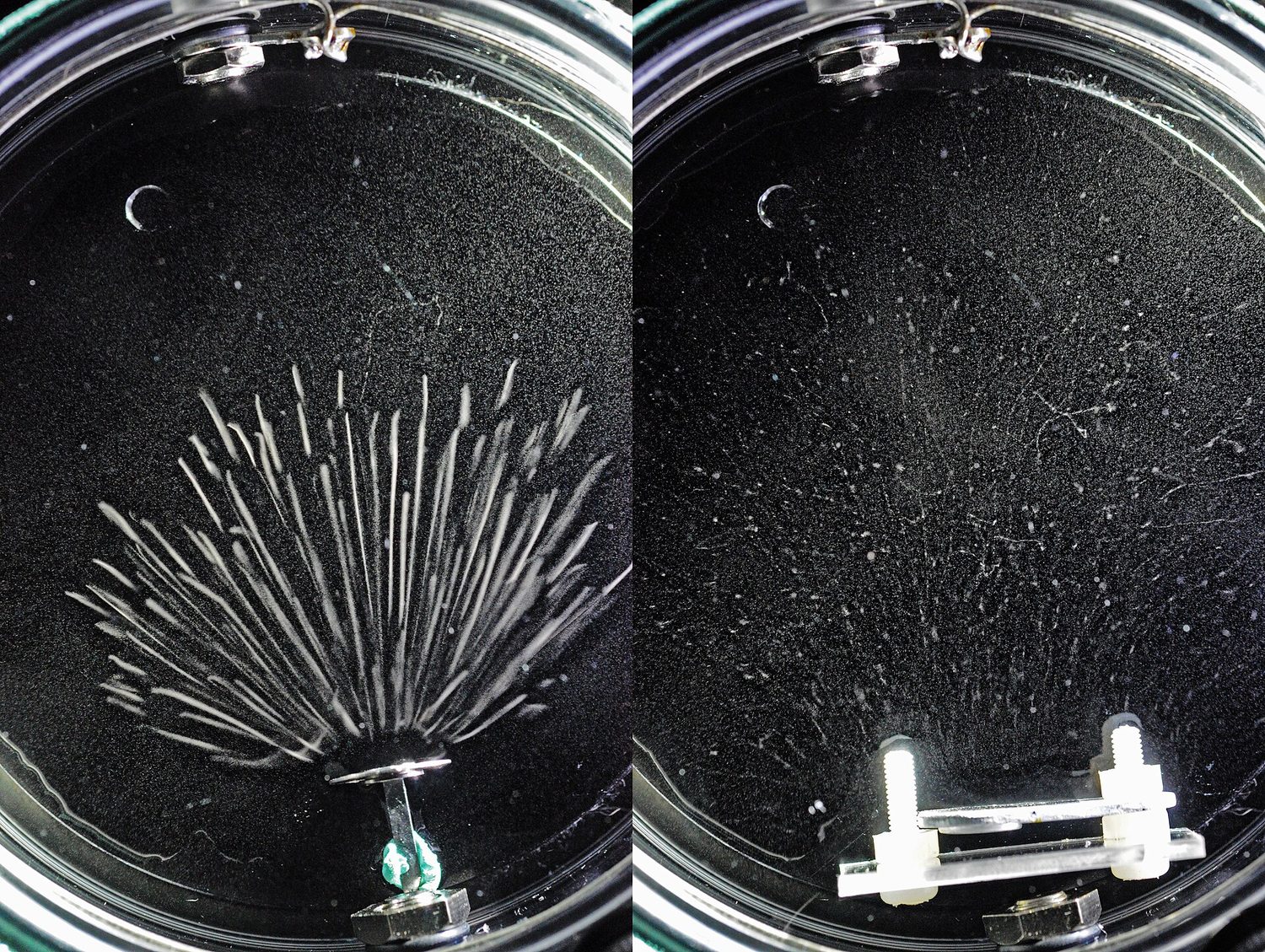
ห้องเมฆ: ฟิสิกส์สมัยใหม่ติดตามอนุภาคที่มีประจุจากการสลายตัวทางรังสี

ในระดับขนาดเล็ก, พลังงานมาในรูปแบบแพ็กเก็ตแบบต่อเนื่องที่เรียกว่า ควอนตัม. แสงถูกนำพาโดย โฟตอน, แต่ละตัวมีพลังงานที่กำหนดโดยความถี่ของมัน:

$$E=hf,$$
โดยที่ $h$ คือค่าคงที่ของแพลঙ্ก ความเป็นคู่ของคลื่น-อนุภาค: แสงและสสารแสดงทั้งพฤติกรรมแบบคลื่น (การแทรกสอด, การเลี้ยวเบน) และพฤติกรรมแบบอนุภาค (โฟตอน, อิเล็กตรอนเป็นการชนที่เฉพาะเจาะจง) อนุภาคยังมี ความยาวคลื่นของสสาร $\lambda=\dfrac{h}{p}$, และอนุภาคสร้างการแทรกสอดได้จริง – ซึ่งเป็นรูปแบบที่แปรผันจากการทดลอง ช่องแยกคู่ของYoung ทำด้วยอิเล็กตรอนจะสร้างลวดลายแถบ干涉 Same as light.

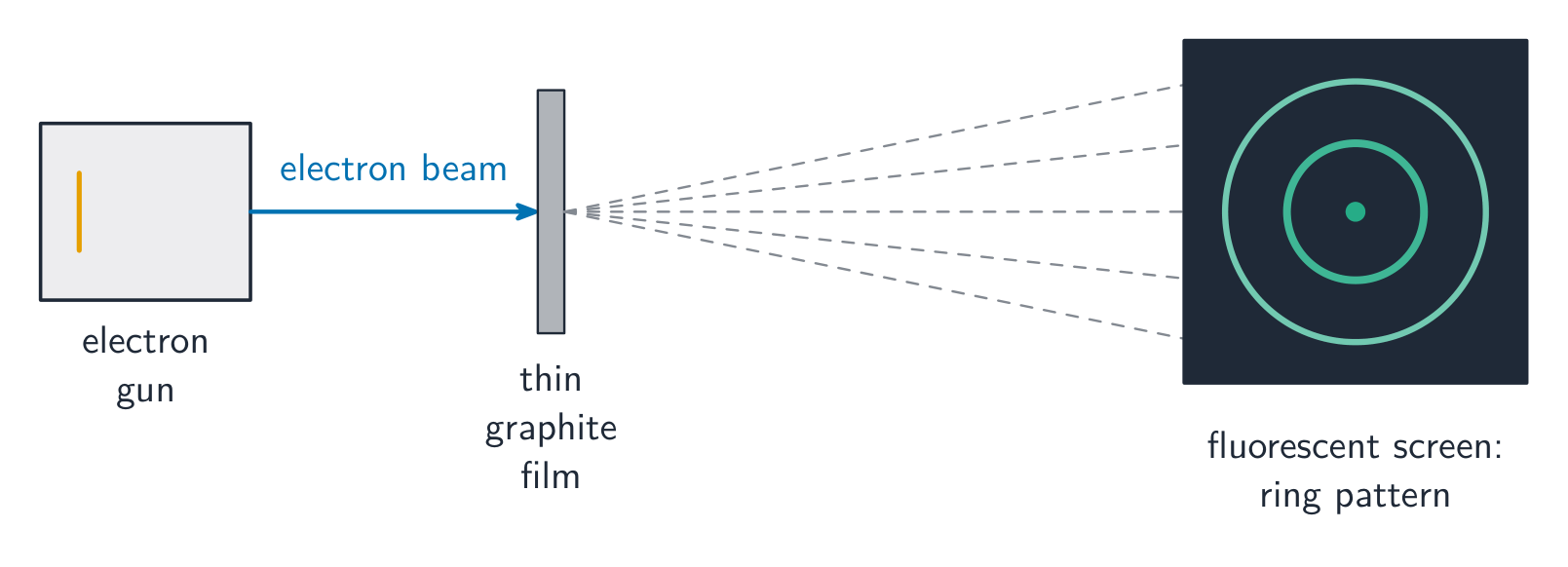
อิเล็กตรอนสร้างลวดลายการกระจาย, แสดงว่าอนุภาคมีธรรมชาติแบบคลื่น

ตัวอย่างฝึกหัด. หาพลังงานของโฟตอนแสงสีส้มที่มีความถี่ $5.0\times10^{14}\ \text{Hz}$ ($h=6.63\times10^{-34}\ \text{J s}$): $E=hf=6.63\times10^{-34}\times5.0\times10^{14}=3.3\times10^{-19}\ \text{J}$, ซึ่งประมาณ equals $2.1\ \text{eV}$ (หารด้วย $1.6\times10^{-19}$). โฟตอนแสงที่มองเห็นได้พกพาพลังงานไม่กี่ electronvolts – เหมาะสมพอดีที่จะกระตุ้นปฏิกิริยาเคมีของการมองเห็นและการสังเคราะห์แสง

15.2

The Bohr Model of Atomic Structure · ⁨โมเดลโบร์ของโครงสร้างอะตอม⁩

Syllabus · ⁨หลักสูตร⁩
English

Learning Objective 15.2.A: Describe the properties of an atom.

  • 15.2.A.1 Atoms have internal structure.
    • 15.2.A.1.i Atoms consist of a small, positively charged nucleus surrounded by one or more negatively charged electrons.
    • 15.2.A.1.ii The nucleus of an atom is made up of protons and neutrons.
    • 15.2.A.1.iii The number of neutrons and protons in an atom can be represented using nuclear notation.
    • 15.2.A.1.iv An ion is an atom with a nonzero net electric charge.
  • 15.2.A.2 Each atomic element has a unique number of protons.
    • 15.2.A.2.i The number and arrangements of electrons affects how atoms interact.
    • 15.2.A.2.ii The total number of neutrons and protons identifies the isotope of an element.
    • 15.2.A.2.iii The mass of an atom is dominated by the total mass of the protons and neutrons in its nucleus.
  • 15.2.A.3 The Bohr model of the atom is based on classical physics and was the historical representation of the atom that led to the description of the hydrogen atom in terms of discrete energy states.
    • 15.2.A.3.i In the Bohr model of the atom, electrons are modeled as moving around the nucleus in circular orbits determined by the electron's charge and mass, as well as the electric force between the electron and the nucleus.
      • Relevant equations:
      • $F_e = k\dfrac{q_1 q_2}{r^2}$
      • $F_{\text{net}} = m\dfrac{v^2}{r}$
    • 15.2.A.3.ii The standing wave model of electrons accounts for the existence of specific allowed energy states of an electron in an atom, because the electron orbit's circumference must be an integer multiple of the electron's de Broglie wavelength.

Boundary statement: The analysis and description of electron structure is limited to energy levels and will not include such advanced descriptions as orbitals, orbital shapes, or probability functions.

ไทย

วัตถุประสงค์การเรียนรู้ 15.2.A: อธิบายคุณสมบัติของอะตอม

  • 15.2.A.1 อะตอมมีโครงสร้างภายใน
    • 15.2.A.1.i อะตอมประกอบด้วยนิวเคลียสขนาดเล็กที่มีประจุบวก并被环绕着一个或多个带负电荷的电子。
    • 15.2.A.1.ii นิวเคลียสของอะตอมประกอบด้วยโปรตอนและนิวตรอน
    • 15.2.A.1.iii จำนวนนิวตรอนและโปรตอนในอะตอมสามารถแทนได้ด้วยสัญลักษณ์นิวเคลียร์
    • 15.2.A.1.iv ไอออนคืออะตอมที่มีประจุไฟฟ้าสุทธิไม่เป็นศูนย์
  • 15.2.A.2 แต่ละธาตุทางเคมีมีจำนวนโปรตอนที่เป็นเอกลักษณ์เฉพาะตัว
    • 15.2.A.2.i จำนวนและการจัดเรียงของอิเล็กตรอนส่งผลต่อการมีปฏิสัมพันธ์ของอะตอม
    • 15.2.A.2.ii จำนวนรวมของนิวตรอนและโปรตอนระบุไอโซโทปของธาตุ
    • 15.2.A.2.iii มวลของอะตอมขึ้นอยู่กับมวลรวมของโปรตอนและนิวตรอนในนิวเคลียส
  • 15.2.A.3 โมเดลอะตอมแบบโบร์ตั้งอยู่บนพื้นฐานของฟิสิกส์คลาสสิก และเป็นภาพแสดงทางประวัติศาสตร์ของอะตอมที่นำไปสู่การอธิบายอะตอมของไฮโดรเจนในฐานะสถานะพลังงานที่แยกเป็นช่วงๆ (discrete energy states)
    • 15.2.A.3.i ในโมเดลอะตอมแบบโบร์ อิเล็กตรอนถูกจำลองให้เคลื่อนที่รอบนิวเคลียสในวงโคจรแบบวงกลม ซึ่งกำหนดโดยประจุและมวลของอิเล็กตรอน รวมถึงแรงไฟฟ้าระหว่างอิเล็กตรอนกับนิวเคลียส
      • สมการที่เกี่ยวข้อง:
      • $F_e = k\dfrac{q_1 q_2}{r^2}$
      • $F_{\text{net}} = m\dfrac{v^2}{r}$
    • 15.2.A.3.ii โมเดลคลื่นนิ่งของอิเล็กตรอนอธิบายถึงการมีอยู่ของสถานะพลังงานที่เป็นไปได้เฉพาะเจาะจงของอิเล็กตรอนในอะตอม เนื่องจากความยาวเส้นรอบวงของวงโคจรอิเล็กตรอนต้องเป็นจำนวนเต็มเท่ากับความยาวคลื่นเด บรอยล์ของอิเล็กตรอน

ข้อจำกัด: การวิเคราะห์และอธิบายโครงสร้างอิเล็กตรอนจะจำกัดอยู่ที่ระดับพลังงานเท่านั้น และไม่รวมถึงคำอธิบายขั้นสูงเช่น ออร์บิทัล รูปร่างของออร์บิทัล หรือฟังก์ชันความน่าจะเป็น

Source: College Board AP Course and Exam Description · ⁨แหล่งที่มา: คำอธิบายหลักสูตรและข้อสอบ College Board AP⁩

English

The Bohr model 玻尔模型 pictures electrons orbiting the nucleus only in certain allowed energy levels 能级. An electron can jump between levels only by absorbing or emitting a photon whose energy exactly matches the gap:

$$E_{\text{photon}}=|E_{\text{final}}-E_{\text{initial}}|.$$
Because the levels are discrete, only specific photon energies are allowed.

ไทย

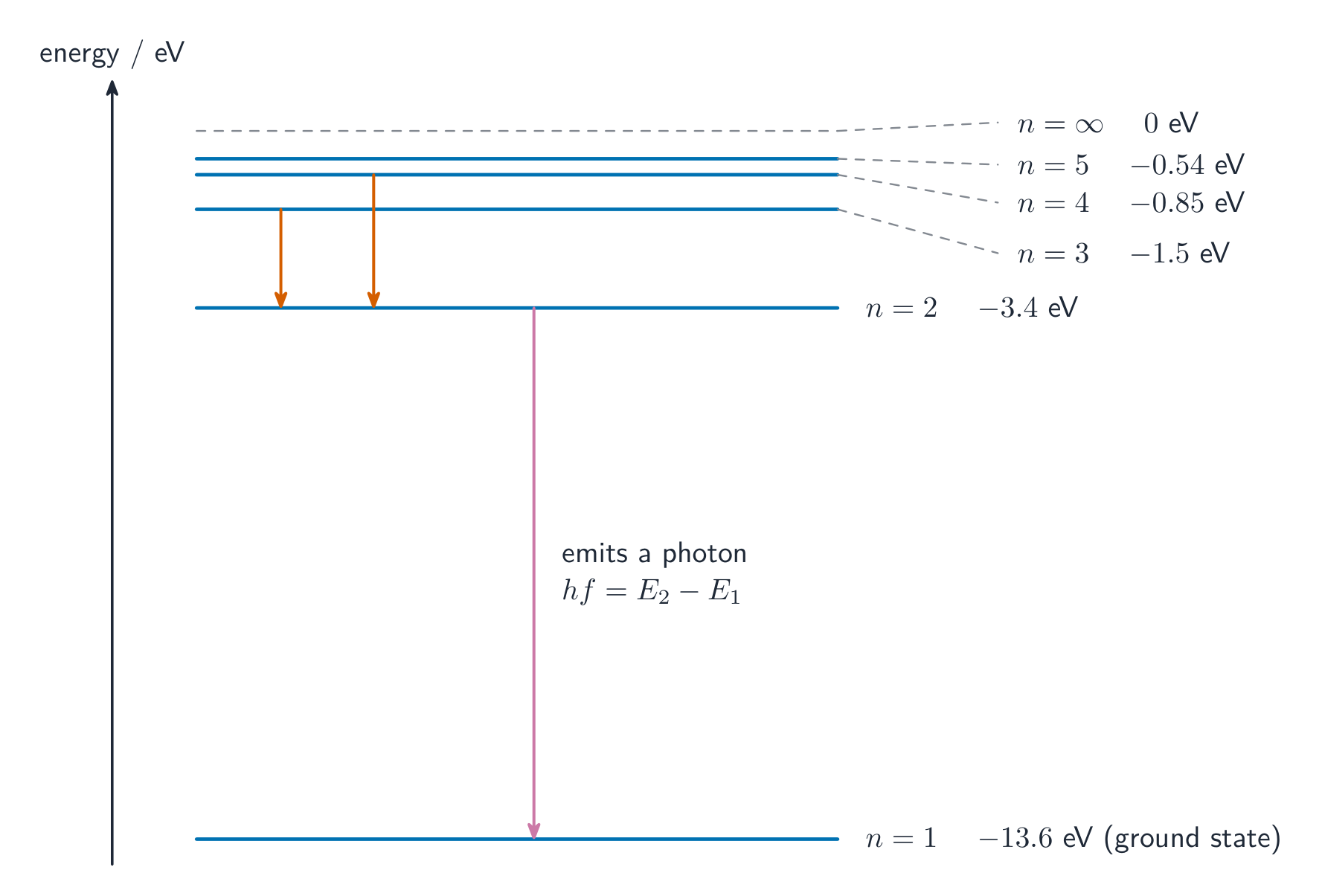
แบบจำลองของ บอร์ แสดงให้เห็นว่าอิเล็กตรอนโคจรรอบนิวเคลียสได้เฉพาะใน ระดับพลังงาน ที่อนุญาตเท่านั้น อิเล็กตรอนจะกระโดดระหว่างระดับได้โดยการดูดกลืนหรือปล่อยโฟตอนที่มีพลังงานตรงกับช่องว่างนั้นพอดี:

$$E_{\text{photon}}=|E_{\text{final}}-E_{\text{initial}}|.$$
เนื่องจากระดับพลังงานเป็นแบบไม่ต่อเนื่อง จึงมีเพียงพลังงานโฟตอนบางชนิดเท่านั้นที่อนุญาตให้เกิดขึ้นได้

15.3

Emission and Absorption Spectra · ⁨สเปกตรัมการแผ่รังสีและการดูดกลืนแสง⁩

Syllabus · ⁨หลักสูตร⁩
English

Learning Objective 15.3.A: Describe the emission or absorption of photons by atoms.

  • 15.3.A.1 Energy transfer occurs when photons are absorbed or emitted by an atom, which is modeled as a system consisting of a nucleus and an electron.
  • 15.3.A.2 Energy can only be absorbed or emitted by an atom if the amount of energy being absorbed or emitted corresponds to the energy difference between two atomic energy states.
    • 15.3.A.2.i An atom in a given energy state may absorb a photon of the appropriate energy and transition to a higher energy state.
    • 15.3.A.2.ii An atom in an excited energy state may emit a photon of the appropriate energy to spontaneously move to a lower energy state.
    • 15.3.A.2.iii Because an atom is modeled as a system consisting of an electron and a nucleus, a change in the energy state of an atom corresponds to a change in the interaction energy between the electron and the nucleus.
  • 15.3.A.3 Transitions between two energy states of an atom correspond to the absorption or emission of a photon of a single frequency and, therefore, a single wavelength.
  • 15.3.A.4 Atoms of each element have a unique set of allowed energy levels and thereby a unique set of absorption and emission frequencies. The unique set of frequencies determines the element's spectrum.
    • 15.3.A.4.i An emission spectrum can be used to determine the elements in a source of light.
    • 15.3.A.4.ii An absorption spectrum can be used to determine the elements composing a substance by observing what light the substance has absorbed.
    • 15.3.A.4.iii Energy level diagrams are commonly used to visually represent the energy states of an atom.
  • 15.3.A.5 Binding energy is the energy required to remove an electron from an atom, causing the atom to become ionized. An atom in the lowest energy level (ground state) will require the greatest amount of energy to remove the electron from the atom.

Boundary statement: In AP Physics 2, only energy level diagrams of single-electron atoms will be considered.

ไทย

วัตถุประสงค์การเรียนรู้ 15.3.A: อธิบายการแผ่รังสีหรือการดูดกลืนโฟตอนโดยอะตอม

  • 15.3.A.1 การถ่ายโอนพลังงานเกิดขึ้นเมื่อโฟตอนถูกดูดกลืนหรือแผ่ออกมาโดยอะตอม ซึ่งถูกจำลองว่าเป็นระบบที่ประกอบด้วยนิวเคลียสและอิเล็กตรอน
  • 15.3.A.2 พลังงานสามารถถูกดูดกลืนหรือแผ่ออกมาจากอะตอมได้ก็ต่อเมื่อปริมาณพลังงานที่ถูกดูดกลืนหรือแผ่ออกมาสอดคล้องกับความต่างของพลังงานระหว่างสองสถานะพลังงานของอะตอมเท่านั้น
    • 15.3.A.2.i อะตอมที่อยู่ในสถานะพลังงาน某一个 อาจดูดกลืนโฟตอนที่มีพลังงานเหมาะสมและเปลี่ยนไปยังสถานะพลังงานที่สูงขึ้นได้
    • 15.3.A.2.ii อะตอมที่อยู่ในสถานะพลังงานกระตุ้นอาจแผ่ออกโฟตอนที่มีพลังงานเหมาะสมเพื่อเปลี่ยนไปยังสถานะพลังงานที่ต่ำลงอย่างอิสระ (spontaneously)
    • 15.3.A.2.iii เนื่องจากอะตอมถูกจำลองว่าเป็นระบบที่ประกอบด้วยอิเล็กตรอนและนิวเคลียส การเปลี่ยนแปลงสถานะพลังงานของอะตอมจึงสอดคล้องกับการเปลี่ยนแปลงพลังงานอันตรกิริยาระหว่างอิเล็กตรอนกับนิวเคลียส
  • 15.3.A.3 การเปลี่ยนผ่านระหว่างสองสถานะพลังงานของอะตอมสอดคล้องกับการดูดกลืนหรือการแผ่ออกโฟตอนที่มีความถี่เดียวและดังนั้นมีความยาวคลื่นเดียว
  • 15.3.A.4 อะตอมของแต่ละชนิดมีชุดสถานะพลังงานที่เป็นไปได้เฉพาะตัว และดังนั้นจึงมีความถี่ของการดูดกลืนและการแผ่รังสีที่เป็นเอกลักษณ์ ชุดความถี่ที่เป็นเอกลักษณ์นี้决定了สเปกตรัมของธาตุนั้น
    • 15.3.A.4.i สเปกตรัมการแผ่รังสีสามารถใช้ระบุธาตุที่มีอยู่ในแหล่งกำเนิดแสงได้
    • 15.3.A.4.ii สเปกตรัมการดูดกลืนสามารถใช้ระบุธาตุที่ประกอบขึ้นเป็นสารด้วยการสังเกตว่าสารนั้นดูดกลืนแสง哪些ส่วน
    • 15.3.A.4.iii แผนภูมิระดับพลังงานมักถูกใช้เพื่อแสดงสถานะพลังงานของอะตอมในรูปแบบกราฟิก
  • 15.3.A.5 พลังงานยึดเหนี่ยวคือพลังงานที่ต้องการในการดึงอิเล็กตรอนออกจากอะตอม ทำให้อะตอมกลายเป็นไอออน อะตอมในระดับพลังงานต่ำสุด (สถานะพื้น) จะต้องใช้พลังงานมากที่สุดในการดึงอิเล็กตรอนออกจากอะตอม

ข้อจำกัด: ใน AP Physics 2 จะพิจารณาเฉพาะแผนภูมิระดับพลังงานของอะตอมที่มีอิเล็กตรอนตัวเดียวเท่านั้น

Source: College Board AP Course and Exam Description · ⁨แหล่งที่มา: คำอธิบายหลักสูตรและข้อสอบ College Board AP⁩

English
  • An emission spectrum 发射光谱 is the set of bright lines given off when electrons drop to lower levels – each line a specific wavelength.
  • An absorption spectrum 吸收光谱 is the set of dark lines where those same wavelengths are absorbed from a continuous source.

The line pattern is a fingerprint of the element, since every element has its own energy levels.

ไทย
  • สเปกตรัมการแผ่รังสี (Emission spectrum) คือชุดของเส้นสว่างที่ emit เมื่ออิเล็กตรอนตกลงสู่ระดับพลังงานต่ำกว่า – แต่ละเส้นแทนความยาวคลื่นเฉพาะ
  • สเปกตรัมการดูดกลืนแสง (Absorption spectrum) คือชุดของเส้นมืดที่เกิดจากการดูดกลืนความยาวคลื่นเหล่านั้นจากแหล่งกำเนิดแสงต่อเนื่อง
ระดับพลังงานที่ไม่ต่อเนื่องของไฮโดรเจนสร้างสเปกตรัมเส้น

รูปแบบเส้นนี้คือ ลายนิ้วมือ ของธาตุ เนื่องจากแต่ละธาตุมีระดับพลังงานของตัวเอง

เส้นการแผ่รังสีที่มองเห็นได้สี่เส้นของไฮโดรเจนบนพื้นหลังสีดำ
สเปกตรัมการแผ่รังสีของไฮโดรเจน: เส้นสว่างแต่ละเส้นคือแสงจากอิเล็กตรอนที่ตกลงระหว่างระดับพลังงานที่กำหนด
Explore · ⁨สำรวจ⁩

See an element's line spectrum · ⁨ดูสเปกตรัมเส้นของธาตุหนึ่ง⁩

Electrons jump between fixed energy levels, emitting or absorbing photons of exact wavelengths — a line spectrum that fingerprints the element. · ⁨อิเล็กตรอนกระโดดระหว่างระดับพลังงานที่กำหนดไว้并发布หรือดูดกลืนโฟตอนที่มีความยาวคลื่นเฉพาะ — สเปกตรัมเส้น ที่ทำหน้าที่เหมือนลายนิ้วมือของธาตุนั้น⁩

Vocabulary · ⁨คำศัพท์⁩ Train · ⁨ฝึกฝน⁩
English ไทย
quanta/ˈkwɒntə/ ควอนตัม
photons/ˈfəʊtɒnz/ โฟตอน
Wave–particle duality/weɪv ˈpɑːtɪkl djuːˈælɪti/ ความเป็นคู่คลื่น-อนุภาค
double-slit experiment/ˈdʌbl slɪt ekˈsperɪmənt/ การทดลองช่องคู่ Young's double-slit experiment
Bohr model/ˈbəʊə ˈmɒdl/ โมเดลของบอร์
energy levels/ˈenədʒi ˈlevlz/ ระดับพลังงาน
emission spectrum/ɪˈmɪʃn ˈspektrəm/ สเปกตรัมการแผ่รังสี
absorption spectrum/əbˈsɔːpʃn ˈspektrəm/ สเปกตรัมการดูดกลืนแสง
15.4

Blackbody Radiation · ⁨การแผ่รังสีของวัตถุดำ⁩

Syllabus · ⁨หลักสูตร⁩
English

Learning Objective 15.4.A: Describe the electromagnetic radiation emitted by an object due to its temperature.

  • 15.4.A.1 Matter will spontaneously convert some of its internal thermal energy into electromagnetic energy.
  • 15.4.A.2 A blackbody is an idealized model of matter that absorbs all radiation that falls on the body. If the body is in equilibrium at a constant temperature, then it must in turn emit energy.
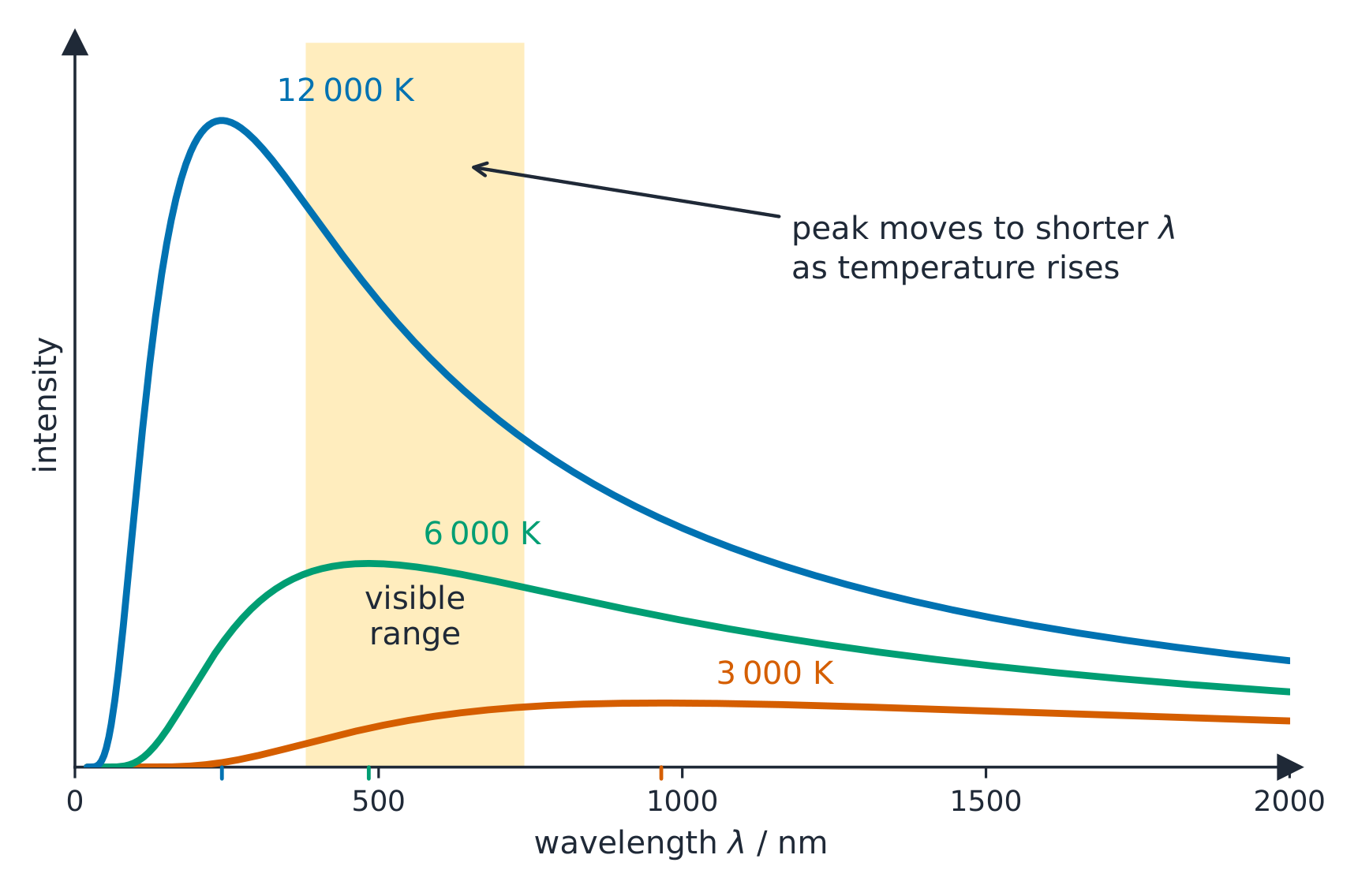
  • 15.4.A.3 A blackbody will emit a continuous spectrum that only depends on the body's temperature. The radiation emitted by a blackbody is often modeled by plotting intensity per unit wavelength as a function of wavelength.
    • 15.4.A.3.i The distribution of the intensity of a blackbody's spectrum as a function of temperature cannot be modeled using only classical physics concepts. A blackbody's spectrum is described by Planck's law, which assumes that the energy of light is quantized.
    • 15.4.A.3.ii The peak wavelength emitted by a blackbody (the wavelength at which the blackbody emits the greatest amount of radiation per unit wavelength) decreases with increasing temperature, as described by Wien's law.
      • Relevant equation:
      • $\lambda_{\max} = \dfrac{b}{T}$
    • 15.4.A.3.iii The rate at which energy is emitted (power) by a blackbody is proportional to the surface area of the body and to the temperature of the body raised to the fourth power, as described by the Stefan-Boltzmann law.
      • Relevant equation:
      • $P = A\sigma T^4$
ไทย

วัตถุประสงค์การเรียนรู้ 15.4.A: อธิบายการแผ่รังสีแม่เหล็กไฟฟ้าที่วัตถุแผ่ออกมาเนื่องจากอุณหภูมิ

  • 15.4.A.1 วัสดุจะแปลงพลังงานความร้อนภายในบางส่วนออกเป็นพลังงานแม่เหล็กไฟฟ้าโดยธรรมชาติ
  • 15.4.A.2 วัตถุดำคือโมเดลในอุดมคติของวัสดุที่ดูดกลืนรังสีทั้งหมดที่ตกกระทบ หากวัตถุอยู่ในสมดุลที่อุณหภูมิคงที่ มันจะต้องแผ่ออกพลังงานกลับออกมาด้วย
  • 15.4.A.3 วัตถุดำจะแผ่สเปกตรัมต่อเนื่องซึ่งขึ้นอยู่กับอุณหภูมิจากวัตถุเท่านั้น รังสีที่วัตถุดำแผ่ออกมามักถูกจำลองโดยการพล็อตความเข้มต่อหน่วยความยาวคลื่นเป็นฟังก์ชันของความยาวคลื่น
    • 15.4.A.3.i การกระจายตัวของความเข้มของสเปกตรัมวัตถุดำตามอุณหภูมิไม่สามารถจำลองได้ด้วยแนวคิดฟิสิกส์คลาสสิกเพียงอย่างเดียว สเปกตรัมของวัตถุดำถูกอธิบายโดยกฎของแพงค์ ซึ่งสมมติว่าพลังงานของแสงถูกแบ่งเป็นควอนตัม
    • 15.4.A.3.ii ความยาวคลื่นสูงสุดที่วัตถุดำแผ่ออกมา (ความยาวคลื่นที่วัตถุดำแผ่รังสีมากที่สุดในหน่วยความยาวคลื่น) จะลดลงเมื่ออุณหภูมิสูงขึ้น ตามที่อธิบายโดยกฎของไว恩
      • สมการที่เกี่ยวข้อง:
      • $\lambda_{\max} = \dfrac{b}{T}$
    • 15.4.A.3.iii อัตราการแผ่ออกพลังงาน (กำลัง) ของวัตถุดำแปรผันตรงกับพื้นที่ผิวของวัตถุและแปรผันตรงกับอุณหภูมิของวัตถุนับกำลังสี่ ตามที่อธิบายโดยกฎของสเตฟาน-โบลต์ซมันน์
      • สมการที่เกี่ยวข้อง:
      • $P = A\sigma T^4$

Source: College Board AP Course and Exam Description · ⁨แหล่งที่มา: คำอธิบายหลักสูตรและข้อสอบ College Board AP⁩

English

A blackbody 黑体 emits a continuous spectrum that depends only on its temperature. Hotter objects glow brighter and peak at shorter wavelengths (red-hot to white-hot to blue-hot). Explaining this spectrum required quantized energy – a founding problem of quantum theory.

ไทย

วัตถุดำ (Blackbody) จะแผ่สเปกตรัมต่อเนื่องที่ขึ้นอยู่กับอุณหภูมิเพียงอย่างเดียว วัตถุที่ร้อนกว่าจะเรืองแสงสว่างขึ้นและสูงสุดที่ ความยาวคลื่นสั้นลง (แดงจัดไปเป็นขาวจัดไปเป็นน้ำเงินจัด) การอธิบายสเปกตรัมนี้จำเป็นต้องใช้พลังงานแบบควอนไทซ์ – ซึ่งเป็นปัญหาพื้นฐานของทฤษฎีควอนตัม

วัตถุดำที่ร้อนกว่าแผ่รังสีมากขึ้น และจุดสูงสุดเลื่อนไปทางความยาวคลื่นสั้นลง
Vocabulary · ⁨คำศัพท์⁩ Train · ⁨ฝึกฝน⁩
English ไทย
blackbody/ˈblækbɒdi/ วัตถุดำ
photoelectric effect/ˌfəʊtəʊɪˈlektrɪk ɪˈfekt/ ปรากฏการณ์โฟโตอิเล็กทริก
15.5

The Photoelectric Effect · ⁨เอฟเฟกต์โฟโตอิเล็กทริก⁩

Syllabus · ⁨หลักสูตร⁩
English

Learning Objective 15.5.A: Describe an interaction between photons and matter using the photoelectric effect.

  • 15.5.A.1 The photoelectric effect is the emission of electrons when electromagnetic radiation is incident upon a photoactive material.
  • 15.5.A.2 The emission of electrons via the photoelectric effect requires a minimum frequency of incident light, called the threshold frequency.
    • 15.5.A.2.i Light that is incident on a material and is at the threshold frequency or higher will induce electron emission, regardless of the number of photons that strike the material.
    • 15.5.A.2.ii The energy of the emitted electrons is not dependent on the number of photons that are incident upon the material, which provides evidence that light is a collection of discrete, quantized energy packets called photons.
  • 15.5.A.3 The maximum kinetic energy of an emitted electron is related to the frequency of the incident light and the work function of the material, $\phi$.
    • 15.5.A.3.i The work function of a material is the minimum energy required to emit an electron from atoms in the material.
    • 15.5.A.3.ii The maximum kinetic energy of an emitted electron is given by the equation $K_{\max} = hf - \phi$.
    • 15.5.A.3.iii In a typical experimental setup to demonstrate the photoelectric effect and determine the work function of a metal, two metal plates are placed in a vacuum chamber and connected to a variable source of potential difference. One of the plates is illuminated by monochromatic light that causes electrons to be ejected and the potential difference between the plates is adjusted until no current is measured in the circuit.

Boundary statement: Where applicable, work functions for materials will be provided on the exam; students are not expected to know values of work functions or variables of a material that influence the magnitude of its work function.

ไทย

วัตถุประสงค์การเรียนรู้ 15.5.A: อธิบายปฏิสัมพันธ์ระหว่างโฟตอนและวัสดุโดยใช้เอฟเฟกต์โฟโตอิเล็กทริก

  • 15.5.A.1 เอฟเฟกต์โฟโตอิเล็กทริกคือการปล่อยอิเล็กตรอนเมื่อรังสีแม่เหล็กไฟฟ้าตกกระทบบนวัสดุที่มีคุณสมบัติโฟโต
  • 15.5.A.2 การปล่อยอิเล็กตรอนผ่านเอฟเฟกต์โฟโตอิเล็กทริกจำเป็นต้องมีความถี่ขั้นต่ำของแสงตกกระทบ ซึ่งเรียกว่าความถี่ขอบ (threshold frequency)
    • 15.5.A.2.i แสงที่ตกกระทบวัสดุด้วยความถี่ที่ขอบหรือสูงกว่าจะ诱发การปล่อยอิเล็กตรอน ไม่ว่าจะมีจำนวนโฟตอน了多少ที่ตกกระทบวัสดุก็ตาม
    • 15.5.A.2.ii พลังงานของอิเล็กตรอนที่ถูกปล่อยออกมาไม่ขึ้นอยู่กับจำนวนโฟตอนที่ตกกระทบวัสดุ ซึ่งเป็นหลักฐานที่แสดงว่าแสงเป็นกลุ่มของแพ็กเก็ตพลังงานที่แยกเป็นช่วงๆ ที่เรียกว่าโฟตอน
  • 15.5.A.3 พลังงานจลน์สูงสุดของอิเล็กตรอนที่ปล่อยออกมาสัมพันธ์กับความถี่ของแสงตกกระทบและฟังก์ชันงานของวัสดุ $\phi$
    • 15.5.A.3.i ฟังก์ชันงานของวัสดุคือพลังงานขั้นต่ำที่จำเป็นในการปล่อยอิเล็กตรอนออกจากอะตอมในวัสดุนั้น
    • 15.5.A.3.ii พลังงานจลน์สูงสุดของอิเล็กตรอนที่ปล่อยออกสามารถหาได้จากสมการ $K_{\max} = hf - \phi$
    • 15.5.A.3.iii ในการจัดตั้งทดลองทั่วไปเพื่อสาธิตปรากฏการณ์โฟโตอิเล็กทริกและหาค่าฟังก์ชันงานของโลหะ จะวางแผ่นโลหะสองแผ่นในห้องสุญญากาศและเชื่อมต่อกับแหล่งจ่ายแรงต่างศักย์แปรผัน หนึ่งในสองแผ่นถูกส่องด้วยแสงโมโนโครมาติกที่ทำให้เกิดอิเล็กตรอนหลุดออกมา และปรับแรงต่างศักย์ระหว่างแผ่นทั้งสองจนไม่พบกระแสไฟฟ้าในวงจร

ข้อจำกัด: หากเหมาะสม ค่าฟังก์ชันงานของวัสดุจะถูกให้ไว้ในข้อสอบ; นักเรียนไม่จำเป็นต้องจำค่าฟังก์ชันงานหรือตัวแปรของวัสดุที่มีผลต่อขนาดของฟังก์ชันงานได้

Source: College Board AP Course and Exam Description · ⁨แหล่งที่มา: คำอธิบายหลักสูตรและข้อสอบ College Board AP⁩

English
The photoelectric effect

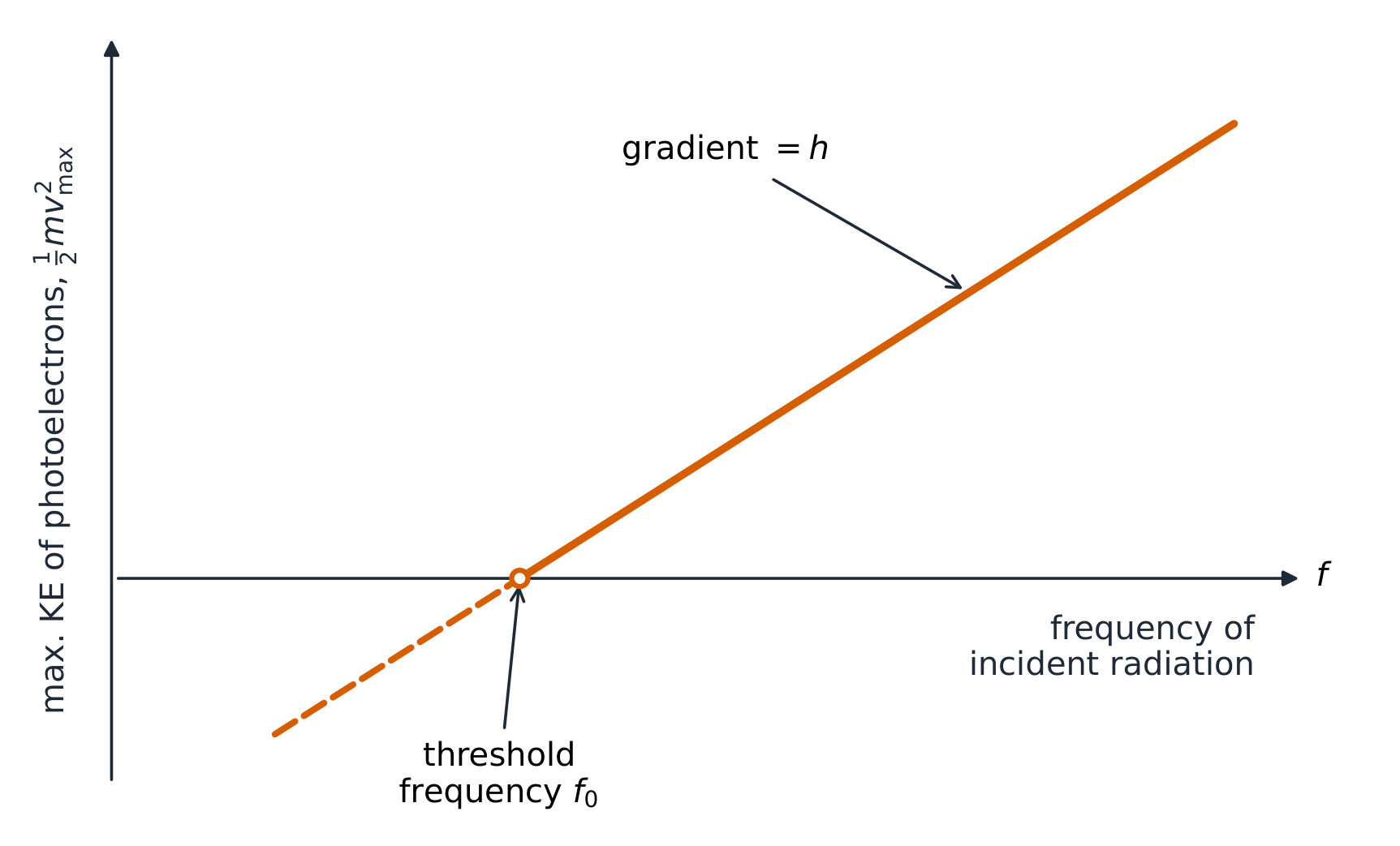
Shining light on a metal can eject electrons – the photoelectric effect 光电效应. Key facts (which only the photon picture explains): electrons come out only if the photon's frequency exceeds a threshold, no matter how bright a dimmer, lower-frequency light is. Energy conservation gives

$$K_{\max}=hf-\phi,$$
where $\phi$ is the metal's work function 逸出功 (the energy to free an electron).

Worked example. Light of frequency $8.0\times10^{14}\ \text{Hz}$ falls on a metal with work function $\phi=3.0\times10^{-19}\ \text{J}$. The most energetic electrons come off with

$$K_{\max}=hf-\phi=(6.63\times10^{-34}\times8.0\times10^{14})-3.0\times10^{-19}=5.3\times10^{-19}-3.0\times10^{-19}=2.3\times10^{-19}\ \text{J}.$$
Below the threshold frequency $\phi/h$, $K_{\max}$ would be negative – meaning no electrons escape at all, however bright the light.

ไทย
เอฟเฟกต์โฟโตอิเล็กทริก

การส่องแสงบนโลหะสามารถทำให้อิเล็กตรอนหลุดออกมาได้ – นี่คือ เอฟเฟกต์โฟโตอิเล็กทริก ข้อเท็จจริงสำคัญ (ซึ่งภาพโฟตอนเท่านั้นที่อธิบายได้): อิเล็กตรอนจะหลุดออกมาก็ต่อเมื่อความถี่ของโฟตอนสูงกว่าค่าเกณฑ์เท่านั้น ไม่ว่าแสงที่ความถี่ต่ำกว่าจะอ่อนแค่ไหนก็ตาม การอนุรักษ์พลังงานทำให้ได้

$$K_{\max}=hf-\phi,$$
โดยที่ $\phi$ คือ ฟังก์ชันงาน (Work function) ของโลหะ (พลังงานที่ใช้ปลดล็อกอิเล็กตรอน)

พลังงานจลน์สูงสุดของโฟโตอิเล็กตรอนเพิ่มขึ้นตามความถี่เชิงเส้น

ตัวอย่างโจทย์: แสงที่มีความถี่ $8.0\times10^{14}\ \text{Hz}$ ส่องtoBeโลหะที่มีฟังก์ชันงาน $\phi=3.0\times10^{-19}\ \text{J}$ อิเล็กตรอนที่มีพลังงานมากที่สุดจะถูกปล่อยออกมาด้วย

$$K_{\max}=hf-\phi=(6.63\times10^{-34}\times8.0\times10^{14})-3.0\times10^{-19}=5.3\times10^{-19}-3.0\times10^{-19}=2.3\times10^{-19}\ \text{J}.$$
หากต่ำกว่าความถี่阈值 $\phi/h$ ค่า $K_{\max}$ จะเป็นลบ – หมายความว่าไม่มีอิเล็กตรอนใดหลุดออกมาเลย ไม่ว่าแสงจะสว่างแค่ไหนก็ตาม

Vocabulary · ⁨คำศัพท์⁩ Train · ⁨ฝึกฝน⁩
English ไทย
work function/wɜːk ˈfʌŋkʃn/ work function
15.6

Compton Scattering · ⁨การกระเจิงของคอมปตัน⁩

Syllabus · ⁨หลักสูตร⁩
English

Learning Objective 15.6.A: Describe the interaction between photons and matter using Compton scattering.

  • 15.6.A.1 In Compton scattering, a photon interacts with a free electron. The Compton effect is when a photon that emerges from the interaction has a lower energy and longer wavelength than the incoming photon. The magnitude of the change is related to the direction of the photon after the collision.
  • 15.6.A.2 Compton scattering provides evidence that light is a collection of discrete, quantized energy packets called photons.
    • 15.6.A.2.i Compton scattering can be explained by treating a photon as a particle and applying conservation of energy and conservation of momentum to the collision between the photon and electron.
    • 15.6.A.2.ii The transfer of a photon's energy to an electron results in the energy, momentum, frequency, and wavelength of the photon changing.
      • Relevant equations:
      • $E = hf$
      • $\lambda = \dfrac{h}{p}$
  • 15.6.A.3 The change in wavelength experienced by a photon after colliding with an electron is related to how much the photon's direction changes.
    • Relevant equation:
    • $\Delta\lambda = \dfrac{h}{m_e c}(1 - \cos\theta)$

Boundary statement: AP Physics 2 includes full quantitative and qualitative treatments of conservation of momentum in two dimensions.

ไทย

จุดประสงค์การเรียนรู้ 15.6.A: อธิบายปฏิสัมพันธ์ระหว่างโฟตอนกับสสาร โดยใช้ปรากฏการณ์การกระเจิงแบบคอมปตัน

  • 15.6.A.1 ในการกระเจิงแบบคอมปตัน โฟตอนจะเกิดปฏิกิริยากับอิเล็กตรอนอิสระ ปรากฏการณ์คอมปตันเกิดขึ้นเมื่อโฟตอนที่ออกมาจากการมีปฏิสัมพันธ์มีพลังงานต่ำกว่าและความยาวคลื่นที่ยาวกว่าโฟตอนเดิม ขนาดของการเปลี่ยนแปลงขึ้นอยู่กับทิศทางของโฟตอนหลังการชนกัน
  • 15.6.A.2 การกระเจิงแบบคอมปตันเป็นหลักฐานที่แสดงว่าแสงประกอบด้วยแพ็กเก็ตพลังงานที่ไม่ต่อเนื่องและถูกกำหนดปริมาณ ซึ่งเรียกว่าโฟตอน
    • 15.6.A.2.i การกระเจิงแบบคอมปตันสามารถอธิบายได้โดยพิจารณาโฟตอนในฐานะอนุภาคและใช้กฎการอนุรักษ์พลังงานและการอนุรักษ์โมเมนตัมกับการชนระหว่างโฟตอนกับอิเล็กตรอน
    • 15.6.A.2.ii การถ่ายโอนพลังงานจากโฟตอนไปยังอิเล็กตรอนส่งผลให้พลังงาน โมเมนตัม ความถี่ และความยาวคลื่นของโฟตอนเปลี่ยนไป
      • สมการที่เกี่ยวข้อง:
      • $E = hf$
      • $\lambda = \dfrac{h}{p}$
  • 15.6.A.3 การเปลี่ยนแปลงความยาวคลื่นที่โฟตอนประสบหลังจากชนกับอิเล็กตรอนสัมพันธ์กับการเปลี่ยนแปลงทิศทางของโฟตอน
    • สมการที่เกี่ยวข้อง:
    • $\Delta\lambda = \dfrac{h}{m_e c}(1 - \cos\theta)$

ข้อจำกัด: AP Physics 2 ครอบคลุมทั้งการวิเคราะห์เชิงปริมาณและเชิงคุณภาพเกี่ยวกับการอนุรักษ์โมเมนตัมในสองมิติอย่างครบถ้วน

Source: College Board AP Course and Exam Description · ⁨แหล่งที่มา: คำอธิบายหลักสูตรและข้อสอบ College Board AP⁩

English

In Compton scattering 康普顿散射, a photon collides with an electron like two particles, transferring some energy and momentum. The scattered photon comes out with less energy (longer wavelength). This is direct evidence that photons carry momentum and behave as particles.

ไทย

ในการ กระเจิงของคอมปตัน (Compton scattering) โฟตอนชนกับอิเล็กตรอนเสมือนสองอนุภาค โดยถ่ายโอนพลังงานและโมเมนตัมบางส่วน โฟตอนที่ถูกกระเจิงจะมี พลังงานน้อยลง (ความยาวคลื่นยาวขึ้น) สิ่งนี้เป็นหลักฐานโดยตรงว่าโฟตอนมีโมเมนตัมและ behaving as particles

Vocabulary · ⁨คำศัพท์⁩ Train · ⁨ฝึกฝน⁩
English ไทย
Compton scattering/ˈkɒmptn ˈskætərɪŋ/ การกระเจิงของคอมปตัน
nucleus/ˈnjuːklɪəs/ นิวเคลียส
15.7

Fission, Fusion, and Nuclear Decay · ⁨การแตกตัว, การรวมตัว, และการสลายตัวของนิวเคลียร์⁩

Syllabus · ⁨หลักสูตร⁩
English

Learning Objective 15.7.A: Describe the physical properties that constrain the behavior of interacting nuclei, subatomic particles, and nucleons.

  • 15.7.A.1 The strong force is exerted at nuclear scales and dominates the interactions of nucleons (protons or neutrons).
  • 15.7.A.2 Possible nuclear reactions are constrained by the law of conservation of nucleon number.
  • 15.7.A.3 The behavior of the constituent particles of a nuclear reaction is constrained by laws of conservation of energy, energy-mass equivalence, and conservation of momentum.
  • 15.7.A.4 For all nuclear reactions, mass and energy may be exchanged due to mass-energy equivalence.
    • Relevant equation:
    • $E = mc^2$
  • 15.7.A.5 Energy may be released in nuclear processes in the form of kinetic energy of the products or as photons.
  • 15.7.A.6 Nuclear fusion is the process by which two or more smaller nuclei combine to form a larger nucleus, as well as subatomic particles.
  • 15.7.A.7 Nuclear fission is the process by which the nucleus of an atom splits into two or more smaller nuclei, as well as subatomic particles.
  • 15.7.A.8 Nuclear fission may occur spontaneously or may require an energy input, depending on the binding energy of the nucleus.

Learning Objective 15.7.B: Describe the radioactive decay of a given sample of material consisting of a finite number of nuclei.

  • 15.7.B.1 Radioactive decay is the spontaneous transformation of a nucleus into one or more different nuclei.
    • 15.7.B.1.i The time at which an individual nucleus undergoes radioactive decay is indeterminable, but decay rates can be described using probability
    • 15.7.B.1.ii The half-life, $t_{1/2}$, of a radioactive material is the time it takes for half of the initial number of radioactive nuclei to have spontaneously decayed.
    • 15.7.B.1.iii The decay constant $\lambda$ can be related to the half-life of a radioactive material with the equation $\lambda = \dfrac{\ln 2}{t_{1/2}}$.
  • 15.7.B.2 A material's decay constant may be used to predict the number of nuclei remaining in a sample after a period of time, or the age of a material if the initial amount of material is known.
    • Relevant equation:
    • $N = N_0 e^{-\lambda t}$
    • Derived equation:
    • $\ln\left(\dfrac{N}{N_0}\right) = -\lambda t$
  • 15.7.B.3 Different unstable elements and isotopes may have vastly different half-lives, ranging from fractions of a second to billions of years.
ไทย

จุดประสงค์การเรียนรู้ 15.7.A: อธิบายคุณสมบัติทางกายภาพที่กำหนดพฤติกรรมของนิวเคลียสที่มีปฏิสัมพันธ์ อนุภาคย่อยอะตอม และนิวคลีออน

  • 15.7.A.1 แรงนิวเคลียร์แรงกระทำในระดับนิวเคลียสและเป็นแรงหลักที่ควบคุมปฏิสัมพันธ์ของนิวคลีออน (โปรตอนหรือนิวตรอน)
  • 15.7.A.2 ปฏิกิริยาทางนิวเคลียร์ที่เป็นไปได้ต้องอยู่ภายใต้กฎการอนุรักษ์จำนวนนิวคลีออน
  • 15.7.A.3 พฤติกรรมของอนุภาคส่วนประกอบในปฏิกิริยานิวเคลียร์ต้องอยู่ภายใต้กฎการอนุรักษ์พลังงาน สมมูลมวล-พลังงาน และการอนุรักษ์โมเมนตัม
  • 15.7.A.4 สำหรับปฏิกิริยานิวเคลียร์ทั้งหมด มวลและพลังงานสามารถแลกเปลี่ยนกันได้เนื่องจากสมมูลมวล-พลังงาน
    • สมการที่เกี่ยวข้อง:
    • $E = mc^2$
  • 15.7.A.5 พลังงานอาจถูกปลดปล่อยในกระบวนการทางนิวเคลียร์ในรูปแบบของพลังงานจลน์ของผลิตภัณฑ์หรือในรูปของโฟตอน
  • 15.7.A.6 การหลอมรวมนิวเคลียสคือกระบวนการที่นิวเคลียสขนาดเล็กสองตัวขึ้นไปรวมกันเป็นนิวเคลียสที่ใหญ่ขึ้น รวมถึงอนุภาคย่อยอะตอม
  • 15.7.A.7 การแตกตัวของนิวเคลียสคือกระบวนการที่นิวเคลียสของอะตอมแตกออกเป็นนิวเคลียสขนาดเล็กสองตัวขึ้นไป รวมถึงอนุภาคย่อยอะตอม
  • 15.7.A.8 การแตกตัวของนิวเคลียสอาจเกิดขึ้นเองหรือต้องการพลังงานเข้าเสริม ขึ้นอยู่กับพลังงานยึดเหนี่ยวของนิวเคลียสนั้น

จุดประสงค์การเรียนรู้ 15.7.B: อธิบายการสลายตัวของกัมมันตรังสีของตัวอย่างวัสดุที่กำหนดซึ่งประกอบด้วยจำนวนนิวเคลียสจำกัด

  • 15.7.B.1 การสลายตัวของกัมมันตรังสีคือการเปลี่ยนแปลงโดยธรรมชาติของนิวเคลียสกลายเป็นนิวเคลียสอื่นหนึ่งหรือมากกว่านั้น
    • 15.7.B.1.i เวลาที่นิวเคลียสแต่ละตัวจะเกิดการสลายตัวของกัมมันตรังสีไม่สามารถระบุล่วงหน้าได้ แต่อัตราการสลายตัวสามารถอธิบายได้ด้วยprobability
    • 15.7.B.1.ii ช่วงครึ่งชีวิต, $t_{1/2}$, ของวัสดุกัมมันตรังสีคือระยะเวลาที่จำเป็นสำหรับนิวเคลียสกัมมันตรังสีจำนวนครึ่งหนึ่งของจำนวนเริ่มต้นที่จะสลายตัวไปโดยธรรมชาติ
    • 15.7.B.1.iii ค่าคงที่การสลายตัว $\lambda$ สามารถเชื่อมโยงกับช่วงครึ่งชีวิตของวัสดุกัมมันตรังสีได้โดยใช้สมการ $\lambda = \dfrac{\ln 2}{t_{1/2}}$
  • 15.7.B.2 ค่าคงที่การสลายตัวของวัสดุสามารถใช้ทำนายจำนวนนิวเคลียสที่เหลืออยู่ในตัวอย่างหลังจากผ่านไปช่วงเวลาหนึ่ง หรือหาอายุของวัสดุหากทราบปริมาณเริ่มต้นของวัสดุนั้น
    • สมการที่เกี่ยวข้อง:
    • $N = N_0 e^{-\lambda t}$
    • สมการที่ได้จากการดัดแปลง:
    • $\ln\left(\dfrac{N}{N_0}\right) = -\lambda t$
  • 15.7.B.3 ธาตุและไอโซโทปที่ไม่เสถียรที่แตกต่างกันอาจมีช่วงครึ่งชีวิตแตกต่างกันอย่างมาก ตั้งแต่เศษส่วนของวินาทีไปจนถึงหลายพันล้านปี

Source: College Board AP Course and Exam Description · ⁨แหล่งที่มา: คำอธิบายหลักสูตรและข้อสอบ College Board AP⁩

English

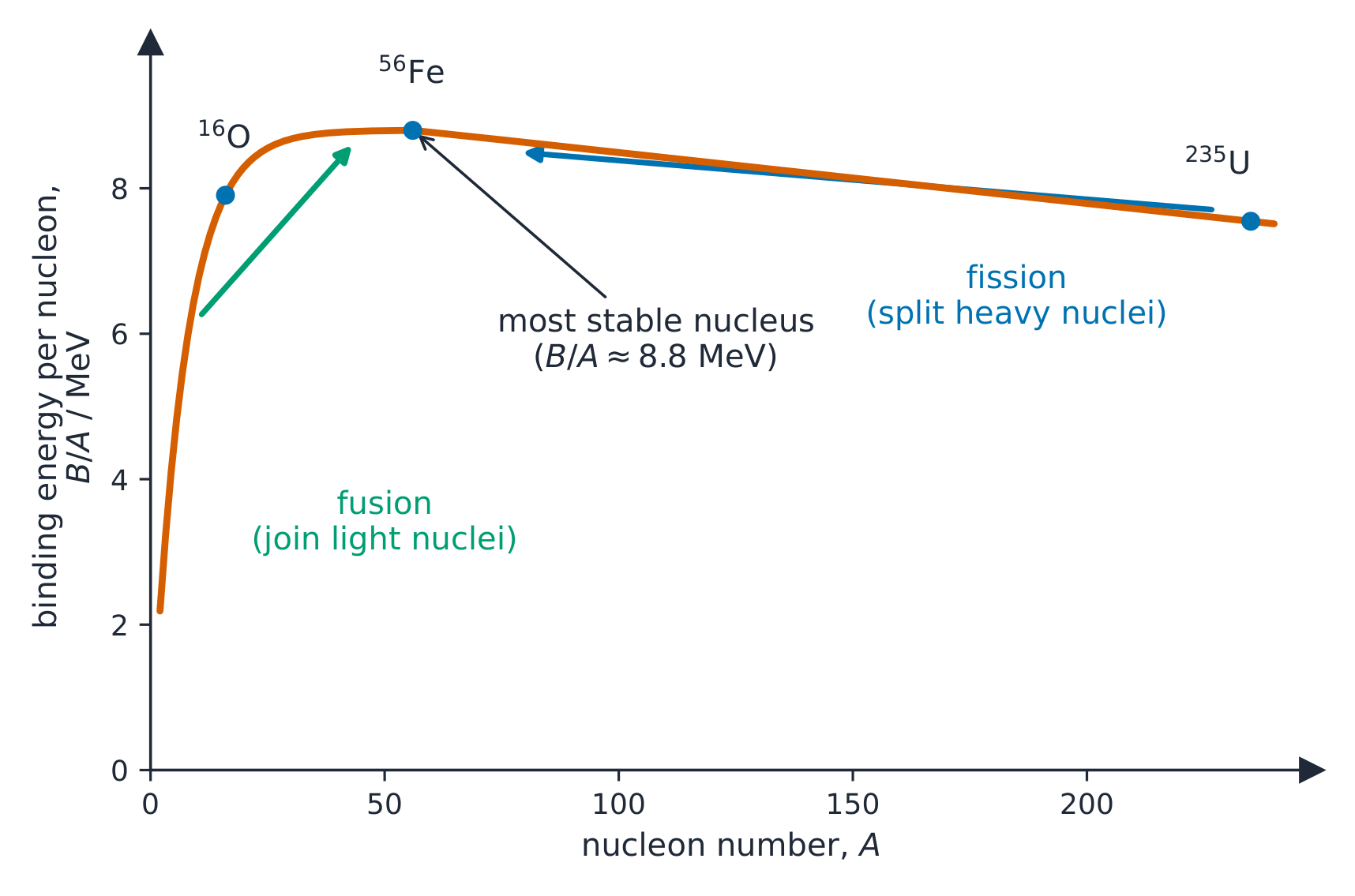
The nucleus 原子核 stores enormous energy. Fission 裂变 splits a heavy nucleus into lighter ones, releasing energy (nuclear reactors, bombs). Fusion 聚变 joins light nuclei into a heavier one (the Sun's power). Both release energy because the products have slightly less mass, converted by $E=mc^2$.

Worked example. Even a tiny mass converts to a huge energy. If a nuclear reaction loses $1.0\times10^{-3}\ \text{kg}$ of mass, it releases $E=mc^2=1.0\times10^{-3}\times(3.0\times10^{8})^2=9.0\times10^{13}\ \text{J}$ – roughly the energy of $20\,000$ tonnes of TNT.

ไทย

นิวเคลียส เก็บพลังงานมหาศาล การแตกตัว (Fission) แบ่งนิวเคลียสหนักออกเป็นนิวเคลียสเบากว่า ปล่อยพลังงาน (เตaN reactors, bombs) การรวมตัว (Fusion) เชื่อมนิวเคลียสเบาเข้าด้วยกันเป็นนิวเคลียสหนัก (พลังงานของดวงอาทิตย์) ทั้งสองกระบวนการปล่อยพลังงานเพราะผลิตภัณฑ์มีมวล น้อยลงเล็กน้อย ซึ่งถูกแปลงเป็นพลังงานโดย $E=mc^2$

พลังงานผูกพันต่อนิวคลีโอออนสูงสุดใกล้กับเหล็ก ทำให้ทั้งการรวมตัวและการแตกตัวสามารถปล่อยพลังงานได้

ตัวอย่างโจทย์: แม้มวลเล็กน้อยก็สามารถแปลงเป็นพลังงานมหาศาลได้ หากปฏิกิริยานิวเคลียร์สูญเสีย $1.0\times10^{-3}\ \text{kg}$ ของมวล มันจะปล่อย $E=mc^2=1.0\times10^{-3}\times(3.0\times10^{8})^2=9.0\times10^{13}\ \text{J}$ – ประมาณเท่ากับพลังงานของ $20\,000$ ตันของ TNT

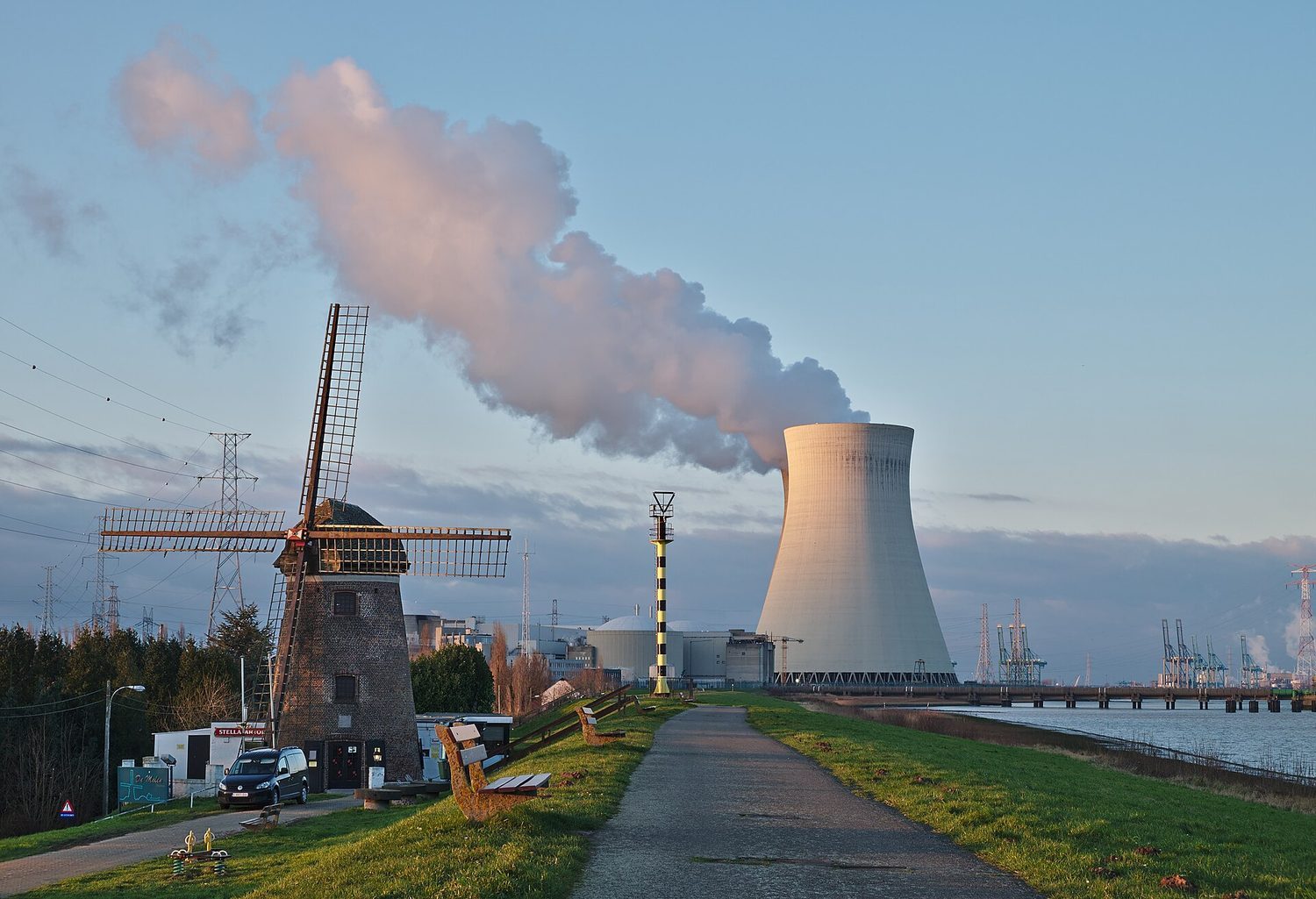
โรงงานผลิตไฟฟ้าพลังนิวเคลียร์: การแตกตัวของนิวเคลียสหนักปล่อยพลังงานที่ขับเคลื่อนโรงงาน
Explore · ⁨สำรวจ⁩

Balance a nuclear decay equation · ⁨ปรับสมการการสลายตัวทางนิวเคลียร์ให้สมดุล⁩

In alpha, beta and gamma decay, nucleon and charge numbers must balance. Pick a mode and see how the parent turns into the daughter nuclide. · ⁨ในการสลายตัวแบบ อัลฟา, เบตา และ แกมมา จำนวนนิวคลีออนและประจุต้องสมดุล เลือกโหมดหนึ่งแล้วดูว่านิวไคลด์แม่เปลี่ยนเป็นนิวไคลด์ลูกได้อย่างไร⁩

Vocabulary · ⁨คำศัพท์⁩ Train · ⁨ฝึกฝน⁩
English ไทย
Fission/ˈfɪʃn/ การแตกตัว
Fusion/ˈfjuːʒn/ การหลอมรวม
15.8

Types of Radioactive Decay · ⁨ประเภทของการสลายตัวทางรังสี⁩

Syllabus · ⁨หลักสูตร⁩
Learning ObjectiveEssential Knowledge

15.8.A
Describe the processes by which individual nuclei decay.

  • 15.8.A.1 Some processes by which nuclei decay emit subatomic particles with unique properties.
    • 15.8.A.1.i An alpha particle, or helium nucleus, consists of two neutrons and two protons and is symbolized by $\alpha$ or $\text{He}^{2+}$. (In Physics 2, only He-4 nuclei will be considered.)
    • 15.8.A.1.ii Neutrinos and antineutrinos are subatomic particles that have no electrical charge, have negligible mass, and are symbolized by $\nu$ and $\bar{\nu}$, respectively.
    • 15.8.A.1.iii Neutrinos and antineutrinos only interact with matter via the weak force and the gravitational force, which results in very little interaction with normal matter.
    • 15.8.A.1.iv Positrons, or antielectrons, are subatomic particles that have an electric charge opposite that of an electron, have the same mass as an electron, and are symbolized by $e^+$ or $\beta^+$.
  • 15.8.A.2 Nuclei can undergo radioactive decay via alpha decay, beta-minus decay ($\beta^-$), beta-plus decay ($\beta^+$), and gamma decay ($\gamma$).
    • 15.8.A.2.i In all nuclear decays, nucleon number (the number of neutrons and protons), lepton number (the number of electrons and neutrinos), and charge are conserved.
    • 15.8.A.2.ii Alpha decay occurs when a nucleus ejects an alpha particle.
    • 15.8.A.2.iii Beta-minus decay occurs when a neutron changes to a proton by emitting an electron and antineutrino.
    • 15.8.A.2.iv Beta-plus decay occurs when a proton changes to a neutron by emitting a positron and neutrino.
    • 15.8.A.2.v Gamma decay occurs after a nucleus has undergone alpha or beta decay and the excited nucleus decays to a lower energy state by emitting a photon.
  • 15.8.A.3 The type of decay exhibited by a given nucleus is determined by the isotope of the element.

Boundary statement: AP Physics 2 does not expect students to memorize the processes by which specific isotopes decay or the half-lives of specific isotopes. Neutron emission and electron capture are not included in the AP Physics 2 curriculum framework. Additionally, types of neutrinos, the characteristics that distinguish neutrinos and antineutrinos, and an explanation or application of the weak force are not within the scope of this course.

Source: College Board AP Course and Exam Description · ⁨แหล่งที่มา: คำอธิบายหลักสูตรและข้อสอบ College Board AP⁩

English
Radioactive decay & half-life

Unstable nuclei undergo radioactive decay 放射性衰变, emitting:

  • Alpha decay 阿尔法衰变 ($\alpha$): a helium nucleus – mass number drops by 4.
  • Beta decay 贝塔衰变 ($\beta$) comes in two kinds. In beta-minus ($\beta^-$) a neutron becomes a proton, emitting an electron and an antineutrino 反中微子: $n\rightarrow p+e^-+\bar{\nu}$. In beta-plus ($\beta^+$) a proton becomes a neutron, emitting a positron 正电子 and a neutrino 中微子: $p\rightarrow n+e^++\nu$.
  • Gamma decay 伽马衰变 ($\gamma$): a high-energy photon – the nucleus sheds excess energy.

The neutrino and antineutrino (symbols $\nu$, $\bar{\nu}$) are tiny, chargeless, almost-massless particles that carry off energy and keep beta decay balanced. Decay is random, but a sample halves every half-life 半衰期: after each half-life, half of the remaining nuclei have decayed. Every decay equation conserves three quantities: nucleon number (mass number), charge, and lepton number 轻子数 – an electron or neutrino counts as $+1$ lepton, a positron or antineutrino as $-1$, and the totals must match on both sides.

Worked example. A radioactive sample has a half-life of $8.0$ days. What fraction is left after $24$ days? That is $24/8.0=3$ half-lives, so the fraction remaining is $\left(\tfrac12\right)^3=\tfrac18$ – about $12.5\%$. In an alpha decay of uranium-238 ($^{238}_{\ 92}\text{U}$), the daughter has mass number $238-4=234$ and atomic number $92-2=90$: thorium-234.

ไทย
การสลายตัวทางรังสี & อายุขัยครึ่งหนึ่ง

นิวเคลียสที่ไม่เสถียรจะ undergo การสลายตัวทางรังสี (Radioactive decay) โดย emit:

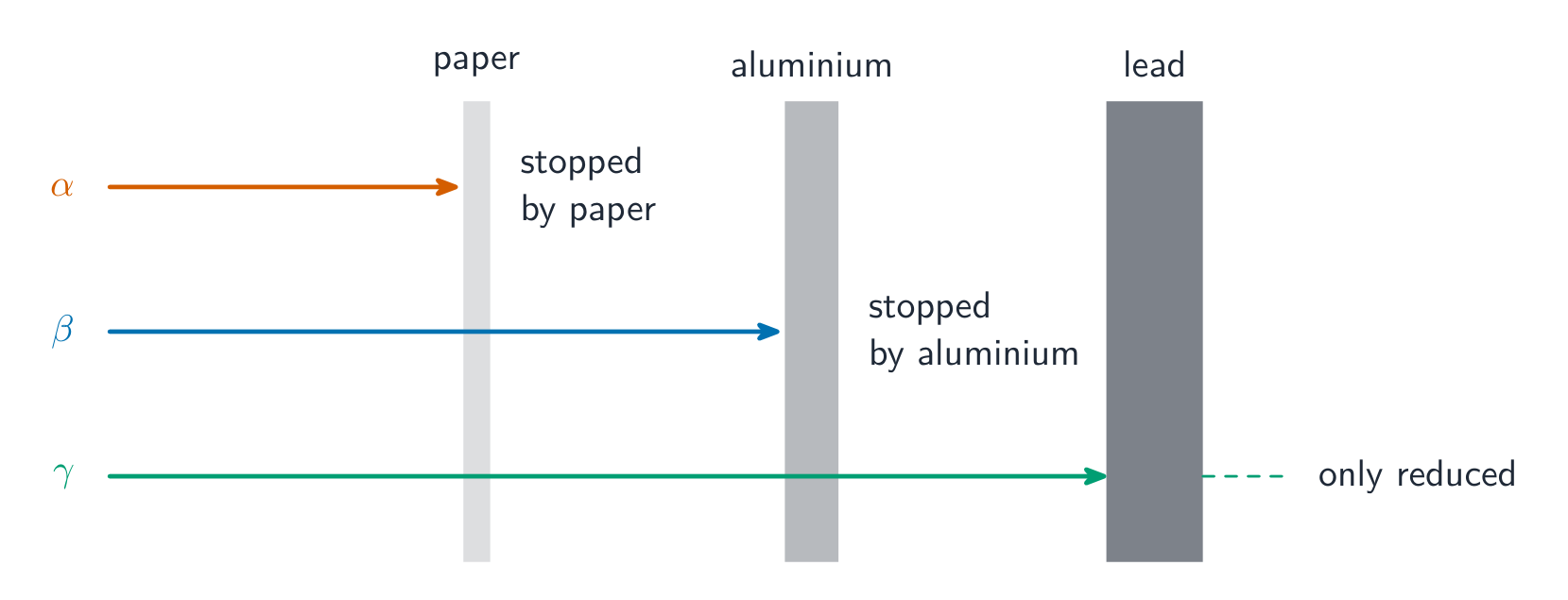
ความสามารถในการทะลุผ่านของรังสีอัลฟา เบตา และแกมมา
  • การสลายตัวแบบอัลฟา (Alpha decay) ($\alpha$): นิวเคลียสของฮีเลียม – เลขมวลลดลง 4
  • การสลายตัวแบบเบตา (Beta decay) ($\beta$) มีสองชนิด ใน เบตา-create-minus (β⁻) ($\beta^-$) neutron กลายเป็น proton emit อิเล็กตรอนและ แอนตินิวทริโน: $n\rightarrow p+e^-+\bar{\nu}$. ใน เบตา-create-plus (β⁺) ($\beta^+$) proton กลายเป็น neutron emit โพซิตรอน และ นิวทริโน: $p\rightarrow n+e^++\nu$.
  • การสลายตัวแบบแกมมา (Gamma decay) ($\gamma$): โฟตอนพลังงานสูง – นิวเคลียส shedding พลังส่วนเกิน

นิวทริโนและแอนตินิวทริโน (สัญลักษณ์ $\nu$, $\bar{\nu}$) เป็นอนุภาคขนาดเล็กมาก ไม่มีประจุ และเกือบไม่มีมวล yang carry off energy และรักษาสมดุลของการสลายตัวแบบเบตา การสลายตัวเป็นแบบสุ่ม แต่ตัวอย่างจะ减半ทุก ครึ่งชีวิต (Half-life): หลังแต่ละครึ่งชีวิต有一半ของนิวเคลียสที่เหลืออยู่จะสลายตัว สมการการสลายตัวแต่ละตัว conserved สามปริมาณ: จำนวนนิวคลีโอออน (เลขมวล), ประจุ, และ จำนวนเลปตัน – อิเล็กตรอนหรือนิวทริโนนับเป็น $+1$ เลปตัน, โพซิตรอนหรือแอนตินิวทริโนนับเป็น $-1$, และผลรวมต้องเท่ากันทั้งสองข้าง

ตัวอย่างโจทย์: ตัวอย่างกัมมันตรังสีมีครึ่งชีวิต $8.0$ วัน ส่วนที่เหลืออยู่หลัง $24$ วันคือเท่าไหร่? นั่นคือ $24/8.0=3$ ครึ่งชีวิต ดังนั้นเศษส่วนที่เหลืออยู่คือ $\left(\tfrac12\right)^3=\tfrac18$ – ประมาณ $12.5\%$. ในการสลายตัวแบบอัลฟาของยูเรเนียม-238 ($^{238}_{\ 92}\text{U}$), ผลิตภัณฑ์ลูกมีเลขมวล $238-4=234$ และเลขอะตอม $92-2=90$: ทอเรียียม-234

Explore · ⁨สำรวจ⁩

Watch a sample decay · ⁨สังเกตการสลายตัวของตัวอย่าง⁩

Radioactive nuclei decay randomly with a fixed half-life: each half-life halves the number remaining. Step forward and watch the sample shrink. · ⁨นิวเคลียกัมมันตรังสีสลายตัวแบบสุ่มด้วย ครึ่งชีวิต ที่คงที่: ทุกครึ่งชีวิตจำนวนที่เหลือจะลดลงครึ่งหนึ่ง ก้าวไปข้างหน้าและสังเกตว่าตัวอย่างมีขนาดเล็กลง⁩

Vocabulary · ⁨คำศัพท์⁩ Train · ⁨ฝึกฝน⁩
English ไทย
radioactive decay/ˌreɪdɪəʊˈæktɪv dɪˈkeɪ/ การสลายตัวของสารกัมมันตรังสี
Alpha decay/ˈælfə dɪˈkeɪ/ การสลายตัว Alpha
Beta decay/ˈbiːtə dɪˈkeɪ/ การสลายตัว Beta
antineutrino/ˌæntɪnjuːˈtriːnəʊ/ แอนตินิวทริโน
positron/ˈpɒzɪtrɒn/ โพซิตรอน
neutrino/njuːˈtriːnəʊ/ นิวทริโน
Gamma decay/ˈɡæmə dɪˈkeɪ/ การสลายตัว Gamma
half-life/hɑːf laɪf/ ครึ่งอายุ (half-life)
lepton number/ˈleptɒn ˈnʌmbə/ เลขเลปตอน
15.8

Exam tips · ⁨ข้อแนะนำสำหรับการสอบ⁩

English
  • Photon energy is $E=hf$; below the threshold frequency no electrons are emitted however bright the light (the photoelectric effect).
  • Use $K_{\max}=hf-\phi$ for the fastest photoelectrons ($\phi$ = work function).
  • Electrons jump between discrete energy levels by absorbing/emitting a photon whose energy equals the level gap — the source of line spectra.
  • In fission and fusion the small mass lost becomes energy via $E=mc^2$.
  • Balance decay equations by conserving mass number, charge, and lepton number (write the antineutrino in $\beta^-$, the neutrino in $\beta^+$), and halve the sample every half-life ($(\tfrac12)^n$ after $n$ half-lives).
ไทย
  • พลังงานโฟตอนคือ $E=hf$; ต่ำกว่า ความถี่ threshold ไม่มีอิเล็กตรอนถูก emit ไม่ว่าแสงจะสว่างแค่ไหน (Efek photoelectric)
  • ใช้ $K_{\max}=hf-\phi$ สำหรับโฟโตอิเล็กตรอนที่เร็วที่สุด ($\phi$ = work function)
  • อิเล็กตรอนกระโดดระหว่าง ระดับพลังงานไม่ต่อเนื่อง โดยการดูดกลืน/emit โฟตอน whose energy เท่ากับช่องว่างของระดับ – แหล่งกำเนิดของสเปกตรัมเส้น
  • ในการแตกตัวและรวมตัวมวลน้อย มวลที่หายไป เปลี่ยนเป็นพลังงานผ่าน $E=mc^2$
  • สมการสลายตัวของสมดุลโดยรักษา มวลเลข, ประจุ และเลปตอนเลข (เขียนแอนทีนิวทริโนใน $\beta^-$, นิวทริโนใน $\beta^+$), และลดจำนวนตัวอย่างลงครึ่งหนึ่งทุก ช่วงครึ่งชีวิต ($(\tfrac12)^n$ หลัง $n$ ช่วงครึ่งชีวิต).

Interactive lessons on this topic · ⁨บทเรียนเชิงโต้ตอบสำหรับหัวข้อนี้⁩

Work through it step by step, with instant-check exercises. · ⁨ทำทีละขั้นตอน พร้อมแบบฝึกหัดตรวจสอบผลทันที⁩

Past Papers · ⁨ข้อสอบย้อนหลัง⁩

More topics in AP Physics 2 · ⁨หัวข้อเพิ่มเติมใน AP Physics 2⁩

Log in or create account · ⁨เข้าสู่ระบบหรือสร้างบัญชี⁩

IGCSE, A-Level & AP