Skip to content

Magnetism and Electromagnetism

AP Physics 2 · Topic 12

Train
12.1

Magnetic Fields

Syllabus
Learning ObjectiveEssential Knowledge

12.1.A
Describe the properties of a magnetic field.

  • 12.1.A.1 A magnetic field is a vector field that can be used to determine the magnetic force exerted on moving electric charges, electric currents, or magnetic materials.
    • 12.1.A.1.i Magnetic fields can be produced by magnetic dipoles or combinations of dipoles, but never by monopoles.
    • 12.1.A.1.ii Magnetic dipoles have north and south polarity.
  • 12.1.A.2 A magnetic field is a vector quantity and can be represented using vector field maps.
    • 12.1.A.2.i Magnetic field lines form closed loops.
    • 12.1.A.2.ii Magnetic fields in a bar magnet form closed loops, with the external magnetic field pointing away from one end (defined as the north pole) and returning to the other end (defined as the south pole).

12.1.B
Describe the magnetic behavior of a material as a result of the configuration of magnetic dipoles in the material.

  • 12.1.B.1 Magnetic dipoles result from the circular or rotational motion of electric charges. In magnetic materials, this can be the motion of electrons.
    • 12.1.B.1.i Permanent magnetism and induced magnetism are system properties that both result from the alignment of magnetic dipoles within a system.
    • 12.1.B.1.ii No magnetic north pole is ever found in isolation from a south pole. For example, if a bar magnet is broken in half, both halves are magnetic dipoles.
    • 12.1.B.1.iii Magnetic poles of the same polarity will repel; magnetic poles of opposite polarity will attract.
    • 12.1.B.1.iv The magnitude of the magnetic field from a magnetic dipole decreases with increasing distance from the dipole.
  • 12.1.B.2 A magnetic dipole, such as a magnetic compass, placed in a magnetic field will tend to align with the magnetic field.
  • 12.1.B.3 A material's composition influences its magnetic behavior in the presence of an external magnetic field.
    • 12.1.B.3.i Ferromagnetic materials such as iron, nickel, and cobalt can be permanently magnetized by an external field that causes the alignment of magnetic domains or atomic magnetic dipoles.
    • 12.1.B.3.ii Paramagnetic materials such as aluminum, titanium, and magnesium interact weakly with an external magnetic field, in that the magnetic dipoles of the material do not remain aligned after the external field is removed.
    • 12.1.B.3.iii All materials have the property of diamagnetism, in that their electronic structure creates a usually weak alignment of the dipole moments of the material opposite the external magnetic field.
  • 12.1.B4 Earth's magnetic field may be approximated as a magnetic dipole.

12.1.C
Describe the magnetic permeability of a material.

  • 12.1.C.1 Magnetic permeability is a measurement of the amount of magnetization in a material in response to an external magnetic field.
  • 12.1.C.2 Free space has a constant value of magnetic permeability, known as the vacuum permeability $\mu_0$, that appears in equations representing physical relationships.
  • 12.1.C.3 The permeability of matter has values different from that of free space and arises from the matter's composition and arrangement. It is not a constant for a material and varies based on many factors, including temperature, orientation, and strength of the external field.

Source: College Board AP Course and Exam Description

The magnetic field around a current

Curtains of green light glowing in the night sky over a snowy landscape An aurora: charged particles from the Sun are steered by Earth's magnetic field toward the poles, where they hit the air and make it glow

Different materials respond very differently to a magnetic field, and the course names three. Ferromagnetic 铁磁性 materials (iron, nickel, cobalt) have dipoles that align strongly and stay aligned, so they can be permanent magnets. Paramagnetic 顺磁性 materials (aluminium, titanium) align only weakly and do not stay aligned. Diamagnetic 抗磁性 materials - in fact all materials have some diamagnetism - align weakly opposite the field. This behaviour comes from a material property, the permeability 磁导率: free space has a fixed permeability of free space $\mu_0$, while the permeability of matter differs from it and is not even constant for a given material.

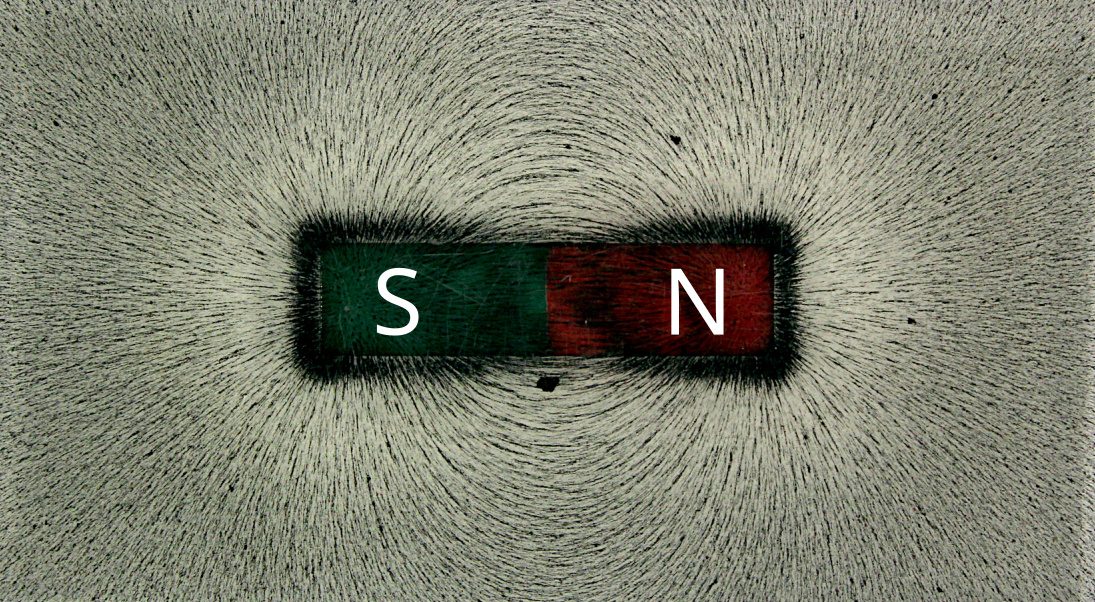
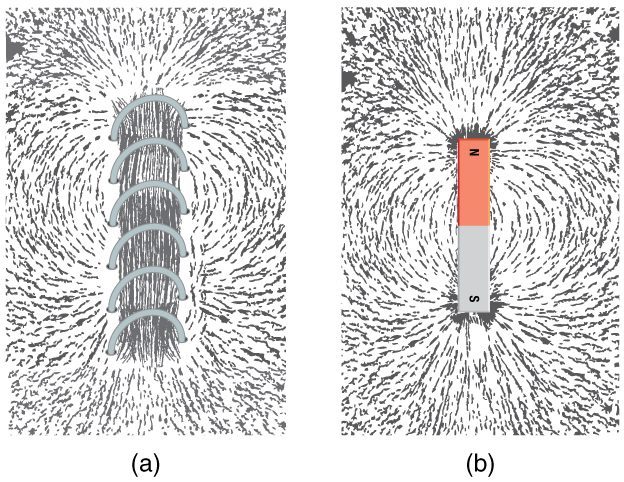
A magnetic field 磁场 $\vec{B}$ surrounds magnets and moving charges. Field lines run from a magnet's north pole to its south pole outside the magnet, and denser lines mean a stronger field. Magnetic poles always come in pairs – cutting a magnet in half makes two smaller magnets, never an isolated pole.
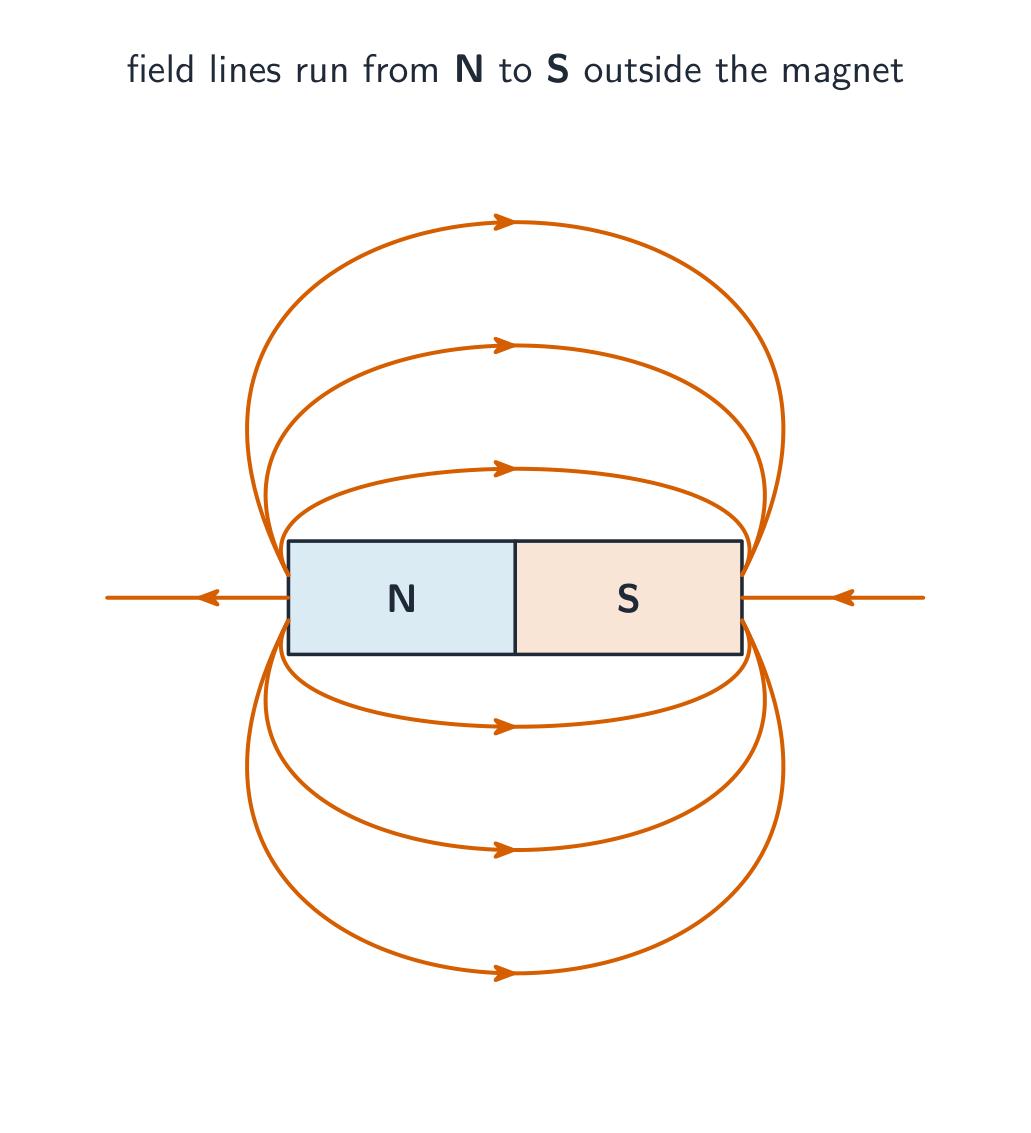
Field lines run from N to S outside a bar magnet, closer where the field is stronger Field lines run from N to S outside a bar magnet, closer where the field is stronger

Iron filings forming curved lines around a bar magnet Iron filings line up along the magnetic field, making the invisible field lines of a bar magnet visible

Explore

See a magnet's field lines

Magnetic field lines run from the north pole to the south pole outside the magnet. Where the lines crowd together the field is strongest.

Vocabulary Train
English Chinese Pinyin
Ferromagnetic 铁磁性 tiě cí xìng
Paramagnetic 顺磁性 shùn cí xìng
Diamagnetic 抗磁性 kàng cí xìng
permeability 磁导率 cí dǎo lǜ
magnetic field 磁场 cí chǎng
Exercise sheet
12.2

Magnetism and Moving Charges

Syllabus
Learning ObjectiveEssential Knowledge

12.2.A
Describe the magnetic field produced by moving charged objects.

  • 12.2.A.1 A single moving charged object produces a magnetic field.
    • 12.2.A.1.i The magnetic field at a particular point produced by a moving charged object depends on the object's velocity and the distance between the point and the object.
    • 12.2.A.1.ii At a point in space, the direction of the magnetic field produced by a moving charged object is perpendicular to both the velocity of the object and the position vector from the object to that point in space and can be determined using the right-hand rule.
    • 12.2.A.1.iii The magnitude of the magnetic field is a maximum when the velocity vector and the position vector from the object to that point in space are perpendicular.

12.2.B
Describe the force exerted on moving charged objects by a magnetic field.

  • 12.2.B.1 Magnetic forces describe interactions between moving charged objects.
  • 12.2.B.2 A magnetic field may exert a force on a charged object moving in that field.
    • 12.2.B.2.i The magnitude of the force exerted by a magnetic field on a moving charged object is proportional to the magnitude of the charge, the magnitude of the charged object's velocity, and the magnitude of the magnetic field and also depends on the angle between the velocity and magnetic field vectors.
      • Equation: $F_B = qvB\sin\theta$
    • 12.2.B.2.ii The direction of the force exerted by a magnetic field on a moving charged object is perpendicular to both the direction of the magnetic field and the velocity of the charge, as defined by the right-hand rule.
  • 12.2.B.3 In a region containing both a magnetic field and an electric field, a moving charged object will experience independent forces from each field.
  • 12.2.B.4 The Hall effect describes the potential difference created in a conductor by an external magnetic field that has a component perpendicular to the direction of charges moving in the conductor.

Boundary statement: Quantitative treatment of the magnitude of the magnetic force exerted by a magnetic field on a moving charge is limited to angles of 0, 90, and 180 degrees between the velocity and the magnetic field. Qualitative analysis of other angles is permitted.

Source: College Board AP Course and Exam Description

A moving charge in a magnetic field

A charge moving through a magnetic field feels a magnetic force 磁力:

$$F=qvB\sin\theta,$$
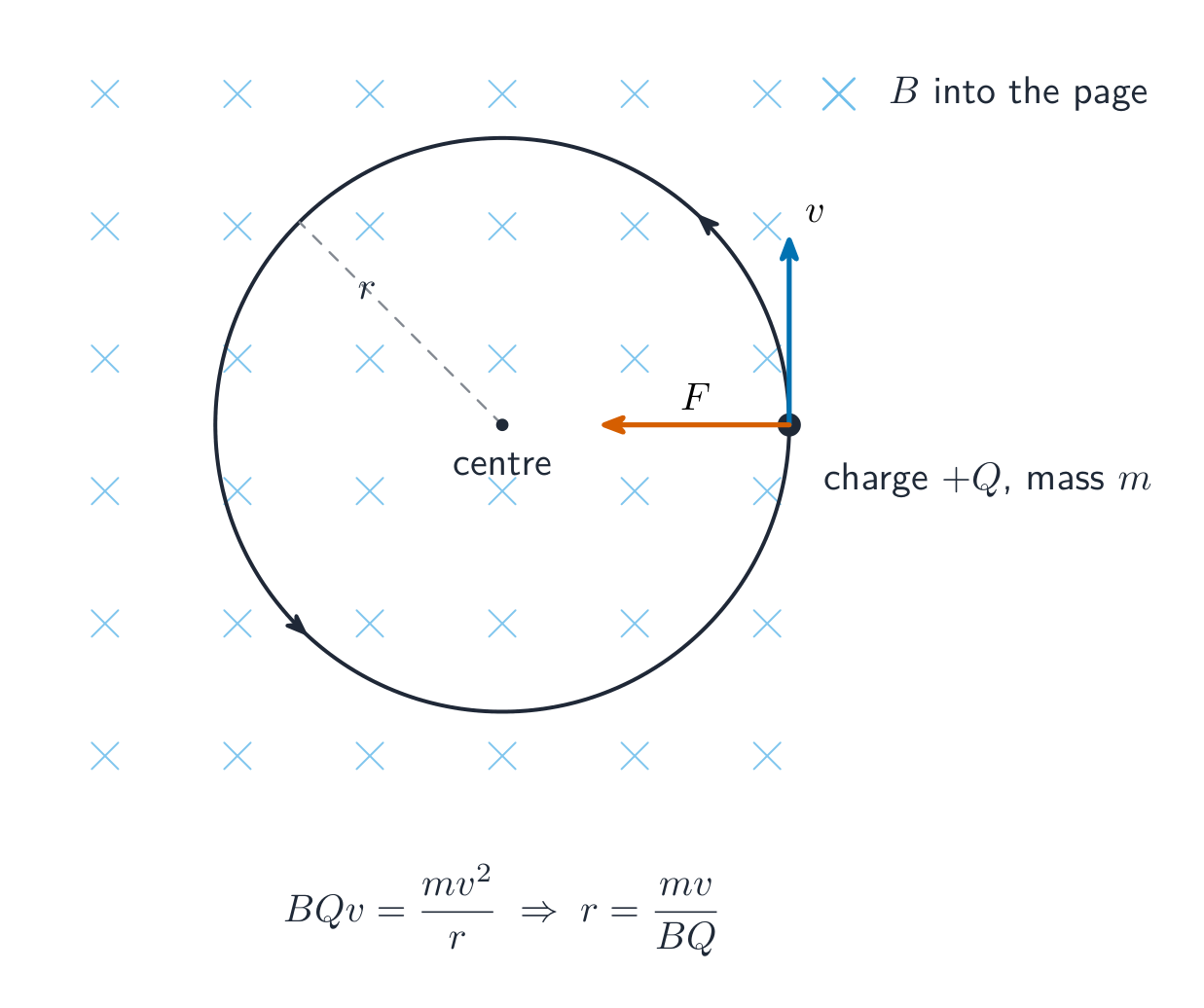
where $\theta$ is the angle between the velocity and the field. The force is perpendicular to both $\vec{v}$ and $\vec{B}$ (use the right-hand rule), so it changes direction but not speed – a charge moving perpendicular to a uniform field travels in a circle. A stationary charge, or one moving parallel to the field, feels no magnetic force.

A charged particle moving across a magnetic field follows a circular path A charged particle moving across a magnetic field follows a circular path

Worked example. A proton ($q=1.6\times10^{-19}\ \text{C}$, $m=1.67\times10^{-27}\ \text{kg}$) enters a $0.50\ \text{T}$ field at $2.0\times10^{5}\ \text{m/s}$, at right angles to the field. The magnetic force is

$$F=qvB=1.6\times10^{-19}\times2.0\times10^{5}\times0.50=1.6\times10^{-14}\ \text{N}.$$
This force is the centripetal force, so it bends the proton into a circle of radius
$$r=\frac{mv}{qB}=\frac{1.67\times10^{-27}\times2.0\times10^{5}}{1.6\times10^{-19}\times0.50}=4.2\times10^{-3}\ \text{m}.$$
Setting $qvB=\dfrac{mv^2}{r}$ and cancelling gives that neat $r=mv/(qB)$ – the principle behind mass spectrometers.

Vocabulary Train
English Chinese Pinyin
magnetic force 磁力 cí lì
12.3

Magnetism and Current-Carrying Wires
Syllabus
Learning ObjectiveEssential Knowledge

12.3.A
Describe the magnetic field produced by a current-carrying wire.

  • 12.3.A.1 A current-carrying wire produces a magnetic field.
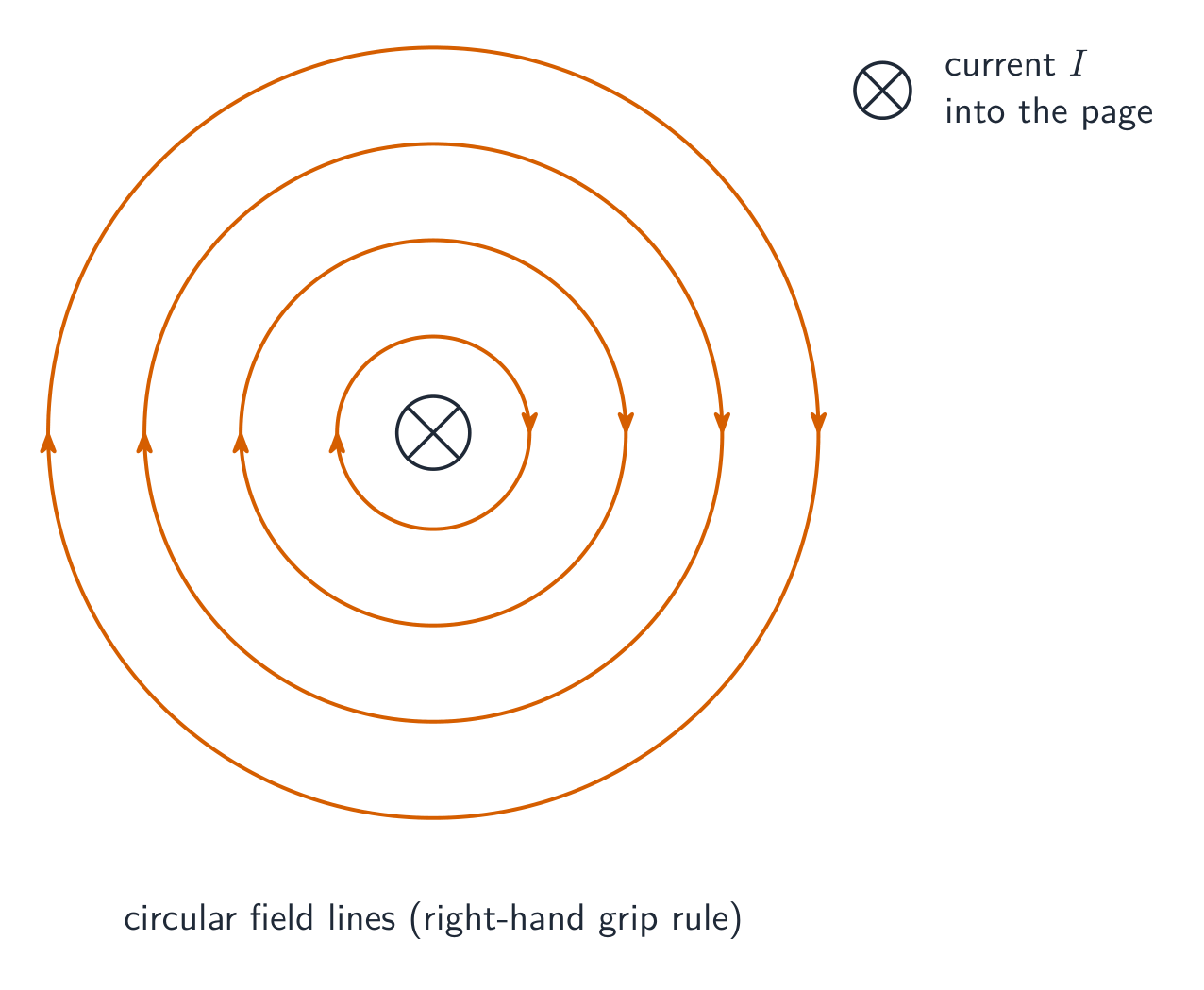
    • 12.3.A.1.i The magnetic field vectors around a long, straight, current-carrying wire are tangent to concentric circles centered on that wire. The field has no component toward, away from, or parallel to the long, straight, current-carrying wire.
    • 12.3.A.1.ii At a point in space, the magnitude of the magnetic field due to a long, straight, current-carrying wire is proportional to the magnitude of the current in the wire and inversely proportional to the perpendicular distance from the central axis of the wire to the point.
      • Equation: $B = \dfrac{\mu_0}{2\pi}\dfrac{I}{r}$
    • 12.3.A.1.iii The direction of the magnetic field created by a current-carrying wire is determined with the right-hand rule.
    • 12.3.A.1.iv The direction of the magnetic field at the center of a current-carrying loop is directed along the axis of the loop and can be found using the right-hand rule.
    • 12.3.A.1.v The magnetic field at a location near two or more current-carrying wires can be determined using vector addition principles.

12.3.B
Describe the force exerted on a current-carrying wire by a magnetic field.

  • 12.3.B.1 A magnetic field may exert a force on a current-carrying wire.
    • 12.3.B.1.i The magnitude of the force exerted by a magnetic field on a current-carrying wire is proportional to the current, the length of the portion of the wire within the magnetic field, and the magnitude of the magnetic field, and also depends on the angle between the direction of the current in the wire and the direction of the magnetic field.
      • Equation: $F_B = I\ell B\sin\theta$
    • 12.3.B.1.ii The direction of the force exerted by the magnetic field on a current-carrying wire is determined by the right-hand rule.

Source: College Board AP Course and Exam Description

Because a current is moving charge, a magnetic field pushes on a current-carrying wire:

$$F=BIL\sin\theta.$$
A current also creates its own magnetic field: circular field lines wrap around a straight wire (right-hand rule), and a coil (solenoid) makes a field like a bar magnet. This is how electromagnets and motors work.

Concentric circular field lines surround a straight current-carrying wire Concentric circular field lines surround a straight current-carrying wire

Worked example. A $0.30\ \text{m}$ length of wire carries $4.0\ \text{A}$ at right angles to a $0.20\ \text{T}$ field. The force on it is $F=BIL=0.20\times4.0\times0.30=0.24\ \text{N}$ – the push that turns a motor's coil.
Explore

Find the force on a current in a field

A current in a magnetic field feels a force $F = BIL$, at right angles to both. Use the left-hand rule; reverse the current or field and the force flips.

12.4

Electromagnetic Induction and Faraday's Law
Syllabus
Learning ObjectiveEssential Knowledge

12.4.A
Describe the induced electric potential difference resulting from a change in magnetic flux.

  • 12.4.A.1 Magnetic flux is a description of the amount of the component of a magnetic field that is perpendicular to a cross-sectional area.
  • 12.4.A.2 Magnetic flux through a surface is proportional to the magnitude of the component of the magnetic field perpendicular to the surface and to the cross-sectional area of the surface.
    • Equation: $\Phi_B = BA\cos\theta$
    • 12.4.A.2.i The area vector is defined to be perpendicular to the plane of the surface and directed outward from a closed surface.
    • 12.4.A.2.ii The sign of the magnetic flux indicates whether the magnetic field is parallel to or antiparallel to the area vector.
  • 12.4.A.3 Faraday’s law describes the relationship between changing magnetic flux and the resulting induced emf in a system.
    • Equation: $|\mathcal{E}| = \left|\dfrac{\Delta\Phi_B}{\Delta t}\right|$
  • 12.4.A.4 Lenz’s law is used to determine the direction of an induced emf resulting from a changing magnetic flux.
    • Equation: $\mathcal{E} = -\dfrac{\Delta\Phi_B}{\Delta t} = -\dfrac{\Delta(BA\cos\theta)}{\Delta t}$
    • 12.4.A.4.i An induced emf generates a current that creates a magnetic field that opposes the change in magnetic flux.
    • 12.4.A.4.ii The right-hand rule is used to determine the relationships between current, emf, and magnetic flux.
  • 12.4.A.5 A common example of electromagnetic induction is a conducting rod on conducting rails in a region with a uniform magnetic field.
    • Derived equation: $\mathcal{E} = B\ell v$

Source: College Board AP Course and Exam Description

Electromagnetic induction

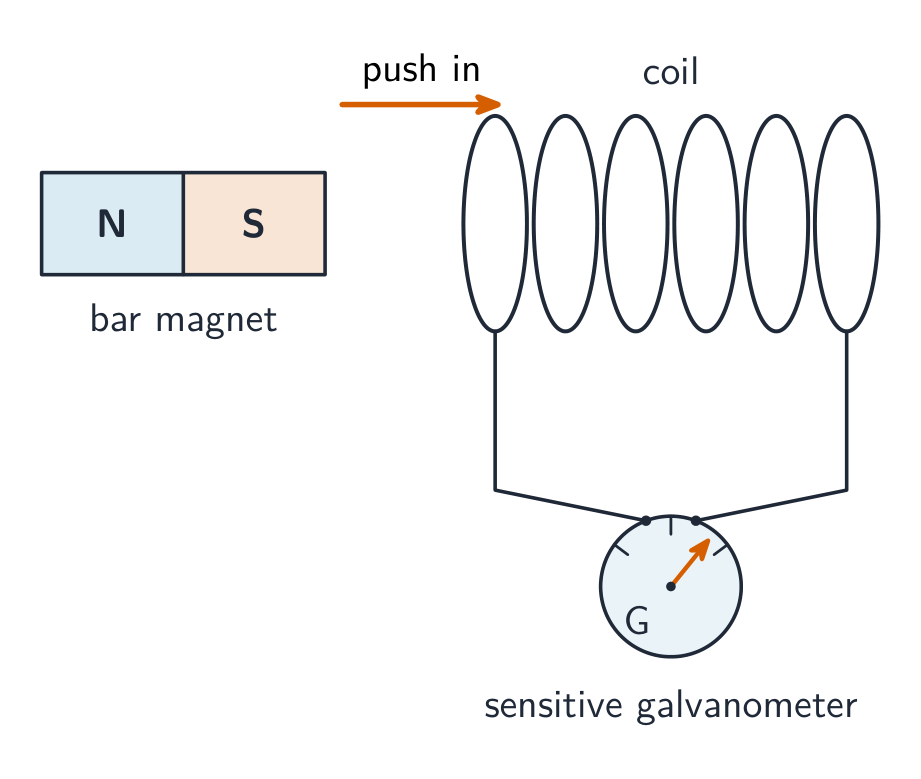
A changing magnetic field through a loop drives a current – electromagnetic induction 电磁感应. The magnetic flux 磁通量 $\Phi=BA\cos\theta$ measures how much field passes through the loop. Faraday's law 法拉第定律 gives the induced emf:

$$\varepsilon=-\frac{\Delta\Phi}{\Delta t}.$$
The flux changes if the field, the area, or the loop's orientation changes. Lenz's law 楞次定律 (the minus sign) says the induced current flows so as to oppose the change that caused it – the basis of generators.

Moving a magnet into a coil induces an e.m.f. that drives a current Moving a magnet into a coil induces an e.m.f. that drives a current

Worked example. The magnetic flux through a single loop drops from $0.020\ \text{Wb}$ to $0.008\ \text{Wb}$ in $0.030\ \text{s}$. The average induced emf is

$$\varepsilon=\left|\frac{\Delta\Phi}{\Delta t}\right|=\frac{0.020-0.008}{0.030}=0.40\ \text{V}.$$
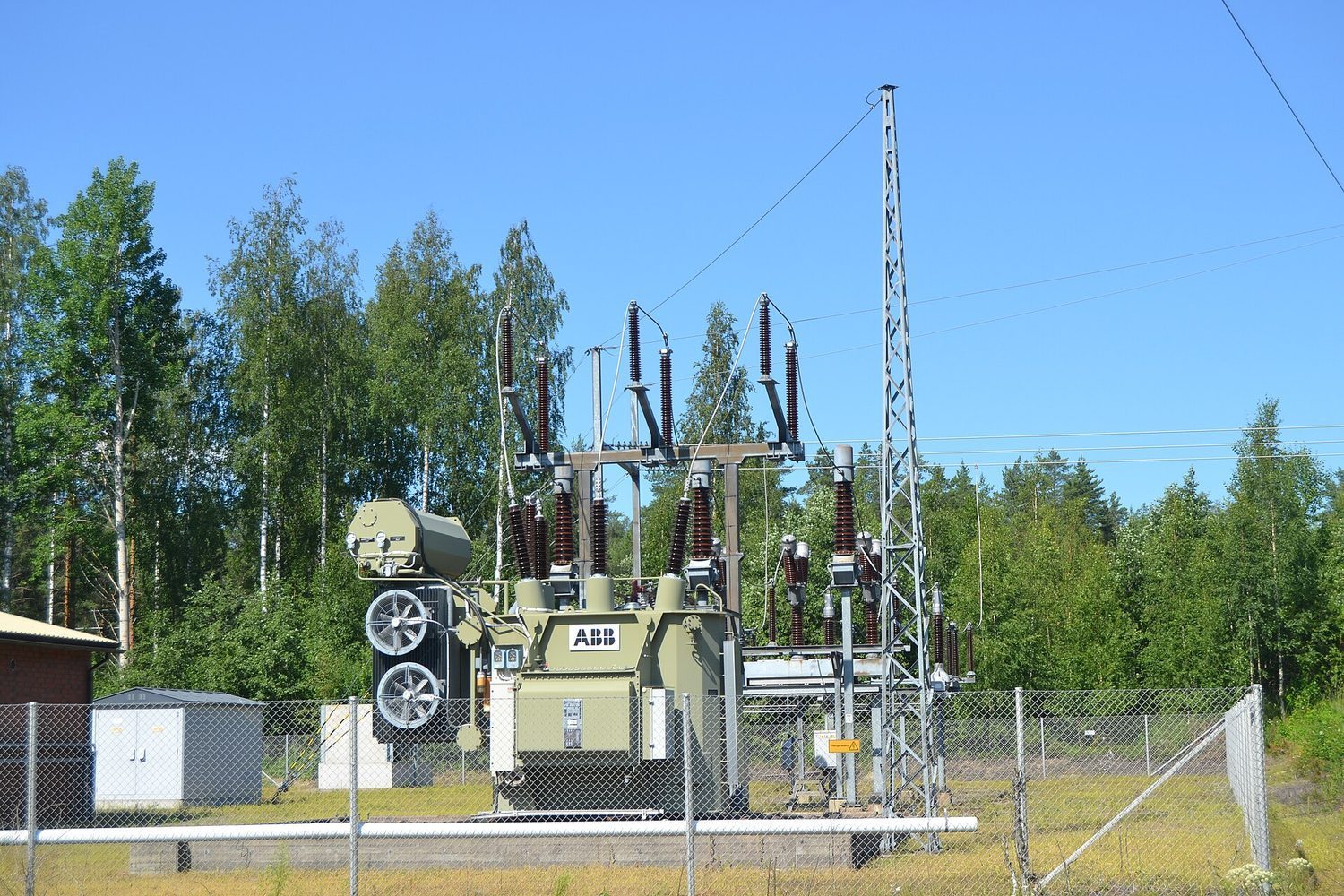
A coil of $N$ turns would give $N$ times this – which is why generators and transformers use many-turn coils.
Explore

Induce a voltage by moving a magnet

Faraday's law: a changing magnetic flux through a coil induces a voltage. Move the magnet faster and the induced EMF grows; Lenz's law sets its direction to oppose the change.

Vocabulary Train
English Chinese Pinyin
electromagnetic induction 电磁感应 diàn cí gǎn yìng
magnetic flux 磁通量 cí tōng liàng
Faraday's law 法拉第定律 fǎ lā dì dìng lǜ
Lenz's law 楞次定律 léng cì dìng lǜ
Exercise sheet
12.4

Exam tips

  • The magnetic force $F=qvB\sin\theta$ is perpendicular to the velocity, so it changes direction (a circle) but not speed; a stationary charge or one moving along the field feels no force.
  • Use $F=BIL$ for the force on a current-carrying wire (the motor effect).
  • A current creates a magnetic field (circles around a wire; a solenoid acts like a bar magnet).
  • Induction needs a changing flux $\Phi=BA$ — a stationary magnet in a coil induces nothing.
  • Faraday: $\varepsilon=\Delta\Phi/\Delta t$ (times $N$ turns); Lenz: the induced current opposes the change (energy conservation).

Log in or create account

IGCSE & A-Level