Fission, Fusion, and Nuclear Decay
Introduced| English |
|---|
| nuclear fission/ˈnjuːklɪə ˈfɪʃn/ |
| nuclear fusion/ˈnjuːklɪə ˈfjuːʒn/ |
A pinch of matter, an ocean of energy
- The Sun turns four million tonnes of its matter into pure energy every second.
- A nuclear reactor powers a city from a few kilograms of fuel.
- The secret is mass turning into energy, through Einstein's $E = mc^2$.
- Because $c^2$ is enormous, a tiny mass releases a colossal amount of energy.
Mass becomes energy
- Einstein's relation $E = mc^2$ says mass and energy are two forms of the same thing.
- In a nuclear reaction, a little mass disappears and reappears as a burst of energy.
- Because $c^2 \approx 9\times10^{16}$, even a gram of mass would give a huge energy.
- Nuclear reactions release millions of times more energy per atom than chemical ones.
Which equation relates mass and energy?
Einstein's $E = mc^2$ links mass and energy.
Why do nuclear reactions release so much more energy than chemical ones?
Converting even a tiny mass gives huge energy because $c^2$ is so large.
Fission: splitting big nuclei
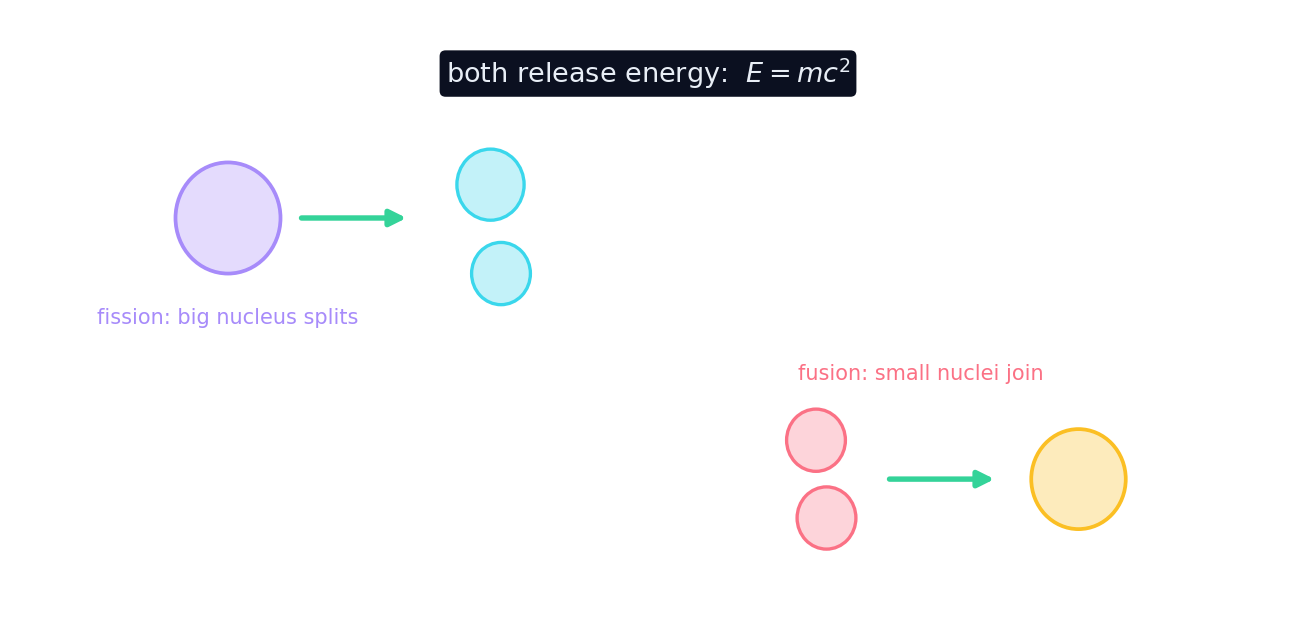
- Nuclear fission 核裂变 splits a large, heavy nucleus (like uranium) into smaller pieces.
- The fragments have slightly less total mass; the lost mass becomes energy.
- Each split also releases neutrons that can split more nuclei — a chain reaction.
- Fission powers nuclear reactors and atomic bombs.
Nuclear fission is the:
Fission splits a large, heavy nucleus into smaller pieces.
Fusion: joining small nuclei
- Nuclear fusion 核聚变 joins small, light nuclei (like hydrogen) into a bigger one.
- Again a little mass is lost and released as energy — even more per kilogram than fission.
- Fusion powers the Sun and the stars, welding hydrogen into helium.
- It needs extreme heat and pressure, which is why fusion power on Earth is so hard.
Fission, fusion or decay?
Sort each nuclear process.
Nuclear fusion powers the ____ and the stars.
The Sun fuses hydrogen into helium, releasing its energy.
Select all true statements about nuclear reactions.
Fission splits, fusion joins, and both release energy from lost mass. Fusion releases energy too.
Both fission (splitting) and fusion (joining) release energy, because in each the products have slightly less mass than the starting nuclei. The "lost" mass isn't destroyed — it becomes energy via $E = mc^2$. Don't assume only splitting releases energy; fusion of light nuclei releases even more.
Both fission and fusion release energy because the products have slightly less mass.
The lost mass becomes energy via $E = mc^2$ in both processes.
The Sun fuses hydrogen into helium. Where does its enormous energy come from?
- The helium nucleus has slightly less mass than the hydrogen that made it.
- That tiny lost mass becomes energy via $E = mc^2$ — and with $c^2$ so large, it is immense.
Nuclear reactions convert mass into energy via $E = mc^2$, releasing millions of times more energy per atom than chemical reactions. Fission splits heavy nuclei (reactors, bombs); fusion joins light nuclei (the Sun). In both, the products have slightly less mass, and that mass becomes energy.