| Learning Objective | Essential Knowledge |
|---|---|
9.1.A |
|
9.1.B |
Boundary statement: AP Physics 2 only expects students to perform qualitative and quantitative analysis of collisions in one and two dimensions. Students are not expected to know the functional form of the Maxwell-Boltzmann distribution but are expected to be familiar with how features of the distribution are related to the temperature of the gas. |
Thermodynamics
AP Physics 2 · Topic 9
 8:56
8:56
Thermodynamics
Put a hot cup of coffee on a table. It always cools down. It never warms back up by taking heat out of the cool room. Both directions would balance the energy…
English narration · English + 中文 subtitles burned in
9.1
Kinetic Theory of Temperature and Pressure
Syllabus
Source: College Board AP Course and Exam Description
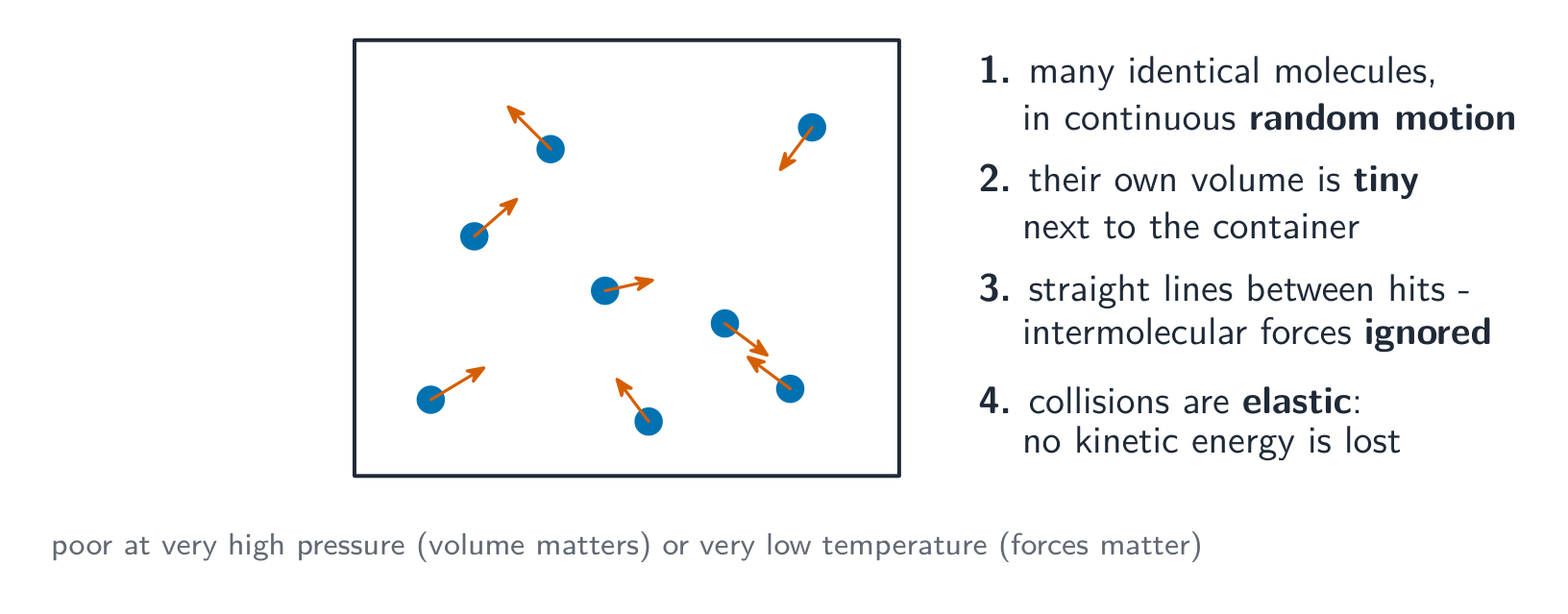
Thermodynamics 热力学 studies heat and energy in large collections of particles. The kinetic theory 分子运动论 explains gas behavior from the random motion of its molecules:
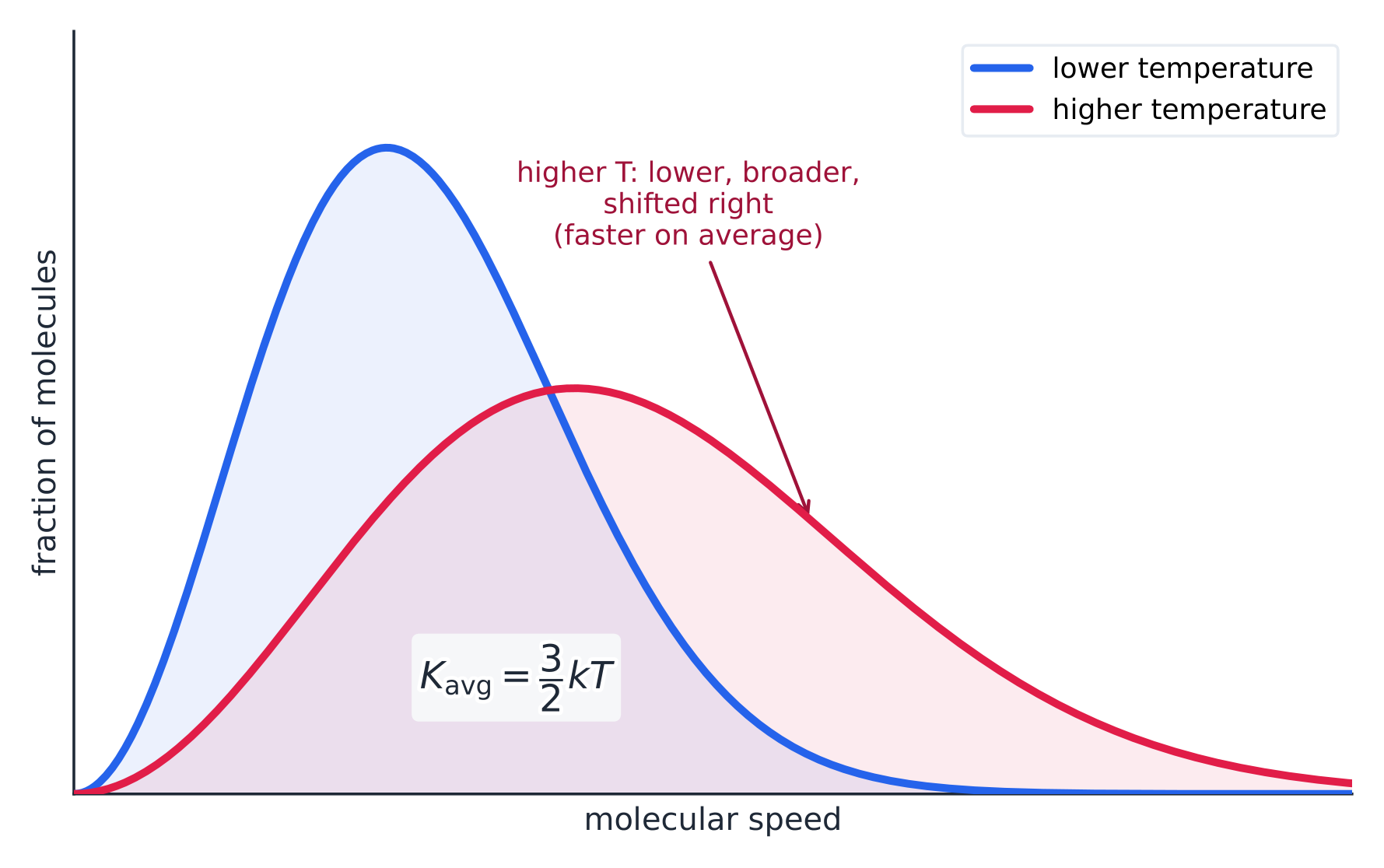
- Temperature 温度 is a measure of the average kinetic energy of the molecules: $K_{\text{avg}}=\tfrac{3}{2}k_B T$ (with $T$ in kelvin). Hotter means faster-moving molecules.
- Pressure 压强 comes from molecules colliding with the container walls – more frequent or harder collisions give more pressure.
Worked example. Find the average kinetic energy of a gas molecule at $300\ \text{K}$, using $k_B=1.38\times10^{-23}\ \text{J/K}$:
$$K_{\text{avg}}=\tfrac32 k_B T=1.5\times1.38\times10^{-23}\times300=6.2\times10^{-21}\ \text{J}.$$
It depends only on temperature, not on the type of gas – at the same $T$, light and heavy molecules share the same average kinetic energy (so the light ones move faster).
Explore
Explore the spread of molecular speeds
Raise the temperature and watch the whole speed distribution shift right and flatten — the particles move faster on average, which is exactly what $\bar K = \tfrac{3}{2} k_B T$ means.
Vocabulary
Train
| English |
|---|
| Thermodynamics/ˌθɜːməʊdaɪˈnæmɪks/ |
| kinetic theory/kɪˈnetɪk ˈθɪəri/ |
| Temperature/ˈtemprɪtʃə/ |
| Pressure/ˈpreʃə/ |
9.2
The Ideal Gas Law
Syllabus
| Learning Objective | Essential Knowledge |
|---|---|
9.2.A |
|
Source: College Board AP Course and Exam Description
An ideal gas 理想气体 obeys
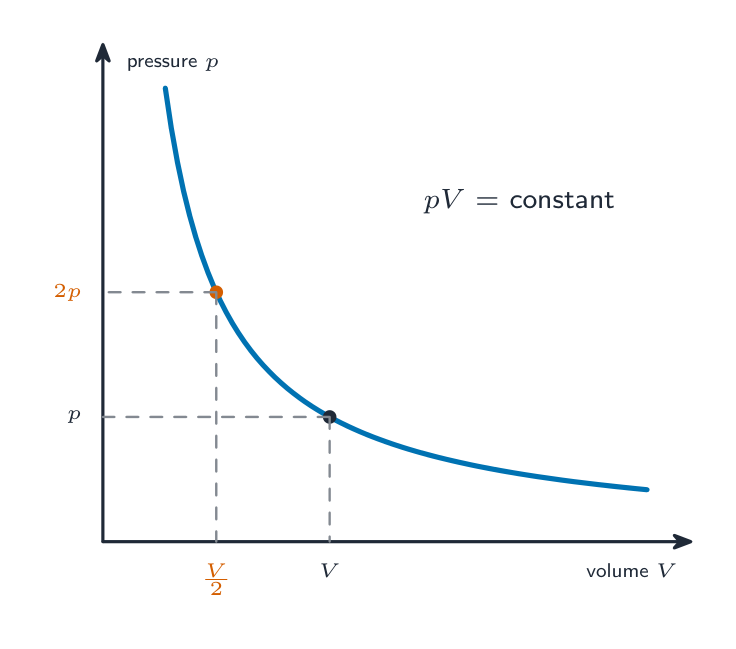
$$PV=nRT \qquad(\text{or } PV=Nk_B T),$$
linking pressure $P$, volume $V$, amount ($n$ moles or $N$ molecules), and absolute temperature $T$. Use it to predict how a gas responds when you change one quantity and hold others fixed (e.g. heating at constant volume raises pressure).
Worked example. A sealed rigid container of gas is at $1.0\times10^{5}\ \text{Pa}$ and $300\ \text{K}$. It is heated to $450\ \text{K}$. Because the volume and amount are fixed, $P/T$ is constant:
$$P_2=P_1\frac{T_2}{T_1}=1.0\times10^{5}\times\frac{450}{300}=1.5\times10^{5}\ \text{Pa}.$$
Always convert temperatures to kelvin before using a gas law – using Celsius here would give nonsense.

Explore
Explore squeezing a gas
Slide the piston in to shrink the volume. The same particles are crammed into less space, so they hit the walls more often and the pressure climbs — while $PV$ stays constant at fixed temperature.
Vocabulary
Train
| English |
|---|
| ideal gas/aɪˈdɪəl ɡæs/ |
9.3
Thermal Energy Transfer and Equilibrium
Syllabus
| Learning Objective | Essential Knowledge |
|---|---|
9.3.A |
|
Source: College Board AP Course and Exam Description
Heat 热量 $Q$ is energy transferred because of a temperature difference; it flows from hot to cold. Two objects in contact reach thermal equilibrium 热平衡 when they share the same temperature, and net heat flow stops. The three transfer methods are conduction 传导, convection 对流, and radiation 辐射.
Explore
Add heat and watch the temperature
Adding heat usually raises temperature, but during a phase change the temperature holds flat while the energy breaks bonds. Two bodies in contact settle at one temperature — thermal equilibrium.
Vocabulary
Train
| English |
|---|
| Heat/hiːt/ |
| thermal equilibrium/ˈθɜːml ˌiːkwɪˈlɪbrɪəm/ |
| conduction/kənˈdʌkʃn/ |
| convection/kənˈvekʃn/ |
| radiation/ˌreɪdɪˈeɪʃn/ |
9.4
The First Law of Thermodynamics
Syllabus
| Learning Objective | Essential Knowledge |
|---|---|
9.4.A |
|
9.4.B |
|
Source: College Board AP Course and Exam Description
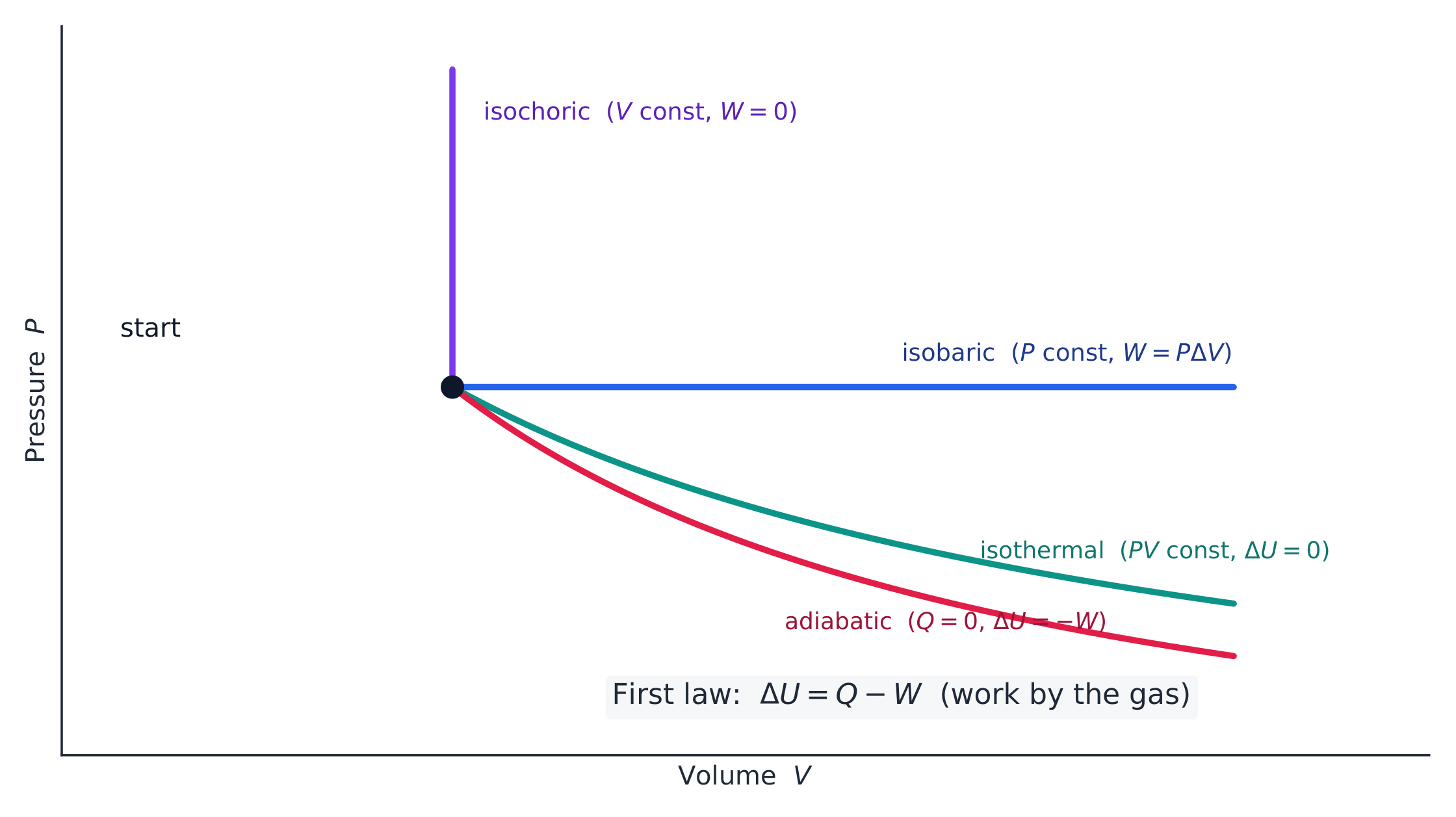
The first law 热力学第一定律 is conservation of energy for a gas:
$$\Delta U = Q + W,$$
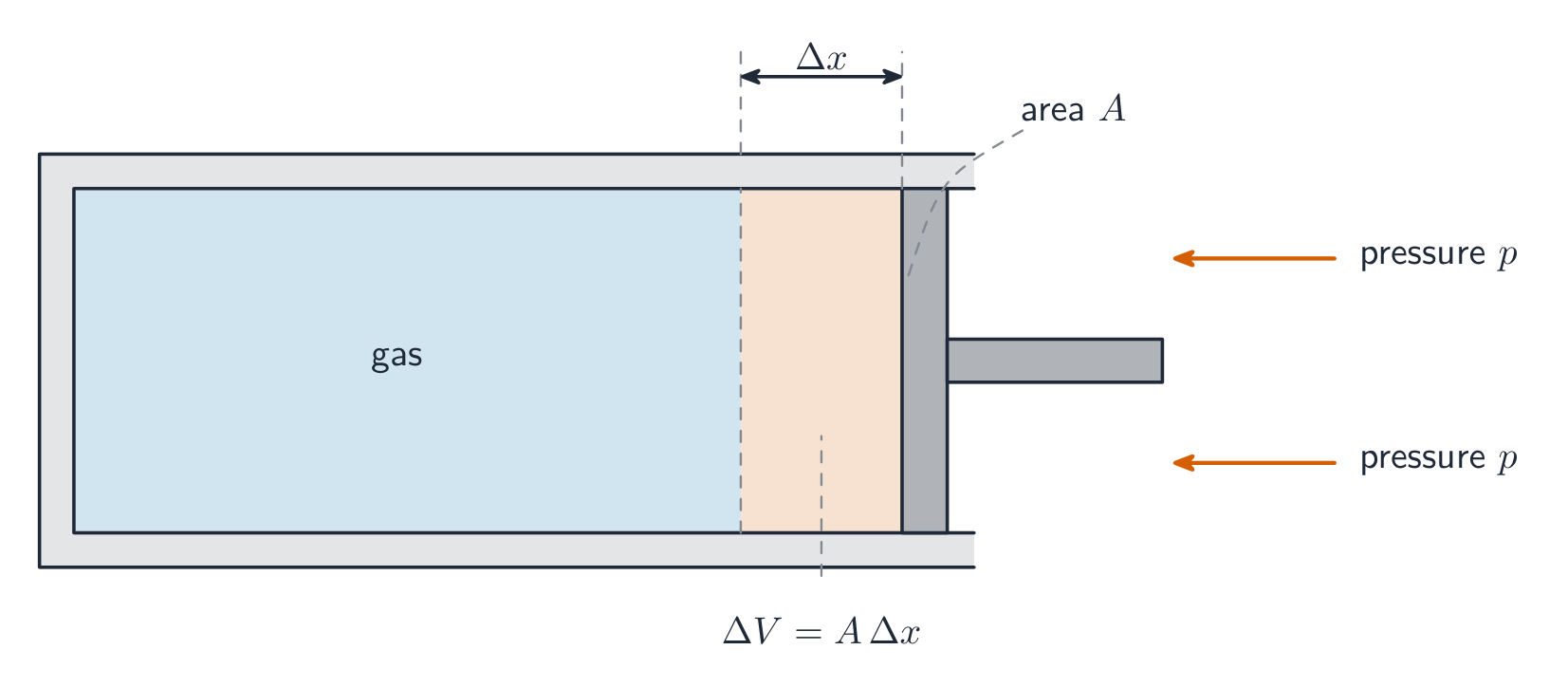
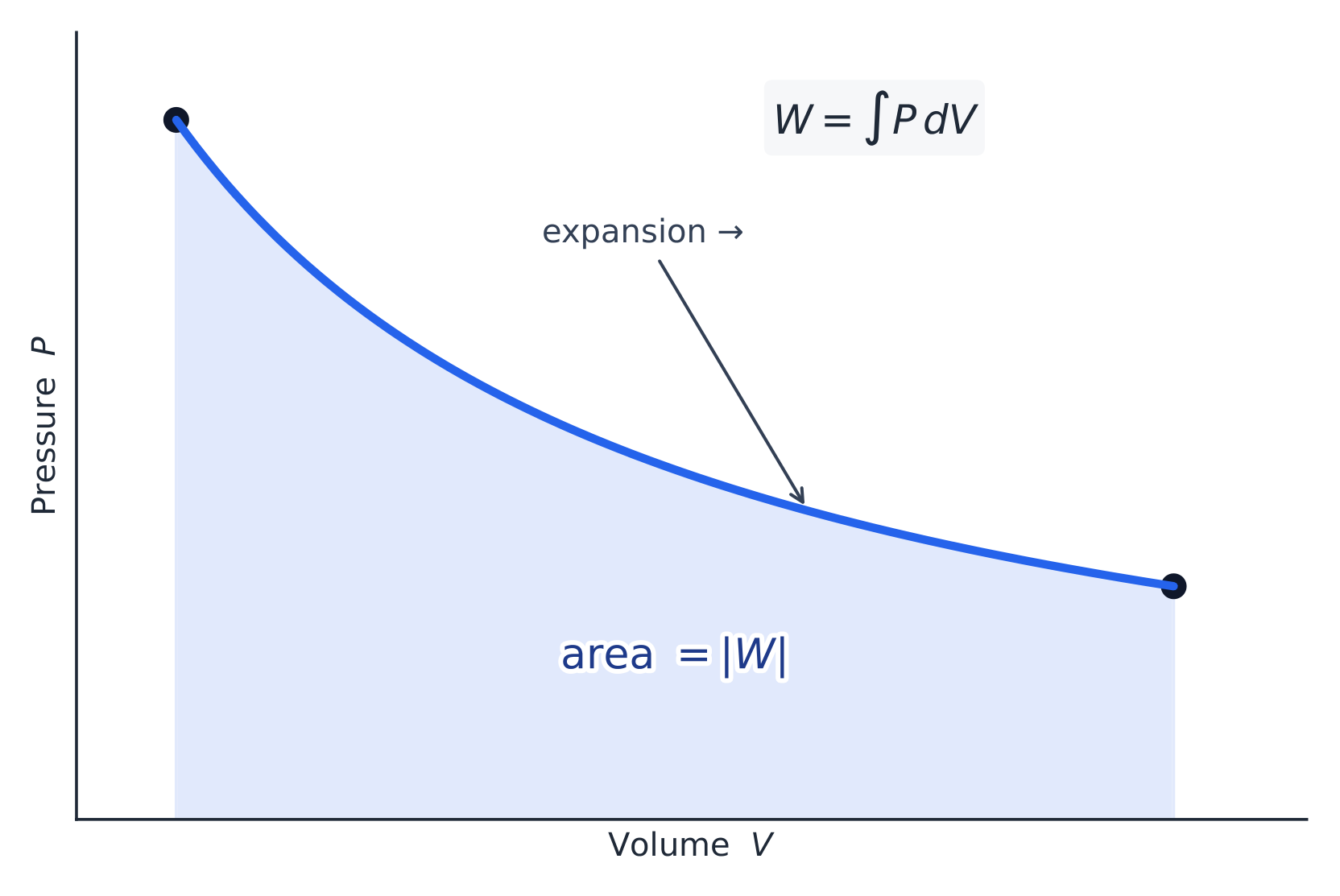
where $\Delta U$ is the change in internal energy 内能 (tied to temperature), $Q$ is heat added to the gas, and $W$ is work done on the gas. On a pressure–volume diagram, the work done by the gas is the area under the process curve. Watch signs: compressing a gas does positive work on it.
Worked example. A gas absorbs $500\ \text{J}$ of heat and, as it expands, does $200\ \text{J}$ of work on its surroundings. Find the change in its internal energy. Work done on the gas is $W=-200\ \text{J}$ (it does work, so it loses that energy):
$$\Delta U=Q+W=500+(-200)=300\ \text{J}.$$
The internal energy rises by $300\ \text{J}$, so the gas ends up hotter. Getting the sign of $W$ right is the whole game in first-law problems.
Vocabulary
Train
| English |
|---|
| first law/fɜːst lɔː/ |
| internal energy/ɪnˈtɜːnl ˈenədʒi/ |
9.5
Specific Heat and Thermal Conductivity
Syllabus
| Learning Objective | Essential Knowledge |
|---|---|
9.5.A |
|
9.5.B |
Boundary statement: AP Physics 2 will model specific heat as independent of temperature. |
Source: College Board AP Course and Exam Description
- Specific heat 比热容 $c$ is the heat needed to raise one kilogram by one degree: $Q=mc\,\Delta T$. A high specific heat (like water's) means a substance resists temperature change.
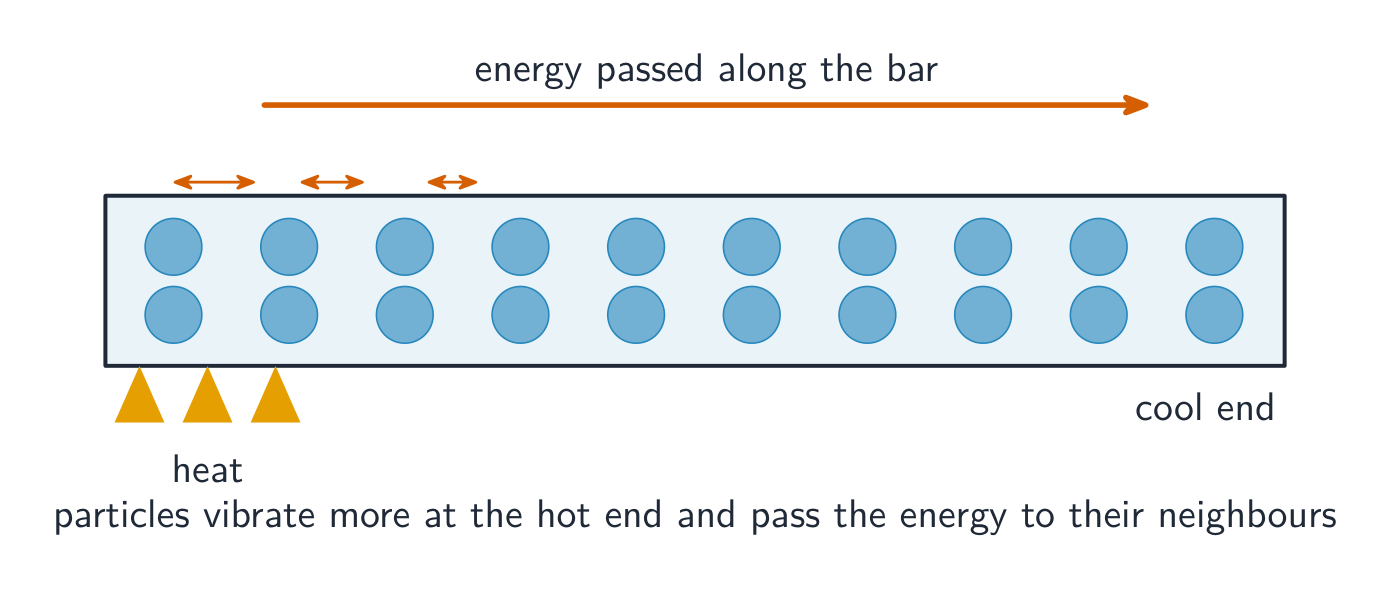
- Thermal conductivity 热导率 measures how fast heat conducts through a material; the rate of conduction rises with area and temperature difference and falls with thickness.
Worked example. How much heat raises the temperature of $2.0\ \text{kg}$ of water from $20\,{}^{\circ}\text{C}$ to $80\,{}^{\circ}\text{C}$? Water's specific heat is $c=4200\ \text{J/(kg}\,{}^{\circ}\text{C)}$:
$$Q=mc\,\Delta T=2.0\times4200\times(80-20)=5.0\times10^{5}\ \text{J}.$$
Water's large specific heat is why it is used as a coolant and why coastal climates are mild.
Explore
Explore how much energy heats a material
Pick a material, set the mass and temperature rise, and read the energy from $Q = mc\,\Delta T$. Water needs far more energy than the metals to warm by the same amount.
Vocabulary
Train
| English |
|---|
| Specific heat/spəˈsɪfɪk hiːt/ |
| Thermal conductivity/ˈθɜːml kɒndəkˈtɪvɪti/ |
9.6
Entropy and the Second Law of Thermodynamics
Syllabus
| Learning Objective | Essential Knowledge |
|---|---|
9.6.A |
Boundary statement: Only qualitative treatment of the second law of thermodynamics is within the scope of AP Physics 2. |
Source: College Board AP Course and Exam Description
Entropy 熵 measures the disorder, or the number of ways to arrange, a system. The second law 热力学第二定律: the total entropy of an isolated system never decreases – energy naturally spreads out. This sets the direction of processes: heat flows hot→cold on its own, never the reverse, and no engine can convert heat entirely into work.
Vocabulary
Train
| English |
|---|
| Entropy/ˈentrəpi/ |
| second law/ˈsekənd lɔː/ |
9.6
Exam tips
- Always convert temperatures to kelvin ($T_{\text{K}}=T_{\text{C}}+273$) before using any gas law.
- In the first law $\Delta U = Q + W$, get the sign of $W$ right: work done on the gas is positive; when the gas expands and does work on its surroundings, $W$ is negative.
- Temperature measures the average kinetic energy of particles, so at the same $T$ lighter molecules move faster.
- On a PV diagram the work done by the gas is the area under the process curve.
- Use $Q=mc\,\Delta T$ for temperature change; the second law fixes the direction — heat flows hot→cold and total entropy never decreases.
Interactive lessons on this topic
Work through it step by step, with instant-check exercises.