| Learning Objective | Essential Knowledge |
|---|---|
10.1.A |
|
10.1.B |
|
10.1.C |
Boundary statement: AP Physics 2 only expects students to make calculations of the electric force between four or fewer interacting charged objects or systems. The analysis of the resulting electric force from more charges is allowed in situations of high symmetry. |
Electric Force, Field, and Potential
AP Physics 2 · Topic 10
 8:05
8:05
Electric Force, Field, and Potential
A thundercloud is a charge factory. Ice crystals crash inside it, and electrons collect at the bottom of the cloud. The ground below turns positive. Nothing…
English narration · English + 中文 subtitles burned in
10.1
Electric Charge and Electric Force
Syllabus
Source: College Board AP Course and Exam Description
Electric charge 电荷 is a fundamental property of matter, and it comes in two kinds, positive and negative; like charges repel and opposite charges attract. Charge is conserved and quantized (a multiple of the elementary charge $e$). The force between two point charges is Coulomb's law 库仑定律:
$$F=\frac{k q_1 q_2}{r^2},$$
directed along the line joining them – an inverse-square law like gravity, but it can push or pull.
The constant $k$ hides a property of the medium: the permittivity 介电常数. Free space has a fixed permittivity of free space $\varepsilon_0$ (with $k = 1/4\pi\varepsilon_0$), while the permittivity of matter differs from $\varepsilon_0$, depending on the material's composition and arrangement - which is why a material between two charges changes the force. Note also that although the electric force is vastly stronger than gravity, gravity dominates at large scales, because large objects are usually electrically neutral (equal + and −), leaving only gravity to act.
Worked example. Two point charges, $+3.0\ \mu\text{C}$ and $-2.0\ \mu\text{C}$, sit $0.10\ \text{m}$ apart ($k=9.0\times10^{9}$). The force between them is
$$F=\frac{k q_1 q_2}{r^2}=\frac{9.0\times10^{9}\times(3.0\times10^{-6})(2.0\times10^{-6})}{(0.10)^2}=5.4\ \text{N},$$
attractive, because the charges have opposite signs. (Use the magnitudes for the size and decide the direction from the signs.)
Vocabulary
Train
| English |
|---|
| Electric charge/ɪˈlektrɪk tʃɑːdʒ/ |
| Coulomb's law/ˈkuːlɒmz lɔː/ |
| permittivity/ˌpɜːmɪˈtɪvəti/ |
10.2
The Process of Charging
Syllabus
| Learning Objective | Essential Knowledge |
|---|---|
10.2.A |
|
Source: College Board AP Course and Exam Description
Objects charge by moving electrons. A conductor 导体 lets charge move freely; an insulator 绝缘体 holds it in place. Three methods:
- Friction: rubbing transfers electrons.
- Conduction 接触起电: touching shares charge.
- Induction 感应起电: a nearby charge rearranges charge in a neutral object, which can then be grounded to leave it charged.
Explore
Charge an object by rubbing
Rubbing transfers electrons from one surface to another, leaving one positively and one negatively charged. Like charges repel, opposite charges attract.
Vocabulary
Train
| English |
|---|
| conductor/kənˈdʌktə/ |
| insulator/ˈɪnsjuːleɪtə/ |
| Conduction/kənˈdʌkʃn/ |
| Induction/ɪnˈdʌkʃn/ |
10.3
Electric Fields

Syllabus
| Learning Objective | Essential Knowledge |
|---|---|
10.3.A |
|
10.3.B |
Boundary statement: AP Physics 2 only expects students to make calculations of the electric field resulting from four or fewer charged objects or systems. Analysis of the electric field resulting from more charges is allowed in situations of high symmetry. Students will only be expected to perform qualitative analysis of electric fields within insulators. |
Source: College Board AP Course and Exam Description
An electric field 电场 $\vec{E}$ is the force per unit charge that a small positive test charge would feel:
$$\vec{E}=\frac{\vec{F}}{q},\qquad E=\frac{kQ}{r^2}\ \text{for a point charge}.$$
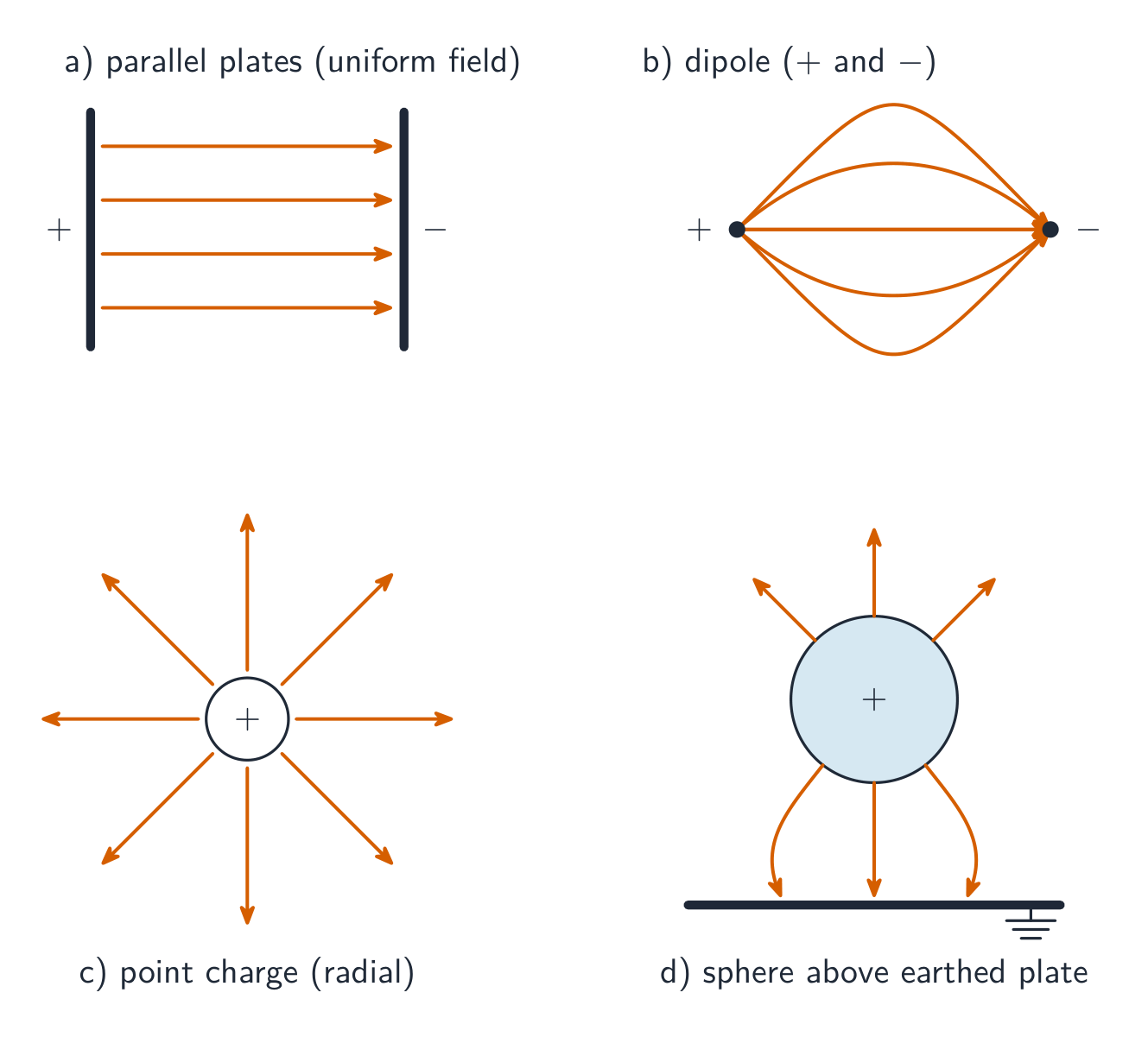
Field lines point away from positive charges and toward negative ones; where they are denser, the field is stronger. A charge in a field feels $\vec{F}=q\vec{E}$.
Worked example. Find the electric field $0.20\ \text{m}$ from a $+5.0\ \mu\text{C}$ point charge: $E=\dfrac{kQ}{r^2}=\dfrac{9.0\times10^{9}\times5.0\times10^{-6}}{(0.20)^2}=1.1\times10^{6}\ \text{N/C}$, pointing away from the charge. A $+2\ \text{nC}$ charge placed there would feel $F=qE=2\times10^{-9}\times1.1\times10^{6}=2.2\times10^{-3}\ \text{N}$.
Explore
Map the field around a charge
An electric field points the way a positive test charge would be pushed: away from a positive charge, toward a negative one. Closer lines mean a stronger field.
Vocabulary
Train
| English |
|---|
| electric field/ɪˈlektrɪk fiːld/ |
10.4
Electric Potential Energy
Syllabus
| Learning Objective | Essential Knowledge |
|---|---|
10.4.A |
Boundary statement: As the methods to calculate the electric potential energy due to extended charge distributions exceed the scope of the course, AP Physics 2 only requires that students calculate the electric potential energy of configurations of four or fewer point charges. |
Source: College Board AP Course and Exam Description
Two charges have electric potential energy 电势能 stored in their arrangement:
$$U=\frac{k q_1 q_2}{r}.$$
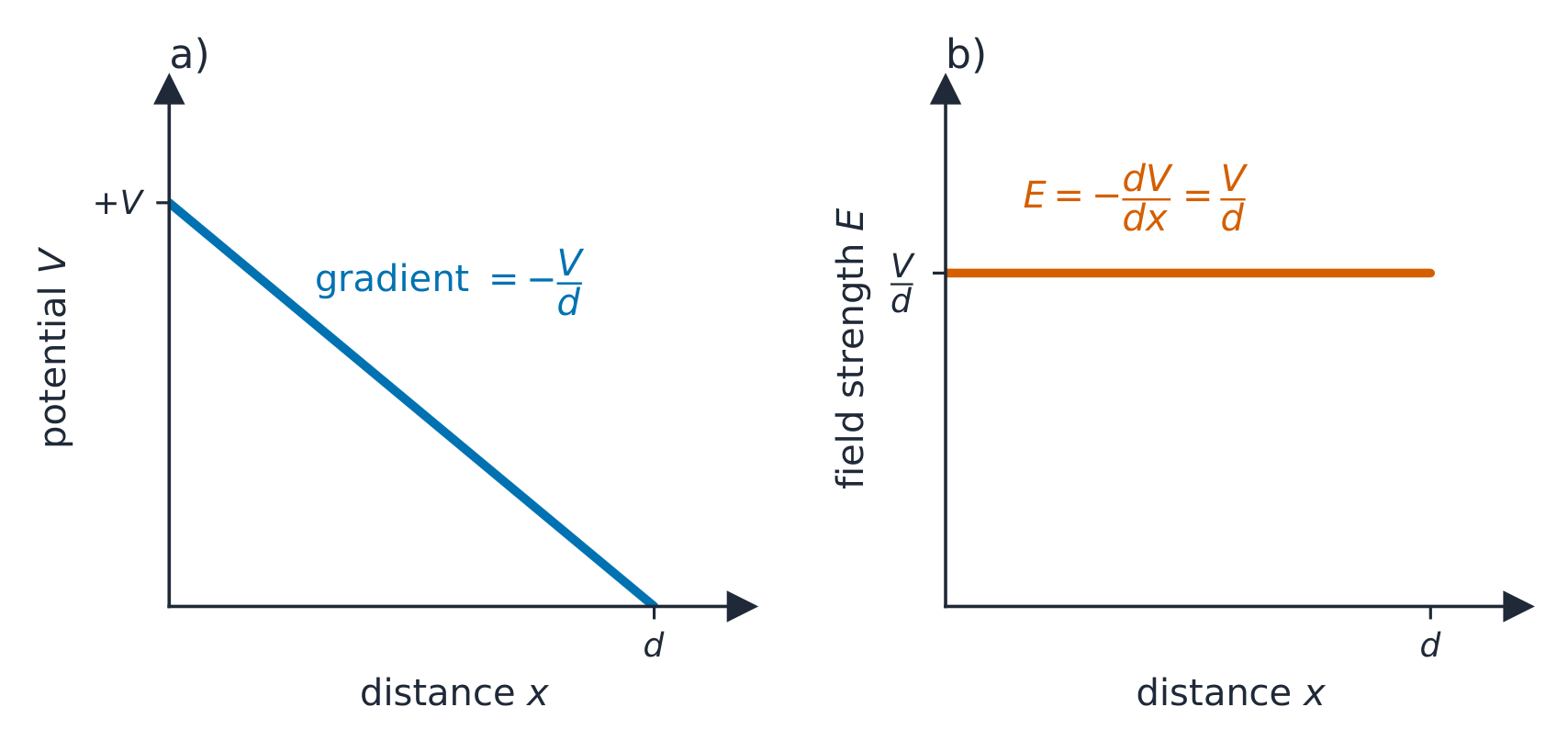
Like charges pushed together store positive energy; opposite charges have negative energy (bound). Moving a charge changes $U$, and the electric force does work equal to $-\Delta U$.
Vocabulary
Train
| English |
|---|
| electric potential energy/ɪˈlektrɪk pəˈtenʃl ˈenədʒi/ |
10.5
Electric Potential
Syllabus
| Learning Objective | Essential Knowledge |
|---|---|
10.5.A |
|
10.5.B |
Boundary statement: As the methods to calculate the electric potential due to extended charges exceed the scope of the course, AP Physics 2 only expects that students calculate the electric potential of configurations of four or fewer particles (or more in situations of high symmetry). |
Source: College Board AP Course and Exam Description
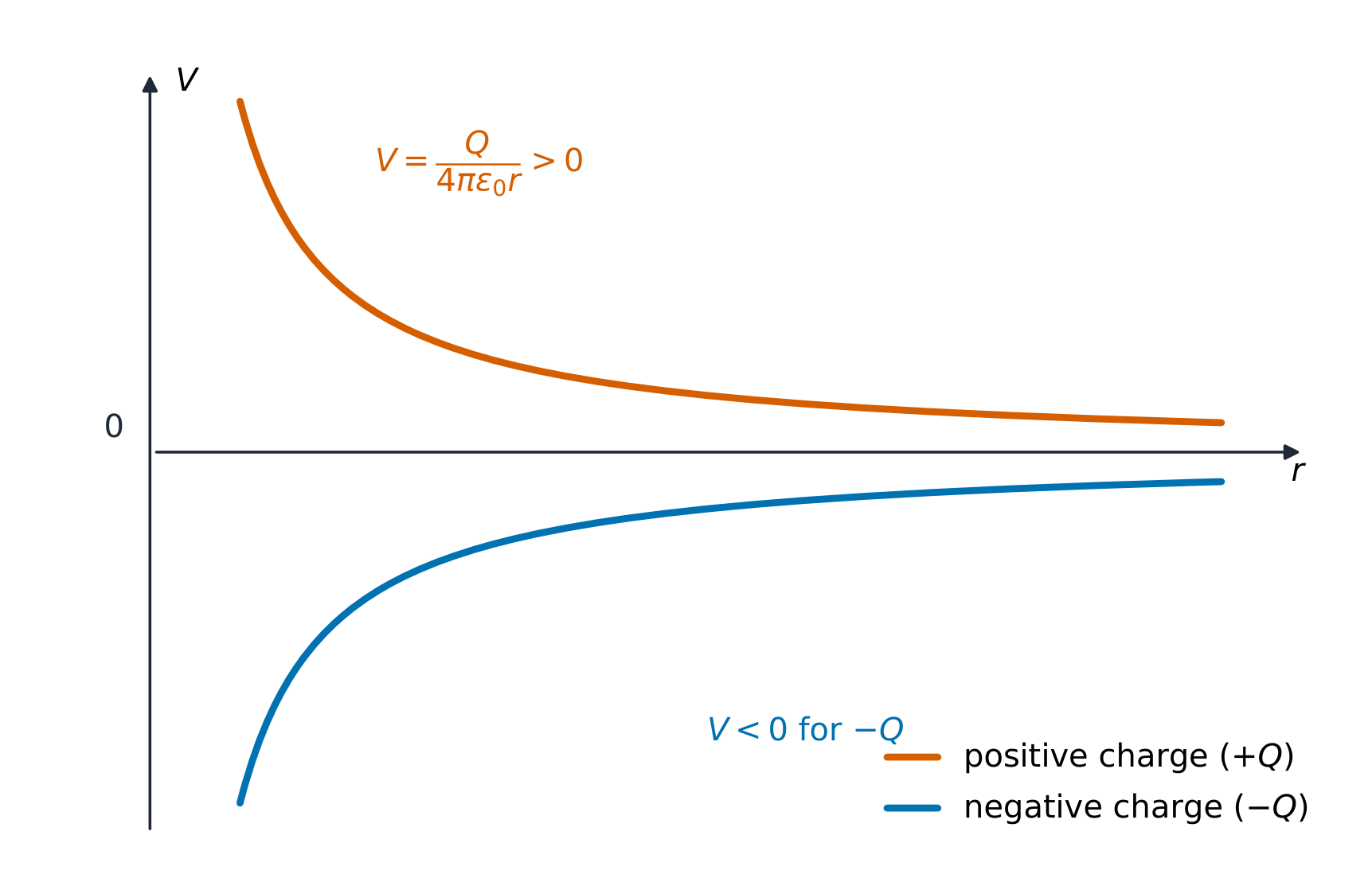
Electric potential 电势 $V$ is the potential energy per unit charge – a scalar field, measured in volts:
$$V=\frac{U}{q}=\frac{kQ}{r}.$$
The potential difference (voltage) 电压 between two points is the work per unit charge to move between them: $\Delta V=\dfrac{\Delta U}{q}$, and $U=qV$. Positive charges move from high to low potential on their own. Because potential is a scalar, adding the potentials from several charges is much easier than adding field vectors.
Vocabulary
Train
| English |
|---|
| Electric potential/ɪˈlektrɪk pəˈtenʃl/ |
| potential difference/pəˈtenʃl ˈdɪfrəns/ |
10.6
Capacitors
Syllabus
| Learning Objective | Essential Knowledge |
|---|---|
10.6.A |
Boundary statement: While other shapes are also able to separate charges, only the analysis and descriptions of parallel-plate capacitors are required for AP Physics 2. Edge effects will be ignored unless explicitly stated otherwise. |
Source: College Board AP Course and Exam Description
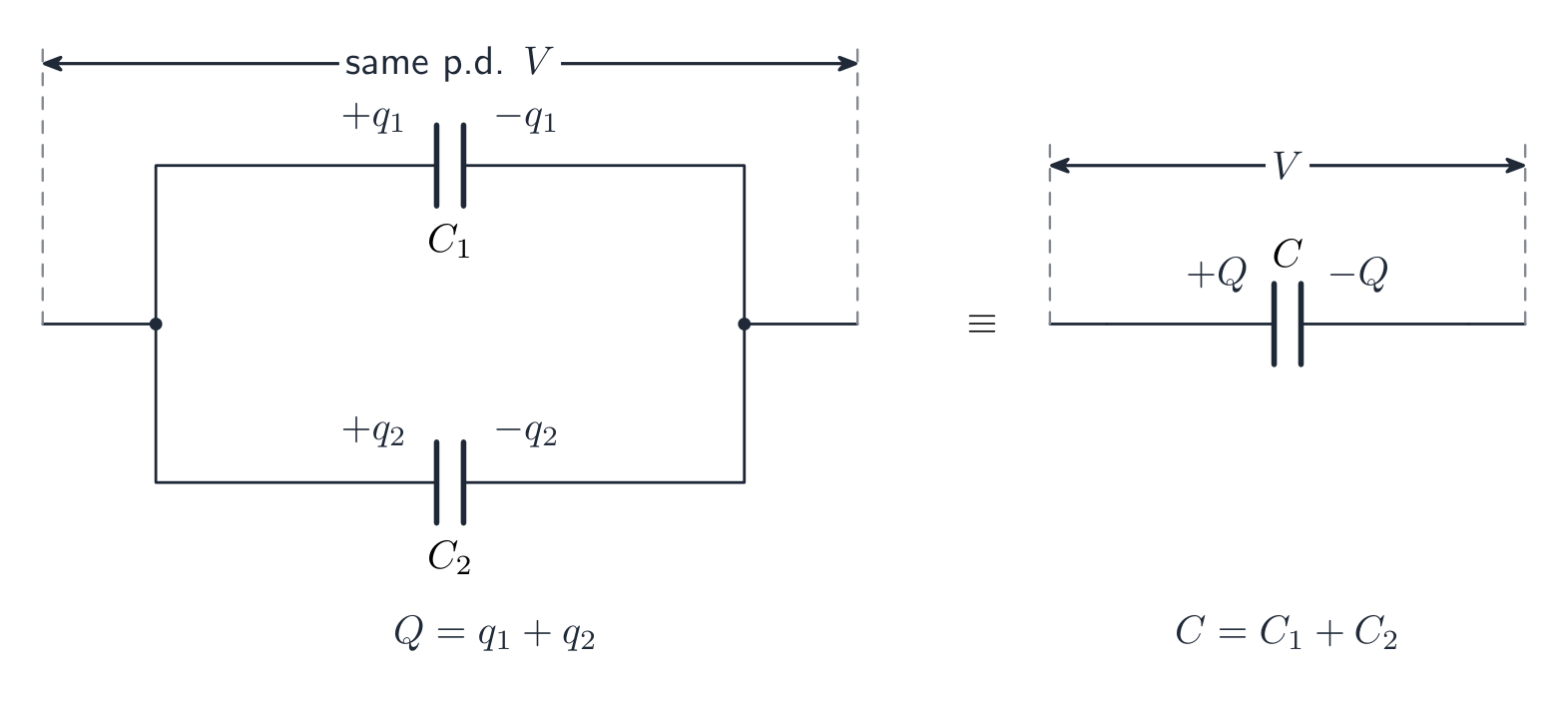
A capacitor 电容器 stores charge and energy on two conductors separated by a gap. Its capacitance 电容 relates charge to voltage:
$$C=\frac{Q}{V},$$
and the stored energy is $U=\tfrac{1}{2}CV^2$. Capacitance depends on the plates' geometry and the material between them, not on the charge placed on it.
Worked example. A $100\ \mu\text{F}$ capacitor is charged to $12\ \text{V}$. It holds $Q=CV=100\times10^{-6}\times12=1.2\times10^{-3}\ \text{C}$ of charge and stores $U=\tfrac12 CV^2=\tfrac12\times100\times10^{-6}\times12^2=7.2\times10^{-3}\ \text{J}$ of energy.
Explore
Charge and discharge a capacitor
A capacitor stores charge on two plates. It fills and empties exponentially, set by the time constant $\tau = RC$ — bigger $R$ or $C$ means slower charging.
Vocabulary
Train
| English |
|---|
| capacitor/kəˈpæsɪtə/ |
| capacitance/kəˈpæsɪtəns/ |
10.7
Conservation of Electric Energy
Syllabus
| Learning Objective | Essential Knowledge |
|---|---|
10.7.A |
|
Source: College Board AP Course and Exam Description
Energy is conserved for charges just as for masses. A charge released in a field converts electric potential energy into kinetic energy:
$$q\,\Delta V=\tfrac{1}{2}mv^2 \quad(\text{gaining speed as it "falls" through a potential difference}).$$
Worked example. An electron ($q=1.6\times10^{-19}\ \text{C}$, $m=9.1\times10^{-31}\ \text{kg}$) is accelerated from rest through a potential difference of $100\ \text{V}$. Its final speed is
$$v=\sqrt{\frac{2q\,\Delta V}{m}}=\sqrt{\frac{2\times1.6\times10^{-19}\times100}{9.1\times10^{-31}}}=5.9\times10^{6}\ \text{m/s}.$$
This is exactly how the electron gun in an old television or an electron microscope works.
10.7
Exam tips
- Coulomb's law and the point-charge field are inverse-square — doubling the separation makes the force (or field) four times smaller.
- Use magnitudes for the size of a force and decide direction from the signs; the field points the way a positive test charge would move.
- Potential ($V$) is a scalar so potentials from several charges simply add; the field ($E$) is a vector and must be added by direction.
- For a charge accelerated through a voltage use energy conservation $qV=\tfrac12 mv^2$.
- Capacitor relations: $C=Q/V$ (capacitance is fixed by geometry) and energy $U=\tfrac12 CV^2$.
Interactive lessons on this topic
Work through it step by step, with instant-check exercises.