The Bohr Model of Atomic Structure
Introduced| English |
|---|
| Bohr model/ˈbəʊə ˈmɒdl/ |
| energy level/ˈenədʒi ˈlevl/ |
Electrons can only stand on certain "steps"
- In an atom, electrons don't orbit at just any distance — only at certain fixed levels.
- Like standing on the rungs of a ladder, they can be on a rung but never between rungs.
- This is the Bohr model 玻尔模型 of the atom, and it explains why atoms give off specific colours.
- Jumping between rungs releases or absorbs light in exact amounts.
Fixed energy levels
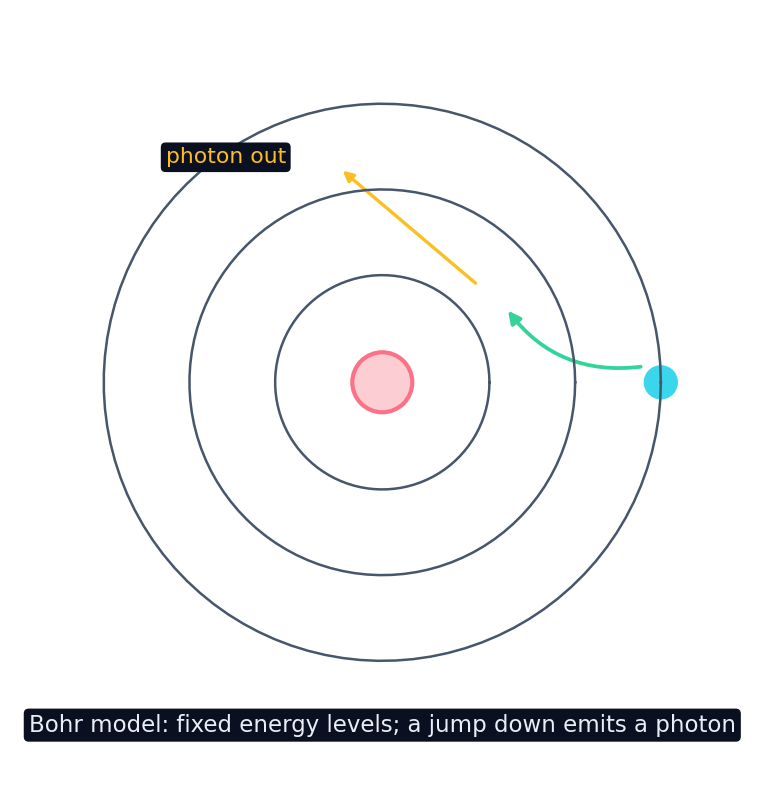
- Electrons occupy only certain energy levels 能级 (fixed orbits) around the nucleus.
- Each level has a definite energy; energies in between are not allowed.
- The lowest level (closest in) is the ground state; higher ones are excited states.
- An electron can move up a level by absorbing energy, or drop down by releasing it.
Jumps make spectral lines
Pick two energy levels and see the spectral line the electron's jump between them produces.
In the Bohr model, an electron can have:
Energy levels are quantised — only certain fixed values are allowed.
The lowest energy level an electron can occupy is the ____ state.
The lowest level is the ground state; higher ones are excited states.
Jumps make photons
- When an electron drops to a lower level, it emits a photon whose energy equals the gap.
- That photon energy is $E = hf$, so the jump fixes the light's frequency (its colour).
- To jump up, an electron must absorb a photon of exactly the right energy.
- Only photons matching a gap can be absorbed or emitted — nothing in between.
When an electron drops to a lower energy level, it:
Dropping down releases the energy gap as an emitted photon.
A photon is only absorbed if its energy exactly matches the gap between two levels.
Only photons matching a level gap can be absorbed or emitted.
A bigger energy gap in a jump produces a photon of:
$E = hf$: a bigger energy gap means a higher-frequency (bluer) photon.
Every element is different
- Each element has its own unique set of energy levels — its own "ladder".
- So each emits and absorbs its own unique set of frequencies (colours).
- This gives every element a spectral fingerprint (next lesson).
- The Bohr model was the first to explain these sharp, element-specific lines.
Select all true statements about the Bohr model.
Levels are fixed and element-specific; jumps emit/absorb photons. Energies between levels are forbidden.
Electron energy levels are quantised — an electron can sit on a level but never between levels. A photon is only absorbed or emitted if its energy exactly matches a gap; a photon that is too big or too small simply passes by.
An electron drops between two levels with an energy gap of $E$. What is the frequency of the emitted photon?
- The photon carries exactly that energy: $E = hf$, so $f = \dfrac{E}{h}$.
- A bigger gap makes a higher-frequency (bluer) photon.
The Bohr model: electrons occupy fixed energy levels and never sit between them. Dropping to a lower level emits a photon of energy equal to the gap ($E = hf$); jumping up absorbs one. Each element has unique levels, giving it a unique spectral fingerprint.