Compton Scattering
Introduced| English |
|---|
| Compton scattering/ˈkɒmptn ˈskætərɪŋ/ |
A photon bounces off an electron — like billiard balls
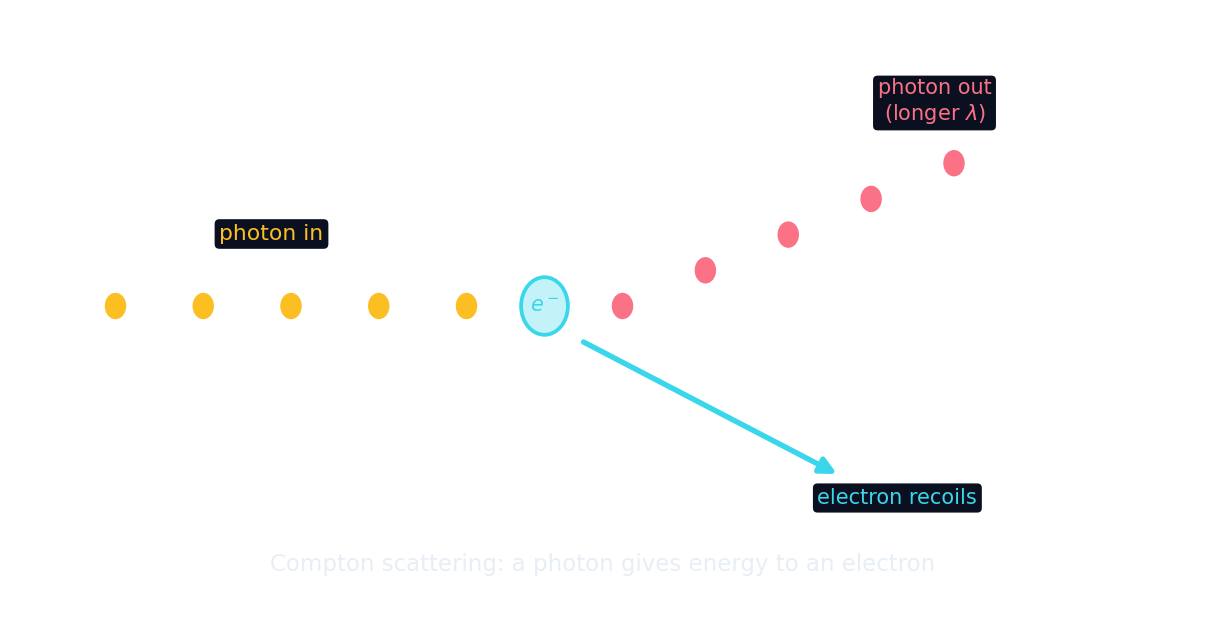
- Fire a high-energy photon at an electron and it bounces off, exactly like two balls colliding.
- The photon comes away with less energy; the electron recoils, taking the difference.
- This is Compton scattering 康普顿散射, and it clinched the case that light carries momentum.
- If a photon can collide like a ball, it must be a particle in every sense.
A photon has momentum
- A photon carries not just energy but also momentum: $p = \dfrac{h}{\lambda}$.
- In the collision, both energy and momentum are conserved — just like a normal collision.
- The photon transfers some of both to the electron, which recoils away.
- Treating the photon as a particle with momentum predicts the outcome exactly.
A photon's momentum is given by:
A photon carries momentum $p = h/\lambda$.
In Compton scattering, which quantities are conserved?
It is a genuine collision — both energy and momentum are conserved.
The scattered photon is redder
- Since the photon gives energy to the electron, the scattered photon has less energy.
- Less energy means a lower frequency and a longer wavelength — a shift toward red.
- The bigger the scattering angle, the more energy is handed over.
- Measuring this wavelength shift confirmed the photon's momentum.
After scattering off an electron, the photon's wavelength is:
The photon loses energy to the electron, so its wavelength gets longer.
A larger scattering angle means the photon transfers more energy to the electron.
The bigger the angle, the more energy (and momentum) is handed to the electron.
Why it mattered
- The photoelectric effect showed photons carry energy; Compton showed they carry momentum.
- Together they made the particle nature of light undeniable.
- The clean billiard-ball maths (conserving energy and momentum) only works if photons are real particles.
- Compton scattering is used today in gamma-ray astronomy and medical imaging.
Compton scattering
An X-ray photon collides with an electron. Sort each outcome.
Compton scattering shows that photons carry ____ as well as energy.
The collision only makes sense if photons carry momentum.
Select all true statements about Compton scattering.
The photon loses energy (longer wavelength), and the collision conserves energy and momentum. It never gains energy.
In Compton scattering the photon loses energy to the electron, so the scattered light has a longer wavelength (redder), not a shorter one. It is a genuine collision: both energy and momentum are conserved, exactly as for colliding balls.
A photon scatters off a stationary electron. What happens to the photon's wavelength?
- The photon gives energy to the electron, so it leaves with less energy.
- Less energy means a longer wavelength — the scattered photon is shifted toward red.
Compton scattering is a photon colliding with an electron like a billiard ball, conserving energy and momentum. The photon has momentum $p = h/\lambda$; after the collision it has less energy and a longer wavelength, and the electron recoils. It proved light carries momentum — confirming the photon particle.