Skip to content

Waves, Sound, and Physical Optics

AP Physics 2 · Topic 14

Train
14.1

Properties of Wave Pulses and Waves
Syllabus
Learning ObjectiveEssential Knowledge

14.1.A
Describe the physical properties of waves and wave pulses.

  • 14.1.A.1 Waves transfer energy between two locations without transferring matter between those locations.
    • 14.1.A.1.i A wave pulse is a single disturbance that transfers energy without transferring matter between two locations.
    • 14.1.A.1.ii A wave is modeled as a continuous, periodic disturbance with well-defined wavelength and frequency.
  • 14.1.A.2 Mechanical waves or wave pulses require a medium in which to propagate. Electromagnetic waves or wave pulses do not require a medium in which to propagate.
  • 14.1.A.3 The speed at which a wave or wave pulse propagates through a medium depends on the type of wave and the properties of the medium.
    • 14.1.A.3.i The speed of all electromagnetic waves in a vacuum is a universal physical constant, $c = 3.00 \times 10^{8}$ m/s.
    • 14.1.A.3.ii The speed at which a wave pulse or wave propagates along a string is dependent upon the tension in the string, $F_T$, and the mass per length of the string.
      • Equation: $v_{\text{string}} = \sqrt{\dfrac{F_T}{m/\ell}}$
    • 14.1.A.3.iii In a given medium, the speed of sound waves increases with the temperature of the medium.
  • 14.1.A.4 In a transverse wave, the direction of the disturbance is perpendicular to the direction of propagation of the wave.
  • 14.1.A.5 In a longitudinal wave, the direction of the disturbance is parallel to the direction of propagation of the wave.
    • 14.1.A.5.i Sound waves are modeled as mechanical longitudinal waves.
    • 14.1.A.5.ii The regions of high and low pressure in a sound wave are called compressions and rarefactions, respectively.
  • 14.1.A.6 Amplitude is the maximum displacement of a wave from its equilibrium position.
    • 14.1.A.6.i The amplitude of a longitudinal pressure wave may be determined by the maximum increase or decrease in pressure from equilibrium pressure.
    • 14.1.A.6.ii The loudness of a sound increases with increasing amplitude.
    • 14.1.A.6.iii The energy carried by a wave increases with increasing amplitude.

Source: College Board AP Course and Exam Description

A wave carries energy through a medium (or space) without carrying the matter along. A single disturbance is a pulse; a repeating one is a wave. Two types:
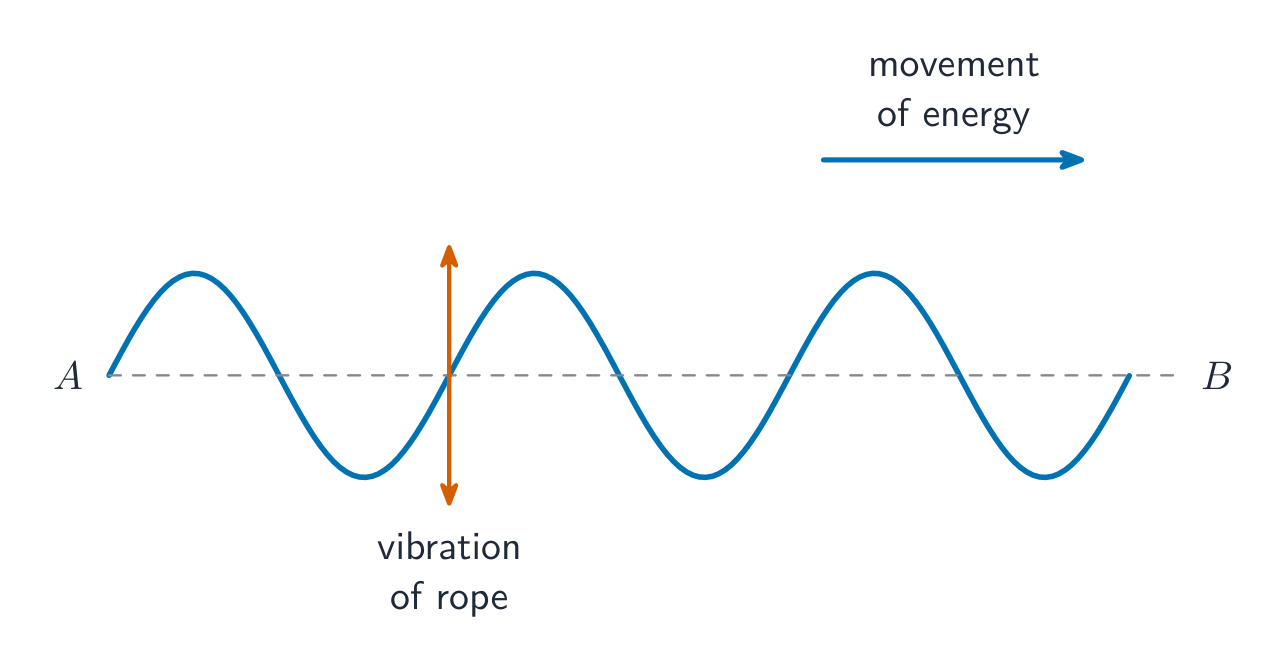
A transverse wave: the medium moves at right angles to the wave's travel A transverse wave: the medium moves at right angles to the wave's travel

  • Transverse 横波: the medium moves perpendicular to the wave's travel (a wave on a rope, light).
  • Longitudinal 纵波: the medium moves along the direction of travel (sound).
Vocabulary Train
English Chinese Pinyin
wave
Transverse 横波 héng bō
Longitudinal 纵波 zòng bō
14.2

Periodic Waves

Syllabus
Learning ObjectiveEssential Knowledge

14.2.A
Describe the physical properties of a periodic wave.

  • 14.2.A.1 Periodic waves have regular repetitions that can be described using period and frequency.
    • 14.2.A.1.i The period is the time for one complete oscillation of the wave.
    • 14.2.A.1.ii The frequency is the rate at which the wave repeats.
      • Equation: $T = \dfrac{1}{f}$
    • 14.2.A.1.iii The amplitude of a wave is independent of the period and the frequency of that wave.
    • 14.2.A.1.iv The energy of a wave increases with increasing frequency.
    • 14.2.A.1.v The frequency of a sound wave is related to its pitch.
    • 14.2.A.1.vi Wavelength is the distance between successive corresponding positions (such as peaks or troughs) on a wave.
  • 14.2.A.2 A sinusoidal wave can be described by equations for the displacement from equilibrium at a specific location as a function of time. A wave can also be described by an equation for the displacement from equilibrium at a specific time as a function of position.
    • Equation: $x(t) = A\cos(\omega t) = A\cos(2\pi f t)$
    • Equation: $y(x) = A\cos\left(2\pi \dfrac{x}{\lambda}\right)$
  • 14.2.A.3 For a periodic wave, the wavelength is proportional to the wave's speed and inversely proportional to the wave's frequency.
    • Equation: $\lambda = \dfrac{v}{f}$

Source: College Board AP Course and Exam Description

Transverse vs longitudinal waves

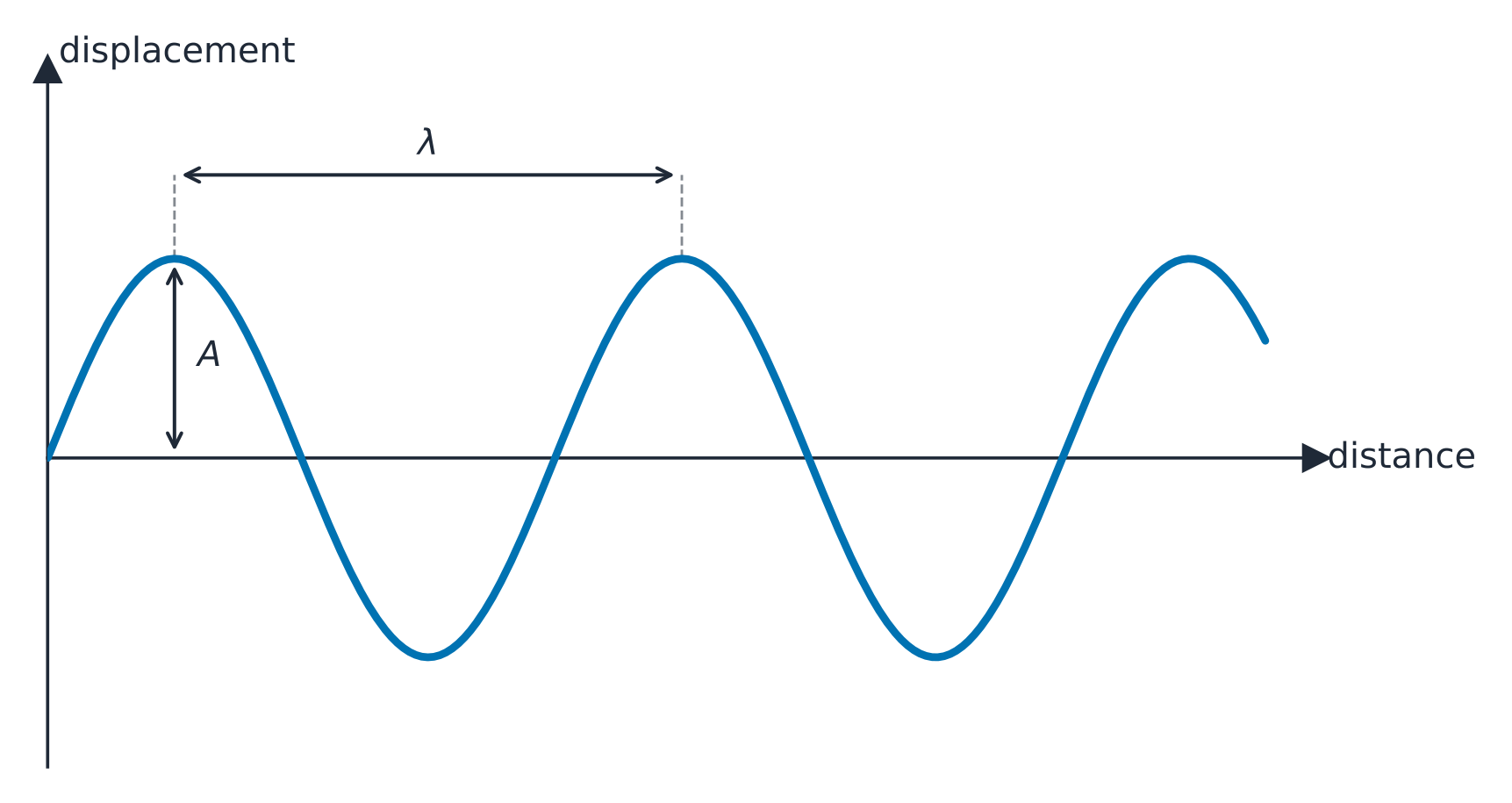
A repeating wave is described by:

A displacement-distance graph shows the amplitude and wavelength A displacement-distance graph shows the amplitude and wavelength

  • wavelength 波长 $\lambda$ (distance between repeats),
  • frequency 频率 $f$ (cycles per second) and period $T=1/f$,
  • amplitude 振幅 $A$ (maximum displacement – related to energy),
  • wave speed 波速 $v=f\lambda$, set by the medium, not the source.

Worked example. A musical note has frequency $340\ \text{Hz}$ and the speed of sound is $340\ \text{m/s}$. Its wavelength is $\lambda=v/f=340/340=1.0\ \text{m}$. If the same note travels into water (where sound moves at $\approx 1500\ \text{m/s}$) the frequency stays $340\ \text{Hz}$ but the wavelength stretches to $1500/340\approx 4.4\ \text{m}$ – the source sets the frequency, the medium sets the speed and hence the wavelength.

Explore

Send a periodic wave

A periodic wave carries energy without moving matter. Its speed $v=f\lambda$ links frequency and wavelength; raise the frequency and the wavelength shrinks.

Vocabulary Train
English Chinese Pinyin
wavelength 波长 bō cháng
frequency 频率 pín lǜ
amplitude 振幅 zhèn fú
wave speed 波速 bō sù
Exercise sheet
14.3

Boundary Behavior and Polarization
Syllabus
Learning ObjectiveEssential Knowledge

14.3.A
Describe the interaction between a wave and a boundary.

  • 14.3.A.1 A wave that travels from one medium to another can be transmitted or reflected, depending on the properties of the boundary separating the two media.
    • 14.3.A.1.i A wave traveling from one medium to another (for example, a wave traveling between low-mass and high-mass strings) will result in reflected and transmitted waves.
    • 14.3.A.1.ii A reflected wave is inverted if the transmitted wave travels into a medium in which the speed of the wave decreases.
    • 14.3.A.1.iii A reflected wave is not inverted if the transmitted wave travels into a medium in which the speed of the wave increases.
    • 14.3.A.1.iv The frequency of a wave does not change when it travels from one medium to another.
  • 14.3.A.2 Transverse waves that are reflected from a surface, refracted through a medium, or pass through specific openings may be polarized.
    • 14.3.A.2.i Transverse waves can be polarized and oscillate in a single plane.
    • 14.3.A.2.ii Longitudinal waves cannot be polarized.
  • 14.3.A.3 Polarization of a wave may result in a reduction of the wave's intensity.
    • 14.3.A.3.i Intensity is a measure of the amount of power transferred per unit area.
    • 14.3.A.3.ii The intensity of a wave is the average power per unit area over one period of the wave.

Source: College Board AP Course and Exam Description

Total internal reflection

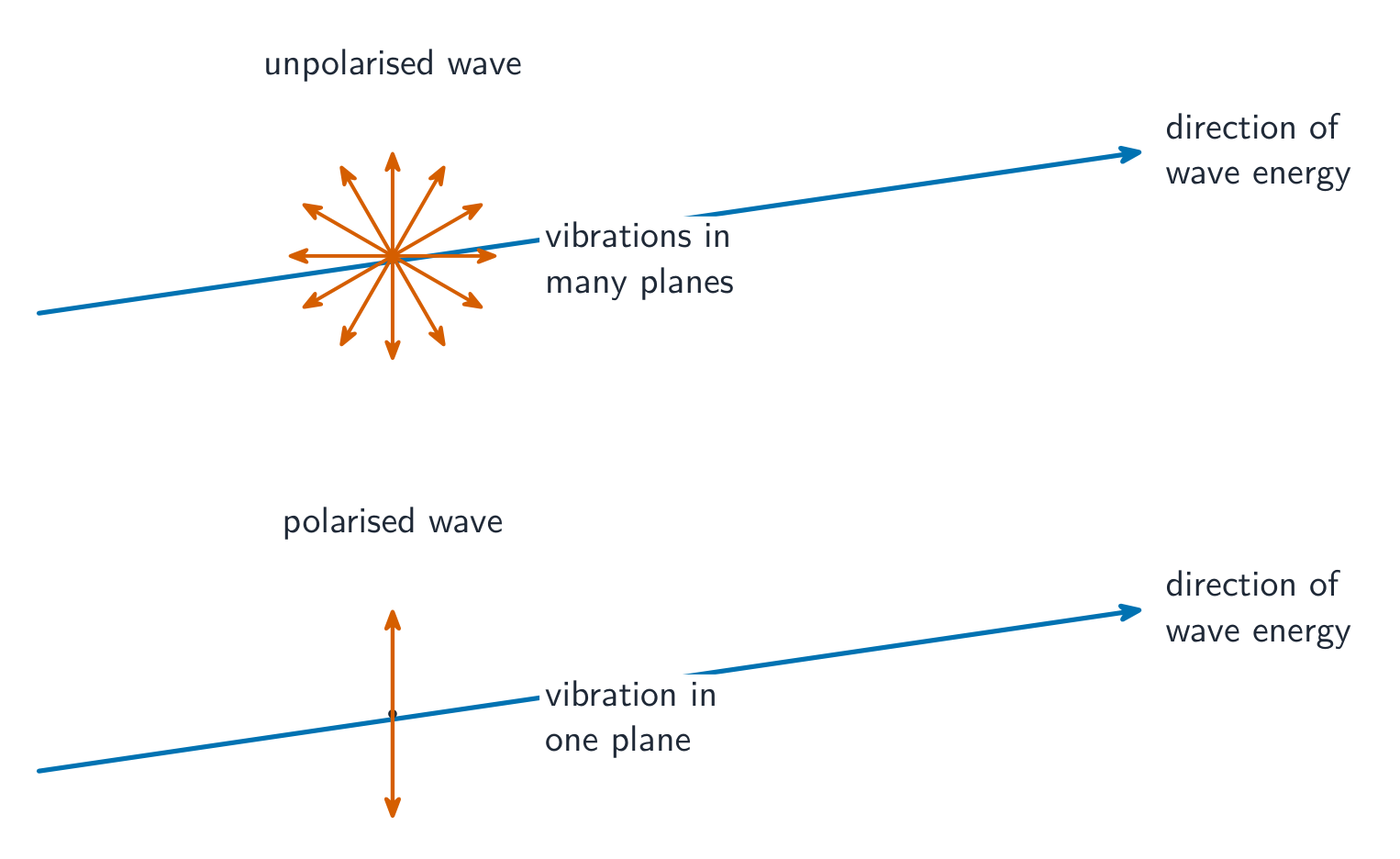
At a boundary a wave partly reflects and partly transmits. Reflecting off a denser medium inverts the wave; off a less-dense medium it does not. Polarization 偏振 applies to transverse waves only: a polarizer passes just one direction of oscillation, which is why polarized sunglasses cut glare.

The effect of a polarizer is measured through intensity 强度 - the average power a wave delivers per unit area over one period, in $\text{W m}^{-2}$. Because a polarizer removes the components of the oscillation that are not aligned with it, it reduces the wave's intensity: unpolarized light passing a single ideal polarizer drops to half its intensity, and a second polarizer at an angle cuts it further. Intensity also falls with distance from a source, since the same power spreads over a larger area.

Unpolarised waves vibrate in many planes; a polarised wave vibrates in one Unpolarised waves vibrate in many planes; a polarised wave vibrates in one

Vocabulary Train
English Chinese Pinyin
Polarization 偏振 piān zhèn
intensity 强度 qiáng dù
Exercise sheet
14.4

Electromagnetic Waves

Syllabus
Learning ObjectiveEssential Knowledge

14.4.A
Describe the properties of an electromagnetic wave.

  • 14.4.A.1 Electromagnetic waves consist of oscillating electric and magnetic fields that are mutually perpendicular.
    • 14.4.A.1.i Electromagnetic waves are transverse waves because the oscillations of the electric and magnetic fields are perpendicular to the direction of propagation.
    • 14.4.A.1.ii Electromagnetic waves are commonly assumed to be plane waves, which are characterized by planar wave fronts.
  • 14.4.A.2 Electromagnetic waves do not need a medium through which to propagate.
  • 14.4.A.3 Categories of electromagnetic waves are characterized by their wavelengths.
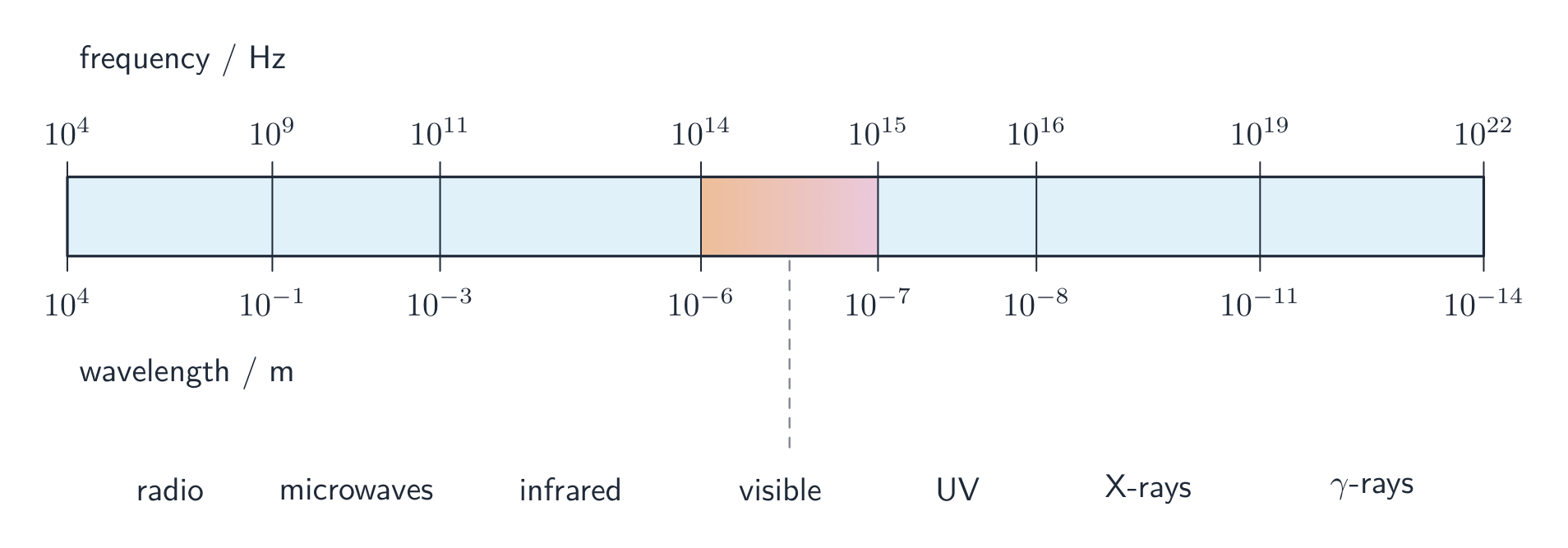
    • 14.4.A.3.i Categories of electromagnetic waves include (in order of decreasing wavelength, spanning a range from kilometers to picometers) radio waves, microwaves, infrared, visible, ultraviolet, X-rays, and gamma rays.
    • 14.4.A.3.ii Visible electromagnetic waves are further broken into categories of color, including (in order of decreasing wavelength) red, orange, yellow, green, blue, and violet.
    • 14.4.A.3.iii Visible electromagnetic waves are also called light. Sometimes, electromagnetic waves of all wavelengths are collectively referred to as light or electromagnetic radiation.

Boundary statement: AP Physics 2 expects students to know the ordering of the electromagnetic spectrum (including visible light). However, students will not be expected to define exact wavelength ranges within the electromagnetic spectrum.

Source: College Board AP Course and Exam Description

Electromagnetic waves 电磁波 are oscillating electric and magnetic fields that travel through vacuum at the speed of light $c$, needing no medium. They span the spectrum from radio to gamma rays; higher frequency means shorter wavelength and higher photon energy.

The electromagnetic spectrum, from radio waves to gamma rays The electromagnetic spectrum, from radio waves to gamma rays

Vocabulary Train
English Chinese Pinyin
Electromagnetic waves 电磁波 diàn cí bō
14.5

The Doppler Effect

Syllabus
Learning ObjectiveEssential Knowledge

14.5.A
Describe the properties of a wave based on the relative motion between the source of the wave and the observer of the wave.

  • 14.5.A.1 The Doppler effect describes the relationship between the rest frequency of a wave source, the observed frequency of the source, and the relative velocity of the source and the observer.
  • 14.5.A.2 A greater relative velocity results in a greater measured difference between the observed and rest frequencies.
    • 14.5.A.2.i For a wave source moving at the same velocity as the observer, the observed frequency is equal to the rest frequency.
    • 14.5.A.2.ii For a wave source moving toward an observer, the observed frequency is greater than the rest frequency.
    • 14.5.A.2.iii For a wave source moving away from an observer, the observed frequency is less than the rest frequency.

Boundary statement: Only qualitative treatments of the Doppler effect are required for AP Physics 2.

Source: College Board AP Course and Exam Description

The Doppler effect

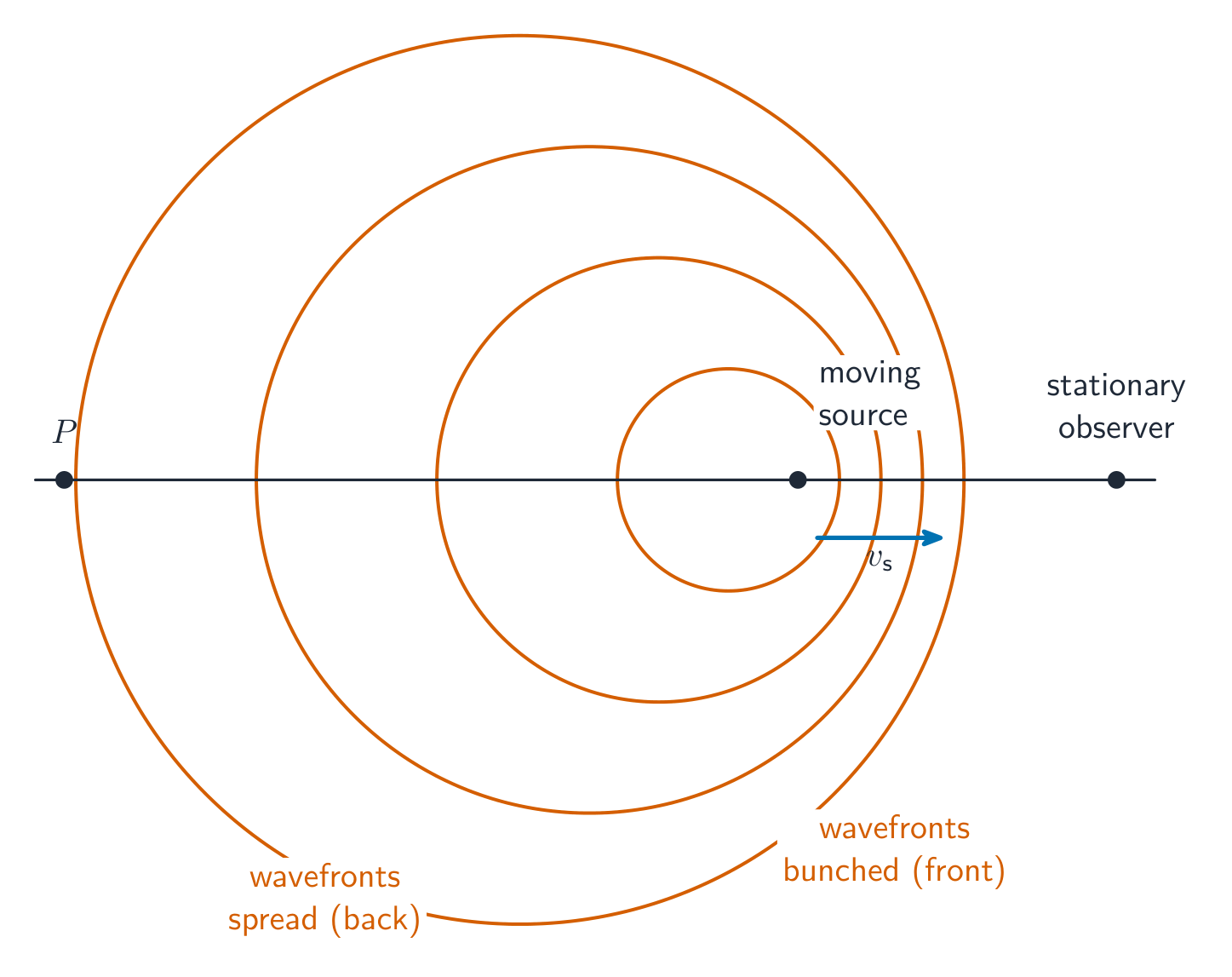
The Doppler effect 多普勒效应 is the change in observed frequency when a wave source and observer move relative to each other. Approaching $\Rightarrow$ higher frequency (shorter wavelength); receding $\Rightarrow$ lower frequency. It explains a passing siren's drop in pitch and the redshift of receding galaxies.

A moving source squashes the wavefronts ahead of it, raising the observed frequency A moving source squashes the wavefronts ahead of it, raising the observed frequency

Explore

Hear the Doppler shift

When a source moves, waves bunch up ahead (higher frequency) and stretch behind (lower) — the Doppler effect. Speed it up to exaggerate the shift.

Vocabulary Train
English Chinese Pinyin
Doppler effect 多普勒效应 duō pǔ lè xiào yìng
14.6

Wave Interference and Standing Waves
Syllabus
Learning ObjectiveEssential Knowledge

14.6.A
Describe the net disturbance that occurs when two or more wave pulses or waves overlap.

  • 14.6.A.1 Wave interference is the interaction of two or more wave pulses or waves.
  • 14.6.A.2 When two or more wave pulses or waves interact with each other, they travel through each other and overlap rather than bouncing off each other.
  • 14.6.A.3 When two or more wave pulses or waves overlap, the resulting displacement can be determined by adding the individual displacements. This is called superposition.
  • 14.6.A.4 Wave interference may be constructive or destructive.
    • 14.6.A.4.i When the displacements of the superposed wave pulses or waves are in the same direction, the interaction is called constructive interference.
    • 14.6.A.4.ii When the displacements of the superposed wave pulses or waves are in opposite directions, the interaction is called destructive interference.
    • 14.6.A.4.iii Two or more traveling wave pulses or waves can interact in such a way as to produce amplitude variations in the resultant wave pulse or wave.
  • 14.6.A.5 Visual representations of wave pulses or waves are useful in determining the result of two interacting wave pulses or waves.
  • 14.6.A.6 Beats arise from the addition of two waves of slightly different frequency.
    • 14.6.A.6.i Waves with different frequencies are sometimes in phase and sometimes out of phase at locations along the waves, causing periodic amplitude changes in the resultant wave.
    • 14.6.A.6.ii The beat frequency is the difference in the frequencies of the two waves.
      • Equation: $\left|f_{\text{beat}}\right| = \left|f_1 - f_2\right|$
    • 14.6.A.6.iii Tuning forks are devices that are commonly used to demonstrate beat frequencies.

14.6.B
Describe the properties of a standing wave.

  • 14.6.B.1 Standing waves can result from interference between two waves that are confined to a region and traveling in opposite directions.
    • 14.6.B.1.i Standing waves have nodes and antinodes. A node is a point on the standing wave where the amplitude is always zero. An antinode is a point on the standing wave where the amplitude is always at maximum.
    • 14.6.B.1.ii The possible wavelengths of a standing wave are determined by the size and boundary conditions of the region to which it is confined.
    • 14.6.B.1.iii Common regions where standing waves can form include pipes with open or closed ends, as well as strings with fixed or loose ends.
  • 14.6.B.2 A standing wave with the longest possible wavelength is called the fundamental or first harmonic. The second-longest wavelength is typically called the second harmonic, the third-longest wavelength is called the third harmonic, and so on. However, for a standing wave with a node at one end and an antinode at the other end, only odd harmonics can be established.
  • 14.6.B.3 Visual representations of standing waves are useful in determining the relationships between length of the region, wavelength, frequency, wave speed, and harmonic.

Source: College Board AP Course and Exam Description

Standing (stationary) waves

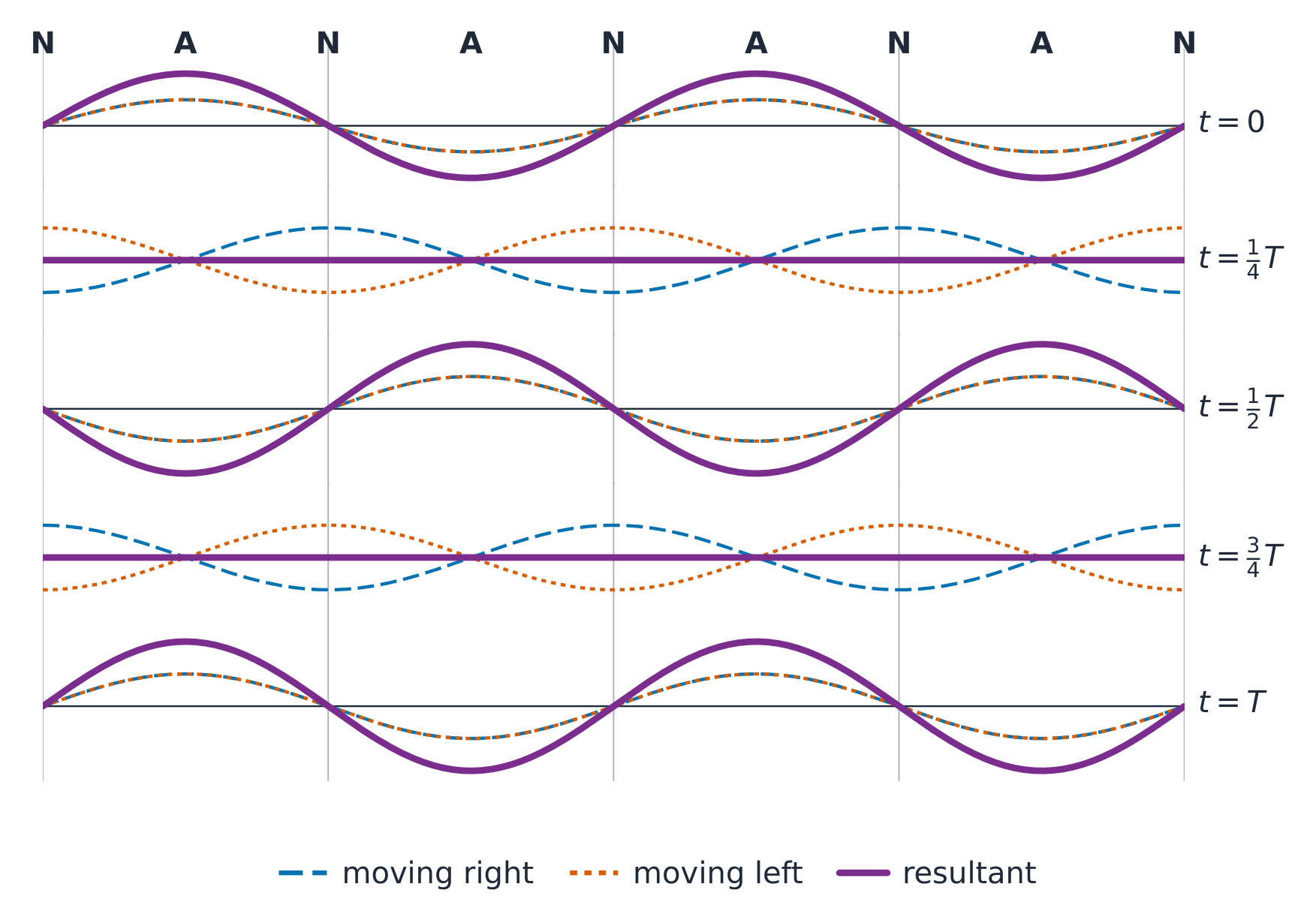
When waves overlap they superpose (add). Constructive interference 相长干涉 (crests aligned) gives a bigger wave; destructive interference 相消干涉 (crest on trough) cancels. Two waves travelling opposite ways in a bounded medium form a standing wave 驻波 with fixed nodes 波节 (no motion) and antinodes 波腹 (maximum motion) – the basis of resonance on strings and in pipes.

A standing wave forms where two waves travelling in opposite directions overlap A standing wave forms where two waves travelling in opposite directions overlap

Worked example. A guitar string $0.65\ \text{m}$ long is fixed at both ends. Its fundamental (first harmonic) fits half a wavelength between the ends, so $\lambda=2L=1.30\ \text{m}$. If waves travel along the string at $260\ \text{m/s}$, the note's frequency is $f=v/\lambda=260/1.30=200\ \text{Hz}$. Shortening the string (a fret) raises the pitch.

When two waves of slightly different frequency overlap, they drift in and out of step, so the combined sound swells loud and soft in a slow throb called beats. The beat frequency 拍频 is simply the difference of the two frequencies:

$$f_{\text{beat}}=|f_1-f_2|.$$
Two tuning forks of $256\ \text{Hz}$ and $260\ \text{Hz}$ sounded together give $|260-256|=4$ beats each second; a musician tunes an instrument by slowing these beats towards zero against a reference note.

Explore

Set up a standing wave

Two waves travelling opposite ways interfere into a standing wave with fixed nodes and antinodes. Only certain frequencies fit, giving the harmonics.

Vocabulary Train
English Chinese Pinyin
Constructive interference 相长干涉 xiāng zhǎng gān shè
destructive interference 相消干涉 xiāng xiāo gān shè
standing wave 驻波 zhù bō
nodes 波节 bō jié
antinodes 波腹 bō fù
beats pāi
beat frequency 拍频 pāi pín
Exercise sheet
14.7

Diffraction

Syllabus
Learning ObjectiveEssential Knowledge

14.7.A
Describe the behavior of a wave and the diffraction pattern resulting from a wave passing through a single opening.

  • 14.7.A.1 Diffraction is the spreading of a wave around the edges of an obstacle or through an opening.
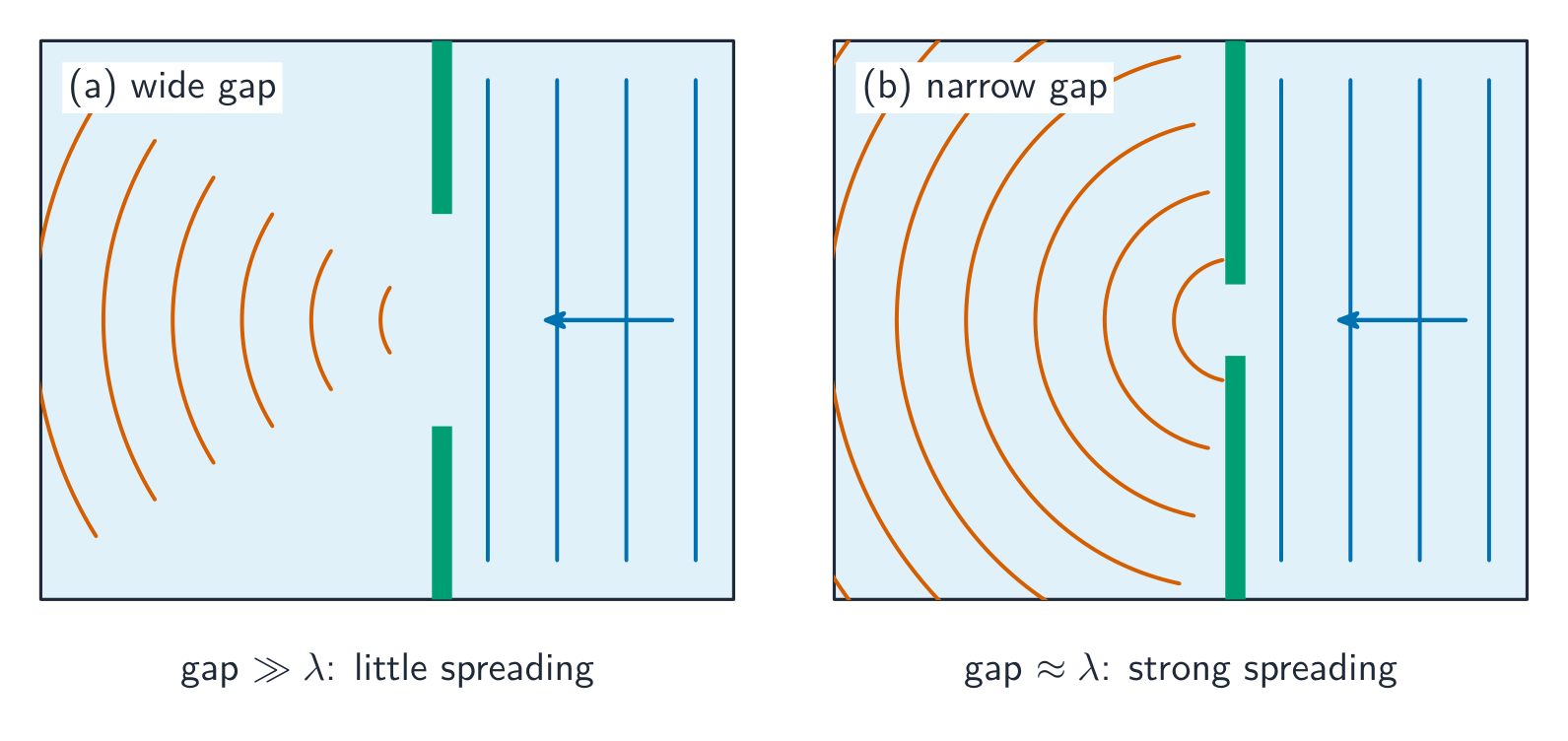
  • 14.7.A.2 Diffraction is most pronounced when the size of the opening is comparable to the wavelength of the wave.
  • 14.7.A.3 Diffraction of multiple wavefronts through a single opening leads to observable interference patterns.
  • 14.7.A.4 Diffraction is commonly demonstrated by monochromatic light of wavelength $\lambda$ incident on a narrow opening of width $a$ that is a distance $L$ from a screen.
    • 14.7.A.4.i Constructive and destructive interference of multiple wavefronts originating from the opening will result in bright and dark bands on the screen.
    • 14.7.A.4.ii The amount of interference between two wavefronts depends on the path length difference $\Delta D$ of the wavefronts.
    • 14.7.A.4.iii The path length difference $\Delta D$ can be described in terms of the opening width $a$ and the angle $\theta$ between the direction of propagation of the wavefront and the normal to the opening by the equation $\Delta D = a\sin\theta$.
    • 14.7.A.4.iv For small angles, where $\theta < 10°$, the small angle approximation can be used to relate $\lambda$, $a$, and $L$ to $y_{\min}$, the distance from the middle of the central bright fringe to the $m^{\text{th}}$ order of minimum brightness on the screen.
      • Equation: $a\left(\dfrac{y_{\min}}{L}\right) \approx m\lambda$
  • 14.7.A.5 The diffraction pattern produced by a wave passing through an opening depends on the shape of the opening.
  • 14.7.A.6 Visual representations of single-slit diffraction patterns are useful in determining the physical properties of the slit and the interacting waves.

Source: College Board AP Course and Exam Description

Diffraction 衍射 is the bending and spreading of waves around edges or through openings. The spreading is significant when the opening is comparable to the wavelength – so sound (long wavelength) bends around doorways easily, while light (tiny wavelength) needs a very narrow slit.

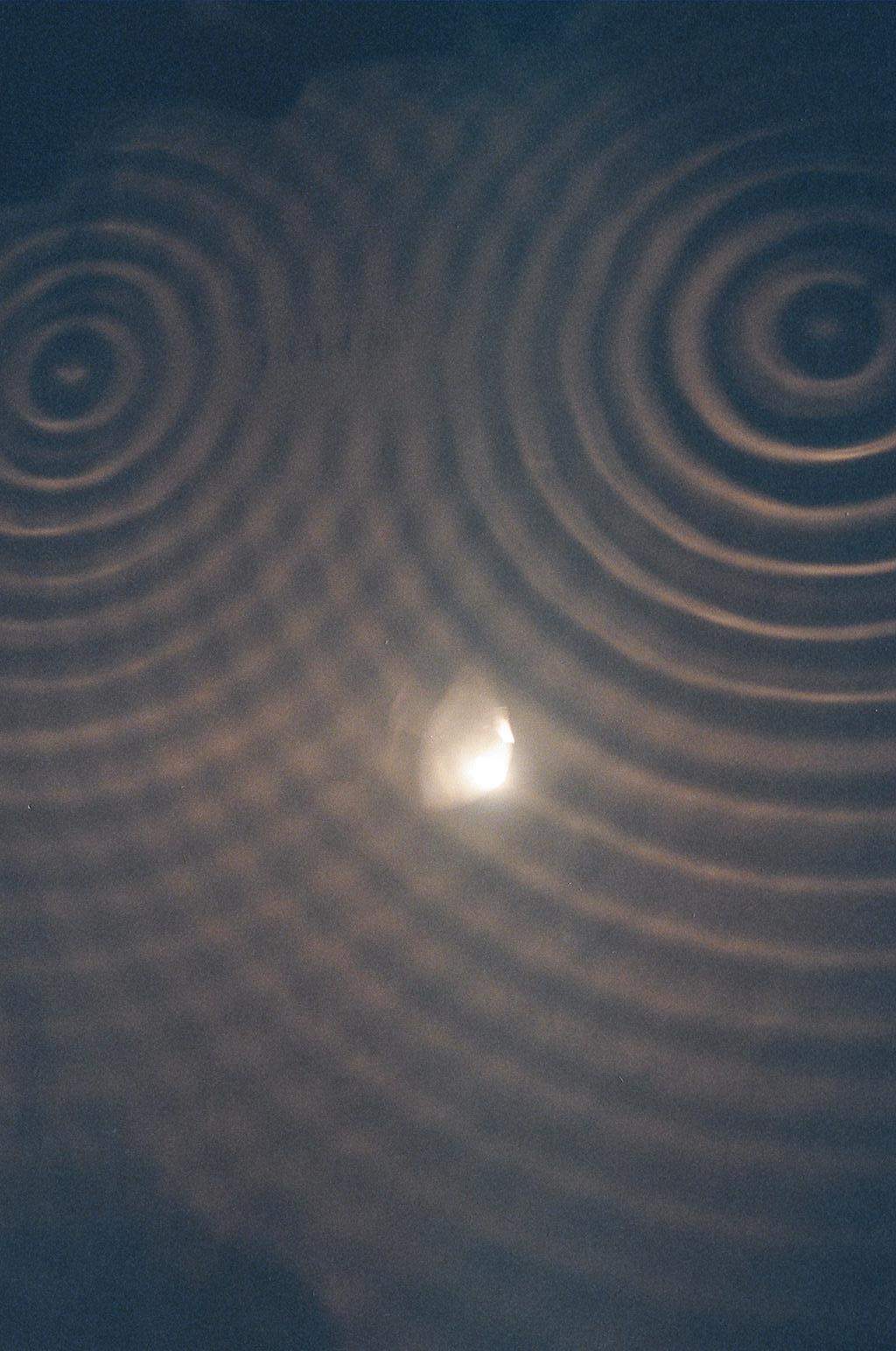
Waves spread out (diffract) as they pass through a gap Waves spread out (diffract) as they pass through a gap

Vocabulary Train
English Chinese Pinyin
Diffraction 衍射 yǎn shè
14.8

Double-Slit Interference and Diffraction Gratings
Syllabus
Learning ObjectiveEssential Knowledge

14.8.A
Describe the behavior of a wave and the diffraction pattern resulting from the wave passing through multiple openings.

  • 14.8.A.1 The pattern resulting from monochromatic light of wavelength $\lambda$ incident on two slits a distance $d$ apart is caused by a combination of wave diffraction and wave interference.
    • 14.8.A.1.i When only considering wave interference, a double slit creates a pattern of uniformly spaced maxima.
    • 14.8.A.1.ii Constructive and destructive interference of the wavefronts originating from each slit will result in bright and dark bands on the screen.
    • 14.8.A.1.iii The amount of interference between two wavefronts depends on the path length difference $\Delta D$ of the wavefronts.
    • 14.8.A.1.iv The path length difference $\Delta D$ can be described in terms of the slit separation $d$ and the angle $\theta$ between the direction of propagation of the wavefront and the normal to the opening by the equation $\Delta D = d\sin\theta$.
    • 14.8.A.1.v For small angles, where $\theta < 10°$, the small angle approximation can be used to relate $\lambda$, $d$, and $L$ to $y_{\max}$, the distance from the middle of the central bright fringe to the $m^{\text{th}}$ order of maximum brightness on the screen.
      • Equation: $d\left(\dfrac{y_{\max}}{L}\right) \approx m\lambda$
    • 14.8.A.1.vi When considering wave interference and wave diffraction, a double slit creates an interference pattern of maxima and minima superimposed within the envelope created by single-slit diffraction.
  • 14.8.A.2 Interference patterns produced by light interacting with a double slit indicate that light has wave properties. The source of this discovery was Young's double-slit experiment.
  • 14.8.A.3 Visual representations of double-slit diffraction patterns are useful in determining the physical properties of the slits and the interacting waves.
  • 14.8.A.4 A diffraction grating is a collection of evenly spaced parallel slits or openings that produce an interference pattern that is the combination of numerous diffraction patterns superimposed on each other.
  • 14.8.A.5 When white light is incident on a diffraction grating, the center maximum is white and the higher-order maxima disperse white light into a rainbow of colors, with the longest-wavelength light (red) appearing farthest from the central maximum.

Source: College Board AP Course and Exam Description

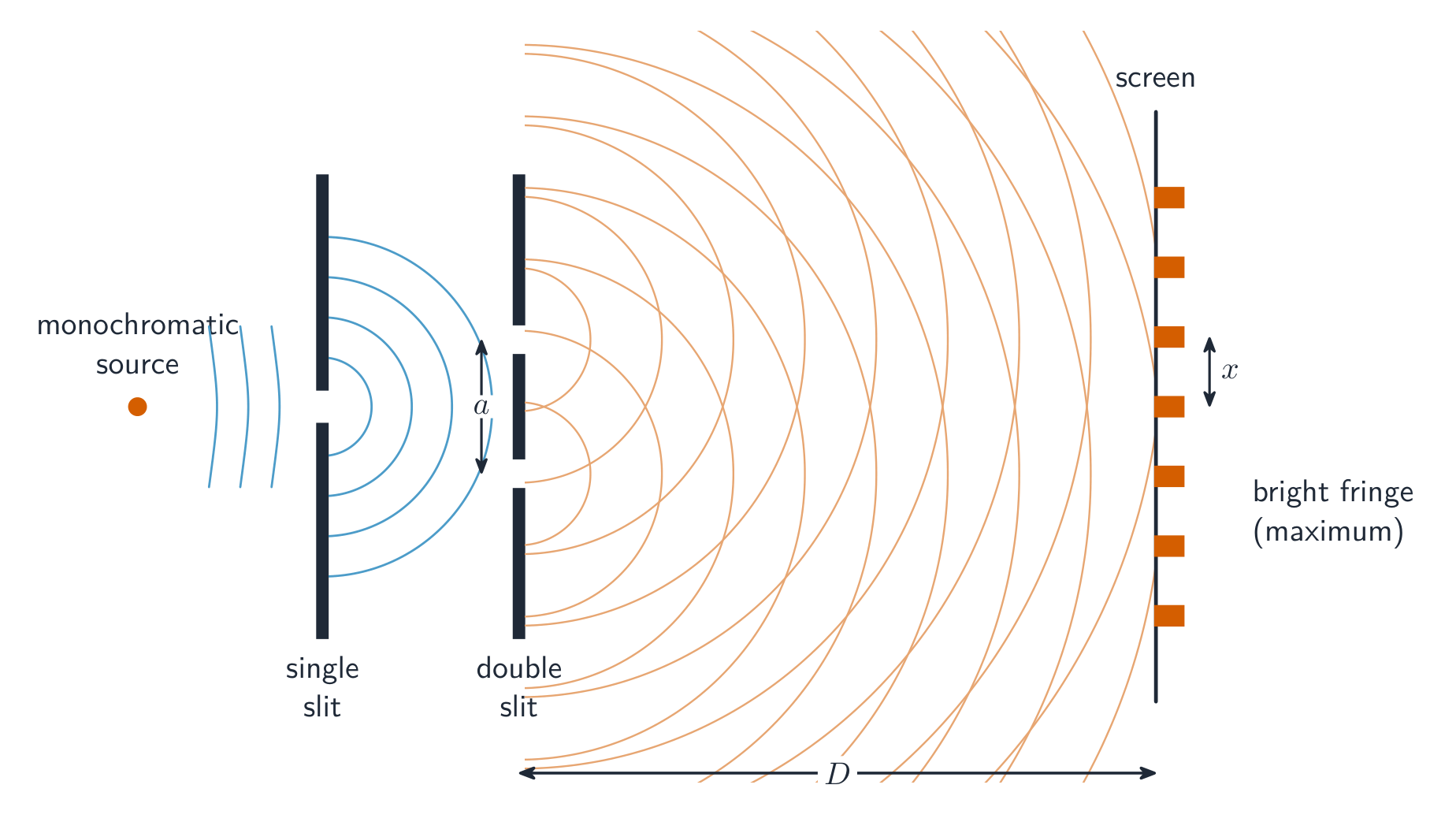
Two-source interference

Coherent 相干 light through two closely spaced slits produces a pattern of bright and dark fringes. Bright fringes occur where the path difference is a whole number of wavelengths:

$$d\sin\theta=m\lambda.$$
A diffraction grating 衍射光栅 has many slits, giving sharp, widely spaced bright lines – useful for separating light into its wavelengths.

Young's double slits give an interference pattern of bright and dark fringes Young's double slits give an interference pattern of bright and dark fringes

Worked example. Light of wavelength $600\ \text{nm}$ passes through two slits $0.20\ \text{mm}$ apart. The first bright fringe ($m=1$) sits at

$$\sin\theta=\frac{m\lambda}{d}=\frac{1\times600\times10^{-9}}{0.20\times10^{-3}}=3.0\times10^{-3}\;\Rightarrow\;\theta=0.17^{\circ}.$$
The tiny angle is why the slits must be very close together and the screen far away to see the fringes clearly.
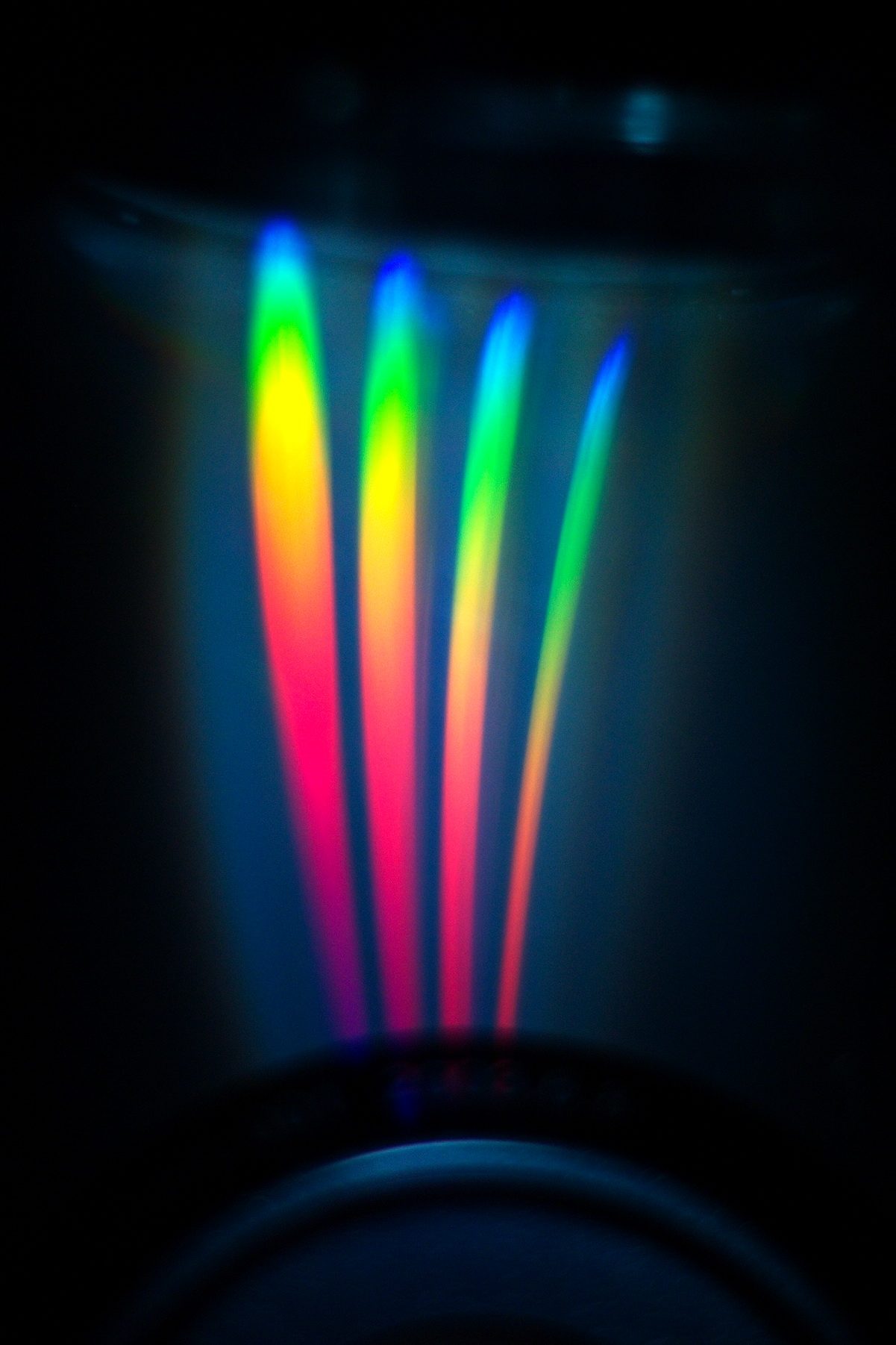
Rainbow colours reflected from the surface of a CD The fine tracks on a CD act as a diffraction grating, splitting white light into a spectrum

Explore

Superpose two waves

Where two waves arrive in phase they add (bright fringe); out of phase they cancel (dark fringe). That interference makes the double-slit pattern.

Vocabulary Train
English Chinese Pinyin
Coherent 相干 xiāng gān
diffraction grating 衍射光栅 yǎn shè guāng shān
Exercise sheet
14.9

Thin-Film Interference

Syllabus
Learning ObjectiveEssential Knowledge

14.9.A
Describe the behavior of light that interacts with a thin film.

  • 14.9.A.1 When light travels from one medium to another, some of the light is transmitted, some is reflected, and some is absorbed.
  • 14.9.A.2 The phase change of a reflected ray depends on the relative indices of refraction of the materials with which the ray interacts.
    • 14.9.A.2.i A phase change of 180 degrees occurs when a light ray is reflected from a medium with a greater index of refraction than the medium through which the ray is traveling.
    • 14.9.A.2.ii No phase change occurs when a light ray is reflected from a medium with a lower index of refraction than the medium through which the ray is traveling.
  • 14.9.A.3 The phase of a wave does not change when it is refracted as it passes from one medium into another.
  • 14.9.A.4 Thin-film interference occurs when light interacts with a medium whose thickness is comparable to the light's wavelength.
    • 14.9.A.4.i The interactions between the initial reflected light and the light exiting the thin film after being reflected from the second interface exhibit wave interference behavior, resulting in a single wave that is the sum of the two interacting waves.
    • 14.9.A.4.ii The amount of constructive or destructive interference between the two reflected waves depends on the relationship between the thickness of the film, the wavelength of light, any phase shifts, and the angle at which the incident light strikes the film.
  • 14.9.A.5 Practical examples of thin-film interference include the color variations seen in soap bubbles and oil films, as well as antireflection coatings.
    • 14.9.A.5.i The spectrum of colors observed in oil films and soap bubbles arises from differences in the thickness of the film.
    • 14.9.A.5.ii Antireflection coatings eliminate reflected light by applying the relationships between indices of refraction, phase shift, and wave interference to create destructive interference of the light reflected from the two surfaces of the coating.
    • 14.9.A.5.iii The simplest antireflection coating has a thickness equal to one-quarter of the wavelength of the light in the coating, and the index of refraction of the coating is greater than that of air and less than that of the surface upon which the coating is applied. This assumes incident light is normal to the surface.

Boundary statement: Quantitative analysis of thin-film interference is limited to waves that are normal to the incident surface.

Source: College Board AP Course and Exam Description

Light reflecting off the top and bottom of a thin film 薄膜 (soap bubble, oil slick) interferes with itself. Depending on the film's thickness and a possible half-wavelength phase flip on reflection off a denser medium, particular wavelengths interfere constructively – producing the shifting colours you see.

The same physics is put to work in an antireflection coating 增透膜 on camera lenses, glasses, and solar cells: a thin transparent layer whose two reflected waves interfere destructively, so almost no light reflects and more is transmitted. The simplest coating is one quarter of a wavelength thick (measured in the coating), and its refractive index sits between that of air and the glass beneath, so the reflected light cancels itself out.

Vocabulary Train
English Chinese Pinyin
thin film 薄膜 báo mó
antireflection coating 增透膜 zēng tòu mó
14.9

Exam tips

  • Use $v=f\lambda$; the source sets the frequency, and when a wave enters a new medium the frequency stays fixed while the speed and wavelength change.
  • Distinguish transverse (vibration perpendicular, can be polarised) from longitudinal (vibration along the travel, e.g. sound).
  • Constructive interference needs a path difference of a whole number of wavelengths; destructive needs a half-odd number.
  • On a string fixed at both ends the fundamental fits half a wavelength ($\lambda=2L$).
  • Diffraction is significant only when the gap is comparable to the wavelength — sound bends round doorways, light needs a very narrow slit.
  • Beats: two waves of slightly different frequency throb at $f_{\text{beat}}=|f_1-f_2|$ (e.g. two tuning forks; tuning to zero beats).
  • An antireflection coating is a quarter-wavelength-thick layer (index between air and glass) whose two reflections cancel, cutting the reflected light.

Log in or create account

IGCSE & A-Level