| Learning Objective | Essential Knowledge |
|---|---|
15.1.A |
|
Modern Physics
AP Physics 2 · Topic 15
 9:32
9:32
Modern Physics
By nineteen hundred, physics looked finished. Then three experiments broke it. A hot glowing object gave out the wrong colours. Light falling on a metal…
English narration · English + 中文 subtitles burned in
15.1
Quantum Theory and Wave-Particle Duality
Syllabus
Source: College Board AP Course and Exam Description
At tiny scales, energy comes in discrete packets called quanta 量子. Light is carried by photons 光子, each with energy set by its frequency:
$$E=hf,$$
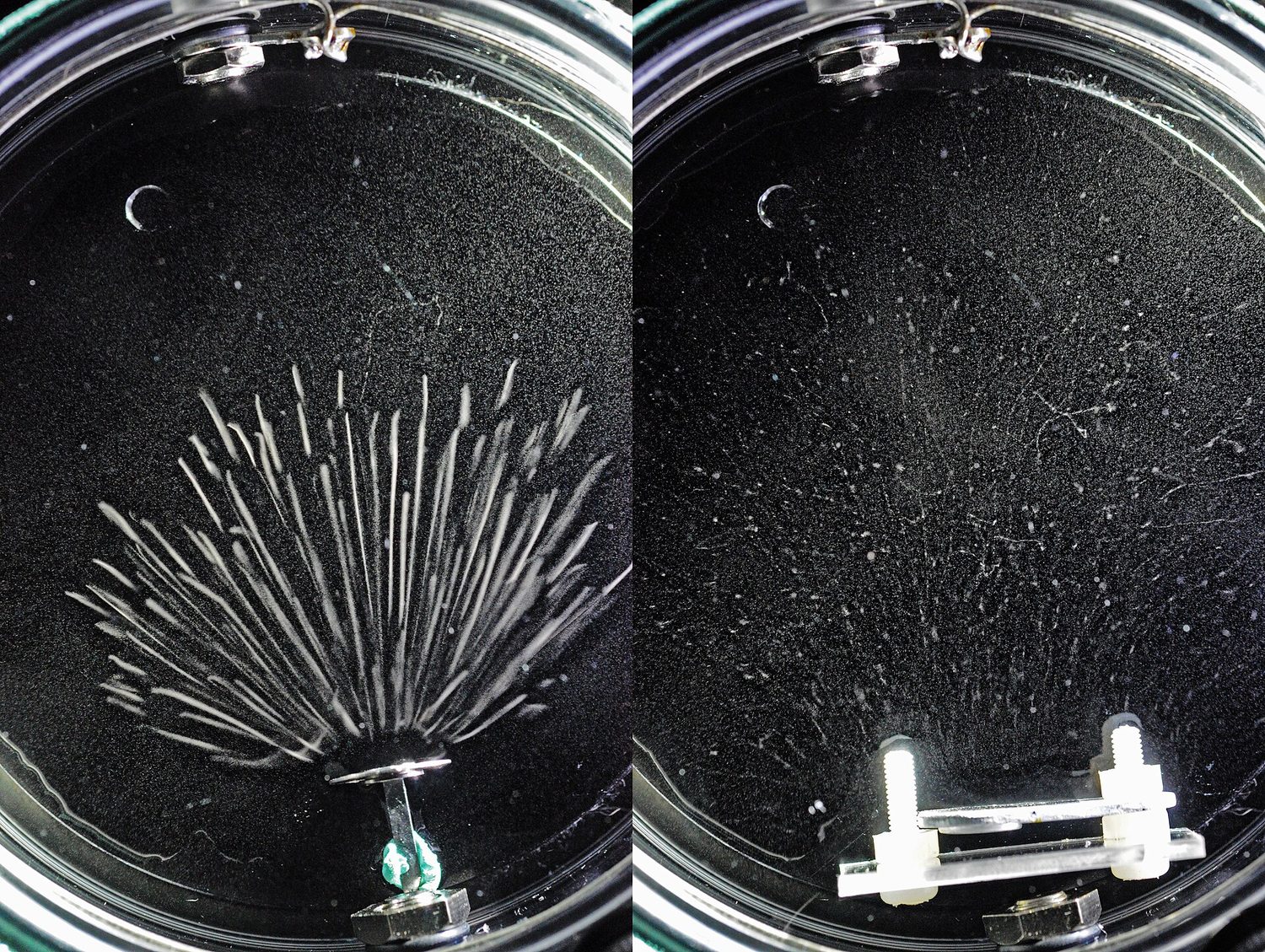
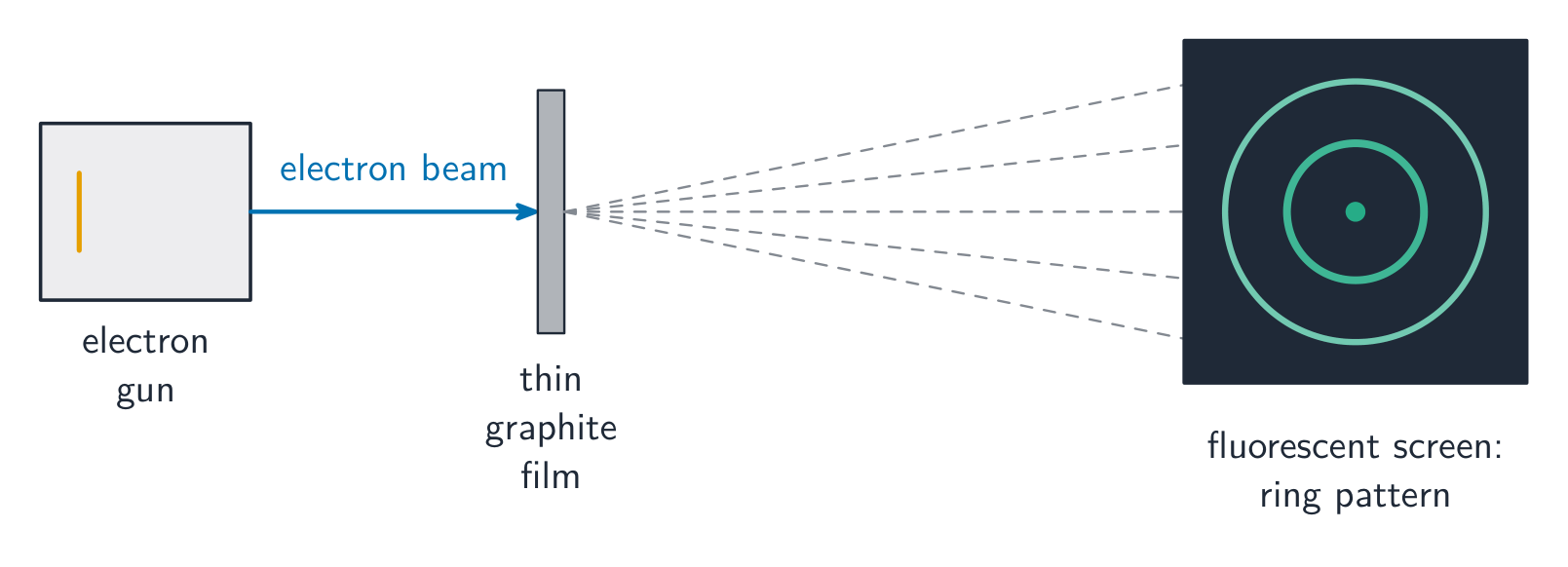
where $h$ is Planck's constant. Wave–particle duality 波粒二象性: light and matter each show both wave behavior (interference, diffraction) and particle behavior (photons, electrons as localized hits). A particle also has a matter wavelength $\lambda=\dfrac{h}{p}$, and particles genuinely produce interference - a variation of Young's double-slit experiment 双缝实验 done with electrons builds up the same fringe pattern as light.
Worked example. Find the energy of a photon of orange light with frequency $5.0\times10^{14}\ \text{Hz}$ ($h=6.63\times10^{-34}\ \text{J s}$): $E=hf=6.63\times10^{-34}\times5.0\times10^{14}=3.3\times10^{-19}\ \text{J}$, which is about $2.1\ \text{eV}$ (dividing by $1.6\times10^{-19}$). Visible-light photons carry a few electronvolts – just right to trigger the chemistry of vision and photosynthesis.
Vocabulary
Train
| English |
|---|
| quanta/ˈkwɒntə/ |
| photons/ˈfəʊtɒnz/ |
| Wave–particle duality/weɪv ˈpɑːtɪkl djuːˈælɪti/ |
| double-slit experiment/ˈdʌbl slɪt ekˈsperɪmənt/ |
15.2
The Bohr Model of Atomic Structure
Syllabus
| Learning Objective | Essential Knowledge |
|---|---|
15.2.A |
Boundary statement: The analysis and description of electron structure is limited to energy levels and will not include such advanced descriptions as orbitals, orbital shapes, or probability functions. |
Source: College Board AP Course and Exam Description
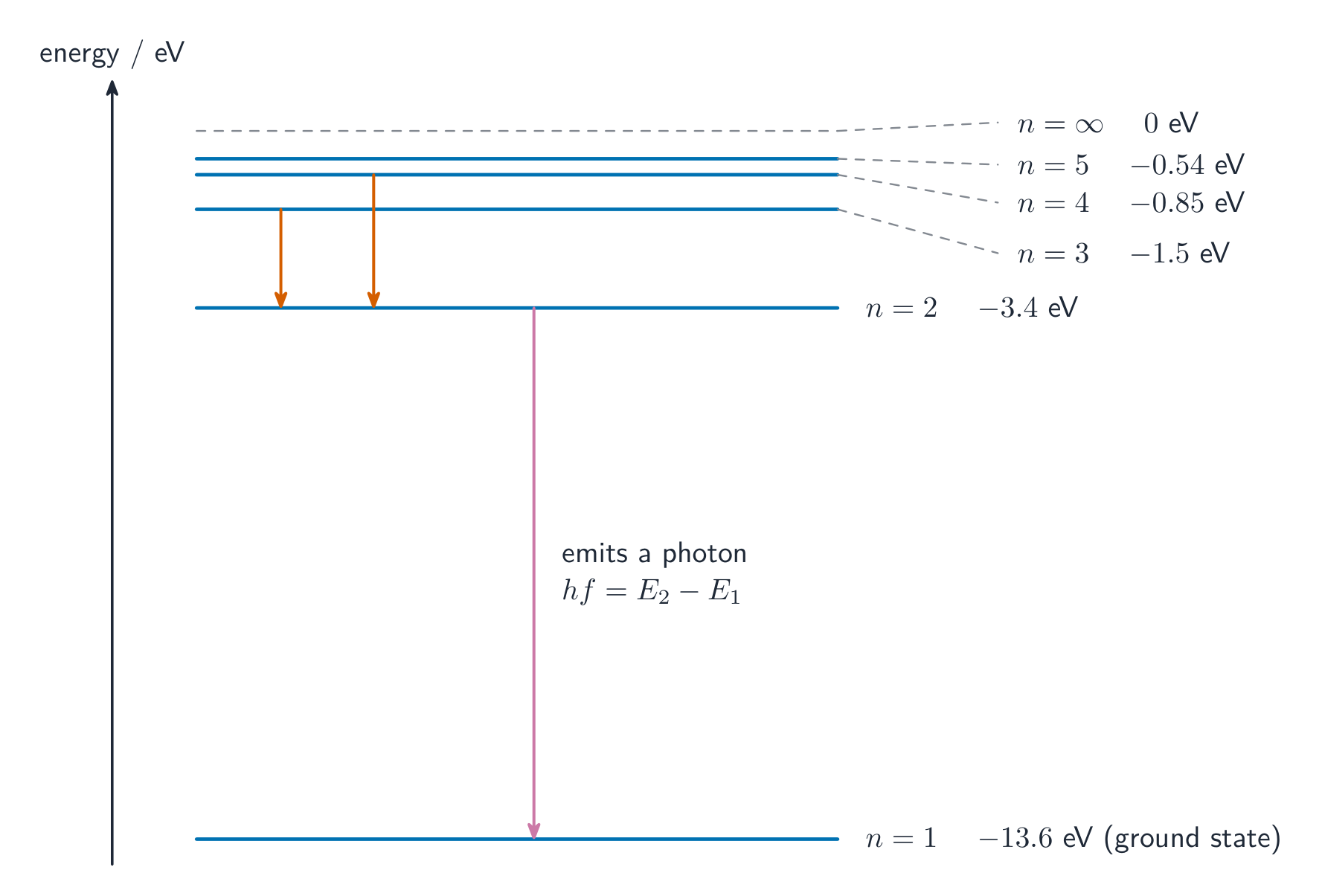
The Bohr model 玻尔模型 pictures electrons orbiting the nucleus only in certain allowed energy levels 能级. An electron can jump between levels only by absorbing or emitting a photon whose energy exactly matches the gap:
$$E_{\text{photon}}=|E_{\text{final}}-E_{\text{initial}}|.$$
Because the levels are discrete, only specific photon energies are allowed.
Vocabulary
Train
| English |
|---|
| Bohr model/ˈbəʊə ˈmɒdl/ |
| energy levels/ˈenədʒi ˈlevlz/ |
15.3
Emission and Absorption Spectra
Syllabus
| Learning Objective | Essential Knowledge |
|---|---|
15.3.A |
Boundary statement: In AP Physics 2, only energy level diagrams of single-electron atoms will be considered. |
Source: College Board AP Course and Exam Description
- An emission spectrum 发射光谱 is the set of bright lines given off when electrons drop to lower levels – each line a specific wavelength.
- An absorption spectrum 吸收光谱 is the set of dark lines where those same wavelengths are absorbed from a continuous source.
The line pattern is a fingerprint of the element, since every element has its own energy levels.

Explore
See an element's line spectrum
Electrons jump between fixed energy levels, emitting or absorbing photons of exact wavelengths — a line spectrum that fingerprints the element.
Vocabulary
Train
| English |
|---|
| emission spectrum/ɪˈmɪʃn ˈspektrəm/ |
| absorption spectrum/əbˈsɔːpʃn ˈspektrəm/ |
15.4
Blackbody Radiation
Syllabus
| Learning Objective | Essential Knowledge |
|---|---|
15.4.A |
|
Source: College Board AP Course and Exam Description
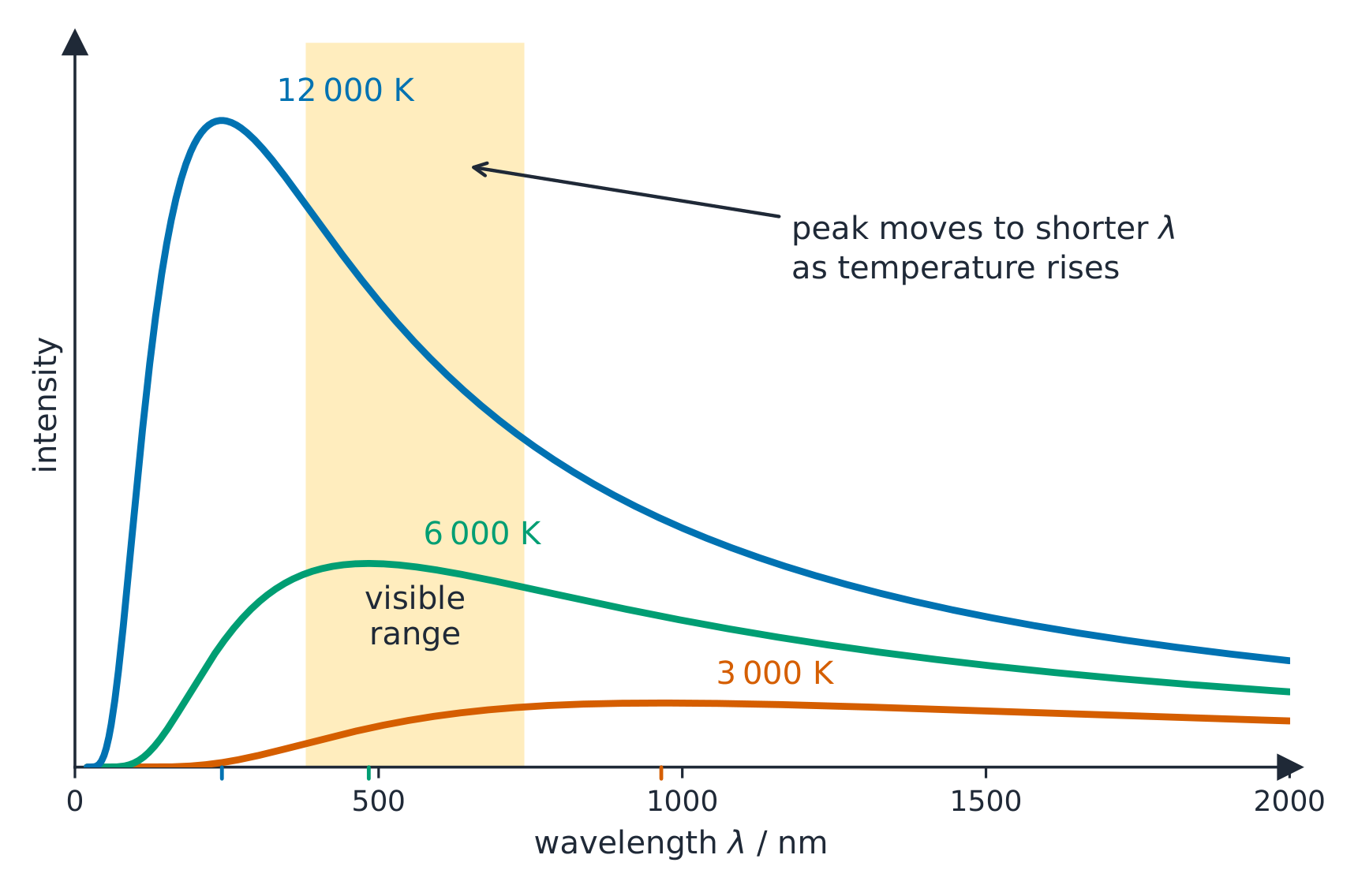
A blackbody 黑体 emits a continuous spectrum that depends only on its temperature. Hotter objects glow brighter and peak at shorter wavelengths (red-hot to white-hot to blue-hot). Explaining this spectrum required quantized energy – a founding problem of quantum theory.
Vocabulary
Train
| English |
|---|
| blackbody/ˈblækbɒdi/ |
15.5
The Photoelectric Effect
Syllabus
| Learning Objective | Essential Knowledge |
|---|---|
15.5.A |
Boundary statement: Where applicable, work functions for materials will be provided on the exam; students are not expected to know values of work functions or variables of a material that influence the magnitude of its work function. |
Source: College Board AP Course and Exam Description
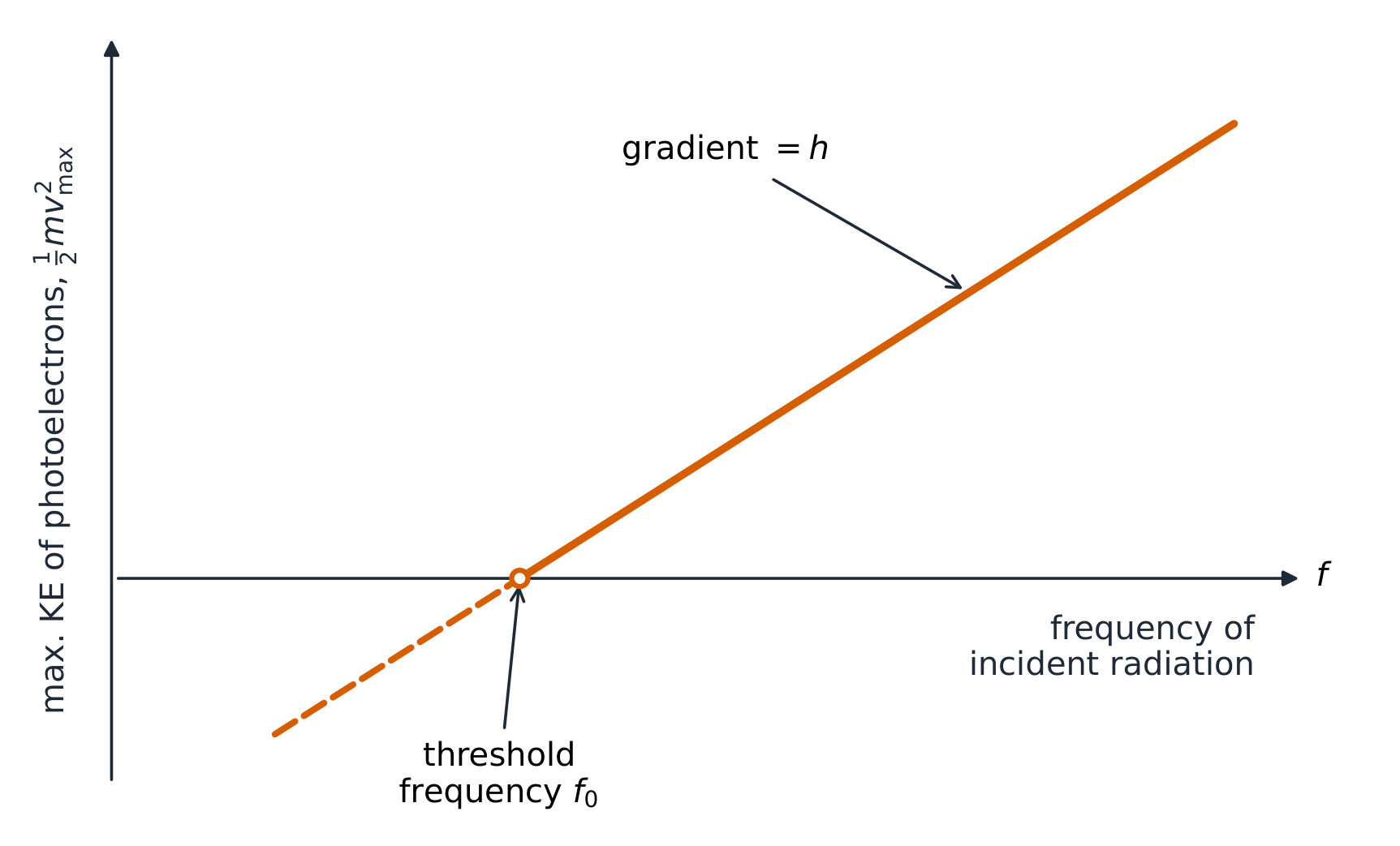
Shining light on a metal can eject electrons – the photoelectric effect 光电效应. Key facts (which only the photon picture explains): electrons come out only if the photon's frequency exceeds a threshold, no matter how bright a dimmer, lower-frequency light is. Energy conservation gives
$$K_{\max}=hf-\phi,$$
where $\phi$ is the metal's work function 逸出功 (the energy to free an electron).
Worked example. Light of frequency $8.0\times10^{14}\ \text{Hz}$ falls on a metal with work function $\phi=3.0\times10^{-19}\ \text{J}$. The most energetic electrons come off with
$$K_{\max}=hf-\phi=(6.63\times10^{-34}\times8.0\times10^{14})-3.0\times10^{-19}=5.3\times10^{-19}-3.0\times10^{-19}=2.3\times10^{-19}\ \text{J}.$$
Below the threshold frequency $\phi/h$, $K_{\max}$ would be negative – meaning no electrons escape at all, however bright the light.
Vocabulary
Train
| English |
|---|
| photoelectric effect/ˌfəʊtəʊɪˈlektrɪk ɪˈfekt/ |
| work function/wɜːk ˈfʌŋkʃn/ |
15.6
Compton Scattering
Syllabus
| Learning Objective | Essential Knowledge |
|---|---|
15.6.A |
Boundary statement: AP Physics 2 includes full quantitative and qualitative treatments of conservation of momentum in two dimensions. |
Source: College Board AP Course and Exam Description
In Compton scattering 康普顿散射, a photon collides with an electron like two particles, transferring some energy and momentum. The scattered photon comes out with less energy (longer wavelength). This is direct evidence that photons carry momentum and behave as particles.
Vocabulary
Train
| English |
|---|
| Compton scattering/ˈkɒmptn ˈskætərɪŋ/ |
15.7
Fission, Fusion, and Nuclear Decay
Syllabus
| Learning Objective | Essential Knowledge |
|---|---|
15.7.A |
|
15.7.B |
|
Source: College Board AP Course and Exam Description
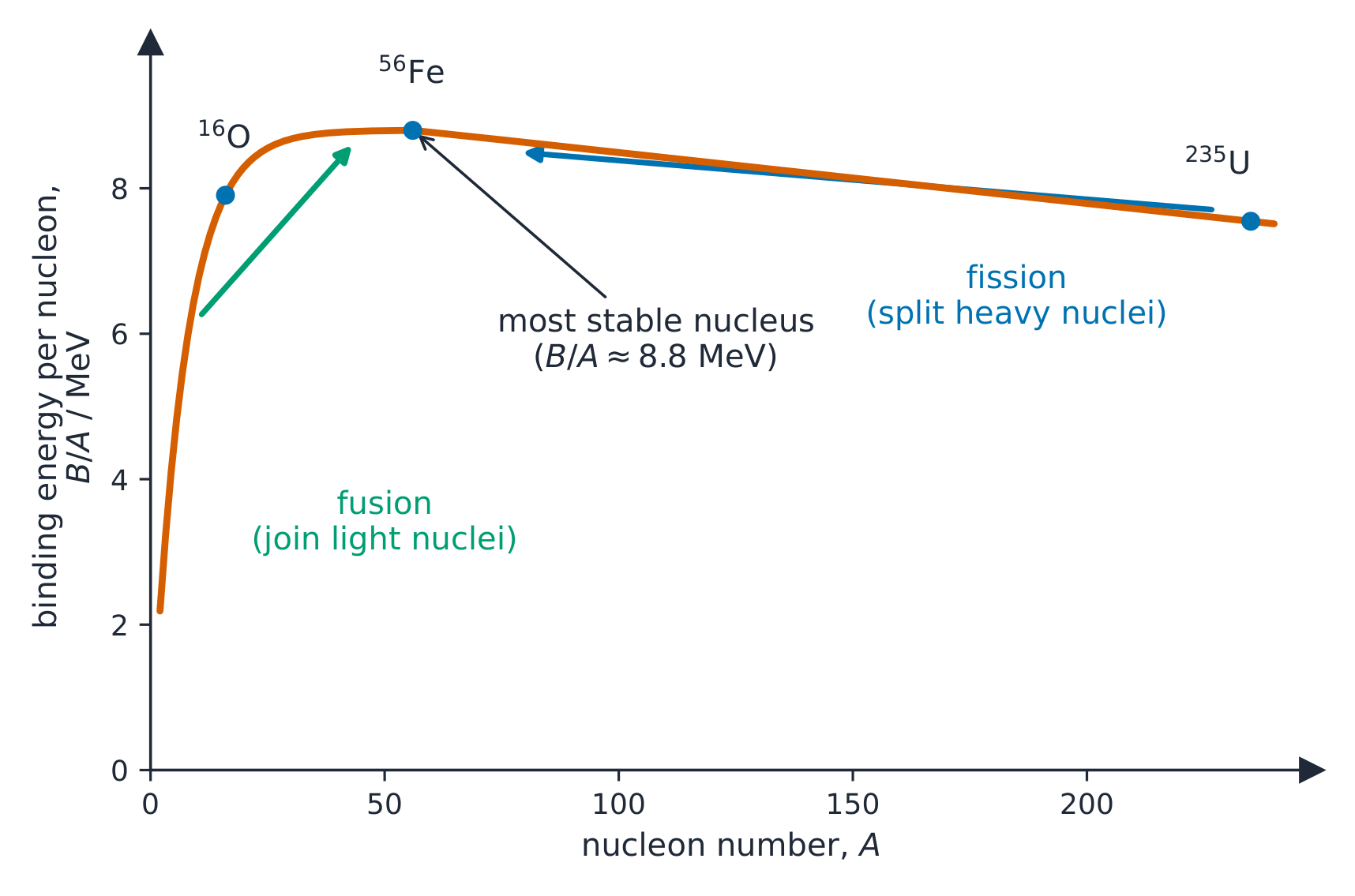
The nucleus 原子核 stores enormous energy. Fission 裂变 splits a heavy nucleus into lighter ones, releasing energy (nuclear reactors, bombs). Fusion 聚变 joins light nuclei into a heavier one (the Sun's power). Both release energy because the products have slightly less mass, converted by $E=mc^2$.
Worked example. Even a tiny mass converts to a huge energy. If a nuclear reaction loses $1.0\times10^{-3}\ \text{kg}$ of mass, it releases $E=mc^2=1.0\times10^{-3}\times(3.0\times10^{8})^2=9.0\times10^{13}\ \text{J}$ – roughly the energy of $20\,000$ tonnes of TNT.
Explore
Balance a nuclear decay equation
In alpha, beta and gamma decay, nucleon and charge numbers must balance. Pick a mode and see how the parent turns into the daughter nuclide.
Vocabulary
Train
| English |
|---|
| nucleus/ˈnjuːklɪəs/ |
| Fission/ˈfɪʃn/ |
| Fusion/ˈfjuːʒn/ |
15.8
Types of Radioactive Decay
Syllabus
| Learning Objective | Essential Knowledge |
|---|---|
15.8.A |
Boundary statement: AP Physics 2 does not expect students to memorize the processes by which specific isotopes decay or the half-lives of specific isotopes. Neutron emission and electron capture are not included in the AP Physics 2 curriculum framework. Additionally, types of neutrinos, the characteristics that distinguish neutrinos and antineutrinos, and an explanation or application of the weak force are not within the scope of this course. |
Source: College Board AP Course and Exam Description
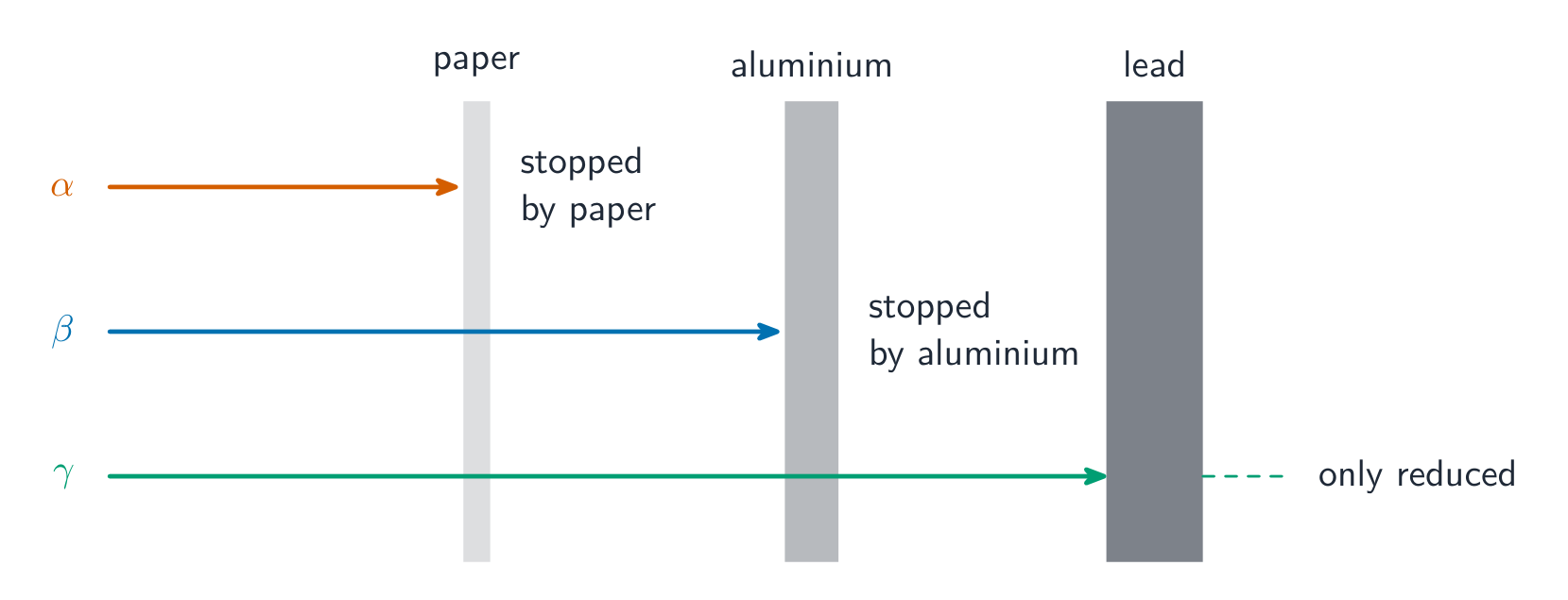
Unstable nuclei undergo radioactive decay 放射性衰变, emitting:
- Alpha decay 阿尔法衰变 ($\alpha$): a helium nucleus – mass number drops by 4.
- Beta decay 贝塔衰变 ($\beta$) comes in two kinds. In beta-minus ($\beta^-$) a neutron becomes a proton, emitting an electron and an antineutrino 反中微子: $n\rightarrow p+e^-+\bar{\nu}$. In beta-plus ($\beta^+$) a proton becomes a neutron, emitting a positron 正电子 and a neutrino 中微子: $p\rightarrow n+e^++\nu$.
- Gamma decay 伽马衰变 ($\gamma$): a high-energy photon – the nucleus sheds excess energy.
The neutrino and antineutrino (symbols $\nu$, $\bar{\nu}$) are tiny, chargeless, almost-massless particles that carry off energy and keep beta decay balanced. Decay is random, but a sample halves every half-life 半衰期: after each half-life, half of the remaining nuclei have decayed. Every decay equation conserves three quantities: nucleon number (mass number), charge, and lepton number 轻子数 – an electron or neutrino counts as $+1$ lepton, a positron or antineutrino as $-1$, and the totals must match on both sides.
Worked example. A radioactive sample has a half-life of $8.0$ days. What fraction is left after $24$ days? That is $24/8.0=3$ half-lives, so the fraction remaining is $\left(\tfrac12\right)^3=\tfrac18$ – about $12.5\%$. In an alpha decay of uranium-238 ($^{238}_{\ 92}\text{U}$), the daughter has mass number $238-4=234$ and atomic number $92-2=90$: thorium-234.
Explore
Watch a sample decay
Radioactive nuclei decay randomly with a fixed half-life: each half-life halves the number remaining. Step forward and watch the sample shrink.
Vocabulary
Train
| English |
|---|
| radioactive decay/ˌreɪdɪəʊˈæktɪv dɪˈkeɪ/ |
| Alpha decay/ˈælfə dɪˈkeɪ/ |
| Beta decay/ˈbiːtə dɪˈkeɪ/ |
| antineutrino/ˌæntɪnjuːˈtriːnəʊ/ |
| positron/ˈpɒzɪtrɒn/ |
| neutrino/njuːˈtriːnəʊ/ |
| Gamma decay/ˈɡæmə dɪˈkeɪ/ |
| half-life/hɑːf laɪf/ |
| lepton number/ˈleptɒn ˈnʌmbə/ |
15.8
Exam tips
- Photon energy is $E=hf$; below the threshold frequency no electrons are emitted however bright the light (the photoelectric effect).
- Use $K_{\max}=hf-\phi$ for the fastest photoelectrons ($\phi$ = work function).
- Electrons jump between discrete energy levels by absorbing/emitting a photon whose energy equals the level gap — the source of line spectra.
- In fission and fusion the small mass lost becomes energy via $E=mc^2$.
- Balance decay equations by conserving mass number, charge, and lepton number (write the antineutrino in $\beta^-$, the neutrino in $\beta^+$), and halve the sample every half-life ($(\tfrac12)^n$ after $n$ half-lives).
Interactive lessons on this topic
Work through it step by step, with instant-check exercises.