Source: College Board AP Course and Exam Description · แหล่งที่มา: คำอธิบายหลักสูตรและข้อสอบ College Board AP
English
The differences between solids, liquids, and gases come from how strongly their particles interact. A fluid 流体 (liquid or gas) has no fixed shape – it flows because its particles move past one another. Density 密度 is mass per unit volume:
$$\rho=\frac{m}{V}.$$
It depends on the substance and its state. An object sinks or floats depending on how its density compares with the surrounding fluid's – less dense floats, more dense sinks. An ideal fluid 理想流体 is incompressible 不可压缩 (constant density, whatever the pressure) and has no viscosity 黏度 (internal friction) – the model AP uses throughout.
ขึ้นอยู่กับสารและสถานะ物体 sinking or floating取决于其密度与周围流体的比较 – ความหนาแน่นน้อยกว่าลอย, ความหนาแน่นมากกว่าจม. ของไหลในอุดมคติ เป็น ของอัดไม่ได้ (ความหนาแน่นคงที่ ไม่ว่าแรงดันจะเป็นอย่างไร) และไม่มี ความหนืด (แรงเสียดทานภายใน) – โมเดลที่ AP ใช้ตลอดทั้งบท
Explore · สำรวจ
Float or sink by density · ลอยหรือจมตามความหนาแน่น
An object floats if it is less dense than the fluid. Change the density and watch it ride higher or sink, displacing its own weight of fluid. · วัตถุจะลอยหากมีความ หนาแน่นน้อยกว่า ของเหลว เปลี่ยนความหนาแน่นเพื่อดูว่ามันลอยสูงขึ้นหรือจมลง โดยFeatureน้ำหนักของของเหลวเท่ากัน
8.2
Pressure · ความดัน
Syllabus · หลักสูตร
English
Learning Objective 8.2.A: Describe the pressure exerted on a surface by a given force.
8.2.A.1 Pressure is defined as the magnitude of the perpendicular force component exerted per unit area over a given surface area, as described by the equation
Equation:$P = \dfrac{F_\perp}{A}$
8.2.A.2 Pressure is a scalar quantity.
8.2.A.3 The volume and density of a given amount of an incompressible fluid is constant regardless of the pressure exerted on that fluid.
Learning Objective 8.2.B: Describe the pressure exerted by a fluid.
8.2.B.1 The pressure exerted by a fluid is the result of the entirety of the interactions between the fluid's constituent particles and the surface with which those particles interact.
8.2.B.2 The absolute pressure of a fluid at a given point is equal to the sum of a reference pressure $P_0$, such as the atmospheric pressure $P_{\text{atm}}$, and the gauge pressure $P_{\text{gauge}}$.
Equation:$P = P_0 + \rho g h$
8.2.B.3 The gauge pressure of a vertical column of fluid is described by the equation
Source: College Board AP Course and Exam Description · แหล่งที่มา: คำอธิบายหลักสูตรและข้อสอบ College Board AP
English
Pressure 压强 is the perpendicular force per unit area, a scalar 标量 measured in pascals (Pa):
$$P=\frac{F_\perp}{A}.$$
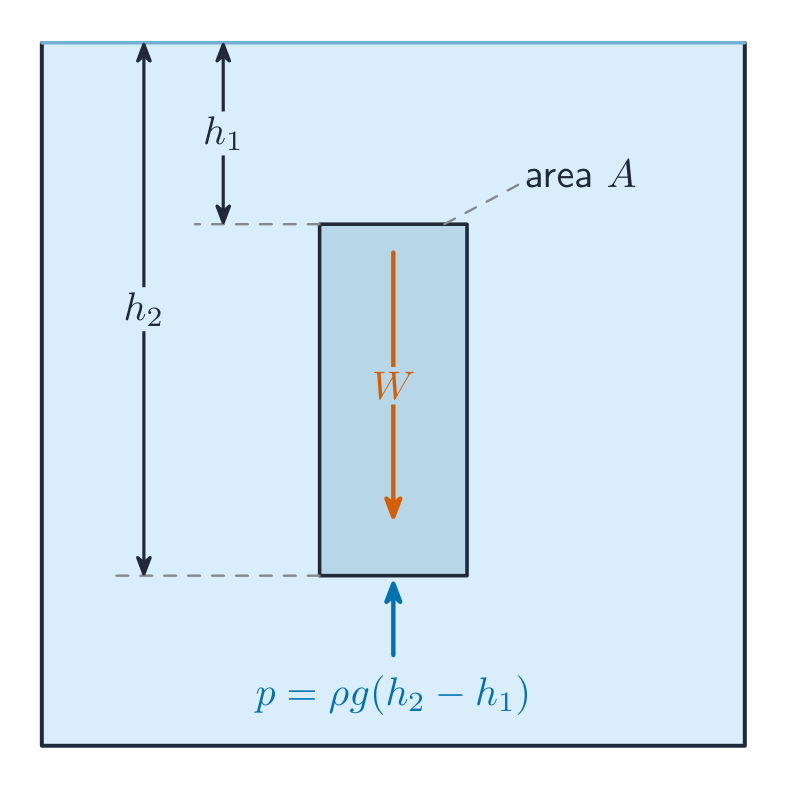
In a fluid at rest, pressure increases with depth 深度 because of the weight of fluid above:
$$P=P_0+\rho g h,$$
where $P_0$ is the pressure at the surface and $h$ is the depth. Pressure acts equally in all directions at a point and pushes perpendicular to any surface.
Distinguish the two pressures AP asks about: the gauge pressure 表压 is the extra pressure the fluid column adds, $P_{\text{gauge}}=\rho g h$, while the absolute pressure 绝对压强 is the total, $P=P_0+P_{\text{gauge}}$ (with $P_0$ usually atmospheric). A tyre gauge reading "$200\ \text{kPa}$" is gauge pressure; the air inside is really at about $300\ \text{kPa}$ absolute.
Worked example. Find the total pressure on a diver $10\ \text{m}$ below the surface of water ($\rho=1000\ \text{kg/m}^3$, surface pressure $P_0=1.0\times10^{5}\ \text{Pa}$):
$$P=P_0+\rho g h=1.0\times10^{5}+1000\times9.8\times10=1.98\times10^{5}\ \text{Pa}.$$
Every $10\ \text{m}$ of water adds roughly one extra atmosphere of pressure. Notice the pressure does not depend on the shape or width of the container, only on the depth.
Learning Objective 8.3.A: Describe the conditions under which a fluid's velocity changes.
8.3.A.1 Newton's laws can be used to describe the motion of particles within a fluid.
8.3.A.2 The macroscopic behavior of a fluid is a result of the internal interactions between the fluid's constituent particles and external forces exerted on the fluid.
Learning Objective 8.3.B: Describe the buoyant force exerted on an object interacting with a fluid.
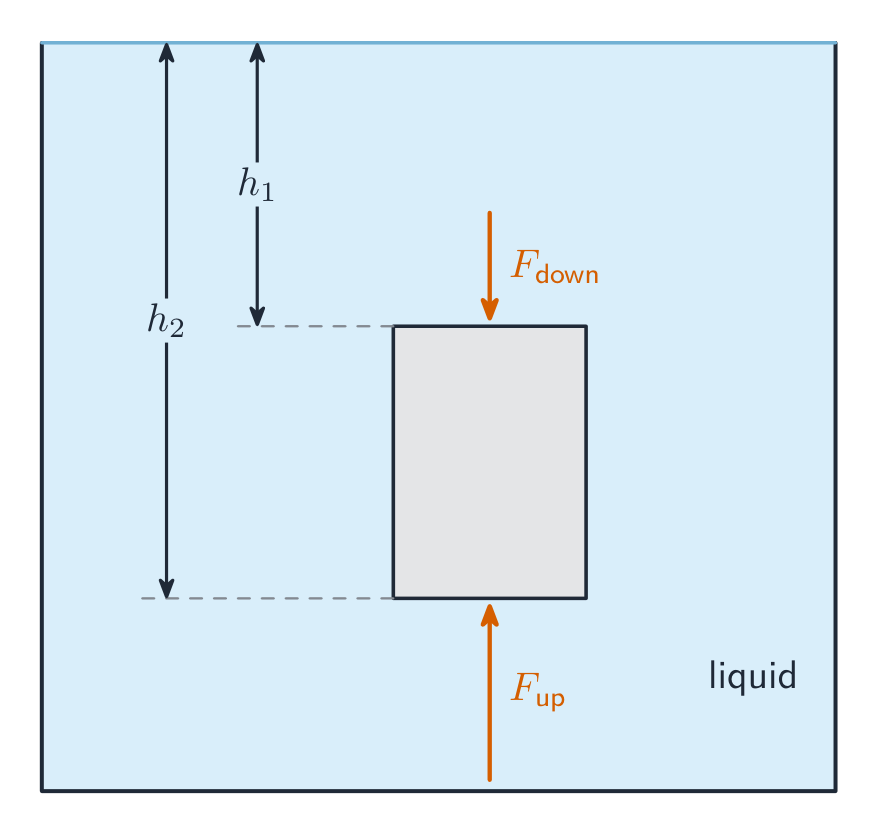
8.3.B.1 The buoyant force is a net upward force exerted on an object by a fluid.
8.3.B.2 The buoyant force exerted on an object by a fluid is a result of the collective forces exerted on the object by the particles making up the fluid.
8.3.B.3 The magnitude of the buoyant force exerted on an object by a fluid is equivalent to the weight of the fluid displaced by the object.
Combine this with Newton's laws: the object floats when buoyancy balances weight, sinks when weight wins, and rises when buoyancy wins. A floating object displaces exactly its own weight of fluid.
Worked example. A block of density $600\ \text{kg/m}^3$ floats in water ($1000\ \text{kg/m}^3$). What fraction is under the surface? For floating, the buoyant force equals the weight, so $\rho_{\text{fluid}}\,g\,V_{\text{sub}}=\rho_{\text{object}}\,g\,V$:
รวมกับกฎของนิวตัน: วัตถุลอยเมื่อแรงลอยตัวสมดุลกับความหนัก จมเมื่อความหนักชนะ และลอยตัวขึ้นเมื่อแรงลอยตัวชนะ วัตถุลอยจะแทนที่流体的Exactly equal to its own weight of fluid.
Fluids and Conservation Laws · ของเหลวและกฎการอนุรักษ์
Syllabus · หลักสูตร
English
Learning Objective 8.4.A: Describe the flow of an incompressible fluid through a cross-sectional area by using mass conservation.
8.4.A.1 A difference in pressure between two locations causes a fluid to flow.
8.4.A.1.i The rate at which matter enters a fluid-filled tube open at both ends must equal the rate at which matter exits the tube.
8.4.A.1.ii The rate at which matter flows into a location is proportional to the cross-sectional area of the flow and the speed at which the fluid flows.
Derived equation:$\dfrac{V}{t} = A v$
8.4.A.2 The continuity equation for fluid flow describes conservation of mass flow rate in incompressible fluids.
Source: College Board AP Course and Exam Description · แหล่งที่มา: คำอธิบายหลักสูตรและข้อสอบ College Board AP
English
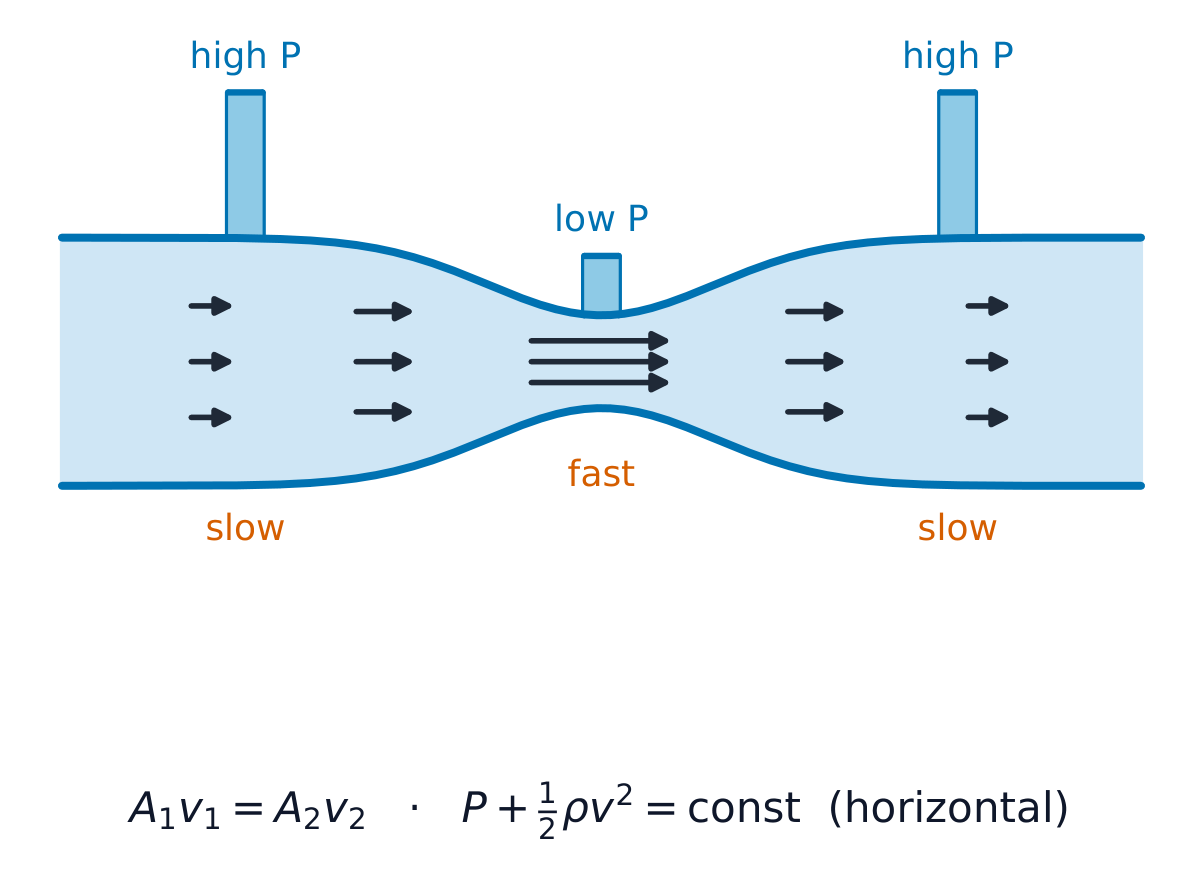
For an ideal fluid flowing steadily, two conservation ideas apply:
Continuity 连续性 (conservation of mass): the volume flow rate is constant, so $A_1 v_1 = A_2 v_2$. A narrower pipe forces faster flow.
Bernoulli's equation 伯努利方程 (conservation of energy per volume): along a streamline,
$$P+\tfrac{1}{2}\rho v^2+\rho g y = \text{constant}.$$
Together they explain why fluid speeds up and its pressure drops where a pipe narrows or where flow is fastest.
Worked example. Water flows at $2.0\ \text{m/s}$ through a pipe of cross-section $0.010\ \text{m}^2$, then enters a narrower section of $0.0040\ \text{m}^2$. By continuity the speed there is
By Bernoulli's equation this faster stream is at lower pressure – the effect that lifts an aeroplane wing and pulls two passing ships together.
Exam skill. Choose the right law by what changes. If the pipe changes width, start with continuity ($A_1v_1=A_2v_2$) to get the speeds; if you then need a pressure, feed those speeds into Bernoulli. Watch the height term $\rho g y$ only when the pipe also changes level.
Pressure with depth is $P=P_0+\rho g h$ — it depends on depth only, not the container's shape or width.
Buoyant force = weight of fluid displaced ($\rho_{\text{fluid}}\,gV_{\text{disp}}$); a floating object displaces its own weight, so the fraction submerged is $\rho_{\text{object}}/\rho_{\text{fluid}}$.
Compare densities to predict floating vs sinking; a floating object is in equilibrium (buoyancy = weight), not weightless.
Use continuity$A_1v_1=A_2v_2$: a narrower pipe means faster flow.
Bernoulli: where a fluid flows faster its pressure is lower (wing lift, spray).
ไทย
ความดันกับความลึกเป็น $P=P_0+\rho g h$ — มันขึ้นอยู่กับ ความลึกเท่านั้น ไม่ใช่รูปร่างหรือความกว้างของภาชนะ
Pick one and the site follows you — notes, papers, videos and practice all open on it. · เลือกหนึ่งตัว และเว็บจะติดตามคุณ — หมายเหตุ, ใบงาน, วิดีโอ และการฝึกฝนจะเปิดอยู่ที่นั้น
Type to search notes, lessons, code, vocabulary and past-paper questions across every subject. · พิมพ์เพื่อค้นหาบันทึก, บทเรียน, โค้ด, คำศัพท์ และคำถามข้อสอบเก่าในทุกวิชา