English
Learning Objective 5.1.A: Describe the rotation of a system with respect to time using angular displacement, angular velocity, and angular acceleration.
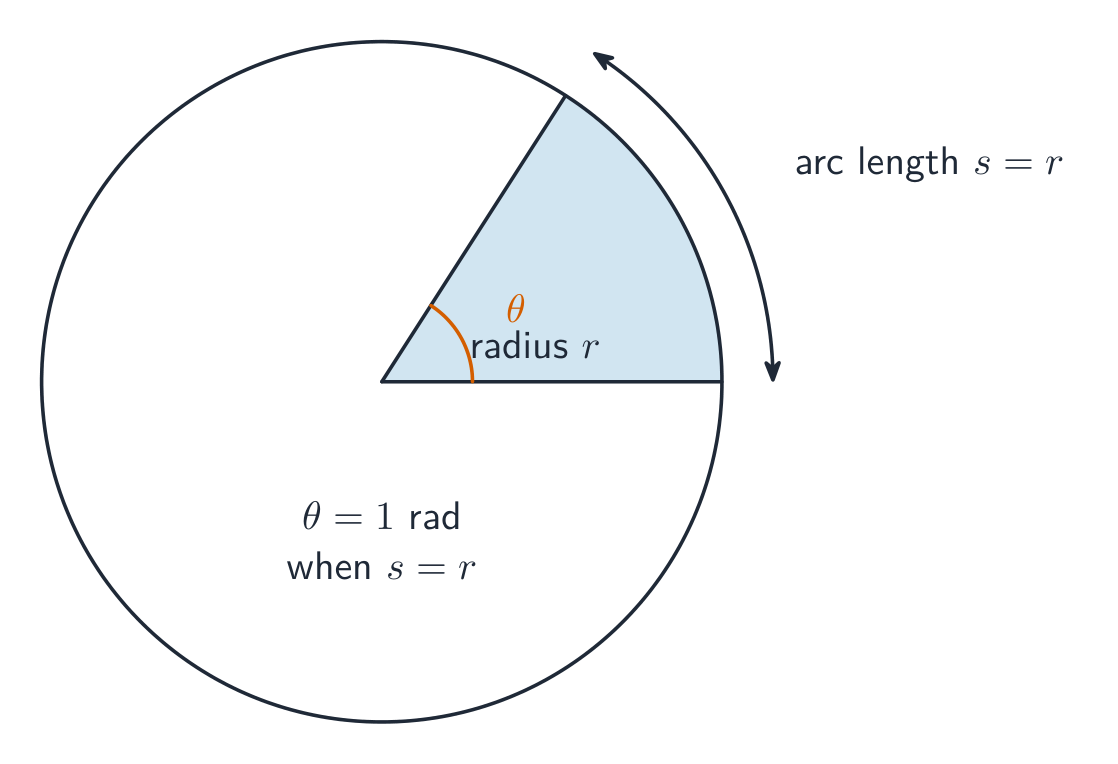
- 5.1.A.1 Angular displacement is the measurement of the angle, in radians, through which a point on a rigid system rotates about a specified axis.
- Equation: $\Delta\theta = \theta - \theta_0$
- 5.1.A.1.i A rigid system is one that holds its shape but in which different points on the system move in different directions during rotation. A rigid system cannot be modeled as an object.
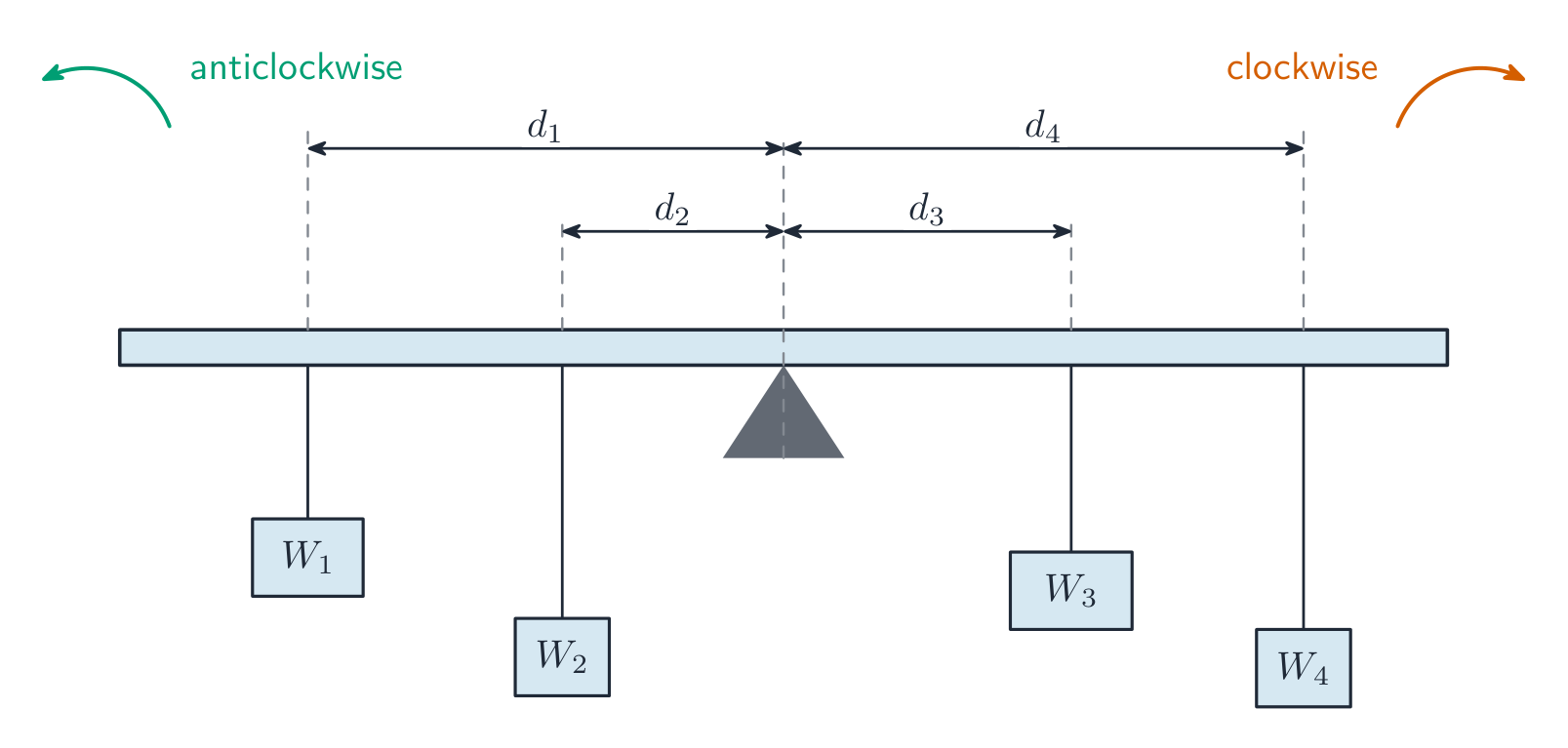
- 5.1.A.1.ii One direction of angular displacement about an axis of rotation—clockwise or counterclockwise—is typically indicated as mathematically positive, with the other direction becoming mathematically negative.
- 5.1.A.1.iii If the rotation of a system about an axis may be well described using the motion of the system's center of mass, the system may be treated as a single object. For example, the rotation of Earth about its axis may be considered negligible when considering the revolution of Earth about the center of mass of the Earth–Sun system.
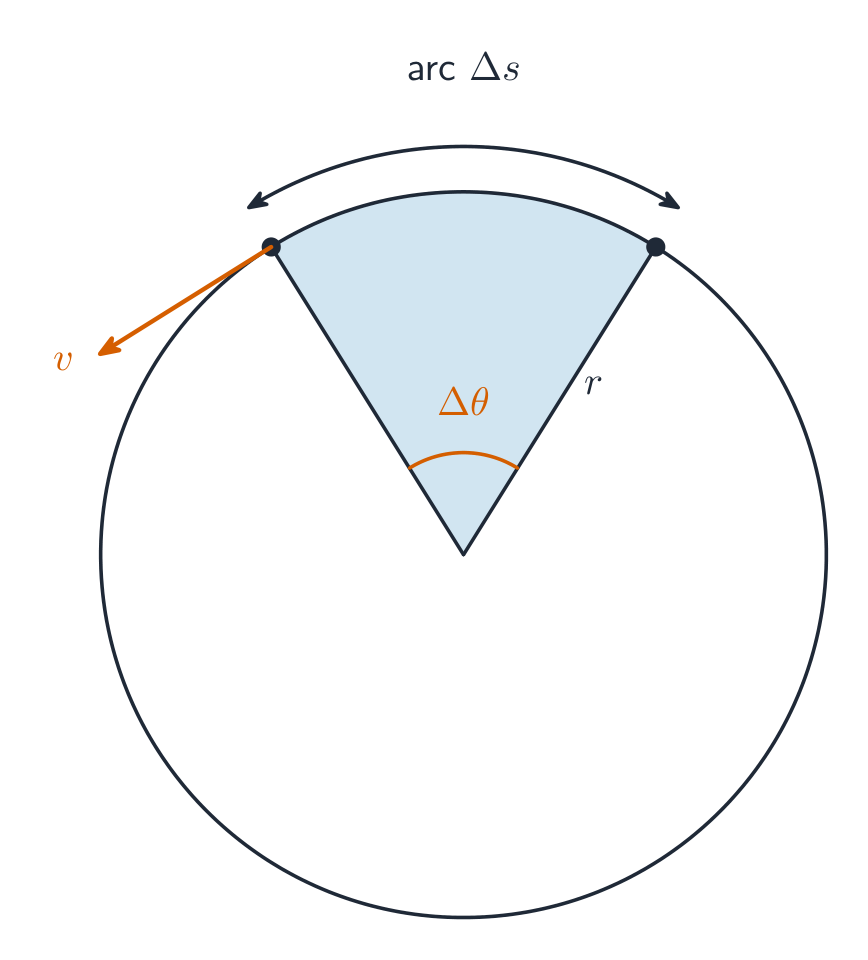
- 5.1.A.2 Average angular velocity is the average rate at which angular position changes with respect to time.
- Equation: $\omega_{\text{avg}} = \dfrac{\Delta\theta}{\Delta t}$
- 5.1.A.3 Average angular acceleration is the average rate at which the angular velocity changes with respect to time.
- Equation: $\alpha_{\text{avg}} = \dfrac{\Delta\omega}{\Delta t}$
- 5.1.A.4 Angular displacement, angular velocity, and angular acceleration around one axis are analogous to linear displacement, velocity, and acceleration in one dimension and demonstrate the same mathematical relationships.
- 5.1.A.4.i For constant angular acceleration, the mathematical relationships between angular displacement, angular velocity, and angular acceleration can be described with the following equations:
- Equation: $\omega = \omega_0 + \alpha t$
- Equation: $\theta = \theta_0 + \omega_0 t + \dfrac{1}{2}\alpha t^2$
- Equation: $\omega^2 = \omega_0^2 + 2\alpha(\theta - \theta_0)$
- 5.1.A.4.ii Graphs of angular displacement, angular velocity, and angular acceleration as functions of time can be used to find the relationships between those quantities.
- 5.1.A.4.i For constant angular acceleration, the mathematical relationships between angular displacement, angular velocity, and angular acceleration can be described with the following equations:
Boundary statement: Descriptions of the directions of rotation for a point or object are limited to clockwise and counterclockwise with respect to a given axis of rotation.
ไทย
วัตถุประสงค์การเรียนรู้ 5.1.A: อธิบายการหมุนของระบบเทียบกับเวลาโดยใช้การกระจัดเชิงมุม ความเร็วเชิงมุม และความเร่งเชิงมุม
- 5.1.A.1 การกระจัดเชิงมุมคือขนาดของมุมในหน่วยเรเดียน ที่จุดหนึ่งบนระบบแข็งหมุนรอบแกนที่กำหนด
- สมการ: $\Delta\theta = \theta - \theta_0$
- 5.1.A.1.i ระบบแข็งคือระบบที่รักษารูปทรงไว้ได้แต่จุดต่างๆ บนระบบเคลื่อนที่ไปในทิศทางที่แตกต่างกันระหว่างการหมุน ระบบแข็งไม่สามารถจำลองเป็นวัตถุเดี่ยวได้
- 5.1.A.1.ii ทิศทางหนึ่งของการกระจัดเชิงมุมรอบแกนหมุน—ตามทเข็มนาฬิกาหรือทวนทเข็มนาฬิกา—มักถูกกำหนดให้เป็นค่าบวกทางคณิตศาสตร์ โดยทิศทางอีกด้านจะเป็นค่าลบทางคณิตศาสตร์
- 5.1.A.1.iii หากการหมุนของระบบรอบแกนสามารถอธิบายได้ดีด้วยการเคลื่อนที่ของศูนย์กลางมวลของระบบ ระบบสามารถพิจารณาเป็นวัตถุเดียวได้ ตัวอย่างเช่น การหมุนของโลก حولตัวเองอาจถูกละเลยเมื่อพิจารณาถึงการโคจรของโลกรอบศูนย์กลางมวลของระบบโลก-ดวงอาทิตย์
- 5.1.A.2 ความเร็วเชิงมุมเฉลี่ยคืออัตราเฉลี่ยที่ตำแหน่งเชิงมุมเปลี่ยนแปลงเทียบกับเวลา
- สมการ: $\omega_{\text{avg}} = \dfrac{\Delta\theta}{\Delta t}$
- 5.1.A.3 ความเร่งเชิงมุมเฉลี่ยคืออัตราเฉลี่ยที่ความเร็วเชิงมุมเปลี่ยนแปลงเทียบกับเวลา
- สมการ: $\alpha_{\text{avg}} = \dfrac{\Delta\omega}{\Delta t}$
- 5.1.A.4 การกระจัดเชิงมุม ความเร็วเชิงมุม และความเร่งเชิงมุมรอบแกนหนึ่งมีความคล้ายคลึงกับการกระจัดเชิงเส้น ความเร็ว และ ความเร่ง ในหนึ่งมิติ และแสดงความสัมพันธ์ทางคณิตศาสตร์เดียวกัน
- 5.1.A.4.i สำหรับความเร่งเชิงมุมคงที่ ความสัมพันธ์ทางคณิตศาสตร์ระหว่างการกระจัดเชิงมุม ความเร็วเชิงมุม และความเร่งเชิงมุมสามารถอธิบายได้ด้วยสมการต่อไปนี้:
- สมการ: $\omega = \omega_0 + \alpha t$
- สมการ: $\theta = \theta_0 + \omega_0 t + \dfrac{1}{2}\alpha t^2$
- สมการ: $\omega^2 = \omega_0^2 + 2\alpha(\theta - \theta_0)$
- 5.1.A.4.ii กราฟของการกระจัดเชิงมุม ความเร็วเชิงมุม และความเร่งเชิงมุมในฐานะฟังก์ชันของเวลาสามารถใช้เพื่อหาความสัมพันธ์ระหว่างปริมาณเหล่านั้นได้
- 5.1.A.4.i สำหรับความเร่งเชิงมุมคงที่ ความสัมพันธ์ทางคณิตศาสตร์ระหว่างการกระจัดเชิงมุม ความเร็วเชิงมุม และความเร่งเชิงมุมสามารถอธิบายได้ด้วยสมการต่อไปนี้:
คำชี้แจงขอบเขต: คำอธิบายทิศทางการหมุนสำหรับจุดหรือวัตถุจำกัดอยู่เฉพาะตามทเข็มนาฬิกาและทวนทเข็มนาฬิกาเทียบกับแกนหมุนที่กำหนดเท่านั้น