Skip to content · ⁨ข้ามไปยังเนื้อหา⁩

Longer Fiction or Drama II · ⁨เรื่องยาวหรือละคร II⁩

AP English Literature and Composition · ⁨AP วรรณกรรมและบทวิเคราะห์เชิงลึก⁩ · Topic 6 · ⁨หัวข้อ 6⁩

Video lesson for this topic · ⁨บทเรียนวิดีโอสำหรับหัวข้อนี้⁩ Open the video page · ⁨เปิดหน้าวิดีโอ⁩
9:35

หน่วยที่ 6: เรื่องยาวหรือละคร II

หน่วยที่ 6 เป็นหน่วยเรื่องยาวหรือละครครั้งที่สอง และเพิ่มเครื่องมือที่ซับซ้อนที่สุดในหลักสูตรสองอย่าง: ความน่าเชื่อถือของนักเล่านิทาน และสัญลักษณ์ มันเปิด...

English narration · English + 中文 subtitles burned in · ⁨การบรรยายภาษาอังกฤษ · คำบรรยายภาษาอังกฤษ + 中文 ลอยตัวบนภาพ⁩

6.1

What Textual Details Reveal About a Character · ⁨รายละเอียดทางภาษาเปิดเผยเกี่ยวกับตัวละครอย่างไร⁩

Syllabus · ⁨หลักสูตร⁩
English

Enduring Understanding (CHR-1): Characters in literature allow readers to study and explore a range of values, beliefs, assumptions, biases, and cultural norms represented by those characters.

Learning Objective 1.A: Identify and describe what specific textual details reveal about a character, that character’s perspective, and that character’s motives.

  • CHR-1.T Different character, narrator, or speaker perspectives often reveal different information, develop different attitudes, and influence different interpretations of a text and the ideas in it.
ไทย

ความเข้าใจที่ยั่งยืน (CHR-1): ตัวละครในวรรณกรรมช่วยให้ผู้อ่านศึกษาและสำรวจค่าต่างๆ ความเชื่อ สมมติฐาน อคติ และบรรทัดฐานทางวัฒนธรรมที่ตัวละครเหล่านั้นสะท้อนออกมา

วัตถุประสงค์การเรียนรู้ 1.A: ระบุและอธิบายว่ารายละเอียดเฉพาะจากข้อความบอกอะไรเกี่ยวกับตัวละคร มุมมองของตัวละคร และแรงจูงใจของตัวละครนั้น

  • CHR-1.T มุมมองที่แตกต่างกันของตัวละคร ผู้เล่านิทาน หรือผู้พูด มักจะเปิดเผยข้อมูลที่แตกต่างกัน พัฒนาทัศนคติที่แตกต่างกัน และส่งผลต่อการตีความข้อความและแนวคิดต่าง ๆ ในข้อความอย่างแตกต่างกัน
Source: College Board AP Course and Exam Description · ⁨แหล่งที่มา: คำอธิบายหลักสูตรและข้อสอบ College Board AP⁩

English

Unit 6 is the second longer-fiction-or-drama unit and it adds the two most sophisticated tools in the course: narrator reliability and the symbol.

Different character, narrator, or speaker perspectives often reveal different information and develop different interpretations of the same events.

In a long work with several perspectives, the discrepancies between them are not a problem to reconcile. They are the text's method.

ไทย

หน่วยที่ 6 เป็นหน่วยเรื่องนิยายหรือละครที่ยาวกว่าหน่วยที่สอง และเพิ่มเครื่องมือที่ซับซ้อนที่สุดในหลักสูตรสองอย่าง: ความน่าเชื่อถือของ narrator และ สัญลักษณ์

มุมมองที่แตกต่างกันของตัวละคร narrator หรือผู้บรรยาย มักเปิดเผยข้อมูลที่แตกต่างกัน และพัฒนาการตีความที่แตกต่างของเหตุการณ์เดียวกัน

ในงานยาวที่มีหลายมุมมอง ความขัดแย้งระหว่างพวกมันไม่ใช่ปัญหาที่ต้องแก้ให้เข้ากัน它们是文本的方法

6.2

The Function of Contrasting Characters · ⁨หน้าที่ของตัวละครที่เปรียบเทียบกัน⁩

Syllabus · ⁨หลักสูตร⁩
English

Enduring Understanding (CHR-1): Characters in literature allow readers to study and explore a range of values, beliefs, assumptions, biases, and cultural norms represented by those characters.

Learning Objective 1.C: Explain the function of contrasting characters.

  • CHR-1.U Foil characters (foils) serve to illuminate, through contrast, the traits, attributes, or values of another character.
ไทย

ความเข้าใจที่ยั่งยืน (CHR-1): ตัวละครในวรรณกรรมช่วยให้ผู้อ่านศึกษาและสำรวจค่าต่างๆ ความเชื่อ สมมติฐาน อคติ และบรรทัดฐานทางวัฒนธรรมที่ตัวละครเหล่านั้นสะท้อนออกมา

วัตถุประสงค์การเรียนรู้ 1.C: อธิบายฟังก์ชันของตัวละครที่ตรงข้ามกัน

  • CHR-1.U ตัวละครที่เป็น foil (foils) ทำหน้าที่เปิดเผย characteristics, attributes, or values ของตัวละครอื่นผ่านการเปรียบเทียบ

Source: College Board AP Course and Exam Description · ⁨แหล่งที่มา: คำอธิบายหลักสูตรและข้อสอบ College Board AP⁩

English

Foil characters 陪衬人物 serve to illuminate, through contrast, the traits, attributes, or values of another character.

A foil is not an antagonist. A foil may be an ally, a sibling, a friend - what makes them a foil is that they are similar enough for the difference to be visible. The useful question is always: what does this character have that the protagonist lacks, and what does the text do with that gap?

ไทย

ตัวละครเสริม (Foil characters) 陪衬人物 ทำหน้าที่ ส่องสว่าง ผ่านการเปรียบเทียบที่ตรงข้าม, ลักษณะ的属性或价值观 ของตัวละครอีกคน

Foil ไม่ใช่อันติโกน Foliator อาจเป็นพันธมิตร พี่น้อง หรือเพื่อน - สิ่งที่ทำให้他们是 foil คือพวกเขามีความคล้ายคลึงกันพอที่จะเห็นความแตกต่างได้ คำถามที่มีประโยชน์คือเสมอว่า: ตัวละครนี้มีอะไรที่主角ขาดไป และข้อความใช้ช่องว่างนั้นทำอะไร?

Vocabulary · ⁨คำศัพท์⁩ Train · ⁨ฝึกฝน⁩
English ไทย
Foil characters/fɔɪl ˈkærɪktəz/ ตัวละครสะท้อน
6.3

Choices, Actions, and Speech Reveal Complexity · ⁨ตัวเลือก การกระทำ และคำพูดเผยความซับซ้อน⁩

Syllabus · ⁨หลักสูตร⁩
English

Enduring Understanding (CHR-1): Characters in literature allow readers to study and explore a range of values, beliefs, assumptions, biases, and cultural norms represented by those characters.

Learning Objective 1.E: Explain how a character’s own choices, actions, and speech reveal complexities in that character, and explain the function of those complexities.

  • CHR-1.V Inconsistencies between the private thoughts of characters and their actual behavior reveal tensions and complexities between private and professed values.
  • CHR-1.W A character’s competing, conflicting, or inconsistent choices or actions contribute to complexity in a text.
ไทย

ความเข้าใจที่ยั่งยืน (CHR-1): ตัวละครในวรรณกรรมช่วยให้ผู้อ่านศึกษาและสำรวจค่าต่างๆ ความเชื่อ สมมติฐาน อคติ และบรรทัดฐานทางวัฒนธรรมที่ตัวละครเหล่านั้นสะท้อนออกมา

วัตถุประสงค์การเรียนรู้ 1.E: อธิบายว่าตัวเลือก การกระทำ และคำพูดของตัวละครเองเปิดเผยความซับซ้อนในตัวละครนั้นอย่างไร และอธิบายหน้าที่ของความซับซ้อนเหล่านั้น

  • CHR-1.V ความไม่สอดคล้องกันระหว่างความคิดส่วนตัวของตัวละครและการกระทำจริงของพวกเขาเปิดเผยความตึงเครียดและความซับซ้อนระหว่างค่านะส่วนตัวและค่านะที่ประกาศ
  • CHR-1.W ตัวเลือกหรือการกระทำที่ขัดแย้งกัน ไม่สอดคล้องกัน หรือแข่งขันกันของตัวละครมีส่วนร่วมในความซับซ้อนของข้อความ

Source: College Board AP Course and Exam Description · ⁨แหล่งที่มา: คำอธิบายหลักสูตรและข้อสอบ College Board AP⁩

English
  • Inconsistencies between the private thoughts of characters and their actual behaviour reveal tensions.
  • A character's competing, conflicting, or inconsistent choices contribute to complexity.

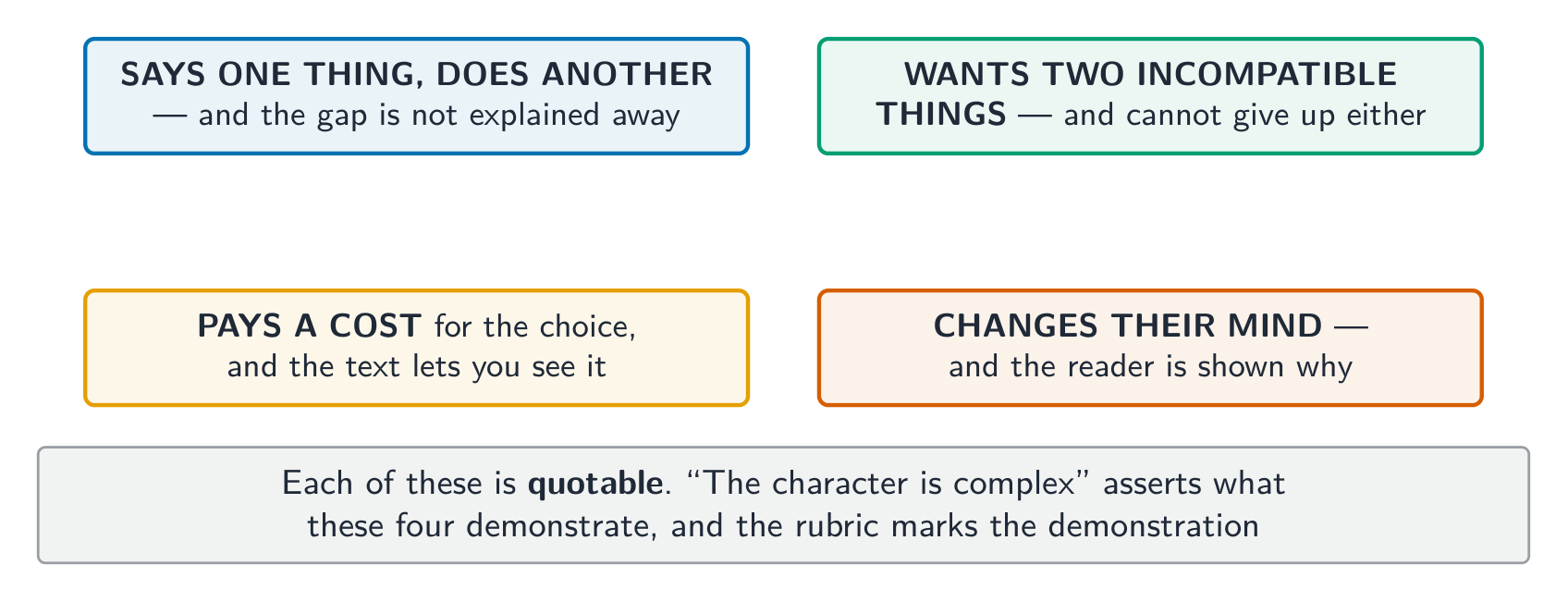
This is where AP Literature parts company with simpler reading. Inconsistency is not a flaw in a character; it is the evidence that the character has an interior. A character who always acts on what they think is a position, not a person.

ไทย
  • ความไม่สอดคล้องกันระหว่างความคิดส่วนตัวของตัวละครกับการกระทำจริงของพวกเขา เผยให้เห็นความตึงเครียด
  • ตัวเลือกที่ขัดแย้งกันหรือไม่สม่ำเสมอของตัวละคร contribute to complexity

นี่คือจุดที่ AP Literature แยกออกจาก的阅读ที่ง่ายกว่า ความไม่สอดคล้องกันไม่ใช่ข้อบกพร่องในตัวละคร; มันคือหลักฐานที่แสดงว่าตัวละครมีโลกภายใน ตัวละครที่กระทำเสมอตามสิ่งที่เขาคิดว่าเป็นตำแหน่ง ไม่ใช่ความเป็นมนุษย์

สี่รูปแบบที่ tríchutipable - rubric mark the demonstration, not the assertion
Explore · ⁨สำรวจ⁩

Find the quotable sign of complexity · ⁨ค้นหาสัญลักษณ์ของความซับซ้อนที่นำไปอ้างอิงได้⁩

The rubric marks the demonstration, not the assertion — and each of these is something you can quote. · ⁨คำแนะนำในการตอบข้อสอบชี้ให้เห็นถึงการพิสูจน์ ไม่ใช่แค่การ assertions — และทั้งสองอย่างนี้เป็นสิ่งที่คุณสามารถนำมาร้อง dikutipได้⁩

6.4

How Plot Orders Events · ⁨วิธีเรียงลำดับเหตุการณ์ของplot⁩

Syllabus · ⁨หลักสูตร⁩
English

Enduring Understanding (STR-1): The arrangement of the parts and sections of a text, the relationship of the parts to each other, and the sequence in which the text reveals information are all structural choices made by a writer that contribute to the reader’s interpretation of a text.

Learning Objective 3.A: Identify and describe how plot orders events in a narrative.

  • STR-1.X Some narrative structures interrupt the chronology of a plot; such structures include flashback, foreshadowing, in medias res, and stream of consciousness.
ไทย

ความเข้าใจที่ยั่งยืน (STR-1): การจัด arrangement ของส่วนและ section ของข้อความ ความสัมพันธ์ของส่วนต่างๆ ต่อกัน และ sequence ที่ข้อความ revealing ข้อมูล ล้วนเป็น structural choices ที่นักเขียนทำซึ่ง contribute ต่อการ interpretation ของผู้อ่านที่มีต่อข้อความ

วัตถุประสงค์การเรียนรู้ 3.A: ระบุและอธิบายว่า plot เรียงลำดับเหตุการณ์ในนิยายอย่างไร

  • STR-1.X โครงสร้างบางชนิดของนิทานหยุดชะงัก chronological ของ plot; โครงสร้างเหล่านี้รวมถึง flashback, foreshadowing, in medias res, และ stream of consciousness.

Source: College Board AP Course and Exam Description · ⁨แหล่งที่มา: คำอธิบายหลักสูตรและข้อสอบ College Board AP⁩

English

Some narrative structures interrupt the chronology of a plot: flashback 倒叙, foreshadowing 伏笔, and in medias res 从中间开始.

ไทย

บางโครงสร้างการเล่าเรื่อง ขัดจังหวะ Chronology ของplot: Flashback 倒叙, Foreshadowing 伏笔, และ In medias res 从中间开始.

Vocabulary · ⁨คำศัพท์⁩ Train · ⁨ฝึกฝน⁩
English ไทย
flashback/ˈflæʃbæk/ การย้อนกลับ
foreshadowing/fɔːˈʃædəʊɪŋ/ การบอกล่วงหน้า
in medias res/ɪn ˈmiːdiːəz rez/ การเริ่มต้นกึ่งกลางเหตุการณ์
6.5

The Function of a Sequence of Events · ⁨หน้าที่ของการเรียงลำดับเหตุการณ์⁩

Syllabus · ⁨หลักสูตร⁩
English

Enduring Understanding (STR-1): The arrangement of the parts and sections of a text, the relationship of the parts to each other, and the sequence in which the text reveals information are all structural choices made by a writer that contribute to the reader’s interpretation of a text.

Learning Objective 3.B: Explain the function of a particular sequence of events in a plot.

  • STR-1.Y Narrative structures that interrupt the chronology of a plot, such as flashback, foreshadowing, in medias res, and stream of consciousness, can directly affect readers’ experiences with a text by creating anticipation or suspense or building tension.
ไทย

ความเข้าใจที่ยั่งยืน (STR-1): การจัด arrangement ของส่วนและ section ของข้อความ ความสัมพันธ์ของส่วนต่างๆ ต่อกัน และ sequence ที่ข้อความ revealing ข้อมูล ล้วนเป็น structural choices ที่นักเขียนทำซึ่ง contribute ต่อการ interpretation ของผู้อ่านที่มีต่อข้อความ

วัตถุประสงค์การเรียนรู้ 3.B: อธิบาย function ของ sequence ของเหตุการณ์เฉพาะ在某 plot

  • STR-1.Y โครงสร้างนิทานที่หยุดชะงัก chronological ของ plot เช่น flashback, foreshadowing, in medias res, และ stream of consciousness สามารถส่งผลโดยตรงต่อประสบการณ์ของผู้อ่านกับข้อความ bằngการสร้าง anticipation หรือ suspense หรือ building tension.

Source: College Board AP Course and Exam Description · ⁨แหล่งที่มา: คำอธิบายหลักสูตรและข้อสอบ College Board AP⁩

English

Those interrupting structures affect the reader's experience of the narrative - what is known when, and therefore what is felt when.

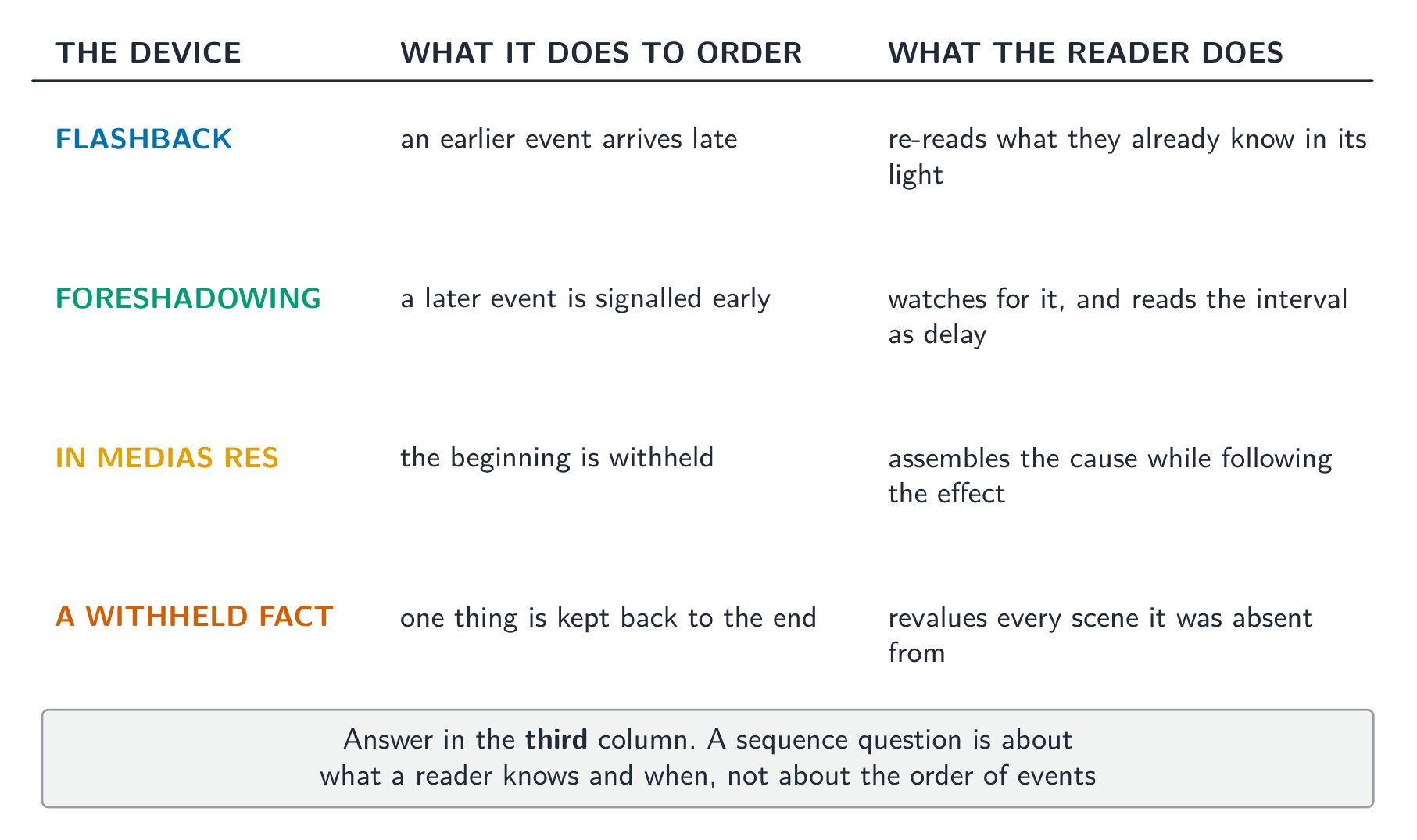
The analytical move is always to ask what the reader knows at that moment. Foreshadowing gives the reader knowledge the characters lack, which converts suspense into dread. A flashback withholds until a later point, so the earlier scenes are read twice - once in ignorance and once in retrospect.

ไทย

โครงสร้างที่ขัดจังหวะเหล่านี้ ส่งผลกระทบต่อประสบการณ์การอ่าน ของผู้อ่านเกี่ยวกับเรื่องราว - สิ่งที่รู้เมื่อไหร่ และดังนั้นสิ่งที่รู้สึกเมื่อไหร่

การวิเคราะห์คือต้องถามเสมอว่า ผู้อ่านรู้อะไรในขณะนั้น การบอกล่วงหน้า (foreshadowing) ให้ความรู้แก่ผู้อ่านที่ตัวละครไม่มี ซึ่งเปลี่ยนความตึงเครียดให้เป็นความหวาดหวั่น การย้อนกลับ (flashback) จะเก็บไว้จนกว่าจะถึงจุดที่ช้ากว่า ดังนั้นฉากก่อนหน้าจึงถูกอ่านสองครั้ง - ครั้งแรกด้วยความไม่รู้ และครั้งที่สองด้วยการทบทวน

คำตอบในคอลัมน์ที่สาม: ผู้รู้อะไร และเมื่อไหร่
Explore · ⁨สำรวจ⁩

Match each device to what the reader then does · ⁨จับคู่เครื่องมือแต่ละชนิดกับสิ่งที่ผู้อ่านจะทำต่อไป⁩

A sequence question is about what a reader knows and when, not about the order of events. · ⁨คำถามเกี่ยวกับลำดับเหตุการณ์是关于什么读者知道和何时,而不是关于事件顺序。⁩

6.6

The Function of Contrasts Within a Text · ⁨หน้าที่ของความแตกต่างภายในข้อความ⁩

Syllabus · ⁨หลักสูตร⁩
English

Enduring Understanding (STR-1): The arrangement of the parts and sections of a text, the relationship of the parts to each other, and the sequence in which the text reveals information are all structural choices made by a writer that contribute to the reader’s interpretation of a text.

Learning Objective 3.D: Explain the function of contrasts within a text.

  • STR-1.Z Contrasts often represent contradictions or inconsistencies that introduce nuance, ambiguity, or contradiction into a text. As a result, contrasts make texts more complex.
ไทย

ความเข้าใจที่ยั่งยืน (STR-1): การจัด arrangement ของส่วนและ section ของข้อความ ความสัมพันธ์ของส่วนต่างๆ ต่อกัน และ sequence ที่ข้อความ revealing ข้อมูล ล้วนเป็น structural choices ที่นักเขียนทำซึ่ง contribute ต่อการ interpretation ของผู้อ่านที่มีต่อข้อความ

จุดประสงค์การเรียนรู้ 3.D: อธิบายหน้าที่ของความแตกต่างในข้อความ

  • STR-1.Z ความขัดแย้งมักแสดงถึงความขัดแย้งหรือความไม่สอดคล้องกันที่นำความละเอียดอ่อน ความกำกวม หรือความขัดแย้งเข้าสู่ข้อความ ผล/result ทำให้ข้อความมีความซับซ้อนมากขึ้น

Source: College Board AP Course and Exam Description · ⁨แหล่งที่มา: คำอธิบายหลักสูตรและข้อสอบ College Board AP⁩

English

Contrasts often represent contradictions or inconsistencies that introduce nuance, ambiguity, or contradictory interpretations.

Note the last phrase. The CED explicitly permits a text to support more than one reading. An essay that acknowledges a competing interpretation and shows why its own is better is doing exactly what the sophistication point rewards.

ไทย

ความแตกต่างมักแสดงถึงความขัดแย้งหรือความไม่สอดคล้อง ที่ นำเสนอความละเอียดอ่อน ความคลุมเครือ หรือการตีความที่ขัดแย้งกัน

สังเกตคำสุดท้าย CED อนุญาตให้ข้อความหนึ่งรองรับการอ่านได้มากกว่าหนึ่งแบบEssay ที่ยอมรับการตีความที่แข่งขันกันและแสดงเหตุผลว่าทำไม interpretation ของตัวเองถึงดีกว่า กำลังทำสิ่งที่จุดความซับซ้อน (sophistication) ตอบรับ

6.7

Details, Diction, and Syntax Reveal Perspective · ⁨รายละเอียด, คำศัพท์ และการจัดวางประโยคเปิดเผยมุมมอง⁩

Syllabus · ⁨หลักสูตร⁩
English

Enduring Understanding (NAR-1): A narrator’s or speaker’s perspective controls the details and emphases that affect how readers experience and interpret a text.

Learning Objective 4.C: Identify and describe details, diction, or syntax in a text that reveal a narrator’s or speaker’s perspective.

  • NAR-1.P The narrator’s or speaker’s tone toward events or characters in a text influences readers’ interpretation of the ideas associated with those things.
  • NAR-1.Q The syntactical arrangement of phrases and clauses in a sentence can emphasize details or ideas and convey a narrator’s or speaker’s tone.
  • NAR-1.R Information included and/or not included in a text conveys the perspective of characters, narrators, and/ or speakers.
  • NAR-1.S A narrator’s or speaker’s perspective may influence the details and amount of detail in a text and may reveal biases, motivations, or understandings.
ไทย

ความเข้าใจที่ยั่งยืน (NAR-1): มุมมองของผู้บรรยายหรือผู้พูด controlling Details และ emphases yang affecting Cómo readers experience และ interpret ข้อความ

วัตถุประสงค์การเรียนรู้ 4.C: ระบุและอธิบายรายละเอียด คำศัพท์ หรือโครงสร้างประโยคในข้อความที่บ่งบอกมุมมองของนักเขียนหรือผู้พูด

  • NAR-1.P Tone ของผู้เล่านิทานหรือผู้พูดต่อ events หรือ characters ในข้อความส่งผลต่อการตีความ ideas ของผู้读的 associated with those things.
  • NAR-1.Q การจัดวาง syntactical ของ phrases และ clauses ในประโยคสามารถเน้น details หรือ ideas และสื่อ tone ของผู้เล่านิทานหรือผู้พูด
  • NAR-1.R ข้อมูลที่รวมอยู่หรือไม่อยู่ในข้อความสะท้อนมุมมองของตัวละคร ผู้เล่าเรื่อง และ/หรือผู้พูด
  • NAR-1.S มุมมองของผู้เล่าเรื่องหรือผู้พูดอาจส่งผลต่อรายละเอียดและปริมาณของรายละเอียดในข้อความ รวมถึงการเปิดเผยความลำเอียง ความตั้งใจ หรือความเข้าใจ

Source: College Board AP Course and Exam Description · ⁨แหล่งที่มา: คำอธิบายหลักสูตรและข้อสอบ College Board AP⁩

English
  • A narrator's or speaker's tone toward events or characters influences readers' interpretations.
  • The syntactical arrangement of phrases and clauses can emphasise details or ideas.
  • Information included and not included conveys the perspective of characters and narrators.
  • A narrator's perspective may influence the details and the amount of detail in a text.
ไทย
  • น้ำเสียงของนักบรรยายหรือผู้พูดที่มีต่อเหตุการณ์หรือตัวละครส่งผลต่อการตีความของผู้ đọc
  • การจัดวางทางไวยากรณ์ ของวลีและประโยคย่อยสามารถ เน้นรายละเอียดหรือความคิด ได้
  • ข้อมูลที่ถูกใส่เข้าไปและไม่ถูกใส่เข้ามามีส่วนในการสื่อมุมมอง ของตัวละครและนักบรรยาย
  • มุมมองของนักบรรยาย อาจส่งผลต่อรายละเอียดและปริมาณรายละเอียด ในข้อความ
6.8

How a Narrator's Reliability Affects a Narrative · ⁨ความน่าเชื่อถือของนักบรรยายส่งผลต่อบรรยายอย่างไร⁩

Syllabus · ⁨หลักสูตร⁩
English

Enduring Understanding (NAR-1): A narrator’s or speaker’s perspective controls the details and emphases that affect how readers experience and interpret a text.

Learning Objective 4.D: Explain how a narrator’s reliability affects a narrative.

  • NAR-1.T Readers can infer narrators’ biases by noting which details they choose to include in a narrative and which they choose to omit.
  • NAR-1.U Readers who detect bias in a narrator may find that narrator less reliable.
  • NAR-1.V The reliability of a narrator may influence a reader’s understanding of a character’s motives.
ไทย

ความเข้าใจที่ยั่งยืน (NAR-1): มุมมองของผู้บรรยายหรือผู้พูด controlling Details และ emphases yang affecting Cómo readers experience และ interpret ข้อความ

วัตถุประสงค์การเรียนรู้ 4.D: อธิบายว่าความน่าเชื่อถือของผู้เล่าเรื่องมีผลต่อนิทานอย่างไร

  • NAR-1.T ผู้อ่านสามารถอนุมานความลำเอียงของผู้เล่าเรื่องได้โดยสังเกตว่าเลือกที่จะรวมรายละเอียดใดไว้ในนิทานและละเว้นรายละเอียดใดไว้
  • NAR-1.U ผู้อ่านที่ตรวจจับพบความลำเอียงของผู้เล่าเรื่องอาจพบว่าผู้เล่านั้นมีความน่าเชื่อถือน้อยลง
  • NAR-1.V ความน่าเชื่อถือของผู้เล่าเรื่องอาจส่งผลต่อการเข้าใจของผู้อ่านเกี่ยวกับเจตนาของตัวละคร

Source: College Board AP Course and Exam Description · ⁨แหล่งที่มา: คำอธิบายหลักสูตรและข้อสอบ College Board AP⁩

English
  • Readers can infer narrators' biases by noting which details they choose to include and which they omit.
  • Readers who detect bias in a narrator may find that narrator less reliable.
  • The reliability of a narrator may influence a reader's understanding of a character's motives.

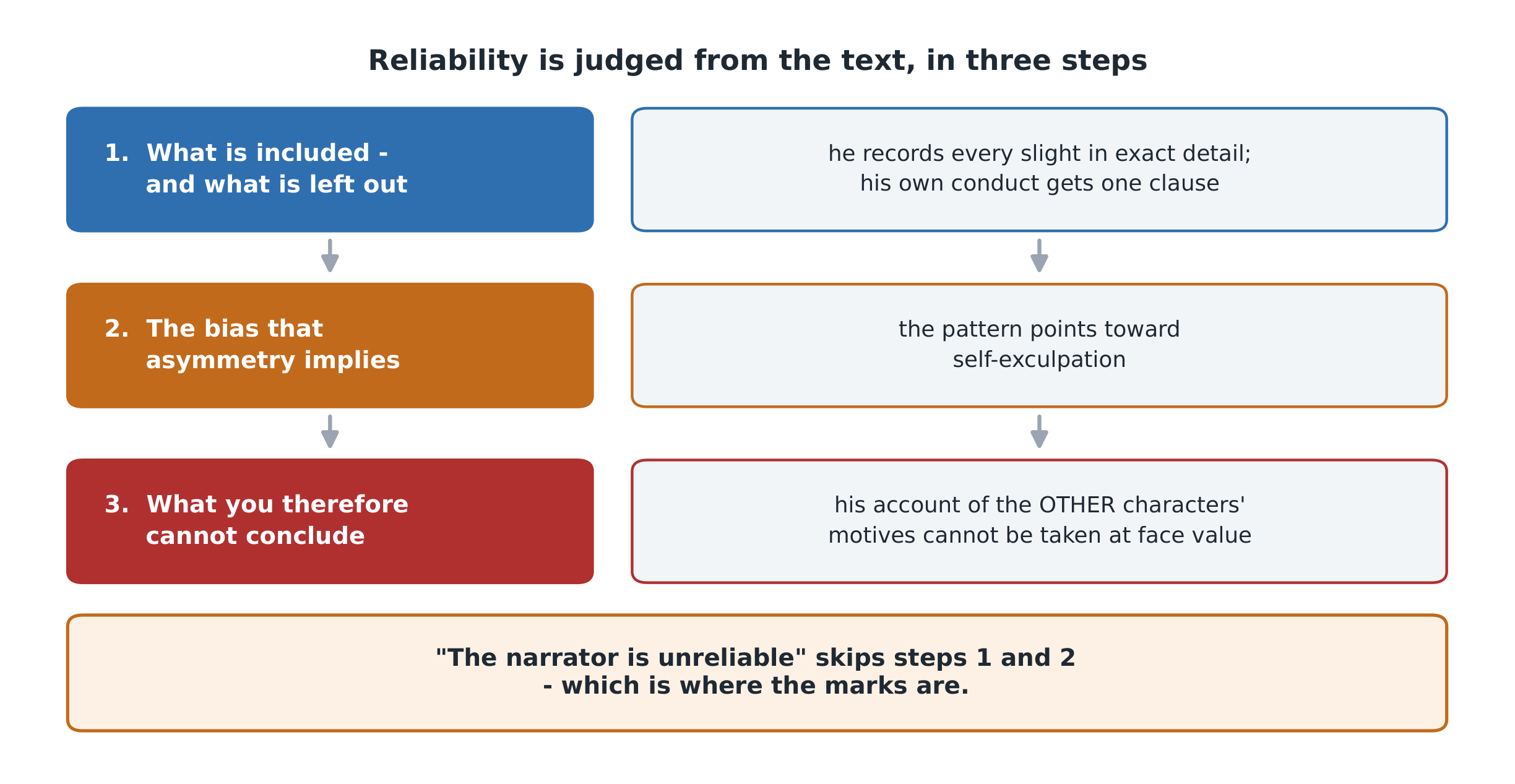
The CED gives this as a chain, and reproducing the chain is what makes an answer analytical rather than impressionistic. You do not assert that a narrator is unreliable; you show the pattern of inclusion and omission, name the bias it implies, and then say what that bias prevents you from concluding.

ไทย
วิธีการตัดสินความน่าเชื่อถือ - และการตัดสินนั้นมาจากข้อความ ไม่ใช่ความรู้สึก
ความลำเอียงถูกอนุมานจากสิ่งที่ถูกใส่และไม่ถูกใส่ ความลำเอียงที่ตรวจพบลดความน่าเชื่อถือ ความน่าเชื่อถือที่ลดลงเปลี่ยนสิ่งที่คุณสามารถสรุปเกี่ยวกับแรงจูงใจ
  • ผู้读สามารถอนุมานความลำเอียงของนักบรรยาย โดยการสังเกต รายละเอียดใดที่เขาเลือกที่จะใส่ และรายละเอียดใดที่ละเลย
  • ผู้读ที่ตรวจพบความลำเอียงในนักบรรยาย อาจพบว่านักบรรยายคนนั้นมีความน่าเชื่อถือน้อยลง
  • ความน่าเชื่อถือของตัวบรรยายอาจมีผลต่อการเข้าใจของผู้读เกี่ยวกับแรงจูงใจของตัวละคร.

CED นำเสนอสิ่งนี้เป็นห่วงโซ่ และการทำซ้ำห่วงโซ่นี้คือสิ่งที่ทำให้คำตอบเป็นการวิเคราะห์แทนที่จะเป็นเพียงความรู้สึก คุณไม่ได้ asserted ว่านักบรรยายไม่น่าเชื่อถือ;但你展示了 inclusion และ omission, ชี้ชื่อความลำเอียงที่มันบ่งชี้, แล้วบอกว่าความลำเอียงนั้นป้องกันคุณจากการสรุปอะไร

6.9

The Function of a Symbol · ⁨หน้าที่ของสัญลักษณ์⁩

Syllabus · ⁨หลักสูตร⁩
English

Enduring Understanding (FIG-1): Comparisons, representations, and associations shift meaning from the literal to the figurative and invite readers to interpret a text.

Learning Objective 5.C: Identify and explain the function of a symbol.

  • FIG-1.AA When a character comes to represent, or stand for, an idea or concept, that character becomes symbolic; some symbolic characters have become so common they are archetypal. Note: The AP Exam will not require students to identify or label archetypes.
  • FIG-1.X When a material object comes to represent, or stand for, an idea or concept, it becomes a symbol.
  • FIG-1.Y A symbol is an object that represents a meaning, so it is said to be symbolic or representative of that meaning. A symbol can represent different things depending on the experiences of a reader or the context of its use in a text.
  • FIG-1.Z Certain symbols are so common and recurrent that many readers have associations with them prior to reading a text. Other symbols are more contextualized and only come to represent certain things through their use in a particular text.
ไทย

ความเข้าใจที่ยั่งยืน (FIG-1): การเปรียบเทียบ การแสดงภาพ และการเชื่อมโยง เปลี่ยนความหมายจากตัวอักษรสู่เชิงสัญลักษณ์และชวนให้ผู้读 mx interpret ข้อความ

วัตถุประสงค์การเรียนรู้ 5.C: ระบุและอธิบายบทบาทของสัญลักษณ์

  • FIG-1.AA เมื่อตัวละครเริ่มเป็นตัวแทนหรือสื่อถึงไอเดียหรือแนวคิด ตัวละครนั้นจะกลายเป็นสัญลักษณ์; บางตัวละครที่เป็นสัญลักษณ์กลายเป็น archetype ที่พบบ่อยมาก หมายเหตุ: การสอบ AP จะไม่要求学生要求学生识别或标记archetypes。
  • FIG-1.X เมื่อวัตถุทางกายภาพเริ่มเป็นตัวแทนหรือสื่อถึงไอเดียหรือแนวคิด วัตถุนั้นจะกลายเป็นสัญลักษณ์
  • FIG-1.Y สัญลักษณ์คือวัตถุที่สื่อความหมาย ดังนั้นจึงเรียกว่ามีลักษณะเป็นสัญลักษณ์หรือเป็นตัวแทนของความหมายนั้น สัญลักษณ์สามารถสื่อถึงสิ่งต่างๆ ได้แตกต่างกันไปขึ้นอยู่กับประสบการณ์ของผู้อ่านหรือบริบทที่ใช้ในข้อความ
  • FIG-1.Z สัญลักษณ์บางชนิดพบบ่อยและซ้ำซากจนผู้อ่านจำนวนมากมีข้อเชื่อมโยงกับมันก่อนการอ่านข้อความ สัญลักษณ์อื่นๆ มีบริบทเฉพาะตัวมากขึ้นและเริ่มสื่อถึงสิ่งบางอย่างเฉพาะเมื่อถูกใช้ในข้อความ particular

Source: College Board AP Course and Exam Description · ⁨แหล่งที่มา: คำอธิบายหลักสูตรและข้อสอบ College Board AP⁩

English
  • When a material object comes to represent an idea or concept, it becomes a symbol 象征.
  • When a character comes to represent an idea, that character becomes symbolic.
  • A symbol is an object that represents a meaning, so it is said to be symbolic or representative of that meaning.
  • Certain symbols are so common and recurrent that readers bring associations to them before reading.

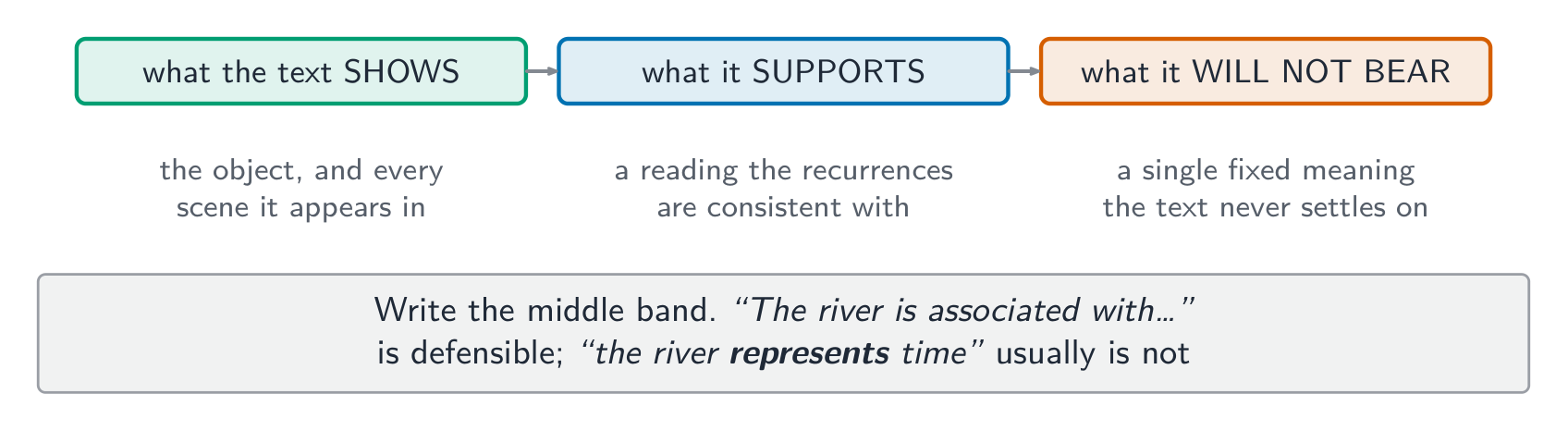
The last point is a warning. A conventional symbol arrives with meanings attached, and the text may be using them, refusing them, or inverting them. Check what the text does before importing the convention.

ไทย
  • เมื่อ วัตถุทางกายภาพ เริ่มเป็นตัวแทนของไอเดียหรือแนวคิด มันกลายเป็น สัญลักษณ์ 象征
  • เมื่อ ตัวละคร เริ่มเป็นตัวแทนของไอเดีย ตัวละครนั้นจะเป็น สัญลักษณ์
  • สัญลักษณ์คือวัตถุที่ มี nghĩaเป็นตัวแทน จึงเรียกว่าเป็นสัญลักษณ์หรือเป็นตัวแทนของความหมายนั้น
  • สัญลักษณ์บางชนิดมีอยู่ทั่วไปและปรากฏบ่อย จนผู้读นำการเชื่อมโยงมาพร้อมกับมันก่อนอ่าน

จุดสุดท้ายคือการเตือน符号 conventional symbol arriving with meanings attached, and the text may be using them, refusing them, or inverting them. Check what the text does before importing the convention.

เขียนแถบตรงกลาง - 'is associated with' สามารถใช้ได้ในกรณีที่คุณ 'represents' ไม่สามารถใช้ได้
Vocabulary · ⁨คำศัพท์⁩ Train · ⁨ฝึกฝน⁩
English ไทย
symbol/ˈsɪmbl/ สัญลักษณ์ (Symbol)
6.10 6.11 6.12

Developing a Literary Thesis, Commentary, and Evidence · ⁨การพัฒนา Thesis, Commentary และหลักฐานทางวรรณกรรม⁩

Syllabus · ⁨หลักสูตร⁩
English

Enduring Understanding (LAN-1): Readers establish and communicate their interpretations of literature through arguments supported by textual evidence.

Learning Objective 7.B: Develop a thesis statement that conveys a defensible claim about an interpretation of literature and that may establish a line of reasoning.

  • LAN-1.D A thesis statement expresses an interpretation of a literary text, and requires a defense, through use of textual evidence and a line of reasoning, both of which are explained in an essay through commentary.
  • LAN-1.E A thesis statement may preview the development or line of reasoning of an interpretation. This is not to say that a thesis statement must list the points of an interpretation, literary elements to be analyzed, or specific evidence to be used in the argument.
ไทย

ความเข้าใจที่ยั่งยืน (LAN-1): ผู้_read者确立并传达对文学作品的解读,通过有文本证据支持的论证。

วัตถุประสงค์การเรียนรู้ 7.B: พัฒนาประโยค luậnะที่แสดงข้ออ้างที่ป้องกันได้เกี่ยวกับการตีความวรรณกรรมและอาจกำหนดเส้นทางการให้เหตุผล

  • LAN-1.D ประโยค论点จุดเด่นแสดงการตีความข้อความทางวรรณกรรม และต้องการการปกป้อง通过使用文本证据和推理,两者都在文章中通过评论来解释。
  • LAN-1.E ประโยค luậnะอาจแสดงการพัฒนาหรือเส้นทางการให้เหตุผลของการตีความ นี่ไม่ได้หมายความว่าประโยค luậnะต้องระบุจุดของการตีความ องค์ประกอบทางวรรณกรรมที่จะวิเคราะห์ หรือหลักฐานเฉพาะที่จะใช้ในข้อโต้แย้ง
English

Enduring Understanding (LAN-1): Readers establish and communicate their interpretations of literature through arguments supported by textual evidence.

Learning Objective 7.C: Develop commentary that establishes and explains relationships among textual evidence, the line of reasoning, and the thesis.

  • LAN-1.F A line of reasoning is the logical sequence of claims that work together to defend the overarching thesis statement.
  • LAN-1.G A line of reasoning is communicated through commentary that explains the logical relationship between the overarching thesis statement and the claims/evidence within the body of an essay.
ไทย

ความเข้าใจที่ยั่งยืน (LAN-1): ผู้_read者确立并传达对文学作品的解读,通过有文本证据支持的论证。

วัตถุประสงค์การเรียนรู้ 7.C: พัฒนาคำอธิบายเชิงวิเคราะห์ที่สร้างและอธิบายความสัมพันธ์ระหว่างหลักฐานจากข้อความ เส้นทางการให้เหตุผล และประโยค luậnะ

  • LAN-1.F เส้นทางการให้เหตุผลคือลำดับตรรกะของข้ออ้างที่ทำงานร่วมกันเพื่อปกป้องประโยค luậnะหลัก
  • LAN-1.G เส้นทางการให้เหตุผลจะถูกสื่อสารผ่านคำอธิบายเชิงวิเคราะห์ที่อธิบายความสัมพันธ์เชิงตรรกะระหว่างประโยค luậnะหลักกับข้ออ้าง/หลักฐานภายในเนื้อหาบทความ
English

Enduring Understanding (LAN-1): Readers establish and communicate their interpretations of literature through arguments supported by textual evidence.

Learning Objective 7.D: Select and use relevant and sufficient evidence to both develop and support a line of reasoning.

  • LAN-1.H Writers use evidence strategically and purposefully to illustrate, clarify, exemplify, associate, amplify, or qualify a point.
  • LAN-1.I Evidence is effective when the writer of the essay uses commentary to explain a logical relationship between the evidence and the claim.
  • LAN-1.J Evidence is sufficient when its quantity and quality provide apt support for the line of reasoning.
  • LAN-1.K Developing and supporting an interpretation of a text is a recursive process; an interpretation can emerge from analyzing evidence and then forming a line of reasoning, or the interpretation can emerge from forming a line of reasoning and then identifying relevant evidence to support that line of reasoning.
ไทย

ความเข้าใจที่ยั่งยืน (LAN-1): ผู้_read者确立并传达对文学作品的解读,通过有文本证据支持的论证。

วัตถุประสงค์การเรียนรู้ 7.D: เลือกและใช้หลักฐานที่เกี่ยวข้องและเพียงพอเพื่อพัฒนาและสนับสนุนเส้นทางการให้เหตุผล

  • LAN-1.H ผู้เขียนใช้หลักฐานอย่างมีกลยุทธ์และมีจุดประสงค์เพื่อชี้ให้เห็น ชัดเจน ตัวอย่าง เชื่อมโยง ขยาย หรือจำกัดข้อ某一个点
  • LAN-1.I หลักฐานมีประสิทธิภาพเมื่อผู้เขียนบทความใช้คำอธิบายเชิงวิเคราะห์เพื่ออธิบายความสัมพันธ์เชิงตรรกะระหว่างหลักฐานกับข้ออ้าง
  • LAN-1.J หลักฐานมีเพียงพอเมื่อปริมาณและคุณภาพของมันให้การสนับสนุนที่เหมาะสมสำหรับเส้นทางการให้เหตุผล
  • LAN-1.K การพัฒนาและสนับสนุนการตีความข้อความเป็นกระบวนการที่วนซ้ำ; การตีความสามารถเกิดขึ้นจากการวิเคราะห์หลักฐานแล้วสร้างเส้นทางการให้เหตุผล หรือการตีความสามารถเกิดขึ้นจากการสร้างเส้นทางการให้เหตุผลแล้วระบุหลักฐานที่เกี่ยวข้องเพื่อสนับสนุนเส้นทางการให้เหตุผลนั้น

Source: College Board AP Course and Exam Description · ⁨แหล่งที่มา: คำอธิบายหลักสูตรและข้อสอบ College Board AP⁩

English

Unchanged from Units 3-5: an interpretation requiring textual defence; a line of reasoning of claims communicated through commentary; evidence used strategically, effective with commentary, sufficient in quantity and quality, developed recursively.

ไทย

ไม่เปลี่ยนแปลงจากหน่วยที่ 3-5:一个 interpretation requiring textual defence; a line of reasoning of claims communicated through commentary; evidence used strategically, effective with commentary, sufficient in quantity and quality, developed recursively.

6.13

Control Over the Elements of Composition · ⁨การควบคุมองค์ประกอบการเขียน⁩

Syllabus · ⁨หลักสูตร⁩
English

Enduring Understanding (LAN-1): Readers establish and communicate their interpretations of literature through arguments supported by textual evidence.

Learning Objective 7.E: Demonstrate control over the elements of composition to communicate clearly.

  • LAN-1.R Writers convey their ideas in a sentence through strategic selection and placement of phrases and clauses. Writers may use coordination to illustrate a balance or equality between ideas or subordination to illustrate an imbalance or inequality.
  • LAN-1.S Writers use words that enhance the clear communication of an interpretation.
  • LAN-1.T Punctuation conveys relationships between and among parts of a sentence.
ไทย

ความเข้าใจที่ยั่งยืน (LAN-1): ผู้_read者确立并传达对文学作品的解读,通过有文本证据支持的论证。

วัตถุประสงค์การเรียนรู้ 7.E: แสดงถึงการควบคุมองค์ประกอบของการประพันธ์เพื่อสื่อสารอย่างชัดเจน

  • LAN-1.R นักเขียนสื่อความคิดของตนในประโยคผ่านการเลือกและวางตำแหน่งวลีและประโยคย่อยอย่างมีกลยุทธ์ นักเขียนอาจใช้ coordination เพื่อแสดงความสมดุลหรือความเท่าเทียมกันระหว่างแนวคิด หรือใช้ subordination เพื่อแสดงความไม่สมดุลหรือไม่เท่าเทียมกัน
  • LAN-1.S นักเขียนใช้คำที่ช่วยเพิ่มประสิทธิภาพในการสื่อสารการตีความให้ชัดเจน
  • LAN-1.Tเครื่องหมายวรรคตอนสื่อถึงความสัมพันธ์ระหว่างและภายในส่วนของประโยค

Source: College Board AP Course and Exam Description · ⁨แหล่งที่มา: คำอธิบายหลักสูตรและข้อสอบ College Board AP⁩

English
  • Writers convey ideas through the strategic selection and placement of phrases and clauses.
  • Writers use words that enhance the clear communication of an interpretation.
  • Punctuation conveys relationships between parts of a sentence.

Worked example (a real AP exam task). A Question 3 literary-argument prompt asks how an unreliable narrator contributes to an interpretation of a work as a whole. A weak answer asserts: "The narrator is unreliable because he lies." A scoring answer runs the CED's chain: "The narrator records every slight he received in exact detail and summarises his own conduct in a clause - 'there was an argument, and I left'. The asymmetry of detail implies a bias toward self-exculpation, which means his account of the other characters' motives cannot be taken at face value. The novel therefore asks the reader to reconstruct a story the narrator is committed to not telling, and its subject is less the events than his need to arrange them." Inclusion and omission, the bias inferred, and what that bias prevents.

ไทย
  • นักเขียนสื่อสารความคิดผ่านการ เลือกและการวาง位置上 strategically ของ phrases และ clauses
  • นักเขียนใช้ คำที่ช่วยเพิ่มการสื่อสาร interpretation อย่างชัดเจน
  • เครื่องหมายวรรคตอนสื่อความสัมพันธ์ ระหว่างส่วนต่างๆ ของประโยค

ตัวอย่างวิธีทำ (โจทย์สอบ AP จริง). Question 3 literary-argument prompt ถามว่านักบรรยายที่ไม่น่าเชื่อถือมีส่วนช่วยในการตีความงานทั้งชิ้นอย่างไร คำตอบที่อ่อน弱的 asserting: “นักบรรยายไม่น่าเชื่อถือเพราะเขาหลอกลวง” คำตอบที่ได้คะแนนตาม chain ของ CED: “นักบรรยายบันทึกทุกความเยียดหยันที่เขาได้รับอย่างละเอียดและสรุปพฤติกรรมของตัวเองใน clause - ‘มีการเถียงกัน และฉันก็จากไป’ ความไม่สมมาตรของรายละเอียดบ่งชี้ถึงความลำเอียงเพื่อปกป้องตนเอง ซึ่งหมายความว่ารายงานของเขาเกี่ยวกับแรงจูงใจของตัวละครอื่นไม่สามารถเชื่อตามตัวอักษรได้ novel ดังนั้นจึงขอให้ผู้读สร้างเรื่องใหม่ที่นักบรรยายมุ่งมั่นจะไม่เล่า และหัวข้อของมันไม่ใช่เหตุการณ์แต่เป็นความต้องการของเขาในการจัดเรียงเหตุการณ์” Inclusion และ omission, ความลำเอียงที่อนุมาน, และสิ่งที่ความลำเอียงนั้นป้องกัน

6.13

Exam tips · ⁨ข้อแนะนำสำหรับการสอบ⁩

English
  • Discrepancies between perspectives are the method, not a problem to reconcile.
  • A foil is similar enough for the difference to show. Ask what they have that the protagonist lacks.
  • Inconsistency is evidence of an interior. A perfectly consistent character is a position, not a person.
  • For any structural interruption, ask what the reader knows at that moment. That is the effect.
  • Reliability is a chain: inclusion and omission, then bias, then what you cannot conclude. Show all three.
  • With a conventional symbol, check whether the text uses, refuses, or inverts the association before importing it.
ไทย
  • ความขัดแย้งระหว่างมุมมองคือ วิธีการ ไม่ใช่ปัญหาที่ต้องแก้
  • Foil มีความคล้ายคลึงกันพอที่จะทำให้ความแตกต่างปรากฏขึ้น ถามว่าพวกเขามีอะไรที่ protagonist ขาด
  • ความไม่สอดคล้องคือหลักฐานของภายใน ตัวละครที่สอดคล้องกันอย่างสมบูรณ์แบบคือตำแหน่งทางความคิด ไม่ใช่บุคคล
  • สำหรับ每一 structural interruption, ask what the reader knows at that moment. That is the effect.
  • ความน่าเชื่อถือคือ chain: inclusion และ omission, แล้วความลำเอียง, แล้วสิ่งที่ไม่สามารถสรุปได้ Show all three.
  • กับ conventional symbol, ตรวจสอบว่าข้อความ使用该, refuse, หรือ invert association ก่อน import

Interactive lessons on this topic · ⁨บทเรียนเชิงโต้ตอบสำหรับหัวข้อนี้⁩

Work through it step by step, with instant-check exercises. · ⁨ทำทีละขั้นตอน พร้อมแบบฝึกหัดตรวจสอบผลทันที⁩

Past Papers · ⁨ข้อสอบย้อนหลัง⁩

More topics in AP English Literature and Composition · ⁨AP วรรณกรรมและบทวิเคราะห์เชิงลึก⁩ · ⁨หัวข้อเพิ่มเติมใน AP English Literature and Composition · ⁨AP วรรณกรรมและบทวิเคราะห์เชิงลึก⁩⁩

Log in or create account · ⁨เข้าสู่ระบบหรือสร้างบัญชี⁩

IGCSE, A-Level & AP