Skip to content · ⁨ข้ามไปยังเนื้อหา⁩

Equilibrium · ⁨สมดุล⁩

AP Chemistry · Topic 7 · ⁨หัวข้อ 7⁩

Video lesson for this topic · ⁨บทเรียนวิดีโอสำหรับหัวข้อนี้⁩ Open the video page · ⁨เปิดหน้าวิดีโอ⁩
8:24

สมดุล

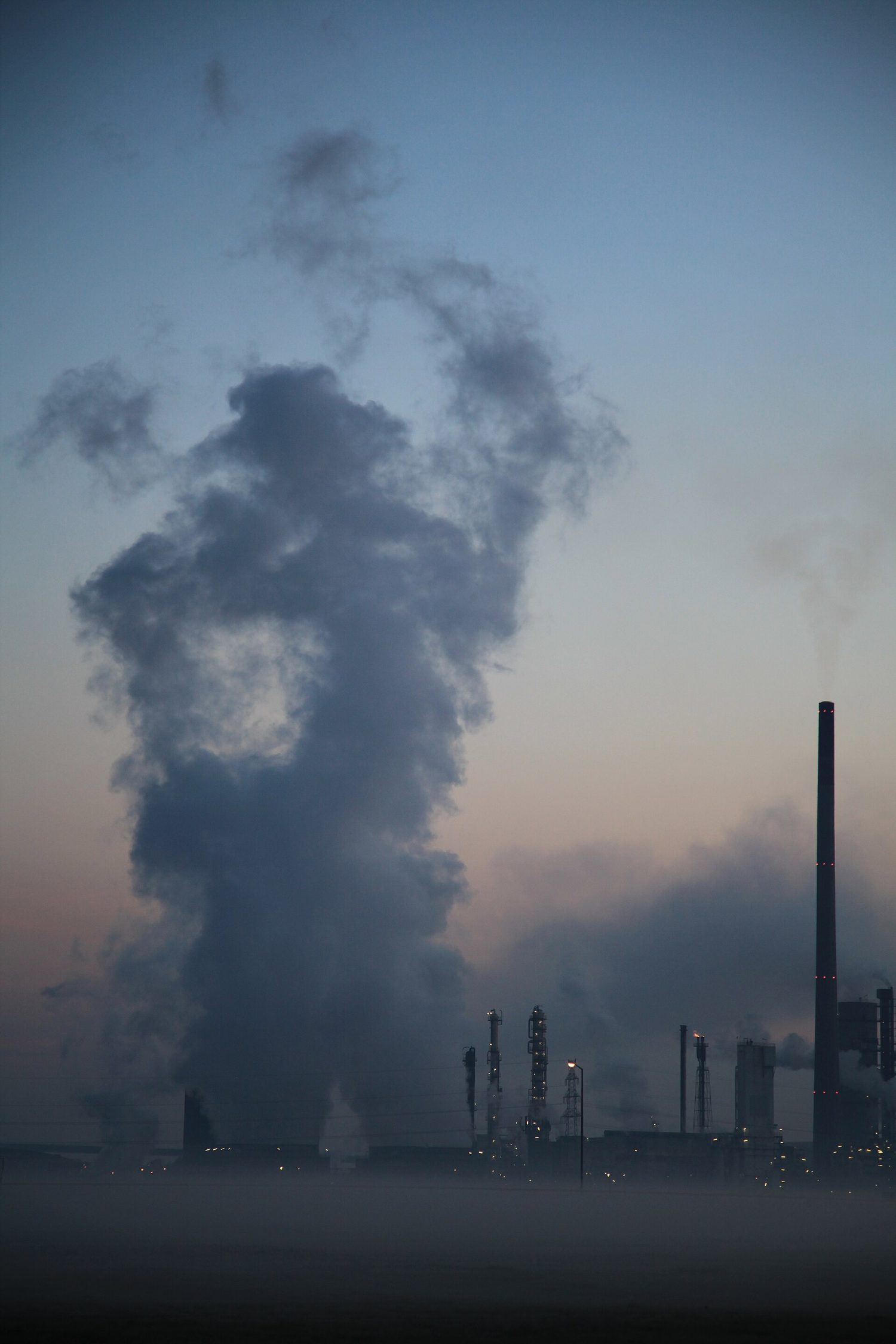
โรงงานเคมีในช่วงพลบค่ำ. ภายในนั้น ไนโตรเจนจากอากาศถูกเปลี่ยนเป็นแอมโมเนีย — ปุ๋ยที่เลี้ยงดูคนประมาณครึ่งหนึ่งของโลกในปัจจุบัน. แต่…

English narration · English + 中文 subtitles burned in · ⁨การบรรยายภาษาอังกฤษ · คำบรรยายภาษาอังกฤษ + 中文 ลอยตัวบนภาพ⁩

7.1

Introduction to Equilibrium · ⁨บทนำสู่สมดุลเคมี⁩

Syllabus · ⁨หลักสูตร⁩
English

Learning Objective 7.1.A: Explain the relationship between the occurrence of a reversible chemical or physical process, and the establishment of equilibrium, to experimental observations.

  • 7.1.A.1 Many observable processes are reversible. Examples include evaporation and condensation of water, absorption and desorption of a gas, or dissolution and precipitation of a salt. Some important reversible chemical processes include the transfer of protons in acid-base reactions and the transfer of electrons in redox reactions.
  • 7.1.A.2 When equilibrium is reached, no observable changes occur in the system. Reactants and products are simultaneously present, and the concentrations or partial pressures of all species remain constant.
  • 7.1.A.3 The equilibrium state is dynamic. The forward and reverse processes continue to occur at equal rates, resulting in no net observable change.
  • 7.1.A.4 Graphs of concentration, partial pressure, or rate of reaction versus time for simple chemical reactions can be used to understand the establishment of chemical equilibrium.
ไทย

จุดประสงค์การเรียนรู้ 7.1.A: อธิบายความสัมพันธ์ระหว่างการเกิดขึ้นของกระบวนการทางเคมีหรือฟิสิกส์ที่ย้อนกลับได้ และการเกิดสมดุล กับผลการทดลองที่สังเกตได้

  • 7.1.A.1 กระบวนการที่สังเกตได้อาจย้อนกลับได้หลายอย่าง ตัวอย่างเช่น การระเหยและการควบแน่นของน้ำ การดูดซับและการคายก๊าซ หรือการละลายและการตกตะกอนของเกลือ กระบวนการทางเคมีที่ย้อนกลับที่สำคัญบางประการรวมถึงการถ่ายโอนโปรตอนในปฏิกิริยາกรด-เบส และการถ่ายโอนอิเล็กตรอนในปฏิกิริยาออกซิเดชัน-รีดักชัน
  • 7.1.A.2 เมื่อถึงสภาวะสมดุล ไม่มีการเปลี่ยนแปลงใด ๆ ที่สังเกตได้ในระบบ สารตั้งต้นและผลิตภัณฑ์มีอยู่พร้อมกัน และความเข้มข้นหรือแรงดันย่อยของทุกสปีชีส์ยังคงที่
  • 7.1.A.3 สภาวะสมดุลมีลักษณะพลวัต กระบวนการไปข้างหน้าและย้อนกลับยังคงดำเนินต่อไปด้วยอัตราเท่ากัน ส่งผลให้ไม่มีการเปลี่ยนแปลงสุทธิที่สังเกตได้
  • 7.1.A.4 กราฟของความเข้มข้น แรงดันย่อย หรืออัตราการปฏิกิริยา เทียบกับเวลา สำหรับปฏิกิริยาเคมี đơn giản สามารถใช้เพื่อเข้าใจการเกิดขึ้นของสมดุลทางเคมี
Source: College Board AP Course and Exam Description · ⁨แหล่งที่มา: คำอธิบายหลักสูตรและข้อสอบ College Board AP⁩

English
Dynamic equilibrium

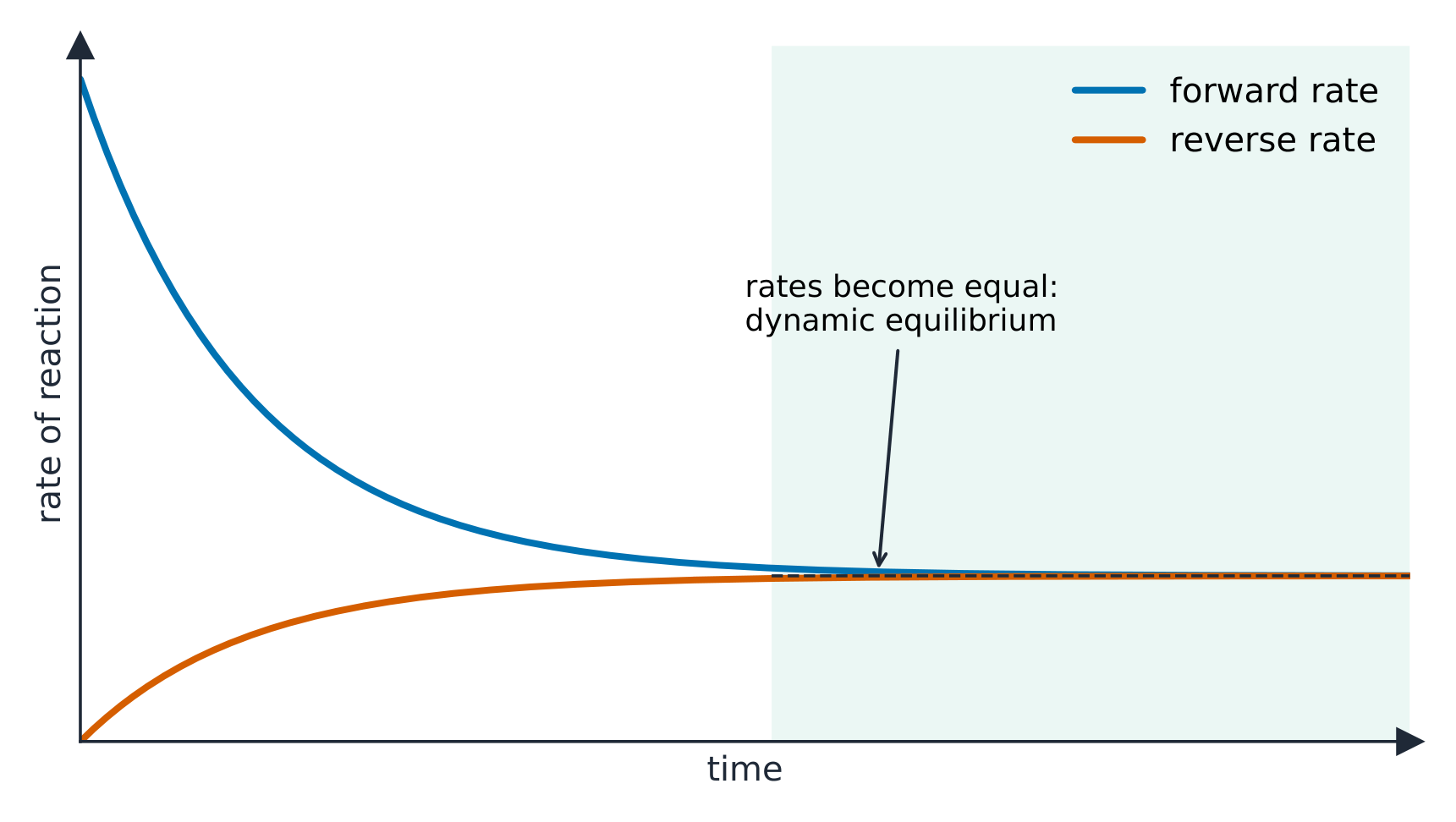
A reversible reaction 可逆反应 runs both ways. Chemical equilibrium 化学平衡 is reached when the forward and reverse rates become equal, so concentrations stop changing. Equilibrium is dynamic – both reactions continue, but at matching rates, so nothing appears to change.

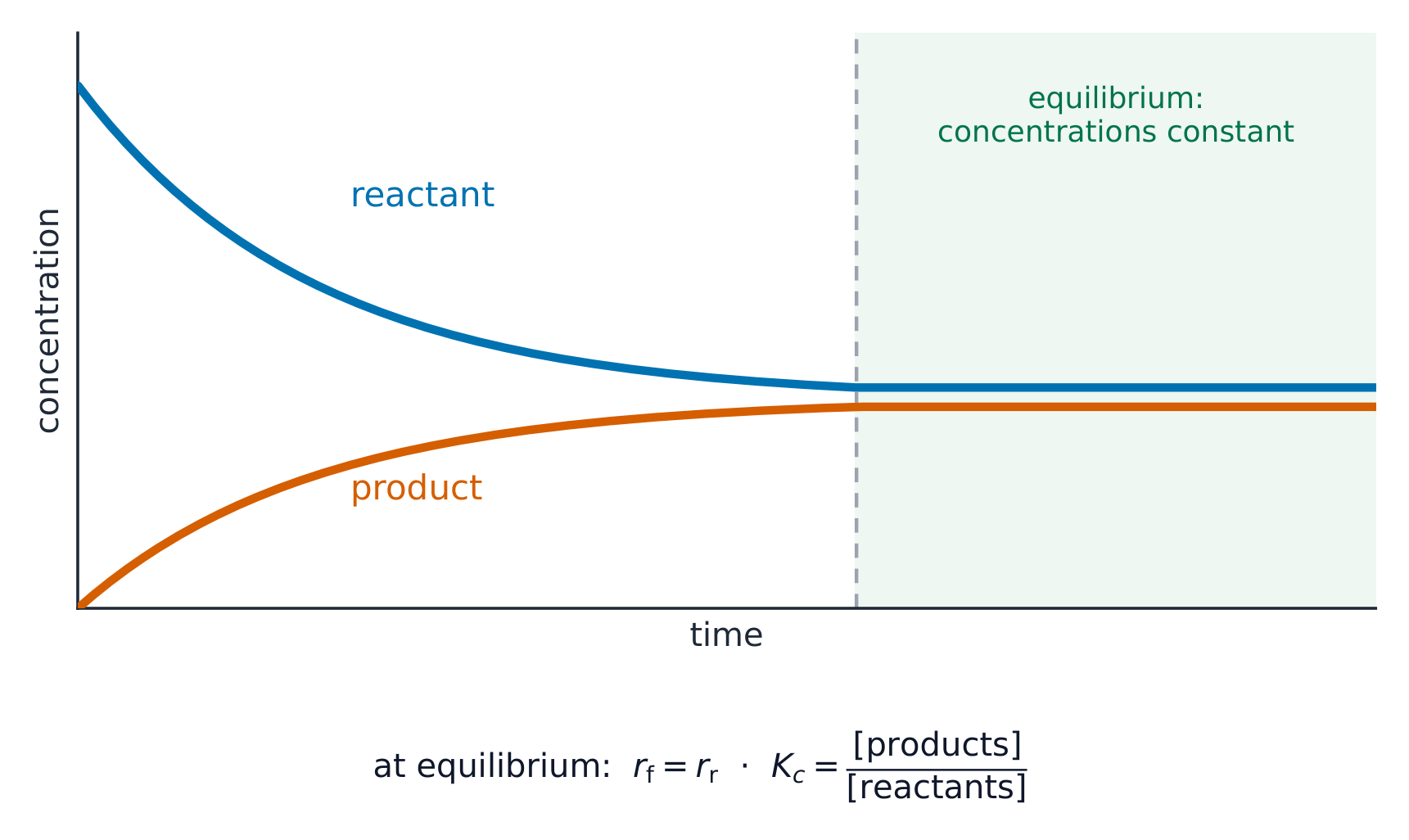
The rates graph above explains why concentrations settle; this next graph shows what the concentrations do – reactants fall and products rise until, once the rates match, both hold constant (they need not be equal).

ไทย
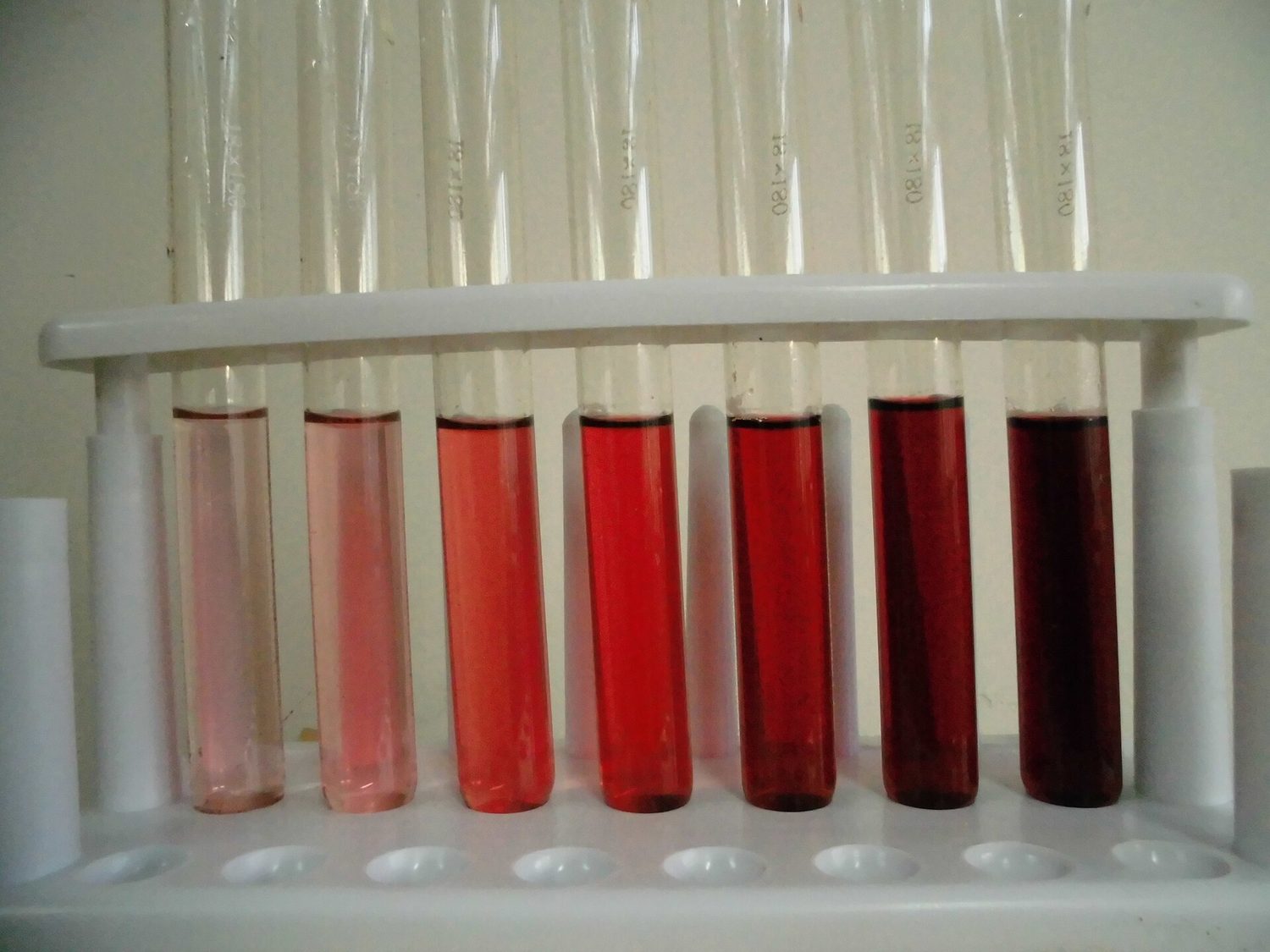
สารละลายโคบอลต์คลอไรด์: ระบบสมดุลจะเคลื่อนที่เมื่อเงื่อนไขเปลี่ยนแปลง (เลอชาเตลีย)

*สมดุลพลวัต

ปฏิกิริยาที่ย้อนกลับได้ เกิดขึ้นได้ทั้งสองทิศทาง สมดุลเคมี จะเกิดขึ้นเมื่ออัตราไปข้างหน้าและย้อนกลับ เท่ากัน ทำให้ความเข้มข้นหยุดเปลี่ยนแปลง สมดุลเป็น พลวัต – ทั้งสองปฏิกิริยากำหนดดำเนินต่อไป แต่ด้วยอัตราที่เท่ากัน จึงไม่มีการเปลี่ยนแปลงที่สังเกตเห็นได้

สมดุลพลวัต: อัตราไปข้างหน้าและย้อนกลับเท่ากัน

กราฟอัตราข้างต้นอธิบาย ว่าทำไม ความเข้มข้นจึงนิ่ง; กราฟถัดไปแสดง ว่า ความเข้มข้นทำอย่างไร – สารตั้งต้นลดลงและผลิตภัณฑ์เพิ่มขึ้นจนกว่าอัตราจะเท่ากัน แล้วทั้งสองจะคงที่ (ไม่จำเป็นต้องเท่ากัน)

ความเข้มข้นของสารตั้งต้นและผลิตภัณฑ์เปลี่ยนแปลง แล้วคงที่เมื่อถึงสมดุล
Vocabulary · ⁨คำศัพท์⁩ Train · ⁨ฝึกฝน⁩
English ไทย
reversible reaction/rɪˈvɜːsɪbl rɪˈækʃn/ ปฏิกิริยาที่ย้อนกลับได้
Chemical equilibrium/ˈkemɪkl ˌiːkwɪˈlɪbrɪəm/ สมดุลทางเคมี
reaction quotient/rɪˈækʃn ˈkwəʊʃənt/ ตัวส่วนปฏิกิริยา
equilibrium constant/ˌiːkwɪˈlɪbrɪəm ˈkɒnstənt/ ค่าคงที่สมดุล
Le Chatelier's principle/lə ˈtʃeɪtlɪəz ˈprɪnsɪpl/ หลักการของเลอชาเตอลิเยร์
solubility product/ˌsɒljuːˈbɪlɪti ˈprɒdʌkt/ ผลคูณความละลาย
7.2

Direction of Reversible Reactions · ⁨ทิศทางของปฏิกิริยาย้อนกลับได้⁩

Syllabus · ⁨หลักสูตร⁩
English

Learning Objective 7.2.A: Explain the relationship between the direction in which a reversible reaction proceeds and the relative rates of the forward and reverse reactions.

  • 7.2.A.1 If the rate of the forward reaction is greater than the reverse reaction, then there is a net conversion of reactants to products. If the rate of the reverse reaction is greater than that of the forward reaction, then there is a net conversion of products to reactants. An equilibrium state is reached when these rates are equal.
ไทย

วัตถุประสงค์การเรียนรู้ 7.2.A: อธิบายความสัมพันธ์ระหว่างทิศทางที่ปฏิกิริยาย้อนกลับดำเนินไป กับอัตราส่วนสัมพัทธ์ของปฏิกิริยาไปข้างหน้าและปฏิกิริยาย้อนกลับ

  • 7.2.A.1 หากอัตราของปฏิกิริยาไปข้างหน้ามากกว่าปฏิกิริยาย้อนกลับ จะมีผลผลิตสุทธิจากการเปลี่ยนสารตั้งต้นเป็นผลิตภัณฑ์ หากอัตราของปฏิกิริยาย้อนกลับมากกว่าปฏิกิริยาไปข้างหน้า จะมีผลผลิตสุทธิจากการเปลี่ยนผลิตภัณฑ์กลับเป็นสารตั้งต้น สภาวะสมดุลจะเกิดขึ้นเมื่ออัตรานี้เท่ากัน

Source: College Board AP Course and Exam Description · ⁨แหล่งที่มา: คำอธิบายหลักสูตรและข้อสอบ College Board AP⁩

English

At equilibrium the amounts of reactants and products are fixed but usually not equal. Whether the mixture favors products or reactants depends on the reaction; you compare the current state to the equilibrium condition to predict which way it shifts.

ไทย

ที่สมดุลปริมาณสารตั้งต้นและผลิตภัณฑ์มีค่าคงที่แต่โดยทั่วไป ไม่เท่ากัน การที่ผสมจะเอื้อต่อผลิตภัณฑ์หรือสารตั้งต้นขึ้นอยู่กับปฏิกิริยา; คุณเปรียบเทียบสถานะปัจจุบันกับสภาวะสมดุลเพื่อทำนายทิศทางการเคลื่อนที่

7.3

The Reaction Quotient and Equilibrium Constant · ⁨ตัวประกอบปฏิกิริยาและค่าคงที่สมดุล⁩

Syllabus · ⁨หลักสูตร⁩
Learning ObjectiveEssential Knowledge

7.3.A
Represent the reaction quotient $Q_c$ or $Q_p$, for a reversible reaction, and the corresponding equilibrium expressions $K_c = Q_c$ or $K_p = Q_p$.

  • 7.3.A.1 The reaction quotient $Q_c$ describes the relative concentrations of reaction species at any time. For gas phase reactions, the reaction quotient may instead be written in terms of partial pressures as $Q_p$. The reaction quotient tends toward the equilibrium constant such that at equilibrium $K_c = Q_c$ and $K_p = Q_p$. As examples, for the reaction

    $$a\,\mathrm{A} + b\,\mathrm{B} \rightleftarrows c\,\mathrm{C} + d\,\mathrm{D}$$
    the law of mass action indicates that the equilibrium expression for $(K_c, Q_c)$ is

    • Equation: $K_c = \dfrac{[\mathrm{C}]^c [\mathrm{D}]^d}{[\mathrm{A}]^a [\mathrm{B}]^b}$

    and that for $(K_p, Q_p)$ is

    • Equation: $K_p = \dfrac{(P_\mathrm{C})^c (P_\mathrm{D})^d}{(P_\mathrm{A})^a (P_\mathrm{B})^b}$
    • Exclusion statement: Conversion between $K_c$ and $K_p$ will not be assessed on the AP Exam. Students should be aware of the conceptual differences and pay attention to whether $K_c$ or $K_p$ is used in an exam question.
    • Exclusion statement: Equilibrium calculations on systems where a dissolved species is in equilibrium with that species in the gas phase will not be assessed on the AP Exam.
  • 7.3.A.2 The reaction quotient does not include substances whose concentrations (or partial pressures) are independent of the amount, such as for solids and pure liquids.

Source: College Board AP Course and Exam Description · ⁨แหล่งที่มา: คำอธิบายหลักสูตรและข้อสอบ College Board AP⁩

English

The reaction quotient 反应商 $Q$ has the same form as the equilibrium expression but uses current concentrations:

$$Q=\frac{[\text{products}]}{[\text{reactants}]}\ \text{(each raised to its coefficient)}.$$
At equilibrium $Q$ equals the equilibrium constant 平衡常数 $K$. Comparing them predicts direction: $Q shifts forward (toward products); $Q>K$ shifts reverse; $Q=K$ means already at equilibrium.

ไทย

ตัวประกอบปฏิกิริยา $Q$ มีรูปแบบเดียวกับนิพจน์สมดุลแต่ใช้ ความเข้มข้นปัจจุบัน:

$$Q=\frac{[\text{products}]}{[\text{reactants}]}\ \text{(each raised to its coefficient)}.$$
ที่สมดุล $Q$ เท่ากับ ค่าคงที่สมดุล $K$ การเปรียบเทียบช่วยทำนายทิศทาง: $Q เคลื่อนที่ ไปข้างหน้า ( toward products ); $Q>K$ เคลื่อนที่ ย้อนกลับ; $Q=K$ หมายถึงอยู่ที่สมดุลอยู่แล้ว

7.4

Calculating the Equilibrium Constant · ⁨การคำนวณค่าคงที่สมดุล⁩

Syllabus · ⁨หลักสูตร⁩
English

Learning Objective 7.4.A: Calculate $K_c$ or $K_p$ based on experimental observations of concentrations or pressures at equilibrium.

  • 7.4.A.1 Equilibrium constants can be determined from experimental measurements of the concentrations or partial pressures of the reactants and products at equilibrium.
ไทย

วัตถุประสงค์การเรียนรู้ 7.4.A: คำนวณ $K_c$ หรือ $K_p$ จากผลการทดลองของความเข้มข้นหรือแรงดันที่สภาวะสมดุล

  • 7.4.A.1 ค่าคงที่สมดุลสามารถกำหนดได้จากผลการทดลองของความเข้มข้นหรือแรงดันย่อยของสารตั้งต้นและผลิตภัณฑ์ที่สภาวะสมดุล

Source: College Board AP Course and Exam Description · ⁨แหล่งที่มา: คำอธิบายหลักสูตรและข้อสอบ College Board AP⁩

English

Write $K$ from the balanced equation (pure solids and liquids are left out). From equilibrium concentrations (or partial pressures for $K_p$), plug in and compute. $K_c$ uses molarities; $K_p$ uses pressures.

Worked example. For $\text{N}_2\text{O}_4\rightleftharpoons2\text{NO}_2$, the equilibrium concentrations are $[\text{N}_2\text{O}_4]=0.20\ \text{M}$ and $[\text{NO}_2]=0.10\ \text{M}$. Then

$$K_c=\frac{[\text{NO}_2]^2}{[\text{N}_2\text{O}_4]}=\frac{(0.10)^2}{0.20}=0.050.$$
The NO$_2$ coefficient of $2$ becomes the power; N$_2$O$_4$ (coefficient $1$) is just to the first power.

ไทย

เขียน $K$ จากสมการที่ถ่วงน้ำหนักแล้ว (ของแข็งบริสุทธิ์และของเหลวถูกตัดออก) แทนค่าความเข้มข้นที่สมดุล (หรือความดันย่อยสำหรับ $K_p$) แล้วคำนวณ $K_c$ ใช้โมลาริตี้; $K_p$ ใช้ความดัน

ตัวอย่างที่หาคำตอบแล้ว. สำหรับ $\text{N}_2\text{O}_4\rightleftharpoons2\text{NO}_2$, ความเข้มข้นที่สมดุลคือ $[\text{N}_2\text{O}_4]=0.20\ \text{M}$ และ $[\text{NO}_2]=0.10\ \text{M}$. จากนั้น

$$K_c=\frac{[\text{NO}_2]^2}{[\text{N}_2\text{O}_4]}=\frac{(0.10)^2}{0.20}=0.050.$$
สัมประสิทธิ์ NO$_2$ ของ $2$ กลายเป็นเลขชี้กำลัง; N$_2$O$_4$ (สัมประสิทธิ์ $1$) เป็นเลขชี้กำลังเพียงหนึ่ง

7.5

Magnitude of the Equilibrium Constant · ⁨ขนาดของค่าคงที่สมดุล⁩

Syllabus · ⁨หลักสูตร⁩
English

Learning Objective 7.5.A: Explain the relationship between very large or very small values of $K$ and the relative concentrations of chemical species at equilibrium.

  • 7.5.A.1 Some equilibrium reactions have very large $K$ values and proceed essentially to completion. Others have very small $K$ values and barely proceed at all.
ไทย

วัตถุประสงค์การเรียนรู้ 7.5.A: อธิบายความสัมพันธ์ระหว่างค่า非常大的หรือเล็กมากของ $K$ และความเข้มข้นสัมพัทธ์ของสปีชีส์เคมีที่สภาวะสมดุล

  • 7.5.A.1 บางปฏิกิริยามี $K$ ที่มีค่า非常大และดำเนินไปจนเกือบสมบูรณ์atie others have very small $K$ values and barely proceed at all.

Source: College Board AP Course and Exam Description · ⁨แหล่งที่มา: คำอธิบายหลักสูตรและข้อสอบ College Board AP⁩

English
  • $K\gg 1$: products strongly favored (reaction nearly complete).
  • $K\ll 1$: reactants favored (little reaction).
  • $K\approx 1$: significant amounts of both.

The size of $K$ tells you where the equilibrium "sits."

ไทย
  • $K\gg 1$: ผลิตภัณฑ์ถูกเอื้ออย่างมาก (ปฏิกิริยาเกือบสมบูรณ์).
  • $K\ll 1$: สารตั้งต้นถูกเอื้อ (ปฏิกิริยาน้อย).
  • $K\approx 1$: มีปริมาณที่สำคัญของทั้งสอง.

ขนาดของ $K$ บอกให้คุณรู้ว่าสมดุล "อยู่" ที่ไหน

7.6

Properties of the Equilibrium Constant · ⁨คุณสมบัติของค่าคงที่สมดุล⁩

Syllabus · ⁨หลักสูตร⁩
English

Learning Objective 7.6.A: Represent a multistep process with an overall equilibrium expression, using the constituent $K$ expressions for each individual reaction.

  • 7.6.A.1 When a reaction is reversed, $K$ is inverted.
  • 7.6.A.2 When the stoichiometric coefficients of a reaction are multiplied by a factor $c$, $K$ is raised to the power $c$.
  • 7.6.A.3 When reactions are added together, the $K$ of the resulting overall reaction is the product of the $K$'s for the reactions that were summed.
  • 7.6.A.4 Since the expressions for $K$ and $Q$ have identical mathematical forms, all valid algebraic manipulations of $K$ also apply to $Q$.
ไทย

วัตถุประสงค์การเรียนรู้ 7.6.A: แสดงกระบวนการหลายขั้นตอนด้วยสมการสมดุลโดยรวม โดยใช้ $K$ ส่วนประกอบของแต่ละปฏิกิริยา

  • 7.6.A.1 เมื่อปฏิกิริยาถูก 역กลับ $K$ จะถูก역กลับ
  • 7.6.A.2 เมื่อสัมประสิทธิ์storesichiometric coefficients of a reaction are multiplied by a factor $c$, $K$ is raised to the power $c$.
  • 7.6.A.3 เมื่อปฏิกิริยานำมารวมกัน $K$ ของปฏิกิริยารวมที่เกิดขึ้นคือผลคูณของ $K$ สำหรับปฏิกิริยาที่ถูกนำมารวมกัน
  • 7.6.A.4 เนื่องจาก $K$ และ $Q$ มีรูปแบบทางคณิตศาสตร์เหมือนกัน การดัดแปลงทางพีชคณิตที่ถูกต้องทั้งหมดของ $K$ ก็ใช้ได้กับ $Q$ ด้วย

Source: College Board AP Course and Exam Description · ⁨แหล่งที่มา: คำอธิบายหลักสูตรและข้อสอบ College Board AP⁩

English

$K$ changes in predictable ways: reversing a reaction inverts $K$ ($1/K$); multiplying coefficients by $n$ raises $K$ to the $n$th power; adding reactions multiplies their $K$ values. Only temperature changes the value of $K$ itself.

ไทย

$K$ เปลี่ยนแปลงในแบบที่คาดเดาได้: กลับด้านปฏิกิริยา ผกผัน $K$ ($1/K$); คูณสัมประสิทธิ์ด้วย $n$ จะยก $K$ ขึ้นเป็น $n$; บวกปฏิกิริยาเข้าด้วยกัน คูณ ค่า $K$ ของพวกเขาเข้าด้วยกัน มีเพียง อุณหภูมิ เท่านั้นที่เปลี่ยนค่าของ $K$ เอง

7.7

Calculating Equilibrium Concentrations · ⁨การคำนวณความเข้มข้นที่สมดุล⁩

Syllabus · ⁨หลักสูตร⁩
English

Learning Objective 7.7.A: Identify the concentrations or partial pressures of chemical species at equilibrium based on the initial conditions and the equilibrium constant.

  • 7.7.A.1 The concentrations or partial pressures of species at equilibrium can be predicted given the balanced reaction, initial concentrations, and the appropriate $K$.
  • 7.7.A.2 When $Q < K$, the reaction will proceed with a net consumption of reactants and generation of products. When $Q > K$, the reaction will proceed with a net consumption of products and generation of reactants. When $Q = K$, the system is at dynamic equilibrium; both forward and reverse reactions proceed at the same rate, and the proportion of reactants and products remains constant.
ไทย

วัตถุประสงค์การเรียนรู้ 7.7.A: ระบุความเข้มข้นหรือแรงดันย่อยของสปีชีส์เคมีที่สภาวะสมดุลโดยพิจารณาจากเงื่อนไขเริ่มต้นและค่าคงที่สมดุล

  • 7.7.A.1 ความเข้มข้นหรือแรงดันย่อยของสปีชีส์ที่สภาวะสมดุลสามารถทำนายได้หากทราบสมการที่ดุลแล้ว ความเข้มข้นเริ่มต้น และ $K$ ที่เหมาะสม
  • 7.7.A.2 เมื่อ $Q < K$, ปฏิกิริยาจะดำเนินไปด้วยการบริโภคสารตั้งต้นสุทธิและการเกิดผลิตภัณฑ์สุทธิ เมื่อ $Q > K$, ปฏิกิริยาจะดำเนินไปด้วยการบริโภคผลิตภัณฑ์สุทธิและการเกิดสารตั้งต้นสุทธิ เมื่อ $Q = K$, ระบบอยู่ในสมดุลพลวัต; ทั้งปฏิกิริยาไปข้างหน้าและปฏิกิริยาย้อนกลับดำเนินไปด้วยอัตราเท่ากัน และสัดส่วนของสารตั้งต้นและผลิตภัณฑ์คงที่

Source: College Board AP Course and Exam Description · ⁨แหล่งที่มา: คำอธิบายหลักสูตรและข้อสอบ College Board AP⁩

English

Use an ICE table (Initial, Change, Equilibrium): fill in starting amounts, express the change with $x$ using the mole ratios, then substitute into the $K$ expression and solve for $x$. When $K$ is small, the approximation "$x$ is negligible" often simplifies the algebra.

Worked example. For $\text{H}_2+\text{I}_2\rightleftharpoons2\text{HI}$ with $K_c=50$, start with $0.100\ \text{M}$ each of H$_2$ and I$_2$. The ICE table gives equilibrium $[\text{H}_2]=[\text{I}_2]=0.100-x$ and $[\text{HI}]=2x$. Substitute:

$$K_c=\frac{(2x)^2}{(0.100-x)^2}=50\;\Rightarrow\;\frac{2x}{0.100-x}=\sqrt{50}=7.07\;\Rightarrow\;x=0.078,$$
so $[\text{HI}]=2x=0.156\ \text{M}$. Taking the square root of both sides works here because the expression is a perfect square.

ไทย

ใช้ ตาราง ICE (เริ่มต้น, เปลี่ยนแปลง, สมดุล): กรอกปริมาณเริ่มต้น, แสดงการเปลี่ยนแปลงโดยใช้ $x$ ตามอัตราส่วนโมล แล้วแทนค่าลงใน $K$-expression และแก้สมการเพื่อหาค่า $x$ เมื่อ $K$ มีค่าน้อย การประมาณการว่า "$x$ สามารถละเลยได้" มักช่วยทำให้การคำนวณพีชคณิตง่ายขึ้น

ตัวอย่างที่หาคำตอบแล้ว. สำหรับ $\text{H}_2+\text{I}_2\rightleftharpoons2\text{HI}$ กับ $K_c=50$, เริ่มต้นด้วย $0.100\ \text{M}$ ของ H$_2$ และ I$_2$ เท่ากัน ตาราง ICE ให้สมดุล $[\text{H}_2]=[\text{I}_2]=0.100-x$ และ $[\text{HI}]=2x$. แทนค่า:

$$K_c=\frac{(2x)^2}{(0.100-x)^2}=50\;\Rightarrow\;\frac{2x}{0.100-x}=\sqrt{50}=7.07\;\Rightarrow\;x=0.078,$$
ดังนั้น $[\text{HI}]=2x=0.156\ \text{M}$. การถอดรากที่สองทั้งสองข้างทำได้ที่นี่เพราะนิพจน์เป็นกำลังสองสมบูรณ์

7.8

Representations of Equilibrium · ⁨รูปแบบการแสดงสมดุล⁩

Syllabus · ⁨หลักสูตร⁩
English

Learning Objective 7.8.A: Represent a system undergoing a reversible reaction with a particulate model.

  • 7.8.A.1 Particulate representations can be used to describe the relative numbers of reactant and product particles present prior to and at equilibrium, and the value of the equilibrium constant.
ไทย

จุดประสงค์การเรียนรู้ 7.8.A: แสดงระบบที่กำลังทำปฏิกิริยากลับได้ด้วยแบบจำลองอนุภาค

  • 7.8.A.1 การแสดงด้วยอนุภาคสามารถใช้เพื่ออธิบายจำนวนสัมพัทธ์ของอนุภาคสารตั้งต้นและผลิตภัณฑ์ที่มีอยู่ก่อนและที่สมดุล รวมถึงค่าของค่าคงที่สมดุล

Source: College Board AP Course and Exam Description · ⁨แหล่งที่มา: คำอธิบายหลักสูตรและข้อสอบ College Board AP⁩

English

A particulate picture at equilibrium shows a fixed mix of reactant and product particles. Graphs of concentration vs time level off (never reaching zero) once equilibrium is reached – both curves flatten at the same moment.

ไทย

ภาพระดับอนุภาคที่สมดุลแสดงส่วนผสมที่ตายตัวของอนุภาคสารตั้งต้นและผลิตภัณฑ์ กราฟความเข้มข้นเทียบกับเวลาจะราบลง (ไม่เคยเป็นศูนย์) เมื่อถึงสมดุล – ทั้งสองเส้นโค้งราบ在同一时刻

7.9

Introduction to Le Chatelier's Principle · ⁨บทนำสู่หลักการของเลอชาเตลีย์⁩

Syllabus · ⁨หลักสูตร⁩
English

Learning Objective 7.9.A: Identify the response of a system at equilibrium to an external stress, using Le Châtelier's principle.

  • 7.9.A.1 Le Châtelier's principle can be used to predict the response of a system to stresses such as addition or removal of a chemical species, change in temperature, change in volume/pressure of a gas-phase system, or dilution of a reaction system.
  • 7.9.A.2 Le Châtelier's principle can be used to predict the effect that a stress will have on experimentally measurable properties such as pH, temperature, and color of a solution.
ไทย

จุดประสงค์การเรียนรู้ 7.9.A: ระบุการตอบสนองของระบบที่สมดุลต่อแรงกดดันภายนอก โดยใช้กฎของเลอชาเตลีย์

  • 7.9.A.1 กฎของเลอชาเตลีย์สามารถใช้ทำนายการตอบสนองของระบบต่อแรงกดดัน เช่น การเพิ่มหรือลดสปีชีส์ทางเคมี การเปลี่ยนแปลงอุณหภูมิ การเปลี่ยนปริมาตร/ความดันของระบบแก๊ส หรือการเจือจางระบบปฏิกิริยา
  • 7.9.A.2 กฎของเลอชาเตลีย์สามารถใช้ทำนายผลกระทบของแรงกดดันต่อคุณสมบัติที่วัดได้ในห้องปฏิบัติการ เช่น ค่า pH อุณหภูมิ และสีของสารละลาย

Source: College Board AP Course and Exam Description · ⁨แหล่งที่มา: คำอธิบายหลักสูตรและข้อสอบ College Board AP⁩

English
Le Chatelier's principle

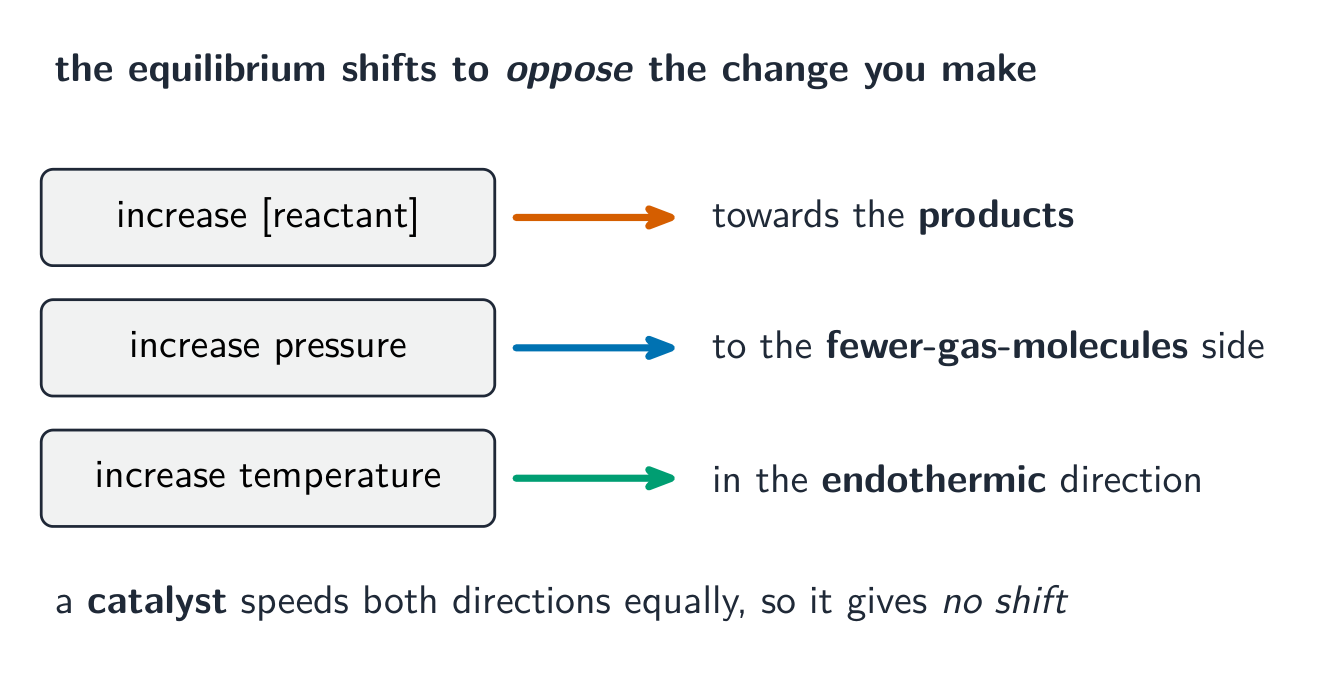
Le Chatelier's principle 勒沙特列原理: if you disturb a system at equilibrium, it shifts to partly counteract the change. Adding a reactant shifts forward; removing product shifts forward; increasing pressure (by reducing volume) shifts toward the side with fewer gas moles; raising temperature shifts in the endothermic direction.

ไทย
หลักการของเลอชาเตลียี

หลักการของเลอชาเตลีย์: หากคุณรบกวนระบบที่สมดุล มันจะเคลื่อนที่เพื่อ ลดทอนการเปลี่ยนแปลงนั้นบางส่วน การเพิ่มสารตั้งต้นจะเคลื่อนที่ไปข้างหน้า; การกำจัดผลิตภัณฑ์จะเคลื่อนที่ไปข้างหน้า; การเพิ่มความดัน (โดยการลดปริมาตร) จะเคลื่อนที่ hacia ด้านที่มีจำนวนโมลก๊าซน้อยกว่า; การเพิ่มอุณหภูมิจะเคลื่อนที่ไปในทิศทางดูดความร้อน

หลักการของเลอชาเตลีย์: สมดุลเคลื่อนที่เพื่อต้านทานการเปลี่ยนแปลงที่เกิดขึ้น
โรงงานแอมโมเนีย: สมดุลอุตสาหกรรมเช่นกระบวนการฮาเบอร์ขับเคลื่อนด้วยความดัน อุณหภูมิ และตัวเร่งปฏิกิริยา
Explore · ⁨สำรวจ⁩

Disturb an equilibrium · ⁨รบกวนสมดุลเคมี⁩

Le Chatelier's principle: an equilibrium shifts to oppose a change. Add reactant, change pressure or temperature and watch the position of equilibrium move. · ⁨หลักการLe Chatelier: สมดุลจะ SHIFT เพื่อต้านทานการเปลี่ยนแปลง เติมสารตั้งต้น เปลี่ยนความดันหรืออุณหภูมิ แล้วดูตำแหน่งสมดุลเคลื่อนที่⁩

7.10

The Reaction Quotient and Le Chatelier's Principle · ⁨ตัวประกอบปฏิกิริยากับหลักการของเลอชาเตลีย์⁩

Syllabus · ⁨หลักสูตร⁩
English

Learning Objective 7.10.A: Explain the relationships between $Q$, $K$, and the direction in which a reversible reaction will proceed to reach equilibrium.

  • 7.10.A.1 A disturbance to a system at equilibrium causes $Q$ to differ from $K$, thereby taking the system out of equilibrium. The system responds by bringing $Q$ back into agreement with $K$, thereby establishing a new equilibrium state.
  • 7.10.A.2 Some stresses, such as changes in concentration, cause a change in $Q$ only. A change in temperature causes a change in $K$. In either case, the concentrations or partial pressures of species redistribute to bring $Q$ and $K$ back into equality.
ไทย

จุดประสงค์การเรียนรู้ 7.10.A: อธิบายความสัมพันธ์ระหว่าง $Q$, $K$, และทิศทางที่ปฏิกิริยาย้อนกลับจะดำเนินต่อไปเพื่อเข้าสู่สมดุล

  • 7.10.A.1 การรบกวนระบบที่สมดุลจะทำให้ $Q$ แตกต่างจาก $K$ ซึ่งทำให้ระบบหลุดออกจากสภาวะสมดุล ระบบจะตอบสนองด้วยการทำให้ $Q$ กลับเข้ามาสอดคล้องกับ $K$ ซึ่งนำไปสู่การกำหนดสภาวะสมดุลใหม่
  • 7.10.A.2 ความเครียดบางชนิด เช่น การเปลี่ยนแปลงความเข้มข้น ทำให้เกิดการเปลี่ยนแปลงใน $Q$ เท่านั้น การเปลี่ยนแปลงอุณหภูมิทำให้เกิดการเปลี่ยนแปลงใน $K$ ในทั้งสองกรณี ความเข้มข้นหรือแรงดันย่อยของสปีชีส์จะจัดเรียงตัวใหม่เพื่อทำให้ $Q$ และ $K$ กลับมาอยู่ในสภาวะเท่ากัน

Source: College Board AP Course and Exam Description · ⁨แหล่งที่มา: คำอธิบายหลักสูตรและข้อสอบ College Board AP⁩

English

You can justify every Le Chatelier shift with $Q$ versus $K$: a disturbance changes $Q$, and the system reacts to bring $Q$ back to $K$. This quantitative view backs up the qualitative rule and is the fuller answer on the exam.

ไทย

คุณสามารถอธิบายทุกการเคลื่อนที่ตามหลักเลอชาเตลีย์ได้ด้วย $Q$ เทียบกับ $K$: การรบกวนเปลี่ยน $Q$, และระบบตอบสนองเพื่อ带回 $Q$ กลับไปที่ $K$. มุมมองเชิงปริมาณนี้สนับสนุนกฎเชิงคุณภาพและเป็นคำตอบที่ครบถ้วนกว่าในการสอบ

Explore · ⁨สำรวจ⁩

Compare Q with K · ⁨เปรียบเทียบ Q กับ K⁩

If the reaction quotient $Q the forward reaction is favoured; $Q>K$ favours the reverse. Perturb the system and watch it move back toward $Q=K$. · ⁨หาก ** quotient ปฏิกิริยา** $Q ปฏิกิริยาไปข้างหน้าจะ đượcfavoured; $Q>K$ favore ปฏิกิริยาย้อนกลับ รบกวนระบบแล้วดูมันเคลื่อนที่กลับเข้าสู่ $Q=K$⁩

7.11 7.12

Introduction to Solubility Equilibria · ⁨บทนำเรื่องสมดุลการละลาย⁩

Syllabus · ⁨หลักสูตร⁩
English

Learning Objective 7.11.A: Calculate the solubility of a salt based on the value of $K_{sp}$ for the salt.

  • 7.11.A.1 The dissolution of a salt is a reversible process whose extent can be described by $K_{sp}$, the solubility-product constant.
  • 7.11.A.2 The solubility of a substance can be calculated from the $K_{sp}$ for the dissolution process. This relationship can also be used to predict the relative solubility of different substances.
  • 7.11.A.3 The solubility rules (see 4.7.A.5) can be quantitatively related to $K_{sp}$, in which $K_{sp}$ values $>1$ correspond to soluble salts.
  • 7.11.A.4 The molar solubility of one or more species in a saturated solution can be used to calculate the $K_{sp}$ of a substance.
ไทย

วัตถุประสงค์การเรียนรู้ 7.11.A: คำนวณความละลายของเกลือจากค่า $K_{sp}$ ของเกลือนั้น

  • 7.11.A.1 การละลายของเกลือเป็นกระบวนการที่ย้อนกลับได้ ซึ่งสามารถอธิบาย extent ได้ด้วย $K_{sp}$ หรือ ค่าคงที่ผลคูณความละลาย (solubility-product constant)
  • 7.11.A.2 ความละลายของสารสามารถคำนวณได้จาก $K_{sp}$ สำหรับกระบวนการละลาย ความสัมพันธ์นี้ยังสามารถใช้เพื่อทำนายความละลายสัมพัทธ์ของสารต่างๆ ได้ด้วย
  • 7.11.A.3 กฎความละลาย (ดู 4.7.A.5) สามารถเชื่อมโยงเชิงปริมาณกับ $K_{sp}$ โดยในนั้น $K_{sp}$ ที่มีค่า $>1$ จะสอดคล้องกับเกลือที่มีความละลายสูง
  • 7.11.A.4 ความละลายโมลาร์ของหนึ่งหรือหลายสปีชีส์ในสารละลายอิ่มตัวสามารถใช้คำนวณ $K_{sp}$ ของสารได้
English

Learning Objective 7.12.A: Identify the solubility of a salt, and/or the value of $K_{sp}$ for the salt, based on the concentration of a common ion already present in solution.

  • 7.12.A.1 The solubility of a salt is reduced when it is dissolved into a solution that already contains one of the ions present in the salt. The impact of this "common-ion effect" on solubility can be understood qualitatively using Le Châtelier's principle or calculated from the $K_{sp}$ for the dissolution process.
ไทย

วัตถุประสงค์การเรียนรู้ 7.12.A: ระบุความละลายของเกลือ และ/หรือ ค่า $K_{sp}$ ของเกลือ โดยพิจารณาจากความเข้มข้นของไอออนร่วมที่มีอยู่ในสารละลายอยู่แล้ว

  • 7.12.A.1 ความละลายของเกลือจะลดลงเมื่อละลายลงในสารละลายที่มีไอออนใดไอออนหนึ่งของไอออนที่มีอยู่ในเกลืออยู่แล้ว ผลกระทบของ "ผลของไอออนร่วม" ต่อความละลายสามารถเข้าใจแบบคุณภาพได้โดยใช้หลักการของ Le Châtelier หรือคำนวณได้จาก $K_{sp}$ สำหรับกระบวนการละลาย

Source: College Board AP Course and Exam Description · ⁨แหล่งที่มา: คำอธิบายหลักสูตรและข้อสอบ College Board AP⁩

English

For a slightly soluble salt, the solubility product 溶度积 $K_{sp}$ is the equilibrium constant for its dissolving:

$$\text{M}_a\text{X}_b(s)\rightleftharpoons a\,\text{M}^{b+}+b\,\text{X}^{a-},\qquad K_{sp}=[\text{M}^{b+}]^a[\text{X}^{a-}]^b.$$
A smaller $K_{sp}$ means less soluble. The common-ion effect – adding an ion already in the salt – pushes the equilibrium back and lowers solubility.

Worked example. Silver chloride has $K_{sp}=1.8\times10^{-10}$. If its molar solubility is $s$, then $[\text{Ag}^+]=[\text{Cl}^-]=s$, so $K_{sp}=s^2$ and

$$s=\sqrt{1.8\times10^{-10}}=1.3\times10^{-5}\ \text{M}.$$
Adding NaCl (a common ion) would raise $[\text{Cl}^-]$, forcing $s$ down – far less AgCl would dissolve.

ไทย

สำหรับเกลือที่ละลายได้เล็กน้อย คงที่ผลคูณการละลาย $K_{sp}$ คือค่าคงที่สมดุลของการละลาย:

$$\text{M}_a\text{X}_b(s)\rightleftharpoons a\,\text{M}^{b+}+b\,\text{X}^{a-},\qquad K_{sp}=[\text{M}^{b+}]^a[\text{X}^{a-}]^b.$$
$K_{sp}$ ที่เล็กลงหมายความว่ามีความสามารถในการละลายน้อยลง ผลของไอออนร่วม – การเพิ่มไอออนที่มีอยู่แล้วในเกลือ – ดันสมดุลกลับและ ลด ความสามารถในการละลาย

**ตัวอย่างฝึกหัด.**datetime silver chloride มี $K_{sp}=1.8\times10^{-10}$. หากความสามารถในการละลายต่อโมลคือ $s$, แล้ว $[\text{Ag}^+]=[\text{Cl}^-]=s$, ดังนั้น $K_{sp}=s^2$ และ

$$s=\sqrt{1.8\times10^{-10}}=1.3\times10^{-5}\ \text{M}.$$
การเติม NaCl (ไอออนร่วม) จะทำให้ $[\text{Cl}^-]$ สูงขึ้น บังคับให้ $s$ ลดลง – AgCl จะละลายได้น้อยลงมาก

7.11 7.12

Exam tips · ⁨ข้อแนะนำสำหรับการสอบ⁩

English
  • At equilibrium the forward and reverse rates are equal, but the amounts are usually not.
  • Leave pure solids and liquids out of the $K$ expression; a large $K$ favours products, a small $K$ favours reactants.
  • Apply Le Chatelier: add reactant → shift forward; raise pressure → shift toward fewer gas moles; raise temperature → shift in the endothermic direction.
  • A catalyst does not shift the position of equilibrium — it only speeds the approach.
  • Use an ICE table for equilibrium concentrations, and the small-$x$ approximation when $K$ is small.
ไทย
  • ที่สมดุล อัตราปฏิกิริยาไปข้างหน้าและย้อนกลับจะเท่ากัน แต่ปริมาณสารมักจะไม่เท่ากัน
  • ทิ้งของแข็งบริสุทธิ์และของเหลวออกจากสมการ $K$; ค่า $K$ ที่ใหญ่เอื้อต่อผลิตภัณฑ์ ส่วนค่า $K$ ที่เล็กเอื้อต่อสารตั้งต้น
  • ใช้หลักการ เลอชาตลียีร์: เติมสารตั้งต้น → สมดุลเลื่อนไปข้างหน้า; เพิ่มความดัน → สมดุลเลื่อน hacia มולแก๊สน้อยลง; เพิ่มอุณหภูมิ → สมดุลเลื่อน hacia ทิศทาง ดูดความร้อน
  • ตัวเร่งปฏิกิริยาไม่เลื่อนตำแหน่งสมดุล – มันเพียงแต่เร่งการเข้าสู่สมดุลเท่านั้น
  • ใช้ ตาราง ICE สำหรับความเข้มข้นที่สมดุล, และการประมาณค่า $x$ เล็กเมื่อ $K$ มีค่าน้อย

Interactive lessons on this topic · ⁨บทเรียนเชิงโต้ตอบสำหรับหัวข้อนี้⁩

Work through it step by step, with instant-check exercises. · ⁨ทำทีละขั้นตอน พร้อมแบบฝึกหัดตรวจสอบผลทันที⁩

Past Papers · ⁨ข้อสอบย้อนหลัง⁩

More topics in AP Chemistry · ⁨หัวข้อเพิ่มเติมใน AP Chemistry⁩

Log in or create account · ⁨เข้าสู่ระบบหรือสร้างบัญชี⁩

IGCSE, A-Level & AP