Skip to content · ⁨ข้ามไปยังเนื้อหา⁩

Kinetics · ⁨จลนศาสตร์ของปฏิกิริยา⁩

AP Chemistry · Topic 5 · ⁨หัวข้อ 5⁩

Video lesson for this topic · ⁨บทเรียนวิดีโอสำหรับหัวข้อนี้⁩ Open the video page · ⁨เปิดหน้าวิดีโอ⁩
8:00

จลนศาสตร์ของปฏิกิริยา

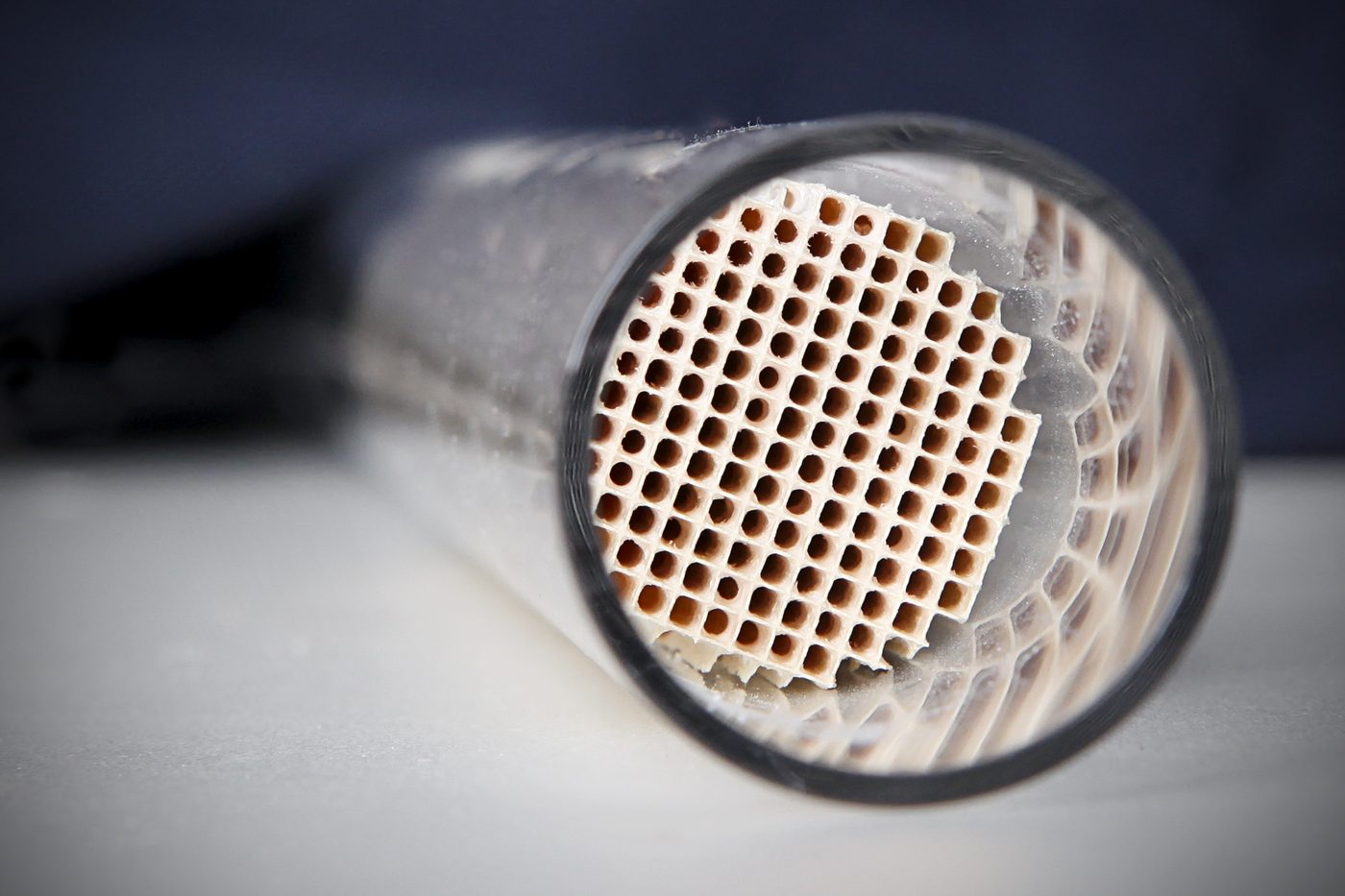
มองเข้าไปในท่อไอเสียรถยนต์. โครงรังผึ้งเซรามิกนี้คือตัวเร่งปฏิกิริยา (catalytic converter). ก๊าซที่พุ่งผ่านมามีพิษ. ถ้าปล่อยไว้โดยไม่ทำอะไรเลย จะใช้เวลาหลายปี…

English narration · English + 中文 subtitles burned in · ⁨การบรรยายภาษาอังกฤษ · คำบรรยายภาษาอังกฤษ + 中文 ลอยตัวบนภาพ⁩

5.1

How Fast a Reaction Goes · ⁨ความเร็วของปฏิกิริยา⁩

Syllabus · ⁨หลักสูตร⁩
English

Learning Objective 5.1.A: Explain the relationship between the rate of a chemical reaction and experimental parameters.

  • 5.1.A.1 The kinetics of a chemical reaction is defined as the rate at which an amount of reactants is converted to products per unit of time.
  • 5.1.A.2 The rates of change of reactant and product concentrations are determined by the stoichiometry in the balanced chemical equation.
  • 5.1.A.3 The rate of a reaction is influenced by reactant concentrations, temperature, surface area, catalysts, and other environmental factors.
ไทย

วัตถุประสงค์การเรียนรู้ 5.1.A: อธิบายความสัมพันธ์ระหว่างอัตราการเกิดปฏิกิริยาเคมีและพารามิเตอร์การทดลอง

  • 5.1.A.1 จลนศาสตร์ของปฏิกิริยาเคมีนิยามว่าคืออัตราที่ปริมาณของสารตั้งต้นถูกแปลงเป็นผลิตภัณฑ์ต่อหน่วยเวลา
  • 5.1.A.2 อัตราการเปลี่ยนแปลงของความเข้มข้นของสารตั้งต้นและผลิตภัณฑ์ถูกกำหนดโดยstoresichiometry_ในสมการเคมีที่สมดุล
  • 5.1.A.3 อัตราการเกิดปฏิกิริยาได้รับอิทธิพลจากความเข้มข้นของสารตั้งต้น อุณหภูมิ พื้นที่ผิว ตัวเร่งปฏิกิริยา และปัจจัยสิ่งแวดล้อมอื่นๆ
Source: College Board AP Course and Exam Description · ⁨แหล่งที่มา: คำอธิบายหลักสูตรและข้อสอบ College Board AP⁩

English
The Maxwell–Boltzmann distribution

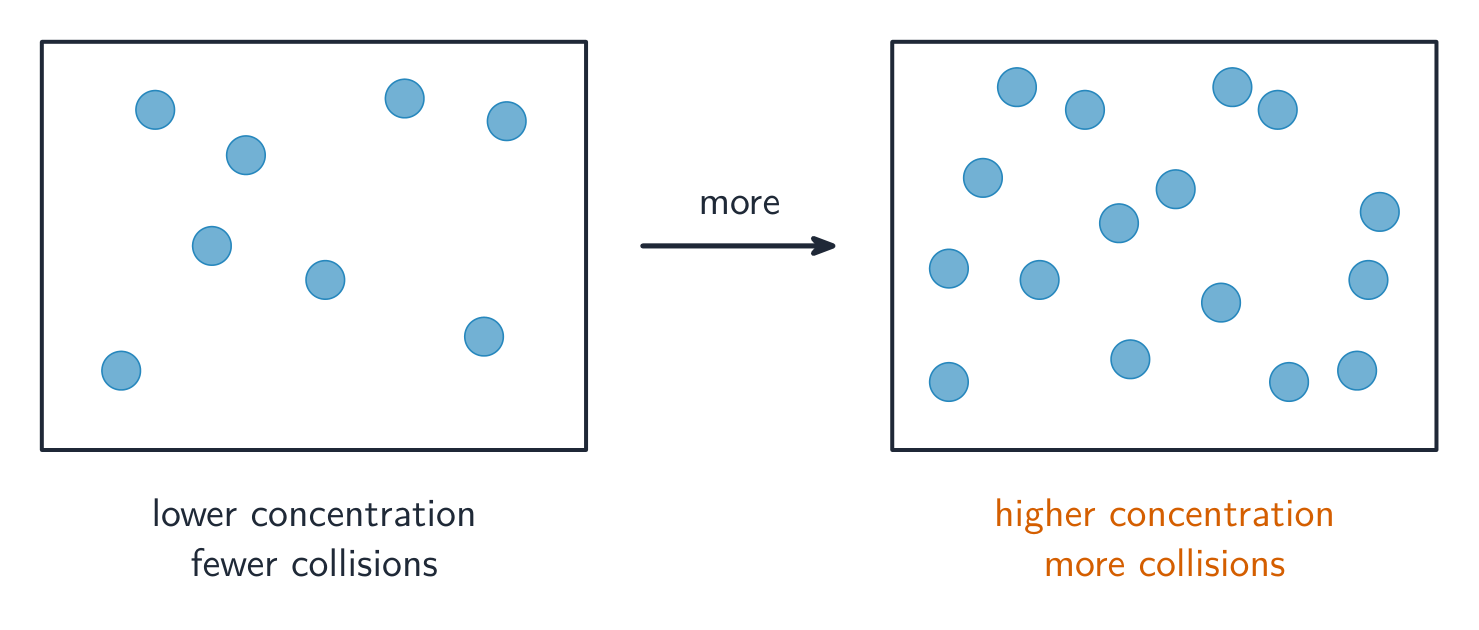
Kinetics 动力学 studies reaction rate 反应速率 – how fast reactants become products. Rate is the change in concentration per unit time, and it typically decreases as reactants are used up. Rate rises with higher concentration, higher temperature, greater surface area, and a catalyst.

ไทย
เครื่อง catalytic converter: ตัวเร่งปฏิกิริยาช่วยเพิ่มอัตราการเกิดปฏิกิริยาโดยการลดพลังงานกระตุ้นโดยไม่ถูกใช้ไป
การกระจายแบบ Maxwell–Boltzmann

จลนศาสตร์ (Kinetics) ศึกษา อัตราการเกิดปฏิกิริยา – ว่าสารตั้งต้นเปลี่ยนเป็นผลิตภัณฑ์เร็วแค่ไหน อัตราคือการเปลี่ยนแปลงของความเข้มข้นต่อหน่วยเวลา และมัก ลดลง เมื่อสารตั้งต้นถูกใช้ไป อัตราเพิ่มขึ้นเมื่อมีความเข้มข้นสูงขึ้น อุณหภูมิสูงขึ้น พื้นที่ผิวมากขึ้น และมีตัวเร่งปฏิกิริยา

เมื่อมีอนุภาคมากขึ้นในพื้นที่เท่าเดิม จะชนกันบ่อยขึ้น ทำให้อัตราเพิ่มขึ้น
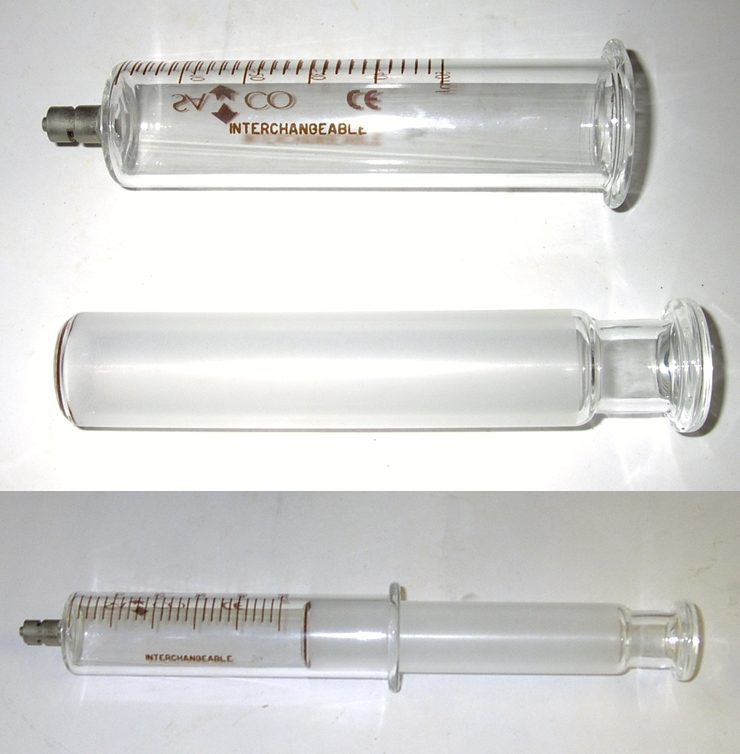
กระบอกฉีดยาแก๊ส: การวัดปริมาตรแก๊สตามเวลาให้ค่าอัตราปฏิกิริยາจากความชัน
แกลเลียงแก๊ส: การวัดปริมาตรแก๊สตามเวลาเพื่อให้ได้อัตราจากความชัน
Explore · ⁨สำรวจ⁩

Change conditions and watch the rate · ⁨เปลี่ยนเงื่อนไขและดูอัตราการเกิดปฏิกิริยา⁩

Reaction rate rises with temperature, concentration, and a catalyst — each gives more frequent or more successful collisions. Change each and watch the reaction speed up. · ⁨อัตราการเกิดปฏิกิริยา เพิ่มขึ้นตาม อุณหภูมิ, ความเข้มข้น และ ตัวเร่งปฏิกิริยา — ทุกอย่างช่วยเพิ่มจำนวนหรือประสิทธิภาพของการชนกัน เปลี่ยนแต่ละปัจจัยแล้วดูปฏิกิริยาเร็วขึ้น⁩

Vocabulary · ⁨คำศัพท์⁩ Train · ⁨ฝึกฝน⁩
English ไทย
Kinetics/kɪˈnetɪks/ จลนศาสตร์ของปฏิกิริยา
reaction rate/rɪˈækʃn reɪt/ อัตราการเกิดปฏิกิริยา
catalyst/ˈkætəlɪst/ ตัวเร่งปฏิกิริยา
5.2

Writing the Rate Law · ⁨การเขียนกฎอัตรา (Rate Law)⁩

Syllabus · ⁨หลักสูตร⁩
English

Learning Objective 5.2.A: Represent experimental data with a consistent rate law expression.

  • 5.2.A.1 Experimental methods can be used to monitor the amounts of reactants and/or products of a reaction over time and to determine the rate of the reaction.
  • 5.2.A.2 The rate law expresses the rate of a reaction as proportional to the concentration of each reactant raised to a power.
  • 5.2.A.3 The power of each reactant in the rate law is the order of the reaction with respect to that reactant. The sum of the powers of the reactant concentrations in the rate law is the overall order of the reaction.
  • 5.2.A.4 The proportionality constant in the rate law is called the rate constant. The value of this constant is temperature dependent and the units reflect the overall reaction order.
  • 5.2.A.5 Comparing initial rates of a reaction is a method to determine the order with respect to each reactant.
ไทย

วัตถุประสงค์การเรียนรู้ 5.2.A: แสดงข้อมูลการทดลองด้วยนิพจน์กฎอัตราที่สอดคล้องกัน

  • 5.2.A.1 วิธีการทดลองสามารถใช้ในการติดตามปริมาณสารตั้งต้นและ/หรือผลิตภัณฑ์ของปฏิกิริยาตามเวลา และเพื่อหาอัตราการเกิดปฏิกิริยา
  • 5.2.A.2 กฎอัตราแสดงถึงอัตราการเกิดปฏิกิริยาที่แปรผันตรงกับความเข้มข้นของแต่ละสารตั้งต้นยกกำลังด้วยเลขชี้กำลังหนึ่ง
  • 5.2.A.3 เลขชี้กำลังของแต่ละสารตั้งต้นในกฎอัตราคืออันดับของปฏิกิริยาสัมพันธ์กับสารตั้งต้นนั้น ผลรวมของเลขชี้กำลังของความเข้มข้นสารตั้งต้นในกฎอัตราคืออันดับโดยรวมของปฏิกิริยา
  • 5.2.A.4 ค่าคงที่การแปรผันในกฎอัตราเรียกว่าค่าคงที่อัตรา (rate constant) ค่าของค่าคงที่นี้ขึ้นอยู่กับอุณหภูมิ และหน่วยจะสะท้อนอันดับโดยรวมของปฏิกิริยา
  • 5.2.A.5 การเปรียบเทียบอัตราเริ่มต้นของปฏิกิริยาเป็นวิธีการหนึ่งในการหาอันดับของปฏิกิริยาสัมพันธ์กับแต่ละสารตั้งต้น

Source: College Board AP Course and Exam Description · ⁨แหล่งที่มา: คำอธิบายหลักสูตรและข้อสอบ College Board AP⁩

English

The rate law 速率方程 relates rate to reactant concentrations:

$$\text{rate}=k[\text{A}]^m[\text{B}]^n,$$
where $k$ is the rate constant 速率常数 and $m,n$ are the orders 级数. Orders are found experimentally (not from the balanced coefficients) by seeing how the rate changes when you change one concentration at a time.

Worked example. In experiments, doubling $[\text{A}]$ makes the rate four times larger, while doubling $[\text{B}]$ leaves the rate unchanged. So the reaction is second order in A ($2^2=4$) and zero order in B, giving $\text{rate}=k[\text{A}]^2$. The overall order is $2+0=2$. Never read the orders off the balanced coefficients – only experiment gives them.

ไทย

กฎอัตรา เชื่อมโยงอัตรากับความเข้มข้นของสารตั้งต้น:

$$\text{rate}=k[\text{A}]^m[\text{B}]^n,$$
โดยที่ $k$ คือ ค่าคงที่อัตรา (rate constant) และ $m,n$ คือ อันดับปฏิกิริยา (orders). อันดับปฏิกิริยาหาได้จาก การทดลอง (ไม่ใช่จากสัมประสิทธิ์ในสมการที่สมดุล) โดยการดูว่าอัตราเปลี่ยนอย่างไรเมื่อเราเปลี่ยนความเข้มข้นของสารหนึ่งอย่างเท่านั้น

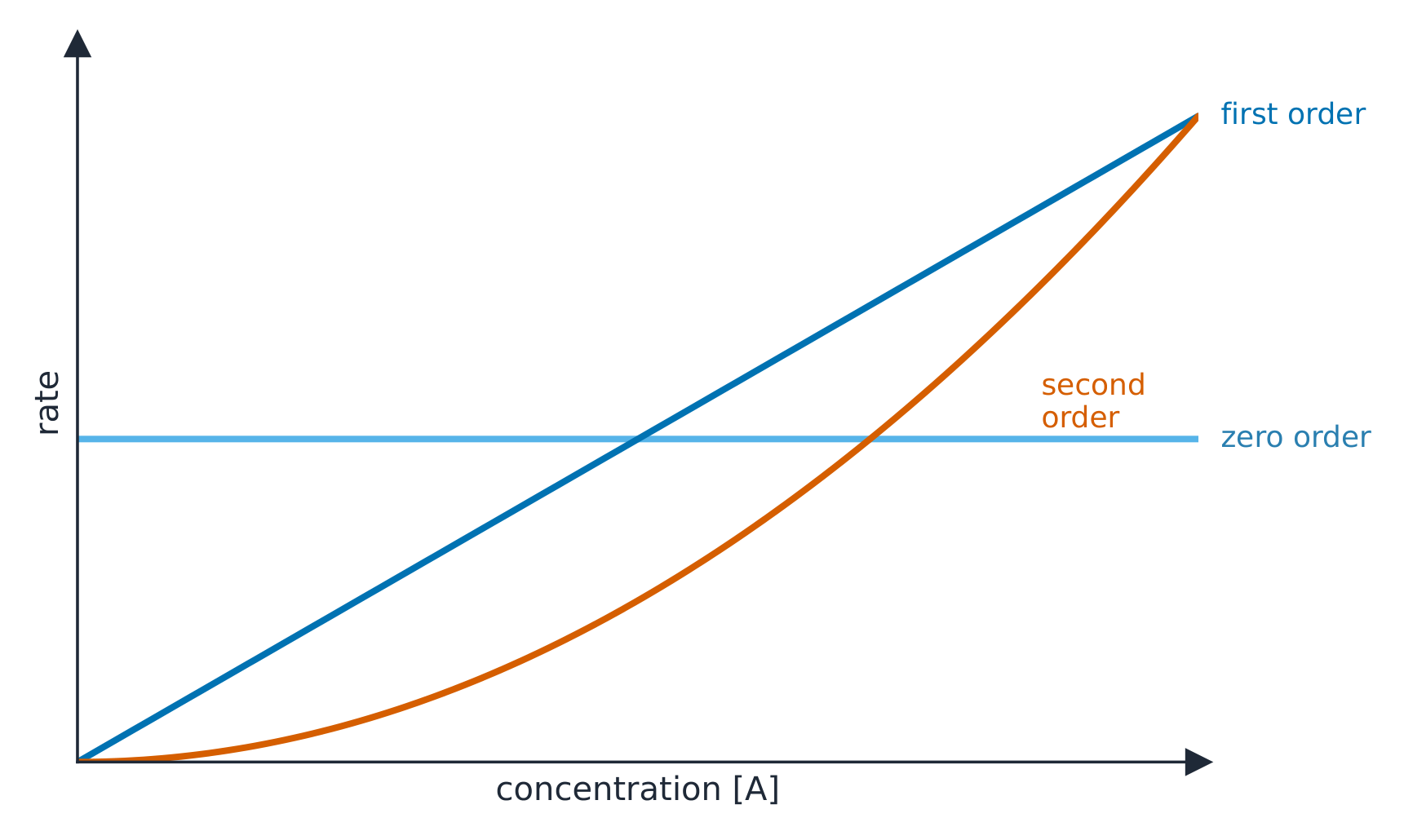
อัตราปฏิกิริยาเทียบกับความเข้มข้นสำหรับปฏิกิริยาอันดับศูนย์ อันดับหนึ่ง และอันดับสอง
อัตราเทียบกับความเข้มข้นสำหรับปฏิกิริยาอันดับศูนย์, อันดับหนึ่ง, และอันดับสอง

ตัวอย่างวิธีทำ. ในการทดลอง การเพิ่ม $[\text{A}]$ เป็นสองเท่า ทำให้อัตรา เพิ่มขึ้นสี่เท่า ในขณะที่การเพิ่ม $[\text{B}]$ เป็นสองเท่า อัตรายังคงเดิม ดังนั้นปฏิกิริยานี้เป็น อันดับสอง ของ A ($2^2=4$) และเป็น อันดับศูนย์ ของ B ทำให้ได้ $\text{rate}=k[\text{A}]^2$. อันดับรวมคือ $2+0=2$. ห้ามอ่านอันดับจากสัมประสิทธิ์ในสมการที่สมดุลเลย – มีแต่การทดลองเท่านั้นที่จะบอกได้

Vocabulary · ⁨คำศัพท์⁩ Train · ⁨ฝึกฝน⁩
English ไทย
rate constant/reɪt ˈkɒnstənt/ ค่าคงที่อัตรา
orders/ˈɔːdəz/ orders
5.3

Concentration Over Time · ⁨ความเข้มข้นตามเวลา⁩

Syllabus · ⁨หลักสูตร⁩
English

Learning Objective 5.3.A: Identify the rate law expression of a chemical reaction using data that show how the concentrations of reaction species change over time.

  • 5.3.A.1 The order of a reaction can be inferred from a graph of concentration of reactant versus time.
  • 5.3.A.2 If a reaction is first order with respect to a reactant being monitored, a plot of the natural log (ln) of the reactant concentration as a function of time will be linear.
  • 5.3.A.3 If a reaction is second order with respect to a reactant being monitored, a plot of the reciprocal of the concentration of that reactant versus time will be linear.
  • 5.3.A.4 The slopes of the concentration versus time data for zeroth, first, and second order reactions can be used to determine the rate constant for the reaction.
    • Zeroth order:
    • Equation: $[\mathrm{A}]_t - [\mathrm{A}]_0 = -kt$
    • First order:
    • Equation: $\ln[\mathrm{A}]_t - \ln[\mathrm{A}]_0 = -kt$
    • Second order:
    • Equation: $1/[\mathrm{A}]_t - 1/[\mathrm{A}]_0 = kt$
  • 5.3.A.5 Half-life is a critical parameter for first order reactions because the half-life is constant and related to the rate constant for the reaction by the equation:
    • Equation: $t_{1/2} = 0.693/k.$
  • 5.3.A.6 Radioactive decay processes provide an important illustration of first order kinetics.
ไทย

วัตถุประสงค์การเรียนรู้ 5.3.A: ระบุรูปสมการกฎอัตราของปฏิกิริยาเคมีโดยใช้ข้อมูลที่แสดงถึงการเปลี่ยนแปลงความเข้มข้นของสปีชีส์ในปฏิกิริยาตามเวลา

  • 5.3.A.1 อันดับของปฏิกิริยาสามารถสรุปได้จากกราฟแสดงความเข้มข้นของสารตั้งต้นเทียบกับเวลา
  • 5.3.A.2 หากปฏิกิริยามีอันดับหนึ่งสัมพันธ์กับสารตั้งต้นที่กำลังติดตาม การพล็อตลอการิทึมธรรมชาติ (ln) ของความเข้มข้นของสารตั้งต้นเทียบกับเวลาจะเป็นเส้นตรง
  • 5.3.A.3 หากปฏิกิริยามีอันดับสองสัมพันธ์กับสารตั้งต้นที่กำลังติดตาม การพล็อตส่วนกลับของความเข้มข้นของสารตั้งต้นนั้นเทียบกับเวลาจะเป็นเส้นตรง
  • 5.3.A.4 ความชันของข้อมูลความเข้มข้นเทียบกับเวลาสำหรับปฏิกิริยาระดับศูนย์ ระดับหนึ่ง และระดับสอง สามารถใช้หาค่าคงที่อัตราของปฏิกิริยาได้
    • ปฏิกิริยาระดับศูนย์:
    • สมการ: $[\mathrm{A}]_t - [\mathrm{A}]_0 = -kt$
    • ปฏิกิริยาระดับหนึ่ง:
    • สมการ: $\ln[\mathrm{A}]_t - \ln[\mathrm{A}]_0 = -kt$
    • ปฏิกิริยาระดับสอง:
    • สมการ: $1/[\mathrm{A}]_t - 1/[\mathrm{A}]_0 = kt$
  • 5.3.A.5 เวลาครึ่งชีวิตเป็นพารามิเตอร์ที่สำคัญสำหรับปฏิกิริยาระดับหนึ่ง เนื่องจากเวลาครึ่งชีวิตมีค่าคงที่และสัมพันธ์กับค่าคงที่อัตราของปฏิกิริยาโดยสมการ:
    • สมการ: $t_{1/2} = 0.693/k.$
  • 5.3.A.6 กระบวนการสลายตัวทางรังสีเป็นตัวอย่างที่สำคัญของการจลนศาสตร์อันดับหนึ่ง

Source: College Board AP Course and Exam Description · ⁨แหล่งที่มา: คำอธิบายหลักสูตรและข้อสอบ College Board AP⁩

English

The integrated rate laws describe how concentration falls with time and give straight-line tests:

  • Zero order: $[\text{A}]$ vs $t$ is linear.
  • First order: $\ln[\text{A}]$ vs $t$ is linear; constant half-life 半衰期.
  • Second order: $\dfrac{1}{[\text{A}]}$ vs $t$ is linear.

Whichever plot is straight tells you the order and gives $k$ from its slope.

Worked example. A first-order reaction has rate constant $k=0.030\ \text{s}^{-1}$. Its half-life is

$$t_{1/2}=\frac{0.693}{k}=\frac{0.693}{0.030}=23\ \text{s},$$
and, being first order, that half-life stays the same no matter how much reactant remains – so after $46\ \text{s}$ ($2$ half-lives) one quarter is left.

ไทย

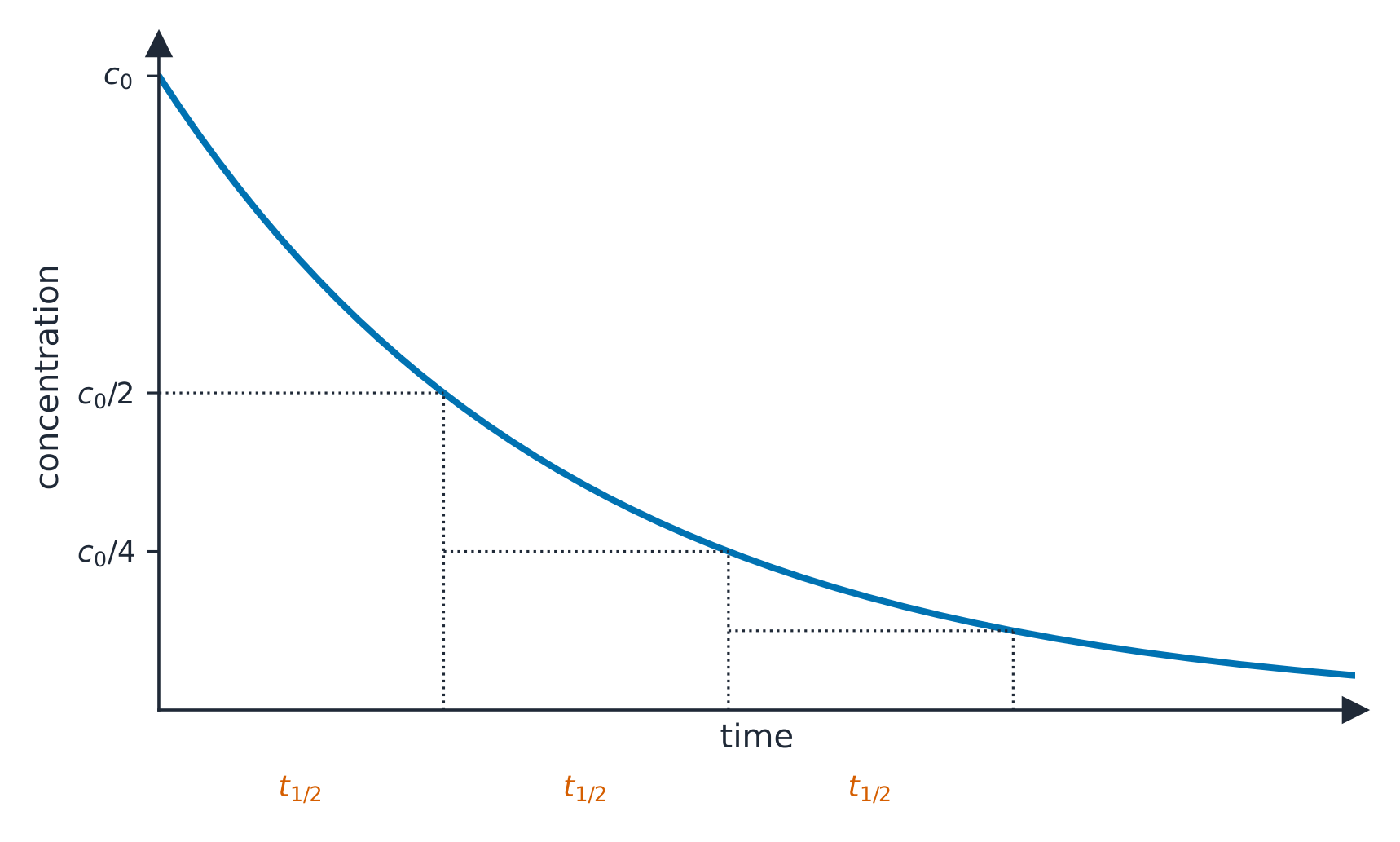
กฎอัตรารวม (integrated rate laws) อธิบายว่าความเข้มข้นลดลงตามเวลาอย่างไร และให้กราฟเส้นตรง用来ทดสอบ:

ปฏิกิริยาลำดับแรกมีครึ่งชีวิตคงที่
  • อันดับศูนย์: $[\text{A}]$ เทียบกับ $t$ เป็นเส้นตรง
  • อันดับหนึ่ง: $\ln[\text{A}]$ เทียบกับ $t$ เป็นเส้นตรง; ครึ่งอายุ (half-life) คงที่
  • อันดับสอง: $\dfrac{1}{[\text{A}]}$ เทียบกับ $t$ เป็นเส้นตรง

กราฟใดที่เป็นเส้นตรง บอกได้ว่าอันดับปฏิกิริยาคืออะไร และให้ $k$ จากความชันของกราฟนั้น

ตัวอย่างวิธีทำ. ปฏิกิริยาอันดับหนึ่งมีค่าคงที่อัตรา $k=0.030\ \text{s}^{-1}$. ครึ่งอายุของมันคือ

$$t_{1/2}=\frac{0.693}{k}=\frac{0.693}{0.030}=23\ \text{s},$$
และเนื่องจากเป็นอันดับหนึ่ง ครึ่งอายุนั้นจะคงที่ไม่ว่าจะมีสารตั้งต้นเหลืออยู่เท่าไหร่ – ดังนั้นหลังจาก $46\ \text{s}$ ($2$ ครึ่งอายุ) จะเหลืออยู่เพียงหนึ่งในสี่

Explore · ⁨สำรวจ⁩

Track concentration as a reaction runs · ⁨ติดตามความเข้มข้นขณะปฏิกิริยากำลังดำเนิน⁩

As reactants are used up the rate slows, so a concentration-time curve is steep at first and flattens out. Raising temperature or adding a catalyst steepens it. · ⁨เมื่อสารตั้งต้นถูกใช้ไป อัตราการเกิดปฏิกิริยาลดลง กราฟความเข้มข้น-เวลาจึงชันมากในตอนแรกแล้วค่อยๆ เรียบเรียบ การเพิ่มอุณหภูมิหรือเติมตัวเร่งปฏิกิริยาจะทำให้กราฟชันขึ้น⁩

Vocabulary · ⁨คำศัพท์⁩ Train · ⁨ฝึกฝน⁩
English ไทย
rate law/reɪt lɔː/ กฎอัตรา
half-life/hɑːf laɪf/ ครึ่งอายุ (half-life)
5.4

The Steps a Reaction Really Takes · ⁨ขั้นตอนจริงที่ปฏิกิริยาเกิดขึ้น⁩

Syllabus · ⁨หลักสูตร⁩
English

Learning Objective 5.4.A: Represent an elementary reaction as a rate law expression using stoichiometry.

  • 5.4.A.1 The rate law of an elementary reaction can be inferred from the stoichiometry of the particles participating in a collision.
  • 5.4.A.2 Elementary reactions involving the simultaneous collision of three or more particles are rare.
ไทย

วัตถุประสงค์การเรียนรู้ 5.4.A: แสดงปฏิกิริยาย่อยในรูปสมการกฎอัตราโดยใช้storeschiometry

  • 5.4.A.1 กฎอัตราของปฏิกิริยาย่อยสามารถสรุปได้จากstoreschiometryของอนุภาคที่มีส่วนร่วมในการชนกัน
  • 5.4.A.2 ปฏิกิริยาย่อยที่เกี่ยวข้องกับการชนกันพร้อมกันของสามอนุภาคขึ้นไปมีน้อยมาก

Source: College Board AP Course and Exam Description · ⁨แหล่งที่มา: คำอธิบายหลักสูตรและข้อสอบ College Board AP⁩

English

A reaction mechanism 反应机理 is the sequence of elementary steps 基元反应 that actually occur. Their molecularity (how many particles collide in a step) sets that step's rate law directly. Species made in one step and used up in a later one are intermediates 中间体.

ไทย

กลไกปฏิกิริยา (reaction mechanism) คือลำดับของ ขั้นตอนย่อย (elementary steps) ที่เกิดขึ้นจริง โมเลกุลarity (molecularity) ของแต่ละขั้นตอน (จำนวนอนุภาคที่ชนกันในขั้นนั้น) กำหนดกฎอัตรานั้นโดยตรง สปีชีส์ที่ถูกสร้าง在某 step และถูกใช้在某 later stepเรียกว่า สารกลาง (intermediates)

Vocabulary · ⁨คำศัพท์⁩ Train · ⁨ฝึกฝน⁩
English ไทย
reaction mechanism/rɪˈækʃn ˈmekənɪzəm/ กลไกของปฏิกิริยา
elementary steps/ˌelɪˈmentəri steps/ ขั้นตอนพื้นฐาน
intermediates/ˌɪntəˈmiːdɪəts/ สารตัวกลาง
5.5

Why Collisions Do or Do Not React · ⁨ทำไมการชนถึงทำให้ปฏิกิริยาเกิดหรือไม่เกิด⁩

Syllabus · ⁨หลักสูตร⁩
English

Learning Objective 5.5.A: Explain the relationship between the rate of an elementary reaction and the frequency, energy, and orientation of particle collisions.

  • 5.5.A.1 For an elementary reaction to successfully produce products, reactants must successfully collide to initiate bond-breaking and bond-making events.
  • 5.5.A.2 In most reactions, only a small fraction of the collisions leads to a reaction. Successful collisions have both sufficient energy to overcome the activation energy requirements and orientations that allow the bonds to rearrange in the required manner.
  • 5.5.A.3 The Maxwell-Boltzmann distribution curve describes the distribution of particle energies; this distribution can be used to gain a qualitative estimate of the fraction of collisions with sufficient energy to lead to a reaction, and also how that fraction depends on temperature.
ไทย

วัตถุประสงค์การเรียนรู้ 5.5.A: อธิบายความสัมพันธ์ระหว่างอัตราการเกิดปฏิกิริยาย่อยกับความถี่ พลังงาน และการจัดวางตัวของอนุภาคในการชนกัน

  • 5.5.A.1 เพื่อให้ปฏิกิริยาย่อยสร้างผลิตภัณฑ์ได้อย่างสำเร็จ สารตั้งต้นต้องชนกันอย่างมีประสิทธิภาพเพื่อบริหารการแตกและการสร้างพันธะ
  • 5.5.A.2 ในปฏิกิริยาส่วนใหญ่ มีเพียงเศษเล็กfractionน้อยของการชน就会导致发生ปฏิกิริยา การชนอย่างสำเร็จต้องมีทั้งพลังงานเพียงพอที่จะ passphrase requirements ของพลังงานกระตุ้น และการจัดวางที่อนุญาตให้พันธะจัดเรียงใหม่ในลักษณะที่ต้องการ
  • 5.5.A.3 กราฟการแจกแจงแมกซ์เวลล์-โบลต์ซมันน์อธิบายการแจกแจงพลังงานของอนุภาค; การแจกแจงนี้สามารถใช้ประมาณ fraction ของการชนที่มีพลังงานเพียงพอที่จะนำไปสู่ปฏิกิริยาในเชิงคุณภาพ และแสดงว่า fraction นั้นขึ้นอยู่กับอุณหภูมิอย่างไร

Source: College Board AP Course and Exam Description · ⁨แหล่งที่มา: คำอธิบายหลักสูตรและข้อสอบ College Board AP⁩

English
Collision theory

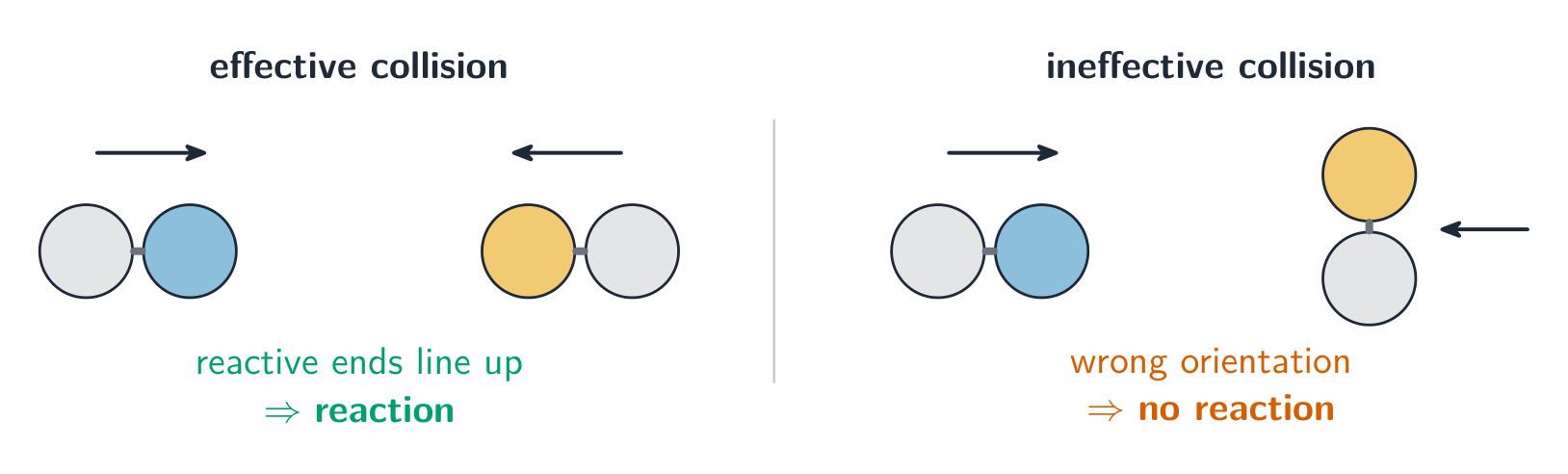
Collision theory 碰撞理论: molecules must collide with enough energy (the activation energy 活化能, $E_a$) and the correct orientation to react. Higher temperature means more molecules exceed $E_a$, so the reaction speeds up sharply.

ไทย
ทฤษฎีการชน

ทฤษฎีการชน: โมเลกุลต้องชนกันด้วยพลังงานเพียงพอ (พลังงานกระตุ้น, $E_a$) และมี ทิศทาง (orientation) ที่ถูกต้องเพื่อให้เกิดปฏิกิริยา อุณหภูมิที่สูงขึ้นหมายถึงมีโมเลกุลจำนวนมากเกิน $E_a$ มากกว่าเดิม ดังนั้นปฏิกิริยาจึงเร่งขึ้นอย่างรวดเร็ว

การชนจะเกิดปฏิกิริยาได้ก็ต่อเมื่อมีทิศทางที่ถูกต้องและมีพลังงานเพียงพอ
Explore · ⁨สำรวจ⁩

Which molecules clear the activation energy · ⁨โมเลกุลใดผ่านพลังงานกระตุ้นได้⁩

Only collisions with energy above the activation energy react. Heating shifts the speed distribution right, so a much larger fraction of molecules can react. · ⁨เฉพาะการชนกันที่มีพลังงานเกิน พลังงานกระตุ้น จึงเกิดปฏิกิริยาได้ การให้ความร้อนทำให้การกระจายความเร็ว SHIFT ไปทางขวา ทำให้มีสัดส่วนของโมเลกุลที่สามารถเกิดปฏิกิริยาได้มากขึ้นอย่างมาก⁩

Vocabulary · ⁨คำศัพท์⁩ Train · ⁨ฝึกฝน⁩
English ไทย
Collision theory/kəˈlɪʒn ˈθɪəri/ ทฤษฎีการชน
activation energy/ˌæktɪˈveɪʃn ˈenədʒi/ พลังงานก่อกวน (activation energy)
energy profile/ˈenədʒi ˈprəʊfaɪl/ โปรไฟล์พลังงาน
5.6

Reading an Energy Profile · ⁨การอ่านกราฟพลังงาน (Energy Profile)⁩

Syllabus · ⁨หลักสูตร⁩
English

Learning Objective 5.6.A: Represent the activation energy and overall energy change in an elementary reaction using a reaction energy profile.

  • 5.6.A.1 Elementary reactions typically involve the breaking of some bonds and the forming of new ones.
  • 5.6.A.2 The reaction coordinate is the axis along which the complex set of motions involved in rearranging reactants to form products can be plotted.
  • 5.6.A.3 The energy profile gives the energy along the reaction coordinate, which typically proceeds from reactants, through a transition state, to products. The energy difference between the reactants and the transition state is the activation energy for the forward reaction.
  • 5.6.A.4 The rate of an elementary reaction is temperature dependent because the proportion of particle collisions that are energetic enough to reach the transition state varies with temperature. The Arrhenius equation relates the temperature dependence of the rate of an elementary reaction to the activation energy needed by molecular collisions to reach the transition state.
    • Exclusion statement: Calculations involving the Arrhenius equation will not be assessed on the AP Exam.
ไทย

วัตถุประสงค์การเรียนรู้ 5.6.A: แสดงพลังงานกระตุ้นและการเปลี่ยนแปลงพลังงานโดยรวมในปฏิกิริยาย่อยโดยใช้โปรไฟล์พลังงานของปฏิกิริยา

  • 5.6.A.1 ปฏิกิริยาย่อยมักเกี่ยวข้องกับการแตกของพันธะบางส่วนและการสร้างพันธะใหม่
  • 5.6.A.2 พิกัดปฏิกิริยาเป็นแกนที่ชุดการเคลื่อนไหวที่ซับซ้อนที่เกี่ยวข้องในการจัดเรียงสารตั้งต้นเพื่อสร้างผลิตภัณฑ์สามารถพล็อตได้
  • 5.6.A.3 โปรไฟล์พลังงานให้พลังงานตามพิกัดปฏิกิริยา ซึ่งมักดำเนินจากสารตั้งต้น ผ่านสถานะเปลี่ยนผ่าน ไปยังผลิตภัณฑ์ ส่วนต่างของพลังงานระหว่างสารตั้งต้นกับสถานะเปลี่ยนผ่านคือพลังงานกระตุ้นสำหรับปฏิกิริยาไปข้างหน้า
  • 5.6.A.4 อัตราของปฏิกิริยาย่อยขึ้นอยู่กับอุณหภูมิเนื่องจากสัดส่วนของการชนของอนุภาคที่มีพลังงานเพียงพอที่จะถึงสถานะเปลี่ยนผ่านแปรผันตามอุณหภูมิ สมการอาร์เรเนียสเชื่อมโยงการพึ่งพาอุณหภูมิของอัตราการเกิดปฏิกิริยาย่อยกับพลังงานกระตุ้นที่จำเป็นสำหรับการชนของโมเลกุลเพื่อถึงสถานะเปลี่ยนผ่าน
    • ข้อควรระวัง: การคำนวณที่เกี่ยวข้องกับสมการอาร์เรเนียสจะไม่ถูกทดสอบในข้อสอบ AP

Source: College Board AP Course and Exam Description · ⁨แหล่งที่มา: คำอธิบายหลักสูตรและข้อสอบ College Board AP⁩

English
Reaction energy profile

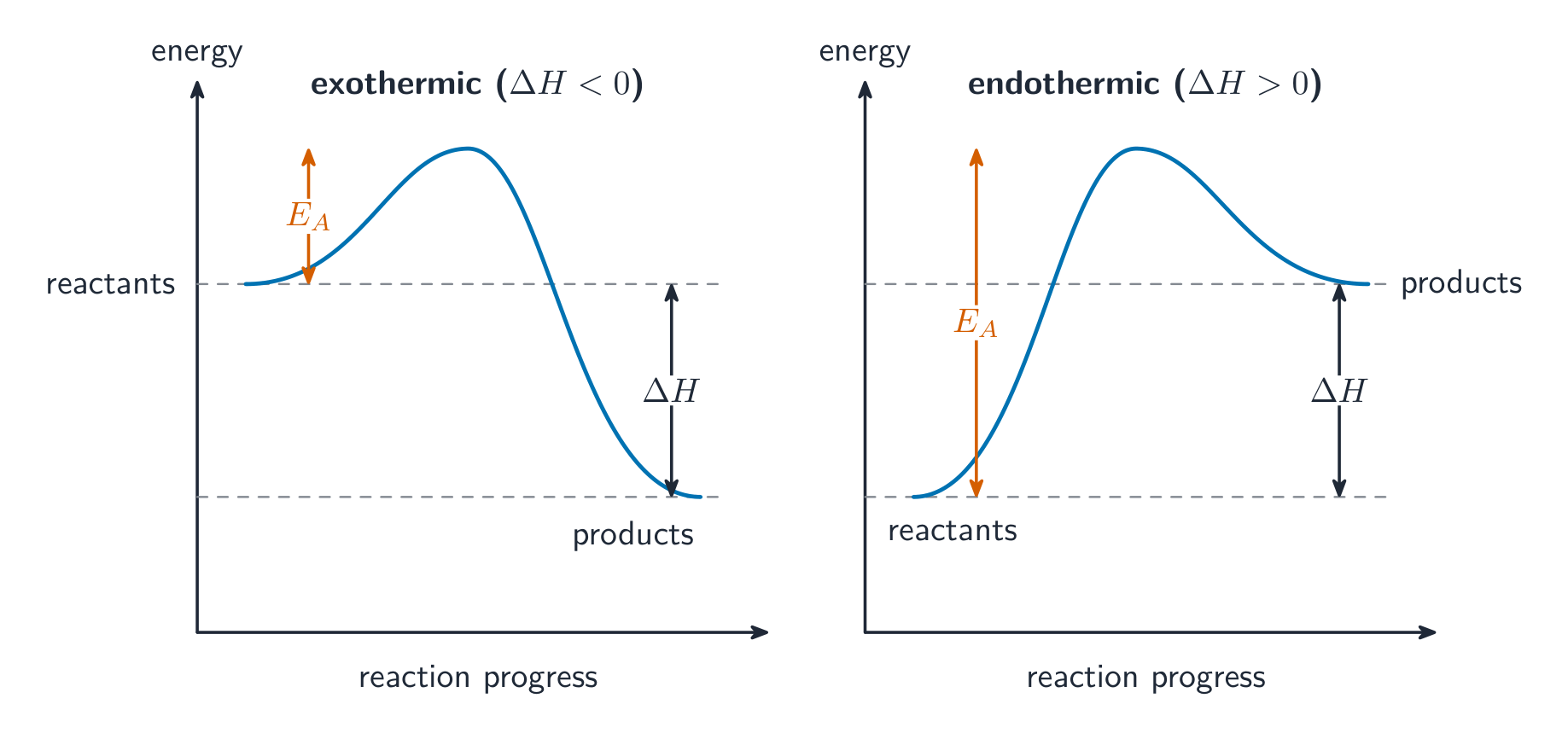
An energy profile 能量图 plots energy along the reaction path. The peak is the transition state 过渡态; the climb from reactants to the peak is $E_a$; the difference between reactant and product energies is the enthalpy change $\Delta H$ (down for exothermic).

ไทย
กราฟพลังงานของปฏิกิริยา

กราฟพลังงานython พลังงานตามเส้นทางปฏิกิริยา จุดยอดคือ สถานะผ่าน (transition state); การปีนจากสารตั้งต้นสู่จุดยอดคือ $E_a$; ส่วนต่างระหว่างพลังงานของสารตั้งต้นและผลิตภัณฑ์คือ enthalpy change $\Delta H$ (ลงสำหรับ exothermic)

ปฏิกิริยาคายความร้อนสิ้นสุดต่ำกว่าสารตั้งต้น; ปฏิกิริยาสอบความร้อนสิ้นสุดสูงกว่า
ปฏิกิริยา exothermic ลงต่ำกว่าสารตั้งต้น; endothermic ขึ้นสูงกว่า
Explore · ⁨สำรวจ⁩

Read activation energy off the profile · ⁨อ่านค่าพลังงานกระตุ้นจากกราฟพลังงาน⁩

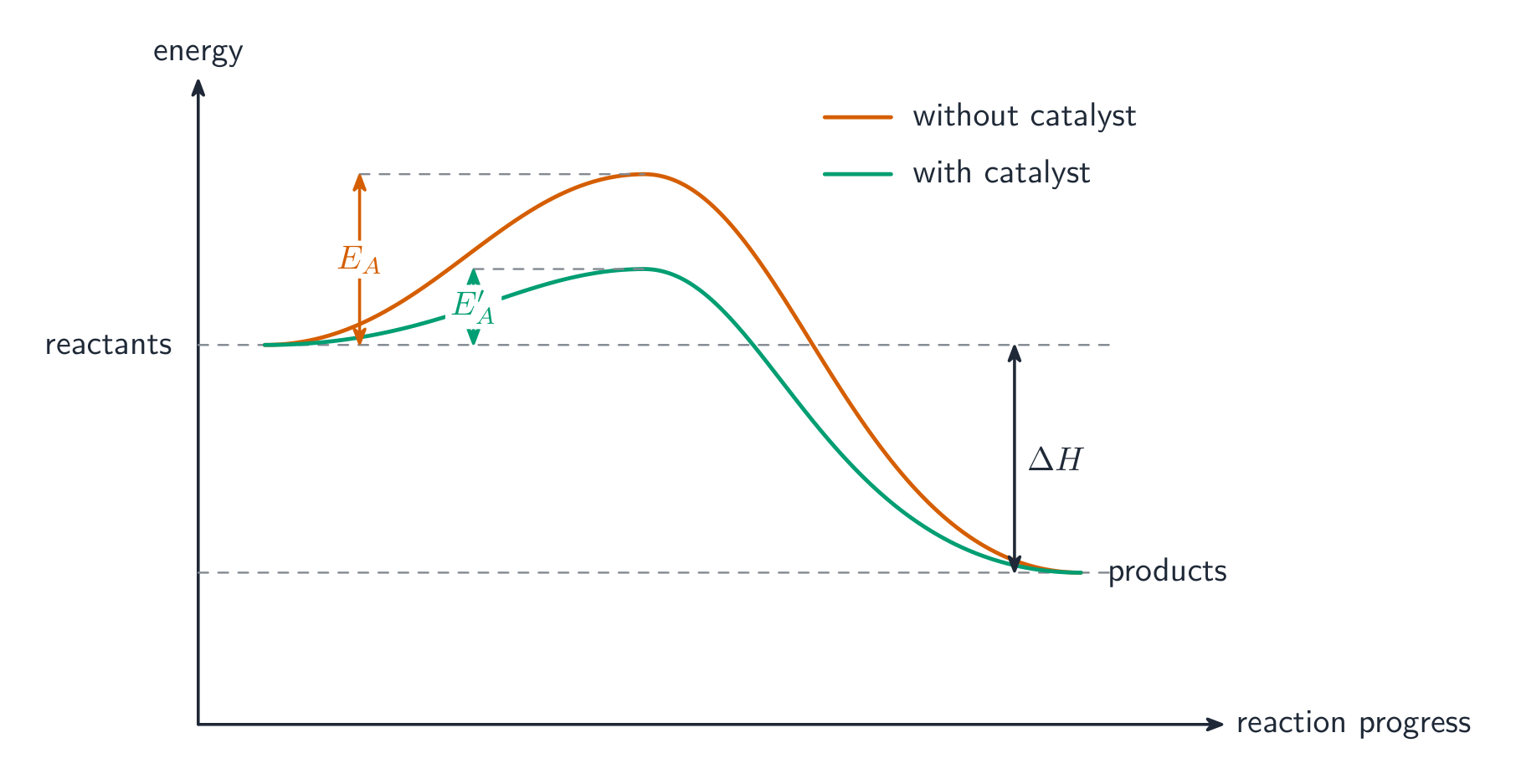
An energy profile plots energy along the reaction. The hump is the activation energy; the drop from reactants to products is $\Delta H$. A catalyst lowers the hump. · ⁨กราฟพลังงาน แสดงพลังงานตามแนวปฏิกิริยา ยอดเขาคือ พลังงานกระตุ้น; การลดลงจากสารตั้งต้นไปสู่ผลิตภัณฑ์คือ $\Delta H$. ตัวเร่งปฏิกิริยาช่วยลดยอดเขาลง⁩

Vocabulary · ⁨คำศัพท์⁩ Train · ⁨ฝึกฝน⁩
English ไทย
transition state/trænˈsɪʃn steɪt/ สถานะทรานซิชัน
5.7

The Sequence of Steps · ⁨ลำดับขั้นตอน⁩

Syllabus · ⁨หลักสูตร⁩
English

Learning Objective 5.7.A: Identify the components of a reaction mechanism.

  • 5.7.A.1 A reaction mechanism consists of a series of elementary reactions, or steps, that occur in sequence. The components may include reactants, intermediates, products, and catalysts.
  • 5.7.A.2 The elementary steps when combined should align with the overall balanced equation of a chemical reaction.
  • 5.7.A.3 A reaction intermediate is produced by some elementary steps and consumed by others, such that it is present only while a reaction is occurring.
  • 5.7.A.4 Experimental detection of a reaction intermediate is a common way to build evidence in support of one reaction mechanism over an alternative mechanism.
    • Exclusion statement: Collection of data pertaining to detection of a reaction intermediate will not be assessed on the AP Exam.
ไทย

วัตถุประสงค์การเรียนรู้ 5.7.A: ระบุองค์ประกอบของกลไกปฏิกิริยา

  • 5.7.A.1 กลไกปฏิกิริยาประกอบด้วย سلسلةของปฏิกิริยาย่อย หรือขั้นตอน ที่เกิดขึ้นตามลำดับ องค์ประกอบอาจรวมถึงสารตั้งต้น中间体 ผลิตภัณฑ์ และตัวเร่งปฏิกิริยา
  • 5.7.A.2 ขั้นตอนย่อยเมื่อรวมกันแล้วควรสอดคล้องกับสมการเคมีที่ดุลแล้วโดยรวม
  • 5.7.A.3中间体被某些步骤产生并被其他步骤消耗,因此它仅在反应进行时存在
  • 5.7.A.4 การตรวจจับ中间体通过实验是支持某一反应机理而非替代机理的常见方法
    • ข้อควรระวัง: การเก็บข้อมูลเกี่ยวกับการตรวจจับ中间体 จะไม่ถูกทดสอบในข้อสอบ AP

Source: College Board AP Course and Exam Description · ⁨แหล่งที่มา: คำอธิบายหลักสูตรและข้อสอบ College Board AP⁩

English

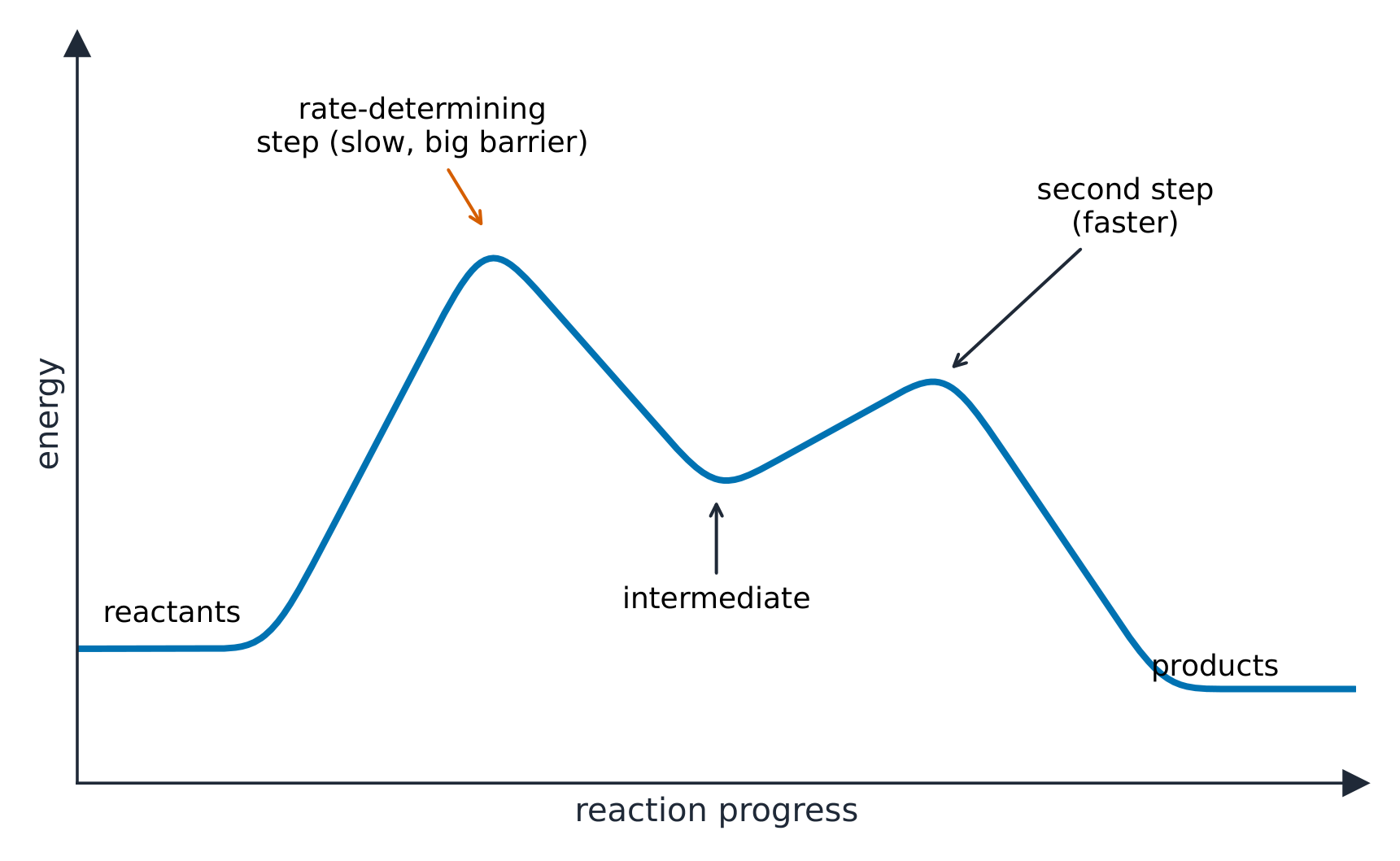
In a multi-step mechanism, the steps must add up to the overall balanced equation (intermediates cancel). Each step has its own energy hill; the tallest hill is the slowest step.

ไทย

ในกลไกหลายขั้นตอน ขั้นตอนต่างๆ ต้อง บวกกัน ได้เป็นสมการรวมที่สมดุล (สารกลางหักล้างกัน) แต่ละขั้นตอนมีเนินพลังงานของตัวเอง; เนินที่สูงที่สุดคือขั้นตอนที่ช้าที่สุด

ขั้นตอนช้าที่มีกำแพงพลังงานสูงกว่าคือขั้นกำหนดอัตรา
ขั้นตอนที่ช้าและมีกำแพงสูงคือตัวกำหนดอัตรา
Vocabulary · ⁨คำศัพท์⁩ Train · ⁨ฝึกฝน⁩
English ไทย
rate-determining step/reɪt dɪˈtɜːmɪnɪŋ step/ ขั้นกำหนดอัตรา
5.8

Finding the Rate Law From a Mechanism · ⁨การหากฎอัตราจากกลไก⁩

Syllabus · ⁨หลักสูตร⁩
English

Learning Objective 5.8.A: Identify the rate law for a reaction from a mechanism in which the first step is rate limiting.

  • 5.8.A.1 For reaction mechanisms in which each elementary step is irreversible, or in which the first step is rate limiting, the rate law of the reaction is set by the molecularity of the slowest elementary step (i.e., the rate-limiting step).
    • Exclusion statement: Collection of data pertaining to detection of a reaction intermediate will not be assessed on the AP Exam.
ไทย

วัตถุประสงค์การเรียนรู้ 5.8.A: ระบุกฎอัตราของปฏิกิริยาจากกลไกที่ขั้นตอนแรกเป็นขั้นจำกัดอัตรา

  • 5.8.A.1 สำหรับกลไกปฏิกิริยาที่แต่ละขั้นตอนย่อยเป็นแบบไม่สามารถย้อนกลับได้ หรือที่ขั้นตอนแรกเป็นขั้นตอนกำหนดอัตรา แล้วกฎอัตราของปฏิกิริยานั้นจะถูกกำหนดโดยโมเลกุลarity ของขั้นตอนย่อยที่ช้าที่สุด (นั่นคือ ขั้นตอนกำหนดอัตรา)
    • ข้อควรระวัง: การเก็บข้อมูลเกี่ยวกับการตรวจจับ中间体 จะไม่ถูกทดสอบในข้อสอบ AP

Source: College Board AP Course and Exam Description · ⁨แหล่งที่มา: คำอธิบายหลักสูตรและข้อสอบ College Board AP⁩

English

The rate-determining step 决速步骤 is the slowest step; its molecularity gives the overall rate law. A valid mechanism must (1) add to the overall reaction and (2) predict the experimentally observed rate law.

Worked example. Suppose the slow (rate-determining) step is the bimolecular collision $\text{NO}_2+\text{NO}_2\rightarrow\text{NO}_3+\text{NO}$. Its molecularity gives the rate law directly: $\text{rate}=k[\text{NO}_2]^2$. If experiment shows exactly this, the proposed mechanism is consistent; if experiment gave $\text{rate}=k[\text{NO}_2]$, the mechanism would be wrong.

ไทย

ขั้นตอนที่กำหนดอัตรา (rate-determining step) คือขั้นตอนที่ช้าที่สุด; โมเลกุลarity ของขั้นนี้กำหนดกฎอัตรารวม กลไกที่ถูกต้องต้อง (1) บวกกันได้ปฏิกิริยารวม และ (2) ทำนายกฎอัตราที่สังเกตจากการทดลองได้

ตัวอย่างวิธีทำ. สมมติว่าขั้นตอนที่ช้า (ตัวกำหนดอัตรา) คือการชนกันแบบ bimolecular $\text{NO}_2+\text{NO}_2\rightarrow\text{NO}_3+\text{NO}$. โมเลกุลarity ของขั้นนี้กำหนดกฎอัตราโดยตรง: $\text{rate}=k[\text{NO}_2]^2$. หากการทดลองแสดงผลลัพธ์เช่นนี้ กลไกที่เสนอมาสอดคล้องกัน; หากการทดลองได้ $\text{rate}=k[\text{NO}_2]$ กลไกนั้นจะผิด

5.9

When the First Step Is Fast · ⁨เมื่อขั้นตอนแรกเร็ว⁩

Syllabus · ⁨หลักสูตร⁩
English

Learning Objective 5.9.A: Identify the rate law for a reaction from a mechanism in which the first step is not rate limiting.

  • 5.9.A.1 If the first elementary reaction is not rate limiting, approximations (such as pre-equilibrium) must be made to determine a rate law expression.
ไทย

จุดประสงค์การเรียนรู้ 5.9.A: ระบุกฎอัตราจากกลไกปฏิกิริยาที่ขั้นตอนแรกไม่ใช่ขั้นตอนกำหนดอัตรา

  • 5.9.A.1 หากขั้นตอนย่อยแรกไม่ใช่ขั้นตอนกำหนดอัตรา จำเป็นต้องมีการประมาณค่า (เช่น การประมาณการก่อนสมดุล) เพื่อหาสมการกฎอัตรา

Source: College Board AP Course and Exam Description · ⁨แหล่งที่มา: คำอธิบายหลักสูตรและข้อสอบ College Board AP⁩

English

If a fast step precedes the slow one, an intermediate appears in the slow step's rate law. Use the fast pre-equilibrium to rewrite that intermediate in terms of reactants, so the final rate law contains only measurable species.

ไทย

หากมีขั้นตอนเร็วนำหน้าขั้นตอนช้า สารกลางจะปรากฏในกฎอัตราของขั้นที่ช้า ให้ใช้ สมดุลก่อนหน้าแบบเร็ว (fast pre-equilibrium) เพื่อเขียนใหม่สารกลางนั้นในรูปของสารตั้งต้น เพื่อให้กฎอัตราส่งท้ายมีเพียงสปีชีส์ที่วัดได้เท่านั้น

5.10

Energy Profiles for Many Steps · ⁨กราฟพลังงานสำหรับหลายขั้นตอน⁩

Syllabus · ⁨หลักสูตร⁩
English

Learning Objective 5.10.A: Represent the activation energy and overall energy change in a multistep reaction with a reaction energy profile.

  • 5.10.A.1 Knowledge of the energetics of each elementary reaction in a mechanism allows for the construction of an energy profile for a multistep reaction.
ไทย

วัตถุประสงค์การเรียนรู้ 5.10.A: แสดงพลังงานก่อกวนและการเปลี่ยนแปลงพลังงานรวมในปฏิกิริยาแบบหลายขั้นตอนด้วยโปรไฟล์พลังงานปฏิกิริยา

  • 5.10.A.1 ความรู้เกี่ยวกับอุณหพลศาสตร์ของแต่ละปฏิกิริยาขั้นพื้นฐานในกลไกช่วยให้สามารถสร้างโปรไฟล์พลังงานสำหรับปฏิกิริยาแบบหลายขั้นตอนได้

Source: College Board AP Course and Exam Description · ⁨แหล่งที่มา: คำอธิบายหลักสูตรและข้อสอบ College Board AP⁩

English

A multi-step reaction's profile shows several peaks (one per step) with valleys (intermediates) between them. The highest peak is the rate-determining transition state – it controls the overall rate.

ไทย

โปรไฟล์ของปฏิกิริยาหลายขั้นตอนแสดงยอดเขาหลายจุด (หนึ่งจุดต่อหนึ่งขั้นตอน) พร้อมหุบเขา (สารกลาง) อยู่ระหว่างยอดเขาเหล่านั้น ยอดเขาที่สูงที่สุด คือสถานะเปลี่ยนผ่านที่กำหนดอัตราการเกิดปฏิกิริยา – ซึ่งเป็นตัวควบคุมอัตราการเกิดปฏิกิริยารวม

5.11

How Catalysts Speed Things Up · ⁨วิธีที่ตัวเร่งปฏิกิริยาช่วยให้ปฏิกิริยาดำเนินการเร็วขึ้น⁩

Syllabus · ⁨หลักสูตร⁩
English

Learning Objective 5.11.A: Explain the relationship between the effect of a catalyst on a reaction and changes in the reaction mechanism.

  • 5.11.A.1 In order for a catalyst to increase the rate of a reaction, the addition of the catalyst must increase the number of effective collisions and/or provide a reaction path with a lower activation energy relative to the original reaction coordinate.
  • 5.11.A.2 In a reaction mechanism containing a catalyst, the net concentration of the catalyst is constant. However, the catalyst will frequently be consumed in the rate-determining step of the reaction, only to be regenerated in a subsequent step in the mechanism.
  • 5.11.A.3 Some catalysts accelerate a reaction by binding to the reactant(s). The reactants are either oriented more favorably or react with lower activation energy. There is often a new reaction intermediate in which the catalyst is bound to the reactant(s). Many enzymes function in this manner.
  • 5.11.A.4 Some catalysts involve covalent bonding between the catalyst and the reactant(s). An example is acid-base catalysis, in which a reactant or intermediate either gains or loses a proton. This introduces a new reaction intermediate and new elementary reactions involving that intermediate.
  • 5.11.A.5 In surface catalysis, a reactant or intermediate binds to, or forms a covalent bond with, the surface. This introduces elementary reactions involving these new bound reaction intermediate(s).
ไทย

วัตถุประสงค์การเรียนรู้ 5.11.A: อธิบายความสัมพันธ์ระหว่างผลของตัวเร่งปฏิกิริยากับปฏิกิริยาและการเปลี่ยนแปลงในกลไกปฏิกิริยา

  • 5.11.A.1 เพื่อให้ตัวเร่งปฏิกิริยาเพิ่มอัตราการเกิดปฏิกิริยา การเพิ่มตัวเร่งปฏิกิริยาต้องเพิ่มจำนวนการชนที่มีประสิทธิผลและ/หรือให้เส้นทางปฏิกิริยากsWith_พลังงานก่อกวนต่ำกว่าเมื่อเทียบกับเส้นทางการเกิดปฏิกิริยาเดิม
  • 5.11.A.2 ในกลไกปฏิกิริยาที่มีตัวเร่งปฏิกิริยา ความเข้มข้นสุทธิของตัวเร่งปฏิกิริยานั้นคงที่ อย่างไรก็ตาม ตัวเร่งปฏิกิริยามักจะถูกบริโภคในขั้นตอนกำหนดอัตราการเกิดปฏิกิริยา ของปฏิกิริยา แล้วถูกสร้างใหม่ในขั้นตอนถัดไปของกลไก
  • 5.11.A.3 ตัวเร่งปฏิกิริยาบางชนิดเร่งปฏิกิริยาโดยการจับกับสารตั้งต้น(们) สารตั้งต้นถูกจัดวางในทิศทางที่ดีขึ้นหรือทำปฏิกิริยากับพลังงานก่อกวนต่ำลง มักมีตัวกลางปฏิกิริยารุ่นใหม่ในซึ่งตัวเร่งปฏิกิริยาจับกับสารตั้งต้น(们) เอนไซม์จำนวนมากทำงานในลักษณะนี้
  • 5.11.A.4 ตัวเร่งปฏิกิริยาบางชนิดเกี่ยวข้องกับพันธะโคเวเลนต์ระหว่างตัวเร่งปฏิกิริยากับสารตั้งต้น(们) ตัวอย่างคือการเร่งปฏิกิริยาระหว่างกรด-เบส ในซึ่งสารตั้งต้นหรือตัวกลาง either gained or lost a proton This introduces a new reaction intermediate and new elementary reactions involving that intermediate.
  • 5.11.A.5 ในการเร่งปฏิกิริยาบนพื้นผิว สารตั้งต้นหรือตัวกลางจะจับกับหรือสร้างพันธะโคเวเลนต์กับพื้นผิว สิ่งนี้引入了 elementary reactions involving these new bound reaction intermediate(s).

Source: College Board AP Course and Exam Description · ⁨แหล่งที่มา: คำอธิบายหลักสูตรและข้อสอบ College Board AP⁩

English

A catalyst 催化剂 speeds a reaction by providing a new pathway with a lower activation energy, without being consumed. It does not change $\Delta H$ or the equilibrium position – only how fast equilibrium is reached. On an energy profile, a catalyst lowers the peak(s).

ไทย

ตัวเร่งปฏิกิริยา ช่วยเพิ่มอัตราการเกิดปฏิกิริยาโดยการสร้างเส้นทางใหม่ที่มี พลังงานกระตุ้นต่ำกว่า โดยไม่ถูกใช้ไปเอง มันไม่เปลี่ยน $\Delta H$ หรือตำแหน่งสมดุล – แต่ทำให้ถึงจุดสมดุลได้เร็วขึ้น ในโปรไฟล์พลังงาน ตัวเร่งปฏิกิริยาจะลดความสูงของยอดเขา(s)

ตัวเร่งปฏิกิริยาให้เส้นทางที่มีพลังงานกระตุ้นต่ำกว่า; การเปลี่ยนแปลงเอนทาลปีไม่เปลี่ยน
5.11

Exam tips · ⁨ข้อแนะนำสำหรับการสอบ⁩

English
  • Rate rises with concentration, temperature, surface area, and a catalyst — explain each with collision theory (more, or more energetic, successful collisions).
  • Temperature works mainly by getting more particles above the activation energy, not just more collisions.
  • Reaction orders come from experiment, not the balanced coefficients — see how the rate changes when one concentration is varied.
  • On an energy profile the hill height is the activation energy and the reactant–product gap is $\Delta H$.
  • A catalyst lowers the activation energy (a new pathway) but leaves $\Delta H$ and the equilibrium position unchanged.
ไทย
  • อัตราการเกิดปฏิกิริยาเพิ่มขึ้นตาม ความเข้มข้น อุณหภูมิ พื้นที่ผิว และตัวเร่งปฏิกิริยา — อธิบายแต่ละปัจจัยด้วย ทฤษฎีการชนกัน (มีการชนกันที่ประสบความสำเร็จมากขึ้น หรือมีพลังงานสูงขึ้นในการชนกัน),
  • อุณหภูมิทำงานโดยทำให้มี อนุภาคจำนวนมากที่มีพลังงานเกินกว่าพลังงานกระตุ้น ไม่ใช่แค่การชนกันมากขึ้นเท่านั้น
  • อันดับของปฏิกิริยามาจากการทดลอง ไม่ใช่จากสัมประสิทธิ์ในสมการที่ปรับแล้ว – ดูว่าอัตราเปลี่ยนแปลงอย่างไรเมื่อเปลี่ยนความเข้มข้นของสารตั้งต้นหนึ่งชนิด
  • ใน โปรไฟล์พลังงาน ความสูงของภูเขาคือพลังงานกระตุ้น ส่วนช่องว่างระหว่างสารตั้งต้นและผลิตภัณฑ์คือ $\Delta H$
  • ตัวเร่งปฏิกิริยา ลดพลังงานกระตุ้น (สร้างเส้นทางใหม่) แต่คง $\Delta H$ และตำแหน่งสมดุลไว้ไม่เปลี่ยนแปลง

Interactive lessons on this topic · ⁨บทเรียนเชิงโต้ตอบสำหรับหัวข้อนี้⁩

Work through it step by step, with instant-check exercises. · ⁨ทำทีละขั้นตอน พร้อมแบบฝึกหัดตรวจสอบผลทันที⁩

Past Papers · ⁨ข้อสอบย้อนหลัง⁩

More topics in AP Chemistry · ⁨หัวข้อเพิ่มเติมใน AP Chemistry⁩

Log in or create account · ⁨เข้าสู่ระบบหรือสร้างบัญชี⁩

IGCSE, A-Level & AP