English
Learning Objective 3.1.A: Explain the relationship between the chemical structures of molecules and the relative strength of their intermolecular forces when: i. The molecules are of the same chemical species. ii. The molecules are of two different chemical species.
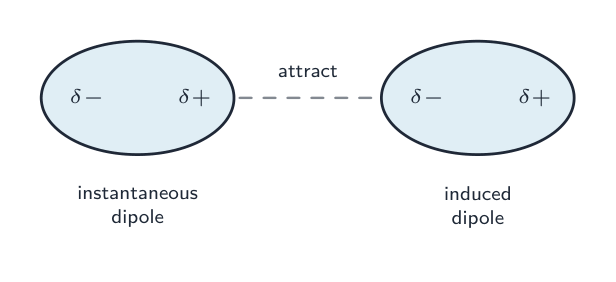
- 3.1.A.1 London dispersion forces are a result of the Coulombic interactions between temporary, fluctuating dipoles. London dispersion forces are often the strongest net intermolecular force between large molecules.
- i. Dispersion forces increase with increasing contact area between molecules and with increasing polarizability of the molecules.
- ii. The polarizability of a molecule increases with an increasing number of electrons in the molecule and the size of the electron cloud. It is enhanced by the presence of pi bonding.
- iii. The term "London dispersion forces" should not be used synonymously with the term "van der Waals forces."
- 3.1.A.2 The dipole moment of a polar molecule leads to additional interactions with other chemical species.
- i. Dipole-induced dipole interactions are present between a polar and nonpolar molecule. These forces are always attractive. The strength of these forces increases with the magnitude of the dipole of the polar molecule and with the polarizability of the nonpolar molecule.
- ii. Dipole-dipole interactions are present between polar molecules. The interaction strength depends on the magnitudes of the dipoles and their relative orientation. Interactions between polar molecules are typically greater than those between nonpolar molecules of comparable size because these interactions act in addition to London dispersion forces.
- iii. Ion-dipole forces of attraction are present between ions and polar molecules. These tend to be stronger than dipole-dipole forces.
- 3.1.A.3 The relative strength and orientation dependence of dipole-dipole and ion-dipole forces can be understood qualitatively by considering the sign of the partial charges responsible for the molecular dipole moment, and how these partial charges interact with an ion or with an adjacent dipole.
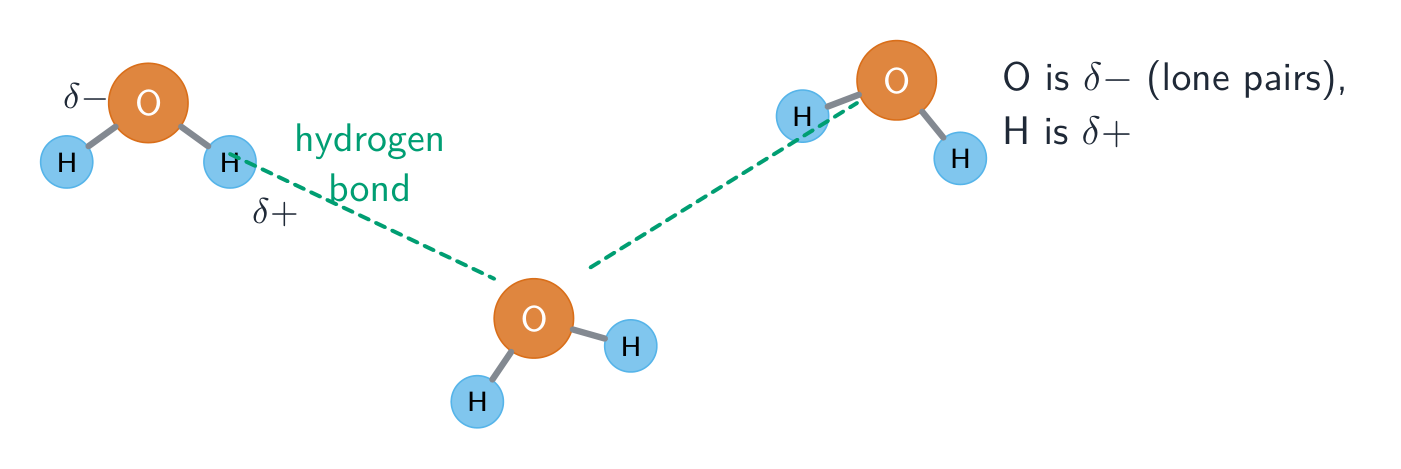
- 3.1.A.4 Hydrogen bonding is a strong type of intermolecular interaction that exists when hydrogen atoms covalently bonded to the highly electronegative atoms (N, O, and F) are attracted to the negative end of a dipole formed by the electronegative atom (N, O, and F) in a different molecule, or a different part of the same molecule.
- 3.1.A.5 In large biomolecules, noncovalent interactions may occur between different molecules or between different regions of the same large biomolecule.
ไทย
จุดประสงค์การเรียนรู้ 3.1.A: อธิบายความสัมพันธ์ระหว่างโครงสร้างทางเคมีของโมเลกุลกับความแข็งแรงสัมพัทธ์ของแรงระหว่างโมเลกุลเมื่อ: i. โมเลกุลเป็นสารเคมีชนิดเดียวกัน ii. โมเลกุลเป็นสารเคมีสองชนิดต่างกัน
- 3.1.A.1 แรงลอนดอนเกิดจากการมีปฏิสัมพันธ์แบบคูลอมบ์ระหว่างไดโพลชั่วคราวที่เปลี่ยนแปลงค่า แรงลอนดอนมักเป็นแรงระหว่างโมเลกุลสุทธิที่แข็งแกร่งที่สุดในโมเลกุลขนาดใหญ่
- i. แรง disperion เพิ่มขึ้นตามพื้นที่สัมผัสระหว่างโมเลกุลที่เพิ่มขึ้นและความสามารถในการทำให้เป็นขั้วของโมเลกุลที่เพิ่มขึ้น
- ii. ความสามารถในการทำให้เป็นขั้วของโมเลกุลเพิ่มขึ้นตามจำนวนอิเล็กตรอนในโมเลกุลและขนาดของเมฆอิเล็กตรอน การเพิ่มประสิทธิภาพนี้เกิดจากการมีอยู่ของพันธะไพ
- iii. คำว่า "แรงลอนดอน" ไม่ควรใช้แทนคำคำว่า "แรงวานเดอรวาลส์"
- 3.1.A.2 ไดโพลโมเมนต์ของโมเลกุลที่มีขั้วนำไปสู่การมีปฏิสัมพันธ์เพิ่มเติมกับสารเคมีอื่น
- i. ปฏิสัมพันธ์ไดโพล-เหนี่ยวนำไดโพลมีอยู่ในระหว่างโมเลกุลที่มีขั้วและไม่ขั้ว แรงเหล่านี้มีความดึงดูดเสมอ ความแข็งแกร่งของแรงเหล่านี้เพิ่มขึ้นตามขนาดของไดโพลของโมเลกุลที่มีขั้วและความสามารถในการทำให้เป็นขั้วของโมเลกุลที่ไม่ขั้ว
- ii. ปฏิสัมพันธ์ไดโพล-ไดโพลมีอยู่ในระหว่างโมเลกุลที่มีขั้ว ความแข็งแกร่งของการขึ้นอยู่กับขนาดของไดโพลและการจัดวางสัมพัทธ์它们的。ปฏิกิริยาระหว่างโมเลกุลที่มีขั้วมักมากกว่าระหว่างโมเลกุลที่ไม่ขั้วที่มีขนาดเทียบเท่าเนื่องจากปฏิกิริยานี้เกิดขึ้นเพิ่มเติมจากแรงลอนดอน
- iii. แรงดึงดูดไอออน-ไดโพลมีอยู่ในระหว่างไอออนและโมเลกุลที่มีขั้ว แรงเหล่านี้มักแข็งแกร่งกว่าแรงไดโพล-ไดโพล
- 3.1.A.3 ความสัมพันธ์ของความเข้มและความขึ้นอยู่กับการจัดวางตัวของแรงดิปอล-ดิปอลและแรงไอออน-ดิปอลสามารถอธิบายโดยเชิงคุณภาพได้จากการพิจารณาเครื่องหมายของประจุย่อยที่เป็นสาเหตุของโมเมนต์ดิปอลของโมเลกุล และวิธีที่ประจุย่อยเหล่านี้มีปฏิสัมพันธ์กับไอออนหรือกับดิปอลที่อยู่ติดกัน
- 3.1.A.4 พันธไฮโดรเจนเป็นประเภทหนึ่งของการดึงดูดระหว่างโมเลกุลที่ค่อนข้างแข็งแรง เกิดขึ้นเมื่ออะตอมไฮโดรเจนที่เชื่อมต่อกันด้วยพันธะโควาเลนต์กับอะตอมที่มีค่าอิเล็กโทรเนกาติวิตีสูง (N, O และ F) ถูกดึงดูดไปยังขั้วลบของดิปอลที่เกิดจากอะตอมที่มีค่าอิเล็กโทรเนกาติวิตีสูง (N, O และ F) ในโมเลกุลอื่น หรือในส่วนต่าง ๆ ของโมเลกุลเดียวกัน
- 3.1.A.5 ในไบโอมoléกุลขนาดใหญ่ อาจเกิดการมีปฏิสัมพันธ์แบบไม่ใช้พันธะโควาเลนต์ระหว่างโมเลกุลต่าง ๆ หรือระหว่างบริเวณต่าง ๆ ของไบโอมoléกุลขนาดใหญ่ตัวเดียวกัน