Skip to content · ⁨ข้ามไปยังเนื้อหา⁩

Differentiation: Definition and Fundamental Properties · ⁨ดิฟเฟอเรนเชียชัน: นิยามและคุณสมบัติพื้นฐาน⁩

AP Calculus AB · Topic 2 · ⁨หัวข้อ 2⁩

Video lesson for this topic · ⁨บทเรียนวิดีโอสำหรับหัวข้อนี้⁩ Open the video page · ⁨เปิดหน้าวิดีโอ⁩
7:54

นิยามของอนุพันธ์

จินตนาการการเดินทางของรถยนต์เป็นกราฟ ในระยะทางทั้งหมด เราสามารถวัดความเร็วเฉลี่ยได้ — ซึ่งเป็นความชันของเส้นตรงที่เชื่อมจุดสองจุดบนกราฟ.…

English narration · English + 中文 subtitles burned in · ⁨การบรรยายภาษาอังกฤษ · คำบรรยายภาษาอังกฤษ + 中文 ลอยตัวบนภาพ⁩

2.1

Average and Instantaneous Rates of Change · ⁨อัตราการเปลี่ยนแปลงเฉลี่ยและอัตราการเปลี่ยนแปลงทันที⁩

Syllabus · ⁨หลักสูตร⁩
English

Enduring Understanding (CHA-2): Derivatives allow us to determine rates of change at an instant by applying limits to knowledge about rates of change over intervals.

Learning Objective CHA-2.A: Determine average rates of change using difference quotients.

  • CHA-2.A.1 The difference quotients $\dfrac{f(a+h)-f(a)}{h}$ and $\dfrac{f(x)-f(a)}{x-a}$ express the average rate of change of a function over an interval.

Learning Objective CHA-2.B: Represent the derivative of a function as the limit of a difference quotient.

  • CHA-2.B.1 The instantaneous rate of change of a function at $x=a$ can be expressed by $\lim\limits_{h\to 0}\dfrac{f(a+h)-f(a)}{h}$ or $\lim\limits_{x\to a}\dfrac{f(x)-f(a)}{x-a}$, provided the limit exists. These are equivalent forms of the definition of the derivative and are denoted $f'(a)$.
ไทย

ความเข้าใจที่ยั่งยืน (CHA-2): ฟังก์ชันอนุพันธ์ช่วยให้เราสามารถกำหนดอัตราเปลี่ยนแปลงที่ช่วงเวลาหนึ่งได้โดยการนำลิมิตไปใช้กับความรู้เกี่ยวกับอัตราเปลี่ยนแปลงในช่วง

วัตถุประสงค์การเรียนรู้ CHA-2.A: หาอัตราเปลี่ยนแปลงเฉลี่ยโดยใช้ผลต่าง quotient

  • CHA-2.A.1 ผลต่าง quotient $\dfrac{f(a+h)-f(a)}{h}$ และ $\dfrac{f(x)-f(a)}{x-a}$ แสดงถึงอัตราเปลี่ยนแปลงเฉลี่ยของฟังก์ชันในช่วง

วัตถุประสงค์การเรียนรู้ CHA-2.B: แสดงอนุพันธ์ของฟังก์ชันเป็นลิมิตของผลต่าง quotient

  • CHA-2.B.1 อัตราเปลี่ยนแปลงทันทีของฟังก์ชันที่ $x=a$ สามารถแสดงได้ด้วย $\lim\limits_{h\to 0}\dfrac{f(a+h)-f(a)}{h}$ หรือ $\lim\limits_{x\to a}\dfrac{f(x)-f(a)}{x-a}$ โดยเงื่อนไขว่าลิมิตต้องมีอยู่ ทั้งสองนี้เป็นรูปแบบที่เทียบเท่ากันของการนิยามอนุพันธ์และสัญลักษณ์คือ $f'(a)$
Source: College Board AP Course and Exam Description · ⁨แหล่งที่มา: คำอธิบายหลักสูตรและข้อสอบ College Board AP⁩

English
The derivative from first principles

Unit 1 built the limit. Unit 2 uses it to define the derivative 导数 – the exact rate of change at a point.

Over an interval, the average rate of change is a difference quotient 差商. Two equivalent forms appear:

$$\frac{f(a+h)-f(a)}{h} \qquad\text{and}\qquad \frac{f(x)-f(a)}{x-a}.$$
The first uses a step of size $h$ from $a$; the second uses two points $x$ and $a$. Both compute $\dfrac{\text{change in output}}{\text{change in input}}$ over the interval.

The instantaneous 瞬时 rate of change at $x=a$ is what the difference quotient approaches as the interval shrinks to zero. This limit is the derivative at $a$, written $f'(a)$:

$$f'(a) = \lim_{h\to 0}\frac{f(a+h)-f(a)}{h} = \lim_{x\to a}\frac{f(x)-f(a)}{x-a},$$
provided the limit exists.

ไทย
รถเหาะบนทางขึ้น: อนุพันธ์วัดอัตราการเปลี่ยนแปลงทันทีของตำแหน่ง
อนุพันธ์จากหลักการแรก

หน่วยที่ 1 สร้างลิมิตไว้ หน่วยที่ 2 ใช้มันเพื่อนิยาม อนุพันธ์ – อัตราการเปลี่ยนแปลงที่แม่นยำ ณ จุดหนึ่ง

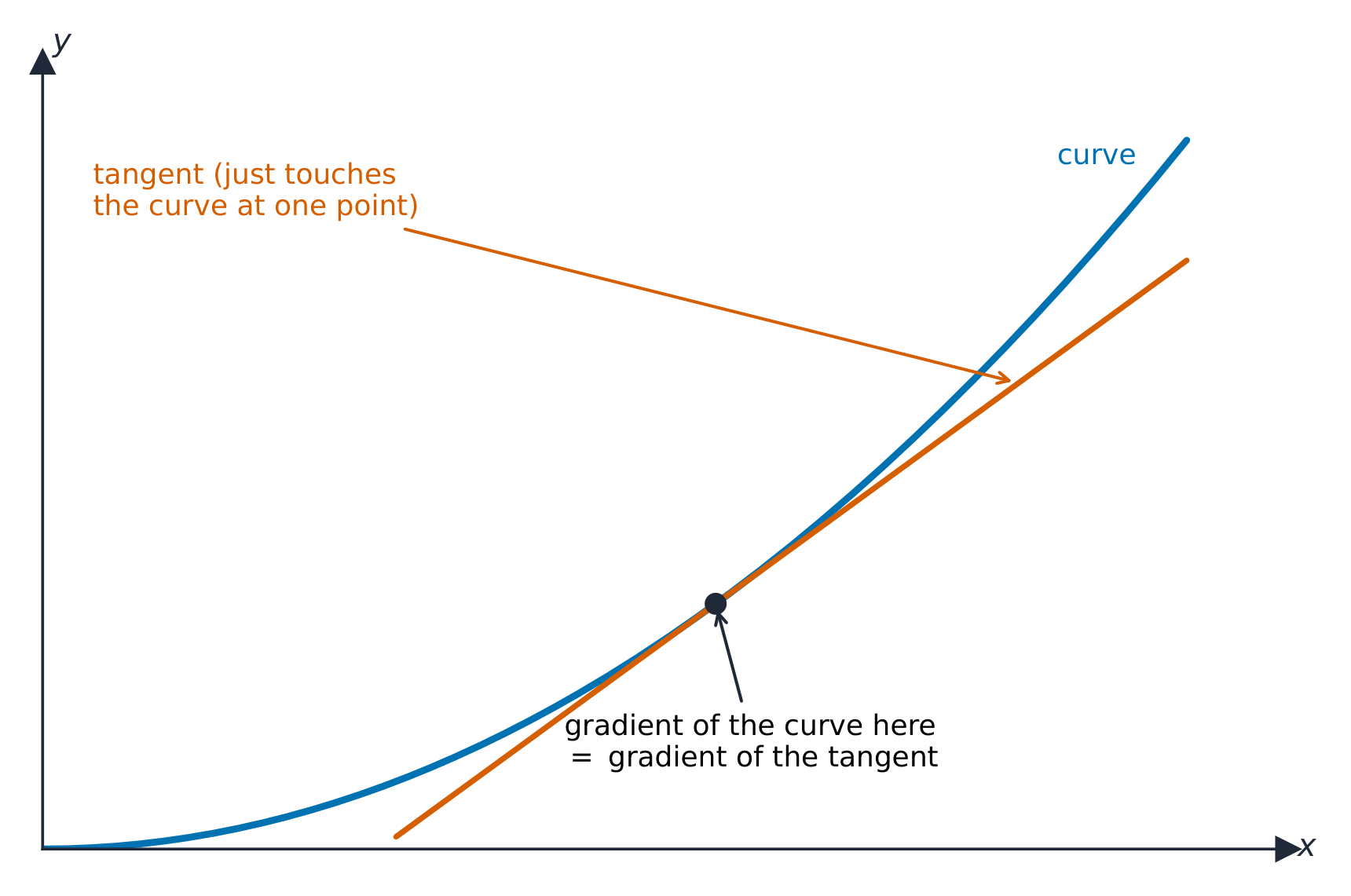
อัตราการเปลี่ยนแปลงทันทีคือความชันของเส้นสัมผัส ณ จุดหนึ่ง

ในช่วงหนึ่ง อัตราการเปลี่ยนแปลงเฉลี่ยคือ ผลต่างของอัตราส่วน รูปแบบที่เทียบเท่ากันสองแบบปรากฏมา:

$$\frac{f(a+h)-f(a)}{h} \qquad\text{and}\qquad \frac{f(x)-f(a)}{x-a}.$$
แบบแรกใช้ก้าวขนาด $h$ จาก $a$; แบบที่สองใช้สองจุด $x$ และ $a$. ทั้งสองคำนวณ $\dfrac{\text{change in output}}{\text{change in input}}$ ตลอดช่วง

อัตราการเปลี่ยนแปลง ทันที ที่ $x=a$ คือสิ่งที่ผลต่างของอัตราENCES เข้าใกล้เมื่อช่วงหดตัวลงเป็นศูนย์ ลิมิตนี้ คือ อนุพันธ์ที่ $a$, เขียนว่า $f'(a)$:

$$f'(a) = \lim_{h\to 0}\frac{f(a+h)-f(a)}{h} = \lim_{x\to a}\frac{f(x)-f(a)}{x-a},$$
ตราบใดที่ลิมิตมีอยู่

Explore · ⁨สำรวจ⁩

From average rate to instantaneous rate · ⁨从平均变化率到瞬时变化率⁩

y = ax³ + bx² + cx + d

Slide the point: the secant through two nearby points tips toward the tangent as they merge. The tangent's slope is the derivative — the instantaneous rate of change. · ⁨滑动该点:穿过两个邻近点的割线在两点合并时趋向切线。切线的斜率是导数——即瞬时变化率。⁩

Vocabulary · ⁨คำศัพท์⁩ Train · ⁨ฝึกฝน⁩
English ไทย
first principles/fɜːst ˈprɪnsɪplz/ หลักการแรก
notations/nəʊˈteɪʃnz/ สัญลักษณ์
slope/sləʊp/ ความชัน
tangent line/ˈtændʒənt laɪn/ เส้นสัมผัส
2.2

Defining the Derivative and Its Notation · ⁨นิยามอนุพันธ์และสัญลักษณ์⁩

Syllabus · ⁨หลักสูตร⁩
English

Enduring Understanding (CHA-2): Derivatives allow us to determine rates of change at an instant by applying limits to knowledge about rates of change over intervals.

Learning Objective CHA-2.B: Represent the derivative of a function as the limit of a difference quotient.

  • CHA-2.B.2 The derivative of $f$ is the function whose value at $x$ is $\lim\limits_{h\to 0}\dfrac{f(x+h)-f(x)}{h}$, provided this limit exists.
  • CHA-2.B.3 For $y=f(x)$, notations for the derivative include $\dfrac{dy}{dx}$, $f'(x)$, and $y'$.
  • CHA-2.B.4 The derivative can be represented graphically, numerically, analytically, and verbally.

Learning Objective CHA-2.C: Determine the equation of a line tangent to a curve at a given point.

  • CHA-2.C.1 The derivative of a function at a point is the slope of the line tangent to a graph of the function at that point.
ไทย

ความเข้าใจที่ยั่งยืน (CHA-2): ฟังก์ชันอนุพันธ์ช่วยให้เราสามารถกำหนดอัตราเปลี่ยนแปลงที่ช่วงเวลาหนึ่งได้โดยการนำลิมิตไปใช้กับความรู้เกี่ยวกับอัตราเปลี่ยนแปลงในช่วง

วัตถุประสงค์การเรียนรู้ CHA-2.B: แสดงอนุพันธ์ของฟังก์ชันเป็นลิมิตของผลต่าง quotient

  • CHA-2.B.2 อนุพันธ์ของ $f$ คือฟังก์ชัน whose value at $x$ is $\lim\limits_{h\to 0}\dfrac{f(x+h)-f(x)}{h}$, โดยเงื่อนไขว่าลิมิตต้องมีอยู่
  • CHA-2.B.3 สำหรับ $y=f(x)$ สัญลักษณ์ของอนุพันธ์รวมถึง $\dfrac{dy}{dx}$, $f'(x)$, และ $y'$
  • CHA-2.B.4 อนุพันธ์สามารถแสดงได้ทั้งแบบกราฟิก แบบเชิงตัวเลข แบบวิเคราะห์ และแบบคำพูด

วัตถุประสงค์การเรียนรู้ CHA-2.C: หาสมการเส้นสัมผัสกับเส้นโค้งที่จุดที่กำหนดให้

  • CHA-2.C.1 อนุพันธ์ของฟังก์ชันที่จุดหนึ่งคือความชันของเส้นสัมผัสกับกราฟของฟังก์ชันที่จุดนั้น

Source: College Board AP Course and Exam Description · ⁨แหล่งที่มา: คำอธิบายหลักสูตรและข้อสอบ College Board AP⁩

English

Let the point $a$ vary and the derivative becomes a new function:

$$f'(x) = \lim_{h\to 0}\frac{f(x+h)-f(x)}{h}.$$
This is the definition of the derivative (sometimes called differentiating "by first principles" 用定义求导). Its value at each $x$ is the instantaneous rate of change there.

Common notations 记号 for the derivative of $y=f(x)$ are:

$$\frac{dy}{dx}, \qquad f'(x), \qquad y'.$$
The derivative can be represented graphically, numerically, analytically, and verbally – be ready to move between them.

Geometric meaning. The derivative at a point is the slope 斜率 of the tangent line 切线 to the graph there. So the tangent line at $x=a$ passes through $\big(a, f(a)\big)$ with slope $f'(a)$:

$$y - f(a) = f'(a)\,(x-a).$$
Writing this line is a routine exam task, so keep the point-slope form ready.

ไทย

ให้จุด $a$ เปลี่ยนไป และอนุพันธ์จะกลายเป็น ฟังก์ชันใหม่:

$$f'(x) = \lim_{h\to 0}\frac{f(x+h)-f(x)}{h}.$$
นี่คือ นิยามของอนุพันธ์ (บางครั้งเรียกว่า differentiation "by first principles") ค่าของมันที่แต่ละ $x$ คืออัตราการเปลี่ยนแปลงทันที ณ จุดนั้น

สัญลักษณ์ ที่พบบ่อยสำหรับอนุพันธ์ของ $y=f(x)$ ได้แก่:

$$\frac{dy}{dx}, \qquad f'(x), \qquad y'.$$
อนุพันธ์สามารถแสดงในรูปกราฟ ตัวเลข สมการ และคำพูด – เตรียมพร้อมสำหรับการเปลี่ยนระหว่างรูปแบบเหล่านี้

ความหมายทางเรขาคณิต. อนุพันธ์ ณ จุดหนึ่งคือ ความชัน ของ เส้นสัมผัส กับกราฟที่จุดนั้น ดังนั้นเส้นสัมผัสที่ $x=a$ ผ่าน $\big(a, f(a)\big)$ ด้วยความชัน $f'(a)$:

$$y - f(a) = f'(a)\,(x-a).$$
การเขียนสมการเส้นนี้เป็นการบ้านปกติในการสอบ ดังนั้นให้เตรียมสูตรจุด-ความชันไว้เสมอ

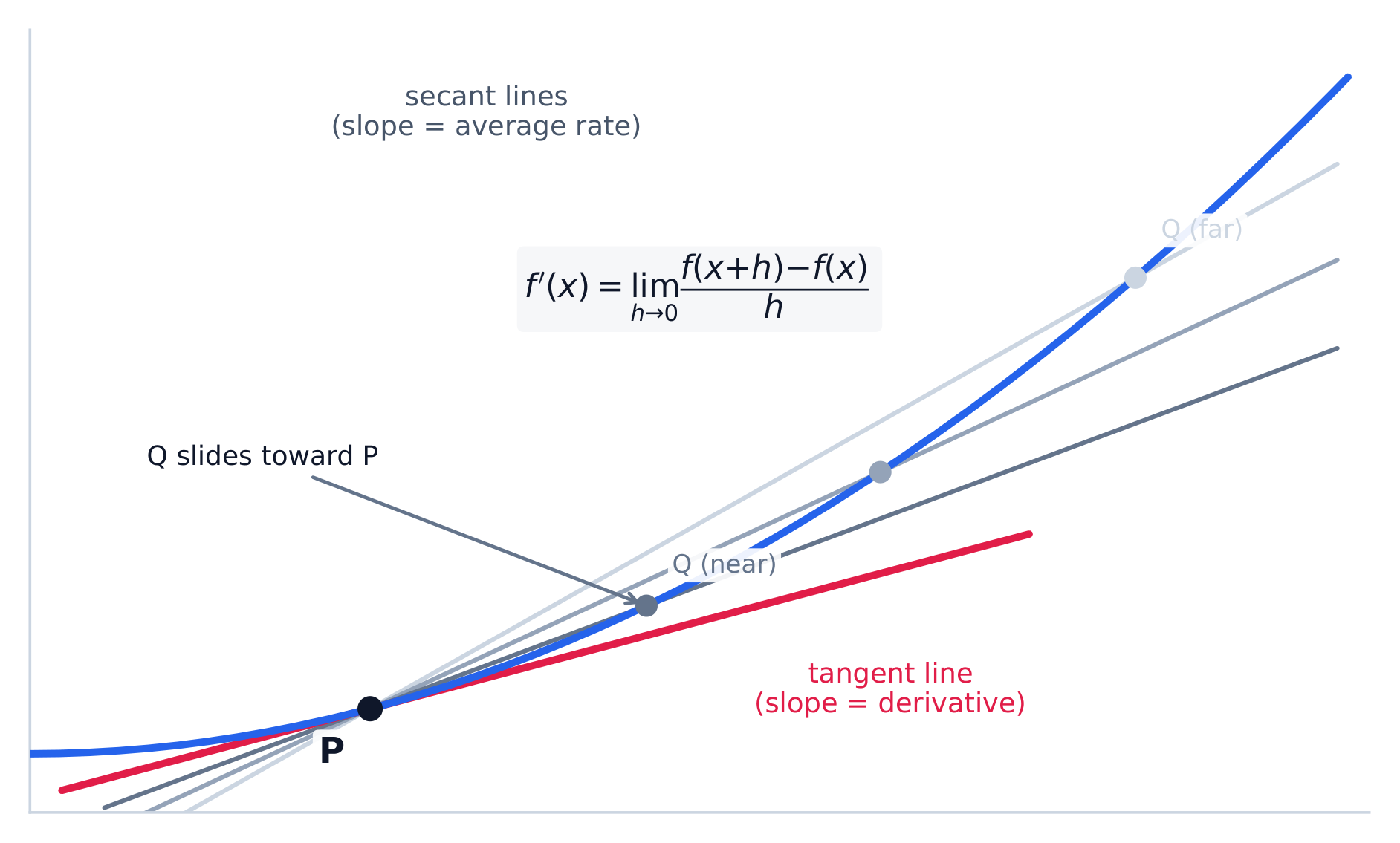
ความชันของเส้นตัดเข้าใกล้ความชันของเส้นสัมผัส: เปรียบเทียบคือลิมิตของอัตราการเปลี่ยนแปลงเฉลี่ย
เมื่อ $Q$ เลื่อนเข้าหา $P$, ความชันของแต่ละเส้นตัด (อัตราเฉลี่ย) จะเข้าใกล้ความชันของเส้นสัมผัส – อนุพันธ์ $f'(a)$.
2.3

Estimating a Derivative at a Point · ⁨การประมาณค่าอนุพันธ์ ณ จุดหนึ่ง⁩

Syllabus · ⁨หลักสูตร⁩
English

Enduring Understanding (CHA-2): Derivatives allow us to determine rates of change at an instant by applying limits to knowledge about rates of change over intervals.

Learning Objective CHA-2.D: Estimate derivatives.

  • CHA-2.D.1 The derivative at a point can be estimated from information given in tables or graphs.
  • CHA-2.D.2 Technology can be used to calculate or estimate the value of a derivative of a function at a point.
ไทย

ความเข้าใจที่ยั่งยืน (CHA-2): ฟังก์ชันอนุพันธ์ช่วยให้เราสามารถกำหนดอัตราเปลี่ยนแปลงที่ช่วงเวลาหนึ่งได้โดยการนำลิมิตไปใช้กับความรู้เกี่ยวกับอัตราเปลี่ยนแปลงในช่วง

วัตถุประสงค์การเรียนรู้ CHA-2.D: ประมาณค่าอนุพันธ์

  • CHA-2.D.1 อนุพันธ์ที่จุดหนึ่งสามารถประมาณได้จากข้อมูลที่ให้ไว้ในตารางหรือกราฟ
  • CHA-2.D.2 เทคโนโลยีสามารถใช้คำนวณหรือประมาณค่าของอนุพันธ์ของฟังก์ชันที่จุดหนึ่งได้

Source: College Board AP Course and Exam Description · ⁨แหล่งที่มา: คำอธิบายหลักสูตรและข้อสอบ College Board AP⁩

English

You do not always have a formula. When a function is given by a table 表格 or a graph, estimate the derivative $f'(a)$ with a difference quotient over a small interval around $a$. A table with values on both sides of $a$ gives the best estimate:

$$f'(a) \approx \frac{f(b)-f(c)}{b-c},\qquad \text{where } c < a < b \text{ are the closest table inputs}.$$
Technology (a calculator) can also estimate a derivative at a point.

Exam skill (appears almost every year). Questions such as "Approximate $M'(7.5)$ using the average rate of change of $M$ over the interval $5 \le t \le 10$" ask for exactly this difference quotient. Show the setup:

$$M'(7.5) \approx \frac{M(10)-M(5)}{10-5}.$$
Full credit needs the numbers plugged in and the correct units 单位 (output units per input unit), since these come from real-world models.

ไทย

คุณอาจไม่มีสูตรเสมอไป เมื่อฟังก์ชันถูกให้มาในรูปแบบ ตาราง หรือกราฟ ให้ประมาณค่าอนุพันธ์ $f'(a)$ โดยใช้ผลต่างของอัตราENCES บน ช่วงเล็กๆ รอบๆ $a$. ตารางที่มีค่าทั้งสองข้างของ $a$ จะให้การประมาณที่ดีที่สุด:

$$f'(a) \approx \frac{f(b)-f(c)}{b-c},\qquad \text{where } c < a < b \text{ are the closest table inputs}.$$
เทคโนโลยี (เครื่องคิดเลข) ก็สามารถประมาณค่าอนุพันธ์ ณ จุดหนึ่งได้เช่นกัน

ทักษะการสอบ (ปรากฏเกือบทุกปี). คำถามเช่น "ประมาณค่า $M'(7.5)$ โดยใช้อัตราการเปลี่ยนแปลงเฉลี่ยของ $M$ ในช่วง $5 \le t \le 10$" ต้องการ answer ที่ exactly คือ difference quotient นี้. แสดงการ setup:

$$M'(7.5) \approx \frac{M(10)-M(5)}{10-5}.$$
การให้คะแนนเต็มต้องมีการแทนค่าตัวเลข และ ใช้ หน่วย ที่ถูกต้อง (หน่วยของผลลัพธ์ต่อหน่วยของตัวแปรต้น) เนื่องจากสิ่งเหล่านี้มาจากแบบจำลองในความเป็นจริง

Vocabulary · ⁨คำศัพท์⁩ Train · ⁨ฝึกฝน⁩
English ไทย
difference quotient/ˈdɪfrəns ˈkwəʊʃənt/ เศษส่วนผลต่าง
instantaneous/ˌɪnstənˈteɪnɪəs/ ในทันที
table/ˈteɪbl/ ตาราง
units/ˈjuːnɪts/ หน่วย
differentiable/ˈdɪfərenʃɪəbl/ หาอนุพันธ์ได้
continuous/kənˈtɪnjuːəs/ 连续的
corner/ˈkɔːnə/ มุมแหลม (Corner)
vertical tangent/ˈvɜːtɪkl ˈtændʒənt/ เส้นสัมผัสแนวตั้ง
power rule/ˈpaʊə ruːl/ กฎกำลัง (Power Rule)
Constant multiple/ˈkɒnstənt ˈmʌltɪpl/ ค่าคงที่คูณ
polynomial/ˌpɒlɪˈnəʊmɪəl/ พหุนาม
2.4

When Does a Derivative Exist? · ⁨เมื่อใดที่อนุพันธ์จะเกิดขึ้น?⁩

Syllabus · ⁨หลักสูตร⁩
English

Enduring Understanding (FUN-2): Recognizing that a function's derivative may also be a function allows us to develop knowledge about the related behaviors of both.

Learning Objective FUN-2.A: Explain the relationship between differentiability and continuity.

  • FUN-2.A.1 If a function is differentiable at a point, then it is continuous at that point. In particular, if a point is not in the domain of $f$, then it is not in the domain of $f'$.
  • FUN-2.A.2 A continuous function may fail to be differentiable at a point in its domain.
    • Illustrative examples for FUN-2.A.2:
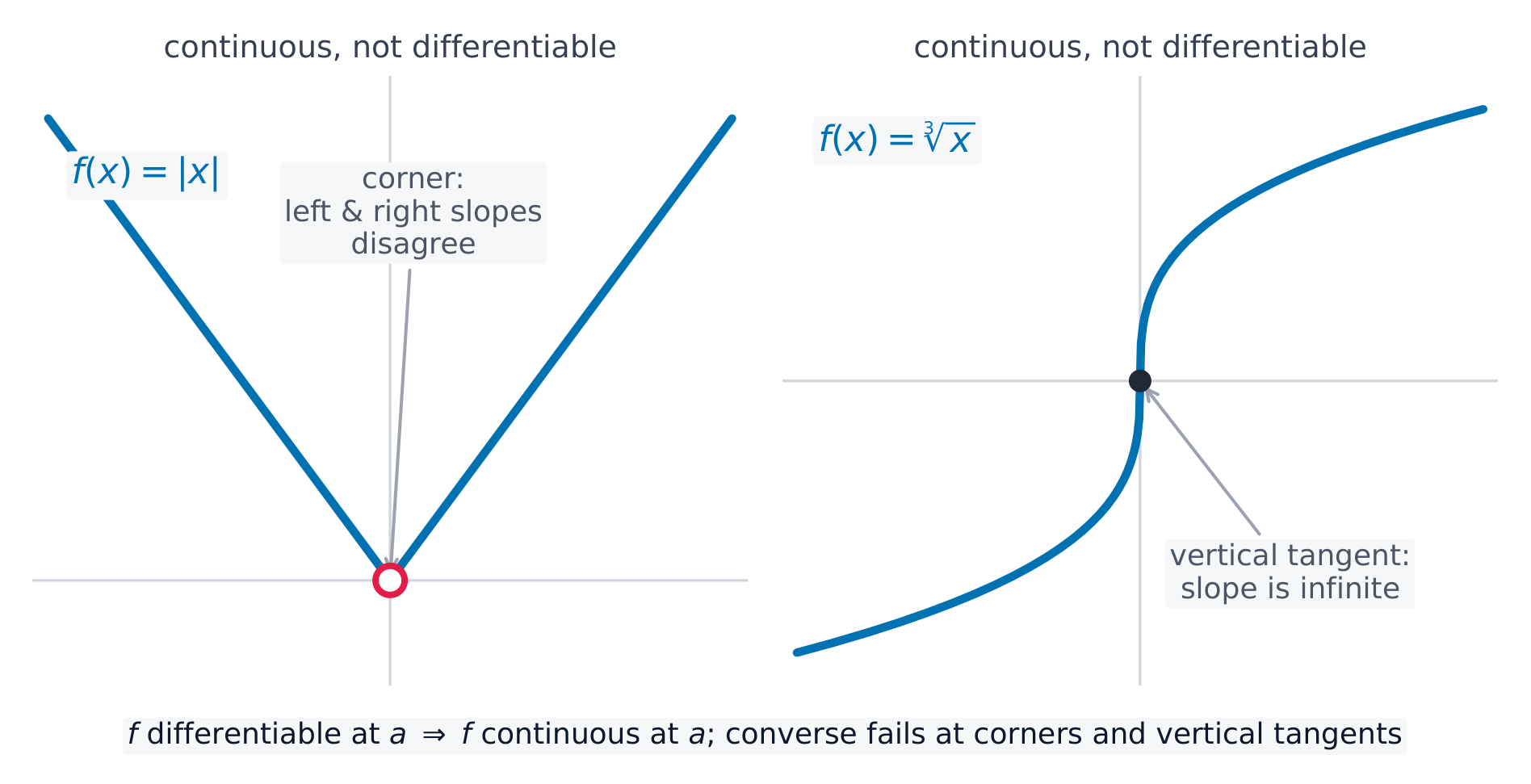
      • The left hand and right hand limits of the difference quotient are not equal, as in $f(x)=|x|$ at $x=0$.
      • The tangent line is vertical and has no slope, as in $f(x)=\sqrt[3]{x}$ at $x=0$.
ไทย

ความเข้าใจที่ยั่งยืน (FUN-2): การตระหนักว่าอนุพันธ์ของฟังก์ชันอาจเป็นฟังก์ชันอื่นก็ช่วยให้เราพัฒนาความรู้เกี่ยวกับพฤติกรรมที่เกี่ยวข้องของทั้งสองอย่างได้

วัตถุประสงค์การเรียนรู้ FUN-2.A: อธิบายความสัมพันธ์ระหว่างความสามารถในการหาอนุพันธ์และความต่อเนื่อง

  • FUN-2.A.1 หากฟังก์ชันหาค่าอนุพันธ์ได้ ณ จุดหนึ่ง,则该函数在该点是连续的。โดยเฉพาะอย่างยิ่ง,หากจุดหนึ่งไม่อยู่ในโดเมนของ $f$,则该点也不在 $f'$ 的域中。
  • FUN-2.A.2 ฟังก์ชันที่ต่อเนื่องอาจไม่สามารถหาอนุพันธ์ได้ที่จุดหนึ่งในโดเมนของมัน
    • ตัวอย่างประกอบสำหรับ FUN-2.A.2:
      • ลิมิตจากทางซ้ายและทางขวาของผลต่าง quotient ไม่เท่ากัน เช่นใน $f(x)=|x|$ ที่ $x=0$
      • เส้นสัมผัสเป็นเส้นตั้งฉากและมีความชันไม่เป็นจำนวนจริง เช่นใน $f(x)=\sqrt[3]{x}$ ที่ $x=0$

Source: College Board AP Course and Exam Description · ⁨แหล่งที่มา: คำอธิบายหลักสูตรและข้อสอบ College Board AP⁩

English

Differentiability is stronger than continuity. The key relationship:

If $f$ is differentiable 可导 at a point, then $f$ is continuous 连续 there.

So differentiability implies continuity. The reverse is false: a continuous function can fail to be differentiable. Two ways this happens:

  • A corner 尖点: the left and right difference-quotient limits disagree, as with $f(x)=|x|$ at $x=0$.
  • A vertical tangent 垂直切线: the slope is infinite (no real number), as with $f(x)=\sqrt[3]{x}$ at $x=0$.

Also, a point outside the domain of $f$ cannot be in the domain of $f'$. Use the contrapositive on the exam: if $f$ is not continuous at $a$, then $f$ is not differentiable at $a$.

ไทย

ความสามารถในการหาอนุพันธ์มีเงื่อนไขเข้มงวดกว่าความต่อเนื่อง ความสัมพันธ์สำคัญคือ:

หาก $f$ หาอนุพันธ์ได้ ณ จุดหนึ่ง แล้ว $f$ จะต่อเนื่อง ณ จุดนั้น.

ดังนั้น ความสามารถในการหาอนุพันธ์ บ่งบอกถึง ความต่อเนื่อง แต่ข้อกลับกันไม่ถูกต้อง: ฟังก์ชันที่ต่อเนื่องอาจไม่สามารถหาอนุพันธ์ได้ มีสองวิธีที่ทำให้เกิดกรณีนี้:

  • มุมคด: ขีดจำกัดของอัตราส่วนผลต่างทางซ้ายและขวาไม่ตรงกัน เช่นกับ $f(x)=|x|$ ที่ $x=0$
  • เส้นสัมผัสแนวตั้ง: ความชันเป็นอนันต์ (ไม่มีจำนวนจริง) เช่นกับ $f(x)=\sqrt[3]{x}$ ที่ $x=0$
สองวิธีที่ฟังก์ชันต่อเนื่องแต่หาอนุพันธ์ไม่ได้: มุมคดและเส้นสัมผัสแนวตั้ง

นอกจากนี้ จุดนอกโดเมนของ $f$ ไม่สามารถอยู่ในโดเมนของ $f'$ ได้ ใช้ทฤษฎีบทปฏิกิริยาในข้อสอบ: หาก $f$ ไม่ต่อเนื่องที่ $a$ แล้ว $f$ จะหาอนุพันธ์ไม่ได้ที่ $a$.

2.5

The Power Rule · ⁨กฎเลขชี้กำลัง⁩

Syllabus · ⁨หลักสูตร⁩
English

Enduring Understanding (FUN-3): Recognizing opportunities to apply derivative rules can simplify differentiation.

Learning Objective FUN-3.A: Calculate derivatives of familiar functions.

  • FUN-3.A.1 Direct application of the definition of the derivative and specific rules can be used to calculate the derivative for functions of the form $f(x)=x^{r}$.
ไทย

ความเข้าใจที่ยั่งยืน (FUN-3): การตระหนักถึงโอกาสในการใช้กฎอนุพันธ์สามารถทำให้การหาอนุพันธ์ง่ายขึ้น

วัตถุประสงค์การเรียนรู้ FUN-3.A: คำนวณอนุพันธ์ของฟังก์ชันพื้นฐาน

  • FUN-3.A.1 การประยุกต์ใช้โดยตรงของนิยามของอนุพันธ์และกฎเฉพาะสามารถใช้ในการคำนวณอนุพันธ์สำหรับฟังก์ชันในรูป $f(x)=x^{r}$

Source: College Board AP Course and Exam Description · ⁨แหล่งที่มา: คำอธิบายหลักสูตรและข้อสอบ College Board AP⁩

English

From here we use rules instead of the limit definition each time. The power rule 幂法则 handles any power of $x$:

$$\frac{d}{dx}\,x^{r} = r\,x^{\,r-1}\qquad\text{for any real } r.$$
It works for whole-number powers, negative powers ($\tfrac{1}{x}=x^{-1}$), and roots ($\sqrt{x}=x^{1/2}$) – rewrite as a power first, then apply the rule.

ไทย

จากนี้ไปเราจะใช้ กฎ แทนนิยามขีดจำกัดทุกครั้ง กฎเลขชี้กำลัง จัดการกับเลขชี้กำลังใดๆ ของ $x$:

$$\frac{d}{dx}\,x^{r} = r\,x^{\,r-1}\qquad\text{for any real } r.$$
ใช้ได้กับเลขชี้กำลังจำนวนเต็ม, เลขชี้กำลังลบ ($\tfrac{1}{x}=x^{-1}$), และราก ($\sqrt{x}=x^{1/2}$) – เขียนใหม่เป็นเลขชี้กำลังก่อน แล้วจึงใช้กฎ

Explore · ⁨สำรวจ⁩

A power function and its steepening slope · ⁨ฟังก์ชันกำลังและความชันที่เพิ่มขึ้น⁩

y = ax³ + bx² + cx + d

The power rule $\frac{d}{dx}x^n = nx^{n-1}$ drops the exponent as a factor. For $x^3$ the slope grows quickly as $x$ moves from 0 — the curve steepens. · ⁨กฎกำลัง $\frac{d}{dx}x^n = nx^{n-1}$ ลดเลขชี้กำลังลงมาเป็นตัวคูณ สำหรับ $x^3$ ความชันจะเพิ่มขึ้นอย่างรวดเร็วเมื่อ $x$ ย้ายออกจาก 0 — เส้นโค้งจะชันขึ้น⁩

2.6

Constant, Sum, Difference, and Constant Multiple Rules · ⁨กฎค่าคงที่ ผลรวม ผลต่าง และค่าคงที่คูณ⁩

Syllabus · ⁨หลักสูตร⁩
English

Enduring Understanding (FUN-3): Recognizing opportunities to apply derivative rules can simplify differentiation.

Learning Objective FUN-3.A: Calculate derivatives of familiar functions.

  • FUN-3.A.2 Sums, differences, and constant multiples of functions can be differentiated using derivative rules.
  • FUN-3.A.3 The power rule combined with sum, difference, and constant multiple properties can be used to find the derivatives for polynomial functions.
ไทย

ความเข้าใจที่ยั่งยืน (FUN-3): การตระหนักถึงโอกาสในการใช้กฎอนุพันธ์สามารถทำให้การหาอนุพันธ์ง่ายขึ้น

วัตถุประสงค์การเรียนรู้ FUN-3.A: คำนวณอนุพันธ์ของฟังก์ชันพื้นฐาน

  • FUN-3.A.2 ผลบวก ผลต่าง และค่าคงที่คูณของฟังก์ชันสามารถหาอนุพันธ์ได้โดยใช้กฎของอนุพันธ์
  • FUN-3.A.3 กฎเลขกำลังร่วมกับคุณสมบัติผลบวก ผลต่าง และค่าคงที่คูณสามารถใช้หาอนุพันธ์สำหรับฟังก์ชันพหุนามได้

Source: College Board AP Course and Exam Description · ⁨แหล่งที่มา: คำอธิบายหลักสูตรและข้อสอบ College Board AP⁩

English

These rules let you differentiate term by term:

  • Constant: $\dfrac{d}{dx}\,k = 0$ (a constant does not change).
  • Constant multiple 常数倍: $\dfrac{d}{dx}\big[k\,f(x)\big] = k\,f'(x)$.
  • Sum / difference: $\dfrac{d}{dx}\big[f(x)\pm g(x)\big] = f'(x)\pm g'(x)$.

Combined with the power rule, they differentiate any polynomial 多项式 term by term. Example:

$$\frac{d}{dx}\big(4x^3 - 5x + 7\big) = 12x^2 - 5.$$

ไทย

กฎเหล่านี้ช่วยให้คุณหาอนุพันธ์ทีละพจน์ได้:

  • ค่าคงที่: $\dfrac{d}{dx}\,k = 0$ (ค่าคงที่ไม่เปลี่ยนแปลง)
  • ค่าคงที่คูณ: $\dfrac{d}{dx}\big[k\,f(x)\big] = k\,f'(x)$
  • ผลบวก/ผลต่าง: $\dfrac{d}{dx}\big[f(x)\pm g(x)\big] = f'(x)\pm g'(x)$.

เมื่อรวมกับกฎเลขชี้กำลัง พวกเขาจะหาอนุพันธ์ทุกพจน์ของ พหุนาม ทีละพจน์ ตัวอย่าง:

$$\frac{d}{dx}\big(4x^3 - 5x + 7\big) = 12x^2 - 5.$$

2.7

Derivatives of sin x, cos x, e^x, and ln x · ⁨อนุพันธ์ของ sin x, cos x, e^x และ ln x⁩

Syllabus · ⁨หลักสูตร⁩
English

Enduring Understanding (FUN-3): Recognizing opportunities to apply derivative rules can simplify differentiation.

Learning Objective FUN-3.A: Calculate derivatives of familiar functions.

  • FUN-3.A.4 Specific rules can be used to find the derivatives for sine, cosine, exponential, and logarithmic functions.

Enduring Understanding (LIM-3): Reasoning with definitions, theorems, and properties can be used to determine a limit.

Learning Objective LIM-3.A: Interpret a limit as a definition of a derivative.

  • LIM-3.A.1 In some cases, recognizing an expression for the definition of the derivative of a function whose derivative is known offers a strategy for determining a limit.
ไทย

ความเข้าใจที่ยั่งยืน (FUN-3): การตระหนักถึงโอกาสในการใช้กฎอนุพันธ์สามารถทำให้การหาอนุพันธ์ง่ายขึ้น

วัตถุประสงค์การเรียนรู้ FUN-3.A: คำนวณอนุพันธ์ของฟังก์ชันพื้นฐาน

  • FUN-3.A.4 กฎเฉพาะสามารถใช้หาอนุพันธ์สำหรับฟังก์ชันไซน์ คอสাইน ฟังก์ชันเอกซ์โพเนนเชียล และลอการิทึมได้

ความเข้าใจที่ยั่งยืน (LIM-3): การให้เหตุผลด้วยนิยาม ทฤษฎีบท และคุณสมบัติสามารถใช้ในการกำหนดลิมิต

**วัตถุประสงค์การเรียนรู้ LIM-3.A:**诠释 ลิมิตในฐานะนิยามของอนุพันธ์

  • LIM-3.A.1 ในบางกรณี การระบุ-expression สำหรับนิยามของอนุพันธ์ของฟังก์ชันที่มีอนุพันธ์อยู่แล้ว สามารถเป็นกลยุทธ์ในการกำหนดลิมิต

Source: College Board AP Course and Exam Description · ⁨แหล่งที่มา: คำอธิบายหลักสูตรและข้อสอบ College Board AP⁩

English

Learn these four building-block derivatives by heart:

$$\frac{d}{dx}\sin x = \cos x, \qquad \frac{d}{dx}\cos x = -\sin x,$$
$$\frac{d}{dx}e^{x} = e^{x}, \qquad \frac{d}{dx}\ln x = \frac{1}{x}\ \ (x>0).$$
Note the minus sign on the derivative of cosine, and that $e^{x}$ is its own derivative.

A limit that is really a derivative (LIM-3.A.1). Sometimes a limit is secretly the definition of a known derivative. If you recognize

$$\lim_{h\to 0}\frac{f(a+h)-f(a)}{h}$$
for a function $f$ whose derivative you know, just evaluate $f'(a)$. For example, $\displaystyle \lim_{h\to 0}\frac{\sin\!\big(\tfrac{\pi}{2}+h\big)-1}{h} = \left.\frac{d}{dx}\sin x\right|_{x=\pi/2} = \cos\tfrac{\pi}{2} = 0$.

ไทย

จำอนุพันธ์พื้นฐานสี่ตัวนี้ให้ได้:

$$\frac{d}{dx}\sin x = \cos x, \qquad \frac{d}{dx}\cos x = -\sin x,$$
$$\frac{d}{dx}e^{x} = e^{x}, \qquad \frac{d}{dx}\ln x = \frac{1}{x}\ \ (x>0).$$
สังเกตเครื่องหมายลบในอนุพันธ์ของโคไซน์ และ اینکه $e^{x}$ เป็นอนุพันธ์ของตัวเอง

ขีดจำกัดที่เป็นอนุพันธ์จริงๆ (LIM-3.A.1). บางครั้งขีดจำกัดก็ซ่อนอยู่ภายใต้คำนิยามของอนุพันธ์ที่รู้จัก หากคุณสามารถจดจำ

$$\lim_{h\to 0}\frac{f(a+h)-f(a)}{h}$$
สำหรับฟังก์ชัน $f$ ที่เรารู้ derivative ของมัน, เพียงแค่แทนค่า $f'(a)$. ตัวอย่างเช่น, $\displaystyle \lim_{h\to 0}\frac{\sin\!\big(\tfrac{\pi}{2}+h\big)-1}{h} = \left.\frac{d}{dx}\sin x\right|_{x=\pi/2} = \cos\tfrac{\pi}{2} = 0$.

Explore · ⁨สำรวจ⁩

The shape of sin x (whose slope is cos x) · ⁨sin x的形状(其斜率为cos x)⁩

y = asin(bx + c) + d

The derivative of $\sin x$ is $\cos x$: the slope of the sine curve is largest where sine crosses zero and zero at its peaks. Watch the curve to feel where its slope is steep or flat. · ⁨อนุพันธ์ของ $\sin x$ คือ $\cos x$: ความชันของเส้นโค้งไซน์มีค่ามากสุดเมื่อ سینัสตัดแกนศูนย์ และมีค่าเป็นศูนย์ที่จุดยอด ดูเส้นโค้งเพื่อสัมผัสว่าความชันตรงไหนชันหรือแบน⁩

Vocabulary · ⁨คำศัพท์⁩ Train · ⁨ฝึกฝน⁩
English ไทย
derivative/dɪˈrɪvətɪv/ อนุพันธ์เชิงซ้อน (ดีริวทีฟ)
2.8

The Product Rule · ⁨กฎผลคูณ⁩

Syllabus · ⁨หลักสูตร⁩
English

Enduring Understanding (FUN-3): Recognizing opportunities to apply derivative rules can simplify differentiation.

Learning Objective FUN-3.B: Calculate derivatives of products and quotients of differentiable functions.

  • FUN-3.B.1 Derivatives of products of differentiable functions can be found using the product rule.
ไทย

ความเข้าใจที่ยั่งยืน (FUN-3): การตระหนักถึงโอกาสในการใช้กฎอนุพันธ์สามารถทำให้การหาอนุพันธ์ง่ายขึ้น

วัตถุประสงค์การเรียนรู้ FUN-3.B: คำนวณอนุพันธ์ของผลคูณและผลหารของฟังก์ชันที่หาอนุพันธ์ได้

  • FUN-3.B.1 อนุพันธ์ของผลคูณของฟังก์ชันที่หาอนุพันธ์ได้สามารถหาได้โดยใช้กฎคูณ

Source: College Board AP Course and Exam Description · ⁨แหล่งที่มา: คำอธิบายหลักสูตรและข้อสอบ College Board AP⁩

English
The product rule as a growing rectangle

A product of two functions is not differentiated by multiplying the derivatives. Use the product rule 乘积法则:

$$\frac{d}{dx}\big[u\,v\big] = u'v + uv'.$$
"Derivative of the first times the second, plus the first times the derivative of the second." Example:
$$\frac{d}{dx}\big(x^2 e^{x}\big) = 2x\,e^{x} + x^2 e^{x}.$$
Exam questions often build a new function from given pieces, e.g. $k'(x) = \big(f(x)\big)^2 g(x)$, and ask you to combine rules while reading values from a table.

ไทย
กฎผลคูณในฐานะสี่เหลี่ยมผืนผ้าที่กำลังขยาย

ผลคูณของฟังก์ชันสองตัว ไม่ใช่ การหาอนุพันธ์โดยการคูณอนุพันธ์เข้าด้วยกัน ให้ใช้ กฎผลคูณ:

$$\frac{d}{dx}\big[u\,v\big] = u'v + uv'.$$
"อนุพันธ์ของตัวแรกคูณด้วยตัวที่สอง บวกด้วยตัวแรกคูณด้วยอนุพันธ์ของตัวที่สอง" ตัวอย่าง:
$$\frac{d}{dx}\big(x^2 e^{x}\big) = 2x\,e^{x} + x^2 e^{x}.$$
คำถามข้อสอบมักสร้างฟังก์ชันใหม่จากชิ้นส่วนที่กำหนด เช่น $k'(x) = \big(f(x)\big)^2 g(x)$ และขอให้คุณรวมกฎพร้อมอ่านค่าจากตาราง

Vocabulary · ⁨คำศัพท์⁩ Train · ⁨ฝึกฝน⁩
English ไทย
product rule/ˈprɒdʌkt ruːl/ กฎผลคูณ
2.9

The Quotient Rule · ⁨กฎผลหาร⁩

Syllabus · ⁨หลักสูตร⁩
English

Enduring Understanding (FUN-3): Recognizing opportunities to apply derivative rules can simplify differentiation.

Learning Objective FUN-3.B: Calculate derivatives of products and quotients of differentiable functions.

  • FUN-3.B.2 Derivatives of quotients of differentiable functions can be found using the quotient rule.
ไทย

ความเข้าใจที่ยั่งยืน (FUN-3): การตระหนักถึงโอกาสในการใช้กฎอนุพันธ์สามารถทำให้การหาอนุพันธ์ง่ายขึ้น

วัตถุประสงค์การเรียนรู้ FUN-3.B: คำนวณอนุพันธ์ของผลคูณและผลหารของฟังก์ชันที่หาอนุพันธ์ได้

  • FUN-3.B.2 อนุพันธ์ของผลหารของฟังก์ชันที่หาอนุพันธ์ได้สามารถหาได้โดยใช้กฎหาร

Source: College Board AP Course and Exam Description · ⁨แหล่งที่มา: คำอธิบายหลักสูตรและข้อสอบ College Board AP⁩

English

For a quotient, use the quotient rule 商法则:

$$\frac{d}{dx}\!\left[\frac{u}{v}\right] = \frac{u'v - uv'}{v^{2}}.$$
"Bottom times derivative of top, minus top times derivative of bottom, all over bottom squared." The order matters because of the minus sign, so write the numerator carefully. Example:
$$\frac{d}{dx}\!\left(\frac{x}{\cos x}\right) = \frac{1\cdot\cos x - x\cdot(-\sin x)}{\cos^2 x} = \frac{\cos x + x\sin x}{\cos^2 x}.$$

ไทย

สำหรับผลหาร ให้ใช้ กฎผลหาร:

$$\frac{d}{dx}\!\left[\frac{u}{v}\right] = \frac{u'v - uv'}{v^{2}}.$$
"ส่วนล่างคูณด้วยอนุพันธ์ของส่วนบน ลบด้วยส่วนบนคูณด้วยอนุพันธ์ของส่วนล่าง ทั้งหมดหารด้วยส่วนล่างยกกำลังสอง" ลำดับมีความสำคัญเนื่องจากเครื่องหมายลบ ดังนั้นให้เขียนเศษอย่างระมัดระวัง ตัวอย่าง:
$$\frac{d}{dx}\!\left(\frac{x}{\cos x}\right) = \frac{1\cdot\cos x - x\cdot(-\sin x)}{\cos^2 x} = \frac{\cos x + x\sin x}{\cos^2 x}.$$

2.10

Derivatives of tan x, cot x, sec x, and csc x · ⁨อนุพันธ์ของ tan x, cot x, sec x และ csc x⁩

Syllabus · ⁨หลักสูตร⁩
English

Enduring Understanding (FUN-3): Recognizing opportunities to apply derivative rules can simplify differentiation.

Learning Objective FUN-3.B: Calculate derivatives of products and quotients of differentiable functions.

  • FUN-3.B.3 Rearranging tangent, cotangent, secant, and cosecant functions using identities allows differentiation using derivative rules.
ไทย

ความเข้าใจที่ยั่งยืน (FUN-3): การตระหนักถึงโอกาสในการใช้กฎอนุพันธ์สามารถทำให้การหาอนุพันธ์ง่ายขึ้น

วัตถุประสงค์การเรียนรู้ FUN-3.B: คำนวณอนุพันธ์ของผลคูณและผลหารของฟังก์ชันที่หาอนุพันธ์ได้

  • FUN-3.B.3 การจัดรูปฟังก์ชันแทนเจนต์ คอสแทนเจนต์ เซกแทนต์ และโคเซกแทนต์โดยใช้เอกลักษณ์ช่วยให้สามารถหาอนุพันธ์ได้ตามกฎอนุพันธ์

Source: College Board AP Course and Exam Description · ⁨แหล่งที่มา: คำอธิบายหลักสูตรและข้อสอบ College Board AP⁩

English
The quotient rule: differentiating a fraction

The remaining trigonometric derivatives are not memorized separately – you rewrite them with identities 恒等式 and apply the quotient (or product) rule. For instance, $\tan x = \dfrac{\sin x}{\cos x}$, so the quotient rule gives

$$\frac{d}{dx}\tan x = \frac{\cos x\cos x - \sin x(-\sin x)}{\cos^2 x} = \frac{1}{\cos^2 x} = \sec^2 x.$$
The same method (writing $\cot x=\tfrac{\cos x}{\sin x}$, $\sec x=\tfrac{1}{\cos x}$, $\csc x=\tfrac{1}{\sin x}$) gives $-\csc^2 x$, $\sec x\tan x$, and $-\csc x\cot x$.

Higher-order derivatives. Differentiating $f'$ again gives the second derivative 二阶导数 $f''(x)$ (or $\tfrac{d^2y}{dx^2}$) – the rate of change of the rate of change. An exam part like "Find $k''(3)$" just means differentiate twice, then substitute. You can also estimate a second derivative from a table by applying the average-rate-of-change method to the $f'$ values.

Worked example. Differentiate $f(x)=x^2\sin x$ with the product rule $(uv)'=u'v+uv'$: take $u=x^2$ ($u'=2x$) and $v=\sin x$ ($v'=\cos x$), giving $f'(x)=2x\sin x+x^2\cos x$. Always read the structure first — a product needs the product rule, not the power rule applied to each factor separately.

ไทย
กฎผลหาร: การหาอนุพันธ์ของเศษส่วน

อนุพันธ์ตรีโกณมิติที่เหลือไม่จำเป็นต้องท่องแยกต่างหาก – คุณเขียนใหม่โดยใช้ เอกลักษณ์ และใช้กฎผลหาร (หรือผลคูณ) ตัวอย่างเช่น $\tan x = \dfrac{\sin x}{\cos x}$ ดังนั้นกฎผลหารจะให้

$$\frac{d}{dx}\tan x = \frac{\cos x\cos x - \sin x(-\sin x)}{\cos^2 x} = \frac{1}{\cos^2 x} = \sec^2 x.$$
วิธีการเดียวกัน (การเขียน $\cot x=\tfrac{\cos x}{\sin x}$, $\sec x=\tfrac{1}{\cos x}$, $\csc x=\tfrac{1}{\sin x}$) ให้ $-\csc^2 x$, $\sec x\tan x$ และ $-\csc x\cot x$

อนุพันธ์อันดับสูง การหาอนุพันธ์ $f'$ อีกครั้งจะได้ อนุพันธ์อันดับสอง $f''(x)$ (หรือ $\tfrac{d^2y}{dx^2}$) – อัตราการเปลี่ยนแปลงของอัตราการเปลี่ยนแปลง ส่วนข้อสอบเช่น "จงหา $k''(3)$" หมายความว่าหาอนุพันธ์สองครั้งแล้วแทนค่า คุณสามารถประมาณค่าอนุพันธ์อันดับสองจากตารางได้โดยใช้นิยามอัตราการเปลี่ยนแปลงเฉลี่ยกับค่า $f'$

ตัวอย่างฝึกหัด หาอนุพันธ์ของ $f(x)=x^2\sin x$ โดยใช้ กฎผลคูณ $(uv)'=u'v+uv'$: นำ $u=x^2$ ($u'=2x$) และ $v=\sin x$ ($v'=\cos x$) มาทำให้ได้ $f'(x)=2x\sin x+x^2\cos x$ เสมอให้อ่าน โครงสร้าง ก่อน – ผลคูณต้องใช้กฎผลคูณ ไม่ใช่การใช้กฎเลขชี้กำลังแยกต่อกำعاملแต่ละตัว

Vocabulary · ⁨คำศัพท์⁩ Train · ⁨ฝึกฝน⁩
English ไทย
quotient rule/ˈkwəʊʃənt ruːl/ กฎผลหาร
identities/aɪˈdentɪtiz/ เอกลักษณ์
second derivative/ˈsekənd dɪˈrɪvətɪv/ อนุพันธ์อันดับสอง
2.10

Exam tips · ⁨ข้อแนะนำสำหรับการสอบ⁩

English
  • The derivative is the slope of the tangent — the limit of the secant slope $\tfrac{f(x+h)-f(x)}{h}$ as $h\to0$.
  • Memorise the rules: power, product, quotient, and the derivatives of $\sin$, $\cos$, $e^x$, and $\ln x$.
  • Differentiability implies continuity, but not the reverse (a corner or cusp is continuous yet not differentiable).
  • Distinguish average rate of change (secant slope over an interval) from instantaneous rate (the derivative at a point).
  • Give a tangent-line equation as $y-f(a)=f'(a)(x-a)$.
ไทย
  • อนุพันธ์คือ ความชันของเส้นสัมผัส – ขีดจำกัดของความชันของเส้นตัด $\tfrac{f(x+h)-f(x)}{h}$ เมื่อ $h\to0$
  • ท่องจำกฎต่างๆ: กฎเลขชี้กำลัง, กฎผลคูณ, กฎผลหาร และอนุพันธ์ของ $\sin$, $\cos$, $e^x$ และ $\ln x$
  • ความสามารถในการหาอนุพันธ์บ่งบอกถึงความต่อเนื่อง แต่ไม่反之 (มุมคดหรือจุดแหลมต่อเนื่องแต่หาอนุพันธ์ไม่ได้)
  • แยกแยะอัตราการเปลี่ยนแปลงเฉลี่ย (ความชันของเส้นตัดในช่วง) ออกจากอัตราการเปลี่ยนแปลงทันที (อนุพันธ์ ณ จุด)
  • เขียนสมการเส้นสัมผัสในรูป $y-f(a)=f'(a)(x-a)$

Interactive lessons on this topic · ⁨บทเรียนเชิงโต้ตอบสำหรับหัวข้อนี้⁩

Work through it step by step, with instant-check exercises. · ⁨ทำทีละขั้นตอน พร้อมแบบฝึกหัดตรวจสอบผลทันที⁩

Past Papers · ⁨ข้อสอบย้อนหลัง⁩

More topics in AP Calculus AB · ⁨หัวข้อเพิ่มเติมใน AP Calculus AB⁩

Log in or create account · ⁨เข้าสู่ระบบหรือสร้างบัญชี⁩

IGCSE, A-Level & AP