Applying the Power Rule
Introduced 7:53
Defining the Derivative
Picture a car's journey as a curve. Over a whole interval, we can measure its average speed — the slope of the straight line joining two points on the curve.…
English narration · English and 中文 subtitles you can switch
In this lesson
| English | Meaning |
|---|---|
| power/ˈpaʊə/ | The result of raising a base to an exponent, with a positive whole-number exponent representing repeated multiplication. |
| Power Rule/ˈpaʊə ruːl/ | The differentiation rule stating that the derivative of x raised to n is n multiplied by x raised to (n - 1). |
| integer/ˈɪntɪdʒə/ | A whole number that may be positive, negative or zero. |
A shortcut that replaces the limit
- Working out every derivative from the limit definition is slow. For powers of $x$, one rule does it in a single line: the Power Rule 幂法则.
- Bring the exponent down in front, then subtract one from the exponent:
A power and its tangent slope
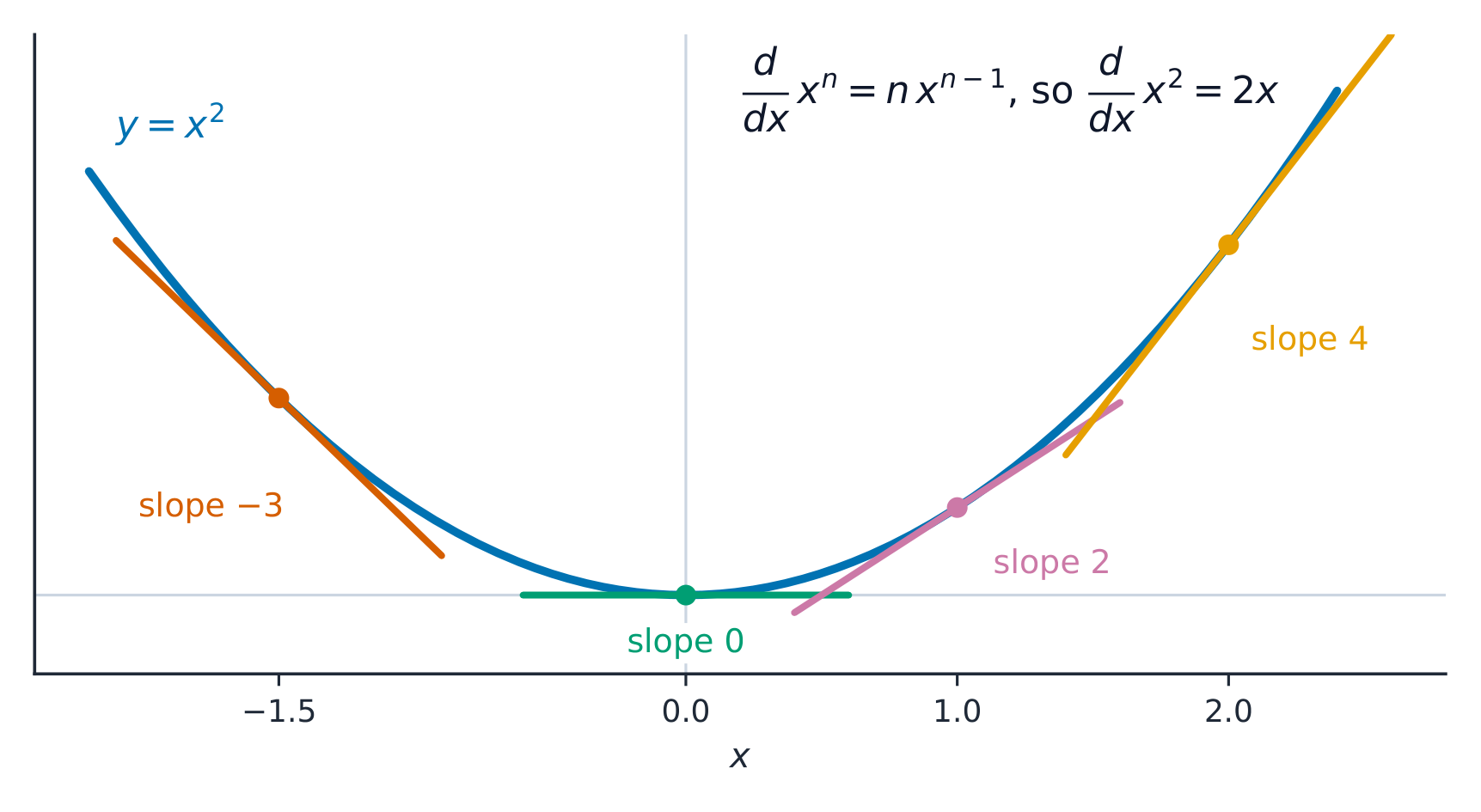
y = x²
For $y=x^2$ the power rule gives slope $2x$ — move the point and check the tangent slope matches $2x$.
Watch it work
- $\dfrac{d}{dx}[x^3]=3x^2$: the $3$ comes down in front and the exponent goes from $3$ to $2$. Also $\dfrac{d}{dx}[x^{10}]=10x^9$ and $\dfrac{d}{dx}[x]=1\cdot x^0=1$.
- It agrees with the limit definition, which gave $\frac{d}{dx}[x^2]=2x$, but takes one line instead of five.
What is $\dfrac{d}{dx}[x^5]$?
Difficulty 1/5 · 100 coins + a small bonus on first completion today
Bring down $5$, reduce exponent: $5x^{5-1}=5x^4$.
If $f(x)=x^4$, find $f'(2)$.
Difficulty 2/5 · 140 coins + a small bonus on first completion today
$f'(x)=4x^3$, so $f'(2)=4\cdot8=32$.
It works for any exponent
- $n$ can be negative or a fraction (rational), not just a positive integer 整数. Negative: $\dfrac{d}{dx}[x^{-2}]=-2x^{-3}$. Rational: $\dfrac{d}{dx}\big[x^{1/2}\big]=\tfrac12 x^{-1/2}$.
- The steps never change: bring down $n$, then reduce the exponent by one. With a negative exponent, "one less" means more negative: $-2\to-3$.
$\dfrac{d}{dx}[x^{-2}]=-2x^{\square}$. The exponent $\square$ is ____.
Difficulty 1/5 · 100 coins + a small bonus on first completion today
Reduce $-2$ by one: $-2-1=-3$.
The Power Rule differentiates which of these directly (after rewriting)?
Difficulty 2/5 · 140 coins + a small bonus on first completion today
All are powers of $x$ after rewriting; $5^x$ is an exponential, not a power of $x$.
Rewrite first, then differentiate
- Roots and fractions hide powers. Rewrite each term as a power $x^n$ first: $\sqrt{x}=x^{1/2}$, so $\dfrac{d}{dx}[\sqrt x]=\tfrac12 x^{-1/2}=\dfrac{1}{2\sqrt x}$.
- $\dfrac{1}{x^3}=x^{-3}$, so $\dfrac{d}{dx}\!\left[\dfrac1{x^3}\right]=-3x^{-4}=-\dfrac{3}{x^4}$. A number in front just stays: $\dfrac{d}{dx}[5x^{-3}]=-15x^{-4}$.
Rewrite and differentiate: $\dfrac{d}{dx}[\sqrt x]$ equals...
Difficulty 1/5 · 100 coins + a small bonus on first completion today
$\sqrt x=x^{1/2}\Rightarrow \tfrac12 x^{-1/2}=\tfrac1{2\sqrt x}$.
Differentiate $g(x)=\sqrt[3]{x^2}+\dfrac{1}{x}$.
- Rewrite as powers: $g(x)=x^{2/3}+x^{-1}$.
- Power rule term by term: $\tfrac23 x^{-1/3}$ and $-1\cdot x^{-2}$.
- $g'(x)=\tfrac23 x^{-1/3}-x^{-2}=\dfrac{2}{3\sqrt[3]{x}}-\dfrac1{x^2}$.
Split the fraction first. Find $f'(2)$ for $f(x)=\dfrac{x^3+4}{x^2}$.
- Divide each term by $x^2$: $f(x)=x+4x^{-2}$.
- $f'(x)=1-8x^{-3}=1-\dfrac{8}{x^3}$, so $f'(2)=1-\dfrac88=0$. The tangent at $x=2$ is horizontal.
Let $f(x)=\dfrac{x^2+3}{x}$. Split the fraction, then find $f'(1)$.
Difficulty 2/5 · 140 coins + a small bonus on first completion today
$f(x)=x+3x^{-1}$, so $f'(x)=1-3x^{-2}$ and $f'(1)=1-3=-2$.
A tangent line. Find the tangent to $y=\dfrac{8}{\sqrt x}$ at $x=4$.
- Rewrite: $y=8x^{-1/2}$. Point: $y(4)=\dfrac{8}{2}=4$.
- Slope: $y'=-4x^{-3/2}$, so $y'(4)=\dfrac{-4}{8}=-\dfrac12$. Tangent: $y-4=-\dfrac12(x-4)$.
Find the slope of $y=\dfrac{6}{\sqrt[3]{x}}$ at $x=8$. Give a decimal.
Difficulty 2/5 · 140 coins + a small bonus on first completion today
$y=6x^{-1/3}$, so $y'=-2x^{-4/3}$. At $x=8$: $x^{4/3}=16$, so $y'=-\dfrac{2}{16}=-0.125$.
For $f(x)=x^4$, find $f'(2)$ and explain how the Power Rule gives it.
4 times 2 cubed is 32.
For $f(x)=x^4$, what is $f'(2)$?
Difficulty 1/5 · 100 coins + a small bonus on first completion today
4 x cubed at 2 is 32.
- The Power Rule needs a variable base and a constant exponent ($x^n$). It does not work for $2^x$: $\frac{d}{dx}[2^x]\neq x\,2^{x-1}$. Exponentials come in the next lesson.
- Reduce the exponent: $\frac{d}{dx}[x^{-2}]=-2x^{-3}$, not $-2x^{-2}$.
- You can split a fraction only when its denominator is a single term: $\dfrac{x^3+4}{x^2}=x+4x^{-2}$, but $\dfrac{1}{x^2+1}$ is not $x^{-2}+1$.
The Power Rule applies to $2^x$, giving $x\cdot 2^{x-1}$.
Difficulty 1/5 · 100 coins + a small bonus on first completion today
The Power Rule needs a variable base with constant exponent; $2^x$ is an exponential (next lesson).
$\dfrac{1}{x^2+1}=x^{-2}+1$, so its derivative is $-2x^{-3}$.
Difficulty 1/5 · 100 coins + a small bonus on first completion today
A sum in the denominator cannot be split. $\dfrac{1}{x^2+1}$ needs the chain or quotient rule.
The Power Rule $\frac{d}{dx}[x^n]=n\,x^{n-1}$ works for any constant exponent — integer, negative, or rational. Rewrite radicals and reciprocals as powers first, then bring the exponent down and reduce it by one. It replaces the limit definition for power functions.
What went wrong? Only the site team sees this.